Thursday, December 25, 2025
Home Blog Page 2957

Scientists Use AI to Diagnose Various Types of Cancers

Scientists Use AI to Diagnose Various Types of Cancers

The molecular pathology of cancer is still limited to the use of a small number of biomarkers rather than the examination of all genes.

Part of this limitation is due to the challenges of computerised data analysis. To overcome this problem, researchers at the Royan Research Institute, Sharif University of Technology, and Colorado State University introduced deep neural networks (DNNs) that can infer the various properties of biological samples at the same time.

It encrypts all the transcriptome part of the genome on a small vector lattice (a computer-generated input image), then retrieves the mRNA and miRNA profiles based on tissue and the type of disease.

This method works much more efficiently than the original gene data to differentiate samples based on tissue and disease.

Researchers have used this method to examine 10,750 samples from 34 different groups (one healthy group and 33 groups with different types of cancer) from 27 tissues.

The results of the study, published in the International Journal of Scientific Reports, showed that the method developed in this study was significantly better than previous methods and conventional methods of using source tissue data, health status or disease, and it can predict the type of cancer in each sample.

For tissues with more than one type of cancer, 99.4% of all types of cancer were correctly diagnosed.

All in all, the results showed that using artificial intelligence can be very useful in molecular pathology of cancer and oncological research.

This project was implemented by Behrouz Azar Khalili, Dr Ali Sharifi Zarchi, Ali Saberi and their colleagues at Royan Research Institute, Sharif University of Technology, and Colorado State University.


Related Articles:


Six Tips to Manage Stress Before an Exam

Six Tips to Manage Stress Before an Exam

However, according to EssayShark, it is the anxiety and stress that help us to mobilize our forces. But at the same time, this feeling disturbs us and conceals a real threat.

Stress and anxiety affect most systems of the human body, but most of all, they negatively affect the nervous, cardiovascular, and immune systems. Anxiety causes the increment of heart rate and spikes in blood pressure. Due to malfunctions in the work of our body, various disorders in the emotional sphere of the personality often occur. They include mood swings, problems in communicating with parents and peers.

How to calm down before exams or other important events?

There is no need to calm down fully. A little anxiety before the exam helps. If you drink too much sedative pills so that nothing else worries you, there is a high probability that you will be just as calm and stupid at the exam. A little thrill stimulates and sets you up for good mental work.

The most straightforward recipe is also the most effective: you just have to get to work. If you have one hour left before the exam, use it as effectively as possible. If you walk around without doing anything, you’ll start worrying again. Use this hour to rewrite the basic phrases you need. It will help you to distract from negative thoughts. No matter how much you manage to learn during this hour — you have done your best and have not wasted your time. Your conscience can be calm.

Why should you not take any pills?

Do not think that this method is the easiest and most effective one. Sedative pills (and almost all drugs) not only calm but also slow down the nervous system. At the exam, your decision-making should be as fast as a flash of lightning to help you respond quickly, confidently, and adequately. That is why the sedative is an evil assistant.

Stress is an important, useful, and occasionally necessary physiological reaction of the body and should not be completely deprived of it. It is possible to cope with such experiences as the examination anxiety without any trendy pills.

How to manage stress?

  • Stop overthinking, imagining possible failures, and treating it as the end of the world. You can think about the worst that can happen if the exam is not passed. Most likely, the consequences of failure are not as fatal as it seems. You will just come back home from school, make yourself a big cup of tea, and life will go on.
  • Think of the fact that you are well-prepared for the text, and you will not only dazzle everyone with your knowledge but also impress the teacher and the group. This attitude is a bit perky, but it works well.
  • Use physical activity to distract from anxiety. Even a few minutes of jumping jacks will blow off some steam and give some rest to your head. Great, if there is a punching bag or just a pillow — let the nervous child inside of you beat it off as hard as it can. You should feel like a winner who is able to cope with any difficulties, not just with a simple exam.
  • Explore the situation. What awaits you? Learn about how and where the exam will be held. Find out the personality of the examiner. It is always possible to find out this information from those “who have been in this situation before”. Make sure you communicate with people you trust and who are not inclined to an excessively emotional perception of reality. Don’t let anyone rile you up. Your job is to gather facts, not gossip.
  • Get a good sleep at night that lasts for at least eight or nine hours. If you do not sleep all night before the exam, and then take a sedative or drink an energy drink, you might have even more troubles — fall asleep in the most responsible moment or become too nervous.
  • Breathing exercises are a great way to calm your nerves just before the exam (5-10 minutes before the test itself). Take a deep breath and deep exhalation. Repeat several times. Breathing exercises allow you to control the flow of oxygen entering our body, that is — to affect energy metabolism.

Iran President Hopes for Closer Ties with Vietnam

Iran President Hopes for Closer Ties with Vietnam

President of the Islamic Republic of Iran Hassan Rouhani on Saturday sent a message to President of the Socialist Republic of Vietnam Nguyen Phu Trong, who is also the General Secretary of the Communist Party of Vietnam.

In the message, the Iranian president warmly congratulated the Vietnamese leader and nation on the Tet Holiday, the most important celebration in Vietnam which marks the beginning of the Vietnamese Lunar New Year.

President Rouhani also expressed hope that the friendly relations and the mutual cooperation between Tehran and Hanoi would further grow in all fields of mutual interest in light of the political will and the joint efforts of the two countries.

The Iranian president finally wished the Vietnamese leader and people health and prosperity.

Iran President Condoles with Turkey on Quake Deaths

US Imperialism More Perilous than Coronavirus: Rouhani

In a Saturday message to Turkish President Recep Tayyip Erdogan, the Iranian president expressed sympathy with the neighbouring country over the deaths and injuries in a quake that struck Turkey’s eastern province of Elazig.

President Rouhani offered condolences and sympathy on behalf of the Iranian government and nation to the “friendly and brotherly” neighbour.

He finally voiced Iran’s readiness to provide whatever assistance necessary for the people in the quake-hit areas of Turkey, and expressed hope that, by God’s grace, the aftermath of the natural disaster would be eliminated immediately and calm would return to the quake-stricken regions.


Related Articles:


Zarif Condoles with Turkey over Deadly Earthquake

Zarif Condoles with Turkey over Deadly Earthquake

In the Saturday conversation, Zarif expressed sympathy with the Turkish nation and government, and offered condolences to the survivors of the incident’s victims.
He also expressed Tehran’s preparedness to dispatch aid to the quake-hit people.
The Turkish foreign minister, in turn, appreciated the Iranian nation and government’s expression of sympathy.

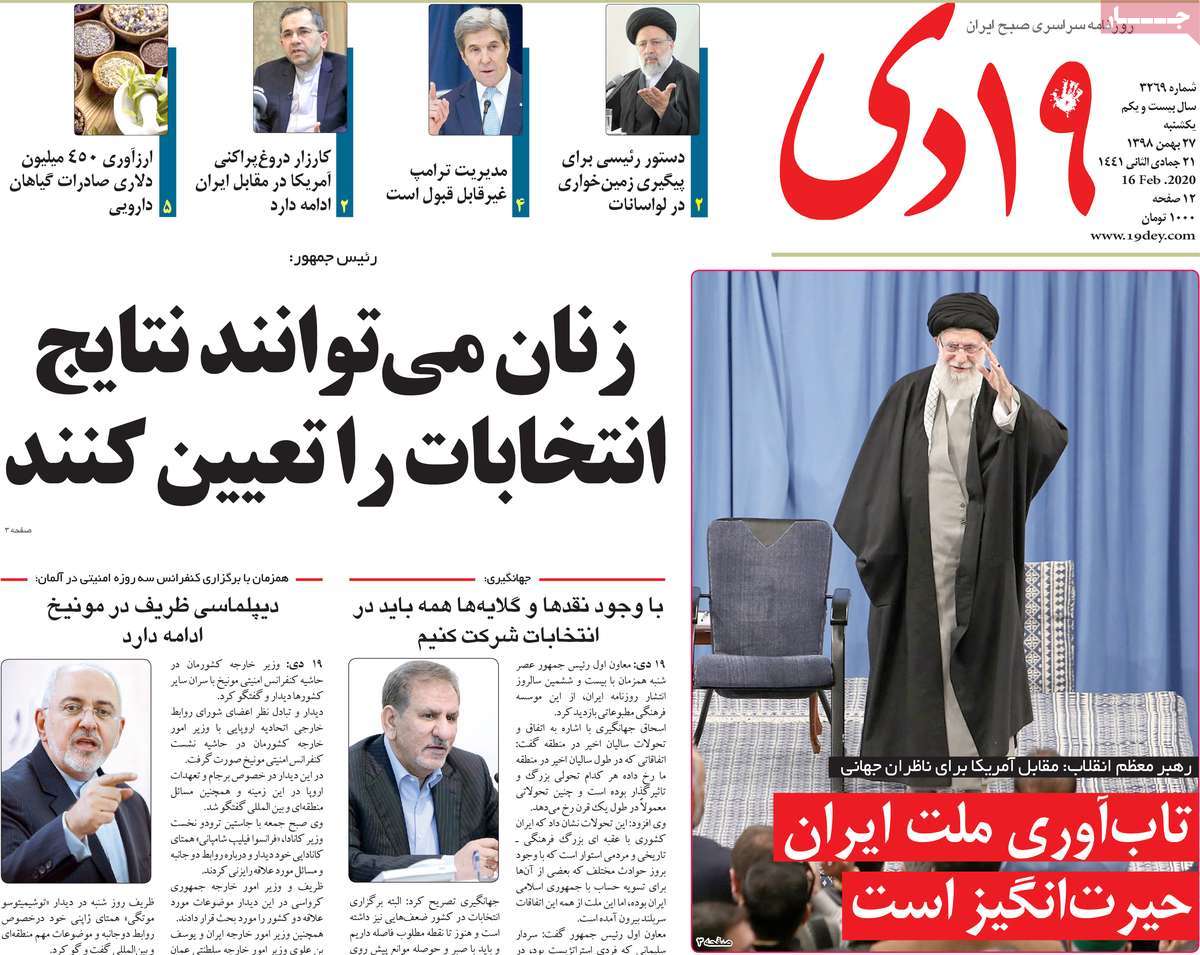
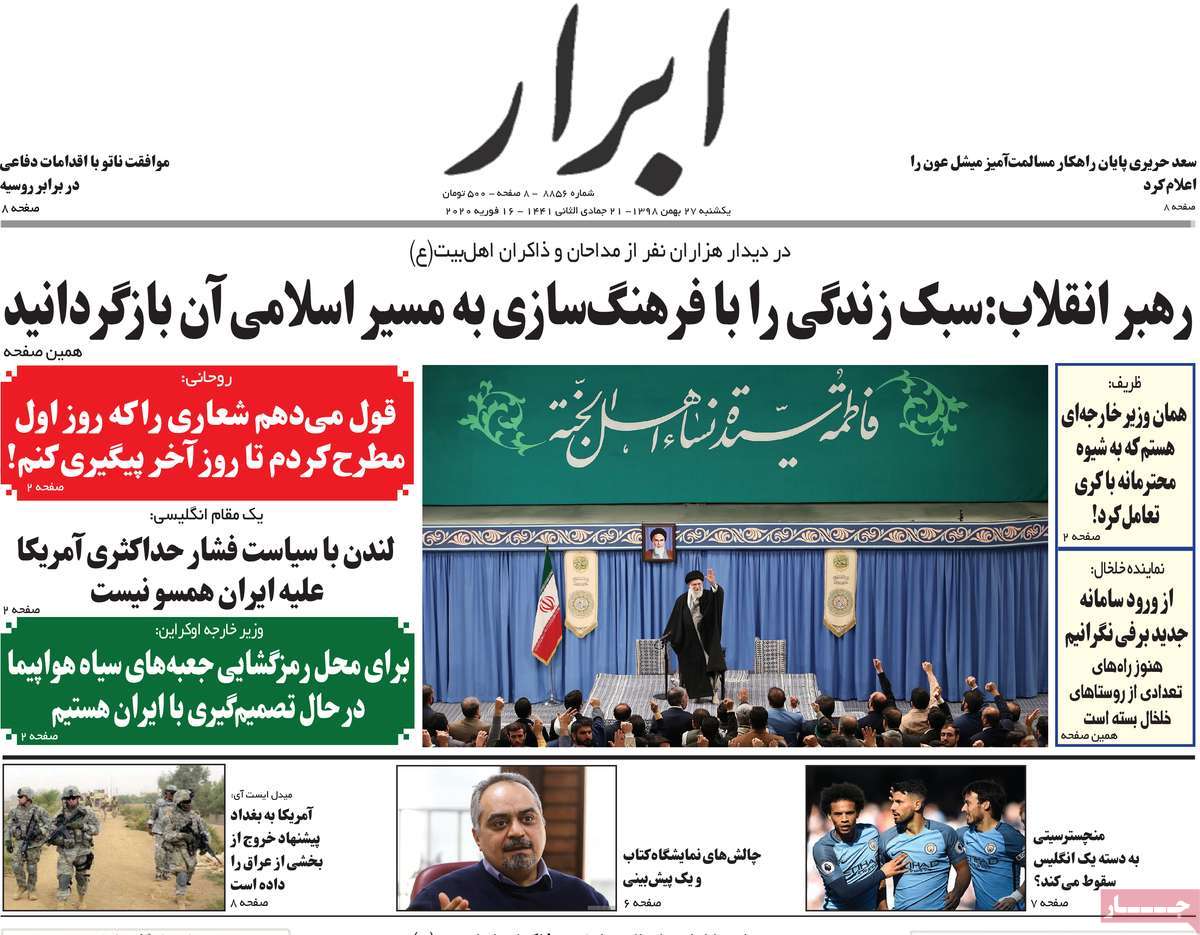
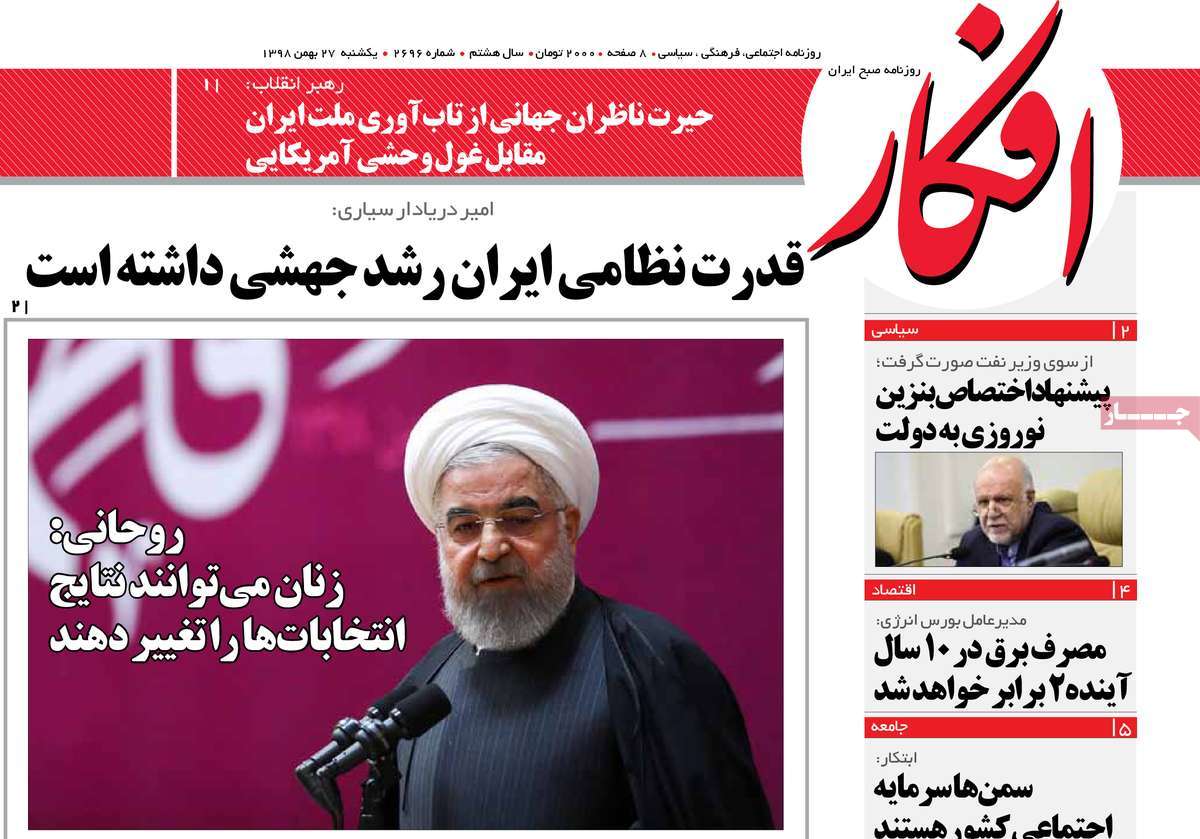
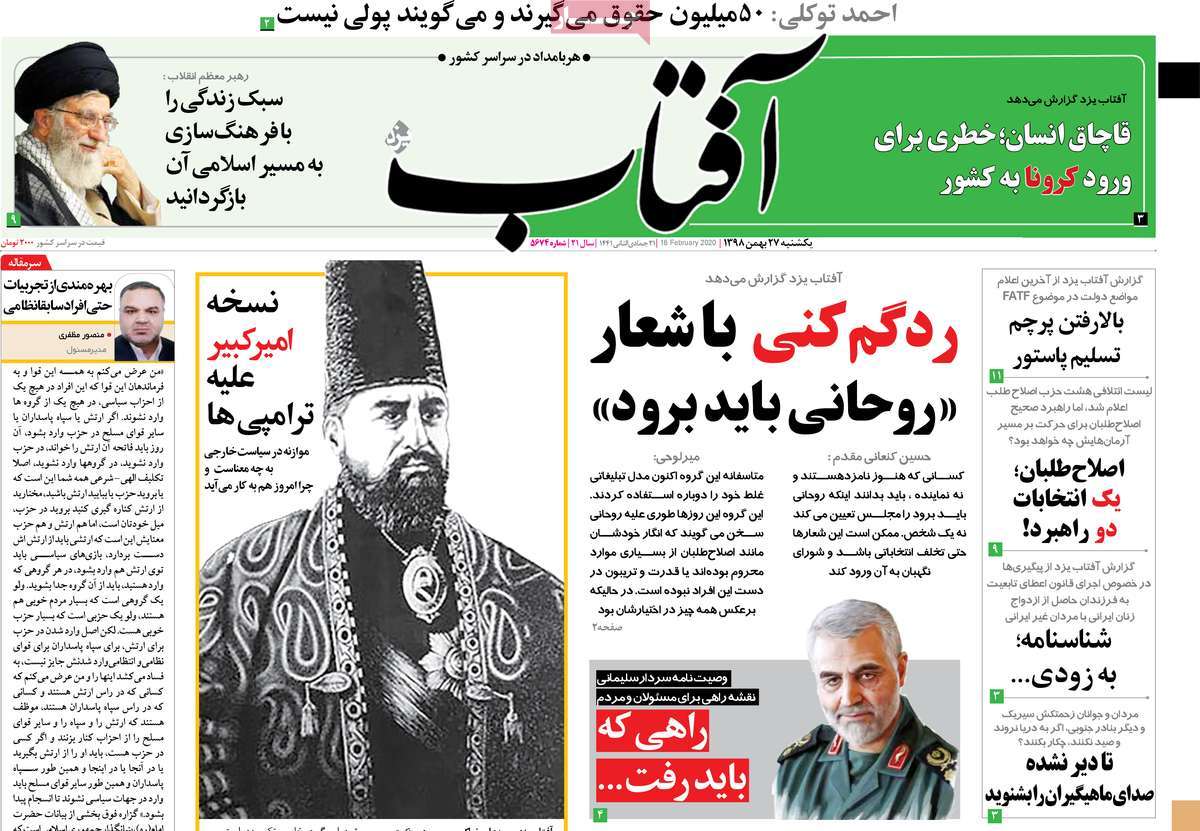
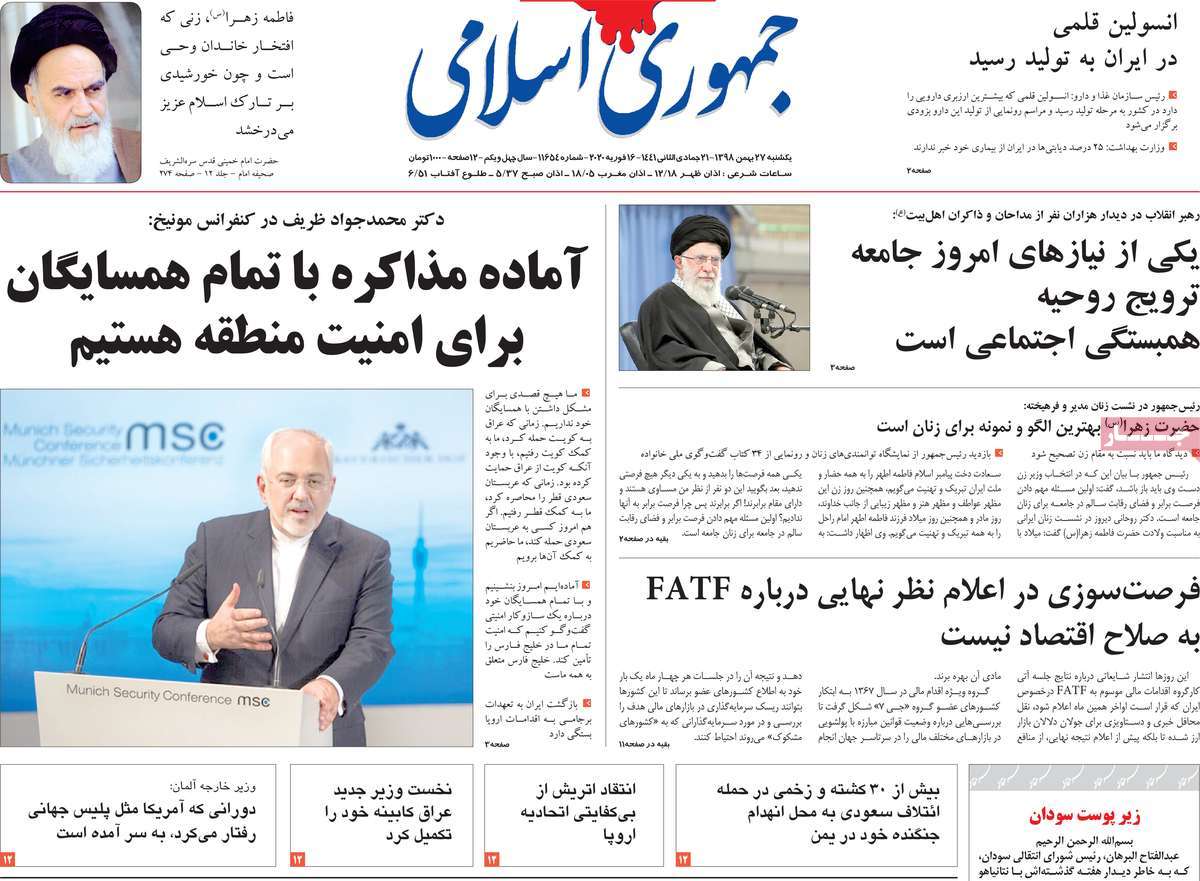
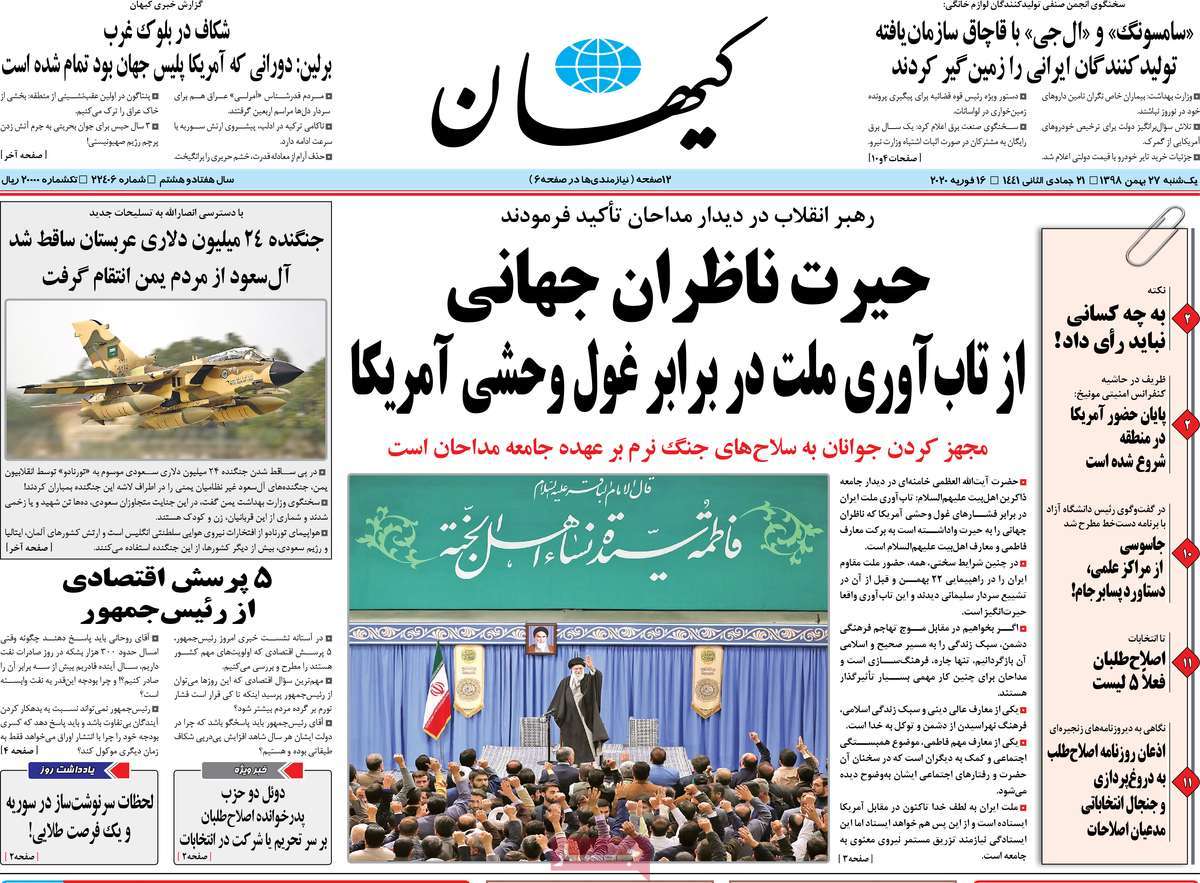
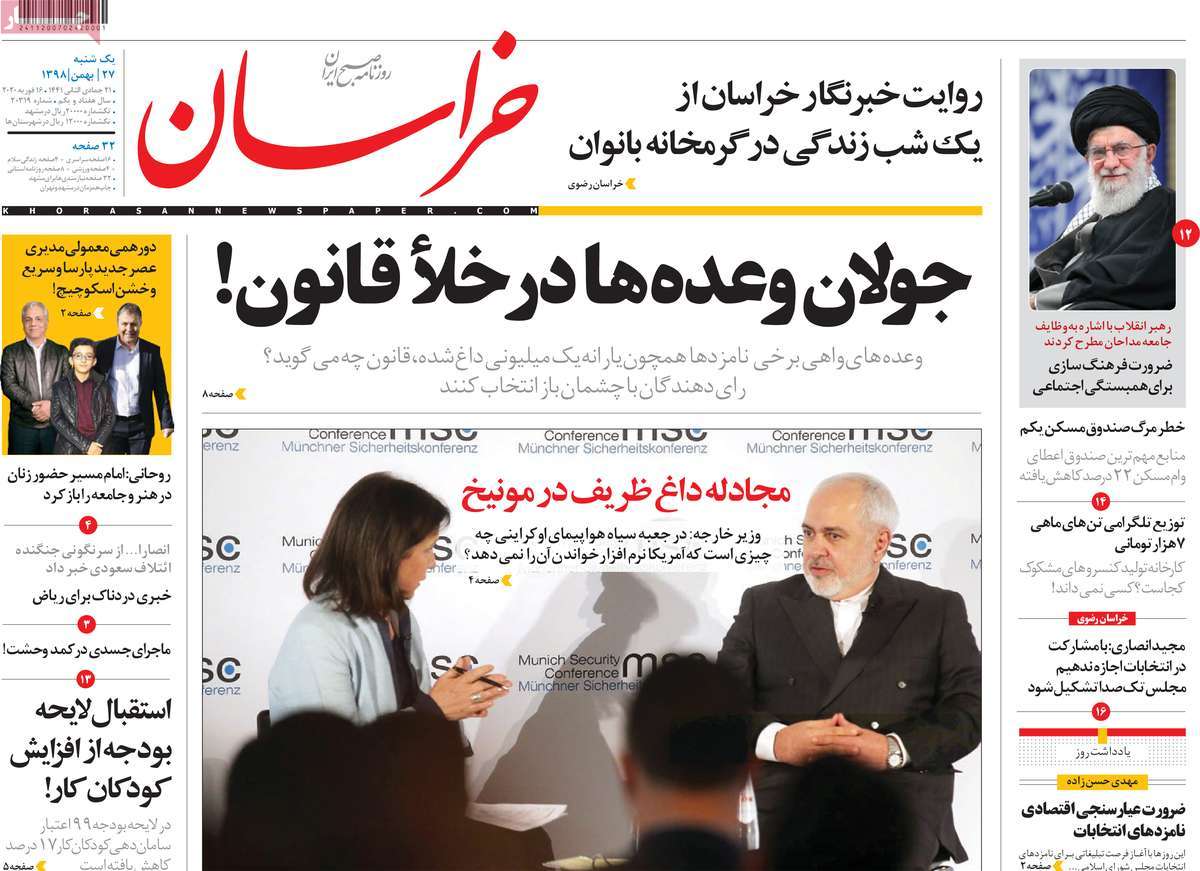
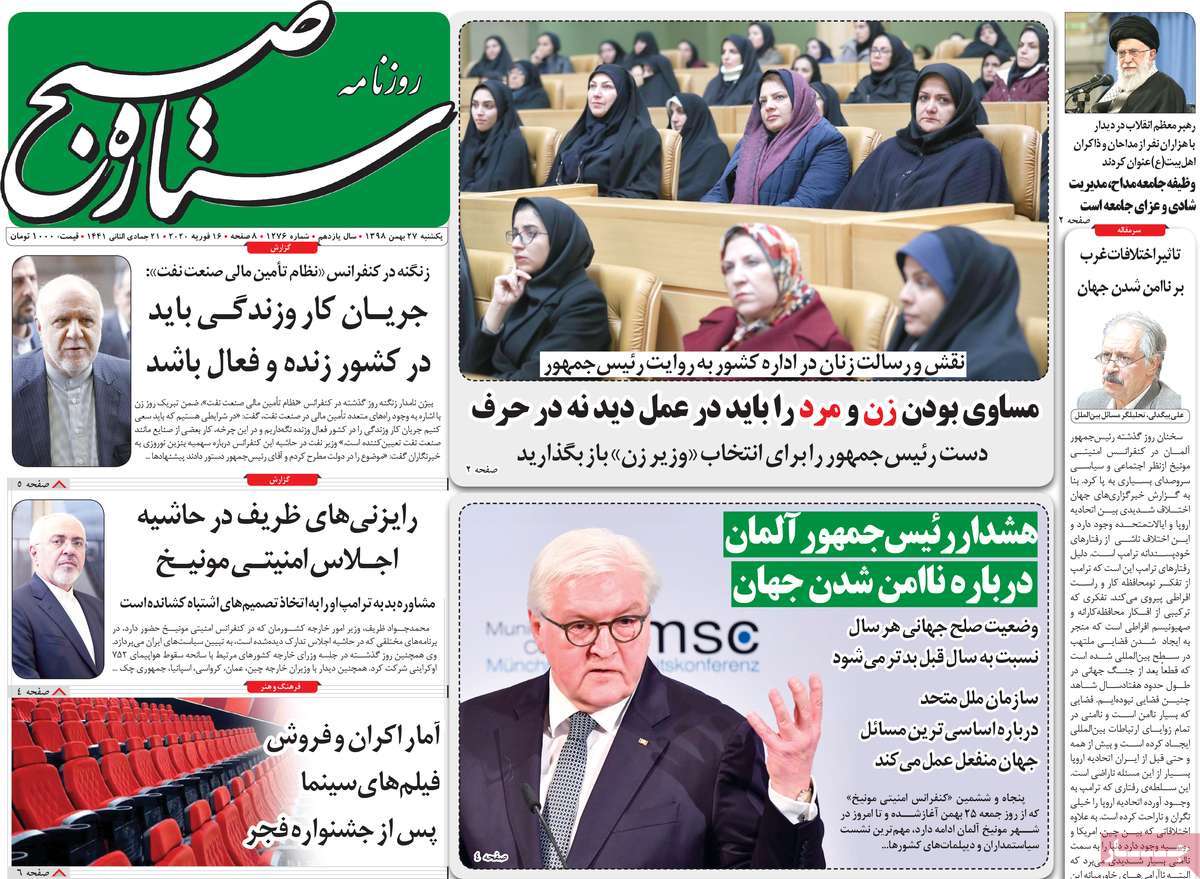
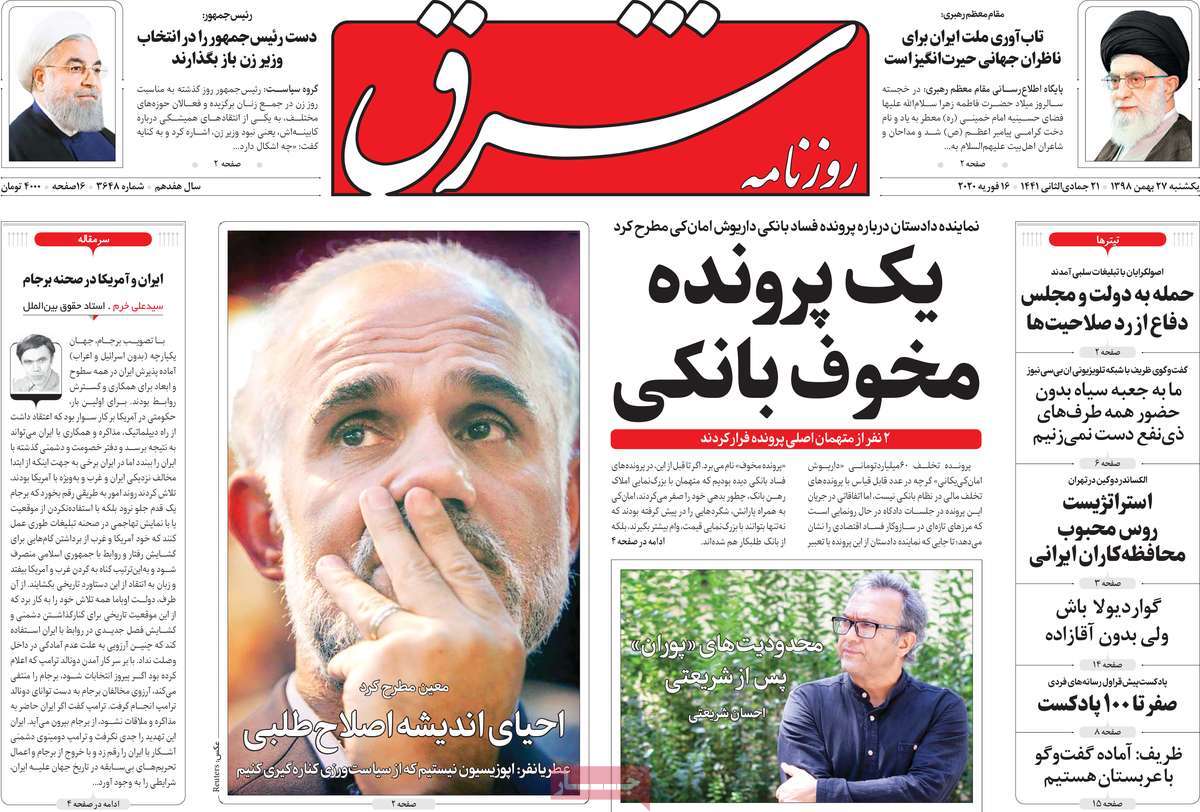
A Look at Iranian Newspaper Front Pages on January 25

Iran Newspaper Headlines in April 11

Iran Newspapers

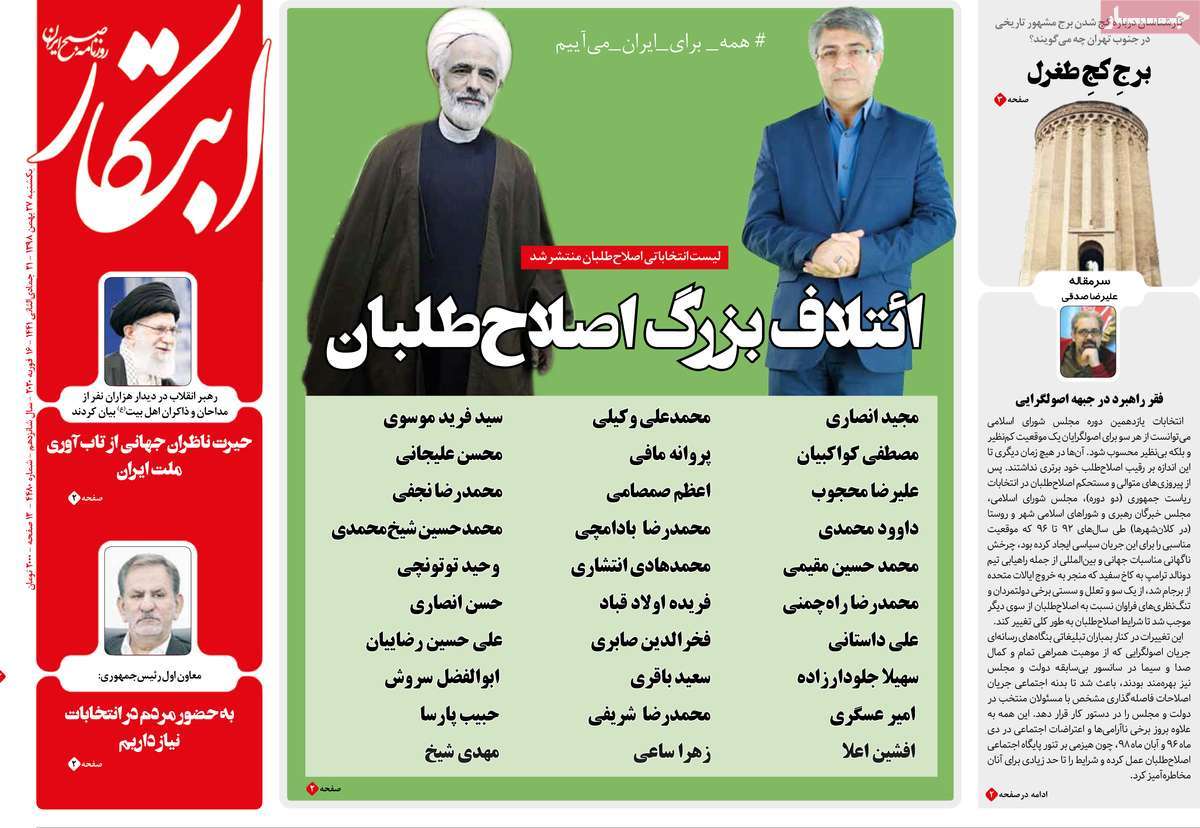
Abrar:

1- Merkel: We Shouldn’t Kill JCPOA Before Reaching New Deal

2- Iran Invites Canada to Join Probe into Ukraine Plane Black Box

3- White House: Trump, Salih Secretly Agree on Continued Presence of US Forces

A Look at Iranian Newspaper Front Pages on January 25


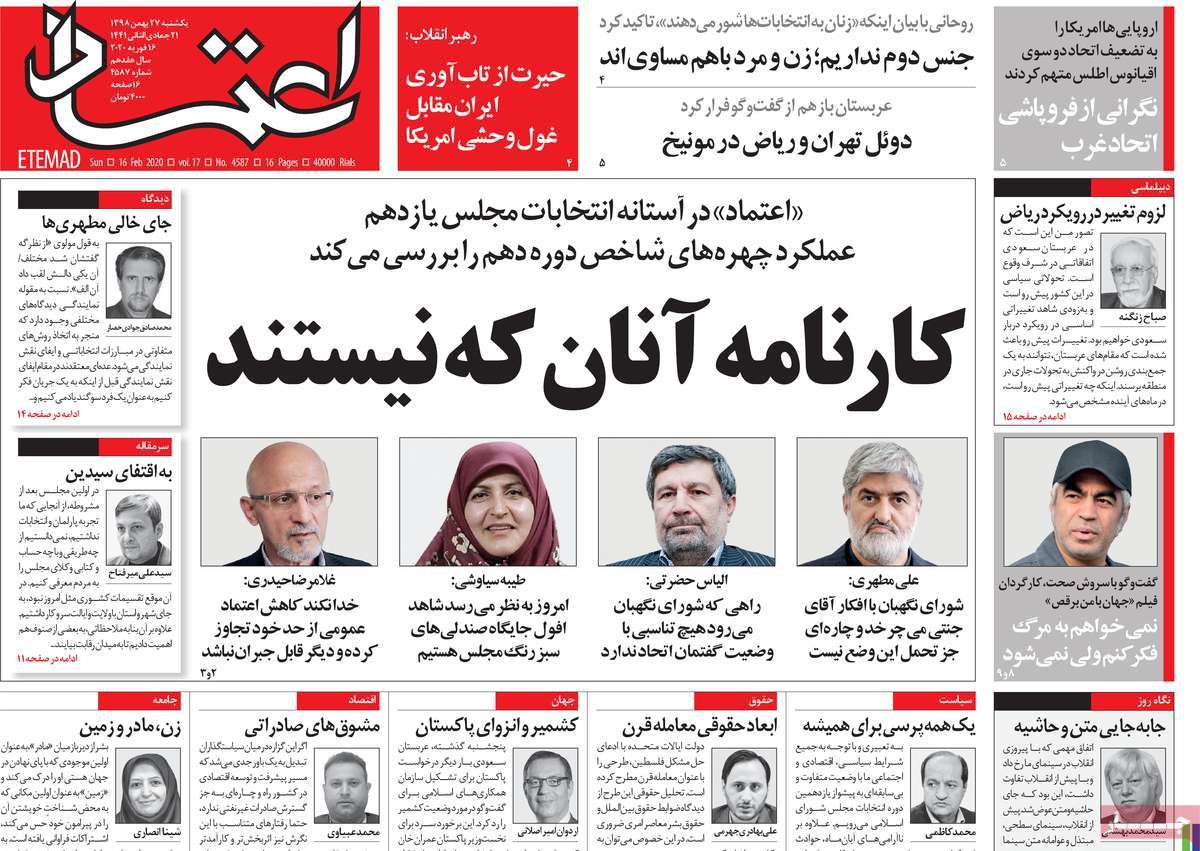
Aftab-e Yazd:

1- Mysterious Virus Threatening Iran: A Report on Health Ministry’s Measures to Fight Virus

2- Iraqi People Protest against US

3- London Leans toward US

* UK Expected to Take Harder Line on Iran

4- Trump’s Already-Failed Plan: No to ‘Deal of Century’

A Look at Iranian Newspaper Front Pages on January 25


Arman-e Melli:

1- Europe: Imperfect Deal Better than Nothing

2- Iraqis Hold Million-Strong Rally against US

A Look at Iranian Newspaper Front Pages on January 25


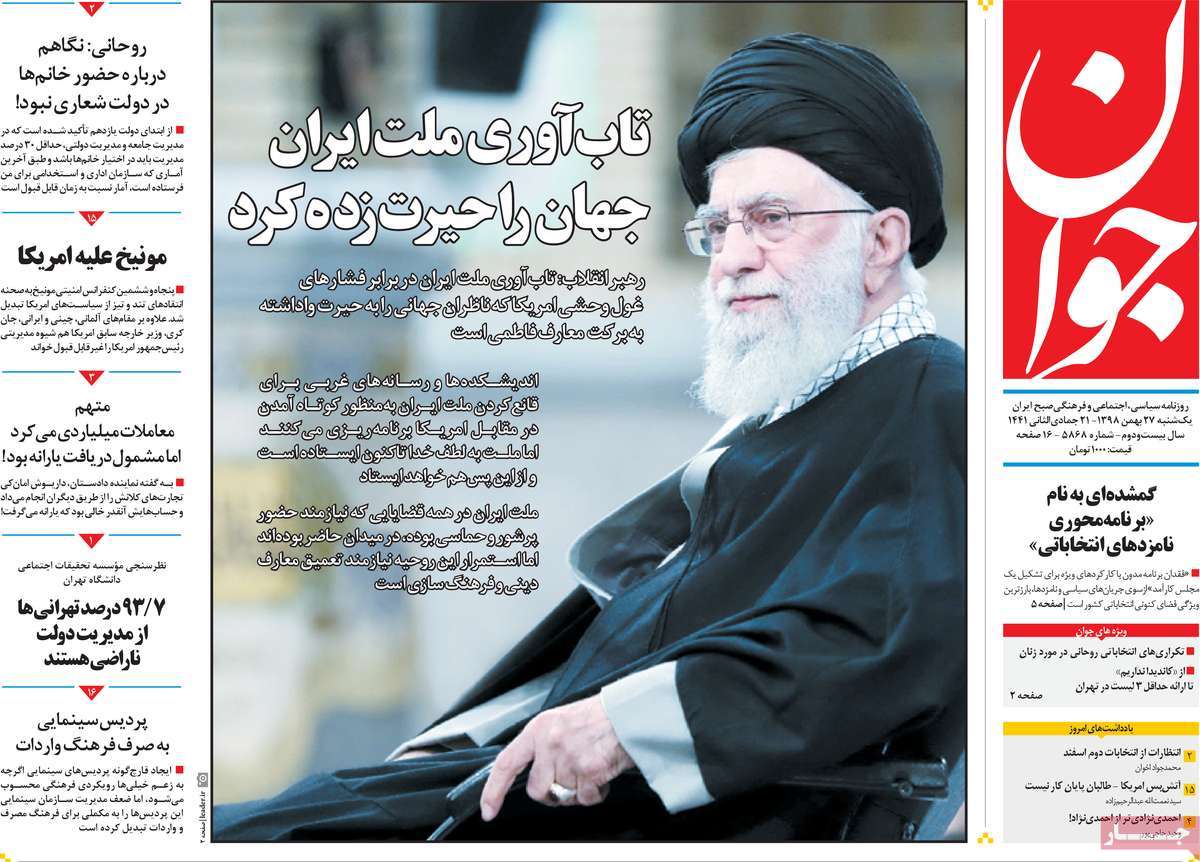
Javan:

1- Iraq Rises for Hard Revenge

  • Millions of Iraqis Chant ‘No to US’ Slogan, Urge Expulsion of Foreign Troops

A Look at Iranian Newspaper Front Pages on January 25


Kayhan:

1- Leave Iraq If You Want to Live: Millions of Iraqis Rise against US

2- Pure Islam Is What Al Saud Preaches: Israeli Army Spokesman

A Look at Iranian Newspaper Front Pages on January 25


Mardom Salari:

1- Biden: I’ll Return US to JCPOA If I’m Elected

2- Iraqi People’s Slap on Face of US Army: Million-Strong Rallies Held in Baghdad

A Look at Iranian Newspaper Front Pages on January 25


Setareh Sobh:

1- Consequences of Activating Trigger Mechanism

* Analyst: JCPOA Based on Tense Iran-US Ties

2- Neoliberal Populist View Will Weaken Domestic Institutions

* Economic Principles Say Iran Must Have Ties with World

A Look at Iranian Newspaper Front Pages on January 25

At Least 70 Americans Killed in Iran Missile Attack: Senior General

At Least 70 Americans Killed in Iran Missile Attack Senior General
US troops stand near a damaged installation hit by Iranian airstrikes inside the Ain al-Asad base near Anbar, Iraq, on Jan. 13. / Photo by The Washington Post

In remarks at a conference in Iran’s central city of Isfahan on January 23, Brigadier General Ahmad Vahidi said the American casualties in the ballistic missile attack launched by the IRGC on the US airbase in retaliation for the assassination of Lt. General Qassem Soleimani are much heavier than what the US authorities have announced.

“(US President Donald) Trump is hiding the truth, while we are confident that the missile attack on the American base has left at least 70 killed and 200 injured,” said Vahidi, who is the President of the Supreme National Defence University of Iran.

On the crash of a Ukrainian passenger plane near Tehran hours after the IRGC missile attack on the US base, General Vahidi said downing of the jetliner occurred under the conditions of war, and the Islamic Republic could have refused to publicize the cause of the crash that happened in war conditions, in the same way that the US administration hid the truth about the casualties caused by Iran’s missile strike.

He also noted that Iran has launched a probe to investigate every possibility in the crash of the passenger plane, such as a hacking attack.

The general further provided a description of the Islamic Republic’s raison d’être and its struggle for independence, saying the concept of Western policy does not apply to the US alone.

“One should not imagine that the other countries, like China and Russia, differ from the US in materialistic and ideological terms despite the difference in the policies, while they are all materialists,” he noted.

General Vahidi said the victory of the Islamic Revolution gave birth to the “hub of Islam” that ended the dominance of the Western and Eastern hubs, describing the Revolution as a humanitarian action that created “intellectual independence” beyond a mere political movement.

“When you take a path alone, the arrogance strives to create a shadow government, like Saudi Arabia, Pakistan and the US who created the Taliban as an ideological rival for the Islamic Republic and strongly supported it, to the extent that the Taliban had an office even in the US. But after a while, they had to fight against them (the Taliban) to prevent them from gaining too much power,” the former defence minister added.

Thereafter, he noted, the enemies hatched a plot to establish secularism in Iran under the guise of moderate Islam, until certain parties claimed that the Revolution was no more a main subject and the focus must be shifted onto economy.

The general also said that when the George W. Bush administration invaded Iraq, it announced plans to turn Iraq into a model for the region, and Washington repeated the same mistake in dealing with Egypt after its failure in Iraq. “Ultimately, they (Americans) are doomed to eviction from the regional countries despite an expenditure of more than $8,000 billion.”

“The Westerners created Daesh (ISIS) and openly supported it, which was a more vicious model than the Taliban and had plans to disrupt the nations and come to Iran after Syria and Lebanon. Under such circumstances, the very same great martyr, General Soleimani, thwarted those plots, which is why the US and the other enemies held such great grudge against him,” Vahidi added.

Iran on January 8 launched a missile strike on the US’ Ain al-Asad military base in Iraq in retaliation for the assassination of Lt. General Qassem Soleimani. While the White House denied any casualties in the strike, the Pentagon has reported recently that 34 US troops have suffered brain injuries from the missile strike.


New Details of US Casualties in Ain al-Assad Attack

Meanwhile, new reports suggest that a number of injured American troops have been taken to Germany and the US.

The official aerial images indicate that exactly a few hours after the Iranian missile attack, the injured troops and possibly the dead bodies had been airlifted from Baghdad to Germany.

Reports suggest that a C-17 Globemaster III military transport aircraft, used for carrying the injured and dead bodies, had departed from Germany for Iraq at 11:20 am local time on January 8 –some 10 hours after the Iranian missile attack- and had flown back to Germany 11 hours later.

After landing in Germany and staying there for a couple of hours, the military plane had reportedly travelled directly to the US and had landed in Camp Springs Air Base in Maryland.

The US had initially announced that the Iranian missile strike has left no casualties, but it was officially announced nine days later that 11 injured American soldiers have been deployed in order to receive treatment.

A few days after the initial reports about the American casualties, the Pentagon admitted that 34 US troops have been injured, eight of whom have been transferred to the US due to their critical health, according to Nour News, an Iranian news agency which is said to be close to the Supreme National Security Council.

Iran’s Petropars Developing South Pars Gas Field Alone

Iran’s Petropars Developing South Pars Gas Field Alone

Zangeneh said on Saturday developing the first phase of the project was awarded to Petropars in full after its initial partners, China’s CNPCI and France’s Total, pulled out of the project.

“Petropars has started developing the project and is currently sealing contracts for correcting jackets and provision of main items for drilling operations,” he said.

In July 2017, Total signed a $1 billion deal to develop the South Pars gas field in cooperation with China National Petroleum Company (CNPC) and PetroPars.

But the French pulled out of the deal in May 2018 in light of a decision by US President Donald Trump to re-impose sanctions on the Islamic Republic.

Later, the CNPC formally replaced Total in the project, but it suspended investment in Iran later in December 2018 in response to US pressures.

The investment halt followed four rounds of talks between Chinese officials and senior US authorities who urged CNPC to refrain from injecting fresh financing in Iran.

South Pars is the world’s largest gas field.

US Treasury Blocks Domain of Iran’s Fars News Agency

US Treasury Blocks Domain of Iran's Fars News Agency

In a post on its Twitter account, Farsnews said that access to its .com domain had been blocked upon the US Treasury’s order.

The news agency said that it had received an email from the server company, which explicitly said that the blockage is due to an order by the Treasury’s Office of Foreign Assets Control (OFAC) and its inclusion in the list of Specially Designated Nationals (SDN).

The agency attached to its post a screenshot of its website with the message “www.farsnews.com’s server IP address could not be found.”

Now, access has become available to Farsnews’ website on its .ir domain.

Previously, Google, YouTube, Facebook, Instagram and Twitter targeted Iranian accounts, including those belonging to broadcasters.

In December 2019, Google blocked access to Press TV and Hispan TV’s official YouTube accounts without any prior notice.
After President Donald Trump took office in 2017, Washington ramped up its efforts to target the Islamic Republic.

The campaign even assumed the self-styled title of “maximum pressure” under the current US president. The drive has seen the US leaving a multi-party nuclear agreement with Iran in May 2018, and returning the nuclear-related sanctions that the deal had lifted.

As part of the campaign, the US State Department has called on social media companies to block the accounts of Iranian government leaders, and iOS — a mobile operating system created by US company Apple Inc. — disabling Iranian applications.

The Islamic Republic of Iran Broadcasting (IRIB) has been targeted by the US sanctions since 2013. The US Treasury sanctioned IRIB Head Abdolali Ali-Asgari in May 2018.

The Trump administration hopes the “maximum pressure” policy would ultimately force Iran to negotiate the sweeping 2015 deal, covering its ballistic missile program and its role in Middle East.

The Islamic Republic, however, has held its ground and said it will not renegotiate the deal which Trump abandoned in May 2018 and announced the most draconian sanctions ever on the country.

Tehran Strongly Condemns US Harassment of Iranians

Tehran Strongly Condemns US Harassment of Iranians

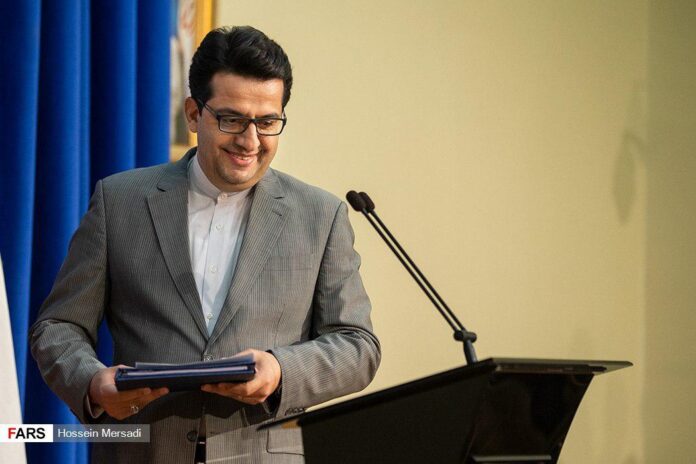
In a statement on Saturday, Spokesman for the Ministry of Foreign Affairs of the Islamic Republic of Iran Seyyed Abbas Mousavi decried the US Customs and Border Protection’s recent illegal and inhumane treatment of Iranian or Iranian-born nationals.

“Such absolutely discriminatory measures that are taken only because of the race, nationality or maybe the faith of people are totally rejected in terms of the international human rights laws and principles, and would result in accountability for the US government,” he added.

“Since those (Iranian) individuals have been questioned by the US border guards and security forces about their political and theological beliefs and their accounts in the virtual space have been also investigated coercively, such measure amounts to an example of inquisition and a blatant violation of human rights,” the spokesman deplored.

Mousavi strongly condemned the US Customs and Border Protection’s harassment of the Iranian citizens, adding, “Such measures against the Iranians are part of the US regime’s hostile and vindictive policy towards Iran and its identity and existence that transpires once in the shape of the decision to ban Iranians from entering the US, once in the threat of attack on Iran’s cultural and civilizational centres, another time in the cowardly assassination of the mythic hero of the fight against terrorism, and most recently in another form in the harassment of Iranians at the borders of the US.”

“Such behaviour from the US government could be definitely brought to and sued by the human rights tribunals,” the spokesman concluded.

The remarks came after dozens of Iranians and Iranian-Americans were stopped at several ports of entry including one in Blaine, Washington, and the Boston Airport, in the days following the US assassination of Iranian commander, General Qassem Soleimani, and Iran’s retaliatory missile attacks on US bases in Iraq.

Some were detained for hours and reported they were asked detailed questions about or additional questioning about their political views and allegiances.
Among them was Mohammad Shahab Dehghani Hossein Abadi, an Iranian student who had a valid F-1 US student visa, but was still deported from the United States in spite of a federal court order to delay his removal.