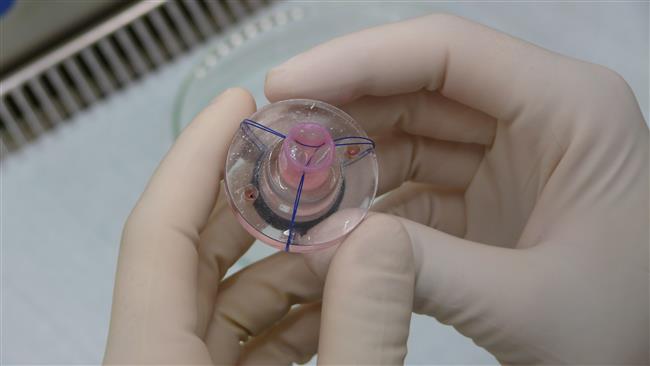
Two Iranian scientists have successfully created the first hybrid tissue-engineered heart valve with the use of a metal alloy.
Hamed Alavi, PhD, and Arash Kheradvar, MD, PhD, from the University of California in Irvine, developed the new valve, which can become a replacement for current valves thanks to its durability, the Mehr news agency reported on Monday.
The findings of their research were published in an article in the latest edition of the Annals of Thoracic Surgery.
In the current technology used in valve replacement, the patient’s cells are used to create an artificial valve set on a scaffold that will eventually degrade, resulting in the failure of the valve.
The scientists believe by using the new technology, patient’s life quality will be improved as the valve eventually incorporates itself into the patient’s heart structure.
The valve is built on a “non-degradable scaffold that stays within the valve to provide the support it needs without interfering with its normal function,” said Kheradvar.
“The valve we created uses an ultra-flexible scaffold made of an alloy of nickel and titanium (nitinol) that is enclosed within the patient’s own cultured tissue,” he added.
According to the team, initial lab tests on the valve have been completed and the next phase of testing is set to begin.
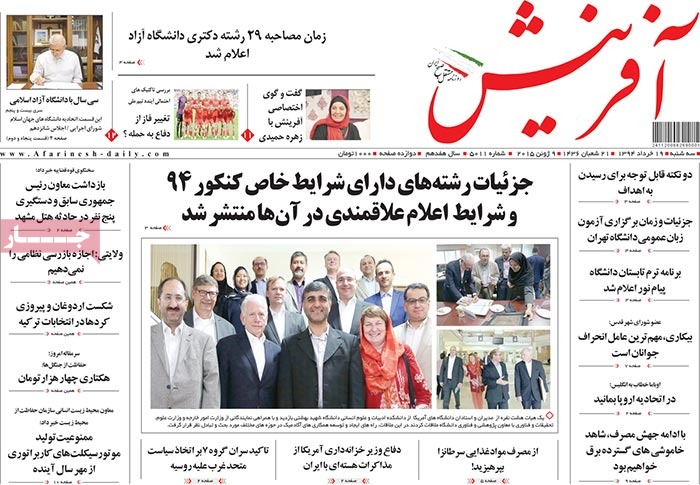
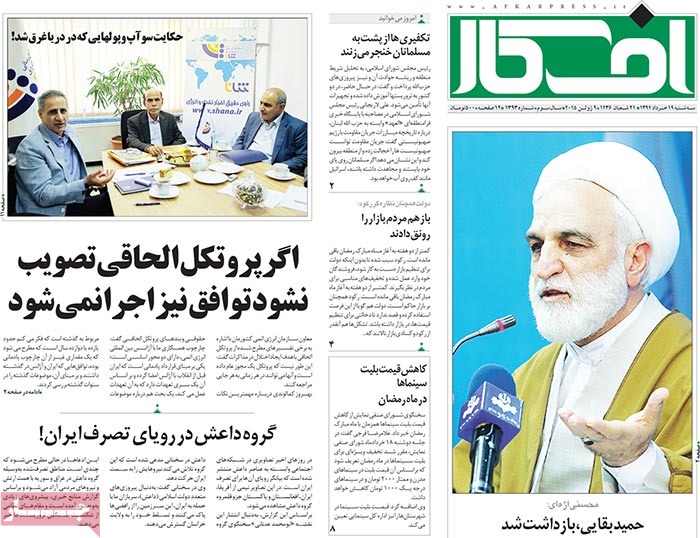
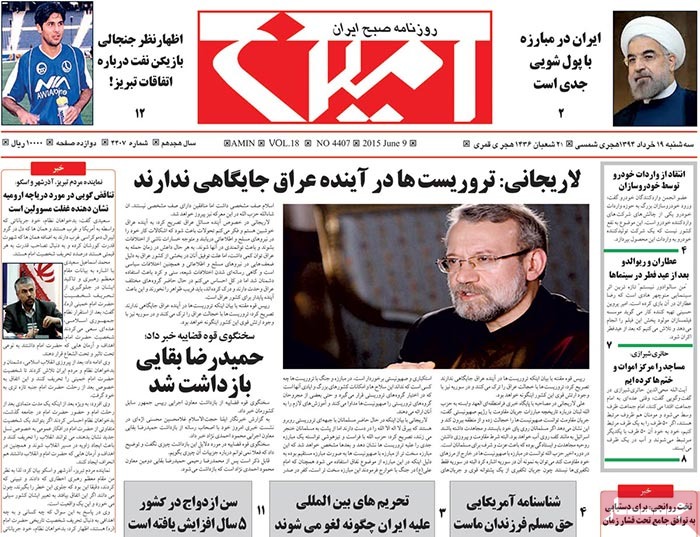
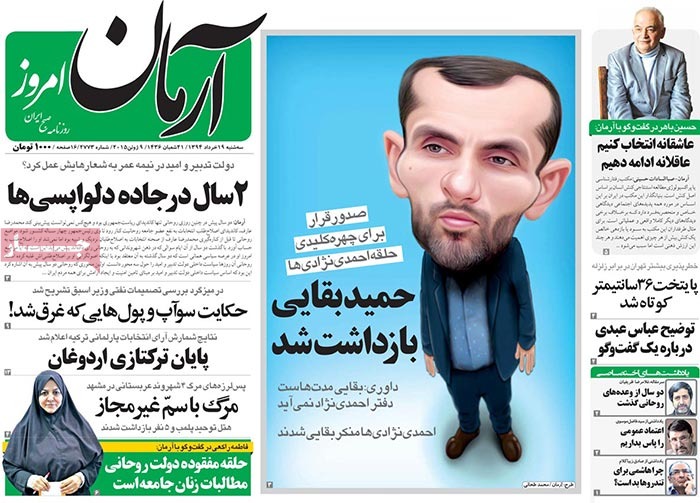
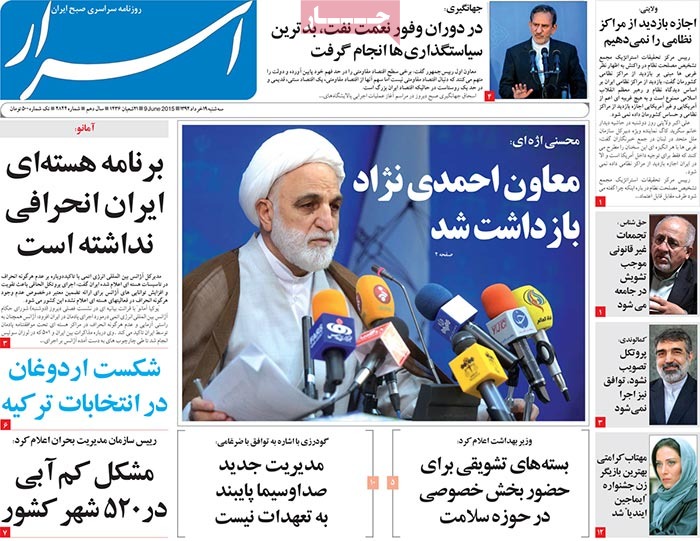
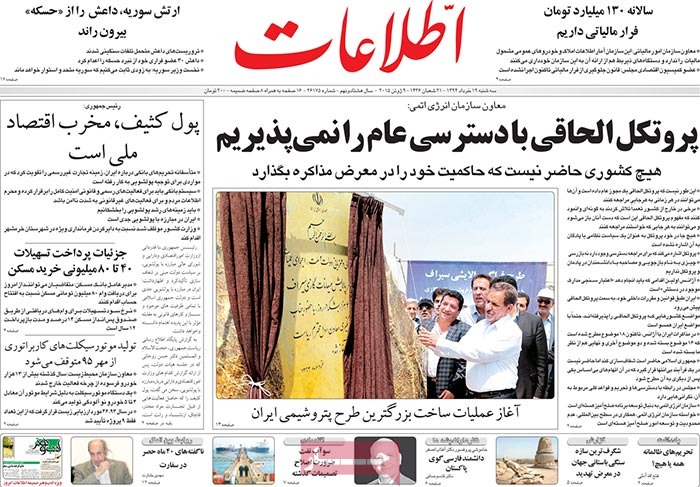
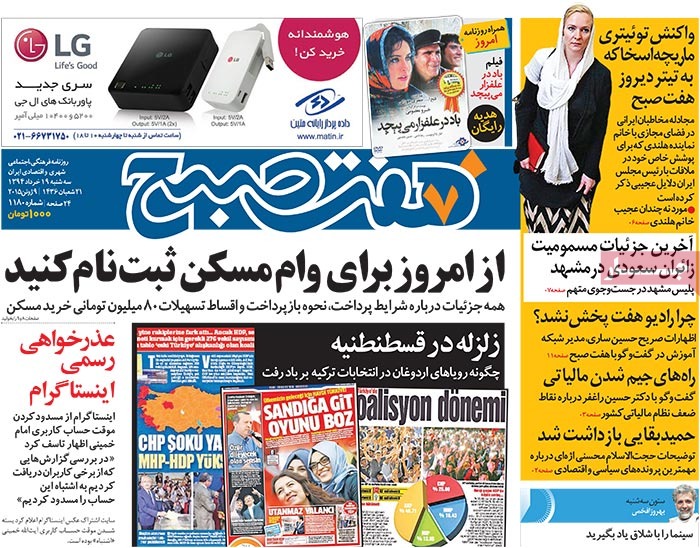
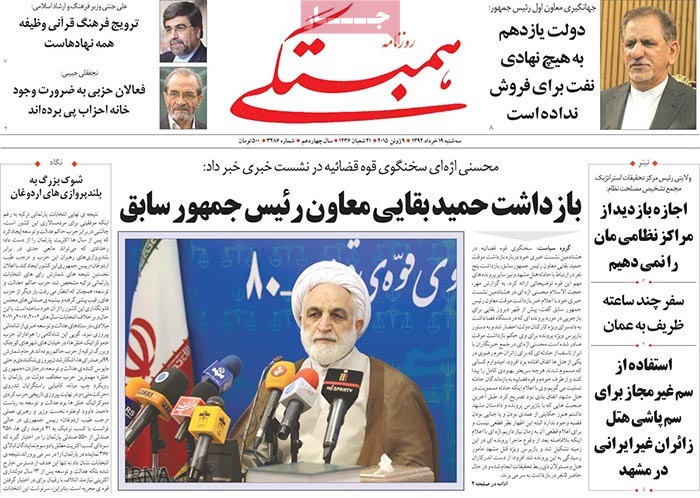
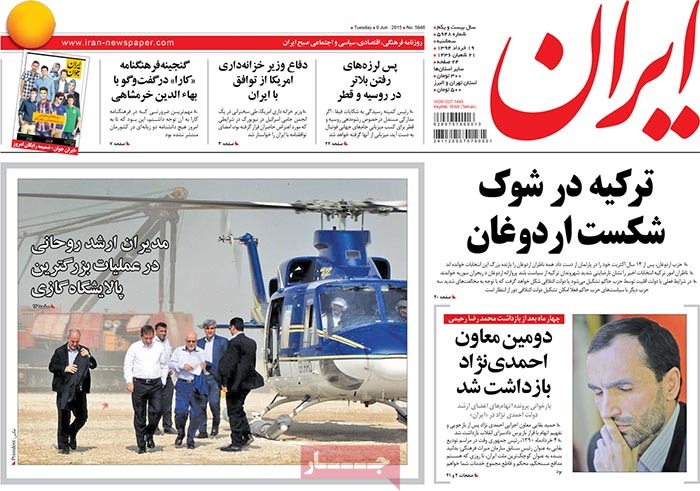
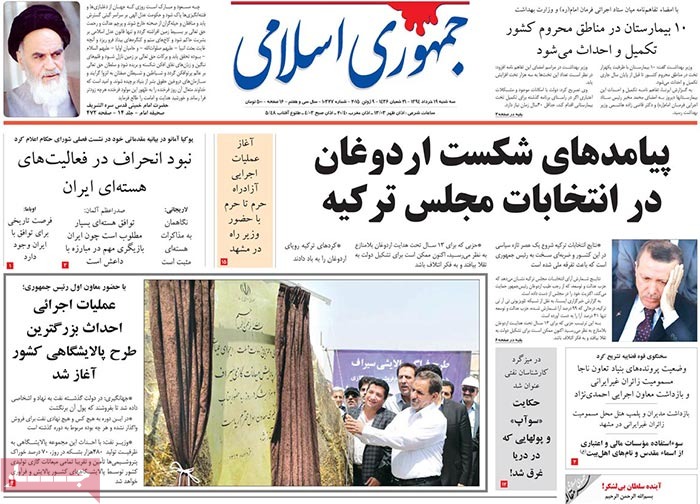
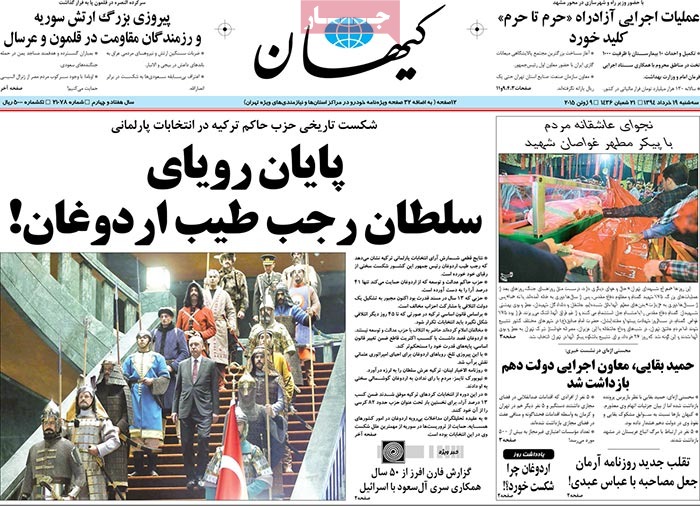
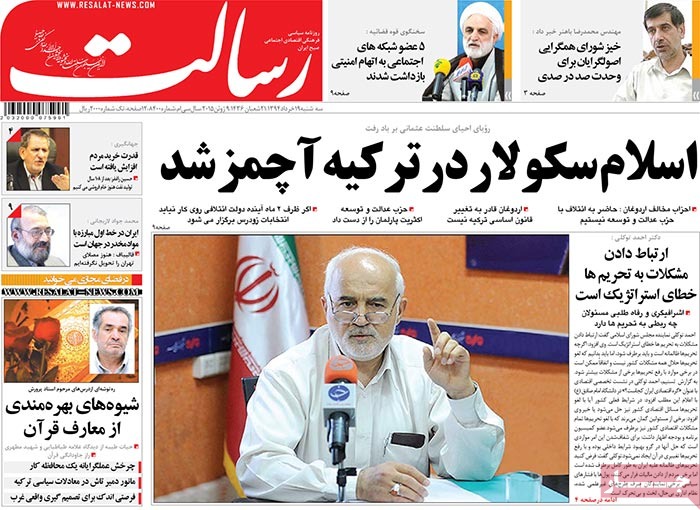
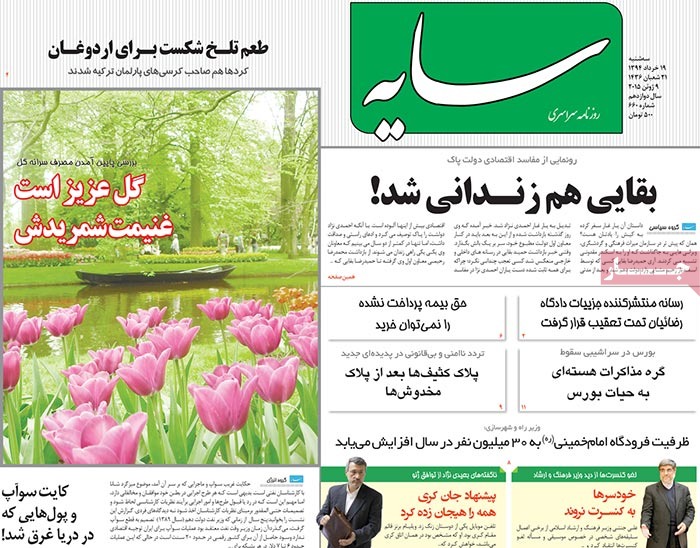
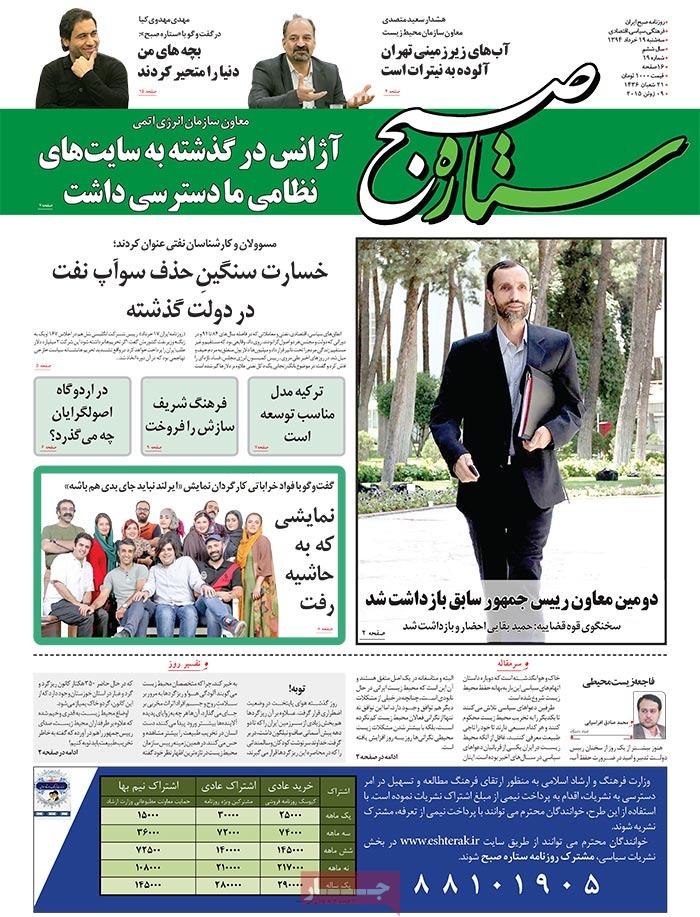
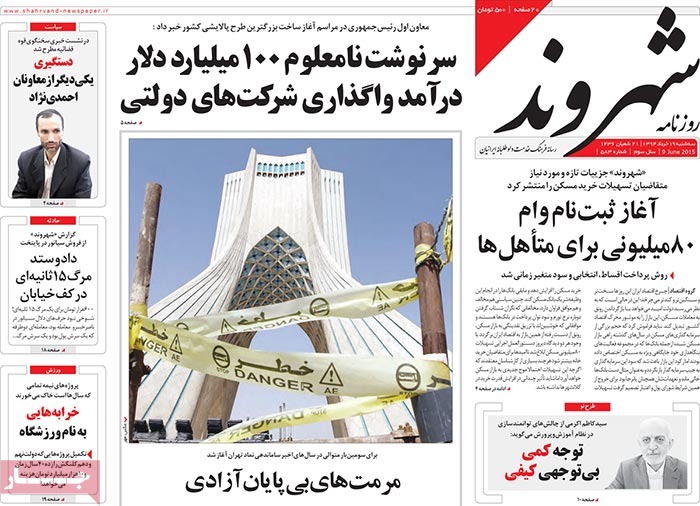
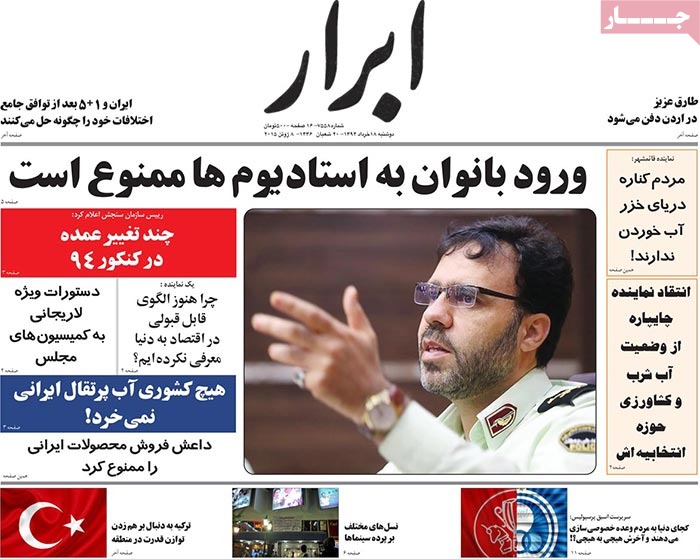
The arrest of Hamid Baghaei, President Ahmadinejad’s deputy, dominated the front pages of Iranian newspapers on Tuesday. The fatal poisoning of four Saudi pilgrims in Mashhad and the historic setback President Erdogan’s party suffered in Turkey’s parliamentary elections were also under the front-page spotlight of the dailies.
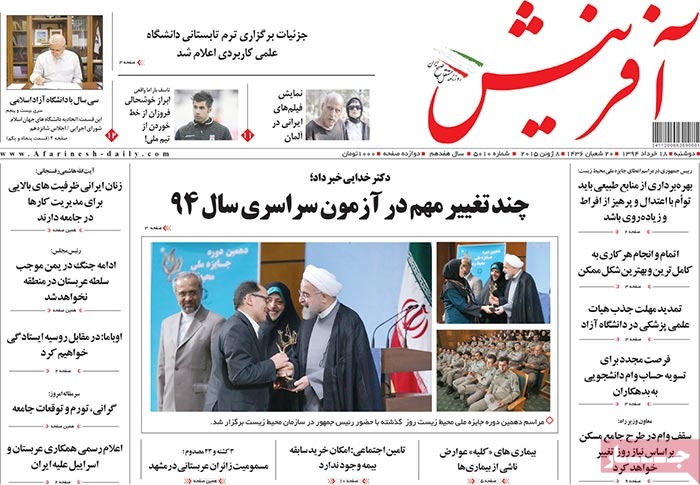
Afarinesh: “We won’t allow inspections of our military sites,” said Ali Akbar Velayati, a former foreign minister and an advisor to the Supreme Leader.
Afkar: IS has set its sights on Iranian land!!
The terrorist grouping has recently released a map of its self-proclaimed caliphate that covers part of Iranian territory.
Claims by the terrorist grouping that it seeks to expand its territory from North Africa all the way to the Indian Subcontinent comes despite the fact that it is suffering back-to-back defeats in Iraq.
Amin: “Iran is determined in the fight against money laundering,” said President Rouhani.
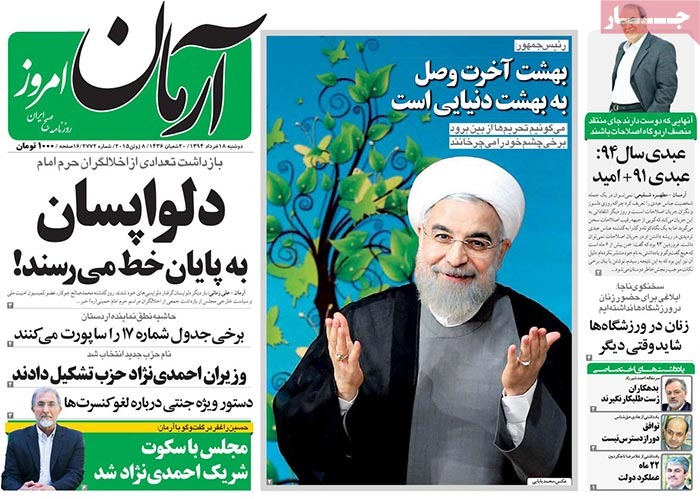
Arman-e Emrooz: Hamid Baghaei [a vice-president under Ahmadinejad] has been arrested.
The inner circle of Ahmadinejad has begun to distance itself from Baghaei.
Abdolreza Davari [a close associate of Ahmadinejad] has said that the last time Baghaei visited the office of the former president was long ago.
Arman-e Emrooz: Death with banned poison
The aftershocks of the deaths of four Saudi nationals: Towhid Hotel has been shut down and five people have been arrested.
Asrar: “Some 520 towns and cities across the nation are grappling with water shortage,” said the director of the Crisis Management Organization.
Asrar: “At a time when oil revenues were at their highest levels, the worst policies were adopted,” said Vice-President Eshagh Jahangiri [in reference to Ahmadinejad presidency].
Ettela’at: “Tax evasion adds up to $43-plus million each year,” said an official with the National Tax Administration.
Haft-e Sobh: Instagram has officially apologized for shutting down an Imam Khomeini account.
Hambastegi: Foreign Minister Mohammad Javad Zarif paid a very brief visit to Oman Monday.
Iran: Turkey in shock over the defeat of Erdogan.
Jomhouri Islami: Construction of the country’s largest refinery got underway with the first vice-president in attendance.
Kayhan: An end to the dreams of Sultan Recep Tayyip Erdogan!
Turkey’s ruling party suffered a historic defeat in the country’s parliamentary elections.
Resalat: “Iran is at the forefront of the global war against drug trafficking,” said Mohammad Javad Larijani, who leads the Human Rights Council of the Iranian Judiciary.
Resalat: “Linking the country’s problems to sanctions is a strategic blunder,” said Ahmad Tavakoli [a principlist MP].
Sayeh: “Measures are underway to make it possible for Tehran’s Imam Khomeini Airport to handle 30 million passengers a year,” said the minister of roads and urban development.
Setare Sobh: A second deputy of the former president has been arrested.
Shahrvand: “It is not clear what has become of the $100 billion the former government earned from the privatization of state companies,” said First Vice-President Eshagh Jahangiri.
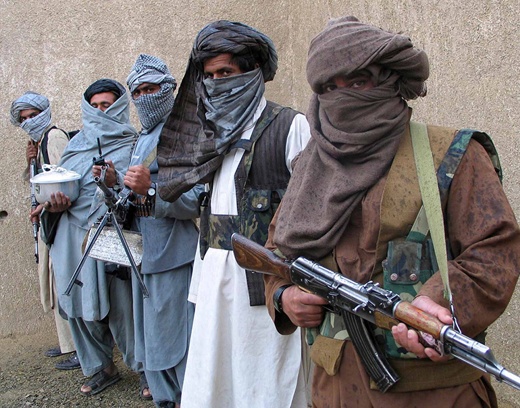
An Afghan political analyst says Iran has come to the conclusion that it has to get along with the Taliban to serve its national interests in the long run.
Pir-Mohammad Molazehi, an expert in Indian Subcontinent Affairs, also says if the Taliban make peace with the central government in Kabul, they can take control of areas in southern Afghanistan. Thus Iran will have to recognize the Taliban who would become its southeastern neighbor.
Mohammad Ashraf Ghani has made important decisions ever since he became president, among them inking security agreements with the US and Pakistan, and launching peace talks with the Taliban.
As the Afghan government is thinking about holding talks with the Taliban in the south, Kunduz in the north has turned into the scene of bitter clashes between Afghan forces and extremists hailing from other nations. The clashes in Kunduz – which serves as the gateway to Central Asia – are likely to drag the Russians and Chinese into this quagmire.
Khabaronline, a news website, on June 7 published an interview with Molazehi on what is going on in Afghanistan, what the Taliban are doing and how Iran will deal with them. The following is the translation of part of what he said in the interview:
Afghanistan and its southeastern neighbor
[…] Kabul believes that the Taliban, Gulbuddin Hekmatyar’s Islamic Party and the Haqqani network are all supported by Pakistan’s Inter-Services Intelligence. Islamabad, on the other hand, is skeptical of ties between Afghanistan and India. […] Things have changed under President Ashraf Ghani. He is seeking to find answers to security issues and make peace with the Taliban through interaction with the Pakistanis. To make peace with the Taliban, the Pakistani intelligence service should shed its support for the Taliban and other opposing groups and prod them to enter talks and work out a political solution to the Afghan crisis.
In exchange, Islamabad has called on Kabul not to do anything against Pakistan’s national security in its relations with New Delhi. If the two neighbors can clinch such an agreement, it can be a positive step toward regional peace and security, because the Taliban have jeopardized the security of both countries.
Afghanistan’s reaction
The agreement between the two neighbors’ intelligence services has drawn fierce opposition. Many in Afghanistan do not trust Pakistan, saying it fails to honor its promises. […] If these doubts are cleared up, the region seems likely to experience peace and stability.
Peace talks with the Taliban
There are many problems standing in the way. The Taliban are not very much willing to enter the talks. Pakistan has failed to meet the Afghan expectations. […] A team of the Afghanistan High Peace Council (HPC) and a Taliban delegation held talks in Qatar, but they failed to reach agreement. The next round of talks will be held in Dubai.
The current conditions and the presence – by 2024 – of US forces in the Afghan military base have caused the Taliban to think about getting their hands on power, albeit partially. The central government was supposed to hand to the Taliban a few ministries and the capital’s Pashtun-dominated districts as well as parts of eastern and southern Afghanistan as part of a self-rule region. If the Taliban lay down arms and turn into a party which does political activities, the stage could be set for establishing peace.
The Taliban and Spring Offensive
The Taliban have announced they will launch the Spring Offensive which the Afghan officials say would be the group’s final attempt before the talks. The offensive can help the Taliban occupy more regions and get more concessions from the central government. This is a high-stakes situation. The Taliban are unable to defeat the US and Afghan forces and seize the north; Kabul and Washington too cannot push the Taliban back in the south. The only solution to the current military standoff is holding talks.
The Taliban in Iran
The Taliban had a trip to Tehran although it was not officially confirmed by Iran’s Foreign Ministry officials. The Taliban are at odds with Iran ideologically, religiously and ethnically. They are extremists who want to help Pashtuns gain power. […] A Taliban trip to Iran could be indicative of the fact that Iran has decided to put up with the Taliban. If the Taliban become part of a power-sharing government in Afghanistan, they would be in control of the regions which share border with southern Khorasan and Sistan and Baluchestan. If so, how can Iran get along with this group without getting engaged in violent clashes? […]
The two sides seem to have developed some sort of political realism for their survival and handling the affairs. If cooperation with people in northern Afghanistan, Shiites and the Hazaras [Persian-speaking people who mainly live in central Afghanistan and Pakistan] had served Iran’s political interests, now Iran needs to take into account another factor: the Taliban and Pashtuns.
If the Taliban – in its give-and-take with the central government – gain power in the regions along Iran’s border, the Iranian side will have no other option but to come to terms with the group. […] Realism calls for Iran to include the Taliban in its political equations. If the Taliban opt for political realism and align with the Pashtuns, they can turn into a powerful political party in next year’s elections and seize power through balloting, which is a peaceful means.
A decision to get along with the Taliban shows that Iran has contemplated the question [of Afghanistan with the Taliban as part of legitimate power structure] in the long run, trying not to remain at variance with the group; rather, Tehran is seeking a peaceful strategy to both keep its borders safe and serve its interests.
Unrest in Kunduz
The developments unfolding in Kunduz are complex. The forces that are active there are from Hizb ut-Tahrir and Islamic Party from Uzbekistan, Tajikistan and Chechnya – not the Taliban – and have set their sights on Central Asia, not northern Afghanistan. The Taliban are working with them; that has made Russia and China very concerned. […]
The Uyghurs are also present in Kunduz, but they are eying China’s Xinjiang province. Central Asian countries such as China, Uzbekistan, Kazakhstan, Turkmenistan, Chechnya and Russia are also at stake. In Kunduz, the Taliban are not the only player involved in the conflict. The Taliban have concentrated their operations in a special region – from the east to the south and from the center to the north – but when it comes to other players in the region they are aiming for a region beyond northern Afghanistan. They seek to rid Central Asia of the influence of China and Russia so that Islamic forces can take over in the region.
Russian and Chinese forces in Kunduz
With Russia and China barring these groups from expanding their activities in Kunduz, their objectives are not easily materialized there, so one should not imagine that these two countries will engage in military operations against these groups. The Russians have combat experience in Afghanistan and do not want to be dragged into another war and repeat their past defeats, but they will prevent these groups from setting foot on Russian soil by blocking them at the border.
The groups active in Kunduz are expert in guerrilla and petty warfare. When it comes to their fighting, there will be no end in sight for their operations. Still, that is not enough reason to imagine that they would one day separate Xinjiang from China and establish – as they claim – an Islamic state in East Turkestan. This is not achievable in the short term because the Chinese and Russian armies are powerful.
That these groups are Taliban’s allies is an upside for them. The Taliban take advantage of this and launch attacks against the central government to capture the areas they seek. The Taliban and Islamist forces are at war with government forces and Afghan guerrillas. […]
These Islamic groups attach significance to the Taliban and Afghanistan. With the Taliban rising to power in Afghanistan, these groups can find a stronghold to support the Islamists in Kunduz. If that happens, they could get closer to their target which is disintegration of Turkestan and Xinjiang.
Islamists in Afghanistan and ISIL
They have links with ISIL. They are local subgroups of ISIL, but it does not mean that Iraq- and Syria-like ISIL militant are active in the country. These groups mostly tap into Al-Qaeda experience: mobilization of tribal groups from different countries in one region to unite them against their home countries.
These tribal groups swore allegiance to who they call the Islamic caliph of Al-Qaeda and ISIL. They are Central Asian locals, not Arabs. ISIL, which is active in Iraq and Syria, is not in Kunduz, but it [the terrorist group] has claimed its forces are present in Central Asia fighting for the spread of Islam because they seek to expand the [so-called] Islamic State from North Africa to Central Asia – as they put it.
The official results of the 25th Turkish parliamentary general election will be announced “within 11 or 12 days”, the supreme election committee chairman says.
According to unofficial results, four political parties, including the Justice and Development (AK) Party, pro-Kurdish Peoples’ Democratic Party (HDP), Republican People’s Party (CHP), and Nationalist Movement Party (MHP) had surpassed the 10-percent election limit needed to obtain seats in the parliament, Sadi Guven told reporters in the capital Ankara late on Sunday.
“According to unofficial results, AK Party, CHP, MHP, and HDP have surpassed the 10-percent election threshold,” he said, adding, “The official results will be announced in 11 or 12 days”. The turnout was 86.47 percent, he said.
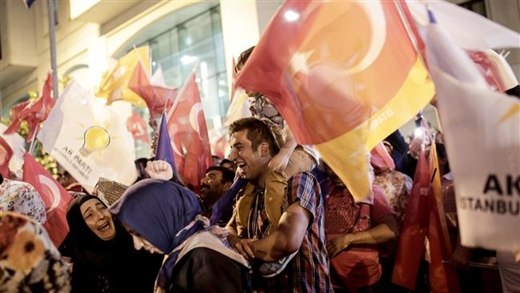
According to the unofficial results, Turkey’s AKP won its fourth consecutive general election Sunday but failed to gain the majority needed to form a single-party government.
With 99.86 percent of ballots counted, AKP secured 40.79 percent of the vote, giving the party 258 seats in the Grand National Assembly — 18 short of a simple majority.
The second-placed CHP secured 25.07 percent of the vote to take 132 seats while the MHP gained 16.38 percent to gain 81 seats. And the pro-Kurdish HDP won 12.98 percent of the vote to take 79 seats, marking the first time it will ever enter the parliament as a party.
President Recep Tayyip Erdogan’s AKP party has gained much less than the current 327 and the 330 parliament seats required for calling a referendum on changing the constitution.
Erdogan, who was elected president in August 2014 after over 11 years of serving as prime minister, was confident before the election that he could transform Turkey into a presidential republic.
To achieve this, the ruling party needed to gain 367 seats (two-thirds of the parliament), to easily push for constitutional changes to increase the powers of the president, without popular vote.
The president now holds a largely ceremonial role under the current constitution.
With talks between Iran and P5+1 entering a final phase and the two sides working against the clock to draft a final nuclear deal, a number of MEPs (Members of the European Parliament) came to Tehran to build confidence with the Iranians and answer questions on removal of sanctions and investment in Iran.
The high-level European parliamentary delegation, headed by Chairman of the European Parliament’s Committee on Foreign Affairs Elmar Brok, arrived in Tehran on Saturday at the invitation of Chairman of the National Security and Foreign Policy Committee at the Iranian parliament Alaeddin Boroujerdi.
One Briton is also on the seven-member team and this shows Europe is interested in tapping into the weight Britain carries in political equations. […]
This is the third trip by a European Parliamentary delegation to Iran after Hassan Rouhani was elected president [in 2013]. The current trip, however, seems to differ from previous visits to Iran. Unlike the previous trips which came with controversial meetings between Members of the European Parliament (MEPs) [with those in the opposition] on the sidelines of their stay in Tehran, the current trip has seen the European politicians stay away from contentious discussions and sideline meetings which are likely to hamper confidence-building efforts.
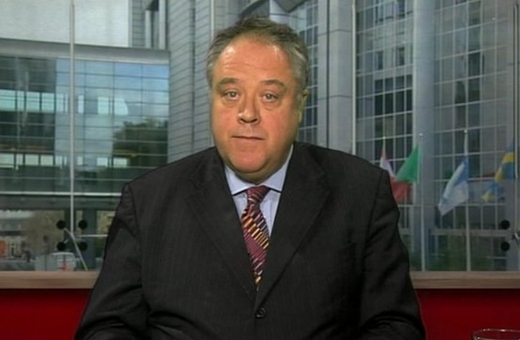
Taadol newspaper published a report on the trip by the delegation of MEPs and an interview with Richard Stuart Howitt – a Member of the European Parliament for the Labour Party for the East of England and the Spokesperson of the Socialist and Democrat Group in the European Parliament [on Human Rights]. What comes next is the translation of part of what the British lawmaker said:
On the reason behind the trip, Howitt said they have come to Iran to help Iran and the negotiating countries build trust in the run-up to the conclusion of a nuclear deal between Tehran and P5+1. […]
Howitt also said Iran and the European Union can cooperate on economic, political, cultural and scientific fronts. He added Europe stands ready to share its knowhow on climate change, water management and other scientific questions with Iran and cooperate with the country.
He further said that the European Parliament is willing to open its Tehran office in 2016 after a nuclear deal is struck.
[…]
Without doubt, Europe and Iran do not see eye to eye over several questions. There are some differences, but we are supposed to hold talks based on mutual respect, he said, adding the delegation’s meetings with Iranian officials have taken place in a calm atmosphere.
[…]
The European delegation wrapped up its two-day visit to Tehran on June 7.
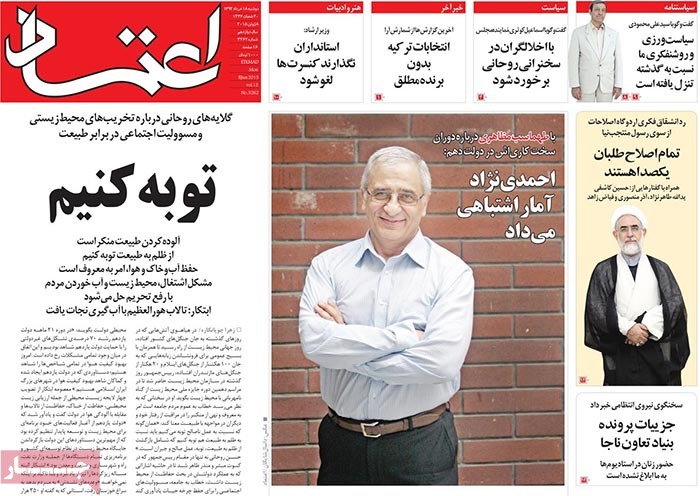
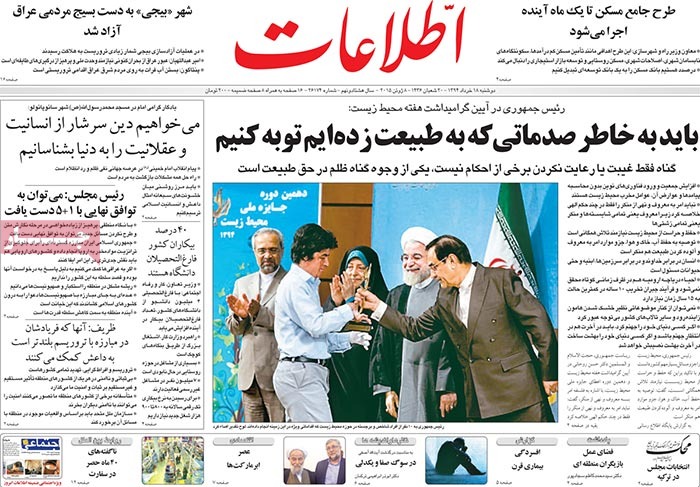
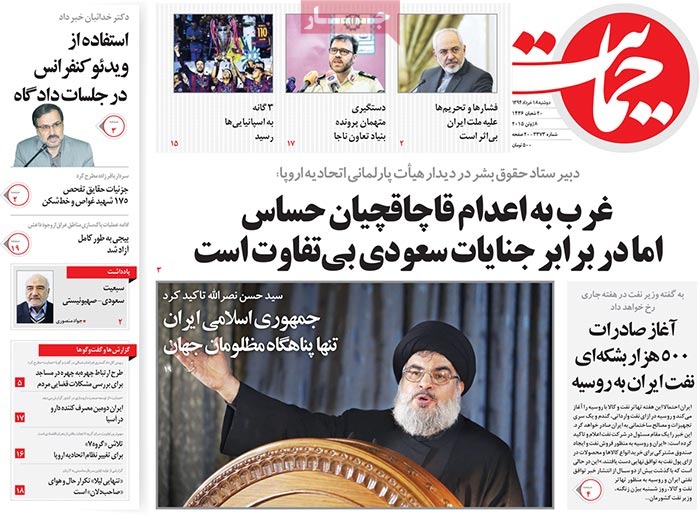
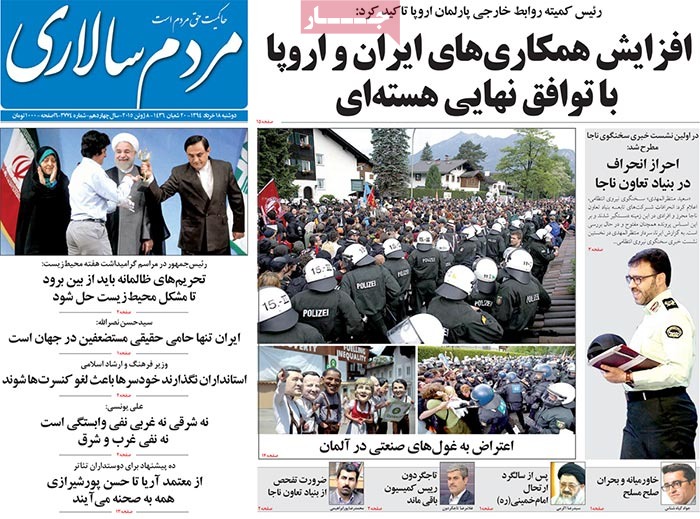
Comments by President Rouhani on measures to protect the environment dominated the front pages of Iranian newspapers on Monday.
Abrar: “Women’s entry into sporting arenas remains illegal,” said the spokesman of the law enforcement force.
Abrar: IS has slapped a ban on the sale of Iranian products.
Afarinesh: “Continued war in Yemen won’t earn Saudi Arabia regional dominance,” said the Iranian parliament speaker.
Arman-e Emrooz: Are the so-called Worriers at the finish line?
A number of individuals who shouted down senior officials [including the president] when they were making speeches at Imam Khomeini Mausoleum have been arrested.
Arman-e Emrooz: Those who served as Cabinet ministers under Ahmadinejad have formed their own party.
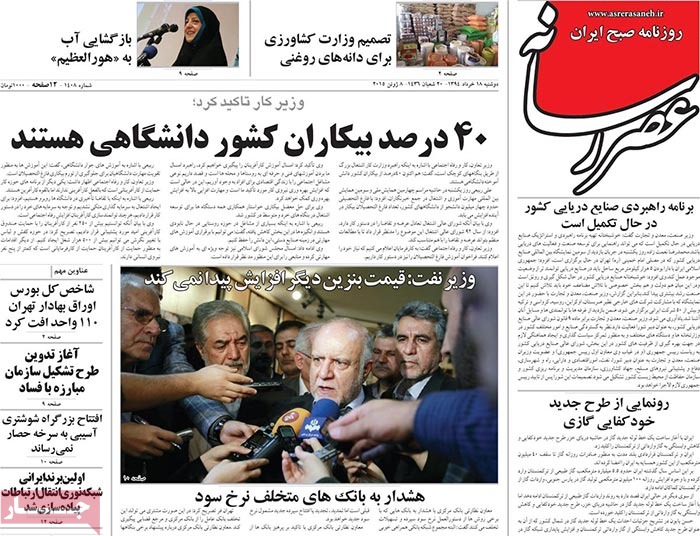
Asr-e Rasaneh: “Gasoline prices won’t go up again,” said the oil minister.
Etemad: “Former President Mahmoud Ahmadinejad would present wrong figures,” said a former Central Bank Governor Tahmasb Mazaheri.
Ettela’at: The Iraqi town of Baiji has been liberated by the Popular Mobilization Force.
Ettela’at: “Those who are louder in the fight against terrorism are assisting IS,” said Iranian Foreign Minister Mohammad Javad Zarif.
Ettela’at: “We need to repent of the harm we have done to the environment,” said President Rouhani in a speech to mark Environment Week.
Ettela’at: University graduates account for some 40 percent of the country’s unemployed.
Hemayat: The oil minister has said that exports of 500,000 barrels of oil to Russia will get underway later this week.
Mardomsalari: The minister of culture and Islamic guidance has urged provincial governors not to allow rogue elements to disrupt concerts.
Climate change, drought, low precipitations and lower water level in marshlands have caused environmental challenges to Iran and the Western Asian nations, Department of Environment chief said on Sunday.
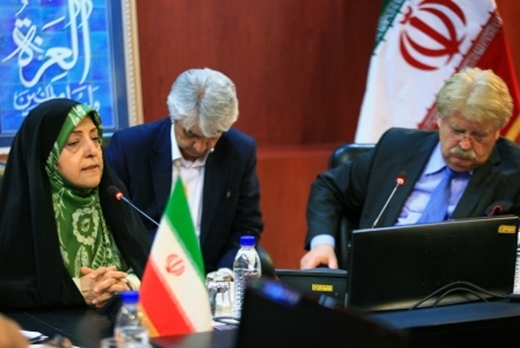
‘A major part of the dust pollution in Iran comes to our country through Iraq and in fact Iraq, Jordan, Syria and the Arabian Peninsula are the major foreign centers for the dust pollution in Iran,’ the environment chief Masumeh Ebtekar said in a meeting with visiting Chairman of EC Committee on Foreign Affairs Elmar Brok and his accompanying delegation.
She said that regional cooperation is one of the most important ways to thwart degradation of environment and the dust pollution.
She said that implementing the plans for protection of environment proceeds very gradually due to deterioration of security situation in the region.
She emphasized that Iran’s efforts are focused on introduction of the real façade of Islam and help the region and the entire world get rid of menaces of terrorism and extremism.
Elmar Brok and members of EC Committee on Foreign Affairs said that Europe is ready for multilateral cooperation with Iran on environment.
‘Europe is also ready for cooperation on transfer of green technology to Iran,’ said Brok.
He said that there are similarities between Christianity and Islam and that both the divine religions have made strict suggestions on the need to protect the environment.
An Iranian nuclear negotiator says the Islamic Republic will not be pressed for time in reaching a final comprehensive agreement with the P5+1 group of powers over Tehran’s nuclear program.
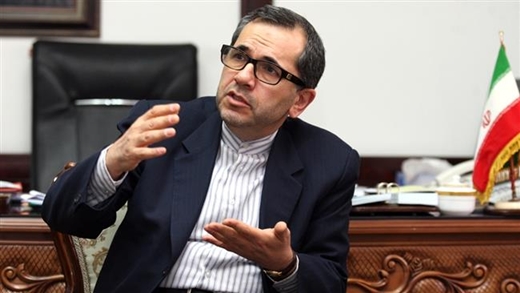
“If the opposite [negotiating] side does not come up with excessive demands, the negotiations will lead to a result by the announced deadline,” Iran’s Deputy Foreign Minister for European and American Affairs Majid Takht-e Ravanchi said in a meeting with Chairman of the European Parliament’s Committee on Foreign Affairs Elmar Brok in Tehran on Sunday.
He urged the negotiating parties to remain committed to previously reached agreements.
“The Islamic Republic of Iran is determined to push ahead with the negotiations seriously and strongly and make all-out efforts to reach a good, reasonable and acceptable agreement,” the Iranian negotiator said.
[…]
Takht-e Ravanchi also stressed the importance of reciprocal visits by delegates from Iran and the European Parliament with a view to enhancing mutual understanding and improving ties.
He expressed Iran’s readiness to strengthen cooperation with Europe in the fight against terrorism and extremism, regional security, commercial exchanges and energy supply.
Brok, for his part, expressed hope that Iran and the P5+1 would succeed in settling differences and reaching a final agreement, saying it would open a new chapter in ties between the Islamic Republic and Europe in all sectors.
He added that the European Parliament is keen to improve relations with Iran.
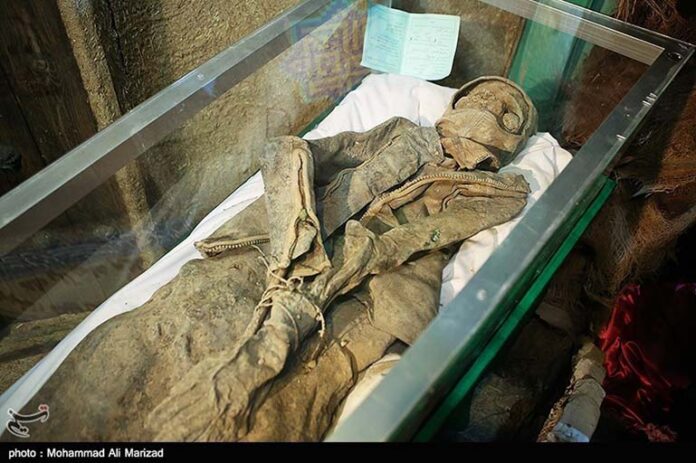
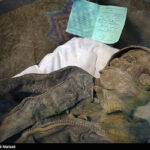
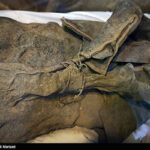
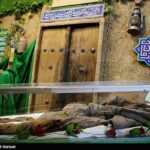
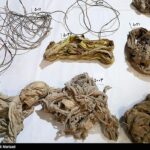
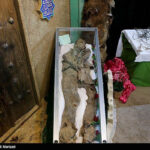
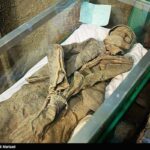
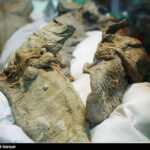
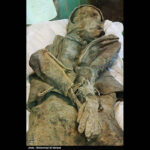
The remains of some 270 Iranian soldiers, including 175 divers, who were killed by the forces of the Iraqi regime during Operation Karbala 4 in the 1980s returned home in mid-May.
The following images of their remains have been released by Tasnim News Agency:
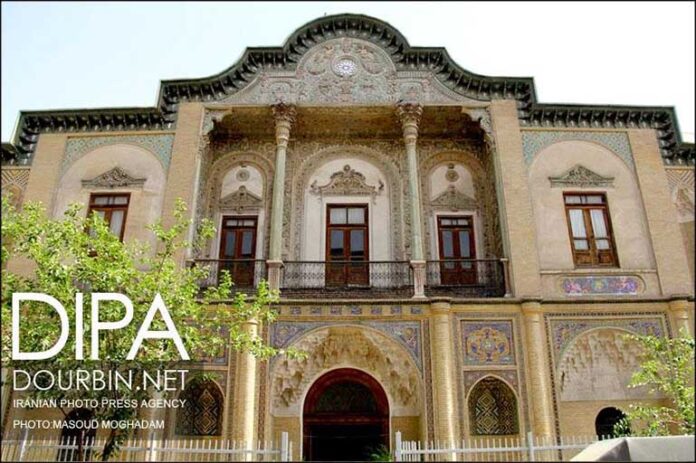
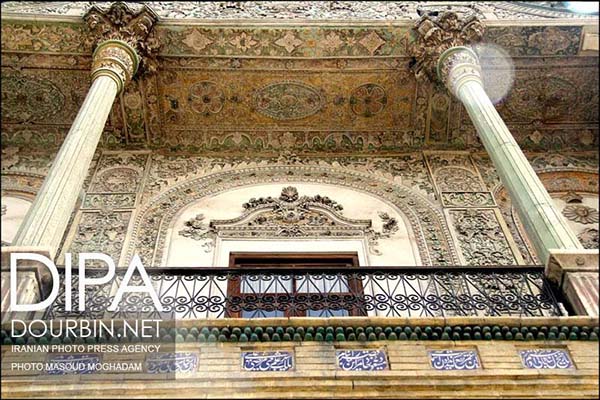
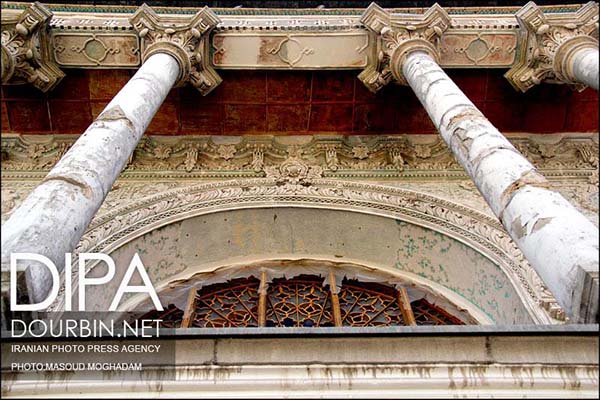
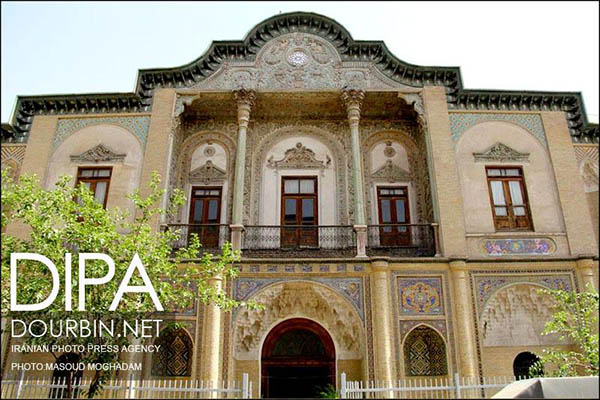
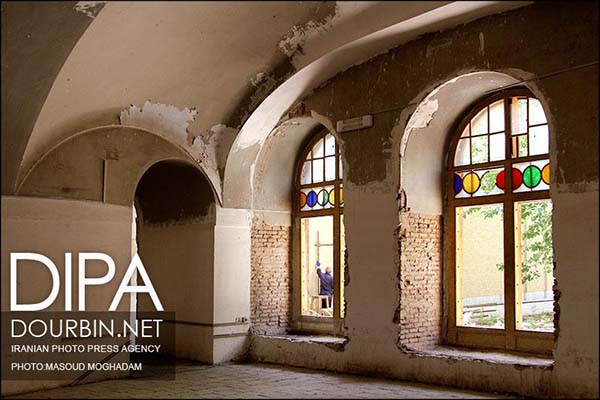
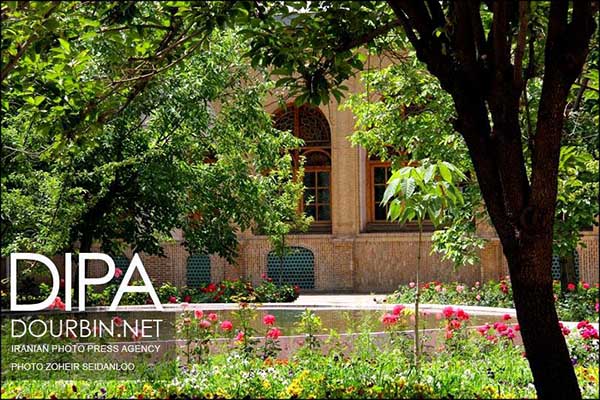
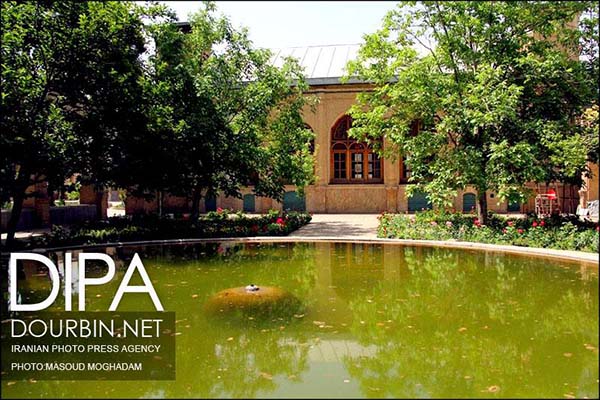
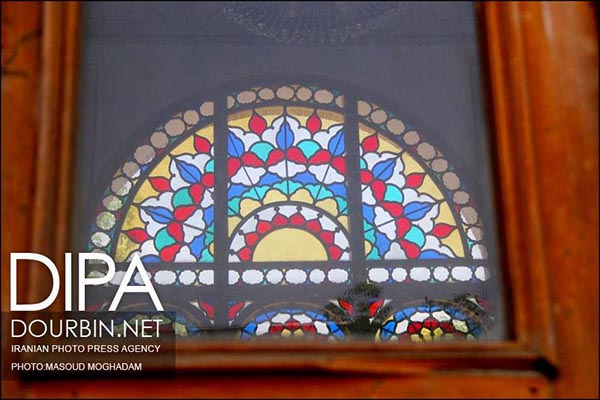
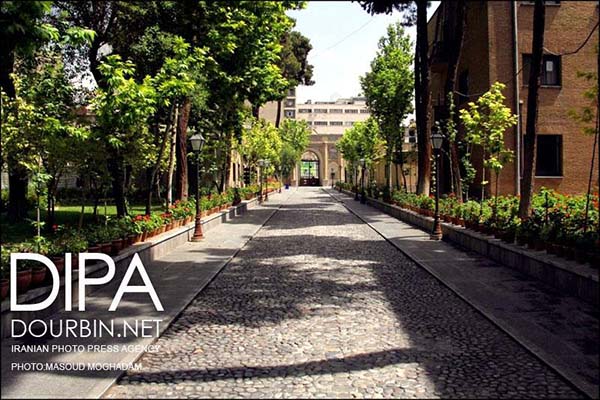
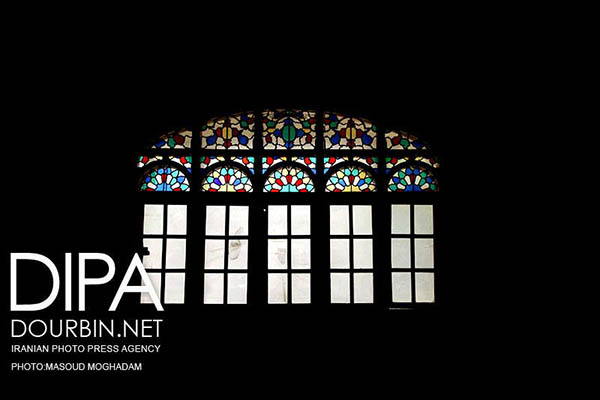
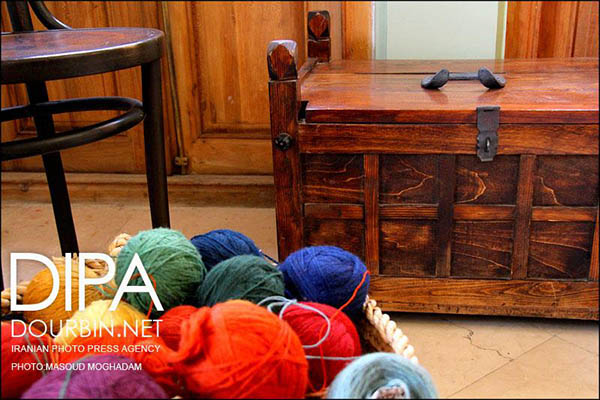
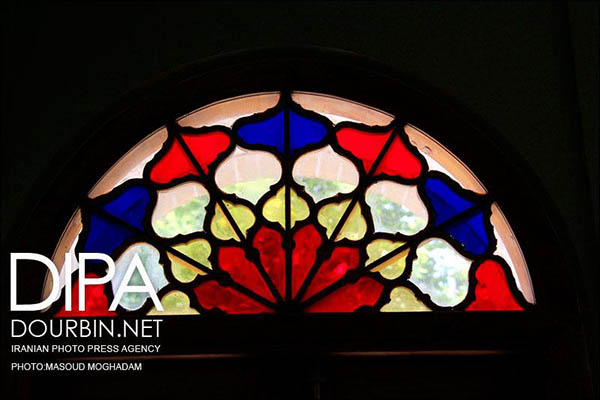
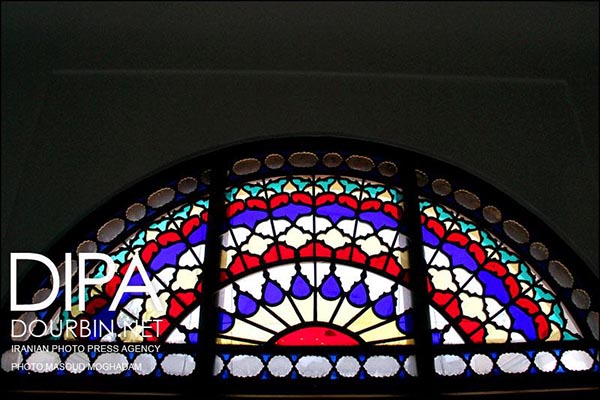
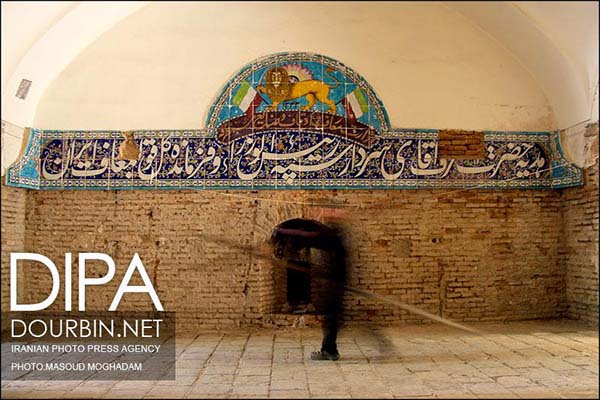
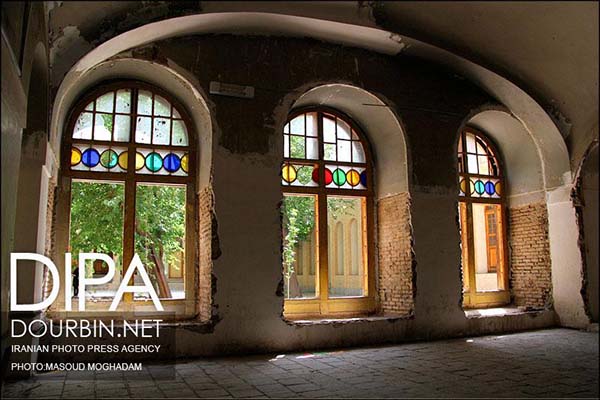
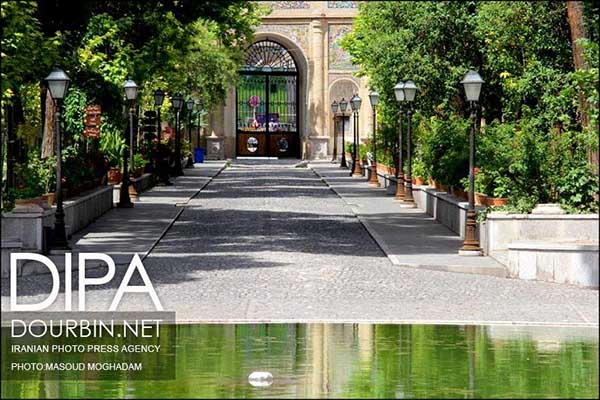
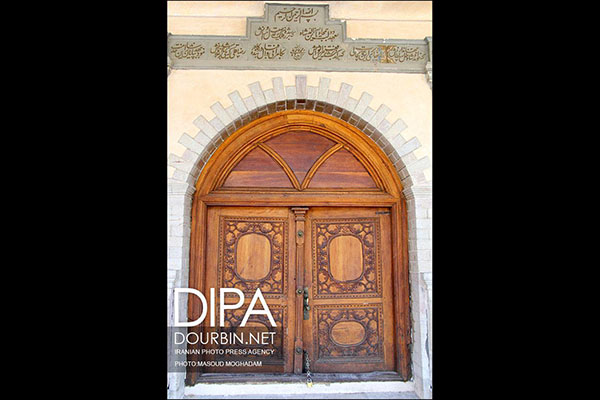
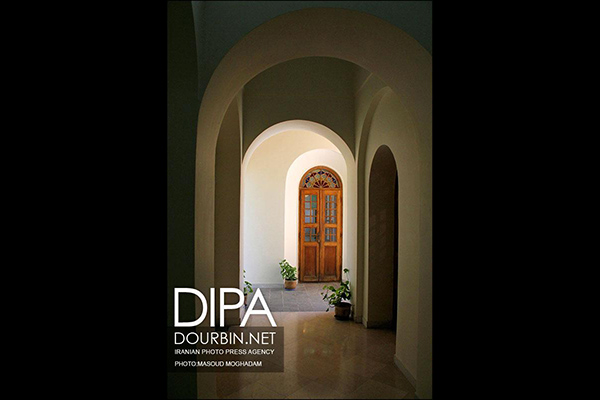
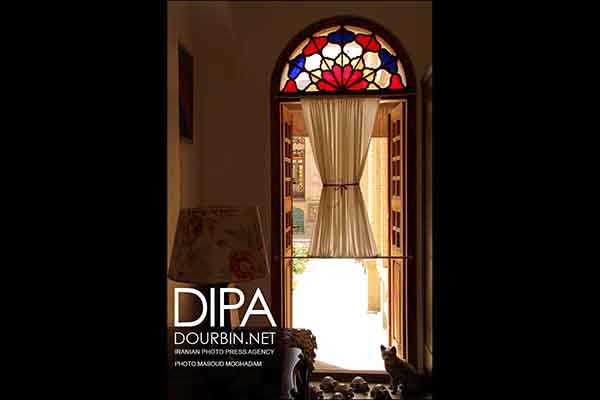
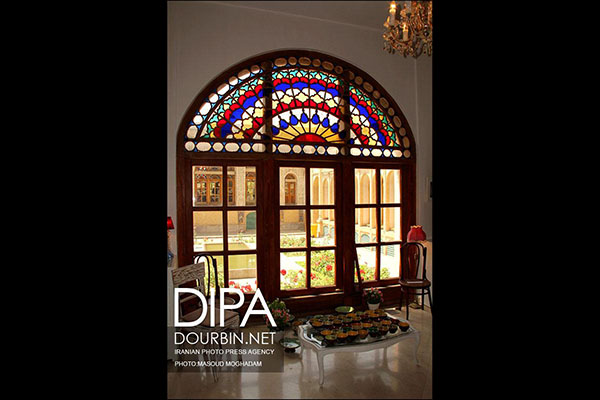
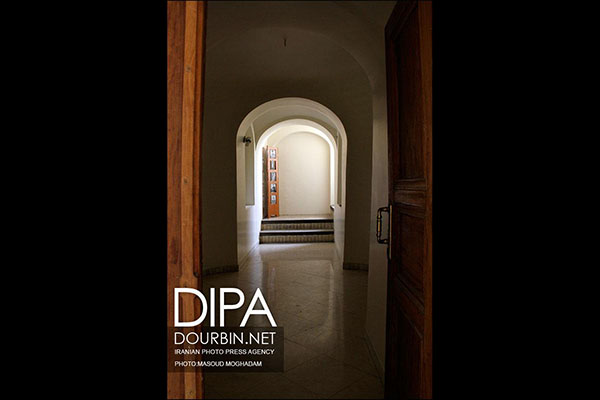
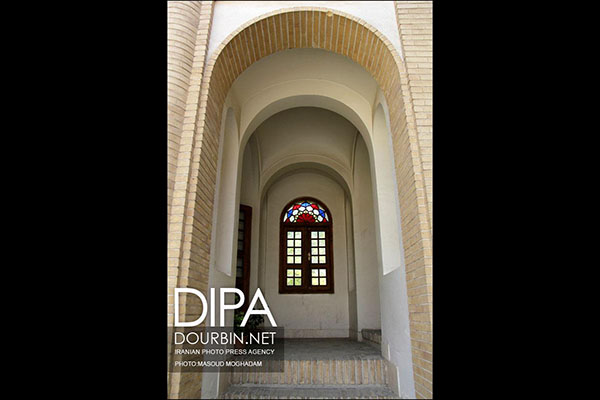
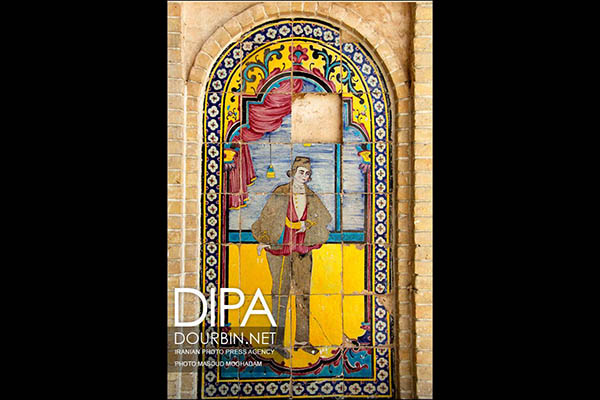
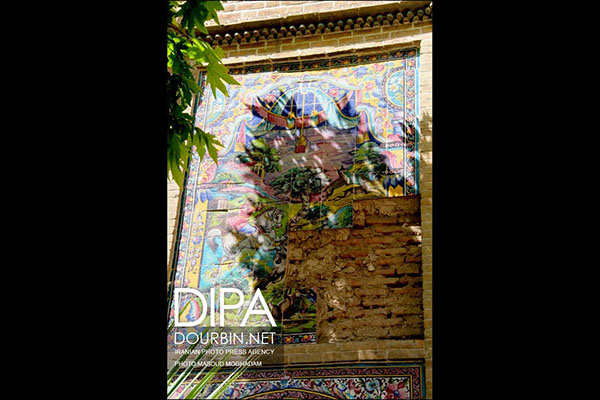
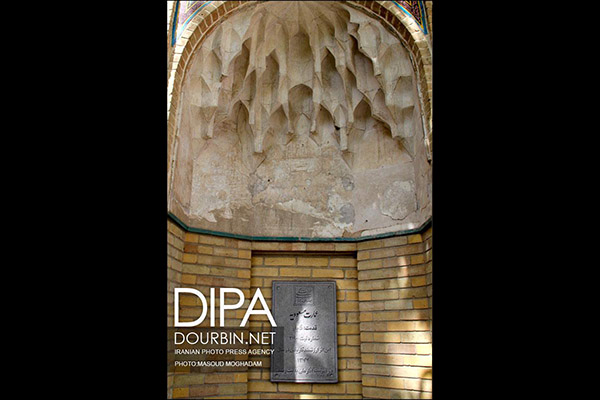
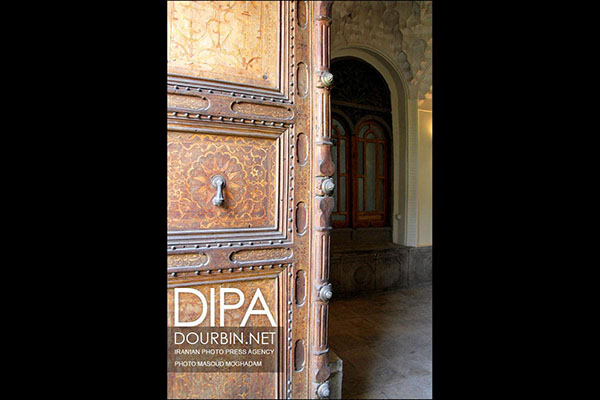
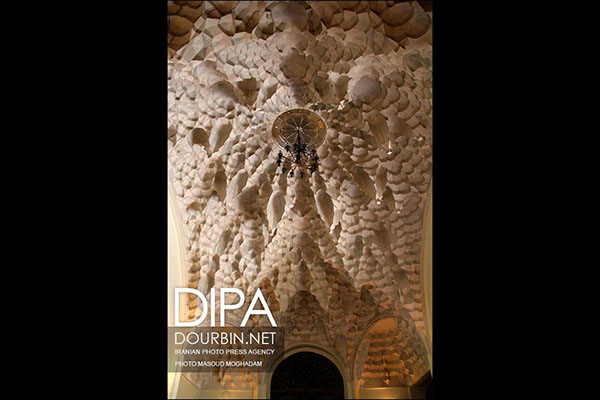
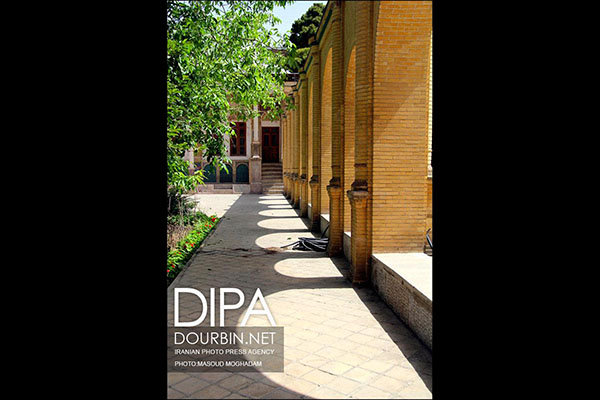
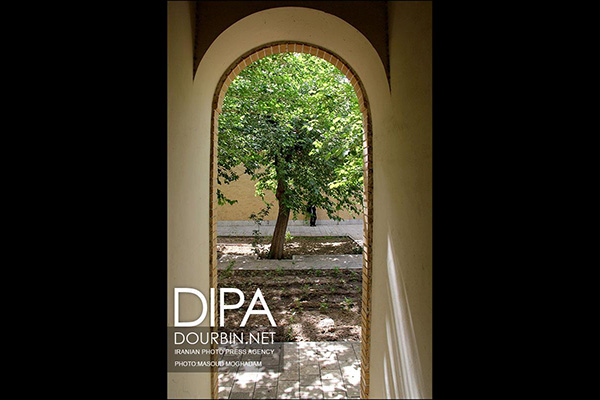
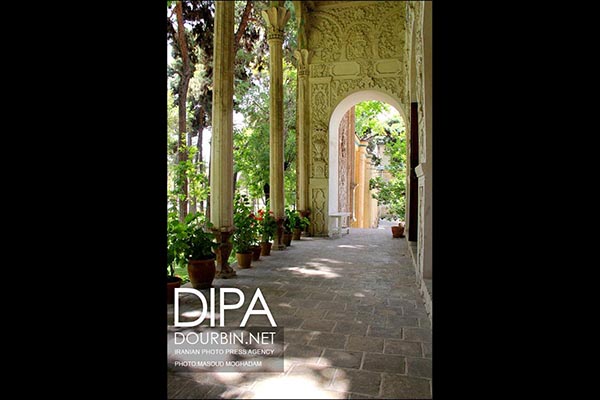
Massoudieh Mansion was built on orders of a son of Nassereddin Shah, a Qajar king, in Tehran around 150 years ago.
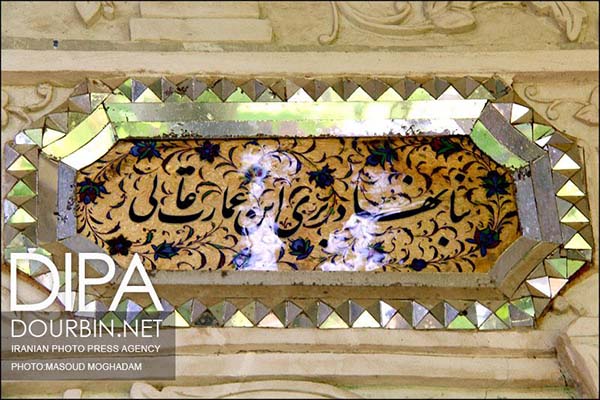
The following are images of the magnificent mansion which sits on a 4,000 square meter expanse of land in Tehran, and has been a registered national site since 1998: