Saturday, April 4, 2026
Home Blog Page 4486

Enemies Capitulated to Iran’s Nuclear Might: Leader

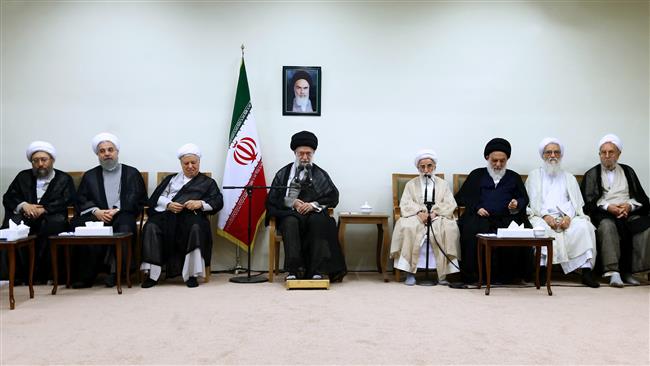
In a Thursday meeting with members of Iran’s Assembly of Experts in Tehran, Ayatollah Khamenei said “there was a time when enemies would not accept even a single centrifuge inside Iran, but they finally surrendered in the face of Iran’s nuclear might.”

“In fact, it was not the Americans who gave [us] this concession; we got it with our own power,” stressed the Leader.

Iran and the five permanent members of the UN Security Council – the United States, France, Britain, China and Russia – plus Germany signed the JCPOA on July 14, 2015 following two and a half years of intensive talks. 

Under the deal, all nuclear-related sanctions imposed on Iran by the European Union, the Security Council and the US would be lifted. Iran has, in return, put some limitations on its nuclear activities.

Elsewhere in his comments, Ayatollah Khamenei warned against enemies’ agenda to wage a “soft war” on the country after they failed to bring the Iranian nation to its knees through numerous acts of aggression.

The Leader said “the hegemonic front is, by nature, after broadening its dominance on nations, and any state or nation which fails to put up resistance, will eventually get caught in the trap.”

Ayatollah Khamenei highlighted enemy attempts over the past decades to gain dominance on the Iranian nation, including the eight-year war imposed on the country by the regime of former Iraqi dictator Saddam Hussein in the 1980s.

Bullying powers have now turned to a “soft invasion” as part of a second phase of hostilities against the Iran since they failed to defeat the Islamic Republic on the battleground, the Leader said.

Ayatollah Khamenei also described as “very dangerous” the enemies’ intention to “infiltrate” Iran, which constitutes the third stage of their hostile polices vis-à-vis the Islamic Republic.

In this stage, the global hegemony seeks to exert influence on the country’s “decision-making centers,” and to make changes in people’s beliefs as well as the stances and policies of Iranian officials, the Leader stressed.

The Thursday meeting took place after Iran’s Assembly of Experts, in its opening, elected Ayatollah Ahmad Jannati to head the body tasked with appointing the “Leader of the Islamic Revolution” and overseeing his work.

Ayatollah Jannati was chosen for the post for two years after securing re-election for the assembly in a February vote.

In a message to its opening, Ayatollah Khamenei said the new assembly has a duty to “carefully and comprehensively guard the Islamic and revolutionary identity of the ruling establishment and direct intertwined apparatuses of the establishment toward lofty and sublime goals.”

The Leader further asked the assembly to pay attention to the “personal and political piety of the leader.”

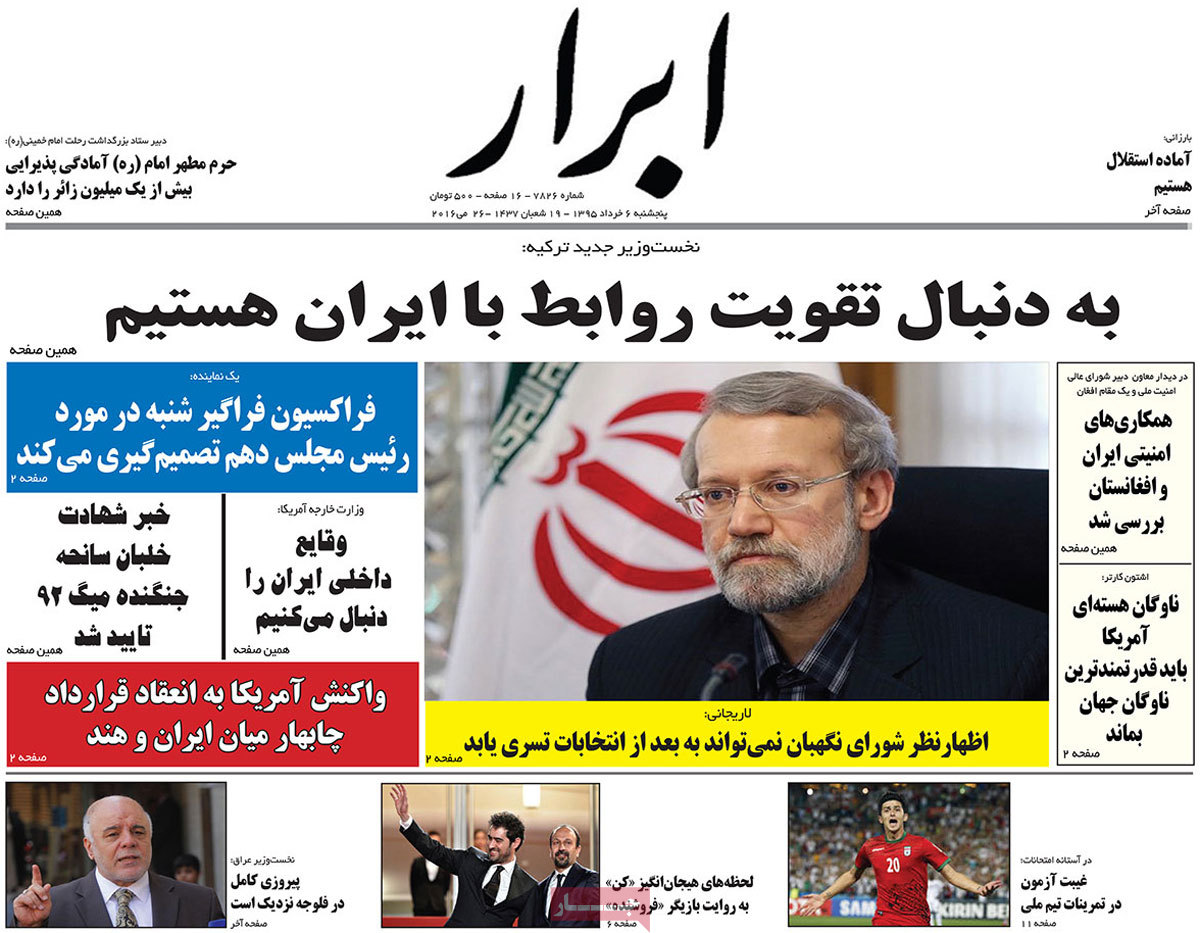
A Look at Iranian Newspaper Front Pages on May 26

Iran Newspaper front pages

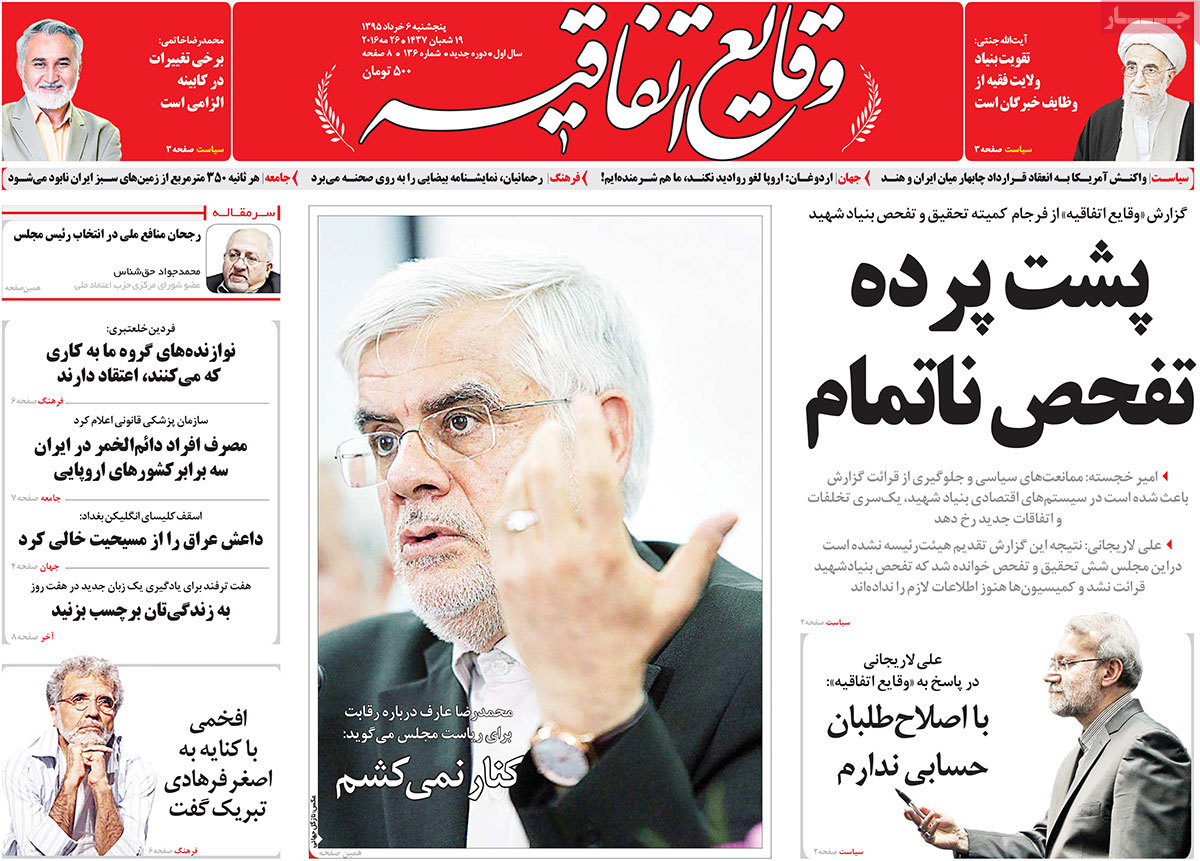
The upcoming election in Iran’s new parliament to choose the next speaker was a top story in most newspapers on Thursday. The competition will be between the reformist Mohammad Reza Aref and the moderate conservative Ali Larijani.

A number of papers also covered the unfinished parliamentary investigations into an alleged corruption in the Foundation of Martyrs and Veterans Affairs.


Abrar:

1- We’re Looking for Reinforcement of Ties with Iran: New Turkish PM

2- Shrine of Imam Khomeini Ready to Receive 1m Visitors [on his upcoming anniversary]

3- Barzani: We’re Ready for Independence

4- Iranian and Afghan Officials Discuss Bilateral Security Cooperation
 

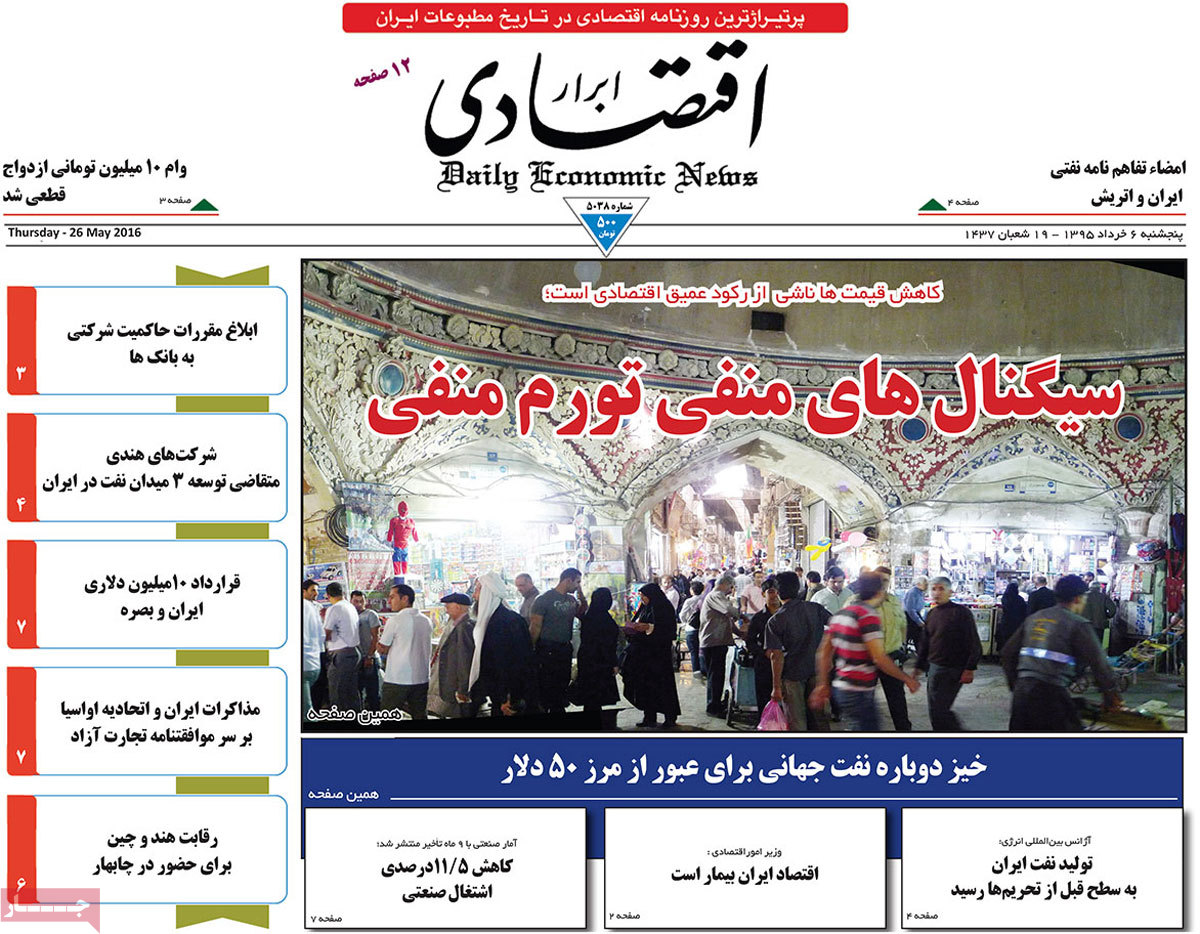
A Look at Iranian Newspaper Front Pages on May 26


Abrar-e Eqtesadi:

1- Negative Signals of Negative [Decreasing] Inflation: Decrease of Prices Result of Deep Economic Downturn

2- Iran and Austria Sign Oil MoU

3- Iran’s Economy Is Ill: Minister

4- India and China Competing for Presence in Iran’s Chabahar Port

5- Iran and Iraq’s Basra Ink $10m Contract

6- Indian Companies Ready to Develop 3 Oilfields in Iran

7- Global Oil Price Poised to Exceed $50
 

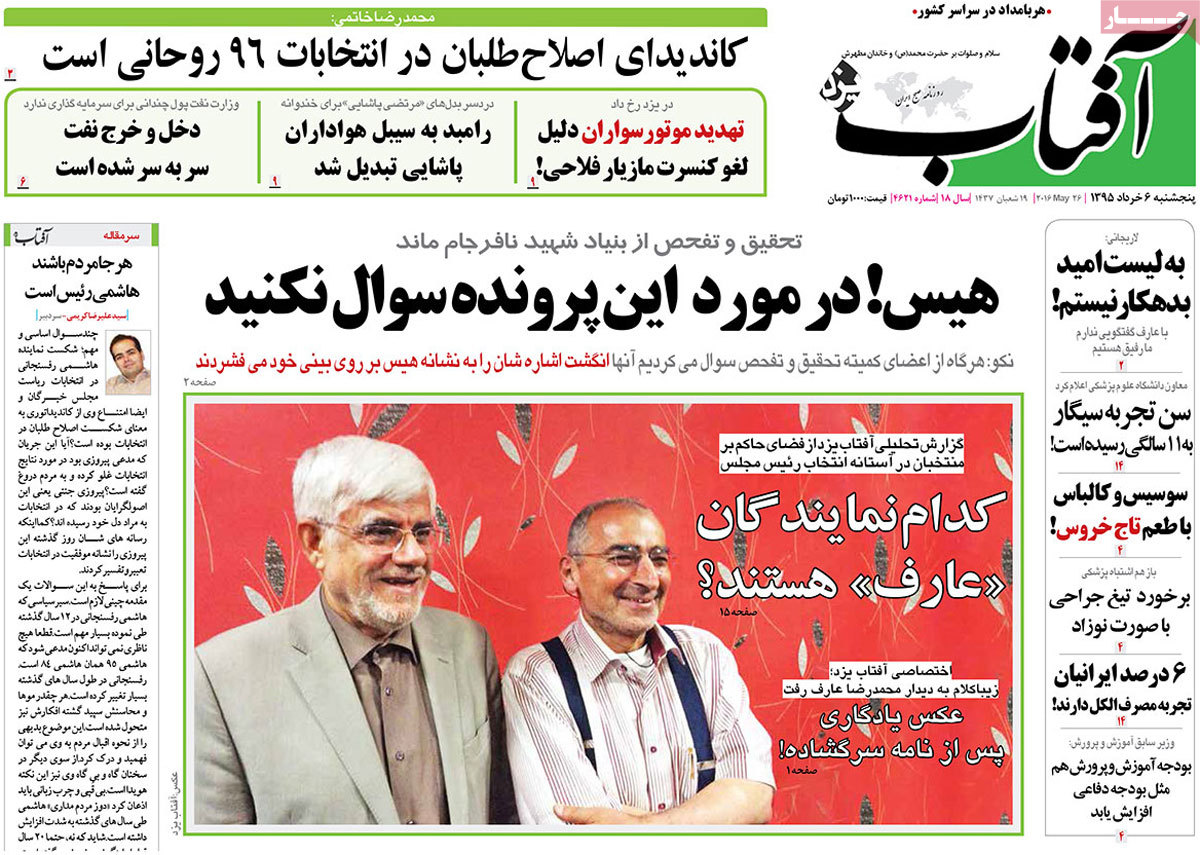
A Look at Iranian Newspaper Front Pages on May 26


Aftab-e Yazd:

1- Larijani: We’re Not Indebted to List of Hope [reformists’ list in February 26 elections]

2- Age of First Cigarette Use Down to 11

3- Rooster’s Comb Used in Sausage Production!

4- Medical Error, Once Again: Surgery Blade Touches Infant’s Face

5- 6% of Iranians Have Used Alcohol
 

A Look at Iranian Newspaper Front Pages on May 26


Arman-e Emrooz:

1- Details of Aref’s Meeting with Rouhani: Secrets behind Reformists’ Offer to Larijani

2- Aref: I Won’t Withdraw [from running for speakership of parliament]

3- Lawsuit Filed against Science Minister of Ahmadinejad

4- Rouhani Will Be Reformists’ Candidate in Next Year’s Presidential Elections: Mohammad Reza Khatami
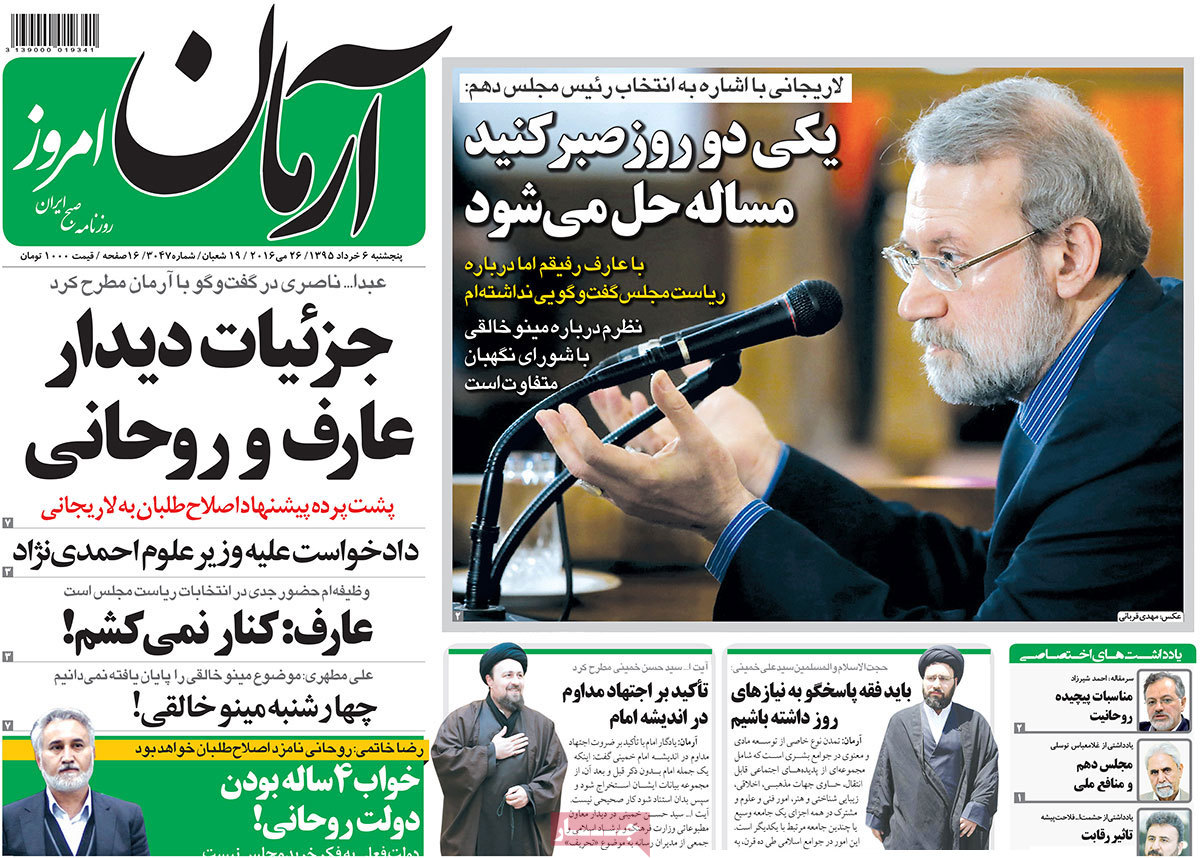
 

A Look at Iranian Newspaper Front Pages on May 26


Asrar:

1- 2 Austrian Banks Have Started Their Ties with Iran: Chamber of Commerce

2- Gov’t Will Not at All Interfere in Election of Parliament Speaker: VP

3- Aref: I Feel Duty-Bound to Participate in Election for Parliamentarian Presidency

4- Imam Khomeini’s Grandson: We Should Have a Fiqh [Islamic Jurisprudence] that Can Respond to Modern Needs

5- Iran’s Volleyball Crushes Poland
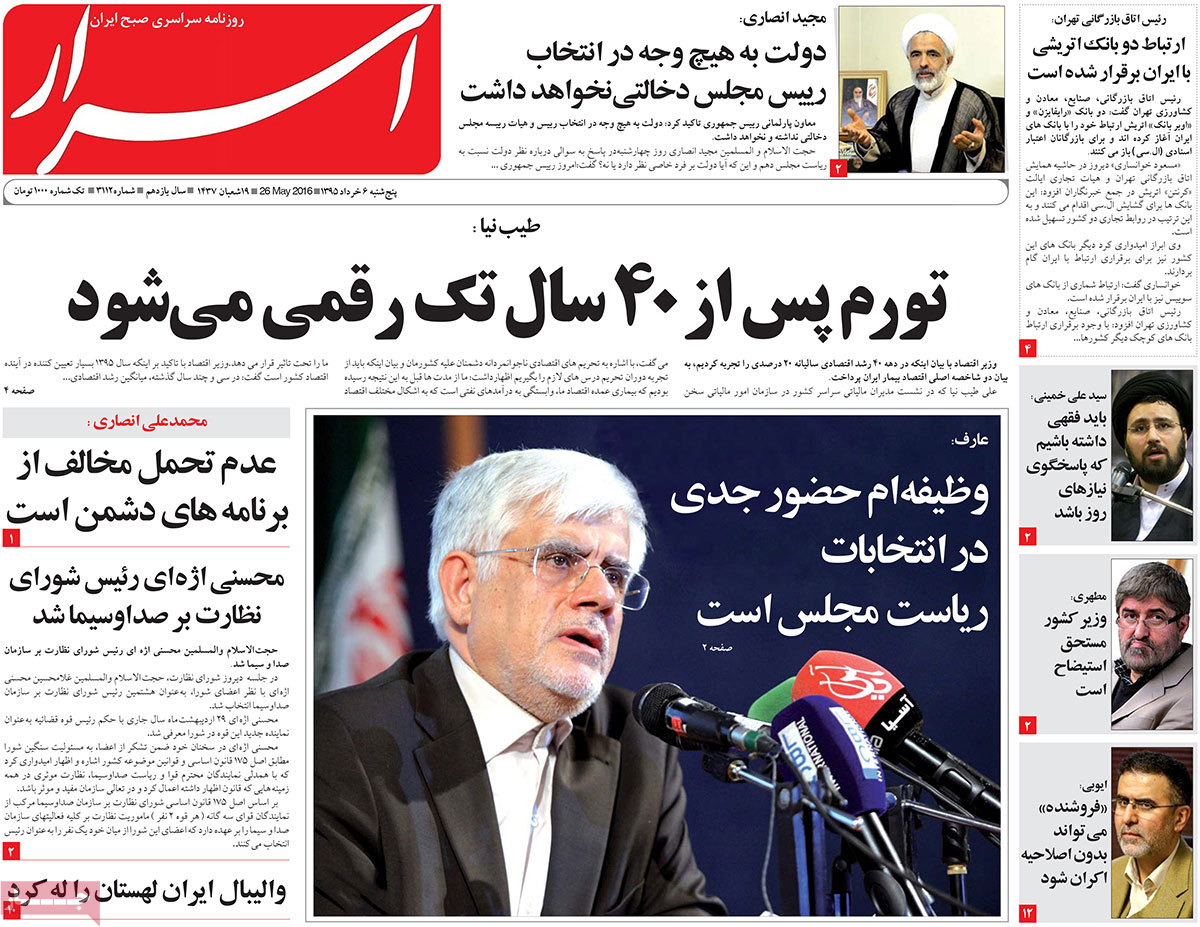
 

A Look at Iranian Newspaper Front Pages on May 26


Emtiaz:

1- Cigarette Kills 1 Person Each 8 Seconds: Health Minister

2- Arg-e Bam [Bam Citadel] Revives after 13 Years

3- Growth of Divorce Rate Stopped
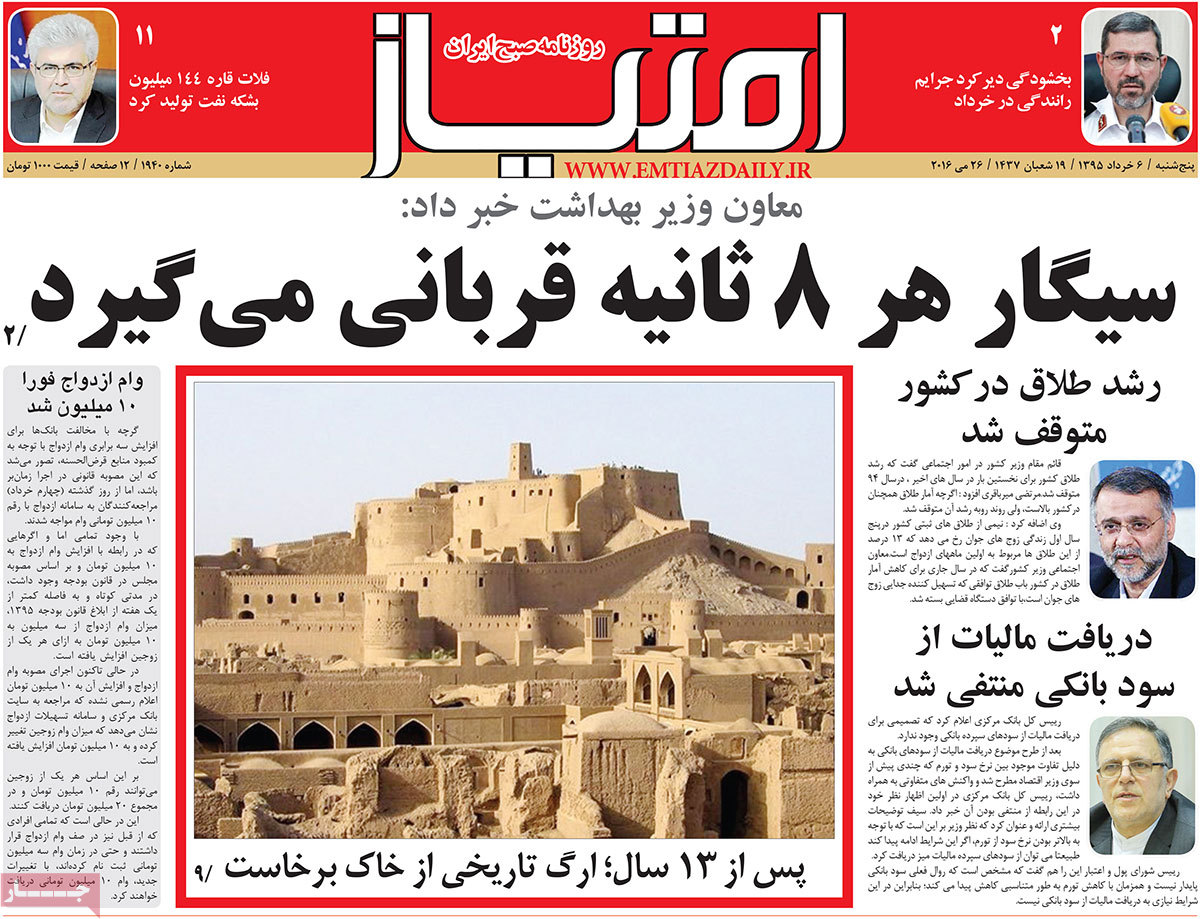
 

A Look at Iranian Newspaper Front Pages on May 26


Etemad:

1- Forensics Official Urges Increased Punishments for Alcohol Use
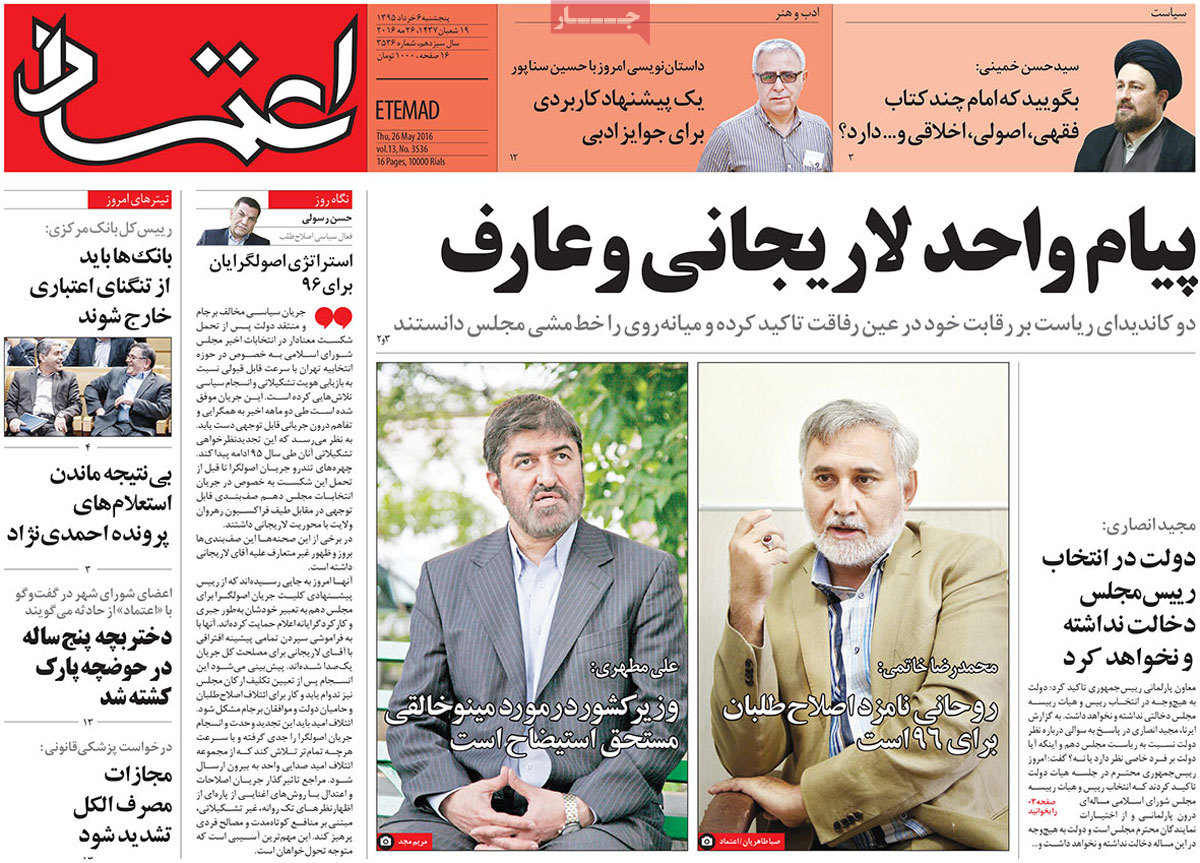
 

A Look at Iranian Newspaper Front Pages on May 26


Ettela’at:

1- People’s Message in Recent Elections Was to Ease Tensions in the Country

2- Tax Incomes to Become Government’s Main Source of Income: Minister

3- Victory in Fallujah Is Imminent and ISIS Is on Verge of Collapse: Iraqi PM
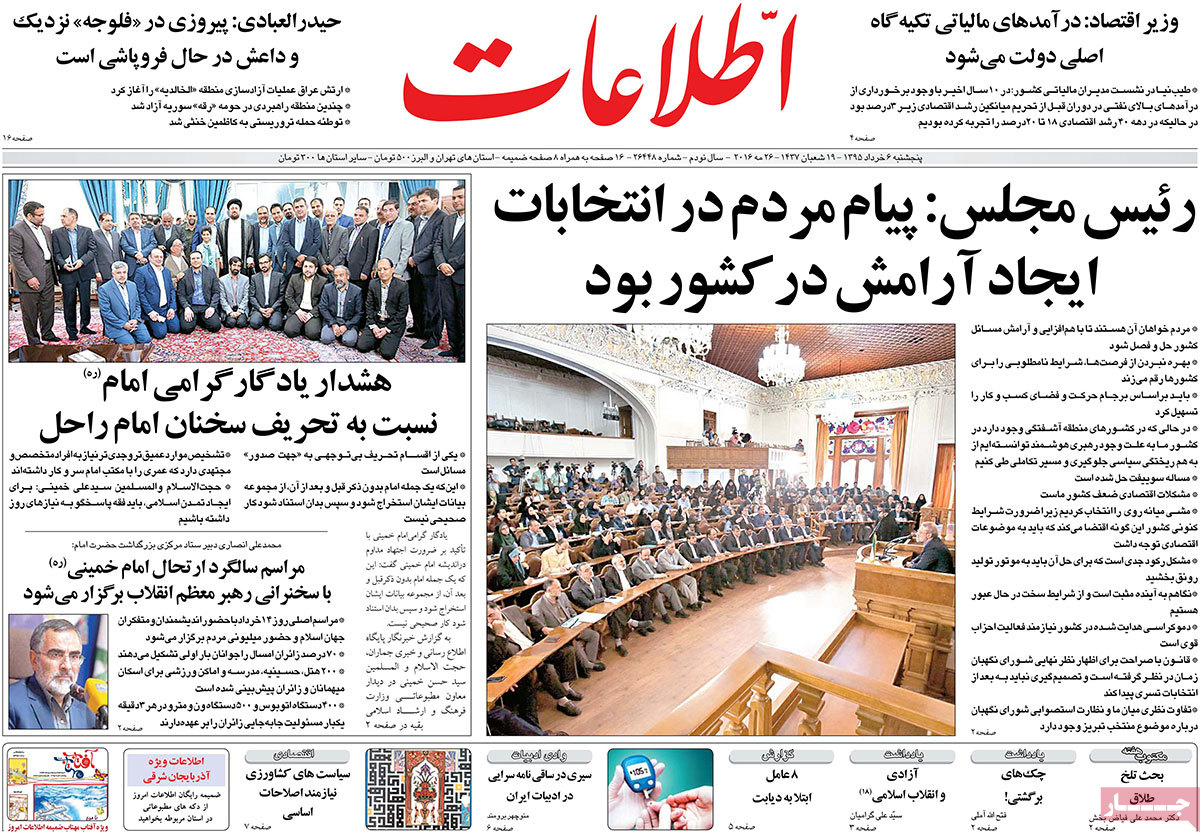
 

A Look at Iranian Newspaper Front Pages on May 26


Haft-e Sobh:

1- Traces of Alcohol Use in 4 Serious Incidents
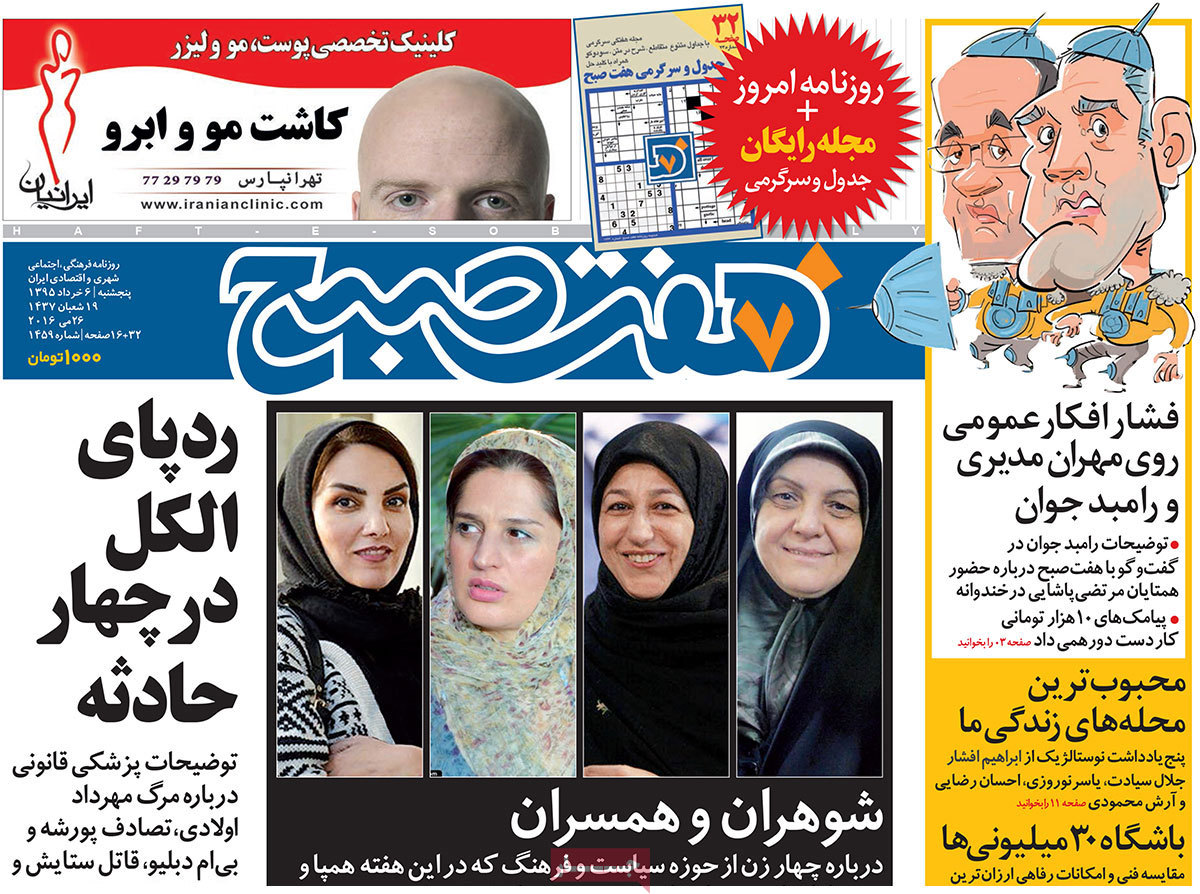
 

A Look at Iranian Newspaper Front Pages on May 26


Javan:

1- “Hellish” Behaviour towards Ayatollah Jannati: Were Rafsanjani and Karoubi the First Members-Elect in Tehran during Their Presidency? [Jannati’s election as the chairman of Assembly of Experts came as he had the least number of votes in Tehran, ranking 16 among the 16 candidates.]

2- Money-Lovers Won’t Achieve Resistance Economy: 2 Months after Leader’s Guidelines, Nothing Accomplished
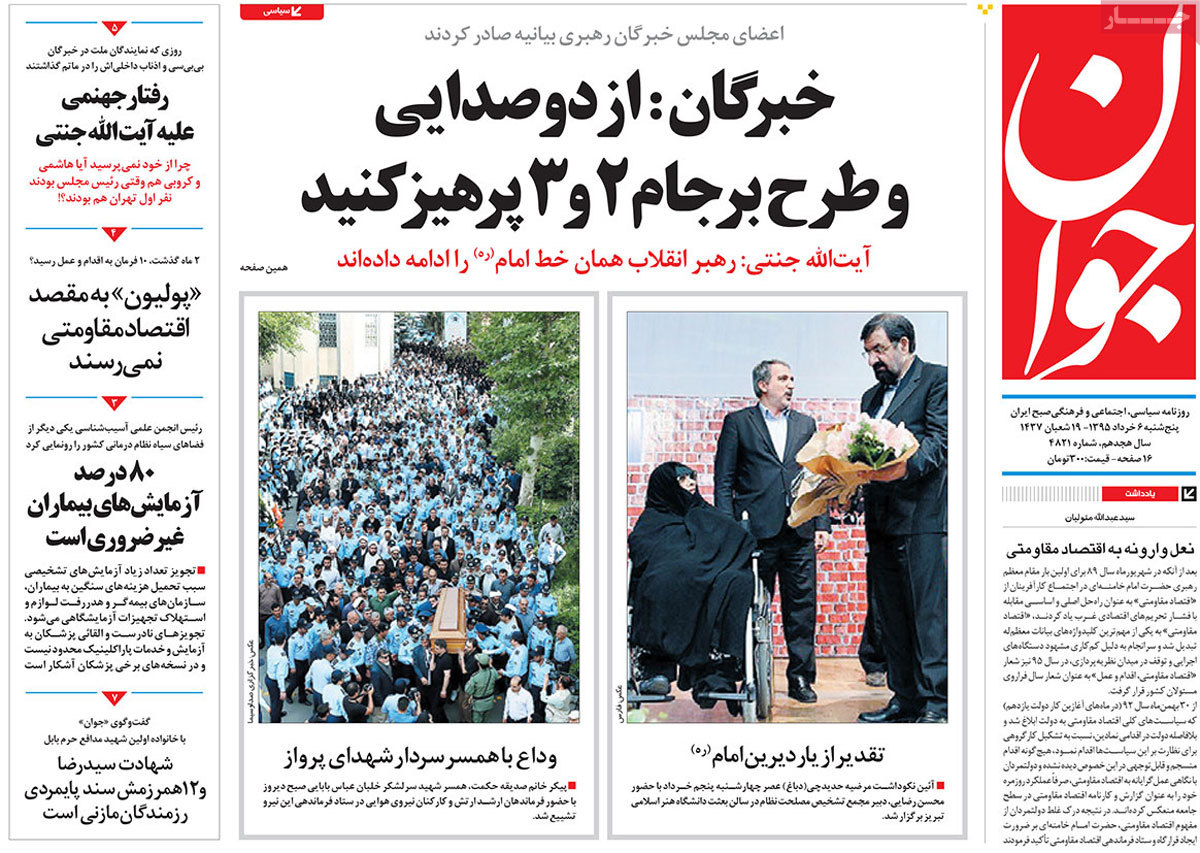
 

A Look at Iranian Newspaper Front Pages on May 26


Jomhouri Eslami:

1- Carter: USA Is a Big Reservoir of Racism

2- We Created Al-Qaeda 20 Years Ago: Clinton

3- Royal Dutch Shell Returns to Iran [Oil Industry] in Cooperation with 2 Iranian Companies

4- Iran’s Oil Exports to Europe Increased to 600,000bpd

5- Ayatollah Sistani’s Advice to Iraqi Fighters
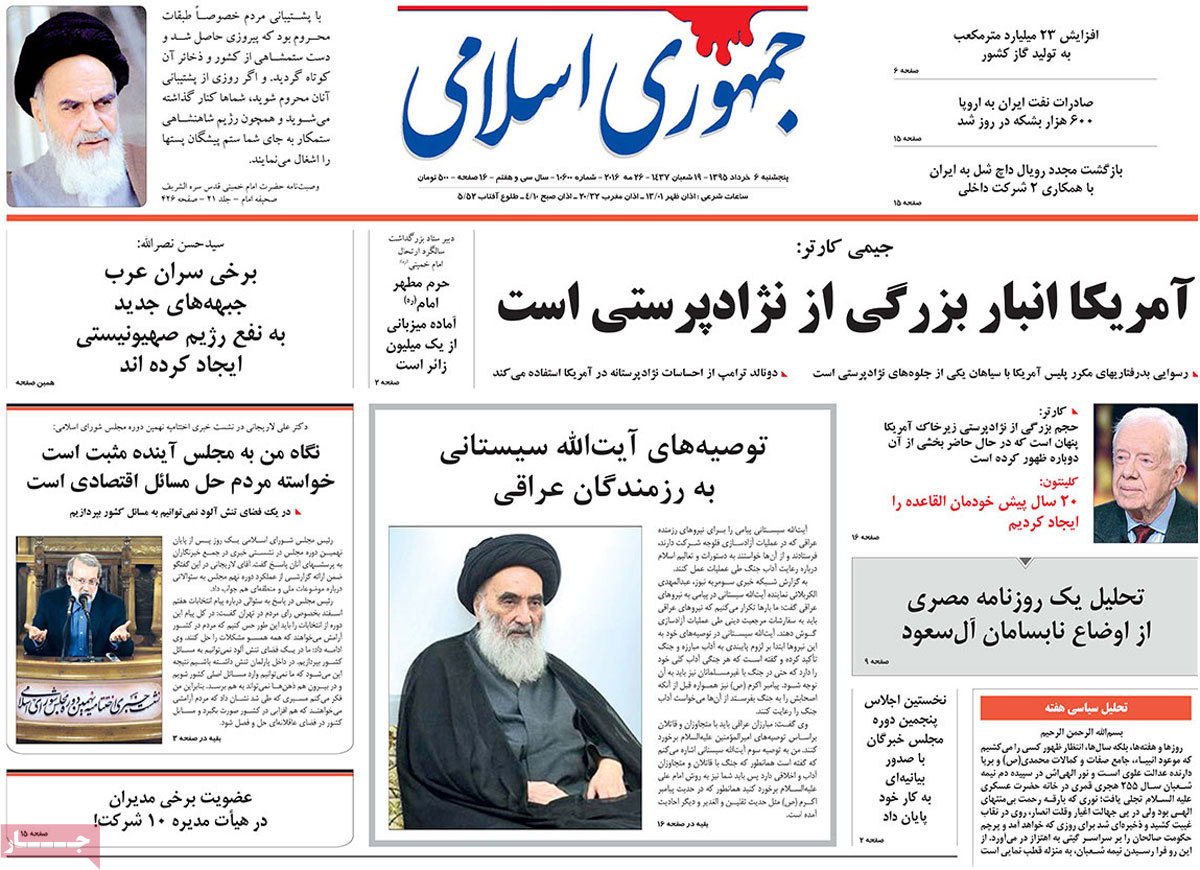
 

A Look at Iranian Newspaper Front Pages on May 26


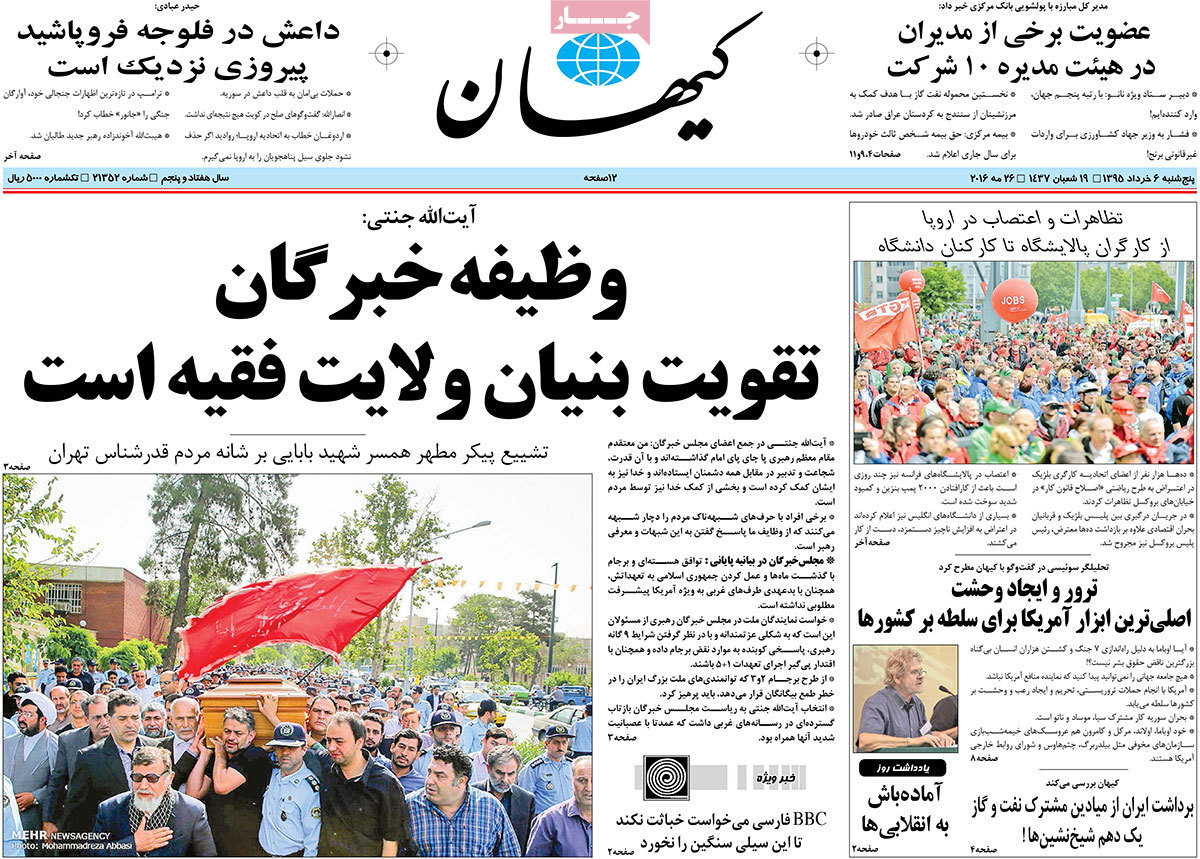
Kayhan:

1- Iran’s Oil Extraction from Joint Fields One-Tenth of That of Sheikhdoms

2- Terror and Intimidation, Main Instruments Used by US to Dominate Other Countries: Swiss Analyst told Kayhan
 

A Look at Iranian Newspaper Front Pages on May 26


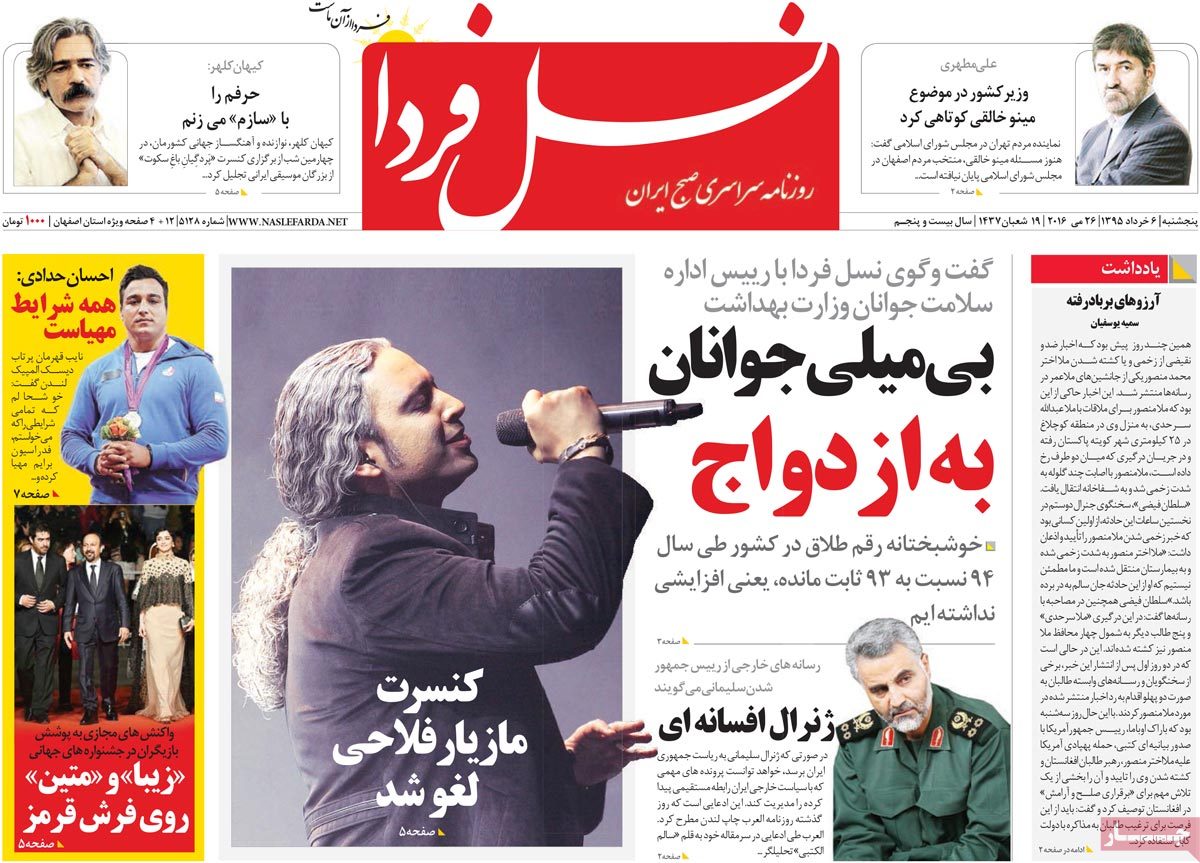
Nasl-e Farda:

1- Young Generation’s Reluctance to Marriage

2- Legendary General: Foreign Media Talk about General Soleimani’s Being Iran’s President
 

A Look at Iranian Newspaper Front Pages on May 26


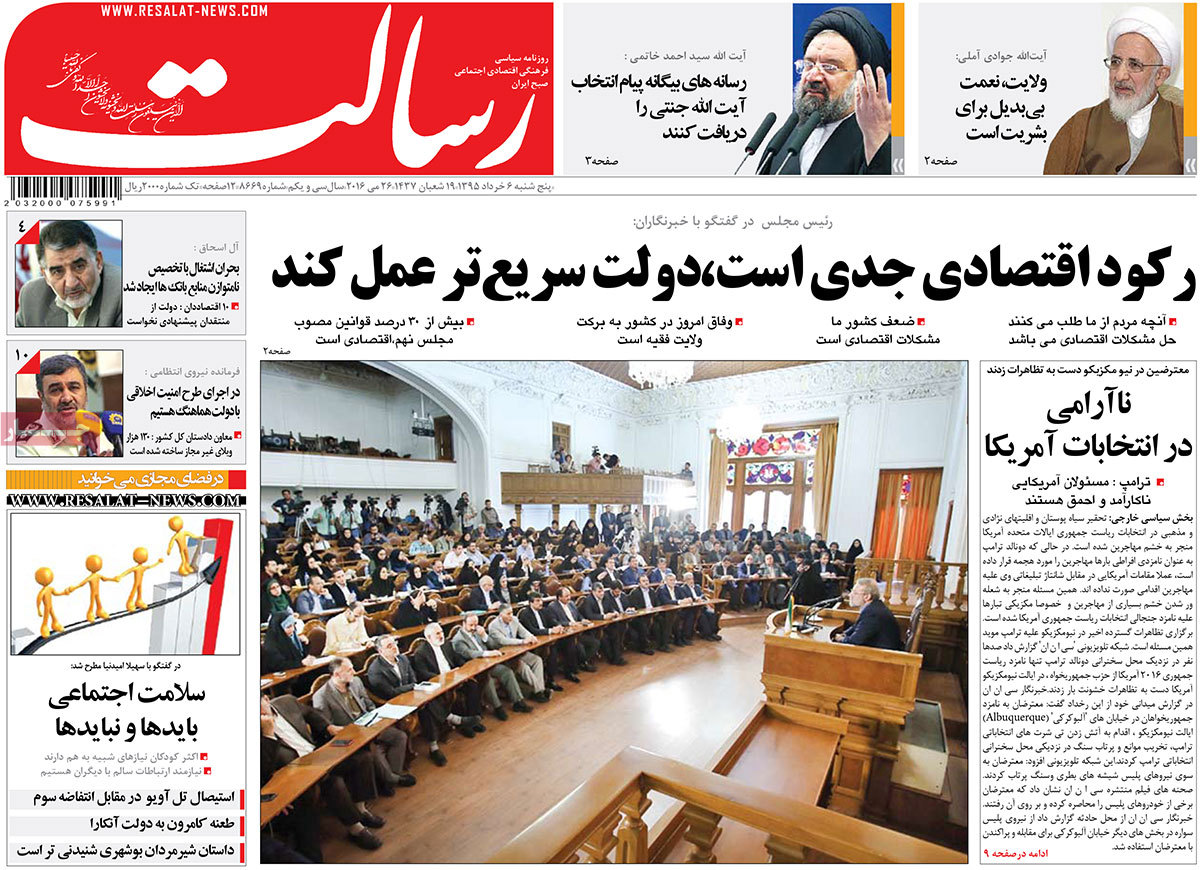
Resalat:

1- Foreign Media Should Understand Message of Ayatollah Jannati’s Election: Cleric Ahmad Khatami

2- Economic Downturn Is Serious, Gov’t Should Take Action Faster: Larijani

3- Unrest in US Elections: Protesters in New Mexico Hold Rallies
 

A Look at Iranian Newspaper Front Pages on May 26


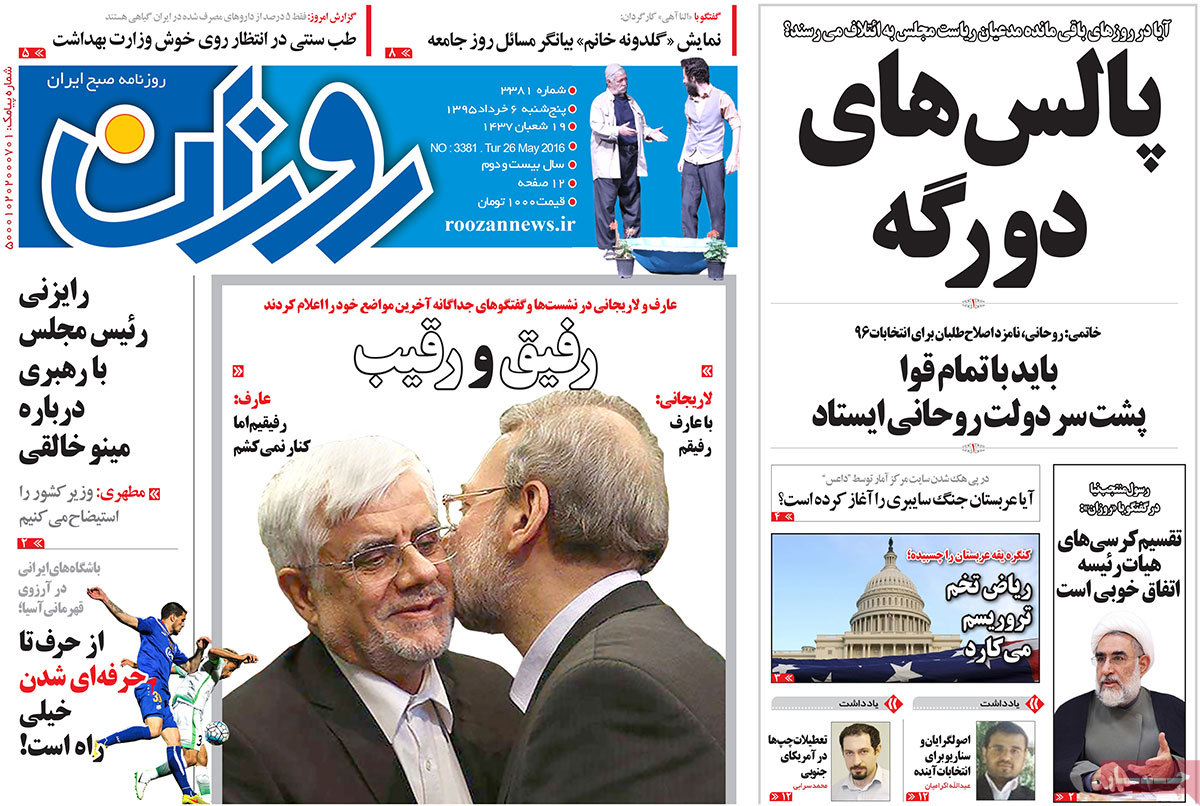
Roozan:

1- Parliament Speaker Larijani Consults Ayatollah Khamenei on Minoo Khaleghi’s Case

2- Riyadh Planting Seeds of Terrorism
 

A Look at Iranian Newspaper Front Pages on May 26


Sayeh:

1- Shanghai Cooperation Organization Waiting for Iran’s Accession: Putin’s Representative

2- Housekeeping in Capitalist World a Symbol of Exploitation of Women
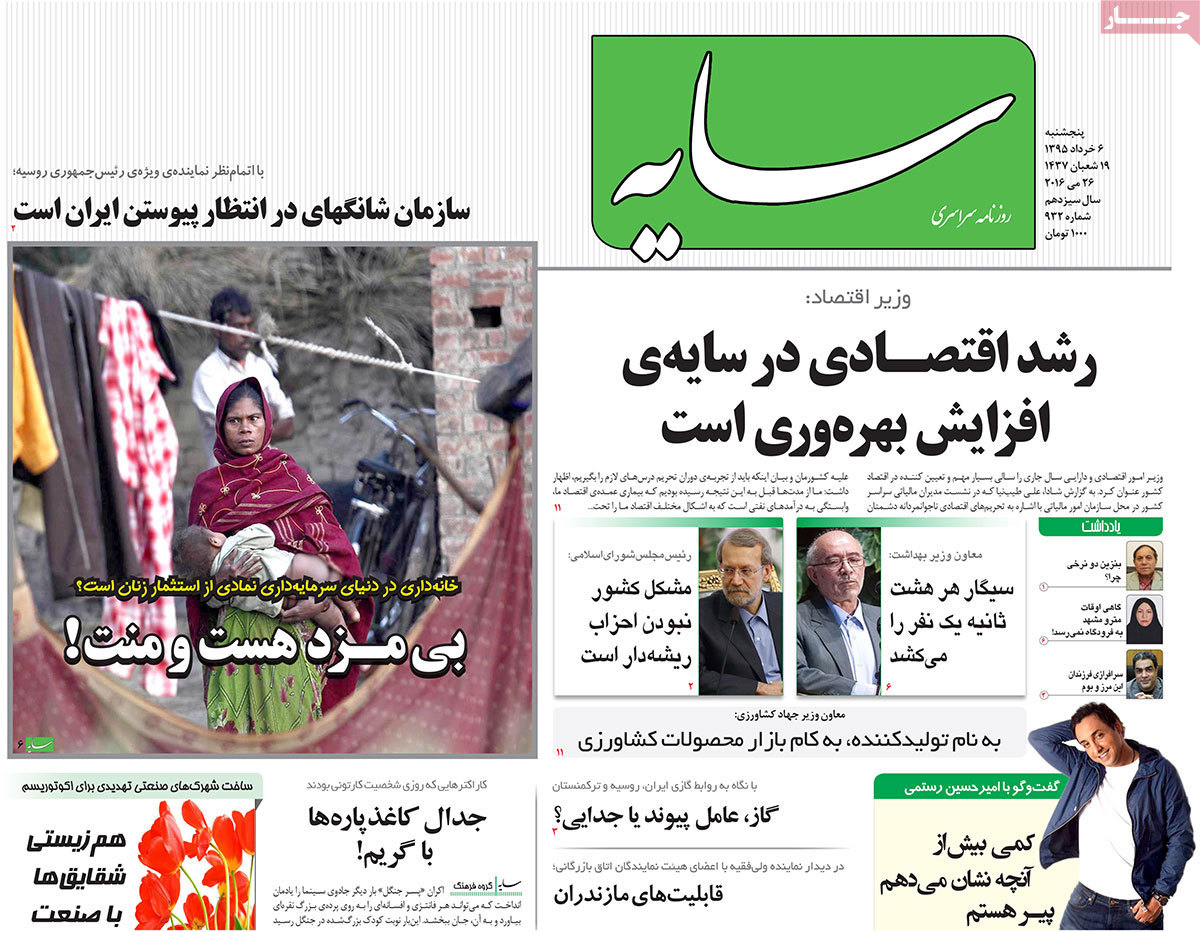
 

A Look at Iranian Newspaper Front Pages on May 26


Shahrvand:

1- Bam Smiles Once Again: Arg-e Bam Will Be Opened to Visitors after 13 Years [A huge earthquake devastated the historical citadel in 2003.]

2- New Incentives for Banks Giving Facilities to Exporters: Huge Step Taken by Gov’t to Encourage Exports

3- Father of Girls Beaten Up in Armenian Competition: I’m Happy My Daughters Became Famous

4- Mullah Haibatullah Becomes New Leader of Taliban
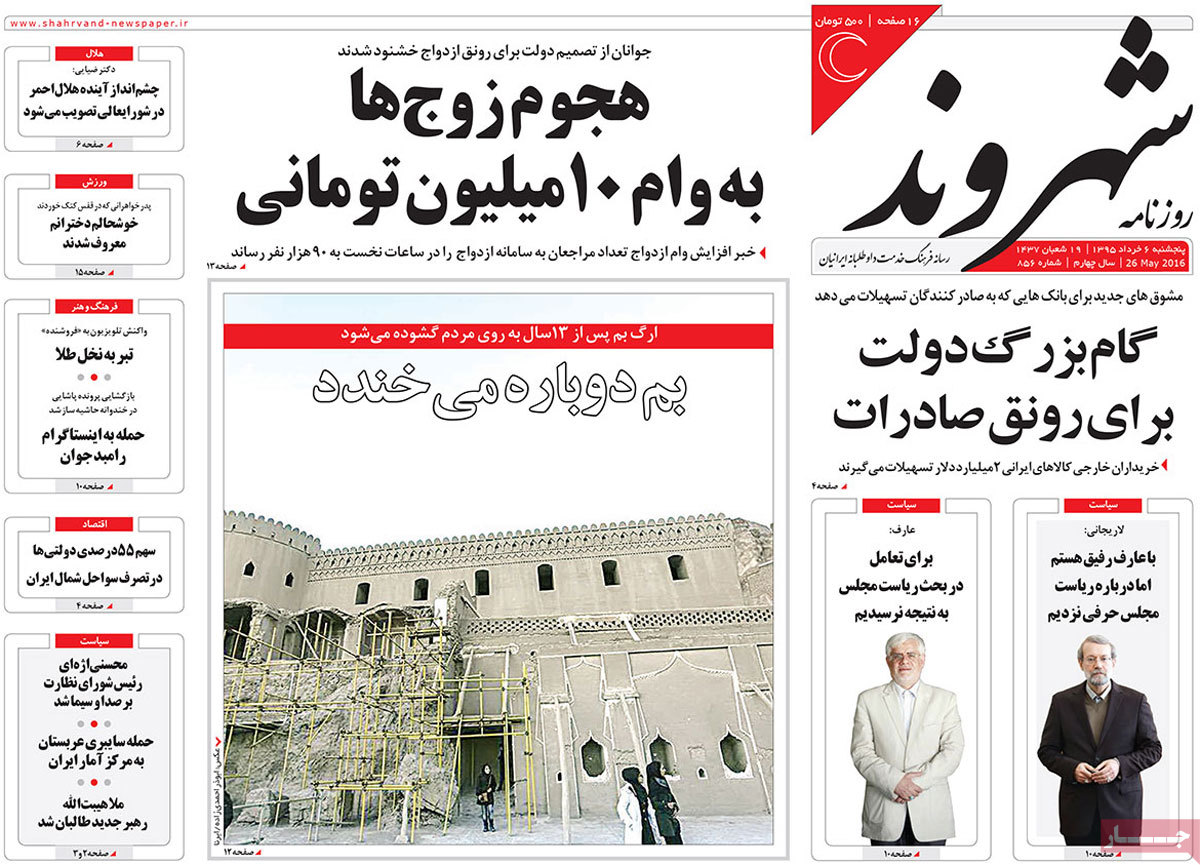
 

A Look at Iranian Newspaper Front Pages on May 26


Shargh:

1- First Statement by Jannati-Led Assembly of Experts: 2nd and 3rd JCPOAs Should Be Avoided [President Hassan Rouhani has repeatedly talked about how the country can resolve other problems, including domestic ones, using the same formula that led to the nuclear deal, JCPOA, and called them the 2nd and 3rd JCPOAs.]

2- Certain Changes in Cabinet Are Necessary: Reformist Figure Mohammad Reza Khatami

3- Saudi Arabia on Path of Regional Confrontation [Editorial]
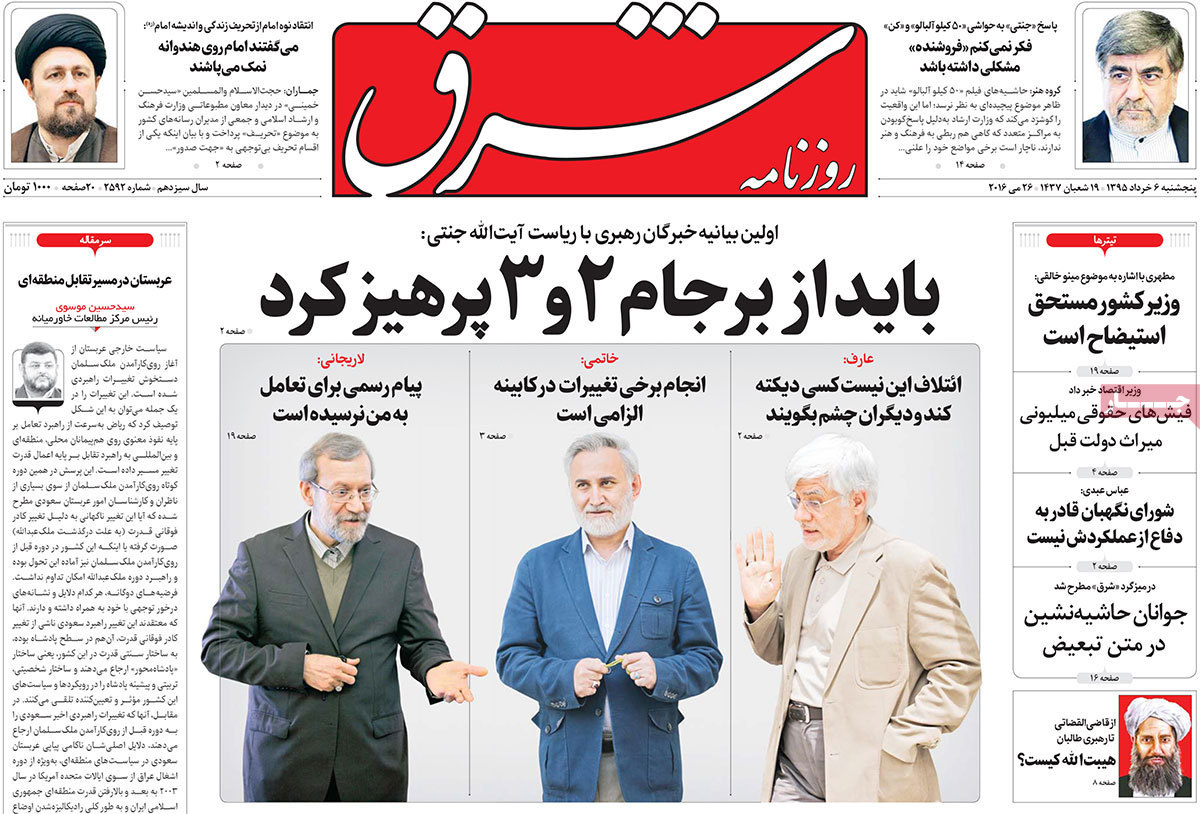
 

A Look at Iranian Newspaper Front Pages on May 26


Shorou:

1- KIA Pride Has Killed 92,000 Iranians in Past 20 Years

2- It Might Get Too Late to Permit Mohammad Reza Shajarian to Continue His Work in Iran [The legendary singer Shajarian has been banned from working in Iran because of his stances after the protests at 2009 presidential elections.]
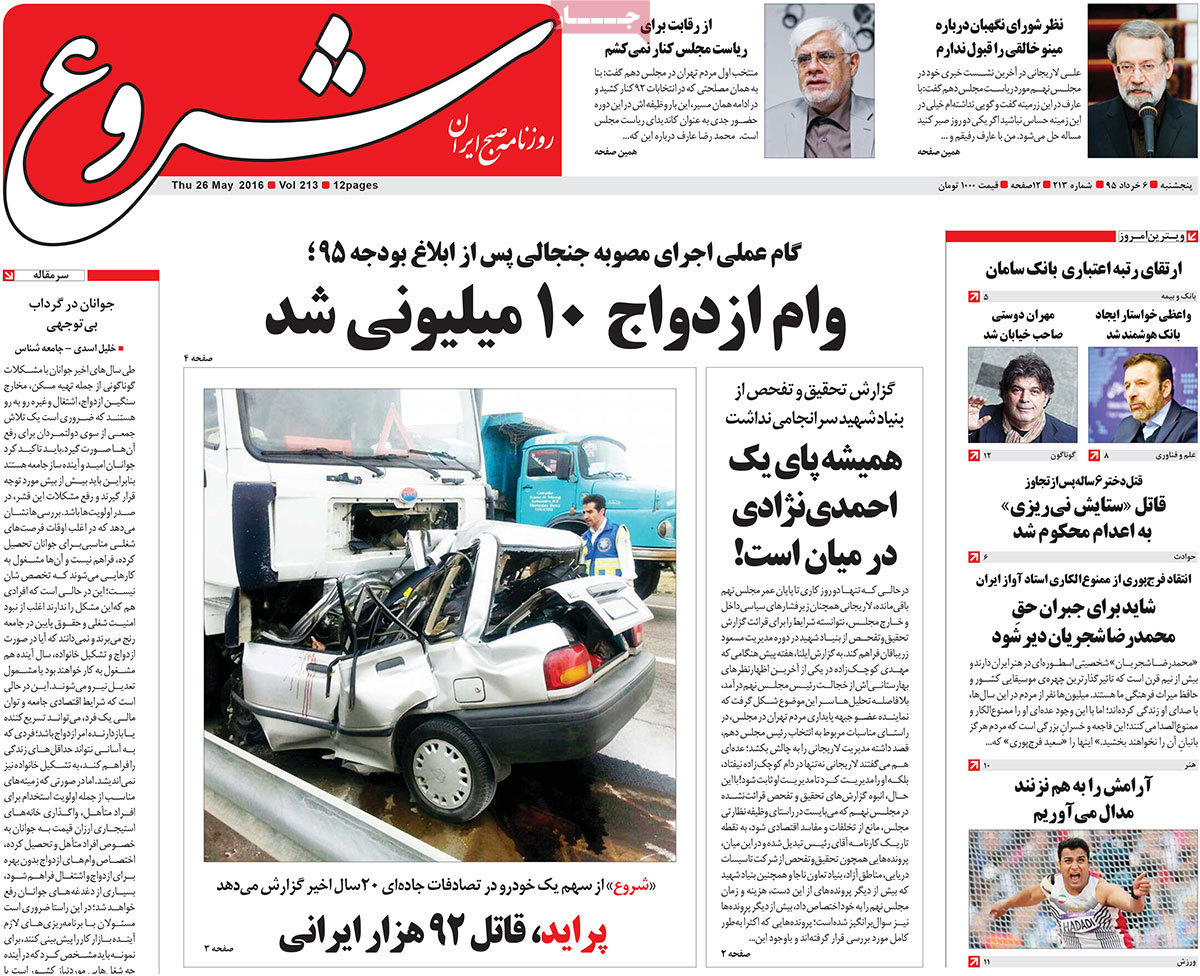
 

A Look at Iranian Newspaper Front Pages on May 26


Vaghaye Ettefaghieh:

1- ISIS Cleaned Iraq of Christians: Baghdad’s Anglican Church Archbishop
 

A Look at Iranian Newspaper Front Pages on May 26


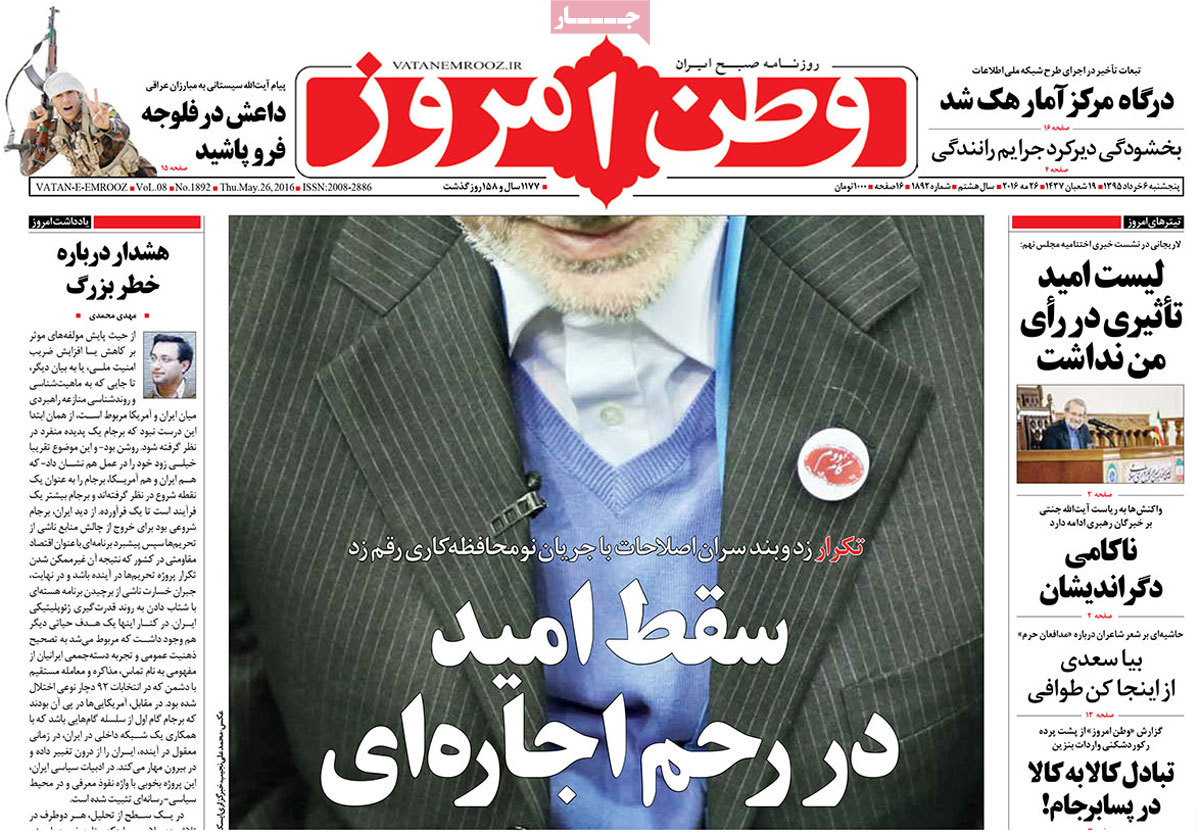
Vatan-e Emrooz:

1- Abortion of “Hope” in a Womb for Rent, Resulted from Repeated Conspiracy of Reformist Leaders with Neo-Conservatives

2- Iran Statistics Organization Portal Hacked: Consequences of Procrastinating Implementation of National Information Network Plan

3- Larijani: List of Hope Had No Impact on My Votes
 

A Look at Iranian Newspaper Front Pages on May 26


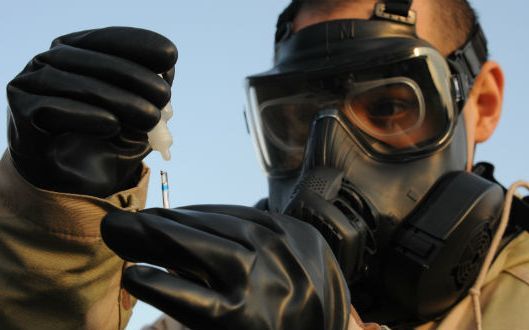
ISIS Carrying Out Chemical Experiments on Prisoners

ISIS is reported to have set up laboratories in built-up neighbourhoods in the heart of its so-called caliphate to avoid being targeted by coalition air strikes, The Telegraph reported, as covered by ISNA.

The terror group is known to harbour chemical and nuclear ambitions, and is trying to manufacture weapons not only for attacks within Iraq and Syria but also the West.

It has a special unit for chemical weapons research made up of Iraqi scientists who worked on weapons programmes under the former dictator Saddam Hussein, as well as foreign experts.

The head of the unit, Suleiman Daoud al-Afari, was captured during a raid by US special forces outside Mosul in March and is now sharing intelligence on ISIS’s chemical operation.

An investigation by Syrian and Iraqi citizen journalists, who report under the name Sound and Picture, reveals that he has now been replaced by Abu Shaima, an Iraqi doctor who worked at the University of Baghdad during Saddam’s reign.

Other than his links to the late Iraqi dictator, little is known about Shaima, which is customary for top ISIS leaders.

He is said last month to have moved the group’s operations away from its main laboratories at the universities of Mosul and Tel Afar, which have both been hit in recent months, to residential areas to protect it against aerial attack.

Residents of al-Mohandseen – which had been a wealthy Christian neighbourhood until ISIS seized the city – said several houses had been taken over by ISIS officials in the last few weeks. A number of large unmarked trucks have been parked outside and more recently they reported seeing dozens of dead dogs and rabbits in nearby rubbish containers.

An ISIS insider confirmed to the journalists, who shared the information with The Telegraph, that they had been dumped there after they were used for chemical testing.

The report also claimed ISIS has been carrying out experiments on prisoners they are holding at a secret jail in al-Andalus, in the Nineveh governorate of Mosul, exposing them to chlorine and mustard gas to test the toxicity.

Residents near the prison have reported breathing difficulties and children developing severe rashes – some of the side effects of exposure to such substances.

The extremists have seized large quantities of industrial chlorine and are believed to have the expertise to make mustard gas. They are also feared to have captured chemical weapon stocks from the Syrian army across the border.


The militant group has already used chemical weapons against Kurdish Peshmerga forces in northern Iraq and Syria.

In March, a suspected ISIS chemical attack on the Iraqi town of Taza, south of Kirkuk, killed three children and wounded some 1,500 people, with injuries ranging from burns to rashes and respiratory problems.

Brigadier Roger Noble, the deputy commander of international troops training and supporting the Iraqi army, told The Telegraph that ISIS militants are expected to use chemical weapons against troops trying to retake Mosul, Iraq’s second city.

Hamish de Bretton-Gordon, former commanding officer of the UK Chemical, Biological, Radiological and Nuclear Regiment (CBRN) and chemical weapons adviser to NGOs in Syria and Iraq, told The Telegraph the revelations showed the group was adapting to the coalition’s punishing air strikes.

“ISIS’s chemical weapons operation has been heavily targeted – as is detailed in this report – and moving into residential areas is exactly what you would expect them to do now.”

He said Western security services should be concerned that their chemical operations have effectively gone underground, allowing them to continue their work outside of strike range.

“Now we know the extent of the ISIS chemical and dirty bomb aspirations we must make doubly sure that our security in the UK is absolutely water-tight against this threat.”

Iranian-Made Haemodialysis Machine Ready to Be Released

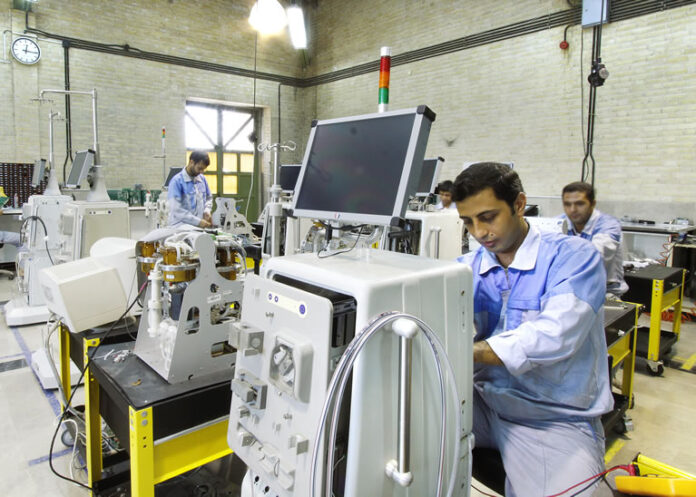
Arya Teb Firouz is the only company in Iran that manufactures haemodialysis machines, putting the country in the small list of countries that are able to produce such machines, Taheri said, as reported by IRNA and translated by IFP.

“Such countries as Germany, Japan, China, Italy, and the US are producing and releasing these machines, and we are the ninth company manufacturing it worldwide,” he went on to say.

The semi-industrial production of the haemodialysis machine was carried out by Iranian researchers, Taheri said, adding that the company can manufacture as many as 1000 machines per year.

The machine has passed all standard and clinical tests and received all required licences and approvals from Iran’s Health Ministry and Tehran University of Medical Sciences, Taheri said, explaining that the machine is being pilot-tested in two hospitals in the capital city.

Talks are underway with several countries, including Tajikistan, Kyrgyzstan, and Afghanistan, for the export of these machines, and with Iraq for the establishment of a dialysis centre, he added.

“We are seeking to receive European and American licences, including the FDA’s, to expand our exports,” Taheri said, adding that such licences would prepare the grounds for the export of these machines to developed countries as well.

Haemodialysis is a process of purifying the blood of a person whose kidneys are not working normally. It is a way of cleansing the blood of toxins, extra salts and fluids through a dialysis machine called an “artificial kidney”. It helps maintain proper balance of bodily chemicals such as potassium, sodium and chloride, and it keeps blood pressure under control.

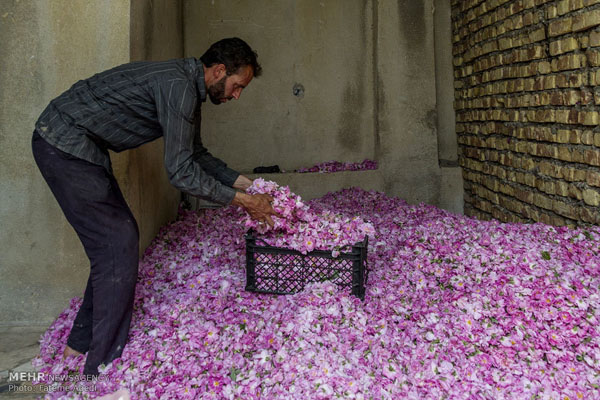
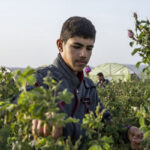
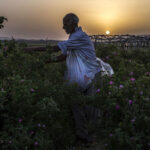
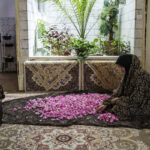
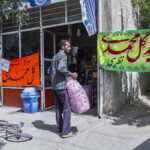
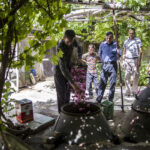
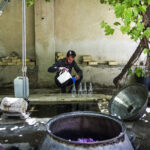
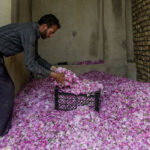
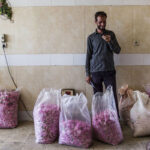
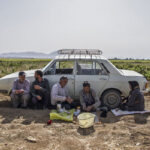
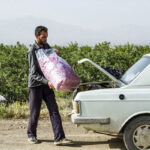
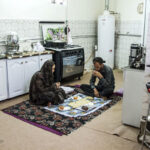
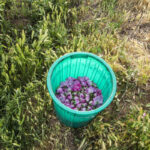
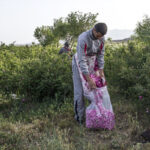
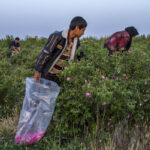
Rose Harvest

Iran’s Central Province, with its large fields of flowers and medicinal herbs, is one of the major sources of herbal extracts in Iran. Here, you can see photos of the yearly rose harvest, courtesy of Mehr. Rose petals and rose essence have been used for centuries in Iran in confectionery, cooking, perfume, traditional medicine and for flavouring tea.


Mandatory Food Standards Implemented to Help Control Non-Communicable Diseases

‘Traffic light’ tags – with information indicating how much fat, salt, sugar and trans-fatty acids (TFAs) a food product contains – have so far been placed on 60% of food products,” he said, IRNA reported.
“By the end of August it will become mandatory for all local food manufacturers to use food labels with nutritional facts. Also, measures to raise awareness about the importance of paying attention to the food labels will start from June through publicity campaigns,” he said, on the sidelines of the recent national meeting of health deputies of medical sciences universities. Stating that the worst Iranians dietary habits are consuming excess salt, sugar and oil, he noted that the import of trans-fatty acids into the country has been banned by the FDA.

Fighting TFAs
In order to achieve the document’s goals by the end of 2025, TFAs should be completely eliminated from the domestic food supply chain, he said.
According to the FDA, in 2005 the average amount of TFAs in edible liquid oils was 25%. This was brought down to 5% by 2014 and will further decrease to 2% by the end of the current fiscal year in March 2017.
On average, each Iranian consumes more than 19 kg of oil each year and improving edible oil standards can help improve people’s health. There are two kinds of fats in food products including TFAs and saturated oils. Although there is some disagreement among health experts about the effects of saturated oils on health, as some believe animal fat in butter and milk are beneficial, all experts agree that TFAs are definitely bad for people’s health.
Highlighting the negative effects of palm oil on people’s health, Dinarvand said that this year the tax on palm oil imports was increased by 16%. Use of palm oil in dairy products was banned in 2014.


War on Salt
High salt intake in the country poses serious risks to people’s health. Many countries are taking measures to reduce the intake of dietary salt to 5 grams per day, and some others to 3 grams per day. Per capita salt consumption is 12 grams per day in Iran, he said.
Traditional breads also contain high amount of salt. “Recently, an ultimatum was issued to all bakeries to reduce the amount of salt in all types of bread or nan. After the measure, the salt amount in breads has been reduced from the previous 2.3% to 1%.”
However, 60% of the problem is related to excessive salt added to home-cooked foods; therefore people’s cooperation is essential in addressing the problem. Stating that “We now have plans to reduce salt intake by 30% over a five-year period,” he said the scheme should be implemented gradually, as it takes time to change people’s sense of taste; otherwise they may oppose it.

Life Expectancy in Iran Rises to 73 for Men, 76 for Women

Eini-Zinab made the remarks in a conference on demographic policies held in the south-eastern city of Zahedan, as reported by IRNA and translated by IFP.

“Life expectancy among Iranian women has also risen during these years, rising from 38 in 1950 to 76 in 2011,” he said.

The rates are expected to increase in the coming years, but the rate of increase is going to be slower than previously, Eini-Zinab explained.

He further praised the country’s success in reducing fatalities, saying the death rate among Iranians under 18 years of age has decreased considerably in the 1996-2011 period.

However, he added, the rate of fatalities among citizens aged between 18 and 35 has increased, mainly because of drug addiction, car accidents, and social ills.

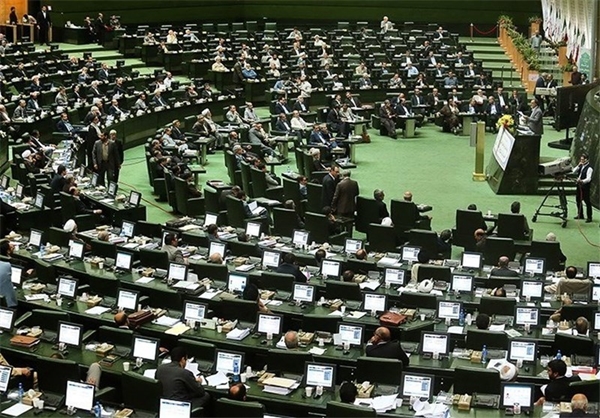
Speaker Larijani: One Third of Previous Parliament’s Decisions Focused on Economy

parliament

Talking to reporters on Wednesday May 25, one day after the conclusion of the last session of the legislative body, he said the parliament had paid special attention to economic issues as a main topic of debate in the country.

He noted that the legislators focused on the economic situation in the country in 30% of their ratifications.

Commenting on the most important achievements of the parliamentarian in the past four years, he referred to the debates about the nuclear negotiations, as well as the act on compensatory measures against the seizure of Iranian assets by the US as the most significant decisions adopted by the speaker.

He also pointed to extensive efforts by parliamentarians to expand dialogue and cooperation with their foreign counterparts as measures which also helped diplomatic endeavours.

He also said that the most outstanding outcome of the Joint Comprehensive Plan of Action (JCPOA) for the country was in improving conditions for entrepreneurs and investors.

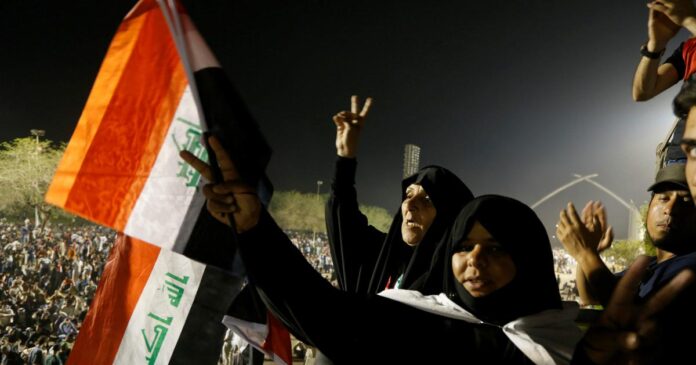
US Policies Move Iraq towards Disintegration: Analyst

What follows is IFP’s translation of excerpts from KhabarOnline’s interview with Tajik.


Nosratollah Tajik“The US didn’t have a good understanding of Iraq’s domestic issues and lacked a transparent policy towards the country. For those reasons, it can be regarded as one of the main culprits behind the current situation in Iraq,” Tajik said.

“The economic interests that Iraq had for the US were reasons for Washington’s interference in the Arab country. Washington, therefore, has had the greatest influence on the arrangement of Iraq’s domestic politics and its ruling system, given the power it achieved through its interference in Baghdad,” he went on to say.

However, Tajik said, the US was unfortunately unaware of Iraq’s internal affairs and Iraqi society was not prepared [for US intervention], either.

Under such circumstances, the system pursued by the Americans will gradually move Iraq towards disintegration, he predicted.


Iran’s Reaction to the Current Crisis in Iraq

“In my opinion, Iraq is not on a good track. This undesirable trend might even have negative effects on our [Iran’s] national security,” he warned.

“We need to have well-ordered and calculated policies towards Iraq. The sectarian issues in Iraq will be of no help to our foreign policy, so we should prepare the groundwork for restoring stability and security to Iraq, and adopt an approach that helps them overcome the crisis.”

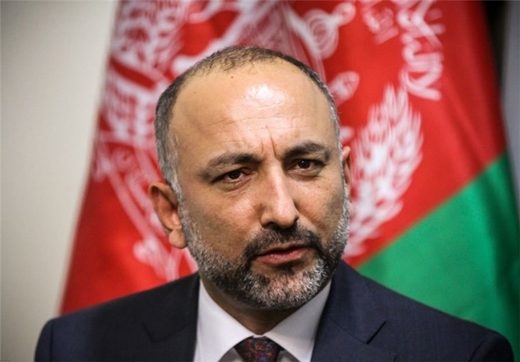
Afghan Official Thanks Iran for Sheltering Refugees

Atmar made the remarks in a Tuesday meeting with Reza Seifollahi, deputy secretary of Iran’s Supreme National Security Council (SNSC) in Chechnya’s capital of Grozny.

He further expressed the hope that Tehran’s support for Afghan nationals would continue and bilateral cooperation between the two countries would expand in all spheres, including politics, economics and security.

During the meeting, the two officials hailed the growing relations between Tehran and Kabul and stressed the need for further security cooperation in the fight against terrorist groups in the Middle East.

Iran has hosted Afghan refugees since the late 1970s, following the occupation of their country by the Soviet Union. Although many of those refugees returned to their country voluntarily, there are still hundreds of thousands of documented and undocumented Afghans in Iran.