Sunday, April 12, 2026
Home Blog Page 4976

IAEA: Iran honoring nuclear commitments

IAEA

Iran is honoring its commitment not to expand its atomic activities while negotiations are underway between the Islamic Republic and six world powers on a comprehensive final deal, a confidential report by the UN nuclear body says.

The monthly update report, obtained by The Associated Press after it was posted on the website of the International Atomic Energy Agency (IAEA), showed that Iran was living up to its obligations to limit certain aspects of its nuclear energy program under an interim nuclear deal it signed with six world powers in November 2013.

The report said that Iran was not enriching uranium above 5 percent, adding that the Islamic Republic was also diluting or converting most of its stockpile of 20-percent enriched uranium.

Iran is not advancing work at Fordow uranium enrichment facility, the report said, adding that Tehran is maintaining a construction freeze on the Arak heavy water reactor that would produce plutonium.

The IAEA report comes as Iran and P5+1 – the US, France, Britain, China, Russia and Germany – are in talks to secure a final comprehensive deal over Tehran’s nuclear work.

Political directors of Iran and P5+1 wrapped up their talks in Geneva, Switzerland, on Sunday.

Since an interim deal agreed in Geneva in November 2013, the negotiating sides have missed two deadlines to ink a final agreement. Tehran and the six countries now seek to reach a high-level political agreement by March 1 and to confirm the full technical details of the deal by July 1.

New US sanctions

The report was released as a bipartisan group of US senators is pushing a new round of sanctions on Iran.

US President Barack Obama has, however, warned that any new bans would harm Tehran’s nuclear talks, threatening that he will use his veto power to stop any sanctions bills.

Dialogue best solution to settle Yemen conflict: Larijani

Yemen

The Iranian Parliament (Majlis) speaker says the country supports the restoration of peace in the Middle East, underlining talks as the best possible way to resolve tensions in Yemen.

“Misunderstandings among Yemeni political groups need to be removed through talks,” Ali Larijani told Yemen’s Parliament Deputy Speaker Mohammad al-Shaddadi on Tuesday on the sidelines of a 10th session of the Parliamentary Union of the Organization of Islamic Cooperation (PUOIC) in Turkey.

Hoping for the tension in Yemen to be defused immediately, Larijani said “Iran always tries to help establish stability in all countries. As for Yemen [the Islamic Republic] will tap into all its potential to help establish lasting peace [in the Arab country].”

He also highlighted the role of the Yemeni Parliament in facilitating talks among political groups aimed at removing divisions.

The Yemeni official, for his part, highlighted Iran’s constructive role in the Middle East. He also hoped for the restoration of stability in his country.

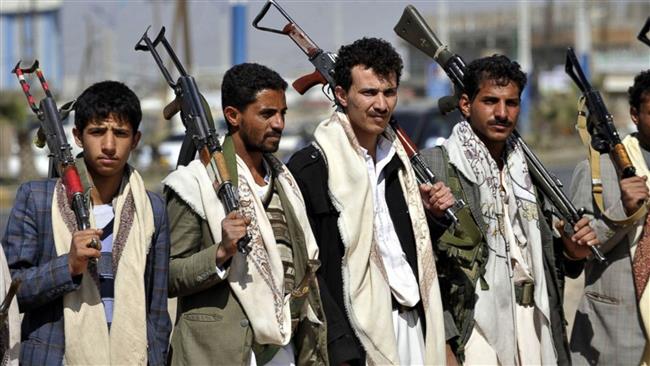
Yemen has been the scene of tensions between the central government and Ansarullah revolutionaries after fighters from Shia Ansarullah movement arrested Ahmed Awad bin Mubarak, President Abdrabuh Mansur Hadi’s chief of staff, at a checkpoint in the country’s western district of Hada a few days ago.

On Tuesday, Shia Ansarullah fighters in the poor country gained full control of the presidential palace in the capital, Sana’a.

In a televised address on the same day, the Ansarullah ringleader, Abdul-Malik al-Houthi, said the Hadi administration should be held accountable for the escalation of violence in the Arab country.

The Ansarullah leader called on Hadi to “speed up” the implementation of a UN-brokered peace agreement reached in September 2014 or face the dire consequences of his decisions.

This comes as al-Qaeda militants have also been engaged in battles with Ansarullah fighters over the past months. Yemen’s central government has so far failed to deal with the terrorist threat.

What Zarif told reporters and fellow commuters on the subway

Zarif-Metro

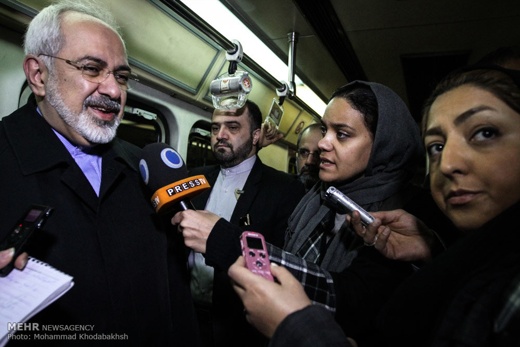
On Monday January 19, which marked the Clean Air Day in Iran, President Rouhani and members of his Cabinet took the subway to work. On Tuesday Haft-e Sobh daily carried a report on what Foreign Minister Mohammad Javad Zarif told reporters and ordinary citizens who happened to be on the same car during the morning commute. The following is a partial translation of the brief report:

A reporter with the Iranian Students News Agency asked the foreign minister what he would do if he were in charge of the Environment Protection Organization to keep the air clean. In response Mr. Zarif said, “I wouldn’t get involved in things I have no knowledge about. This [diplomacy] is the only thing I know.”

[…]

In reaction to critical comments by some media outlets and officials about the walk he took with US Secretary of State John Kerry on the streets of Geneva, he said that focusing on the peripheral matters won’t help us solve the problems. “What we did in Geneva was simply designed to clear the rather tense air that prevailed in the conference room.”

At this point a reporter asked the foreign minister, “If open-air meetings contribute to progress in the talks, why don’t you hold all your meetings outdoors?”

In response the top diplomat said, “That is a good point. The only problem is that it is too cold outdoors and cold air may give rise to other problems.”

When bombarded with questions by reporters, the foreign minister said, “Down here on the subway, I can’t run away from you.”

And in response to a question as to how often he rides the subway, he said, “When I was between jobs, my wife and I would take the subway to the grand bazaar, not necessarily to buy stuff, but have fun.”

At this point a passenger told Mr. Zarif that some view him a new Mosadegh [a nationalist prime minister who played a key role in the nationalization of the oil industry] and thanked him for standing up for the country’s national interests.

A look at Iranian newspaper front pages on Jan. 21

Iranian Newspapers Headlines

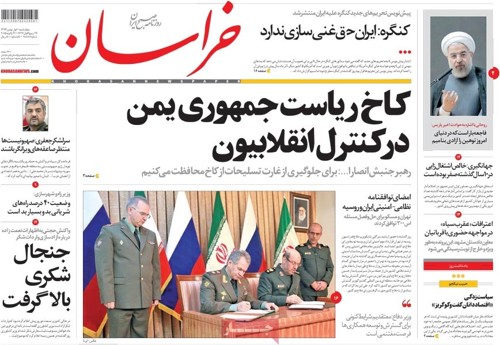
Conclusion of a military cooperation deal between Iran and Russia which could possibly pave the way for the delivery of the S300 missile system to Iran by authorities in Moscow dominated the front pages of Iranian newspapers on Wednesday. The warning the commander of the Islamic Revolution Guard Corps issued to Israeli authorities following the martyrdom in an Israeli airstrike of a revolution guards commander in Syria appeared on the front pages too. Last but not least was the swipe President Rouhani took at those who kill in the name of religion and those who insult religions in the name of freedom of speech.


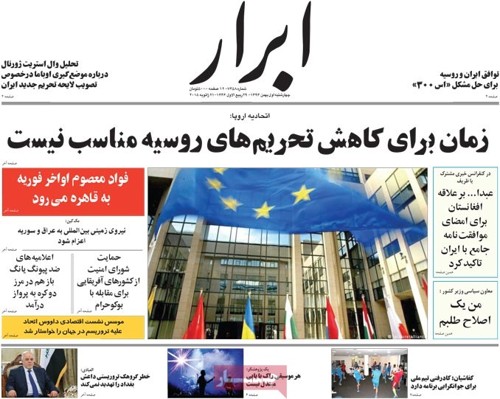
Abrar: Afghan Chief Executive Abdullah Abdullah has expressed Kabul’s interest in conclusion of a comprehensive deal with Iran.
 

Abrar Newspapre-1-20


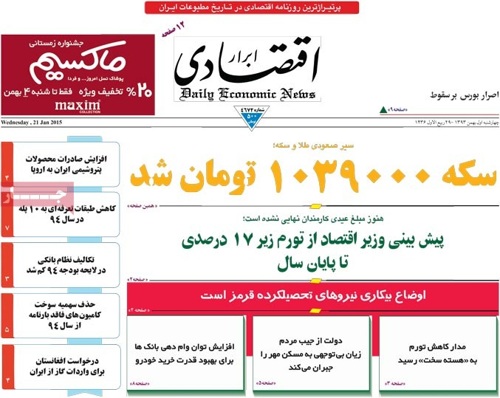
Abrar-e Eghtesadi: Afghanistan seeks to import natural gas from Iran.
 

Abrar Eghtesadi Newspapre-1-20


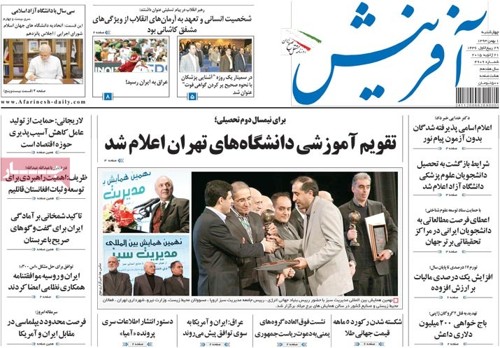
Afarinesh: Foreign Minister Mohammad Javad Zarif has said that Tehran attaches strategic importance to Afghan development and stability.

Afarinesh: Secretary of the Supreme National Security Council Ali Shamkhani has signaled Tehran’s readiness to hold “frank talks” with Saudi officials.
 

Afarinesh Newspapre-1-20


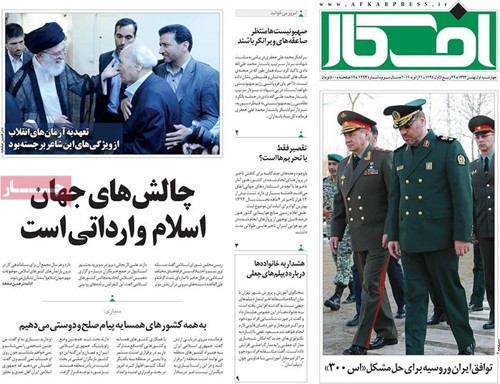
Afkar: The commander of the naval forces of the Iranian Army has said that Iran sends a message of peace and friendship to all neighboring countries.
 

Afkar Newspapre-1-20


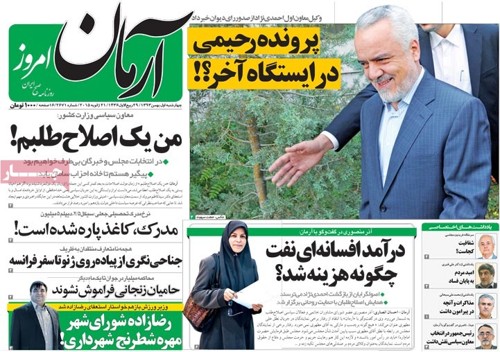
Arman-e Emrooz: Babak Zanjani, a young billionaire who stands accused of massive corruption, will stand trial within a month.

Arman-e Emrooz: The newly appointed deputy interior minister has said that he is a reformist and that the Interior Ministry will maintain impartiality in upcoming elections for parliament and the Assembly of Experts.
 

Arman Newspapre-1-20


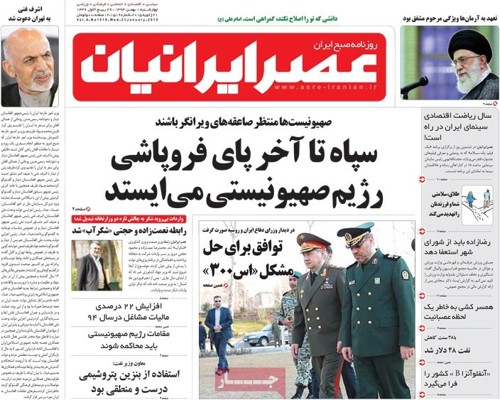
Asr-e Iranian: Afghan President Ashraf Ghani has been invited to pay an official visit to Iran.
 

Asr Iranian Newspapre-1-20


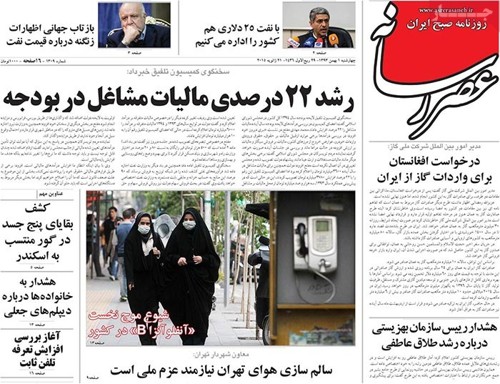
Asr-e Rasaneh: A first wave of an influenza B outbreak has swept the country.
 

Asr Resaneh Newspapre-1-20


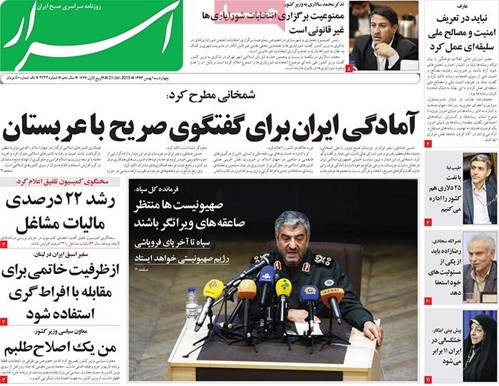
Asrar: The commander of the Islamic Revolution Guard Corps has said the Zionists should await “destructive thunderbolts” [after a senior revolution guards commander was killed at the hands of the Zionists in an attack on Syrian soil].

Asrar: A former Iranian ambassador to Lebanon has said the potential of [former President Mohammad Khatami] should be tapped in countering extremism.
 

Asrar Newspapre-1-20


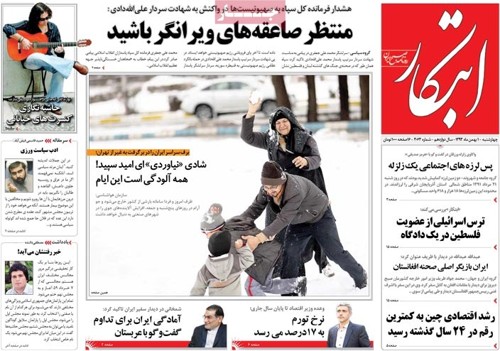
Ebtekar: The minister of economy and financial affairs has said inflation will fall to 17 percent by the end of the year [March 21, 2015].
 

Ebtekar Newspapre-1-20


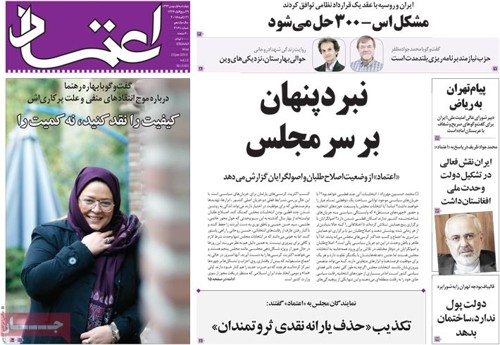
Etemad: Foreign Minister Mohammad Javad Zarif has said that Tehran played an active role in the formation of a national unity government in Afghanistan.
 

Etemad Newspapre-1-20


Ettela’at: “Insults, terror and violence are neither freedom nor defense of religion,” President Rouhani told a meeting of the Supreme Cultural Revolution Council.

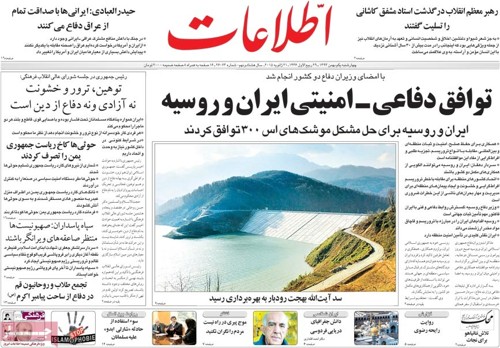
Ettela’at: Iran and Russia have signed a security and defense deal which among other things clears the way for the delivery to Iran of the S300 missile system.
 

Ettelaat Newspapre-1-20


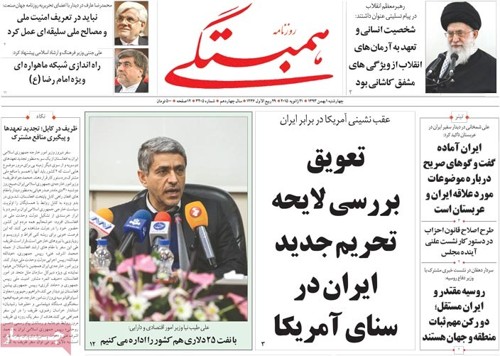
Hambastegi: “Personal tastes should be sidelined in defining national security and national interests,” said Mohammad Reza Aref [a former first vice-president under Mohammad Khatami].
 

Hambastegi Newspapre-1-20


Hemayat: “Zionists seek to hatch plots against Islamic countries in Syria,” said Iranian Parliament Speaker Ali Larijani.
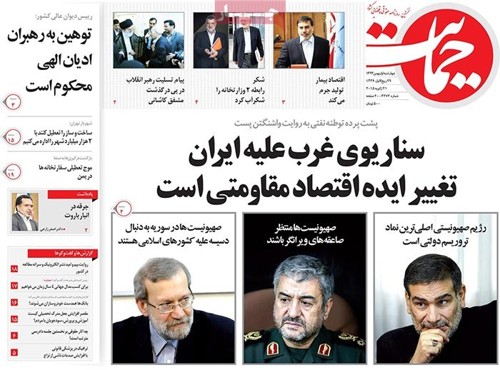
 

Hemayat Newspapre-1-20


Iran: The Supreme Leader has issued a message of condolence on the passing of well-known poet Moshfegh Kashani.
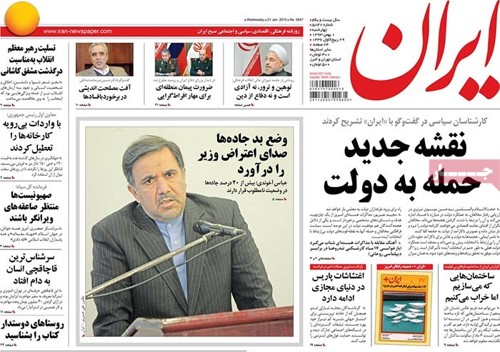
 

Iran Newspapre-1-20


Jomhouri Islami: A reservoir dam has been inaugurated in Bijar [northern Iran] with the first vice-president on hand.
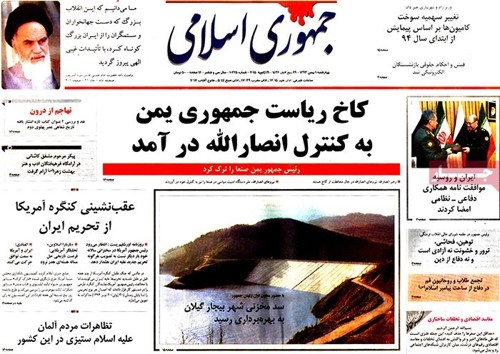
 

Jomhouri Eslami Newspapre-1-20


Kaenat: “We will be able to run the country even if oil prices plunge to $25 a barrel,” said the Iranian ministry of economy and financial affairs.
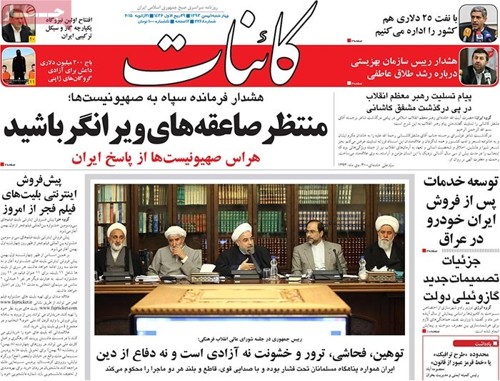
 

Kaenat Newspapre-1-20


Khorasan: “Some 40 percent of the country’s major arteries are in bad or very bad conditions,” said the minister of roads and urban development.
 

Khorasan Newspapre-1-20


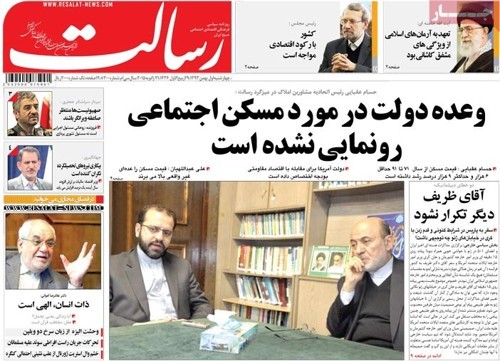
Resalat: Two diplomatic blunders by Zarif: A visit to Paris [at a time when anti-French sentiments run high across the Muslim world], and a stroll with US Secretary of State John Kerry on the streets of Geneva.
 

Resalat Newspapre-1-20


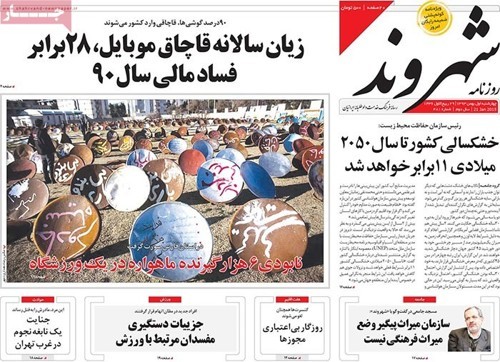
Shahrvand: The director of the Environment Protection Organization has said that by 2050 drought in Iran will worsen 11-fold.

 

Shahrvand Newspapre-1-20


Obama threatens to veto Iran sanctions again

Obama-Congress

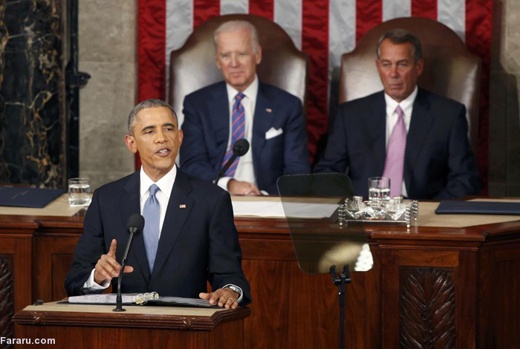
US President Barack Obama used his State of the Union address on Tuesday to once again threaten that he would use his veto power to thwart any bill that would place additional sanctions on Iran over its nuclear program.

“New sanctions passed by this Congress, at this moment in time, will all but guarantee that diplomacy fails,” Obama said during the speech before a joint session of the House of Representatives and Senate, adding, “That is why I will veto any new sanctions bill that threatens to undo this progress.”

“Our diplomacy is at work with respect to Iran, where, for the first time in a decade, we’ve halted the progress of its nuclear program and reduced its stockpile of nuclear material,” Obama said.

Obama said that Iran and P5+1 – the US, France, Britain, Russia, China and Germany – have a chance to reach a comprehensive agreement by this spring.

The president, however, said that “there are no guarantees that negotiations will succeed” and vowed to “keep all options on the table to prevent a nuclear Iran.”

Obama warned that any new hostile move against Iran would “alienate” the United States from its allies and ensure that “Iran starts up its nuclear program again.”

The comments came as the White House and Congress remain divided over Iran, with a bipartisan group of senators pushing a new round of sanctions against Tehran.

Iran and P5+1 are in talks to work out a final deal aimed at ending the longstanding standoff over the Islamic Republic’s nuclear program.

Political directors of Iran and P5+1 states wrapped up their talks in Geneva, Switzerland, on Sunday.

The latest talks included lengthy meetings between Iranian Foreign Minister Mohammad Javad Zarif and US Secretary of State John Kerry in Geneva and Paris.

This was the second round of discussions since Tehran and six world powers failed to work out a permanent nuclear deal by last November’s deadline despite making some progress.

The two sides decided to extend their talks for seven more months until July 1, with the interim deal they had signed in Geneva in November 2013 remaining in place.

Tehran and the six countries now seek to reach a high-level political agreement by March 1 and to confirm the full technical details of the agreement by July 1.

The scale of Iran’s uranium enrichment and the timetable for the lifting of anti-Iran sanctions are seen as major sticking points in the ongoing negotiations.

Iran reiterates need for open dialog with Saudi Arabia

Shamkhani

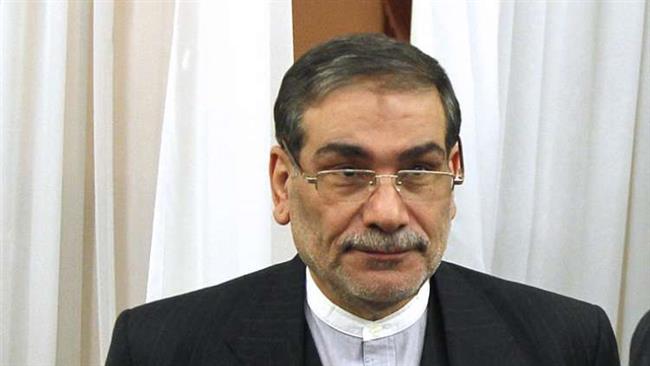
Secretary of Iran’s Supreme National Security Council Ali Shamkhani said on Tuesday that the policy of the Islamic Republic of Iran is to launch “open, transparent and inclusive talks” with Saudi Arabia.

Shamkhani made the remarks in a meeting with Iran’s envoy to the kingdom, Hossein Sadeghi.

The top Iranian official added that talks between the two regional powers could include all issues of mutual interest.

He said the current turbulent situation in the Muslim world necessitates a more “pragmatic contribution” by governments like Iran and Saudi Arabia.

Such contribution, Shamkhani said, must lead to an in-depth, serious and honest confrontation with extremism and terrorism which have manifested in Takfiri groups like ISIL.

Sadeghi, for his part, said misunderstandings between Iran and Saudi Arabia should be cleared and obstacles in the way of further cooperation between the two countries should be removed.

Countering the spread of terrorism and Islamophobia, and preventing Muslim countries’ resources from being wasted require convergence between Muslims, the Iranian envoy said.

Muslim nations must close ranks against Israel: Larijani

Larijani-Turkey

Iran’s parliament (Majlis) Speaker Ali Larijani has called for unity among Muslim countries in the face of Israeli aggression.

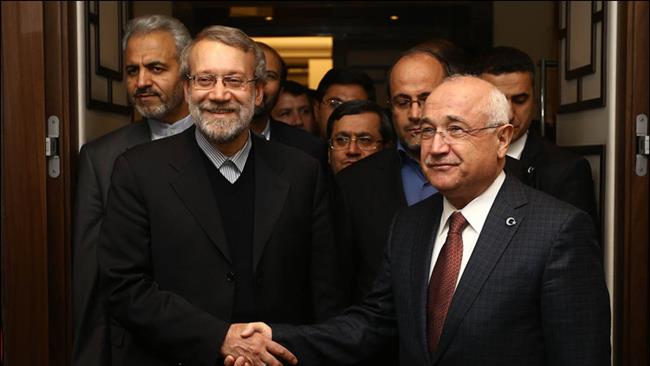
“The Zionist regime’s interference in Syria is a significant sign that they (Israelis) plan to pressure Muslims countries through conspiracy,” Larijani, who is on an official visit to Turkey, said in a meeting with his Turkish counterpart, Cemil Çiçek, in Istanbul on Tuesday.

On Sunday, an Israeli military helicopter fired two missiles at Amal Farms in the strategic southwestern Syrian city of Quneitra, close to line separating the Syrian part of the Golan Heights from the Israeli-occupied sector.

“Therefore, Muslim countries must unite in the face of incursions by the Zionist regime [of Israel] like the recent terrorist attack [on Syria] by this fake regime,” Larijani added.

Referring to the ongoing crisis in Syria, the top MP said the status quo in Syria is not in the interest of any country, calling for political efforts to restore stability to the conflict-stricken country.

Larijani also touched on ties between Tehran and Ankara, calling for the promotion of relations between the two countries.

Regarding the publication of blasphemous cartoons of Prophet Muhammad by French satirical magazine Charlie Hebdo, he said, “An issue that has hurt the feelings of Muslims is the offense against the Prophet Muhammad (PBUH), which has been committed in the Western countries.”

The Turkish speaker, for his part, pointed to the upcoming session of the Parliamentary Union of the Organization of Islamic Cooperation (PUOIC), and expressed hope that the problems of Muslim countries will be addressed and a telling answer will be given to the recent insults at the holy Prophet.

Çiçek also noted that foreign intervention will fail to settle the crises in the Middle East.

The Western countries aim to exploit the trivial differences among Muslims, the Turkish speaker stressed.

[…]

Iran denounces acts of terror, blasphemy

Rouhani-Iran

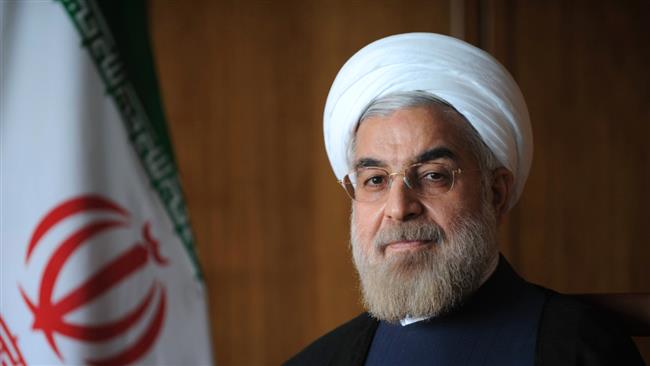
Iranian President Hassan Rouhani has condemned any act of violence perpetrated in Islam’s name, including the recent Paris shooting, as well as disrespecting religions under the pretext of freedom of speech.

“The Islamic Republic of Iran condemns terror, violence and extremism under the pretext of defending religions as well as insults, blasphemy and provoking the sentiments of followers of other religions in the name of defending freedom,” Rouhani said on Tuesday.

Pointing to the recent Paris shooting which left 12 people dead, Rouhani said “the Islamic Republic of Iran, in principle, condemns such violent acts and does not attribute them either to Muslims or to Islam.”

He said that Iran is the flag-bearer of fighting violence, extremism and terror both in word and in deed, and supports countries plagued with terrorism.

The Iranian president also denounced the depiction of Prophet Muhammad (PBUH) on the cover of the latest edition of the French satirical magazine, Charlie Hebdo.

He said the move was carried out in the name of supporting freedom, but in fact it provoked the sentiments of Muslims across the globe.

It is “regrettable” that the sacrilegious act was carried out in a country which claims to be an advocate of freedom, he said.

The Iranian president also warned that such measures will further fan the flames of extremism.

Rouhani’s remarks come nearly two weeks after an attack on the office of Charlie Hebdo, which left 12 people dead. Al-Qaeda affiliates claimed responsibility for the shooting.

Following the Paris shooting, the French magazine once again published a cartoon last week, depicting Prophet Muhammad (PBUH) on the cover of its new edition.

Muslims consider depicting Prophet Muhammad as blasphemous.

Iran FM Zarif meets with senior Afghanistan officials

Zarif - Afghanistan

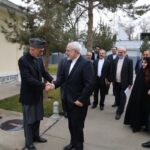
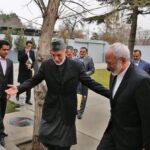
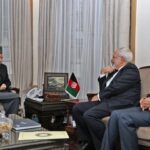
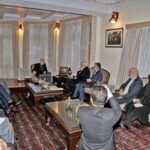
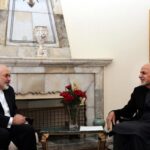
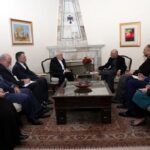
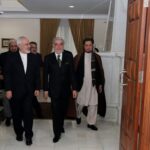
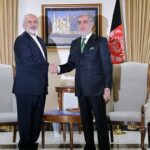
Iranian Foreign Minister Mohammad Javad Zarif met with a number of senior Afghan officials in Kabul on Tuesday.

In his one-day stay in Kabul, Zarif met with Afghan President Mohammad Ashraf Ghani and submitted President Rouhani’s invitation letter to his Afghan counterpart to visit Iran.

President Ghani hoped the visit will take place soon, saying that consolidation of ties with Iran is of prime importance to Kabul as Tehran is Afghanistan’s long-standing ally.

He said that Afghanistan and Iran, which share common interests, should cooperate to fully tap into their capacities.

The Afghan president further said that the present peace and stability in Afghanistan will help promote security in the region, adding his government is investing in cooperation with neighboring countries as well as Islamic nations.

For his part, Zarif welcomed formation of the national unity government in Afghanistan which promotes participation of all people in the country’s affairs and said a new chapter has opened in the life of the nation.

As always, Iran will stand by Afghanistan in all areas, he said.

The Iranian foreign minister also said that Iran is planning to run long-term programs based on mutual interest.

In a separate meeting with Afghanistan’s National Security Adviser Mohammad Hanif Atmar, Zarif said that Iran welcomes solid relations with Afghanistan, adding that both countries need to help the development process in the region.

The Afghan official hoped a future visit by President Ghani to Iran will result in working out cooperation agreements between the two countries in various fields.

Also in another meeting with former Afghan President Hamid Karzai, the Iranian foreign minister hailed the role of former president in consolidating good and long-term relations [with Iran], saying it could help boost stability, security, progress and prosperity in the region.

Karzai appreciated Iran’s support for Afghanistan over years and said that Tehran has always played a positive role in boosting security and political development in Afghanistan.

Zarif also conferred with Afghan Government Executive Chief Abdullah Abduallah on issues of mutual interest.

The Iranian top diplomat then met with Afghan permanent representative to the UN, Zahir Tanin, at Iran’s Embassy in Kabul.


Restored Sphere by Arnaldo Pomodoro is unveiled in a Tehran Museum

Iran-Italy

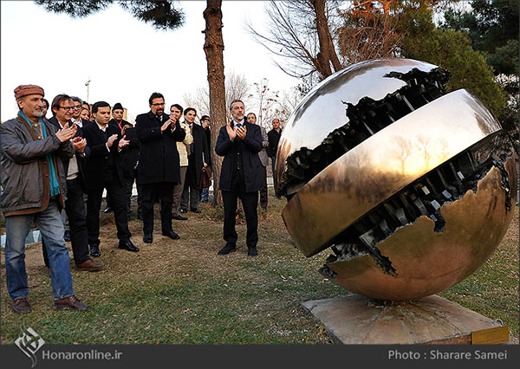
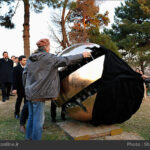
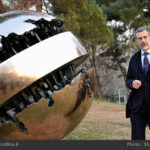
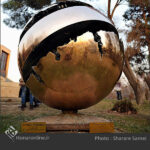
On January 20, honaronline.ir posted a report on a ceremony in which a restored Sphere sculpture by veteran Italian sculptor Arnaldo Pomodoro was unveiled. The following is a partial translation of the piece:

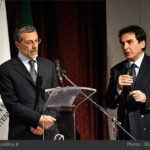
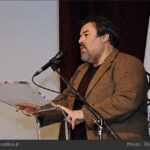
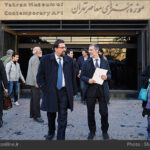
The Sphere, a sculpture by Italy’s Arnaldo Pomodoro, was unveiled at Tehran Museum of Contemporary Art with Director of the Visual Arts Center Majid Mola Nouruzi, Italian Ambassador to Iran Mauro Conciatori, Mazdak Feiznia representing the Feiznia Foundation, Hamid Ayni, a sculptor, a representative of the Pomodoro Foundation and a number of visual arts enthusiasts in attendance.

At the ceremony, before the artwork was unveiled, Mola Nouruzi said, “Organization of such an event is a reflection of good relationships between Iranian and Italian artists, and we are honored that there is an artwork by Pomodoro at Tehran Museum of Contemporary Art.”

He added, “Restoration of the work which was carried out with the permission of the sculptor is a symbol of purging the earth of dust, attention to the environment and respect for artworks,”

As for Iran’s substantial presence after four decades in Venice Biennial next year, he stated, “Venice Biennial is a world event for the display of arts and fortunately, at the event next year, we are given an area 10 times bigger than that of previous years’.”

[…]

Thanking the Feiznias who contributed to the restoration of the sculpture, Italian Ambassador to Iran Mauro Conciatori said, “The sculpture was long exposed to pollution and had lost its luster, so it needed restoration.”

He went on to say, “From my perspective, the presence of an artwork by the Italian artist in Tehran and the attention given to its maintenance remind us of the strong historical bonds between Iran and Italy. Although a gap has appeared between the two countries in the past, art once again has brought them together.”

As for relations between the Italian Embassy with Tehran Museum of Contemporary Art, Conciatori stated, “Relations between the two are extremely good and pretty soon we will embark on a lot of joint programs. An exhibition featuring artworks by Iranian-Italian artist Bijan Basiri at Tehran Museum of Contemporary Art as well as another expo showcasing the works of Bianchini, an Italian physician who lives in Iran, in the same museum are examples of such cooperation; the artworks of such artists are like a bridge linking the two nations.”

The representative of the Pomodoro Foundation at the ceremony said, “Pomodoro could not travel to Iran to observe the restoration of its work because of old age.”

Arnaldo Pomodoro, an Italian sculptor and artist, was born in the Italian city of Morciano in 1926. At present, he lives in Milan. The artist is well known for his spherical and columnar sculptures. Some of his works are on display in the Vatican Museum, Trinity College, Dublin, the United Nations Headquarters in New York, the Hirshhorn Museum and Sculpture Garden in Washington D.C, Christian Theological Seminary in Indianapolis, the de Young Museum in San Francisco and the University of California, Berkeley.

Of his artworks in Iran, one is on display at Tehran Museum of Contemporary Art; another is housed in the library of Niavaran Palace; and a third stands outside the parking lot of Eram Amusement Park.