Sunday, December 21, 2025
Home Blog Page 4860

Senior cleric blasts US Congress bill on direct arms supplies to Iraqi Kurds

khatami

Tehran’s Provisional Friday prayers leader Ayatollah Seyyed Ahmad Khatami strongly blasted a bill proposed by the US Congress that mandates arming the Iraqi Kurds and Sunni tribesmen directly.

Addressing a large congregation of people on Tehran University campus on Friday, Ayatollah Khatami said, “The recent US bill on the Iraqis and forming three separate Shiite, Sunni and Kurd states is a dream that God willing will not come true, because the Iraqi nation is well aware of that plot and will stand against it.”

He termed the bill as another attempt to interfere in Iraq’s internal affairs.

In March 2015, the US Congress introduced legislation that would allocate military aid directly to the Kurdish Peshmerga fighters and Sunni tribesmen.

Last Wednesday, Iraqi Prime Minister Haidar al-Abadi himself said his government strongly opposed the bill, saying the bill would sow division.

In a press release, Al-Abadi said that the Iraqi government strongly opposed the bill.

“The bill proposed by the Senate Foreign Relations Committee is opposed (by the Iraqi government), as it leads to further divisions in the region,” Al-Abadi said.
“We call on the US Congress not to go through with the bill to preserve strategic relations between the two countries (the United States and Iraq) in fighting the Islamic State (of Iraq and the Levant) terrorist organization and reinforcing cooperation between them,” Al-Abadi added.
The Iraqi Prime Minister noted that the countries working alongside Baghdad in combatting the ISIL have respected Iraq’s sovereignty, and stressed that nobody will receive weapons without the consent of the central government.

“There is no double dealing with the outside parties… We stress that arming any group will not occur unless via the Iraqi government, in accordance with its military plans,” Al-Abadi added.

On Sunday, Iraqi Parliament issued a statement rejecting the bill, and reiterated its support for a unified Iraq.

Yet, senior parliamentary officials in Baghdad disclosed on Tuesday that Germany has sent 70 tons of weapons to the Iraqi Kurds in the city of Erbil without any coordination with the country’s central government in Baghdad, a move seen as part of the Western states’ plan for disintegrating Iraq through undermining Baghdad’s authority.

“Germany has sent 70 tons of weapons to Iraq’s Kurdistan region without prior information of the Iraqi government,” Al-Sumeriya news website quoted Iraqi MP Haytham al-Jabouri as saying.

The move by the German government takes place at a time when the Iraqi Parliament voiced strong opposition to a bill proposed by the US Congress that allows the Kurdish forces and the Sunni tribesmen to be armed directly, bypassing Iraq’s central government.

Al-Jabouri noted that the arms cargo arrived in Iraqi Kurdistan region on Monday, and said, “The German government’s move has been made in violation of the Iraqi parliament’s rejection of any foreign interference in the country’s internal affairs or interaction with Iraqi political groups without prior coordination with the Federal government.”

Riyadh playing blame game on Iran: Afkham

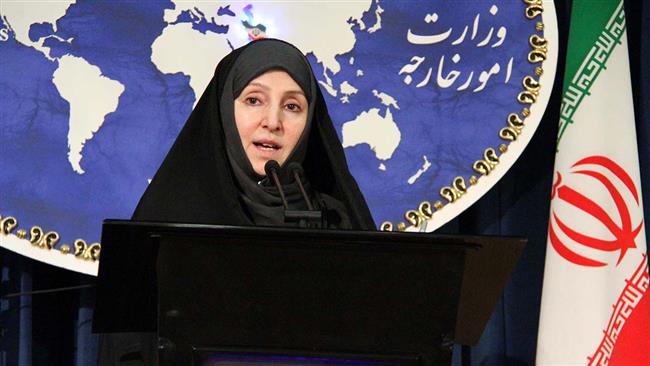
Iranian Foreign Ministry Spokeswoman Marziyeh Afkham

During a joint press conference with US Secretary of State John Kerry on Thursday, Saudi Foreign Minister Adel Al-Jubeir accused Iran of meddling in regional countries, including Yemen.

“These remarks are a blame game, based on a string of repetitious and useless analyses,” Iranian Foreign Ministry Spokeswoman Marzieh Afkham said on Friday.

Afkham said that Saudi Arabia’s accusations against Iran come while Yemen has been under constant Saudi air attacks for more than 40 days, and “has been held to ransom through a full blockade from air, land and sea.”

The Iranian official noted that the Yemeni people would not allow any countries to interfere in their affairs, stressing that the Islamic Republic seeks only “an end to Yemen’s siege as well as immediate delivery of humanitarian aid” to the war-stricken people to avert a crisis.


US Secretary of State John Kerry (L) and Saudi Foreign Minister Adel al-Jubeir during a joint press conference in Riyadh on May 7, 2015 ©AFP


Afkham underlined the need for an end to Saudi airstrikes as well as the resumption of intra-Yemeni talks aimed at forming an inclusive government as the key to the settlement of the crisis in the Arab country.

Riyadh launched its military aggression against neighboring Yemen on March 26 – without a United Nations mandate – in a bid to undermine the Arab country’s popular committees back by the Ansarullah movement and to restore power to Yemen’s fugitive former president, Abd Rabbuh Mansur Hadi, who is a staunch ally of Saudis.

Last month, Saudi Arabia prevented two Iranian civilian planes from delivering medical aid and foodstuff to the Yemeni people.

On Thursday, the UN Humanitarian Coordinator in Yemen voiced grave concern over the deteriorating situation in Yemen and said “attacks on hospitals and other civilian infrastructure must stop immediately.”

Universities should help society and improve ethics

Ali Rabii

The minister of cooperatives, labor and social welfare has said that Iranian society has been plagued by certain ethical disorders, adding universities can enter the scene and help society in this regard.

Ali Rabie made the remark Wednesday in a ceremony to respect the role of teachers and added that teachers have always played a key role in the social life of people.

The following is the translation of excerpts from the minister’s remarks as reported by the Islamic Republic News Agency on May 7:

The minister said universities should hold out a helping hand to solve the country’s basic issues on different fronts, especially ethical and social problems.

[…]

Rabie further said a number of university graduates are still out of work, adding today those who finish their academic studies cannot be a source of creativity because a problem – which has its roots in textbooks or teaching methods – stands in the way.

[…]

He went on to say that we lack a production-driven country. “What has happened to [this] society? People who dug qanats one day to tap into the subterranean waters are now seeking to get [the government’s monthly cash] subsidies.

“Creativity has been hurt in society. The country’s attitude toward labor has changed and the culture of labor faces fundamental problems,” said the labor minister.

As for the economic growth, he said Iran needs an eight percent economic growth to create 900,000 jobs each year, adding we need to mobilize all our potential on different fronts to materialize such growth.

To improve ethical standards in society, he stressed, we need to upgrade the culture of labor and economic transformation.

The minister said that the target economic growth rate [eight percent] is achievable, but to improve ethics and the culture of labor in society, universities should step forward and offer a helping hand.

[…]

Daesh will fade into history; Daeshism will live on (PART TWO)

Turkey-ISIS

Abbas_ValiA Turkish sociologist says that the Islamic State of Iraq and the Levant (ISIL) will become history, but its ideology will live on among nations.

In his interview with Sharq daily published on April 27, Professor Abbas Vali, who is a distinguished Kurdish political and social theorist specializing in Modern and Contemporary Political Thought and Modern Middle Eastern Politics, has addressed the root causes of the crisis in the Middle East and the inefficiency of a nation-state solution from a sociological aspect.

The Turkish theorist – who is also the head of the Department of Sociology at Bogazici University in Istanbul – says that Daesh [the Arabic term used for ISIL] has emerged from the depths of endless political violence, which is bare and systemic in the region.

The following is the translation of the second part of the interview which entails the professor’s views on Turkey’s domestic issues and an assessment of the performance of President Recep Tayyip Erdogan’s government as far as the Middle East is concerned.


A new crisis seems to have been brewing in the region. A type of liberal Islam – in the form of a country which claims to represent democratic Islamic nations – has aligned itself with the Islam which is advocated by Daesh.

In Turkey, a government led by the Justice and Development Party has addressed this crisis arbitrarily. The Turkish government’s policies in Iraq and Syria have failed to achieve anything. On the foreign policy front, Turkey’s measures in Syria clashed with those of Iran, Saudi Arabia and Qatar, because Turkey has not had any agents in Syria, and Daesh provided Turkey with the opportunity to carry out its plans there with no direct involvement.

[…]

The threat of Daesh is likely to be growing in Turkey which has a radical Sunni society. I think Ankara’s arbitrary treatment of the crisis – on the domestic front –has been of essence inside Turkey.

Erdogan’s selective use of the crisis [the emergence of Daesh and its atrocities in the region] is akin to what [Muhammad] Zia-ul-Haq [the Pakistani president (1978 – 1988) did in dealing with the Taliban, but failed to keep them in check and his approaches cost him his life [he died in a mysterious plane crash back in 1988].

Erdogan’s approach [his dealing with Daesh] can have a huge social and cultural impact on Turkey in the long run. Turkey does not stand ready to counter this problem without paying [a dear] price, nor is it capable of doing so.


Turkey has started to solve the issue of the Kurds. Do you think it can be solved in the short or medium term?

It is possible because both the Kurdish [nationalist] movement and the Turkish government have come to the conclusion that a military solution is not an option and that the issue should be solved through talks. Common ground and the two sides’ awareness of the fact – that they cannot maintain the status quo and a costly military solution will not result in a settlement in the long run – is the basis for the give-and-take.

But the question that arises here is whether Turkey is ready to enter peace talks [with the Kurds] and meet their demands. […]


As the first step, Turkey insists on [the Kurds’] disarmament.

The Turkish government and the Kurds have their own interpretation of the issue. The government thinks if the Kurds lay down their arms and the Kurdish guerrillas are protected by the government, the problem will be history. This interpretation is nothing more than a political dream.

At issue is not simply a 34-year armed struggle by the Kurds in the mountains. The issue – which has political and cultural dimensions – should be solved; otherwise its military aspects can get momentum by the day.

At this juncture, the [Turkish] government’s behavior has been far from rational – or realistic from a political angle. The Kurds too should ease their demands and offer a new interpretation of the issue.

The point is that the Turkish government is not expected to simply meet the Kurdish demands; rather, it should meet the expectations of a large part of Turkish society which have shown concerns in this regard.

I think disarmament should not be a precondition [for talks]. The Kurds should be treated as a party to the talks in a free, democratic way. […]


Given the upcoming parliamentary election in Turkey, how do you evaluate the future of the [ruling] Justice and Development Party?

Turkey’s politics is in a critical condition. [President] Erdogan is seeking to take advantage of the June elections and change the country’s political establishment to a [stronger] presidential system. To that end, he needs a sizeable majority in parliament; it is an ambitious goal, though.

[…]

The Kurdish-dominated Peoples’ Democratic Party (HDP) has entered the race and this means the Kurds need 10 percent of the votes at a national level. In case they fail to win the percentage they need, they will be removed from the political scene and their votes will go for the ruling party. This carries a high risk, but the party’s members say they will gain the number of votes they need.

[…]


How will Erdogan’s efforts to tighten his grip on power and the Middle East’s developments affect Iran’s regional policies?

Erdogan’s grip on power is not viewed as a key factor in Iran’s future. What matters for Iran is the agreement it [possibly] clinches during nuclear talks with Western countries and its results.

For Turkey, the positions of Saudi Arabia and Qatar are more important. Due to Turkey’s disagreements with the US, Ankara’s measures in Syria and in the region have been limited.

Apparently, Turkey is ready to inactively get involved in the fight against Daesh. This willingness has not prompted Turkey to let the US use Turkish soil [Incirlik Air Base] to launch attacks on the [terror] group.

Prior to the withdrawal of US forces from Iraq, Obama did not approve of a military base in the Kurdistan region. Because of Turkey’s measures in Iraq and Syria, the US seems likely to change its decision on the military base. This would deal a big blow to Turkey on a regional scale.

[…]

A new political system and a shift in Erdogan’s political status will activate Turkey’s policies in Syria, but Turkey does not seem to want and be able to pay a heavy military price in the long term.

The ten-year economic management has been the reason behind popular support for the president. Involvement in a war – albeit short – would leave an impact on Turkey’s economic policies.

Germany ships arms to Erbil without Baghdad’s knowledge

flags

Germany has supplied Peshmerga fighters [in Erbil, the capital of the Kurdistan Region] with 70 tons of weapons and ammunition without the knowledge of the Iraqi central government. This comes despite promises by the West that it will not support different tribes and religious sects in Iraq.

Kayhan daily on Wednesday published a report on an arms delivery by Germany to Erbil and the true US intention of arming the Peshmerga forces in the Kurdistan Region. The following is the translation of part of that report:

Haitham al-Jubouri, a member of [the Finance Committee in] the Iraqi House of Representatives, broke the news, saying the weapons were transferred from Germany to the Kurdistan Region on Monday. He also said the delivery violates the [Iraqi] Constitution and a recent parliamentary act which bans interference by other countries in the Iraqi internal affairs.

Al-Jubouri also said the shipment has been sent to the country’s Kurdistan Region with Prime Minister Haider al-Abadi – who is also the commander-in-chief of the country’s armed forces –kept in the dark.

The arms delivery comes after assurances earlier this week [early May] by US Vice-President Joe Biden to the Iraqi premier that the West will not support different ethnicities, tribes and religious sects without Baghdad’s knowledge.

Biden’s remarks are not in conformity with the policies the West, Washington in particular, has adopted on Iraq. A number of US Senators have recently put forth a bill to divide Iraq into three [independent] Shiite, Sunni and Kurdish regions.

In line with the bill, the US administration lent substantial support to ISIL in Iraq and targeted volunteer forces in order to strike a balance between different Iraqi tribes, something which was believed to have set the stage for the disintegration of Iraq.

Following the Iraqi disintegration bill, President of Iraq’s Kurdish region Massoud Barzani went to Washington to consult with US officials and weigh different aspects of the bill during his weeklong stay in the US!

In recent years and prior to ISIL’s onslaught in Iraq last year, Barzani had repeatedly put forward the independence of Iraq’s Kurdistan.

Oil sales are one issue over which Iraq’s autonomous Kurdish region is at odds with the central government. On Monday, Hanan Al Fatlawi, an Iraqi MP [a member of Foreign Affairs Committee] revealed that the Erbil government has exported 46 million barrels of oil in recent months without informing Baghdad.

Secessionist movements inside Iraq and foreign support for these movements have drawn strong reaction from Iraqi officials, political groups and people.

As a case in point, Iraqi Foreign Minister Ibrahim al-Jaafari said a few days ago that Iraq has full sovereignty and Iraqis will not let their territories be subject to disintegration and aggression.

In addition to Erbil, the leaders in Washington speak of arming nomadic tribes, but the fact is that these tribes are willing to be armed by the central government against the armed ISIL terrorists.

Tribes in Ramadi, the capital of Al-Anbar Governorate in central Iraq, have held a meeting, calling on the central government in Baghdad to provide them with weapons and ammunition to take on ISIL.

[…]

A look at Iranian newspaper front pages on May 7

Iranian Newspapers Headlines

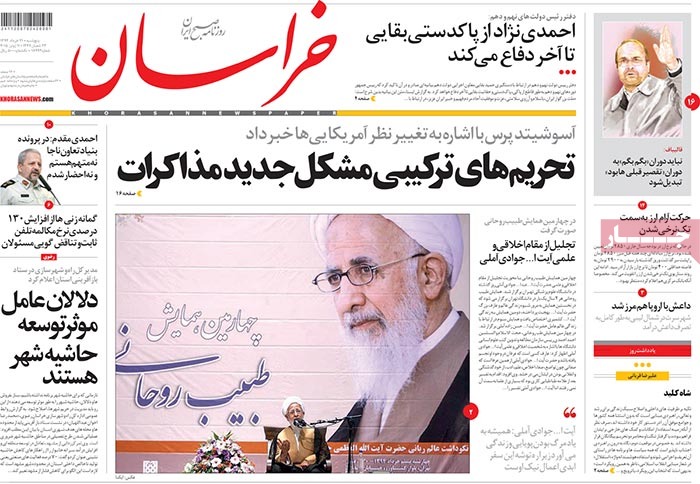
Comments by Islamic Revolution Leader Ayatollah Seyyed Ali Khamenei in a meeting with Iranian teachers that nuclear talks overshadowed by threats are not acceptable dominated the front pages of Iranian newspapers on Thursday. Also in the news were the opening of the 20th International Oil, Gas, Refining and Petrochemical Exhibition in Tehran and remarks by the Iranian oil chief that the Islamic Republic is ready to engage in talks with foreign countries on oil trade.


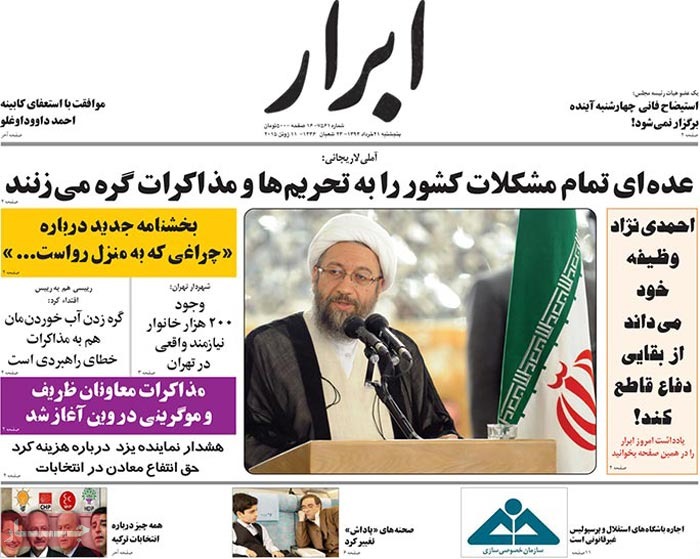
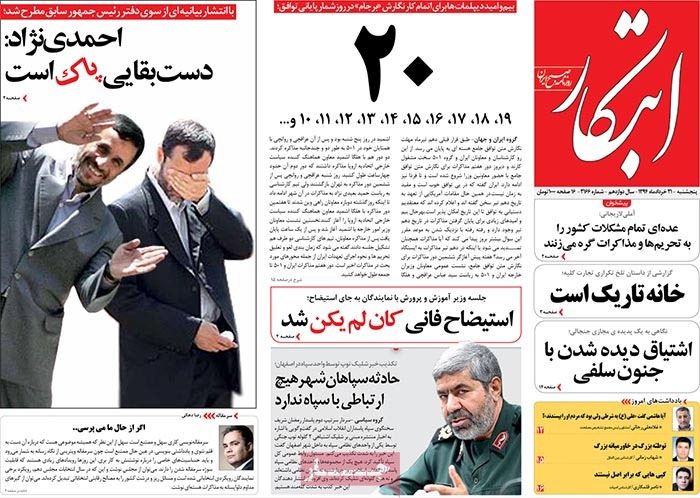
Abrar: “The eleventh government has based its appointment [of office holders] based on moderation and merit,” said President Hassan Rouhani in a cabinet session.


A look at Iranian newspaper front pages on May 7


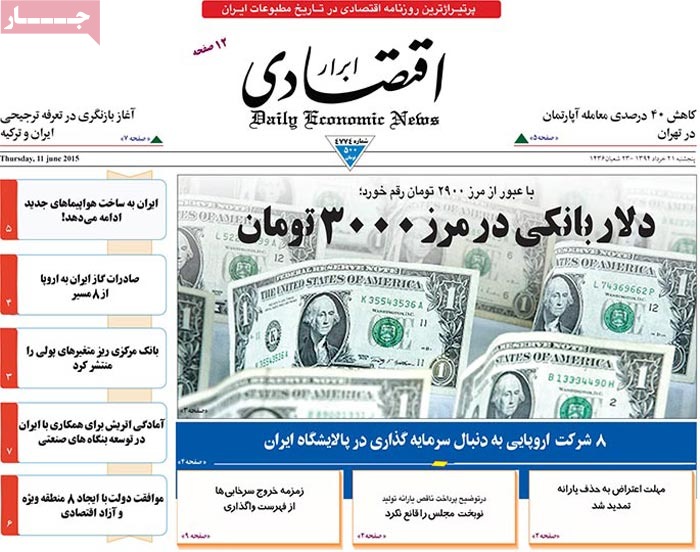
Abrar-e Eghtesadi: Despite a ban on imports, the Chinese hand-woven carpets found their way to the Iranian market!


A look at Iranian newspaper front pages on May 7


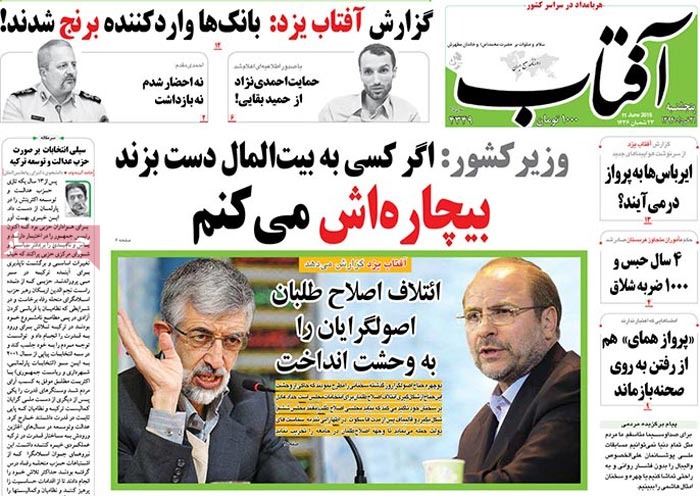
Aftab-e Yazd: “Money laundering in the ministry of science [under former President Mahmoud Ahmadinejad] was unprecedented in [Iranian] history,” said Gholam Reza Zarifian, a deputy science minister in the reformist cabinet in an exclusive interview with the daily.

Aftab-e Yazd: “The national medium [IRIB] is at the disposal of the opponents of the reformists,” said Mohammad Reza Aref, a reformist leader.


A look at Iranian newspaper front pages on May 7


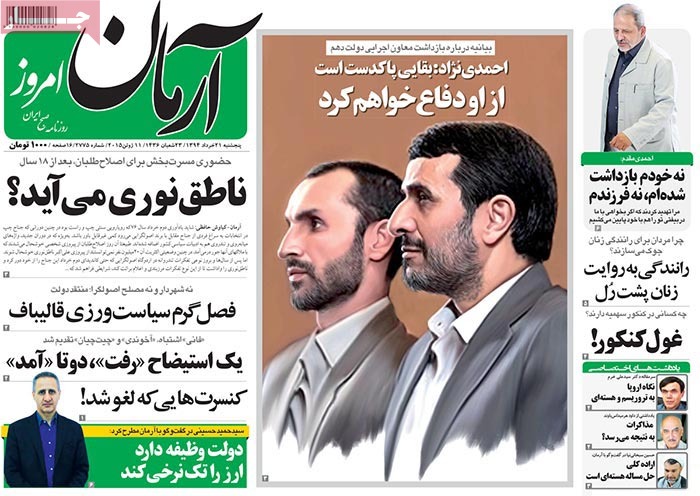
Arman-e Emrooz: Registration of those who run for [March 2016] parliamentary election will open on December 19.


A look at Iranian newspaper front pages on May 7


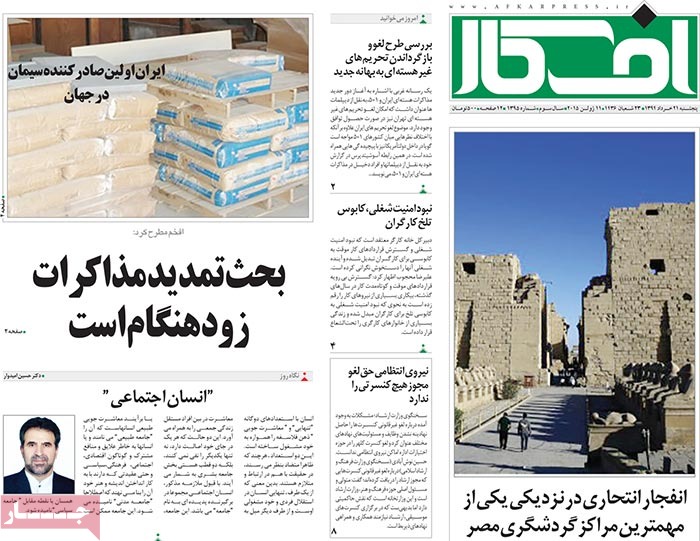
Ebtekar: “The Iranian nation will not tolerate talks under the shadow of threats”.

The Supreme Leader made the remark in a meeting with Iranian teachers from across the nation.

Ebtekar: “I am writing my memoirs for people,” said Chairman of the Expediency Council Ayatollah Akbar Hashemi Rafsanjani.


A look at Iranian newspaper front pages on May 7


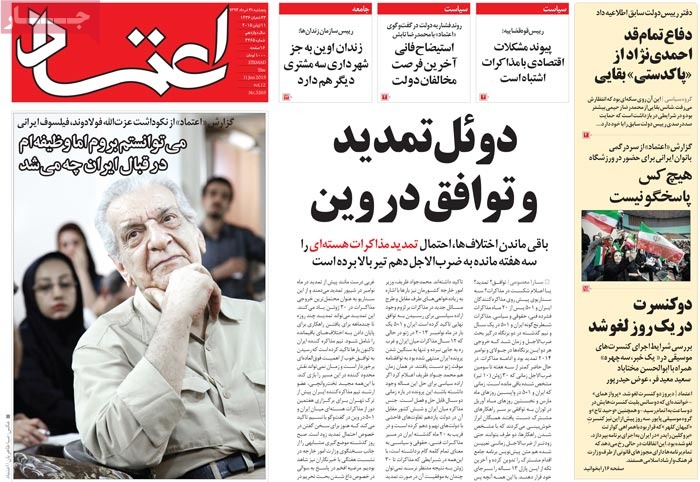
Etemad: Zanganeh’s signal to oil giants

Oil Minister Bijan Namdar Zanganeh has said that Iran is ready for talks. His remarks come as foreign oil delegations arrive in Tehran [to take part in an International Oil, Gas, Refining and Petrochemical Exhibition.]


A look at Iranian newspaper front pages on May 7


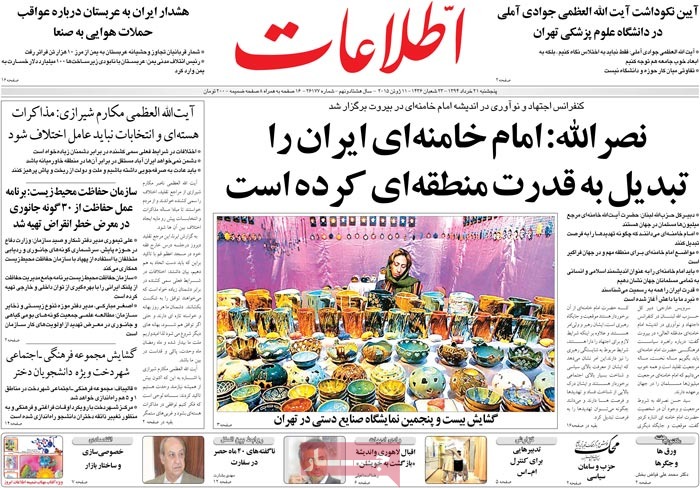
Ettela’at: “The Education [Ministry] needs fundamental changes, not superficial plans,” said the Supreme Leader in a meeting with teachers.

Ettela’at: “The improvement of business atmosphere is needed for economic growth”.

The first vice-president made the remark in the opening of the 20th International Oil, Gas, Refining and Petrochemical Exhibition.


A look at Iranian newspaper front pages on May 7


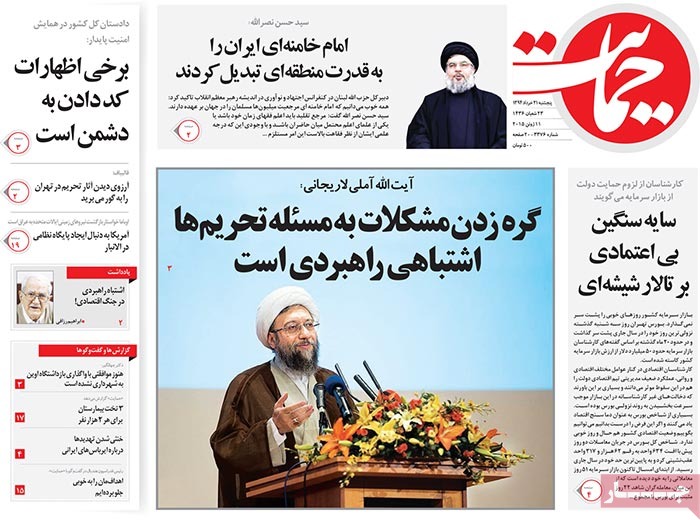
Hemayat: “The leaders of the Saudi regime should be put on trial like the Nazi criminals,” said Judiciary Chief Ayatollah Sadegh Amoli Larijani.


A look at Iranian newspaper front pages on May 7


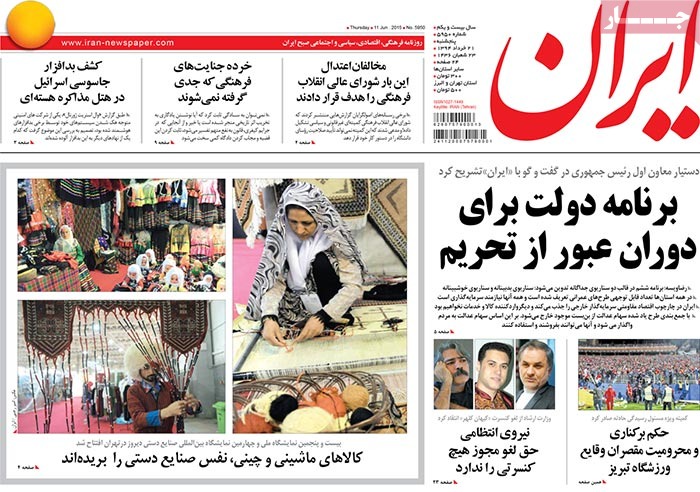
Iran: The presence of 600 foreign companies from 29 countries in the International Oil, Gas, Refining and Petrochemical Exhibition in Tehran


A look at Iranian newspaper front pages on May 7


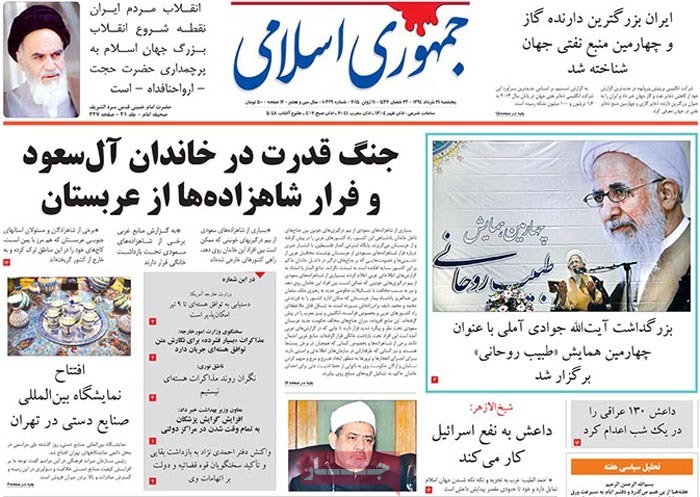
Jomhouri Islami: “Continue the nuclear talks, but do not give in to imposition [of sanctions], humiliation and threats.”

The Supreme Leader addressed the country’s officials in a meeting with thousands of teachers from across Iran.


A look at Iranian newspaper front pages on May 7


Kaenat: “[Uranium] Enrichment is an eternal right for Iran,” said Foreign Ministry Spokeswoman Marziyeh Afkham.


A look at Iranian newspaper front pages on May 7


Kar va Kargar: “Teachers play the most effective role in helping shape up the future generation,” the Supreme Leader told teachers.


A look at Iranian newspaper front pages on May 7


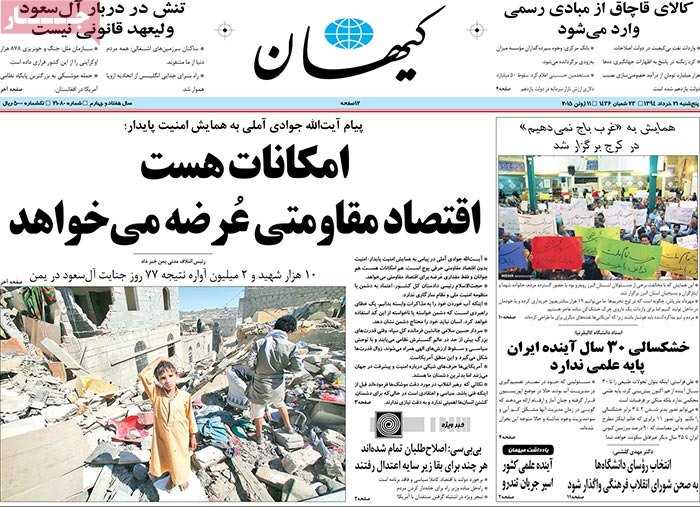
Kayhan: “We interact with foreigners although they left us alone,” said the oil minister.

Kayhan: “The revolutionaries in Yemen do not need arms [because] Ansarullah have taken over all garrisons [in the country],” said the Supreme Leader.


A look at Iranian newspaper front pages on May 7


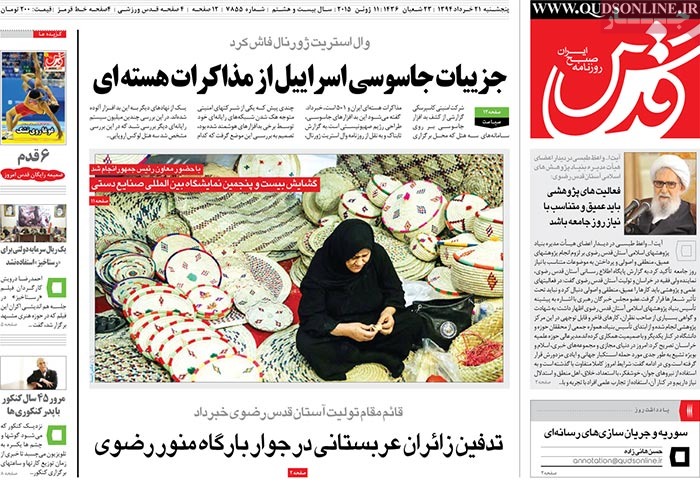
Qods: “Failure to pay due attention to the teachers’ pocketbook issues will play into the hands of the enemy,” said Supreme Leader Ayatollah Khamenei.


A look at Iranian newspaper front pages on May 7


Rah-e Mardom: “The dignity and respect of the Iranian nation should remain protected,” said the Supreme Leader.


A look at Iranian newspaper front pages on May 7


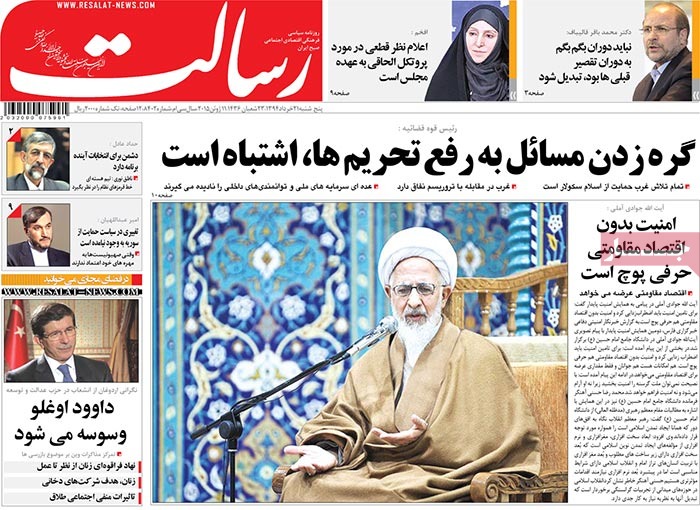
Resalat: “The fight on corruption should be institutionalized,” said Grand Ayatollah Abdollah Javadi Amoli.

Resalat: “The Intelligence Ministry monitors the movements of the Takfiri groups,” said Intelligence Minister Mahmoud Alavi.


A look at Iranian newspaper front pages on May 7


Roozan: An oil fever in Tehran

“The oil-producing countries should make room for Iran,” said Oil Minister Bijan Namdar Zanganeh.


A look at Iranian newspaper front pages on May 7


Shahrvand: “Iran will export gasoline by yearend [March 2016],” said First Vice-President Eshagh Jahangiri.


A look at Iranian newspaper front pages on May 7


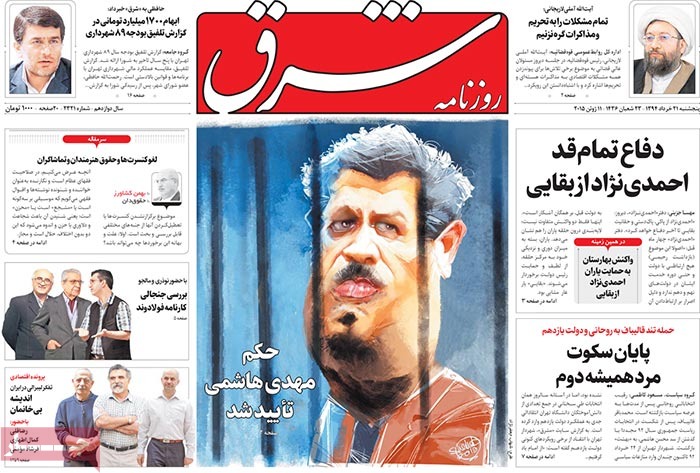
Sharq: “Working for the land of the brave is my honor,” said Foreign Minister Mohammad Javad Zarif.


A look at Iranian newspaper front pages on May 7


SMT: The first vice-president said in the opening ceremony of the 20th International Oil, Gas, Refining and Petrochemical Exhibition in Tehran that foreign capital will be funneled into Iran’s oil industry.


A look at Iranian newspaper front pages on May 7


Iran, India ink deal on Chabahar Port

43

Iran and India reached a deal to develop a strategic port in southeast Iran despite US pressure on New Delhi not to rush into any such trade agreements before world powers clinch a final nuclear accord with Tehran.

Iran’s Minister of Road and Urban Development Abbas Akhondi and Indian Shipping Minister Nitin Gadkari signed a memorandum of understanding (MoU) on Wednesday to develop the Chabahar Port on the Sea of Oman, near Iran’s border with India’s arch-rival Pakistan.

Chabahar port is located in Sistan and Baluchestan Province on Iran’s southeastern coast and is of great strategic utility for India which will get sea-land access route to Afghanistan bypassing Pakistan.

The port will be used to ship crude oil and urea, saving India transportation costs.

“With the signing of this MoU, Indian and Iranian commercial entities would now be in a position to commence negotiations towards finalization of a commercial contract under which Indian firms will lease two existing berths at the Port and operationalize them as container and multi-purpose cargo terminals,” an Indian Ministry of External Affairs statement said.

Earlier on Wednesday, Iranian President Hassan Rouhani referred to Iran-India joint project to develop Chabahar port, and described it as the opening of a new chapter in bilateral relations.

“We welcome the presence of Indian investors in the development of Chabahar port and other southern ports as well as the construction of roads and railroads,” Rouhani added in a meeting with Indian Minister Gadkari in Tehran.

India and Iran agreed in 2003 to develop the port, but the venture had made little progress because of Western sanctions tied to Tehran’s peaceful nuclear program.

Now, spurred on by Chinese President Xi Jinping’s signing of energy and infrastructure agreements with neighboring Pakistan worth $46 billion, Indian Prime Minister Narendra Modi wants swiftly to sign trade deals with Iran and other Persian Gulf countries.

Encouraged by a provisional, April 2 deal over Tehran’s nuclear program, India recently sent a delegation to Iran to scout for trade, energy and infrastructure deals.

However, the United States has expressed concern that India is moving too fast and could undermine a sanctions regime imposed on Iran.

In the past few years, India and Iran have been working towards developing energy and economic cooperation. India is among Asia’s major importers of energy and relies on Iran to meet a portion of its energy demand.

Iran, Algeria working to promote trade ties

iran

Closer economic cooperation between Iran and Algeria was top on the agenda of a Tehran-Algiers trade gathering in Tehran, with the heads of the two countries’ chambers of commerce and the Algerian ambassador to Tehran in attendance.

“The new policy of the government is to give priority to Muslim countries as far as economic relations are concerned,” Gholamhossein Shafei, the head of Iran’s Chamber of Commerce, was quoted by Donyay-e Eghtesad as telling the session.

Shafei added economic relations between the two countries do not measure up to political ties.

He went on to say, “Iranian and Algerian chambers of commerce are duty-bound to encourage their private sectors to promote trade and embark on joint ventures. Iranian and Algerian private sectors do not have enough information about each other’s capabilities and potential for cooperation. That’s why the chambers of commerce and joint trade councils should do more to offer more information to those active on the economic front.”

Shafei further said, “The volume of trade between the two countries in 2014 stood at about $7 million; Algerian imports accounted for 97 percent of the total volume.”

Muhammad al-Eid Bin Omar, the head of the Algerian Chamber of Commerce, for his part, said that the joint council of Iranian and Algerian businessmen which was established in 2010 can promote the volume of trade and economic interaction and inject dynamism into the current trend through evaluation of present opportunities for further cooperation.

He put the volume of trade between the two nations at $3.2 million in the first quarter of 2015, and said those figures show that the heads of chambers of commerce as well as Iranian and Algerian businessmen should make more efforts to create a dynamic platform for economic activities.

Iran releases Marshall Islands-flagged cargo ship: Report

ship

Iran has reportedly released a Marshall Islands-flagged cargo ship recently impounded in the Persian Gulf by Iranian forces.

An informed source told IRNA on Thursday that the Iranian Ports and Shipping Organization will issue a statement in a matter of hours on the details of the ship’s release.

On April 28, Iranian forces boarded the Maersk Tigris ship carrying the Marshall Islands flag in the Strait of Hormuz.

Hamid Reza Jahanian, the managing director of the Pars Talayieh oil products company, which had filed a lawsuit against the Maersk Line container shipping company, told Fars News Agency on May 2 that the reason behind the seizure was the damage inflicted upon Pars Talayieh by Maersk Line, which is part of the Maersk Group headquartered in Copenhagen, Denmark.

Australian FM: Iran visit very productive

FM

Foreign Minister of Australia Julie Bishop described her recent visit to Iran as “very productive and useful”.

She made the remark in an interview on Wednesday with IRNA in Pakistan where she is paying her first official visit since she assumed office in September 2013.

Bishpo further said that during her visit to Tehran in April, she met President Hassan Rouhani and her counterpart Mohammad Javad Zarif and discussed a good number of bilateral, regional and international issues, including the Yemeni conflict.

“Presumably all such conflicts ultimately need to be resolved with a political solution and we hope that all stakeholders will achieve a political solution in Yemen,“ she stressed.