Sunday, December 21, 2025
Home Blog Page 4849

Velayati, Nasrallah discuss issues of mutual interest

velayatt-nasrallah

The Iranian Supreme Leader’s Advisor for International Affairs Ali Akbar Velayati and Secretary General of Lebanon’s Hezbollah Hassan Nasrallah met in Beirut and discussed important international, regional and bilateral issues.

The meeting on Monday evening focused on issues related to the World of Islam, Lebanon and extremism.

Velayati called for further unity and cooperation between Muslim nations in the fight against extremism and Takfiri groups.

Certain states inside and outside the region are supporting Takfiri groups and extremists in order to divide the Islamic countries, said Velayati.

The enemies, he noted, will not be able to make their sinister dreams about the region come true.

Velayati arrived in the Lebanese capital on Monday morning.

He held separate meetings with Lebanese Prime Minister Tammam Salam, Parliament Speaker Nabih Berri and leader of the Lebanese Free Patriotic Movement General Michel Aoun.

Velayati also attended a press briefing and answered the reporters’ questions about various international issues as well as strategic ties between Tehran and Beirut.

He also attended the closing ceremony of an international conference on Palestine and delivered a speech.

Democracy is all about communications

media

Social humans produce communications which are the best and most valuable of their products. In establishing contact [with others] and disseminating information, humans are indebted to communications for their procedural evolution and transformation ever since their creation – from the time humans were engaged in a struggle with nature for survival on earth to date when they have turned into well-established citizens who are key players in global interactions.

Jahan-e Sanat daily on May 18 published an opinion piece by Kamalledin Hadiyan, a university lecturer, on the Information Age and the impact of communications on the social life of humans. The following is the translation of the piece:

The history of social development shows that the formation of different ages and periods is the fruit of a golden moment which paves the way for the dissemination of information and the subsequent use of such information on a massive scale.

The creation of textual or written information, the invention of the printing press [in the past] and broad access [at present] to digital equipment which help produce, keep and disseminate information have each been the origin of transition from a traditional community to a modern society. They have also been the reason behind the presence of humans in the capacity of global citizens in a modern society which is also known as information society.

Development and foundation-laying are inherent parts of communications. The advances made in communications have produced democracy which is one of the long-held dreams of humans. One can argue that choosing effective modern communications technologies can be a shortcut – a shorter, more cost-effective and accessible way – for developing nations to transition into rich, developed societies.

It seemed hard to believe [the effectiveness of such a shortcut] when Alvin Toffler [an American writer and futurist, known for his works discussing the digital revolution, communication revolution and technological singularity] sounded alarm bells in his book The Third Wave about the effects of modern technologies and the experience of growing environmental and human changes. However, it [the shortcut] is viewed today as a certainty.

Tolerance and uncritical acceptance [of opposing views] is the result of using modern communications technologies. This process has helped citizens improve their lives, get engaged in international, social discourse and actively and knowingly participate [in social affairs], and it will gradually take the place of the dominant power discourse.

The [same] process will see the international life [of people or nations] – irrespective of their race, ethnicity, gender, etc. – become full of security and unity for everybody, everywhere. The pace and content of the change which takes place as a result of spreading communications is so high that ignoring the way changes – those which are in contrast with the nations’ independent national and social identity – are managed will cause serious harms to the fabric of national societies and will foil efforts which aim to materialize international social convergence.

Adoption of divergent stances on communications developments and failure to approve of moderate and logical attitudes toward creating fitting conditions for citizens – to have free and broad access to communications technologies – will widen the gap between the train of social communications developments [which is traveling forward at full blast] and nations.

The impacts of such attitudes can be seen in the absence of independent social identities – an effective way to counter alienation and estrangement from [the nations’] origin – and in the metamorphosis of the national and religious identity [of nations] into the culture of the invading country.

Efforts to prepare the ground for people’s free and unfettered access to the communications information and technologies, to guarantee the freedom [to access such information and technologies], to make communications technologies operational and to include them in all social aspects of citizens’ daily lives will greatly help them grow and enables them to enjoy even more capabilities.

In such a society, efforts to decrease conflicts and avoid confrontation go hand in hand with what is done to bring about peaceful coexistence and transformation in national-international societies. From this perspective, marking World Telecommunications Day and remembering and praising the matchless effects of communications amount to hailing human and civic rights at the information age.

In The Third Wave, Toffler describes three types of societies, based on the concept of “waves”—each wave pushes the older societies and cultures aside. First Wave is the society after agrarian revolution and replaced the first hunter-gatherer cultures. Second Wave is the society during the Industrial Revolution, and Third Wave is the post-industrial society.

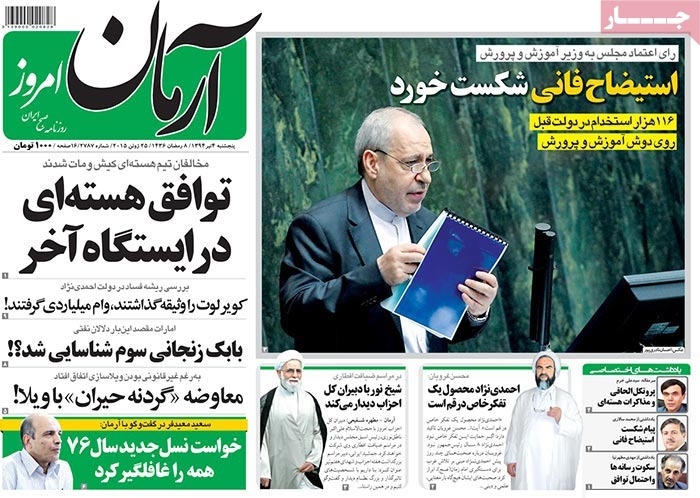
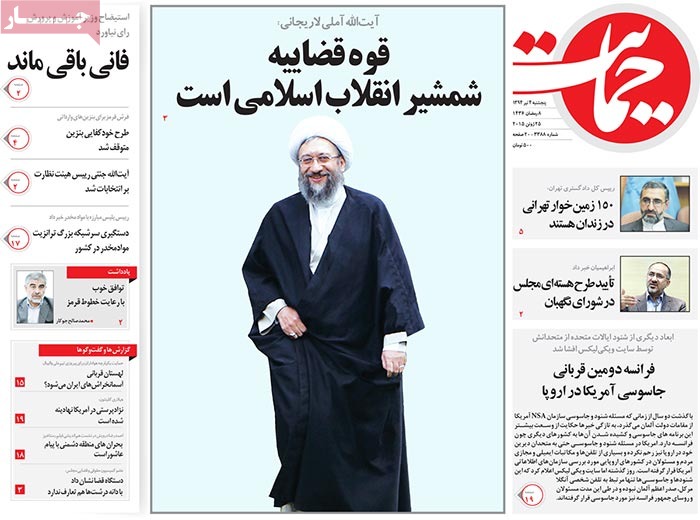
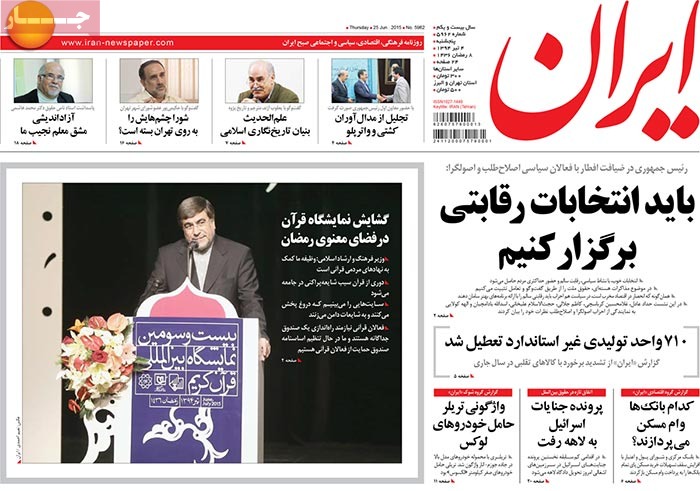
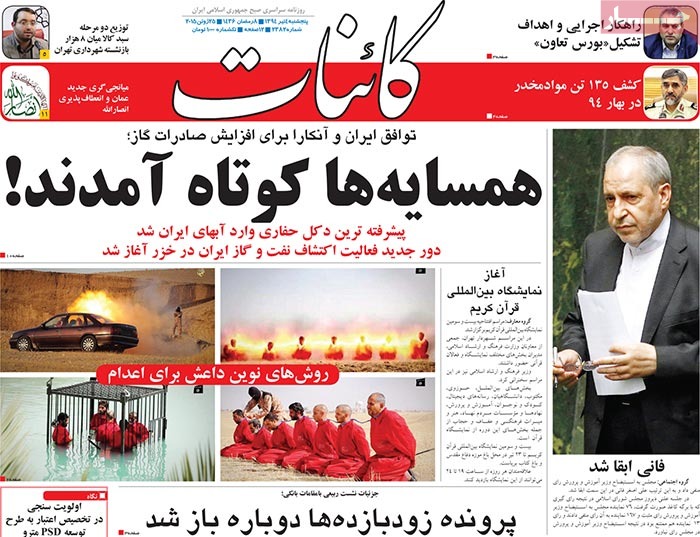
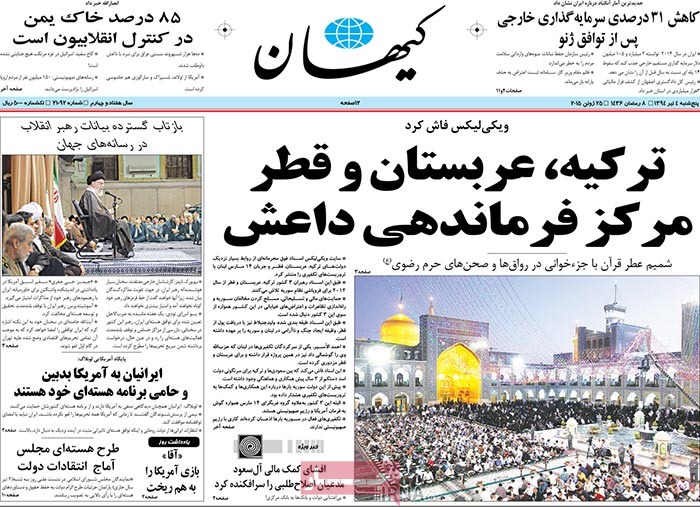
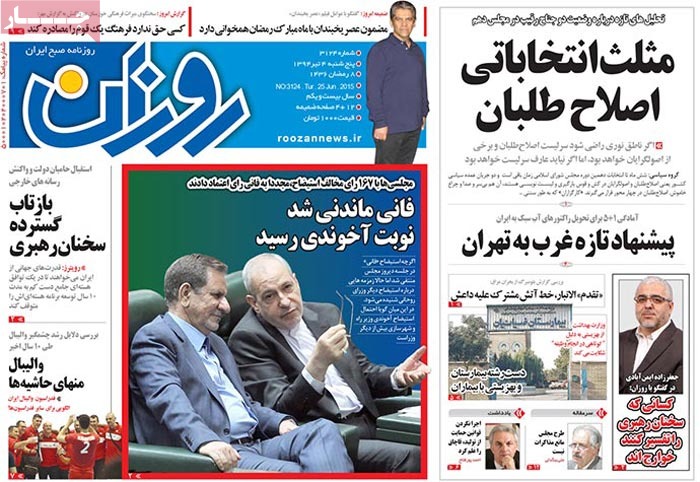
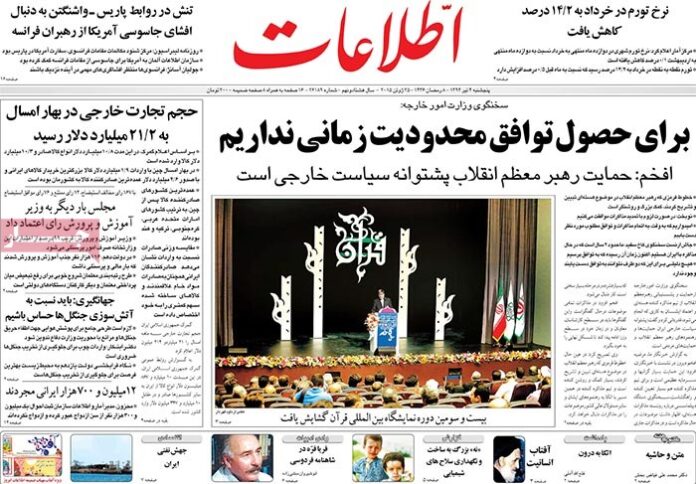
A look at Iranian newspaper front pages on May 19

Iranian Newspapers Headlines

Comments by the Supreme Leader that the enemies of Islam resort to issues such as religion and ethnicity to divide Muslims and those of Foreign Minister Zarif that Iran won’t allow unrestricted inspection of its sites dominated the front pages of Iranian newspapers on Tuesday.


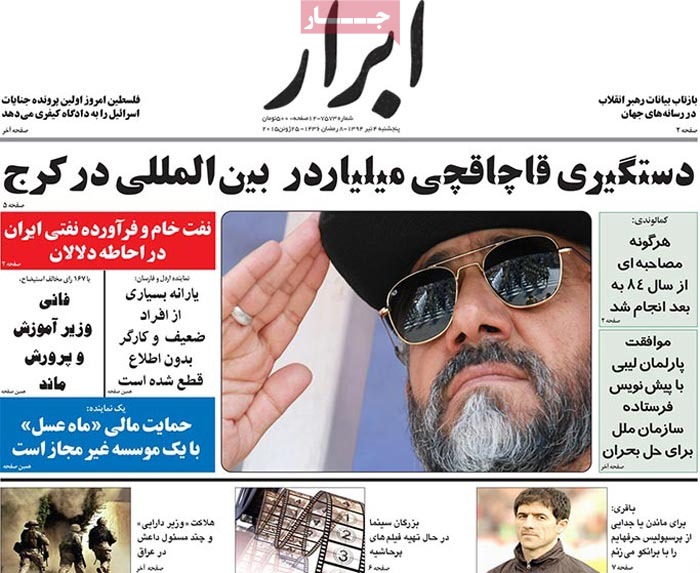
Abrar: “We won’t accept excessive demands in nuclear talks,” said Foreign Minister Mohammad Javad Zarif.

Abrar: “The result of Tractor Sazi-Naft match won’t change,” vowed the director of the Football Federation.

It came after controversy surrounding the result of another match allegedly stripped Tabriz-based Tractor Sazi Football Club of the championship title.


A look at Iranian newspaper front pages on May 19


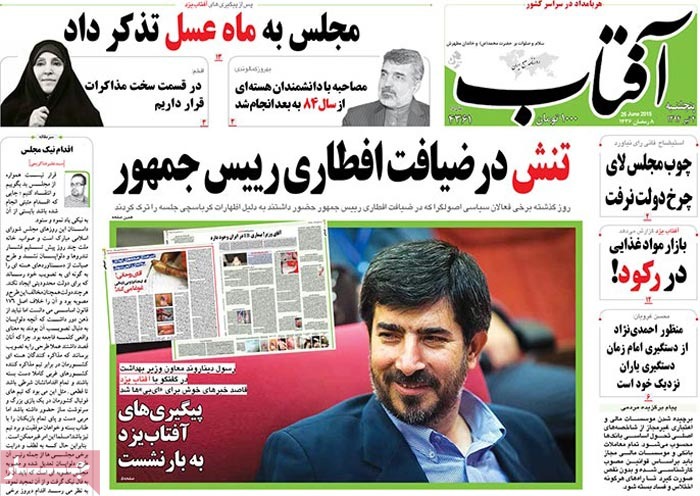
Aftab-e Yazd: “The enemy is resorting to issues such as religion and ethnicity to sow the seeds of discord among Muslims,” said the Supreme Leader.

Aftab-e Yazd: “Government has more than 2,000 unfinished development projects to deal with,” said the government spokesman.

Aftab-e Yazd: Mr. Minister! EB does exist in Iran.

[Epidermolysis Bullosa (EB) is an illness that causes the skin to be fragile.]


A look at Iranian newspaper front pages on May 19


Asr-e Iranian: Iran’s oil exports to rise to 2.5 million barrels a day.


A look at Iranian newspaper front pages on May 19


Asr-e Rasaneh: Iran to build eight new refineries in a bid to offset the effects of cheap oil.


A look at Iranian newspaper front pages on May 19


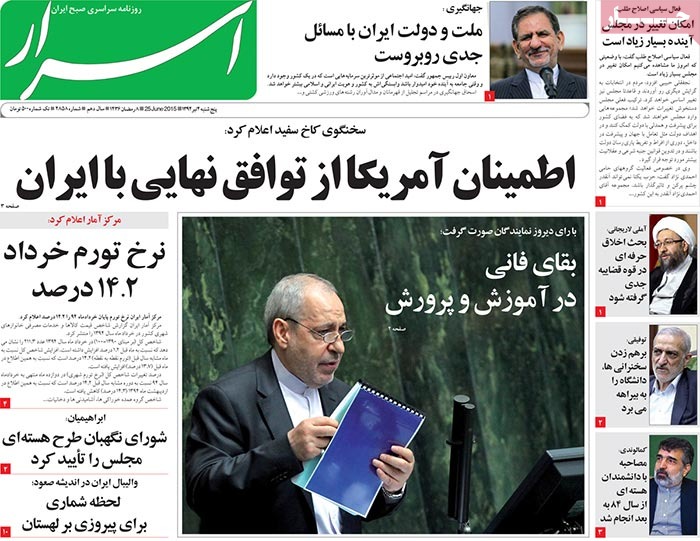
Asrar: “Failure in previous years to abide by law has plunged the country into deep trouble,” said First Vice-President Eshagh Jahangiri.

Asrar: Pressure and sanctions are unacceptable,” said President Rouhani.

Asrar: “We won’t accept unlimited inspections,” said Foreign Minister Zarif.

He added Iran’s plan to solve the Yemeni crisis is the most logical plan there is.


A look at Iranian newspaper front pages on May 19


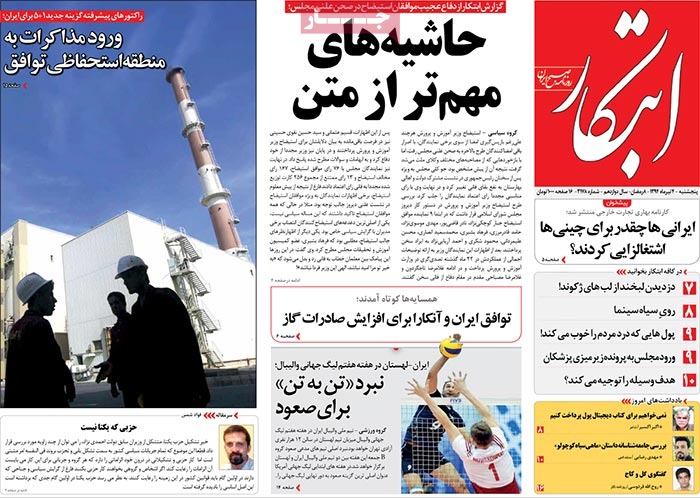
Ebtekar: “Iran will return to the pre-sanctions conditions in a year’s time,” said an economic advisor to the president.

Ebtekar: A suspect in the case of acid attacks in Isfahan has been apprehended.

Ebtekar: A day to answer questions for the minister!

Labor Minister Ali Rabiei will first appear in court following charges pressed against him by [Saeed] Mortazavi [a Tehran prosecutor who has been disbarred and is on trial again for massive corruption] and then will go to parliament to answer questions posed by MPs.


A look at Iranian newspaper front pages on May 19


Emtiaz: Tehran’s governor has said that birth rate in the capital is down 6 percent.

Emtiaz: “There will be 200 subway stations in the capital within three years,” said Tehran Mayor Mohammad Bagher Ghalibaf as he inaugurated a new station downtown.


A look at Iranian newspaper front pages on May 19


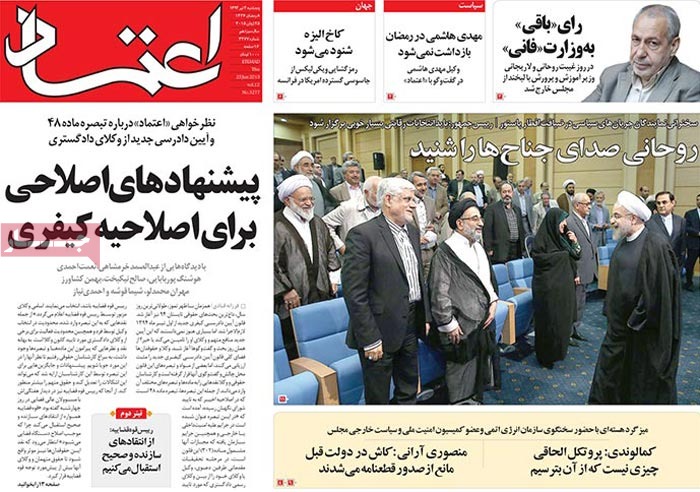
Etemad: Three new steps to resuscitate the economy

That the handout of cash subsidies of some individuals will stop has been officially confirmed; interest rates are likely to be further slashed; privatization at Telecommunications Company will be redressed.


A look at Iranian newspaper front pages on May 19


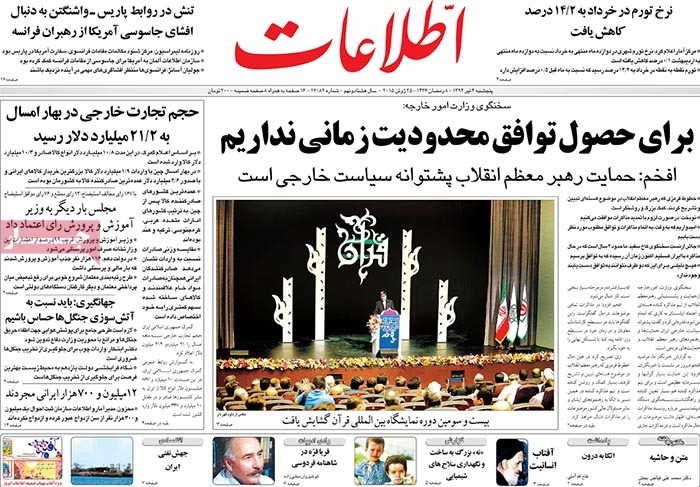
Ettela’at: “A police unit is to be formed to take on economic crimes,” said Police Chief Hossein Ashtari.

Ettela’at: The Supreme Leader and President Rouhani have congratulated the Iranian national taekwondo team following its victory in the World Taekwondo Championships in Russia.


A look at Iranian newspaper front pages on May 19


Hemayat: Iran’s commitments are clear but conditions surrounding the termination of sanctions are vague; that is how the spokesman of parliament’s National Security and Foreign Policy Committee has described the wording of a possible final deal [between Iran and P5+1].


A look at Iranian newspaper front pages on May 19


Iran: The volume of Iran-Germany trade is on the verge of 12 billion euros.

Iran: “No decision has been made to introduce a Cabinet shakeup,” said the president’s chief of staff.


A look at Iranian newspaper front pages on May 19


Kaenat: “Creating jobs for youth who live in towns near borders is on the agenda of the government,” said the minister of labor.


A look at Iranian newspaper front pages on May 19


Kayhan: The remains of 270 Iranian war martyrs have returned home.


A look at Iranian newspaper front pages on May 19


Resalat: “Reliance on the West to ensure security interferes with the independence of nations,” said Iranian Parliament Speaker Ali Larijani.


A look at Iranian newspaper front pages on May 19


Assad praises Iran’s pivotal role in defeating terrorists in Syria

velayati-asad

Syrian President Bashar al-Assad appreciated Iran for its key role and assistance to Damascus in fighting the terrorist groups and supporting the resistance front.

“The axis of resistance has been formed in the region and no one can break it and we will, no doubt, be the winning side, and the support extended by Saudi Arabia, Turkey and some other countries to the terrorists has, thus far, failed to annihilate the resistance, and God willing, we will witness growing victories and of course, these victories were not possible without the Islamic Republic of Iran’s support,” Assad said in a meeting with Iranian Supreme Leader’s top adviser for international affairs Ali Akbar Velayati in Damascus on Tuesday.

He also named victory against terrorism, certain regional powers, divisive thoughts and extremist groups as instances of those cases where Iran and Syria have earned shared victory.

Velayati, for his part, appreciated Assad and his nation’s resistance against terrorist groups and enemies’ plots, and said Syria is now in a better situation and has grown more powerful compared with 4 years ago, when crisis started in the country.

He referred to the illusions that certain states pursue through training and sending terrorist groups to Syria, and said, “No doubt these actions will backfire on these countries, and their ominous illusions and dreams for controlling the region, creating strife and even disintegrating certain countries will never come true.”

Velayati stressed that Iran will remain beside the resistance front and the Syrian government and nation.

[…]

Iran, Iraq defense ministers vow to broaden defense cooperation

General Hossein Dehghan

Defense Minister Brigadier General Hossein Dehghan conferred on Monday with his Iraqi counterpart Khaled al-Obeidi on expansion of defense cooperation between the two countries.

Iran’s defense minister is currently on a visit to Iraq at the official invitation extended by his Iraqi counterpart.

On the first round of talks, Brigadier General Hossein Dehghan expressed satisfaction over the visit to Iraq and said that relations are very deeply rooted.

Referring to successful visit of Iraqi president to Tehran and his meeting with Iranian Supreme Leader and president, he said “We are here to show our firm determination to implement the agreements and help broaden mutual cooperation, remove challenges and the security crisis.”

Tehran is determined to broaden relations and cooperation with the Iraqi government in various defensive and security fields, said the Iranian defense minister.

Iran fully backs the Iraqi government and nation and spares no efforts to support them in their campaign against terrorism, he said.

He expressed hope that during the current visit to Iraq he and his hosts will be able to take concrete action to help eradicate Zionist-Takfiri and criminal terrorists.

He denounced Daesh terrorists as the root-cause of regional insecurities.

Muslims must fully counter Zionist enemy: Iran official

Aliakbar Velayati

A senior adviser to Ayatollah Seyyed Ali Khamenei, the Leader of the Islamic Revolution, says Muslim nations should put up an all-out fight against the Zionist enemy and prevent any discord.

Addressing the closing ceremony of an international conference in the Lebanese capital of Beirut on Monday, Ali Akbar Velayati said enemies of Muslim nations are hatching plots to push the issue of Palestine and violated rights of Palestinians into oblivion.

Not only the Palestinians, but all Muslims are duty-bound to make every effort to liberate the holy al-Aqsa Mosque and protect its sanctity, he added.

The Iranian official emphasized that all Muslims should fully tap into their potential and draw up a strategic and overarching plan in a bid to liberate the mosque in East al-Quds (Jerusalem).

He pointed to an international plot that led to the occupation of the Palestinian land by the Zionists and said, “It is very obvious that the restoration of peace and stability to this strategic region will not be possible but through putting an end to the occupation and the liberation of all occupied Palestinian territories.”

Velayati emphasized that the return of the Palestinian refugees to their homeland is an “unchangeable” demand by all Palestinians.

All international treaties have recognized the legal rights of Palestinians to liberate their land and return to their homes, he pointed out.

He called on Palestinian groups to remain vigilant to defend the “Islamic and humanitarian” right of the Palestinian people and refrain from getting involved in minor differences.

“The Muslim world expects different Palestinian groups to solve their differences and create unity to realize the Palestinian people’s cause,” Velayati said.

He pointed to the Israeli regime’s anti-human measures to deprive the Palestinian people of their rights and continue the blockade of the Gaza Strip, expressing regret that Muslims have so far failed to fulfill their responsibility in that regard.

Velayati called on Muslim nations to reinforce their unity more than ever before.

Israel has tried to change the demographic makeup of al-Quds over the past decades by constructing illegal settlements, destroying historical sites and expelling the local Palestinian population.

Over half a million Israelis live in over 120 illegal settlements built since Israel’s occupation of the Palestinian territories of the West Bank, including East Jerusalem al-Quds in 1967.

Much of the international community regards the Israeli settlements as illegal because the territories were occupied by Israel in 1967, and they are hence subject to the Geneva Conventions, which forbid construction on occupied lands.

Iran summons Bahrain envoy over FM improper remarks

Foreign ministery

Iran has summoned the Bahraini charge d’affaires in Tehran and handed him a strong note of protest against the recent inappropriate comments by the foreign minister of the Persian Gulf kingdom.

Iran’s Foreign Ministry summoned the Bahraini envoy, in the absence of the Bahraini ambassador to Tehran, on Monday to urge the kingdom’s officials to rectify their conduct and comments.

The Iranian ministry recommended the Bahraini government focus on the root causes of the ongoing problems in Manama in a bid to settle them.

Iran also emphasized that playing a blame game and leveling accusations against other countries would not help solve the Bahraini woes.

The move came a day after Bahrain’s Foreign Ministry summoned the Iranian Chargé d’affaires to Manama Mohammad Reza Babaei to protest against what it alleged was Iran’s meddling in the affairs of the country.

Addressing senior Iranian officials and ambassadors of Muslim countries in Tehran on Saturday on the occasion of Eid al-Mab’ath, Leader of the Islamic Revolution Ayatollah Seyyed Ali Khamenei expressed support for the “oppressed” nations of Yemen, Bahrain, and Palestine.

“We support the oppressed as much as we can and to the extent that our abilities and our facilities allow, it is our duty,” Ayatollah Khamenei said.

On his Twitter account, Bahrain’s Foreign Minister Shaikh Khalid Bin Ahmad Al Khalifa alleged that the comments constituted interference in the internal affairs of the kingdom.

Iran urges UN to create safe zone in Yemen

Zarif

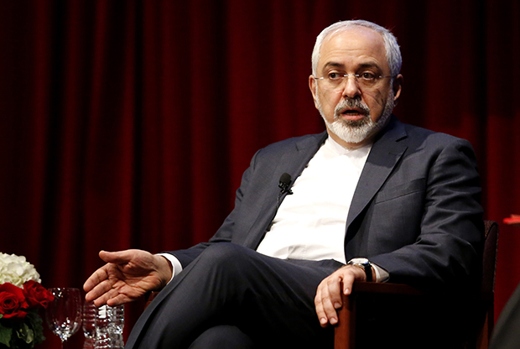
Iran’s Foreign Minister Mohammad Javad Zarif called on the United Nations to create a safe zone in Yemen to allow the delivery of humanitarian supplies to the poor country that has come under military attacks by a Saudi-led coalition.

“The United Nations needs to create a protected zone in Yemen for access to humanitarian aid,” Zarif said Monday in a joint press conference with his Hungarian counterpart in Tehran.

It is time for the United Nations to take control of the situation so that humanitarian aid would be delivered to Yemen, the top Iranian diplomat underscored.

He said Iran has called on the UN to shoulder its responsibilities regarding the war on Yemen in order for the ceasefire to continue in the Arabian Peninsula country.

“The (Saudi-led) attacks on civilian areas are going on and what makes it more deplorable is that humanitarian aid does not reach those areas, which is a serious challenge,” Zarif further said.

“The restrictions imposed on the people of Yemen by the Saudi-led coalition are unacceptable and violate international regulations and human rights laws.”

Saudi Arabia and some of its Arab allies on March 26 began to launch deadly airstrikes against the Houthi Ansarullah movement in an attempt to restore power to the fugitive former President Abd Rabbuh Mansour Hadi, a close ally of Riyadh.

According to Yemen’s Freedom House Foundation, the Saudi airstrikes have claimed the lives of nearly 4,000 Yemeni people so far while more than 6,887 others have been wounded.

Meanwhile, the Saudi-led airstrikes on Yemen resumed early Monday, hours after the expiry of a five-day truce meant to facilitate badly needed humanitarian aid.

Kabul and Tehran can serve as driving force behind regional convergence

Rangin Dadfar Spanta

Dr. Rangin Dadfar Spanta, the former Afghan foreign minister and national security advisor to President Hamid Karzai, is the director of the Afghan Institute for Strategic Studies and an influential behind-the-scenes figure in Afghan politics.

His father, Shah Alam Khan Taheri was a politician too and found his way to parliament under Mohammed Zahir Shah.

Spanta completed his higher education in Germany and taught for years as director of Aachen University’s Third World Studies Institute.

He believes that there is no such thing as IS ideology in Afghanistan and what today exists in the country is a Taliban line of thinking which has only changed its outward appearance. He says the Salafi-Takfiri doctrine of IS can never be indigenized in Afghanistan.

Spanta, who is known as being outspoken about Pakistan, says that the Taliban means Pakistan and its intelligence service and military. Afghanistan needs to engage in dialog with Pakistan to keep its armed fifth column away from the country, he says, adding some countries such as China can play a constructive role in peace negotiations in his country.

Iran and Afghanistan are two similar countries whose relations have always been robust in spite of some hard feelings at times; in fact the two nations cannot live without each other, he says.

What appears below is the translation of part of an interview Spanta gave to Sharq daily on May 17:

[…]

What do you make of cooperation between IS and the Taliban in Afghanistan?    

The presence of IS in Afghanistan can be studied from two angles. Although IS movements in Afghanistan are a reality, they are also a product of media hype.

I think over the last few months, some Taliban insurgents have replaced their white flag with the black one of IS for a number of reasons.

[…]

It must be noted that the so-called economy of assassination, opium and abduction is a complicated issue in Afghanistan and Taliban militants [involved in such crimes] are looking for a new mask to hide behind.

Relations among major powers are to blame for the presence of another segment of the Taliban. Some countries use the Taliban as leverage to put pressure on others.

IS is not an indigenized phenomenon in Afghanistan. It is really tough for IS, as a political current with Salafi-Takfiri ideology, to take roots like the Taliban in Afghanistan and grow robustly.

Those who are on the ground in Afghanistan under the banner of IS are either members of the groups that I mentioned or are among terrorist circles in Central Asia or Arab countries who   have crossed the border to Afghanistan from Pakistan.

[…]

How serious is the threat of terrorism in northern Afghanistan? 

Terrorist acts are not confined to northern Afghanistan, but media focus much of their attention on that region.

[…]

Undoubtedly, Badakhshan, Kunduz and Faryab are the three northern flashpoints where acts of terror are committed. In Farah, a border province next to Iran in the southwest, acts of terrorism are a common occurrence.

These are the four hotspots where terrorism is pervasive. Some of the terrorists have hoisted the IS flag in these areas.

What about recent reports about activities by hardliners in Herat Province?

From my perspective, aside from some agents from East Turkestan and the Islamic Movement of Uzbekistan, Taliban fighters do not feel attached to IS as an ideological movement. […]

What exists in Afghanistan today is Taliban’s way of thinking which has changed its façade. IS thinking is based on a Salafi-Takfiri doctrine which seeks to trigger sectarian conflict and establish and boost Wahhabism. Such ideologies will never be indigenized in Afghanistan; thus there is no room for them there.

These radical agents have simply changed their flags, but their ideology pursues the same traditional strategy of the Taliban.

It seems that following the formation of the national unity government, the Afghan foreign policy has shifted toward its neighbors, including Iran and India. In your opinion, to what extent can this shift serve the interests of Afghanistan?

[…]

Kabul pursues a multifaceted foreign policy; our foreign policy principles in play over the past 13 years take account of our national interests.

Long-term Afghan interests require us to have deep and close friendship with countries with broad-based political systems.

We have a lot in common with Iran and India. We should bear in mind that geographical boundaries are not changeable.

Without doubt, it’s strategically important for us to have friendly relations with Pakistan providing that Islamabad abandons terrorism as a foreign policy tool.

For a number of reasons, India is Afghanistan’s ally which inevitably has strategic ties with it. New Delhi is also the biggest buyer of Afghanistan’s agricultural and non-agricultural products and grants scholarship to 1,500 Afghan university students at different levels each year.

Although India is not traditionally among countries which offer international aid, it has dedicated $2.3 billion in developmental aid to Kabul which has been spent on construction of roads, promotion of government capabilities, and transfer of energy from Central Asia to Kabul.

Over the 11 years that I held office, India never expected Afghanistan to repay its favors. Kabul-New Delhi relations do not revolve around ideology or hegemonic ambitions; India has never sought to impose its political system or a certain lifestyle on Afghans.

As a democrat, I believe as a country with numerous religions and ethnic groups India can be a good role model for us.

This is the ideal system I pursue; a system in which people assume responsibilities based on their political beliefs, as well as their love for and interest in human freedom, justice and equality. Given Afghanistan’s variety of religions and ethnic groups, Kabul can modestly take a leaf out of New Delhi’s democracy book.

[…]

In relations with Tehran and Washington, Kabul has adopted the same policy for years. Although the two countries are in confrontation with each other, they have finally accepted to take Afghanistan off the list of issues that make their relations tense. Therefore, Afghanistan has deep and amicable ties with both Iran and the US.

Unilateral policies and measures that upset the equilibrium of foreign policy are not to the benefit of Afghanistan.

China has recently got engaged in Afghanistan and has tried to play a role in peace talks between the Afghan government and the Taliban. From your perspective, to what extent can China help bring the two sides together?   

[…]

In the past, the US, Saudi Arabia and China had influence over Pakistan; but in my opinion, China wields the greatest influence over Islamabad today and their ties are really deep.

Another thing is that China is under direct threat from terrorists along its border with East Turkestan, and Beijing knows well that those terrorists are trained in Pakistan.

All in all, I think China can play an effective role to that end; its efforts in talks [as a mediator in the peace process] are nothing new.

[…]

It seems that Pakistan, Russia, Iran and India are trying to bring about regional unity with Moscow as its axis. Kabul’s ties with Washington and its consistent foreign policy in dealing with America are absolutely clear. Do you think that the emergence of such unity will cause problem for Afghanistan?

[…]

As a politics instructor, I have learned that for us, I mean the Third World, a multipolar world is better than a unipolar one.

[…]

As long as the alternative of internal democracy is missing, outside pressure to topple governments can only give rise to more terrorist groups.

I think it’s not to the benefit of the global peace, coexistence and social evolution to help failed states cling to power.

For the very reason and in a bid to put an end to all global authoritarianism, I am in favor of a multipolar world regardless of its social components.

In the Afghan system, I am among people who seek strategic relations with America and I spearheaded this campaign in the country. I have been in charge of drafting the US-Afghan Bilateral Security Agreement and a strategic deal with NATO. Thus, I am not opposed to such deals and believe that Afghanistan needs such agreements.

Also, I believe that because of our Third-World identity, we need a balance in international politics to keep go-it-alone approaches at bay.

[…]

Finally, Afghan President Ashraf Ghani paid a visit to Iran, although there were speculations about the reasons behind multiple delays in his Tehran visit. How do you evaluate Tehran-Kabul relations today?

Relations between two neighbors like Iran and Afghanistan which have a lot in common are really strong. It must be noted that the more the two countries have in common, the bigger will be the likelihood of misunderstanding between them. I still think that our bilateral ties are so robust and sustainable that the two countries cannot live without each other.

Kabul has tried a lot over the last 13 years to establish deep and extensive relations with Tehran and steer its ties with Iran away from its relations with the US.   

I wish to offer some suggestions and not consultations to politicians. I suggest we have deep, extensive relations with Iran. Our future can be shaped through regional convergence. Kabul and Tehran can serve as the driving force behind convergence providing that their relations are robust. Misunderstanding might arise at times, but generally I am optimistic about the future of Kabul-Tehran ties.

UN rights report based on false, fabricated information: Iran

Ahmad Shahid

Iran has denounced as unsubstantiated and false a recent report by the United Nations special rapporteurs about the alleged increase of executions in the country.

In a statement released on Sunday, Iranian Judiciary’s High Council for Human Rights rejected the report as being founded upon “incorrect information and fabricated sources,” adding that no correspondence has been made with Tehran in order to verify the accuracy of the allegations.

The Iranian rights body called on the UN officials to “refrain from politicizing the issue of human rights and adopt an impartial attitude,” the statement said, noting, “The structure of Iran’s judicial system guarantees the process of a fair trial.”

The statement touched upon drug-related death sentences in Iran, saying such verdicts are issued only after a thorough and comprehensive judicial process.

Iran shares a long border with Afghanistan, the world’s biggest producer of opium, and this makes it “strategically important” for Tehran to launch a constant battle against drug trafficking, the statement added.

According to the council, Iran has paid a heavy price in the battle against drug trafficking and such related issues as rehabilitation of addicts as well as spending hundreds of millions of dollars on an annual basis.

Iran’s war against drugs has claimed the lives of 4,000 Iranian forces and disabled over 12,000 of them, the statement added.

Last week, Ahmed Shaheed, the UN Special Rapporteur on Human Rights in Iran, and Christophe Heinz, the UN Special Rapporteur on Extrajudicial, Summary and Arbitrary Executions issued a joint statement, voicing concern over the alleged increase of executions in Iran.

On June 17, 2011, the UN Human Rights Council, under pressure from the United States and its allies, named former Maldivian Foreign Minister Ahmed Shaheed as its human rights investigator on Iran.

Tehran insists that the appointment of a UN special rapporteur on Iran’s human rights is a selective, politically-motivated and unacceptable move.