Sunday, December 21, 2025
Home Blog Page 4848

Pakistan will not provide Saudi with nukes: Former army official

Talat Masood

A Pakistani senior analyst, Lieutenant General Talat Masood has said that news reports by Western media that Saudi Arabia has taken the ‘strategic decision’ to acquire nuclear weapons from its ally Pakistan are baseless and false.

Speaking to IRNA he said that the objective of these reports is to malign Pakistan. “These reports are nothing new. They have been coming out over for many years and their sole objective is to defame Pakistan,” he said.

He said that as Iran and Western powers are set to sign a comprehensive nuclear deal so Western media is creating hype that under threat, Saudi Arabia might ask Pakistan to give it nuclear weapons.

The analyst said that objective of this move is to put Pakistan and Saudi Arabia under pressure. He added that these reports are incorrect as Pakistan is a responsible nuclear state and knows its responsibilities very well.

He said that Pakistan has a good standing at international level and cannot afford to take a step that would damage its reputation in the world. “Selling nuclear weapons to Saudi Arabia is out of question,” he said.

Iran to further expand naval presence in high seas: Navy commander

Habibollah Sayyari

Iran’s Navy Commander Rear Admiral Habibollah Sayyari says the Islamic Republic will expand its naval presence in international waters.

Rear Admiral Sayyari said Tuesday that Iran has some “operational plans” for broader presence in international waters.

“We are a peaceful nation and are not in the habit of trespassing the borders of other countries,” he told IRNA, adding that Iran will, however, have its military vessels sail in international waters as they belong to all the countries of the world.

The Iranian commander said that Iranian vessels have had continuous presence in an area that covers the northern limits of the Indian Ocean, a waterway, which Sayyari said, is of geopolitical and commercial importance to Iran and the entire world.

He said more than a third of the global trade transit takes place through the northern part of the Indian Ocean, and for Iran, a country which relies on maritime transportation for more than 90 percent of its exports, the presence would be of high significance.

Iranian flotillas have already been to several areas in the high seas, including waterways near India, Sri Lanka, the Equator, Indonesia, the Strait of Malacca, the Pacific Ocean, the Suez Canal, the Mediterranean and the South Indian Ocean, Sayyari said.

Iranian interests in the Gulf of Aden

“We have interests in the Gulf of Aden because our commercial ships are sailing, and we have to protect the safety of these vessels,” Sayyari said.

He also elaborated on the presence of the Iranian 34th flotilla in the Gulf of Aden, saying that Iran has dispatched the flotilla to the waterway to escort the ships sailing there.

He said that the flotilla, which is comprised of the Alborz Destroyer and the Bushehr logistic vessel, is currently patrolling the region with the aim of ensuring security, adding that it will be ready to help other ships if need be.

The 34th fleet of the Iranian Navy began its journey toward the Gulf of Aden on April 9. The ships entered the waterway through a passage between the boundaries of Yemen and Oman before reaching the Bab-el-Mandab Strait. After sailing through the strait, the ships will sail toward the Red Sea, according to Sayyari.

Tehran mathematics gathering (PHOTOS)

Cédric Villani

A fourth Meeting on Contemporary Mathematics in Tehran was attended by Cédric Villani, a French mathematician who was awarded the Fields Medal in 2010.

When asked about how he found the gathering and the questions posed by Iranian university students and academics, the renowned French mathematics professor said that Iranian students struck him as very interested and asked questions indicative of their broad knowledge.

Snapshots of the gathering with Villani in attendance released online by jamejamonline.ir:

Iran, Germany to sign agreement on forestry cooperation

Iran Forest

Deputy head of Iran’s Forests, Range and Watershed Management Organization (FRWO), Behzad Angouraj, told IRNA on Tuesday that the agreement will be soon signed as a follow-up to a conference held between the two countries on the opportunities and challenges related to sustainable management of Iran’s Caspian forests.

He added that the conference was held on May 14-15, attended by the FRWO; Germany’s Michael Succow Foundation; the Institute for Forests, Range and Watershed Management Research, which is affiliated to University of Tehran’s Faculty of Natural Resources; as well as the Department of Environment.

Angouraj noted that the participants focused on opportunities and challenges that face Iran with regard to the sustainable management of the country’s Caspian forests, and also discussed natural habitats and protection of biodiversity in that region.

Emphasizing the need to promote international cooperation on forests, the official said introduction of existing capacities, optimal use of opportunities and discussion of challenges were major topics raised in the conference.

He noted that since two years ago, Iran has been implementing a project in cooperation with the United Nations Development Program (UNDP) and the Global Environment Facility (GEF) for multipurpose exploitation of Hyrcanian mixed forests and empowerment of local communities living in that region.


Iran forests map
The map shows location of Hyrcanian mixed forests in northern Iran.


Angouraj said German specialists have also indicated their keen interest to take part in this project.

Hyrcanian mixed forests are located in northern Iran with a total area of 1.9 million hectares and contain 90 tall tree species as well as 211 species of short trees and 1,558 species of shrubs.


President urges high respect for scholars, academics

rouhani-uni

President Hassan Rouhani on Tuesday termed Iranian scholars and academics residing inside or outside the country as national assets and urged officials to highly respect them.

Speaking at the Islamic Azad University (IAU), he praised the role of this university in promoting higher education in Iran.

President Rouhani stressed the need for efforts to deepen the national cultural identity and called for scientific independence and freedom for Iranian universities.

He urged officials to make it possible for Iranian scholars residing abroad to get employment in Iranian universities and research institutes, particularly in the Islamic Azad University (IAU).

The President said everybody in the country should show respect and tolerance towards academics and scholars who are residing inside or outside the country even if they have a different attitude which contrasts with official views.

The Islamic Azad University, commonly referred to as Azad University is the world’s third largest university and the largest private university system. The university is based in Iran.

Headquartered in Tehran, the Islamic Azad University was founded in 1982 by Akbar Hashemi Rafsanjani, currently has 1.5 million students.

Azad University has over 100 branches across the country and also in other countries. It has branches in the UAE, the UK, Tanzania, Lebanon and Armenia and has plans to establish more branches in Malaysia, Canada, Afghanistan and Tajikistan in the near future.

A look at Iran’s registered and unregistered heritage at UNESCO

iran-history

There is still a big question mark as to why some are under the false impression that whatever is located within the national borders of Iran only belongs to them and no one else. Perhaps, for the very reason they think of historical and cultural heritage as their inherited property!

Zendegi-Salam, a supplement of Khorasan daily, has highlighted the need for urgent action to have Iranian cultural heritage and intellectual property registered with UNESCO before it’s too late. The following is the translation of the item which appeared in the newspaper on May 18:

What makes things worse is that some are not concerned about the preservation of cultural heritage because they do not even feel attached to it.

People fall into two categories according to their reaction to what is left behind by the past generations. Some denounce historical items as a bunch of odds and ends which are too out-of-date to have any value; others keep visiting museums and hailing them.

Sometimes we forget the fact that what we consider dilapidated historical sites which should be leveled and replaced with skyscrapers or a bunch of useless items which are simply gathering dust in museums are in fact our cultural heritage; without them we have no evidence to prove the deep roots of our civilization.

In case of their disappearance, if one day we claim that we are a civilized nation, posterity will mock us and wonder how a nation can call itself civilized while failing to preserve what is passed down to it from its ancestors.

Living at the heart of one of the greatest human civilization centers does not give us the right to say we can do whatever we want with the heritage. We should bear in mind that what we have access to today belongs to all humans and is not only ours.

In other words, although our cultural heritage is in our possession, it’s world property. That’s why years ago UNESCO started to register national property as world property, meaning that world heritage belongs to all humans regardless of their race, color of skin, religion or nationality.

Thus, preservation of such property does not fall only on the country which owns it; rather, all UNESCO members are duty-bound to safeguard it. That reflects global concerns about the preservation of world civilization.

Iran’s registered heritage

After UNESCO’s decision to register the cultural heritage of different nations, Iran made efforts to have at least a small part of its cultural heritage sites registered in a bid to both prove its historical identity and guarantee its preservation.

The bid resulted in the registration of 17 historical sites such as Susa’s Chogha Zanbil, Persepolis, Pasargadae and West Azerbaijan’s Saint Thaddeus Monastery.

In 2006, UNESCO made another decision to register the intellectual property of countries under their own names.

In this regard, Iran has so far had a small part of its intellectual property registered. Among other things, Nowruz and the skill of carpet-weaving have secured a berth on the UNESCO world list of intellectual property.

Iranian heritage and too many ownership claims!

As for registration of some items, there are disputes underway among countries as they each want to lay claim to their ownership.

The main problem lies in the fact that Iran used to be an absolutely vast country with modern-day Azerbaijan, Armenia and Afghanistan being part of its territory.

Some countries have succeeded in having the disputed intellectual property registered in their own names and it’s too late to undo things.

Legally speaking, it’s possible to apply for the registration of joint ownership which would lead to the property being registered under the names of two countries, but that task is too challenging.

In fact, a laundry list of Iranian property has been registered in the name of other nations. For instance the sport of polo, which dates back to the Achaemenid Empire in Iran, as well as the Ashighlar music, tar, an Iranian musical instrument, and Yalda have been all registered under the name of Azerbaijan; Turkey got Iran’s coffeehouse, Lavash, an Iranian bread, has been registered under the name of Armenia, and the UAE has laid claim to Iran’s windcatchers.

Unfortunately, claims to ownership are not confined to things and include historical figures like Rumi, Ferdowsi, Omar Khayyam, Al-Farabi, Nizami Ganjavi, Avicenna, Nasreddin, Nasir al-Din al-Tusi, Abu’l-Fadl Bayhaqi, Al-Biruni and Pourya-ye Vali.

What beats me is that no one disputes the claims of some Arab officials. How could Nasir al-Din al-Tusi have hailed from an Arab country while his family name, al-Tusi, clearly indicates his hometown, Tus [an ancient city in the northeastern Iranian province of Khorasan Razavi]?

Iran expresses concern about Egypt’s death sentences

Egypt

Iran has expressed concern about Egypt’s recent string of death sentences, saying the verdicts could tarnish the image of the North African country.

Foreign Ministry Spokeswoman Marzieh Afkham on Tuesday expressed regret about Egypt’s recent death penalties and said the verdicts which encourage violent measures and a policy of elimination could harm Egypt’s image and credibility.

“We believe that certain problems and divisions could be resolved based on the lofty goals of Egypt’s popular revolution as well as through national dialog and political consensus among the peaceful, political and social movements,” Afkham added.

On Saturday, a court in Egypt sentenced former President Mohamed Morsi along with 105 others to death for a mass prison break in 2011 during the country’s revolution against long-time dictator Hosni Mubarak.

The death sentences are now to be referred to the Grand Mufti, Egypt’s highest religious authority, for consultative review and the final decision will be pronounced on June 2. The Grand Mufti’s verdict is non-binding on the court.

Back in April, Morsi was also given a 20-year prison term in a separate trial on charges of protester deaths in 2012. The case stemmed from the deaths and torture of demonstrators outside Morsi’s presidential palace in December 2012.

In July 2013, Morsi, the country’s first democratically-elected president, was ousted in a military coup led by the former head of the armed forces and the current President Abdel Fattah el-Sisi.

The Egyptian government has been cracking down on any opposition since Morsi’s ouster, banning the Muslim Brotherhood movement and arresting thousands of his supporters.

Hegemonic powers wage proxy wars to achieve goals: Iran

2bb47f23-b806-4dfc-84a0-3ceae6d9cffb

Iran’s Defense Minister Brigadier General Hossein Dehqan says the hegemonic powers wage proxy wars to maintain their interventionism and dominion.

“Waging proxy wars and giving covert and overt support to terrorism are among the means the hegemonic system uses to achieve its evil goals,” General Dehqan said in a meeting with Iraqi Foreign Minister Ibrahim al-Jaafari in Baghdad on Tuesday.

He also dismissed the global hegemonic powers’ advocacy of human rights, freedom and welfare of nations as “empty and flimsy slogans,” saying the hegemonic system continues to interfere in the affairs of nations despite such claims.

Iran’s defense minister reaffirmed Tehran’s support for an independent and united Iraq and added that the two neighbors have overcome significant hurdles.

The Iraqi nation has established a broad-based and strong government and displayed its determination to improve stability and peace and counter the danger of Takfiri terror, noted General Dehqan.

The Iraqi foreign minister, for his part, said the ISIL Takfiri terrorist group, which operates in his country and Syria, poses a “very dangerous” threat to regional countries.

The danger that today threatens Iraq and Syria will challenge Turkey and Saudi Arabia as well as other regional countries, Jaafari said, stressing that all nations are “duty-bound” to combat ISIL terrorists.

Iran-Iraq ties

Meanwhile, in a meeting between General Dehqan and Iraq’s Interior Minister Mohammed Salem al-Ghabban, the two officials stressed the importance of bolstering cooperation to counter terrorism and improve stability and security.

The Islamic Republic of Iran regards Iraq’s security as its own and will spare no effort in helping Iraq establish stability, peace and security, the Iranian defense minister pointed out.

[…]

Iran, Arabs, Israel; a geopolitical parody

Camp David-Arabs

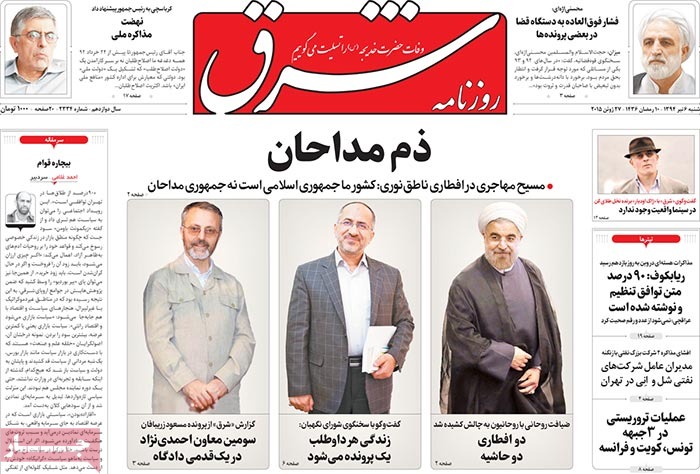
A summit between the US president and leaders of the Persian Gulf Arab nations at Camp David wrapped up its work on May 15 by stressing the need to counter what the participants called Iran’s threat and destabilizing efforts in the region. To the disbelief of Washington’s Arab allies, the summit failed to produce concrete, satisfactory results.

That was the opening of an opinion piece – by Meysam Behravesh – Sharq daily published on May 18 about the summit earlier this month between President Barack Obama and members states of the Persian Gulf Cooperation Council and the upshot of the Camp David summit. The following is the translation of excerpts of the piece which was originally titled “Those discontented at Camp David”:

The expectations of the Arabs – to sign an official security pact with the United States – were not met at Camp David. Perhaps the knowledge about Washington’s reluctance to ink such a pact was one reason behind the decision by the leaders of Saudi Arabia, Bahrain and the UAE not to attend the summit [at the presidential retreat in Maryland].

[…]

The Obama administration refused to give the Arab countries present at the summit an MNNA status [Major non-NATO ally, which is a designation given by the United States government to close allies who have strategic working relationships with US Armed Forces, but are not members of the North Atlantic Treaty Organization (NATO)].

It is worth mentioning that Egypt, Israel, Jordan, Bahrain and Kuwait have been already declared major non-NATO allies by the US. Washington also declined to provide a nuclear umbrella [A protective status in which a nuclear state promises to use its arsenal to defend an ally without nuclear capabilities] for its Arab allies in the Middle East – similar to the US nuclear commitment to South Korea.

[…]

[The fact remains that] the US administration simply does not want to challenge Israel’s military and arms supremacy by lending military support to the Arabs or offering them a special security and defense status.

[…]

A case in point for such a mindset is the US unwillingness to sell its state-of-the-art, radar-evading F-35 fighters – which have been developed by Lockheed Martin [an American global aerospace, defense, security and advanced technology company with worldwide interests] – to the Arab nations in the Middle East. ​It is interesting to know that the US has already agreed to deliver the F-35 jets to Israel [so that Tel Aviv can maintain its military edge in the region].

[…]

Conceivably the US commitment to help the Arab states in the Persian Gulf build a joint defense shield in the region – to counter [what the Arabs call] a possible missile attacks from Iran – was the only tangible result of the 2015 Camp David Summit. For sure, there would be challenges in the way of carrying out such a [transnational] project.

As Anthony Cordesman – an American defense and intelligence expert at the Center for Strategic and International Studies (CSIS) and a national security analyst on a number of global conflicts – has put it, the main challenge to this joint project would be the conclusion of a comprehensive agreement among members of the Persian Gulf Cooperation Council (PGCC) over the rules and preparations which are needed to counter missile threats.

In light of the fact that the Arab nations are divided over certain security issues in the region, it would not be an easy task to have such an agreement inked.

In December 2014, Washington agreed to US companies selling defense equipment and arms to the PGCC – as an organization – like what Washington did in selling weapons to NATO and setting the stage for creating a joint air defense system.

Nonetheless, Israel is believed to be a bigger challenge. If the US seeks to help Israel maintain its military edge in the Middle East, the joint defense system should be designed and installed in a way that it can only intercept missile attacks from Iran and not those of Israel!

A look at the not-too-distant past shows that an undiplomatic [controversial] address in March 2015 by Israeli Prime Minister Benjamin Netanyahu to a joint meeting of the US Congress against Iran – together with his move to treat a national question as a personal issue he has with President Barack Obama – eventually tilted the balance in favor of a nuclear deal with Iran.

This is the second time over the past several months that the stance of Israel – which is a key US ally in the Middle East – ironically and unwittingly serves Iran’s interests.

For years, Israel had taken maximal advantage of Iran’ behavior to advance its strategic objectives. Now the tides have turned in Iran’s favor and this is – to a large extent – the direct result of the new [Iranian] government’s foreign policy which is based on wisdom and moderation.

The [Rouhani administration’s] foreign policy has seen the United States go as far as alienate its old allies in the region.

Taliban delegation in Iran for talks

Tayyab-Agha-Taliban

A political delegation of Afghanistan’s Taliban has paid a visit to Tehran to hold talks with Iranian security officials on regional issues, particularly the developments of the Muslim world.

The visiting team, comprised of members of Afghan Taliban’s political bureau in Qatar, arrived in Tehran on Monday.

Led by Tayyeb Aqa, head of the Taliban bureau in Qatar, the delegation met with Iranian security officials and discussed regional issues, particularly what is going on in the Islamic world as well as matters relating to the Afghan refugees.

Taliban had already dispatched political delegations to Iran two times, for meeting Iranian security officials and for attending an international conference on Islamic Awakening, a popular uprising that swept has regional and Islamic countries in recent years.

Afghanistan’s Taliban had announced earlier that it had established the political bureau in Qatar to stay in touch with the other countries.

Members of the Taliban’s Qatar bureau have also visited China, Australia, Germany and Japan in the past.

No details have been released on the talks.