Sunday, December 21, 2025
Home Blog Page 4850

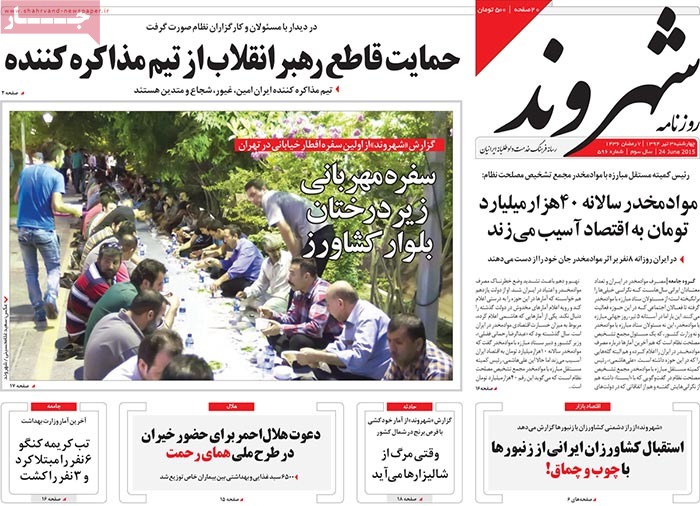
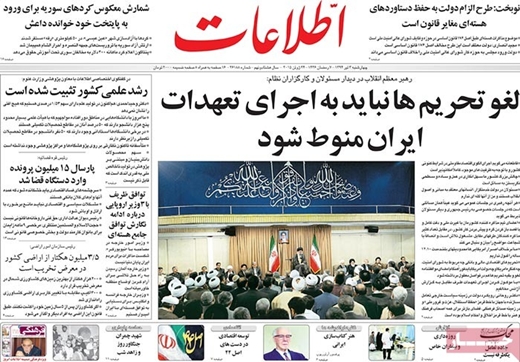
A look at Iranian newspaper front pages on May 18

Iranian Newspapers Headlines

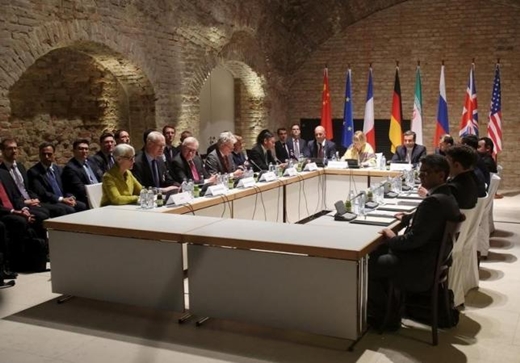
Comments by Ali Akbar Velayati, an advisor to the Supreme Leader, and Foreign Minister Mohammad Javad Zarif about nuclear talks with P5+1, the US in particular, dominated the front pages of Iranian dailies on Monday.


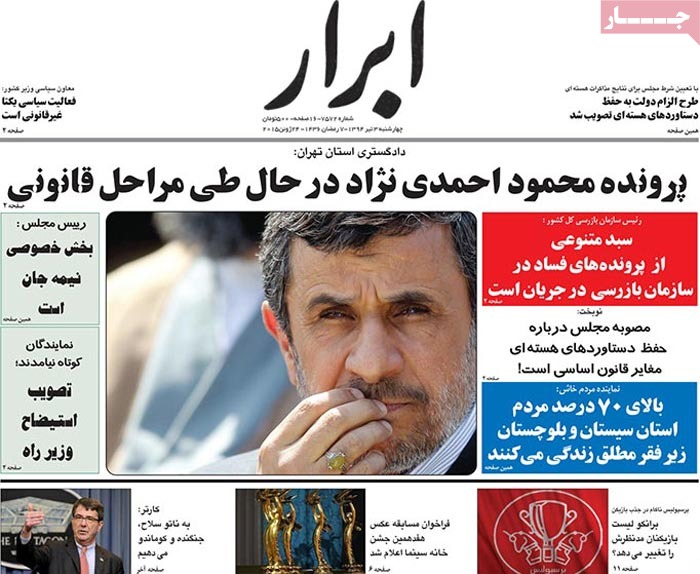
Abrar: A motion to summon the minister of sports and youth to parliament has been presented to the Presiding Board of the Islamic Consultative Assembly.


A look at Iranian newspaper front pages on May 18


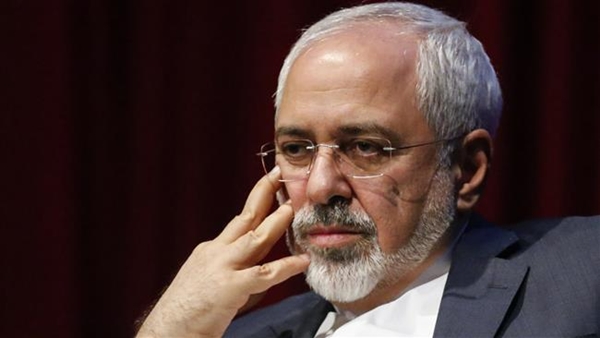
Afkar: “We are not talking to the US to improve bilateral ties,” said Foreign Minister Mohammad Javad Zarif.

Afkar: “We’ll take no prisoner when it comes to trying the corrupt,” said the deputy judiciary chief.

Afkar: “The Sabalan Mountain is to be registered as a world site within four years,” said the director of the Cultural Heritage, Tourism and Handicrafts Organization.


A look at Iranian newspaper front pages on May 18


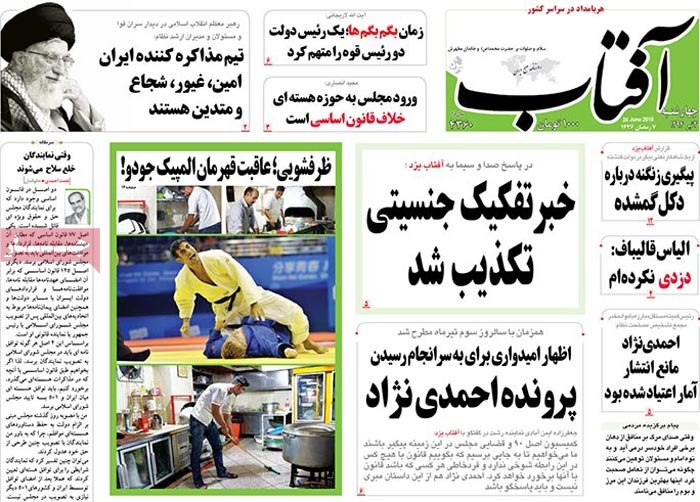
Aftab-e Yazd: “The uptick in crime rate is alarming,” said Chairman of the Expediency Council Ayatollah Akbar Hashemi Rafsanjani.

Aftab-e Yazd: President Rouhani has ordered those who acted against the rules in what happened in Tabriz to be seriously dealt with.

An announcement by yet-to-be-identified officials that made the fans of the city’s powerhouse football club falsely believe that their team is the champion of the Premier League sparked chaos in the northwestern city.


A look at Iranian newspaper front pages on May 18


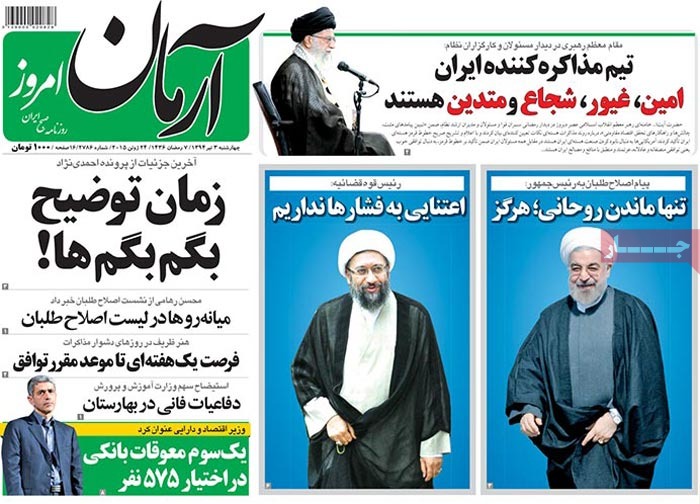
Arman-e Emrooz: The governor who supported [Ali] Motahari [after he was attacked by hardliners in Shiraz] has been sacked.

A controversial move by the Interior Ministry and Fars Provincial Governor’s office!

Arman-e Emrooz: Is Tehran Mayor Mohammad Bagher Ghalibaf only one step away from impeachment?

The capital’s Espinas Hotel has turned into a headache for the mayor.


A look at Iranian newspaper front pages on May 18


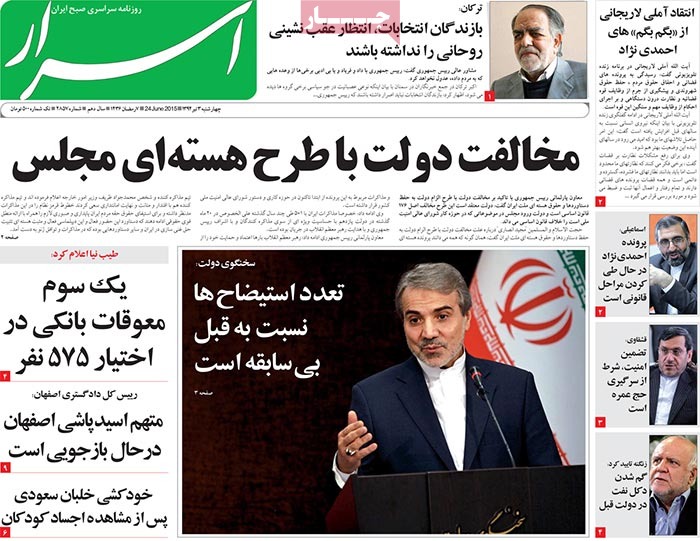
Asrar: “Some seek to distort the environmental measures of the government,” said the director of the Environment Protection Organization.

Asrar: “The number of thefts registered an 11 percent decline in the 30 days to April 20,” said the director of the Criminal Investigation Department of Tehran Police.


A look at Iranian newspaper front pages on May 18


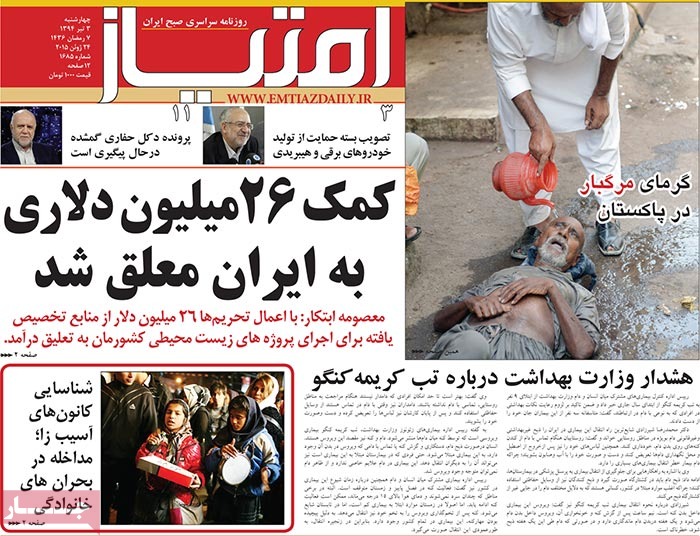
Emtiaz: There are no pediatric surgeons in 13 Iranian provinces.


A look at Iranian newspaper front pages on May 18


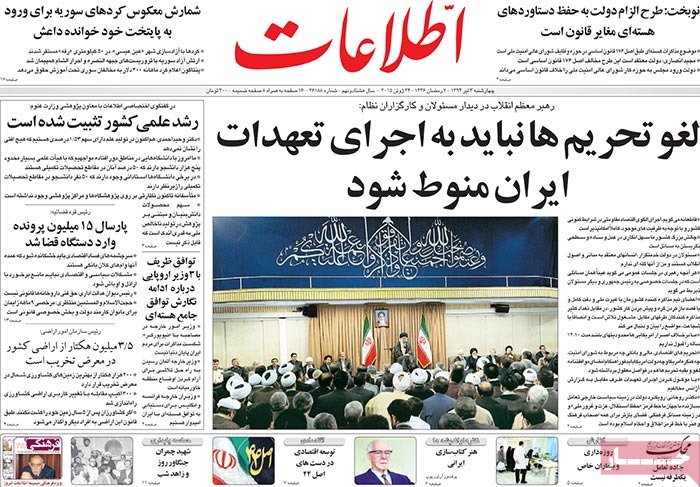
Ettela’at: “Iran’s economic growth is projected to be around 3 percent this year,” said the governor of the Central Bank of Iran.


A look at Iranian newspaper front pages on May 18


Haft-e Sobh: The Persian service of Voice of America is to fall silent.

What lies behind the decision: Budget crunch, a decline in the number of listeners or the nuclear talks?


A look at Iranian newspaper front pages on May 18


Jomhouri Islami: The foreign ministers of Iran, China and Russia have held talks over shipment of aid to Yemen.


A look at Iranian newspaper front pages on May 18


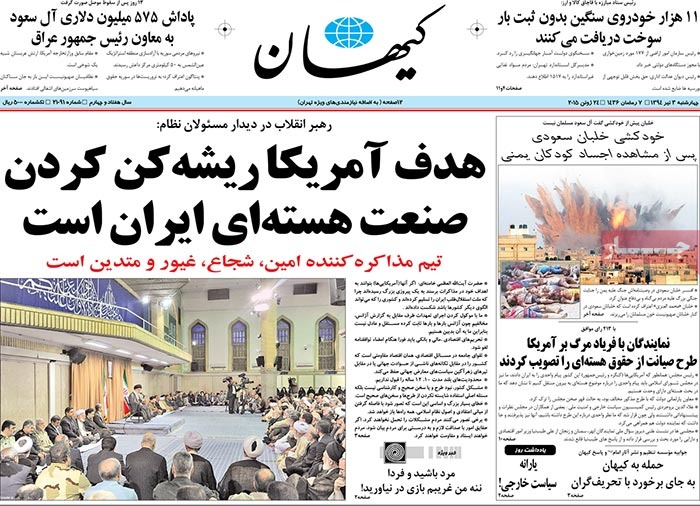
Kayhan: “Our nuclear red lines remain the same,” said Ali Akbar Velayati, an advisor to the Supreme Leader.


A look at Iranian newspaper front pages on May 18


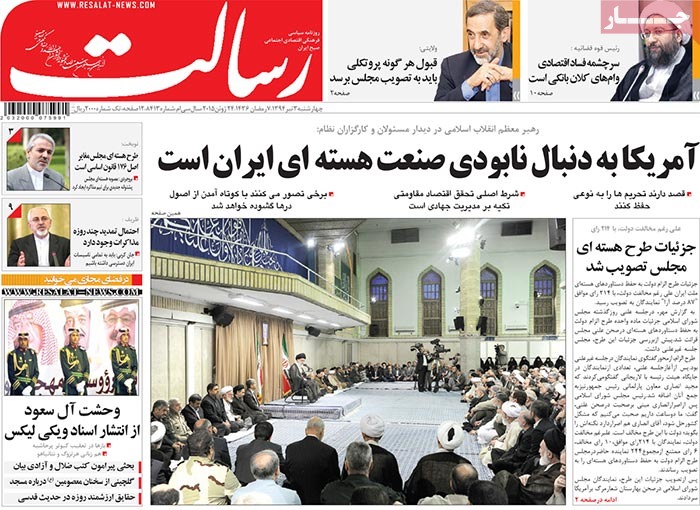
Resalat: “Military threats [by the US] put nuclear talks at stake,” said the Supreme Leader’s advisor Ali Akbar Velayati.

He further said that the US secretary of state says something in public and another in private.


A look at Iranian newspaper front pages on May 18


Muslims should not be overtaken by non-Muslims in following Koranic teachings

Rouhani-Koran

President Hassan Rouhani has said that the holy Koran is for Muslims and that the real nature of the Muslim faith would slip into oblivion if and when non-Muslims excelled Muslims in obeying the Koranic teachings.

The president made the remark in a speech at the opening of the 32nd International Holy Koran Competitions in Tehran on Friday and added that the Holy book is the most important factor in boosting Muslim unity.

He further said that we should plunge into the depths of the Holy Koran and see [for ourselves] how the insight we get from the divine book affects our lives.
Aftab-e Yazd on May 17 covered Rouhani’s remarks at the event. The following is the translation of the highlights of the president’s remarks:

[…]

May it not happen that we return to a point in time when the mere recitation of and [verbal] praise for the Koran was the order of the day, a point in time when implementation of Koranic principles was nowhere to be seen.

The Koran is a blessed book and any group or society which follows its verses in practice would get blessings and goodness.

May there not come a day in which non-Muslims take the lead when it comes to implementing what the divine book instructs.

May it not happen that we keep our distance from science – to which the holy Koran has invited us – while others, non-Muslims included, practice what it preaches and become [real] thinkers and scientists.

[…]

Islam means honesty, chivalry, tolerance, brotherhood and helping others. Islam means [a time when] extremism and violence are not seen or practiced in society.

Can we claim to be Muslims and followers of the Koran if we rain down bombs and missiles on our neighbors only to cement our regional hegemony? Have we obeyed what Islam and law say if we bankroll and strengthen the extremists and terrorists instead of assisting those who live in reduced circumstances and the oppressed in the world of Islam?

Today the world of Islam needs to observe the Koranic rules and the traditions of the Muslim Prophet.

May we not see a day in which nothing has been left of Islam but a name and the holy Koran is just a sign. If we see such a day, that would be a day in which we are flanked by magnificent buildings such as mosques, but guidance remains elusive.

[…]

Police seize over 1.6 ton of narcotics in southern province

drug1

Iran’s drug combat squads have seized more than 1.6 ton of illicit drugs in the southern province of Hormozgan, a provincial police chief announced.

“Over 1.4 tons of opium and 200 kilograms of hashish was seized from the drug traffickers in the province,” Commander of Hormozgan’s Law Enforcement Forces Brigadier General Reza Mohammadi Yeganeh told reporters on Sunday.

Eastern Iran borders Afghanistan, which is the world’s number one opium and drug producer. Iran’s geographical position has made the country a favorite transit corridor for drug traffickers who intend to smuggle their cargoes from Afghanistan to drug dealers in Europe.

Iran spends billions of dollars and has lost thousands of its police troops in the war against traffickers. Owing to its rigid efforts, Iran makes 81 percent of the world’s total opium seizures and has turned into the leading country in drug campaign.

Sistan and Baluchistan Province, where Iran, Pakistan and Afghanistan come together, has porous borders, where bandits and drug traffickers operate despite frequent entanglements and intense efforts of the Iranian law enforcement police.

More than 3,720 Iranian security personnel have been killed fighting drug smugglers since Iran’s 1979 Islamic Revolution.

Iran has recently established a central database and strengthened police-judiciary cooperation in a new effort to combat organized crime.

Every year, Iran burns more than 60 tons of seized narcotics as a symbol of its determination to fight drugs.

Iran to launch trade center in Iraq’s Kurdistan Region

erbil

Iran has signed a contract to launch a trade center in northern Iraqi city of Erbil with the aim of facilitating trade with Iraq’s semi-autonomous Kurdistan Region.

During a ceremony to sign the agreement for establishing the trade center, Head of the Trade Promotion Organization of Iran Valiollah Afkhami Rad said it should serve to provide a good understanding of Iraq’s market, introduce Erbil’s trade attractions to traders and support the Iranian industries that eye a share in the Iraqi city.

He recommended Iranian companies to enhance their knowledge of the interests of people in Erbil before establishing a branch in the planned trade center.

Another purpose behind setting up a trade center in Erbil, Afkhami Rad added, is to revive tourism, meaning that Iranian leisure and health tourism agencies can start a business there to facilitate the dispatch of Iraqi patients who need treatment.

Earlier this month, Iran’s Minister of Cooperatives, Labor, and Social Welfare Ali Rabiei unveiled plans for the construction of two new factories in Iraq in the near future.

During a visit to Iraq, Rabiei said one of the plants will produce medicine and the other cement.

As two neighboring Muslim countries, Iran and Iraq have sought to enhance bilateral ties in various political, economic, cultural and defense areas.

No one allowed to inspect Iranian military sites: Senior MP

Alaedin Broujerdi

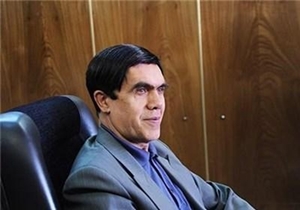
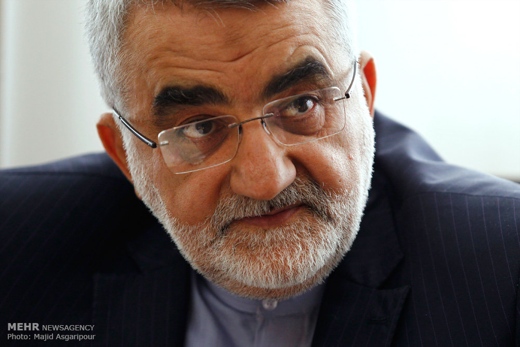
A senior member of parliament said Sunday that no one has the right to inspect Iranian military sites.

Alaeddin Boroujerdi, head of parliament’s National Security and Foreign Policy Committee, told reporters that inspection of Iran’s military sites would not be part of an emerging nuclear deal between Tehran and the six world powers.

Asked whether Iran and the P5+1 could meet a June 30 deadline for reaching a deal, Broujerdi referred to remarks by Supreme Leader Ayatollah Ali Khamenei that the important thing is the maintenance of national interests of the country. He said that if the negotiating parties fail to meet the deadline, they will extend it.

Commenting on whether the Additional Protocol has to be approved by Parliament, Boroujerdi said that the seventh Parliament halted the voluntarily implementation of the Additional Protocol and that in order to resume implementing it, an approval of the chamber is needed.

He said that Majlis National Security and Foreign Policy Committee has a plan on the agenda which would oblige the government to preserve nuclear achievements of the country.

Velayati: US military threats against Iran endanger nuclear talks

Ali Akbar Velayati

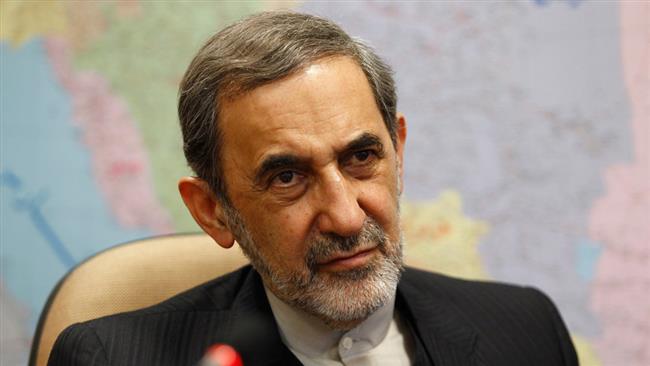
Supreme Leader’s Advisor for International Affairs Ali Akbar Velayati said on Sunday that US military threats against Iran endanger nuclear talks.

US military threats against Iran cannot get operational, he said, citing that the Americans have suffered defeat in wars against countries which are not as strong as Iran.

He referred to US President Barak Obama electoral promises to return the American soldiers back home and decrease US military involvement in other countries and said that US strategy is to avoid more wars.

The negotiations should continue in a balanced, interactive way in keeping with the preliminary agreements reached between the two sides, Velayati added.

He underlined that US officials should abandon their hypocritical policy in order to realize their goals in nuclear talks.

The US president says he will veto any anti-Iranian bill and in the meantime, he declares that he will accept Congress’ anti-Iranian bill, Velayati said, adding that US paradoxical approach and its military threats against Iran can sabotage the negotiations.

He said that Iran wants the removal of sanctions simultaneous with acceptance of limitation on its nuclear program.

Iran will not accept any nuclear limitation before the removal of sanctions, Velayati reiterated.

He underlined that Iran has not accepted any timeframe to limit its nuclear program and the Supreme Leader has clearly declared that Tehran will not accept any inspections of its military sites.

US officials insist on bypassing Iran’s red lines but Iran’s negotiating team considers all the red lines in its talks with P5+1, Velayati added.

He said that the success of Iran talks will prove that diplomacy is a useful tool in resolving the Iranian nuclear issue.

Referring to the defeat of US and its regional allies’ policy in Syria, Iraq and Lebanon, Velayati said that the US and its allies need success of nuclear talks with Iran.

Iran as a Muslim state will not allow US to realize its plot for dividing Syria, Iraq and Yemen and will support these countries’ sovereignty, he added.

Syrian Opposition has to accept Iran in Geneva-3

11
Mohammad Irani
Mohammad Irani

Staffan de Mistura, the UN special envoy in Syria, has invited the Islamic Republic of Iran to an [international] conference – dubbed Geneva-3 – in a bid to work out a solution to the Syrian crisis.

In reaction, Vice President of the National Coalition of Syrian Revolution and Opposition Forces (NCSROF) Hisham Marwah has said the coalition will not attend the conference.

His opposition [to Iran’s presence] comes after Khaled Khoja, the president of the National Coalition of Syrian Revolution and Opposition Forces, welcomed Iran’s invitation to the Geneva-3 Conference on Syria.

Fararu, a news website, has conducted an interview with Mohammad Irani, a former Iranian ambassador to Jordan and Lebanon, asking him about the possible boycott of the Geneva-3 Conference by the Syrian opposition. What follows is the translation of excerpts of Irani’s views on the conference:

The NCSROF seems to be divided over different issues, including Iran’s presence in the conference.

[…]

I think conditions [on the ground] have changed to some extent. Thanks to advances over the past two weeks in Idlib Governorate and some areas in southern Syria, the armed opposition and other people who are part of this coalition think their position has now improved.

Drawing on the new developments and the illusion that they now have the upper hand, the coalition has shown objection to Iran’s presence.

However, they are ignorant of the fact that the Syrian developments are affected by and intertwined with what plays out across the region, among them the developments of the Arabian Peninsula.

These are the things that have turned the tides ahead of the Geneva-3 Conference. That’s why international players are insisting that Iran participate in the Geneva-3 Conference since they have realized that settlement of regional issues would be impossible in the absence of Iran.

The fight on extremism and terrorism – especially taking on ISIL – is one of the major topics on the agenda in the Geneva-3 Conference. A serious and collective will [by members of the international community] is needed to counter ISIL.

The problem [the terrorist grouping and its indiscriminate crimes] won’t be solved unless Iran – which is one of the most influential regional players – becomes part of efforts to take on ISIL. This is an undeniable fact the West now appreciates. […]

Despite a verbal invitation by the UN secretary general to Iran to attend the Geneva-2 Conference, the NCSROF disapproved of Iran’s participation due to opposition and pressures by regional governments.

As it was predictable, the Geneva-2 Conference failed to produce a remarkable result simply because it did not bring on board all influential players in the Syrian crisis.

I think the Geneva-3 Conference too cannot play a key role in determining the future of Syria. Its prospect is not bright due to numerous problems that have arisen on the Syrian political scene and elsewhere in the region.

Add to it the possible absence of Iran – which has played a decisive role in different political questions in the region – and you will see that the conclusiveness of the Geneva-3 Conference will be dramatically overshadowed by such absence.

[…]

[The Geneva I Conference was held in June 2012, initiated by then UN peace envoy to Syria Kofi Annan. The Geneva II Conference met in January 2014.]

Why did an on-pitch bombshell spill off-pitch?

Tabriz-Tractor Sazi

The result of a football match between Sepahan [a football club based in Isfahan] and Saipa from Alborz Province [a 2-0 win for the Isfahani club] broke differently in a Tabriz stadium where another soccer match was under way between the hosts Teraktorsazi – the city’s powerhouse – and Tehran’s Naft on Friday.

Entekhab, a news website, on May 16 ran an analysis on the football match in Tabriz and what ensued which turned a sporting event into a politically-tinged news story. The following is the translation of the analysis in its entirety:

Viewers saw on their TV screens the extreme joy of Tabriz-based team and their fans who were shouting cries of championship. Only seconds later, though, another scene showed Sepahan players relishing their championship. The soccer league seemed to have two champions this year!

A Football Federation official has reportedly approached Tractor Sazi’s bench in the final minutes of the match, saying that the showdown between Sepahan and Saipa ended in a two-all draw. [That would have crowned Tractor Sazi as this year’s champions.]

To prepare the ground for releasing the fabricated news, certain people allegedly interrupted TV and radio channels and cut off mobile [and Internet] communications three minutes before the final whistle of the decisive match between the hosts Teraktorsazi and Tehran-based Naft to prevent people from getting the correct news on the result of the match [which was crucial in deciding which team lifts the trophy].

The fake news of a draw [between Sepahan and Saipa which would have resulted in the championship of Tractor Sazi] circulated around and everybody bought what was sold unequivocally.

Happy with the sweet lie, Tractor Sazi fans ran onto the pitch after the game and started partying. Alireza Mansourian, Naft’s head coach, congratulated Toni Oliveira, the head coach of Tractor Sazi, who looked overjoyed too.

Their revelry did not last long, though. When fans in Tabriz learned that the championship of their favorite team has been nothing but a lie, they grew angry and the situation became explosive.

The truth was so shocking that even Teraktorsazi’s head coach couldn’t believe his ears: images released show him shell-shocked with disheveled appearance. The bombshell also sent a number of fans to the hospital.

Some media sources claim that Toni Oliveira’s son was behind the rumor. Even if those claims are accepted, one should ask: Did the stadium’s announcer break the news of Tractor Sazi’s championship and Sepahan’s draw simply with a gesture from Oliveira’s son? Did the head coach’s son prevent the result of the Sepahan-Saipa match from being displayed on the scoreboard? These questions and the ambiguities surrounding the case [have remained unanswered].

What is certain is that the government should form a fact-finding committee to look into the dramatic event which left people in Tabriz with a heavy heart, bring to justice those behind the incident, and make up, one way or another, for the trampled rights of Tractor Sazi.


Teractor sazi


Rumors to disrupt a presidential trip

The spread of the fake news [that Sepahan and Saipa played to a 2-2 draw] came just a few days before President Rouhani’s scheduled trip to the northwestern city of Tabriz. That the fake news came so close to a presidential trip fuels suspicions that it was a preplanned lie.

It seems that the Worriers and opponents of government have tried to interfere with the president’s trip to Tabriz (where Rouhani won an overwhelming number of votes in the 2013 presidential election).

There are reports that posters advertising a trip by [members of] the Government of Prudence and Hope were distributed among people – in a spontaneous, provocative manner – after angry Tractor Sazi fans filled the streets of the city.

The fans – who were sick at heart after realizing that their emotions have been played around with and thought they’ve been deceived by the Football Federation – started to tear the posters.

Observers say that the role of the opponents of the Government of Prudence and Hope – who have so far done whatever they have been able to, to throw a wrench into the works of government – in what played out in the Tabriz stadium should not be ignored.

There’s no denying of the fact that a suspicious and bungling move by some at the Ministry of Sports and Youth Affairs and the Football Federation has definitely triggered such a nasty incident.

Instead of getting involved in a verbal row with the head coach of the national football team and micromanaging all sporting affairs, the sports minister (who was not among the president’s first options to take charge of the ministry) is expected not to let the [existing] opportunities slip, and to exercise resourcefulness and avoid imposing hefty costs and huge problems on government.

Iran’s aid ship to arrive in Yemeni port on May 21

ship

The Iranian cargo ship “Nejat” (Rescue) loaded with 2,500 tons of aid supplies for war-stricken Yemen will dock in Hodeida port on May 21, the ship’s captain announced.

“It is four days since we set sail from Bandar Abbas and God willing, given the weather forecast, we will enter (Yemen’s) Hodeida port six days later on May 21,” Captain Masoud Qazi Mir-Saeed told the Tasnim News Agency on Friday evening.

He said currently the ship is located 30 miles from Omani coasts and is sailing toward the Gulf of Aden.

The captain emphasized that the ship is moving toward Yemen, adding that everything for the voyage is good and there is no problem.

The cargo ship, which belongs to Iran’s Valfajr Shipping Company, left Iran for Hodeida on Monday evening.

It has been loaded with 700 tons of flour, 1,200 tons of rice, 400 tons of canned food, 50 tons of medication and health products, and 50 tons of mineral water.

The ship’s journey comes after Yemen agreed to a five-day truce proposed by Saudi Arabia.

The ceasefire, which is to allow humanitarian aid in, came into effect at 11 pm (2000 GMT) on Tuesday.

On March 26, Saudi Arabia and some of its Arab allies began to launch deadly airstrikes against the Houthi Ansarullah movement in an attempt to restore power to the fugitive former President Abd Rabbuh Mansour Hadi, a close ally of Riyadh.

Some seven weeks of deadly aerial attacks on Yemen have killed over 3,500 people and left some 6,200 others injured.

Nasrallah Lashes Out at US, Israel for Creating Takfiri Terrorism

Hassan Nasrollah

Secretary General of Lebanon’s Hezbollah Resistance Movement Seyed Hassan Nasrallah lashed out at the US and Israel for making arbitrary use of Takfiri terrorism to undermine the Islamic nation.

“We are witnessing a new Nakba,” Nasrallah said in a televised address on Saturday.

“The Nakba of the Takfiri militants was first brought to the region by the British Zionist project, now it is the American Takfiri Zionist project, and America is using this to weaken the Ummah and tear it apart and to seize control of its capabilities,” he added.

Every year on May 15, Palestinians all over the world hold demonstrations to commemorate Nakba Day, which marks the anniversary of the forcible eviction of hundreds of thousands of Palestinians from their homeland by Israelis and the creation of the Israeli regime in 1948.

On May 15, 1948, Israeli forces displaced some 700,000 Palestinians, forcing them to flee to   neighboring countries. Israeli soldiers also wiped nearly 500 Palestinian villages and towns off the map, leaving an estimated total of 4.7 million Palestinian refugees and their descendants dreaming of an eventual return to their ancestral homeland more than six decades later.

Battle for Qalamoun

Nasrallah praised the “victory” in Qalamoun as a major achievement for Lebanon, Syria, and the entire region.

The battles there took place from “hilltop to hilltop and from valley to valley,” he added.

Hezbollah, the Syrian army, and Syrian volunteer forces, as well as the locals in Qalamoun helped fighting the terrorists in the strategic area, he noted.

Referring to the major difficulties in the battle for Qalamoun, he said the high mountains and hills inside the area made the mop-up operation very difficult.

A total of around 300 square kilometers of the Syrian and Lebanese territory was retaken from the militants and some of their operation centers were also destroyed, Nasrallah added.

“The highest level of security was achieved for Syrian villages in Qalamoun and the same goes for Damascus-Homs road,” he said, adding; however, that as long as the militants are present in border areas, such as in Arsal outskirts and some parts of Qalamoun, there would be risks.

Nasrallah said Hezbollah fighters have cut off the supply lines of the militants from Lebanon to Syria.

He further described attempts by certain entities to pit Hezbollah against the Lebanese army as “foolish”.

The secretary general also criticized some Arab media for waging what he referred to as psychological warfare against Hezbollah. He added the media has overplayed the number of Hezbollah’s casualties.

“There have been thirteen Hezbollah martyrs in the battle so far,” he stated.

Nasrallah also stressed that the media was trying to portray the Takfiri militants as revolutionaries while they are in fact terrorists.

Since the most recent Syria-Hezbollah joint operations about nearly two weeks ago, al-Nusra Front Takfiri militants had been using Qalamoun mountainous region for transferring weapons and reinforcements from Lebanon into Syria, where they have been engaged in terrorist operations against the government.

Failure after failure

Turning to Yemen, he called for the condemnation of the US-backed Saudi aggression against the impoverished country.

He said the Saudi military campaign has failed to achieve any of its goals, saying Riyadh has gained nothing but “failure after failure.”

“This aggression won’t achieve its goals…. and it has failed in achieving its goals,” he said.

Saudi Arabia has been striking Yemen for 53 days now to restore power to fugitive president Mansour Hadi, a close ally of Riyadh.

[…]

World mum on rights violations in Bahrain

Touching upon the developments about the popular uprising in Bahrain, he slammed the violation of human rights in the Persian Gulf kingdom, saying that the people of Bahrain are facing torture and prison for their peaceful upraising.

“The situation in the prisons in Bahrain is very difficult, it’s not just against the most basic human rights and something awful is taking place… in light of international silence,” the secretary general added.

Anti-government protesters have been holding peaceful demonstrations across Bahrain since mid-February 2011, calling for an end to the al-Khalifa dynasty.

[…]

Power vacuum in Lebanon

On the future presidential election in Lebanon, Nasrallah said the power vacuum has reached a dangerous point, urging the Lebanese people not to pin their hopes on foreigners to make decisions for them in this regard.

“Take these matters very seriously, it’s very important and sensitive, discuss the ways out and raise solutions for the power vacuum,” he said.

The power vacuum is considered the longest since 1990, which marked the end of Lebanon’s civil war.

In Lebanon’s power-sharing system, the president must be a Christian, the prime minister a Sunni Muslim and the parliament speaker a Shiite Muslim. Any presidential candidate would have to receive the backing of the two main political blocs, the March 8 alliance and the rival March 14 alliance, to win the necessary majority from the legislature’s 128 members.