Thursday, December 25, 2025
Home Blog Page 4586

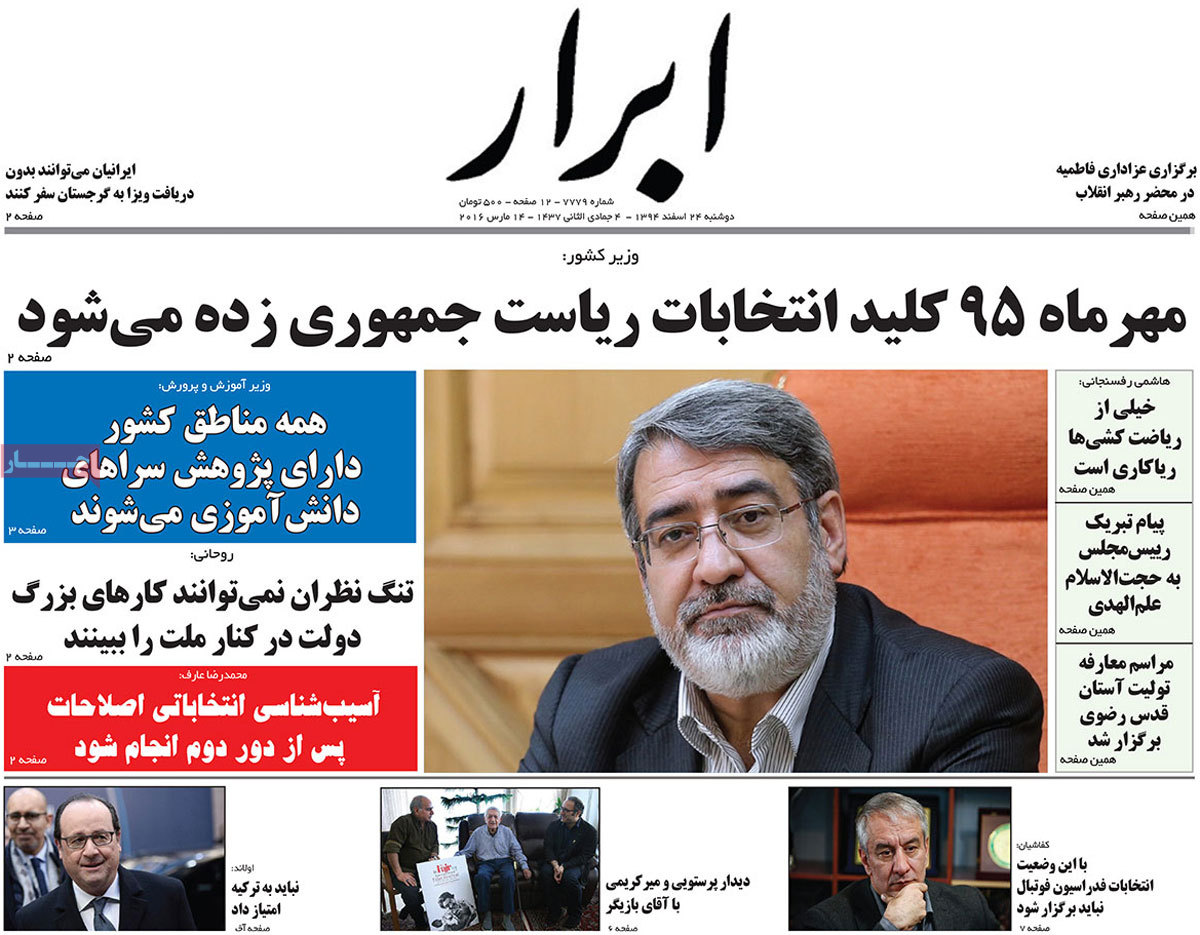
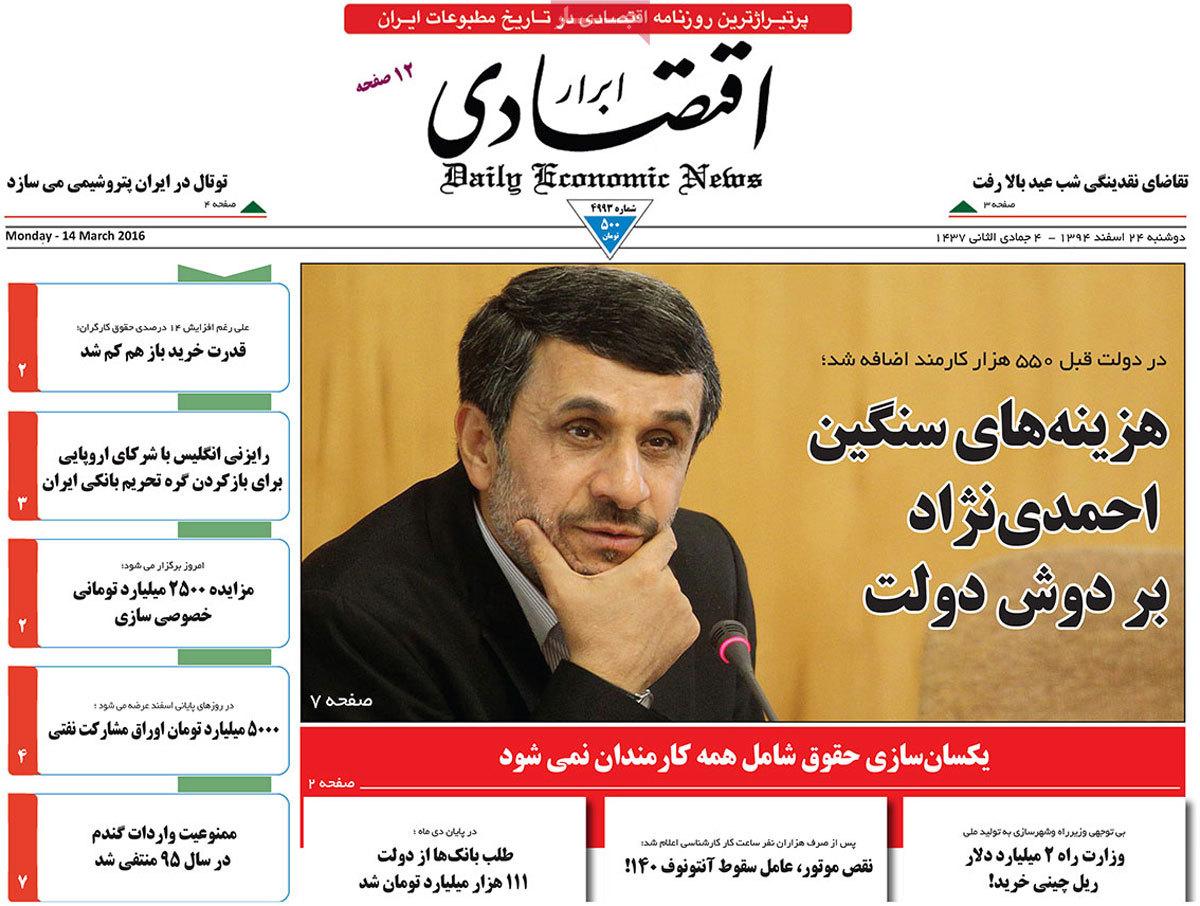
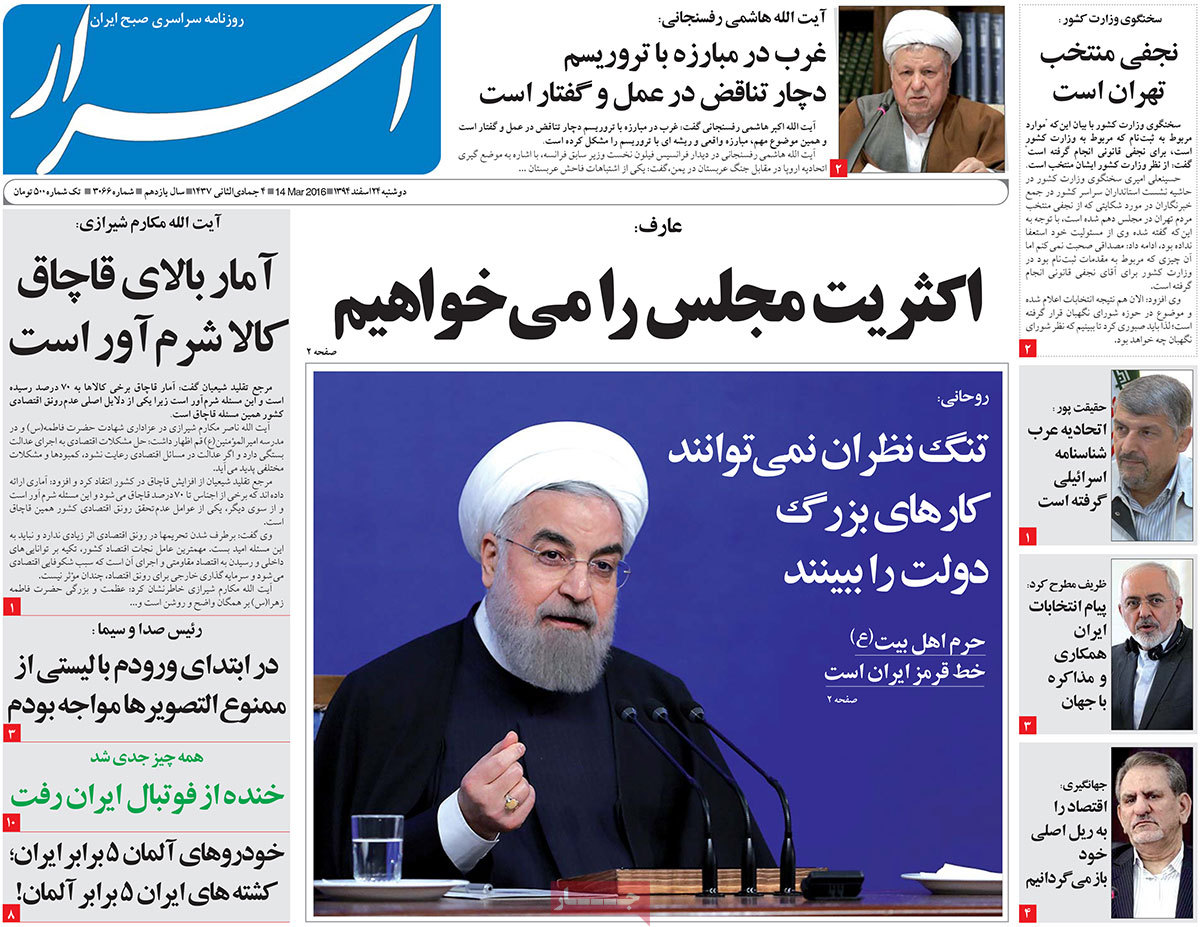
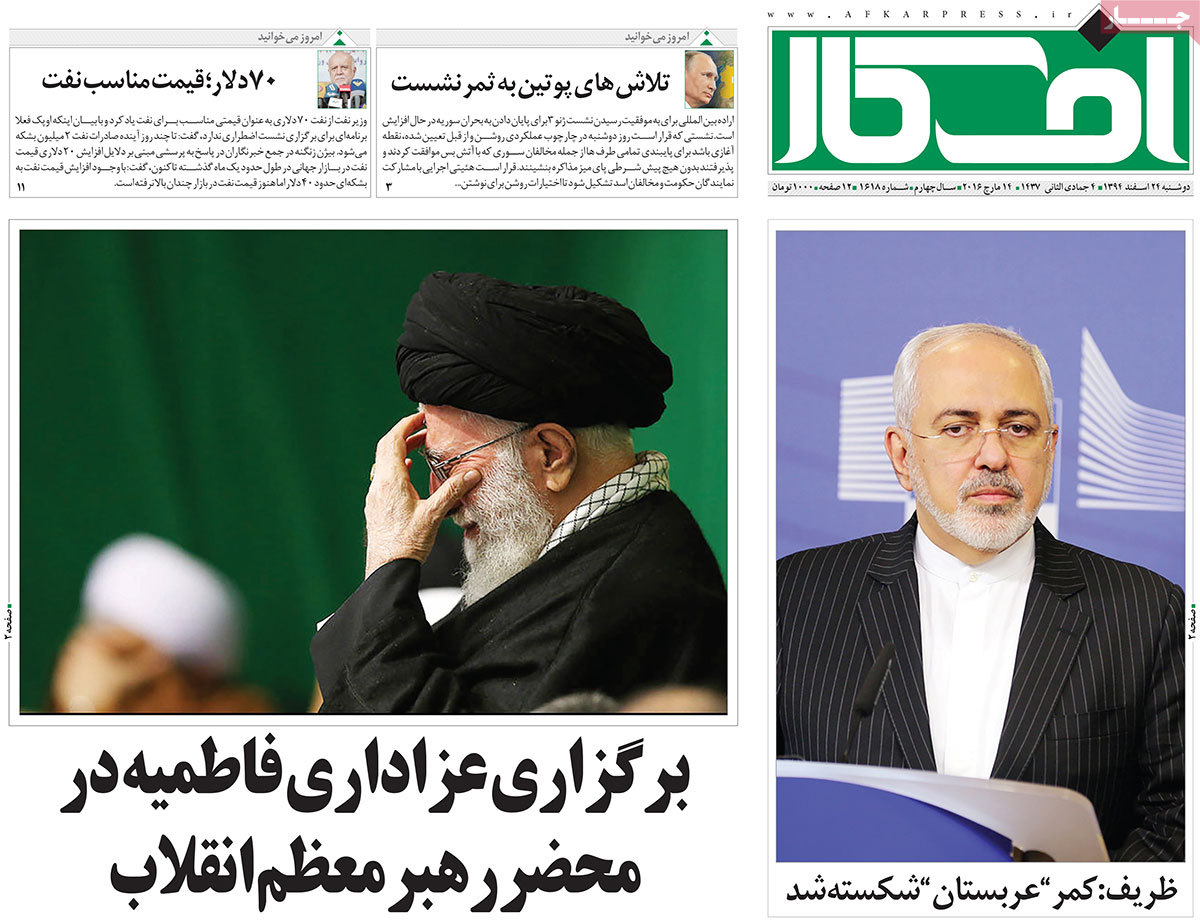
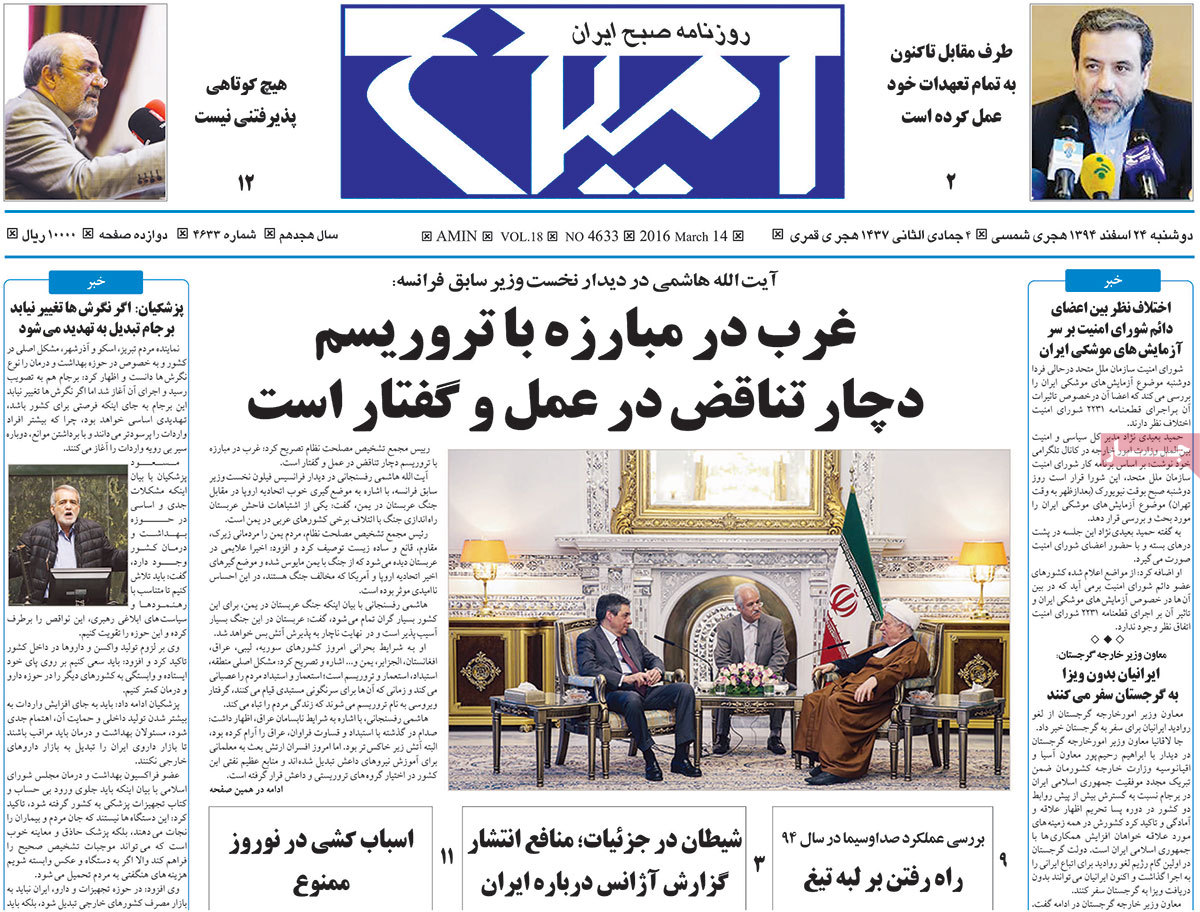
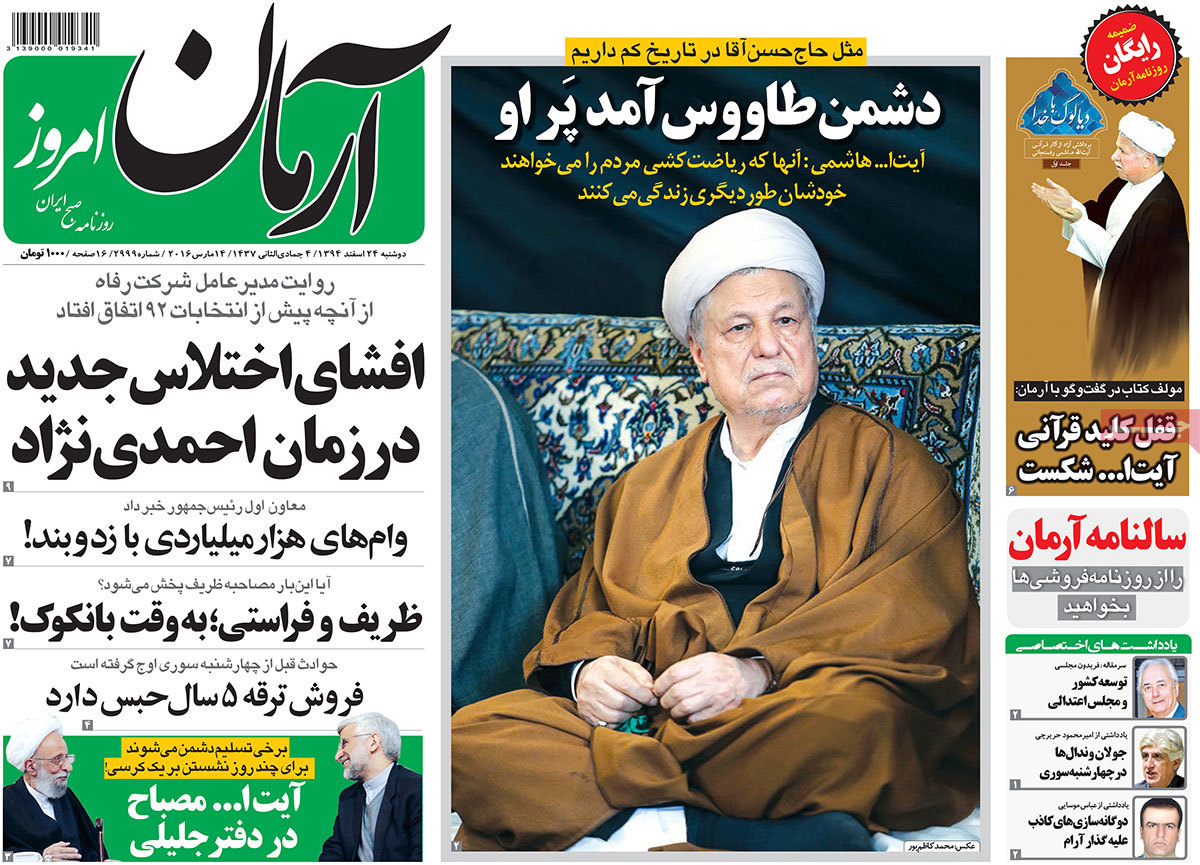
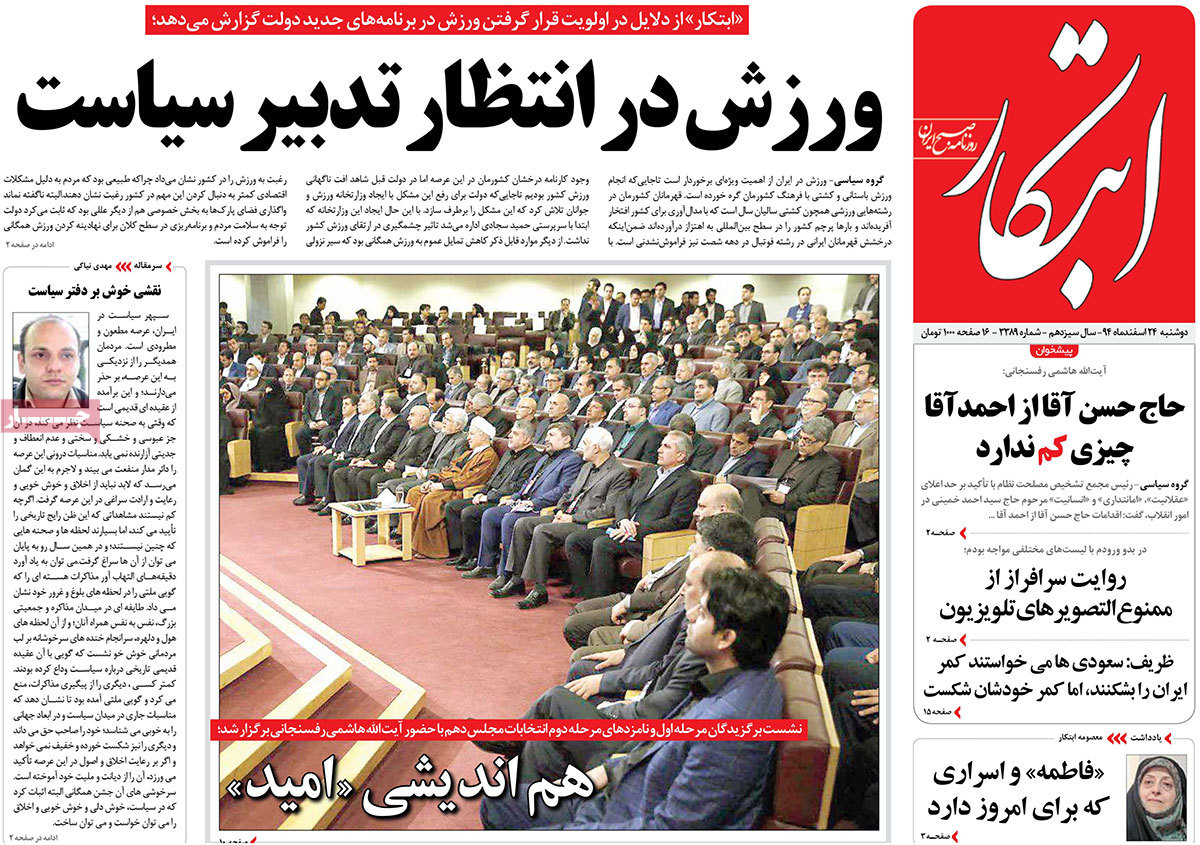
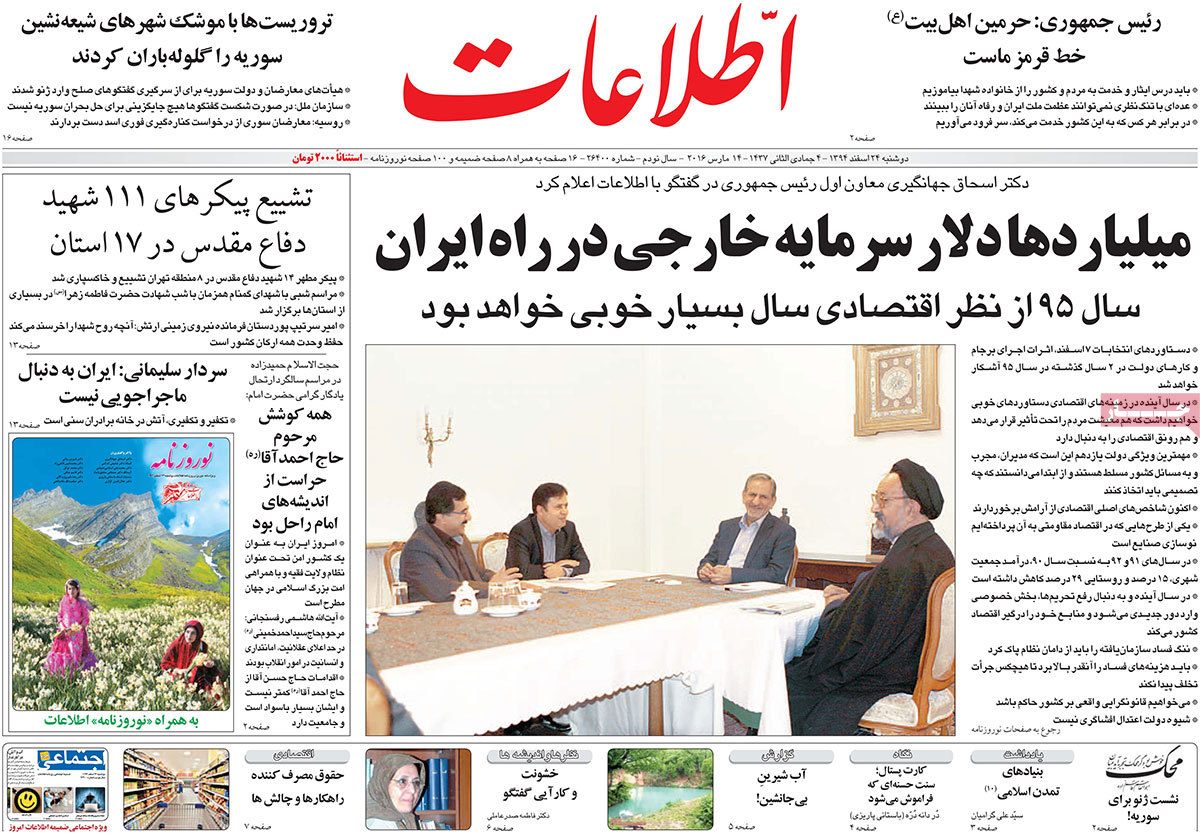
A look at Iranian newspaper front pages on Feb 22

Iran Newspaper front pages


Ettela’at:

1-  Inflation rate at 11.8% in Iran

2-  Iran, Russia start talks on Syrian crisis

3- 91 killed on bloody Sunday in Syria’s Zeinabiyeh, Homs

4- Iran futsal, wrestling teams bag Asia cups


Ettelaat


Afkar:

1- Blast kills 50 in Syria’s Homs

2- ‘Fire at Sea’ documentary about Lampedusa migrants wins Berlin film festival

3- Moscow to Arabs: Iran is Russia’s first all


Afkar


Arman-e Emrouz:

1- Lead reformist candidate calls on Tehrani voters to stay home on Friday

Mohammad Reza Aref demanded that all Tehrani citizens stay home on Friday so they can vote.

2- Rafsanjani: Disuniters act like double agents

Principalists dream of Rouhani-Hashemi chasm

3- Iran wins AFC futsal championship

4-  Putin sends special message to Rouhani

5-  Interior Minister: Stop saying some candidates are English

6-  Charity Organization launched new system to prevent potential crimes


Arman


Asrar:

1- John Kerry announces Syrian provisional ceasefire agreement

2- Russian defense minister deliver’s Putin’s special message to Rouhani

3- Hassan Khomeini: Problems can be solved by holding correct elections


Asrar


Ebtekar:

1- Dust storms shadow election promises

A report about emerging dust storms in southwestern Khuzestan Province

2- Rafsanjani: Feb election must be modeled on 2013 election win

3- Very dog-day afternoon

A report about animal abuse in Iran which is on the limelight these days after a video went viral on social media showing a man brutally abusing a poor dog.


Ebtekar daily


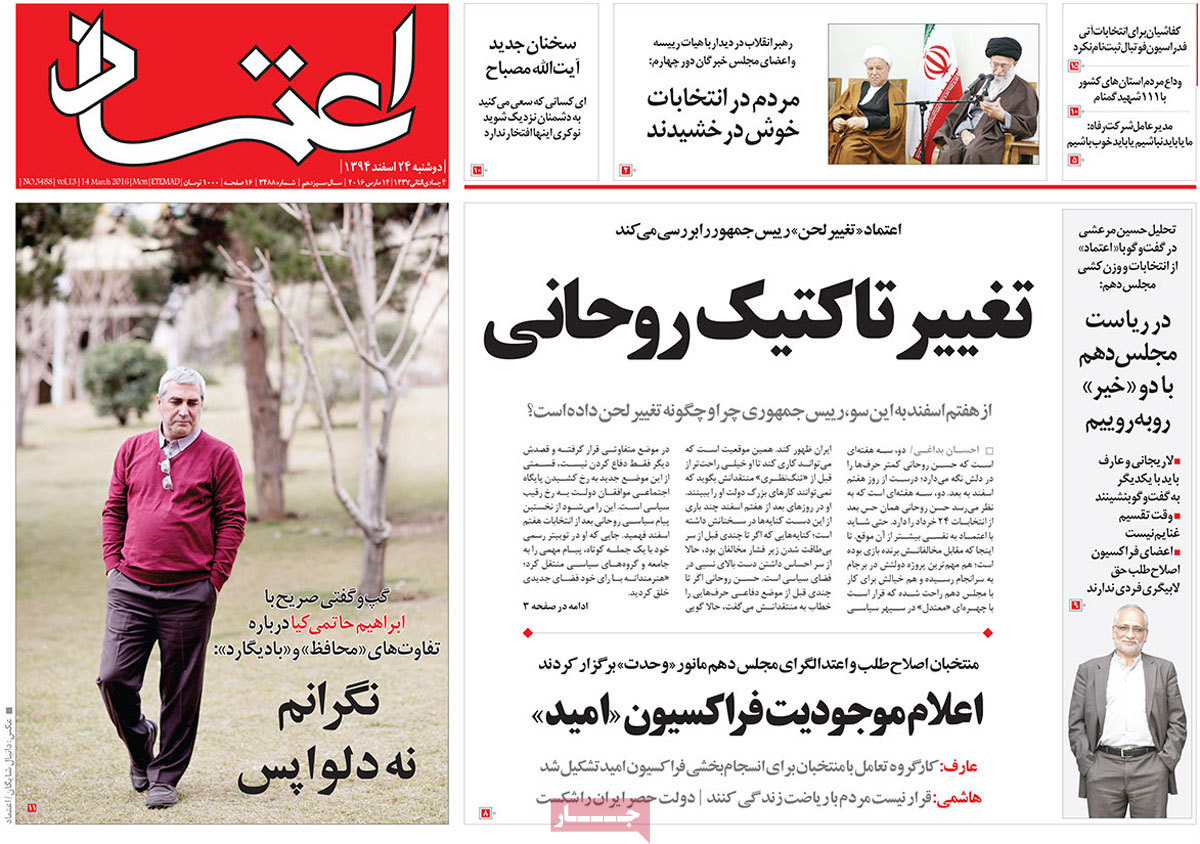
Etemad:

1- Hassan Khomeini: Let’s not turn our backs on ballots boxes

Hassan Khomeini, the grandson of Imam Khomeini who was disqualified to enter election campaigns to enter Assembly of Expert, urged the highest turnout in Feb 26 elections.

2- Ahwaz air no longer dusty; it is muddy

3- Homayoun Shajarian wins special Fajr Music Award


Etemad


Emtiaz:

1- 10 million smokers in Iran

2- Iran looks to create joint plane-leasing companies

3- Culture Minister: Issues of Music House to be resolved


Emtiaz


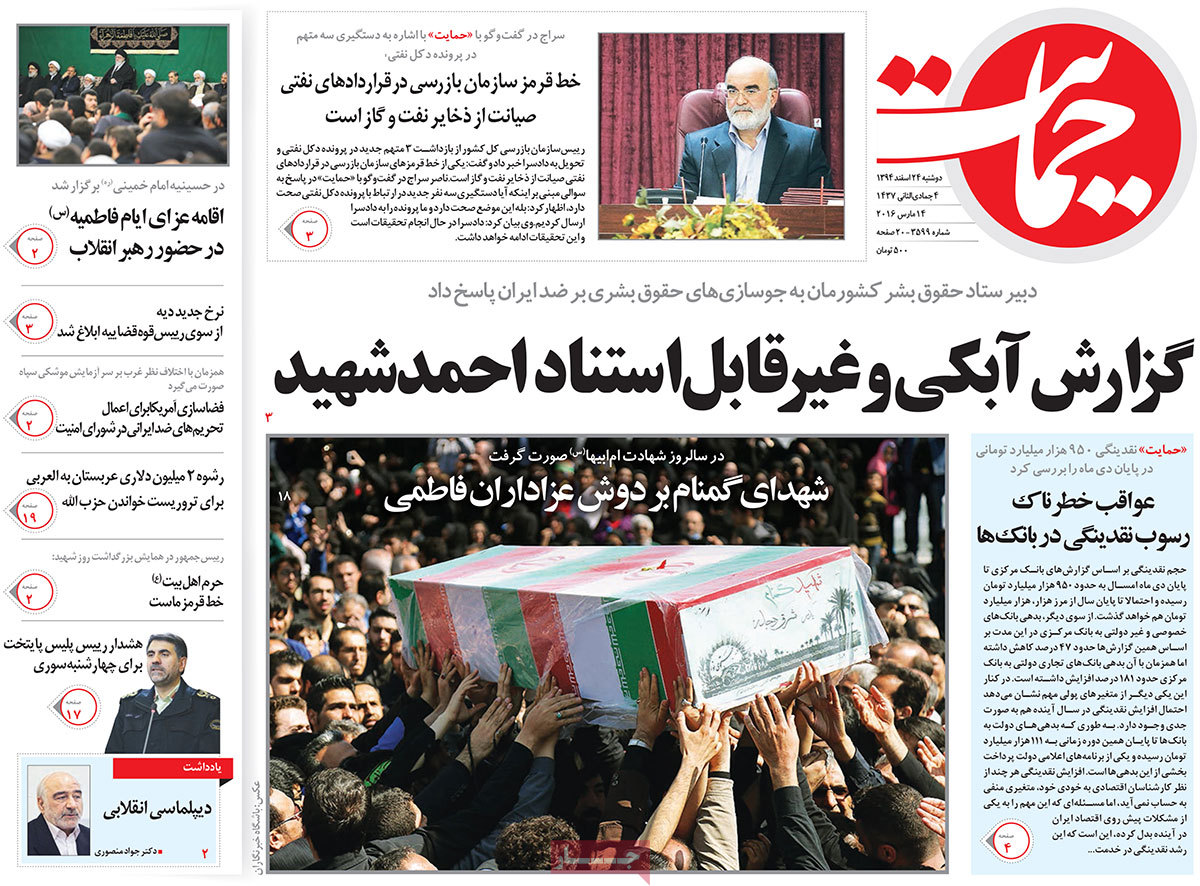
Hemayat:

1- English cap on house of Al Khalifa crimes

2- Animal abusers captured

3- Iran to counter security issues by soft power: Official

Head of Iran’s Civil Defense Organization Brigadier General Gholam Reza Jalali  said Iran would combat security incidents through soft power.


Hemayat


Hosban:

1- 50,000 smokers in Iran: Health Minister

2- Sports being managed by experts under current admin

3- First house of environment opens in Tehran


Hosban


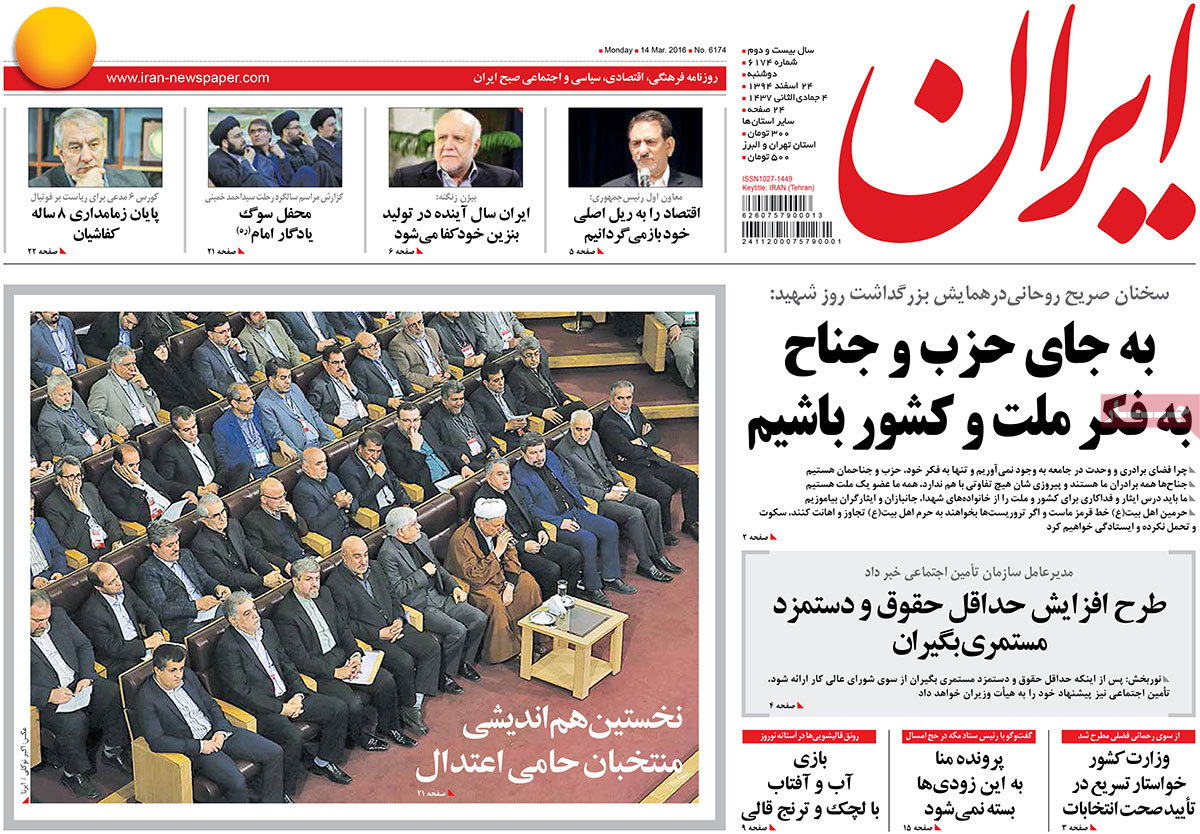
Iran:

1- Hassan Khomeini: Correct election ensures instilling hope, serenity

2- Assad Opposition Front calls for temporary truce

3- Dust storms blanket 6 Iranian Provinces

4- Music stars glow as hope builds up for music in Iran


Iran


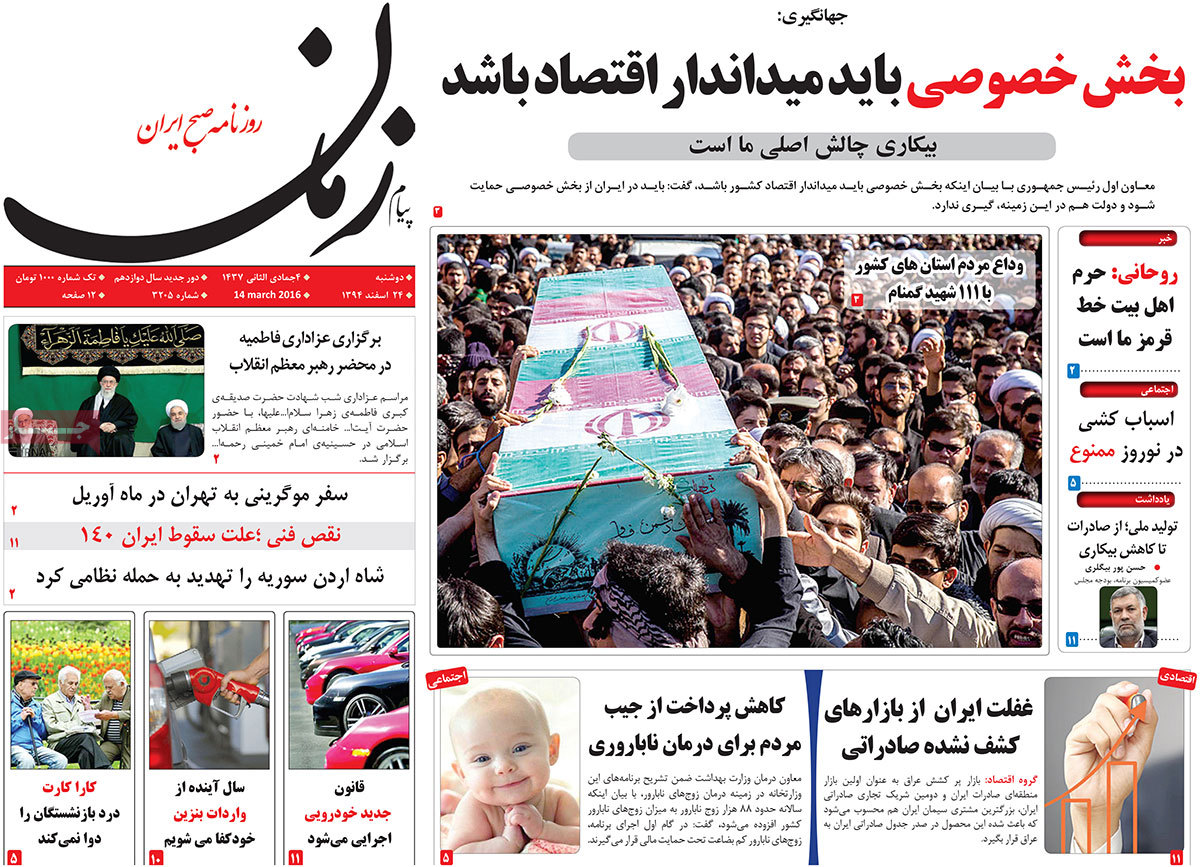
Payam-e Zaman:

1- Airbus 380 flight to Iran may cancel

2- Missile test shows might of armed forces: Iran Chief of Staff

3- Iran unveils 12 drugs, medical tools

4- Iran upbeat about future of Iran-Oman ties: Petroluem Minister


Payame Zaman


Jame-Jam:

1- Countdown starts for passionate elections

2- Peugeot’s pious hope [to Iran]

3- Cosmetics brands raid Iran market


Jame Jam


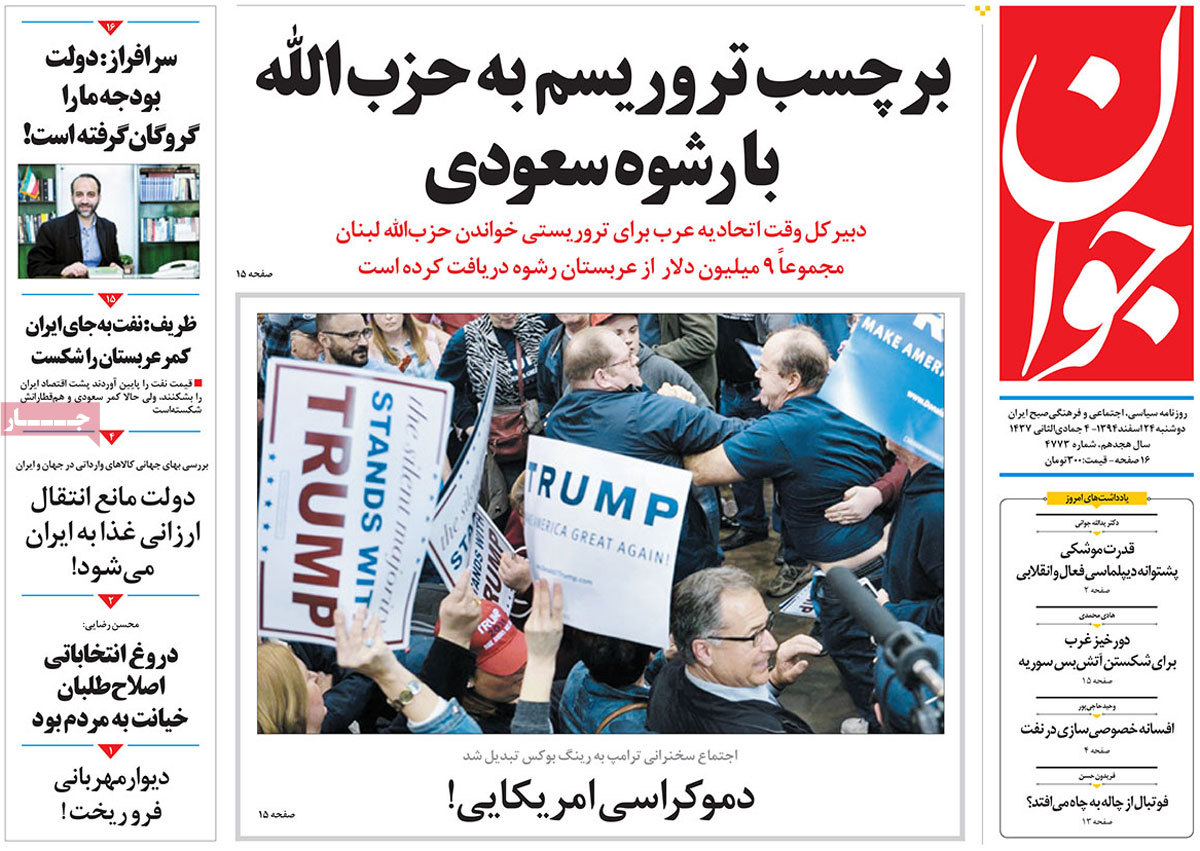
Javan:

1- Hadad Adel warns Rouhani to mind sedition hidden behind moderation

2- 2 hours of humiliation is enough

The French-made A350 plane stayed for only 2 hours in Iran before continuing in its journey to Singapore. The plane landed in Tehran for a bunch to take their photos with the plane.

Javan newspaper


Jomhouri Islami:

1- Rafsanjani: Stigmatizing election comes from distress; Clearly, enemies do not care about Revolution

2- Iran to renovate medicine industry: Minister of Health

3- Electrical lists of moderates, independents finalized
Jomhouri Eslami


Khorasan:

1- Lead candidates openly express views

Khorasan


Rah-e Mardom:

1- No Iranian firm needless of int’l interactions

2- Judiciary chief issues election message

3- 31st Fajr Music Festival wraps up

4- Iran to host presidents of 3 countries in a few days


Rahe Mardom


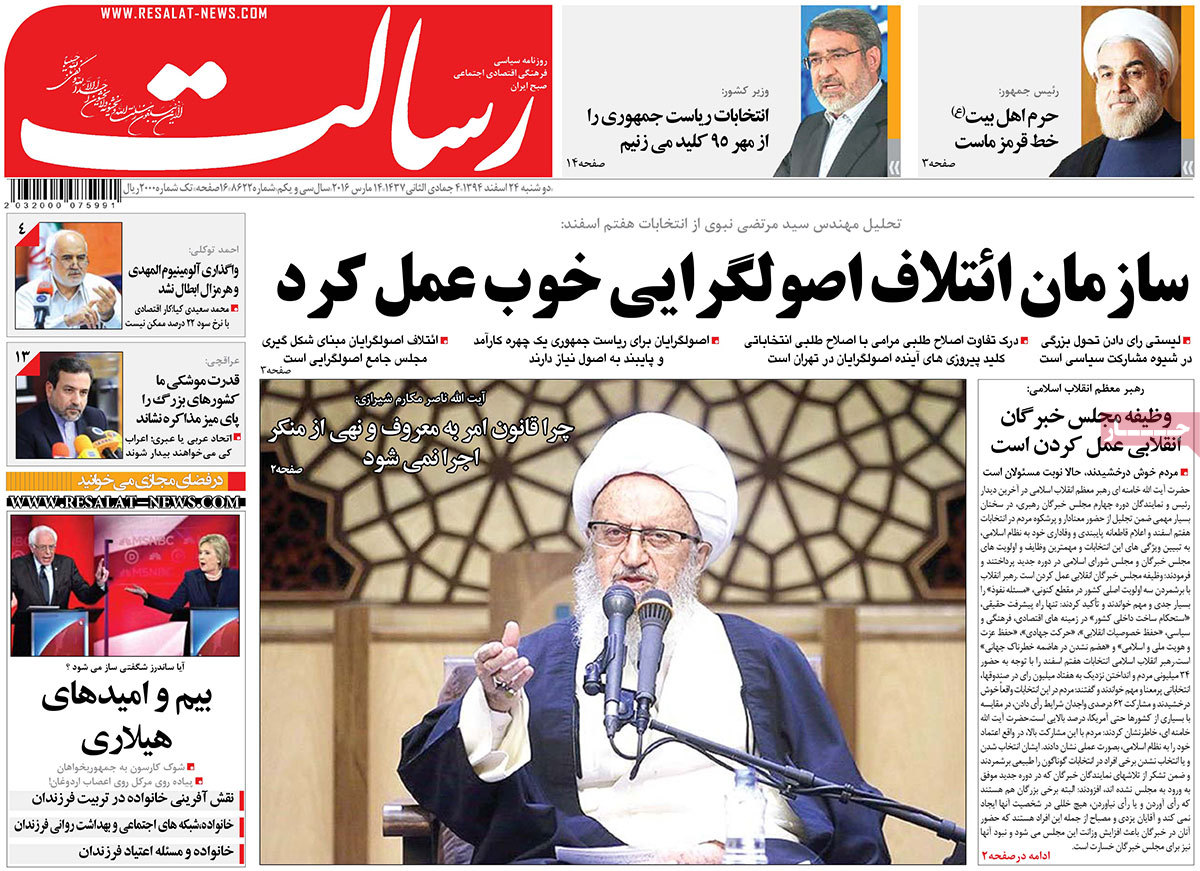
Resalat:

1- MP: Where is the unblocked $17bn

2- Putin: Russian forces in Syria protect Moscow’s interests

3- 80 countries stop supporting ISIS


Resalat daily


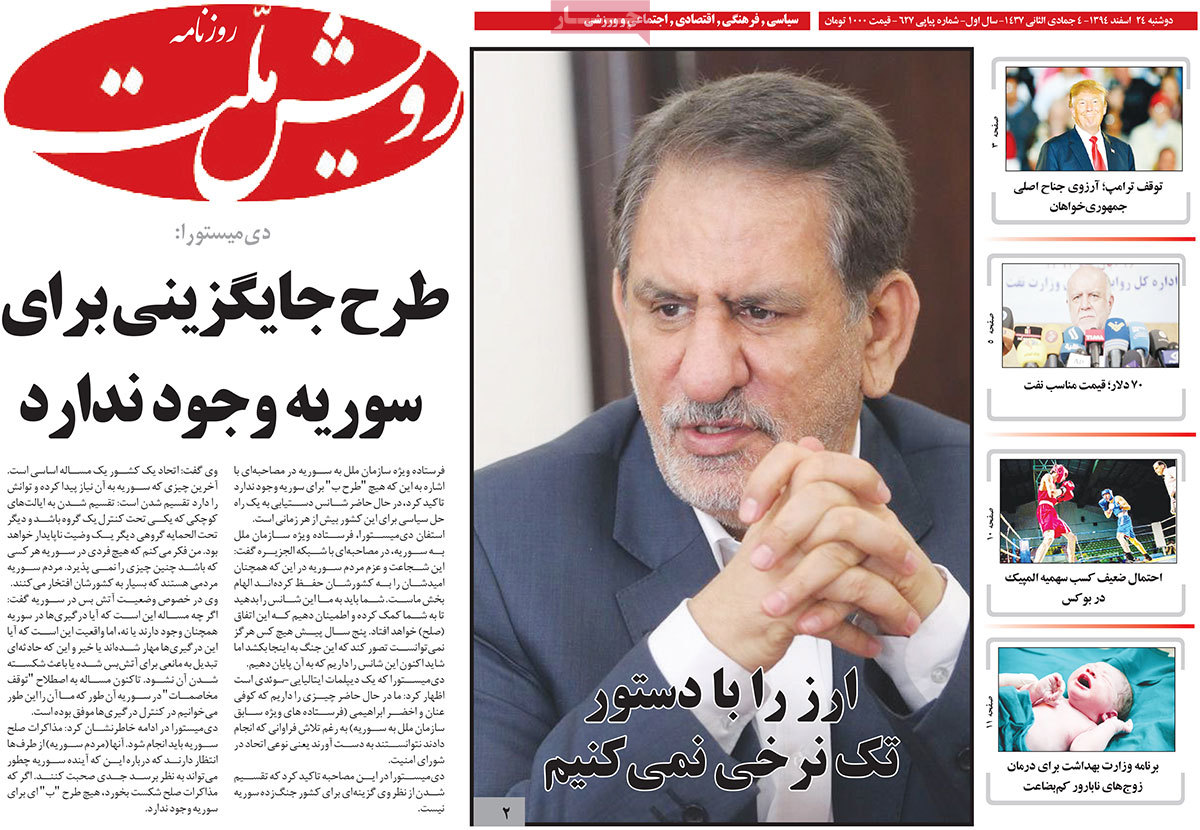
Rooyesh Mellat:

1- Parliament Speaker: Universities must not be run by petrodollars

2- Kerry: Eminent ceasefire in Syria

3- Iran’s return to oil market, chance, not threat, for Russia

4- When and how to start spring house cleansing


Rooyesh mellat


Sayeh:

1- Head of Volleyball Federation: Girl volleyball players lack nothing compared with boys

2- US’s new task for Saudis: New psychological war on Iran’s oil underway

3- Iran opens largest Zurkhaneh (house of strength) in southern Tehran


Sayeh daily


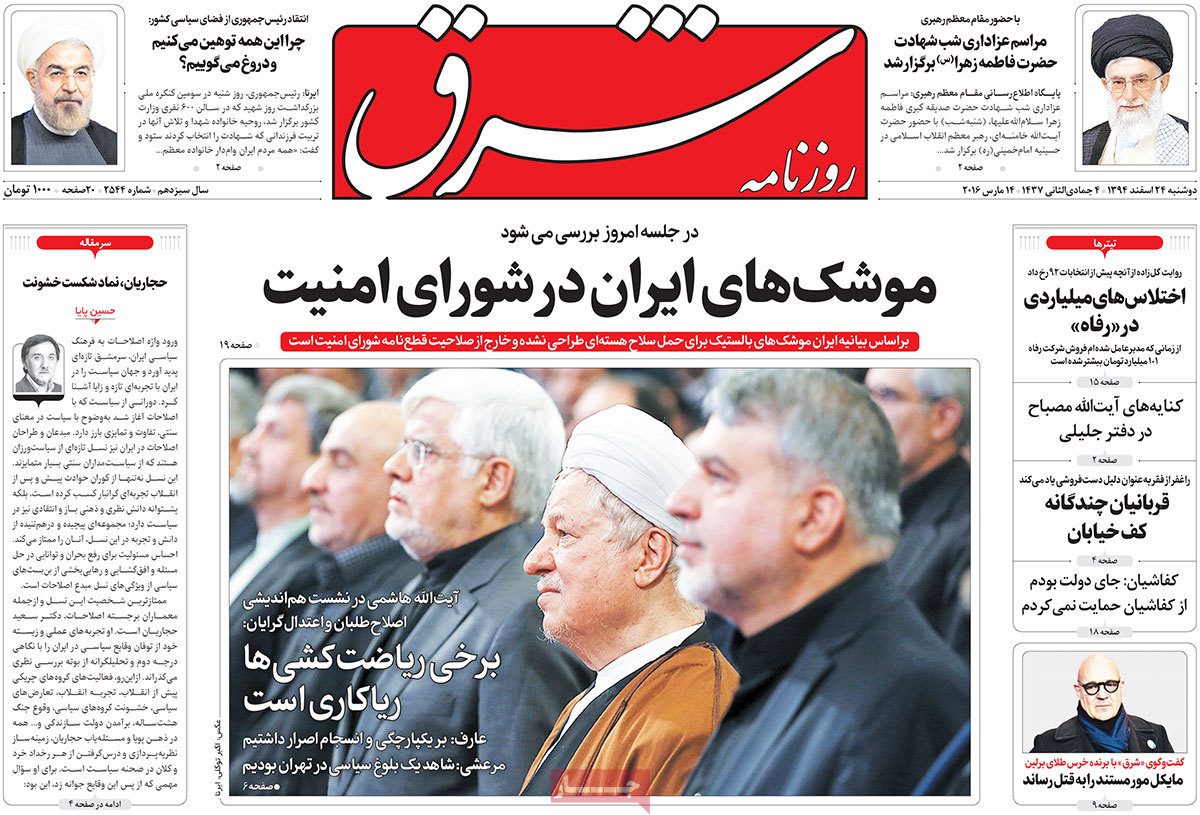
Shargh:

1- Khatami has inflicted misery on UK

2- Hassan Khomeini: Turning backs on ballot boxes is not the way to solve problems


shargh daily


Shahrvand:

1- No more tax evasion by 3 million taxpayers

Shahrvand


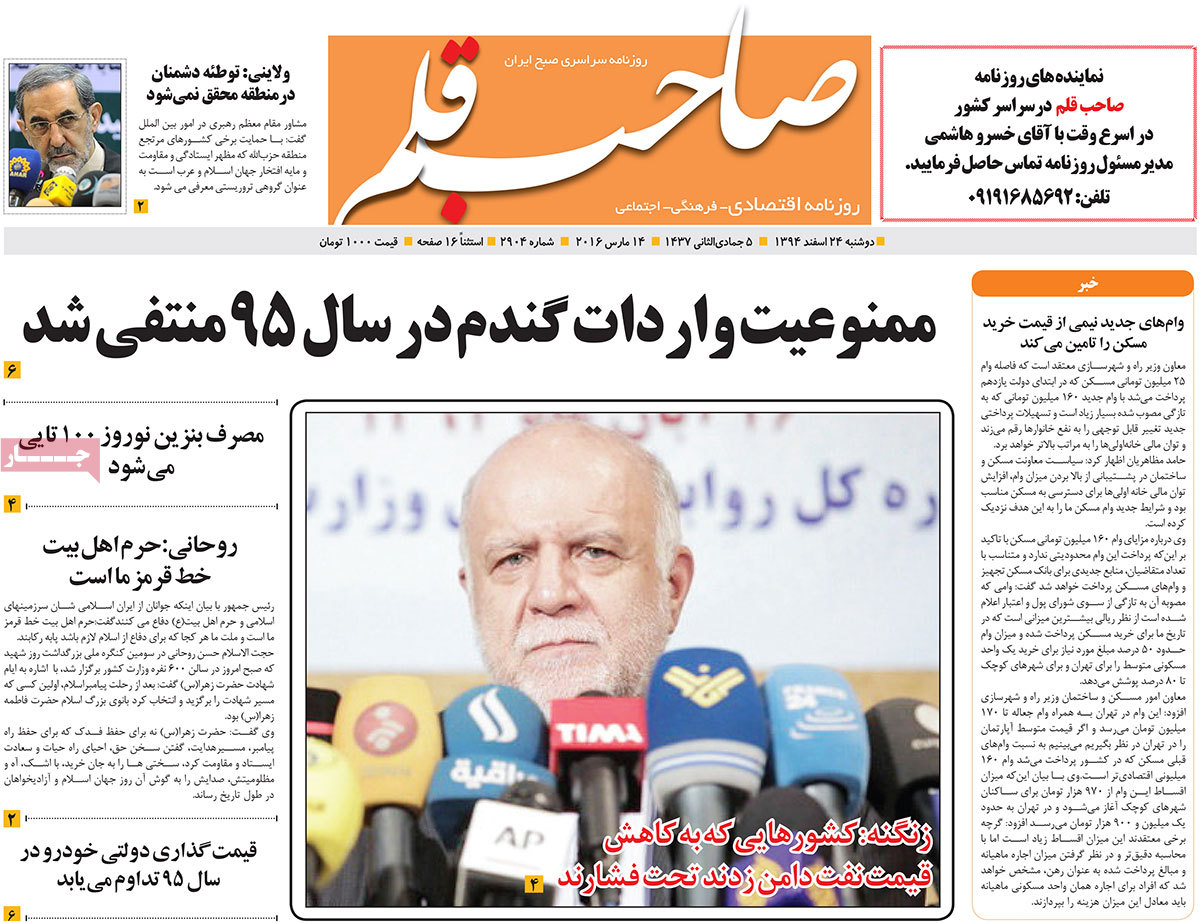
Sahib Ghalam:

1- Urmia lake again visible on Iran map

2- Oman to send Iran gas to world

Saheb Ghalam


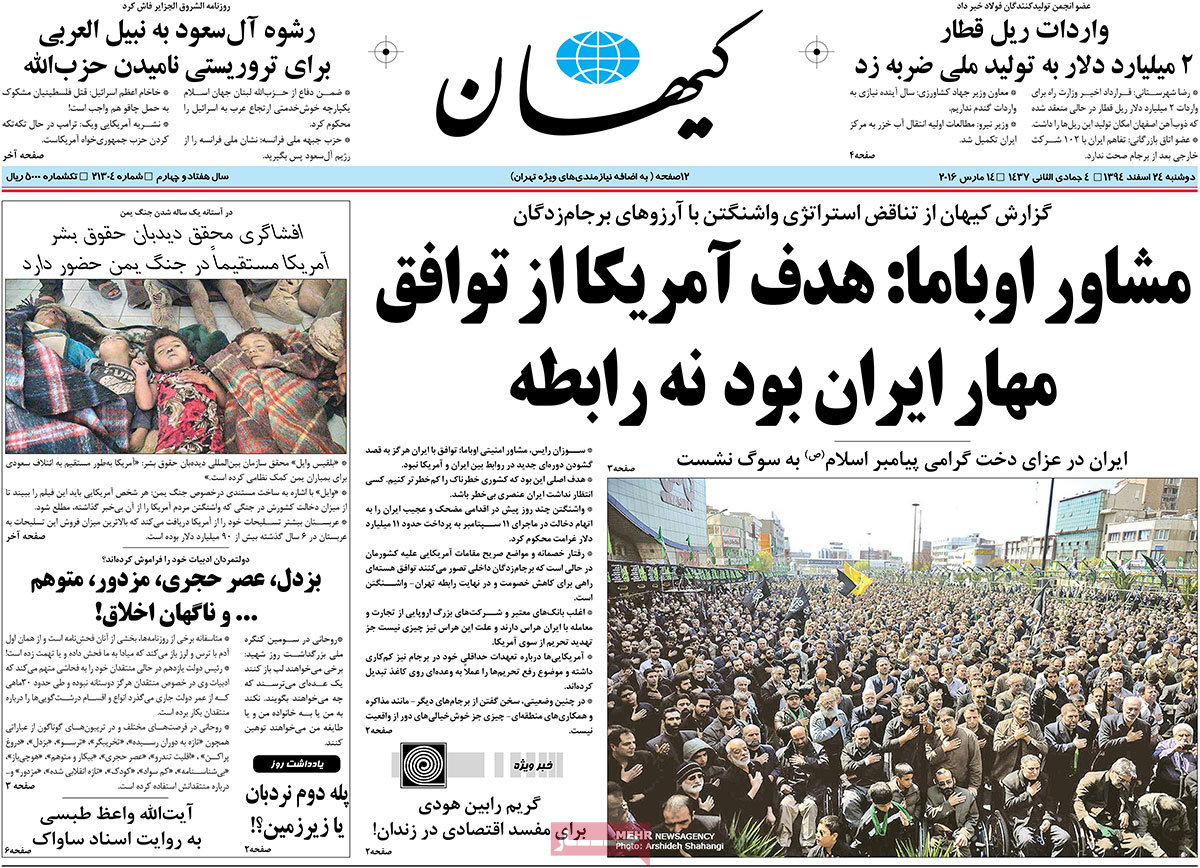
Kayhan:

1- Source: US Military Chopper Transfers ISIL Leaders from Fallujah to Unknown Location

2- Economist: People’s livelihood marked of reformists’ electoral lists


Kayhan


Syria ceasefire should not lead to terrorists’ reinforcement: Zarif

“A ceasefire [in Syria] does not mean allowing Daesh, al-Nusra Front, and other al-Qaeda-affiliated groups to carry on their activities,” Zarif said during a joint press conference Monday with his Bosnian counterpart Igor Crnadak in the Iranian capital, Tehran.

Zarif also said that Iran has always supported any kind of truce in Syria; adding, however, that the details of such a plan should be discussed.

“Iran has always believed that the crisis in Syria has no military solution,” the Iranian minister said, adding, “the plans presented so far have brought about [the issue of] ceasefire, and Iran has emphasized the matter in addition to the delivery of humanitarian aid since the first negotiation meeting in Vienna.”

Referring to the relations between Tehran and Sarajevo, Zarif said the two sides are willing to expand bilateral ties in various fields including political, economic and banking areas.

Crnadak, for his turn, welcomed further expansion of Iran-Bosnia cooperation in different areas and dialogue between the two countries.

He also said that the two sides discussed the impact of terrorism on Europe, the unprecedented refugee crisis in the continent, and the situation in Yemen and Syria.

The International Syria Support Group (ISSG) agreed in the German city of Munich on February 12 to a “cessation of hostilities” in Syria and to implement a ceasefire in a week. However, acts of terrorism continues unabated in the country.

The ISSG said in a statement that the ceasefire in Syria does not include areas held by groups designated as terrorist organizations by the United Nations Security Council, including Daesh and al-Nusra Front.

The ISSG members also asked the UN to resume the collapsed peace talks between the Syrian government and the Saudi-backed Syrian opposition group known as the High Negotiations Committee (HNC).

Syrian President Bashar al-Assad said on February 15 that “a ceasefire means in the first place halting the terrorists from strengthening their positions. Movement of weapons, equipment or terrorists, or fortification of positions, will not be allowed.”

Syria has been gripped by foreign-backed militancy since March 2011. According to a new report by the Syrian Center for Policy Research, the conflict has claimed the lives of over 470,000 people, injured 1.9 million others, and displaced nearly half of the country’s pre-war population of about 23 million within or beyond its borders.

Iran, Russia stress political resolution for Syria crisis

The two also stressed establishment of a ceasefire and dispatch of humanitarian aid to all regions except those where terrorists have a presence.

According to Amir-Abdollahian and Bogdanov, resumption of talks between Syrian opposition groups who believe in political solution and the Syrian government is top on the agenda of resolving the ongoing crisis in Syria.

Bogdanov is dur to pay a visit to Tehran in the near future upon an invitation from his Iranian counterpart.

Moscow Condemns Series of Terrorist Attacks in Syria

“Moscow strongly condemns the inhumane terrorist attacks. We express our sincere condolences to the families of those killed and wish a speedy recovery to the injured,” the Russian Foreign Ministry said in a statement.

It is crucial to thwart attempts of Daesh (ISIL) group and other extremists to exacerbate the Syrian conflict, the Russian Foreign Ministry said, Sputnik News reported.

“It is important to put a reliable barrier in the way of attempts of ISIL, the Nusra Front and other terrorist groups to further aggravate the situation in Syria and around it, which are betting on further inciting sectarian strife,” the statement reads.

Syria has been in a state of civil war since 2011, with the country’s government fighting multiple militant factions including Daesh.

The meeting of the International Syria Support Group on February 12 resulted in a final communique calling for swift humanitarian access to all besieged areas in Syria. It had also set a one-week deadline for measures to be implemented toward the cessation of hostilities in the country.

Vilified Siemens is Iran’s new darling

Once suspected of helping the US and Israelis sabotage Iran’s nuclear energy program, the trains-to-turbines German group is back to revive the lucrative business which it abandoned in the wake of Western sanctions on Tehran in 2012.

Siemens Chief Executive Joe Kaeser met Zangeneh in Tehran on Monday to work out details of an initial agreement which the company landed early last month to capitalize on trade with Iran.

The minister said Iran needed Siemens’s gas compressors and machinery to revive its ramped-up production bid which fizzled out after Western companies downed the tools under the sanctions regime.

Siemens blocked the delivery of gas turbines and compressors which Iran had bought to provision and service its oil and gas projects.

“The equipment was for South Pars phases, LNG (projects) and some of the Iranian refineries, the release of which has started after the annulment of sanctions,” Zangeneh said.

A Siemens official said earlier this month that “there are no legal restrictions anymore” for exports of machinery to Iran.

Siemens had been the main provider of gas turbines and compressors to Iran’s oil projects for decades, winning major contracts in the country.

In 2010, Siemens reportedly made over $967 million more than the previous year in Iran on the back of several contracts which included a $420 million deal to provide the country with 150 locomotives and also gas turbines and compressors.

Stuxnet controversy

Iranian officials later accused Siemens of providing sensitive information to US and Israelis about control systems it had acquired from the company, enabling them to damage Iran’s industry.

They said the US and Israelis had used the details provided by Siemens to produce the Stuxnet worm that specifically attacked Iranian centrifuges used for enriching uranium. Siemens denied the accusations.

On Monday, Zangeneh said Siemens can jointly produce equipment with Iranian companies for exports to regional countries, including Iraq, Central Asia and elsewhere.

“We hope a new chapter will open in cooperation between Iran and Siemens during the post-sanction (era),” he said, quoted by the Shana news agency.

Rail deal

Last month, Siemens signed a contract worth between 1.5 billion euros ($1.6 billion) and 2 billion euros to build rail coaches and upgrade train lines in Iran.

The deal reportedly calls for Siemens to build 500 train carriages and improve electrification on two lines serving Tehran. It also includes service and maintenance contracts.

“If you look at what Iran needs to rebuild its country, it almost looks like a description of business for Siemens,” Kaeser told Bloomberg then.

Germans’ footprints in major industrial projects in Iran date back to the late ninetieth century, including the Trans-Iranian Railway. The line is famous for being used by the Anglo-Soviet occupiers in 1940s to ship arms supplies during World War II.

Unlike Britain and the US, Germany has had no imperialist and cloak-and-dagger history in Iran and is generally viewed positively.

A number of Germany companies, including Volkswagen and Daimler, are jostling for position as Iran is opening to international business. 

Linde plans $4 billion of investment in Iranian petrochemical projects along with Japan’s Mitsui Chemicals, new Managing Director of the National Petrochemical Company (NPC) Marzieh Shah-Daei said earlier this month.

Iranian Nation Needs No Foreign Advice on Elections: Spokesman

British Broadcasting Corporation (BBC) recently encouraged Iranian people not to vote for certain Iranian candidates in the Assembly of Experts elections, which will be held on February 26.

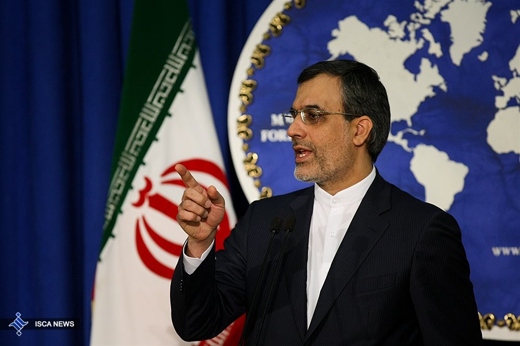
“The Islamic Republic of Iran’s position (on BBC’s move) is a clear one; an important achievement of Iran’s Islamic Revolution is independence and freedom, and the vigilant nation of Iran does not need the advice of any foreign player,” Jaberi Ansari said in his weekly press conference.

“We are sure that, in the upcoming elections, the Iranian nation will prepare the grounds for the expansion of Islamic Republic’s power at the international and regional level through their massive participation and vigilant and conscious choice,” he asserted.

His comments came after Deputy Chief of Staff of the Iranian Armed Forces complained about the Iranian diplomatic body’s muted response to the recent attempts by BBC to influence the outcome of the upcoming elections in Iran.

“The (Iranian) Foreign Ministry’s silence on the British interference in our country’s internal affairs raises doubts,” Brigadier General Massoud Jazayeri said on Monday.

He called on the Foreign Ministry to show “decisive and proportional” reaction to the British government and embassy in Iran because of BBC’s brazen interference in the country’s domestic issues.

“People of Iran expect the administration to take action in this regard and silence the voice of the devil,” the general noted.

The Assembly of Experts and parliamentary elections will be held simultaneously on February 26.

Drug Trafficking Saudi Prince – The Reason behind Cutting Aid to Lebanon

According to Al Alam TV channel, an activist named Mojtahed, who is well known and widely praised in his country for revealing secrets about the Saudi ruling family, tweeted on Saturday that the withholding of Saudi aid to the Lebanese Army has nothing to do with claims that Hezbollah has control of the Lebanese military or the Lebanese government’s support of the Syrian government.

Arab prince drugAccording to Mojtahed, the real reason for the cessation of aid is due to the failure of talks to secure the release of a Saudi prince currently detained in Lebanon on charges of drug trafficking.

Mojtahed claimed that the Saudis are hopeful that, by halting the flow of military aid to Lebanon, all Lebanese factions (including Hezbollah) would push for the release of the drug trafficker prince.

Prince Abdolmohsen bin Valid Al Saud was detained last October in Beirut airport while in possession of 2 tons of counterfeit Captagon pills, which had been imported to Beirut on board the prince’s private airplane and were valued at around $280 million.

Iran negotiating with 30 European countries on oil drilling

Tehran, February 21, IRNA – Managing Director of Iranian Drilling Company announced that his company has held talks with 30 European and Asian firms over past several months, and said Tehran is ready to cooperate with accredited oil companies and joint cooperation in oil and gas drilling projects.

Heydar Bahmani pointed to the post-sanction committees for Iran’s oil and gas drilling industry, and said, ‘Given the removal of sanction, these committees will pursue the topics related to economic and technical topics, planning, negotiating with foreign companies and studying the contracts.

He referred to Iran’s negotiations with Italian and Singaporean companies, and said, ‘The most important topics of these negotiations were drilling industry and utilizing the world’s modern technologies.’

‘All these companies have called for joint cooperation with Iran’s National Drilling Company in oil and gas industries,’ Bahmani added.

He reiterated that the National Iranian Drilling Company is ready to cooperate with international accredited companies with the aim of joint activities in oil and gas drilling projects.

Iran intends to increase oil output: Analyst

Speaking to IRNA, Mohammad Hassan Ghadiri Abyaneh further remarked that although Iran has repeatedly stressed on the gradual increase of its oil exports in the post-sanctions period and demands nothing more than its previous quota, OPEC oil ministers and non-OPEC members are univocally making efforts to prevent Iran from restoring its previous quota.
Ghadiri Abyaneh, Iran’s former Ambassador in Mexico, said international sanctions forced Iran to cut production by about 1.5 million barrels. ‘We cannot further drop our production and in the meantime it should return to its previous production level of 4.2 million barrels per day.
He stressed that Iran’s economy is in need of independence from oil and the only solution is to have an economy based on work and production and the best option in this regard is the economy of resistance.
In the aftermath of the February 16 agreement of Russia and Saudi Arabia to freeze oil output Iran’s oil minister stressed that the country is decisive on increasing its product and will not withdraw its share in the market.
Meanwhile, Managing Director of the National Iranian Oil Company Rokneddin Javadi referred to the restoration of Iran’s quota as one of the oil challenges in the post-sanctions era and said Iran’s oil production will reach 4.7 million barrels per day in coming years.

General Worried about Iran’s Diplomatic Inaction on BBC’s Interference

“The (Iranian) Foreign Ministry’s silence on the British interference in our country’s internal affairs raises doubts,” Brigadier General Massoud Jazayeri said on Monday.

He called on the Foreign Ministry to show “decisive and proportional” reaction to the British government and embassy in Iran because of BBC’s brazen interference in the country’s domestic issues.

“People of Iran expect the administration to take action in this regard and silence the voice of the devil,” the general noted.

Jazayeri stressed that the Foreign Ministry should set a precondition for the expansion of diplomatic ties with London, namely “an end to Britain’s shameful interference” in Iran’s internal affairs.

The remarks came in reaction to a recent move by BBC encouraging the Iranians not to vote for certain candidates running for the Assembly of Experts.

The Assembly of Experts and parliamentary elections will be held simultaneously next Friday.