Wednesday, December 31, 2025
Home Blog Page 4560

Iran Raps Saudi’s “Intentional” Attack on Embassy in Yemen

Jaber Ansari

On Wednesday night, Saudi Arabia launched a rocket attack on the Iranian embassy in Sana’a, which incurred damages to the building and wounded several Iranian guards.

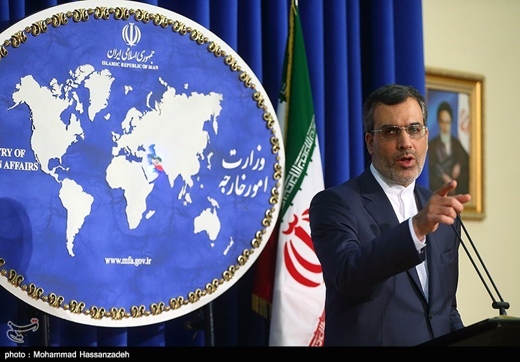
The foreign ministry spokesman condemned the attack, saying this “intentional move by the Saudi government is in violation of all international conventions and legal rules on protecting the security of diplomatic posts and their immunity under all circumstances.”

The Saudi government is fully responsible for the attack and should compensate for the damages incurred on the building and the injuries of the Iranian embassy staff, Jaberi Ansari stressed.

Obviously, he added, the Islamic Republic of Iran reserves the right to pursue the issue.

The attack came amid the recent tensions between Iran and Saudi Arabia mainly caused by Riyadh’s execution of prominent Shiite cleric Sheikh Nimr al-Nimr, and a subsequent attack by outraged Iranian protesters on Saudi embassy, which resulted in Saudi Arabia’s decision to sever its ties with Tehran.

Saudi Arabia on Saturday executed Sheikh Nimr, among dozens of others. The execution ignited widespread international condemnation, from both political and religious figures.

On Sunday, furious demonstrators in the Iranian cities of Tehran and Mashhad stormed Saudi Arabia’s diplomatic buildings in protest at the Al Saud’s execution of Sheikh Nimr.

Although Iranian officials criticized the embassy attack and police arrested several individuals involved, Saudi Arabia on Sunday severed diplomatic ties with the Islamic Republic.


Saudi Arabia to collapse over ‘sectarian’ policies: Iran cmdr.

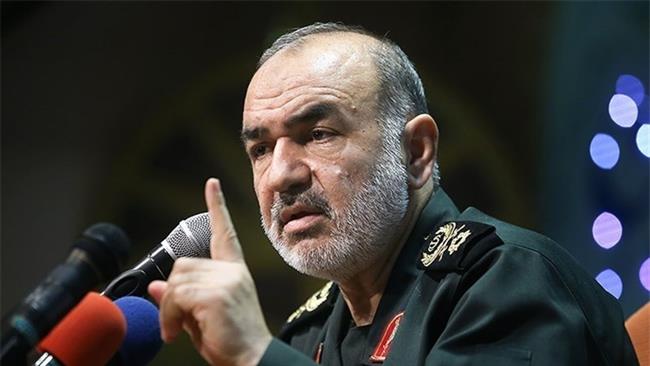
The policies of the Saudi regime will have a domino effect and they will be buried under the avalanche they have created, said Brigadier General Hossein Salami, the second-in-command of the Islamic Revolution Guards Corps (IRGC), on Thursday.

“If the Al Saud regime does not correct this path, it will collapse in the near future,” Tasnim news agency quoted General Salami as saying.

On Saturday, Saudi Arabia announced the execution of top Shia cleric Sheikh Nimr Baqir al-Nimr and 46 others despite international calls for their release. This led angry protesters to held demonstrations in front of the Saudi embassy in Tehran and its consulate in the northeastern city of Mashhad, censuring the Al Saud regime for the killing of Nimr.

Some people mounted the walls of the consulate in Mashhad while incendiary devices were hurled at the embassy in Tehran. Some 50 people were detained over the transgression.

Riyadh severed diplomatic relations with Tehran after the incident.

General Salami described the kingdom’s decision to sever ties with Tehran “irrational,” adding that the violence in Iraq and Syria were the direct results of Saudi’s sectarian policies in the region.

He also compared the policies of the Saudi regime with those of former Iraqi dictator Saddam Hussein who was executed in 2006 during the US-led invasion of Iraq.

The path the Saudi regime is taking is like the one Saddam took in the 1980s and 90s. He started a war with Iran, executed prominent clerics and top officials, suppressed dissidents and ended up having that miserable fate, Salami noted.

Iran’s President Hassan Rouhani, has already denounced Saudi Arabia’s sectarian policies, saying the execution of Nimr “is in line with sectarian policies.”

Rouhani has said, “Such a measure is in line with sectarian policies and aims to spread terrorism and extremism in the region and across the world, which have destabilized the region and waged war and conflicts in recent years.”

The execution also saw condemnations from Iraq and the UN. Muslims and human rights activists all over the world also protested Nimr’s killing.


A look at Iranian newspaper front pages on Jan 7

Iranian Newspapers Headlines

Iranian President’s letter to the Judiciary Chief asking him to hasten investigations regarding the case of Saudi embassy attackers, the screening of parliamentary electoral candidates’ qualifications and heated race by the Assembly of Experts’ election candidates grabbed most of Iran’s newspaper headlines on Thursday, January 7, 2016.

The following are some of the trending stories that appeared on leading Iranian newspapers.


Arman-e Emrouz: Competency of absentees of the Assembly of Experts’ entrance exam cannot be ascertained: Spokesman of the Guardian Council

Arman-e Emrouz: Iran President has asked Judiciary Chief with urgently dealing with the case of Saudi Embassy takedown in Tehran.

Arman-e Emrouz: Talks no sign of ties

Zarif said responding to rumors that he has been repeatedly talked with US Secretary of State John Kerry


A look at Iranian newspaper front pages on Jan 7


Aftab: Gov’t resolved to contain rebels
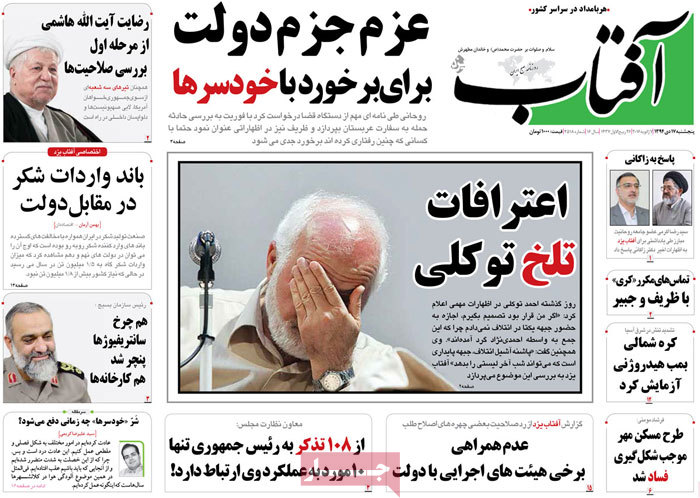
 

A look at Iranian newspaper front pages on Jan 7


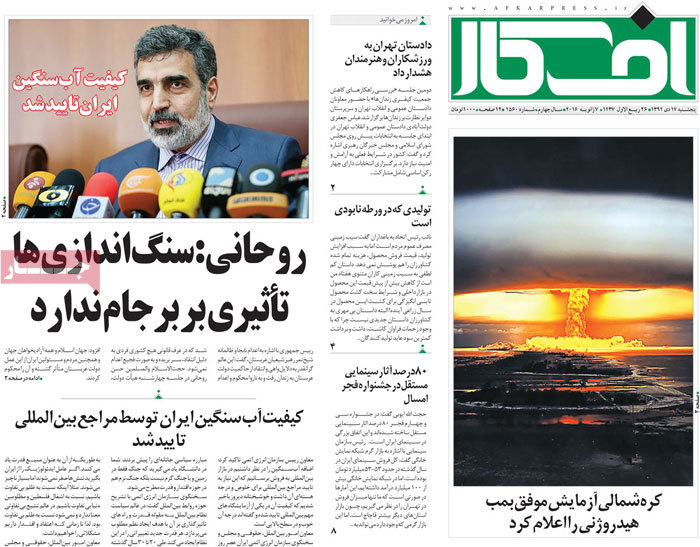
Afkar: Stonewalling will not hinder JCPOA progress: Iranian President

Afkar: Int’l bodies confirm quality of Iran heavy-water: deputy head of the Atomic Energy Organization of Iran (AEOI)
 

A look at Iranian newspaper front pages on Jan 7


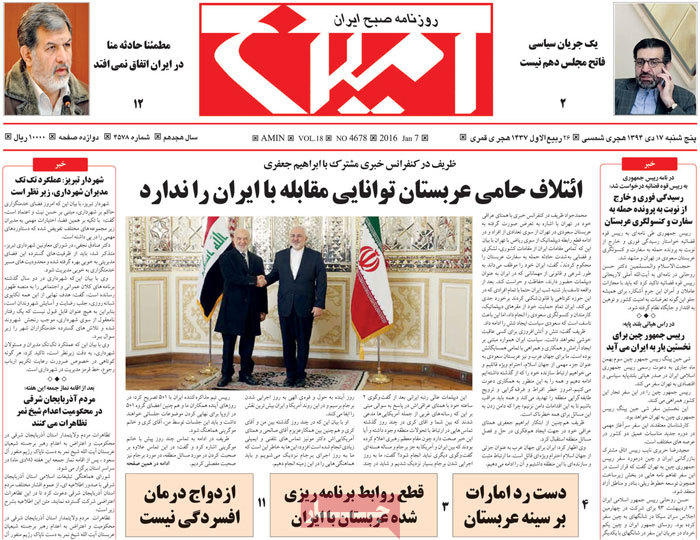
Amin: No Political Party leads the 10th parliament, said Mohammad Sadegh Kharazi, one of the moderate reform figures supporting Rouhani’s government.
 

A look at Iranian newspaper front pages on Jan 7


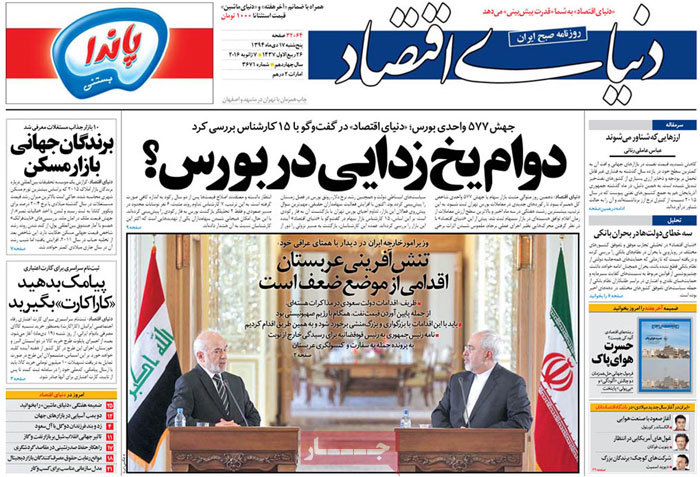
Donyaye Eqtesad:

Saudi Government played into the hands of the Zionist interests by throwing monkey wrenches in the course of Iran’s nuclear talks by taking measures like dragging down oil prices, Iran’s Foreign Minister Mohammad Javad Zarif told his Iraqi opposite number.
 

A look at Iranian newspaper front pages on Jan 7


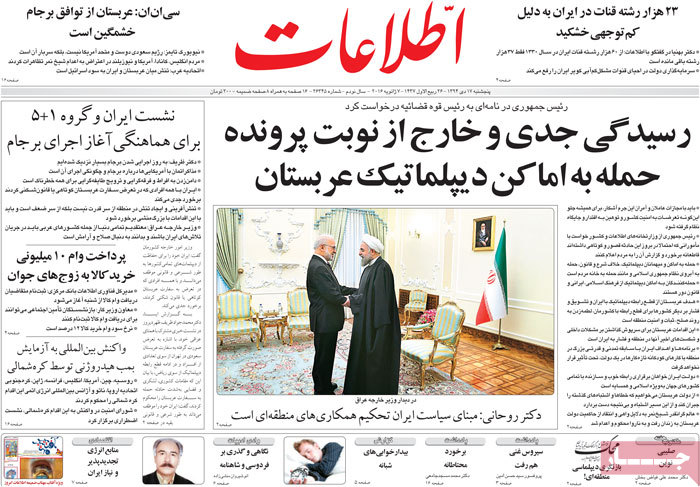
Ettela’at: Strengthening regional countries is the basis of Iran’s foreign policy: Iranian President to Iraqi FM

Ettela’at: Negligence dries out thousands of Qanats in Iran
 

A look at Iranian newspaper front pages on Jan 7


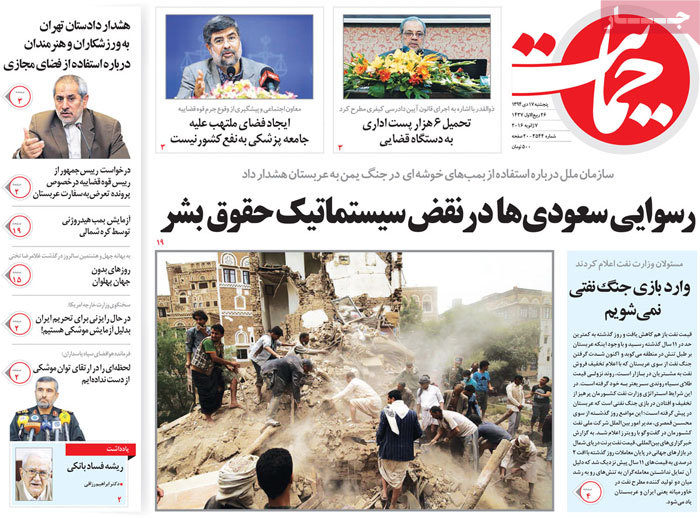
Hemayat: Tehran prosecutor warns celebrities about social media use

The warning comes after a professional Persepolis goalie, Sosha Makani, was jailed in Iran after posting pictures that violated social norms in Iran on his Instagram page.
 

A look at Iranian newspaper front pages on Jan 7


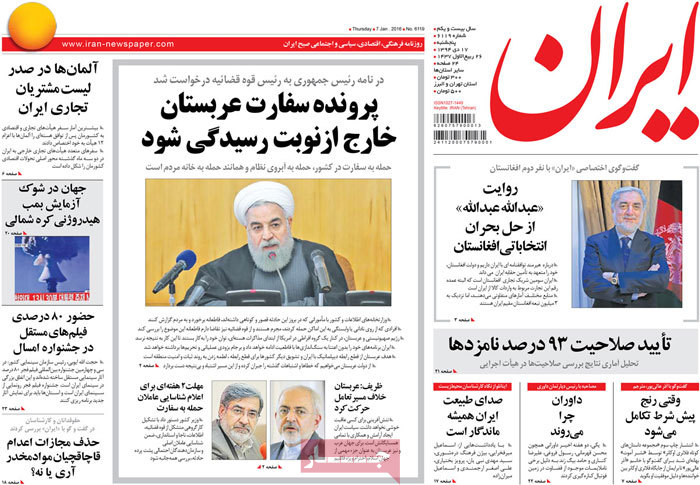
Iran: Germans top Iran trade partners

Iran: 80% of Fajr filmmakers independent

Iran: End of capital punishment for smugglers?

Iran: 15-day deadline for identifying Saudi Embassy attackers: Interior Minister

Iran: Arabia moved against the course of interaction: FM

Iran: The executive boards [affiliated with the Interior Ministry] have given the [initial] go-ahead to 93 percent of electoral candidates.
 

A look at Iranian newspaper front pages on Jan 7


Ta’adol: All NDFI (national development fund of Iran) arrears settled, the fund’s managing director said.

Ta’adol: Global community concerned about growing tensions in the Middle East

Ta’adol: 15 strategic instructions to boost auto-making industry
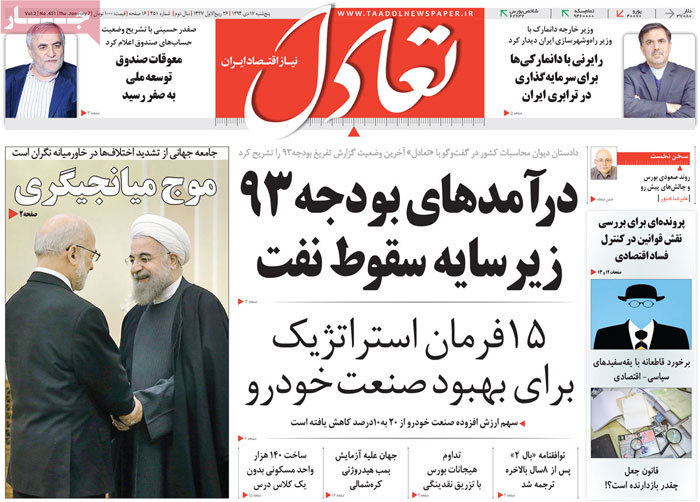
 

A look at Iranian newspaper front pages on Jan 7


Jahan Eqtesad: Anti-Iran coalitions pointless: Iran FM

Jahan Eqtesad: Excessive supply biggest oil market challenge

Jahan Eqtesad: Impact of Tehran-Riyadh tensions on Market not lasting
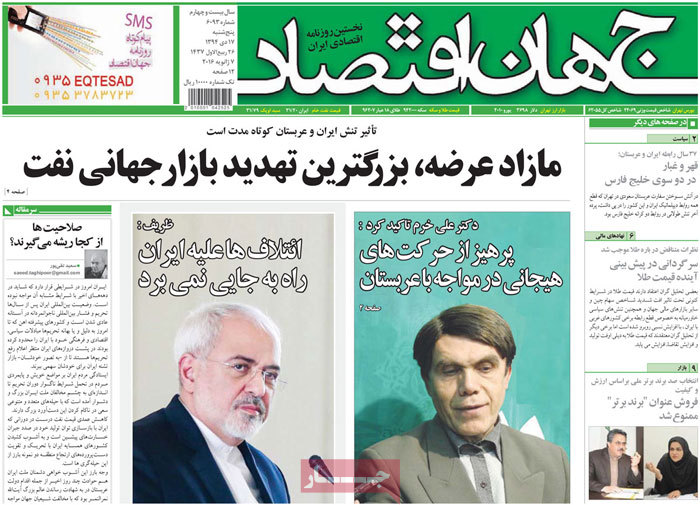
 

A look at Iranian newspaper front pages on Jan 7


Jame-Jam: Insurance Support under way for families in need of psychotherapeutic services

Iranian Ministry of Health has launched an initiative to offer insurance coverage to Iranian families in search of psychotherapeutic consultation services. Such services are very expensive in Iran and many families cannot afford them.
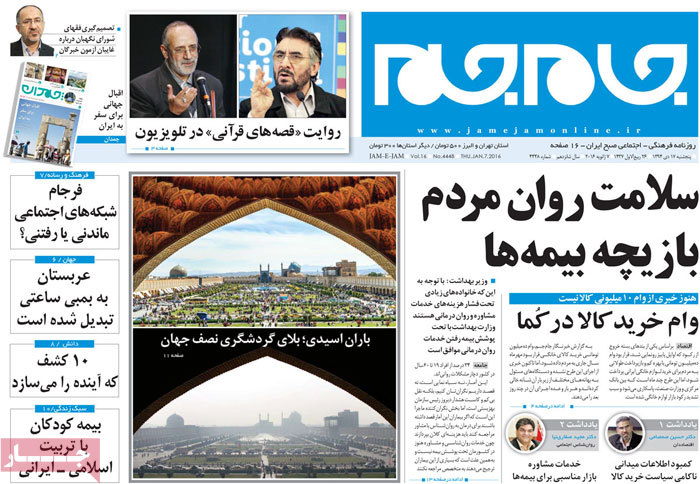
 

A look at Iranian newspaper front pages on Jan 7


Javan:

The daily has highlighted the “open carry” law in the Republican-dominated Texas Legislature in an article entitled as, “30,000 Murder Cases Prompt US Law to Change for Openly Carrying Guns”.

Also in the daily’s front page was Pyongyang’s H-bomb test story.

The story’s title: East Asia Shaken by an Emerging H-bomb from N. Korea
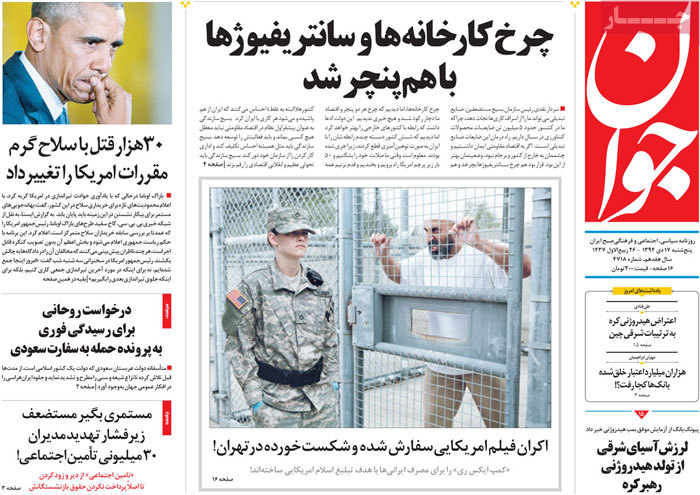
 

A look at Iranian newspaper front pages on Jan 7


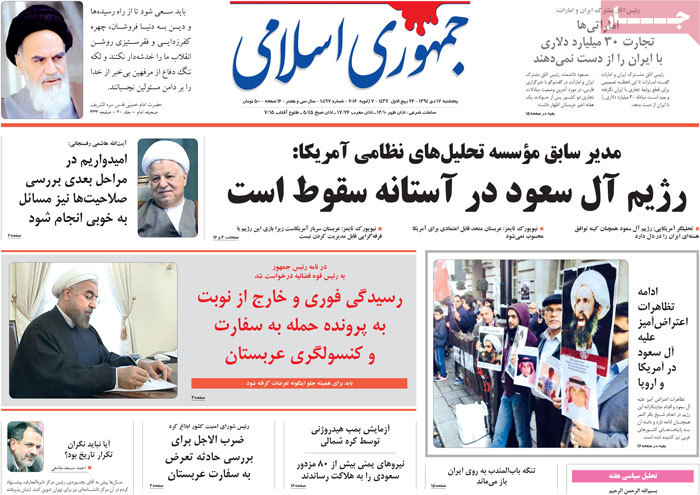
Jomhouri Eslami: Mandeb Strait Open to Iranian Vessels

Bab-el-Mandeb (or Mandeb Strait) is a strait located between Yemen on the Arabian Peninsula, and Djibouti and Eritrea in the Horn of Africa. It connects the Red Sea to the Gulf of Aden. After it was rumored earlier this week that Djibouti severed its ties with Iran, some speculated that the country will close the strait to passing Iranian ships. Iranian foreign ministry authorities have rejected such speculations as being baseless.
 

A look at Iranian newspaper front pages on Jan 7


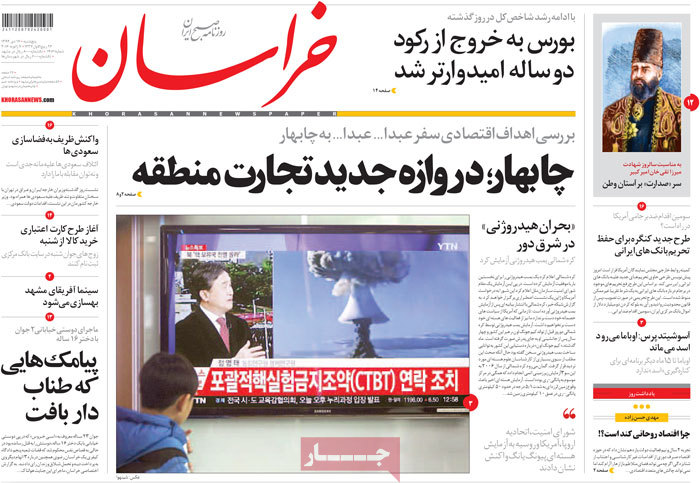
Khorasan: Chabahar; Region’s emerging trade hub

Assessing the possibilities of entering partnerships with Iranian projects was one of chief goals of the recent state visit by Afghan Chief Executive Officer Abdullah Abdullah from Iran, possibly in a bid to diversify its trade terminals. Most Afghan trade is done via Pakistan’s Karachi port.
 

A look at Iranian newspaper front pages on Jan 7


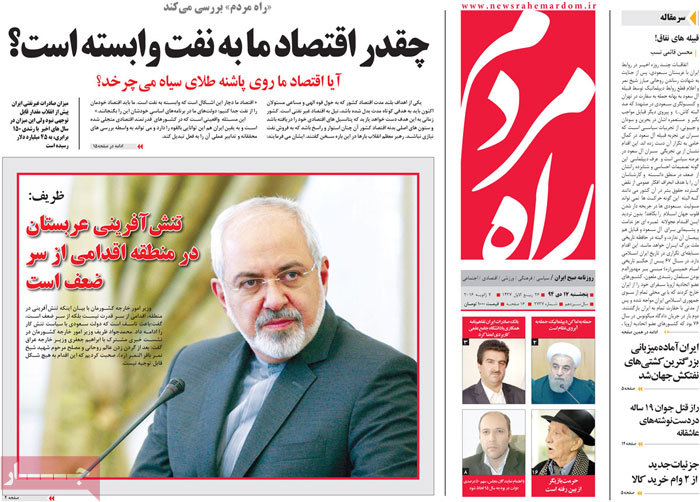
Rah-e Mardom: Saudi entente is out of weakness, Iranian Foreign Minister Mohammad Javad Zarif said during a press conference with his Iraqi counterpart in Tehran.

Rah-e Mardom: Iran bracing for berthing VLCCs

Iran has said it is ready to moor the world’s largest crude oil carriers.
 

A look at Iranian newspaper front pages on Jan 7


Resalat:

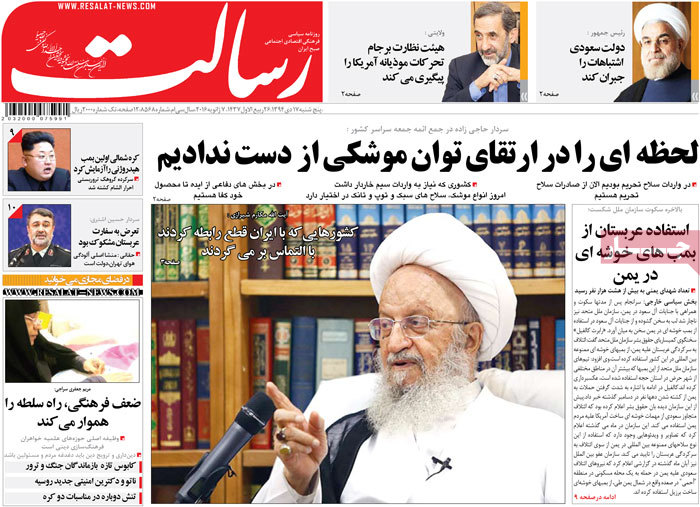
“We spared no single moment to enhance the country’s missile capabilities,” said Brigadier General Amir-Ali Hajizadeh, the commander of the Aerospace Division of the Islamic Revolution Guards Corps (IRGC), addressing a gathering of Friday prayer leaders from across the country.

Senior Iranian cleric Grand Ayatollah Nasser Makarem Shirazi said countries that cut their ties with Tehran will beg to restore them.
 

A look at Iranian newspaper front pages on Jan 7


Shargh:

Possibilities high for Hassan Khomeini (the grandson of Imam Khomeini, leader of the 1979 Islamic Revolution)’s progress in the race to make way to the Assembly of Experts
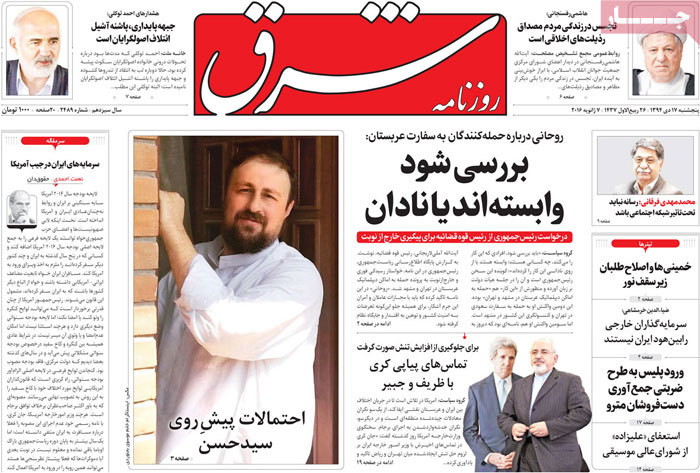

 

A look at Iranian newspaper front pages on Jan 7


Saudi execution of Nimr looks like act of terror: Minister

“The Saudi government behaved wrongly by decapitating one of the country’s freedom-seekers, which is more like acts terrorists commit across the length and breadth of the region,” Hassan Qazizadeh Hashemi said.

Muslims living in Saudi Arabia’s Eastern Province have the right to live and express their opinions in their own country, Hashemi said, adding that voicing criticism is not liable to execution.

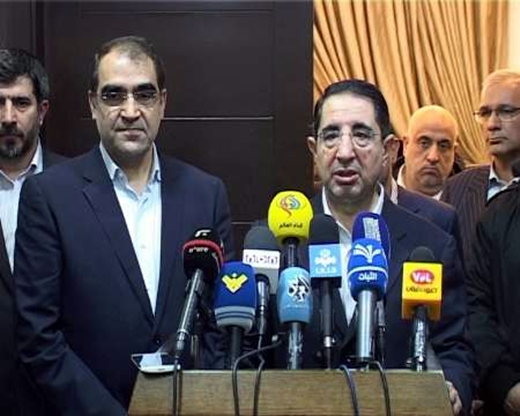
He made the statements at a Wednesday press conference during a visit to Beirut where he met senior Lebanese officials and Hezbollah chief Seyyed Hassan Nasrallah.

Riyadh announced the execution of Sheikh Nimr and 46 others on January 2, after convicting them of involvement in “terrorism.”

Nimr’s execution was widely censured by Muslims and human rights activists around the globe as well as various governments and international bodies.

Elsewhere in his remarks, Hashemi said Saudi authorities should take complete responsibility for the “crisis of their own making” in the region.

The Iranian minister, who arrived in Beirut on Wednesday, is on a three-day visit to Lebanon.

On the first day of his stay, Hashemi held separate meetings with Lebanese Parliament Speaker Nabih Berri, Health Minister Wael Abou Faour, and Industry Minister Hussein Hajj Hassan.

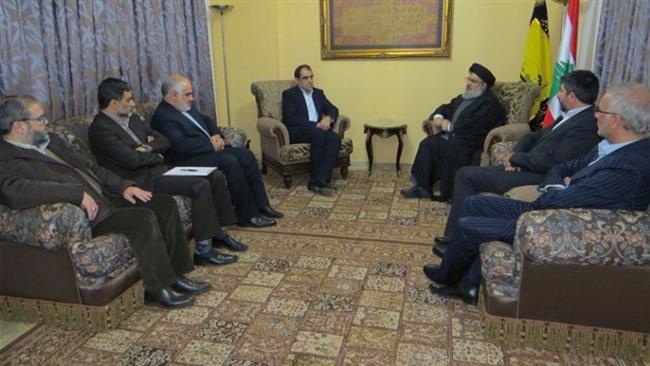
On Thursday, Hashemi held a meeting with Nasrallah and discussed the latest regional developments.

Iran ready to provide Lebanon medical needs: Health minister

He made the remarks in a meeting with Lebanese Minister of Industry Hussein al-Hajj Hassan.

Iran’s pharmaceutical industry with its highly qualified medical equipments has the potential to provide Lebanon with its needs in this field of medicine, Hashemi said.

He noted that the trend of Iran-Lebanon relations is promoting.

The official said that Iran is to decrease its independence on its oil revenues by boosting the country’s non-oil exports.

Hashemi called for facilitation of Iran’s drugs and medical equipments exports to Beirut, adding that Tehran is currently exporting medicines to Russia, South Africa and a number of the regional states.

The official urged exchange of delegations between the Iran and Lebanon industries to help boost bilateral relation.

He also said that Iranians love the Lebanese Hezbollah Resistance Movement and that the movement’s popularity is increasing in the Islamic World.

Meanwhile, Al-Hajj Hassan, hailed the progress made by Iran in the field of pharmaceutical industry and noted that Lebanon could play the role of a marketing center for exports of the Iranian goods to the region.

The Lebanese minister referred to Iran as a powerful Muslim country that can be relied on by other Muslims.

Referring to the ongoing process for the removal of Iran’s sanctions, the Lebanese minister called for boosting bilateral ties between private sectors of the two countries.

Iran’s health minister arrived in Lebanon on Wednesday at the head of a delegation comprising of health officials, representatives of pharmaceutical companies and investors. He has met so far with his Lebanese counterpart Wael Abu Faour.

The Iranian delegation is reportedly to leave Lebanon for Syria at the end of his visit to Beirut.

He is accompanied in the visit by a number of Iranian investors and managers of companies working in the field of pharmaceuticals and medical equipment.

The Iranian health minister has made the trip at the invitation of his Lebanese counterpart, Wael Abou Faour.

Hasty, Provocative Decisions to Worsen Regional Tensions: Iran’s Rouhani

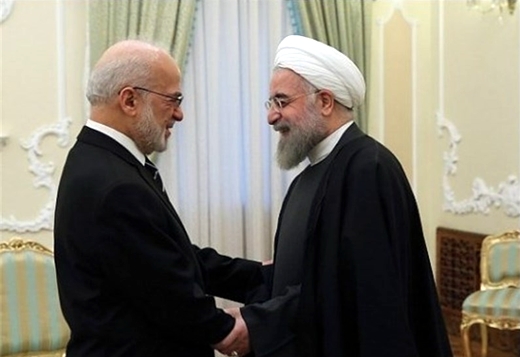
In a Wednesday meeting with Iraqi Foreign Minister Ibrahim al-Jaafari here in Tehran, Rouhani referred to the recent positions and measures taken by Saudi Arabia as being on the path of worsening the conflicts and rifts in the region.

Rouhani stressed that amid the ongoing fight against terrorism in the Middle East, unity and solidarity among regional countries is now needed more than ever.

Unwise, hasty, and provocative decisions would definitely foment tensions and harm the regional states, the Iranian president added.

Jaafari, for his part, affirmed that any rise in the conflicts and tensions among regional countries would spoil the solidarity and unity among Muslim countries.

He also hailed as “wise and prudent” the Islamic Republic’s policies in the region and world, and admired Iran’s strong diplomacy, which incorporates patience and courage.

In similar remarks, Rouhani had earlier on Wednesday lashed out at the Saudi regime’s policies and measures that cause further rifts between Shiites and Sunnis.

“Unfortunately, the government of Saudi Arabia, which is the government of an Islamic country, has long been trying to raise and exacerbate conflicts between Shiite and Sunni Muslims,” Rouhani said in a cabinet meeting in Tehran.

Saudi Arabia on Saturday executed prominent Shiite cleric Sheikh Nimr al-Nimr, among dozens of others. The execution ignited widespread international condemnation, from both political and religious figures.

On Sunday, furious demonstrators in the Iranian cities of Tehran and Mashhad stormed Saudi Arabia’s diplomatic buildings in protest at the Al Saud’s execution of Sheikh Nimr.

Although Iranian officials criticized the embassy attack and police arrested several individuals involved, Saudi Arabia on Sunday severed diplomatic ties with the Islamic Republic.


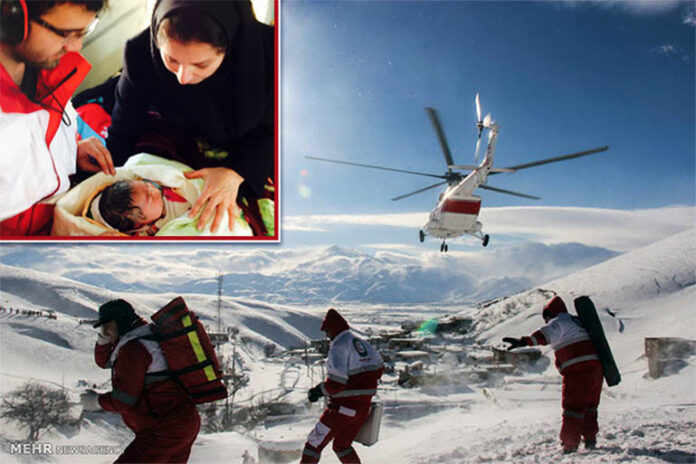
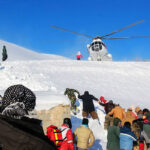
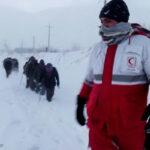
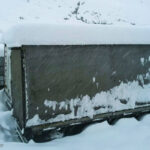
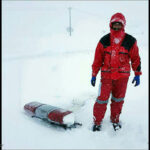
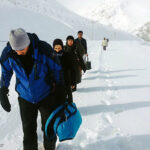
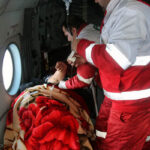
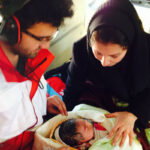
Woman stuck in snow gives birth (PHOTOS)

Relief workers with the Red Crescent Society of Iran have rescued a number of people affected by a snowstorm in the northwest.

One stranded individual was a heavily pregnant woman who gave birth in the process of being rescued.

The following images have been released by Mehr News Agencies:


Iran’s Shamkhani: Execution of Shiite Cleric Unveils Riyadh’s Sectarian Policy

Speaking at a meeting with the visiting Iraqi Foreign Minister, Ibrahim al-Jaafari, in Tehran, Secretary of Iran’s Supreme National Security Council (SNSC) Ali Shamkhani described as “regrettable and unacceptable” the execution of Sheikh Nimr Baqir al-Nimr by the Saudi regime.

He reiterated that the killing arises from sectarian policy of Riyadh.

He further criticized as unacceptable Saudi Arabia’s exploitation of its capacities to harm Muslims’ interests in the Middle East region.

Shamkhani also expressed regret that certain countries are hiring foreign mercenaries to kill civilians in Yemen and exacerbate insecurity across the region.

Saudi Arabia began the campaign against Yemen in late March 2015. The strikes are supposedly meant to undermine the Ansarullah movement and restore power to fugitive former Yemeni president, Abd Rabbuh Mansour Hadi.

Reports say that over 7,500 people have been killed and over 14,000 others injured since the strikes began.

Saudi Arabia announced the execution of Sheikh Nimr and 46 others on Saturday despite international calls for the release of the opposition cleric and other jailed political activists in the kingdom.

Also at the meeting the Iraqi foreign minister denounced the killing of Sheikh Nimr, but at the same time underlined “the need for unity among Muslims” to counter enemy plots.


Iran, Kuwait diplomatic ties untouched: Envoy

Following a meeting with high-ranking officials in the Kuwaiti Foreign Ministry on Tuesday, Alireza Enayati said President Hassan Rouhani has ordered an investigation to the angry protests before the Saudi embassy in Tehran.

Explaining about the meeting on his Facebook account, the Iranian diplomat said he stressed that Iran is a responsible country and is committed to protection of the diplomatic missions.

Enayati said he was told that his Kuwaiti counterpart has been recalled from Tehran only for consultations.

‘Therefore, it turns out that there was no mention of severance or reduction of relations between Iran and Kuwait,’ he added.

‘We see Kuwait walking along the path of prudence and hear the call to solidarity from its officials specially from the Kuwaiti Emir,’ the envoy wrote.

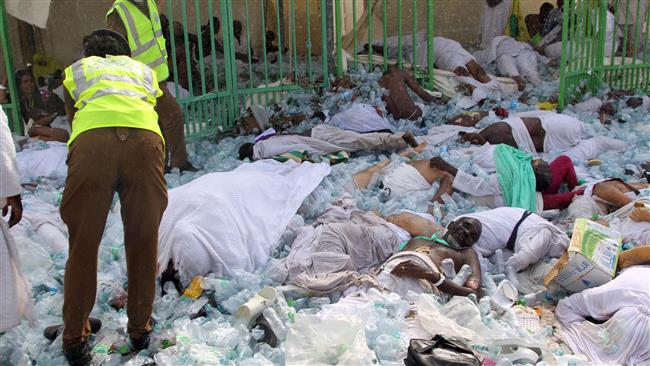
All missing Iranian Hajj pilgrims identified: Iran

Saeed Ohadi said on Wednesday the case of the Iranian pilgrims unaccounted for following the Mina tragedy was closed after 65 immediate families of the victims were dispatched to Saudi Arabia to help the identification process.

Stating that some 79 Iranian pilgrims had been buried in Mecca, Ohadi said that the families of 37 buried victims wanted the bodies to be returned to the country.

The bodies of 10 Iranian pilgrims arrived in the Iranian capital of Tehran on Wednesday, he said, adding that 16 more are expected in the next few days.

The crush occurred after two large masses of pilgrims converged at a crossroads in Mina during the symbolic ceremony of the stoning of Satan in Jamarat on September 24.

Saudi Arabia claims nearly 770 people were killed in the incident, but Iranian officials say about 4,700 people lost their lives in the tragedy.

The number of the Iranian fatalities is at least 464, exceeding that of other countries.

Saudi Arabia has come under harsh criticism over its role and handling of the Mina incident.

The tragedy came days after a massive construction crane collapsed into Mecca’s Grand Mosque, killing more than 100 people and leaving over 200 others wounded. According to the figures released by Iran’s Hajj and Pilgrimage Organization, 11 Iranian pilgrims were among the deceased and 32 of the injured were also Iranian nationals.