Wednesday, December 31, 2025
Home Blog Page 4559

World Bank expects Iran’s economic growth to hit 5.8% in 2016

The WB says Iran’s economic growth will be specifically encouraged by an expected rapid rise in its oil production after the removal of sanctions that have so far banned big oil companies to take their technology as well as their funds to develop the Iranian oil fields. The Bank says it expects Iran’s oil production to increase by an estimated 0.5–0.7 million barrels per day (mbd) in 2016 up from the 2015 level of 2.8 mbd.

Iran reached a historic nuclear deal with the P5+1 group of countries – the permanent members of the Security Council plus Germany – in July 2015.  Based on the deal, Iran would restrict certain aspects of its nuclear energy activities in return for the removal of the nuclear-related economic sanctions.

US Secretary of State John Kerry said on Thursday that the implementation of the Iran nuclear deal may be only “days away,” stressing that Iran has met all commitments toward the deal.

The WB in its report titled “Global Economic Prospects: Spillovers and Weak Growth” says the potential increase in capital inflows in the post-sanctions environment will also boost the Iranian natural gas production.  That, together with the much-anticipated release of Iran’s frozen assets will give a further push to the progress of the Iranian economy.

“A rebounding Iranian economy will affect neighboring countries within the Middle East and North Africa to varying degrees,” it further added. “A rapid rise in Iranian oil production would dampen growth prospects in oil-exporting countries and improve them in oil-importing countries.”

The World Bank elsewhere emphasized that Lebanon and Turkey will particularly benefit from the openings created in Iran business environment in a post-sanctions era.

“Lebanese banks have already indicated that they are interested in operating in the Islamic Republic of Iran,” it said adding that Turkey remains an important trading partner for Iran.

The report has further emphasized that Iran’s economy will also grow to 6.7 percent in 2017 before shrinking to 6.0 percent in 2018. All forecast growth rates will be the highest in the Middle East and North Africa and among the highest in the world.

The world’s highest growth rate for 2016 will be for India at 7.8 percent followed by Bangladesh (6.7 percent) and China (6.7 percent).

The growth rate for the world in 2016 will be 2.9 percent and for the developing countries will be 4.8 percent.


Iran to switch from gas to power exports

Kamal Kharrazi, a former foreign minister and the head of the External Relations Council of Iran (ERCI), told an expert panel in Tehran on Friday that the country will need to give more weight to exporting electricity produced from natural gas rather than the gas, itself.

Kharrazi said electricity will have a greater added value over natural gas, suggesting that exporting electricity will lead to larger returns to Iran in terms of economic gains.

He further said that Iran’s gas exports are currently at lower levels, adding that this is because Iran is production of the strategic fuel is low.

Kharrazi said Iran should purchase the natural gas supplies of other countries including Turkmenistan and re-export them.  This, he emphasized, is a policy that will bring Iran major economic and strategic gains in the long term.

Iran is the leading producer of electricity in the Middle East and 15th top producer in the world. The country currently exports electricity to Turkey, Armenia, Turkmenistan, Azerbaijan (including the Nakhchivan Autonomous Republic), Pakistan, Afghanistan and Iraq.

Iran’s Energy Ministry announced in November that the country will be able to import the technology to transform conventional power plants to combined-cycle plants that consume natural gas to produce electricity after the removal of the sanctions.

Combined-cycle plants consume one-20th of the energy needed by conventional plants. Such plants use both gas and steam turbines to produce up to 50 percent more electricity than the traditional simple-cycle plant, the Ministry announced as reported by the media.

Iran’s nominal power generation capacity stands at around 75,000 megawatts (MW) and plans to increase this by 5,000 MW annually to reach 120,000 MW by 2025.

Rallies Held in Iran to Condemn Saudi Execution of Sheikh Nimr

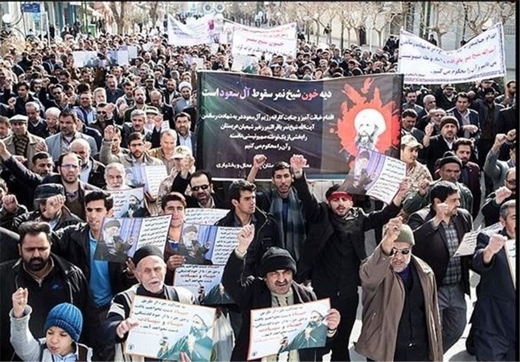
People all over the country poured into the streets after the Friday prayers for demonstrations against the Al Saud regime’s execution of the popular cleric.

Protesters in Tehran burnt the US and Israeli flags and chanted “Death to Al Saud” slogans.

On January 2, Saudi Arabia executed Sheikh Nimr on baseless terrorism-related charges.

The execution has ignited widespread international condemnation, from both political and religious figures.

In the early hours of January 3, furious demonstrators in the Iranian cities of Tehran and Mashhad stormed Saudi Arabia’s diplomatic buildings in protest at the Al Saud’s move

The incident worsened strained ties between Tehran and Riyadh, with Saudi Arabia severing diplomatic relations with Iran.

Sheikh Nimr had been detained in July 2012 after delivering anti-regime speeches and defending political prisoners.


US, Saudi, Zionist regime 3 main pillars of anti-Islamic plots

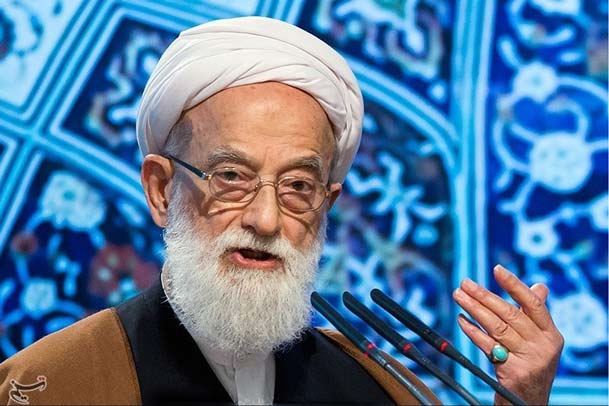
Condemning the Saudi regime’s execution of the martyred Sheikh Nimr al- Baqer al-Nimr, the ayatollah said that the Zionist regime plans the anit-Islamic crimes, the United States supports them, and the Saudis provide the money for their conducting them.

‘A man who elaborated on Islamic jurisprudence was treated that way in Saudi Arabia and quite unfortunately the world and international organizations have not resolutely condemned this execution, and that is the true nature of the situation in Saudi Arabia and the international society,’ he added.

Ayatollah Emami-Kashani reiterated that the Takfiri mentality which has led to so much terrorist acts in the region and the Middle East region existed in Saudi Arabia secretly for decades and is now emerging and leading to so much miseries and bloodshed.

‘Unfortunately, coming to power of a bunch of young and ignorant rulers in Saudi Arabia has led to the occurrence of Mina disaster in this year’s Hajj pilgrimage, suppressing the regional nations, ignoring the international community’s demands, and acting quite cruelly and irresponsibly by supporting the terrorists and extremists throughout the world,’ he stressed.

Iran to report Saudi raid on Sana’a mission to UN: Official

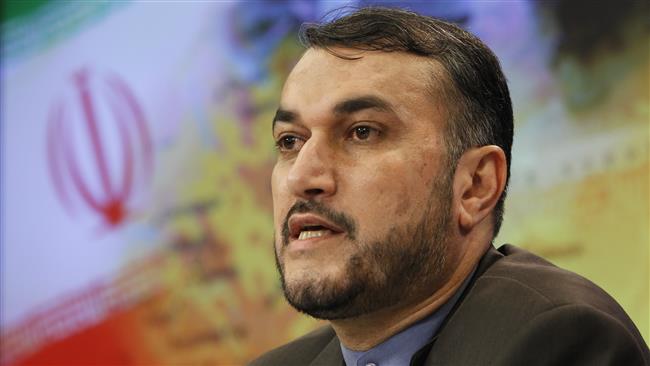
Amir Abdollahian

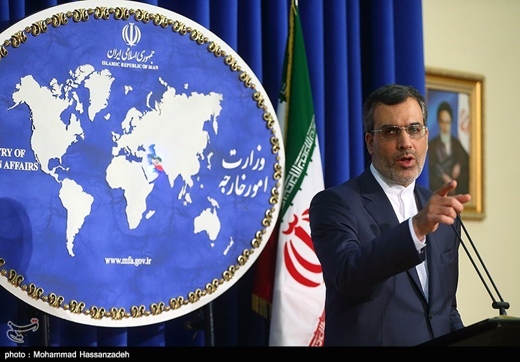
Iranian Deputy Foreign Minister for Arab and African Affairs Hossein Amir-Abdollahian said the overnight Saudi raid on the Iranian embassy has seriously wounded one of the security guards at the site.

“In the coming hours, we are set to inform the United Nations on the details of this issue in an official report,” said the Iranian diplomat, stressing that the Islamic Republic would pursue the Saudi crime through legal channels at the international level.

He added that Saudi Arabia is responsible for any measures that undermine the security of Iranian diplomatic missions in Yemen, which has been under relentless Riyadh’s attacks since late March 2015.

Late on Wednesday, Saudi jets targeted Iran’s embassy in Sana’a, damaging the mission’s building and wounding a number of security forces guarding the place. The Saudi military has said it will launch an investigation into the issue.

The official further referred to the violence that erupted on January 2 near two Saudi missions in Iran during angry protests against Riyadh’s execution of top opposition cleric Sheikh Nimr al-Nimr, saying it is regrettable that the kingdom has made a “political brawl” out of an “unforeseen” act carried out by a handful of people.

Earlier in the day, the Iranian Foreign Ministry sharply condemned the “deliberate” Saudi attack on Tehran’s embassy in the Yemeni capital, describing the move as a “violation of all conventions and international regulations” on protecting diplomatic missions under all circumstances.

Jaberi Ansari said Tehran reserves the right to follow up on the Saudi aerial attack.

The Iranian mission in Sana’a has time and again come under Saudi attacks since the beginning of Riyadh’s military campaign against Yemen on March 26, 2015.

Last June, Iran sent a letter to the UN Security Council to inform the 15-nation body that Riyadh’s air forces had pounded areas near Tehran’s embassy in the Yemeni capital twice during a period of two months.

The Iranian diplomatic mission’s compound suffered severe damage during the bombings on May 25, 2015, which was followed a similar attack on April 20 the same year.

Tehran-Riyadh ties have hit a new low since Saudi Arabia decided to break off diplomatic relations with Iran, which strongly criticized the kingdom’s execution of Sheikh Nimr.

Sheikh Nimr’s killing came in defiance of international calls on Riyadh to overturn the death sentence handed down in 2014 to the prominent religious figure, sparking angry anti-Saudi protest rallies in several countries around the world, including Iran.

When the news of Sheikh Nimr’s death broke out, angry Iranian protesters held demonstrations in front of the Saudi embassy in Tehran and its consulate in the northeastern city of Mashhad on January 2.

During the demonstrations, some people mounted the walls of the consulate in Mashhad, while incendiary devices were hurled at the embassy in Tehran.

Following the incidents, Saudi Arabia severed diplomatic relations with Tehran after the incident. A number of Riyadh’s allies, including Bahrain, Sudan, Djibouti and Somalia, also took the kingdom’s lead and severed relations with the Islamic Republic.

This is while Tehran detained some 50 people over the transgression, with senior Iranian officials, including President Hassan Rouhani, criticizing the violence and vowing a firm response to any violations of law.

Rouhani has tasked Iran’s Judiciary with prosecuting those involved in this “evidenced offense” in a bid to bring a halt to more such attempts.

However, the Iranian president has criticized Riyadh’s move to sever diplomatic relations with Tehran as an attempt to cover up the failure of its regional policies and undermine peace in the region.

Terrorism, Extremism Region’s Main Problems: Iran’s Deputy FM

“Iran considers terrorism and extremism as the region’s number one problem and is leading the way in confronting this phenomenon,” Sarmadi said Thursday in a meeting with Kuwait’s Foreign Minister Sheikh Sabah Al-Khaled Al-Hamad Al-Sabah.

He highlighted Iran’s positive role in regional developments and said all countries should fulfill their responsibilities in ensuring peace and security in the region and avoid creating tensions.

Sarmadi regretted that certain countries use terrorism as a means to advance their agenda.

He further referred to Saudi Arabia’s recent execution of prominent Shiite cleric Sheikh Nimr al-Nimr who was a “religious and freedom-seeking figure” as an act of desperation that has fueled tensions in the region.

Riyadh on Saturday executed Shiite Nimr, among dozens of others. The execution was widely condemned by both political and religious figures.

On Sunday, furious demonstrators in the Iranian cities of Tehran and Mashhad stormed Saudi Arabia’s diplomatic buildings in protest at the Al Saud’s execution of Sheikh Nimr.

Although Iranian officials criticized the embassy attack and police arrested several individuals involved, Saudi Arabia on Sunday severed diplomatic ties with the Islamic Republic.


Iran Raps Saudi’s “Intentional” Attack on Embassy in Yemen

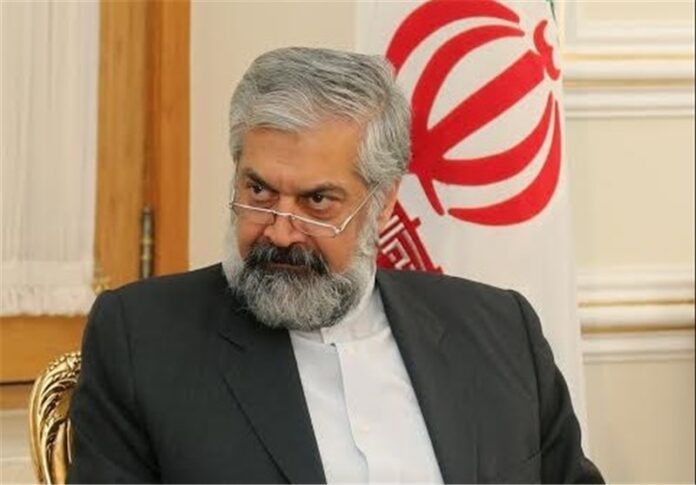
Jaber Ansari

On Wednesday night, Saudi Arabia launched a rocket attack on the Iranian embassy in Sana’a, which incurred damages to the building and wounded several Iranian guards.

The foreign ministry spokesman condemned the attack, saying this “intentional move by the Saudi government is in violation of all international conventions and legal rules on protecting the security of diplomatic posts and their immunity under all circumstances.”

The Saudi government is fully responsible for the attack and should compensate for the damages incurred on the building and the injuries of the Iranian embassy staff, Jaberi Ansari stressed.

Obviously, he added, the Islamic Republic of Iran reserves the right to pursue the issue.

The attack came amid the recent tensions between Iran and Saudi Arabia mainly caused by Riyadh’s execution of prominent Shiite cleric Sheikh Nimr al-Nimr, and a subsequent attack by outraged Iranian protesters on Saudi embassy, which resulted in Saudi Arabia’s decision to sever its ties with Tehran.

Saudi Arabia on Saturday executed Sheikh Nimr, among dozens of others. The execution ignited widespread international condemnation, from both political and religious figures.

On Sunday, furious demonstrators in the Iranian cities of Tehran and Mashhad stormed Saudi Arabia’s diplomatic buildings in protest at the Al Saud’s execution of Sheikh Nimr.

Although Iranian officials criticized the embassy attack and police arrested several individuals involved, Saudi Arabia on Sunday severed diplomatic ties with the Islamic Republic.


Saudi Arabia to collapse over ‘sectarian’ policies: Iran cmdr.

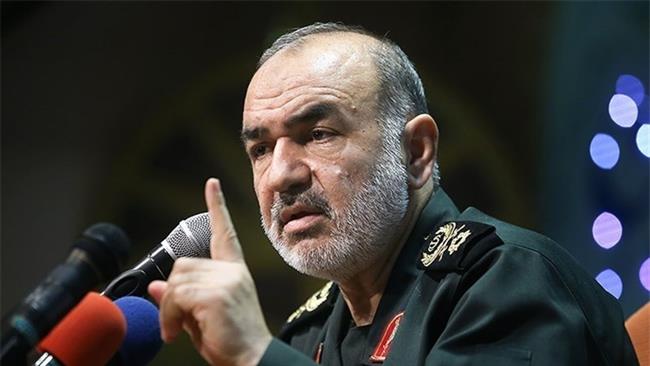
The policies of the Saudi regime will have a domino effect and they will be buried under the avalanche they have created, said Brigadier General Hossein Salami, the second-in-command of the Islamic Revolution Guards Corps (IRGC), on Thursday.

“If the Al Saud regime does not correct this path, it will collapse in the near future,” Tasnim news agency quoted General Salami as saying.

On Saturday, Saudi Arabia announced the execution of top Shia cleric Sheikh Nimr Baqir al-Nimr and 46 others despite international calls for their release. This led angry protesters to held demonstrations in front of the Saudi embassy in Tehran and its consulate in the northeastern city of Mashhad, censuring the Al Saud regime for the killing of Nimr.

Some people mounted the walls of the consulate in Mashhad while incendiary devices were hurled at the embassy in Tehran. Some 50 people were detained over the transgression.

Riyadh severed diplomatic relations with Tehran after the incident.

General Salami described the kingdom’s decision to sever ties with Tehran “irrational,” adding that the violence in Iraq and Syria were the direct results of Saudi’s sectarian policies in the region.

He also compared the policies of the Saudi regime with those of former Iraqi dictator Saddam Hussein who was executed in 2006 during the US-led invasion of Iraq.

The path the Saudi regime is taking is like the one Saddam took in the 1980s and 90s. He started a war with Iran, executed prominent clerics and top officials, suppressed dissidents and ended up having that miserable fate, Salami noted.

Iran’s President Hassan Rouhani, has already denounced Saudi Arabia’s sectarian policies, saying the execution of Nimr “is in line with sectarian policies.”

Rouhani has said, “Such a measure is in line with sectarian policies and aims to spread terrorism and extremism in the region and across the world, which have destabilized the region and waged war and conflicts in recent years.”

The execution also saw condemnations from Iraq and the UN. Muslims and human rights activists all over the world also protested Nimr’s killing.


A look at Iranian newspaper front pages on Jan 7

Iranian Newspapers Headlines

Iranian President’s letter to the Judiciary Chief asking him to hasten investigations regarding the case of Saudi embassy attackers, the screening of parliamentary electoral candidates’ qualifications and heated race by the Assembly of Experts’ election candidates grabbed most of Iran’s newspaper headlines on Thursday, January 7, 2016.

The following are some of the trending stories that appeared on leading Iranian newspapers.


Arman-e Emrouz: Competency of absentees of the Assembly of Experts’ entrance exam cannot be ascertained: Spokesman of the Guardian Council

Arman-e Emrouz: Iran President has asked Judiciary Chief with urgently dealing with the case of Saudi Embassy takedown in Tehran.

Arman-e Emrouz: Talks no sign of ties

Zarif said responding to rumors that he has been repeatedly talked with US Secretary of State John Kerry


A look at Iranian newspaper front pages on Jan 7


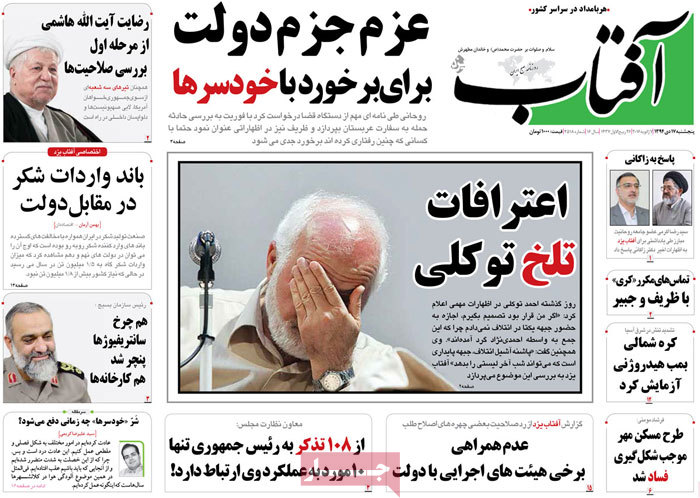
Aftab: Gov’t resolved to contain rebels
 

A look at Iranian newspaper front pages on Jan 7


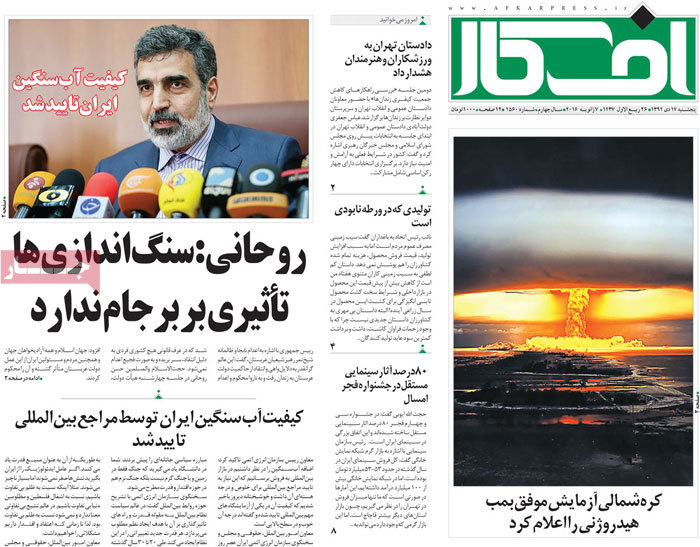
Afkar: Stonewalling will not hinder JCPOA progress: Iranian President

Afkar: Int’l bodies confirm quality of Iran heavy-water: deputy head of the Atomic Energy Organization of Iran (AEOI)
 

A look at Iranian newspaper front pages on Jan 7


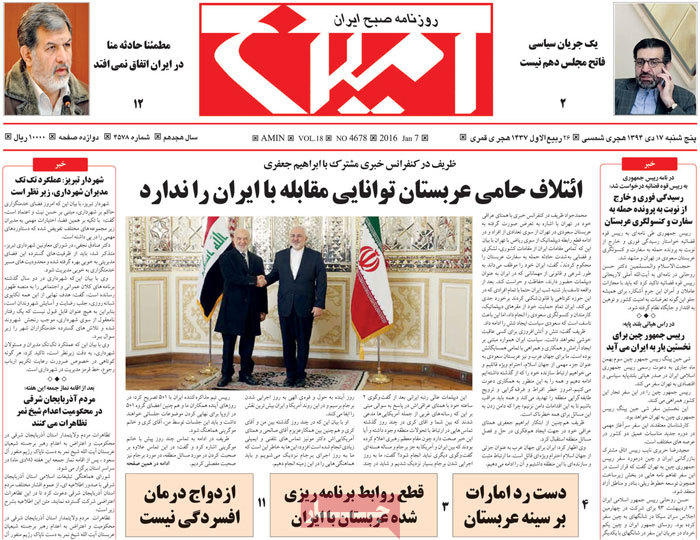
Amin: No Political Party leads the 10th parliament, said Mohammad Sadegh Kharazi, one of the moderate reform figures supporting Rouhani’s government.
 

A look at Iranian newspaper front pages on Jan 7


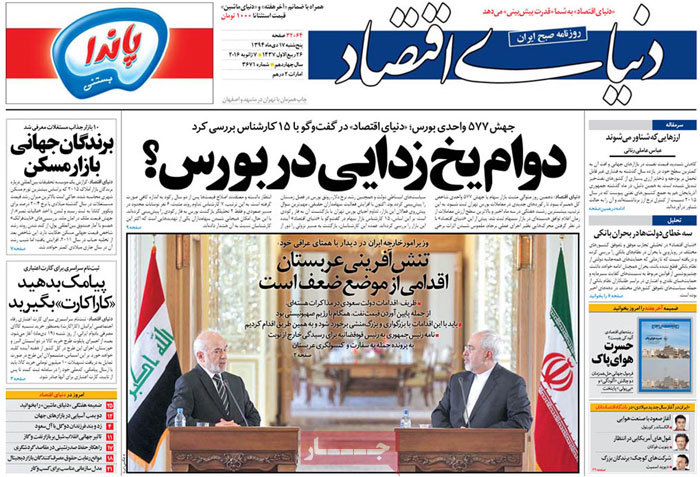
Donyaye Eqtesad:

Saudi Government played into the hands of the Zionist interests by throwing monkey wrenches in the course of Iran’s nuclear talks by taking measures like dragging down oil prices, Iran’s Foreign Minister Mohammad Javad Zarif told his Iraqi opposite number.
 

A look at Iranian newspaper front pages on Jan 7


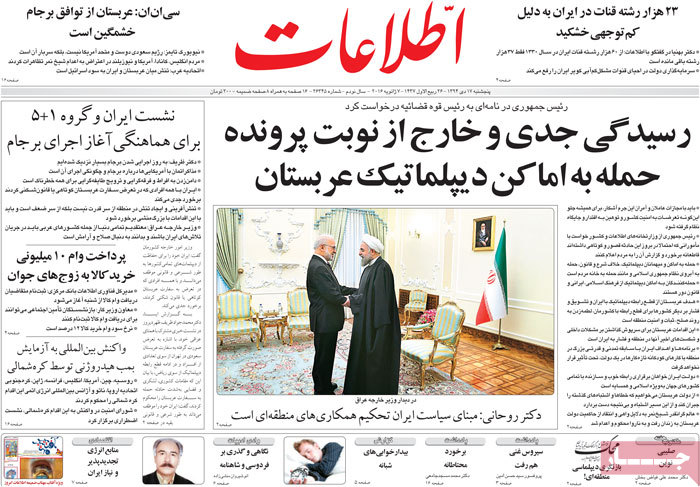
Ettela’at: Strengthening regional countries is the basis of Iran’s foreign policy: Iranian President to Iraqi FM

Ettela’at: Negligence dries out thousands of Qanats in Iran
 

A look at Iranian newspaper front pages on Jan 7


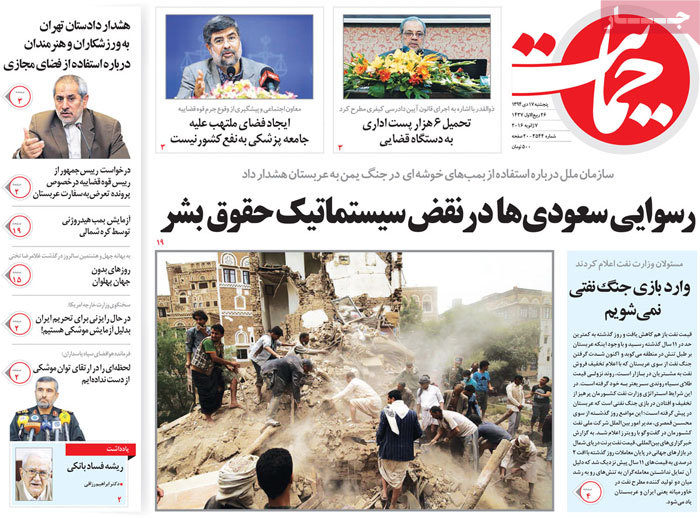
Hemayat: Tehran prosecutor warns celebrities about social media use

The warning comes after a professional Persepolis goalie, Sosha Makani, was jailed in Iran after posting pictures that violated social norms in Iran on his Instagram page.
 

A look at Iranian newspaper front pages on Jan 7


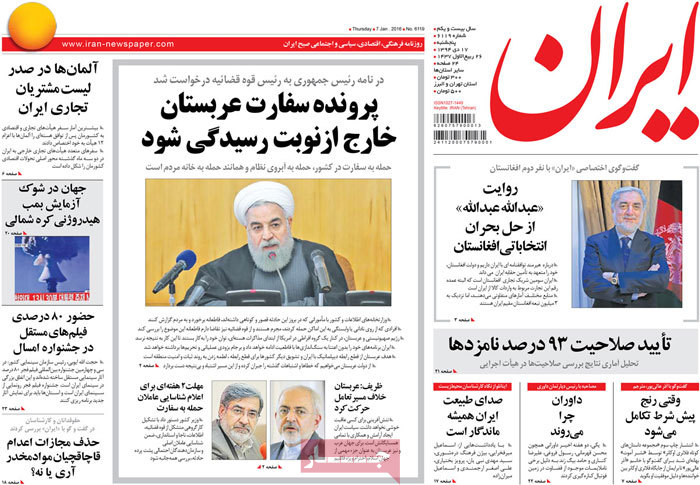
Iran: Germans top Iran trade partners

Iran: 80% of Fajr filmmakers independent

Iran: End of capital punishment for smugglers?

Iran: 15-day deadline for identifying Saudi Embassy attackers: Interior Minister

Iran: Arabia moved against the course of interaction: FM

Iran: The executive boards [affiliated with the Interior Ministry] have given the [initial] go-ahead to 93 percent of electoral candidates.
 

A look at Iranian newspaper front pages on Jan 7


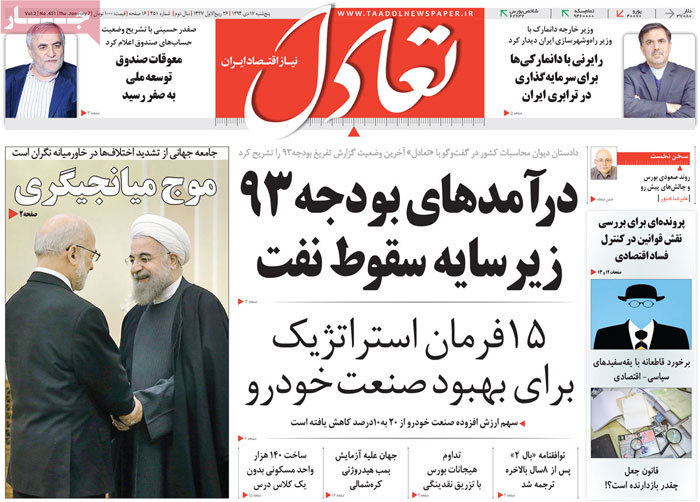
Ta’adol: All NDFI (national development fund of Iran) arrears settled, the fund’s managing director said.

Ta’adol: Global community concerned about growing tensions in the Middle East

Ta’adol: 15 strategic instructions to boost auto-making industry
 

A look at Iranian newspaper front pages on Jan 7


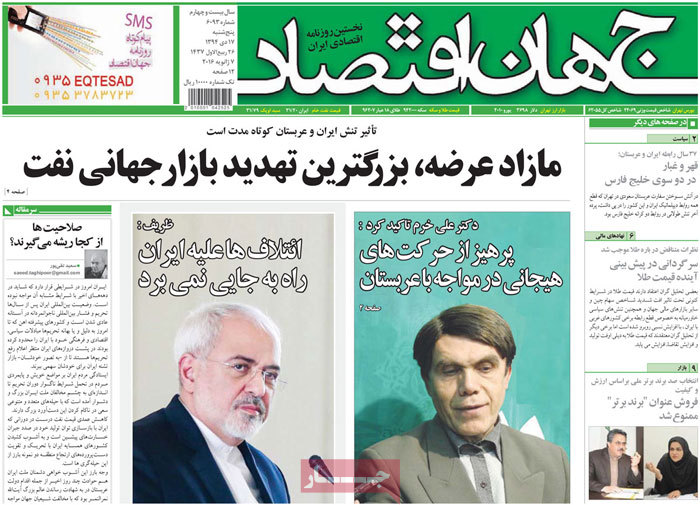
Jahan Eqtesad: Anti-Iran coalitions pointless: Iran FM

Jahan Eqtesad: Excessive supply biggest oil market challenge

Jahan Eqtesad: Impact of Tehran-Riyadh tensions on Market not lasting
 

A look at Iranian newspaper front pages on Jan 7


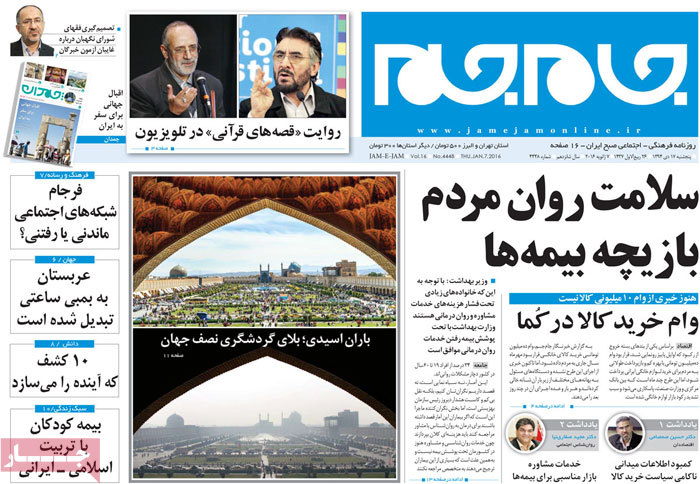
Jame-Jam: Insurance Support under way for families in need of psychotherapeutic services

Iranian Ministry of Health has launched an initiative to offer insurance coverage to Iranian families in search of psychotherapeutic consultation services. Such services are very expensive in Iran and many families cannot afford them.
 

A look at Iranian newspaper front pages on Jan 7


Javan:

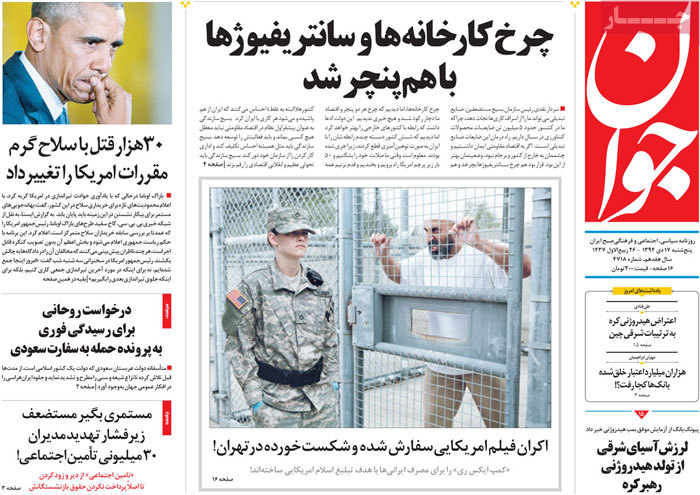
The daily has highlighted the “open carry” law in the Republican-dominated Texas Legislature in an article entitled as, “30,000 Murder Cases Prompt US Law to Change for Openly Carrying Guns”.

Also in the daily’s front page was Pyongyang’s H-bomb test story.

The story’s title: East Asia Shaken by an Emerging H-bomb from N. Korea
 

A look at Iranian newspaper front pages on Jan 7


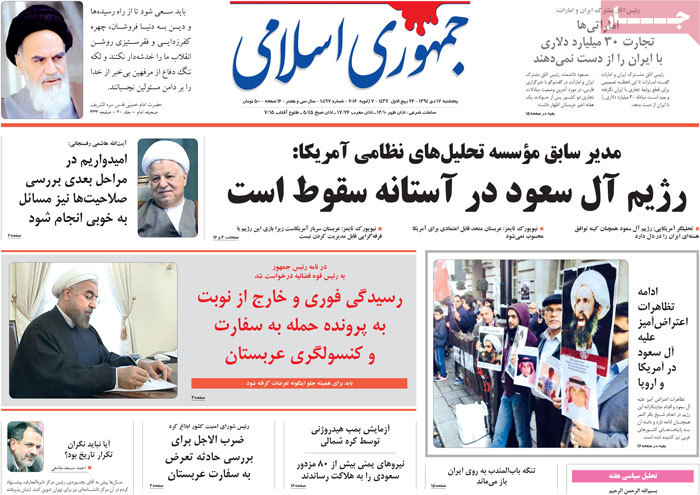
Jomhouri Eslami: Mandeb Strait Open to Iranian Vessels

Bab-el-Mandeb (or Mandeb Strait) is a strait located between Yemen on the Arabian Peninsula, and Djibouti and Eritrea in the Horn of Africa. It connects the Red Sea to the Gulf of Aden. After it was rumored earlier this week that Djibouti severed its ties with Iran, some speculated that the country will close the strait to passing Iranian ships. Iranian foreign ministry authorities have rejected such speculations as being baseless.
 

A look at Iranian newspaper front pages on Jan 7


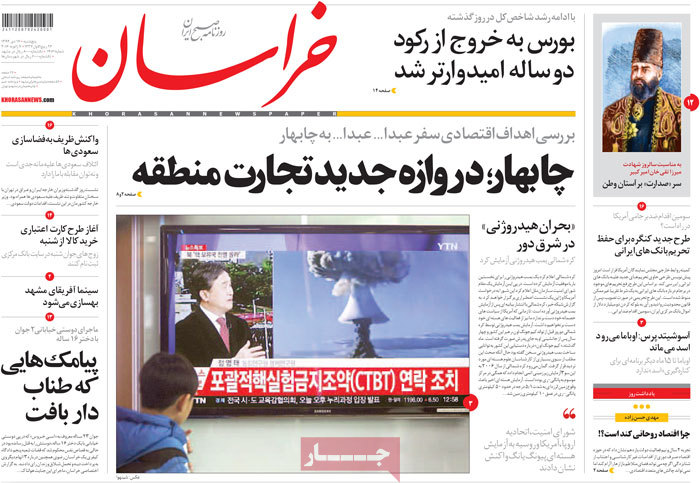
Khorasan: Chabahar; Region’s emerging trade hub

Assessing the possibilities of entering partnerships with Iranian projects was one of chief goals of the recent state visit by Afghan Chief Executive Officer Abdullah Abdullah from Iran, possibly in a bid to diversify its trade terminals. Most Afghan trade is done via Pakistan’s Karachi port.
 

A look at Iranian newspaper front pages on Jan 7


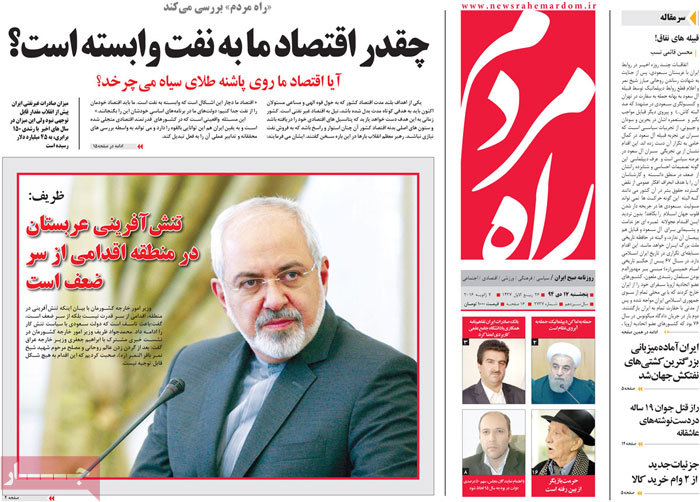
Rah-e Mardom: Saudi entente is out of weakness, Iranian Foreign Minister Mohammad Javad Zarif said during a press conference with his Iraqi counterpart in Tehran.

Rah-e Mardom: Iran bracing for berthing VLCCs

Iran has said it is ready to moor the world’s largest crude oil carriers.
 

A look at Iranian newspaper front pages on Jan 7


Resalat:

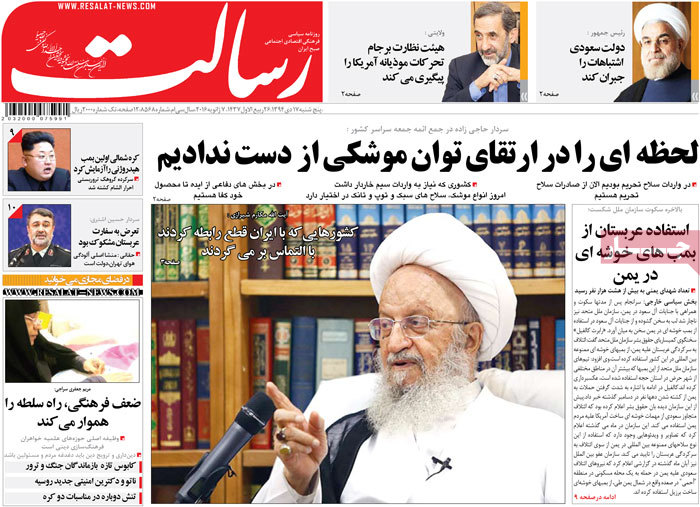
“We spared no single moment to enhance the country’s missile capabilities,” said Brigadier General Amir-Ali Hajizadeh, the commander of the Aerospace Division of the Islamic Revolution Guards Corps (IRGC), addressing a gathering of Friday prayer leaders from across the country.

Senior Iranian cleric Grand Ayatollah Nasser Makarem Shirazi said countries that cut their ties with Tehran will beg to restore them.
 

A look at Iranian newspaper front pages on Jan 7


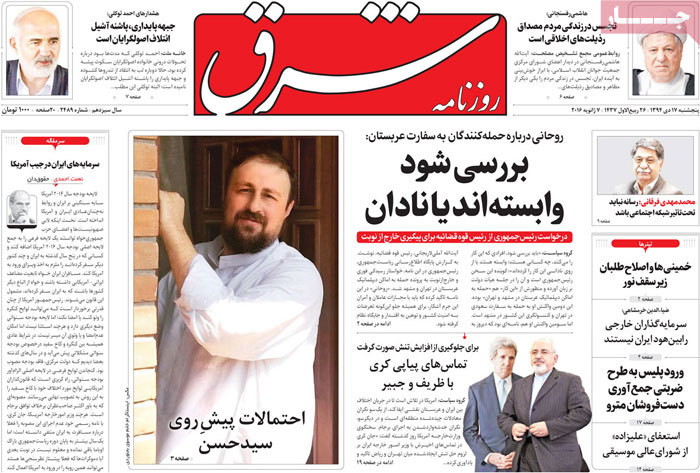
Shargh:

Possibilities high for Hassan Khomeini (the grandson of Imam Khomeini, leader of the 1979 Islamic Revolution)’s progress in the race to make way to the Assembly of Experts

 

A look at Iranian newspaper front pages on Jan 7


Saudi execution of Nimr looks like act of terror: Minister

“The Saudi government behaved wrongly by decapitating one of the country’s freedom-seekers, which is more like acts terrorists commit across the length and breadth of the region,” Hassan Qazizadeh Hashemi said.

Muslims living in Saudi Arabia’s Eastern Province have the right to live and express their opinions in their own country, Hashemi said, adding that voicing criticism is not liable to execution.

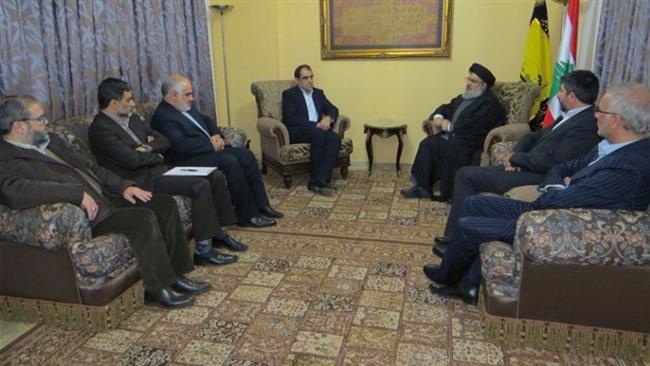
He made the statements at a Wednesday press conference during a visit to Beirut where he met senior Lebanese officials and Hezbollah chief Seyyed Hassan Nasrallah.

Riyadh announced the execution of Sheikh Nimr and 46 others on January 2, after convicting them of involvement in “terrorism.”

Nimr’s execution was widely censured by Muslims and human rights activists around the globe as well as various governments and international bodies.

Elsewhere in his remarks, Hashemi said Saudi authorities should take complete responsibility for the “crisis of their own making” in the region.

The Iranian minister, who arrived in Beirut on Wednesday, is on a three-day visit to Lebanon.

On the first day of his stay, Hashemi held separate meetings with Lebanese Parliament Speaker Nabih Berri, Health Minister Wael Abou Faour, and Industry Minister Hussein Hajj Hassan.

On Thursday, Hashemi held a meeting with Nasrallah and discussed the latest regional developments.