Friday, December 26, 2025
Home Blog Page 4505

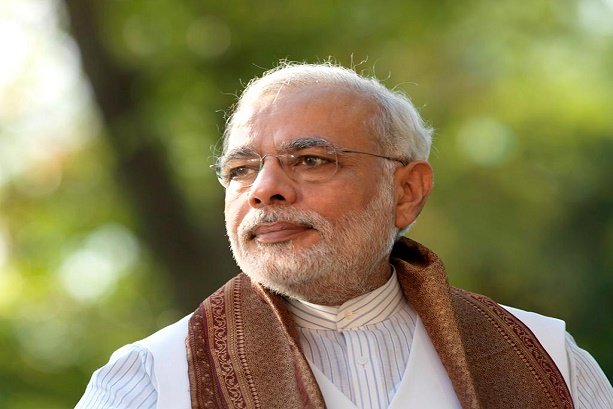
Indian PM Modi to Visit Iran in Late May

Indian daily newspaper The Hindu has cited government sources involved in the planning of the visit that Modi is likely to make a visit to Iran on May 21-23, although the dates are yet to be finalized. Iranian Ambassador to India Gholamreza Ansari has predicted the visit to be on May 22.

Modi is also expected to visit Chabahar and gas fields that are of India’s interest for investment, following the South Asian country’s approval for the Ashgabat Agreement in March, which is aimed at creating an International North South Transport Corridor connecting India, Russia, Iran with Europe and Central Asia.

According to the Indian media, coinciding with Modi’s visit, the Indian Ocean Region Association will host a major international summit in Chahbahar.

During the visit, India and Iran are likely to seal an MoU on the pending energy project at Farzad–B gas field, adds the Indian source.

Iran Ambassador to New Delhi Gholamreza Ansari said Prime Minister Modi is expected to invite President Rouhani for an official visit to India. He further maintained that Modi’s visit will be a significant step toward the expansion of relations between the two countries.

Iran and India have held long-standing relations and despite sanctions, the volume of their trade transactions has reached $15bn in the past years. This will be the first visit of PM Modi to Tehran since he took office in 2014.

Iran’s Interior Ministry Backs Off from Plainclothes Morality Police Plan

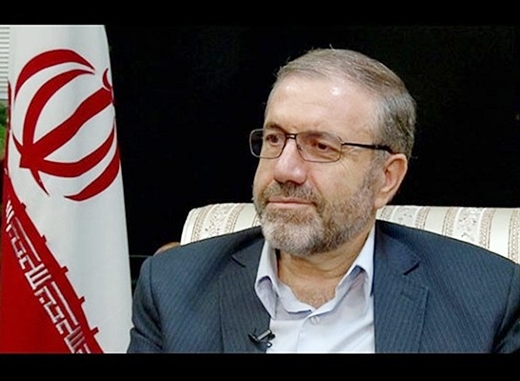
Deputy Interior Minister for Security Affairs Hossein Zolfaqari announced that a recent plan for using 7,000 plainclothes forces as morality police has been revised, and that these forces will do their job in uniform instead.

Here is IFP’s translation of a report by Ana on his remarks.


“We have received and studied the Law Enforcement’s ‘Social and Moral Security Plan’… The plan has considered actions against thugs, drug dealers, thieves, disturbers of social security, and those who do not observe the Islamic dress code (Hijab),” he noted.

After carrying out certain studies on the issue, it was decided that the plan for social security and the one for moral security should be prepared separately, because moral issues have their own mechanisms, Zolfaqari stressed.

He referred to the concerns over plainclothes morality police, saying, “Two factors caused certain concerns about the issue: first, grouping the two plans (morality and social security) together, and secondly, the plainclothes nature of these forces, about which people and officials were not well informed.”

The Interior Ministry held talks with the law enforcement officials, and it was agreed that the disciplinary forces responsible for moral security should continue their job in uniform, as they used to before, Zolfaqari said.

The plainclothes forces will only be used for social security, not issues of morality, he said, expressing the hope that people and authorities’ concerns can now be allayed.

Gergiev, Top International Conductor, Invites Rahbari to Conduct St. Petersburg Orchestra

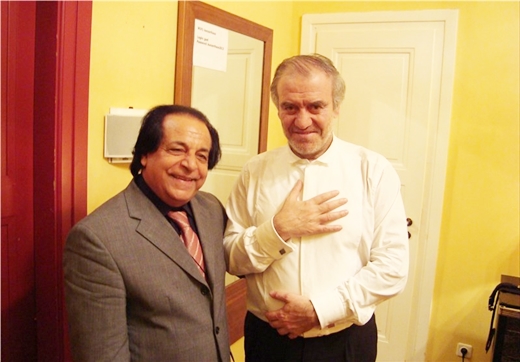
As reported by Tasnim, and translated by IFP, Valery Gergiev, the world-renowned conductor who is directly supported by Vladimir Putin, officially invited Ali Rahbari to conduct the St. Petersburg Orchestra in the Mariinsky Opera Hall. Rahbari has accepted the invitation, and the dates for this event will be announced soon.


63-year-old Valery Gergiev, conductor and Artistic Director of the White Nights Festival in St. Petersburg, knows Ali Rahbari from many years ago, when Rahbari was the conductor of the Berlin Philharmonic Orchestra, and was also an assistant of Herbert Von Karajan, the well-known conductor.

Gergiev has invited Ali Rahbari to conduct St. Petersburg’s orchestra for the last two years, but now this invitation has been accepted.

This collaboration will play an important role in highlighting Iranian artists.

The Mariinsky Theatre is the biggest hall in the world, and is managed and directed by Gergiev. Currently, the Stravinsky Orchestra has 350 players. This hall has three large orchestras. Stravinsky Hall was opened in 1860 and became a significant performance space for glorious performances by notable late 19th Century composers such as Tchaikovsky, Mussorgsky and Rimsky-Korsakov. Today, the Mariinsky Orchestra, Opera and Ballet are all world-famous, and only significant conductors are invited to lead them.

German Firms Dissatisfied with Merkel’s Stance on Iran

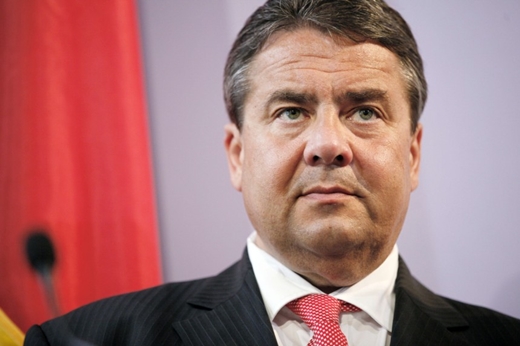
Gabriel is slated to visit Tehran on May 2 for the second time since Iran and world powers clinched a comprehensive nuclear deal back in July 2015.

He is going to take part in the Iran-Germany Joint Economic Commission, which is scheduled to take place in Tehran for the first time in 15 years.

The German Vice-Chancellor’s visit is expected to help reinforce economic relations between the two countries.

Helene Rang, the CEO and Deputy Chairperson of NUMOV (the German Near and Middle East Association) told Deutsche Welle that she expected Gabriel, who is also Germany’s Economy Minister, to take serious action for the promotion of ties with Tehran.

German firms are not at all satisfied with the fact that Merkel, due to certain considerations regarding Israel, has maintained a distance in ties with Iran. Comparatively, French President François Hollande and Italian Prime Minister Matteo Renzi have received Iranian President Hassan Rouhani in their capitals.

German corporations expect Berlin to give the same sort of signals to the Iranian administration, and to demonstrate that the strengthening of mutual economic cooperation is high on Germany’s agenda.

Investors in Germany, however, are hopeful that a couple of contracts, albeit minor ones, will be finalized during the trip. They welcomed a recent agreement between Germany’s Siemens and Iran’s Mapna to manufacture gas turbines and power generators, and considered it the first step for future ventures.

The lack of banking guarantees is one of the most important reasons why many German firms are unable to invest in Iran and sign deals with Iranian companies.

“This is a key problem that should be resolved quickly, because most German banks refuse to provide the financial deposits for economic activity with Iran. Many businessmen are hopeful the issue will be settled during Gabriel’s visit to Tehran,” Rang said.

(A report published by Fararu news website and translated by IFP)

Rouhani on Workers’ Day: Stresses Need for Knowledge-Based Economy

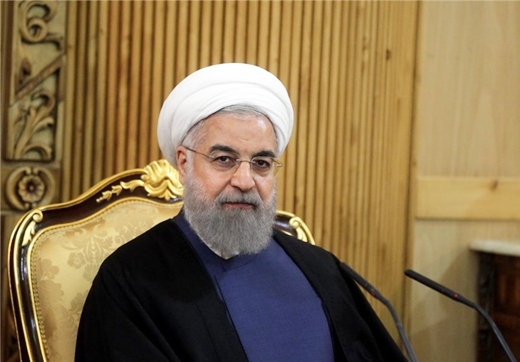
He also paid tribute to the Iranian nation, especially women, for their massive turnout in the elections and said for the first time in the history of the country, 18 seats in the parliament are going to women.

Saying that striking a nuclear deal with six world powers helps remove many obstacles towards national progress, the President slammed certain pessimistic elements who are trying to downplay this achievement.

He said this was a day of hard work for the nation, but that people certainly need resources and technology to achieve their objectives.

Honoring the achievements of MAPNA industrial group as a knowledge-based organization, the President said Iran favours those economic units which are strong enough to enter international competitions to raise their income.

Stressing that in the past four decades the domestic economy lacked resources to generate enough employment in the country, President Rouhani underlined the need for lower inflation rates, which he said would guarantee job security and the purchasing power of workers.

He said his government was proud to say it paid workers wages and salaries above the inflation rate, and promised to get a single-digit inflation rate for the country by end of the current Iranian year (set to end March 20, 2017).

He said a growing economy which could provide job security to workers has to improve its infrastructural indexes to be able to attract the needed investment.

He said it is not just presidents visiting Iran with their deputies, but the owners of up to 200 major companies accompanying them to Tehran.

“They come here and talk with Iranian entrepreneurs and strike deals with them,” he added, citing the visit of the Kazakh president, during which 53 documents were signed, or the visit of the South Korean president with a large economic delegation.

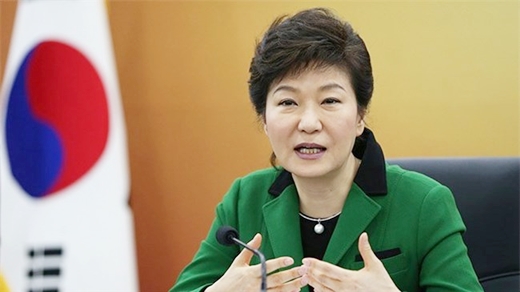
Park Guen-hye Hopes for New Chapter Between Seoul and Tehran

South Korea’s president arrives in Tehran today on a three-day visit aimed at boosting mutual ties, becoming the first South Korean president to visit Iran since the nations established diplomatic ties in 1962.

Park Geun-hye will be accompanied by Seoul’s biggest-ever traveling business delegation of over 230 executives during the visit. Local reports suggested the two countries are expected to seal deals worth $10bn.

Officials in Seoul say the primary purpose of the visit is economic as Korean companies eye deals in areas such as construction, automobiles and electronics.

South Korea is also eager to boost its oil supply from Iran, which used to account for 10% of its oil imports before sanctions were imposed.

Iran Daily spoke with President Park ahead of her landmark visit to Tehran.


Excerpts of the interview follow:


In spite of several ups and downs, in general, Tehran and Korea have maintained a positive economic relationship and have not experienced any major diplomatic issues; yet, you are the first South Korean President to visit Iran. Why was the present moment chosen for this visit?

Since the establishment of diplomatic relations in 1962, Korea and Iran have advanced economic cooperation and continued cultural exchange. From a political perspective, however, bilateral interactions have so far been relatively less vibrant than would have been desired for various reasons.

The recent conclusion of the Iranian nuclear deal provided a valuable opportunity for our two countries to seek new ways to cooperate. The purpose of my visit is to further promote bilateral relations in the years to come. My visit is the first by a Korean president since the establishment of diplomatic relations, and I have high hopes that it will become a starting point for more active interaction between our two countries.

I hope our two nations will be able to write new chapters together in history, for mutually beneficial cooperative ties not only in economic fields, but also in more diverse areas.

Which delegations are accompanying the president on this visit to Tehran and what missions are they pursuing?

I will travel with official aides, including four key cabinet ministers, and a delegation of 230 business leaders not only from large conglomerates but also a number of strong small- and medium-sized enterprises. The government officials will hold separate talks with their Iranian counterparts and explore diverse measures to work together, such as through the signing of MOUs. The business delegation is scheduled to hold a Korea-Iran business forum and one-on-one meetings.

Notably, the companies represented in the delegation cover all lines of business that are deemed promising for economic cooperation with Iran, including infrastructure, energy, manufacturing and health care.

It is my hope that there will be in-depth consultations this time in areas where there is a potential for substantive cooperation so that a new framework for economic cooperation between our two countries will be forged.


What is Seoul’s political stance regarding the nuclear issue since it was transferred to the UN until the sanctions were lifted? And on what grounds is this political stance founded?

I think it is very meaningful that the Iranian nuclear issue was resolved through negotiations between Iran and the countries concerned. I hope the conclusion of negotiations on the nuclear issue will set a milestone in not only bringing about peace and stability in the Middle East, but also bolstering the international nonproliferation regime.

To that end, I believe it is important to faithfully implement international agreements, including United Nations Security Council resolutions and the Joint Comprehensive Plan of Action between Iran and the P5+1 (the five permanent members of the UN Security Council — China, France, Russia, the United Kingdom, the United States—plus Germany).


How has Seoul’s political stance changed toward Tehran since the resolution of the nuclear challenge? Besides furthering the economic ties, can the South Korean president’s visit to Iran be considered a remarkable progress in political interactions as well?

We welcome the adoption of the resolution lifting sanctions against Iran. I hope that Iran will achieve new development and prosperity based on cooperation with the international community.

I expect this visit at this point to be an important opportunity to achieve great progress in our bilateral cooperation in all related fields.

I hope the future expansion of high-level political exchange, including meetings of foreign ministers on a regular basis, and the revitalization of the Korea-Iran Joint Economic Committee represented by ministers of commerce of the two countries, will help further accelerate our economic cooperation.


South Korea has generally not taken a clear stance on Middle East crises such as terrorism. Does this mean that Seoul and Far Eastern countries see themselves at a safe distance from terrorist issues?

It is truly shocking and deplorable that a countless number of innocent lives have fallen victim to the series of terrorist acts that have taken place in the Middle East and throughout the world, including in Paris late last year and more recently in Brussels and Lahore, Pakistan.

Terrorism constitutes a grave threat to peace and security of the international community, and Korea is no exception to this threat.

With an unequivocal stance that terrorist acts that indiscriminately take the lives of innocent civilians are a crime against humanity that cannot be justified under any circumstances, the Korean government has strongly denounced those acts and worked together with the international community to respond.

In the days to come, the Korean government will continue to make efforts together with the international community to deal with terrorist acts and violent extremism inciting terrorism.


What is your assessment of the importance of Iran and its position in regional diplomacy?

The Middle East is vital to maintaining global peace and security. I think that the efforts of the world, including nations in the region, for the settlement of sustainable peace in the region are very meaningful.

The region is currently faced with various political and economic challenges. As a key nation in the region, Iran can play a constructive role in addressing those problems. Even though it is difficult to directly compare Iran’s nuclear issue with Syria’s problem, Iran’s role will be important since it can play a significant role in the region.

The Korean government hopes that a political solution will be promptly arranged to address regional instability and the humanitarian crisis caused by prolonged problems in Syria. In this connection, we will join the efforts of the international community.


Would South Korea consider presuming a more active role in fighting terrorism? In this regard, how close is South Korea’s stance to Iran’s?

The Korean government has actively participated in international efforts to combat terrorism by implementing the United Nations Security Council resolutions pertaining to terrorism, strengthening humanitarian assistance to Syrian and Iraqi refugees, and reinforcing, through the United Nations, the capacity of nations vulnerable to violent extremism. We will continue such efforts in the future.

I am aware of Iranian efforts to fight and prevent violent extremism through the ‘World Against Violence and Extremism (WAVE) initiative,’ proposed by President Rouhani at the General Assembly of the United Nations in 2013.

Terrorism knows no borders, thus it cannot be addressed by the power of one nation alone. All nations should actively join the international community’s efforts to combat and prevent terrorism.


How did the global implementation of sanctions by South Korea impact commercial relations between the two countries? And how did it change the statistics of transactions?

International sanctions against Iran had a huge influence on trade relations between our two countries.

As of 2011, before the sanctions, bilateral trade totaled US$17.4 billion. However, the amount dropped to US$6.1 billion in 2015. A number of cooperative economic projects underway in Iran were suspended, and companies and businesspeople of both nations endured many difficulties.

Now the sanctions against Iran have been lifted, and Iran has returned to the international economic system. Bilateral economic cooperation is expected to recover soon to the level before the sanctions were imposed.

I hope that the two nations will closely cooperate based on the trust built so far.


In this visit to Iran, besides meeting authorities, has any negotiation with the private sector been planned as well?

I will attend the Korea-Iran Business Forum now being prepared by the Korea International Trade Association (KITA) and the Iran Chamber of Commerce, Industries, Mines and Agriculture (ICCIMA). There, I will communicate with business leaders of both countries and discuss a wide range of issues on how to promote economic cooperation in the private sector.

I hope that Iranian participants will be able to share constructive ideas on how to promote substantive bilateral cooperation with the Korean delegation of 230 business leaders accompanying me on my visit to Iran. I hope that in the process, there will be discussions on potential projects not only in the area of traditional cooperation, such as infrastructure and energy, but also in future growth engines such as IT, healthcare and the environment.


In the post-JCPOA era, which section of the Iranian market does South Korea consider as an economic target?

I hope that bilateral trade will not only recover but also diversify. In addition, I hope that we will be able to establish a close partnership to promote growth in various areas such as infrastructure and the industrial base as well as in science and technology, which are necessary to rebuild the Iranian economy.

Iran is expected to focus on improving its infrastructure in the days to come, including railways, roads, harbours, power generation and the electric grid, and water resources. I believe that since Korean businesses have taken part in various projects in Iran and proven their technology and credibility, there are good prospects for expanding bilateral cooperation.

Moreover, at present, Korea imports crude oil from Iran, and Iran imports raw and subsidiary industrial materials from Korea. There is high potential to diversify trade items between the two nations.

Considering the high level of science and technology and enthusiasm for education in Iran, there will be great synergy from mutual cooperation in new high value-added industries such as information and communications technology, health care and medicine, and new and renewable energy.


In which oil projects would Korean oil companies prefer to invest? What makes Iranian oil project more appealing than the oil projects belonging to other countries in the Middle East?

I am aware that Iran is currently pushing forward various projects for economic reconstruction in the field of energy infrastructure in general, including not only projects for gas and oil production but also shipping infrastructure, oil refining plants, and the integrated gasification combined cycle.

Korean companies have accumulated technology and experience in operating various energy infrastructures for the last 30 years. They are also interested not only in developing resources in Iran but also in investing in Iran’s energy infrastructure projects.

Korean enterprises have gained recognition from Iran for their commitment to given projects and ability to complete on time despite any hardship. On this basis of strong trust, I look forward to good cooperation in all fields related to resources and energy infrastructure development.

Tehran, Seoul Determined to Boost Energy Cooperation

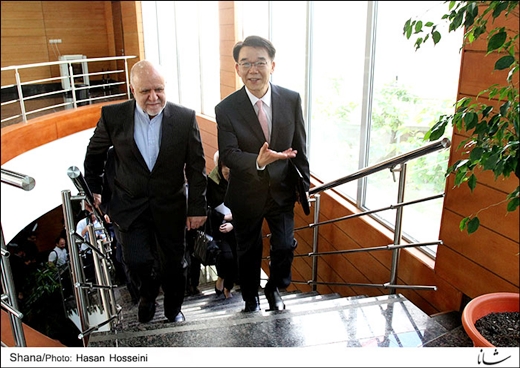
Addressing a meeting with Kang Hoin, South Korea’s minister of land, infrastructure and transport in Tehran, Zangeneh highlighted his meeting with the South Korean Minister of Trade, Industry and Energy Joo Hyung-hwan in his office in Tehran in February, saying that many Korean companies have initiated talks with Iranian energy companies and petroleum ministry subsidiaries since February.

Iran and Korea are to sign a cooperation MoU in which avenues of the two countries’ joint work has been considered.

Zangeneh expressed hope that the wishes of companies will be materialized by operational determination of both sides.

“Iran and South Korea can enjoy cooperation from oil recovery in Iran to investment of Korean companies in LNG and petrochemical industries,” said the official.

For his part, Kang Hoin said Korean companies are interested to join energy projects in Iran.

Iran and South Korea are to sign 4 memoranda of understanding on energy cooperation during the visit.

The two countries will sign a long-term oil and gas cooperation instrument in a ceremony held in the presence of their presidents along with Iranian Minister of Petroleum Bijan Zangeneh and his South Korean counterpart.

Besides the document, three other MoUs will be signed by head of National Iranian Oil Company (NIOC), National Iranian Gas Company (NIGC) and National Iran Gas Exports Company (NIGEC) with their Korean counterparts.

Enhanced oil recover from Iranian oil fields, industrial knowledge transfer, investments in national gas trunklines 9 and 11, mini-LNG facilities and petrochemical plants are the areas the MoUs will cover.

Park Geun-hye’s visit to Iran will be marked as the highest ranking visit to Tehran by a Korean delegation.

In 2013, Iran and South Korea traded over $4.1 billion worth of goods.

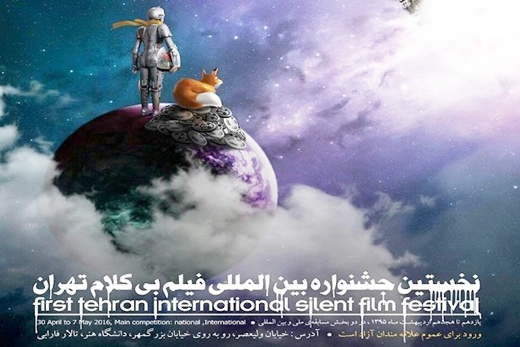
1st Tehran International Silent Film Festival Kicks Off

According to the festival’s public relations office, this is the first time in Asia that a festival with a focus on non-verbal films is being held.

The Tehran International Silent Film Festival will be held in two sections: National Cinema and International Cinema. Films will be presented both in competition and out of competition (for the national section only) categories, in four formats: Fiction, Documentary, Animation, and Experimental.

The festival has not set many limitations for its participants. Student or non-student participants have submitted their films, regardless of the duration or the year of the film’s production. According to Alireza Ghasemi, founder and director of the festival, over 800 submissions have been received, of which 70 titles will be screened in the international section and 45 titles in the national category.

Ghasemi – previously the director of the 11th Nahal Student Film Festival – also mentioned the broad reception of the festival by non-Iranian participants.

The juries for the international section comprise Kamran Shirdel, Mahmoud Kalari, Haydeh Safi Yari, Fatemeh Motamed Arya and Dana Poulan.

To find out about the screening programs for the international section, please visit here. The festival is accessible to the public free of charge.

Illegal Hunter to Collect Rubbish Instead of a Jail Sentence

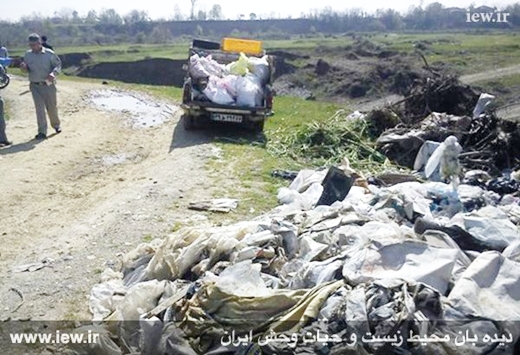
In IFP’s translation of a report by Hamshahri Online, on May 7, the Head of Bukan Environment Protection Organization announced the arrest of several hunters who were illegally hunting partridges. One of them confessed and gave information leading to another hunter who keeps partridges illegally. After investigation, this hunter was arrested too and found guilty. According to the relevant hunting laws, his sentence should have been 100 days in prison. The judge, however, based on his age and lack of a criminal record, and also to teach him about the environment, gave him a sentence of 15 days of rubbish collection in the protected environment of Bukan County. His sentence will be carried out under the supervision of environmental officers, and he will also have to attend environment education classes.

In the legal framework, based on the Alternative Punishments regulations, this hunter was spared from going to jail where he might have become involved with drugs and would have been separated from his family for 3 months. Instead, he now serves the environment and, more importantly, the public’s attention will be drawn to the importance of protecting the environment.


Alternative Punishments

Experts have warned about the high number of prisoners and the consequences of keeping them in jail, both for their families and the fact that they can be drawn into more complicated criminal networks there. According to statistics, there are more than 200,000 prisoners in Iran. Iran’s Supreme Leader also showed his discontent in this regard and asked for decreased jail sentences and offering other punishments. The Alternative Punishments laws officially came into action in 2013.

A Look at Iranian Newspaper Front Pages on May 1

Iran Newspaper front pages

The results of Friday’s run-off elections, and the final formation of the next Iranian parliament, were naturally the main focus of almost all newspapers on Sunday. The number of MPs from each of the two major factions, however, was contested. Each media source, reformist or conservative, had its own interpretation of the results. Even the numbers reported among the outlets aligned with the same faction differed somewhat.

The majority of newspapers, however, mentioned a general reformist victory. A record was broken in terms of the number of female MPs, and there was a large turnover in terms of new parliament members – 75% of the members will be different from the previous parliament. These issues were also looked at in detail by many newspapers.

Meanwhile, the visit by President of the Senate of Belgium Christine Defraigne to Tehran, and her meetings with Iran’s President Hassan Rouhani as well as a number of other officials also received great coverage.

The recent developments in the Iraqi capital of Baghdad, and the seizure of its parliament, were also focused on by Iranian media.


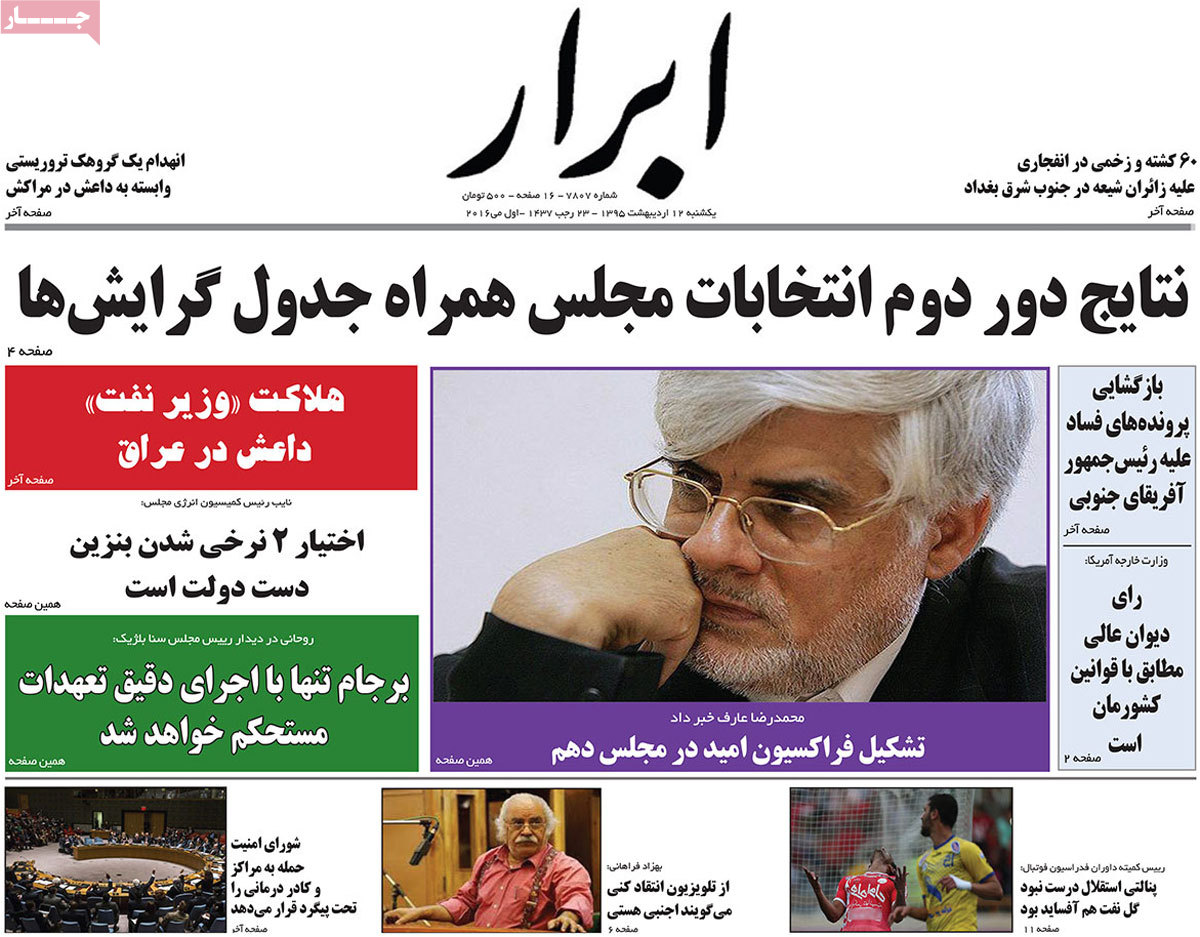
Abrar:

1- JCPOA to Be Strengthened Only through Full Implementation of Commitments: Rouhani

2- 60 Dead and Wounded in Explosion against Shiite Pilgrims in Southeast Baghdad


A Look at Iranian Newspaper Front Pages on May 1


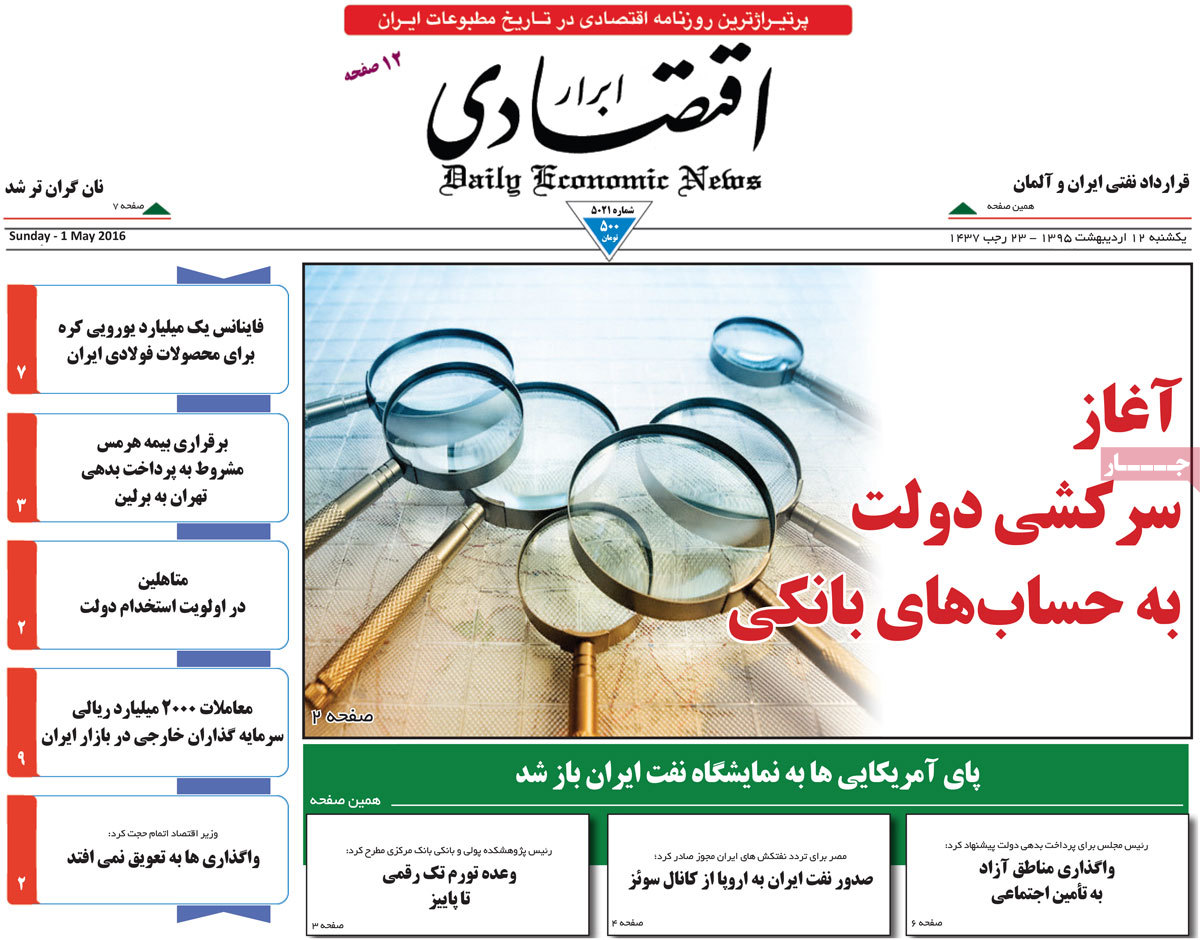
Abrar-e Eqtesadi:

1- Exporting Oil to Europe through Suez Canal: Egypt Allows Iranian Tankers

2- Iran’s Central Bank Vows to Make Inflation Rate One-Digit by Autumn

3- Americans to Take Part in Iran’s Oil Exhibition

4- Married People Favoured in Gov’t Employment

5- South Korea Dedicates €1bn Financing to Iran’s Steel Products


A Look at Iranian Newspaper Front Pages on May 1


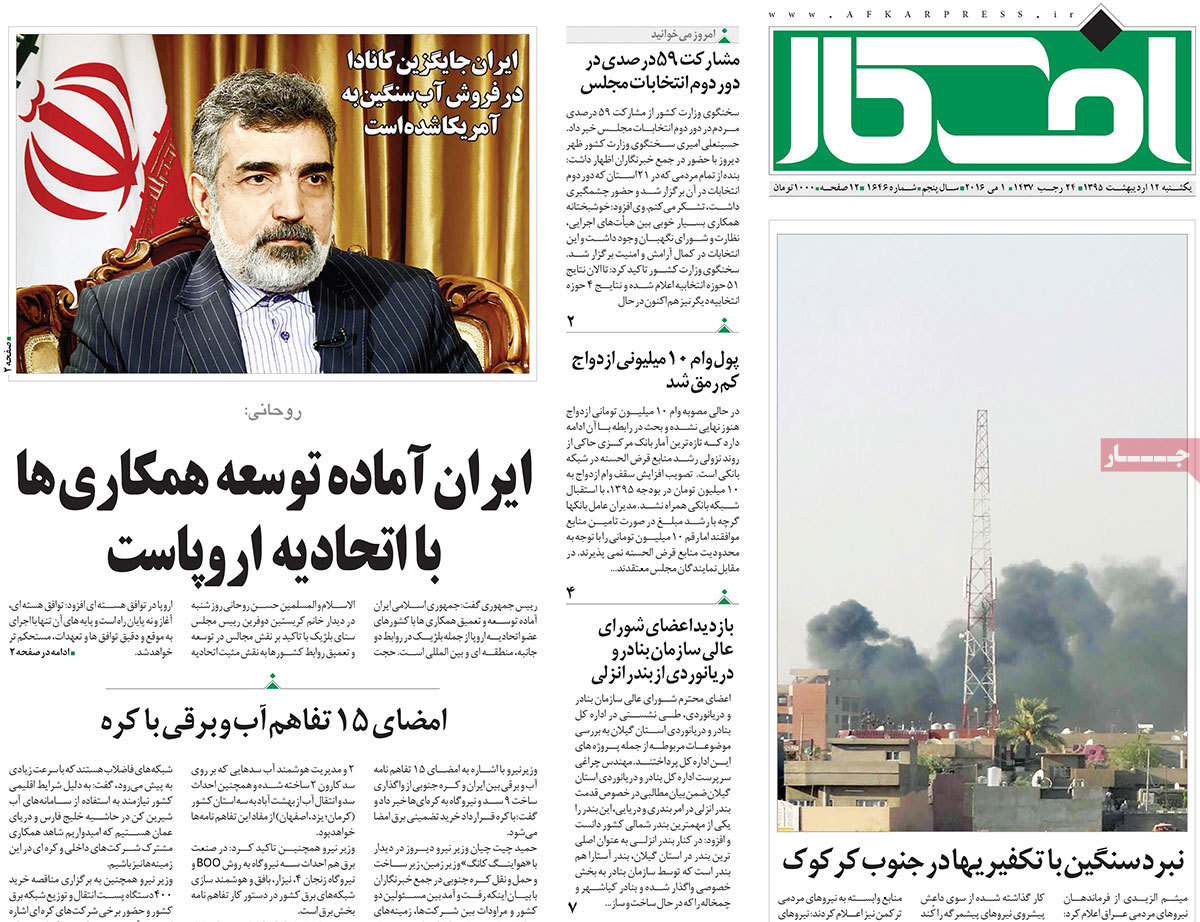
Afkar:

1- 59% Popular Turnout in Run-Off Elections

2- Iran Replaces Canada in Sale of Heavy Water to US: AEOI Spokesman

3- Iran and South Korea to Sign 15 MoUs on Water and Power


A Look at Iranian Newspaper Front Pages on May 1


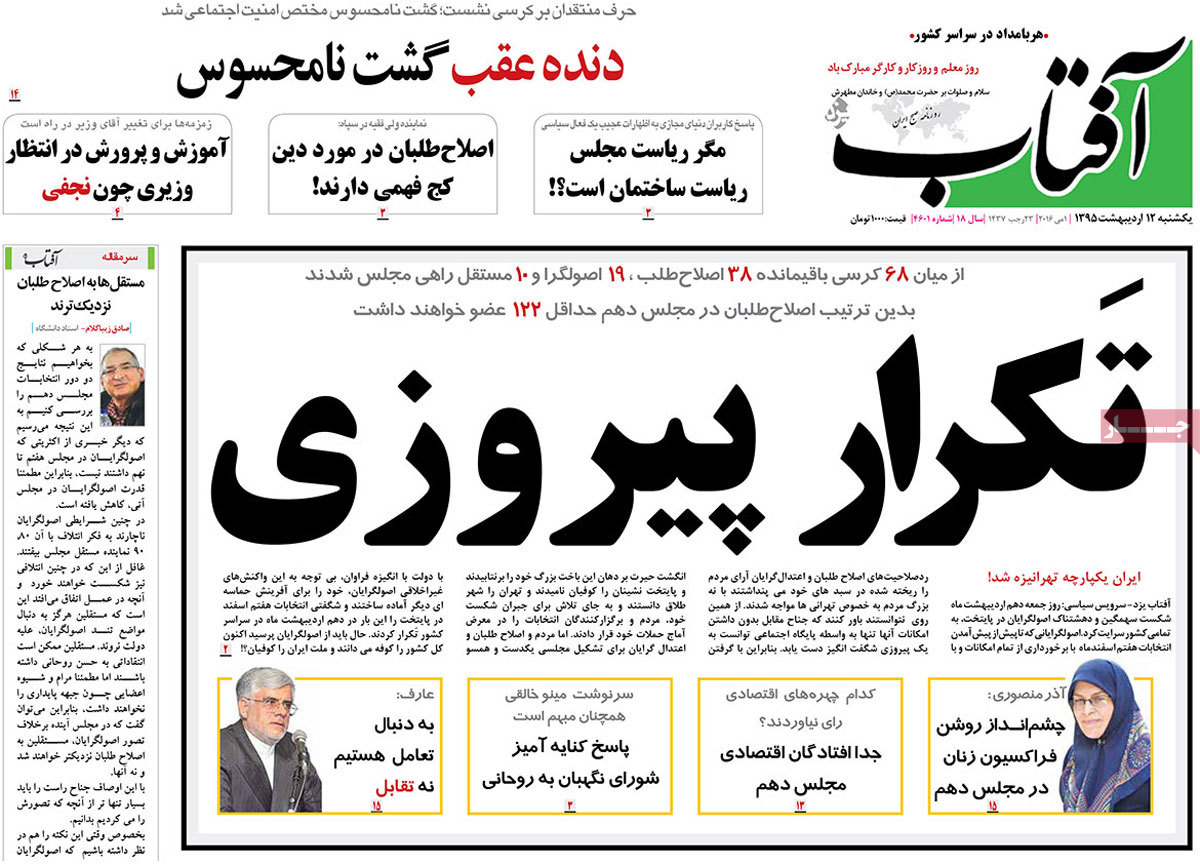
Aftab-e Yazd:

1- “Victory Again”: Reformists to Have at Least 122 Seats in Next Parliament

2- Independent MPs Are More Inclined towards Reformists: Zibakalam


A Look at Iranian Newspaper Front Pages on May 1


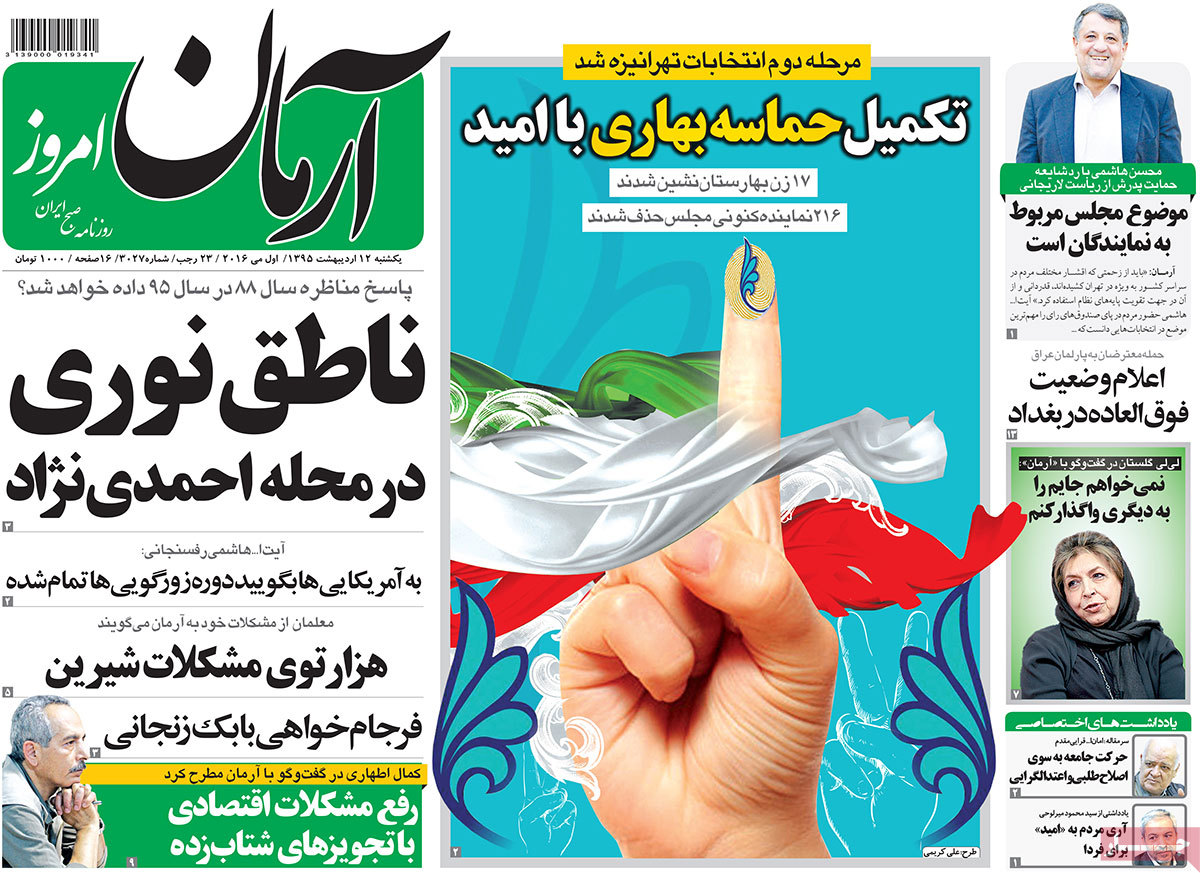
Arman-e Emrooz:

1- 17 Female Candidates Elected as MPs

2- Rafsanjani: Tell Americans the Time of Bullying is Over

3- Attack on Iraqi Parliament: State of Emergency Declared in Baghdad


A Look at Iranian Newspaper Front Pages on May 1


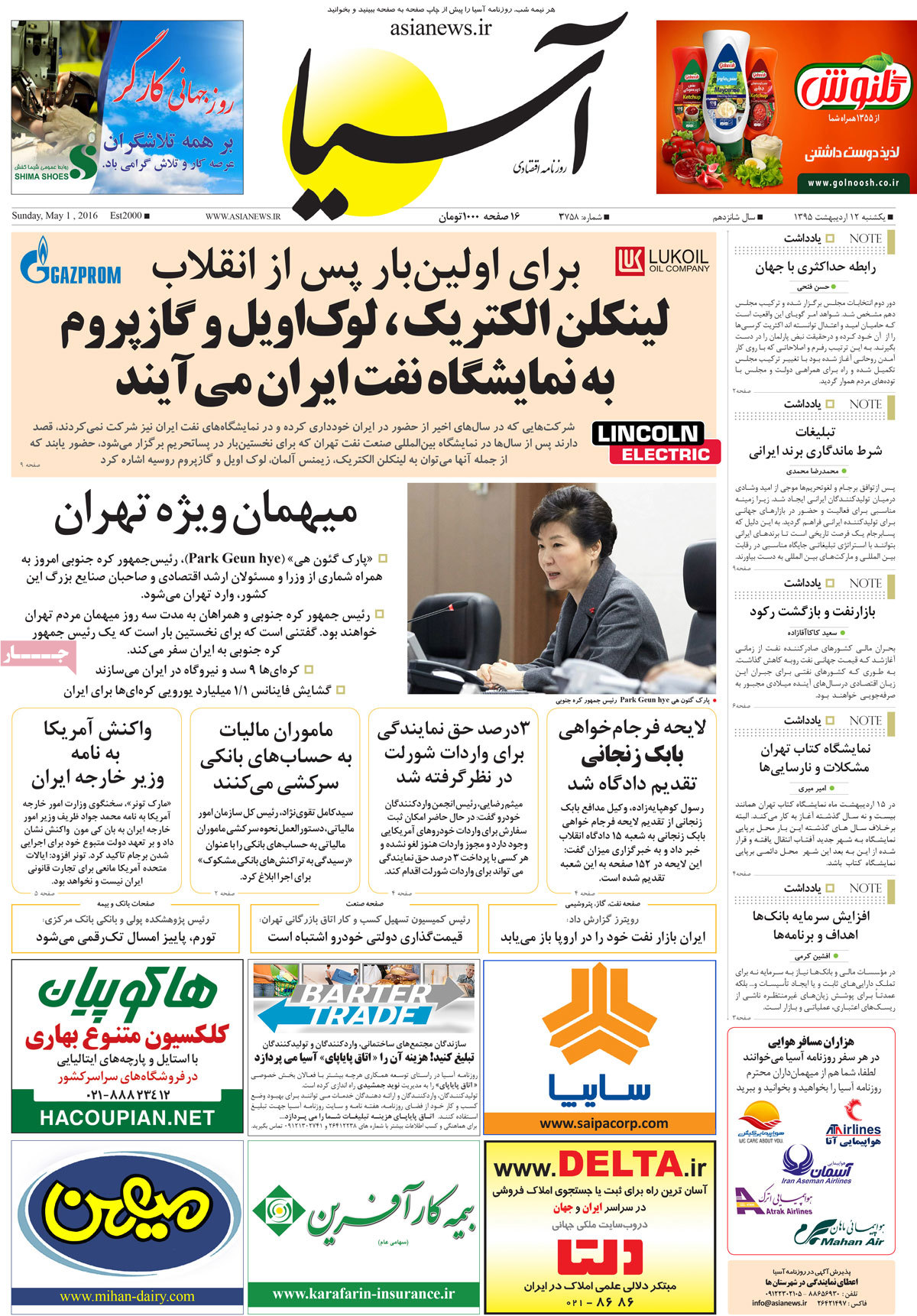
Asia:

1- For 1st Time after 1979 Revolution: Lincoln Electric, Lukoil, Gazprom to Attend Iran Oil Exhibition

2- Iranian Businessmen Can Import US-Made Chevrolet: Official


A Look at Iranian Newspaper Front Pages on May 1


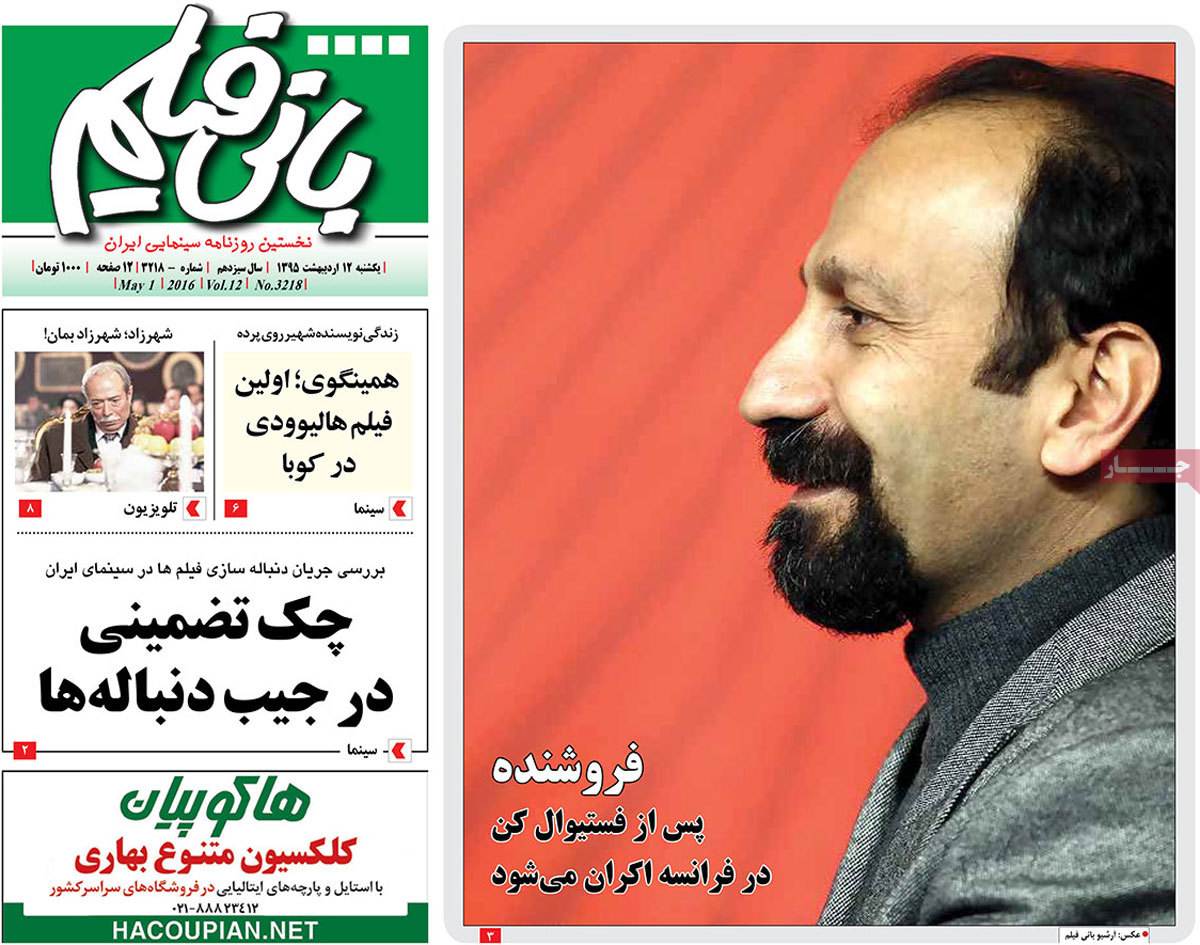
Bani Film:

1- Asghar Farhadi’s Salesman to Be Screened in France after Cannes

2- First Hollywood Film in Cuba: Life of Ernest Hemingway


A Look at Iranian Newspaper Front Pages on May 1


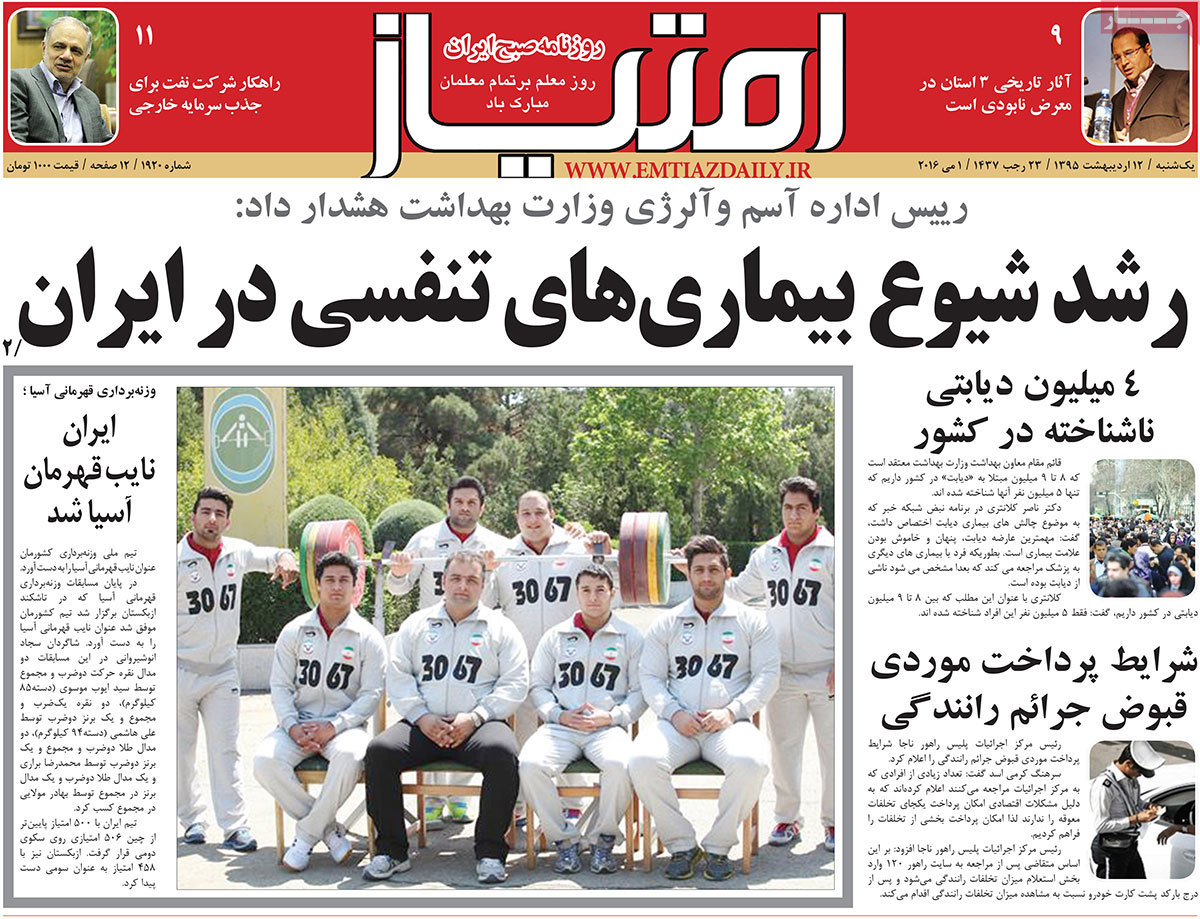
Emtiaz:

1- Increase in Spread of Respiratory Diseases in Iran


A Look at Iranian Newspaper Front Pages on May 1


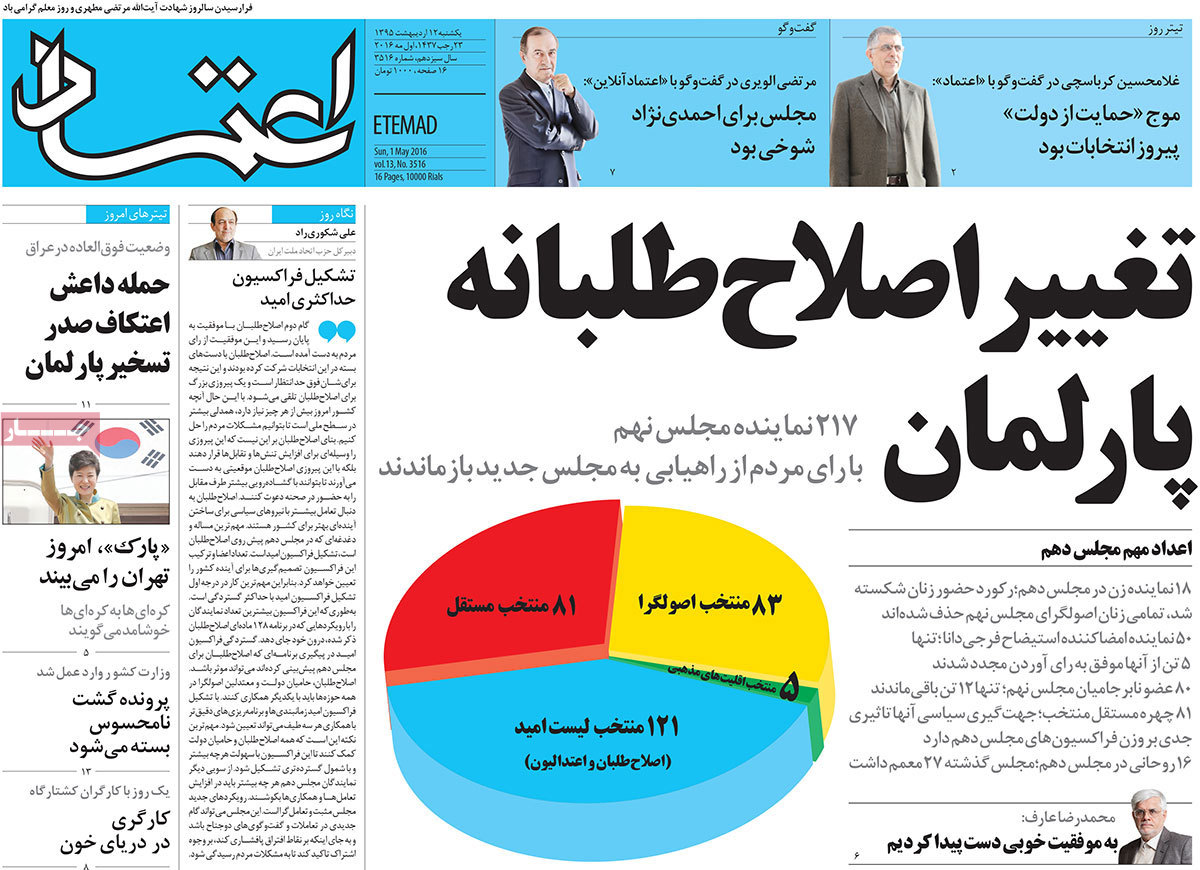
Etemad:

1- Reformist Change in Iranian Parliament’s Makeup

2- Interior Ministry Cancels “Plainclothes Morality Police” Plan


A Look at Iranian Newspaper Front Pages on May 1


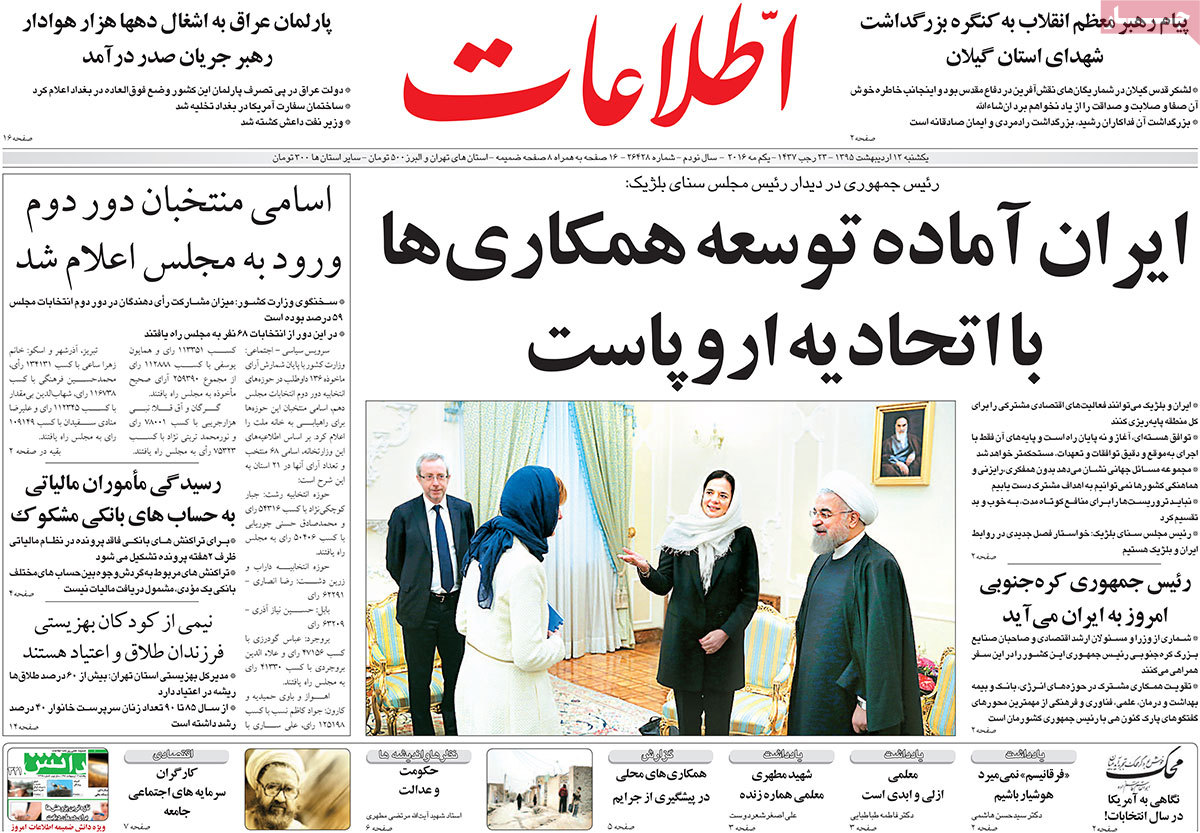
Ettela’at:

1- Iran Ready to Expand Cooperation with EU: Rouhani to Belgian Senate President

2- South Korean President Due in Iran Today


A Look at Iranian Newspaper Front Pages on May 1


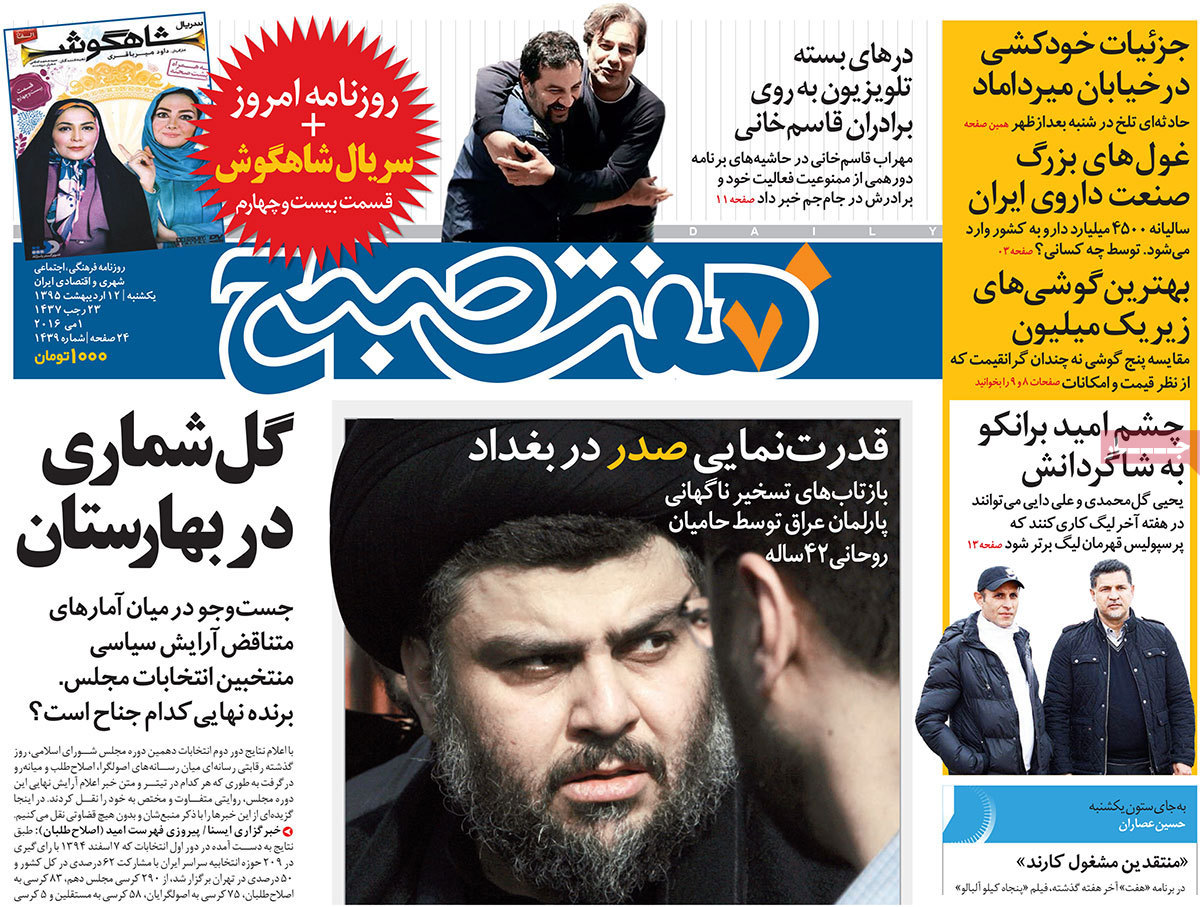
Haft-e Sobh:

1- Young Man Commits Suicide by Hanging Himself from Pedestrian Bridge in Tehran


A Look at Iranian Newspaper Front Pages on May 1


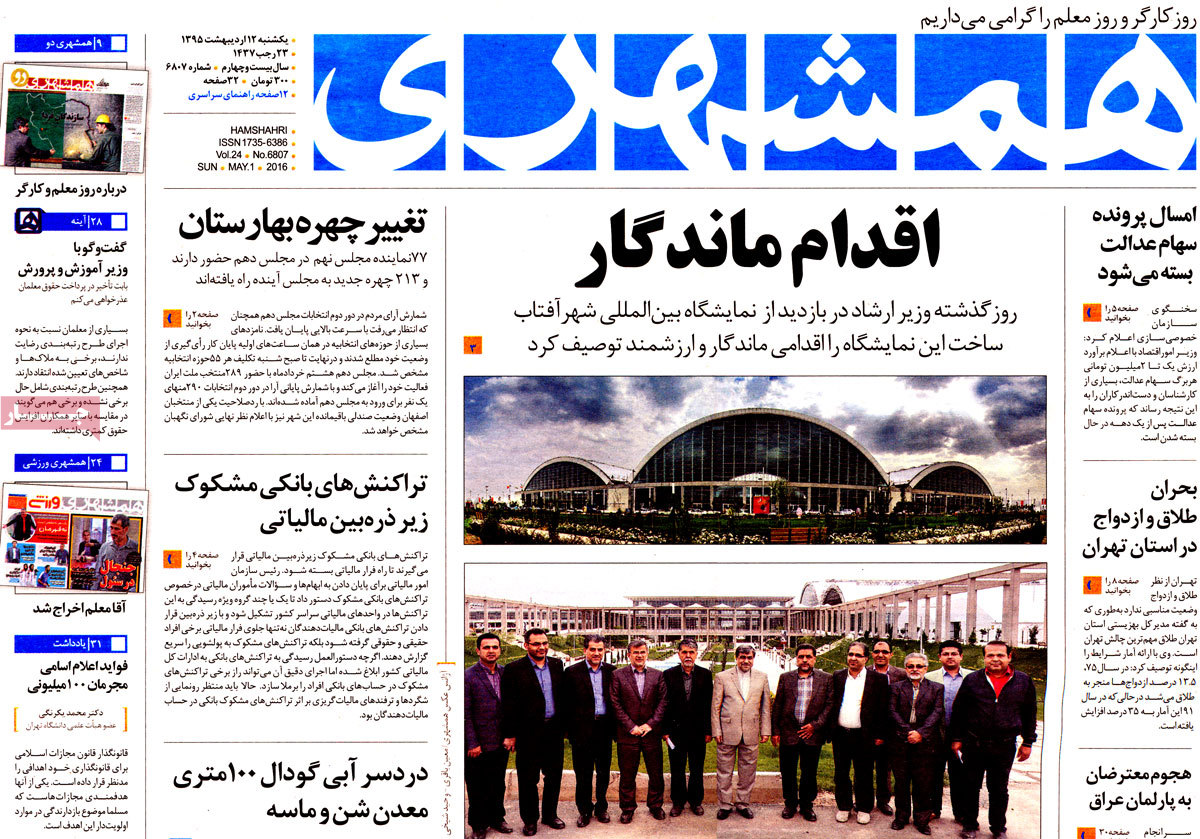
Hamshahri:

1- Marriage and Divorce in Critical Condition in Tehran Province

2- Change in Parliament’s Face: 213 New MPs Make It to Majlis


A Look at Iranian Newspaper Front Pages on May 1


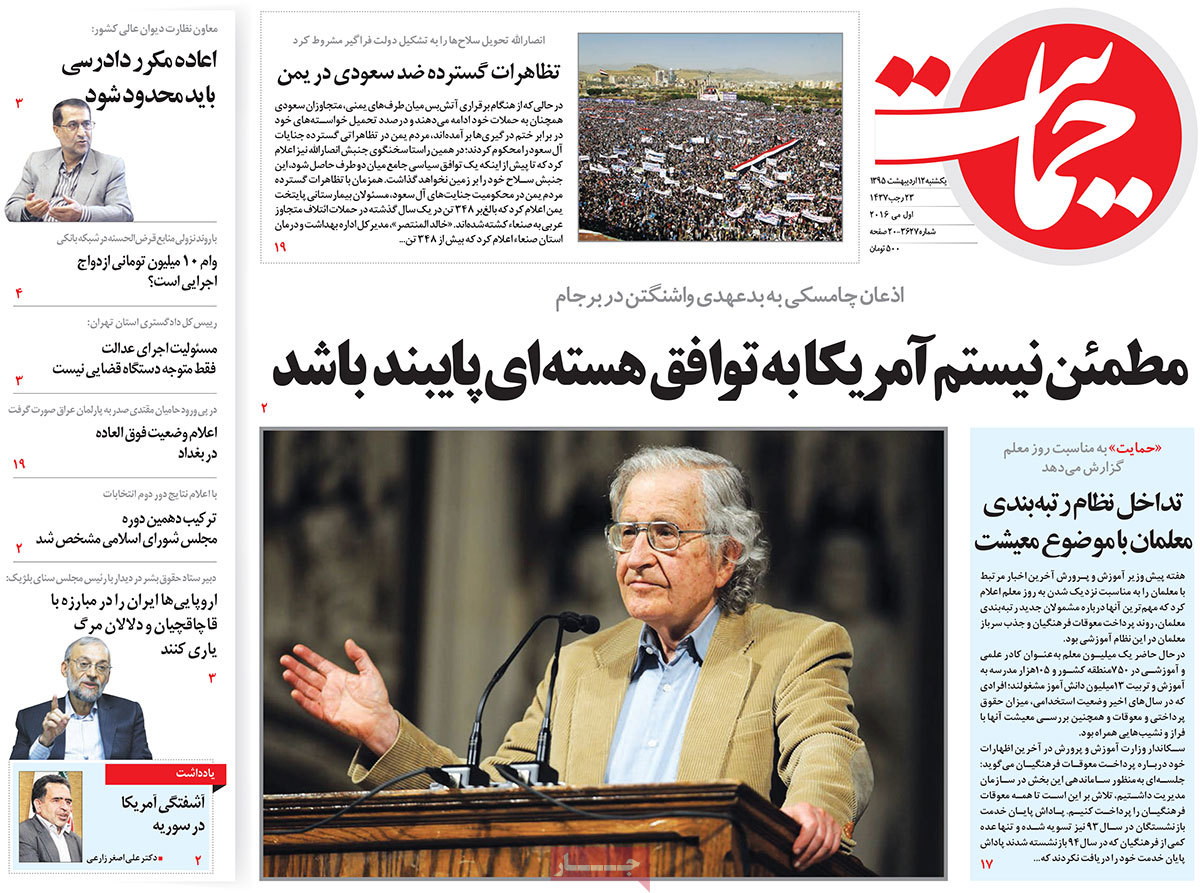
Hemayat:

1- Noam Chomsky Not Sure about USA’s Compliance with JCPOA

2- Human Rights Official Urges Europeans to Help Iran in Fight against Drug Traffickers

3- Massive Anti-Saudi Demonstrations in Yemen


A Look at Iranian Newspaper Front Pages on May 1


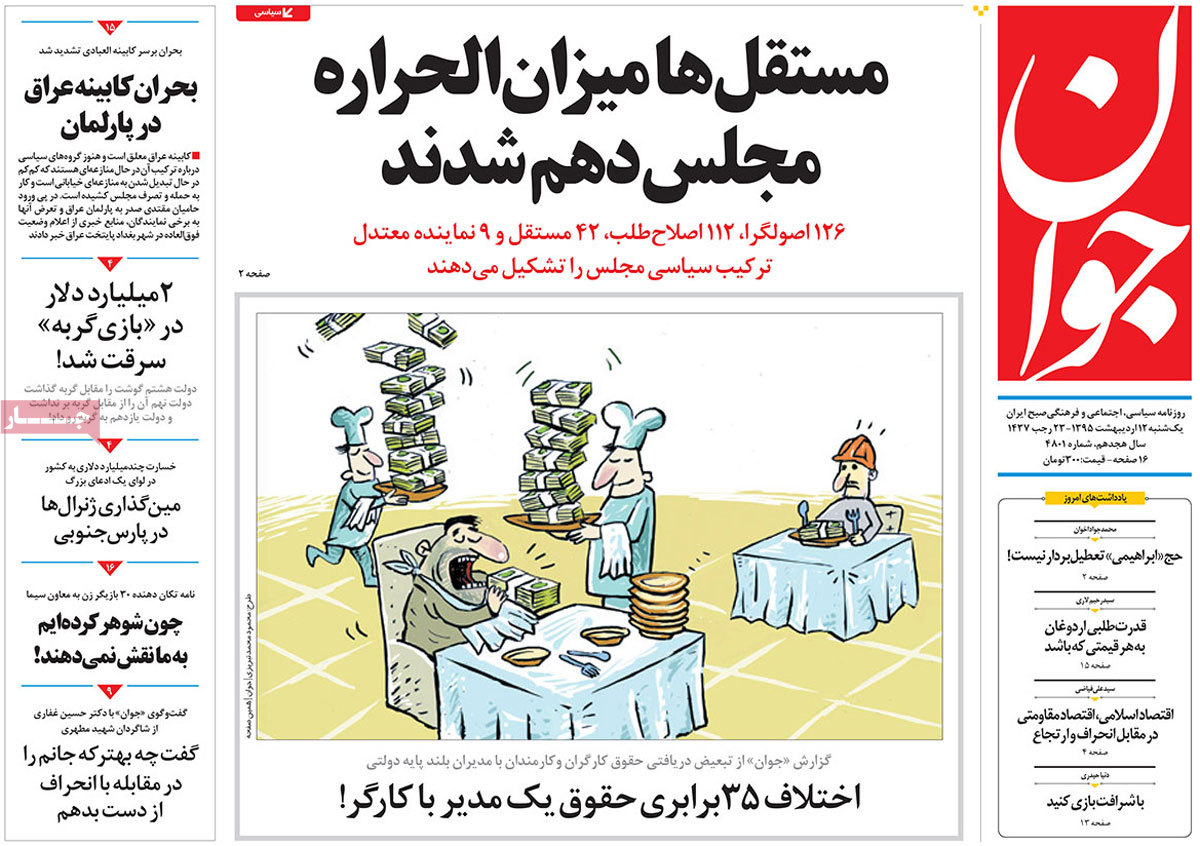
Javan:

1- 30 Actresses to IRIB Deputy Head: No New Roles Given to Us Since Marriage

2- Wage Discrimination: High-Ranking Gov’t Managers Receive 35 Times More than Workers

3- Independent MPs Serve as Barometer of 10th Parliament


A Look at Iranian Newspaper Front Pages on May 1


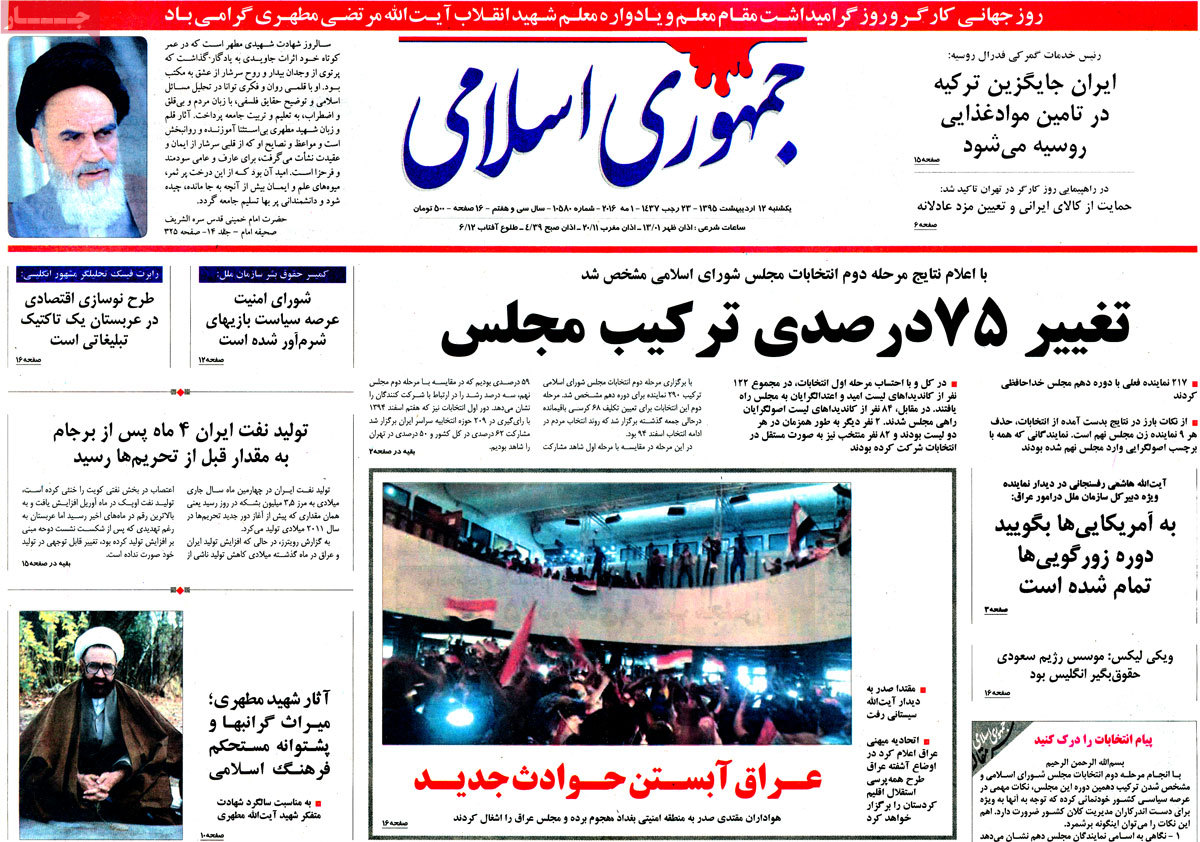
Jomhouri Eslami:

1- 4 Months after JCPOA: Iran’s Oil Output on Par with Pre-Sanctions’ Amount

2- Iran to Replace Turkey in Supplying Russia’s Food Products


A Look at Iranian Newspaper Front Pages on May 1


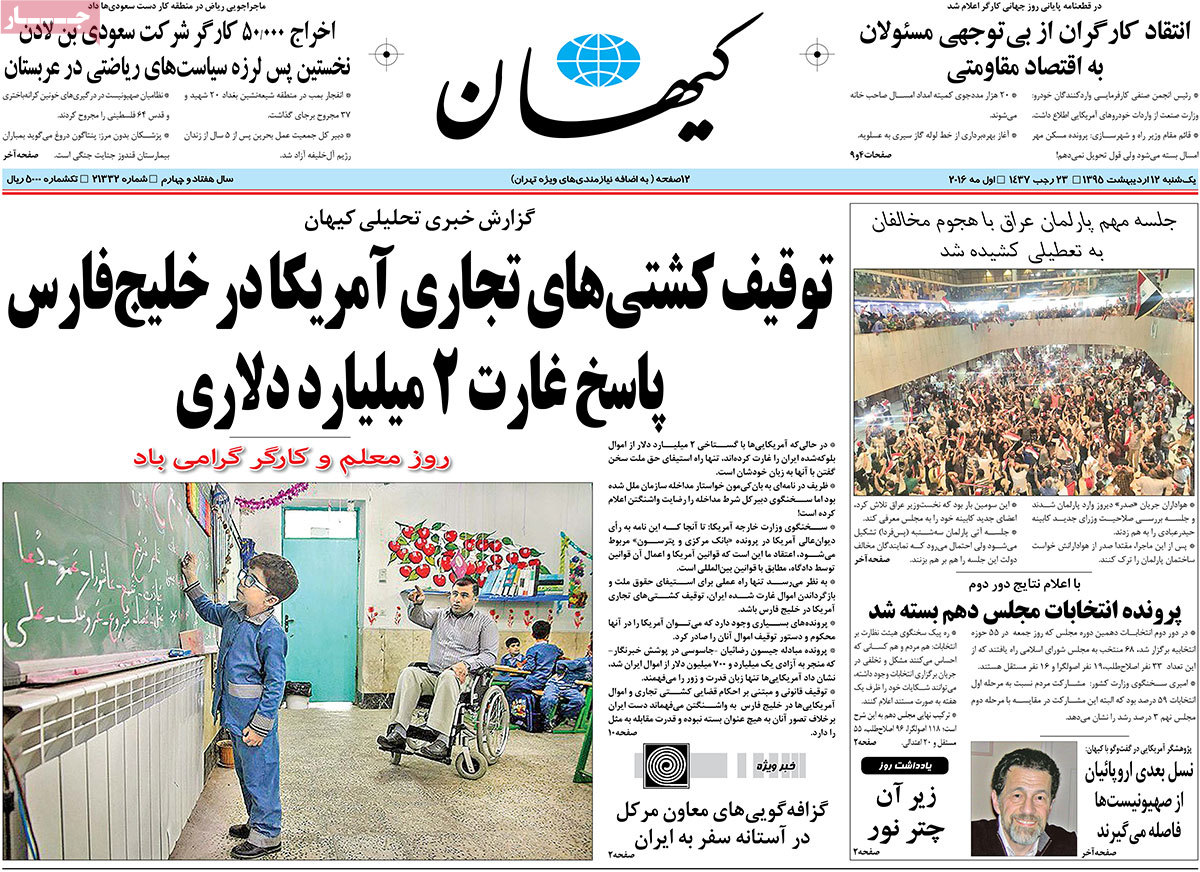
Keyhan:

1- Seizure of US Merchant Ships in Persian Gulf, a Response to Americans’ $2bn Robbery

2- German Vice-Chancellor Overstepping the Mark ahead of Iran Visit

3- 50,000 Workers of Saudi Company Fired amid Riyadh’s Austerity Plan

4- 118 Conservatives, 96 Reformists, 55 Independents, 20 Moderates to Represent People in Parliament


A Look at Iranian Newspaper Front Pages on May 1


Mardom Salari:

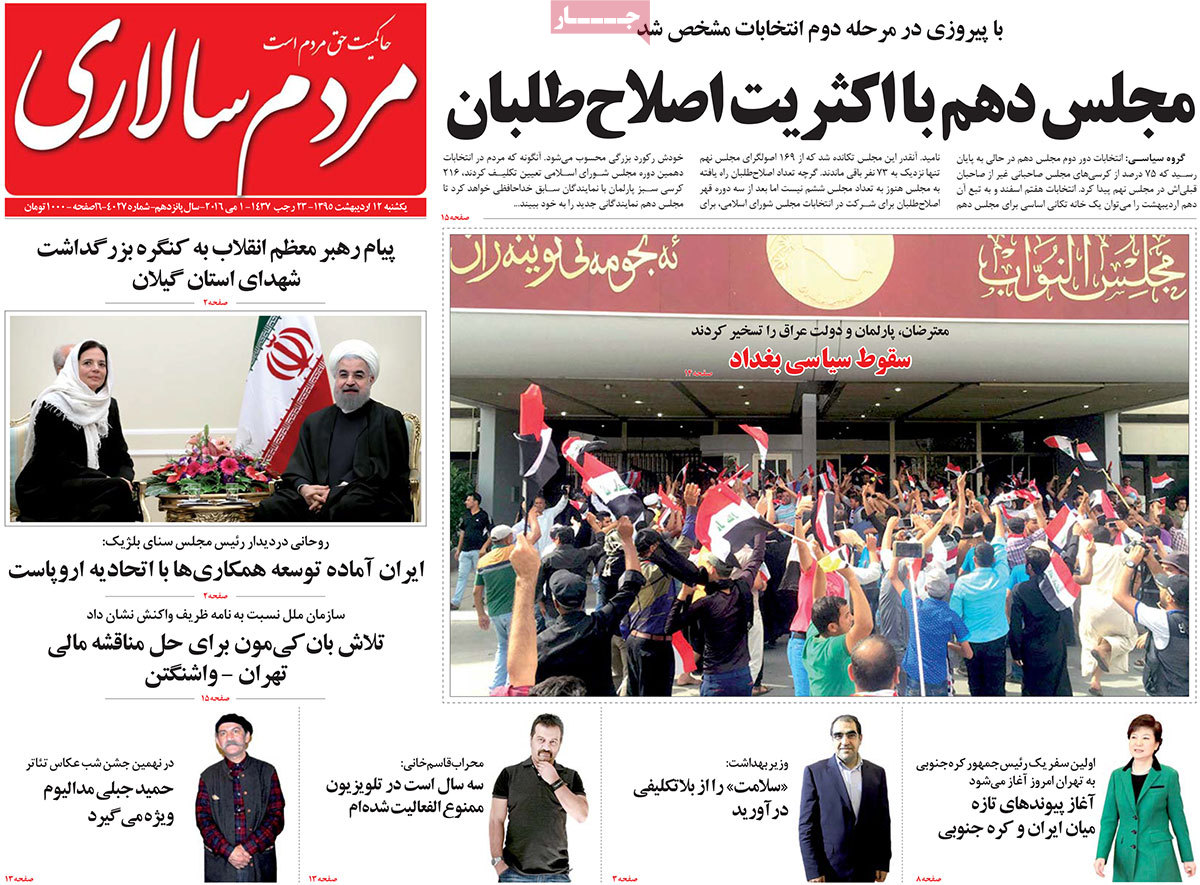
1- Reformists Win Majority of 10th Parliament

2- Political Fall of Baghdad: Protestors Seize Iraqi Parliament and Gov’t Building


A Look at Iranian Newspaper Front Pages on May 1


Payam-e Zaman:

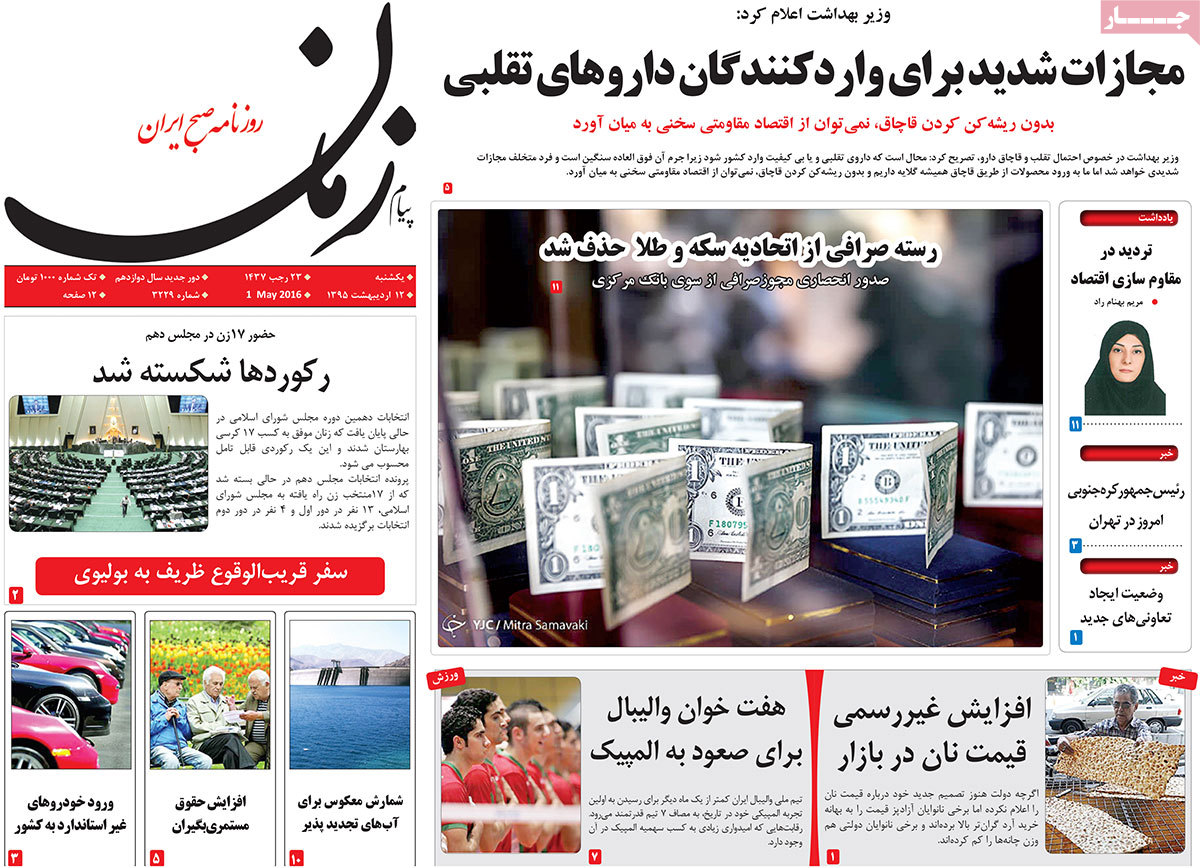
1- Severe Punishment for Importers of Fake Drugs: Minister

2- FM Zarif to Visit Bolivia in Coming Days


A Look at Iranian Newspaper Front Pages on May 1


Shahrvand:

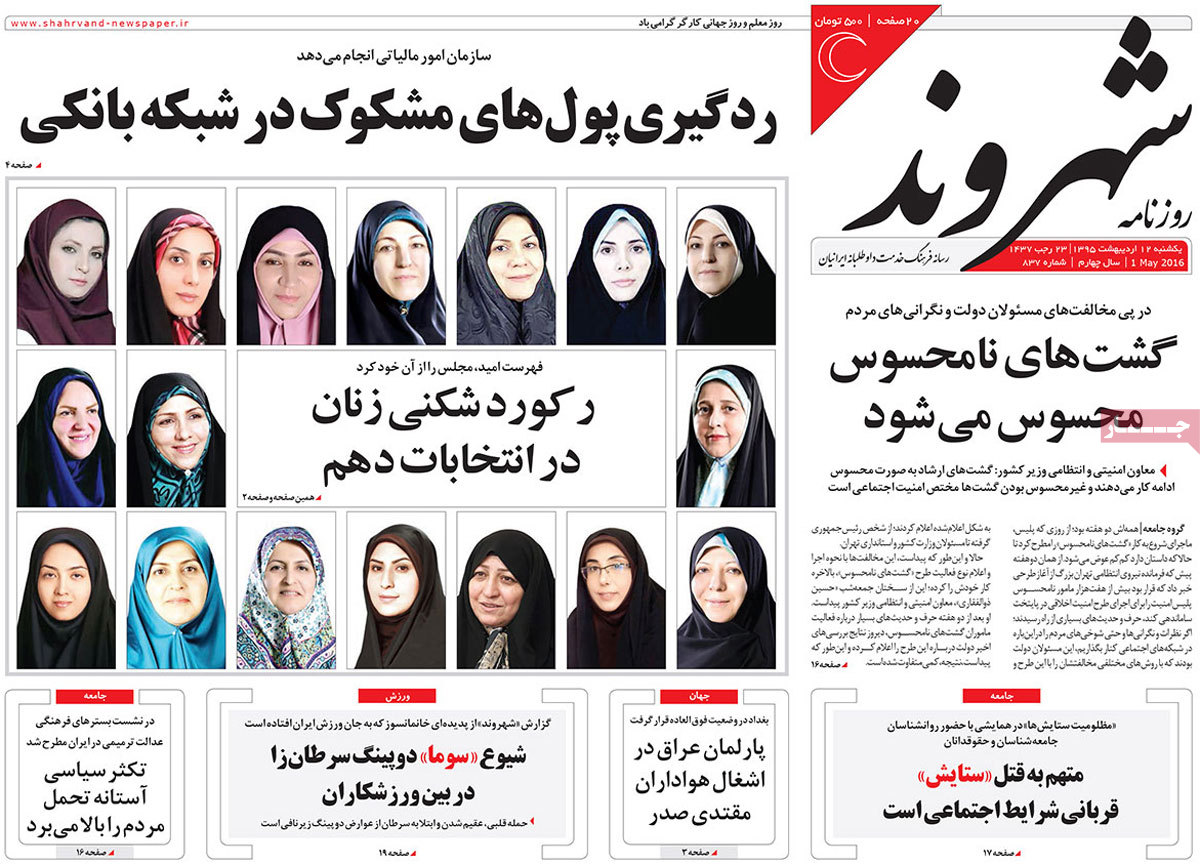
1- Women Break Records in Parliamentary Polls: “List of Hope” Wins

2- Uniformed Forces, Rather than Plainclothes, to Be Used for Morality Police


A Look at Iranian Newspaper Front Pages on May 1


Sharq:

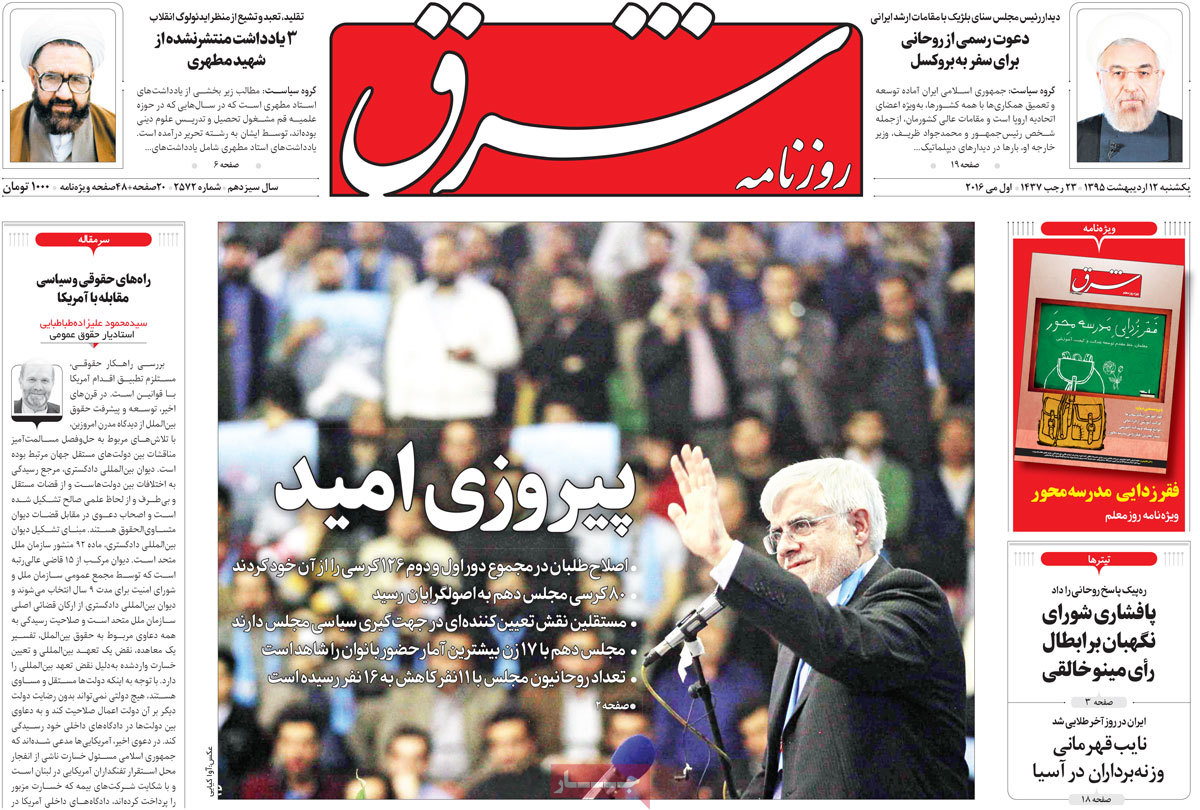
1- “Hope” Wins: Reformists Won Majority of Iran’s Parliament

2- President Rouhani Officially Invited to Visit Belgium


A Look at Iranian Newspaper Front Pages on May 1


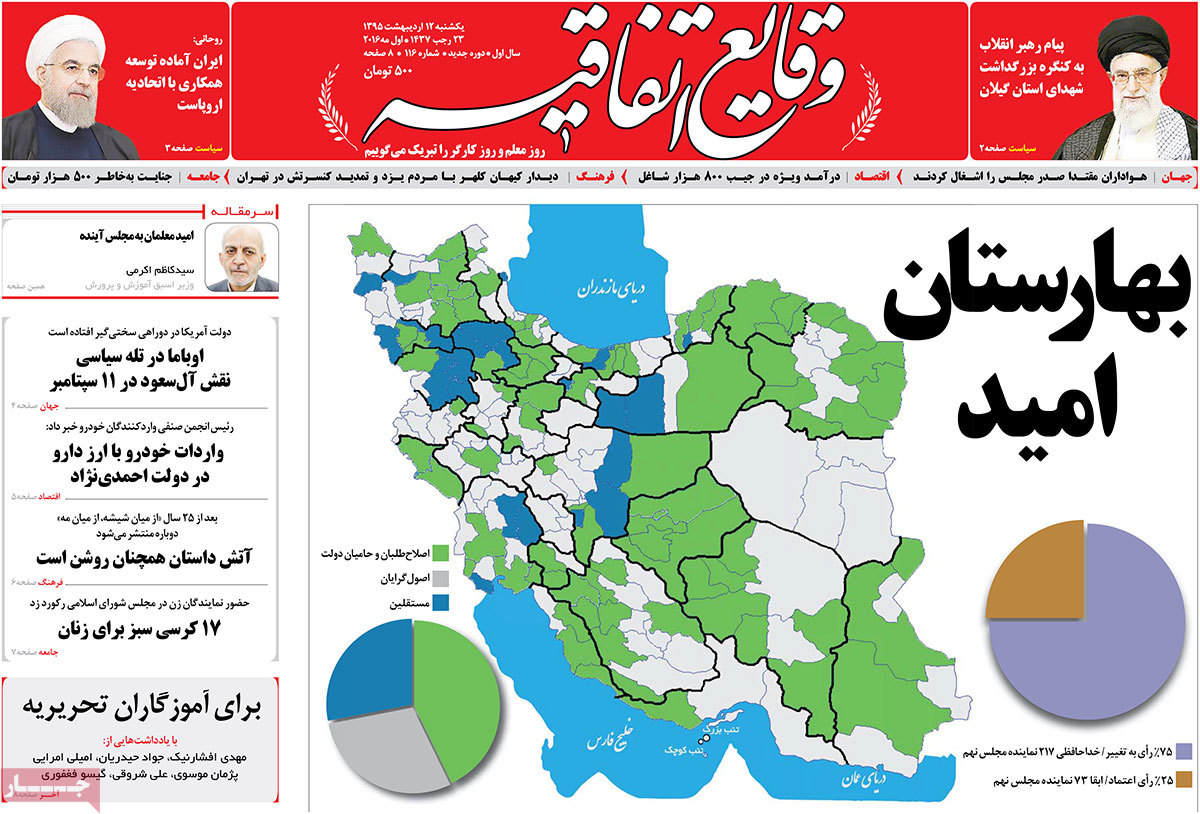
Vaghaye Ettefaghieh:

1- 75% of Parliament Formation Changed: Only 73 (Out of 290) MPs Re-Elected


A Look at Iranian Newspaper Front Pages on May 1


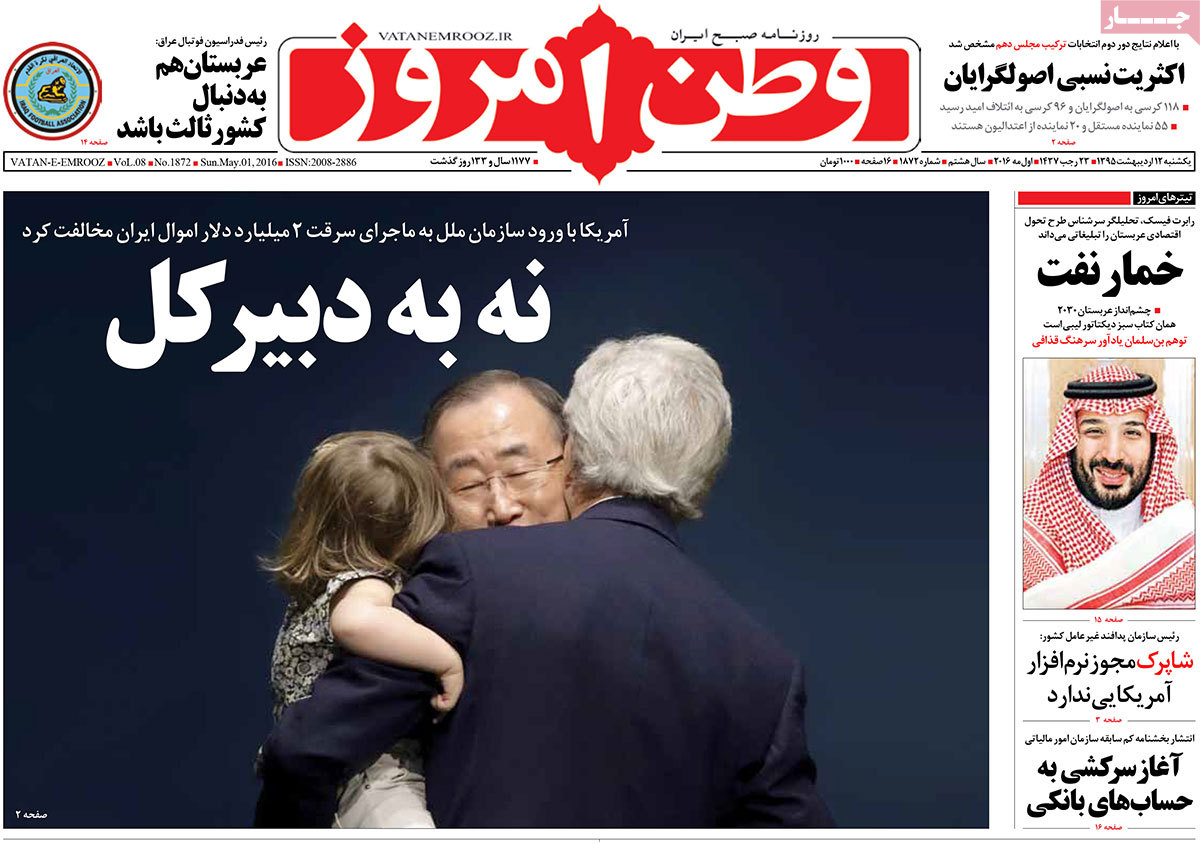
Vatan-e Emrooz:

1- Iran’s Payment and Settlement Network (Shaparak) Has No Permission to Use American Software: Civil Defence Organization

2- Relative Majority of Conservatives in Iranian Parliament


A Look at Iranian Newspaper Front Pages on May 1