Tuesday, December 30, 2025
Home Blog Page 4484

Javan: European Banks Demand $15bn from Iran

On Friday May 13, US Secretary of State John Kerry met with heads of 10 European banks. According to a report by Javan newspaper, a source has commented that while publically, these banks did not respond positively to re-engaging with the Iranian financial system, certain European banks have unofficially indicated their willingness to resume ties, on the condition that they are compensated for penalties already paid to the US for their relations with Iran. The Javan report is translated by IFP.


Javan- 5- 15-2016After a Friday (May 13) meeting with John Kerry, the heads of certain European banks said that the American official’s remarks had failed to convince them to resume banking ties with Iran.

However, an informed source in Tehran says that some of these bankers sent unofficial messages to Iran, expressing their readiness to start banking ties with Tehran on the condition that the Islamic Republic compensates them for billions of dollars’ worth of fines they have already paid to the US.

The Americans, therefore, are hypocritically suggesting that their Secretary of State, as a goodwill gesture, is encouraging European banks to resume their dealings with Iran, but that in the end it was the Europeans who refused to do so!

However, three days after Kerry’s closed-door meeting with the heads of 10 major European banks, unofficial reports relate a different story; a story that reveals European banks are aiming to demand a ransom from Iran.

Within the past five years, the US has imposed penalties of $15bn on Standard Chartered and HSBC, and $8.9bn on France’s BNP Paribas. However, an informed source close to the banking network says the European banks have asked Iran to pay $15bn compensation.

“European banks have also informed the Iranian side that it should provide guarantees to compensate for possible future penalties imposed by the US if it wants to resume ties,” the source added.

Good Cop, Bad Cop?

So far, it was believed that the US was the one stalling [the process of Iran’s return to the global economy]; however, Iran is now faced with ransom demands from certain European bankers. These banks claim that the remarks made by Kerry on Thursday have not only failed to allay their concerns [over the resumption of ties with Tehran], but have actually increased them.

There are observers who do not reject the possibility of a “good cop/bad cop” scenario. Kerry on Thursday repeatedly expressed concern over what he called Iran’s measures in the region, and in this way, he not only failed to allay the banks’ concerns, but also made them understand that the sanctions will continue on this pretext. He suggested that if these banks sign any deal with Iran, the country’s assets, and consequently part of the banks’ investments, could be easily confiscated by American courts.

This scenario is aimed at humiliating the Europeans, prolonging financial sanctions, and sanctifying the US: John Kerry, like a wolf in sheep’s clothing, is the main player behind this scenario, and is implementing it precisely. The US talks about terminating anti-Iran sanctions in the media so as to portray Europeans as cowards who are excessively terrified of this country. However, it secretly threatens them to practically scare these banks into avoiding ties with Tehran.

John Kirby, a spokesman for the US State Department, admitted on Friday, May 13, that his country’s officials had sent negative signals to European banks about their return to Iran.

“When the Secretary was in London speaking with European banking institutions, on more than one occasion in that meeting he raised very specifically our continued concerns about what Iran is doing in the region,” Kirby said in his press briefing.

The US knows that “Iran is a state sponsor of terrorism and that they have continued to support this particular group [Hezbollah] which is a designated foreign terrorist organization,” he added.

“… Here you have a country which, while living up to their commitments under the JCPOA, is certainly still conducting any number of destabilizing activities in the world and in the region. And we understand that and the Secretary was very clear about that,” Kirby told reporters.

The US spokesman, however, did not mention why Kerry had raised such an issue in a meeting aimed at giving assurance to European banks on the resumption of ties with Iran.

In a Thursday article, the Associated Press referred to US stonewalling in the JCPOA implementation, stressing that the US refusal to give written guarantees on the safety of trade with Iran is why European banks are reluctant to resume their ties with Tehran.

“Foreign governments, banks and other companies want written clarification from the US Treasury Department — essentially a guarantee they won’t be punished. But Washington is reluctant to do that, not wanting to appear to be softening its firm penalties for non-nuclear behavior,” AP reported.

In separate statements released after meeting with Kerry, the European banks Standard Chartered, Deutsche Bank, and HSBC announced that the American diplomat’s remarks had failed to convince them to resume their ties with Iran.

In a Friday article in the Wall Street Journal, Stuart Levey, the chief legal officer of HSBC Holdings and the former undersecretary for terrorism and financial intelligence at the US Treasury Department, provided the best explanation of why Kerry’s remarks were not convincing.

He argued that Washington’s double-standards, and its officials’ fears and hopes about the resumption of ties with Iran were the main factor behind European banks’ unwillingness to trade with Iran.

On Friday, US Republican Representative John Ratcliffe introduced the Iran Cyber Sanctions Act of 2016, which requires the administration to impose sanctions on hackers allegedly linked to the Iranian government. The measure pushes the administration to take action on an April 2015 executive order that authorized the Treasury Department to sanction individuals and entities who engage in malicious cyber activities against the United States.

“The danger posed by Iran’s increasingly sophisticated cyber capabilities has grown significantly over the past few years, and we must take these threats seriously,” Ratcliffe said, according to his personal website.

A couple of months ago, the US Justice Department announced it has indicted seven hackers associated with the Iranian government with cybercrimes.

Foreign Minister Mohammad Javad Zarif said on Saturday, May 14, that the parties to the Joint Comprehensive Plan of Action must discharge their obligations in a tangible way so that Iranian people would feel the positive results.

The Foreign Minister made the remarks in his speech to the inaugural ceremony of a conference entitled “JCPOA, the Economy of Resistance; Opportunities and Capacities” in Tehran, which was attended by Iranian foreign ambassadors.

The Iranian ambassadors should focus their efforts on helping the country’s economic growth and enhancing people’s living standards, Zarif said.

Referring to the opposition of certain parties in the US to the JCPOA, Zarif said that some of the opponents of the Iran deal, who have a record of supporting the Zionist [Israeli] regime, had tried to slow down the implementation of the deal by pursuing their own closed-minded views.

He said that the hostile approaches held by the JCPOA opponents in the US require Iranian ambassadors to exercise vigilance and push forward the goals of the Islamic Republic of Iran.

“We have gathered together here to exchange views on all the new chances and opportunities for making use of the JCPOA in the light of the Economy of Resistance,” he added.

Iran’s top diplomat also highlighted the significant role of Iranian ambassadors in presenting a true image of the JCPOA implementation and the efforts made by the administration to clarify the JCPOA achievements in the fields of banking and finance.

For more news and views on this story, see:

Any Request for Banking Guarantees in Ties with Europe Is Nonsense: Official

Iran’s Zarif Says Military Solution in Syria an ‘Illusion’

Zarif made the remarks after arriving in Vienna late on Monday to take part in an upcoming International Syria Support Group (ISSG) meeting.

“We are going to continue to insist on the need for a comprehensive ceasefire, of course excluding terrorist groups,” Zarif told the Press TV correspondent.

He stressed that a political solution is the only way to solve the crisis in Syria, which has been gripped by foreign-backed militancy since March 2011.

“Unfortunately there seems to be a persistence by some that they want to pursue a military solution, that illusion has to come to an end and they should look for a political solution,” the Iranian foreign minister said.

Iran, Russia, Turkey and Saudi Arabia as well as representatives from the European Union and the Arab League are among the countries participating in the ISSG meeting on Tuesday. The 17-nation ISSG aims to discuss the stalled negotiations, challenges in maintaining the February ceasefire and the delivery of UN humanitarian aid to various areas across the war-ravaged country.

Almost immediately upon arrival, Zarif held talks with UN Special Envoy for Syria Staffan de Mistura (seen below) over the upcoming ISSG meeting after he held a meeting with EU Foreign Policy Chief Federica Mogherini where they discussed regional and international developments and the implementation of the Iran’s nuclear deal.

Iran and the five permanent members of the UN Security Council – the United States, France, Britain, China and Russia – plus Germany signed a deal known as the Joint Comprehensive Plan of Action on July 14, 2015 following two and a half years of intensive talks. The two sides started implementing the JCPOA on January 16.

Iranian Deputy Foreign Minister for Arab and African Affairs Hossein Amir-Abdollahian, Foreign Ministry spokesman Hossein Jaberi-Ansari and Deputy Foreign Minister for Legal and International Affairs Abbas Araqchi have also traveled to the Austrian capital.


European Banks’ Conservatism Hindering JCPOA Implementation: Iran Deputy FM

Iran’s Deputy Foreign Minister for European and American Affairs Majid Takht-e Ravanchi made the remarks at a joint trade meeting between Iranian and Italian delegates in Tehran on Monday.

“There is conservatism among large European banks,” hindering “the required cooperation” in the banking sector to fully implement the Joint Comprehensive Plan of Action (JCPOA), he said.

Tehran blames Washington for promoting reluctance in US and European businesses so as not to deal with Iran for fear of getting tangled in a thicket of US regulations months after sanctions were lifted following the nuclear agreement.

“We are not fully satisfied with the implementation of the JCPOA because the US government has not fully carried out its responsibilities in relation to the agreement,” the senior diplomat said.    

Iran and the five permanent members of the UN Security Council – the United States, France, Britain, China and Russia – plus Germany signed the JCPOA on July 14, 2015 following two and a half years of intensive talks. The two sides started implementing the accord on January 16. 

Under the deal, all nuclear-related sanctions imposed on Iran by the European Union, the Security Council and the US would be lifted. Iran has, in return, put some limitations on its nuclear activities.


West Urged Not to Undermine JCPOA

Speaking in Tehran on Monday, Chief of the Iranian Judiciary’s Human Rights Council Mohammad Javad Larijani noted that Iran has made major accomplishments in the field of nuclear technology but put some restrictions on its nuclear program under the deal, known as the Joint Comprehensive Plan of Action (JCPOA).

He warned Western countries against impairing the JCPOA because otherwise Iran would resume its previous work “at a much higher speed”.

Tehran and the Group 5+1 (Russia, China, the US, Britain, France and Germany) on July 14, 2015 finalized the comprehensive deal on Tehran’s nuclear program and began to implement it on January 16.

Under the JCPOA, limits have been put on Iran’s nuclear activities in exchange for, among other things, the removal of all economic and financial bans against Tehran.

While Tehran has fully complied with the nuclear agreement and delivered on its commitments, certain Western parties to the JCPOA, especially the United States, have failed to fulfil their undertakings.

Iranian officials have in recent weeks complained about the US failure to fully implement the accord.

Last month, Leader of the Islamic Revolution Ayatollah Seyed Ali Khamenei said Americans have yet to live up to their commitments as per the nuclear deal.

Iran still has problems in its banking transactions or in restoring its frozen assets, because Western countries and those involved in such processes are afraid of Americans, Imam Khamenei said, criticizing the US for its moves to prevent Iran from taking advantage of the sanctions removal.


Workgroup Recommends SNSC ‘Address US Seizure of CBI Assets’

The report cites several cases where the US government and courts had agreed on the seizure of Iranian bonds and assets due to terrorist acts and other pretexts. President Rouhani established a workgroup headed by the Minister of the Economy to address the case from the standpoint of international law and provide necessary advice and recommendations to higher authorities for further action.

The workgroup also has a mission to investigate the factors and causes behind such seizures and other restrictive measures taken by US courts and government.

In a recent measure, a US court gave a verdict to pay compensation to the families of military personnel killed in a blast in a US military base in Beirut in 1983. The court implicated Iran in the event which killed 243 American marines.

The report by the workgroup carefully considered Foreign Ministry papers and letters and correspondence from the Supreme National Security Council, the Central Bank, the President’s office, and the Center for International Legal Affairs. “Hostile acts by Congress and the US government are a violation of Iranian national interests based on an ill-conceived claim and a highly dubious court verdict, which effectively breaches the principle of immunity of foreign assets. This is not only unprecedented in legal history, but it is also defying peremptory norms of international law and an example of piracy in broad daylight,” the report stated.

It also criticized actions taken by previous cabinets who, the report findings indicated, had ignored the warnings and caveats about depositing Iranian assets in a US mainland bank, and had failed to make timely efforts to withdraw the assets and bonds to avoid such appropriations between autumn 2007 and summer 2008. Under those conditions, the US courts’ and government’s potential access to these bonds was a risk, and the Iranian assets were duly targeted by court verdicts.

The workgroup report recommends that the SNSC intervene in the case since the case was not exclusively related to the economic and financial sectors, but had national security dimensions as well.

“The cabinet has put in place all diplomatic and legal resources and efforts to vindicate Iranian national interests, which includes but is not limited to securing a NAM Conference condemnation of the US court verdict,” the report concluded.

ICOM President to Celebrate Intl. Museum Day in Tehran

On this occasion, Hinz will send a message to ICOM national committees and member museums from Tehran, the event secretary, Ahmad Mohit-Tabatabaei, announced.

The official website of Iran’s ICOM national committee will be launched and the country’s best museum will be introduced during a meeting on May 18 at the National Museum of Iran, he said.

He also said that an ICOM office will be opened in the city of Shiraz during Hinz’s stay in Iran.

The National Museum of Iran will also convene meetings on museums and disabled people, museums and children, museums and documents, and museums and architecture, all to be held on May 23 and 24 in various Tehran museums.

The worldwide community of museums will celebrate International Museum Day with a theme of Museums and Cultural Landscapes.

The Advisory Committee of ICOM, the only organization of museums and museum professionals with a global scope, organizes the theme of this event that, given the high number of countries involved, lasts a day, a weekend, a week or even a month.


See photos from the event here.

Iran to Increase Oil Swap Capacity in Caspian Sea Region

When the Neka oil terminal in the north of Iran is completed, the present daily swap capacity of this terminal will increase from 130,000bpd to 500,000, 1m and 2.5m bpd respectively at its three stages of completion, the official added.

He said that removal of sanctions had increased the interest of foreign states, particularly European ones, to enter Iran’s market.

Zamani Nia referred to Iran’s geopolitical potential, including access to international waters, having 15 neighbours and giant hydrocarbon resources, saying that Iran plans to develop its oil terminals in both the south and north of the country, including the Jask oil terminal.

Iran is preparing the Neka port for use as a hub for transfers of oil and oil products from central Asia to other parts of the world, he added.

The official said that Iran should become the second-largest oil producer among OPEC member states, the third-largest gas producer and the number one producer of petrochemical products in the region, according to the 20-Year Vision Plan.

This plan states that Iran should play a key role in the transfer of oil and its products, as well as in gas and petrochemicals in the region.

Zamani Nia stressed that talks be pursued with Russia, Turkmenistan, Kazakhstan, Azerbaijan and Iraq for oil and oil product swaps, adding that the Ministry of Petroleum supports the development of Jask, Neka and Chabahar ports.


UK Operator Launching Escorted Ski Trips to Iran

Nick Williams, the managing director, will lead two eight-day tours to the resorts of Dizin, Shemshak and Darbandsar in the Alborz Mountains, which will also visit Tehran and Esfahan. The cost of £1,100 ($1,580) per person includes accommodation, guiding and some meals but not international flights or an Iranian visa.
Overnight snowfalls in excess of 50 centimetres are not uncommon at Iran’s two main resorts, in the Alborz Mountains north of Tehran. Shemshak is 2,550 metres high, and Dizin 2,650 metres, with slopes up to 3,500 meters, making it the highest resort in the country, with views of Iran’s tallest mountain, the 5,610-metre Damavand. Dizin’s high altitude means the resort can stay open until mid-May.
“All the bad press is simply not true … there are no scenes from Homeland,” Williams told British snowsports website Skipedia, referring to a controversial American television series. “Travelling as a group, organized by a bonded tour operator, will make it simpler for curious skiers to enjoy the skiing, Iranian culture, fantastic food and a very warm welcome!”
British travel agencies have been promoting Iran as an exotic destination since last July, when the landmark nuclear accord was signed between Tehran and the six major world powers (the US, Britain, China, Russia, France and Germany).
The UK Foreign and Commonwealth Office relaxed its travel warning for Iran a week after the signing of the deal, and Britain reopened its embassy in Tehran the following August. British Airways is resuming flights from Heathrow to Tehran this summer, with a six-time weekly service starting on July 14.

Iran Earnestly Seeking to Reduce Greenhouse Gases: Ebtekar

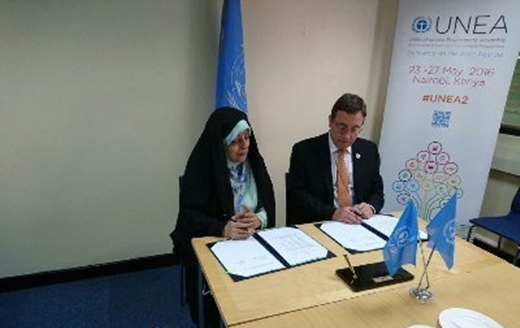
Masoumeh Ebtekar made the remarks at an annual gathering of Iranian ambassadors in the “Conference on the JCPOA and Resistance Economy – Opportunities and Capacities.” She said, “The Paris agreement was the most important event of 2015, which the Islamic Republic signed. Everyone needs to reduce their greenhouse gas emissions down to 12% in coming years.”

“President Rouhani has reaffirmed time and time again that his government is the government of environment,” said Ebtekar, adding “a number of environmental measures have been taken during the office of President Rouhani, including reviving wetlands, replacing petrochemical gasoline with Euro 4, holding an exhibition on environment, activating environmental funds, holding a Green International Film Festival, exchanging green technology with other countries, and making efforts to reduce pollution in 8 large cities across the country.”

She went on to add that Iran is planning to pursue the issue of dust storms in the Second Meeting of the UN Environment Assembly, to be held in Kenya on 23-27 May.

Tehran Experimental Art Week – Photos

Organized by the Urban Art House (UAH), the event covers three different projects, including an art performance, an open exhibition of installations and fusion music.

As visitors walk into the open grounds of the venue, they come face to face with experimental sculptures and installations set in the green spaces. The materials used for the artworks are mostly ordinary things such as socks, cotton, wool, wire, scraps of paper and short pieces of hose.

The festivities include concerts of fusion music and a theatrical performance, with the event running until May 18. Below are some photos of some of the installation pieces set out in the grounds of the Niavaran Cultural Centre.

Text from the Financial Tribune, photos from HonarOnline.