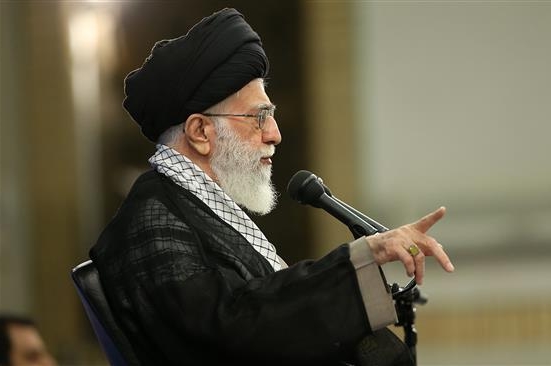
Saturday, January 17, 2026
Home Blog Page 4430

In Case of a War on Iran, Saudis Won’t Survive More than a Few Days

Abbas-Ali Mansouri Arani

A few days ago, Daily Beast quoted a letter from Colonel Faris bin Saif Al Harbi, an advisor to Saudi Arabia’s King Salman, in which he recommended the King to attack Iran.

“My King, at the direction of your most worthy son, the Deputy Crown Prince and Defense Minister Mohammed bin Salman, I have prepared a plan for the inevitable conflict against the Persians and Rejectionists [Shiite Muslims],” the Saudi advisor said in his letter.

“Defence is not enough.  We must also acquire the capability to strike at the Persians’ oil and gas infrastructure.  To this end we might take a lesson from the Persians and acquire shore-based anti-ship missiles and additional ballistic missiles to threaten their infrastructure and to project power from our coastline,” Faris went on to say.

He also referred to the historical hostility between Jews and Persians, saying, “While in the long run, the destruction of the Zionists is inevitable, in the short to medium term, they have a useful role to play against the Persians.”

“Even the Takfiri [extremists aligned with ISIS or Al Qaeda] among our population have a role to play in the coming war. […] The Takfiri of Daesh [ISIS] and Jabhat al-Nusra are at the forefront of the fight against the Rejectionists.  While neither group has any love for the Family or the Kingdom, they can be relied on to focus the attention of the Persians and their lackeys,” he added.

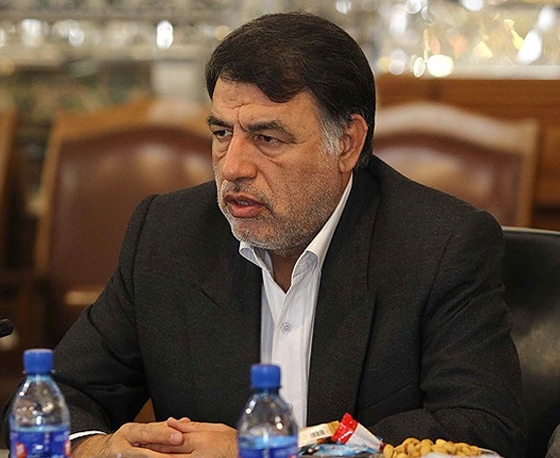
In reaction to the letter, Abbas-Ali Mansouri Arani, Iran’s former military attaché to Saudi Arabia and former member of Iranian Parliament’s National Security and Foreign Policy Committee, had an interview with Mizan. Here’s IFP’s translation of excerpts from the interview:


“The Saudi colonel’s letter can be interpreted in two ways: He has written the letter either under the pressure of Takfiris and Zionists or to break the taboo of cooperation with Zionists in Saudi Arabia,” Mansouri Arani noted.

“A colonel who has passed military courses is definitely familiar with military calculations and knows that Saudi Arabia has a far less chance against the Islamic Republic of Iran,” he went on to say.

They can’t even think about launching a war on Iran, Mansouri Arani stressed, downplaying the threat by describing it as unimportant.

“They don’t even have the preliminary military information. Saudis well know that they would not last more than a few days against Iran’s motivated forces, who are equipped with advanced weaponry, particularly indigenous long-range missiles,” he added, emphasizing that Iran will never start any war.

“Intelligence agencies of Saudi Arabia, the US, and Israel always try to introduce Iran to the world’s public opinion as an enemy,” he said, adding that Tehran’s might is that of the Muslim world, and Iran always advises regional states not to be deceived by Zionist and US plots.

He further drew a distinction between the Saudi rulers and their people, saying that even Saudi people themselves do not accept the rule of Al Saud royal family.

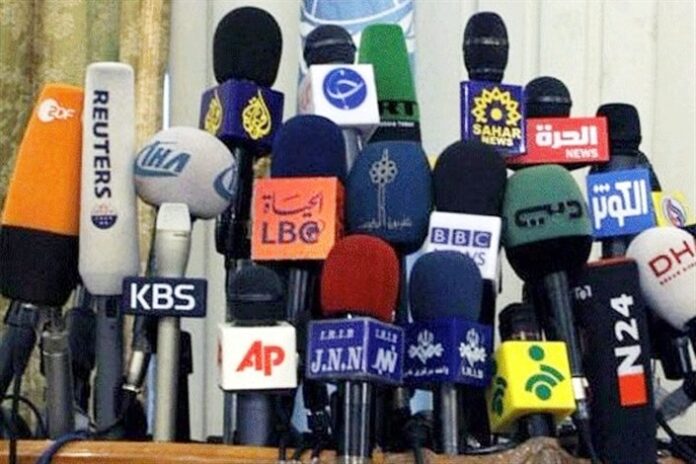
153 Accredited Foreign Media Working in Iran: Official Report

Foreign Media Working in Iran

Here’s IFP’s translation of a report by the Foreign Media Department:

According to the latest records published by the Foreign Media Department, there are 153 accredited foreign media agencies in the Islamic Republic of Iran, covering and broadcasting the latest news to the world in 14 different languages.

304 members of the press, including Iranian and foreign correspondents, journalists, cameramen, and assistants are working for these media, he went on to say.

201 of them have Iranian nationality and 98 are working as foreign nationals. 29 countries have representatives in Iran, 11 of which are Muslim states and 9 from Europe, an official with the Department, Mohammad Jafar Safi, told IRNA.

“With 18 media outlets, Iraq has the highest number of media agencies in Iran,” Safi noted.

Out of the 153 outlets, 79 are radio and TV stations, 35 are news agencies, 28 are newspapers, and 11 are photo agencies.

Austria, Azerbaijan, Australia, Afghanistan, Bahrain, Belgium, Canada, Colombia, China, England, France, Germany, Holland, Italy, Iraq, Japan, Kuwait, Lebanon, Luxemburg, North Korea, Oman, Palestine, Qatar, Spain, Syria, South Korea, Turkey, UAE, USA, and Switzerland are the countries that have representatives in Iran.

Why Zarif Left SCO Meeting in Tashkent

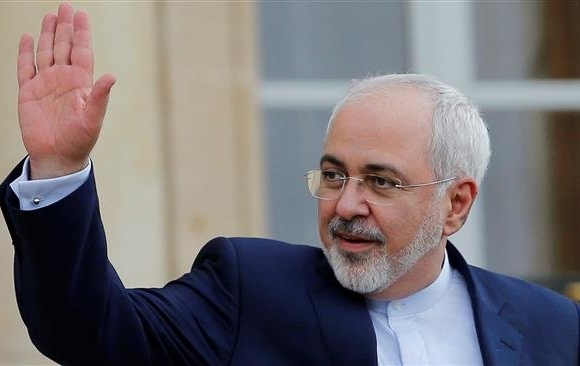
zarif in Tashkent-SCO

Certain media in Iran claimed on Friday that Zarif had left the SCO meeting in Uzbekistan’s capital, Tashkent, as a sign of protest. Rahimpour rejected the rumours, saying that Zarif left the meeting not to show his dissent but to say his prayers, as reported by Tabnak and translated by IFP.

An informed source told Tabnak that nothing special had happened at the SCO meeting, and thus there was no cause for the Foreign Minister to protest.

However, the source added, Zarif intended to show in a practical way that the Organization was not very important to Iran. Therefore, he only attended a few speeches before leaving the meeting.

According to the informed source, Iran’s Foreign Ministry does not agree at all with the previous government’s approach – over-insisting on Iran’s accession to the SCO – and believes that the Organization itself should call for Iran’s membership, as it did for India and Pakistan.

This was the reason why Iran’s President Hassan Rouhani did not take part in the Tashkent Summit, which was held at the level of Leaders, because the issue of Iran’s accession was not at all supposed to be raised at this meeting, the source added.

Iran’s Government and Foreign Ministry are resolved to maintain the country’s honour in the issue of SCO accession, Tabnak quoted the source as saying.

The Shanghai Cooperation Organisation is a Eurasian political, economic, and military organisation which was founded in 2001 in Shanghai by the leaders of China, Kazakhstan, Kyrgyzstan, Russia, Tajikistan, and Uzbekistan.

The SCO conference opened in Tashkent on Friday 24 June with the participation of several leaders, including Russian President Vladimir Putin.

Iran currently holds observer status in the SCO, and its full membership is expected to be put on the SCO conference’s agenda in the near future.

According to Rahimpour, the presidents of China, Kyrgyzstan, Kazakhstan, Russia, India, and Pakistan backed Iran’s bid for SCO membership during the recent summit.

A Look at Iranian Newspaper Front Pages on June 26

Iran Newspaper front pages

Iranian papers on Sunday focused on the recent remarks by the Leader of the Islamic Revolution Ayatollah Seyyed Ali Khamenei about Sheikh Isa Qassim, the Bahraini cleric, and the ongoing uprising in Bahrain. The Leader also pointed to the fight against terrorism in Iraq and Syria, stressing that the ISIS was created as the first phase of a failed project to paralyse Iran.

The repercussions of Britain’s withdrawal from the European Union, known as Brexit, also remained a top story in many Iranian newspapers. The major changes in oil and gold prices as well as the shocks to global markets are covered in today’s front pages.

The death of three Iranian rangers in the past two days in their fight against illegal hunters is another story covered by many Iranian media. There ongoing debates over the laws and regulations that should be passed to protect the lives of rangers.

Here are the abovementioned topics as well as several other issues covered by Iranian press on Sunday:


Abrar:

1- Fallen Soldiers and Negligence of Authorities

2- Boeing Deal Indicates the Road for Trade with Iran Is Open: US Diplomat

3- Brexit Not to Change Iran’s Approach: Foreign Ministry
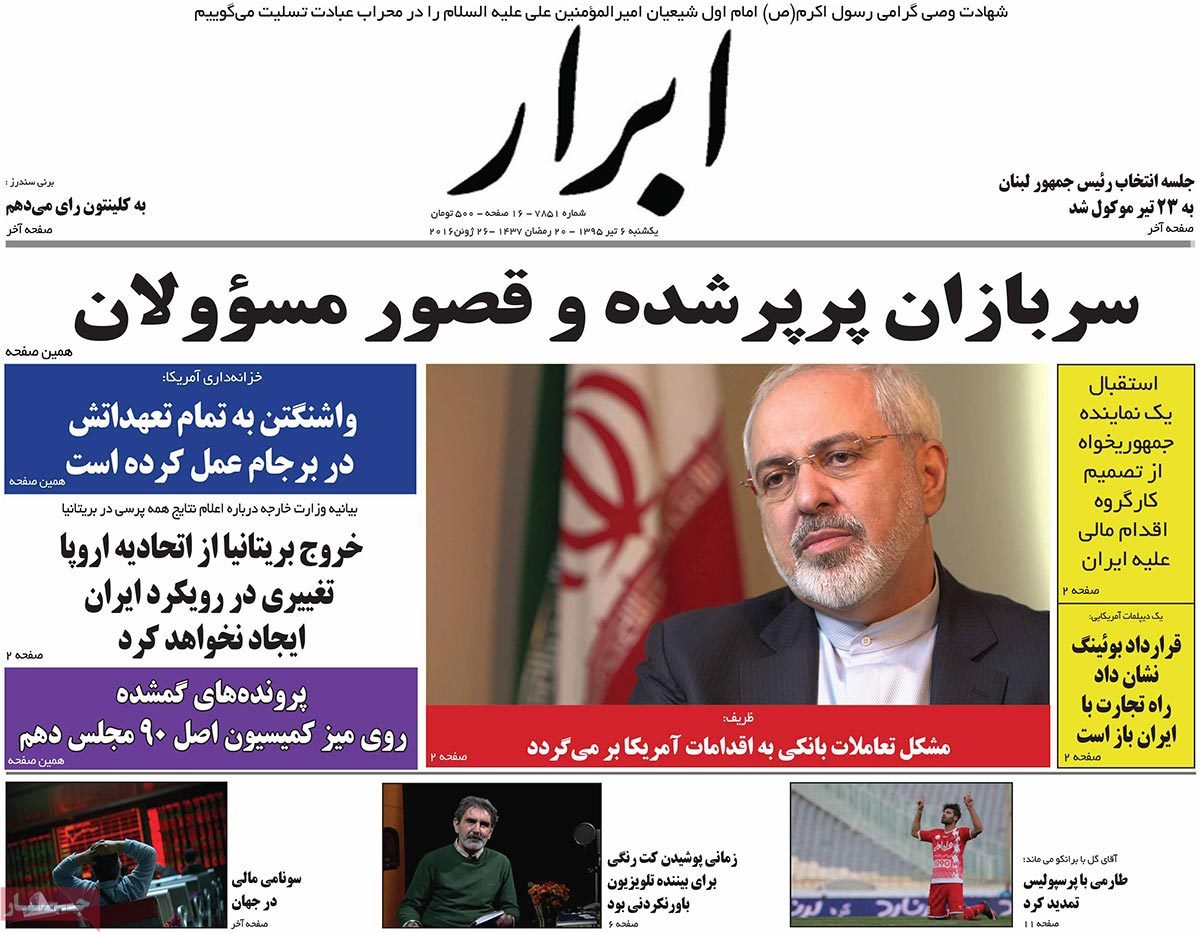
A Look at Iranian Newspaper Front Pages on June 26


Abrar-e Eqtesadi:

1- Gold Coin Price Stands at Highest Price in 2 Years

2- Iran’s Daily Oil Income Down by $4m

3- Iran’s Stock Exchange Market Waiting for Reactions to Brexit

4- Sale of 1m Barrels of Oil to Spain: Iran’s Oil Exports to Europe Will Increase
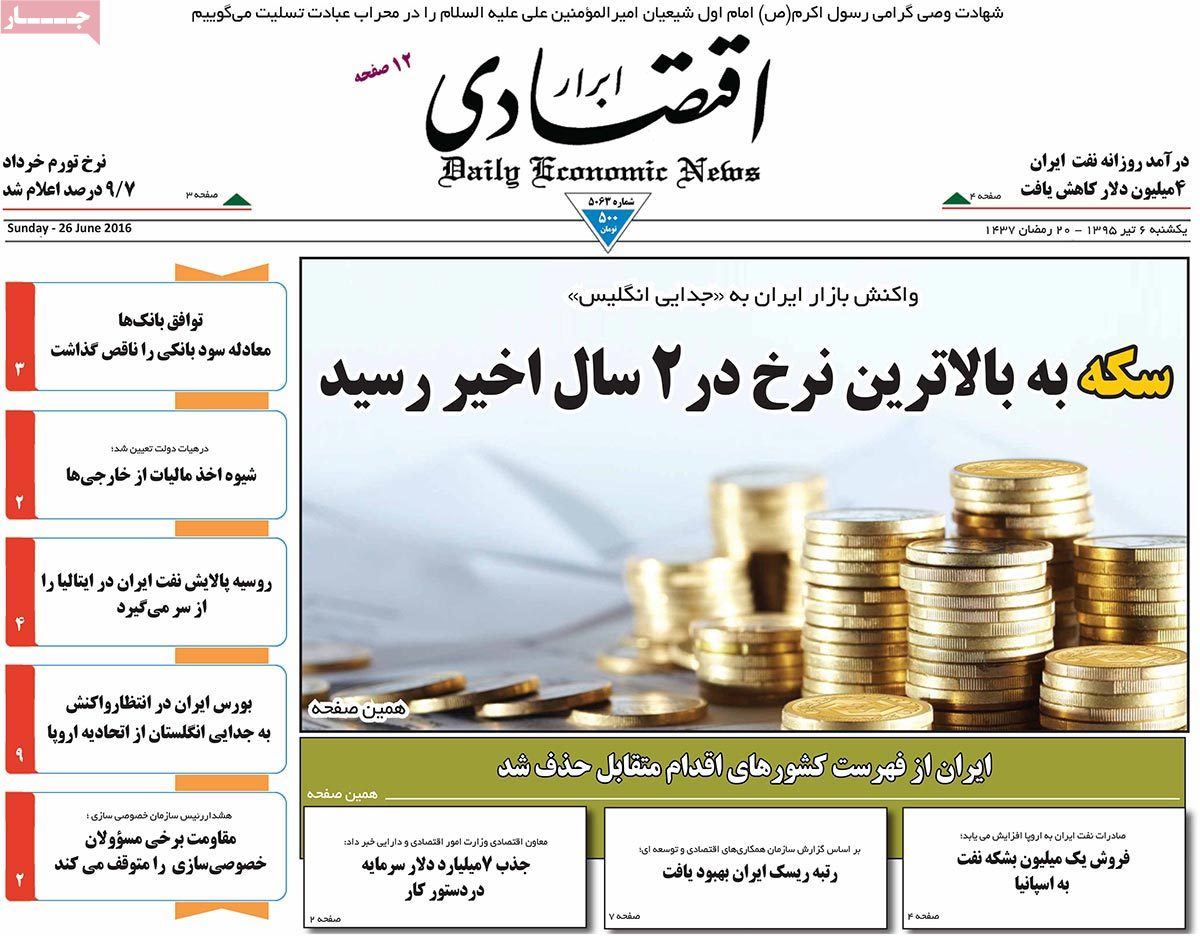
A Look at Iranian Newspaper Front Pages on June 26


Aftab-e Yazd:

1- Who Runs the Anti-Gov’t Think-Thanks?

2- Rouhani’s Advisor: Ahmadinejad’s Associates Are Terrified

3- It’s Not Appropriate to Say All Executives Are Thieves: Imam Khomeini’s Grandson
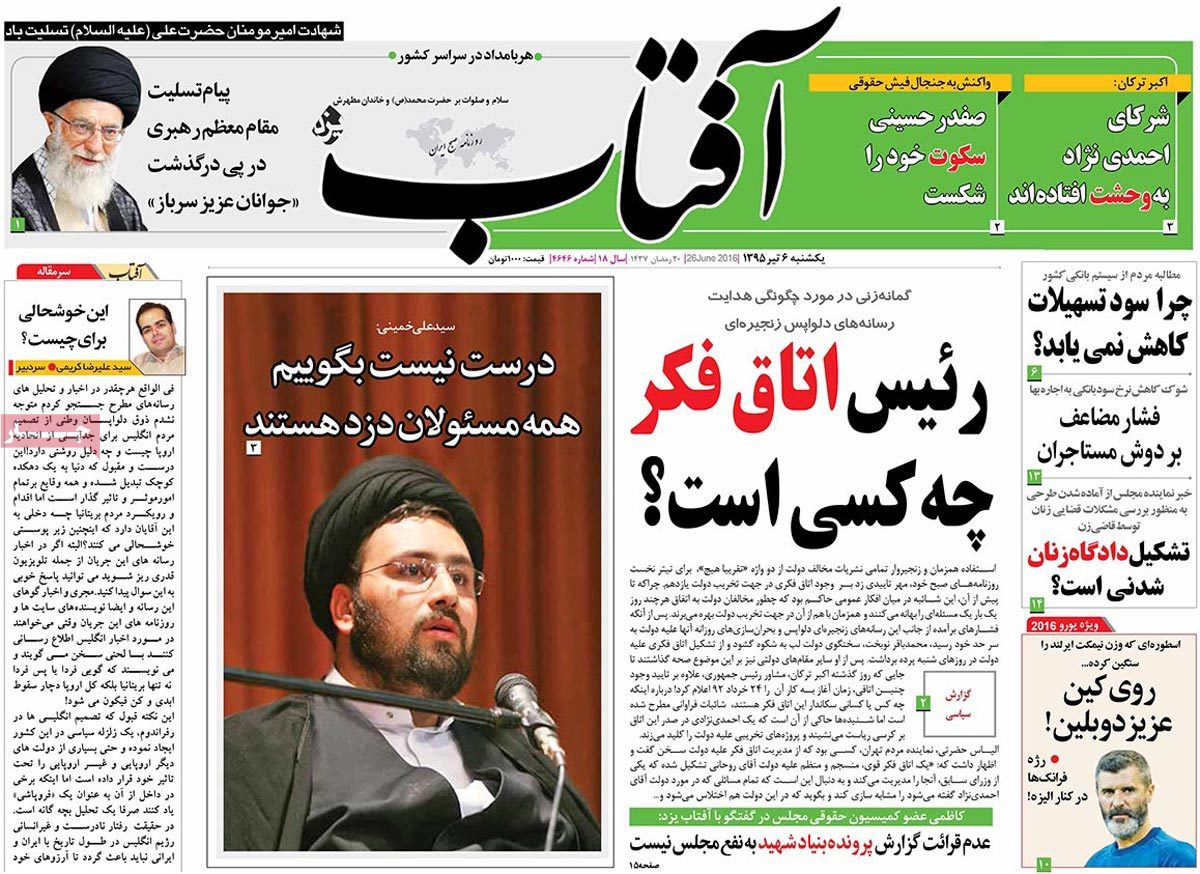
A Look at Iranian Newspaper Front Pages on June 26


Arman-e Emrooz:

1- They Created ISIS to Defeat Iran: Leader

2- Rouhani Is Alone: No One in Rouhani’s Cabinet Defends Him, Reformist Politician Says

3- Women Want to Become Judges! Parliament to Discuss a Plan Which Allows Appointment of Women as Judges of Cases Related to Women Issues

4- Democracy and Centre of Power in Britain [Editorial by Zibakalam]

5- Parliament to Deal with Issue of 3 Rangers Killed in Past Two Days

6- Consequences of Brexit for Iran: Decrease in Oil Price or Removal of Communication Barriers?
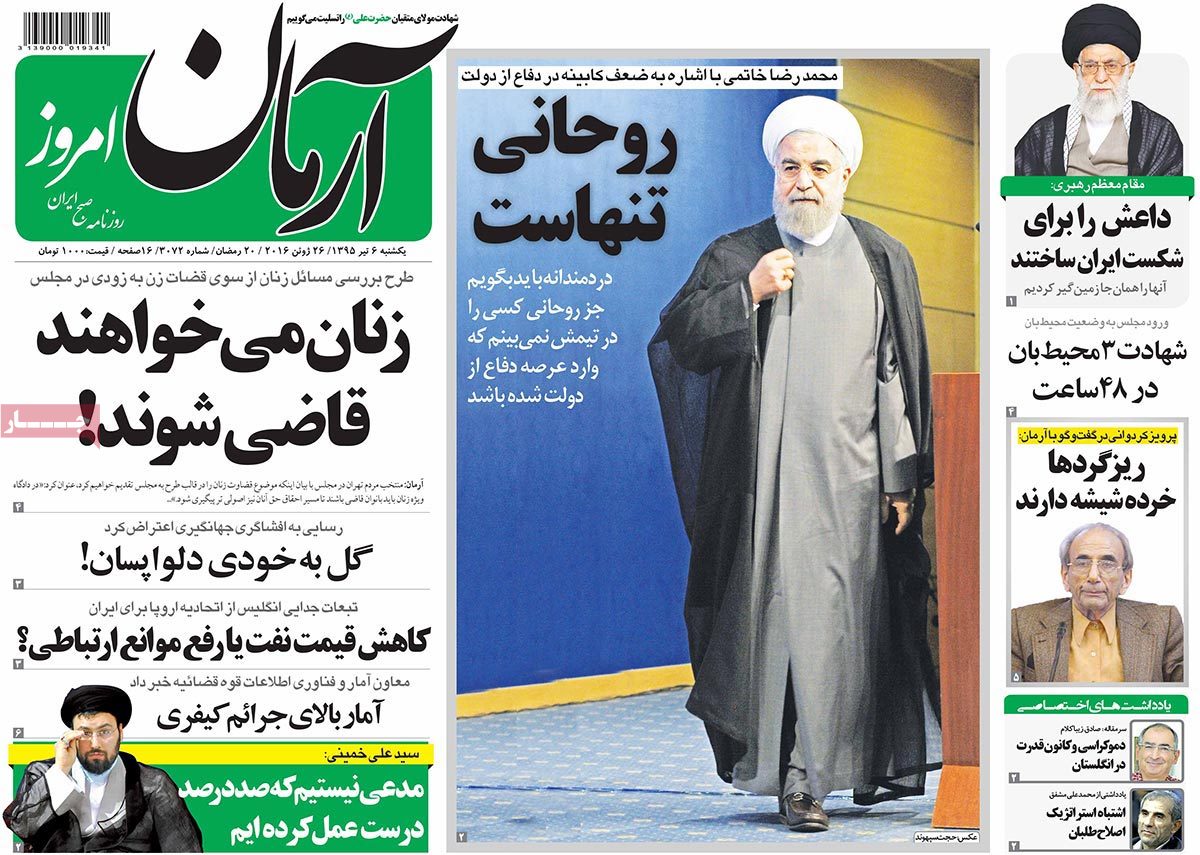
A Look at Iranian Newspaper Front Pages on June 26


Asia:

1- EU Founders in a Statement: What a Mistake Britons Made!

2- JCPOA Has Potential to Reduce Iran-US Hostility: Lesli Tsou

3- Sweden Opens Trade Office in Iran
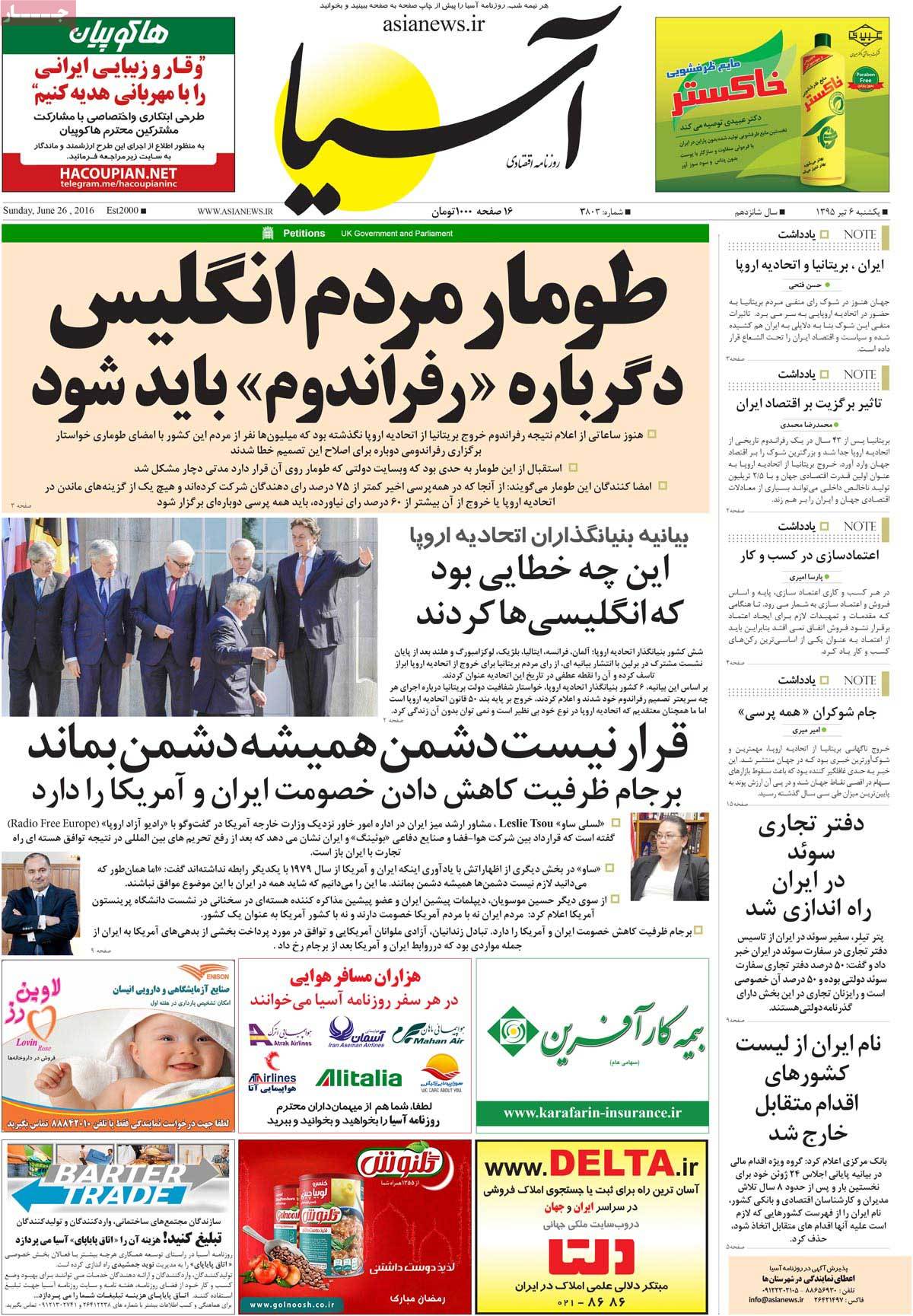
A Look at Iranian Newspaper Front Pages on June 26


Asrar:

1- Bioterrorism Threat Should Be Taken Seriously: Senior MP

2- Leaders of Shanghai Cooperation Organization Emphasize Iran’s Accession to SCO

3- Anti-Gov’t Think-Tanks Have Been Formed Since 2013: Advisor
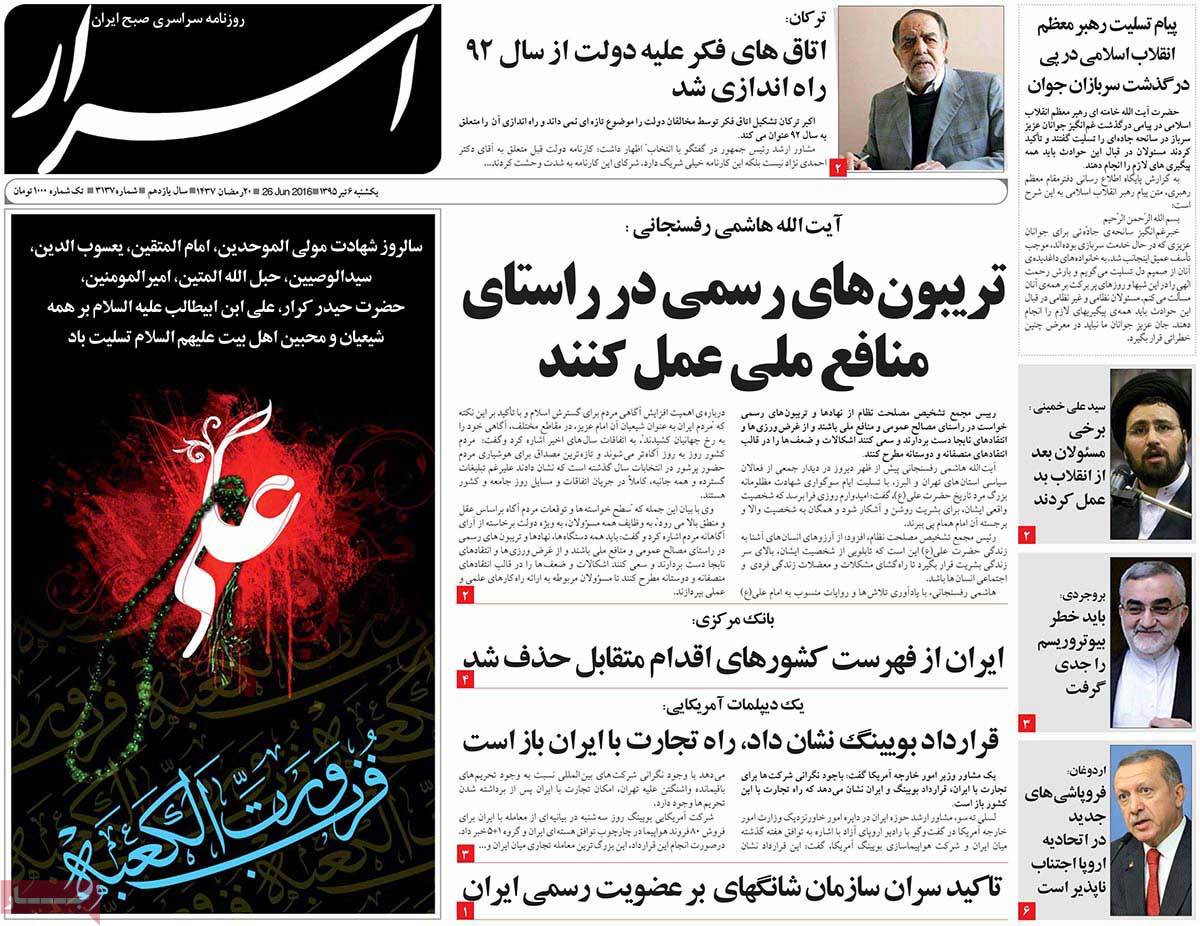
A Look at Iranian Newspaper Front Pages on June 26


Ebtekar:

1- Lives of Our Dear Youth Should Not Be Endangered by Such Threats: Leader on Recent Bus Crash that Killed Several Soldiers

2- Our Budget Comes from Iran, So Do the Rockets by Which We Threaten Israel: Nasrallah

3- Extinction of Rangers! There’s No Law for Protecting Rangers’ Lives
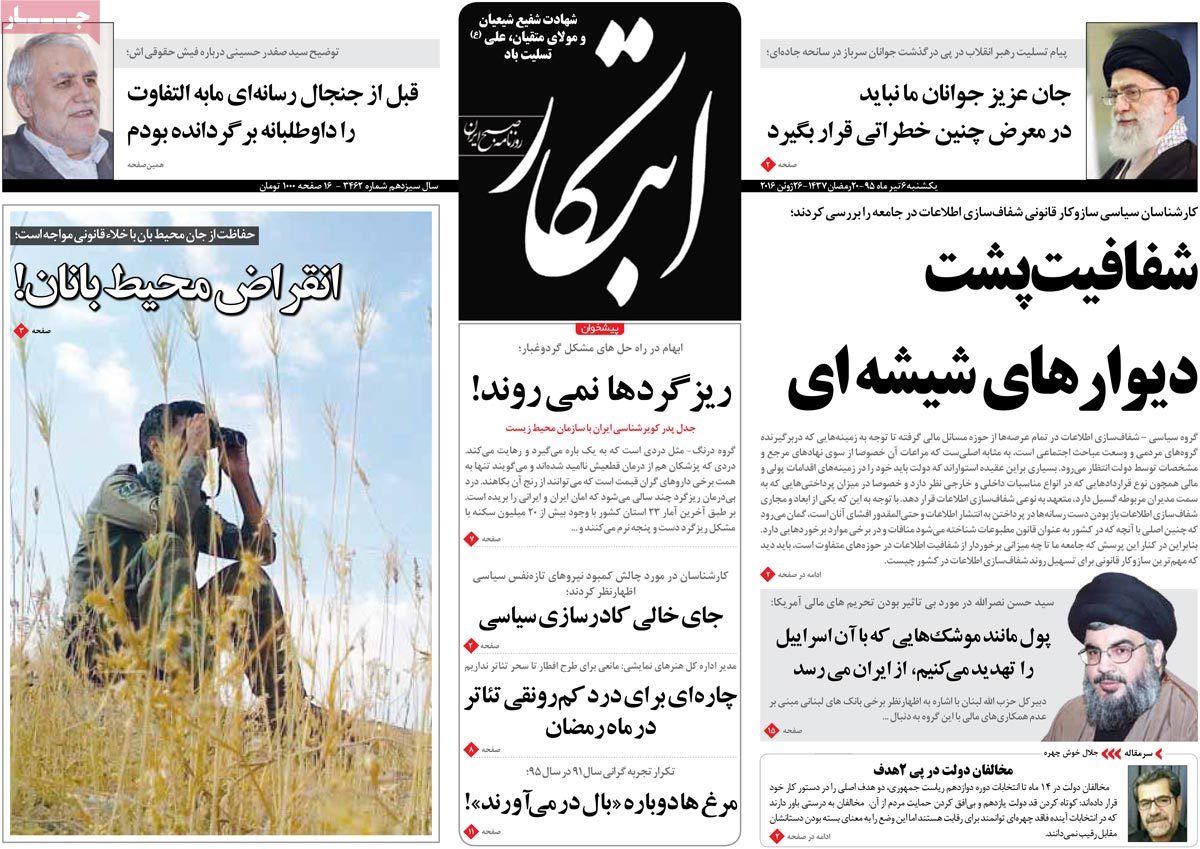
A Look at Iranian Newspaper Front Pages on June 26


Etemad:

1- I Don’t Claim What Revolutionary Forces Did [in early years after 1979 Revolution] Was 100% Correct: Imam Khomeini’s Grandson

2- On Anniversary of Saddam Hussein’s Chemical Attack on Sardasht: Our Responsibilities and Those of Chemical Attack Survivors [Editorial]
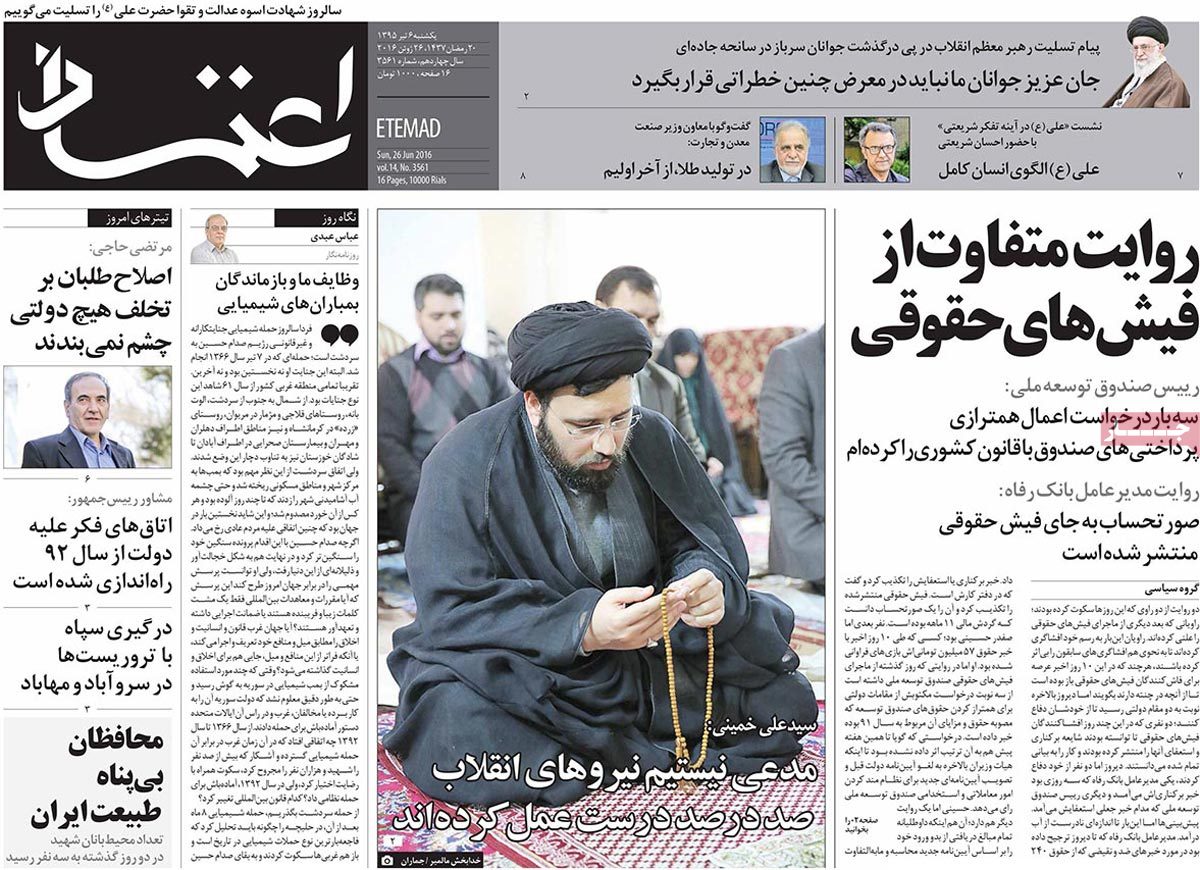
A Look at Iranian Newspaper Front Pages on June 26


Ettela’at:

1- Wave of Divergence in EU: Right-Wingers of France, Germany and Italy Keen to Exit from EU

2- Brexit Decreases Value of World’s Capital Markets by $2.1tr

3- Bill Being Prepared to Protect Rangers: Environment Dept. Chief

4- Lives of Billionaires in Iran
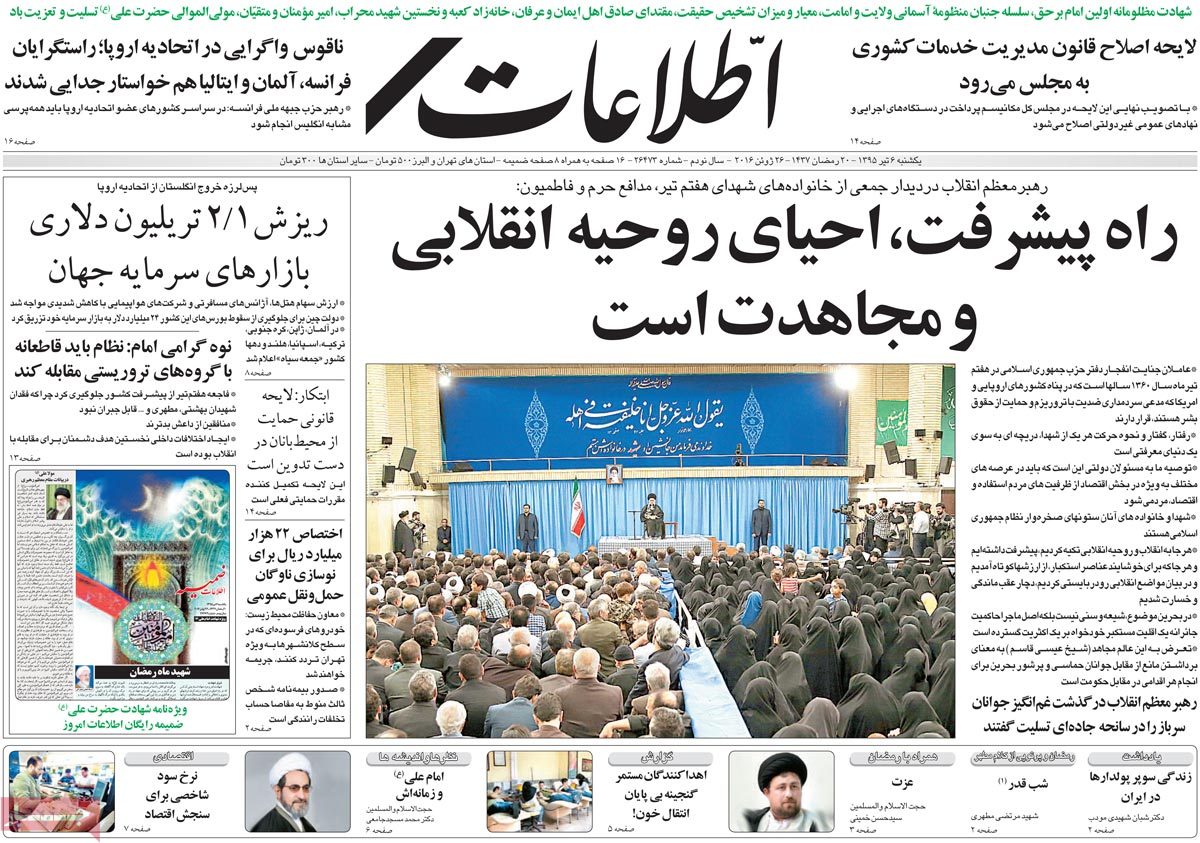
A Look at Iranian Newspaper Front Pages on June 26


Haft-e Sobh:

1- What Hunters Want from Us? Murder of 3 Rangers in Past 48 Hours

2- British Storm in Iran’s Gold and Foreign Exchange Markets
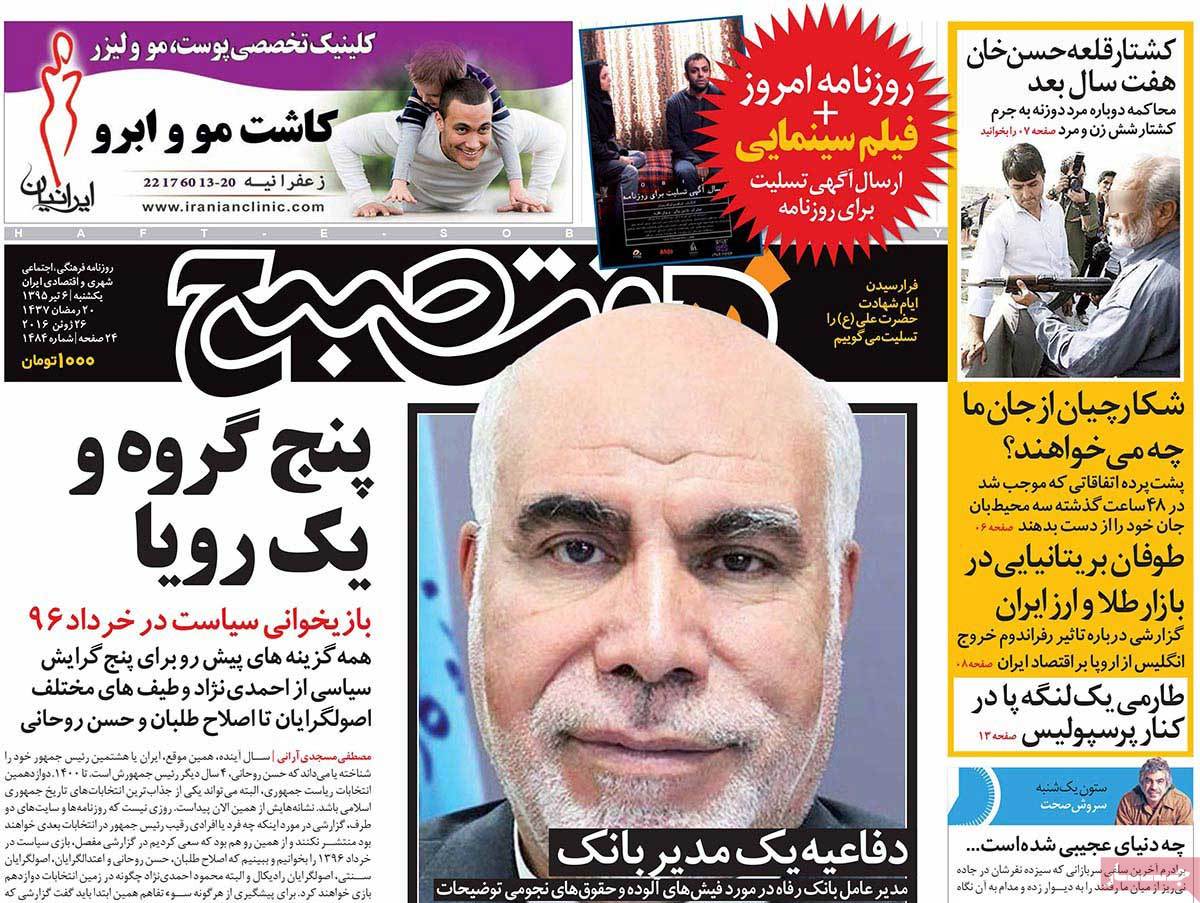
A Look at Iranian Newspaper Front Pages on June 26


Iran:

1- British Shock to Iranian and Global Markets: Repercussions of Brexit

2- Iran’s Oil Extraction from South Pars Field to Equal Qatar’s by Year-End
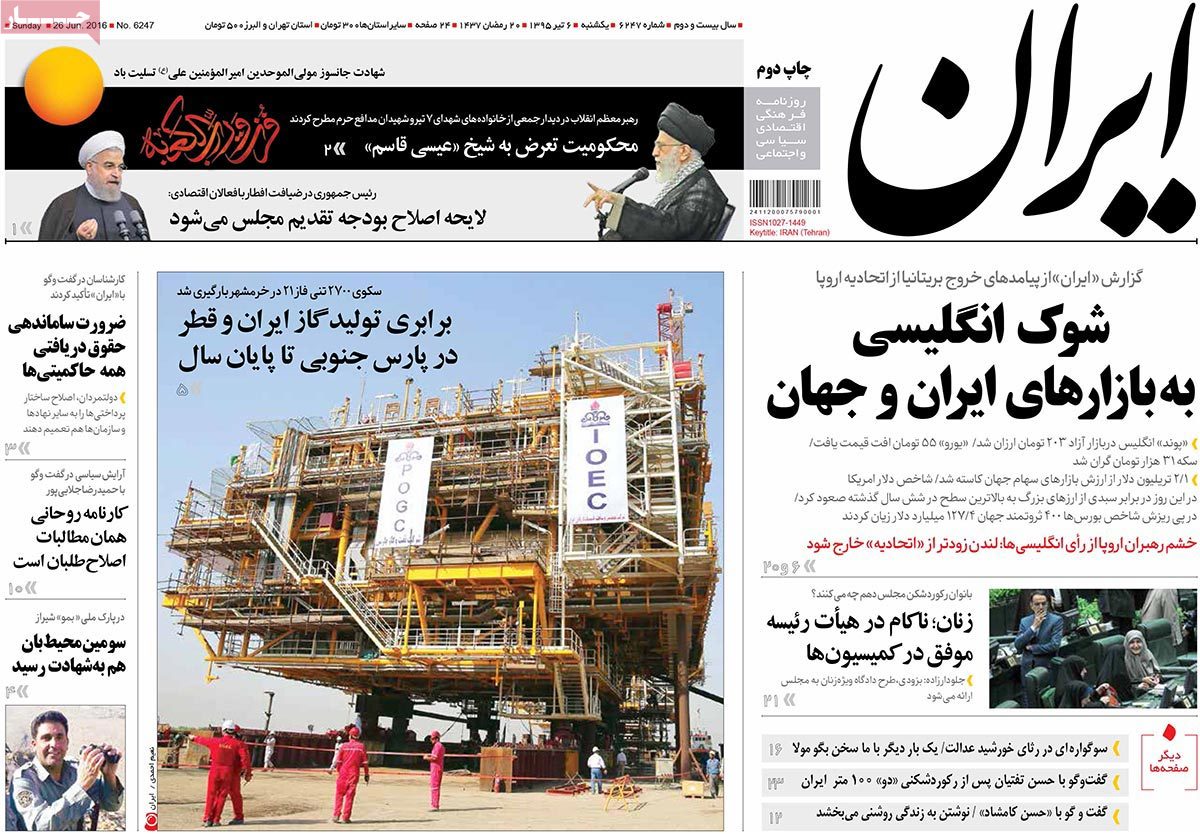
A Look at Iranian Newspaper Front Pages on June 26


Jame Jam:

1- Britons Regret Voting in Favour of Brexit

2- Palestine, the Main Issue of Muslim World
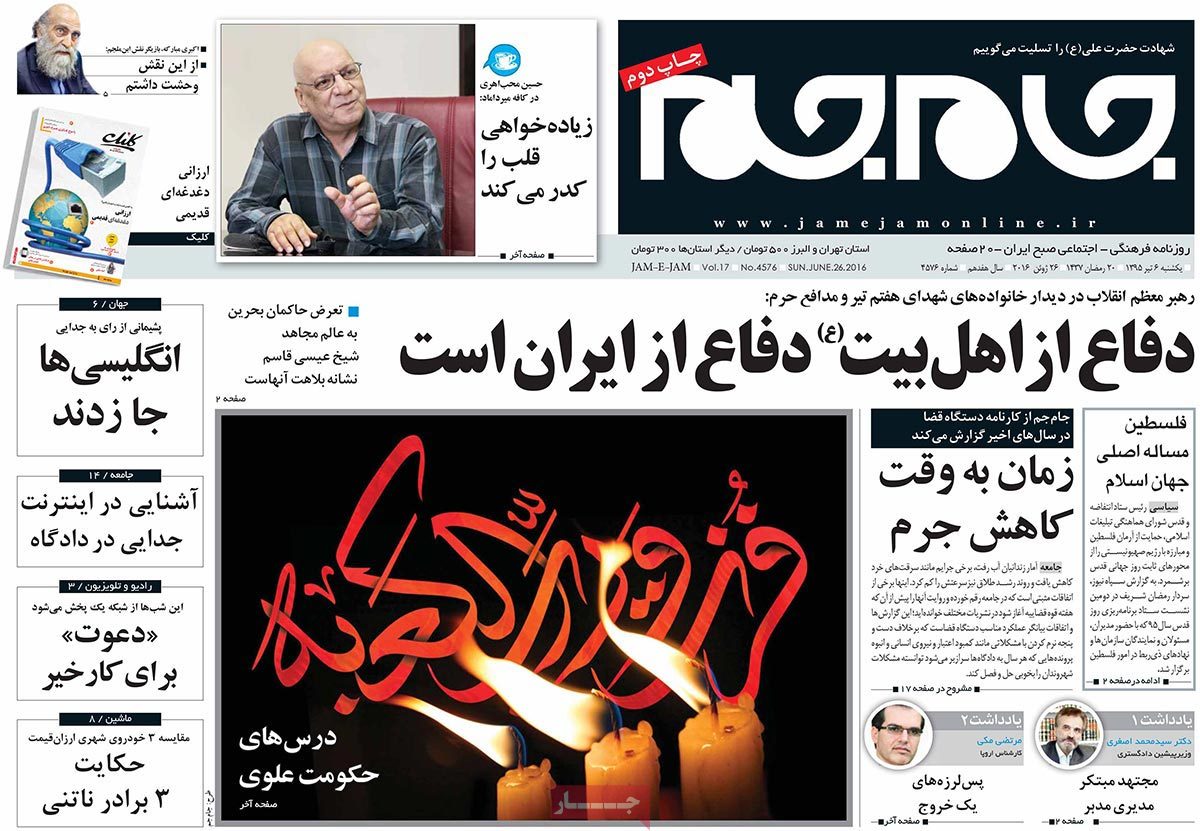
A Look at Iranian Newspaper Front Pages on June 26


Javan:

1- Defending the Shrines of Ahl-ul-Bayt [Prophet Muhammad’s Family] Is Defending Iran: Leader

2- US Lawmakers Seeking to Reopen Iran’s PMD Case

3- Shadow of Autonomy from Europe to US: Repercussions of Brexit

4- Iran’s Central Bank Commits Itself to FATF Obligations, Which Are beyond Scope of JCPOA
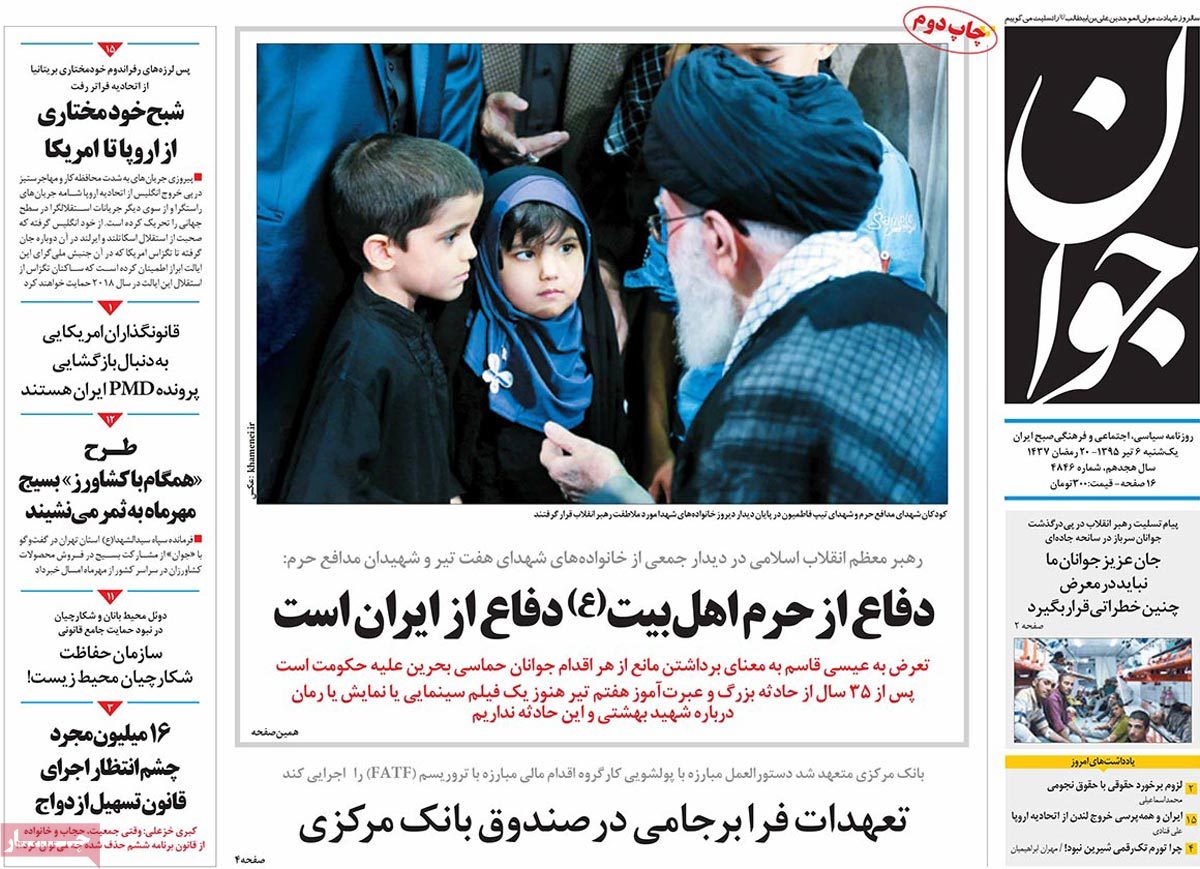
A Look at Iranian Newspaper Front Pages on June 26


Jomhouri Eslami:

1- Island of Britain Exposed to Waves of Disintegration

2- Iraqi Forces Continue Their Progress in Northern Salahuddin and Southern Mosul
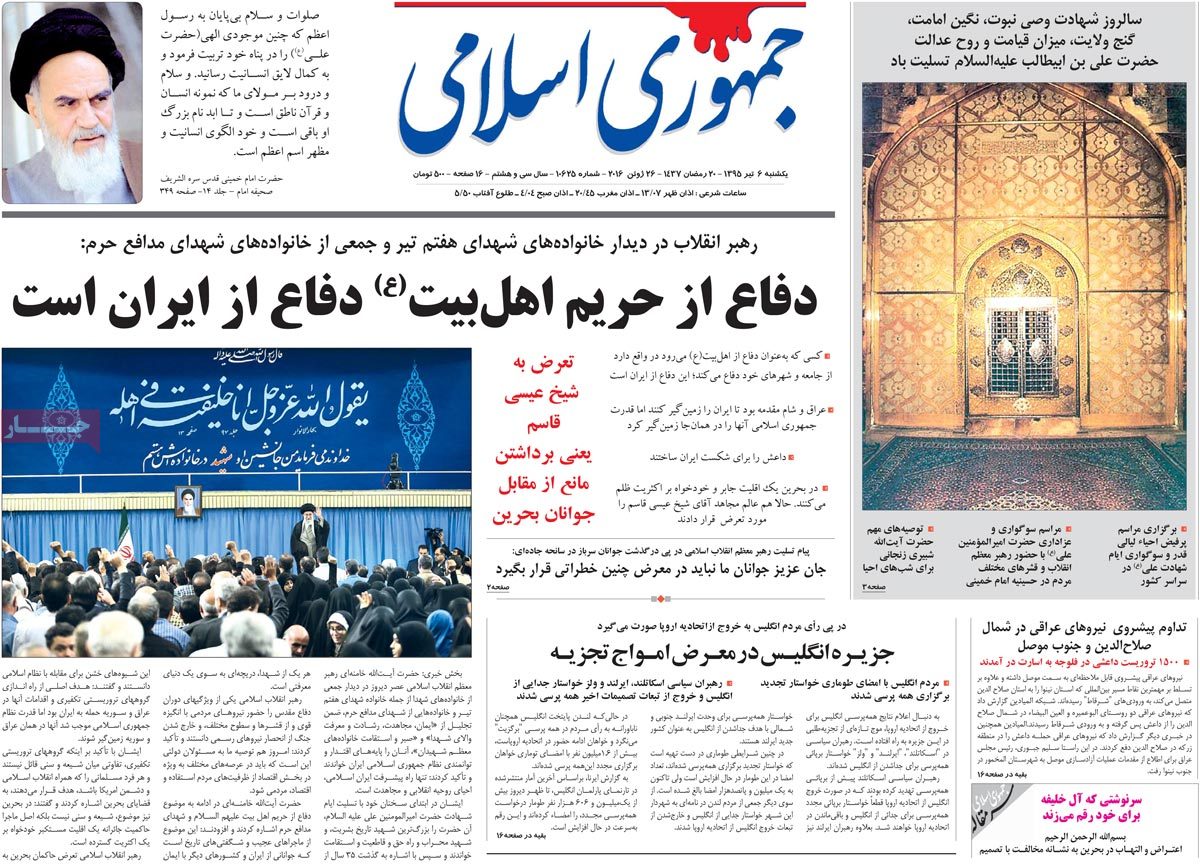
A Look at Iranian Newspaper Front Pages on June 26


Kayhan:

1- Attacks on Sheikh Qassim Unleashes Bahraini Youth’s Ire [at Al Khalifa rulers]: Ayatollah Khamenei

2- 7 Other European Countries Ready to Exit EU
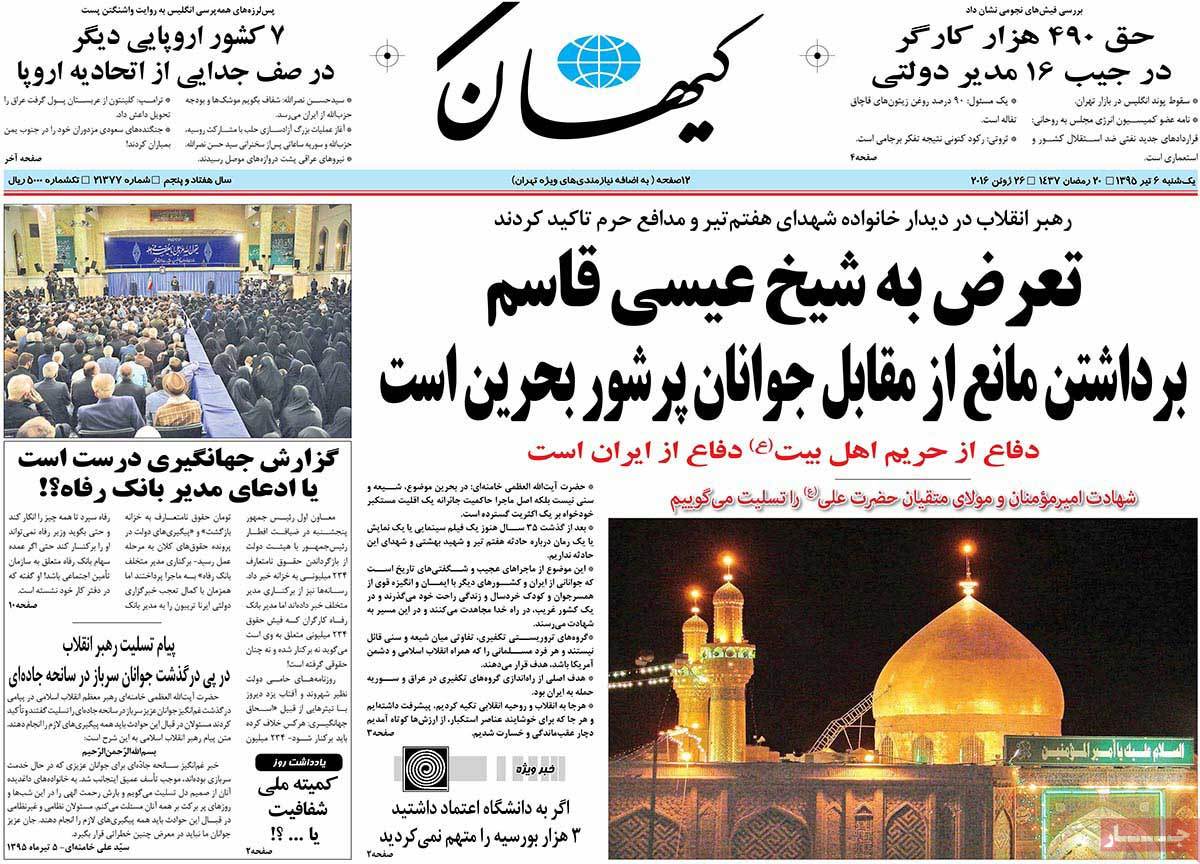
A Look at Iranian Newspaper Front Pages on June 26


Khorasan:

1- Iran Was Their Target, But They Were Paralysed in Iraq and Syria: Leader

2- Iran’s Central Bank Welcomes FATF Move: Opponents Worried about Beginning of JCPOA
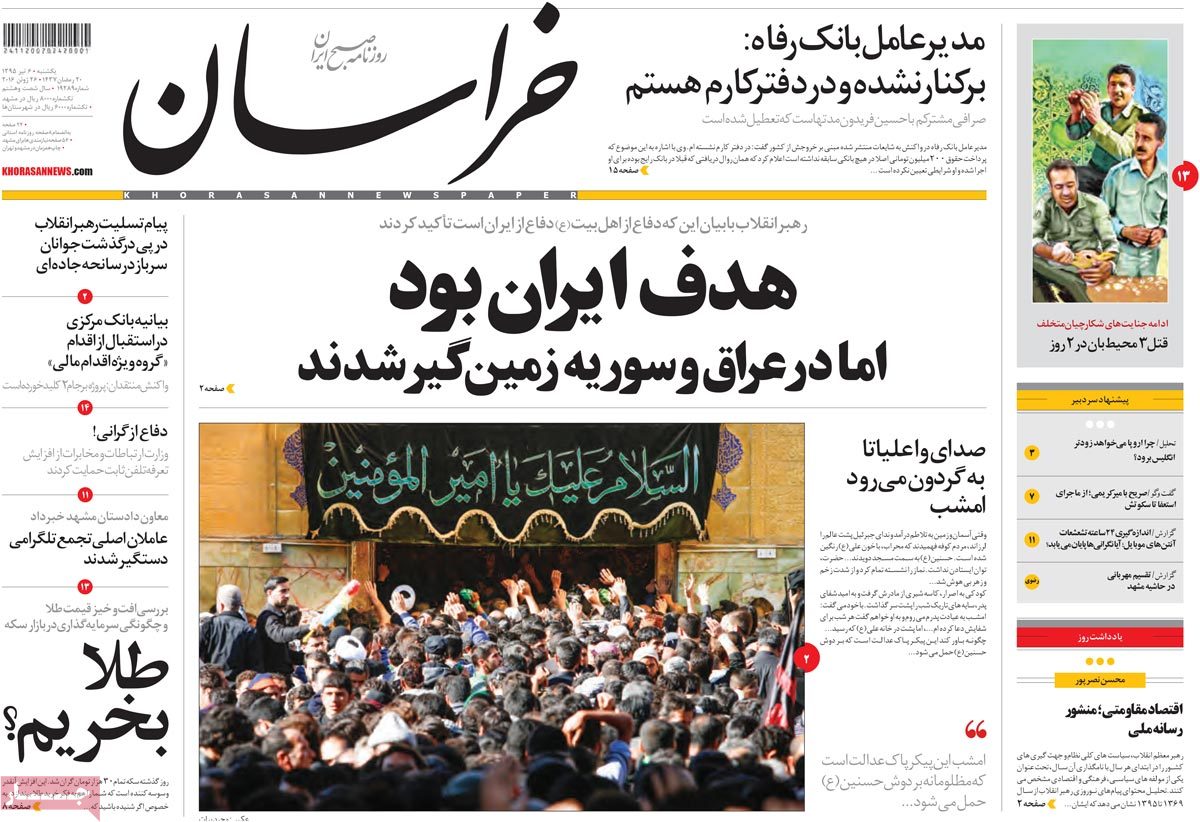
A Look at Iranian Newspaper Front Pages on June 26


Resalat:

1- A Cruel Minority Is Ruling the Majority in Bahrain: Ayatollah Khamenei

2- Beginning of a Domino for Exiting the EU
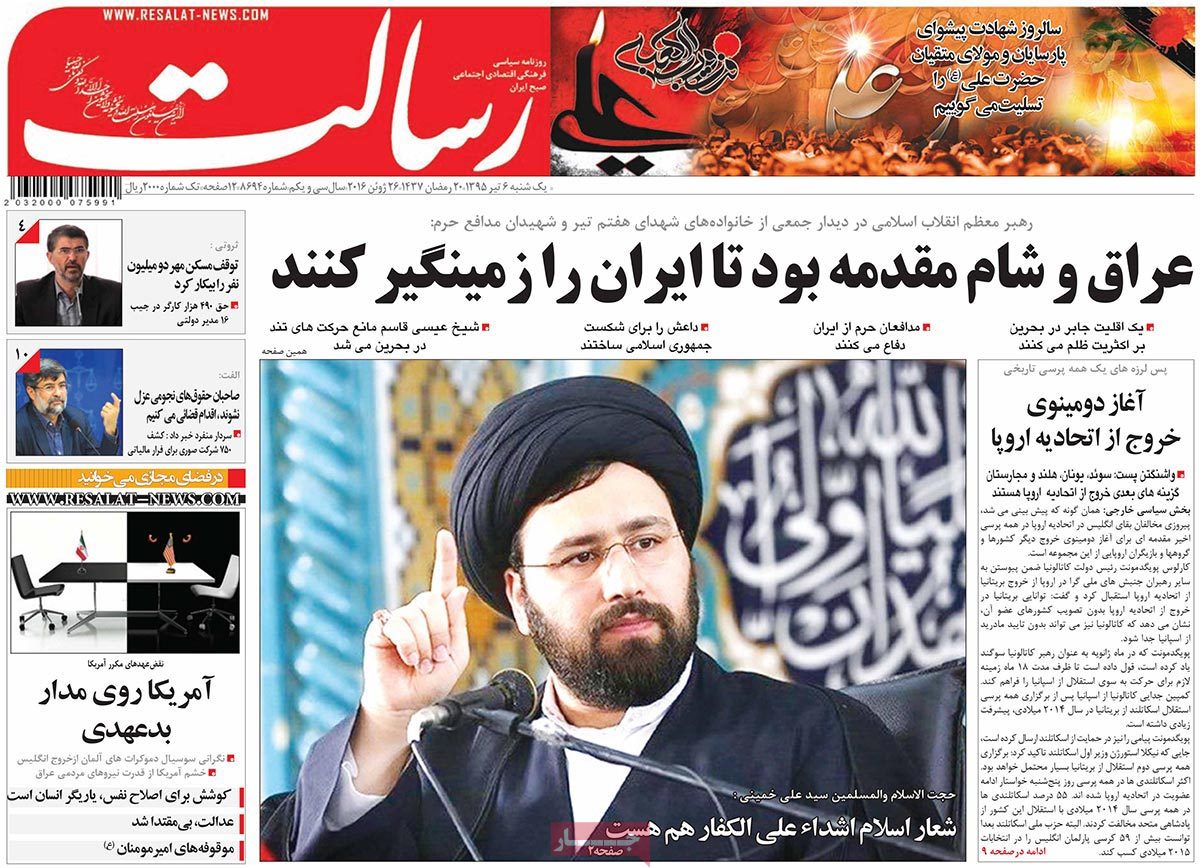
A Look at Iranian Newspaper Front Pages on June 26


Sayeh:

1- We Don’t Want Turkization: Zarif’s Timely Move to Leave SCO’s Tashkent Summit
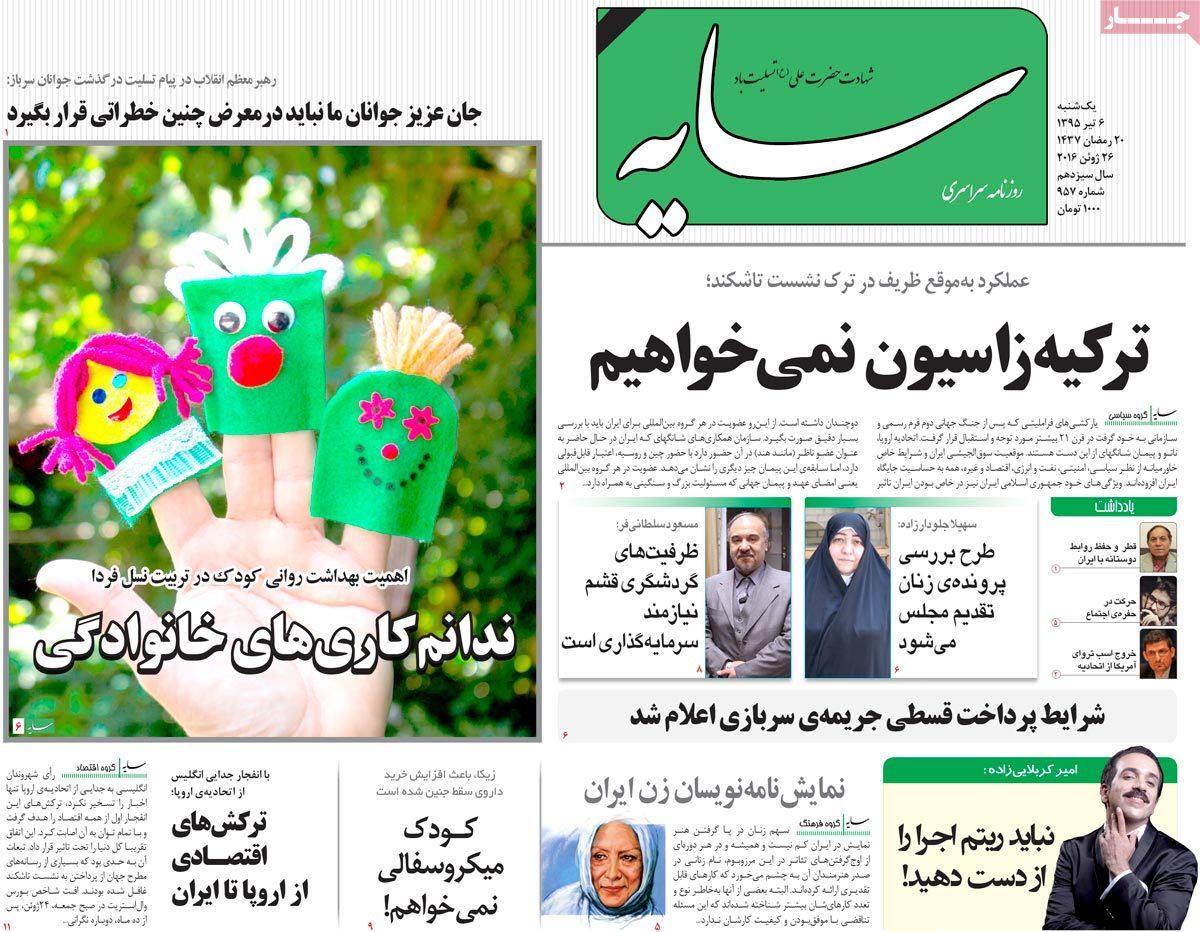
A Look at Iranian Newspaper Front Pages on June 26


Sepid:

1- 33 Iranians among World’s Top 1% Highly-Cited Scientists

2- A Report on Infants Who Are Addicted to Drugs since Their Birth
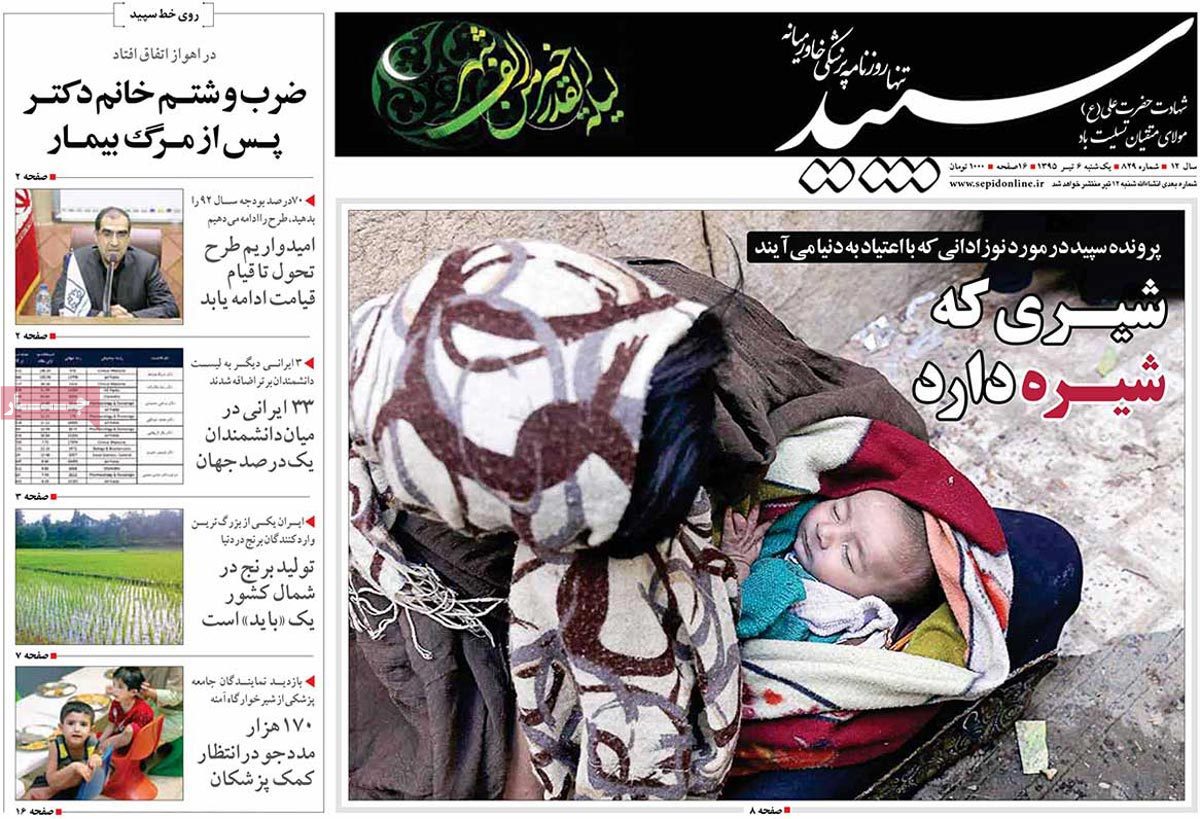
A Look at Iranian Newspaper Front Pages on June 26


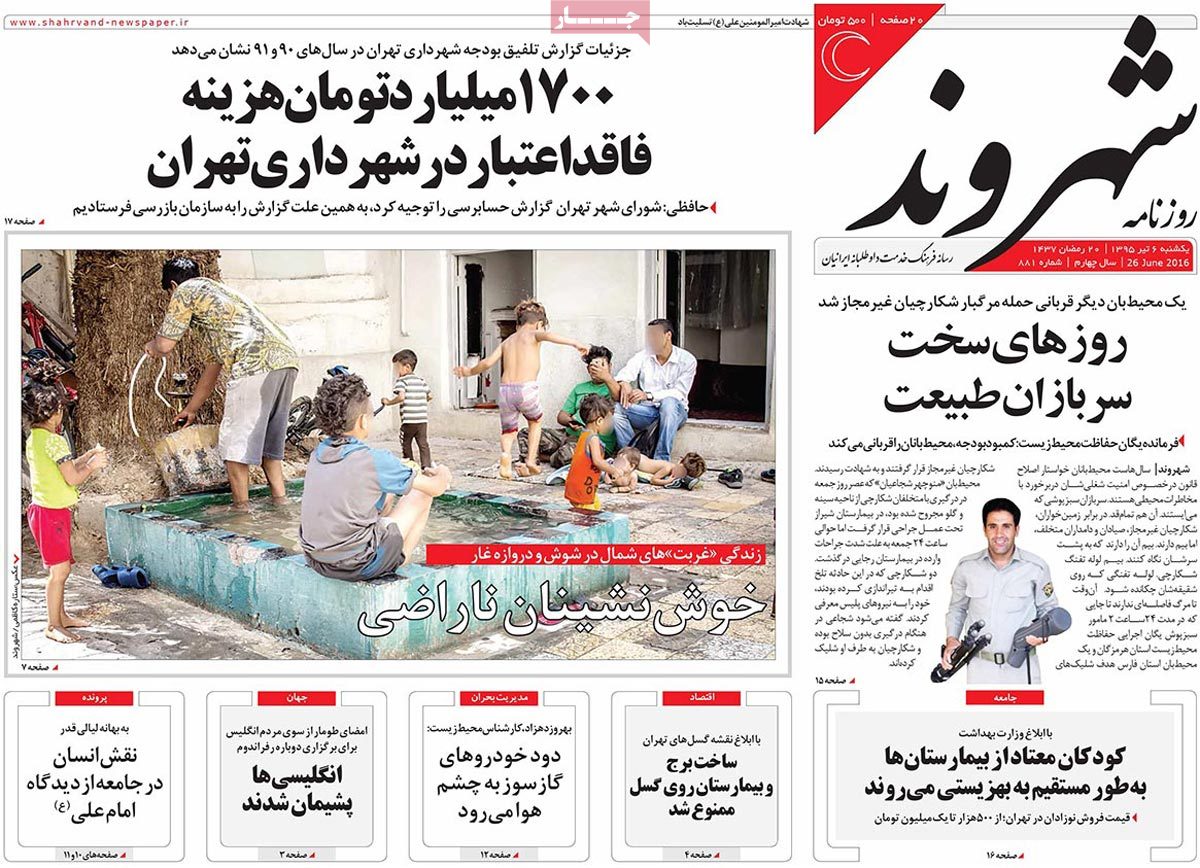
Shahrvand:

1- Hard Days of Soldiers of Nature: Another Ranger Killed by Illegal Hunters

2- British People Sign Petition, Calling for a Second Referendum
A Look at Iranian Newspaper Front Pages on June 26


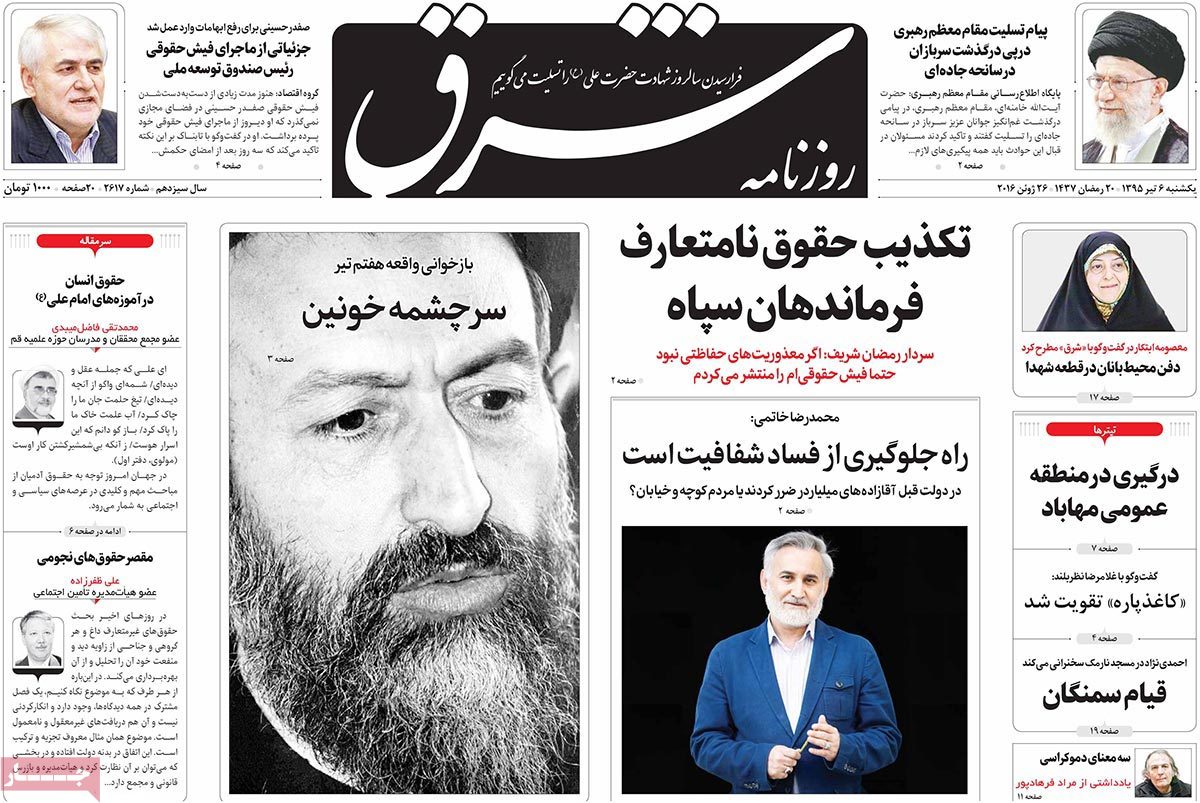
Shargh:

1- IRGC Dismisses Reports on Huge Salaries of Its Commanders

2- Transparency Is the Way to Prevent Corruption: Politician
A Look at Iranian Newspaper Front Pages on June 26


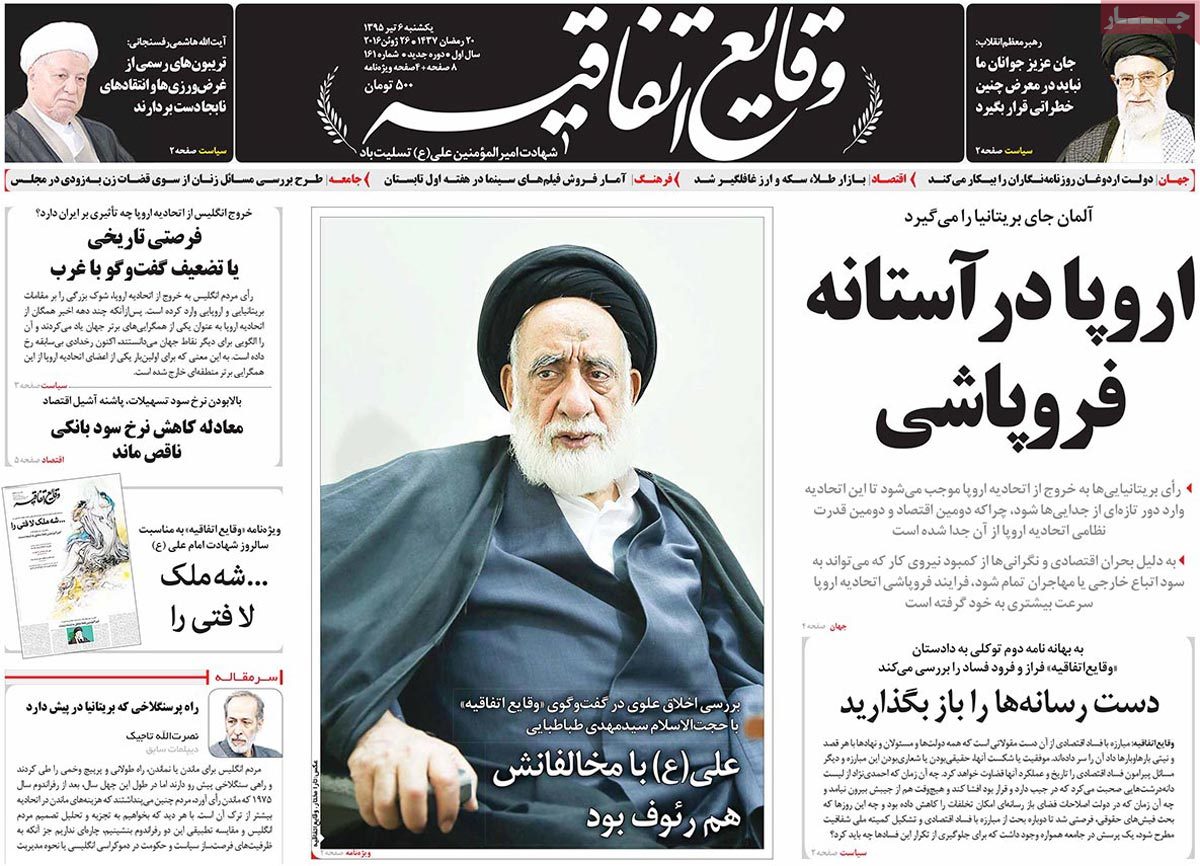
Vaghaye Ettefaghieh:

1- Europe on Verge of Collapse: Germany to Replace Britain

2- Rafsanjani Urges Official Tribunes to Stop Unfair Criticism

3- The Rocky Road ahead of Britain [Editorial]
A Look at Iranian Newspaper Front Pages on June 26


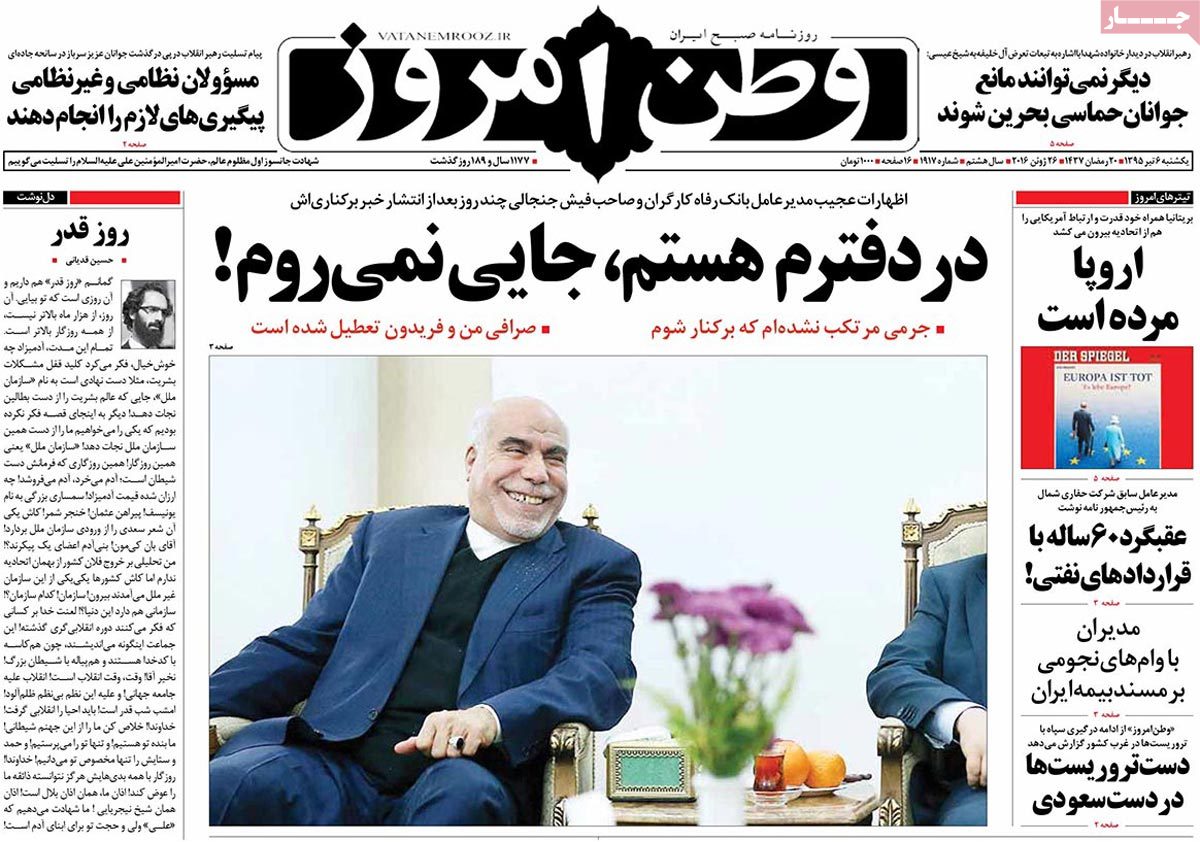
Vatan-e Emrooz:

1- They Can’t Prevent Movement of Bahraini Youth Anymore: Iran’s Leader

2- Bank Refah Chief Who Received a Monthly Salary of over $67,000: I’ve Not Committed Any Crime, Why Should I Be Dismissed? I’m at My Office, I Won’t Go Anywhere!

3- Terrorists and Saud Arabia Are Hand in Hand in West of Iran

4- Europe is Dead: Brexit Will Cleanse EU of US Power and Influence
A Look at Iranian Newspaper Front Pages on June 26

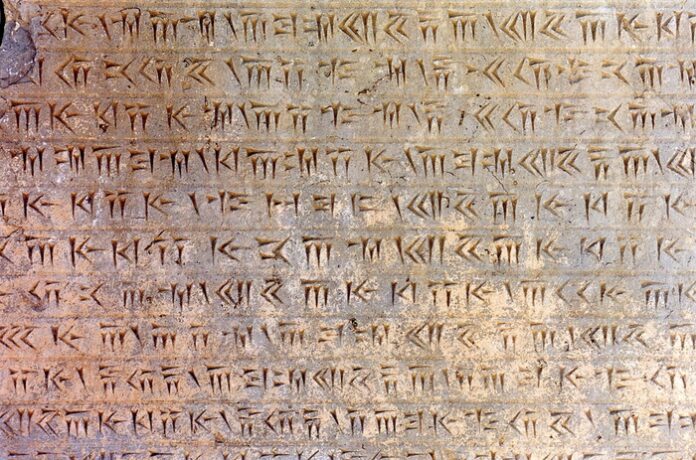
Iranian Researchers Decipher Cuneiform Inscription

Persépolis

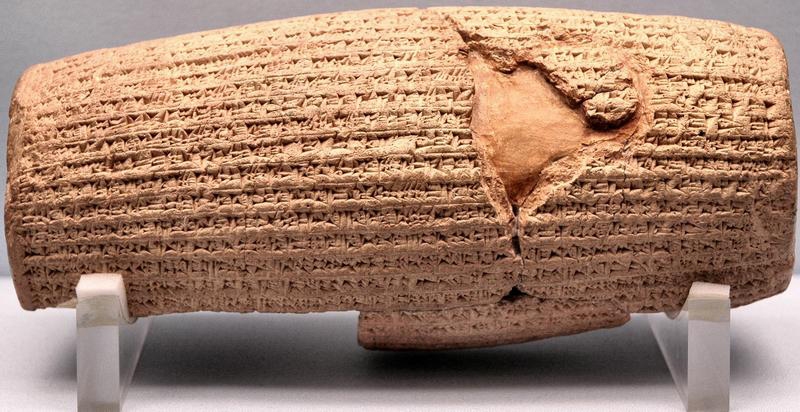
Researchers of Islamic Azad University have managed to develop a spectacular software application which not only translates cuneiform inscriptions but provides the users with their pronunciations.

The Cyrus Cylinder
The Cyrus Cylinder

According to a report by Entekhab, as translated by IFP, Omid Amini Azar, the software’s developer, elaborated on the cuneiform dictionary, saying, “The software is able to decipher and provide translation for the inscriptions which date far back to Achaemenid era into four languages of Persian, Kurdish, English and Arabic.”

Iran-cultural-heritage
Kul-e Farah is located near the city of Izeh in Khuzestan, southwest Iran.

Iran Sees Rise in Export of Agricultural Products

Agriculture products

Figures indicate that Iran’s farm sector has shipped abroad $802 million in agricultural products from March 20 to May 20.

With a total weight of 955,000 tons, exports in the two-month span have risen by approximately 6% in terms of value and by 22.5% in terms of weight, in comparison to the corresponding period last year.

Iran hopes to boost the export of agricultural products now that trade has been facilitated under the Joint Comprehensive Plan of Action (JCPOA), a lasting nuclear deal between Tehran and the Group 5+1 (Russia, China, the US, Britain, France and Germany) that has terminated nuclear-related anti-Iran sanctions.

Neighbouring countries are the main export destinations for Iranian farm produce.

Export of seafood and fruit to Russia is also an attractive option for Iran.

Russia has plans to replace Turkish foodstuffs with Iranian, Azerbaijani, and Abkhazian goods to avoid food shortages following Moscow’s economic sanctions on Ankara.

The move by Kremlin came after Russian President Vladimir Putin approved a bill to impose economic sanctions on Turkey in the wake of the Turkish military’s shooting down of a Russian fighter jet in Syria in November 2015.

Nothing Can Silence Bahrainis Anymore: Ayatollah Khamenei

Supreme Leader

“In Bahrain, a ruthless and arrogant minority is oppressing the majority; and has now carried out an act of aggression against the diligent scholar, Sheikh Isa Qassim. This is insanity and stupidity,” the Leader said on Saturday.

Ayatollah Khamenei elaborated that it was Sheikh Qassim who prevented the mass protests in Bahrain from being driven to extremism.

“These fools do not understand that eliminating Sheikh Isa Qassim means removing the barrier in front of the spirited Bahrani youths against the government. Nothing can silence these youths anymore,” the Leader said.

Bahrain on Monday revoked the citizenship of Sheikh Qassim, accusing him of sowing “sectarianism and violence.”

Bahrain’s Interior Ministry claimed in a statement that Sheikh Qassim actively sought the “creation of a sectarian environment” through his connections with foreign powers.

The ministry claimed that the cleric had misused his religious position to advance a political agenda and serve foreign interests.

The Bahrain Center for Human Rrights said in a statement that the decision against the top Shia cleric “is yet another blow to freedom of speech and expression in Bahrain” and is “part of an escalating crackdown on freedoms and rights.”

It urged the government to “immediately and unconditionally reinstate the citizenship of Qassim and all those affected,” saying that it had documented evidence of at least 261 cases since 2012.

Elsewhere in his speech, Ayatollah Khamenei pointed to the enemy plots against Iran, saying, ” They created Daesh [Takfiri terrorists] to defeat the Islamic Republic. Iraq and the Levant were a prelude to crippling Iran.”

However, the Leader stressed, “It was the might of the Islamic Republic that brought them to their knees.”

Iran has recently arrested a number of Takfiri elements seeking to carry out terror attacks in the country.

Iran’s Intelligence Minister Mahmoud Alavi said on June 21 that as many as 10 terrorists were apprehended from June 14 to 20 in Tehran and three border and central provinces.

According to the minister, the militants were planning remote control explosions, suicide bombings, and car bombings against bustling areas.

A day earlier, Iran’s Intelligence Ministry released a statement about the foiled bombing plots by Takfiri-Wahabi groups.

Wahhabism is the radical ideology dominating Saudi Arabia. It forms the dogma of the Daesh Takfiri terrorist group, which is wreaking havoc mainly in Iraq and Syria.

Ayatollah Khamenei made the remarks in a meeting with the families of Iranian military advisers killed in Syria while on a mission against the Takfiri terrorists wreaking havoc in the Arab country.

Iran maintains military advisers in Syria, where the government of Syrian President Bashar al-Assad is fighting an array of foreign-backed militant forces, including, but not limited to, those of the Daesh terrorist group.

Syria has been gripped by a foreign-backed militancy since March 2011. According to United Nations Special Envoy for Syria Staffan de Mistura, over 400,000 people have been killed in the conflict.

Also meeting with the Leader on Saturday were the families of the victims of a bomb attack in Iran in early 1980s.

On 28 June, 1981, a powerful bomb went off at the headquarters of the Islamic Republic Party (IRP) headquarters, where the party’s leaders were holding a meeting. Tens of Iranian officials, including then Head of Supreme Judicial Council Ayatollah Mohammad Beheshti, were killed in the bombing by the terrorist Mujahedin-e Khalq Organization (MKO).

The MKO has carried out numerous terrorist attacks against Iranian civilians and government officials over the past three decades. Out of the nearly 17,000 Iranians killed in terrorist attacks since the victory of Iran’s 1979 Islamic Revolution, about 12,000 have fallen victim to MKO’s acts of terror.

ISIS Expresses Satisfaction with Brexit

ISIS terrorist group

According to a report by Entekhab, as translated by IFP, ISIS terrorist outfit hailed Brits’ historic decision to leave the EU and expressed satisfaction as the exit will lead to dire economic consequences for the EU member states.

ISIS also asked its affiliates to conduct terrorist attacks on Berlin and Brussels and spare no efforts to paralyze the Europe.

Earlier, British intelligence officials had warned against ISIS’s dangerous attacks on tourism centres in Europe, and the UK Foreign Office had also issued the same warning addressing British people.

In a referendum, some 51.9% of British voters opted to leave the EU, while roughly 48.1% of people voted to stay in the Union. More than 17.4m Britons said the country should leave the bloc, as just over 16.14m others favoured remaining in the EU.

Leader Condoles Death of Young Iranian Soldiers in Bus Accident

Leader of the Islamic Revolution Ayatollah Seyed Ali Khamenei

In a message of condolence on Saturday, Ayatollah Khamenei voiced sympathy with bereaved familites of the victims.

The Leader underlined that youth should be protected, and asked military and civil officials to carefully pursue all necessary measures to prevent similar incidents.

Earlier, Iranian President Hassan Rouhani offered a message of condolence on the death of 19 soldiers in a bus accident south of the country, and ordered his ministers to make whatever efforts possible to address the problems of the injured and their families.

In the early hours of Wednesday, a bus carrying soldiers rolled over on a road linking the southern cities of Shiraz and Kerman, killing 19 passengers and injuring 23 others.

Putin: No Barriers to Iran’s Accession to SCO

Russian president Putin

“Iran has been taking a proactive part in the organization’s work as observer for a long while, since 2005. I think that after the resolution of the Iranian nuclear problem and lifting of the UN sanctions there are no obstacles for a positive answer to Iran’s request,” Putin said during a meeting of the member states’ leaders in Tashkent, as reported by Tass and covered by Tehran Times.

Kazakh President Nursultan Nazarbayev told Tass on Thursday that possible admission of India, Pakistan and Iran to the organization is an important step in the development of the Eurasian Economic Space.

Summit of the SCO heads of state was held on Friday in Tashkent, Uzbekistan.

The SCO is a Eurasian political, economic, and military organization which was founded in 2001 in Shanghai by the leaders of China, Kazakhstan, Kyrgyzstan, Russia, Tajikistan, and Uzbekistan.

On July 10, 2015, the SCO decided to admit India and Pakistan as full members, and they are expected to join by 2016.

Afghanistan, Belarus, India, Iran, Mongolia and Pakistan are the current observers of the organization.

Iran applied for full membership on 24 March 2008.