Tuesday, December 23, 2025
Home Blog Page 3593

“Arab Intelligence Report Says Bin Salman Could Be Dead”

“This intelligence service in a confidential report to the country’s top official insists that at least two bullets have hit bin Salman in April 21 clashes in Riyadh and it is even possible that he is dead,” said Hossein Shariatmadari, the daily’s editor-in-chief, in an editorial published on Thursday.

The editorial came following a similar report by Fars News Agency on Wednesday which raised questions about the whereabouts of the 32-year-old heir to the Saudi throne, known to be highly active on the political scene.  

The report said bin Salman hadn’t appeared in public since April 21, when videos were posted online in social media purporting to show areas around royal palaces ringing with heavy gunfire.

Saudi authorities firmly denied any major security breach, saying Saudi forces had “dealt with” an unauthorised toy drone near the royal palaces.

But footage circulating on social media showed heavy gunfire, tanks and armed vehicles around palaces, giving rise to speculations about a possible coup attempt or a retaliation by the House of Saud’s adversaries.

As a proof, Fars News Agency pointed to the fact that bin Salman made no media appearance during the April 28 visit of the newly-appointed US Foreign Secretary Mike Pompeo to Riyadh, his first foreign trip as the top US diplomat.

This is while the state-run outlets used to publish images of meetings in Riyadh between bin Salman and former US secretary of state Rex Tillerson.

Mysterious Disappearance of Crown Prince: Where Is Bin Salman?

Bin Salman Absent from another Major Ceremony in Saudi Arabia


Kazeroon Division Plan Stopped, Iran Interior Ministry Says

In a statement published on the ministry’s website on Thursday, it said the ministry’s experts have travelled to the city several times to listen to the concerns of the people in Kazeroon and take them into account.

Considering demands by the people, the plan has been stopped and won’t be implemented until logical and genuine concerns of the Kazerooni people are addressed.

Wednesday night, the city was a scene of clashes between security forces and people demanding the release of people arrested in small demonstrations held Wednesday afternoon.

The protests in front of a police station took a violent turn after people masking their face tried to enter the police station, leaving at least one dead and six wounded, Fars News Agency reported.

Kazeroon Division Plan Stopped, Iran Interior Ministry Says
Casualties Reported in Southern Iran after Protests Turn Violent

Some protestors set fire to parts of the station and police vehicles.

The Interior Ministry expressed regret over the deadly incident, saying the protests do not have much to do with the division plan and could be rooted in efforts by anti-revolution forces to incite violence in the country.

“[The ministry] asks the aware and religious people of Kazeroon to keep calm and exercise vigilance against plots by adversaries and anti-revolution websites and do not allow the region’s security to be endangered,” the statement reads.

Located over 1,000 kilometers south of Tehran, a group of Kazeroon citizens held protest gatherings against a parliamentary motion to separate cities of the Kazeroon county to form another country.

Fars News Agency reported that the Wednesday afternoon protests were strange, as the city had seen no major protests since Kazeroon Friday Prayer Leader Mohammad Khorsand, who himself opposes the division plan, paid a visit to Tehran three weeks ago to discuss the issue with government officials.

The visit led to announcements by First Vice President Es’haq Jahangiri and provincial officials that the separation plan was stopped.

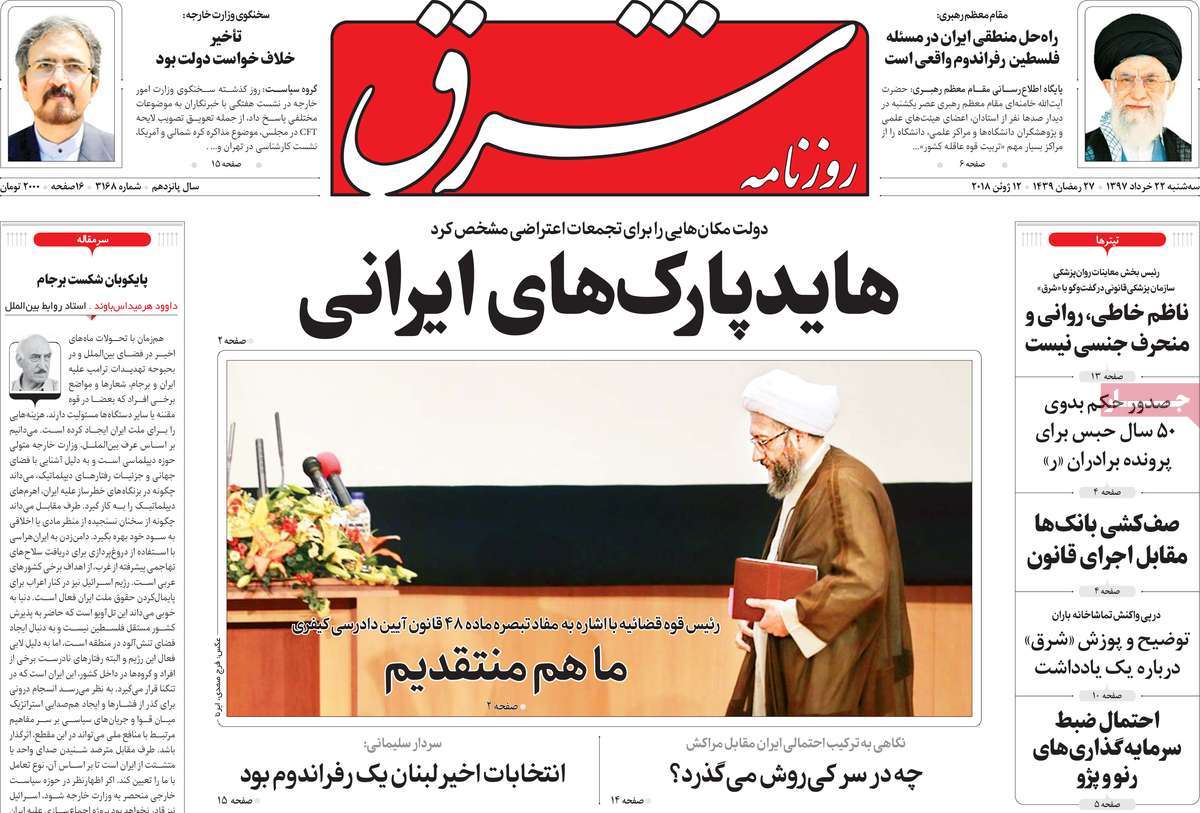
“Muslim Communities Indifferent to Palestine Plight Don’t Believe in Quran”

Ayatollah Seyyed Ali Khamenei made the comment at a gathering dubbed “Affinity with the Quran” held on the first day of the holy month of Ramadan.

“Today, the scourge gripping the Muslim world is alienation from the Quran,” said the Leader.

“Look at the situation of Palestine; a nation is stranded away from its homeland; those who’ve stayed in their homes are under different types of pressure; a lot of people have been killed and thousands wounded,” said Ayatollah Khamenei.

“Some complain why the US does not take a stance. The US and some Western countries are hand in glove with each other. How do you expect them to take a position? It is the Islamic governments that should take a stand. It is the Islamic community that should adopt a position. It is they (Muslims nations) that should resist, but they don’t! Why? Because they have distanced themselves from the Quran; because they don’t believe in the Quran,” said the Leader.

Ayatollah Khamenei underlined that Palestine will, by God’s grace, get rid of the enemy.

“[Jerusalem] Al-Quds is the capital of Palestine, and the US, and its cronies, and those weaker or stronger than the US, cannot do a damn thing vis-à-vis the truth and the divine tradition, when it comes to Palestine,” he said.

Iran President, Qatari Emir Denounce Israel’s Atrocities

In a Thursday phone conversation with Sheikh Tamim bin Hamad Al Thani, Rouhani described as “provocative” the US government’s relocation of its embassy from Tel Aviv to Jerusalem al-Quds.

The president also dismissed the Israeli regime’s killing of innocent Palestinians as a criminal act and regrettable for the international community.

He also touched upon an extraordinary meeting of the Organization of Islamic Cooperation (OIC) in Istanbul, saying, “In this meeting, Islamic countries should give a proper response to this tyranny and major crime.”

He further noted that he is pleased to see most world countries have condemned the United States’ unilateral withdrawal from the Iran nuclear deal.

President Rouhani said Trump’s pullout from the JCPOA will not be in the interests of the US and other signatories to the deal.

The president also congratulated the Qatari nation and government on the arrival of the holy month of Ramadan.

“The Islamic Republic of Iran regards the blockade on the Qatari government and nation as an inappropriate and unfair move, and welcomes the promotion of cooperation and relations with Qatar as a friendly country and a neighbor,” said President Rouhani.

He said the Iranian government and nation have stood by the Qatari government and nation under any circumstances, and will continue to do so. He also embraced the idea of holding an Iran-Qatar joint cooperation commission in a bid to promote mutual relations on all fronts.

Rouhani noted that there is no way to settle differences other than dialogue, adding, “Iran always stands ready for talks with the Persian Gulf countries on regional issues, but unfortunately, some countries think they should choose a path other than negotiations.”
Sheikh Tamim, in turn, congratulated the Iranian nation and government on the arrival of the holy month of Ramadan.

He touched upon the cordial relations between Doha and Tehran in different areas and praised the constructive positions adopted by Iran vis-à-vis the Qatar crisis, calling for all-out enhancement of ties between the two sides.

The Qatari Emir denounced the US government’s relocation of its embassy to al-Quds as well as the Israeli regime’s blockade of Gaza and killing of Palestinian people.

He said the OIC summit would be an ideal opportunity for consultations and talks on regional issues and problems.

He also referred the recent tension created against Iran, saying Iran is a powerful country in the region, and his country believes international issues and differences should be resolved only through dialogue.

Iran Becomes Permanent Member of Int’l Cancer Research Centre

After Iran gained the permanent membership of the IARC, the country’s flag was hoisted in the headquarters of the centre in the French city of Lyon, the Research Department of Iran’s Health Ministry said.

The membership of Iran in the IARC as the 26th country in the world and third country from Asia came after a vote by the members of the governing council of the IARC on May 17, a report by Mehr News Agency said.

Before the vote, a report on the studies conducted in Iran on cancer was distributed among the delegates of the governing council members and then Iran’s membership document was read out.

For a brief review of Iran’s achievements in various fields of science and technology, check the book “Science and Technology in Iran: A Brief Review

Then, Iran’s Deputy Health Minister, Reza Malekzadeh officially took part in the meeting of the governing council.

As the new member of the IARC, Iran has made great achievements in research on cancer including the first report on cancer across Iran which have been approved by the most prestigious institution in the world, Cancer Incidence in Five Continents, in terms of scientific accuracy and quality. The report is the first practical step taken so far to diagnose cancer and treat it at its earliest stages.

Among other major reports by Iranian scientists which have been approved internationally, one can refer to two separate reports on the carcinogenic nature of hot drinks and opium. These reports are the fruits of two decades of extensive research conducted by Iranian scientists and their foreign counterparts.

Dr. Malekzadeh received a medal of honour from the IARC back in January for his contribution to the report on the carcinogenic nature of opium.

The International Agency for Research on Cancer (IARC) was established in 1965 as the specialized cancer agency of the World Health Organization. The objective of the IARC is to promote international collaboration in cancer research.

The IARC Medals of Honour are awarded to acknowledge and reward the work of scientists whose research has made an outstanding contribution to advancing our understanding of the biology or of the epidemiology of cancer, identifying causes and ways of prevention and helping to relieve the burden of this disease.

Eurasian Economic Union to Create Free Trade Zone with Iran

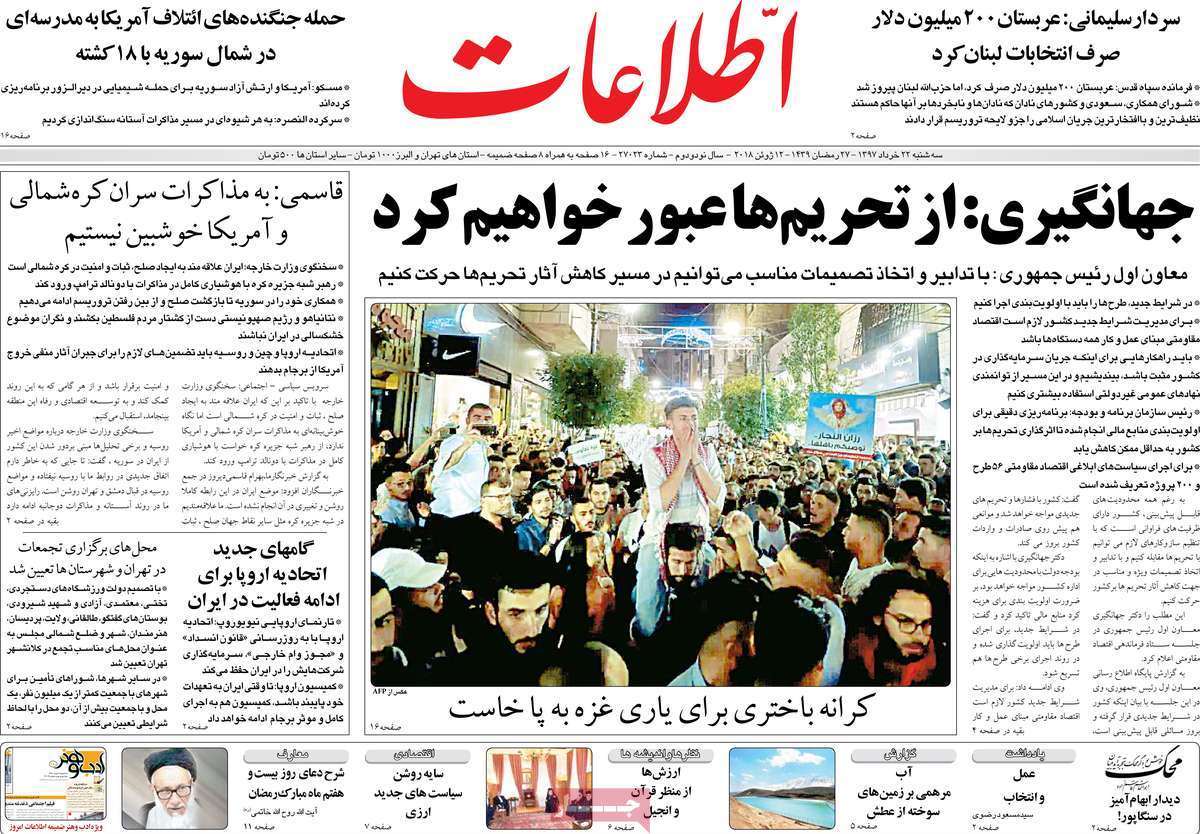
The economic block also signed an interim trade deal with Iran during talks on Thursday in the Kazakh capital of Astana, Kazakh sources said.

The deal comes as the US is snapping economic sanctions on the country back into place following its withdrawal from the Iran nuclear deal.

It has also warned companies about doing business with Iran saying they will face sanctions.

Iran is now engaged in extensive talks with the five remaining signatories to the JCPOA -Russia, China, France, Germany and Britain – to decide about the future of the nuclear deal.

Iranian Foreign Minister Mohammad Javad Zarif made a tour of the countries over the past days and sat for talks with their top diplomats over the future of the JCPOA.

Iran says it will pull out of the deal if its benefits under it is not safeguarded.

The EEU is comprised of Russia, Armenia, Belarus, Kazakhstan and Kyrgyzstan. It is an international organization created with the aim of encouraging regional economic integration through the free movement of goods, services and people within the union.

The bloc was established in 2015, after it superseded the Eurasian Economic Community that functioned from 2000 to 2014. The union has an integrated single market of 183 million people and a gross domestic product of over $4 trillion.

Iran, France Establish Mideast’s Largest Blood Bag Factory

Ali Akbar Pour-Fathollah says the factory in Alborz province has been established with French investment.

“With the establishment of the factory, Iran which used to import blood bags will become self-sufficient in this field,” Pour-Fathollah said, according to a report by Mehr News Agency.

He went on to say that the production capacity of the factory is much higher than the domestic needs and added the company can produce 6 million blood bags in just one single shift.

“This means that it can produce 18 million blood bags in 18 hours providing us with an opportunity to export blood bag.”

The Iranian official said domestic demand for blood bag stands at 17 million per day and noted by reaching self-sufficiency in this area, Iran can export the product and expand its knowhow in this field.

Pour-Fallah underlined that the company has created 200 jobs and said the figure can reach 400 once the export of the blood bags begins.

Director General of Iran Blood Transfusion Organization also said the factory has been established with a 50-percent foreign investment, including those made by France.


France’s Blood Scandal in Iran

The investment by France in Iran’s health section comes as Iran is one of the victims of France blood scandal back in 1980s.

In the mid-80s, France’s national blood transfusion centre knowingly distributed HIV-contaminated blood products. This caused the deaths of several hundred hemophiliacs in France. When the scandal was exposed, several doctors and politicians were brought to trial, including ex-Prime Minister Laurent Fabius. He was, however, cleared of all charges.

The tainted products were also exported to several foreign countries, including Iran, where several hundred patients were contaminated. Iranian health authorities said that this led to the very first cases of AIDS in the country.

The scandal got a fresh attention in Iran back in 2015 when Fabius arrived in Tehran as French Foreign Minister for talks with Iranian officials.

The new deal with France in this field means the dispute between Tehran and Paris has come to an end.

UK Signs First Int’l Oil Deal with Iran after US Withdrawal from JCPOA

The Heads of Agreement (HOA) was signed on the development of the Iranian Koranj oil field.

The agreement was inked in a ceremony in Tehran attended by Iranian Oil Minister Bijan Namdar Zangeneh as well as Rob Macaire, the British ambassador to Tehran, and senior oil industry officials.

The HOA was signed between Managing Director of the National Iranian South Oil Company Bijan Aalipour, and CEO of the Pergas International Consortium Colin Rowley, Shana reported

If finalized, the deal would see up to 200 thousand barrel of crude produced per day, with a collective output of around 655 million barrels in ten years’ time. The project comes with a price tag of well over $1.1 billion.

Iranian Peasant Saves Train Passengers’ Lives

Less than 6 months have passed since the death of Iranian hero Rizali Khajavai, the Iranian peasant who sacrificed his life to save the passengers of a train decades ago.

Now, history has repeated itself. A 61-year-old Iranian peasant has sacrificed his life to save dozens of passengers travelling from Tabriz to Tehran.

Hossein Alimardani found out the soil under the railway line had caved in after a heavy flood, which meant a disaster could happen if the train ran over it. So, he decided to save the passengers’ lives, one way or another.

It was morning, May 15, 2018. Spring rain had refreshed the city. Like other days, Alimardani got into his KIA Pride (one of the most affordable automobiles in Iran) to go to his agricultural fields. The fields are located 36 kilometres from the city of Zanjan. He earns a living for his family of 7 by working on the fields.

The road leading to his agricultural fields lies next to the railway line.

“I hadn’t arrived at my fields, yet, when I realized the soil under the track had collapsed and had been washed away onto the road. … The soil under the railway line had cave in almost 15 metres deep,” he said.
“I had no doubt that if the train passed over it, the track couldn’t withstand [the weight of the train] and a disaster would be inevitable,” he said in an interview with Hamshahri newspaper.

Iranian Peasant Saves Train Passengers’ LivesHe called emergency police, but there was no answer. He could not reach emergency teams, either. Finally, he climbed a height and saw a train coming. He decided to make the train driver realize what had happened. He found an old red banner lying somewhere nearby, grabbed it, and began to run on the track toward the train. The locomotive driver found out that something must have happened, and put on the brakes. The train stopped just 20 metres from the place where soil had collapsed. And officials on the train thanked him for saving the passengers’ lives.

It was not the first time Alimardani sacrificed his life. Years ago when he was young, he saved two people from drowning in a canal.

Alimardani’s story is reminiscent of the deceased Iranian hero Rizali Khajavi, who died of kidney failure and respiratory disease months ago at the age of 86. Back in the early 1960s, Rizali saved the lives of passengers on a train on a cold night. Rockfalls had blocked the track; so, he picked a lantern and began waving it to the train driver, who finally saw the dim light and stopped the train in time to avoid a disaster.

Rizali’s heroic move has long been an important part of school books in Iran, teaching the students the lesson of bravery and sacrifice.

Iranian Peasant Saves Train Passengers’ Lives
Photo of Rizali Khajavi (left) and the illustration of his brave move at school books in Iran (right)

Iranian People Mark National Ferdowsi Day

Ferdowsi is one of the greatest poets of Iran known as the Savior of the Persian Language. He is called so because without his 30 years of hard work on the ‘Book of Kings’, Iranians perhaps would be speaking Arabic today.

What follows are Mehr News Agency’s photos of the ceremony held to mark the national day of Ferdowsi in his mausoleum near the city of Mashhad, northeastern Iran: