Friday, April 24, 2026
Home Blog Page 3594

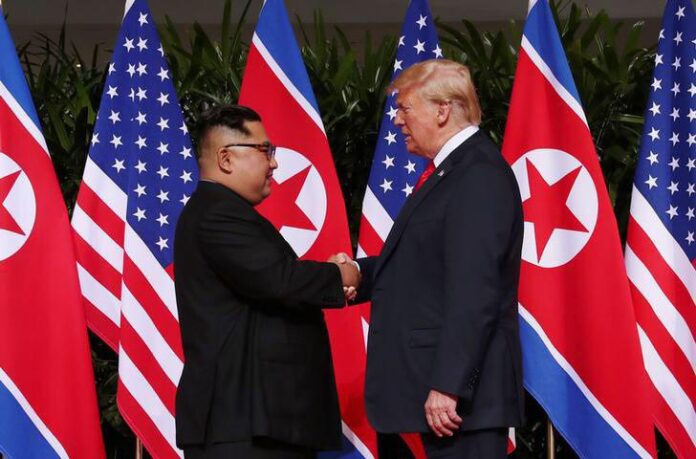
North Korean Leader Signs Denuclearisation Deal with Trump

The US, in turn, “committed to provide security guarantees” to North Korea following a “comprehensive, in-depth and sincere exchange of opinions” with Kim, according to a document signed by both leaders.

Following the historic meeting, Trump announced that denuclearisation on the Korean Peninsula would begin “very quickly.”

In a televised ceremony held in Singapore, the two leaders signed a joint statement that Trump called “comprehensive.” In the statement, Trump “committed to provide security guarantees” to North Korea, and Kim “reaffirmed his firm and unwavering commitment to complete denuclearisation of the Korean Peninsula.”

But the statement was short on details, and it was not clear if the two leaders had signed another document laying out potential next steps or a timetable. The joint statement was not immediately released to reporters, but it was legible in a photo of Trump holding it up at the ceremony.

The statement said the two nations would hold “follow-on negotiations” led by Secretary of State Mike Pompeo and a high-level North Korean official “at the earliest possible date, to implement the outcomes” of the summit meeting.

It also said the two nations would “join their efforts to build a lasting and stable peace regime” on the divided peninsula, meaning talks to reduce military tensions that could eventually lead to a formal peace treaty to end the Korean War.

“We had a historic meeting and decided to leave the past behind,” Kim said at the signing ceremony, adding that “the world will see a major change.”

“We’re very proud of what took place today,” Trump said. “I think our whole relationship with North Korea and the Korean Peninsula is going to be a very much different situation than it has in the past.” He said that copies of the document would be distributed and that he would speak to reporters later about it.

The signing ceremony came after several hours of discussions between the two leaders.

Iran Intelligence Forces Bust Terror Group, Arrest 27

Intelligence

The Intelligence Ministry says it apprehended 27 of the terrorists, who intended to trigger unrest in Iran by striking the capital, Tehran, and several other major towns and cities across the nation.

The terror team had posted images on social media, threatening to kill Iranians, reports IRIB News Agency.

They were arrested by intelligence agents in cooperation with judicial authorities as well as security and law enforcement forces.

Large quantities of weapons and ammunition were seized from the terrorists. The confiscated munitions include several Kalashnikov rifles, handguns, grenades, bombs and equipment used to make explosive devices.

This comes on the heels of several other operations by Iranian forces against terrorists.

Earlier, Iran’s Islamic Revolution Guards Corps (IRGC) had dismantled three terrorist groups in northwestern and western Iran in less than 24 hours.

In a statement, the IRGC said the Iranian forces foiled a scheme by a terrorist group seeking to penetrate into Iran’s soil Friday evening to commit acts of sabotage in the country.

During clashes between the two sides along the border, IRGC forces killed all the seven members of the terrorist group.

In separate clashes on Saturday, the IRGC troops smashed two other groups of terrorists, killing six of them.

Iranian FM to Visit South Africa on Tuesday

Iran’s Foreign Minister in Beirut for Talks

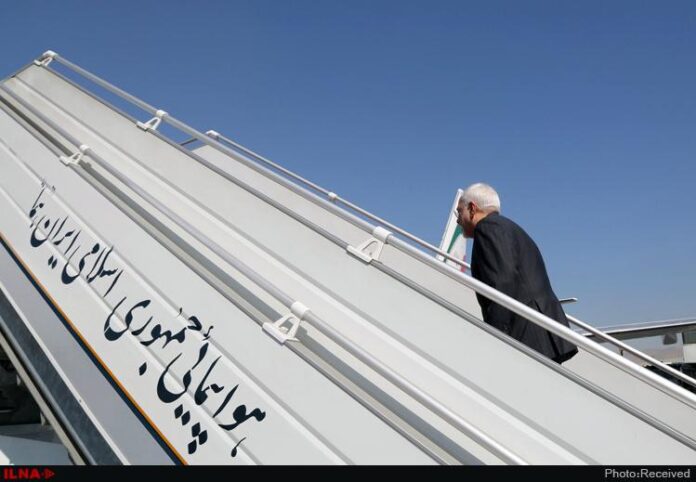
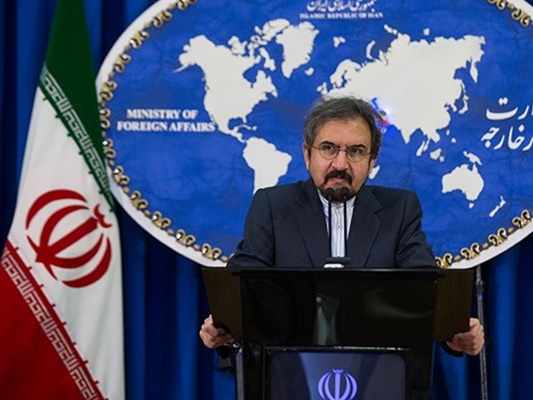
According to Foreign Ministry Spokesman Bahram Qassemi, Zarif will head a high-ranking politico-economic delegation to the South African capital of Pretoria for talks with the country’s senior officials.

Expansion of bilateral ties is among the main topics to be discussed during the Iranian foreign minister’s visit to South Africa.

Zarif last visited South Africa back in October 2017 to attend the 13th meeting of the two sides’ Joint Commission.

Iran and South Africa share historical bilateral relations. Iran supported the South African liberation movements.

The Islamic Republic severed its ties with South Africa in 1979 and banned doing any business with the African country in protest against its apartheid policies. However, in January 1994, Tehran lifted all trade and economic sanctions against South Africa and diplomatic relations were reestablished soon.

Western Media Coverage of Int’l Quds Day; Textbook Example of Propaganda Ploy

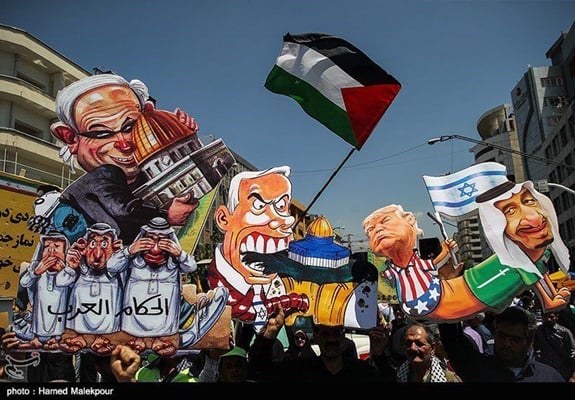
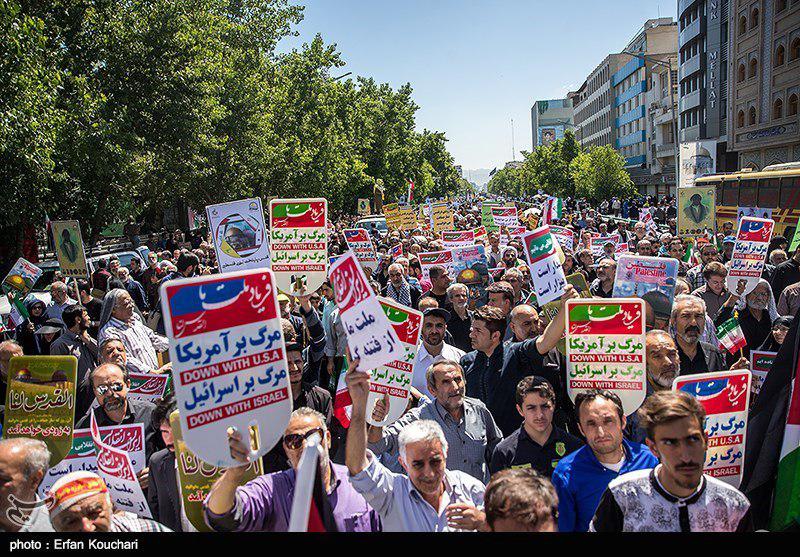
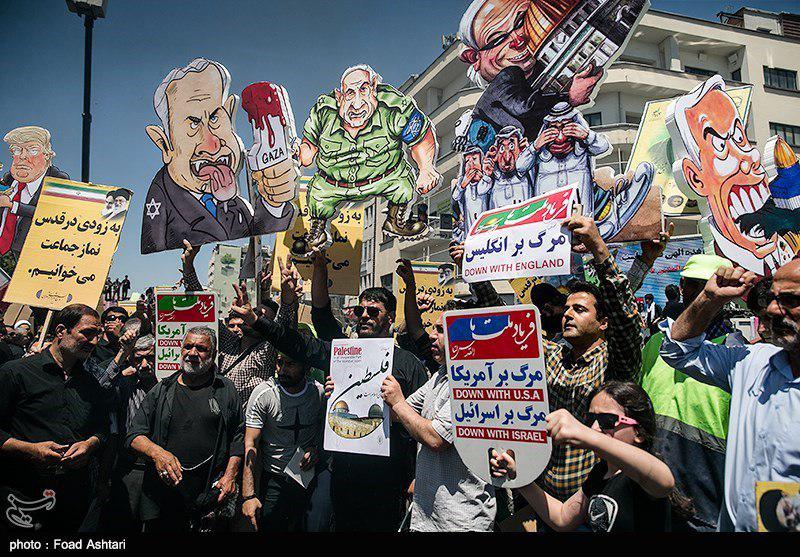
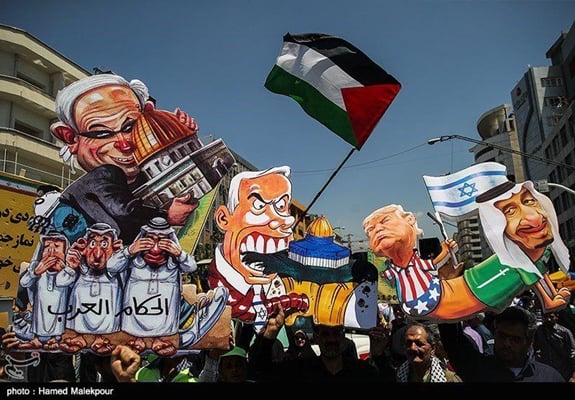
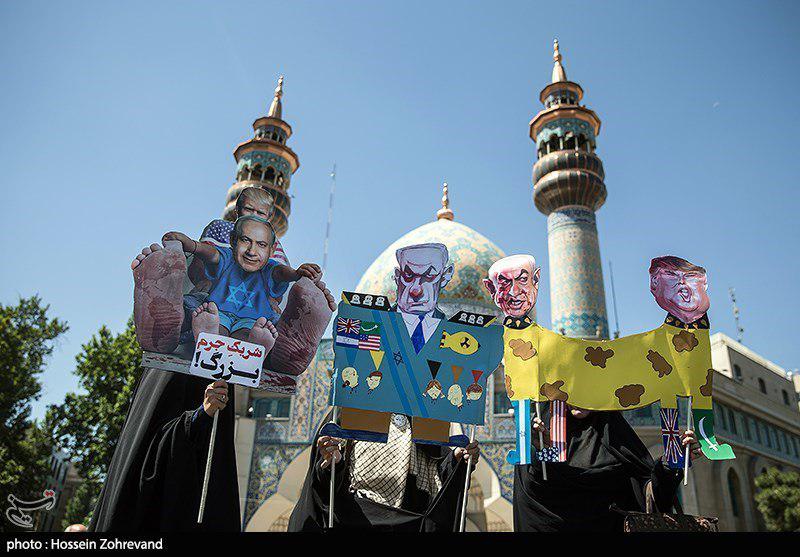
Marking the international Quds Day, the marchers in thousands of cities across the globe chanted “death to Israel” and called for an end to the seven-decade occupation of Palestine.

The demonstrators were honouring a long-established tradition going back to August 1979, when the late founder of Iran’s Islamic Republic issued a message to Muslims urging them to hold anti-Israeli rallies on the last Friday of the Muslim holy month of Ramadan.

Since then, millions of demonstrators around the world take part in the annual event to express their protest against the Israeli occupation of al-Quds and its western backers enabling the decades-long suppression of Palestinians.


Al-Quds in Danger

This year’s rallies came at a particularly sensitive time, as Palestine is the scene of heightened tensions in the wake of a decision by US President Donald Trump to recognise al-Quds as the capital of Israel.

The decision was followed by the relocation of the US embassy from Tel Aviv to al-Quds in mid-May.

The US move, seen as part of preparations for implementing a so-called peace plan dubbed “The Deal of the Century” and formulated by the Trump administration, prompted mass protest across the Muslim world and among Palestinians in Gaza and West Bank.

Since late March, Palestinians have held regular marches up to the border fence separating Gaza and Israel, during which 115 protesters have so far been killed and over 3,800 have been wounded by Israeli gunfire.

However, to no one’s surprise, the global event received little coverage by western mainstream media, who are notorious for their highly biased coverage of the Palestine conflict.

There was scant footage of the rallies broadcast in the Western media, and even the limited news coverage devoted to the event was flawed.

Fairest in the World

Once again, astute observers noticed how skillfully the western media frame subjects in a way that play into their governments’ agenda.

A detailed look at the coverage of Western media, who celebrate themselves as the freest and fairest in the world, reveals an attempt to distort reality of the annual anti-Israeli protests and present misleading assertions to the reader as unchallenged facts.

In fact, it was a textbook example of a propaganda ploy, the goals of which can be summarized as follow:

  1. Playing down the biggest annual show of support for Palestinians by devoting limited coverage to it.
  2. Portraying al-Quds Day as an event exclusive to Shiite Iran and anti-Israel groups allied with the country.
  3. Creating a perception that the event is politically motivated and is an attempt by an Iran embroiled in a standoff with the West to advance its interests.

To illustrate these points, this article examines coverage of the event by Reuters, Associated Press and AFP, known as the “Big Three” western news agencies, which serves as an interesting case study of how western media not only misrepresent the pro-Palestine event, but also act as a mouthpiece for the western governments.


This is Iran’s Day

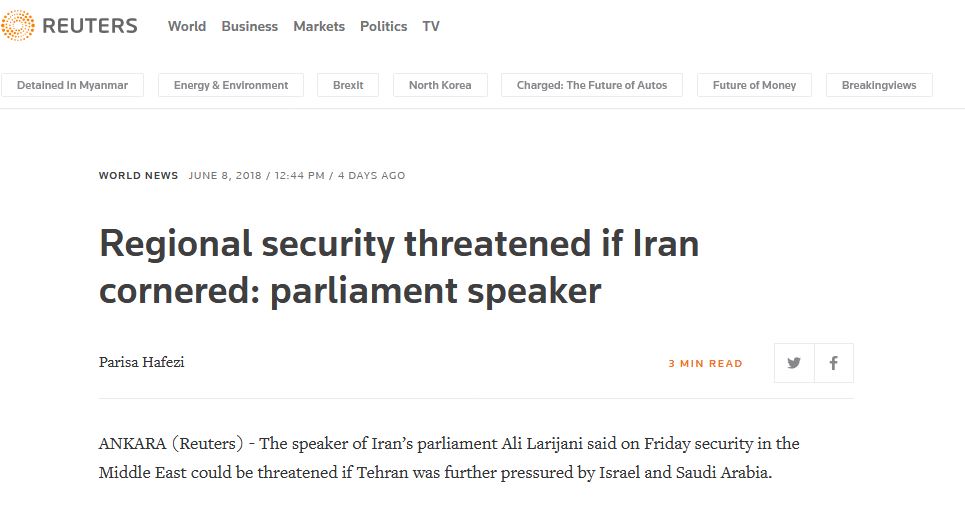
The British outlet Reuters refused to cover the event directly. The news agency just covered a speech by Iran’s Parliament Speaker Ali Larijani delivered after the al-Quds rallies at Tehran’s Friday Prayers ceremony.

Surprisingly, Reuters has selected a relatively less important point of Larijani’s long speech, which was mainly focused on the Palestine conflict, for the title of its news piece.

The article describes the al-Quds event as “Iran’s annual day of solidarity with the Palestinians” and says only “tens of thousands of Iranians” took part in this year’s rallies.

This is while the number of participants were certainly much more than that, as the demonstrations were held in Tehran and around 900 other Iranian cities across the 80-million country.

Moreover, the al-Quds rallies were also held in many countries, including Pakistan, India, Afghanistan, Indonesia, Lebanon, Syria, Iraq, Bahrain, Malaysia, Turkey, Nigeria, South Africa, Yemen and Palestine.

Similar rallies were also held in major western capitals, including London, Berlin and Washington, on Saturday and Sunday.


Divert Attentions

The Reuters article refuses to go into details about the Palestine conflict, and instead draws a link between the event and problems between Iran and the west, including Iran’s nuclear program, Trump’s withdrawal from the 2015 nuclear accord and Tehran’s influence across the region.

But one can hardly see a correlation between the event and disputes between Iran and the West.

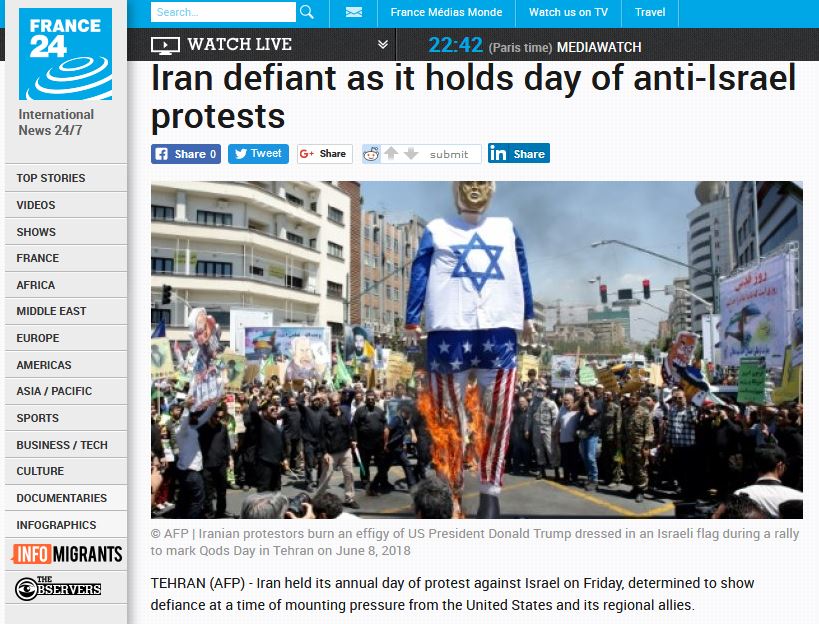
Iranian protestors did burn an effigy of Trump dressed in an Israeli flag, but it was in protest at Trump’s recognition of Muslims’ third holiest city (after Mecca and Medina) as the capital of Israel, not the controversial president’s tough line on Iran.

As a matter of fact, anti-Israeli sentiments have been running high among Iranians since the formation of the Israeli regime in 1948.

The hostility of Iran’s revolutionary leaders towards Israel has nothing to do with the US, as it could be traced to years before the revolution.

Notably, Ayatollah Khomeini in a speech leading to the 1963 uprising against the US-backed Iranian regime criticized Shah Mohammad Reza Pahlavi for pressuring clergies not to speak against Israel in their sermons.

“[They order us] not to talk about Israel and not to talk about Shah. What’s the connection between them? Is Shah an Israeli?” Imam Khomeini said.

Since the Shah regime was toppled, Iran has been steadfast in its support for the Palestinian cause.

According to Iran’s Constitution, Iranian governments are obliged to support the oppressed across the globe.
Western Media Coverage of Int’l Quds Day; Textbook Example of Propaganda Ploy

Iran Threatens Regional Security

Of note, Reuters has also distorted Larijani’s remarks, reporting as if Iran has threatened to move to destabilize the region.

Reuters quotes Larijani as saying that “the region’s security will be threatened if they corner Tehran”, referring to the US, Israel and Saudi Arabia.

This is while the Persian transcript of Larijani’s speech shows the Reuters’ translation has been inaccurate.

“… the wicked triad of the US, Saudi and Israeli are trying to push Iran into a corner, but these amateur and sneaky creatures should be careful not to end up bringing themselves insecurity,” he said.


Shiite Demonstrations

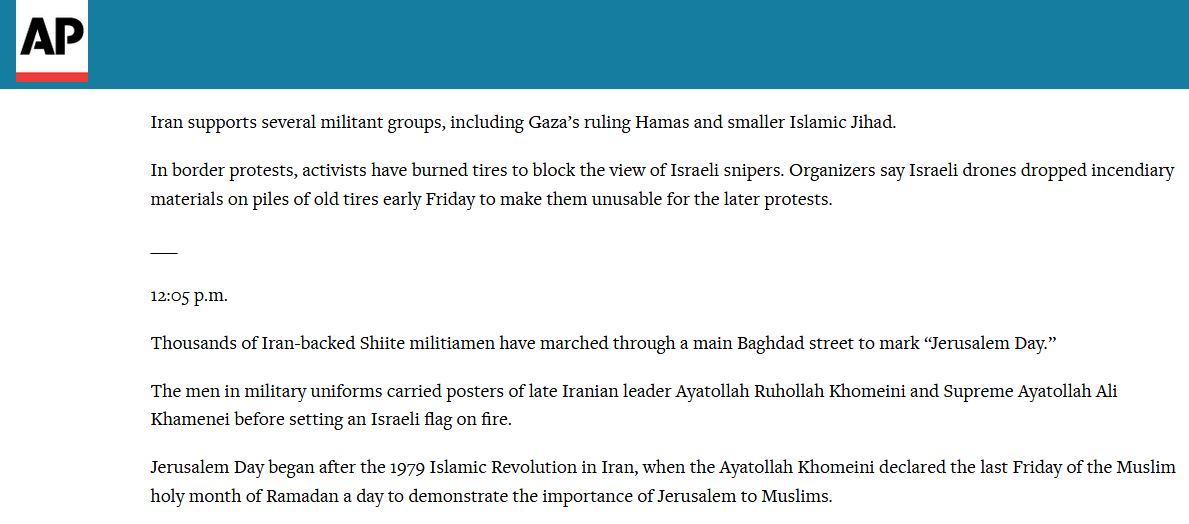
The Associated Press has provided a broader coverage of the event, reporting al-Quds rallies in Syria, Iraq, Iran, Lebanon, Pakistan and Palestine.

However, the reports are mainly focused on the role of anti-Israel resistance groups, which are mainly labeled by the western governments as terrorist.

For example, in its Iraq report, AP says thousands of “Iran-backed militiamen” rallied in a main street of Baghdad in protest to Israel.

In its Palestine reports, AP repeats several times that al-Quds Day protests in Gaza were organized by Hamas.

In another report, AP says thousands of “Shiite Muslims” in the capitals of Iran and Iraq marked “Jerusalem Day” with protests

By emphasizing the Shiite identity of those attending the rallies, AP seems to be trying to frame the event as a Shiite ceremony not welcomed by Sunnis.

This is while the Palestine conflict has often served as a base for unity among Muslims, as supporting Palestine is a shared concern among Shiites and Sunnis.

Interestingly, AP refers to the protests by the name “Jerusalem day”, perhaps to avoid legitimatizing the Palestinian’s claims over the city.
Western Media Coverage of Int’l Quds Day; Textbook Example of Propaganda Ploy

Iran Defies Pressures

AFP was also inaccurate in its portrayal of al-Quds Day. Reporting that “Iran held its annual day of protest against Israel”, AFP tried to limit the worldwide popularity of the international event.

Mirroring Reuters’ narrative, AFP linked the event with Iran’s standoff with the west, saying holding the ceremony showed Iran’s “defiance at a time of mounting pressure from the United States and its regional allies”.
Western Media Coverage of Int’l Quds Day; Textbook Example of Propaganda Ploy

It’s All About Israel

To decode the western propaganda campaign on al-Quds Day, one only needs to look at Israel’s direct efforts to counter the demonstrations.

Zionists have tried to curb the impact of the al-Quds Day demonstrations, and have even attempted to supress them if there was a chance to succeed.

For example, pro-Israel groups have in recent weeks tried to prevent al-Quds rallies from being held in Berlin and London.

But perhaps one of the most striking evidence useful for explaining western media’s approach toward al-Quds Day could be found in propaganda leaflets thrown into Gaza by the Israeli army last Thursday.

The leaflets urged Palestinians not to join al-Quds rallies and not to let Hamas “to turn you into a tool to advance its narrow agenda”.

Behind this agenda is “Shiite” Iran, which has made it its mission to “inflame tensions” in the region for the sake of its “religious and sectarian” interests, the leaflets said.

The narrative Israel is presenting in these leaflets appear to be in accordance with the propaganda ploy tried by western media: The event is organized by Iran and its allies, Iran is inflaming tensions in the region and It is merely seeking its own interests.

It seems safe to conclude that Israel and its allied western governments are dissatisfied with the international al-Quds Day and are following a common formula to diminish its impact.

This formula is centred on provoking divisions among Muslims and demonizing Iran, who enjoys growing popularity in the Arab streets of the region due to its honest, strong backing for the Palestinian cause.

Seemingly, the Israeli regime is pinning hope on efforts to widen the Shiite-Sunni rift and separate Palestinians from their true supporters, among other measures.

Will the Muslim world be vigilant enough not to fall in this trap? We hope so.


Article by Iranian journalist Alireza Hashemi

“US’ Insistence on Unilateralism Threatens Global Peace, Security”

In a Monday statement, Qassemi referred to the G7 communiqué released after the group’s summit in Canada, and slammed certain “meddlesome” demands and claims raised by the member states about Iran.

The Islamic Republic of Iran advises the G7 member states not to fall into the trap of Iranophobia and anti-Iran sentiments laid by certain states and regimes with excessive demands, he noted.

“It goes without saying that such approaches are not constructive and based on realities on the ground,” he said.

The spokesman said the Islamic Republic has proved that it is more concerned about the international peace and security compared with other countries, even some of the G7 members.

“Iran has shown its positive approach by paying a high price in fight against the unbridled and boundless terrorism of ISIS and other similar terrorist groups over the past decades,” he noted.

Qassemi said the worrisome problem is that the US insists on its unilateral, self-centred and selfish measures and behaviours. “Such an approach poses a serious threat to the international peace and security.”

The spokesman rejected as baseless the concerns raised by the G7 about Iran’s peaceful nuclear program.

He then referred to Iran’s legitimate defensive missile program and underlined that the government and nation of the Islamic Republic stand serious and resolute in the face of enemies’ threats without being coerced by their political brouhaha and unsubstantiated and baseless accusations.

“To defend the country and provide its people with security, Iran will never abandon its defensive doctrine which calls for developing our defensive and deterrent missile program that violates none of the UN resolutions,” he said.

Qassemi underlined that the principled, constructive and legitimate role of the Islamic Republic in the region particularly in fight against terrorist groups like ISIS guarantees the stability and economic boom of all regional states and significantly contributes to the international peace and security.

“The biased, targeted and useless accusations raised against Iran by the US’ ruling party and its blame game will never undermine Tehran’s regional role,” he concluded.

G7 leaders, in a joint statement on Saturday signed by the US and its European and Asian allies, vowed to ensure that Iran’s nuclear program “remains peaceful”.

“We are committed to permanently ensuring that Iran’s nuclear program remains peaceful, in line with its international obligations and commitments to never seek, develop or acquire a nuclear weapon,” the leaders said at the end of a two-day summit in Canada.

“We condemn all financial support of terrorism including terrorist groups sponsored by Iran. We also call upon Iran to play a constructive role by contributing to efforts to counter terrorism and achieve political solutions, reconciliation and peace in the region,” the statement added.

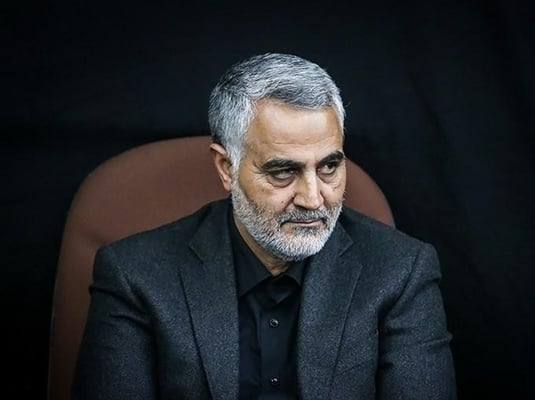
Saudis Spent $200m on Lebanon Elections but to No Avail: Gen. Soleimani

General Qassem Soleimani

Major General Qassemi Soleimani has described the recent Lebanon elections as a referendum, saying the votes were held in a situation where Hezbollah was being accused of interfering in Syria, Lebanon, Iraq, Yemen and the region.

Fars News Agency quoted him as saying that the Arab countries, Persian Gulf Cooperation Council (GCC), Saudi Arabia and the countries with ignorant rulers put the most peaceful and most prestigious Islamic movement in the list of terrorist groups.

“They put the names that bring joy to the heart of Muslims, such as Sayyid Hassan Nasrallah, next to the terrorists. He is the man who defeated the most important enemy of the Arab world [Israel].”

The commander of the IRGC Quds Force further referred to the propaganda campaign of the enemies, saying that everyone who was next to the Hezbollah movement, both Sunni and non-Sunni, was called a mercenary of Iran.”

He said Saudi Arabia spent $200 million in such a small country like Lebanon and that is not easy to be done in a short period of time. “But what happened? For the first time in Lebanon, the winner of the majority of the votes was a person attributed to Hezbollah and, of course, Shiites.”

General Soleimani also stated that Hezbollah won 74 seats out of 128 Lebanese parliamentary seats and turned into the Lebanese government which was a great victory.

Lebanon’s parliamentary elections had been delayed three times since 2009 due to the crisis in neighbouring Syria as well as disagreements over the new electoral law. The elections were finally held on May 6, 2018, under a new electoral law passed in June 2017 after years of wrangling.

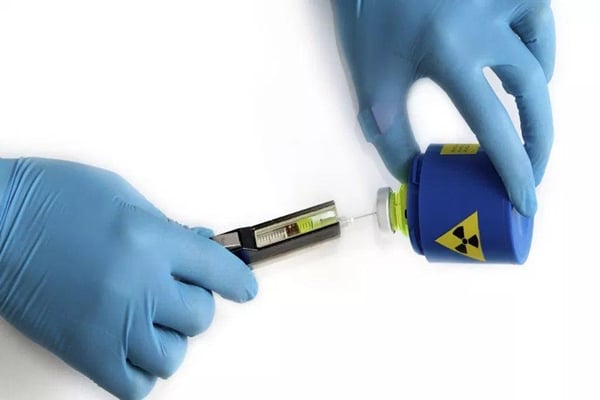
Iran to Establish Advanced Nuclear Centre for Cancer Treatment

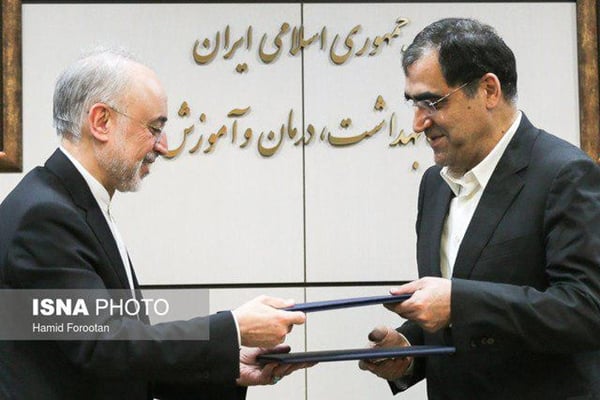
In a ceremony for signing the agreement between the two sides, Hashemi thanked the AEOI for its close cooperation with the Health Ministry and its huge contributions to enhance Iran’s health sector.
He expressed the hope that the cooperation would continue to expand in the future and said for the time being the two sides have launched a large number of joint projects in the health sector, a report by ISNA said.

Hashemi then said the AEOI has already launched a project to establish a unique hospital in the region to be equipped with cutting-edge technologies and highly-skilled personnel.
The Iranian health minister went on to say that the joint hospital to be built by the Health Ministry and the AEOI in Tehran could be one of the major centres for treating advanced cancers.

“Meanwhile as you know atomic knowledge could have great benefits for civilian purposes and the establishment of the hospital will pave the way for using atomic technology in the health sector,” he said.

In an address to the signing ceremony, Head of the Iran University of Medical Sciences, Masoud Naseripour, said the joint 350-bed hospital will be equipped with the latest technologies as well as highly experienced human resources in cancer studies.

He also said along with the hospital, the AEOI and the Health Ministry will establish a specialized clinic on a 10-thousand-square-metre area for offering services to patients suffering from cancer.

Iran to Establish Advanced Nuclear Centre for Cancer Treatment

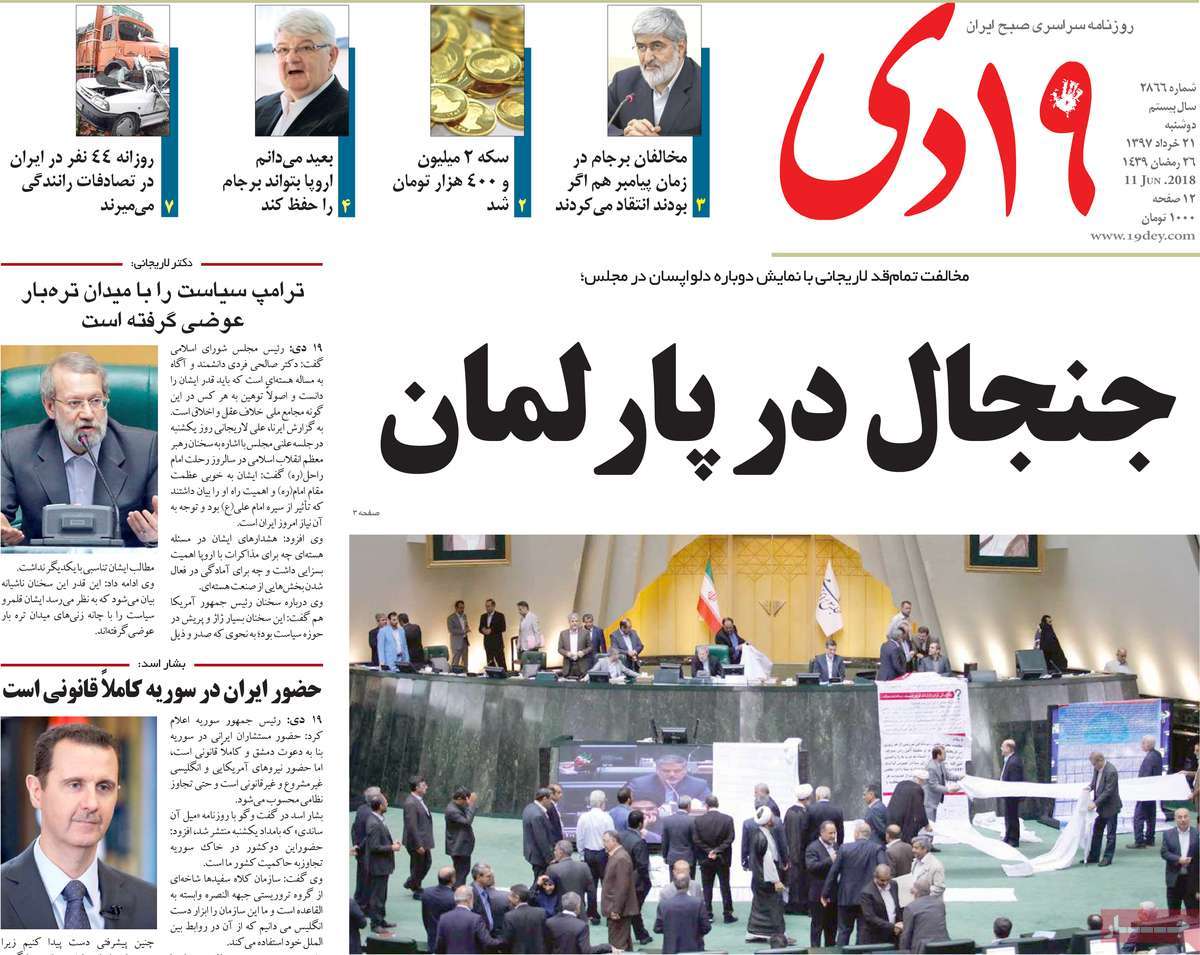
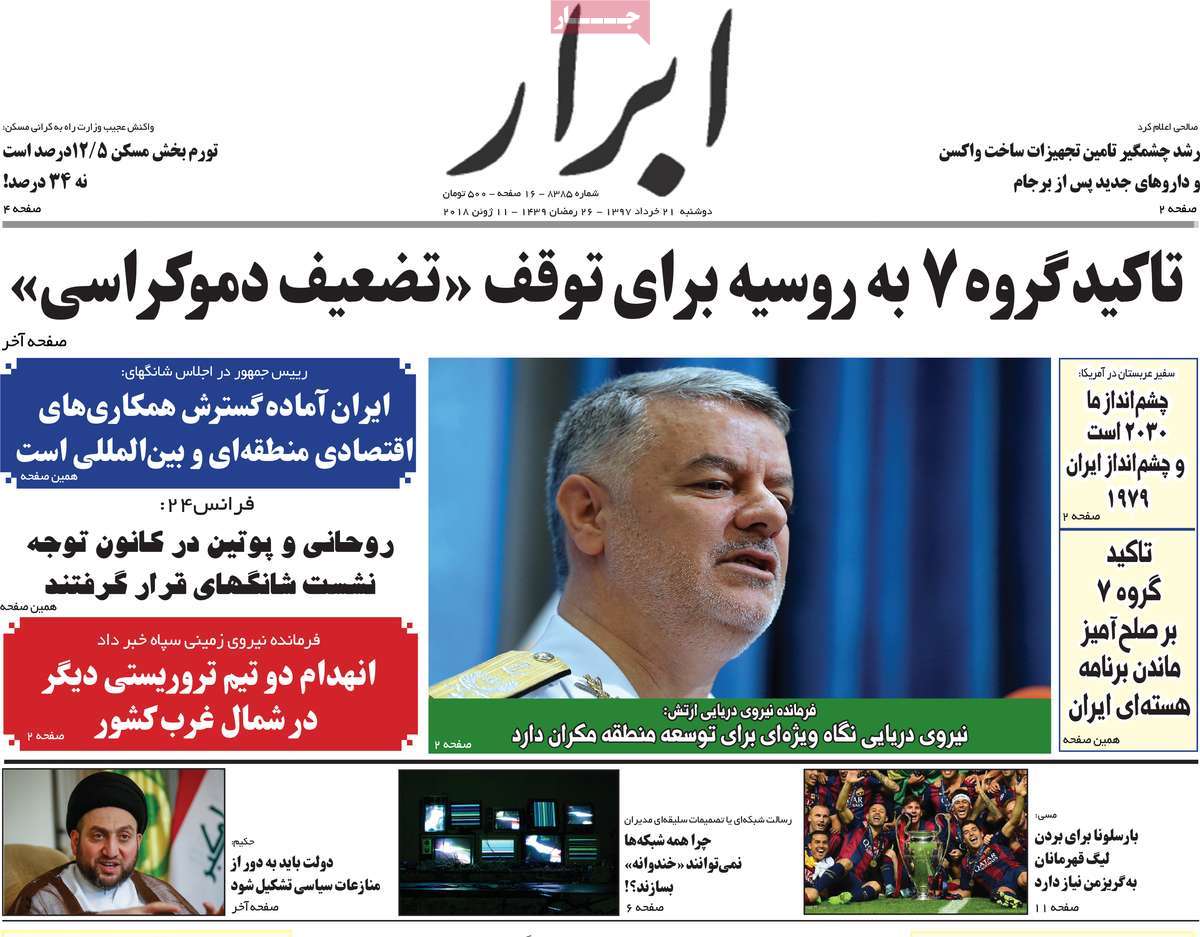
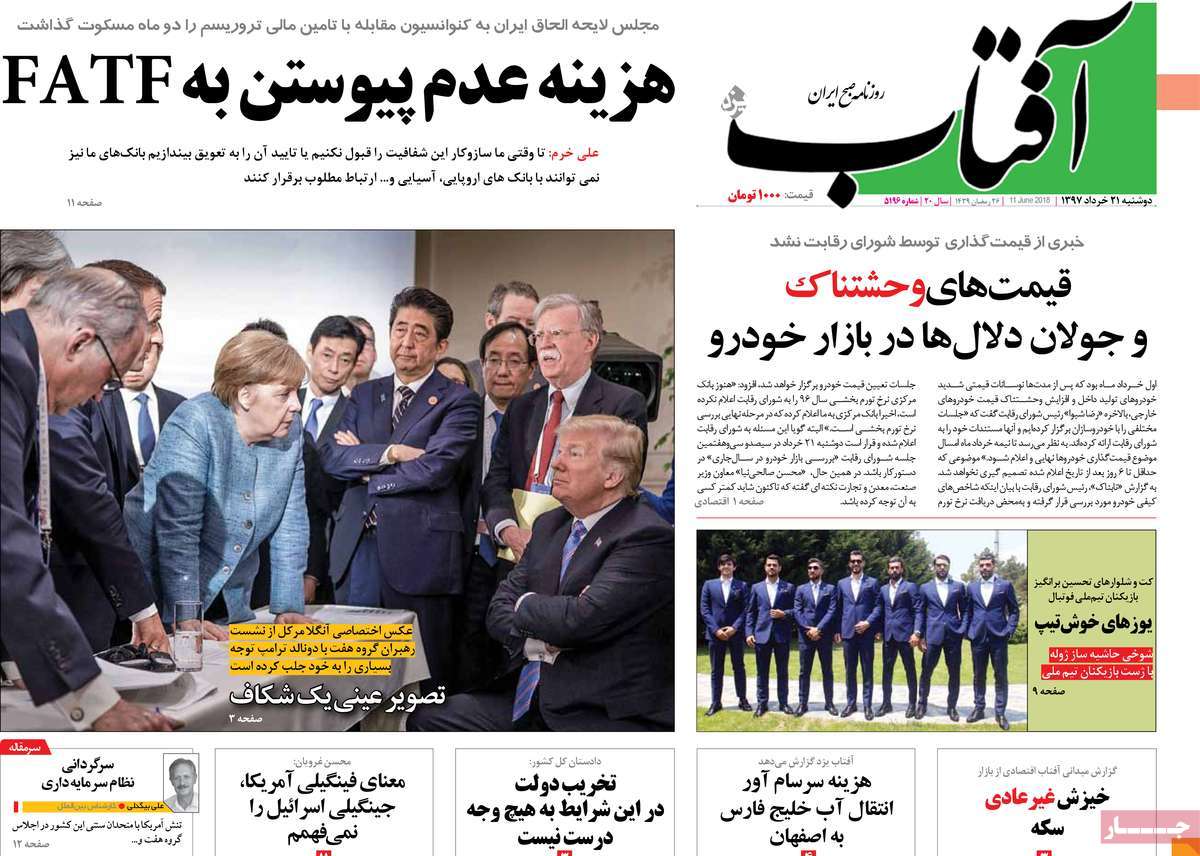
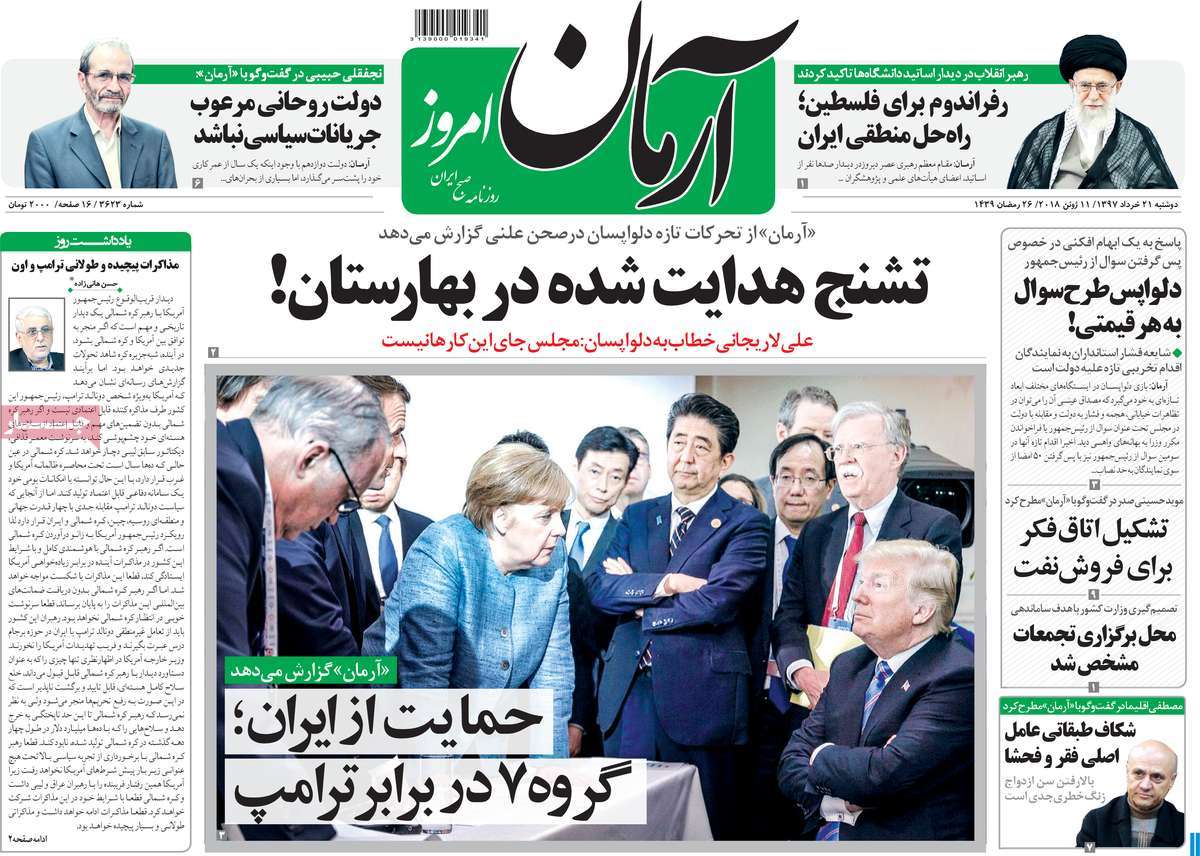
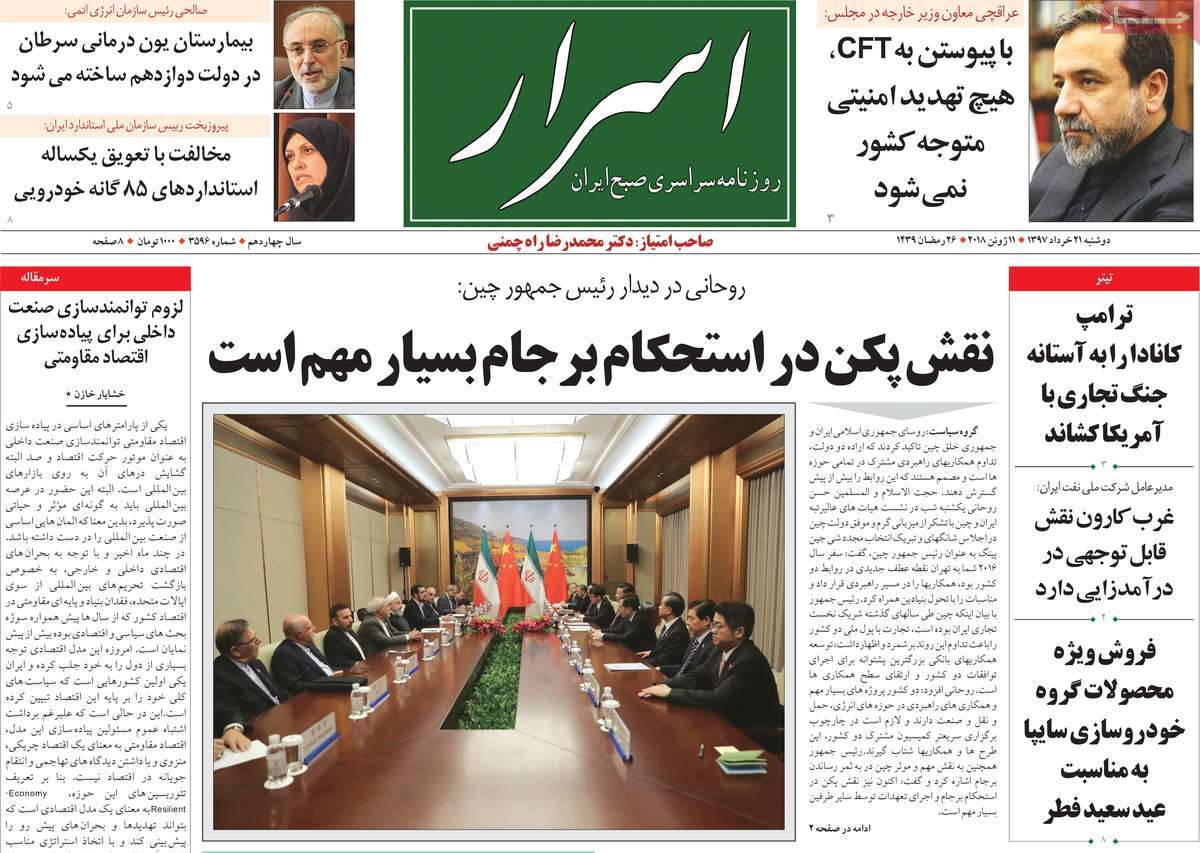
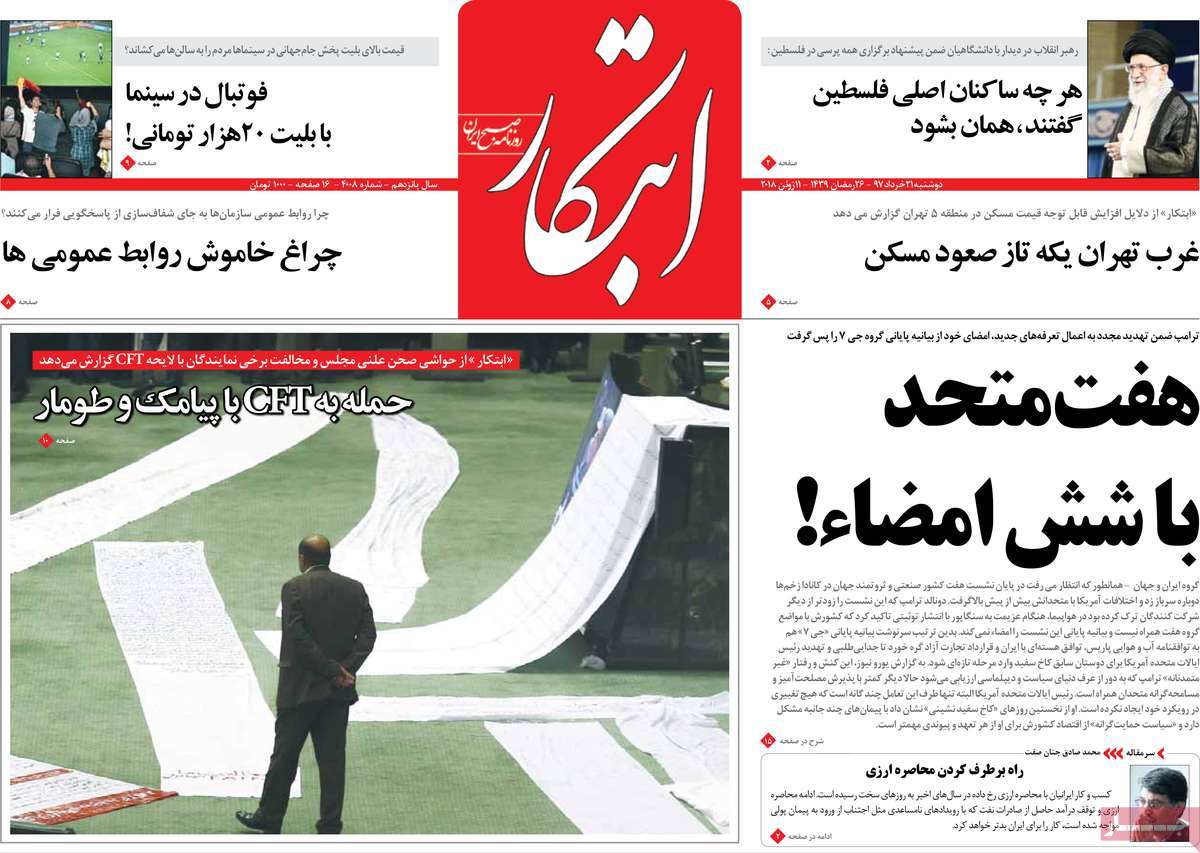
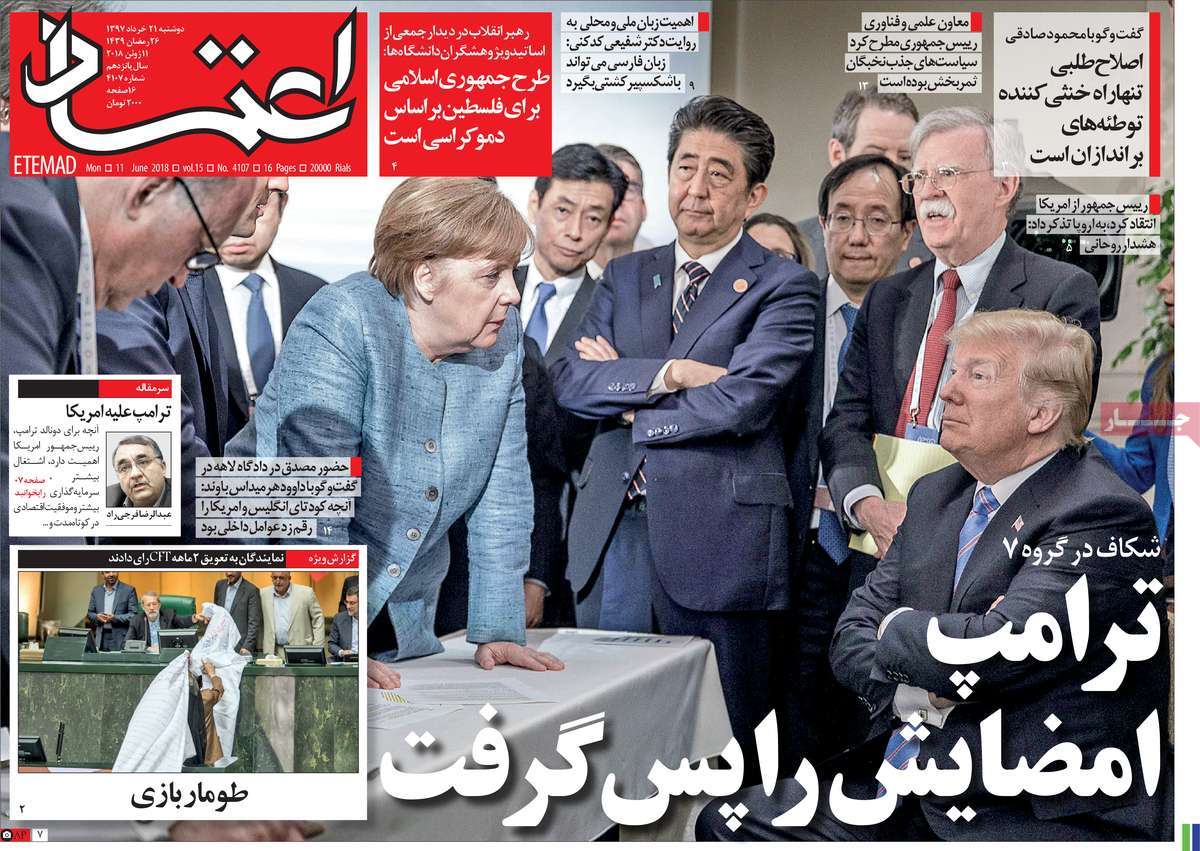
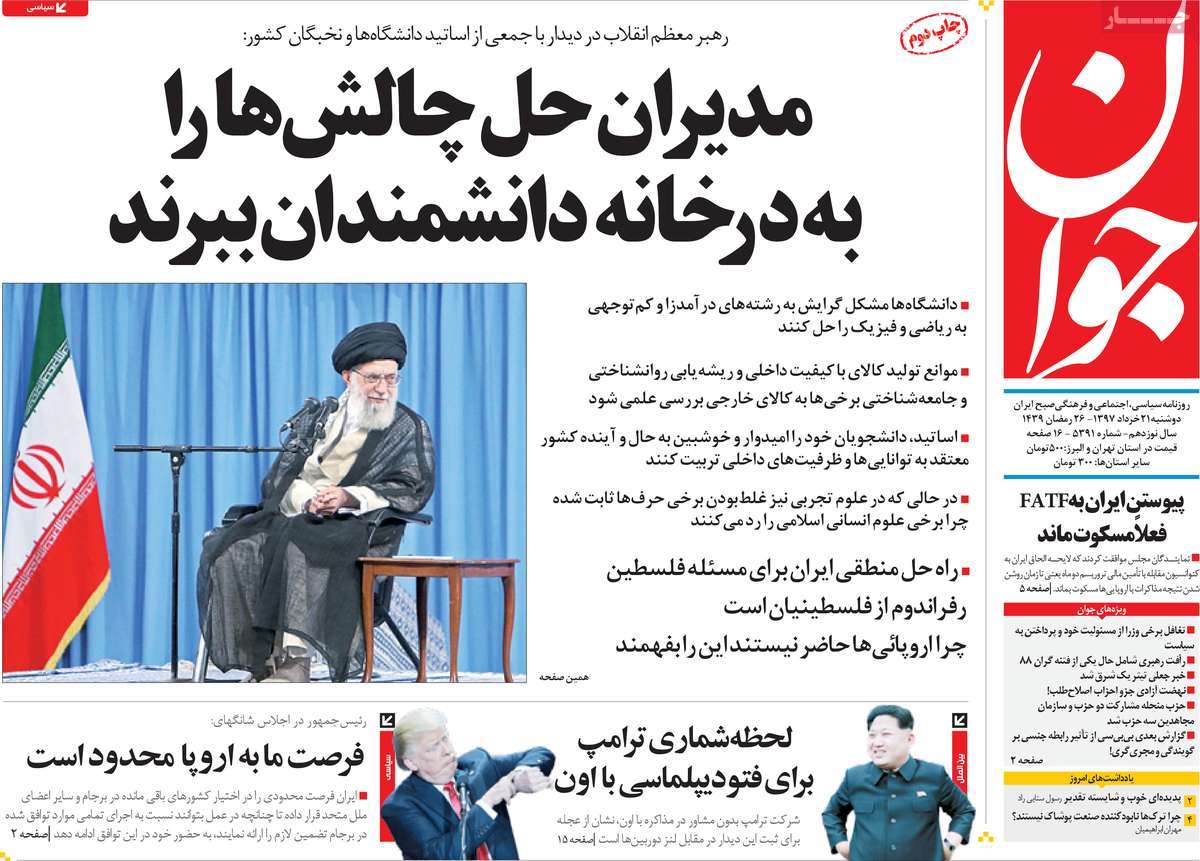
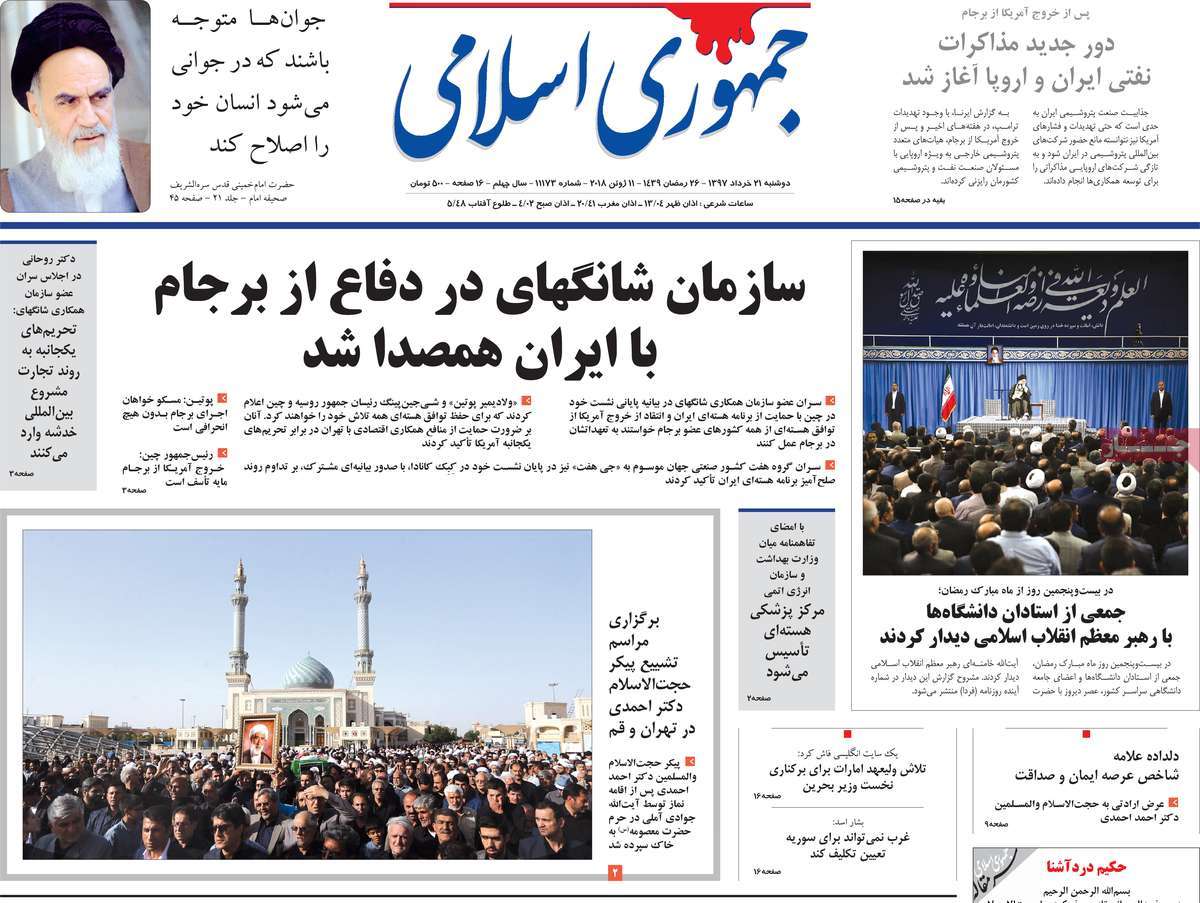
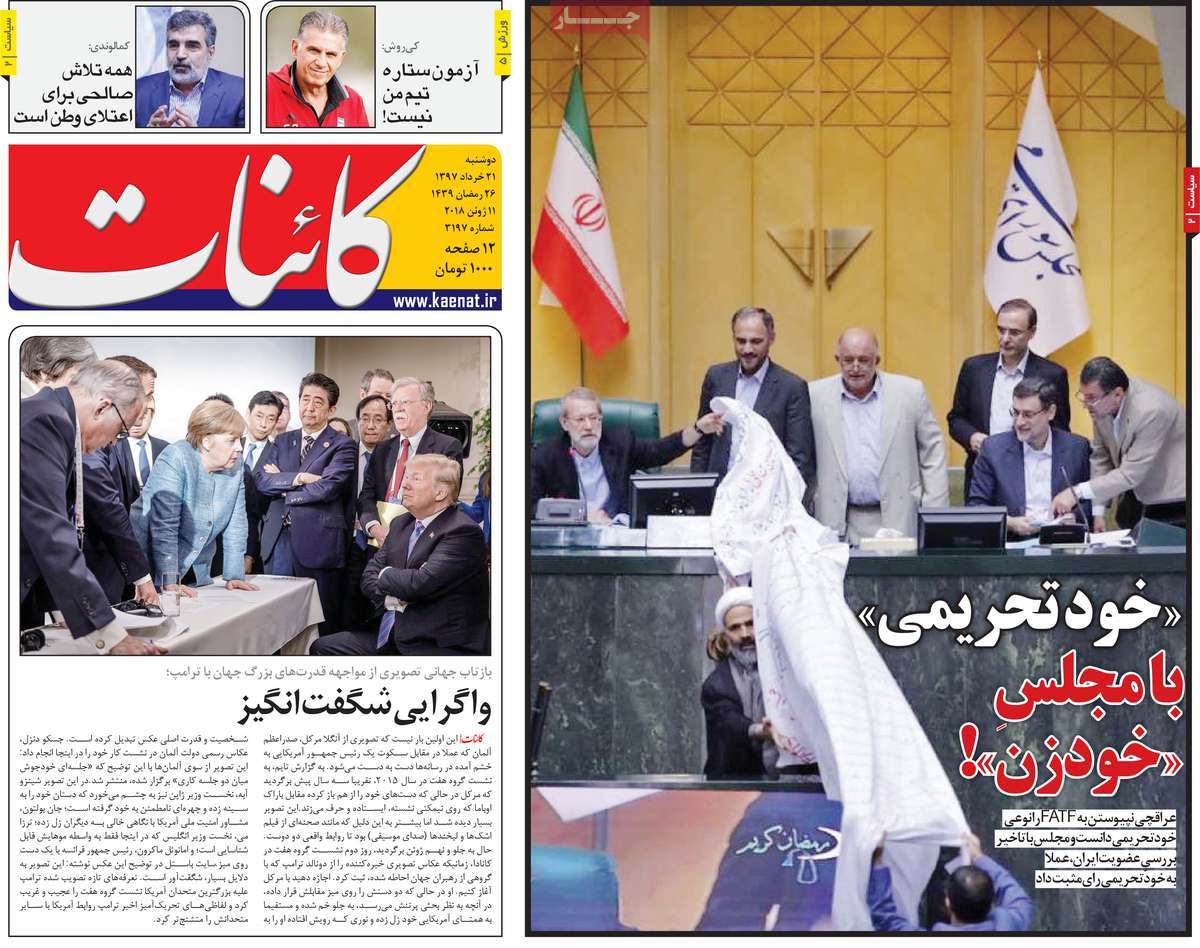
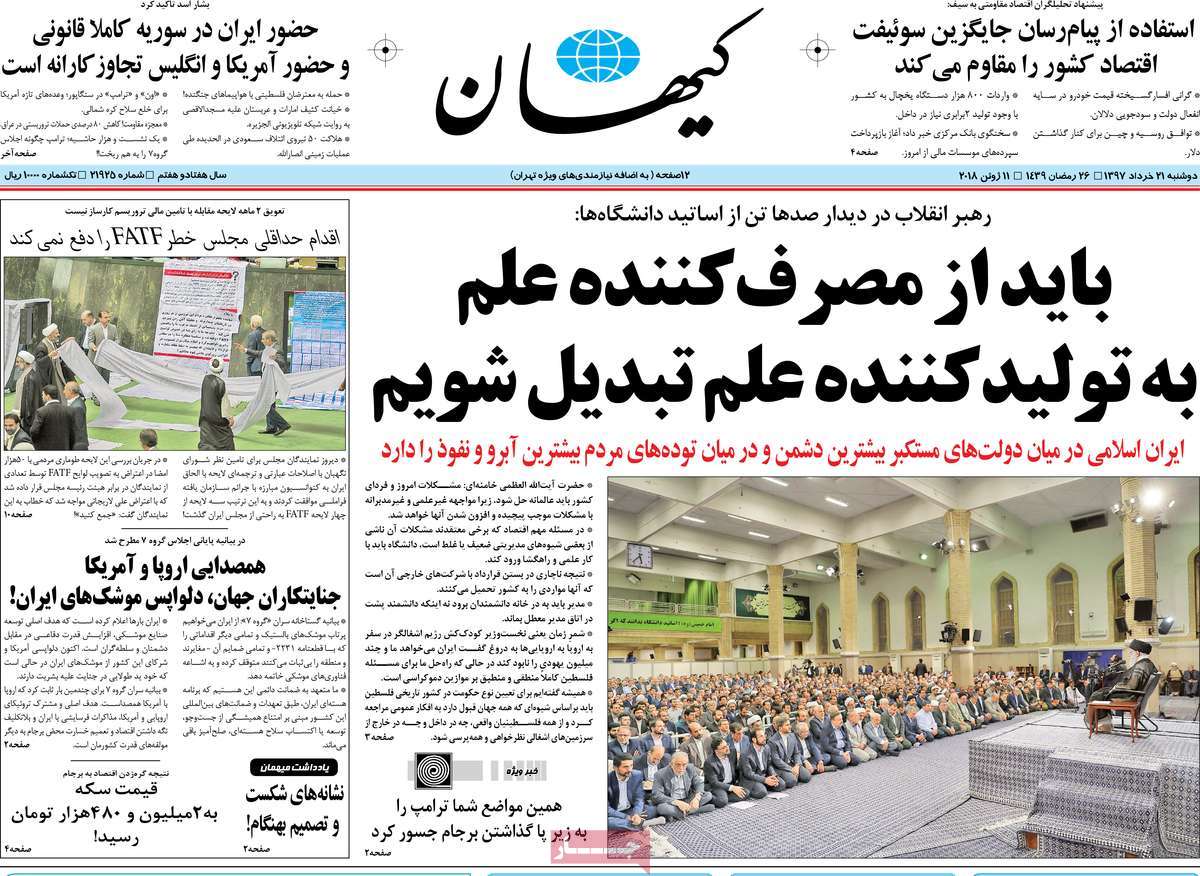
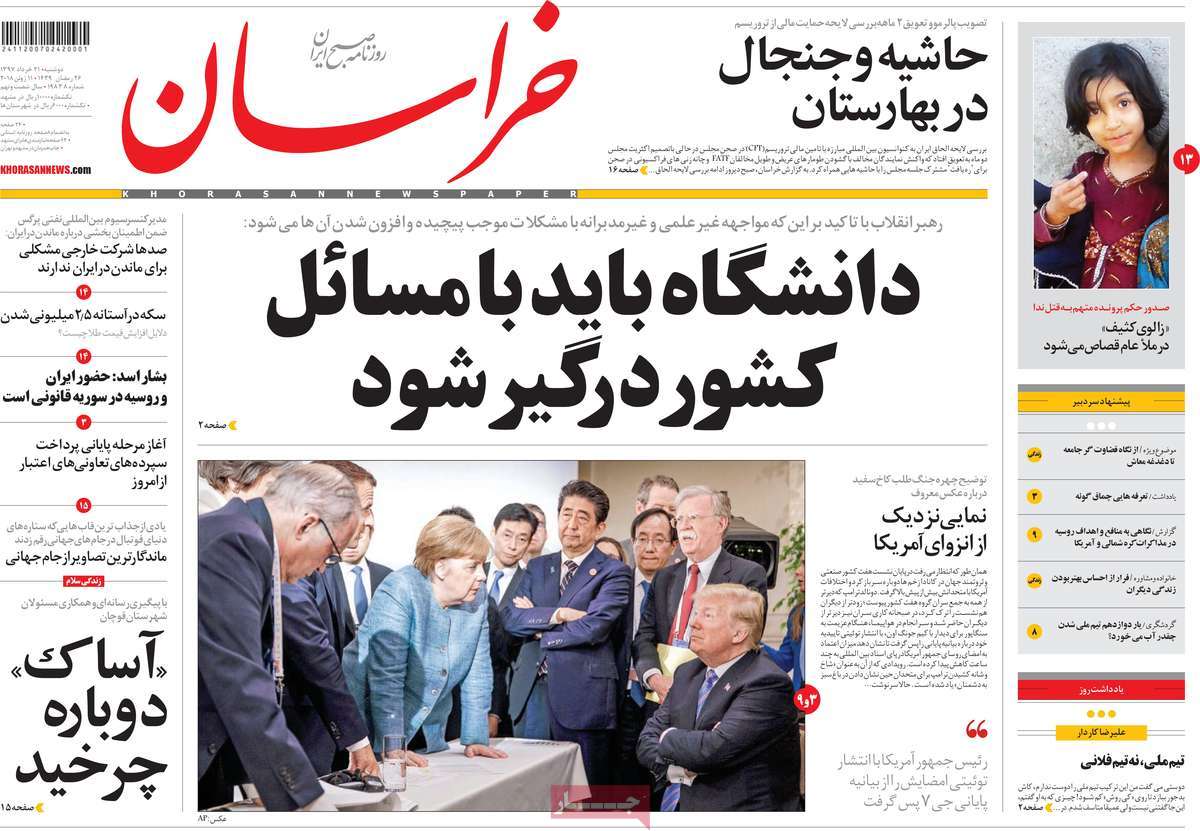
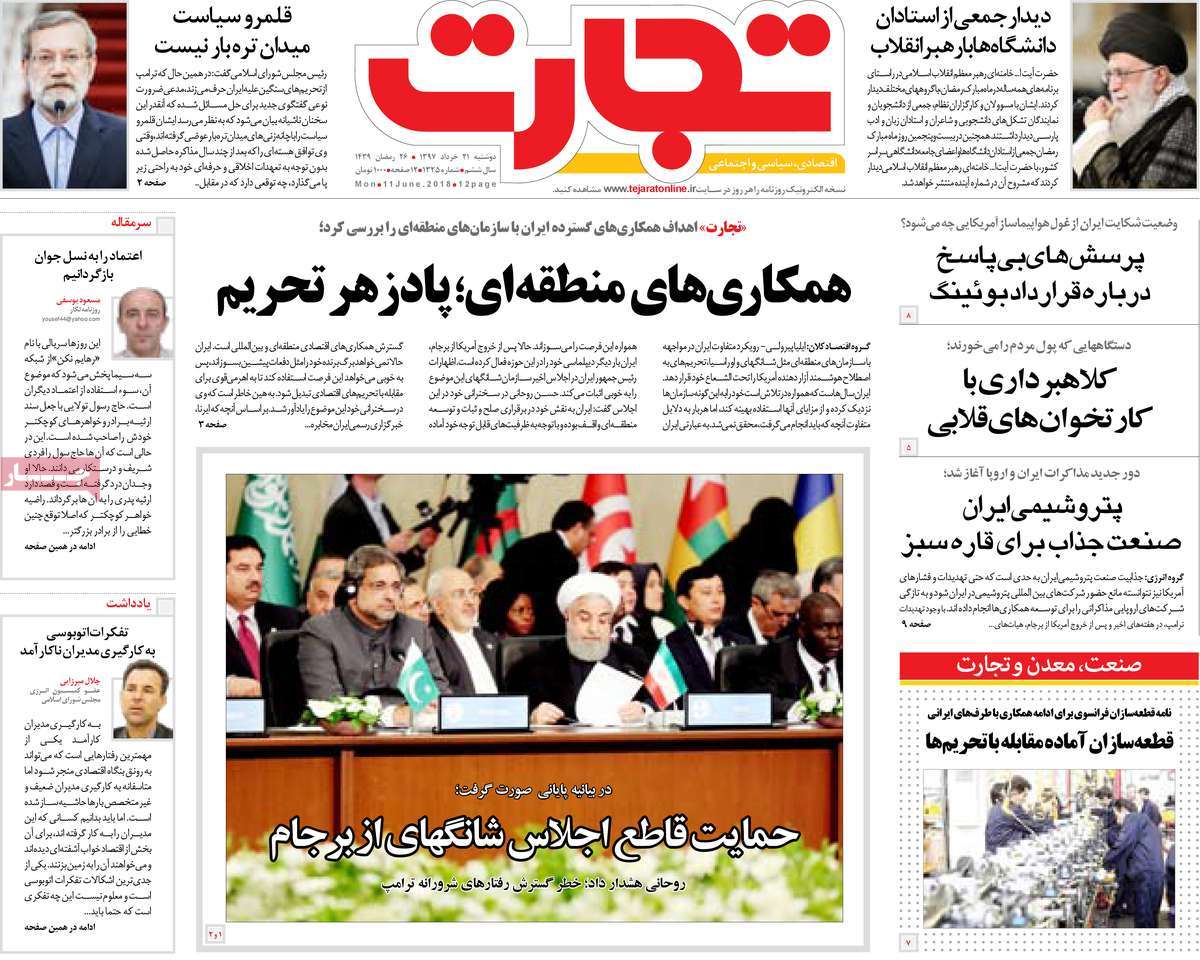
A Look at Iranian Newspaper Front Pages on June 11

A Look at Iranian Newspaper Front Pages on November 19

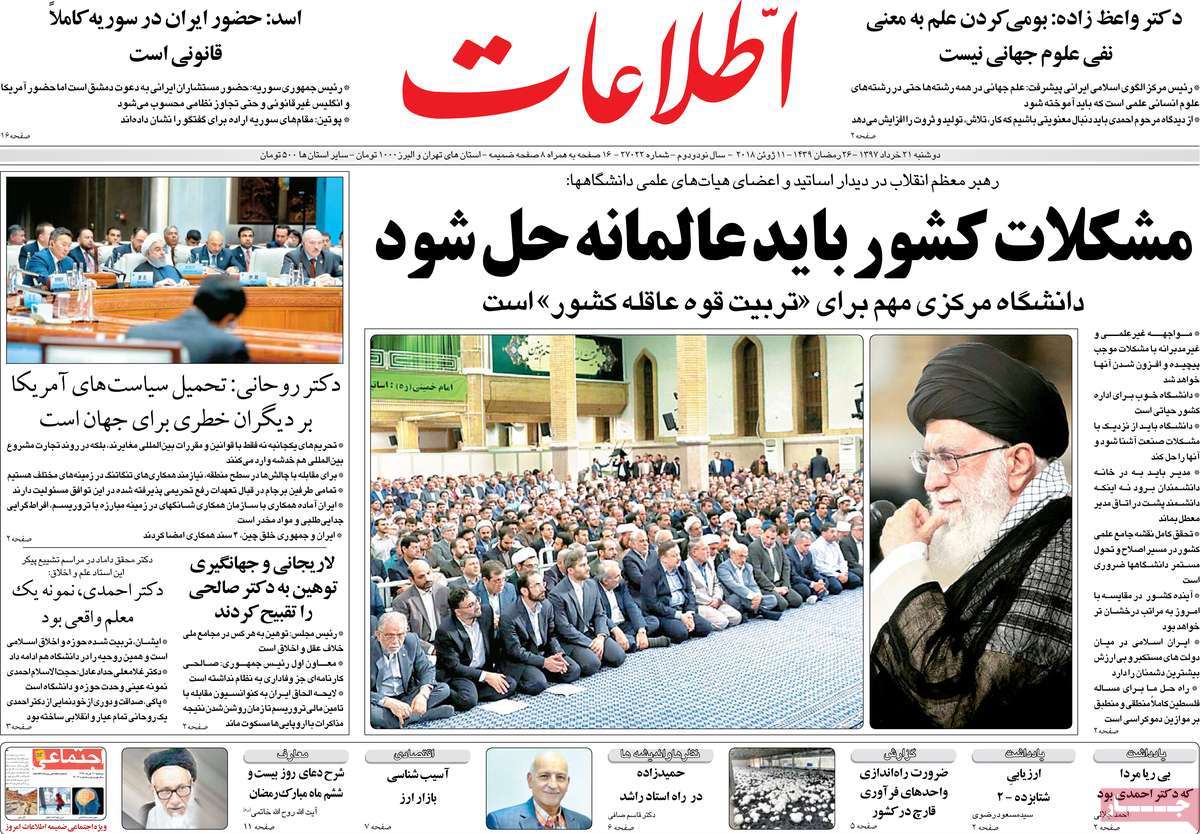
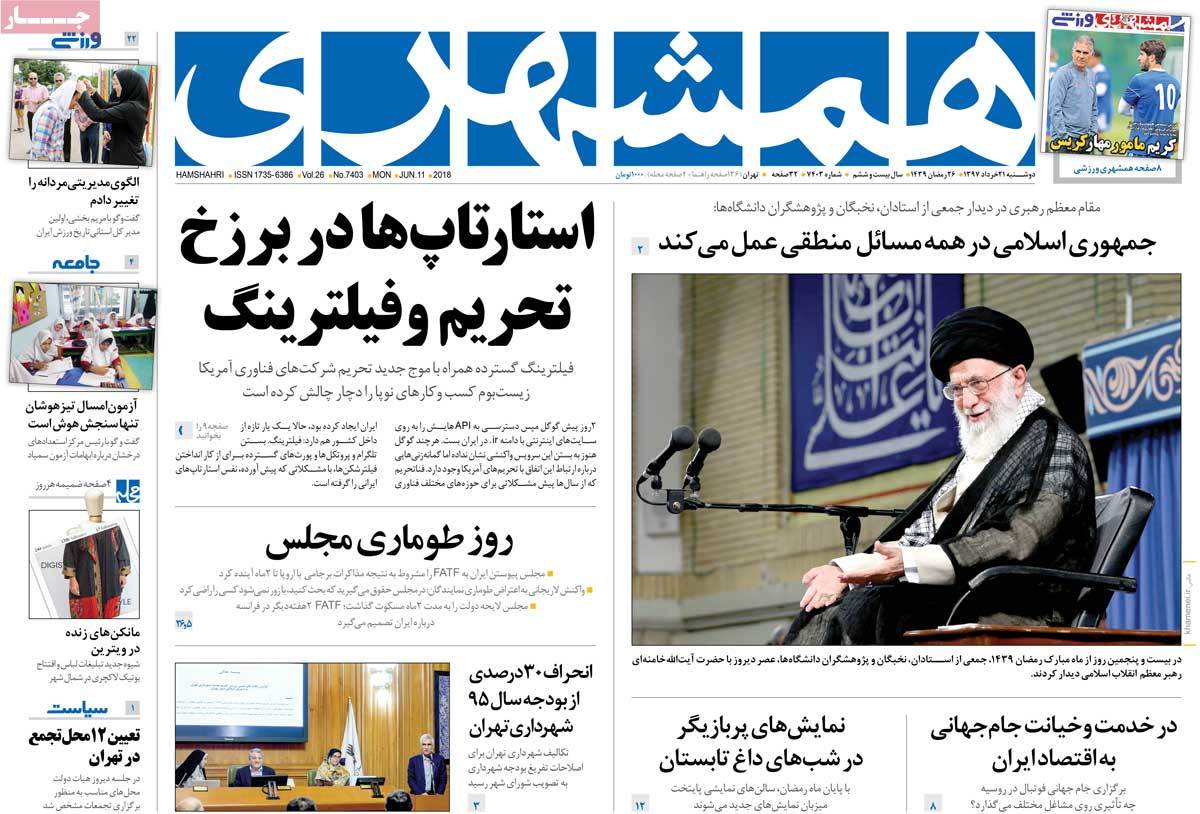
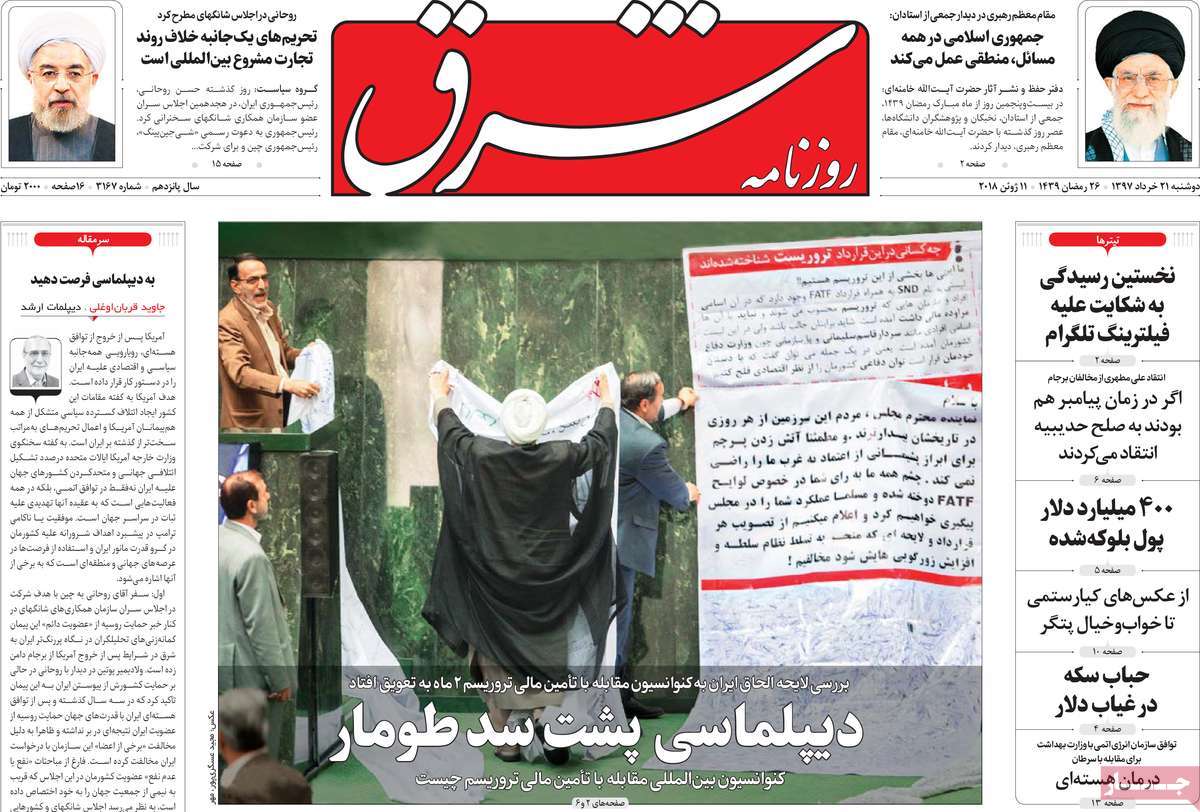
Newspapers today widely covered the remarks made by the Leader of Iran’s Islamic Revolution Ayatollah Seyyed Ali Khamenei in a meeting with a group of university professors and scientists.

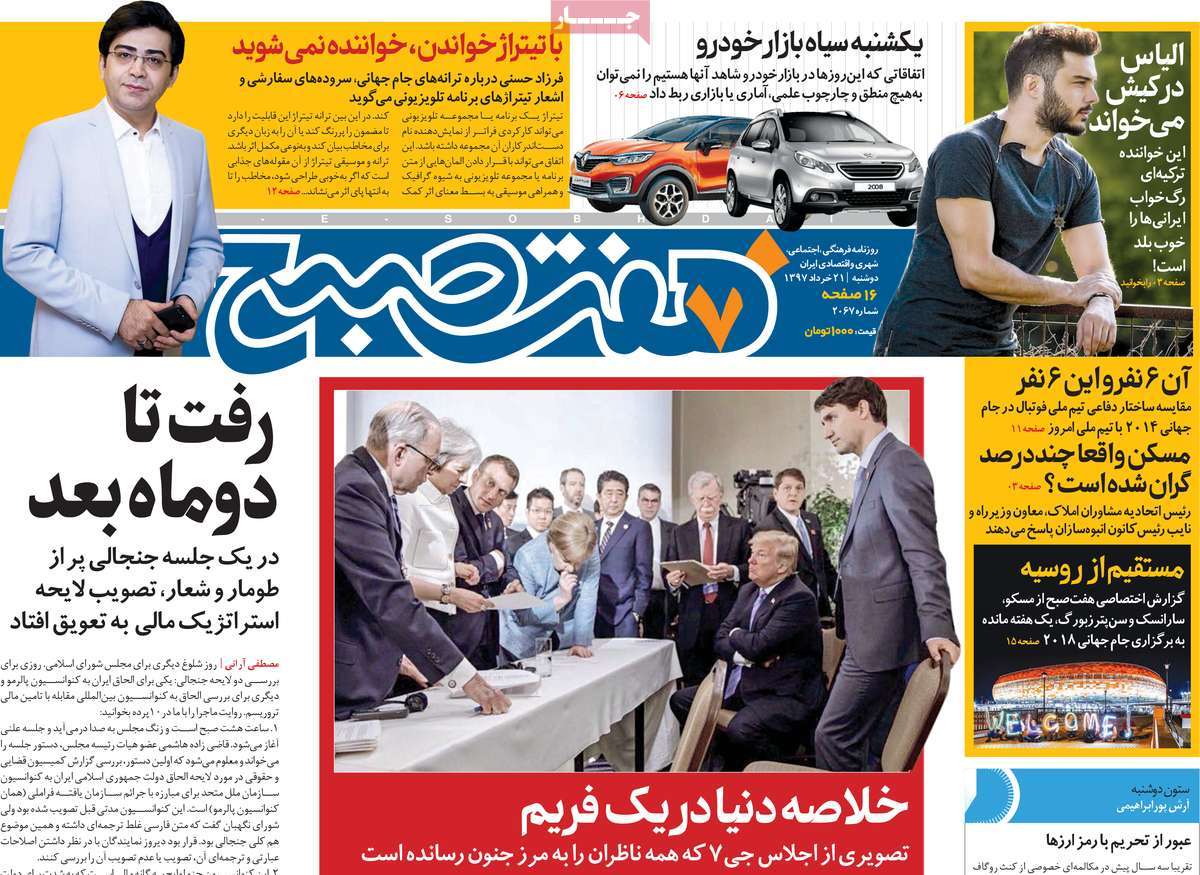
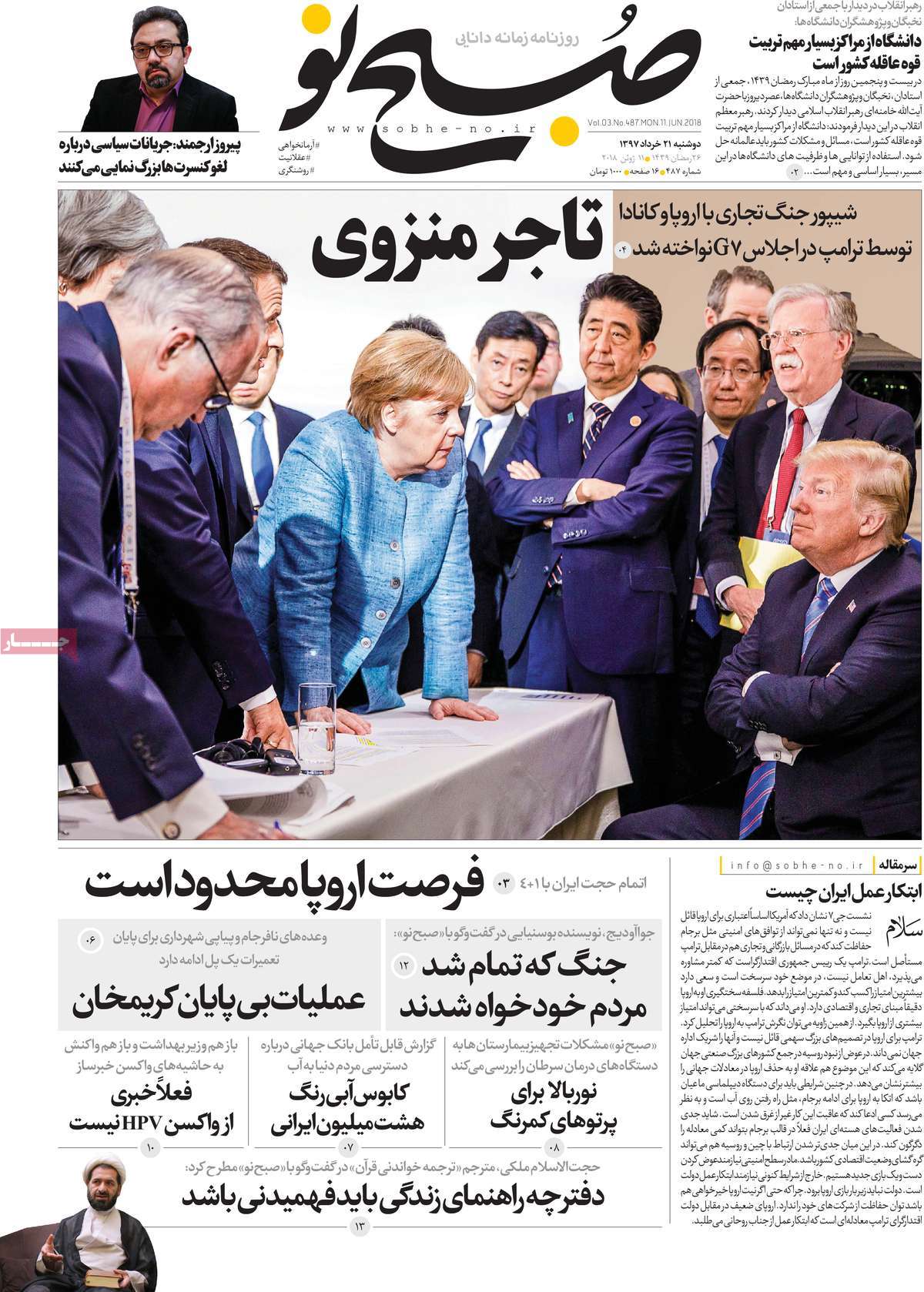
Also a top story was the controversial photo of the G7 summit, in which US President Donald Trump seems to be isolated in a meeting with other world leaders, particularly German Chancellor Angela Merkel.

Several papers also highlighted the latest summit of the Shanghai Cooperation Organisation (SCO), in which all member states expressed their full support for the Iran nuclear deal.

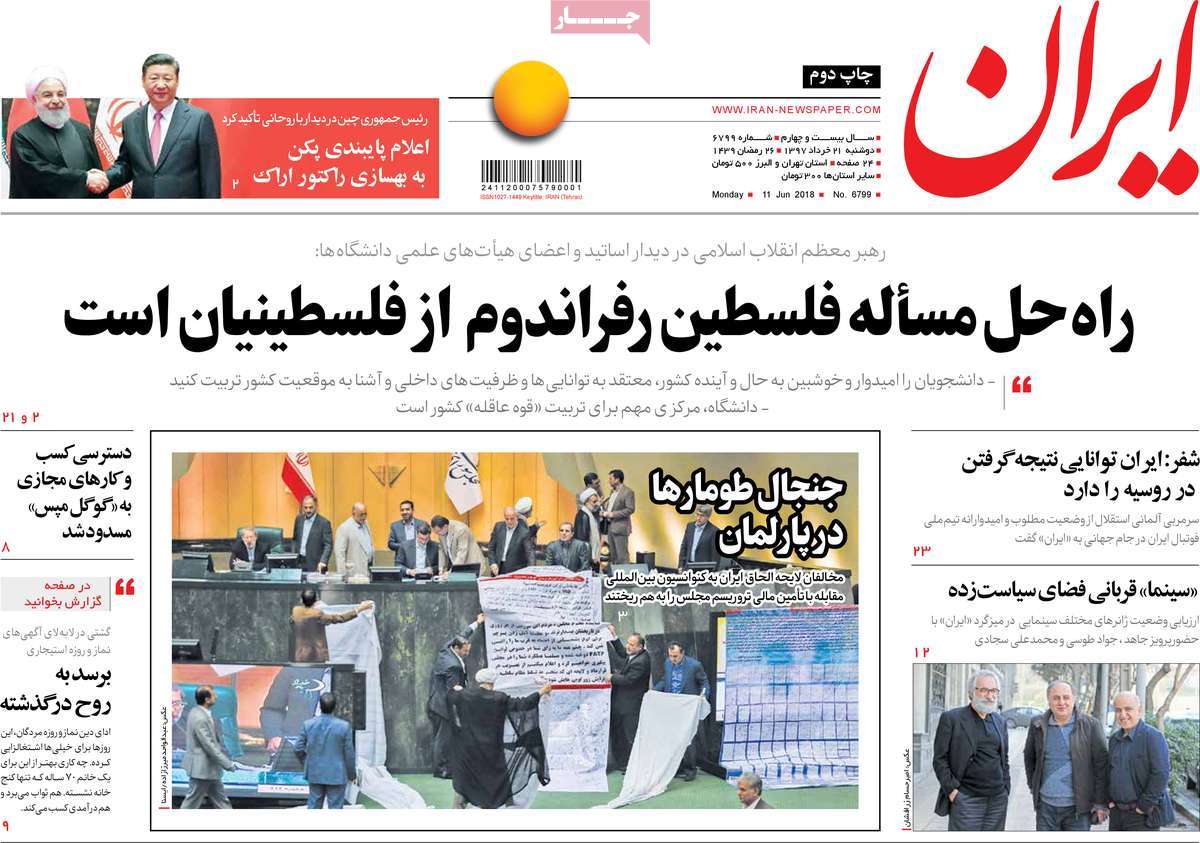
The Iranian Parliament’s refusal to approve the country’s accession to FATF was also a top story and received great coverage today.

The above issues, as well as many more, are highlighted in the following headlines and top stories:


19 Dey:

1- Controversy in Iran Parliament

  • Larijani Strongly Opposes Hardliners’ Show on FATF

2- Trump Has Mistaken Politics for Grocery Market: Larijani

A Look at Iranian Newspaper Front Pages on June 11


Abrar:

1- Rouhani: Iran Ready to Expand Regional, International Economic Cooperation

A Look at Iranian Newspaper Front Pages on June 11


Aftab-e Yazd:

1- Gap between US, Other Countries Clear in This Photo

  • Exclusive Photo of Angela Merkel in G7 Summit Makes Headlines

A Look at Iranian Newspaper Front Pages on June 11


Arman-e Emrooz:

1- Ayatollah Khamenei: Holding Referendum Is Iran’s Logical Solution for Palestine

2- G7 Supports Iran against Trump

A Look at Iranian Newspaper Front Pages on June 11


Asrar:

1- Araqchi in Parliament: Joining CFT Not to Pose Any Security Threat to Iran

A Look at Iranian Newspaper Front Pages on June 11


Ebtekar:

1- Iran Leader: Main Residents of Palestine the Ones Who Must Decide Fate of Palestine

2- Seven Allies with Six Signatures!

  • Trump Once Again Threatens to Impose New Tariffs, Takes Back His Signature from Communiqué

A Look at Iranian Newspaper Front Pages on June 11


Etemad:

1- Trump Revokes G7 Communiqué: Gap among World Leaders

2- Trump against US [Editorial]

3- Democracy Is Iran’s Plan for Palestine: Leader

A Look at Iranian Newspaper Front Pages on June 11


Ettela’at:

1- Iran Leader: Domestic Problems Must Be Resolved Wisely

2- Assad: Iran’s Presence in Syria Totally Legal

3- Rouhani: US Imposition of Its Policies on Others Threat to World

A Look at Iranian Newspaper Front Pages on June 11


Haft-e Sobh:

1- World Summarized in One Frame

  • Photo of G7 Summit Surprises All Observers

A Look at Iranian Newspaper Front Pages on June 11


Hamshahri:

1- Iran Leader: Islamic Republic Acts Logically in Dealing with All Issues

A Look at Iranian Newspaper Front Pages on June 11


Iran:

1- Iran Capable of Achieving Goods Results in Russia: Winfried Schäfer

A Look at Iranian Newspaper Front Pages on June 11


Javan:

1- Iran Leader: Officials Must Ask for Scientists’ Help to Overcome Challenges

2- Trump Eagerly Waiting for Taking Photo with Kim Jong-un

A Look at Iranian Newspaper Front Pages on June 11


Jomhouri Eslami:

1- SCO United in Supporting Iran Nuclear Deal

2- New Round of Iran-EU Oil Talks Begins after US Withdrawal from JCPOA

A Look at Iranian Newspaper Front Pages on June 11


Ka’enat:

1- Iran Imposing Sanctions on Itself!

  • Araqchi: Parliament’s Refusal to Approve FATF Accession Yes Vote to Iran Sanctions

A Look at Iranian Newspaper Front Pages on June 11


Kayhan:

1- Iran Leader: We Must Turn into Producer of Science, Knowledge

A Look at Iranian Newspaper Front Pages on June 11


Khorasan:

1- Close-up of US Isolation: White House’s Warmonger Explains about Famous Photo

A Look at Iranian Newspaper Front Pages on June 11


Sepid:

1- Health Minister: Best Use of Peaceful Nuclear Energy Is in Social Field

A Look at Iranian Newspaper Front Pages on June 11


Shargh:

1- Diplomacy Blocked behind Dam of Opposition

  • Iran’s Accession to FATF Postponed for 2 Months

 A Look at Iranian Newspaper Front Pages on June 11


Sobh-e Now:

1- Isolated Businessman: Trump Starts Trade War with Europe, Canada in G7

A Look at Iranian Newspaper Front Pages on June 11


Tejarat:

1- Regional Cooperation to Neutralise Sanctions

A Look at Iranian Newspaper Front Pages on June 11

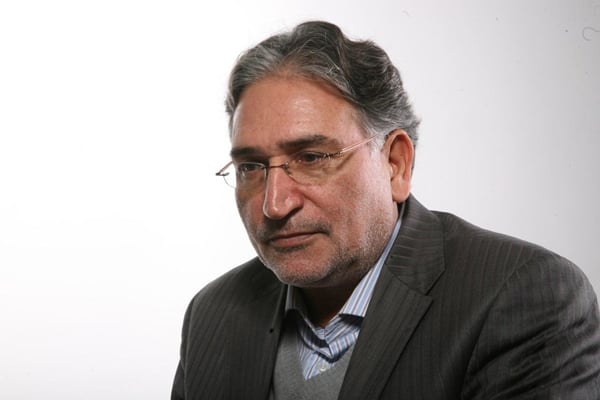
Iran Leader Permits Dissident to Leave Country: Report

According to a group of social media activists, Nourizad has written a letter to Leader of the Islamic Revolution Ayatollah Seyyed Ali Khamenei, asking the Leader to permit him to leave Iran in order to visit his child, who suffers from a refractory disease.

Nourizad has requested Ayatollah Khamenei to issue an order that would annul a verdict banning him from leaving the country, reports Tasnim News Agency.

Social media activists say the Leader has accepted Nourizad’s request.

The news has made headlines on social media, especially on Twitter, and users have posted a lot of comments about Nourizad with the hashtag #Islamic_Pardon.

Mohammad Nourizad is a far-left reformist activist who has always been a local opposition figure and has lashed out at the Establishment in all areas.

Among other criticisms, Nourizad has made harsh comments about Iran’s presence in Iraq and Syria and the defenders of holy sites.

He was apprehended in 2009 in the wake of the unrest and chaos that followed Iran’s presidential election the same year. Before being arrested, he wrote a number of harshly-worded letters to the Leader, calling on Ayatollah Khamenei to change his policies on how to deal with protesters.

Iran Releases Details of Complex Operation to Free Fishermen Held by Pirates

Iranian Intelligence Minister Seyyed Mahmoud Alavi welcoming the four fishermen released from the Somalia pirates' captivity after a complex intelligence operation

Intelligence Minister Mahmoud Alavi said on Thursday that his ministry’s agents secured the fishermen’s release through a long process and despite tight security controls by the pirates.

The sailors Masoud Balouchi, Ahmad Balouchi, Adam Balouchi and Shir-Mohammad Tabezar, kidnapped three years ago in international waters near Somalia, were welcomed by Alavi in Tehran on Thursday.

In March 2015, two Iranian fishing ships were captured by Somali pirates who then took 21 crew members hostages and demanded a huge ransom for their freedom.

On Saturday, Jame Jam daily conducted an interview with the released fishermen and an expert from the Intelligence Ministry who shed light on the complex and covert operation.

Rescue Attempts Started

Right after the fishermen were captured, the Intelligence Ministry started communicating with Somali government to help Iran have the fishermen released, but since the pirates were running through a lawless area in the African nation the attempts to free the hostages were not very successful, the expert said.

However, those attempts were not totally in vain and after some months eventually four fishermen were released by the pirates, he added.

Another fisherman, named Golab, then managed to escape and after days of wandering – which even saw him being jailed in Ethiopia – was finally transferred to Iran, he said.

Sailors’ Saga

The escape, however, came at a price as the captors, angry at Golab’s breaking out, turned the conditions for the hostages into a hell, torturing and starving them to death.

In the days to come eight fishermen lost their lives. Adam, whose brother was also among the captured, says two of the fishermen, including his brother, were killed as a result of tortures and six others died of starvation.

Adam said that out of the eight people remaining in the captivity, four, including the ship captain were taken to an unknown place by a pirate named Karani.

Diplomatic Bids Failed

The Intelligence expert said the ministry started its overseas operation after attempts through diplomatic channels did not make any progress.

The intelligence operation for the release of the sailors was highly challenging as the sailors were not held by a government or an official organization, he said.

The operation was conducted by the Intelligence Ministry in close collaboration with the Quds Force of the Islamic Revolution Guards Corps (IRGC) – the special forces in charge of overseas operations, he told the daily.

Unsuccessful Prisoner Swap

The expert added that the Intelligence Ministry arranged a prisoner swap with one of the pirates’ leaders to free the four fishermen but that plan hit the wall when the pirates did not show up at the arranged rendezvous.

The Iranian Navy has been conducting anti-piracy patrols in the Gulf of Aden – where Somali pirates have been frequently attacking ships since November 2008 – to safeguard maritime traffic, especially for the country’s ships and oil tankers.

During their operations, the Iranian navy thwarted several hijacking attempts by the pirates and captured some them.

Tanzania Operation

The expert said a covert team from Tanzania under the command of the Iranian intelligence forces was then charged to rescue the fishermen. The team tried to reach the pirates by sea with a fishing boat.

A fishing boat was used as the team did not want to raise suspicion of any operation being conducted in the area, he said.

The vessel was sent to Kismayo peninsula in south-eastern Somalia, he said, but the fishing ship could not carry out its mandate as other forces – US drones – were also present in the area.

The expert added that US drones were running reconnaissance operations in the area at the time because the Americans had suspected Al-Qaeda activities there.

The fishing ship spent two months in the area, he added, but eventually could not reach the intended location as the intelligence team behind the operation did not want the US to become suspicious of its activities.

Coup de Grace

The expert then said that the ministry had no choice but to deal the final blow by conducting the operation by land.

“Finally we reached them by land and could set the hostages free,” he concluded.

The expert also added that other four sailors are still at the hands of the pirates and the intelligence ministry is trying to bring them home as soon as possible.