Thursday, January 15, 2026
Home Blog Page 2688

Iran FM Discusses Persian Gulf Situation in UNSC Speech

Iran FM Discusses Persian Gulf Situation in UNSC Speech

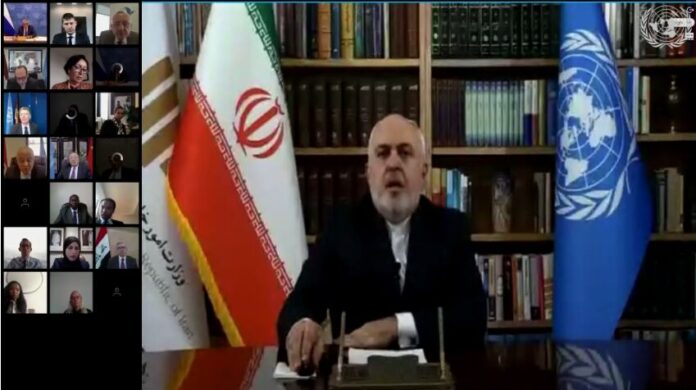
“We can choose to remain prisoners of the past and perpetuate instability and tension. Or, all of us can choose peace, security, stability, and prosperity for all,” Foreign Minister Zarif said in his speech.

“The choice should be obvious to all,” he added.
What follows is the full text of the statement:

In the Name of God, the Compassionate, the Merciful

Mr. President,

Allow me to begin by thanking you for convening this important meeting, and thank Russia for its constructive initiatives. I would also like to acknowledge and welcome the initiative by my friend, State Councilor Wang Yi. 

A year ago, I participated in a similar meeting of the Security Council, presided by you, Minister Lavrov, to present the Hormuz Peace Endeavor—or HOPE—that had just been launched by President Rouhani in his address to the General Assembly. 

Iran stands by that initiative which is the culmination of various Iranian proposals for security and confidence building in the Persian Gulf region. Our first proposal in 1985 became the foundation of paragraphs 5 and 8 of Security Council Resolution 598, which read:

  1. Calls uponall other States to exercise the utmost restraint and to refrain from any act which may lead to further escalation and widening of the conflict and thus to facilitate the implementation of the present resolution;

….

  1. 8Further requeststhe Secretary-General to examine in consultation with Iran and Iraq and with other states of the region measures to enhance the security and stability of the region;

Regrettably—and despite our persistent follow-ups—those paragraphs remain unimplemented.  

And our region has since been the scene of several wars, massive foreign military buildups, ensuing nightmare of extremism and terrorism, dangerous accumulation of the most sophisticated weaponry, and aggression and power projection by various actors.

The disparities in power, geographic size, and natural and human resources are very real. Historical anxieties and rivalries among many regional countries cannot be overlooked. But three flawed prescriptions have caused catastrophic consequences: 

First, that you can purchase security from others: Be it from Saddam Hussein invading Iran on some of our neighbor’s behalf; or from the U.S. coming to rescue our neighbors from the monster that they had together created; or through unprecedented purchase of military hardware. 

Second, that you can have security at the expense of the insecurity of your neighbors: Be it Iran, Kuwait or Qatar at one time or another. 

And third, that you can establish regional hegemony: Be it in Yemen, North Africa or the Horn of Africa.

Extra-regional actors have looked at our regional disparities, unending rivalries, and new hegemonic illusions as opportunities to expand their military presence and to sell more weapons.

The U.S. has deployed nearly 50,000 troops in the Persian Gulf region in 29 military installations with more than 300 combat aircraft. 

It has at least one aircraft carrier patrolling our waters at any given time, as well as tens of destroyers and other vessels with four Central Command Headquarters for its Army and its Special Forces, Air Force, and Navy. 

And, from 2014 to 2018, the Persian Gulf States accounted for nearly one quarter of global arms imports, almost double compared to the preceding five years. Unsurprisingly, the United States sold most of these lethal armaments.

Yet, the military build-ups and hundreds of billions of dollars of arms sales have enhanced neither the security of the external powers, nor of the region. 

Let me take this opportunity here and express our appreciation to the overwhelming majority of Security Council members for rejecting U.S. efforts to kill the JCPOA and Security Council Resolution 2231.  Iran does not intend to engage in an arms race in the region and start a buying spree in spite of the end of Security Council restrictions.

For too long, foreign forces have come to our region to project their power, not to protect our people. 

The illegitimate U.S. presence—7600 miles from its shores— culminated in the cowardly assassination by President Trump of General Qassem Soleimani, Daesh’s Enemy No.1. 

Dear Friends,

Security is contingent on a reliance on our own peoples and cooperation with our own neighbors. 

Yes, with money one can buy the most sophisticated weaponry. But the truth is: security and stability can never be bought.

We need collective efforts by regional countries to establish inclusive dialogue and security networking in this region. Otherwise, we will all be engulfed in turmoil for generations to come.  

And our turmoil will be everyone’s turmoil.

We need a fundamental paradigm shift in our region. 

We need a strong region that precludes hegemonic illusions by any power—regional or global. 

A strong region that requires homegrown political and territorial stability. 

And a strong region in which all neighbors exercise strategic self-restraint. 

Our Hormuz Peace Endeavor (or HOPE) is founded on these imperatives.

HOPE also rests on the responsibility of every state in the region to ensure peace, stability and prosperity in our neighborhood, and to benefit from it. 

HOPE is founded on a commitment by all littoral states to:

  • Promote mutual understanding, peaceful and friendly relations and cooperation among all States and peoples of the Persian Gulf region; 
  • Ensure the territorial integrity and inviolability of international boundaries of all Persian Gulf littoral states; 
  • Cooperate in eradicating terrorism, extremism and sectarian tensions across the region; 
  • Promote peaceful resolution of all regional tensions and conflicts through enhanced communication and early warning; and
  • Ensure the freedom of navigation and energy security for all

To achieve these objectives, we propose adherence to common principles such as 

  • dialogue and mutual respect; 
  • equal footing; 
  • respect for each other’s sovereignty; 
  • rejection of the threat or use of force; 
  • non-aggression and non-intervention in the internal affairs of each other; and 
  • rejection of participation in alliances and coalitions against one another.

We believe that a new regional approach should be the outcome of collective deliberations. Last year, President Rouhani shared our initial thoughts with all the leaders of the littoral states of the Persian Gulf, inviting them to enrich these ideas and participate in their implementation. 

Together we can envisage a broad spectrum of cooperation and confidence-building measures that include water management, environmental protection, nuclear safety, energy security, education, tourism, economic cooperation, trade, investment, poverty eradication and people empowerment. 

We can agree on regional early warning systems and on military contacts among Persian Gulf littoral states. 

We can agree to establish joint task forces regarding practical measures to gradually expand cooperation.

Mr. President,

We know that most of our neighbors prefer peace and dialogue. That cannot be achieved if one or two pursue confrontation and wishfully wait for alien vampires to “cut their neighbor’s head”. That delusion will never be realized. 

My Friends,

We all have anxieties and grievances. 

Certainly, Iranians will never forget 8 years of an imposed war: the aggressor fully financed by our neighbors. 

So, we can choose to remain prisoners of the past and perpetuate instability and tension. 

Or, all of us—and I stress all—can choose peace, security, stability and prosperity for all

The choice, surely, should be obvious to everyone.

Thank you.
Government’s Top Priority Is to Protect Iranians’ Lives: President

Government’s Top Priority Is to Protect Iranians’ Lives: President

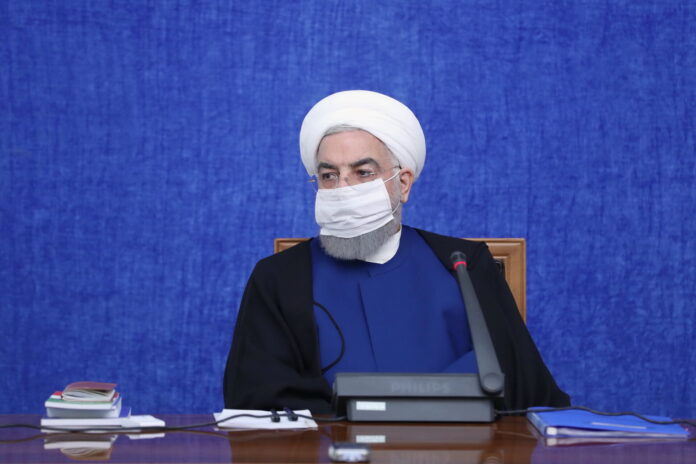
Addressing a Tuesday session of the Administration’s Economic Coordination Headquarters, President Rouhani said the efforts to safeguard the health and lives of people make up the administration’s first priority.
“The government will do its utmost to protect the health of people, and the organizations in charge are obligated to make the necessary arrangements in the cycle of production and distribution to ensure the consumers’ reliable and rapid access (to commodities) across the country,” the president emphasized.

President Rouhani further ordered the Iranian institutions involved in the process of supplying basic commodities and medicine to avoid imposing any restrictions and step up efforts to facilitate public access to the necessary goods.

After hearing reports from the governor of the Central Bank of Iran, the minister of Industry, Mine and Trade, and the minister of Economy about the plans to handle the country’s monetary, currency and commercial sectors in the coming months, the president said the administration’s another main goal is to overcome the current economic problems and reduce the pressure on the vulnerable groups.

The overriding priorities in the administration’s economic strategy under the current special circumstances include plans to supply the basic commodities and raw materials for factories, and to counter the cruel sanctions that the enemies have imposed with the purpose of crippling Iran’s economy and production, the president noted.

President Rouhani also pointed to the cabinet’s plans for stability in the foreign currency market and controlling inflation, saying the main measures include prioritization of imports commensurate with the currency incomes and the strategies to repatriate the foreign currency earned from the exports to the country’s economy.

Iran Not to Join Regional Arms Race: Spokesman

New US Sanctions Not to Affect Iran’s Activities: Spokesman

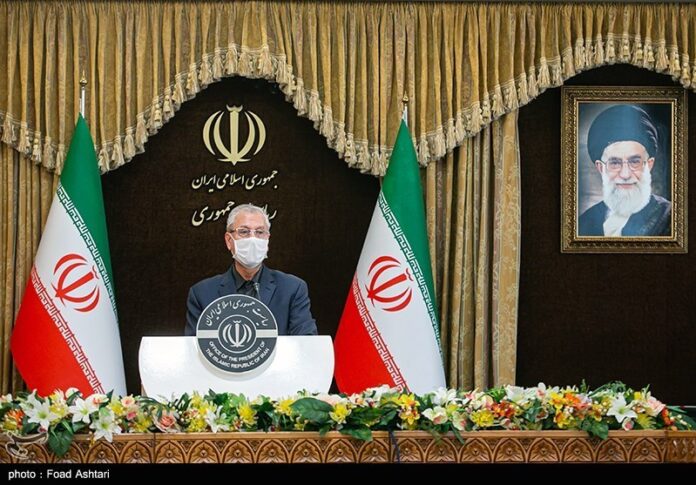
In response to a question about Iran’s plans after the termination of the UN arms embargo, Ali Rabiei said at a press conference on Tuesday, “The Islamic Republic of Iran does not intend to join the arms race in this region, which serves the financial interests of the arms-producing companies.”

“I make it clear that we are concerned about this region turning into a stockpile of weapons, and hold the US accountable for the unbridled sale of arms to the region,” he stressed.

The spokesman then noted that Iran has no special plans for arms trade for now, adding, “Whenever we deem it necessary – considering our legitimate and reasonable defence needs – we will take action in compliance with the customary international law and every state’s inherent right to self-defence.”

The arms embargo on Tehran was founded upon “false Iranophobia”, he stated, saying US President Donald Trump and Israeli Prime Minister Benjamin Netanyahu resorted to a massive Iranophobia campaign to prevent the removal of the arms embargo.

“It basically lacks credibility,” Rabiei said of the arms embargo that was terminated on October 18.

The futile arms sanctions against Iran have only strengthened the country’s self-reliance in the process of manufacturing defense products, he added.

“These sanctions did not restrict Iran’s defence capabilities, nor would the removal of these restrictions today result in any new change in the path we had already taken,” the spokesman said.

“As I mentioned, we have never started any war, and believe that security is ensured through the will of people and self-sufficiency. During the years that we faced the arms embargo, we had no choice but to work on research and development of the indigenous defence industry. After these years, today we enjoy great advantages in manufacturing special defense products, and are prepared to sell them at the request of purchasers with special conditions,” he added.

“We, however, believe that arms are not the solution in the region. Arms are not the solution (to the conflicts) among the countries. What we must rely on is security in light of peace and friendship in the region,” Rabiei stated.

“We have red lines and considerations when it comes to arms trade. Our arms trade doctrine is not different from our defence doctrine,” the spokesperson concluded.

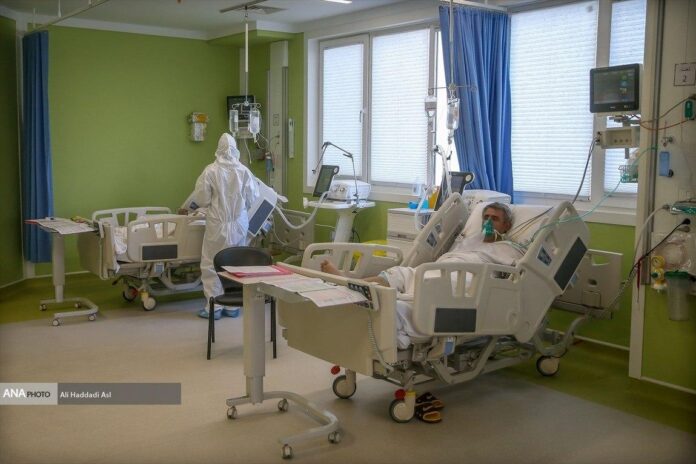
Records Broken Again: Over 5,000 Iranians Contract Coronavirus in 24 Hours

Over 5,000 Iranians Contract Coronavirus in 24 Hours

In a press briefing on Tuesday, Sima-Sadat Lari said the virus has killed 322 patients since Monday noon, raising the overall death toll to 31,034.

So far, she added, 434,676 patients have recovered from the disease or been discharged from the hospital.

Lari said 4,810 patients are also in critical conditions caused by more severe infection.
The spokeswoman noted that 4,570,243 COVID-19 tests have been taken across the country so far.

She said the high-risk “red” zones include Tehran, Qom, Mazandaran, East Azarbaijan, Isfahan, Yazd, Ardabil, Khorasan Razavi, Khuzestan, Hamadan, West Azarbaijan, Bushehr, Chaharmahal and Bakhtiari, Kohgiluyeh and Boyer-Ahmad, Alborz, Lorestan, Markazi, Ilam, South Khorasan, Kermanshah, North Khorasan, Semnan, Gilan, Zanjan, Qazvin, Kurdistan, and Kerman provinces.

The “orange” zones also include Golestan, Hormozgan, and Fars provinces, she added.

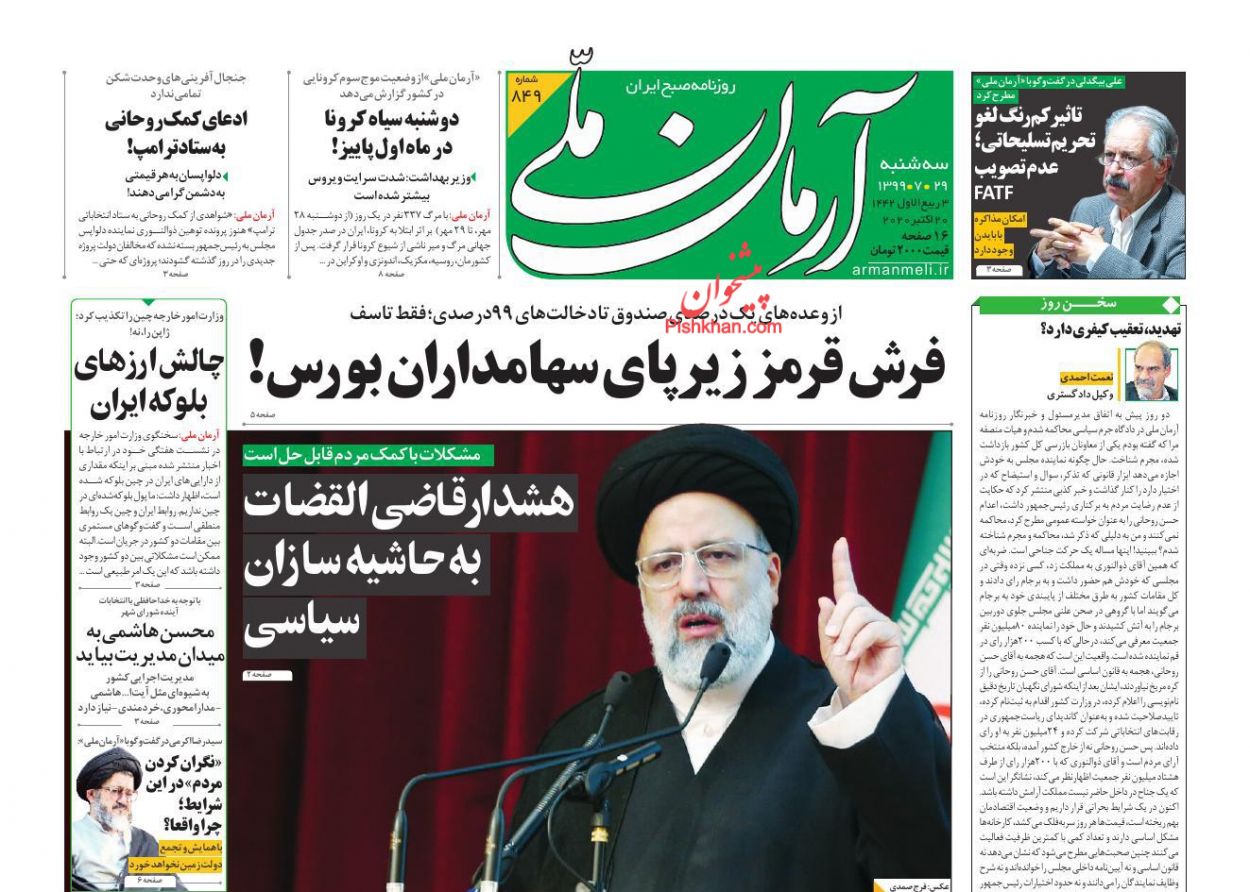
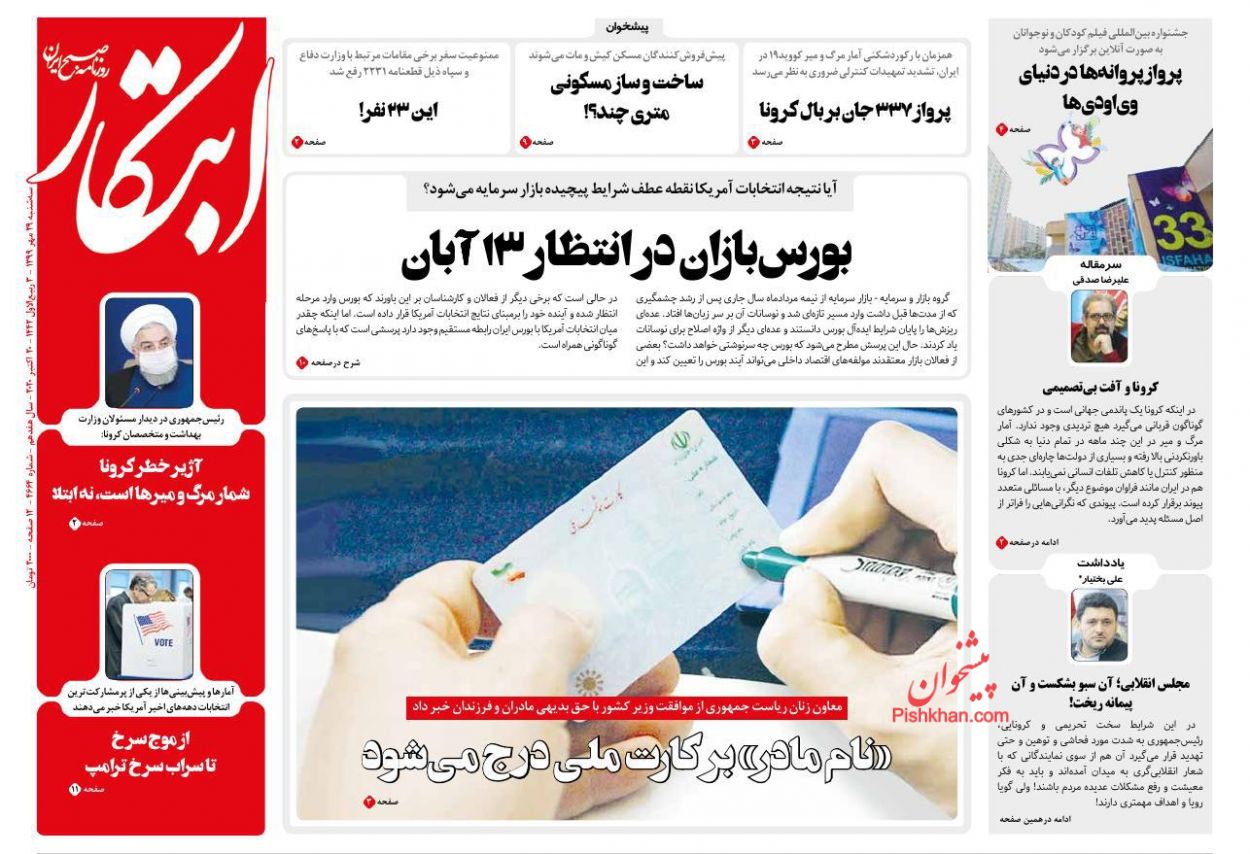
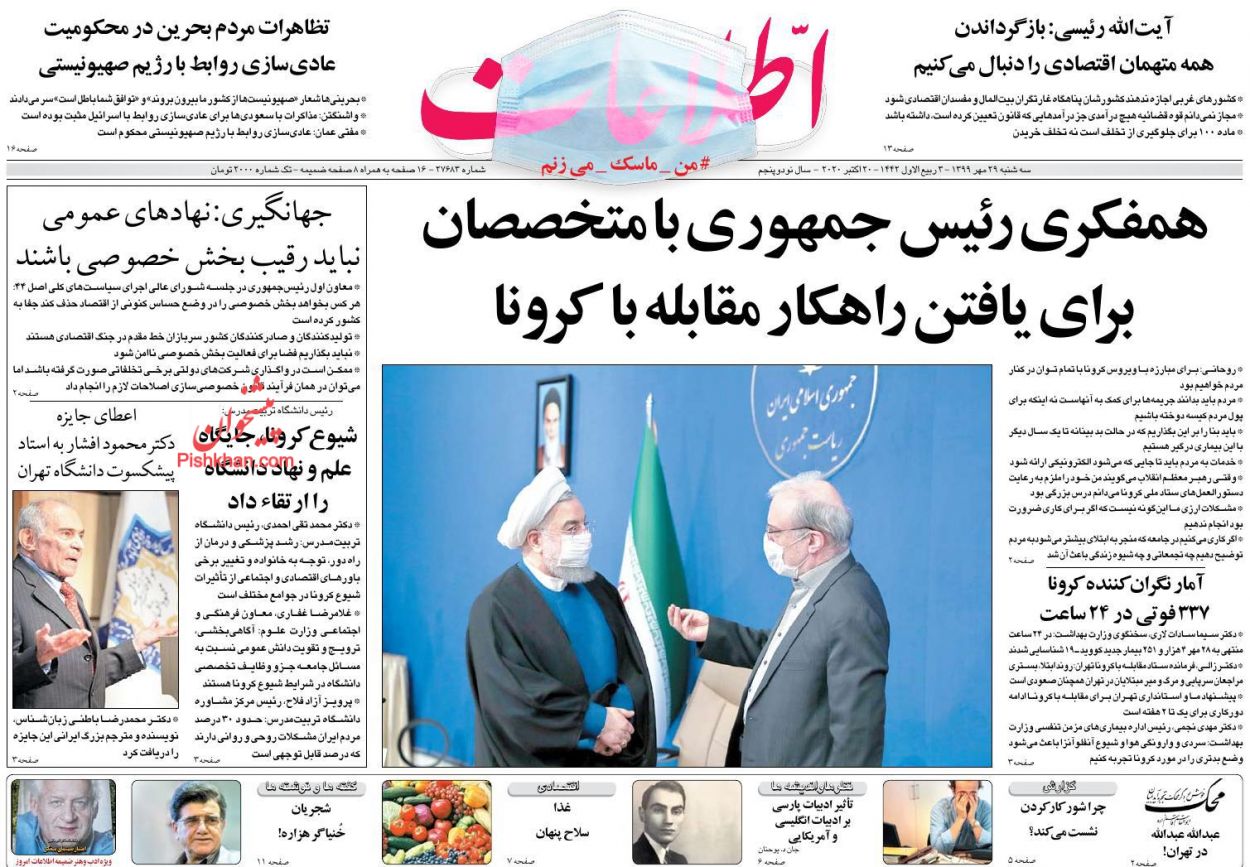
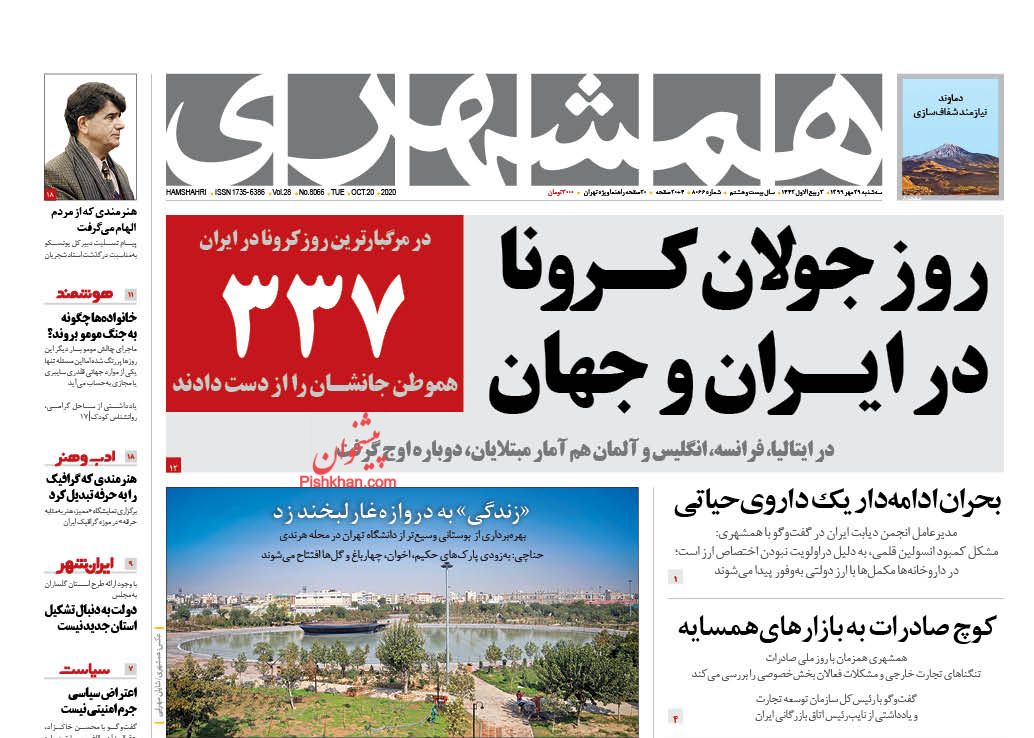
A Look at Iranian Newspaper Front Pages on October 20

A Look at Iranian Newspaper Front Pages on November 18

Iranian Newspapers

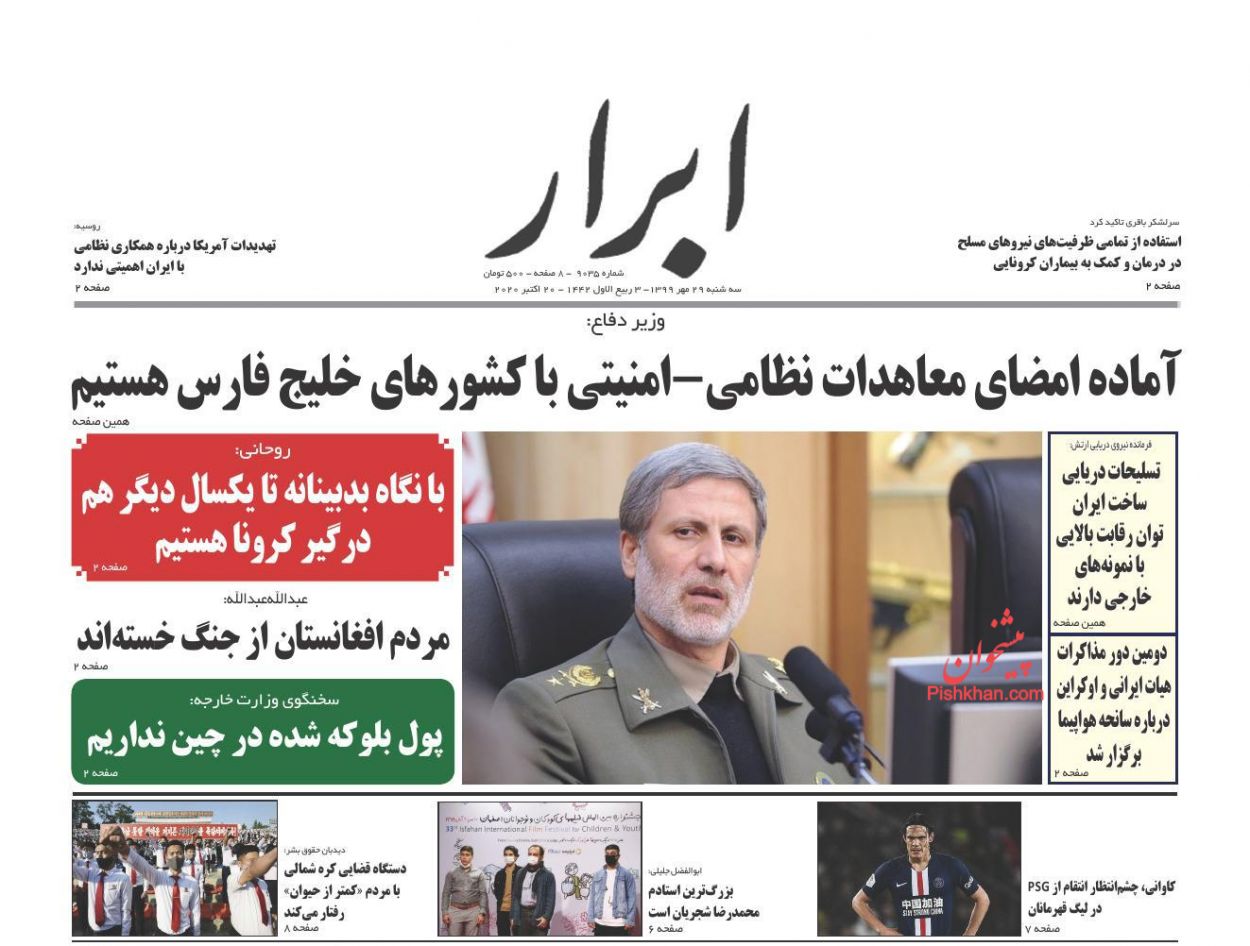
Abrar Newspaper:

1- DM: Iran Ready to Sign Security-Military Pacts with Persian Gulf States

2- Rouhani: Sceptically, We’ll Be Dealing with Corona for One More Year

A Look at Iranian Newspaper Front Pages on October 20


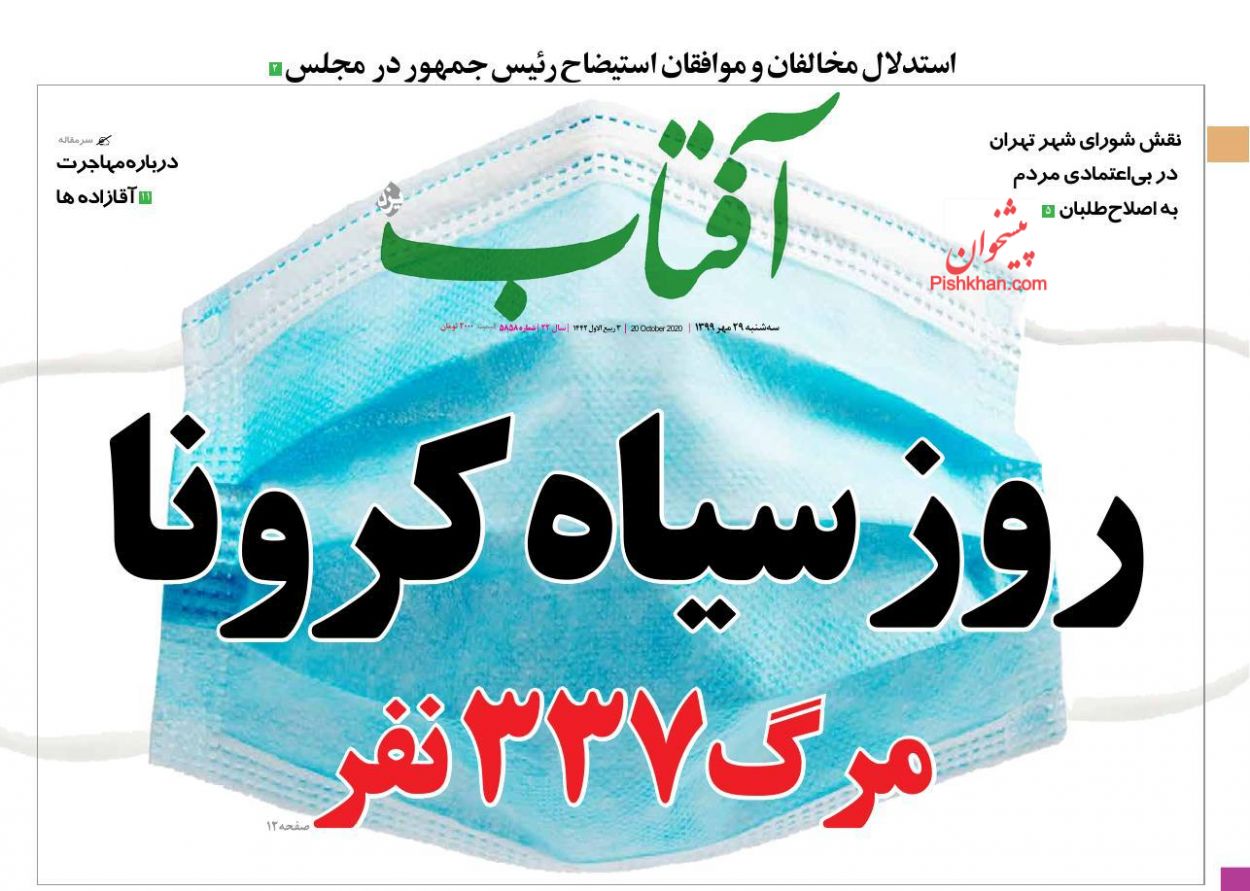
Aftab-e Yazd Newspaper:

1- Dark Day for Iran: 337 Die of COVID-19

2- What MPs Say about Rouhani’s Impeachment

A Look at Iranian Newspaper Front Pages on October 20


Arman-e Melli Newspaper:

1- Black Monday of Coronavirus in Early Autumn

2- Rouhani Has Allegedly Helped Trump Campaign!

A Look at Iranian Newspaper Front Pages on October 20


Ebtekar Newspaper:

1- Interior Minister Agrees Women’s Names Be Put on Iranian People’s National IDs

2- Rouhani: Alarming Number of People Dying of COVID-19

3- From Red Wave to Red Mirage of Trump

* Speculations Say US Will See One of Its Biggest Turnouts This Year

A Look at Iranian Newspaper Front Pages on October 20


Ettela’at Newspaper:

1- Rouhani Consults with Specialists to Find Solutions to Corona

A Look at Iranian Newspaper Front Pages on October 20


Hamshahri Newspaper:

1- Day of Coronavirus Surge in Iran and the World

A Look at Iranian Newspaper Front Pages on October 20


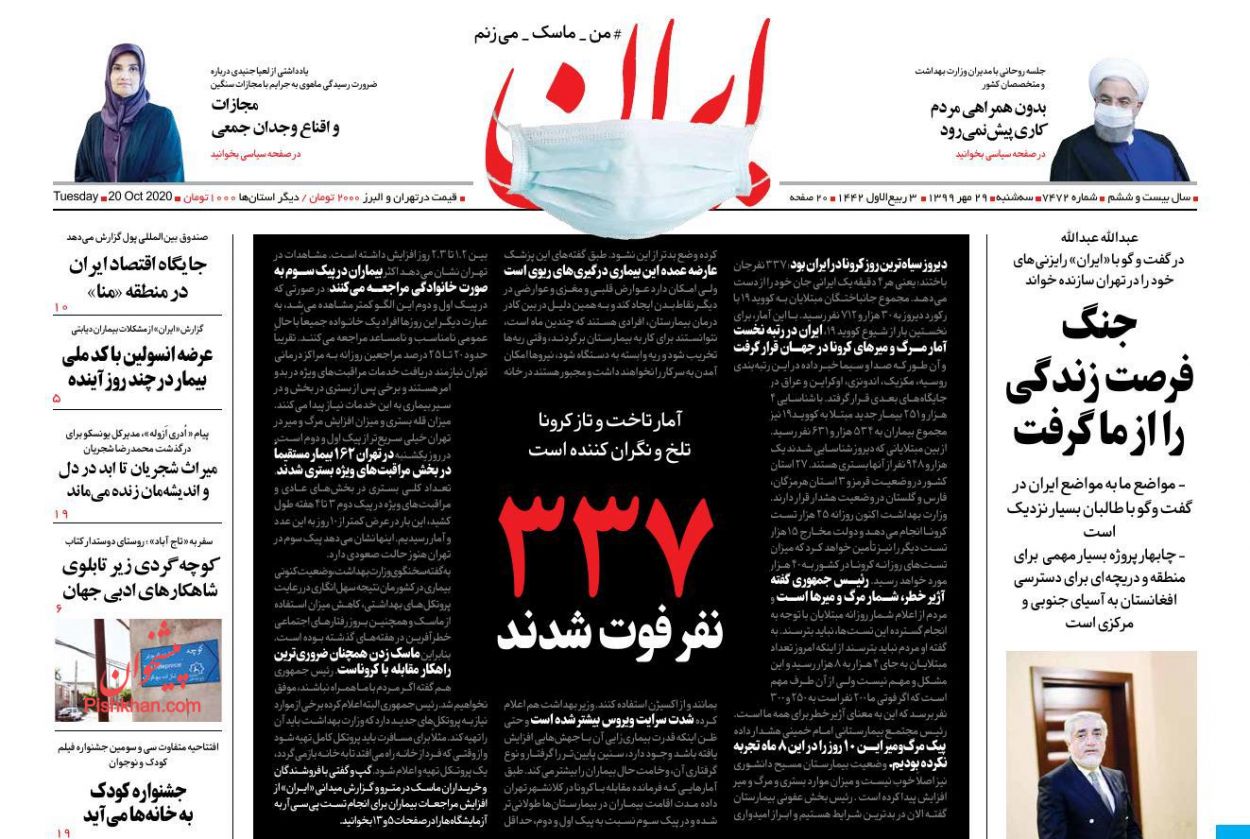
Iran Newspaper:

1- 337 People Die of COVID-19: Bitter and Worrying Statistics

A Look at Iranian Newspaper Front Pages on October 20


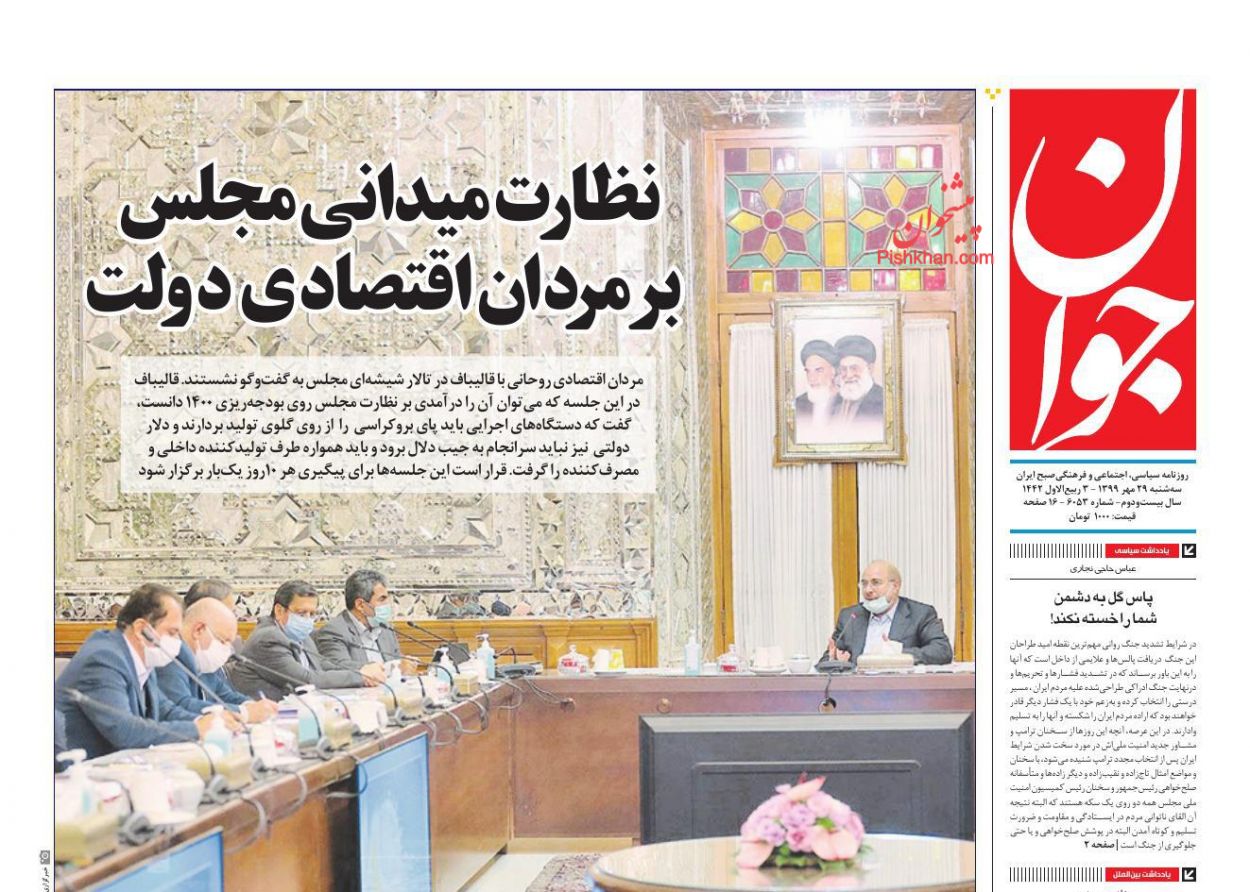
Javan Newspaper:

1- Parliament’s Field Monitoring of Gov’t Officials

A Look at Iranian Newspaper Front Pages on October 20


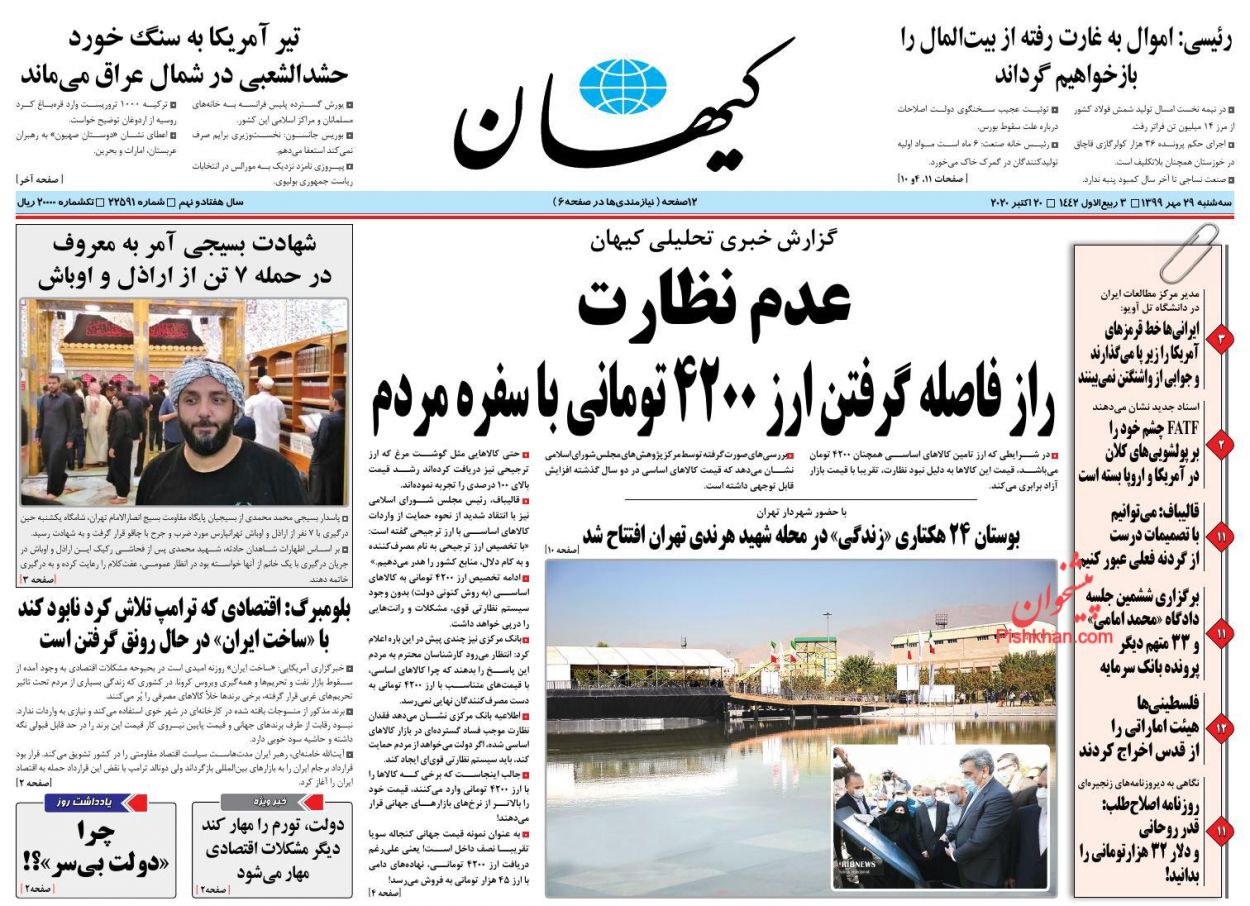
Kayhan Newspaper:

1- US Fails to Achieve Its Goal: Hashd al-Shaabi Will Remain in Northern Iraq

2- Bloomberg: ‘Made in Iran’ Thriving Despite Trump’s Efforts to Destroy Iran Economy

3- Iranians Violating US Red Lines, Receiving No Response from Washington

4- Palestinians Expel UAE Delegation from Quds

A Look at Iranian Newspaper Front Pages on October 20


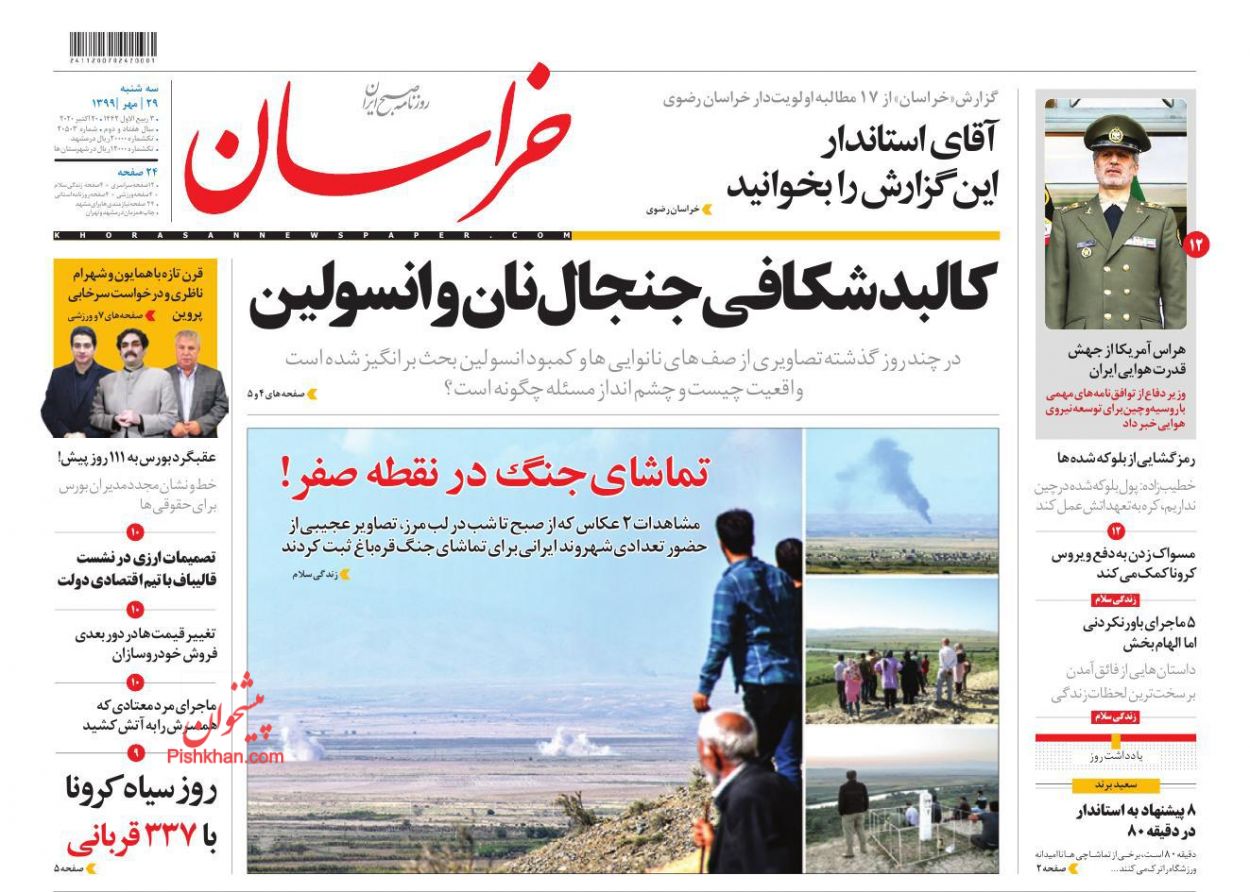
Khorasan Newspaper:

1- Watching the War from Border

* Two Photographers Take Strange Photos of Iranians Watching Karabakh War along Border

A Look at Iranian Newspaper Front Pages on October 20


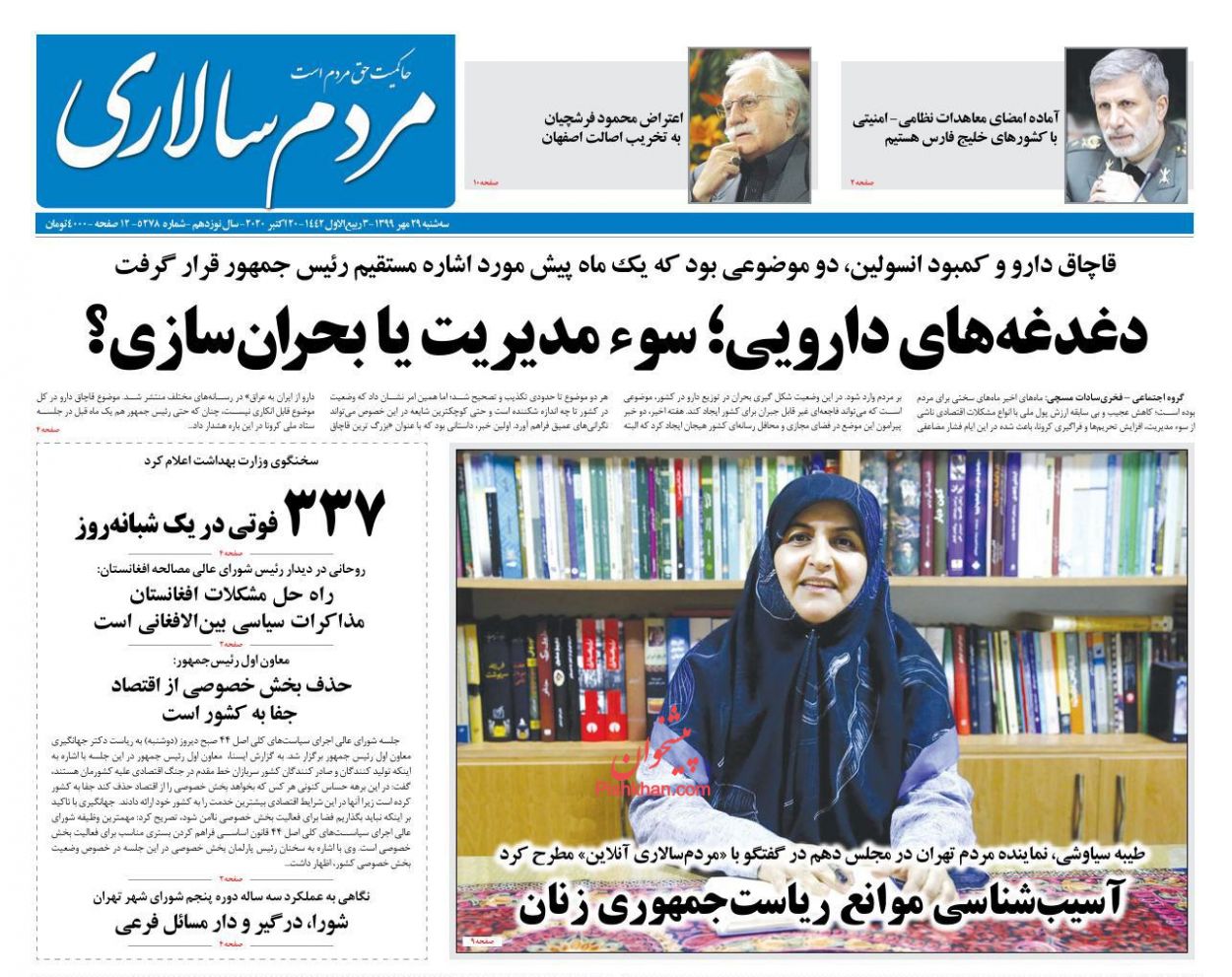
Mardom Salari Newspaper:

1- 337 Die in 24 Hours

2- Medicine Concerns: Mismanagement or Crisis-Making?

* Rouhani Had Highlighted Insulin Shortage One Month Ago

3- Solution to Afghan Problems Is Intra-Afghan Political Talks

A Look at Iranian Newspaper Front Pages on October 20


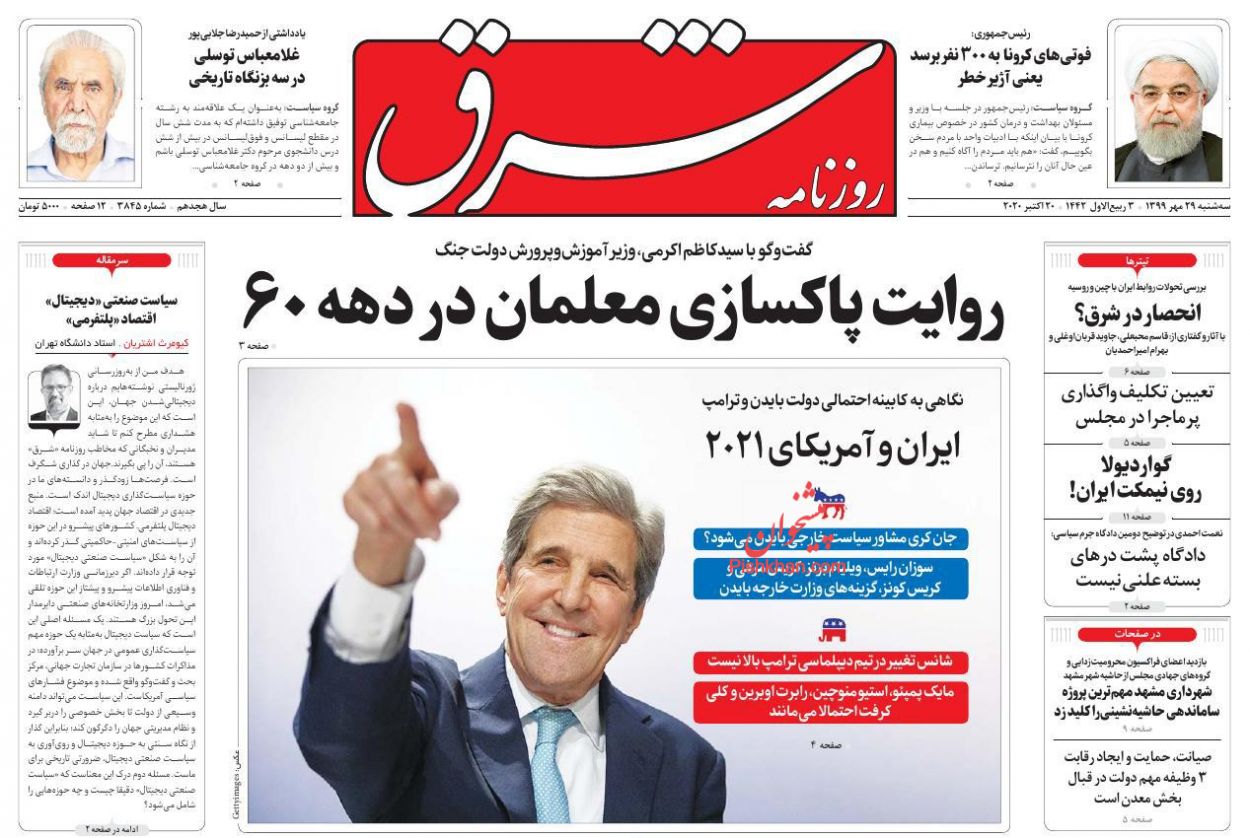
Shargh Newspaper:

1- Iran and the US in 2021

* A Look at Biden and Trump’s Possible Cabinet Line-up

2- It’s Alarming Over 300 Dying of COVID-19 Every Day

A Look at Iranian Newspaper Front Pages on October 20

Iran’s Efforts to Foil US Plots Bearing Fruit, Spokesman Says

Iran Says US Change of Tack to Benefit Region, World

Speaking at a weekly press conference on Tuesday, Ali Rabiei highlighted Washington’s successive defeats in the international arena.

“The positive effects of foiling the US government’s plot for isolating Iran and reinstating the Security Council resolutions on Iran are emerging gradually,” he noted.

Pointing to Iran’s political victories over the US at the International Court of Justice and the UN Security Council, Rabiei said, “Termination of the arms embargo on our country is also a harbinger of (enemy’s) more surrenders.”

The spokesman finally noted that the removal of the UN arms embargo on Iran despite the US pressures would pave the way for the lifting of other cruel sanctions against Tehran in the economic, financial and banking fields, or the restrictions on the delivery of humanitarian supplies.

The US suffered an embarrassing diplomatic defeat in August when the United Nations Security Council rejected a proposal to extend the arms embargo on Iran.

The embargo on conventional arms expired on October 18 under the terms of a resolution that blessed the Iran nuclear deal, signed in July 2015 and officially known as the Joint Comprehensive Plan of Action (JCPOA).

Iran Says Has Nothing to Hide about Ukrainian Plane Crash

Iran Says Has Nothing to Hide about Ukrainian Plane Crash

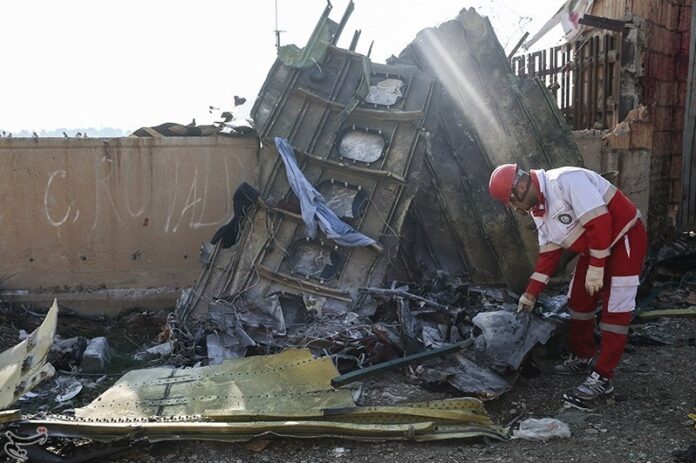
The second round of negotiations between the Islamic Republic of Iran and Ukraine about the Ukrainian plane crash is underway in Tehran.

In an event on the sidelines of the new round of talks, Iranian Deputy Foreign Minister Baharvand held a meeting with the families of victims of Ukraine International Airlines Flight 752 (PS752) on Tuesday.

“The Islamic Republic of Iran would never seek to hide details of the Ukrainian plane crash or violate the rights of families of the victims,” the Iranian diplomat stressed.

He also assured the bereaved families that Iran’s diplomatic apparatus will employ all of its capacities and do its utmost to safeguard the rights of victims in cooperation and coordination with all relevant institutions.

Baharvand finally expressed sympathy with the families of victims of the plane crash, pledging that he would pursue plans for a meeting between the families of victims and the Iranian Judiciary officials in order to inform the families of victims about the judicial procedures concerning the incident and to answer questions and clear up doubts about the plane crash.

Iran to Give ‘Direct Response’ to Any Israeli Threat in Persian Gulf

Iran to Give 'Direct Response' to Any Israeli Threat in Persian Gulf

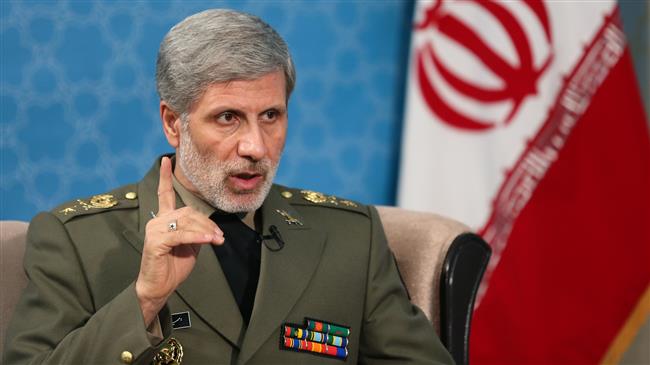
In an interview with Aljazeera network, published on Monday, Brigadier General Amir Hatami reflected on a recent measure by the United Arab Emirates and Bahrain to fully normalize relations with Israel through deals mediated by the administration of US President Donald Trump, noting that such a measure will pose a direct threat to security of the entire Persian Gulf region.

He added, “Any threat posed by the Zionist regime in the Persian Gulf [against Iran’s interests] will be faced with a direct and clear response.”

The United Arab Emirates and Bahrain signed the controversial normalization agreements with Israel at the White House on September 15, amid outrage across Palestine and the Muslim world at the Arab regimes’ betrayal of the Palestinian cause.

Trump, who presided over the signing of the normalization pacts, said “five or six” other countries were close to making similar agreements with Israel, but did not name them.

Reports say Sudan and Oman could be next in line to normalize with Israel.

The US-brokered deals make the UAE and Bahrain the third and fourth Arab states to take such steps to normalize ties since Israel signed treaties with Egypt in 1979 and Jordan in 1994.

Answering a question about the US insisting on inclusion of Iran’s missile capability in any possible future talks, Iran’s defense minister said the Islamic Republic will never engage in negotiations over its missile program with the US, emphasizing, “Nobody has the right to ask us to do this.”

Elsewhere in his interview, the Iranian defense chief pointed to the latest armed conflicts between Armenia and Azerbaijan over the Nagorno-Karabakh region and said the Islamic Republic has given stern and clear warnings to the warring sides about the need to protect security in the border areas.

He rejected claims about Russia’s transfer of weapons to Armenia through Iran’s soil, saying, “We have never allowed Russia to use our borders and territories to transfer Russian weapons to Armenia and this is an accusation leveled against Iran.”

Hatami said, “We expect Turkey, as a friendly and important regional country, to help settle the crisis in the disputed Karabakh region through diplomatic means.”

Karabakh is internationally recognized as part of Azerbaijan, but it is held by ethnic Armenian separatists backed by Armenia since 1992, when they broke from Azerbaijan in a war that killed some 30,000 people.

The conflict re-erupted in late September, leading to the worst fighting in decades in the region.

Baku and Yerevan agreed to a “humanitarian ceasefire” on Saturday after a Russian-brokered truce fell apart, earlier.

The two sides, however, accuse each other of violating the latest truce.

Late on Sunday, the separatist government of Karabakh said it had recorded another 37 deaths among its forces. The latest casualties pushed the toll to 710, Russia’s Interfax news agency reported.

The Iranian Foreign Ministry said on October 7 that it has delivered a note of protest to both Azerbaijan and Armenia over the extension of hostilities to the Islamic Republic’s territory in the ongoing fighting between the two ex-Soviet republics over the disputed Karabakh region.

Spokesman Saeed Khatibzadeh said that the Iranian Foreign Ministry had sent the official note to the Republic of Azerbaijan and Armenia to convey the country’s “strong protest” against the firing of bullets and shelling into the country, which “violated Iran’s territorial integrity, undermined its security and inflicted financial damage” on Iranian citizens.

His remarks came a day after the Iranian defense minister once again warned the warring parties involved in the military clashes that Tehran will take stronger measures than warnings if the shells fired in the fighting continue to hit the country’s border regions even by mistake.

“It is not acceptable at all that a bullet hits the Islamic Republic’s borders due to a mistake or carelessness,” Hatami said at the time.

Iran in Photos: Stepped Village of Sar-e Aqa Seyyed

Stepped Village of Sar-e Aqa Seyyed 8

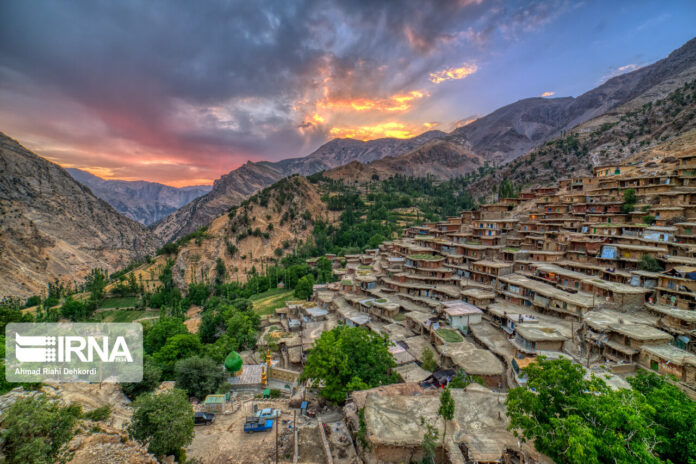
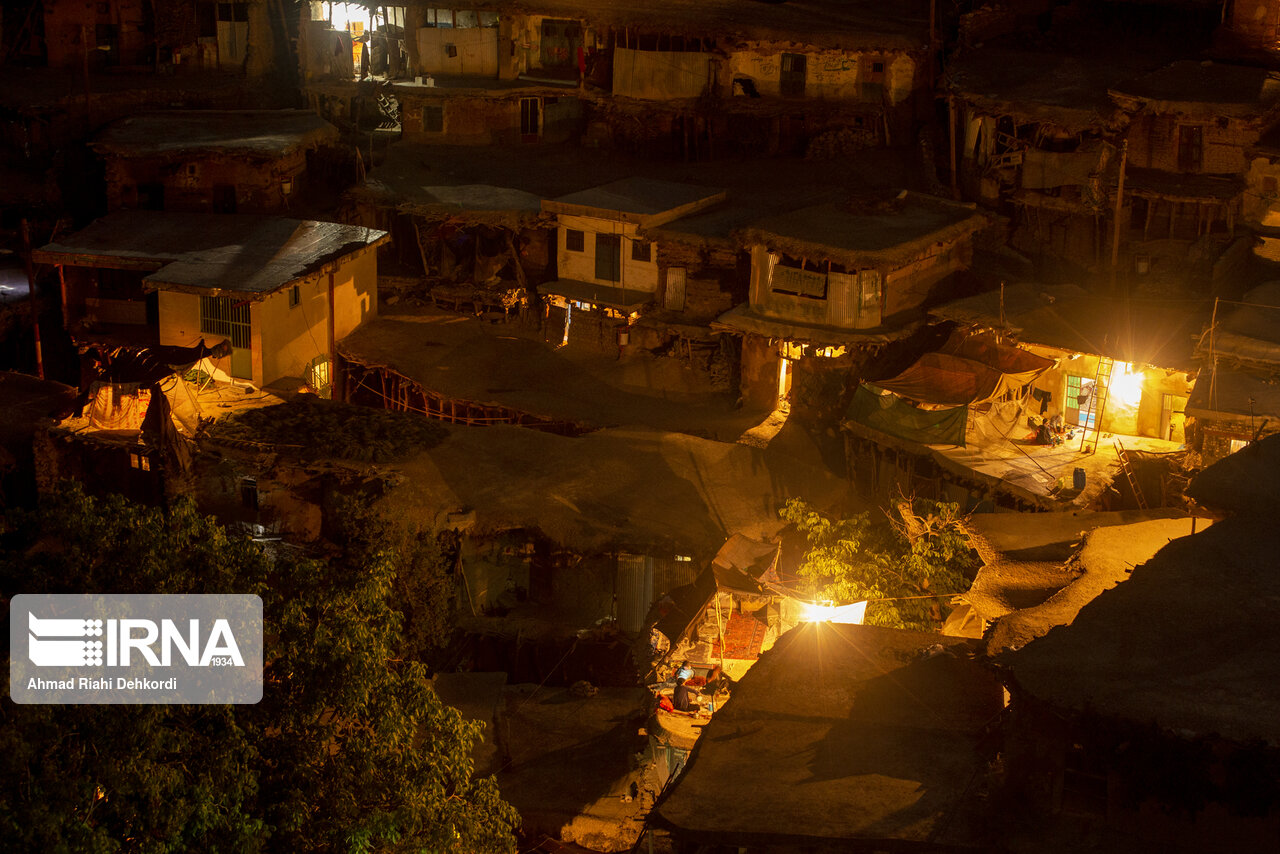
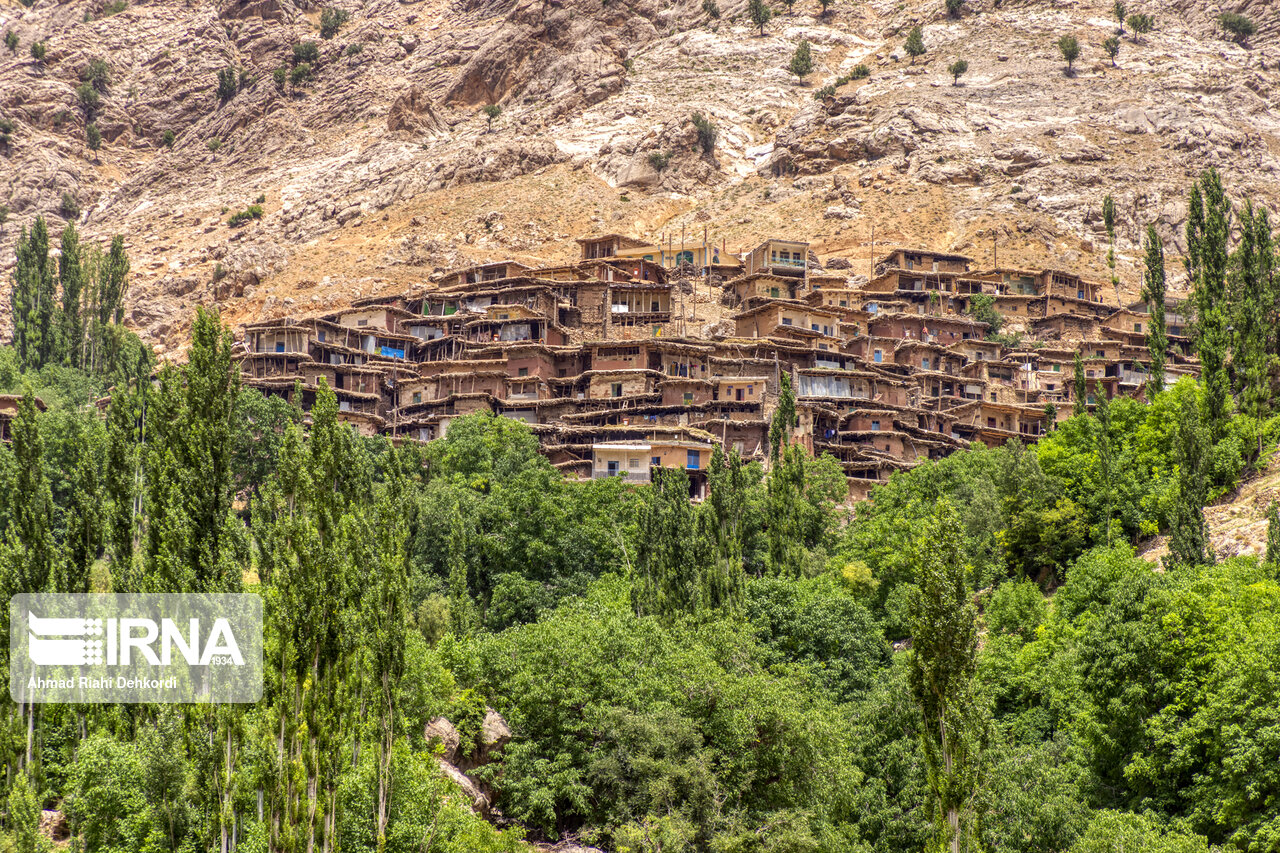
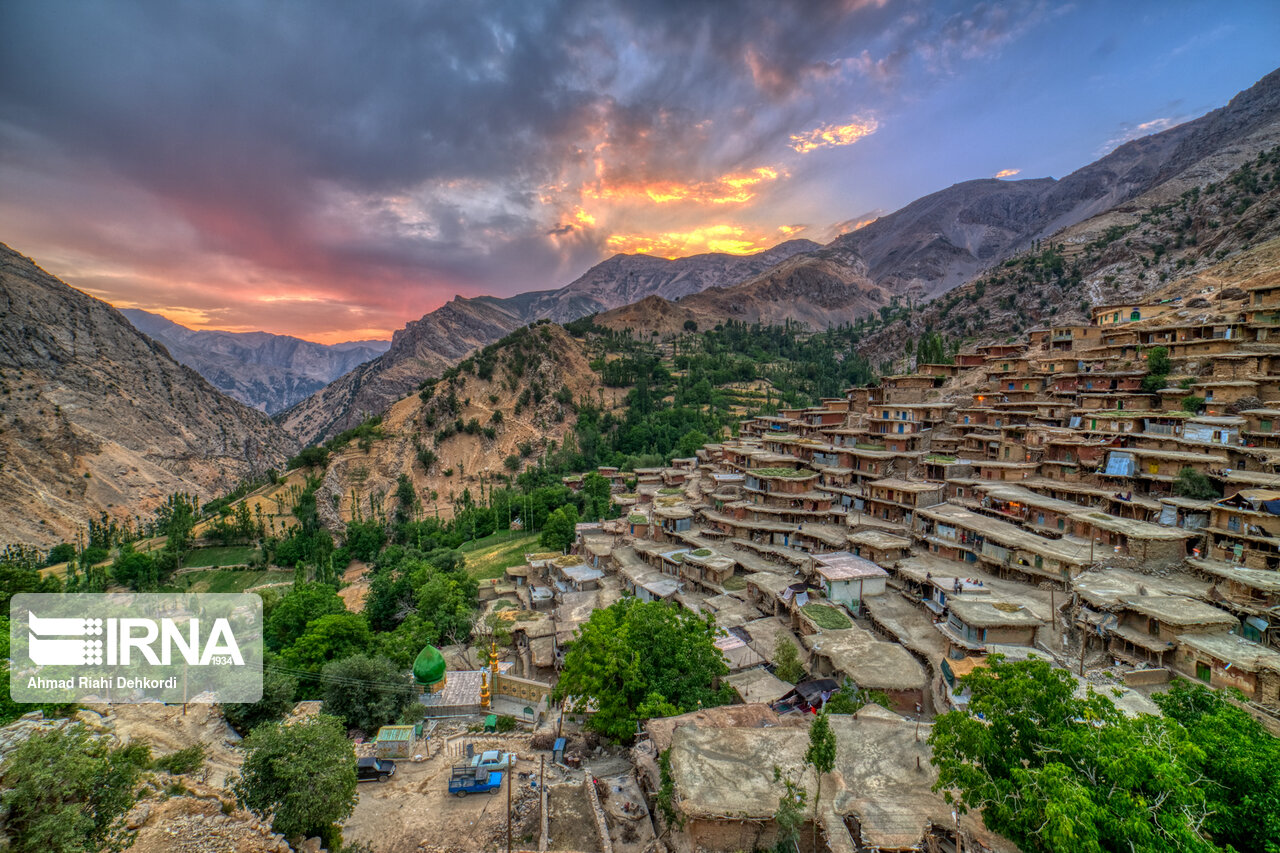
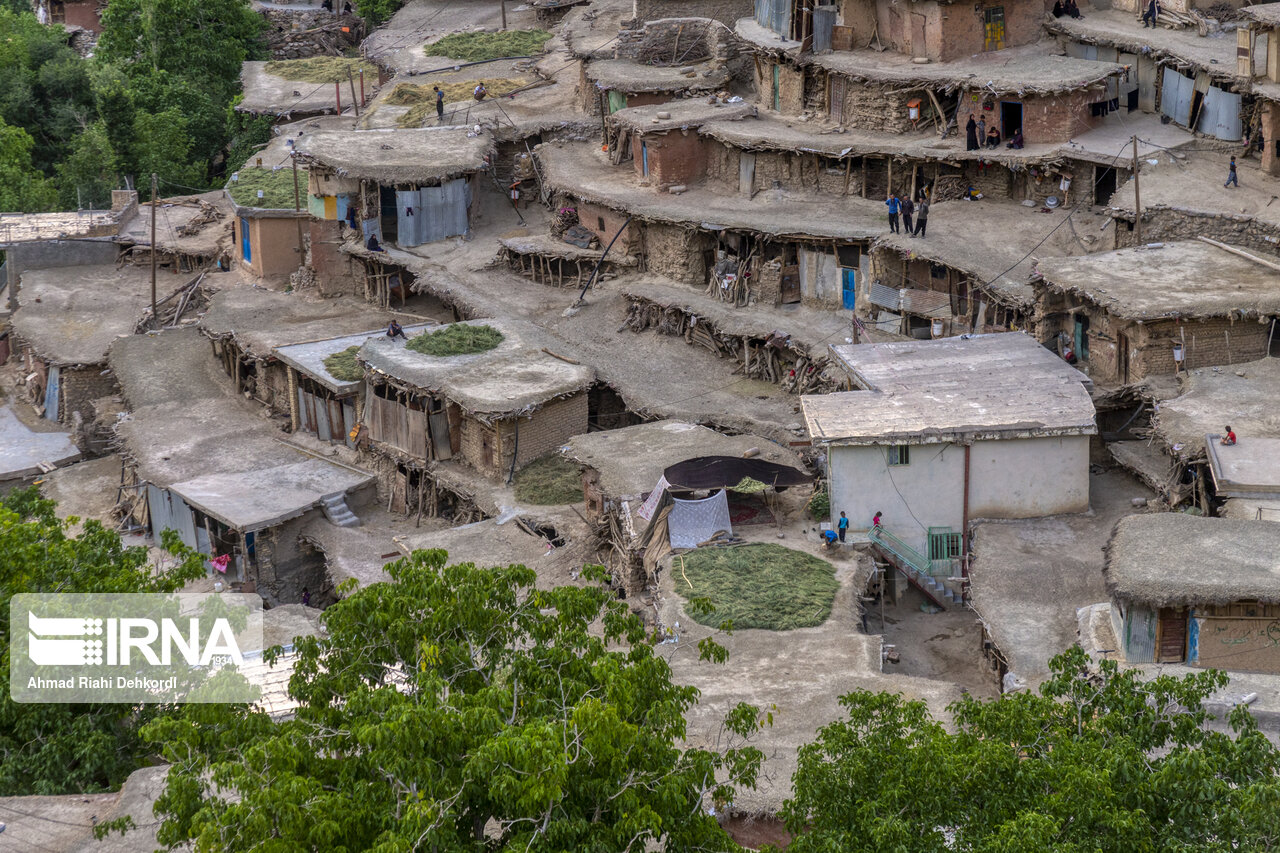
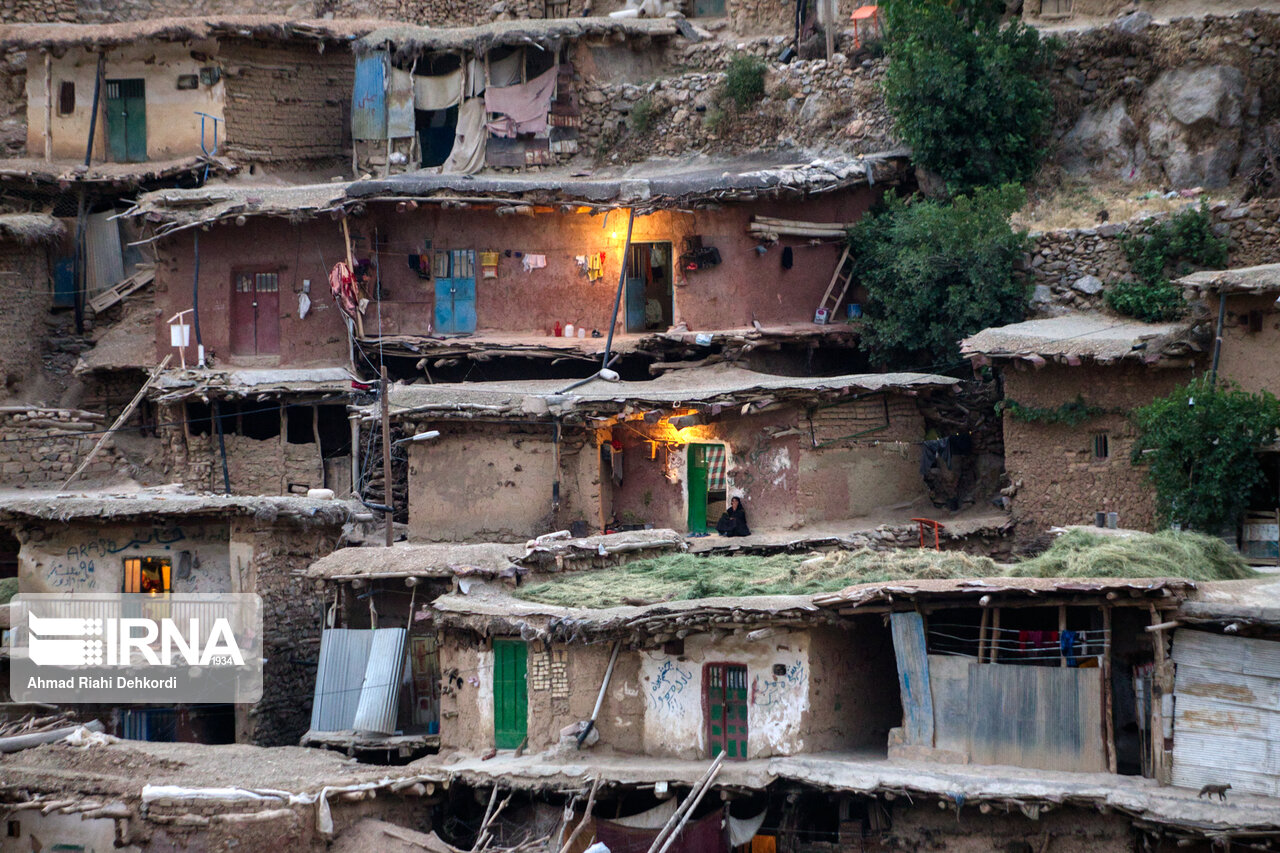
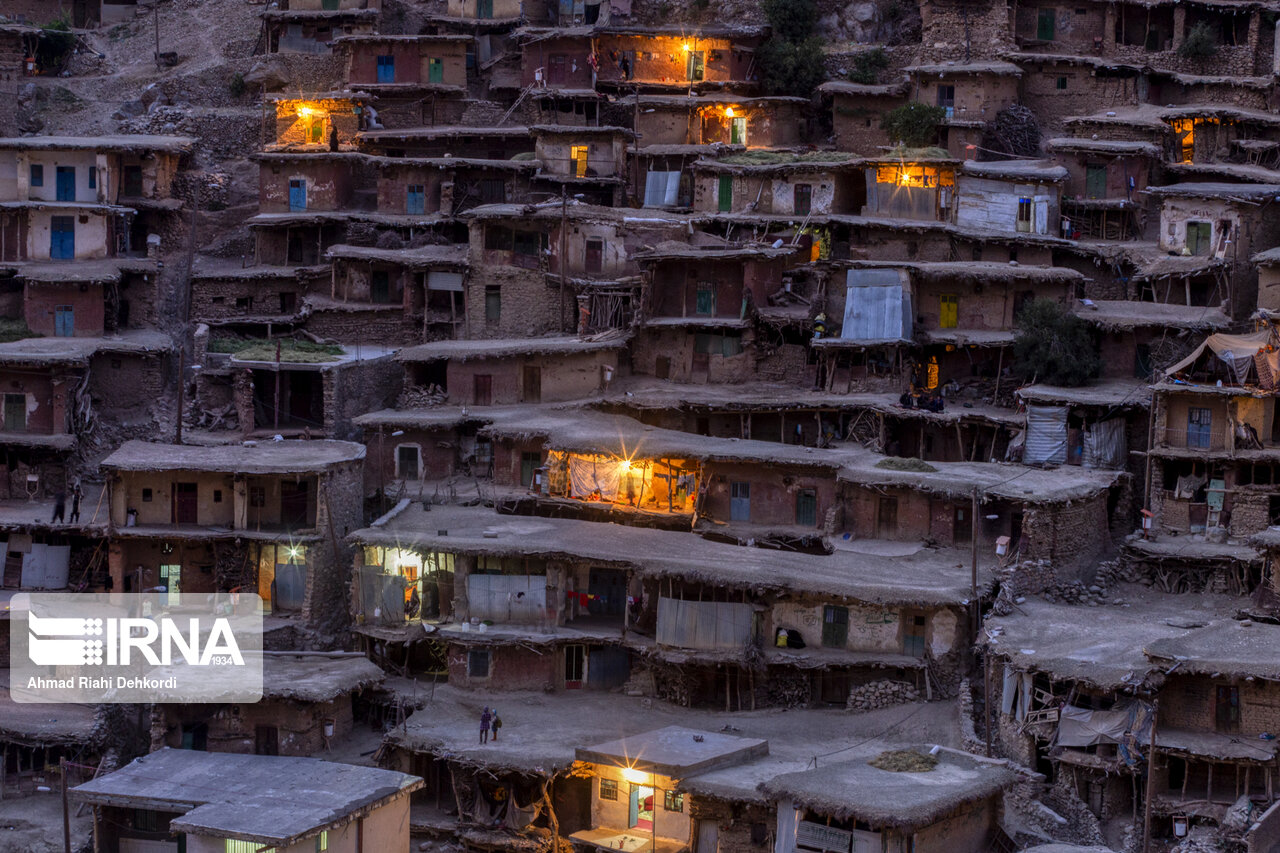
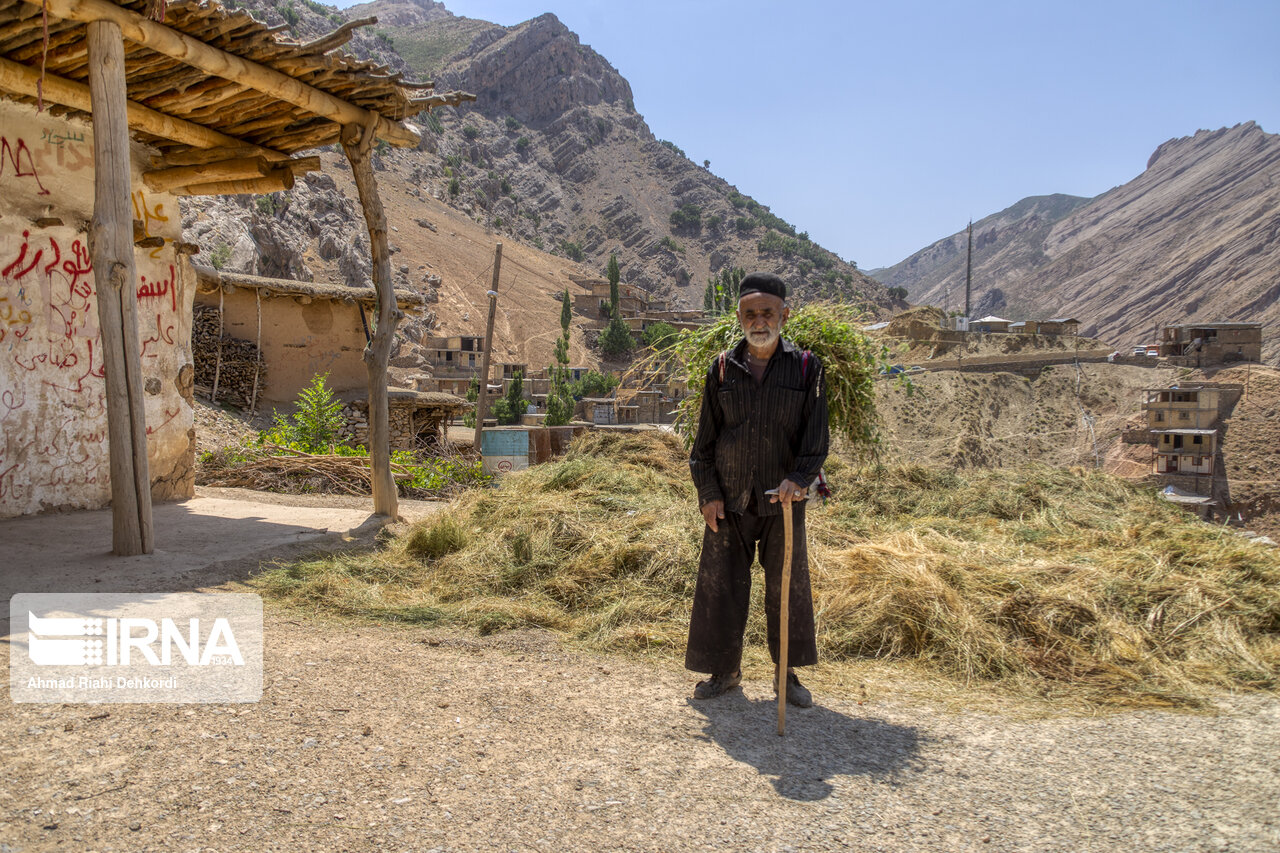
Sar-e Aqa Seyyed is located in Mouguyi county, 45 km from Chelgard, the centre of Koohrang city.

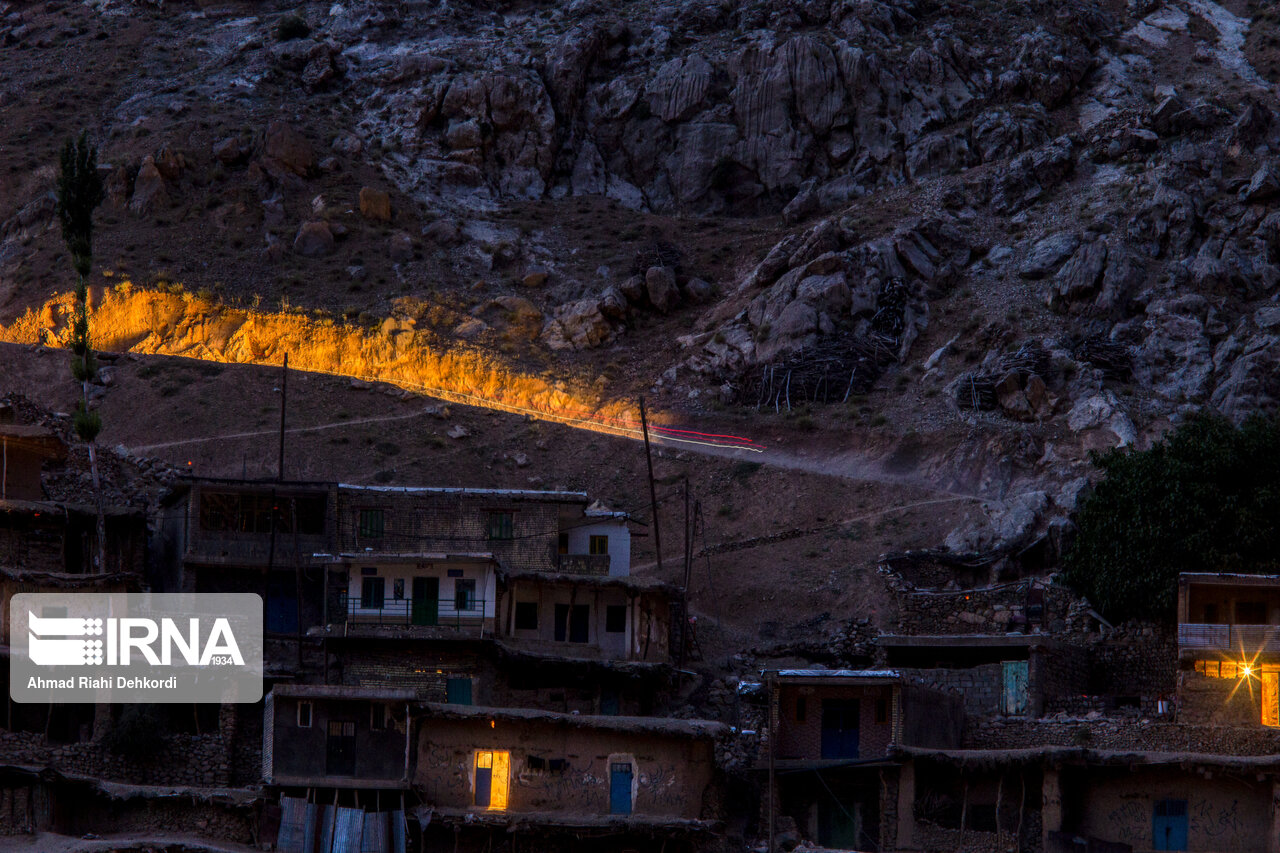
There is only one path to access this village: a dirt road which is blocked after the first snowfall until next spring.

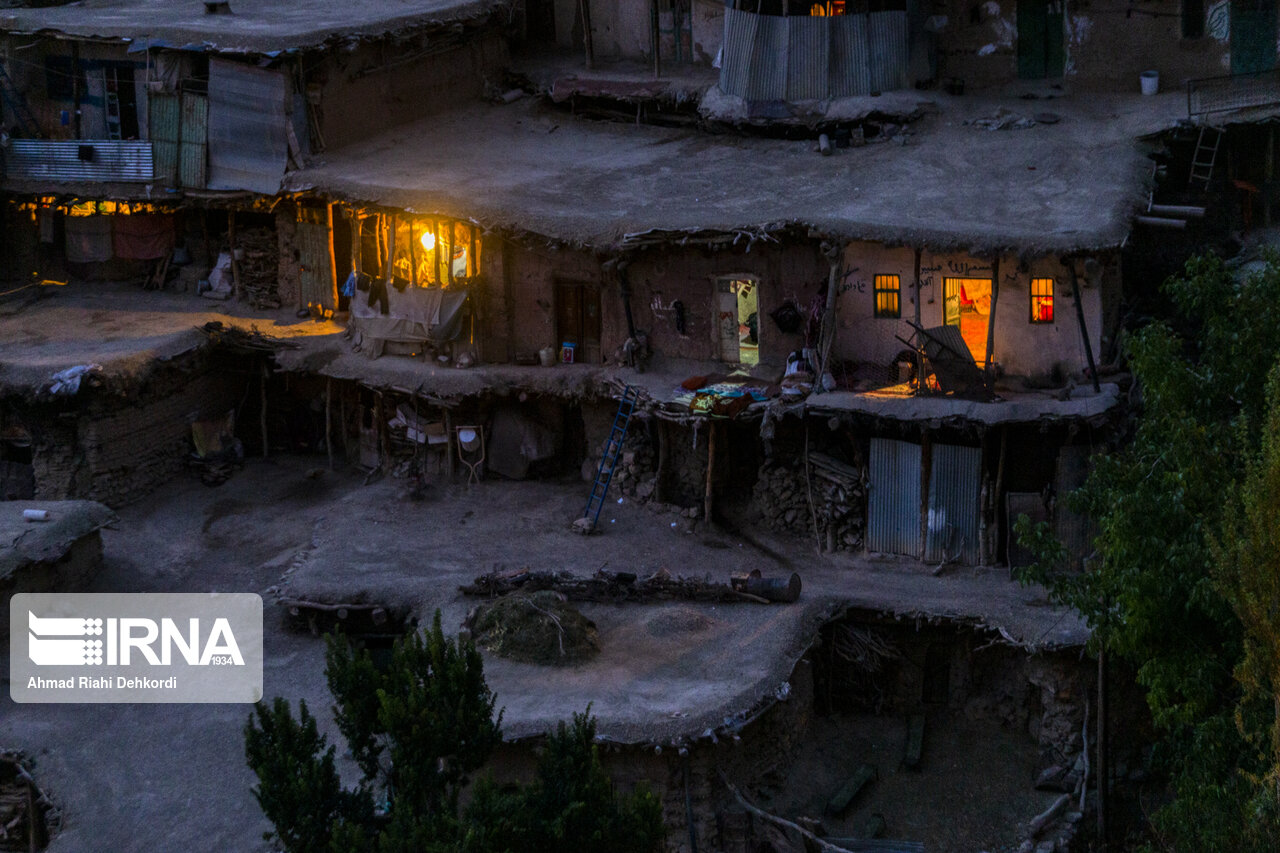
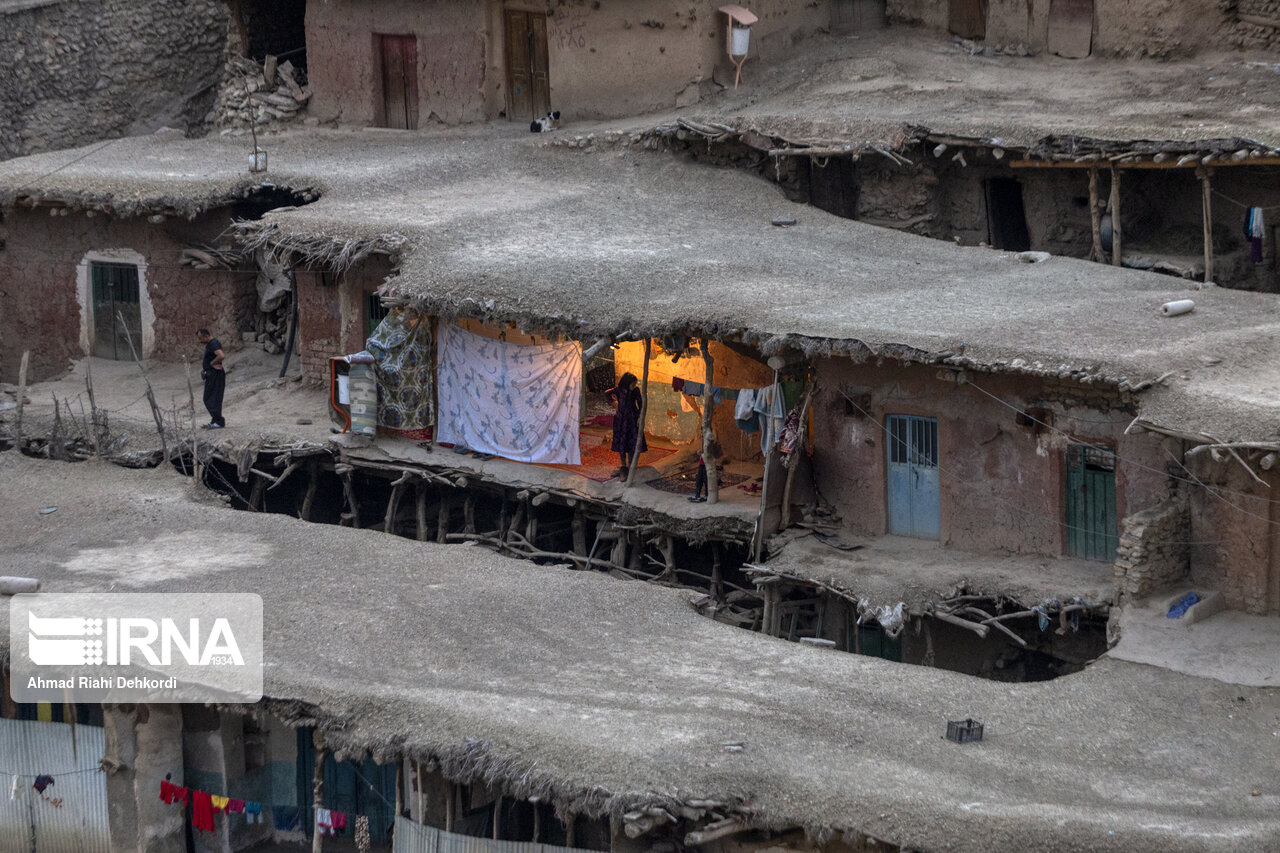
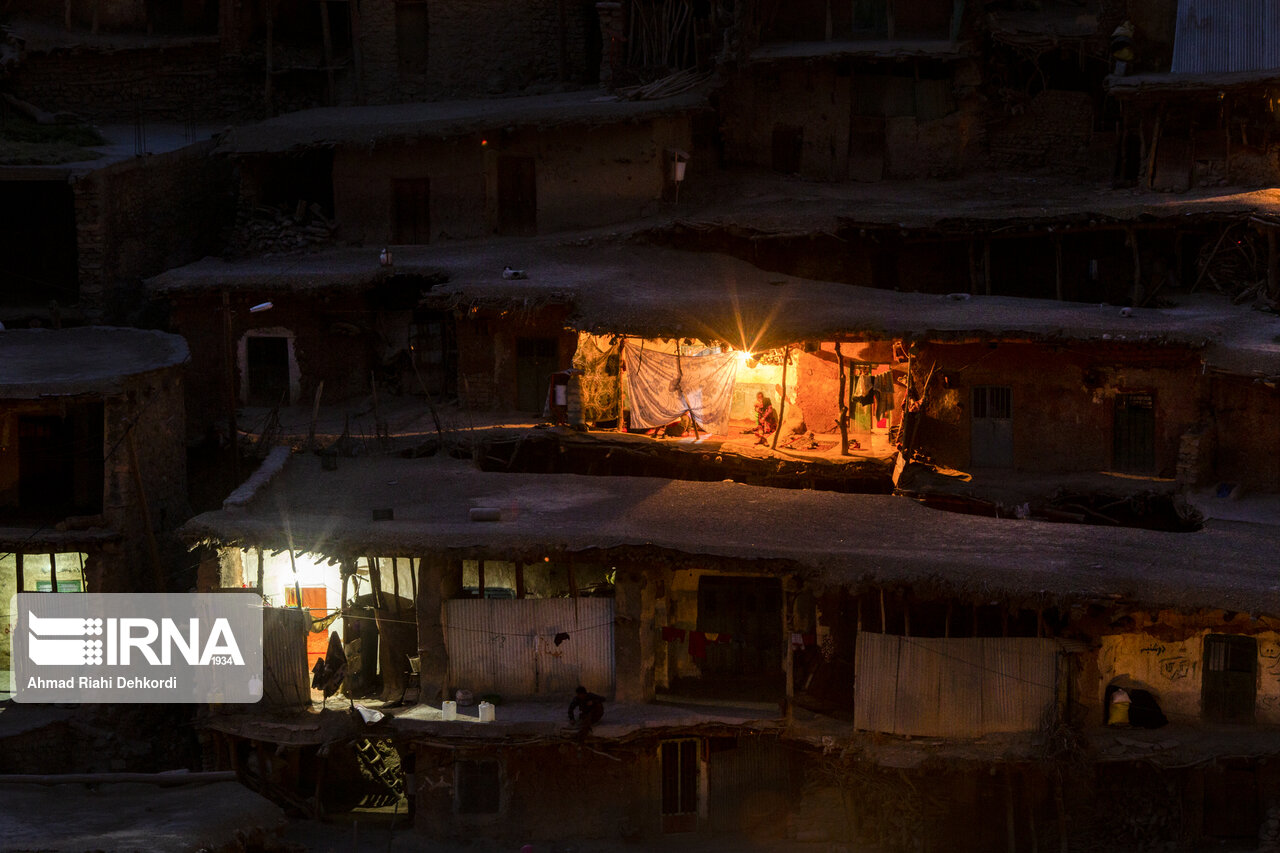
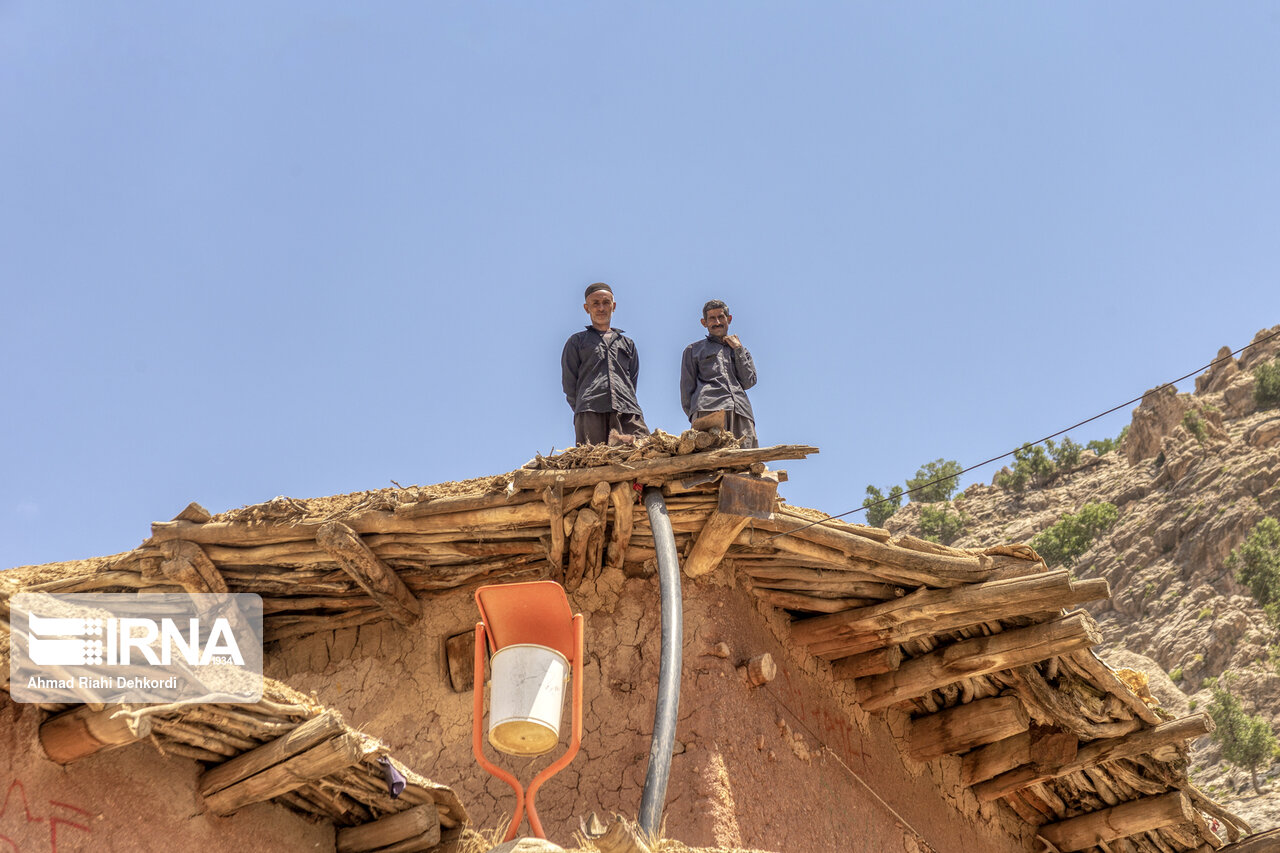
Its structure is stepped and “Bar-aftow”, that means “facing the sun” in the local language: the houses are built in a way that allows making the most of the sun’s heat during the winter.

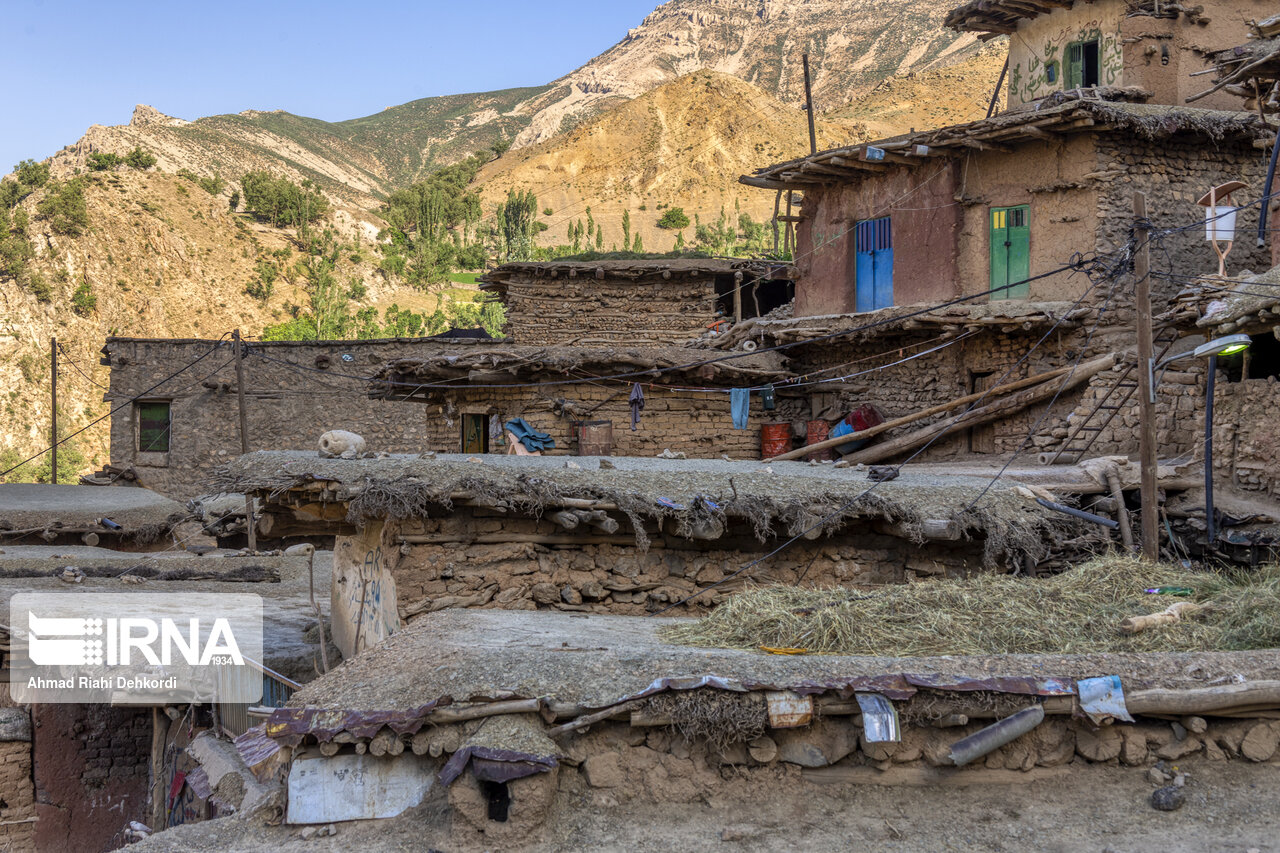
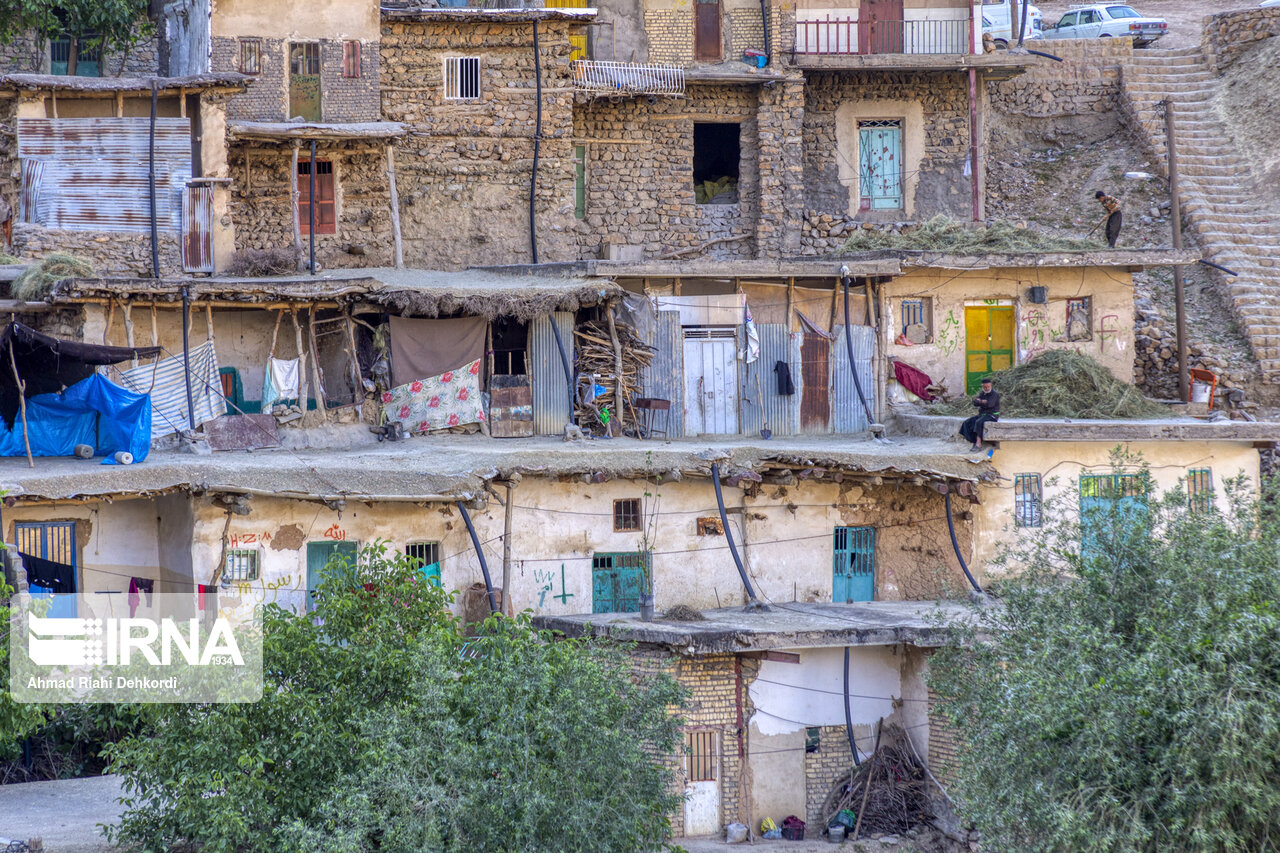
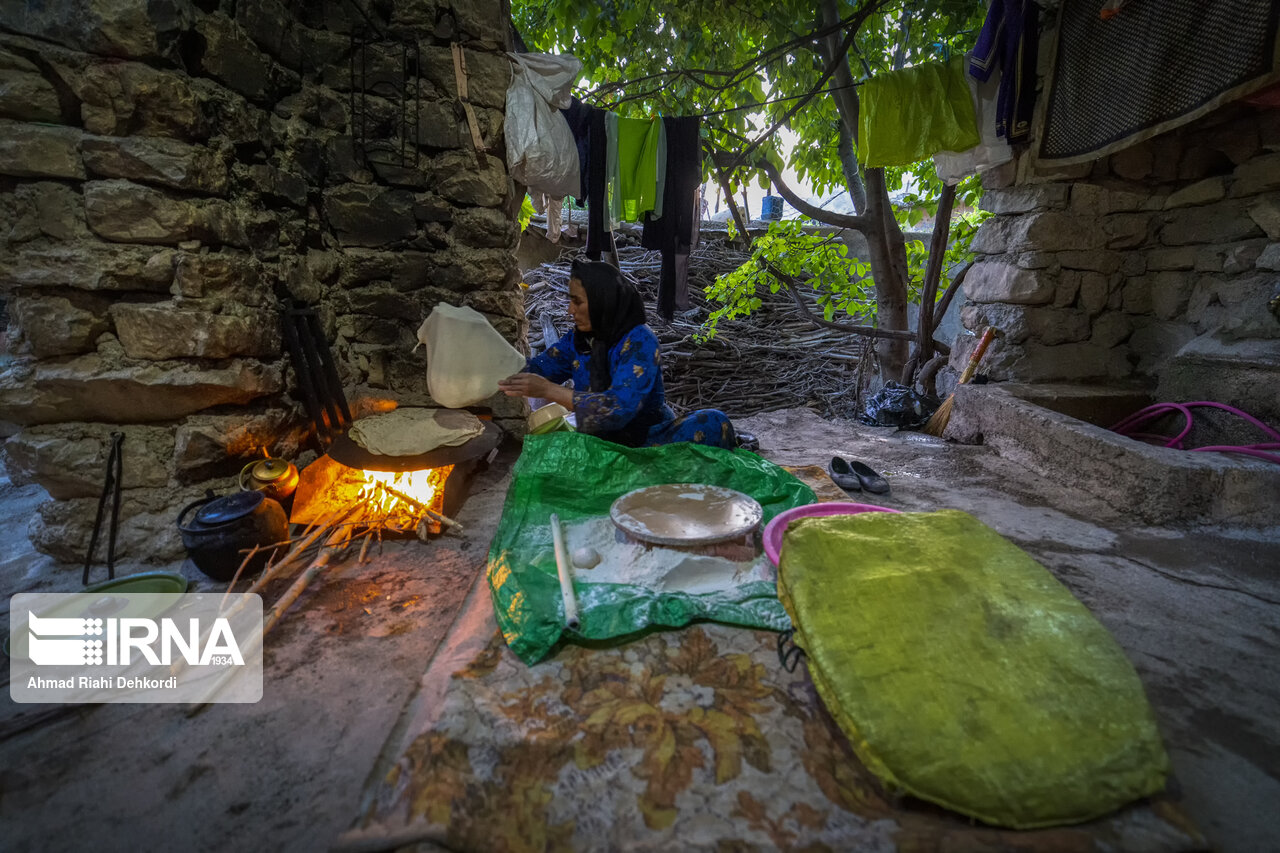
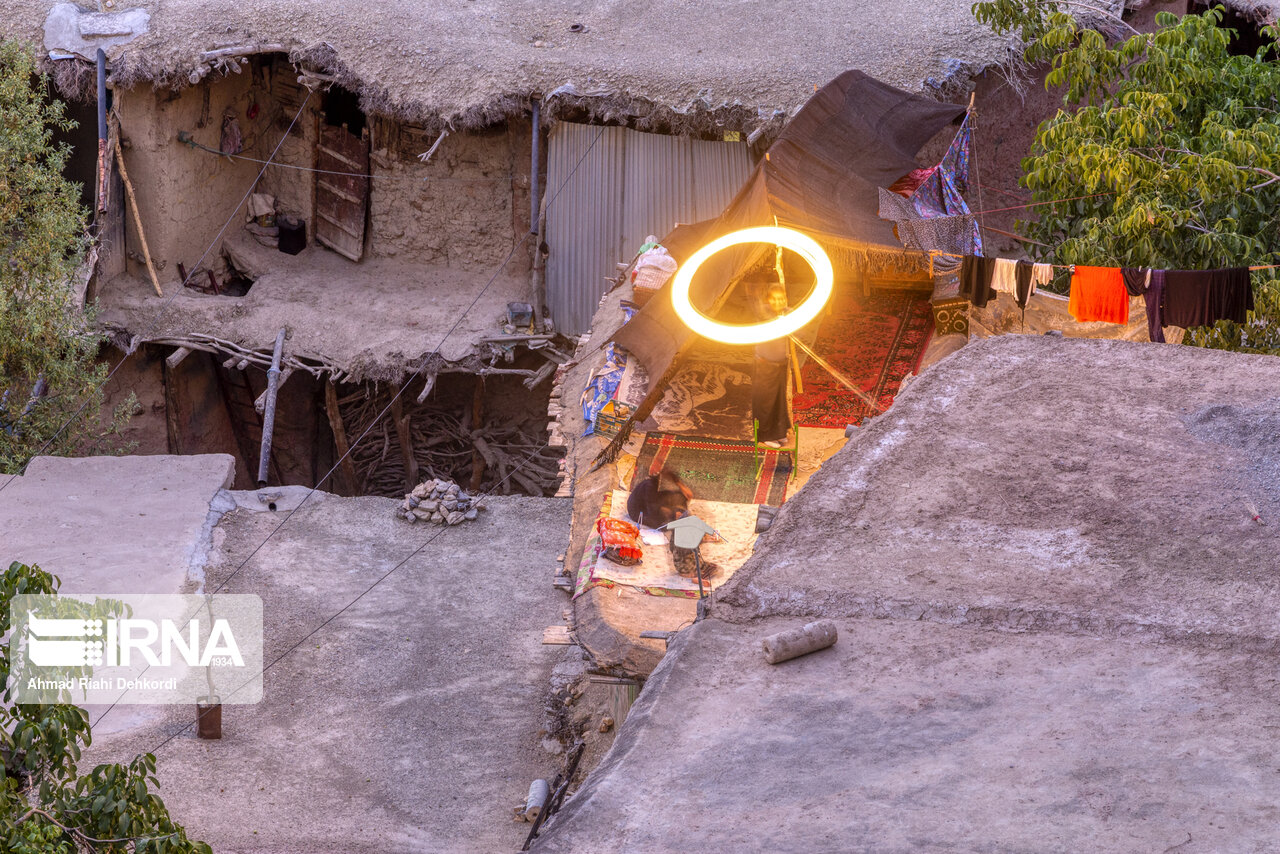
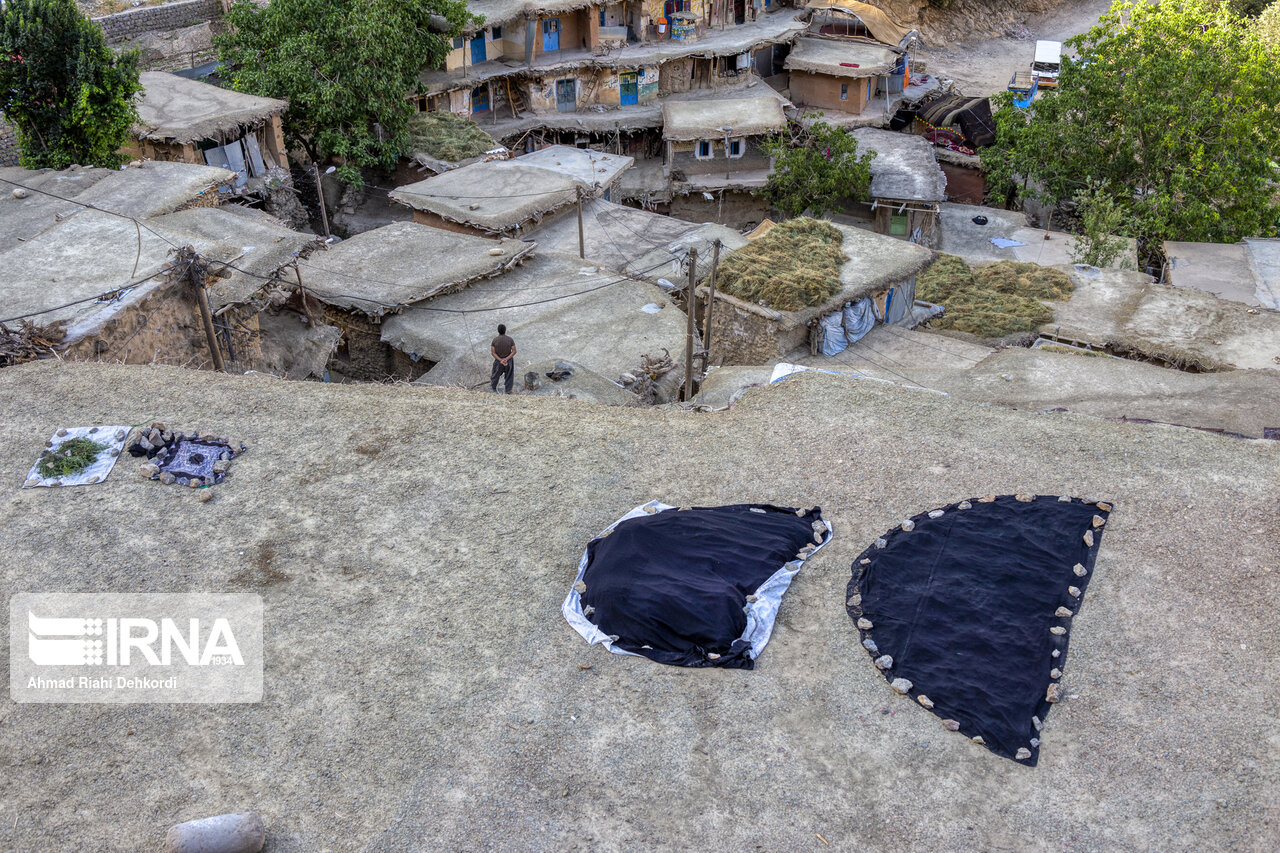
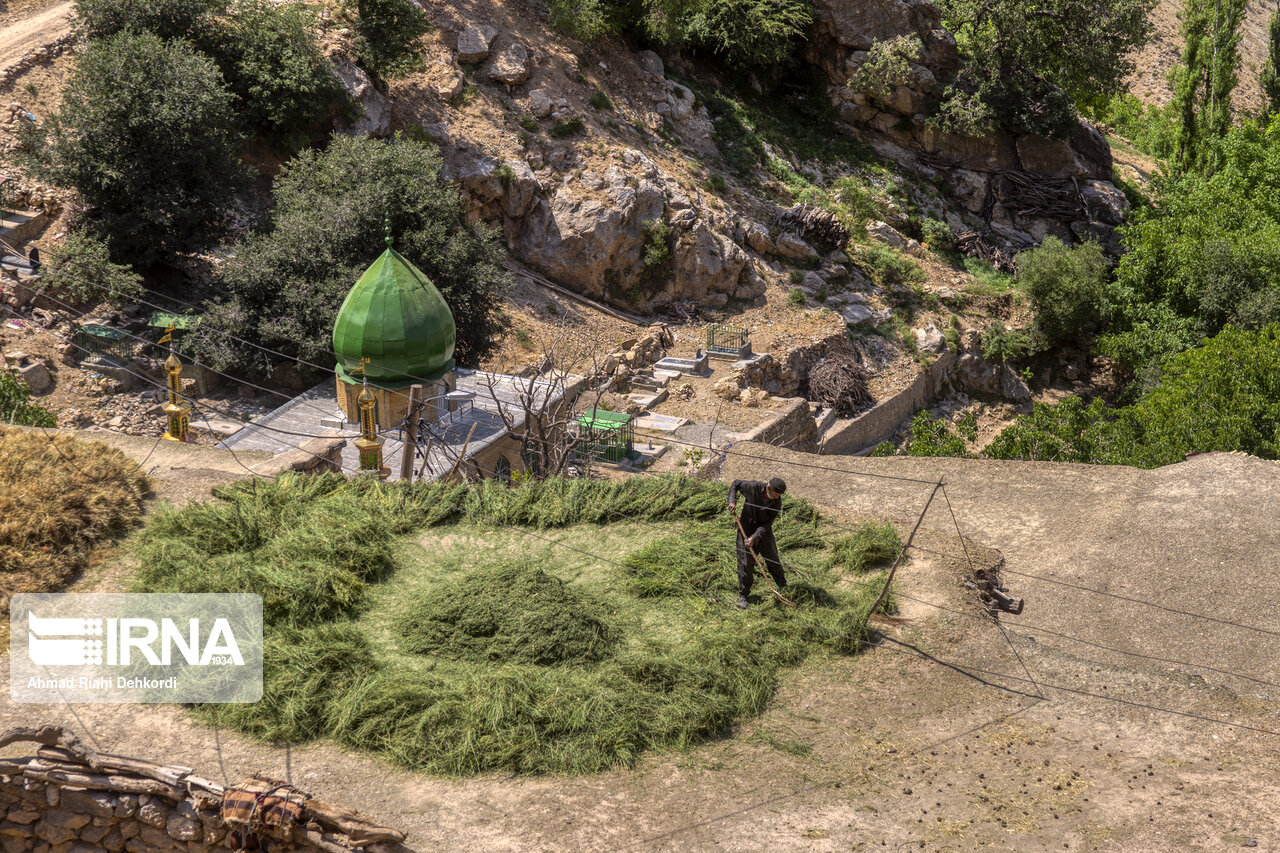
The stairs of Sar-e Aqa Seyyed have stories to tell about the residents of each house! The stepped structure gives a special beauty to the village: the yard of an upper house is the roof of the house below. This space is used by people for drying fodder and vegetables, baking bread and making handicrafts.

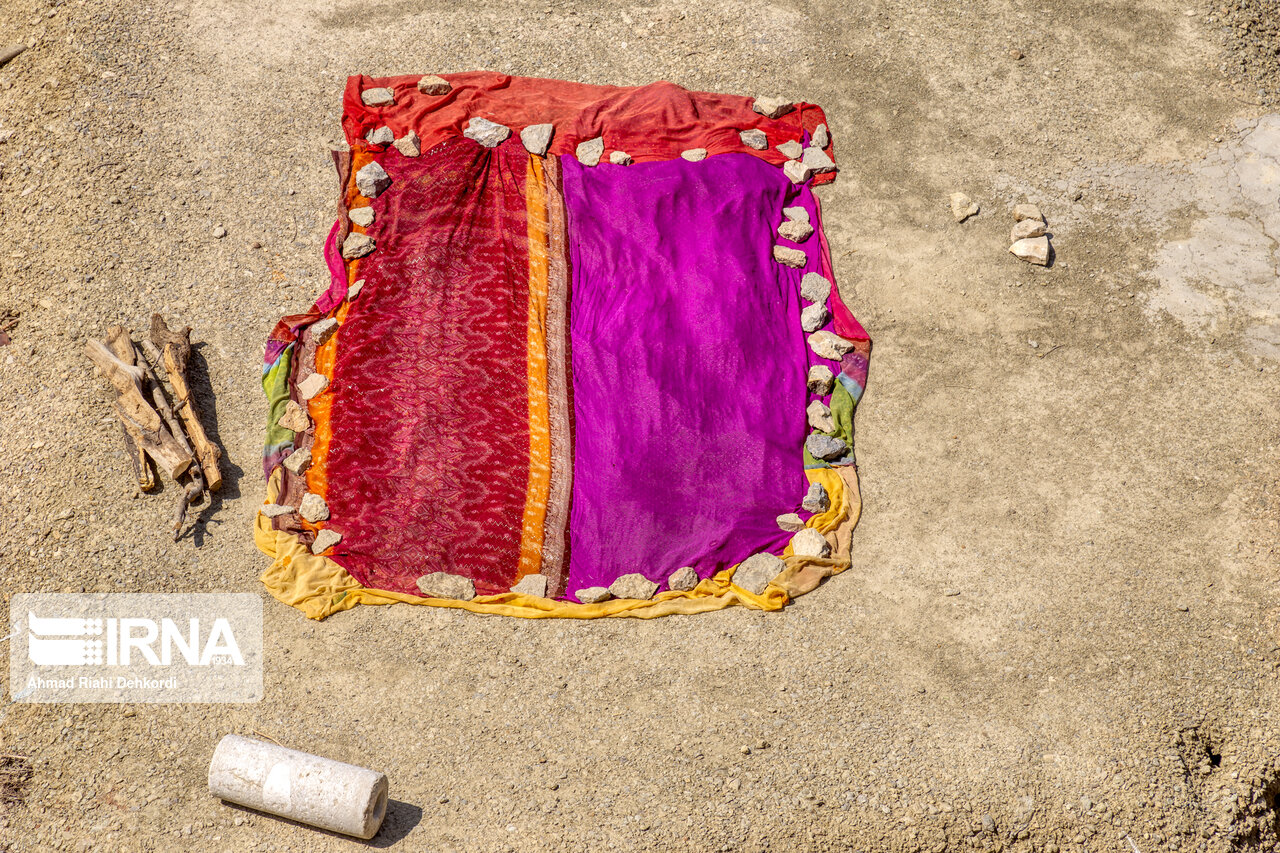
What follows are IRNA’s photos of Sar-e Aqa Seyyed village:

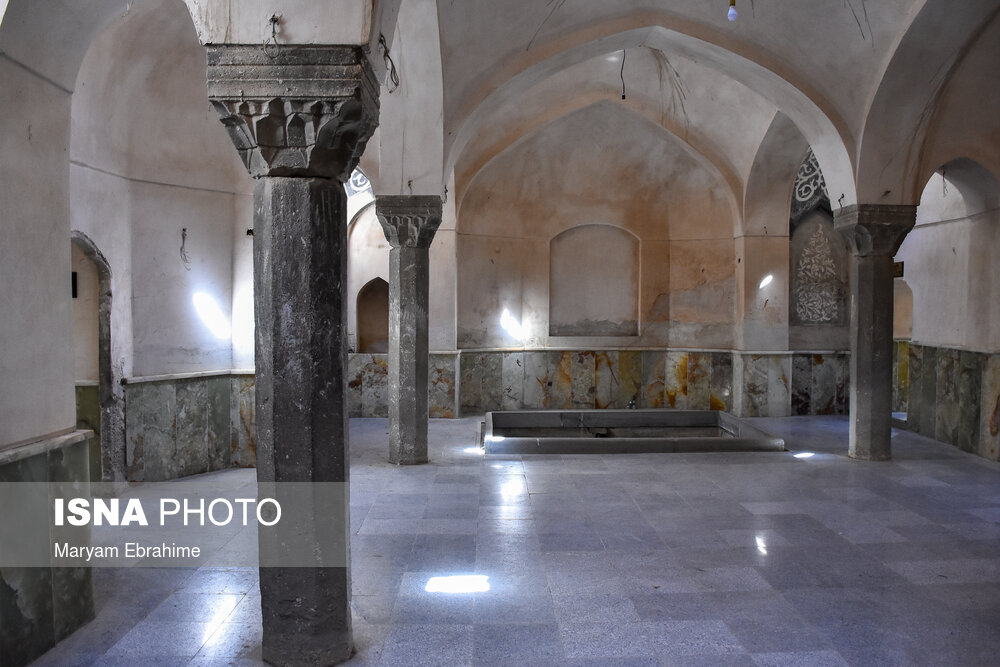
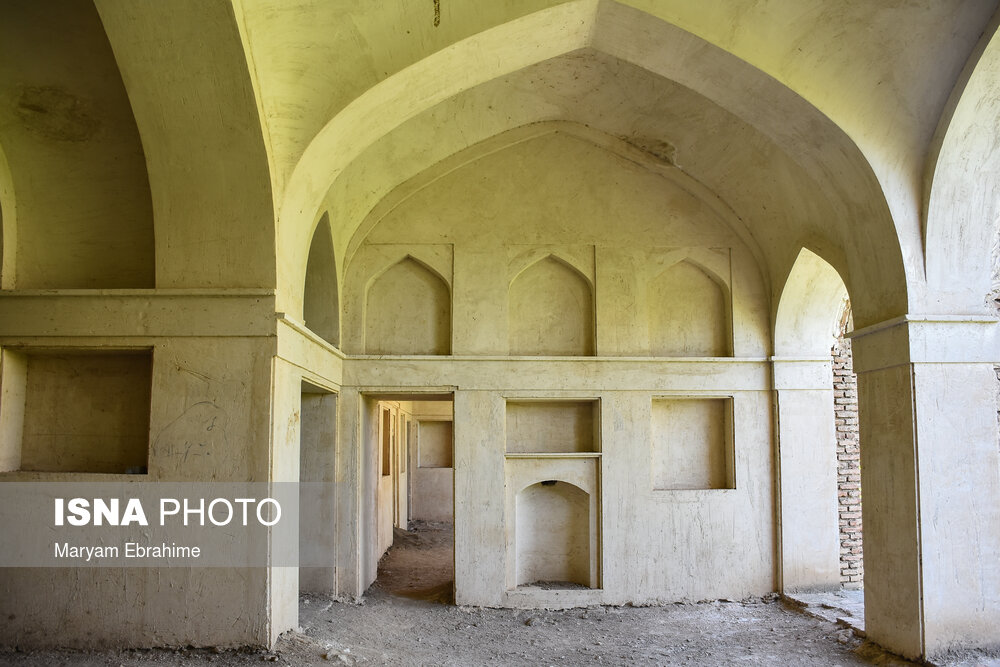
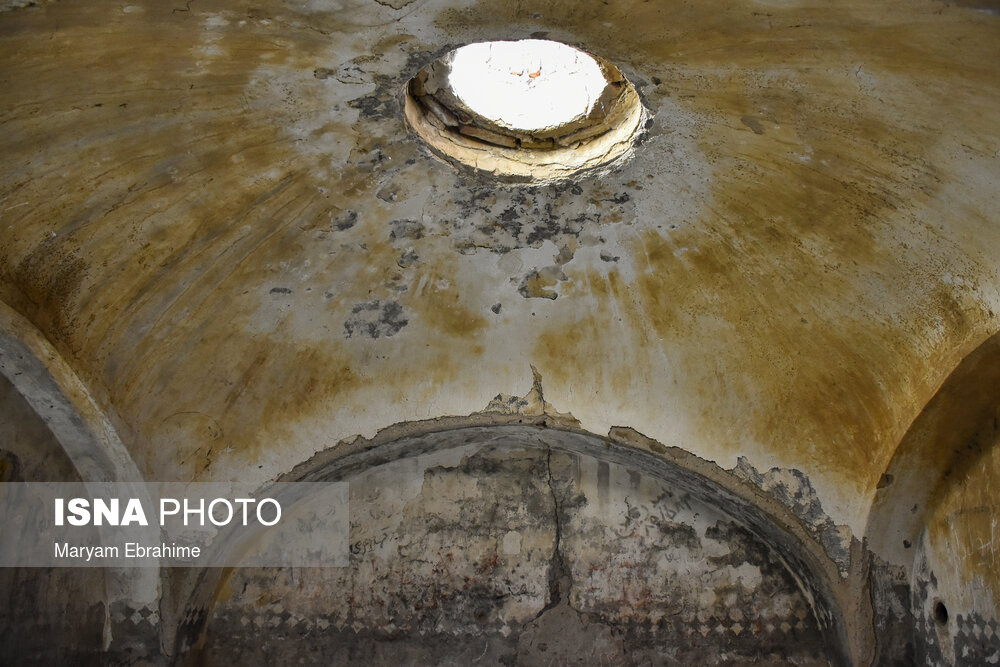
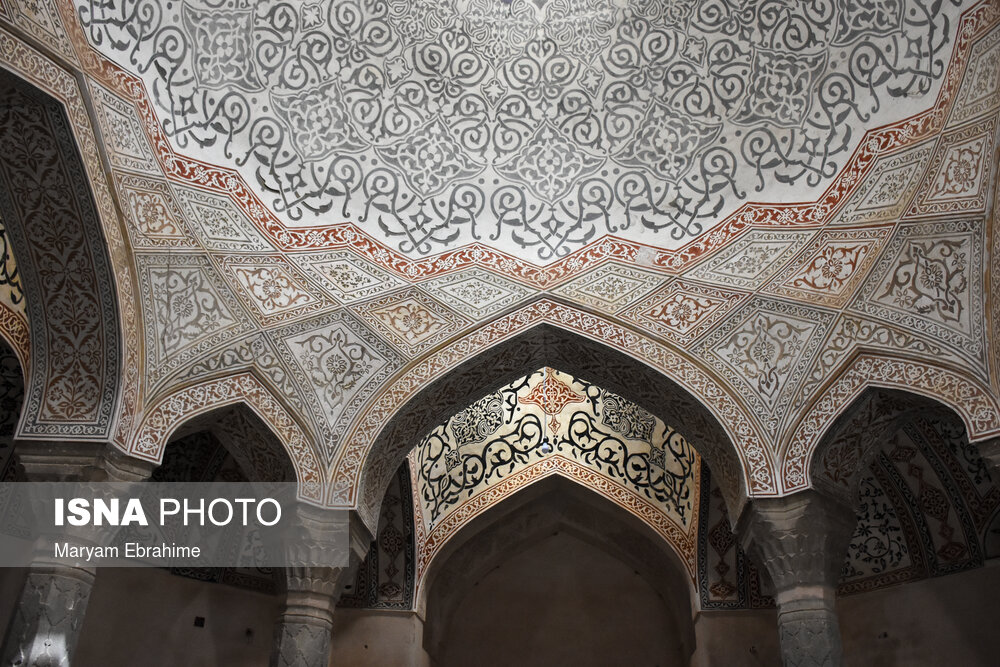
Kordasht Historical Site: A Must-See Tourist Attraction in Iran

Kordasht Historical Site A Must-See Tourist Attraction in Iran 9

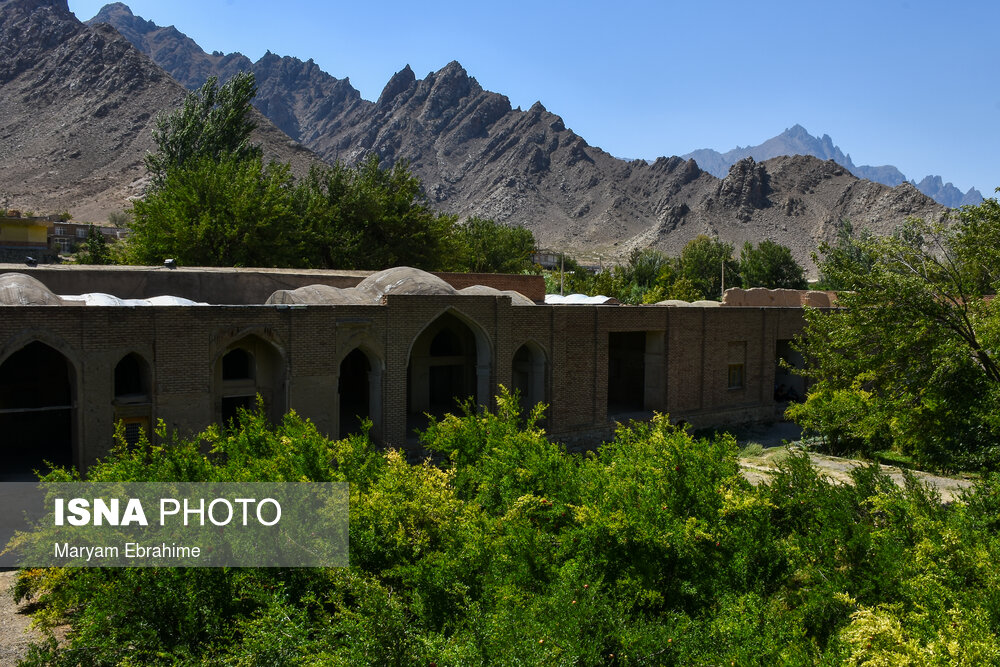
The ancient complex draws thousands of local and foreign visitors every year.

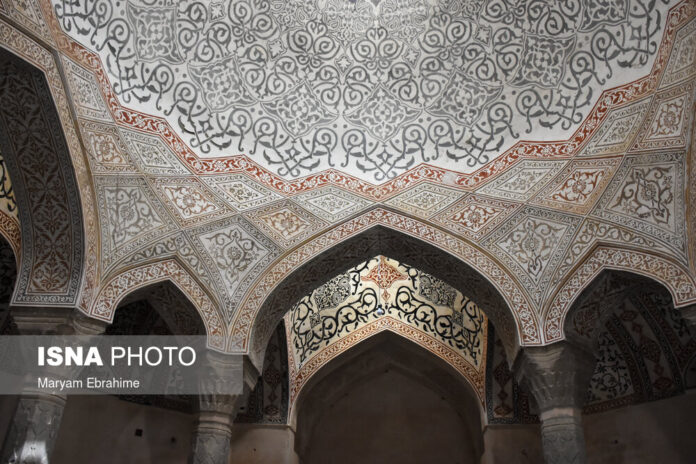
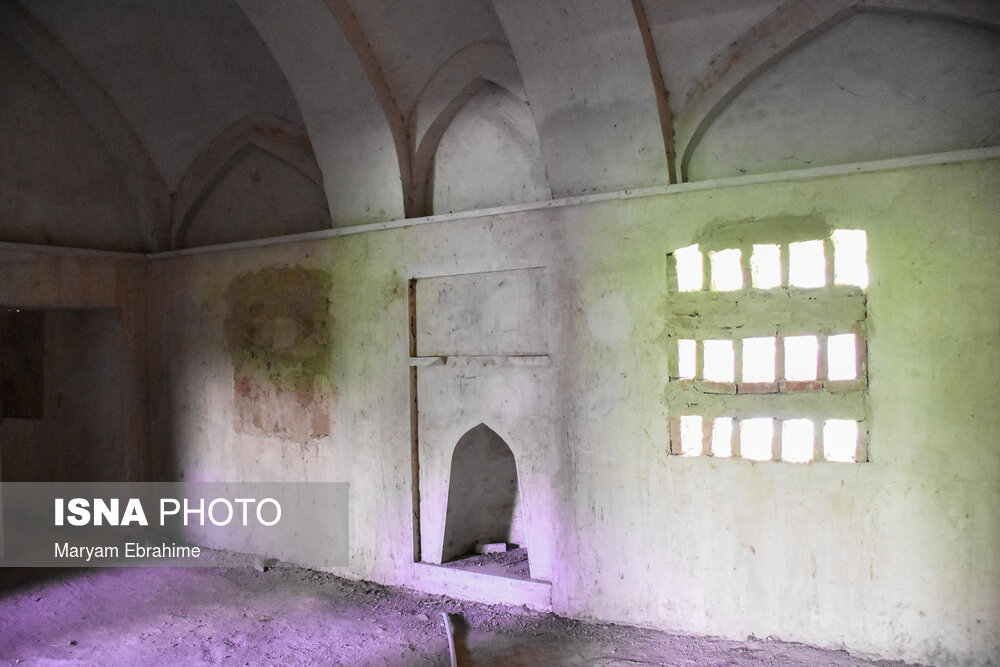
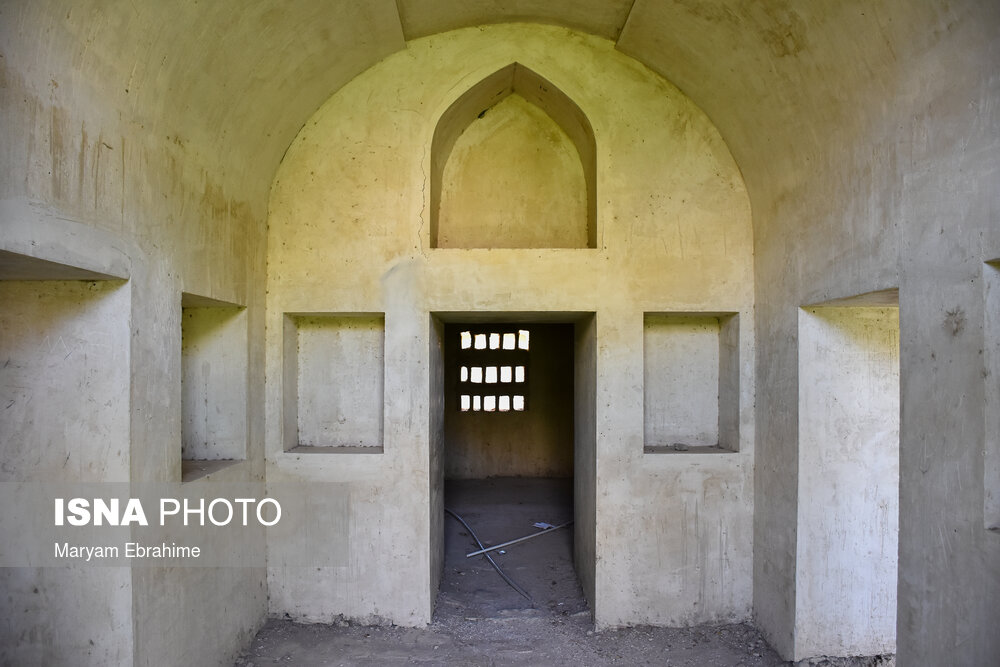
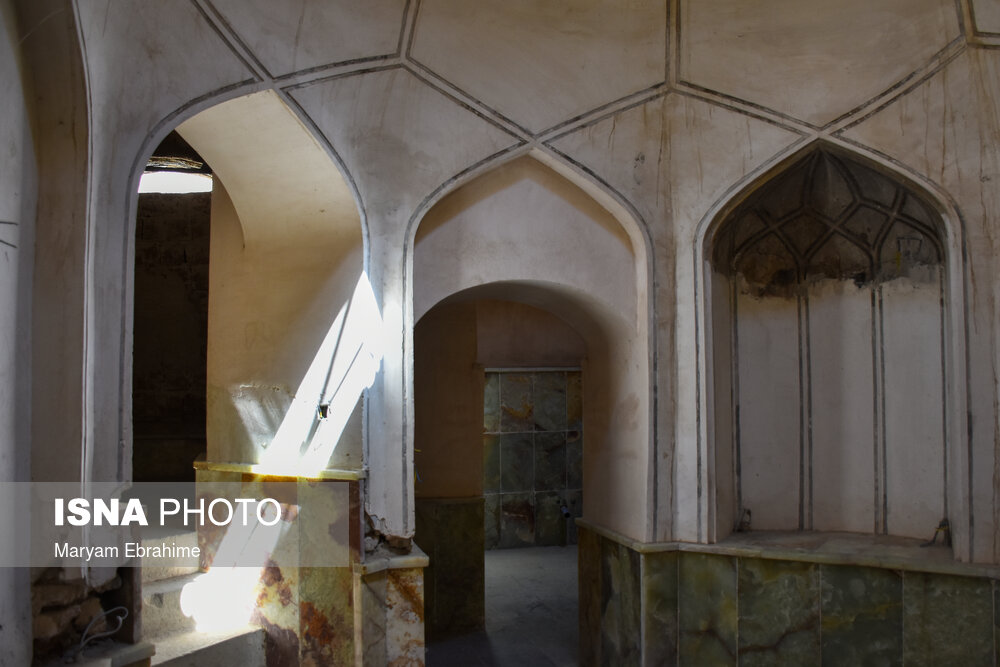
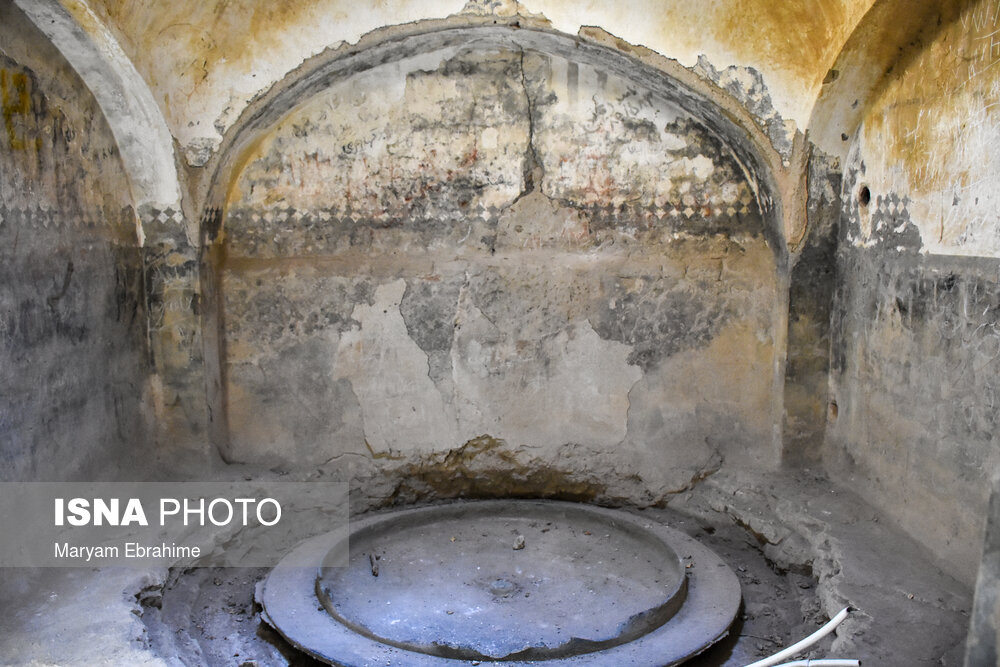
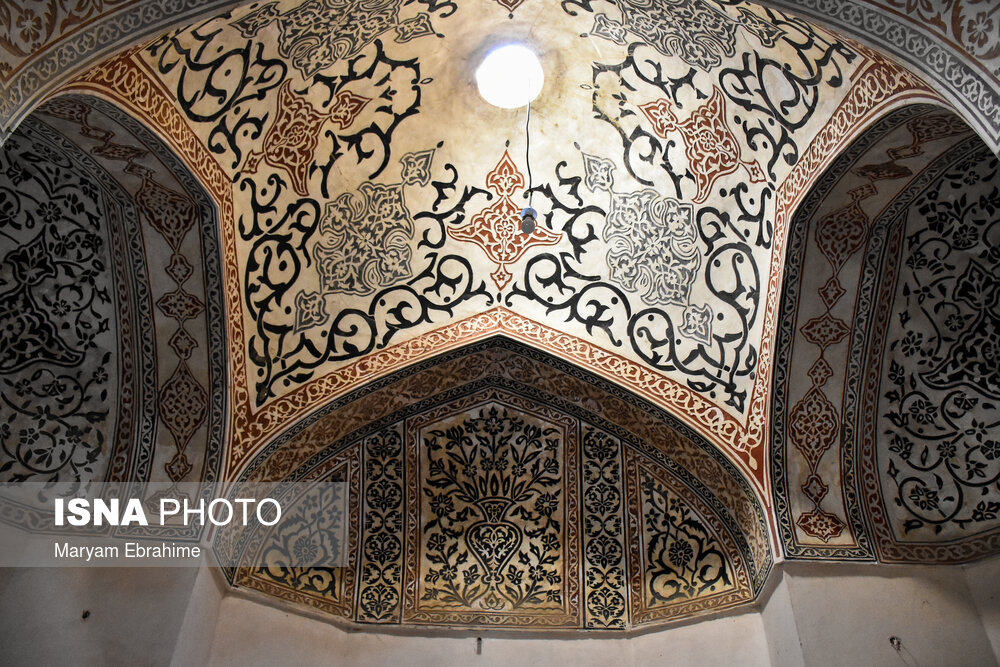
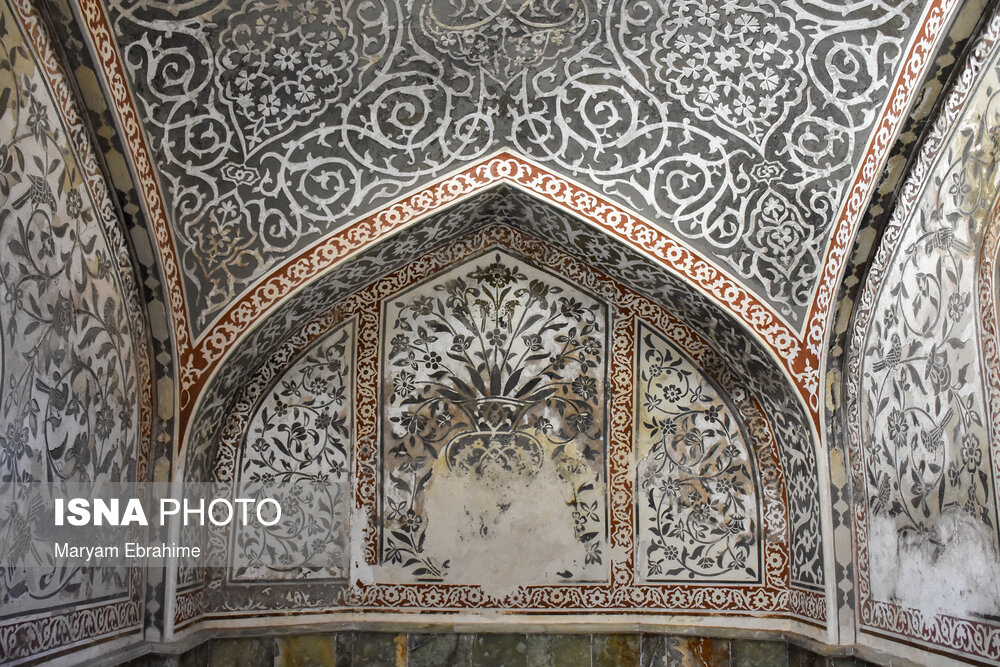
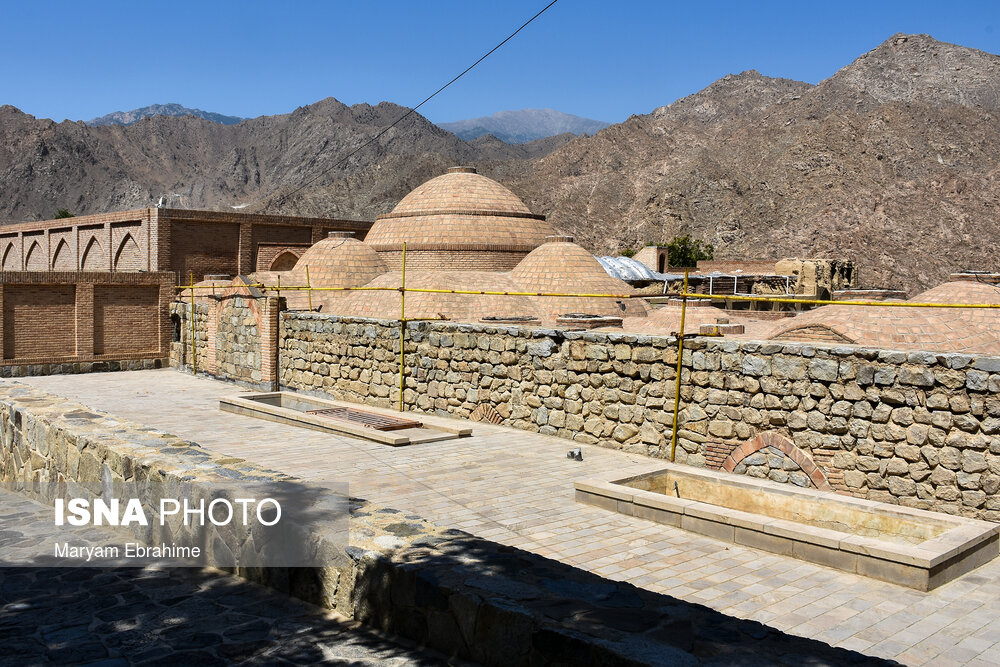
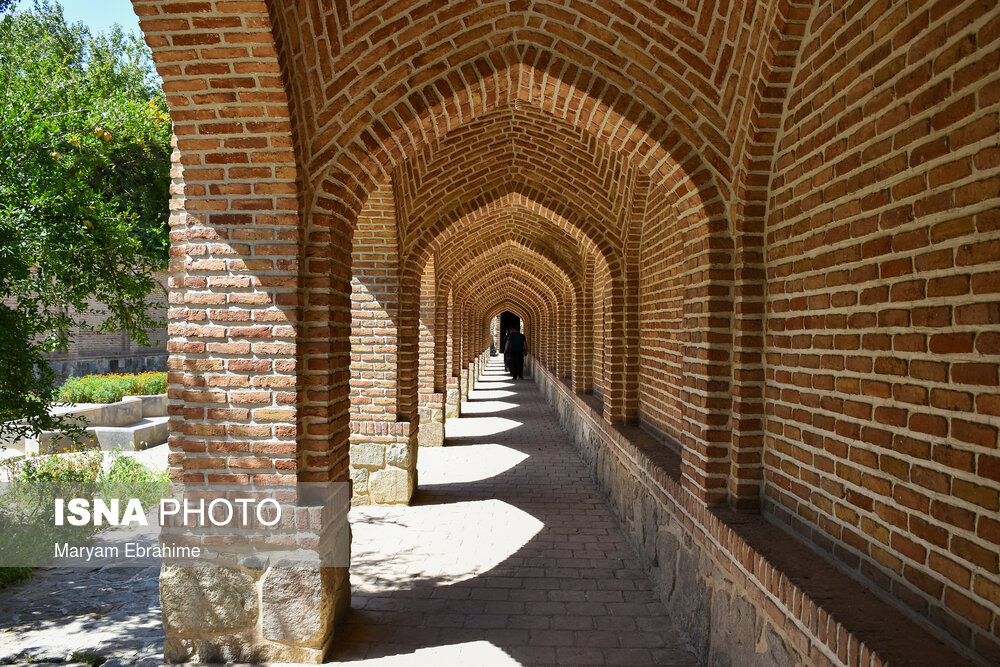
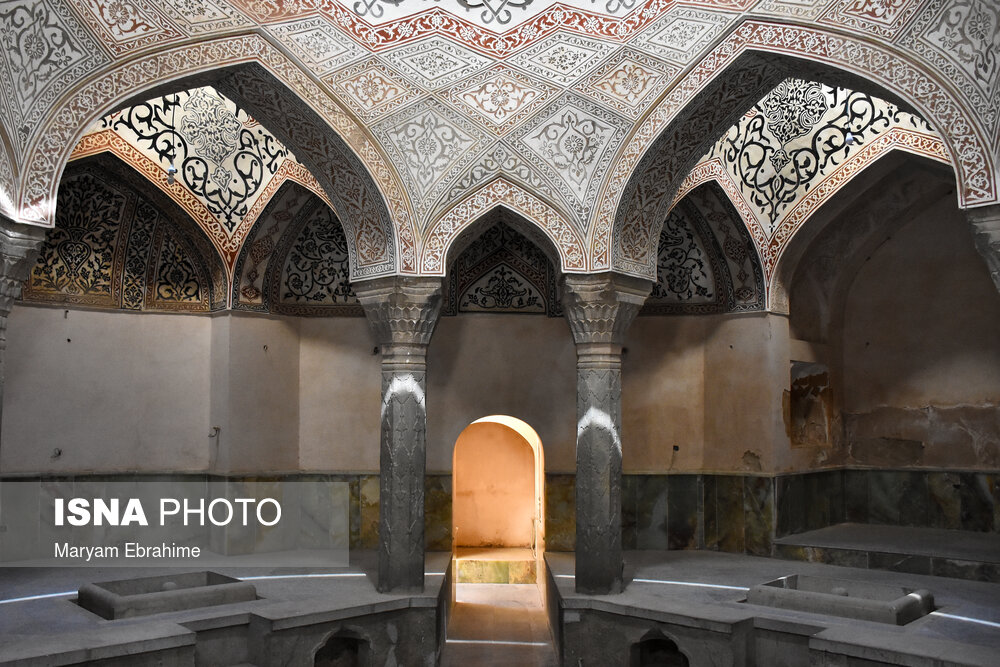
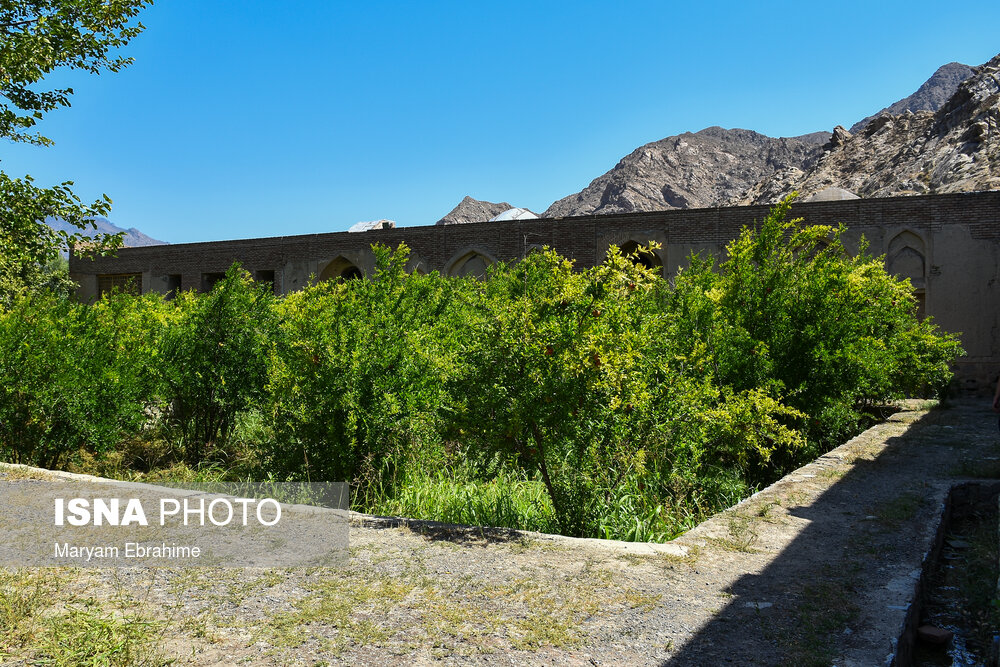
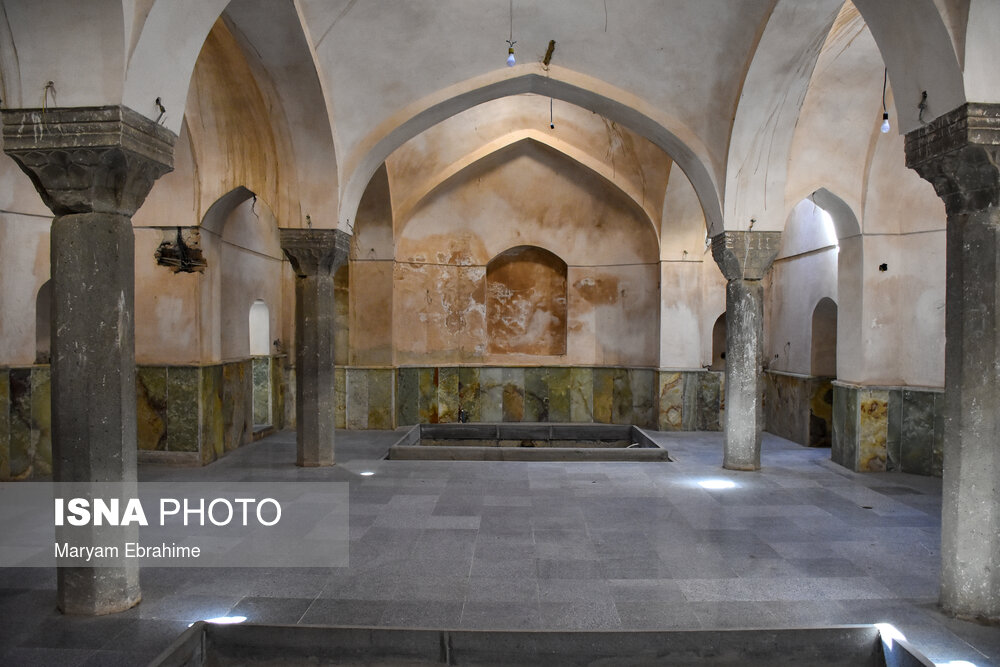
The historical site boasts monuments such as an ancient bath, a historical mosque and a tower. The historical monuments have been restored, and new structures such as a fort and battlements, stables and gates were built following the war between Iran and the former Soviet Union.

The bath which is part of the Kordasht historical complex used to be used by kings only, but upon orders by Agha Mohammad Khan Qajar, the founder of the Qajar dynasty, the bath later became open to the public.

The following are ISNA‘s photos of the village: