Kyiv suspends exports of Ukrainian gas, coal and fuel oil
Ukraine’s government has approved the suspension of any exports of the country’s gas, coal and fuel oil because of Russia’s invasion.
Kyiv announced the move was “connected to “the armed aggression of the Russian Federation against Ukraine and the imposition of martial law in Ukraine.”
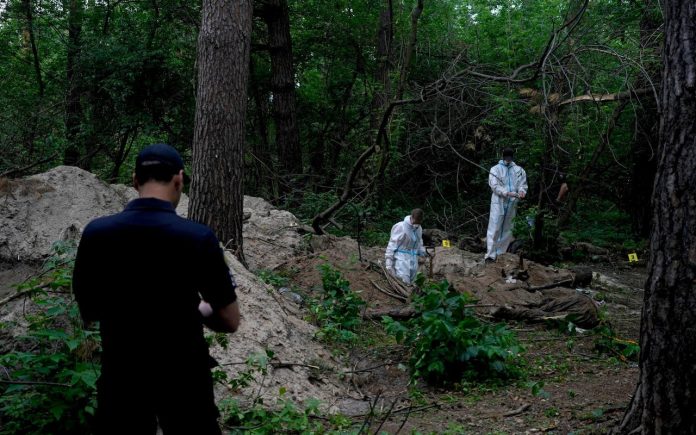
Seven bodies found in grave near Bucha: Police
Seven bodies of killed Ukrainian civilians, several with their hands and legs tied, have been found in a grave near Bucha, a town near Kyiv where Russian forces are accused of having carried out war crimes, according to regional police.
“Seven civilians were tortured by the Russians then executed in a cowardly manner with a bullet to the head,” Kyiv regional police chief Andriy Nebytov said on Facebook.
“This grave was discovered today in an area where Russian troops were stationed near the village of Myrotske” which lies some 10 kilometres (six miles) northwest of Bucha, he added.
All bridges to Severodonetsk destroyed but ‘access’ remains: governor
All bridges to Ukraine’s embattled eastern frontline city of Severodonetsk have been destroyed, rendering impossible the evacuation of civilians remaining there, the local governor has said, adding that some “access” to the city remained.
Governor Serhiy Gaidai wrote on the Telegram app that Russia had not taken full control of the city, and that “a part” of it remained under Ukrainian control.
Up to 1,200 bodies remain unidentified in Ukraine: Police chief
Ukraine’s top police officer says that up to 1,200 bodies, including some found in mass graves, are yet to be identified and that criminal proceedings have been opened in connection with the deaths of more than 12,000 civilians overall.
National police chief Ihor Klymenko told the Interfax Ukraine news agency that about 75 percent of the dead were men, about two percent were children and the rest were women.
“These are civilians, these people had absolutely no connection to the military or law enforcement agencies,” Klymenko was quoted as saying.
More than 1,500 civilians died in the region surrounding Kyiv alone, he added, with 116 people found buried in a single mass grave in Bucha.
Klymenko also noted that the identification process of some of the bodies was lengthy, with efforts complicated by many corpses being in a “state of decay”.
Russia using ‘weapons of mass destruction’ in Ukraine: Finland
Finland’s president, Sauli Niinistö, has said both Ukraine and Russia are using heavier weapons – including, in Russia’s case, thermobaric bombs.
Speaking to reporters during security policy talks at his summer residence in Naantali, Niinistö stated: We are supporting Ukraine with increasingly heavy weaponry. And on the other hand Russia has also begun to use very powerful weapons, thermobaric bombs that are in fact weapons of mass destruction.
Ukraine and NATO countries have accused Russia of using thermobaric weapons, which are more destructive than conventional explosives.
Lithuania seeking to decouple from Russian power grid in 2024: President
Lithuania’s president stated his country is seeking to decouple from the Russian power grid in 2024, a year ahead of schedule.
“Let’s not leave any opportunities for the aggressor to use energy as a tool of political manipulation,” Gitanas Nauseda was quoted as saying in a statement released after his meeting with Kadri Simson, the European Union’s energy commissioner, in Vilnius.
“The fastest possible coupling to the European electricity grid would increase the energy security of the Baltic States and the European Union as a whole”, Nauseda added.
Three killed by artillery attack in breakaway region: Report
At least three people, including a child, have been killed by a Ukrainian artillery attack at a market in the Russian-backed, self-proclaimed breakaway Donetsk People’s Republic (DPR) in eastern Ukraine, the separatist-affiliated Donetsk News Agency reports.
At least four others were wounded in the incident, according to the agency, which published pictures of burning stalls at the central Maisky market and at least one body on the ground.
It reported that 155mm calibre NATO-standard artillery munitions had been used in the attack.
There was no immediate reaction to the report from Kyiv. Al Jazeera could not independently verify the report.
“Arbitrary arrest” of anti-war protesters in Russia “worrying”: UN Human Rights Commissioner
The United Nations High Commissioner for Human Rights Michelle Bachelet has called the “arbitrary arrest of a large number of anti-war protesters” in Russia “worrying.”
Speaking at the UN’s Human Rights Council session in Geneva Monday, Bachelet added that Russia had introduced “new criminal law restrictions” that included “general prohibitions on the dissemination of information based on vague and ambiguous notions, including ‘false news’ or ‘non-objective information.'”
“I also regret the increase in censorship and restrictions on independent media,” Bachelet, a two-time former Chilean president, told the session.
“Bachelet had earlier told diplomats that “the war in Ukraine continues to destroy the lives of many, causing havoc and destruction” and the “horrors inflicted on the civilian population will leave their indelible mark, including on generations to come.”
Ukrainian military spokesperson derides “complacency” of Western donor countries
The spokesperson for the Ukrainian military’s international legion on Monday derided a “sense of complacency” among Ukraine’s military patrons, saying that the country needed far more support if it is to defeat Russia’s invasion.
“There’s a certain sense of complacency that seems to have fallen over our western partners that the arms deliveries that Ukraine has been already provided with are somehow enough to win the war,” stated Damien Magrou, spokesperson for the International Legion for the Defense of Ukraine, during a press conference.
“They are not! They do not come near anything that would be close to enabling us to defeat the Russians on the battlefield,” he added.
Magrou said that Ukraine’s long-range artillery capability was severely lacking.
“Please keep sending heavy artillery, heavy weapon systems, long-distance rockets, anti-ship rockets. All of these things are needed today on the battlefield. They also were needed yesterday. The longer we wait, the more deaths there will be. And these deaths will be not only of Ukrainian armed forces but also our legioners,” he added.
Mariupol’s ‘occupying authorities’ treating residents as ‘slaves’: Ukrainian official
A Ukrainian official has accused Russian forces of treating the residents of Ukraine’s occupied southeastern port city of Mariupol as “slaves and a human shield”.
Petro Andryushchenko, an adviser to the mayor of Mariupol, who is based outside of the city, stated in a Telegram post that its “occupying authorities” had informed residents that as of June 1, humanitarian aid supplies will only be provided to those who are disabled.
All other residents left in the war-torn city will be forced to “survive any way they can”, he added.
Andryushchenko claimed that the city’s new authorities also planned to destroyed all of the city’s damaged buildings by September 1. Residents will receive no compensation for any prior damage to, or the destruction of, the buildings, he said.
“Step by step, Russia and the occupying authorities will begin to announce their real plans in Mariupol … the city’s residents … are being treated as tied-up slaves and a human shield,” Andryushchenko continued.
Ukrainians in Severodonetsk must “give up or die”: Separatist leader
Ukrainian forces in Severodonetsk must surrender or face death, a leader of the separatist so-called Donetsk Peoples Republic (DPR) in eastern Ukraine stated Monday.
“They have two options: either follow the example of their colleagues and give up, or die,” said Eduard Basurin, deputy head of the People’s Militia Department in the DPR, reports Russian state media outlet RIA Novosti.
“They don’t have any other option,” he added.
Russian forces are now in control of most of Severodonetsk, the epicenter of the bloody battle for Ukraine’s eastern Donbas region, but Ukrainian lines to the city do not yet appear to be totally severed.
Serhiy Hayday, head of the Luhansk region military administration, announced Monday that Ukraine was still managing to evacuate some people from the city, but it was limited by the scale of bombardment.
Ukrainian President Volodymyr Zelenskiy has described the situation in Sievierodonetsk as “severe”.
Russia says it destroyed US, European weapons in eastern Ukraine
Russia’s defence ministry says its forces have destroyed a large number of weapons and military equipment in Ukraine’s eastern Donbas region, including some that had been sent by the United States and European nations.
The ministry announced its military had used high-precision air-based missiles to conduct strikes near the Udachne railway station, hitting equipment that had been delivered to Ukrainian forces.
Kyiv’s international allies, including the US, the United Kingdom and several European Union member states, have supplied Ukraine with billions of dollars’ worth of military aid amid Russia’s offensive.
There was no immediate reaction to the Russian defence ministry’s claims from Kyiv, or any of its Western allies.
Russia-appointed authorities to introduce new tax system in Zaporizhia: Report
Russia-appointed authorities in Ukraine’s mostly-occupied southeastern Zaporizhia region are reportedly set to introduce a “simplified” system of taxation as they consolidate their hold on the area.
As of July 1, all businesses will be required to pay a five percent overall tax, while those selling alcohol or tobacco will pay 10 percent, Yevgeny Balitsky, the head of the Moscow-installed military-civilian administration in the region, told Russia’s Interfax news agency.
Russia controls more than half of the region, including the Zaporizhzhia nuclear power plant, the largest facility of its kind in Europe.
Ukraine appeals for “heavy weapons parity” ahead of defense summit
Ukraine is appealing for “heavy weapons parity’’ ahead of a summit of defense ministers in Brussels on Wednesday.
“Being straightforward – to end the war we need heavy weapons parity,” said Mykhailo Podolyak, adviser to the head of the Office of the Ukrainian President, via Twitter.
Podolyak added that Ukraine needed: “1,000 howitzers caliber 155 mm; 300 MLRS; 500 tanks; 2,000 armored vehicles; 1,000 drones.”
NATO will on Wednesday host the Ukrainian defense minister, along with allied ministers and officials from Sweden, Finland, Georgia, and the European Union.
Nearly 300 children killed amid war: Ukrainian prosecutors
Some 288 children have been killed since Russia launched its invasion on February 24, Ukrainian prosecutors say.
Another 527 children have been wounded, they added on social media. They also said that most of the victims were in the southeastern Donetsk region (218), the northeastern Kharkiv region (166) and around Kyiv (116).
Russia ‘earned’ $98bn in fuel exports in 100 days of Ukraine war
Russia has earned $98bn from fossil fuel exports during the first 100 days of its war in Ukraine, with the European Union being the top importer, according to new research.
Ukrainian troops pushed back from Severodonetsk city centre
Ukraine announced on Monday that its forces have been pushed back from the centre of the eastern city of Severodonetsk, where fighting with Russia has raged for weeks.
“The enemy, with support of artillery, carried out assault operations in the city of Severodonetsk, had partial success, pushed our units away from the city centre,” the Ukrainian military said on Facebook.
The local governor, Sergiy Gaiday, stated “the Russians were partially successful at night” in the city.
They “pushed our troops from the centre and continue to destroy our city,” he said on Facebook.
Gaiday noted Moscow’s forces were “gathering more and more equipment” to “encircle” Severodonetsk and nearby Lysychansk.
He added that three civilians were killed by shelling in Lysychansk, across a river from Severodonetsk, in the last 24 hours, including a six-year-old boy.
Amnesty accuses Russia of war crimes in Kharkiv
Amnesty International has accused Russia of war crimes during its efforts to capture the north-eastern Ukrainian city of Kharkiv.
In a new 40-page report, Amnesty has documented the alleged use of cluster munitions and other indiscriminate means of attack.
“The repeated bombardments of residential neighbourhoods in Kharkiv are indiscriminate attacks which killed and injured hundreds of civilians, and as such constitute war crimes,” the report said.
“This is true both for the strikes carried out using cluster as well as those conducted using other types of unguided rockets and unguided artillery shells, which are indiscriminate when used in the vicinity of concentrations of civilians,” it added.
Amnesty’s researchers say they “documented seven strikes in different areas of Kharkiv, where they found fins and pellets of 9N210 or 9N235 cluster munitions.”
“Cluster bombs are inherently indiscriminate,” Amnesty’s report said.
“Rockets release dozens of submunitions in mid-air, scattering them indiscriminately over a large area measuring hundreds of square metres. In addition, cluster munitions have a high dud rate, with a high percentage failing to explode on impact and thus effectively becoming land mines, which pose a threat to civilians long after deployment,” it added.
Amnesty also said that Russia has used the PTM-1S, “a small, scatterable anti-personnel mine.”
Donatella Rovera, Amnesty International’s senior crisis response adviser, stated that the investigation was “further indication of utter disregard for civilian lives.”
“People have been killed in their homes and in the streets, in playgrounds and in cemeteries, while queueing for humanitarian aid, or shopping for food and medicine,” she continued, adding, “The repeated use of widely banned cluster munitions is shocking.”
Russian officials have repeatedly insisted that they do not target civilians.
River crossings to become key in determining course of war: UK
River crossings will be among the most important determining factors in the course of the war in the coming months, the United Kingdom’s defence ministry says.
The ministry announced Russia’s 90km (56 miles) key front line in the Donbas lay to the west of the Siverskyi Donets River, which Russian forces have previously been unable to cross. Ukrainian officials said on Sunday that Russian troops had damaged the bridge over the river which linked Severodonetsk with its twin city of Lysychansk.
“To achieve success in the current operational phase of its Donbas offensive, Russia is either going to have to complete ambitious flanking actions, or conduct assault river crossings,” the ministry added in its latest intelligence briefing.
“Ukrainian forces have often managed to demolish bridges before they withdraw, while Russia has struggled to put in place the complex coordination necessary to conduct successful, large scale river crossings under fire,” it noted.
Russian war casualties may top 40,000 this month: Ukraine president
President Volodymyr Zelensky has said that Russian casualties since the start of the war may pass 40,000 in June.
Speaking to the nation on Sunday in his 109th daily address since the start of the Russian invasion, Zelensky also reiterated Ukraine’s call for advanced air defence systems from the West.
He noted that such defences could have averted many tragedies, including an air attack on Ternopil on Sunday after which 10 people remain in hospital, including a 12-year-old girl.
Zelensky added that such incidents were replacing Peter the Great and novelist Leo Tolstoy as how the world now thought of Russia.
White House says Putin “absolutely has weaponized food” by blockading grain exports from Ukraine
US National Security Council Coordinator for Strategic Communications John Kirby told CNN that Russian President Vladimir Putin “absolutely has weaponized food” in his invasion of Ukraine.
Kirby said the administration of US President Joe Biden and partner nations are working to overcome an export blockade that’s causing a global food shortage.
“It absolutely has weaponized food — Mr. Putin has weaponized food, and we are working hard with the international community and the UN to find ways to be able to get that grain out there and on the market where it belongs,” Kirby told CNN in an interview.
Russia’s export blockade, Kirby acknowledged, “is going to have a global impact.”
“We’re going to feel some of that probably here as well, which is why we’re working so hard on trying to find out find alternative routes to get some of that grain out,” he added.
Russia to “completely cut off” eastern Ukrainian city of Severodonetsk
Russia plans to isolate the key city of Severodonetsk in eastern Ukraine in the coming days according to Ukrainian military officials.
The twin cities of Severodonetsk and Lysychansk are the epicenter of fighting in the east and Ukrainian officials have said most of the former is now under Russian control.
Overnight on Sunday, Russian armed forces destroyed the second of three bridges between the two cities and are heavily shelling the third, Serhiy Hayday, head of the Luhansk regional military administration stated.
“As I understand they want to completely cut off Severodonetsk and leave it without any chance to evacuate people or bring in any munition or assistance,” Hayday continued, adding that he expects the Russians to “throw all their reserves to seize the city.”
It’s possible they will cut off and seize the main highway into the city, he announced.
Zelensky accuses Russian generals of using soldiers as ‘cannon fodder’
President Volodymyr Zelensky has said Moscow’s tactics had not changed in the war and that poorly-trained Russian reserves were now being deployed in the battle for Donbas, where “every metre” is being fought over.
“The Russian army is trying to deploy reserve forces in Donbas. But what reserves can they have now?” Zelensky asked in his daily address to the nation.
“It seems that they will try to throw into battle poorly trained conscripts and those who were gathered by covert mobilisation,” he stated.
“Russian generals see their people simply as the cannon fodder they need to gain an advantage in numbers,” he added.
Around 500 civilians hiding at Severodonetsk Azot plant: Governor
The governor of Luhansk has stated around 500 civilians remain in hiding at the Azot chemical plant in Severodonetsk.
“About 500 civilians remain on the territory of the Azot plant… 40 of them are children. Sometimes the military manages to evacuate someone,” Serhiy Haidai noted.
Russian forces should be seizing bridges rather than destroying them: ISW
Russian forces should, in principle, be seeking to seize bridges rather than destroy them, since Russian troops have struggled to get across the Siverskyi Donetsk River in the past, the Institute for the Study of War (ISW) has announced.
Ukrainian officials recently said that Russia had destroyed the bridge over the river, which links Severodonetsk with Lysychansk, cutting off evacuation routes for civilians. The ISW said this move was likely an attempt to cut Ukrainian ground lines of communication that run from Bakhmut to Lysychansk and Severodonetsk.
“They could hope to trap Ukrainian defenders in Severodonetsk by cutting off their retreat, but it seems unlikely that the benefit of catching a relatively small number of defenders would be worth the cost of imposing a contested river crossing on Russian troops,” the institute noted in its latest offensive assessment on June 12.
The ISW added Russian forces likely expected to break out of their positions around Toshkivna or from Popasna, and to encircle Lysychansk or attack it from the west bank of the river, “thereby obviating the need to seize the bridges or conduct an opposed crossing”.
Ukraine uncovers 50 Russian agents in Lysychansk: Governor
Ukraine has uncovered sabotage activities among 50 people in Lysychansk who were leaking Ukraine’s operational information to Russian forces to help Moscow with its offensive, the governor of Luhansk has said.
Serhiy Haidai stated Ukraine’s security services and police searched through shared network data and found the mobile devices of people who “shared information too vividly with Russian Telegram channels”.
“Traitors. They went to our humanitarian headquarters to use the Internet to leak information to the Russians, and then the cities burned,” Haidai added.
“It is noteworthy that Russian agents transmitted data through the Starlink satellite network… They cheated on Ukraine. They knew that they were killing and destroying by their actions. Why did you betray your own?” Haidai wrote without saying what the consequences were for such actions.
Ukraine war protesters surround European Commission building
Protesters formed a human chain outside the European Commission building in Brussels in solidarity with Ukraine’s bid to join the European Union.
Ukrainian officials have made various pleas in the past weeks for their country to be named a candidate for EU membership, a move that would bring the war-torn nation closer to the bloc without guaranteeing its admittance.
Turkey to discuss exports of Ukrainian grain with Moscow, Kyiv
Turkish President Recep Tayyip Erdogan stated he will discuss with the presidents of Russia and Ukraine the steps to ensure exports of Ukrainian grain to the world.
Western and Russian officials are warning of a global food crisis due to the war in Ukraine and sanctions on Russia. The two countries, major global grain exporters, had a share of 30 percent of world wheat exports in 2021.