Death toll from Russian cruise missile attack in Vinnytsia rises to 25
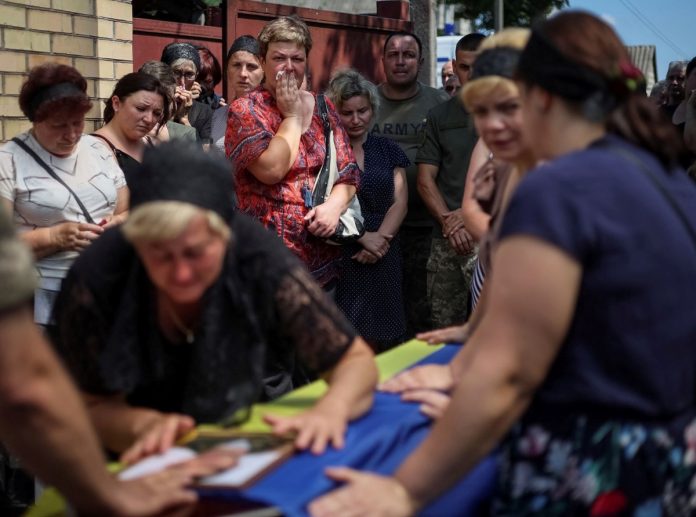
The death toll from a Russian cruise missile strike on Vinnystia last Thursday has risen to 25.
“Unfortunately, this night Natalia Falshtynska, a neurologist, who worked at the ‘Neuromed’ clinic, which was in the epicenter of the explosion, has died,” the head of the Vinnytsia region military administration, Serhii Borzov, told Ukrainian television on Tuesday.
Falshtynska was treating patients at the clinic when the missile struck. She leaves behind three children.
At least 54 people injured in the strike remain hospitalized.
“Eight of them are severely wounded, including a 20-year-old girl in critical condition, who has burns in 98% of her body,” Borzov said, adding, “Four patients with severe burns were transported to the Lviv burn center clinic.”
Talks on safe passage for Ukrainian grain expected to resume soon: Kremlin
Kremlin spokesman Dmitry Peskov has said that Russia expects talks on the safe passage for Ukrainian grain shipments via the Black Sea to continue in the near future, Russia’s state-owned TASS news agency reported.
Peskov stated that Russia was willing to do its best to ensure that Ukrainian grain can reach global markets.
Turkey announced on Monday that officials from Russia, Ukraine, Turkey and the United Nations were expected to meet later this week to discuss the issue, which the United Nations has said has contributed to a global food crisis.
EU set to add Russia’s biggest bank Sberbank to sanctions list
The European Union is set to add Russia’s biggest bank, Sberbank, and the head of giant zinc and copper firm UMMC to its blacklist of individuals and companies accused of supporting Moscow’s invasion of Ukraine, according a draft document seen by Reuters.
The new list of 48 officials and nine entities to be blacklisted, prepared by the EU foreign affairs service, also includes leaders of the Night Wolves motorcycle club, actors, politicians, the deputy head of a Russian security service, family members of sanctioned oligarchs and military people.
Adding Sberbank to the blacklist would freeze its assets in the west and completely prevent transactions, with the exception of financial operations for the trade in food and fertiliser, an EU official told Reuters.
Russia ramping up strikes on southern Ukraine
The Ukrainian military has said missile strikes and attacks with rocket systems have picked up in southern Ukraine, hundreds of miles from the epicenter of the war in Donbas.
Natalia Humeniuk, spokeswoman for the Ukrainian military’s Operational Command South, stated that six Russian Kalibr missiles had hit a village in Odesa region, striking residential buildings close to a school and a cultural center. Six people were injured.
In the neighboring Kherson region, she noted, the Ukrainian counteroffensive was taking place in “a certain silence and secrecy. Each of our achievements, which is worth announcing, we bring to the public.”
“The occupiers are gradually releasing people in the direction of Zaporizhzhia,” she added.
Operational Command South also said that a fuel depot in the town of Nikopol in Dnipropetrovsk region had been hit on Monday night, as had the town’s river port, during a barrage of fire from Russian rocket systems.
It added the city of Mykolaiv also came under attack again on Monday evening.
EU proposes joint arms purchases to replenish stocks
The European Commission has proposed spending $512 million (500 million Euroes) to finance joint defence purchases among member states to replenish weapons stocks following Russia’s invasion of Ukraine.
EU countries “have drawn on their stocks of ammunition, light and heavy artillery, anti-aircraft and anti-tank defence systems, and even armoured vehicles and tanks,” European Commissioner Thierry Breton said.
“This has created a de facto vulnerability that now needs to be addressed urgently,” he added.
Former Russian president: Moscow will ‘achieve all its goals’ then set terms for peace
Russia’s former President Dmitry Medvedev has stated Russia will prevail in Ukraine and will set the terms for a future peace deal with Kyiv.
“Russia will achieve all its goals. There will be peace – on our terms,” Medvedev, now deputy chairman of Russia’s Security Council, said in a post on Telegram.
Russia says it destroyed Ukrainian arms depots storing Western-supplied weapons near Odesa
Russia’s defence ministry has said its forces destroyed ammunition depots in Ukraine’s southern Odesa region that were storing weapons supplied to Kyiv by the United States and European countries.
The ministry did not say how many depots it had destroyed or what weapons were being stored there, and the claim could not be immediately independently verified.
Ukrainian officials had stated earlier on Tuesday that a Russian missile attack had injured at least four people in the village Dachnoye in Odesa.
Ukraine inflicting ‘significant’ losses on Russian logistics: Zelensky
Ukrainian President Volodymyr Zelensky has said Ukraine’s armed forces inflicted “significant” losses on Russian logistics in the occupied territories.
“Step by step, we are advancing, disrupting supplies for occupiers, identifying and neutralising collaborators. The end result is obvious, the Ukrainian flag will be in all our cities and villages. It’s just a question of time,” he added.
Russia struggles to sustain effective offensive combat: UK
Russia has struggled to sustain effective offensive combat power since the start of its invasion of Ukraine and the problem is likely becoming increasingly acute, the United Kingdom’s defence ministry has said.
“As well as dealing with severe under-manning, Russian planners face a dilemma between deploying reserves to the Donbas or defending against Ukrainian counterattacks in the southwestern Kherson sector,” the ministry noted in an intelligence update.
The ministry added that while Russia may still make further territorial gains, their operational tempo and rate of advance is likely to be very slow.
US intel key to aiding Kyiv before war: Washington
United States intelligence was vital in building support for Ukraine ahead of Russia’s invasion earlier this year, Secretary of State Antony Blinken has said.
“You had confidence long before it happened that President Putin planned to launch this second military assault on Ukraine,” Blinken told employees at the Department of National Intelligence.
“The fact that we were able, and you were able, to get to a place where we could downgrade and declassify an unprecedented amount of intelligence, made all the difference in building that coalition so that we were ready to go on day one and we had the world with us,” he added.
Russia’s disproportionate mobilisation in ethnic enclaves may trigger resistance: ISW
President Vladimir Putin’s effort to shield ethnic Russians from high levels of mobilisation may trigger resistance in some ethnic enclaves that are disproportionately bearing the burden of war, the Institute for the Study of War (ISW) has said.
ISW previously noted the prevalence of non-ethnic Russian battalions fighting in Ukraine, which include troops from Chechnya, South Ossetia, Tuva, Tartarstan, Bashkortostan, and Chuvashia and others. In its latest campaign assessment, the ISW pointed to Russian Telegram channel Rybar’s recently released report about an anti-war organisation comprised of activists from the Tuvan ethnic minority enclave.
“Rybar accused the Novaya Tuva movement of disseminating anti-war propaganda and inciting ethnic discord within the Russian Federation. This report is noteworthy in the context of the recent increase in the formation of regionally-based volunteer battalions through Russia, many of which fall along distinct ethnic lines,” the ISW added.
“Rybar’s post as well as previous reporting on a ‘Free Buryatia’ anti-war group bring to the fore the risk that Putin’s apparent desire to have non-Russians bear the brunt of the war at this stage could create domestic tension in these regions,” the institute noted.
Russia has ‘weaponised’ economic integration: US
US Treasury Secretary Janet Yellen has said Washington would impose harsh consequences on countries that abused or broke international economic order.
“Economic integration has been weaponised by Russia,” she stated, calling for all responsible countries to unite in opposition to its war in Ukraine.
She added she was heartened by conversations with South Korean counterparts on a proposed cap on Russian oil prices while visiting South Korea, the final leg of her 11-day visit to the Indo-Pacific region.
Jill Biden will host Ukrainian first lady at White House on Tuesday
Jill Biden will host Ukrainian first lady Olena Zelenska at the White House Tuesday afternoon, according to a release from the East Wing. The two women are slated to talk privately during a scheduled bilateral meeting.
Biden and Zelenska first met in person in May when Biden made a stealth trip to Ukraine. The first ladies had been in communication prior to their meeting, which was the first time Zelenska emerged from hiding since the start of the Russian invasion in February.
During their one-hour closed meeting, Zelenska shared with Biden her concerns for the emotional health of Ukrainian children.
Zelenska will deliver remarks before the US Congress on Wednesday, House Speaker Nancy Pelosi’s office announced Monday.
All members of the House and Senate are invited to the speech.
Zelensky and other Ukrainian officials say influx of new Western weapons shifting battlefield balance
President Volodymyr Zelensky said that the Ukrainian Armed Forces are now able to inflict “significant losses” on the Russians — and other Ukrainian officials have said that the influx of Western weapons is changing the battlefield.
In his daily video message, Zelensky stated that the armed forces are “able to inflict significant logistical losses on the occupiers. It is increasingly difficult for the Russian army to hold positions on the captured territory. Step by step, we advance, disrupt the supply of the occupiers, and identify and neutralize collaborators.”
Valeriy Zaluzhniy, commander-in-chief of the Ukrainian Armed Forces, noted that the “timely arrival” of longer range artillery such as the US HIMARS system was helping to change the battlefield.
“We managed to stabilize the situation. It is complex, intense, but completely controlled. An important factor contributing to our retention of defensive lines and positions is the timely arrival of M142 HIMARS, which deliver surgical strikes on enemy control posts, ammunition and fuel storage depots,” Zaluzhniy added.
Zaluzhniy said he had thanked Gen. Mark Milley, the chairman of the Joint Chiefs of Staff in the US, for the help of the US and its allies “in the struggle for freedom.”
Separately, Oleksiy Danilov, secretary of the National Security and Defense Council, told Ukrainian television that “today, we really have a completely different situation than it was a month ago. Now, thanks to the fact that we receive enough weapons from our partners, we have established a certain parity in certain positions.”
Danilov added Ukraine would like more weapons in future to tip the balance in its favor “so that we have as many capabilities as possible to end this war as soon as possible.”
Speaking about the situation in Donbas, Serhiy Hayday, head of the Luhansk regional military administration, said Monday that “Western weapons work not at 100% but at 200% because [Russian] warehouses are blown up. Command posts are also blown up. “
Hayday added that “we can clearly understand that the Russians are really afraid of a further increase in those Western weapons.”
EU approves another $507m for arms to Ukraine
European Union foreign ministers have agreed to another 500 million euros ($507m) of EU funding to supply arms to Ukraine, taking the bloc’s security support to $2.5bn since Russia invaded Ukraine on February 24.
“Today at the EU foreign ministers meeting, a political agreement was reached on the fifth tranche of military assistance to Ukraine,” Sweden’s Foreign Minister Ann Linde said in a statement.
The money should help the EU continue to jointly buy equipment and supplies for the Ukrainian military, including lethal weaponry, which the bloc has announced should be used for defensive purposes.
EU rules normally prevent the bloc from using its seven-year budget to fund military operations, but the so-called European Peace Facility, which has a limit of $5bn, is off budget and can be used to provide military aid.
EU top justice official: Perpetrators of war crimes in Ukraine will be prosecuted
It may take years to hold perpetrators of war crimes in Ukraine accountable, but those responsible should know the threat of prosecution will hang over them “forever”, European Justice Commissioner Didier Reynders has told Reuters news agency.
The European Union’s top justice official spoke as the United States and more than 40 other countries work to align evidence to help prosecutions for atrocities that Russian troops have committed in Ukraine.
“It will be for the next weeks, next months, next years, maybe for the next decades. For some cases, it will be very fast. It will be longer for others,” Reynders stated.
“But it is also a clear message to the Russian authorities – the risk of these investigations and prosecutions and trials will hang over them for the rest of their lives. It’s forever,” Reynders added.
Russia’s Gazprom tells Europe gas halts are beyond its control
Gazprom has told customers in Europe it cannot guarantee gas supplies because of “extraordinary” circumstances, according to a letter seen by Reuters.
Dated July 14, the letter from the Russian state gas company said it was declaring force majeure on supplies, starting from June 14.
Known as an “act of God” clause, force majeure is standard in business contracts and spells out extreme circumstances that excuse a party from its legal obligations.
US to keep up intelligence with Ukraine despite personnel changes
The United States will keep up intelligence exchanges with Ukraine despite recent personnel changes in Volodymyr Zelensky’s inner circle, the US State Department has said.
“The fact is that in all of our relationships, and including in this relationship, we invest not in personalities. We invest in institutions and, of course, President Zelenskyy has spoken to his rationale for making these personnel shifts,” State Department Spokesperson Ned Price stated.
He added Washington would continue to work with Kyiv on war-crimes investigations and information sharing. Intelligence sharing, he noted, is “an important element of the assistance that we are providing to our Ukrainian partners in an effort to help them defend themselves.”
Zelensky sidelined his childhood friend as head of Ukraine’s security service and another close ally as top prosecutor in Kyiv’s biggest internal purge of the war, citing their failure to root out Russian spies.