Monday, December 29, 2025
Home Blog Page 4991

Iran Raps “Biased” UN Human Rights Resolution

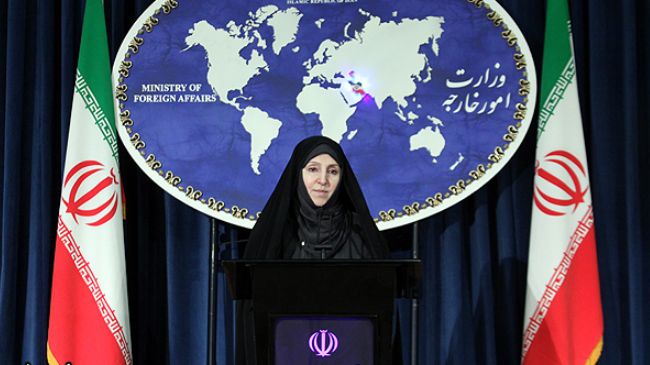
Iranian Foreign Ministry Spokeswoman Marziyeh Afkham

Iran’s Foreign Ministry spokeswoman slammed a UN resolution on the alleged human rights violations in the country, saying the resolution is based upon “biased and unauthentic” sources.

The UNGA approved the resolution based on a recent report by UN Human Rights Rapporteur on Iran Ahmed Shaheed.

In reply, Marziyeh Afkham condemned any “arbitrary and political use of human rights against independent states.”

“The Islamic Republic of Iran fundamentally rejects the introduction, adoption and content of such resolutions,” she said.

“It is regrettable that the United Nations’ human rights mechanisms and tools are abused by certain Western countries which are occasionally known as the flagrant violators of human rights inside and outside their own borders,” she added.

Afkham said Iran has already responded to the claims in the resolution “reasonably and by providing documents.”

She added that such a resolution on the basis of biased sources would have proved entirely unnecessary if those who drafted it had made decisions “impartially and had avoided double-standard attitudes.”

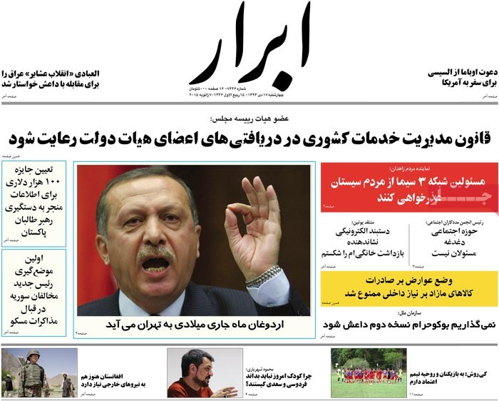
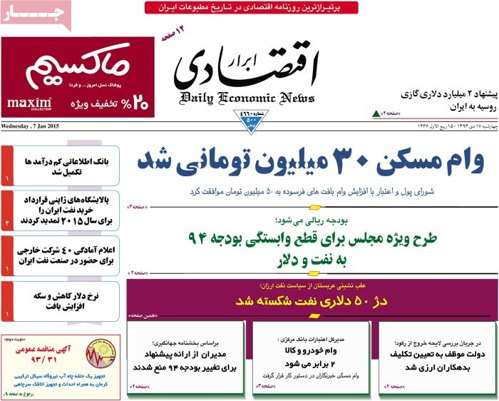
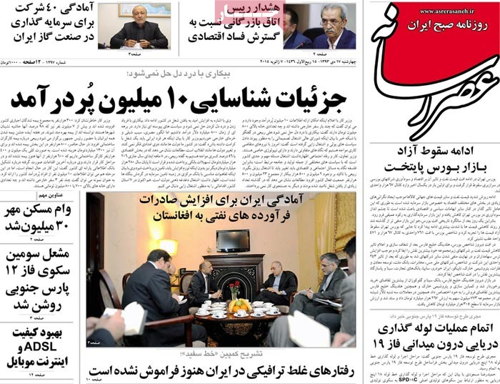
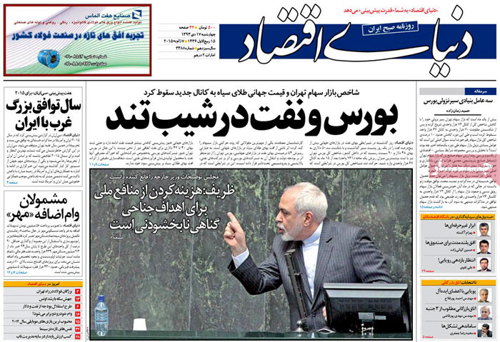
A look at Iranian newspaper front pages on Dec. 20

Iranian Newspapers Headlines

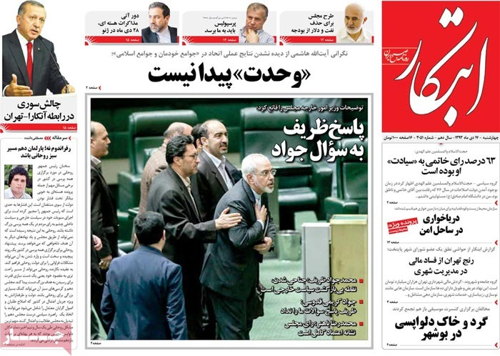
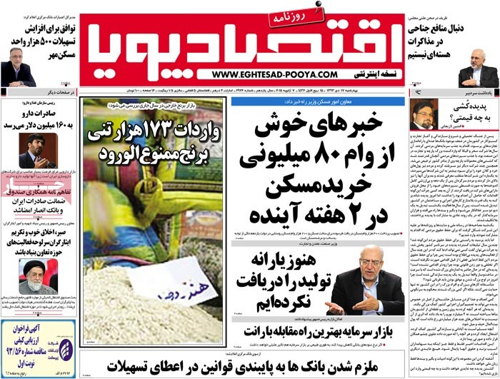
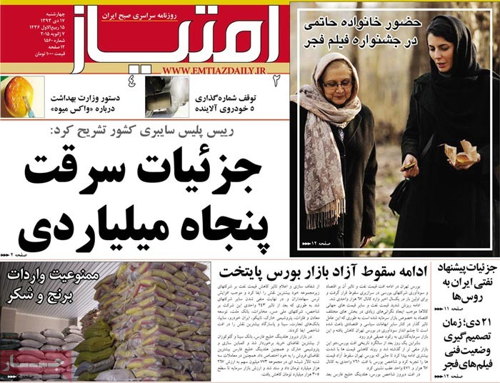
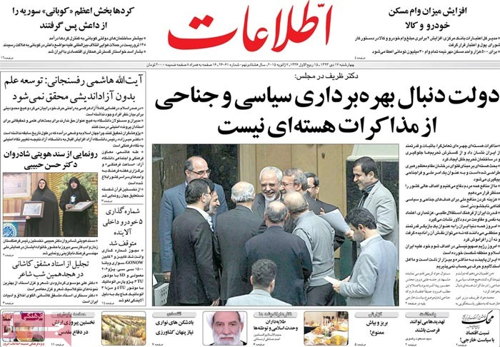
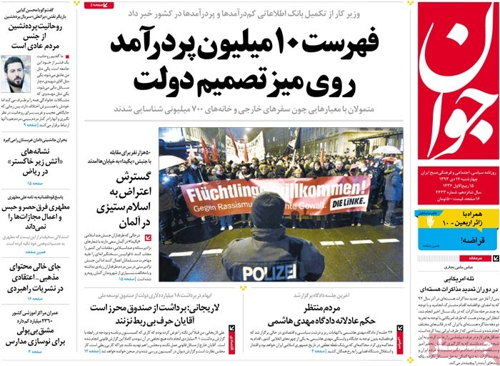
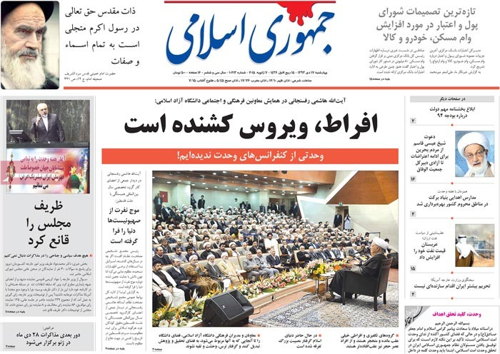
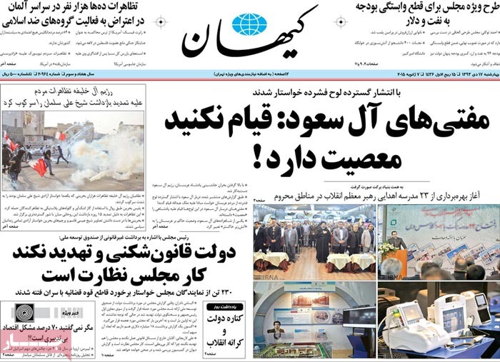
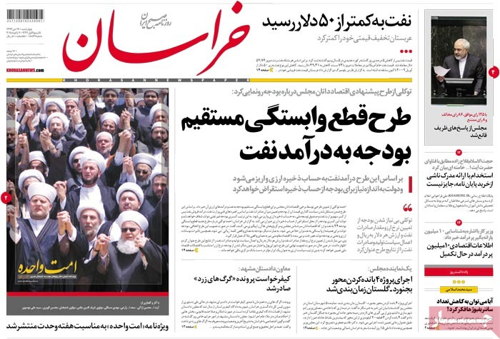
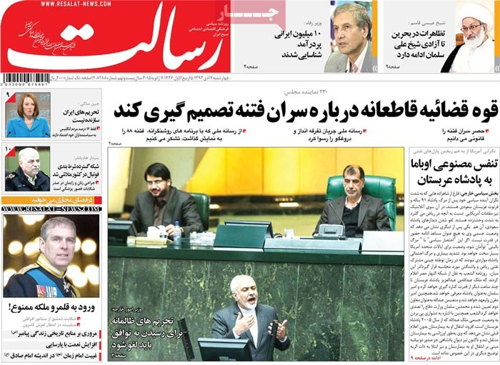
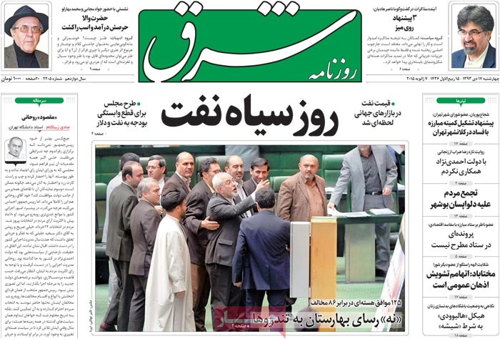
No single news story dominated the front pages of the Iranian newspapers on Saturday. Reformist-leaning dailies covered the comments of former President Mohammad Khatami on moderation and the stance of the reformist camp vis-à-vis subversive elements. The comments of the Russian president that P5+1 are close to securing a deal with Iran also appeared on the front pages of some dailies. And news about a likely cut in interest rates drew attention as well.


Abrar-e Eghtesadi: EU imports from Iran have registered a 100 percent hike.

Abrar-e Eghtesadi: A member of parliament’s Budget and Planning Committee has said that the chamber will have to tweak the government-proposed spending package’s assumption that oil prices will hover around $72 a barrel next year.

Abrar-e Eghtesadi: Interest rates won’t change by yearend [March 21, 2015].


Abrare eghtesadi newspaper 12 - 20


Afarinesh: Compassionate Hands, a Health Ministry plan to examine patients free of charge, has been implemented in a number of poor neighborhoods of the capital.


Afarinesh newspaper 12 - 20


Afkar: “Eighty-eight Iranian scientists are on the 60,000-strong list of top world scientists,” said the Iranian deputy health minister.


Afkar newspaper 12 - 20


Aftab-e Yazd: “Reformists are opposed to subversion and approve of the moderate approach the government [of President Rouhani] practices,” said former President Mohammad Khatami.

Aftab-e Yazd: President Putin of Russia has said that P5+1 are very close to clinching a nuclear deal with Iran.


Aftabe yazd newspaper 12 - 20


Arman-e Emrooz: An Asiatic Cheetah poacher has been sentenced to 42 months in prison.

Arman-e Emrooz: “Gender segregation results in scientific progress,” said Ayatollah Mesbah Yazdi.

Arman-e Emrooz: “Creation of a security atmosphere won’t ensure security,” said former President Mohammad Khatami.

Arman-e Emrooz: Fifty-three people have died as a result of alcohol abuse.


Armane emruz newspaper 12 - 20


Asr-e Rasaneh: High-speed internet is accessible in 12,000 Iranian villages.


Asre resaneh newspaper 12 - 20


Ebtekar: “Subversive elements have no place in society,” former President Mohammad Khatami said.


Ebtekar newspaper 12 - 20


Emtiaz: Iran will be self-sufficient in gasoline production in two years.

Emtiaz: The deputy minister of roads and urban development has said a plan to raise fines for traffic offenders is being reviewed.


Emtiaz newspaper 12 - 20


Ettela’at: “The next round of nuclear talks between Iran and P5+1 will be held next month,” Deputy Foreign Minister Seyyed Abbas Araghchi said.

Ettela’at: The Iranian army will stage maneuvers codenamed Muhammad, the Messenger of God, later in December.

Ettela’at: In Iraq, Kurdish Peshmerga fighters have broken the siege of Mount Sinjar.


Ettelaat newspaper 12 - 20


Farhikhtegan: President Obama’s decision to reestablish ties with Cuba has drawn a smile from the rest of the world, and a frown from Republicans at home.


Farhikhtegan newspaper 12 - 20


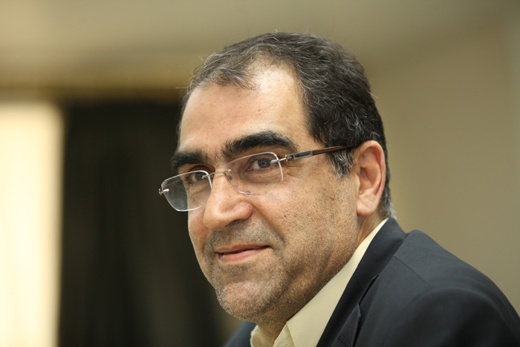
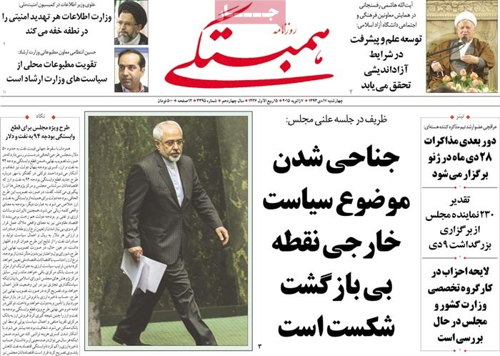
Hambastegi: The health minister has called for runaway expansion of universities to be stopped.


Hambastegi newspaper 12 - 20


Iran: At meetings with the Iranian health minister, sources of emulation have thrown their weight behind the Health Transformation Plan initiated by his ministry.


Iran newspaper 12 - 20


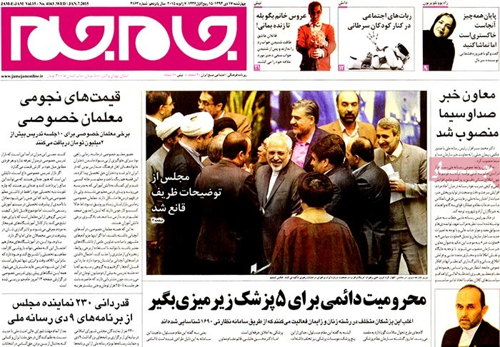
Jamejam: Russian President Putin is preparing for a visit to Iran.

Jamejam: IS terrorists have suffered losses in three different regions in Iraq.

Jame jam newspaper 12 - 20


Javan: Tehran’s Friday prayer leader Ayatollah Movahedi Kermani has urged nuclear negotiators to make sure Iranian dignity is preserved in talks [with P5+1].


Javan newspaper 12 - 20


Jomhouri Islami: As many as 180 UN members have supported a plan that recognizes the Palestinian right to self-determination.

Jomhouri Islami: The minister of economy has said government is considering a cut in interest rates.


Jomhorie eslami newspaper 12 - 20


Kayhan: The US has decided not to release a report on CIA’s involvement in a coup in Iran in 1953, fearing it could have an adverse effect on nuclear talks with Tehran.


Kayhan newspaper 12 - 20


Mardomsalari: A monthly report by the International Atomic Energy Agency has confirmed Iran’s commitment to the Geneva Interim Agreement.


Mardom salari newspaper 12 - 20


Payam-e Zaman: “Carmakers are likely to be merged,” said the Iranian minister of industries.


Payame zaman newspaper 12 - 20


Rah-e Mardom: Water levels behind Latian and Lar dams that supply part of the capital’s water needs have fallen again.


Rahe mardom newspaper 12 - 20


Sayeh: Foreign Ministry Spokeswoman Marziyeh Afkham has dismissed an anti-Iranian human rights resolution at the United Nations General Assembly as “fundamentally flawed”.

Sayeh: Ayatollah Seyyed Ali Ghayuri, the Supreme Leader’s representative to the Red Crescent Society of Iran has passed away.


Sayeh newspaper 12 - 20


Sepid: Phase One of the Health Transformation Plan is 95 percent complete.


Sapid newspaper 12 - 20


Shahrvand: Sony Pictures caved. The Interview won’t be released after a threat by North Korean hackers.


Shahrvand newspaper 12 - 20


Tafahom: Iran’s gas revenues are to increase 3-fold.


Tafahom newspaper 12 - 20


Iranian police seize 450 tons of illicit drugs in eight months

Iran Police chief: Ahmadi Moghadam

Police Chief Brigadier General Esmail Ahmadi Moghadam has been quoted by Shahrvand newspaper as saying that law enforcement forces have seized as much as 450 tons of drugs in the eight months to November 22, 2014. The following is the translation of a very brief report the daily ran on the police commander’s comments on December 18:

The police chief, who was in Mazandaran province, said efforts are underway to render better quality services to members of the public on all fronts.

Brigadier General Ahmadi Moghadam said that in the Islamic Republic of Iran, the law enforcement and the military are there to serve citizens, not act against them. “Up to 5,000 police personnel provided security for the return home of hundreds of thousands of pilgrims who had crossed the border into Iraq to attend religious ceremonies there.”

The brigadier general went on to say his men are credited with 90 percent of all drug seizures across the country.

He further said the launch of an anti-theft center within the police has seen the number of thefts drop dramatically across the nation.

Putin says final deal on Iran nuclear issue ‘very close’

Russia-President-Putin

During a Thursday news conference, Putin expressed hope that Tehran and the six states – Russia, China, Britain, France, the US and Germany – will manage to resolve their differences and ink a historic nuclear agreement “in the near future.”

The Russian leader also praised the Islamic Republic for showing the necessary flexibility in the course of the nuclear discussions, adding that Iran and its negotiating sides are “very close to the settlement of” the 12-year dispute over Iran’s nuclear issue.

A permanent accord on Iran’s civilian nuclear work would benefit economic relations between Tehran and Moscow, added the Russian head of state.

Putin’s comments came a day after nuclear negotiators from Iran and the P5+1 group wrapped up their latest round of talks on Tehran’s nuclear energy program in the Swiss city of Geneva.

The three-day Geneva discussions were held almost three weeks after Tehran and the six countries failed to reach a final agreement by a November 24 deadline despite making some progress.

However, the two sides agreed to extend their discussions for seven more months until July 1, 2015. They also agreed that the interim deal they had signed in Geneva last November remain in place during the negotiations.

Elsewhere in his remarks, Putin pointed to the drop in oil prices in recent months, saying Saudi Arabia and the United States might have conspired to lower the prices in an attempt to harm the Iranian and Russian economies.

Oil prices have been falling throughout 2014, almost halving since June as a result of declining demand and increased supply.

The five-year low prices further slumped following the refusal of some major oil producers, including Saudi Arabia, to cut their crude output.

Iranian President Hassan Rouhani has warned that the current drop in global crude prices is not simply an economic issue, but rather a political plot by some countries.

Iran Army to stage anti-terror war games: General

Iran army

“The massive drill by the Army will be held from December 25 to 31,” the Second-in-Command of the Iranian Army Brigadier General Abdolrahim Mousavi said on Thursday at a press conference, adding, “The Army’s Navy, Air Force, Ground Forces and Air Defense will participate in the maneuvers.”

“New weapons and tactics will be tested and evaluated in the war games,” Mousavi said, adding the drill will also feature exercises on fighting terrorism.

“The show of lasting might, peace, and friendship under the banner of Islamic and regional unity” is the motto of the maneuvers, said the general, adding Iran is “opposed to the presence of foreigners in the region.”

It falls upon regional countries to establish peace and security in the region, he stressed.

The Army’s decision to practice fight against terrorism comes as the scourge poses a threat to the whole Middle East region.

Iran’s Navy Commander Rear Admiral Habibollah Sayyari also said at the press conference that the military’s missile capability will also be tested in the drill by “launching surface-to-surface, surface-to-sea, surface-to-air and air-to-surface missiles.”

In recent years, Iran has secured great accomplishments in its defense sector and attained self-sufficiency in producing essential military equipment and systems.

Iran has repeatedly said its military might poses no threat to other countries, insisting that its defense doctrine is based on deterrence.

Iran supporting fight against terrorism across Iraq: Rouhani

Rouhani-al-Jabouri

“The Islamic Republic of Iran has always stood by all Iraqi people” regardless of their religious, sectarian and tribal affiliations and “supports unity, integrity, security and stability across Iraq,” President Rouhani said in a meeting with visiting Iraqi Parliament Speaker Salim al-Jabouri on Wednesday.

The Iranian nation is now standing by the Iraqi nation, Rouhani further stated, adding, “In every region of Iraq that [Iraqis] fight terrorists, we support the resistance of the Iraqi people and it makes no difference [to us] which tribe or sect is in the majority in that region.”

The Iranian president further noted that unity and integrity among the Iraqi tribes and sects have been cemented more than ever after terrorist attacks by the Takfiri ISIL militants.

Rouhani further lauded Iraq’s victories against the Takfiri militants, describing as “praiseworthy” the Iraqi nation and army’s resistance against terrorists and aggressors.

The Iranian president congratulated the Iraqi people and government on providing security for millions of people participating in Arba’een rituals in the country, describing the measure as a great “show of power”.

The Arba’een ceremony, which marks the 40th day after the anniversary of the martyrdom of Prophet Mohammad’s grandson, Imam Hossein, was held in Karbala on December 13.

The Iraqi official, for his part, stressed Iraq’s willingness to boost its relations with Iran, saying Baghdad and Tehran have numerous common interests and ties.

Key steps have been taken in Iraq today to cement unity in a bid to fight terrorism and the ISIL, Jabouri said, adding that terrorists will not be allowed to sow discord among the Iraqi people.

He stressed that terrorism poses a threat to the whole region, urging a collective effort to counter the scourge.

The ISIL militants currently control swathes of territory across Syria and Iraq. They have carried out heinous atrocities in both countries, including mass executions and beheadings of people.

Traditional art of matting in Iran in photos

Iran-wicker mats

Mats or wicker mats are woven by palm leaf fibers in Iranian southwestern province of Khuzestan. Mats are also made by Cyperus papyrus found in abundance in the region. This type of mat is applied as a wicker as well as a cover for house roofs.

The following are the pictures Mehr News Agency posted on its website on December 16 of the traditional art:


Media in captivity

Ekrem Dumanli

The man who is seen in the picture above raising his right hand is Ekrem Dumanli, the editor-in-chief of Zaman newspaper, Turkey’s widest circulating daily.

That is the lead of a report by Sharq daily on December 17 on the arrests by the Turkish government of journalists and the uproar it has caused inside and outside the country. What appears below is the translation of the report followed by the reaction of President Recep Tayipp Erdogan to the barrage of condemnations at home and abroad:

Ekrem Dumanli and a host of fellow journalists should be put behind bars in order for the government of Prime Minister Ahmet Davutoglu not to be harmed, although the prime minster seems to have faded into the background these days and President Recep Tayipp Erdogan is said to be behind all these developments.

A while ago the Turkish government passed a bill in parliament to tighten its control over the media, something which will help it reach its intended objectives much more easily.

The government has rejected as destructive the performance of many independent media outlets and has arrested about 150 citizens who are active in media circles. Some Turkish newspapers have denounced the government decision as bulk arrests [of journalists].

The mass arrests of journalists in Turkey have sparked a firestorm in Europe. Turkey no longer hopes to join the EU; rather, the go-it-alone policies adopted by the ruling Justice and Development Party (AKP) show that the country seems to be dreaming about a return to the days of the Ottoman Empire.


Erdogan
President Erdogan

Erdogan: It is nobody’s business

President Erdogan showed bitter reaction to the EU’s condemnation of the arrests and said, “This question has nothing to do with European Union officials. The arrest of journalists does not run counter to the principle of press freedom”.

‘Crackdown on Corruption Possible through Transparency’

entezami-41

Deputy Minister of Culture and Islamic Guidance Hossein Entezami said the 11th government [President Rouhani’s] is determined to implement a law that allows citizens free access to information, because it believes transparency is the best way to turn up the heat on corruption and the free flow of information contributes to transparency. The following is the translation of part of Entezami’s comments in a press conference as reported by Sharq newspaper on December 17:

Hossein Entezami, who also serves as secretary of the Free Publication of and Access to Information Commission, said crackdown on corruption is possible through transparency, not rhetorical questions of ‘Shall I tell? Shall I tell?’ [A reference to the tactic of threatening to reveal someone’s secrets used by former President Mahmoud Ahmadinejad in presidential debates as he sought reelection in 2009 and later during his second term in office] “What the new law does is that it makes transparency legally binding. Transparency helps stop empty talk.”

He went on to say that by the definitions presented by international organizations we are not in a good position as far as administrative corruption goes. “I am hopeful that the new law helps improve our status in this regard, because the existence of such laws is a factor international bodies take account of in measuring transparency in countries.”

Entezami further said in order for the Free Publication of and Access to Information law to be implemented, free access to information should turn into a public demand. “The cooperation of the legislature and the judiciary with the executive branch is also required.”

The deputy culture minister stated, “The new law requires state institutions to provide citizens access to anything that gives them a right or requires them to do something. In that, the new light is expected to revolutionize the way the state interacts with citizens.”

In conclusion, he said, “In the beginning, there might be some problems about the existence of information in some areas. That means we need to move ahead slow and steady.”

Saudi Arabia serving Western States by Surplus Production

General Firouzabadi

Chief of Staff of the Iranian Armed Forces Major General Hassan Firouzabadi blasted Saudi Arabia for serving the Western countries’ interests by producing excessive oil.

“By increasing oil production, Saudi Arabia assured the US and the West, which represent the world’s big capital holders, that they will not be restricted for supplying fuel and on the other hand by decreasing the oil prices, it laid financial pressure on the regional countries which are fighting the ISIL terrorists,” Firouzabadi said in Tehran on Wednesday.

He voiced regret that regional countries have sustained $500bln worth of losses due to the increasing crude output by Saudi Arabia and its pro-ISIL allies, adding that Riyadh has strengthened the Western states’ financial system with a $300bln gift.

Also, Iranian Supreme Leader’s representative at the Islamic Revolution Guards Corps (IRGC) Ali Saeedi said in relevant remarks that “Saudi Arabia’s wrath at Iran’s influence” is the underlying cause of the falling crude prices.

Also earlier this month, Secretary of Iran’s Supreme National Security Council (SNSC) Ali Shamkhani warned that the decrease in oil prices in recent months was the result of a plot hatched by certain countries.

The fall of oil prices is a manufactured and political plot, he said.

“The reduction in crude oil prices is not an economic issue, rather a political plot by certain countries,” Shamkhani added.

President Hassan Rouhani also stated last Wednesday that the sudden decrease in oil prices in recent months is a plot hatched by the enemies against the regional people and Muslims.

Stressing that regional people would not forget these plots and betrayals against the Muslim world, Rouhani said, “Certainly, people will react to such schemes and the countries which have hatched this plot should know that they have just increased the Muslim world’s hatred for themselves.”