Monday, December 29, 2025
Home Blog Page 4992

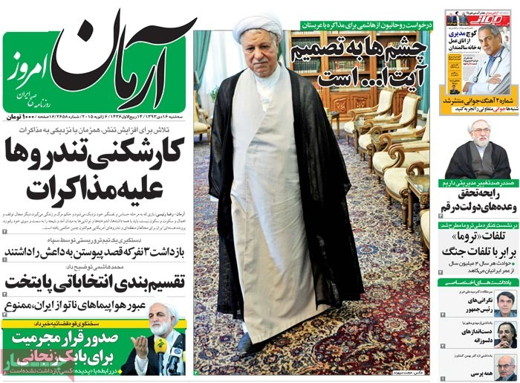
A look at Iranian newspaper front pages on Dec. 18

Iranian Newspapers Headlines

The meetings the visiting Turkish foreign minister and Iraqi parliament speaker held in Tehran with senior officials dominated the front pages of Iranian newspapers on Thursday. The comments of government spokesman about subsides, next year’s budget and cooperation with the construction arm of the Islamic Revolution Guard Corps were on the front pages of several newspapers too.

Abrar: “Talks with the United States are part of negotiations with P5+1,” said Iranian Foreign Minister Mohammad Javad Zarif at a joint press conference with his Turkish counterpart in Tehran on Wednesday.


abrar


Abrar-e Eghtesadi: “A 17 percent pay rise for civil servants [next year] is impossible,” said Government Spokesman Mohammad Bagher Nobakht.


abrar eghtesadi


Afarinesh: “Thanks to the mismanagement of the past, the development budget has been undermined,” said Speaker of the Islamic Consultative Assembly Ali Larijani.


afarinesh


Afkar: Saudi Arabia has declared an oil war on Iran and Russia.


afkar


Arman-e Emrooz: “Tolerance for opposing views should be raised,” said Seyyed Hassan Khomeini, the grandson of the founding father of the Islamic Republic.


armane emrooz


Asrar: “In universities neither the graveyard quiet is good, nor the quiet that is typical of garrisons,” said Seyyed Hassan Khomeini, the grandson of the architect of the Islamic Republic.

Asrar: “Only 40 percent of [individuals and institutions that make up the] economy pay taxes,” said the director of the State Tax Organization.

Asrar: “The Worriers [supporters of the former President Ahmadinejad who are bitterly opposed to the policies of President Rouhani and keep sounding alarms about anything his government does] need not worry about nuclear talks,” said Mohammad Reza Bahonar, a [Principlist] deputy speaker of the Islamic Consultative Assembly.

Asrar: “Hardliners think my warnings are politically motivated,” said Chairman of the Expediency Council Ayatollah Akbar Hashemi Rafsanjani.


asrar


Ebtekar: Reaction to an economic allegation. Reports that $4.1 billion has been withdrawn from the National Development Fund are false.

Ebtekar: “The stage is set for a deal [with P5+1],” said Foreign Minister Mohammad Javad Zarif.


ebtekar


Emtiaz: “The drop in oil prices is a political ploy,” said Iranian Oil Minister Bijan Namdar Zanganeh.


emtiaz


Etemad: The US-Cuba Cold War has ended. Washington and Havana are to reestablish diplomatic ties after five decades.

Etemad: “Khatam al-Anbia Base [the construction arm of the Islamic Revolution Guard Corps] helps the government nobly,” said the government spokesman.

Etemad: “No one will lose as a result of a deal [between Iran and P5+1]” Foreign Minister Mohammad Javad Zarif told a joint press conference with his Turkish counterpart.


etemad


Ettela’at: “High-income individuals won’t get cash subsidies,” the government spokesman said.

Ettela’at: “Iran has no designs on regional countries,” said Parliament Speaker Ali Larijani.

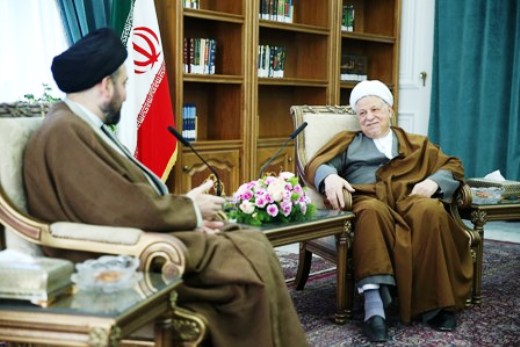
Ettela’at: “Iran stands by the Iraqi people on all scenes,” President Hassan Rouhani told the visiting Iraqi parliament speaker.


ettelaat


Iran: President Rouhani has met with visiting Turkish foreign minister and Iraqi parliament speaker.

Iran: Handicrafts are more appreciated by foreigners than Iranians themselves.


iran


Jomhouri Islami: “The Takfiri movement thrives on division among nations and on insecurity,” the chairman of the Expediency Council told the Iraqi top MP.

Jomhouri Islami: “Ensuring security during Arba’een ceremonies was a manifestation of the power of the Iraqi government and people,” President Rouhani told the Iraqi parliament speaker.


jomhouri eslami


Kaenat: Hamas has been taken off Europe’s list of terrorist entities.


kaenat


Kayhan: The heinous massacre of Pakistani children at the hands of the Taliban has drawn international condemnation.

Kayhan: News of an imminent grand assault by the Iraqi army has sent IS Takfiri leaders fleeing Iraq’s Saladin Province.


kayhan


Roozan: “Reformists have no problem with Larijani and his associates,” said the parliamentary advisor to the chairman of the Expediency Council.


rouzan


Sayeh: “The overall condition of the health sector will improve in six months,” vowed Health Minister Hassan Hashemi.

Sayeh: “Iran stands ready to help Pakistan fight terrorism,” said President Rouhani in a message to the Pakistani prime minister following a school massacre in Peshawar at the hands of the Pakistani Taliban terrorists.


sayeh


Shahrvand: “Between 500 and 1,000 saplings have been planted along Tehran’s most beautiful street: Valiasr.”

Shahrvand: The secretary general of the International Federation of the Red Cross and Red Crescent has said that the potential of the Iranian Red Crescent Society should be tapped into to promote peace.


shahrvand


West Trying to Spread Iranophobia in Region

Ali Larijani

Western countries are trying to spread Iranophobia in the region in a bid to siphon the regional countries’ wealth off, Speaker of Iran’s Parliament Ali Larijani said on Wednesday.

Addressing a gathering of commanders and directors of Khatam al-Anbia Construction Headquarters, Larijani underscored that the Islamic Republic of Iran is looking for restoring the dignity of the Islamic Ummah (community) not boosting its regional influence.

Larijani pointed to Western attempts in recent years to intimidate small Middle-Eastern countries through spreading Iranophobia and stir rifts among regional countries, and said the plots are aimed at plundering these states’ resources.

“Iran is not looking for expanding (influence) and reviving (the Persian) empire in the region,” he said, adding that Iran has never invaded any country.

Larijani also said the strategy set by Imam Khomeini, the late founder of the Islamic Republic, was maintaining the unity and dignity of Islamic Ummah, and stressed that Iran is not involved in “hollow regional rivalry”.

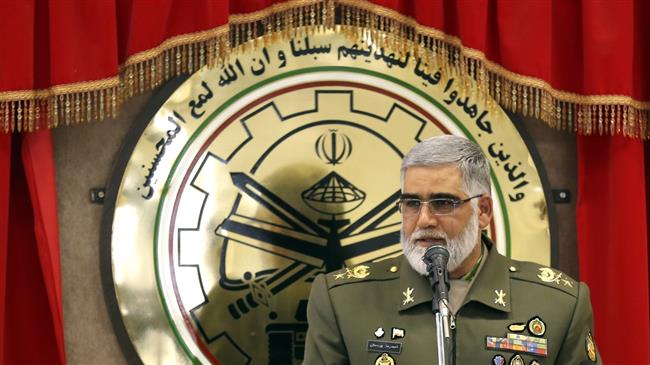
In similar remarks this month, Iranian Defense Minister Brigadier General Hossein Dehqan slammed as doomed the attempts to isolate Iran from the world, saying the moves to spread Iranophobia will lead nowhere either.

Iranian President Hassan Rouhani had also underlined his administration’s resolve to confront ongoing efforts to spread Iranophobia, and said Iran opposes interference in the other country’s affairs.

Iran raps terrorist attack in Pakistan

Pakistan-attack

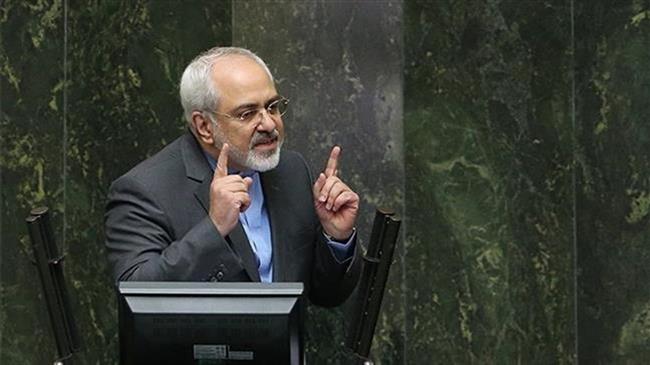
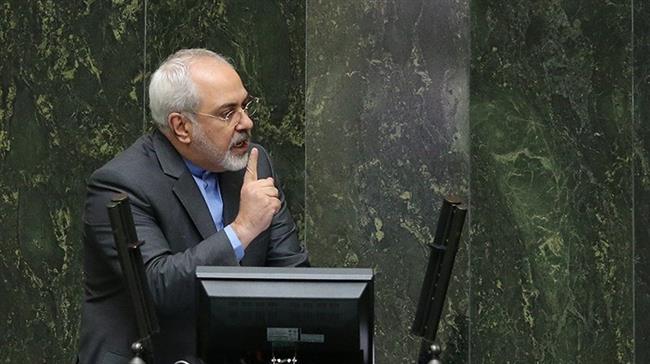
Iran’s Foreign Minister Mohammad Javad Zarif has denounced the recent terrorist attack on a school in Pakistan, saying that the perpetrators of such crimes seek to harm Islam’s image.

Zarif made the remarks in a Wednesday telephone conversation with Sartaj Aziz, a senior adviser to Pakistani Prime Minister Nawaz Sharif on national security and foreign affairs.

The top Iranian diplomat expressed sympathy with the Pakistani government, people and the families of the victims over the tragic incident in Peshawar, in which more than 140 people, mostly children, were killed.

In accordance with its strategic policy to condemn any kind of terrorist act, and considering its friendly and brotherly relations with Pakistan, the Islamic Republic strongly denounces the attack, Zarif said.

The Iranian foreign minister further expressed Iran’s preparedness to take any necessary measures to provide the injured with medical treatment and care.

Zarif further reiterated the Islamic Republic’s readiness for cooperation with Pakistan and other regional countries in fighting terrorism and extremism in the region.

The Pakistani official, for his part, expressed gratitude for Iran’s sympathy over the deadly incident.

He also said that bilateral and regional cooperation is the most effective way in countering terrorist and extremist groups.

In one of the bloodiest attacks in Pakistan’s history, a group of gunmen, reportedly dressed in military uniforms, stormed the Army Public School in Peshawar on Tuesday morning, going from classroom to classroom, shooting students and teachers.

The Pakistani military said at least 141 people, 132 of them children, lost their lives in the attack. More than 100 others were injured.

The death toll, however, does not include the seven terrorists who attacked the school, all of whom were killed by security forces.

The militant group Tehreek-e-Taliban Pakistan (TTP) has claimed responsibility for the attack, saying it was carried out in retaliation for an ongoing Pakistani military offensive against the militants.

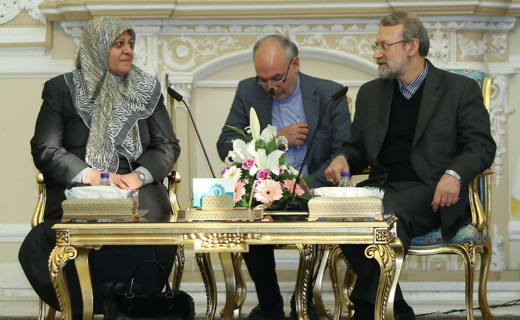
Iran, Turkey can bring about stability in ME

Rouhiani-Çavuşoğlu-Tehran

Iranian President Hassan Rouhani says Iran and Turkey should seek common goals in regional issues in an effort to bring about stability.

The Iranian president made the remarks at a meeting with Turkish Foreign Minister Mevlut Cavluoglu in Tehran on Wednesday.

“Tehran and Ankara should seek common and important goals in the field of regional issues,” Rouhani said. “The two countries’ close cooperation could help ensure stability and security in the whole region.”

He added that “longer steps” have to be taken in boosting relations in political, economic, and cultural fields.

Rouhani noted that “important decisions” had been made during the visits the two countries’ presidents have had.

Cavluoglu, for his part, said, “We believe that we could reach significant solutions with helping each other.”

The Turkish minister also held talks with Iranian Parliament Speaker Ali Larijani and Iranian Foreign Minister Mohammad Javad Zarif after his arrival earlier in the day.

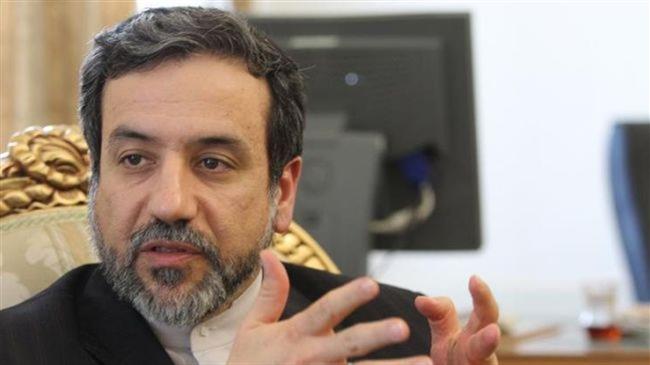
Abbas Araghchi: Iran nuclear talks to be held in January

Abbas-Araqchi

A senior Iranian nuclear negotiator says the next round of nuclear talks between Tehran and P5+1 will be held at the deputy level in January.

“The negotiations next month will also be held at the deputy foreign ministers level,” said Seyyed Abbas Araghchi, who also acts as Iran’s deputy foreign minister for legal and international affairs.

Araghchi made the remarks after nuclear negotiators from Iran and the five permanent members of the United Nations Security Council — Russia, China, France, Britain and the United States — plus Germany wrapped up talks on Iran’s nuclear energy program in the Swiss city of Geneva on Wednesday.

During the discussions, which began on Monday, deputy foreign ministers and experts from Iran and the US held bilateral negotiations on Tehran’s nuclear program.

Representatives from Iran also sat down for bilateral nuclear talks with delegations from France, Russia, and China separately.

Deputy foreign ministers from Iran, Germany, Britain and France also held quartet talks on the Islamic Republic’s nuclear program.

The three-day Geneva discussions were organized three weeks after Tehran and the six countries failed to reach a final agreement by a November 24 deadline.

Despite making progress, Iran and the six countries failed to clinch a final nuclear deal during their previous talks in the Austrian capital of Vienna.

However, Tehran and P5+1 agreed to extend their discussions for seven more months until July 1, 2015. They also agreed that the interim deal they had signed in Geneva in November 2013 remain in place during the negotiations.

Carnage of 135 children; reprisal against the Pakistani army, Taliban-style

Pishawar pakistan-Taliban-4

On December 17, Farhikhtegan, a daily, dedicated its editorial to the mass slaughter, the day before, of defenseless Pakistani students at the hands of Taliban militants. What appears below is a partial translation of a report the daily published on the bloody incident and the editorial penned by Pir Mohammad Molazehi, an Indian Subcontinent expert:

The bloody attack launched by five Taliban insurgents on an army-run school in the northwestern Pakistani city of Peshawar left at least 135 dead, as many as 125 of them students.

The attack was apparently in response to a recent army offensive against leaders of the Taliban and al-Qaeda in which the Pakistani army killed Adnan Shokri Juma, a senior al-Qaida leader.

[…]

The Pakistani media reported that at the time of the attack, at least 500 people were inside the school. A few hours after Taliban militants stormed the school, the Pakistani army and police launched a rescue operation and released a group of students from captivity. During the operation, four Taliban fighters were killed.

Students at this school were reportedly all below 15 years of age (first to tenth graders).

Tehreek-e Taliban Pakistan (TTP) have claimed responsibility for the deadly attack.

“When our suicide bombers entered the school, they had instructions not to harm the children, but to target the army personnel,” said Taliban spokesman Muhammad Umar Khorasani.

Referring to an anti-Taliban military offensive that began in June, he said the school attack was a revenge attack for the army offensive in North Waziristan.

As for the reason why the Taliban have targeted the army-run school, he said that the Pakistani government targets Taliban families and women; Taliban sought to give them a taste of their own medicine.

The Pakistani army has announced that in a few operations carried out over the past few months, more than 1,000 militants have been killed in North Waziristan.

The army-run school which came under the deadly attack was in the northwestern city of Peshawar. The majority of students there were children of army staff and officials.


The vicious circle of massacre

Editorial by Pir Mohammad Molazehi

[…] In recent days, a few warlords of the Tehreek-e Taliban Pakistan (TTP), also known as the Pakistani Taliban, have lost their lives in attacks by the Pakistani military. Therefore, the question of revenge and the fact that the Pakistani Taliban can stage military operations should not be discounted.

This gains more weight in Peshawar, northwest Pakistan, which is one of the most militarized administrative centers in the country where the military has a heavy presence. In the eyes of the Taliban, any blow to the city’s security can challenge the military’s efforts to maintain law and order there.

In fact, the Taliban have massacred students in a military-run school to target the credibility of the Pakistani military. The Taliban do not care about the fact that their attack on a school could trigger condemnations in the court of public opinion; for them what matters is to cause public panic and wreak terror havoc on people. What they do signals the following message to civilians and military men alike: attacks by the military in North Waziristan will not go unanswered.

It should be noted that the Tehreek-e Taliban have been currently hit by a lack of integrity and torn into smaller groups. Although these splinter groups think they are entitled to the Taliban title, some of them hold more extremist views and have stronger motivations to counter the Pakistani military and security forces.

The Mullah Fazlullah group is one of the most extremist groups of the TTP which has so far carried out and claimed responsibility for several suicide operations [in Pakistan].

Mullah Fazlullah once declared a caliphate in Swat Valley, but the military’s attacks forced the self-styled caliph out of the valley. He is said to be moving back and forth in border areas of Pakistan and neighboring Afghanistan, trying to get his forces to large cities and thus spread the security conflict which is raging on between the military and the TTP in North Waziristan tribal areas.

By staging the December 16 attack on the school in Peshawar Tehreek-e Taliban made good on the threats they had previously issued. They had warned the Pakistani government and military that the extended attacks – which they say are launched in coordination with the US – fail to prevent the TTP from advancing their objectives: Islamization of power in Islamabad.

Apart from this, the newly emerged extremism in South Asia is the product of flawed policies and superficial perceptions the Pakistan military has ironically tried to improve.

However, Pakistan’s military generals believe that the Jihadists who used to fight against the Red Army of the former Soviet Union in Afghanistan and were supported [by the government] were naturally different from the extremist fighters that are now called terrorists and pose a threat to Pakistan’s national security.

Moreover, there are some experts who blame the erroneous policies of the past and present for the growing spread of religious extremism, something which is still growing as a result of the reoccupation of Afghanistan by the US and NATO. These extremist groups which have emerged in the form of the Islamic State of Iraq and the Levant (ISIL) have jeopardized the security of both South Asia and the Middle East region.

Small incidents on the sidelines of a big event

Karbala-Arbaeen-Masjed Jamei

This year Iraq required no entry visa from Iranian pilgrims as they streamed in to take part in ceremonies to mark Arba’een, forty days after Ashura: the climax of mourning functions for Imam Hussein, the grandson of Prophet Muhammad, who was martyred in Karbala more than 13 centuries ago. Iraqi officials have said that they have registered more than 800 life events, including 704 births and 154 deaths, during the days-long ceremonies.

The Cultural Heritage News Agency (CHN) on December 15 quoted Iranian officials as saying that as many as 1.2 million pilgrims entered Iraq for the religious occasion, but Governor General of Karbala Province Aqil al-Tarihi put the number at closer to 1.5 million. The following is a partial translation of what else the governor general had to say in a meeting with Ahmad Masjed-Jamei, a member of Tehran City Council:

Except for religious tourists from Iran, about 65,000 people from Arab nations and 13,000 from non-Arab countries, including five Brazilians, were among pilgrims in Karbala.

Visiting the holy shrine of Imam Hussein this year was somehow different from previous years, because Karbala served as a meeting point of Shiites from all over the world.

More importantly, the ceremonies were given extensive media coverage in the world because they coincided with the victories of the Iraqi army and volunteers against ISIL terrorists.

We thank Tehran Municipality for sending more than 3,000 urban service workers to Karbala to offer services to pilgrims.

Up to 704 women went into labor in the city hospitals and as many as 154 people died, among other things because of cardiovascular conditions and car accidents.

Backgammon dug out from 15-century-old dates storage depot

Tal Ghale Seyfabad

Iran’s Cultural Heritage News Agency – www.chn.ir – has reported that a first phase of excavations in Tal Ghale Seyfabad in Kazerun, Fars Province has resulted in important discoveries. The following is a partial translation of the report:

Throughout the first phase of archeological exploration of the region known as Tal Ghale Seyfabad in the southern city of Kazerun, which used to be a major dates distribution center and storage depot, seven large earthen jars dating back to the Sassanid era were discovered.

One day prior to this finding, a dice and a backgammon piece belonging to the same era were unearthed. Along with the large jars, a large number of date seeds were discovered in the area.

“Analyses are being conducted on different types of date seeds discovered. They are likely to be the dates grown in Shapour Khoreh [one of the five provinces of Fars region during the reign of the Sassanid Empire] which would be distributed to other parts of the empire after being stored there,” Parsa Ghasemi, an archeologist, said.

Tal Ghale Seyfabad is located 15 Km to the southwest of Kazerun and is along a natural gas pipeline to the north of Seyfabad Village. Based on archeological findings, the region has been a trade and economic center of Shapour Khoreh.

Western sanctions against Iran contradict human rights

Mohammad Javad Larijani

The secretary of Iran’s Human Rights Council says the sanctions the West has imposed on Iran are meant to show to the world that the Islamic Revolution is an unsuccessful experience, adding these sanctions havefailed [to produce the intended results].

On December 16, Hemayat newspaper said Mohammad Javad Larijani made the comment at an international seminar on “The Negative Impacts of Economic and Financial Sanctions on the Full Enjoyment of Human Rights” which was attended, among others, by Tehran-based foreign diplomats. The following is the translation of what he said in the conference and later to reporters on the sidelines of the gathering:

Islamic countries should ruin the monopolistic atmosphere of liberal democracy which dominates documents governing human rights. Seventy years ago, Western countries drew up these documents in the absence of Muslims. Now you feel that Islamic wisdom, philosophy, literature and logic are missing in these documents. This is a downside of the documents and amounts to injustice to humanity.

Over time this shortcoming has been highlighted and the world of Islam has become aware that it should be given a role in [establishing] the rights mechanisms and procedures and [producing] documents.

The absence of others when these human rights documents and texts were being drafted led to a misconception about the universality of human rights, one which says the whole world should live based on the rationality of liberal democracy. However, this is not universality [of human rights]; rather it is sheer imposition. Universality means participation and interaction by all countries and consideration of multicultural human rights.

It is high time that Islamic countries worked with the Organization of Islamic Cooperation to break the imposed unilateralism, which is called “universality”, to serve the interests of the world of Islam and humanity alike. If so, it would allow other cultures and lifestyles which are suffocating in the liberal democracy to breathe and get rid of the Western-imposed universality.

The question of human rights is not something which the West has given to humanity as charity. The Islamic nations consider human rights an issue which has its roots in the holy Koran and religious teachings, and the Koranic words prove what we say, because God Almighty says, “We created man and bestowed upon you dignity”. This is not charity; rather, it is the God-given right of people.

Any attempt to impose bans and restrictions on people’s rights to life, lifestyle, and development – which are humans’ main rights – is breach of human rights and runs counter to all international texts and documents.

Islamic countries are entitled to choose their way of life – either in public places or in their private lives – based on Islamic wisdom, and nobody has the right to impose on them a special style, including liberal democracy. The Islamic Republic of Iran, for instance, has chosen over the past 35 years the current style based on Islamic wisdom and as a result has pulled off remarkable success on all fronts.

The right to life, which is humans’ second right, is defined at three levels: First is humans’ basic rights. Security and the right to social life come next. Any threat to any of these three levels amounts to infringement of human rights and is against the right to life. Despite this, you see that unprecedented Western-imposed sanctions against Iran mostly target the right to life.

The West has slapped tough, inhuman sanctions against the Islamic Republic only to bar it from making progress and deal a blow to Iran’s efforts to establish a political-civic system based on Islamic wisdom. The sanctions have failed [in their objectives] and Iran is moving forward and will continue to move farther.

Although Iran has steadfastly resisted the inhumane sanctions, the resistance and sustenance of the Iranian nation does not give legitimacy to their anti-rights and inhuman measures. If they intended to block Iran’s progress, they have failed in their attempts. There’s no doubt that these sanctions are illegitimate and in full contravention of the main human rights documents.

Iran enjoys rich human resources and has good relations with all countries; denying it the right to tap into the world’s plentiful potential is not right. For some governments, ties with the world become meaningful when they have relations with Paris, London and Washington, but it is not the case for Iran which puts ties with its neighbors above relations with the West. For Iran, the world is not confined to the West; it does not start with or end in the West either.

As for the right to development, I should say that Iran is the most developed country in the Middle East despite massive sanctions imposed by the West, and it is satisfied with its achievements in nuclear, Nano and stem-cell technologies.


A-bomb, an excuse to block scientific and technological progress

Iran is not after A-bombs for two reasons: First, Iran is powerful militarily and atomic weapons have no place in its defense doctrine. Second, a fatwa by Supreme Leader Ayatollah Khamenei has banned [the production and use of] such weaponry. To us, fatwas are more important than the law.

Claims that Iran is seeking to develop an atomic bomb are an excuse [for the West] to stop Iran from making scientific and technological gains. The Western governments openly say that you have made too much progress. They are defining a basis beyond which countries like Iran will not be allowed to go.

Iran does not bow to bullying because none of the texts on international human rights have talked about limited development. Our talented students are expelled from European universities. They have even dismissed students studying in non-nuclear fields, claiming that their research could be used for nuclear purposes. This is outrageous, because preventing people from learning sciences is the grossest rights violation.

Time has come for us to get involved. Human rights should be up for discussion in Muslim nations. They should get involved and replace the Western unilateralism with Islamic wisdom and multicultural human rights, and introduce a new concept of human rights universality to the world.


On the sidelines of the seminar, Larjani said pressures are likely to build up

We will continue to support the government whether or not the nuclear talks produce results. I’m not optimistic about the extension of the talks. I think the West will pile up more pressure on Iran in the extended time. The Iranian nation and officials support President Rouhani’s government in the nuclear talks.

Iranian negotiators are well-experienced diplomats. All of us like to see the talks are conclusive, but we should not forget that two parties are involved in the talks. The other party includes the acquisitive US administration and certain European governments. If the talks break down, the acquisitiveness of the other party is to blame, and the fault does not lie with Iran.


Senate torture report was a counterattack by Democrats

The Senate [Intelligence Committee’s] report on the CIA torture program was a counterattack by Democrats against Republicans. Democrats are no different from Republicans as far as the question of human rights go. The torture report is incomplete. The rights of Americans and other nations are being violated extensively. Unfortunately, the biggest rights violators have raised its flag and try to forcibly dictate the Western liberal-secular mindset and lifestyle to the world.

We’ve had no doubt that the West, the US included, are the main rights violators. There are many reasons why the Senate report came out. Reports that the Western government officials violate the rights of Americans and other nations are plenty. The disclosure of the torture report is the result of bipartisan infighting.

Time is ripe for the world of Islam to step forward, because people’s basic rights are trampled upon.

Serious defects in the UN mechanisms are to blame for the sanctions Western countries have imposed on Iran. Our mission is to correct those mechanisms, because the world today is like a neighborhood in which bullies blackmail others. The Islamic Republic is a good example of resistance against bullying for which it has been rewarded.

Assad asks closer Iran-Syria cooperation to prevent US-Israeli plots

Assad-syria

Syrian President Bashar al-Assad in a letter called for the expansion of mutual cooperation between Damascus and Tehran against the influence of the United States and the Zionist regime of Israel.

The letter was submitted to Iranian President Hassan Rouhani by visiting Syrian Prime Minister Wael al-Halqi on Tuesday.

Assad said in the letter that the two countries share a will to develop bilateral ties on all levels in the face of the Zionist-American plots.

Also at the meeting with Rouhani, Halqi hailed Iran’s support for Syria during the recent crisis in the Arab country.

Iran, a close ally of Syria, has been giving its support to Syria’s legitimate government in countering the foreign-backed militants.

The Arab country has been gripped by civil war since March 2011 with ISIL terrorists currently controlling parts of it, mostly in the east.

The US and its regional allies have been supporting the militants operating inside Syria for more than three years.