Sunday, April 19, 2026
Home Blog Page 4913

A look at Iranian newspaper front pages on April 15

Iranian Newspapers Headlines

Comments by the oil minister about a wide range of issues, including hikes in natural gas and gasoline production, and about Babak Zanjani, a billionaire who stands accused of siphoning off the country’s oil money, dominated the front pages of Iranian newspapers on Wednesday. Also in the news were projections by the government spokesman about the country’s economic growth in the year ahead.


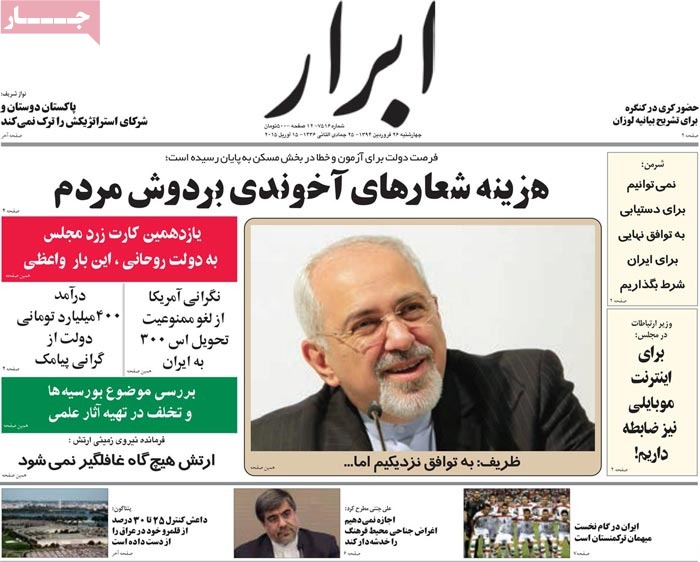
Abrar: “We won’t allow partisan bias to overshadow cultural activities,” said the minister of culture and Islamic guidance.


A look at Iranian newspaper front pages on April 15


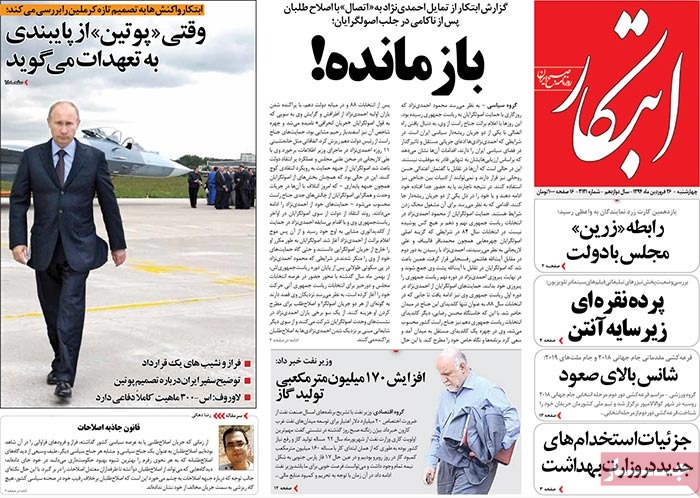
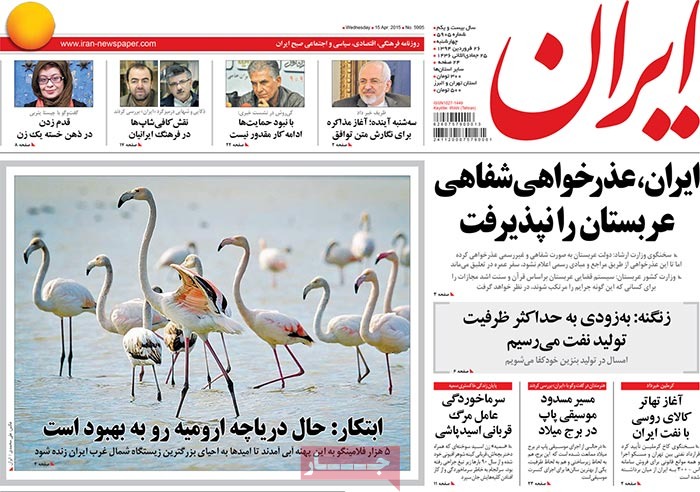
Ebtekar: The Outcast!

After failing to win over fellow principlists, [former President] Ahmadinejad seems interested in aligning himself with reformists.

Ebtekar: The Iranian oil minister has reported a 170 million cubic meter increase in natural gas production in the country.


A look at Iranian newspaper front pages on April 15


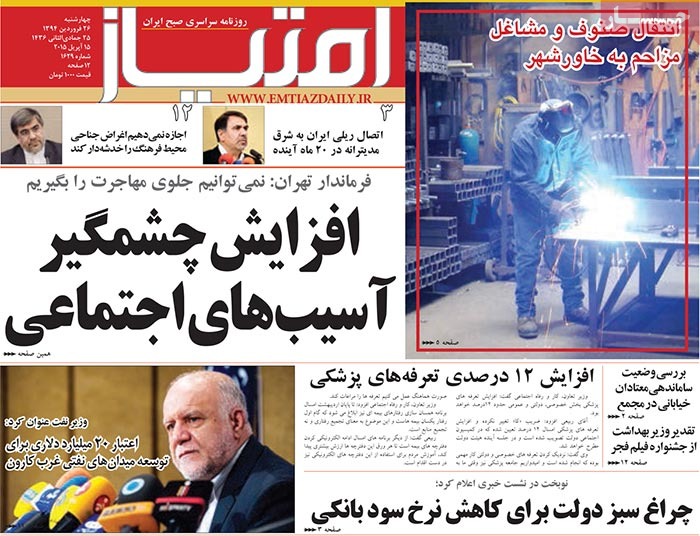
Emtiaz: “Iran will be connected on rail to the Eastern Mediterranean within 20 months,” said the minister of roads.


A look at Iranian newspaper front pages on April 15


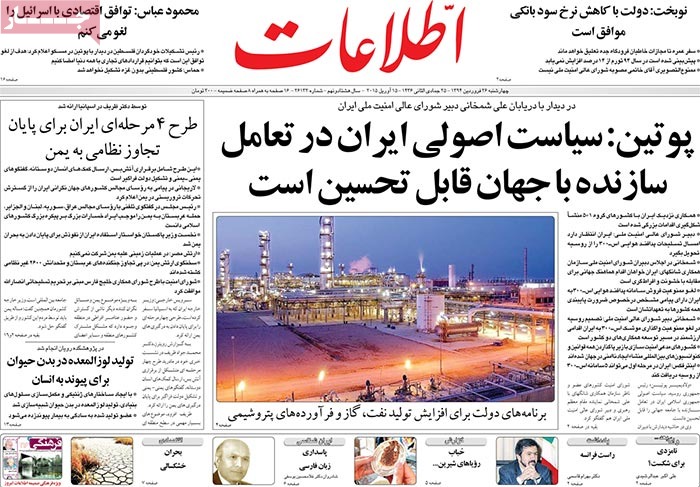
Ettela’at: “Government favors a cut in interest rates,” said Government Spokesman Mohammad Bagher Nobakht.

Ettela’at: Iran has presented a four-stage plan to end military aggression against Yemen.

The plan made public by the foreign minister entails: a cease-fire, shipment of humanitarian aid, talks between Yemeni groups and formation of a broad-based government.


A look at Iranian newspaper front pages on April 15


Iran: Iran has not accepted a verbal Saudi apology.

The spokesman of the Ministry of Culture and Islamic Guidance has said that as long as the apology does not come through official channels, Minor Hajj pilgrimage would remain suspended.


A look at Iranian newspaper front pages on April 15


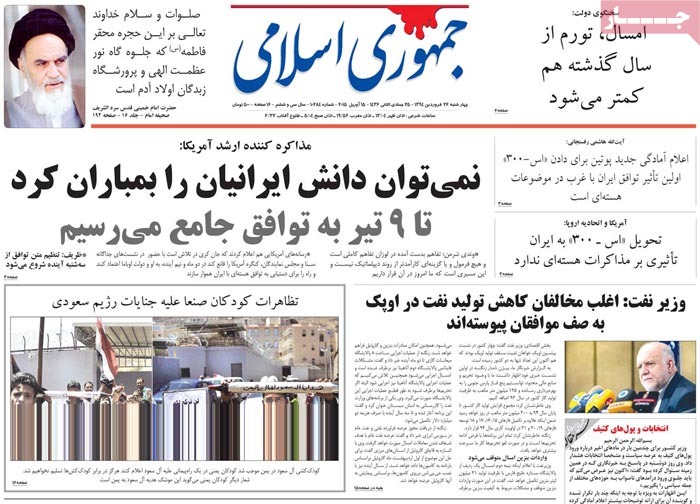
Jomhouri Islami: “Inflation will slip further this year,” promised the government spokesman.


A look at Iranian newspaper front pages on April 15


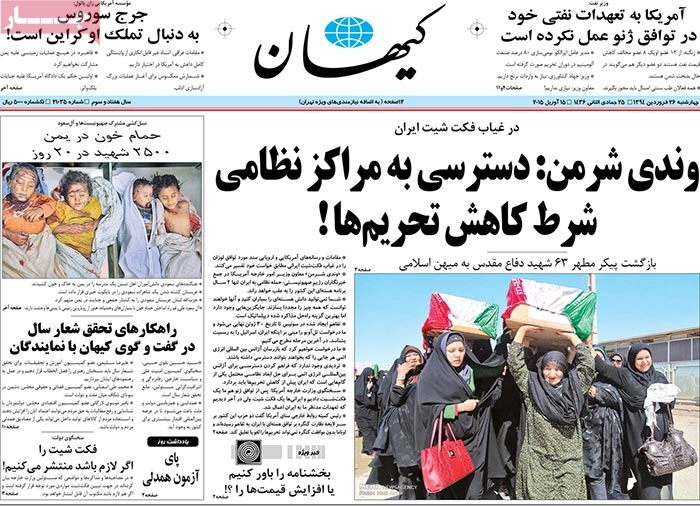
Kayhan: Sixty-three martyrs of the Scared Defense have returned home.


A look at Iranian newspaper front pages on April 15


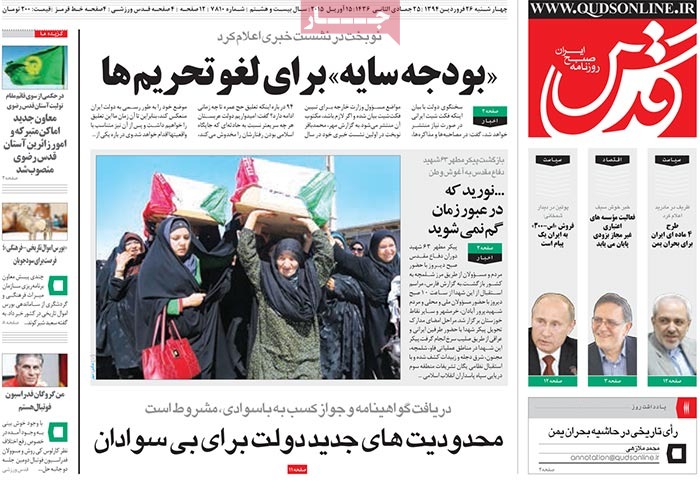
Qods: New government restrictions for the illiterate

Getting driver’s and business licenses hinges on literacy.


A look at Iranian newspaper front pages on April 15


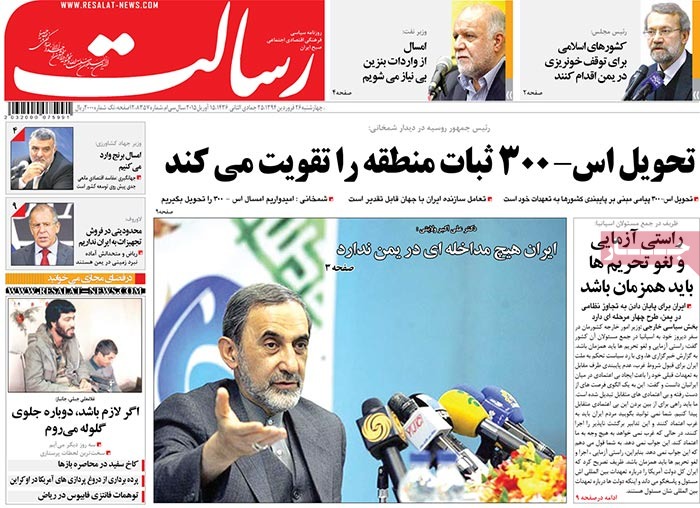
Resalat: “Iran will no longer need to import gasoline later this year,” the oil minister said.


A look at Iranian newspaper front pages on April 15


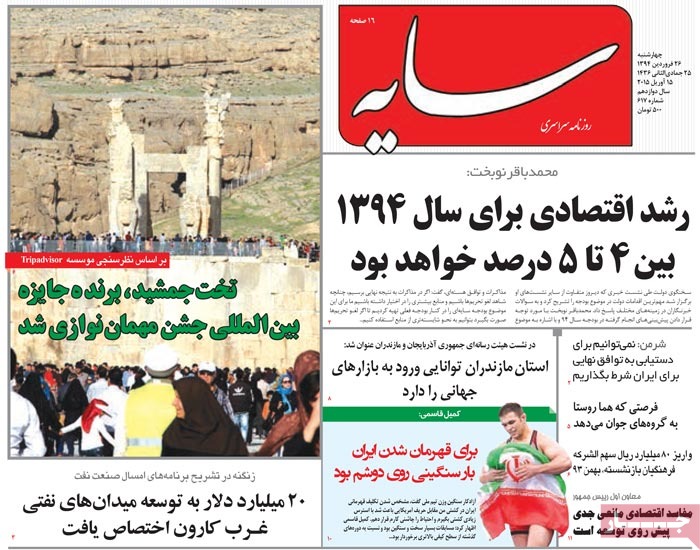
Sayeh: “Iran’s economy will post 4-5 percent growth this year,” said the government spokesman.

Sayeh: Iran’s Persepolis has won the hospitality prize in a poll conducted by tripadvisor.com.


A look at Iranian newspaper front pages on April 15


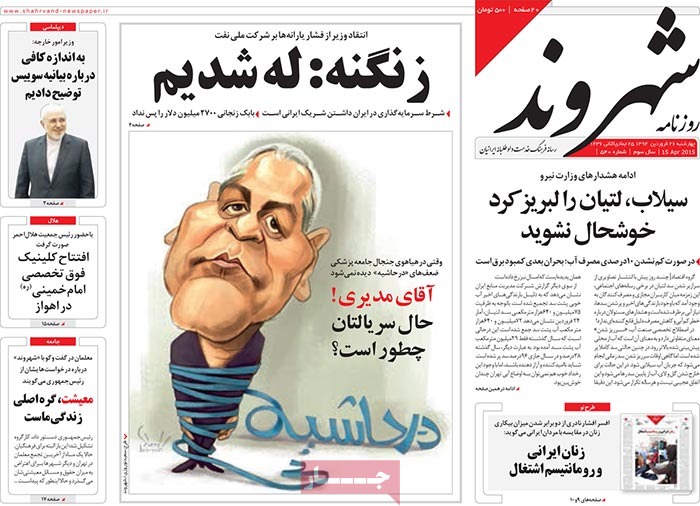
Shahrvand: In case citizens do not cut back on water consumption by at least 10 percent, electricity shortage will be in the offing.

The warning by the Energy Ministry came after a dramatic surge in water levels behind Latian Dam prompted people to forget that they had just gone through a very dry winter.


A look at Iranian newspaper front pages on April 15


Iranian bodyguard recalls painful encounter with Seagal

steven seagal

ahmad IrandoostAhmad Irandoust, an Iranian bodyguard-turned-actor who has been hired in the past by Hollywood celebrities such as Jennifer Lopez, has recalled an encounter with US actor Steven Seagal when he was still the bodyguard of a Hollywood figure.

The following is the translation of his story which originally appeared on cinemapress.ir and then printed on April 14 by Haft-e Sobh daily:

I used to believe that martial arts performed by Steven Seagal were just acrobatic tricks, so I invited him to a fight at the backstage of a movie.

Seagal asked for a written waiver to be cleared of all responsibility in case anything happened to me in the showdown.

Immediately after I threw the first punch, I was thrown in the air and landed on the arm, sustaining multiple fractures to my hand.

In spite of the written deal, Seagal paid for the medical costs, apologized to me and said that he never thought that I would land on my arm.

IAEA delegation arrives in Tehran for technical talks

IAEA

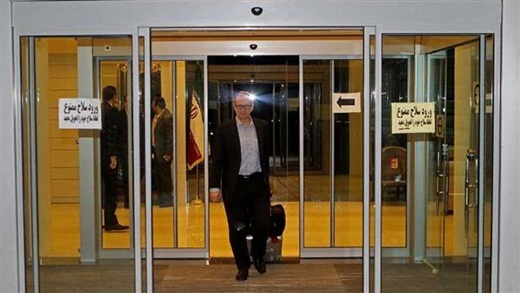
A delegation of experts from the International Atomic Energy Agency (IAEA) has arrived in the Iranian capital, Tehran, to hold technical talks with Iranian officials.

The five-strong delegation, led by Tero Varjoranta, the IAEA deputy director general and head of the department of safeguards, arrived in Tehran on Wednesday morning.

The IAEA team is scheduled to hold one-day technical negotiations with the relevant Iranian officials within the framework of the implementation of the Framework for Cooperation.

The Joint Statement on a Framework for Cooperation was signed in November 2013 to outline a roadmap on mutual cooperation on certain outstanding nuclear issues between Iran and the IAEA.

Behrouz Kamalvandi, the spokesman for the Atomic Energy Organization of Iran (AEOI), said on Tuesday that the negotiations between Iranian officials and the IAEA team will end on Wednesday night, adding that the day-long talks between Iran and the UN nuclear agency will focus on the two issues of alleged explosives testing at a site in the western city of Marivan and neutron calculations.

Behrouz Kamalvandi, the spokesman for the Atomic Energy Organization of Iran (AEOI)

He also noted that Tehran has already responded to all of the IAEA’s questions about Iran’s nuclear program.

The IAEA claims that Iran has not yet addressed specific issues such as questions on alleged research activities into explosives testing and neutron calculations.

Iran has rejected the accusations as baseless and repeatedly emphasized its readiness for full cooperation with the IAEA as part of its transparency efforts to help settle the country’s nuclear issue.

The IAEA has never concluded in its reports on Iran that there has been diversion in the Islamic Republic’s nuclear energy program toward military purposes.

On March 2, IAEA Director General Yukiya Amano once again verified the lack of any diversion toward non-peaceful purposes in Iran’s declared nuclear material. All Iran’s nuclear activities are strictly monitored by the UN nuclear watchdog.

Iran to accredit 1st woman ambassador: Report

Iran-Afkham
Iran-Afkham

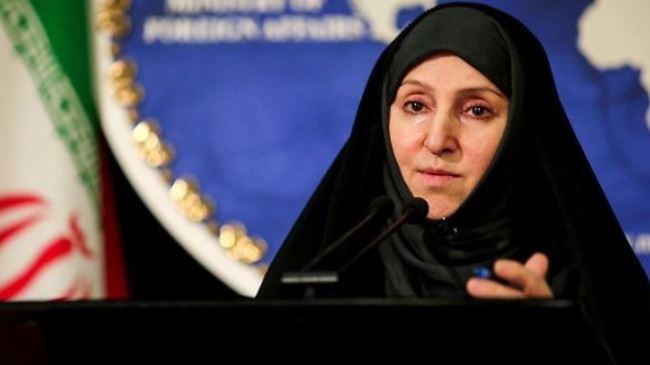
Iranian Foreign Ministry Spokeswoman Marzieh Afkham is to be accredited as the country’s first woman ambassador in the near future, Mehr News Agency reported on Monday.

She will reportedly head the Islamic Republic’s mission in an East Asian country.

The official has been serving as the ministry’s first woman spokesperson for more than a year.

It is not yet clear who will replace her as spokesperson.

Setting precedent has been Mansoureh Sharifi-Sadr, who served as the charge d’affaires of Iran’s Embassy in Japan during the ambassadorship of Abbas Araqchi, the current deputy foreign minister for legal and international affairs. Araqchi had preceded Afkham as the Foreign Ministry’s spokesperson.

Iran, Spain FMs meet in Madrid

zarif

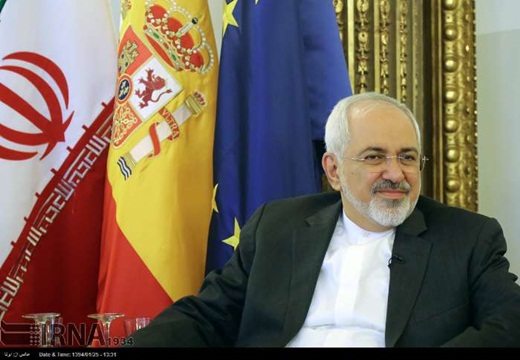
Visiting Foreign Minister of Iran Mohammad Javad Zarif discussed issues of mutual interest in a meeting in Madrid on Tuesday with his Spanish counterpart Manuel Garcia Margallo.

The two stressed the need for further Tehran-Madrid cooperation in all fields including energy, tourism, fisheries, agriculture, railways and water management as well as infrastructure sector.

Zarif arrived in Madrid early on Tuesday. He is to depart Madrid for Lisbon, Portugal, later in the day.

The two foreign ministers also exchanged views on latest regional developments particularly the situations in Syria, Iraq and Yemen stressing the need to fight against terrorism.

The Iranian minister stressed the need for resolving the crisis in Yemen through peaceful means including an immediate ceasefire, relief operations, dialogue among Yemeni groups (Yemeni-Yemeni talks) and formation of an inclusive government.

Meanwhile, Margallo welcomed Iran’s solution for the crisis in Yemen.

Reviewing latest developments in the nuclear talks between Iran and the Group 5+1, the Spanish foreign minister hailed positive steps taken during the talks hoping that would lead to reaching a final comprehensive agreement between the two sides.

Strategic weight of world changing to the benefit of Asia: Shamkhani

shamkhani

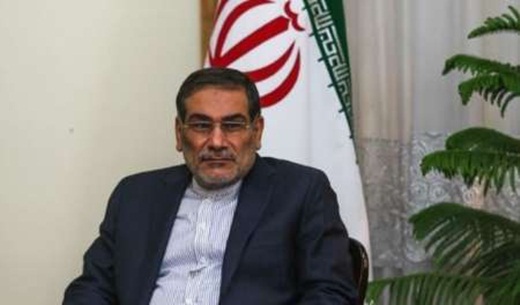
Secretary of Supreme National Security Council Ali Shamkhani said on Tuesday that power of Asia is on upward trend and the strategic balance of the world is changing to the benefit of Asia.

He made the remarks in a meeting of Shanghai Cooperation Organization (SCO) national security secretaries. Shamkhani is currently on a visit to Moscow to attend the SCO meeting.

He said that balance of power has undergone a drastic change leading to emergence and shaping of new powers at regional and international levels.

He said that by increasing pivotal role of Asia in trade, politics and world security, strategic weight of Asia has gained momentum.

Shamkhani expressed concern about the threats posed to the international peace and security, calling for collective measures by the international community to thwart the elements disrupting security at national, regional and international level.

He deplored the fact that several governments refuse to discharge their international obligations to support the international campaign against terrorism and to the contrary, they resorted to use of force, violence and military intervention in clear violation of the international law and the internationally recognized standards and formed a coalition against a sovereign state which has set an unlawful precedent in the direction of institutionalization of insecurity.

He criticized the Western governments for applying double standards in the international campaign against terrorism, citing their formula to divide the ominous phenomenon of terrorism to bad and good.

Shamkhani added that the arbitrary use of terrorism and unlawful measures by the international bodies to interfere in other countries affairs through imposing illegal sanctions against the sovereign states with the political agenda of regime change, on one hand, and financial aid for terrorist groups and empowering criminals under the pretext of support for democracy, on the other, are clear evidence for the arbitrary use of terrorism.

Secretary of Iran’s SNSC said that insistence of the world powers on stopping the changing trend of unipolar world and opting for unilateralism, which runs counter to priorities of the international community, has thrown a worrying future in the way of the mankind.

Criticizing the adoption of dual standard of certain governments in confrontation with similar crises in Syria, Yemen, Ukraine and Bahrain, Shamkhani said that compliance with national demands is the solution for current crises in those countries.

He said that President Rouhani’s proposal of War Against Violence and Extremism, which approved by the UN General Assembly, called for world cooperation and coordinated move against these two sinister phenomena.

In another part of his speech, the Iranian senior official presented a number of proposals to overcome security challenges in the region.

Paying attention to the growing public awareness in the region, especially that of the youth and the need to educate them on religious moderate moves, the misuse of cyber space and social networks by the terrorists, special attention to issues like poverty, unemployment, the gap in social classes, ethnical and religious discrimination and narrowing the gap between governments and nations are among necessary measures in the field of management of regional challenges.

He underlined the necessity of creation an effective mechanism in cutting financial sources and harboring terrorists and ending intelligence, operational and military support for terrorists and added that exchange of intelligence experience between countries to confront terrorism and designing an efficient and flexible mechanism to implement preventive plans in this regard is necessary.

Shamkhani said that Iran enjoys precious experience in the field of effective confrontation and control of waves of violence and terrorism in the region, and is ready to share experience and cooperate with Shanghai Cooperation Organization in this concern.

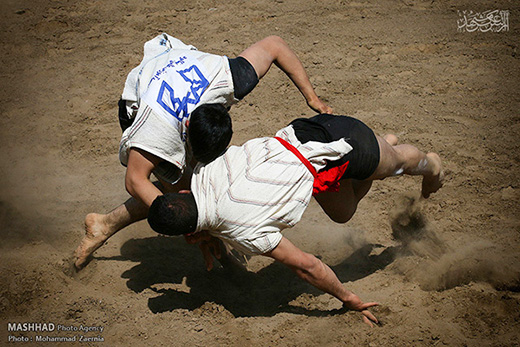
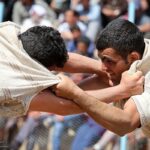
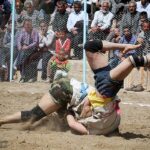
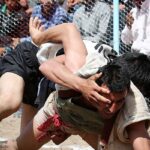
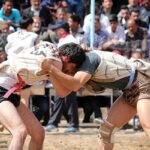
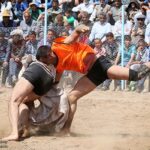
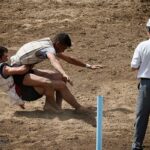
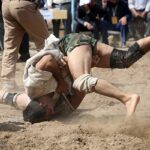
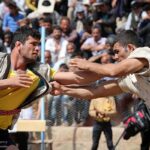
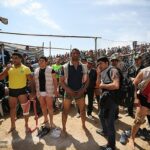
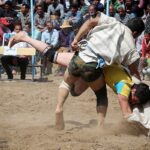
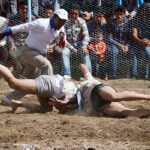
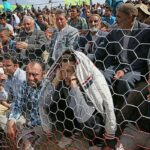
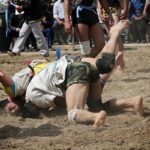
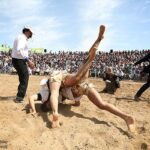
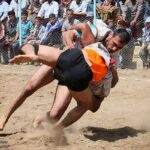
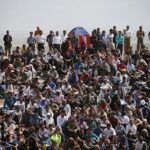
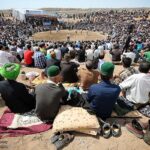
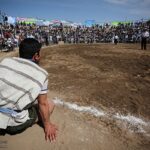
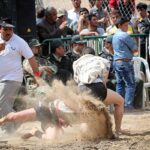
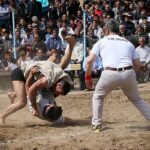
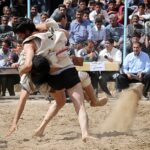
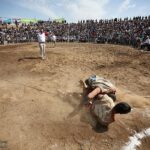
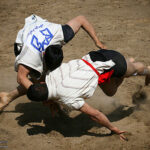
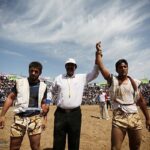
Traditional wrestling (PHOTOS)

Traditional wrestling

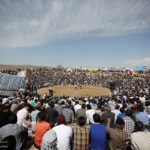
Neyshabur, northeastern Iran, played host to a 19th round of national traditional wrestling tournament on April 9.

The snapshots below of the competition have been released online by mashhad, a website:

Conceding fewer goals amounts to a win for us

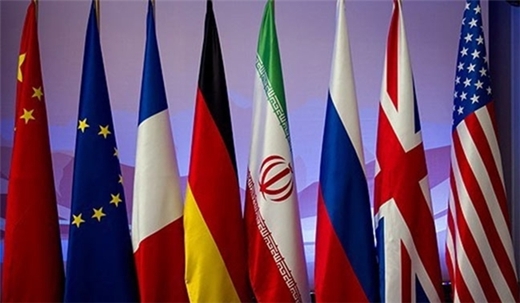
IranTalks flags

There are many speculations about the possible impact of a likely deal between Iran and P5+1 on Tehran’s domestic policy. Although we don’t have the crystal ball to say for certain what that impact will be, we can make projections.

The two sentences above led off an interview Sharq daily published on April 13 with Amir Mohebian, Ph.D. a university professor on Western philosophy, about the probable change conclusion of a nuclear deal will introduce to Iran’s political priorities.

The following is the translation of the interview with Mohebian, a principlist political analyst who is in charge of Arya Strategic Research Center:

Q. For Iran, was the conclusiveness of talks in Lausanne simply a settlement of an international issue, or will it amount to transformation in the country’s foreign policy?

A. It is too soon to pass judgment on the results of Lausanne talks, because there are still differences, not only on the wording of the document but in the views of parties to the talks.

Unfortunately, from the beginning the government of President Rouhani touted the talks as win-win. That raised the expectations of a certain section of the public who now ask: What is Iran’s share of the win?

The play on word aside, what is obvious is that in today’s unfair world, on one side of the table sits the West which seeks to exploit invalid excuses to prevent Iran’s entry into the nuclear club, and on the other is Iran which is trying to make as few concessions as possible in this equation of power and resistance.

In other words, this [zero-sum] game is not expected to produce two winners. Conceding as few goals as possible is a win for us. Of course, Iran has its own calculations in this game. The least of our demands which were described as red lines by the Leader are being met.

One should not forget the fact that the establishment views the nuclear issue under a grand strategy heading which justifies some of these apparent retreats.

Q. Has there been a paradigm shift in Iran’s foreign policy discourse? Are we looking at the West from a new angle?

A. Our policy of “Neither East, nor West” was not originally crafted in opposition to the West; rather, it was meant to put the focus on the independence and self-sufficiency of the country. But over time, thanks to the West’s subversive acts and pressures, it turned into a medium to express opposition to Western political performance.

Of course, there is no denying that a paradigm shift toward the West is in the works in the Islamic Republic of Iran. The change in question is partly because of self-confidence within the establishment which, in turn, has its roots in successful containment of local and foreign crises and in a bigger regional clout. That change comes in part thanks to leaving behind some economic bottlenecks.

Q. If we put down the current foreign policy to pragmatism, what changes in domestic and economic policies can be expected to be ushered in? Are the overall goals and the course the establishment has taken expected to undergo change?

A. The establishment is trying to reconcile pragmatism and dogmatism. Any theocracy that is established feels the need for such reconciliation sooner or later. The clash between ideals and realities is sometimes paradoxical. Praxis comes in handy here. Of course by Praxis I don’t mean the Marxist humanist movement that originated in Zagreb and Belgrade in the 1960s. […]

Q. Will the configuration of political factions inside the country undergo an overhaul? Will we see transformation in the behavioral patterns and political priorities of factions inside the country? If that is the case, what will be the new priorities? 

A. The impact a likely deal might have on factions cannot be assessed now, because for now an agreement is not a done deal.

I believe that economic opening and investment will have the greatest impact on political interactions of factions and on their stance.

For some unknown reasons, no studies have been conducted on the impact of economy on the political behavior of parties in Iran. But I believe there is significant correlation between the two.

Instead of allowing their approaches to be influenced by their social base, our populist political factions let their decisions be influenced by public circumstances.

Economic openings usher in new conditions which indirectly lead to changes in the approaches and even values of political groups.

Q. Under the present circumstances, […] what change would a comprehensive deal with the West bring to the balance of political groupings at home? And if there is need for containment of the energy of some groups, which factions do you think will face more restrictions?

A. In any relationship, confrontation has different reasons, and psychological, economic, interest-related and ideological factors might come into play.

Any change in such a confrontational approach stems from changes in these factors. It would be simplistic to expect change as long as these factors remain intact.

Some of the factors that pit Iran against the existing world order are ideological. The level of confrontation on this front wholly depends on the role of decision-makers who define their relations based on ideological factors.

On the other hand, passage of time erodes the ideological foundation of revolutionary systems, replacing their ideological justifications with pragmatic requirements. The change in the interest-related factors, which are the most pragmatic here, will bring about change to behaviors. […]

Naturally, as these factors change, the more a political faction is involved in a certain area, the more change they will face.


How would a President Hillary Clinton deal with Iran?

hillary-clinton

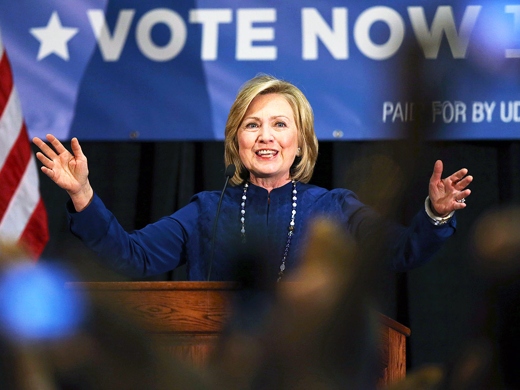
Former first lady, US Senator and Secretary of State Hillary Rodham Clinton ended months of speculations and threw her hat in the ring on Sunday, officially entering the 2016 presidential race.

Given that Iran and the United States are locked in a tussle over the former’s nuclear program, how would a former US top diplomat deal with Iran if she became the occupant of 1600 Pennsylvania Avenue in Washington D.C.?

An April 14 edition of Sharq daily has posed that question to four Iranian experts. The following is the translation of the answers they have provided to the reformist daily:


Ali Bigdeli (University professor, expert in international affairs)


Ali BigdeliGiven that the approval rating of Democrat President Barrack Obama has dropped to 43 percent, on the one hand, and his administration is at odds with Israel on the other, assumptions that the Democratic Party has lost the backing of the Israeli lobby would not be way off base. So next year’s presidential election is unlikely to see someone from the ranks of Democrats become the new occupant of the White House.
Even if we assumed that Hillary Clinton would win the presidential election, we couldn’t count on her to opt for interaction with Iran. Hillary comes from a noble family and has an inflated ego.

When she was secretary of state, she was at loggerheads with President Obama on several issues. She was in favor of military action against Syria and Iran and even threatened to quit.

I believe we need to strike a deal with the United States before President Obama leaves office.


Davoud Hermidas-Bavand (Political scientist, international law professor)


Davood HermidasThe overall policy of Democrats in dealing with Iran is somewhat clear. There might have been some differences in their approaches over the decades, but the principles of their Iran policy have remained unchanged.
Assuming that Hillary Clinton wins the election, she is likely to follow President Obama’s approach. In light of the fact that she has been his secretary of state, her future policy will be somewhat influenced by Obama’s.

Of course, when she was secretary of state, at times she was at odds with her boss, but those differences are unlikely to have been centered on Iran. She will take measures to settle differences with Iran and re-establish ties.

However, one should not forget the fact that America’s ties with China and Russia will have much impact on Washington’s Iran policy.


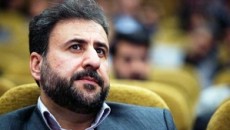
Heshmatollah Falahatpisheh (Former member of Parliament’s National Security Committee)


Falahat PishehAnyone who takes over as US President in less than two years will definitely be influenced by what will be happening in the world in 2017.
Ms. Clinton would opt for détente if the nuclear deal between Iran and P5+1 is implemented by then.

Under normal circumstances, Clinton is a Democrat but her policies would put her somewhere between Bush 43 and Barrack Obama. Although she was Obama’s secretary of state, she would adopt policies similar to her husband’s.

One can say her political stance is similar to Robert Menendez, a Democratic supporter of a tough Iran sanctions regime. When Bill Clinton was in office, Iran reached out to the US, but thanks to those who had vested interest in sanctions, those overtures produced no results.


Ahamd Shirzad (Former reformist MP and university professor)


ShirzadWhen it comes to interaction and avoidance of hostility, Obama is the best choice for Iran, one that is unlikely to be repeated.

Even if the next president of the United States is a Democrat, s/he is unlikely to be as good as Obama for Iran.

If Hillary Clinton is elected president, she would not opt for confrontation with Tehran. But she should not be expected to follow in the footsteps of Obama in defying the Israeli lobby and Congress.

If the current US president is successful in settling the nuclear dispute, she will follow his lead.

But if things get complicated and efforts to settle the dispute linger into the term of the next US president, she would not be able to stand up to pressures as audaciously as Obama.

In short, a President Clinton will be more cautious and vulnerable in the face of pressures than President Obama.

Iranian protesters call for Saudi Embassy’s closure

Iranian protesters

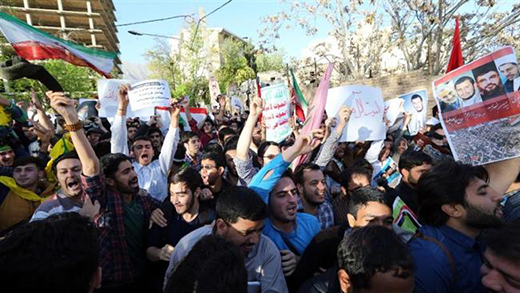
Iranians have staged a protest rally outside the Saudi Embassy in Tehran, denouncing the kingdom’s airstrikes on Yemen as well as the sexual abuse of two Iranian teenagers by Saudi officers at the Jeddah airport.

During the Monday demo, a large group of angry demonstrators also shouted slogans against the Saudi royal family, the US, and Israel.

“We are here to show that we will defend an oppressed nation anywhere in the world. Such military aggression irrespective of its objectives is a blow to the Muslim Ummah (community) and benefits the Zionist regime of Israel and major powers. The aggressive countries must explain why they are using their facilities to attack a Muslim state,” a protester told a Press TV correspondent in Tehran.

Yemeni nationals and students living in Tehran also took part in the rally. The protesters called on Iranian officials to immediately shut down the Saudi embassy.

“We strongly condemn what is happening in Yemen. Women are being killed, children are being killed, civilians are being killed and I don’t find this acceptable. It is totally unacceptable,” another protester told the correspondent. A similar rally was also held outside the Saudi embassy on Saturday.

[…]