Friday, December 26, 2025
Home Blog Page 4912

Important tourism-related developments in Iran in 12 months

Iran tourists
Iran tourists

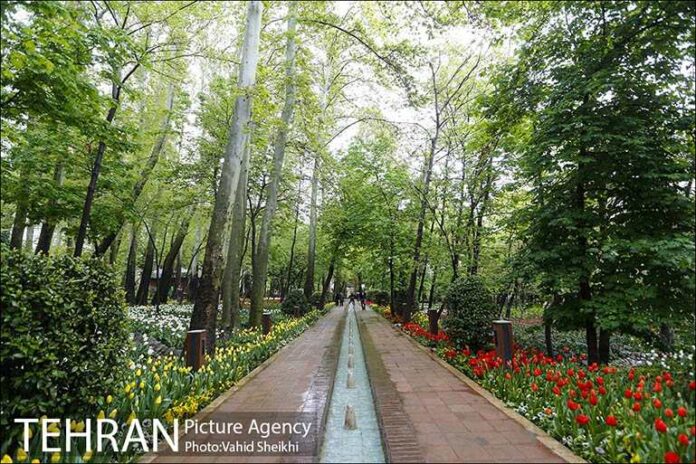
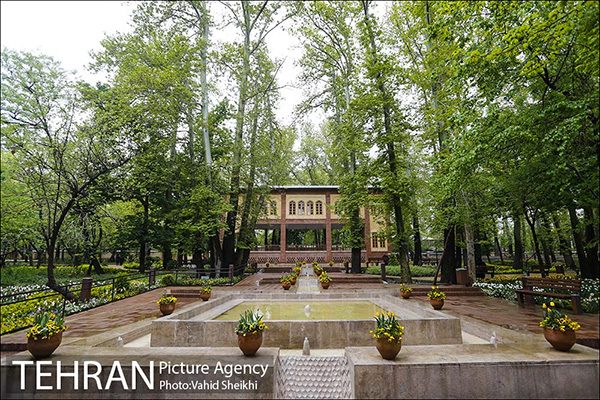
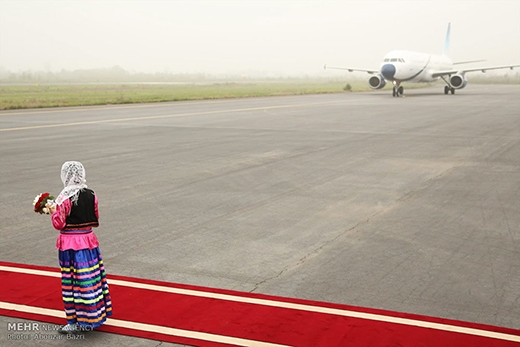
For the first time in 35 years, Iran’s tourism balance was in the positive territory this year [ends March 20, 2015]. According to a March 14 issue of Donyay-e Eghtesad, a daily that focuses on economic issues, that is one of the 10 most important developments in Iran’s tourism sector in the 12-month period. The following is a partial translation of a report the daily carried:


1. Tourism balance landed in positive territory

According to tourism officials, in the summer [of 2014], foreign arrivals in the country outnumbered departures by some 80,000, landing the country’s tourism balance in the positive territory for the first time in more than 35 years.

2. Intelligence minister announced visa waiver with 12 countries

At a meeting with tourism officials in April, Intelligence Minister Mahmoud Alavi said the country needs to make optimal use of tourism. The unprecedented meeting, which received widespread news coverage, suggested that there has been a change of approach at a high state level to tourism.

3. Airfares were liberalized

In May the Supreme Aviation Council liberalized airfares. Under the new arrangements there will be no floor under fares, but there is a ceiling for the prices airlines charge passengers.

4. Iranian Tourism Org. and World Tourism Org. signed a deal

In June, the United Nations World Tourism Organization (UNWTO) and Iran’s Cultural Heritage, Handicrafts and Tourism Organization signed a memorandum of understanding to boost bilateral cooperation.

5. Foreign media welcomed coverage of Iran tourist attractions  

Also in June, a delegation of German media representatives arrived in Iran to cover beautiful places across Iran. The move was designed to make it possible for foreign media to learn about Iran’s tourism potential firsthand.

6. Tourism Org. was admitted to Supreme Non-Oil Exports Council    

In August, the Cultural Heritage, Handicrafts and Tourism Organization was given a seat and the right to vote at the Supreme Non-Oil Exports Council.

7. Golden Eagle Train arrived in Iran

The Golden Eagle Danube Express, a European private train with 67 passengers on board, arrived in Iran in late October.

8. Iran landed on the list of top 2015 destinations

In late 2014, some renowned websites including Business Insider put Iran on the list of the likely top tourist destinations in 2015.

9. Iran won the right to host WFTGA convention in 2017

In late January 2015, Iran was named the host of the 2017 convention of the World Federation of Tourist Guide Associations.

10. Iran’s first airport hotel was inaugurated

And in late February the first 4- and 5-star airport hotels of the country were inaugurated outside Tehran’s Imam Khomeini International Airport.

American Senators proved mistrust of US justified: Speaker

Larijani-2

Parliament Speaker Ali Larijani said that the recent act of US Senators proved that Iran’s lack of trust in America was quite justified.

Larijani made the remark in the Sunday session of Parliament and said what they [US Senators] included in the letter was harshly against international norms and dealt a serious blow to their country’s legal image.

He said that the move was inspired by the fact that the US Congress suffered much from making hollow investments in the meaningless claims of the Zionist regime’s prime minister, something which was met with total indifference by the world public opinion.

He also said the letter was just an indication to prove that the financial support of Zionist lobbies has caused a political recklessness in America.

In their relations with the US, Larijani added, countries are now wondering whether they are dealing with a government which has deceitfully assumed global leadership and has absolute power or one which is literally nothing inside.

He renewed the support of the Iranian Parliament for the nuclear negotiation team and advised them to be more tactful in their future moves.

The top MP also condemned the physical attack on a member of parliament [Ali Motahari] during his Shiraz visit and went on to stress that such hooliganism will certainly work against the interests of the country, especially because of its foreign reflections.

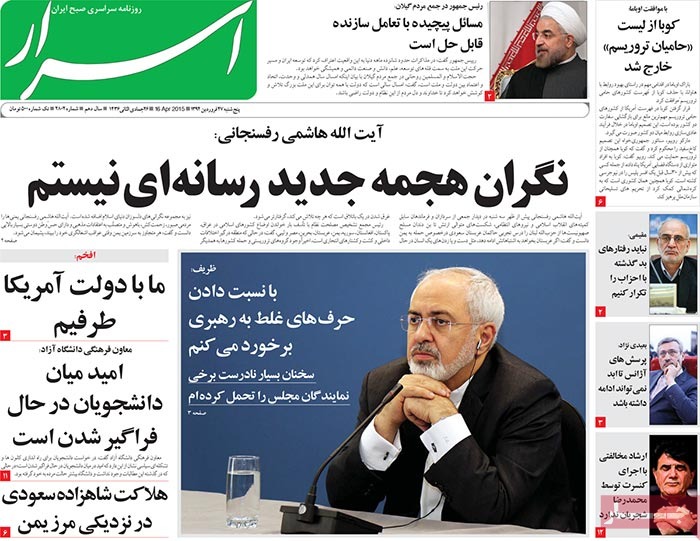
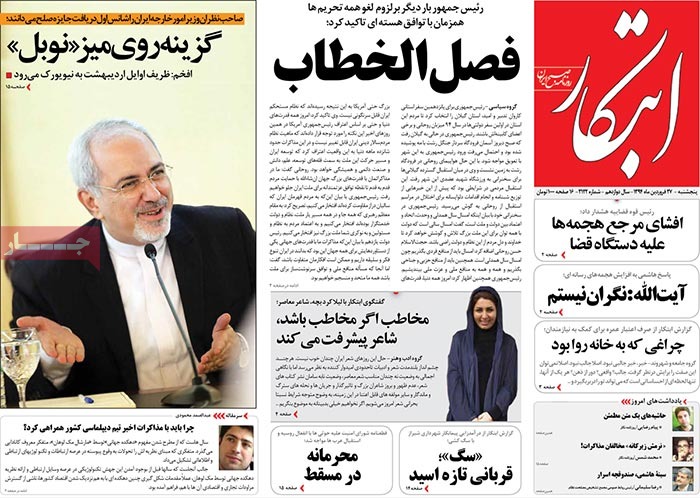
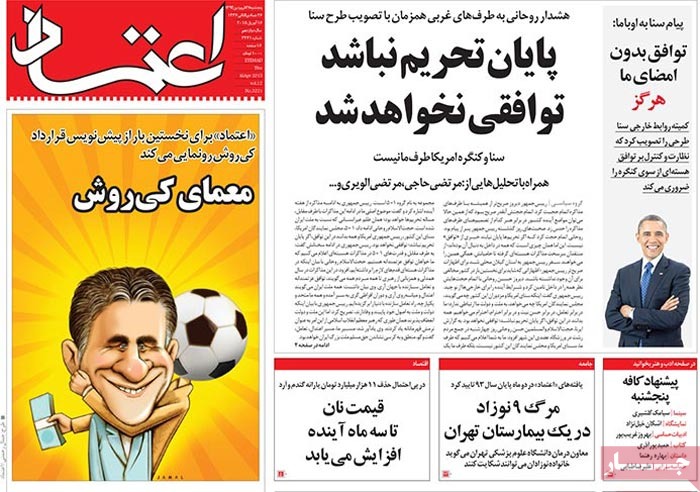
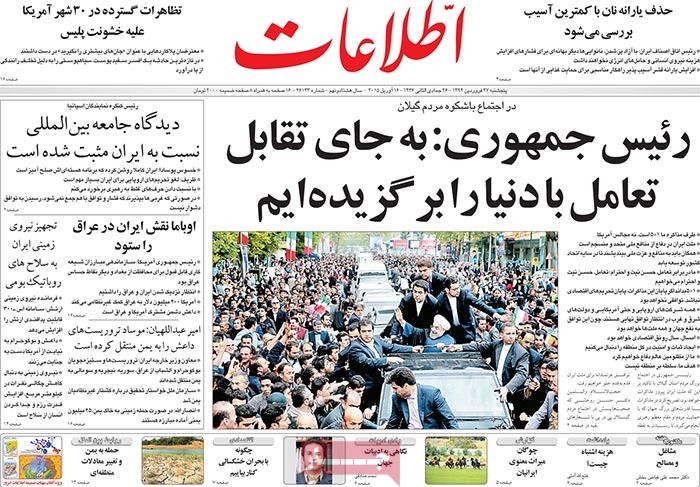
A look at Iranian newspaper front pages on March 15

Iranian Newspapers Headlines

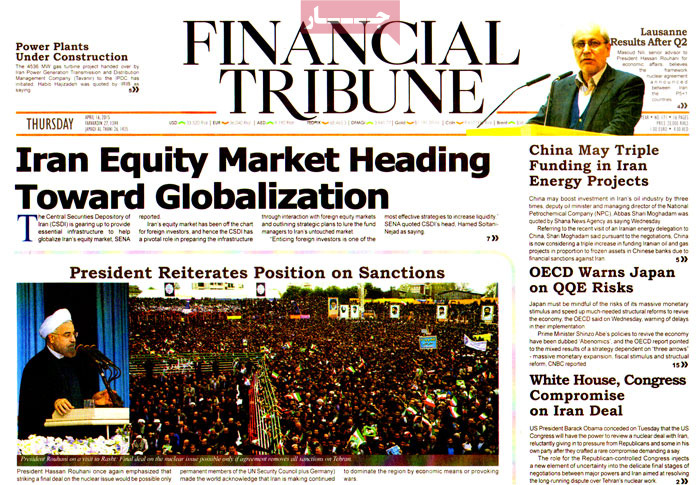
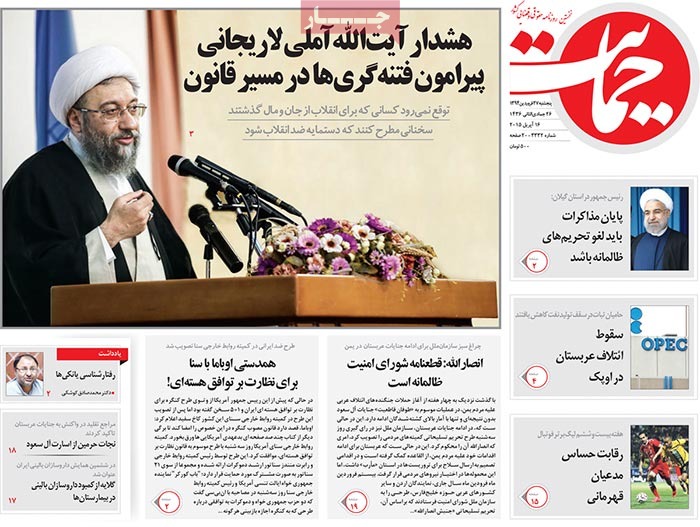
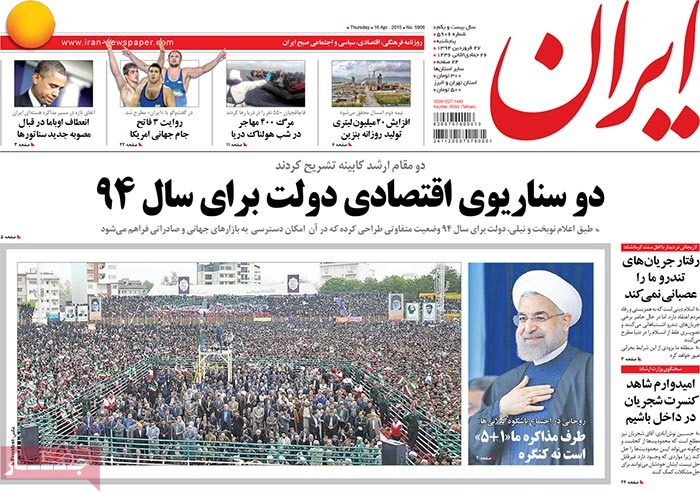
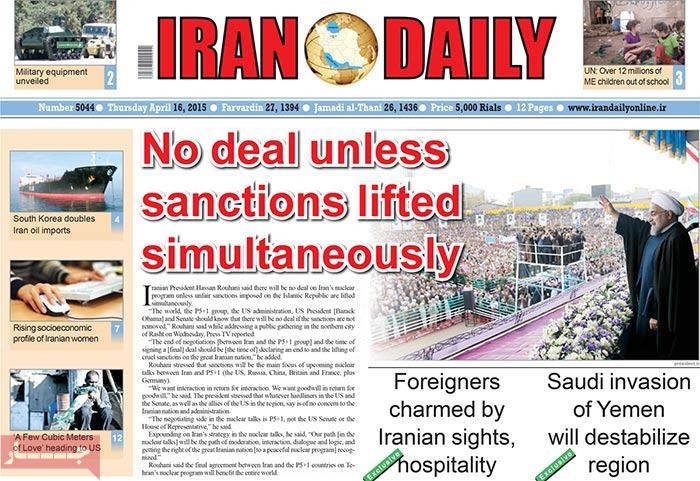
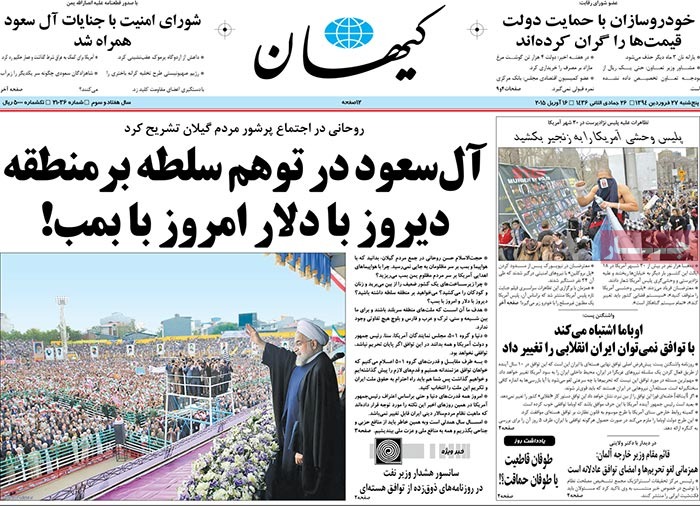
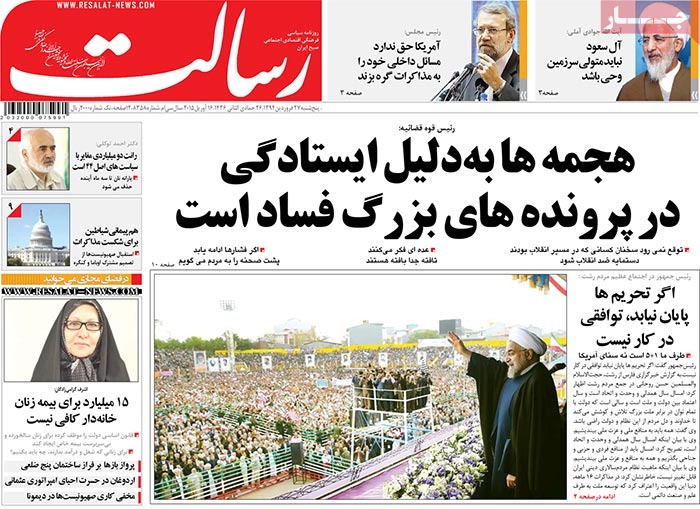
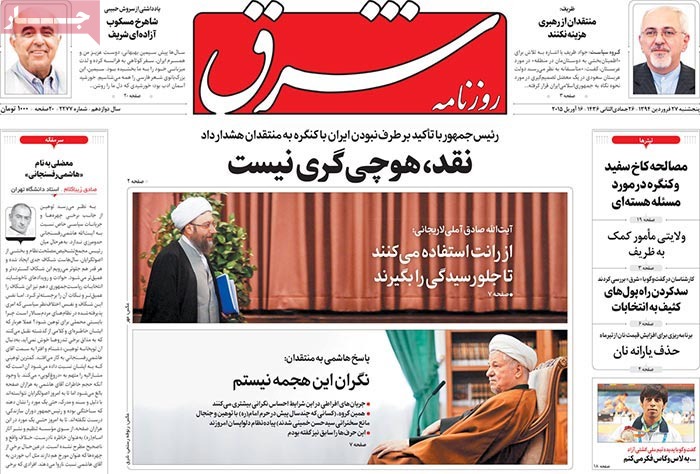
Comments by Speaker of the Islamic Consultative Assembly Ali Larijani that Iran has no intention of reestablishing a regional empire dominated the front pages of Iranian newspapers on Sunday. Planned resumption of nuclear talks in Switzerland between Iran and P5+1 also appeared on the covers of many dailies.


Abrar: President Rouhani has said that if each family cut down on its water consumption by just 10 percent, the problem of water shortage would be solved.

Abrar: Iranian Parliament Speaker Ali Larijani has told a Kuwaiti TV station that he is not pessimistic about nuclear talks with world powers.


A look at Iranian newspaper front pages on March 15


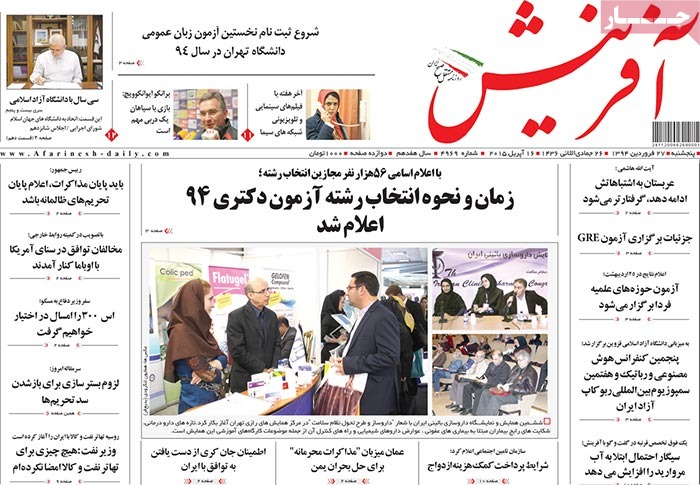
Afarinesh: “Iran does not seek to rebuild a regional empire,” said Parliament Speaker Ali Larijani.

Afarinesh: US Secretary of State John Kerry has said that President Obama has full authority to sign a deal with Iran.

His comments came after 47 US Senators said in a letter that Congressional approval of any deal with Iran is necessary, otherwise any agreement would remain in effect as long as Obama is the occupant of the White House.


A look at Iranian newspaper front pages on March 15


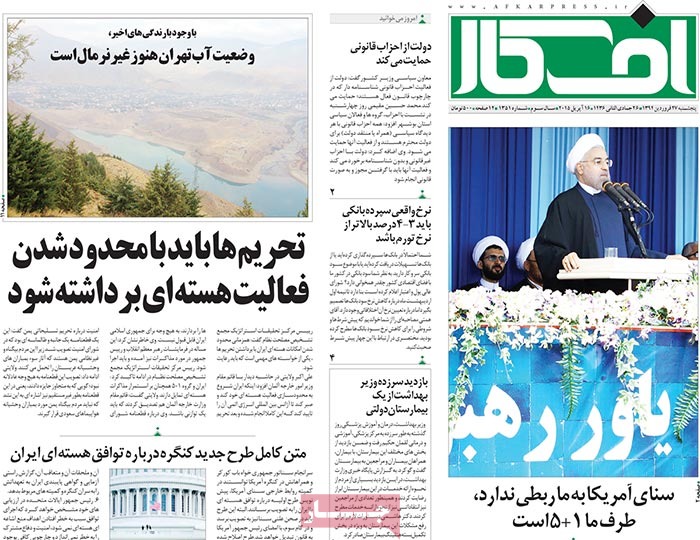
Afkar: The director of the Iranian Environment Protection Organization has said that power plants won’t be allowed to use Mazut anymore.


A look at Iranian newspaper front pages on March 15


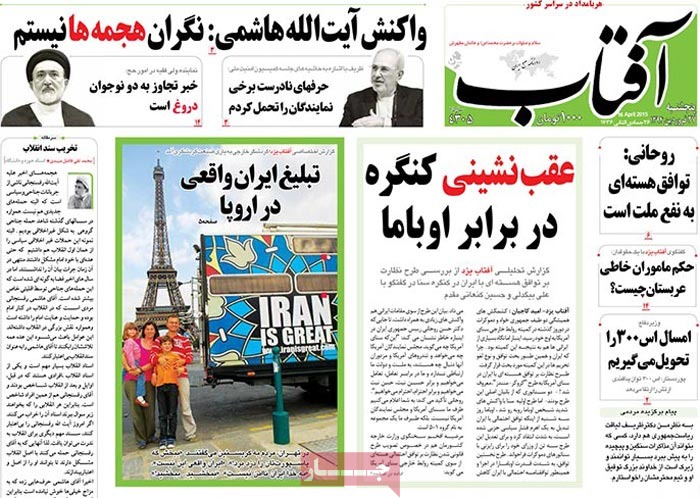
Aftab-e Yazd: The US has welcomed Iranian FM Zarif’s initiative to take a possible nuclear deal between Iran and P5+1 to the UN Security Council for approval [to make it internationally binding].

Aftab-e Yazd: Iran will build power plants in Yemen.


A look at Iranian newspaper front pages on March 15


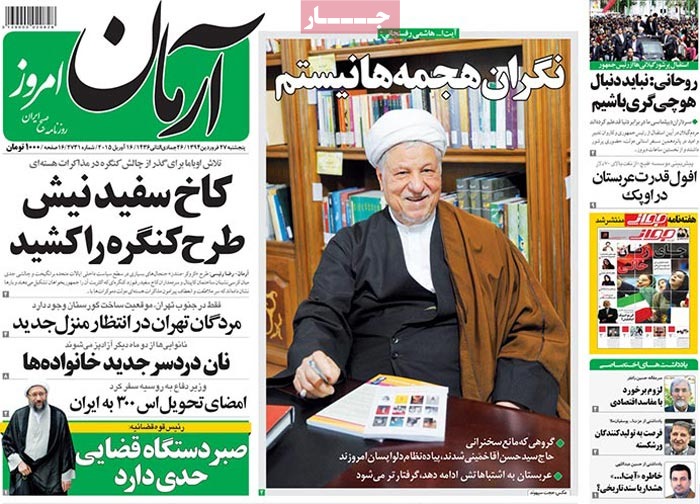
Arman-e Emrooz: President Rouhani has ordered an investigation into an attack on [Tehran MP Ali] Motahari in Shiraz.

It came as a grandson of the late Imam Khomeini said that the executive branch should not leave the incident [which led to the cancellation of a planned speech by the principlist deputy in Shiraz] un-probed.

Arman-e Emrooz: Prisons are in a cashless limbo.

The budget of the Prisons Organization is only enough to take care of 50% of inmates serving time in detention centers.


A look at Iranian newspaper front pages on March 15


Asr-e Iranian: “Respect for the sovereignty of nations is part of Iran’s foreign policy,” said Foreign Ministry Spokeswoman Marzieh Afkham.


A look at Iranian newspaper front pages on March 15


Asr-e Rasaneh: Iran is now one of the five countries in the world in possession of the technology to develop gas turbines.


A look at Iranian newspaper front pages on March 15


Emtiaz: Clamping down on corruption and making efforts to reduce traffic offenses are the priorities of the new police chief.

Emtiaz: Preliminary studies suggest that there are huge freshwater reserves in the Persian Gulf region.


A look at Iranian newspaper front pages on March 15


Ettela’at: A new round of talks between Iran and the West gets underway in Lausanne, Switzerland later on Sunday.

Ettela’at: “Those opposed to the Health Transformation Plan are worried about their own personal interests,” said the health minister in an exclusive interview with Ettela’at.

Ettela’at: Some $32 billion has been allocated to infrastructure projects from the National Development Fund.

Ettela’at: Mass production of Qadir Cruise Missile got underway with the defense minister in attendance.


A look at Iranian newspaper front pages on March 15


Hemayat: “The coalition to fight IS is hollow,” said the Iranian top MP.


A look at Iranian newspaper front pages on March 15


Jomhouri Islami: A final round of nuclear talks between Iran and the United States will get underway [in Switzerland] on Sunday.


A look at Iranian newspaper front pages on March 15


Kaenat: The stock exchange has woken up from hibernation.


A look at Iranian newspaper front pages on March 15


Kayhan: An induction ceremony has been held for the new police chief who has said that cracking down on corruption is his top priority.

Kayhan: The president has given a car as a gift to an 8-year-old girl who knows the entire Koran by heart.


A look at Iranian newspaper front pages on March 15


Kayhan International: CIA cites threat of Takfiris: US doesn’t want fall of Syrian gov’t


A look at Iranian newspaper front pages on March 15


Mardomsalari: Foreign Minister Zarif has presented a report on the nuclear issue to the Expediency Council.

Mardomsalari: Some 300,000 old cars were taken off the roads in the past 12 months.


A look at Iranian newspaper front pages on March 15


Shahrvand: The new police chief has vowed to rely on social capital and popular contribution in leading the law enforcement force.


A look at Iranian newspaper front pages on March 15


Sobh-e Eghtesad: Iran’s share of the global halal market turnover is no more than one percent.

Sobh-e Eghtesad: Parliament has amended the budget bill clauses the Guardian Council had found fault with.


A look at Iranian newspaper front pages on March 15


Tehran Times: Key environmental projects inaugurated in Tehran

Tehran Times: European officials criticize Republican letter to Iran


A look at Iranian newspaper front pages on March 15


MP accuses Friday prayer leader of helping his attackers

Ali Motahari
Ali Motahari

Ali Motahari, a Tehran MP, was attacked by unknown individuals on Monday (March 9) after he left Shiraz Airport for a university in the southern city where he was scheduled to deliver a speech. The assailants pelted him with tomatoes, eggs and pieces of tiles, and smashed the rear screen of the cab carrying him. He sustained minor injuries and had to cut short his trip and return to Tehran.

Following the attack, Shiraz Friday prayer leader Ayatollah Asadollah Imani [a member of the Assembly of Experts] took what happened to the principlist MP to his sermons, doubting Motahari’s respect for and commitment to the leadership and the Assembly of Experts.

In response, Ali Motahari, released an open letter to Ayatollah Imani and offered his own side of the story. The following is a partial translation of the letter as reported by Entekhab, a news website, on March 15:


To Mr. Asadollah Imani

Shiraz Friday prayer leader

Hello. You mentioned an attempt on my life in Shiraz in your Friday prayer sermons and said, ‘Can the one who disrespects the sanctity of Velayat [the guardianship of the Islamic Jurist] and the Assembly of Expert expect others to respect him? Isn’t it true that the one who sows wind will reap whirlwind?’
Through these words you supported the assailants and approved of what they did. I’m glad to see that you have uncovered your role in the incident. An investigation team set up by the Interior Ministry should naturally consider you an accessory. […]

You have described what played out on Black Monday in Shiraz as a political incident. Apparently you view an attack on a lecturer who happens to be a member of parliament as simply an unimportant political question, not an ethical or legal issue.

I wish you had been with me that day and one of those bricks had hit your head to see whether your judgment would be the same as today’s.

‘Whatever you like for yourself, like for others, and whatever you dislike to happen to you, spare others from such happenings’ is a saying shared by all faiths.

You have said, ‘With problems such as unemployment, factory shutdowns, drought, slum-dwelling and its spread to downtown areas, do we need to invite someone to deliver a speech in the city every day?’ It is unclear how a city’s problems and the need for cancellation of an intellectually and scientifically-themed speech are related. These speeches might even help solve those social and economic problems.

If that is the case, all religious, scientific and intellectual speeches should be called off in Shiraz as long as the problems remain unsolved!

Moreover, what does a speech in a university have to do with the city’s Friday prayer leader? Is the Friday prayer leader supposed to meddle in all affairs of the city?
I’m sure you remember the 1980s when certain IRGC commanders commented on what took place on parliament floor and the late Imam Khomeini said, ‘It’s none of IRGC’s business what’s going on in parliament!’ Thus, legal and real individuals should attend to their own business instead of poking their nose into the business of others.

As for the proverb you have mentioned “The one who sows wind would reap the whirlwind”, I should say this proverb applies to you who are sowing wind by supporting and instigating those hooligans. You will reap the whirlwind in the future. Your turn will come, for sure. You are sharpening the knife – of overexcitement – held by some indiscrete youths, and the very knife will one day cut your own hand, just like Alqaeda and the Taliban which eventually turned against the US and Israel.

You have asked ‘Can the one who disrespects the sanctity of Velayat [the guardianship of the Islamic Jurists] and the Assembly of Expert expect others to respect him/her?’

The question that arises here is ‘When have I disrespected the sanctity of Velayat and that of the Assembly of Experts?’ If memory serves me correctly, I have said that the Assembly of Experts should undertake its responsibility, including supervising the bodies working under the leadership; this is what the Supreme Leader has emphasized and is the letter of the Constitution. In your viewpoint, the constitution itself has disrespected the sanctity of the Assembly of Experts!

Concerning the sanctity of Velayat, do you really think that whoever expresses a view against that of the Supreme Leader has shown disrespect? This is against what the Leader says. A few months ago, the leader told a crowd of students, ‘Some [wrongly] think that they should repeat what I say. No, it is not right. Everybody should speak their own mind.’ […]

As far as you are concerned, anybody who expresses a view which is against yours should be denied entry into the city and to that end beating or taking lives is permissible. Truly, everybody should learn about Islam from your excellency! I send a copy of The future of the Islamic Revolution, a book written by [my father] Ayatollah Morteza Motahari, to get familiar with the nature and ideals of the Islamic Revolution.

[…]

As a representative of the Islamic Consultative Assembly, I tell you and your friends that I will not let an atmosphere of suffocation take hold in the country. I will stand up – to the bitter end –for the freedom of thought and speech – the great ideal of the Islamic Revolution.

I recommend you cooperate with the Interior Ministry’s fact-finding team to eradicate the cancerous tumor of extremism and set the stage for changes in Shiraz.

Ali Motahari

March 14, 2015          

Iran says it will start exporting electricity to UAE soon

Iran-power-energy-transmission

Homayoun Haeri, the managing director of Iran Power Generation and Transmission Company (TAVANIR), has emphasized that Iran’s power grid will be connected to the UAE in the near future.

“This will be carried out through a subsea power line,” Haeri has been quoted as saying by the Persian-language Forsat-e Emrooz newspaper.

He added that this is the result of the latest round of electricity export talks between Iran and the UAE.

Iran’s current electricity production capacity stands at above 73,000 megawatts, Haeri has said, adding that this has turned the country into the electricity export hub of the Middle East.

The official further said Iran is currently exporting its electricity to Iraq, Armenia, Turkey, Turkmenistan, Afghanistan and Pakistan.

The UAE has been facing rising consumption of electricity over the past few years with official figures showing that demand is increasing by about 9 percent per year. The country has now designed plans to diversify its power generation capacity that envisage a mix of solutions that range from natural gas to solar and nuclear power.

Iran starts mass producing naval cruise missile

Iran Missles

Iran’s defense minister on Saturday inaugurated the mass production of the country’s homegrown long-range naval missile “Qadir”, while a first cargo of the anti-ship cruise missiles was delivered to the IRGC Navy.

In a ceremony to inaugurate the missile production line, Brigadier General Hossein Dehghan referred to ‘Qadir’ as a “strategic and effective missile in the naval battles.”

As regards the features of the new missile, Dehghan said it is prepared for rapid launch, flies in low altitudes with high navigation capabilities, hits the targets precisely with great destructive power, suits for electronic warfare thanks to advanced radars, and can be launched from various types of vessels and even a helicopter, helping extend its operational range.

The minister also noted that videos of the Qadir show it identifying and annihilating a naval target at a distance of 300 kilometers away from the coast.

Dehghan then noted that Iran’s Defense Ministry is the region’s dominating producer of missiles, stressing that “precision, speed and quality” of the projectiles have boosted the country’s military power.

The domestically-made cruise naval missile was already unveiled in August 2014 by President Hassan Rouhani.

In recent years, the Islamic Republic of Iran has made great achievements in its defense sector and has attained self-sufficiency in producing essential military equipment and systems.

Tehran has repeatedly assured other nations that its military might poses no threat to the regional countries, saying that the Islamic Republic’s defense doctrine is entirely based on deterrence.

Latest photos of two abandoned Persian leopard cubs

hirkanvarkan-1

In August 2014, two Persian leopard cubs were abandoned by unidentified individuals outside the environment department in Kordkuy, a city in Golestan Province.

The two cubs were later transferred to the provincial environment department and were named. Hirkan, the female cub, and Varkan, the male cub, are now in good condition.

The head of the Public Relations Office at Golestan Provincial Environment Department has said, “We will finally release the cubs back into the wild, but for that we need to wait until they are between 16 and 20 months old.”

The following are the latest photos snapped by Siavash Roshanian of the two cute, lovely leopards. The photos were posted online by the website of Iran Environment and Wildlife Watch on March 9:


The presence of women and the youth heralds profound changes in Iran’s economy

Fatemeh Moghimi
Fatemeh Moghimi

Fatemeh Moghimi, a member of Tehran Chamber of Commerce, came in fourth in the latest election to pick members of the chamber.

She became the first woman to secure a seat in the chamber in its sixth election. Earlier this year she was reelected for a third term. Moghimi is the first Iranian woman to have registered an international transport company in her name.

Some figures suggest that she is among the 30 richest Iranians, but she disputes the accuracy of such information, citing the fact that all people on the rich lists are members of the chamber of commerce.

What appears next is a partial translation of a report Haft-e Sobh daily published on March 11 about what this accomplished Iranian woman had to say after the Chamber of Commerce vote results came out:

As for the presence of some new faces in the make-up of Tehran Chamber of Commerce, she said, “I am ever so glad that a difference in approach and methods has emerged in this round of the vote. It reflects the fact that a breath of fresh air has been injected into Iran’s economy. Any change takes time and one should bear in mind that we should make the most of the experience of veteran economists who, for any reason, have failed to win a seat in this vote.”

When asked what changes the new composition might introduce, she said, “In my opinion, this election heralds an economic transformation down the road. There has been a tendency to give the youth an opportunity to prove themselves on different fronts throughout the world. Iran has now started to follow suit.

There are a lot of young people on the list of those elected in the recent vote. It shows that a scientific and academic approach to economy is being adopted. Many of them are educated in Iran and have degrees in subjects associated with economics. This trend shows that in the years to come, a new economic approach which is in line with the latest science will prevail in the business sector of Iran.

I believe that the experience of seasoned economics must be used and formation of a shadow economic cabinet made up of private players is highly beneficial.”

[…]

The business atmosphere in Iran has gradually become more welcoming to women. In recent years, women have undertaken more responsibilities in the economic sector.

On the growing presence of women in chambers of commerce and in the business sector at large, Moghimi said, “In the sixth vote for Tehran Chamber of Commerce, I was the only woman elected; in the seventh, though, the number of women elected stood at three. This year, three women have found their way to Tehran’s chamber. Although the final figures of all women elected to chambers of commerce across Iran have yet to be released, I am very hopeful that the total number goes beyond that of the previous election which stood at nine. It will indicate that the presence of women in the business sector has been fruitful and Iran’s economic sector has developed more trust in women than before.”

[…]

Yemeni disintegration would not stop at national borders

Ansarullah spokesman

The spokesman of Yemen’s Ansarullah Movement says that Yemen’s political parties have initially agreed to the formation of a national parliament and an interim presidential council as well as to establishment of a new transitional period.

Mohammad Abdul-Salam also says that any talks on the future of Yemen which are held outside the country will not be viewed as national dialogue.

Tasnim News Agency on March 9 published an interview with the spokesman on developments in Yemen, speculations about its disintegration and the movement’s stance. The following is a partial translation of his remarks:


Talks in transitional period

UN-brokered talks between the Yemeni political parties are still ongoing. An initial agreement has been reached, but an agreement on the details is yet to be negotiated. The responsibility rests with Yemen’s parliament to run the country during the transitional period. It should organize, schedule and hold elections, and introduce and push through new constitutional reforms. It is also responsible to hold a referendum to have those reforms ratified and pave the way for the formation of a new government.

The twists and turns created [in the country’s political atmosphere] are the result of pressures from certain foreign groups and countries which are trying to claim a bigger slice of the pie in the possible disintegration of Yemen.

[…]

We are not seeking to eliminate others. Mutual agreement is what Yemen needs most. Such an agreement – which will serve the interests of people – belongs to the Yemeni people. When interference by foreign countries, especially Saudi Arabia, which is trying to annex Yemen, derails or blocks talks on this agreement, we walk out of the talks. Under such circumstances, we will not bow to the outcome of the talks; neither will we count on the fruitfulness of talks for the Yemeni people.

[…]


Venue of the talks

Claims that several parties have asked for the talks to be held out of Sana’a because they cannot sit down for talks under the barrel of Ansarullah’s guns are unfounded. These parties could have said loud and clear in Movenpick [Hotel, the venue of the talks] that they would not confirm any agreement and would even oppose it. Right there we came under attack by some of them; more than this, they even tried to eliminate us from the political process. Despite this, talks did not slide into disarray.

Words that nothing was heard from them when they were in Movenpick but they voiced their complaints elsewhere have no foundation. The reverse is likely to be true, something that could have shown their protest. In Movenpick, the voice of opposition drowned out any outside force.

These claims are part of attempts to contribute to what Saudi Arabia and the US want to happen in Yemen. […] [Jamal] Benomar [the United Nations Special Adviser on Yemen] was present in the talks every day and talked with the media on a daily basis.

They [representatives of different political parties] all attended the talks, spoke with opposing media outlets and attributed bitter, hurtful words to us. They attacked us and characterized revolutionaries as armed militiamen. They said what they said openly with no restriction.


Solutions to problems standing in the way

If we fail to solve our problems inside Yemen, history will always remember us as the ones who could not settle their problems inside the country through national dialogue. […]

The talks cannot be pursued with those who have taken a stand against the revolution of the Yemeni nation.


Transfer of Persian Gulf embassies

A decision by the Arab nations in the Persian Gulf to transfer their embassies from Sana’a to Aden came after a hostile stance by Saudi Arabia which has come to the conclusion that its guardianship in Yemen has diminished. […] Well, I should say that certain Arab nations in the Persian Gulf region did not agree to transfer their diplomatic missions; they have even not closed down their embassies in Sana’a. […]

The Americans and Britons have realized that the transfer of their embassies will lead to dire consequences for them; they were not seeking to serve our interests. Let me put it this way: frankly, the calm and security which is in place in Sana’a is seen nowhere else in Yemen. […]

As far as the Yemeni nation is concerned, it makes no difference where these embassies are; those countries which want to relocate their missions are the ones that sustain loss.


Future of talks and the threat of disintegration

Disintegration of Yemen will not happen. We know which country is trying to make it happen. The political elite in Saudi Arabia have been assured that Riyadh regards itself as the guardian of Yemen. People in Saudi Arabia, I should say, have been told that Yemen’s stability and calm poses a threat to Saudi Arabia.

Take a look at what has happened to us. One of the wealthiest countries in the world is our neighbor. Wealth is abundant in this country, so is the surplus wealth. This wealthy country shares border with a poor and weak country. What has Saudi Arabia done for its neighbor, Yemen?

What would have happened if our neighbor had been another country? Let me give you an example. Thanks to Iran’s efforts, several countries have electricity. […] Riyadh has done nothing for Yemen; it has not helped in road building, education, healthcare and services. We want none of this. They don’t leave the Yemeni nation alone. Unfortunately, several Arab nations are not willing to leave the Yemeni people alone. […]

All across Yemen, hardly can you find a family in which one member has not left for Saudi Arabia to make more money. But they are placed behind bars there. Tens of thousands of Yemenis are in Saudi prisons and suffer torture without trial. They were held in poor, indecent, unhealthy and inhuman conditions, but today they are defending their dignity. Those days are gone now. I believe that the disintegration of Yemen is out of the question thanks to the vigilance of the Yemeni people. […]


Unity and solidarity

[…] Those who have signed Yemen’s constitution believe that Yemen, when splintered, can wield power. Are they right? Not at all! We approved of [the formation of] a central or federal government, but disapproved of Yemen’s disintegration. We called for the agreement of all sides. We wanted to see the question of South Yemen solved. If the problems of South Yemen are properly addressed, an integrated government with a just system is what all people, including the residents in the South, want. […]

Sheikh Abdul-Malik al-Houthi [the leader of Shiite Houthi fighters in Yemen] has sent multiple messages to people in the South calling on them to take part in talks to solve all problems fairly.

[…]

The supporters of the Yemeni disintegration in the Persian Gulf Arab states should know that a fragmented Yemen will establish a dangerous precedent for minority groups in other countries. They may seek to secede from the mainland to establish tiny states. This would be a tragic experience for the entire region. […]

Strangest way to sneak camels into country

A video released recently shows the strangest way possible to sneak a camel across a border.

According to Alalam Arabic-language News Network, in the video that has gone viral on the Internet, smugglers haul a camel on their shoulders on rough terrain to cross the border from Yemen to Saudi Arabia.

As they say, actions – read videos in this case – speak louder than words: