Thursday, December 25, 2025
Home Blog Page 4581

Iranians vote in parliamentary, Assembly elections

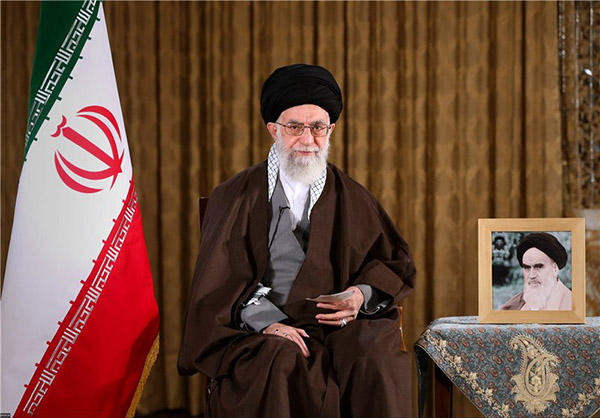
Leader of the Islamic Revolution Ayatollah Seyyed Ali Khamenei said the elections have an added importance as he cast his vote in the opening hours of the voting at a polling station in downtown Tehran on Friday. 

“Elections are always important but in certain junctures they have more importance,” Ayatollah Khamenei said. 

As the polls opened at 8:00 local time (0430 GMT) long queues formed in the capital Tehran, our correspondents reported. Iranian news agencies also reported high turnout elsewhere in the country of 80 million, where 55 million people are eligible to vote. 

Ayatollah Khamenei called on all Iranians to participate in the elections, saying “voting is both a right and a duty.”

“Anybody who loves Iran, anybody who loves the Islamic Republic and national dignity, grandeur and glory is advised to participate in the elections,” the Leader said.   


Leader-Voting


A burning issue on the minds of many Iranians is the economy which found center stage during a week of campaigning by candidates. 

Most of the 4,844 candidates, including about 500 women, opted to get down to brass tacks on their campaign trails, including a nagging stagflation. The official unemployment rate stands at 10 percent and inflation hovers around 15 percent. 

The elections are the first since Iran clinched a landmark nuclear agreement which has generated both hopes and worries in the country. Iranians have had to temper their expectations amid warnings that the West’s uncompromising ways with the country are far from over. 

“Our enemies have their covetous eyes trained on Iran. People are advised to vote with discretion and foresight and disappoint the enemies,” Ayatollah Khamenei said.  

The Leader advised voters to participate “in this great task with the intention of generating additional dignity and full independence for the country.” 

The impact of the deal has yet to be felt on the streets as international companies are jockeying for position for trade with Iran. Moreover, the US administration is keeping most “primary” sanctions against the Islamic Republic in place. 

“We are worried about the numerous (Western) companies that are constantly travelling to Iran since the nuclear agreement,” Golamali Hadad Adel said on Wednesday. 

“This country should not turn into a market for the consumer goods of alien forces,” he added. 

A former parliament speaker, Hadad Adel leads the main principlist faction in the elections against reformists vying for seats under the leadership of Mohammed Reza Aref, a former vice president.

Any new legislation must pass through the Parliament; hence, the elections matter to the president to press ahead with his plans. 

“I have no doubt that the Iranian nation will create another epic at this important juncture,” President Hassan Rouhani said as he cast his ballots in Tehran. 

The president called elections as “a symbol of Iran’s independence and national sovereignty,” saying the government will spare no efforts to protect people’s vote and ensure healthy and legitimate elections.


Rouhani voting
Iranian President Hassan Rouhani casts his ballots in parliamentary and Assembly of Experts in Tehran on February 26, 2016.


In the capital Tehran, some 1,000 candidates compete for 30 parliamentary seats. Five seats also go to the religious minorities recognized in the Iranian Constitution, namely Jews, Christians and Zoroastrians.

Members of Parliament serve four-year terms.

Among the main tasks of the legislative body are introducing legislation, dismissing the president and cabinet ministers through no-confidence votes, approving annual national budget and ratifying international treaties.

In the simultaneous vote on Friday, Iranians will also select 88 senior religious figures of the Assembly of Experts, which is tasked with appointing the Leader and monitoring his performance.


A week of heated election campaigns came to a close on Wednesday night. Interior Minister Abdolreza Rahmani said opinion polls and estimates showed the turnout would be at around 70 percent.

Rahmani Fazli added that the vote counting will begin as soon as the polls are closed.

“All necessary measures have been taken in various parts of the country in preparation for vibrant elections, and no security issues have been reported,” he said. 

He pointed to special features of the ballots being used in this year’s elections, saying they have been designed in a way to lower the chances of fraud.

There are 52,000 polling stations with 120,000 ballot boxes across the country, according to the Iranian minister.


China among main importers of Iranian hand-woven carpets

Talking to IRNA, Kargar reiterated that China keeps increasing the volume of its import of Iranian hand-woven carpets everyday.

‘The volume of exported Iranian hand-made carpets to China has increased from $8,000 to $8,000,000 within five years,’ he said.

‘During the sanctions era, Iran’s hand-woven carpets had inconspicuous presence in the traditional European markets,’ the official added.

‘Iranian carpet merchants sought new markets in countries like Brazil, South Africa, Russia and China that are considered as new carpet export destinations for Islamic Republic,’ he said.

‘Iran’s rival, China, which used to produce carpets for itself, has now become a client of Iranian carpets today and is one of the top buyers of Iranian handmade carpets,’ Kargar noted.

Recently, deputy minister of industry, mines and trade said the export of machine-made carpets will hit $400 million in the year to March 20, 2016.

Mojtaba Khosrotaj put the value of machine-made carpet exports in the past nine months to December 2015 at $300 million.

The figure for the nine months last year stood at $330 million, he said.

All Preparations Made for Friday Votes: Iranian Official

All the necessary preparations have been made all over the country, including urban, mountainous and border regions, so that all those eligible for voting can cast their ballots in the Friday polls, he said in a press conference here in Tehran.

The parliamentary and Assembly of Experts elections will be held simultaneously tomorrow.

Moqimi said some 54.9 million Iranians are eligible to cast their votes in the two elections.

He said as many as 4,844 candidates, including about 500 women, are competing for a place in the parliament.

According to Moqimi, voting will start at 8 o’clock in the morning and continue for at least 10 hours.

If necessary, the official noted, the voting hours can be extended with the approval of the interior minister.

Meanwhile, the parliamentary and Assembly of Experts candidates’ week-long campaigns officially ended at 8 on Thursday, 24 hours before the beginning of the votes.

Iranian officials have in recent weeks reiterated the importance of the elections and called for massive turnout in the polls.

In an address to a group of Iranian people on Wednesday, Leader of the Islamic Revolution Ayatollah Seyed Ali Khamenei underlined the significance of going to the polls, saying that it would display people’s power despite different kinds of pressures, cruel sanctions, and mischievous propaganda against Iran.

The Leader also assured that the Iranian nation will be the ultimate victor despite all the efforts made by the enemy.

The results of upcoming elections, whatever they are, would be to the benefit of Iran, Ayatollah Khamenei said, stressing that whether the Iranian people make good or bad choices, the outcome would go back to themselves, so they had better make a good choice.

There are currently 290 seats in the Iranian parliament, known as Majlis, elected by direct vote of people in nationwide election for four years.

The Assembly of Experts is also a high-ranking body that elects and oversees the activities of the leader of the Islamic Revolution.

Members of the assembly are directly elected to office by people for an eight-year term. It holds biannual meetings to appoint a new chairman.


Enemy Incapable of Changing Revolution’s Path

Velayati said that in the past 37 years since the victory of the Islamic Revolution, the enemies have made every attempt to infiltrate the country but they have failed to do so or change the path of the revolution.

Referring to the upcoming parliamentary elections, he added that the foes have been unsuccessful in their media campaigns aimed at influencing Iran’s elections.

His comments came ahead of the parliamentary and Assembly of Experts votes due to be held simultaneously on Friday.

Leader of the Islamic Revolution Ayatollah Seyed Ali Khamenei has also underlined the enemies’ failure to influence votes in the country.

During the past 37 years, the enemy has plotted against Iran’s elections, trying, in vain, to discourage people from going to the polls, the Leader said Wednesday in an address to a group of Iranian people here in Tehran.


Iran’s Naval Fleet to Berth at Tanzanian Port

“The flotilla will probably dock at Tanzania’s Dar es Salaam port tomorrow or the day after tomorrow,” Sayyari told reporters on the sidelines of a meeting with an Indian Navy delegation.

He further highlighted the significance of security in the Indian Ocean, saying that its importance is no secret to anyone.

Iran’s trade is mostly carried out in this strategic region, and the northern Indian Ocean is of importance to Iran, India, and the world, the Iranian commander noted.

“We will not allow any insecurity in this part of the world,” he stressed.

He also touched upon his meeting with the Indian delegation, saying that the two sides talked about the establishment of security in the Indian Ocean.

An Indian flotilla will visit Iran’s port city of Bandar Abbas in April-May, he noted, adding that the Iranian and Indian navies are scheduled to hold joint tactical drills and relief and rescue exercises.

The two sides also agreed to have cooperation in the fields of education and construction as well as technical interactions, he added.

It was the second meeting in six months between Iran’s Navy commander and an Indian military team.

In August 2015, and after a meeting with a top-ranking military delegation from India’s University of Strategic Sciences, Sayyari said Iran and India, as two influential countries in the region, can develop broad maritime relations with each other.

Sayyari also expressed the hope that Tehran and New Delhi would promote their relations to end trans-regional countries’ presence for safeguarding security in the northern part of the Indian Ocean.


‘Wanted terrorist arrested in neighboring country’

Ali Behmanesh who was in charge of Abdol-Malek Rigi’s file told reporters on the occasion of the capturing operation of Rigi’s that the arrested brother was wanted by Iran.

‘His main crimes were those committed in Iran and he was arrested after Iran approached Interpol. Apparently, he is also accused of acts in the arresting country.’

He said Iran is after extradition of the arrested man to be tried here.

Behmanesh also said that Rigi was supported and financed by Saudi regime to fan sectarian differences between Shia and Sunni Muslims and commit terrorist actions in Iran.

Rigi was also connected to Mossad of the Zionist regime in Casablanca through an anti-revolutionary agent, he said adding that he was also involved in drugs smuggling.

He rejected claims about cooperation of foreign sensitive agencies with Iran in landing Rigi’s plane to arrest him.

The Intelligence Ministry’s expert stressed that there is no distinction between so-called ‘good’ and ‘bad’ terrorists and that Iran has reiterated the point to the European countries.

All capabilities employed to fulfill ‘economy of resistance’: VP

Iran’s five-year 6th Development Plan kicks off next Iranian calendar year starting March 20.

Addressing a panel on sports and cultural heritage, Massoud Soltanifar said Iran’s share of the world’s 1,200 million tourists in 2014 was 5,000,000, while its tourist income was dlrs. 7-7.5 billion from the world tourism revenue of dlrs. 1,476 billion.

Vice President stressed that most of tourists visiting Iran last year were pilgrims from the Middle East, while efforts should be made to improve infrastructures in order to develop ecotourism and health tourism.

Soltanifar noted that the overall balance in Iran’s tourism is negative as some seven million Iranian tourists have travelled to other world countries. Iran should take steps to reverse the situation by increasing the number of tourists by five-folds and encouraging flourishment of handicraft industry during the implementation of the 6th plan.

Facilitating visa issuance and electronic visa for nationals of 190 countries, expansion of air and rail transportation and construction of museums are among steps taken to boost tourism.

He also noted that efforts are underway to develop handicraft industry, including revitalization of some 2,000 handicraft workshops and launching 171 online stores, in order to gain the 3rd rank in the field after China and India.

Iranian officials including Minister of Culture and Islamic Guidance Ali Jannati and Minister of Sports and Youth Mahmoud Goudarzi were present at the panel.

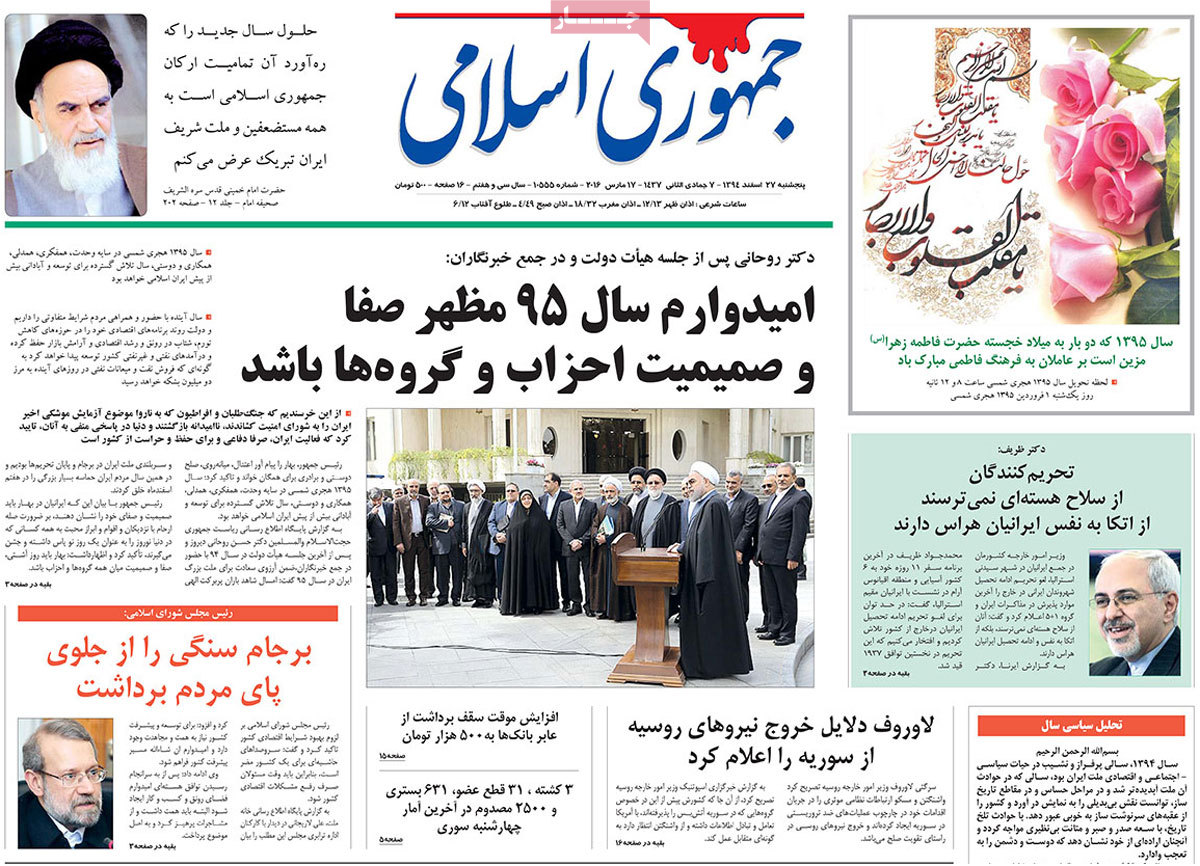
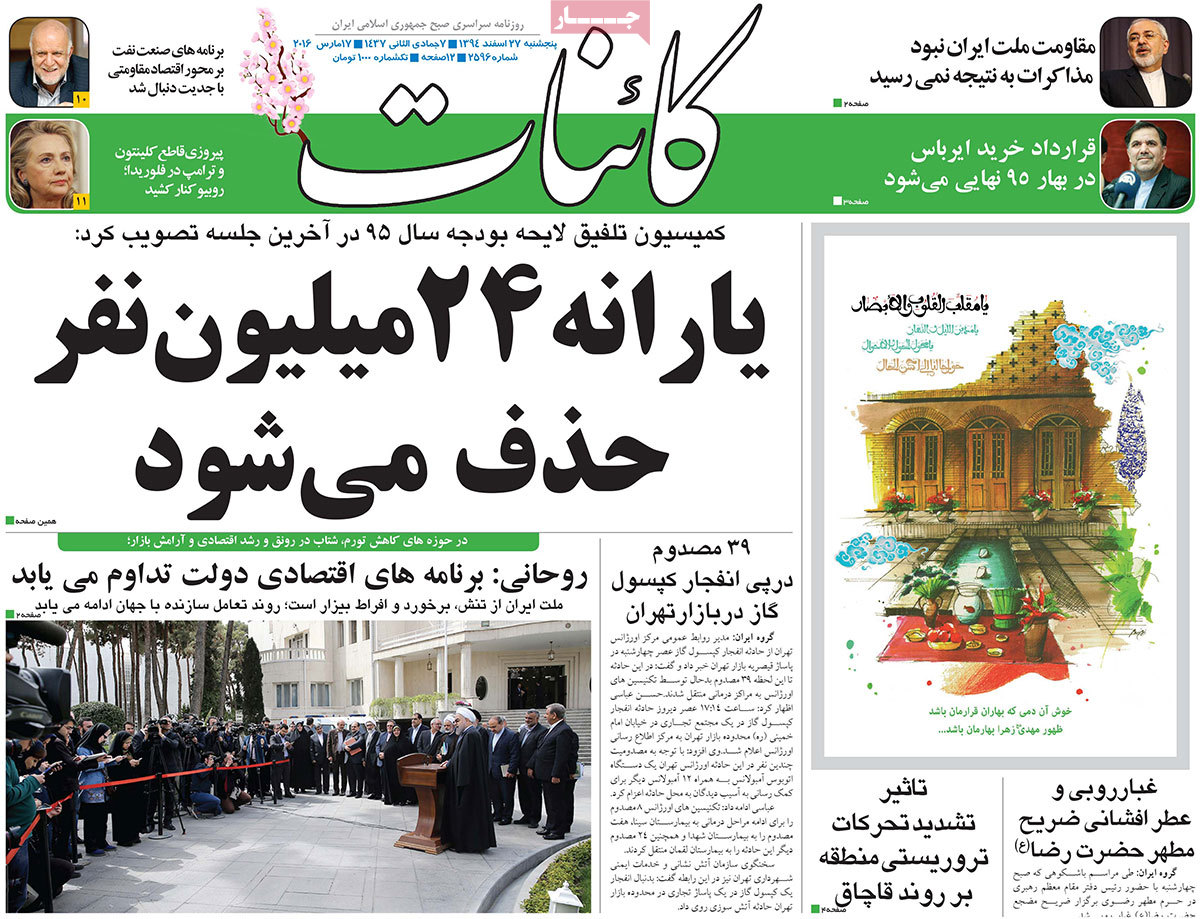
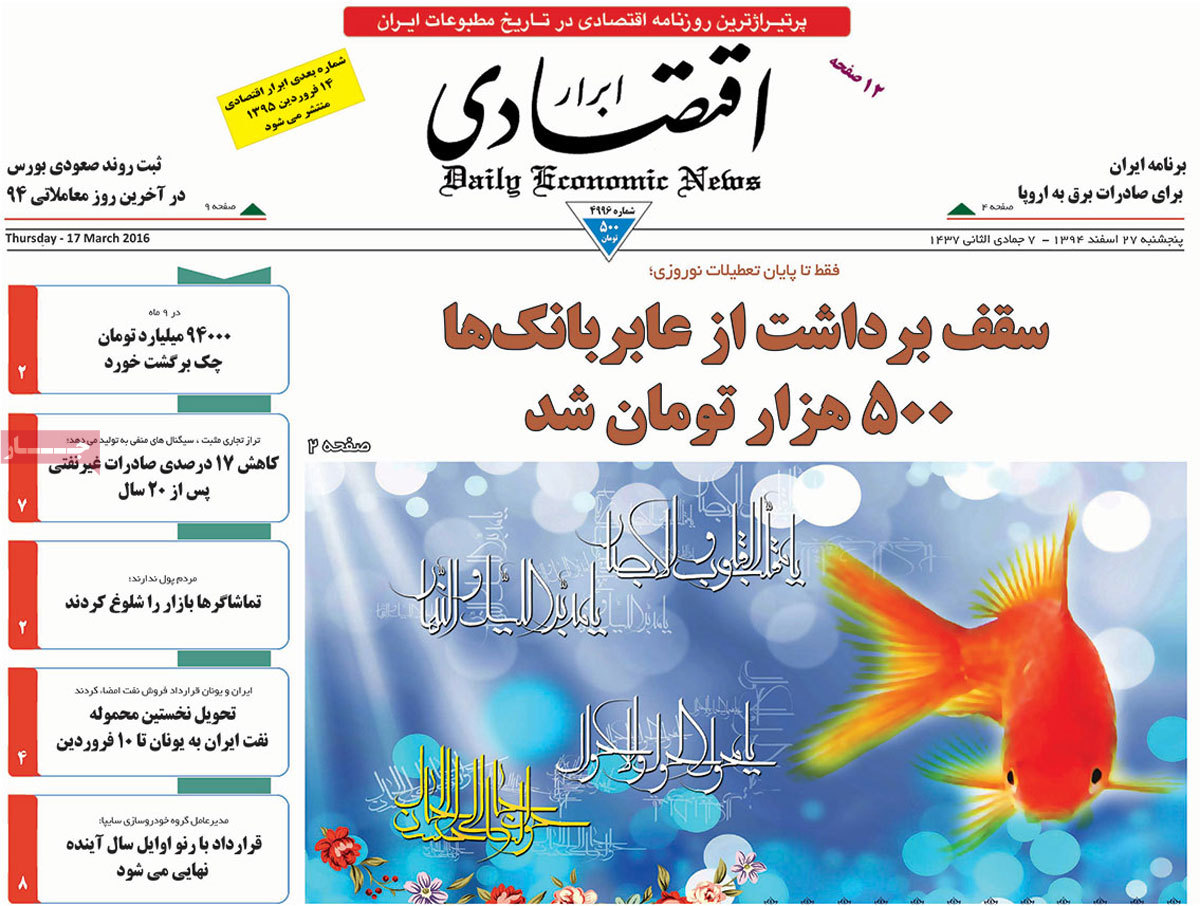
A look at Iranian newspaper front pages on Feb 25

Iran Newspaper front pages

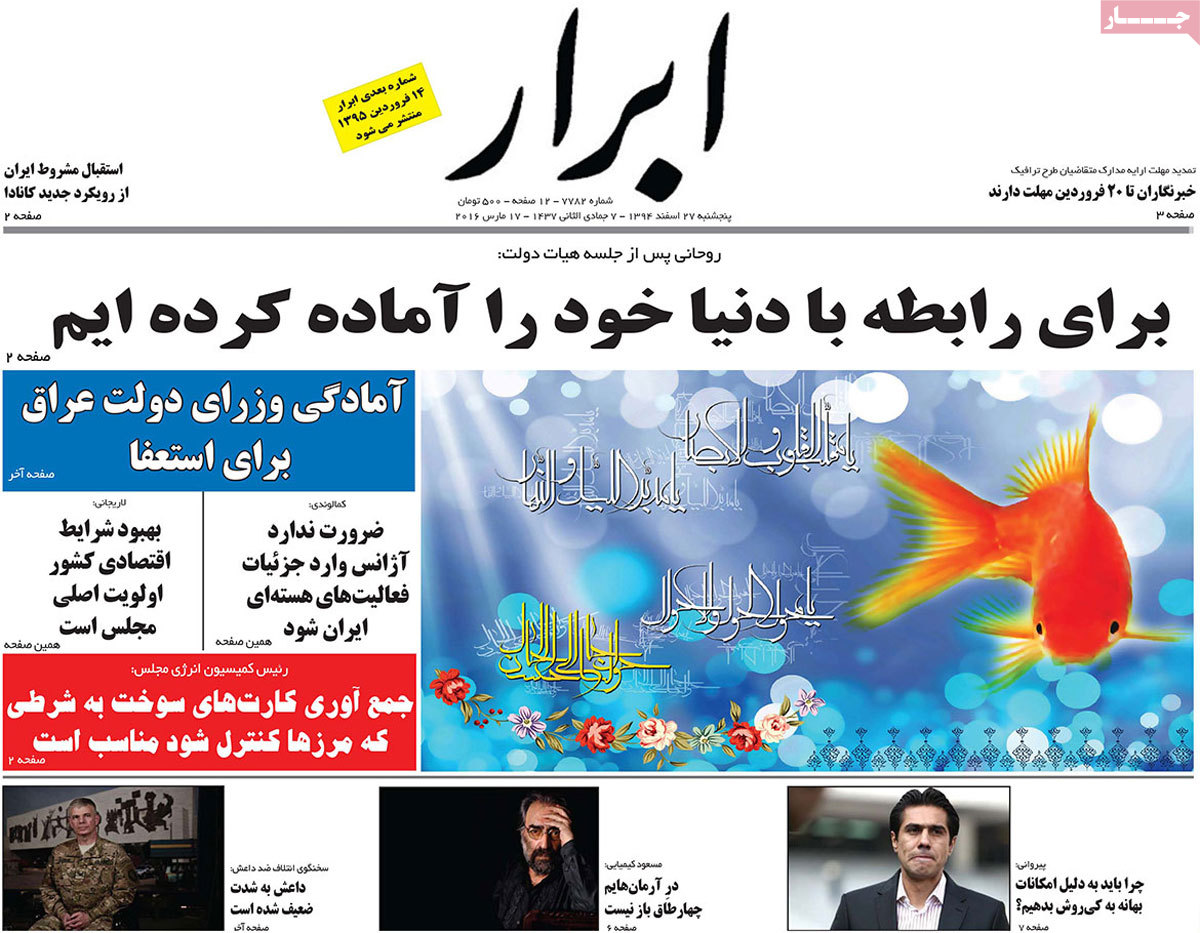
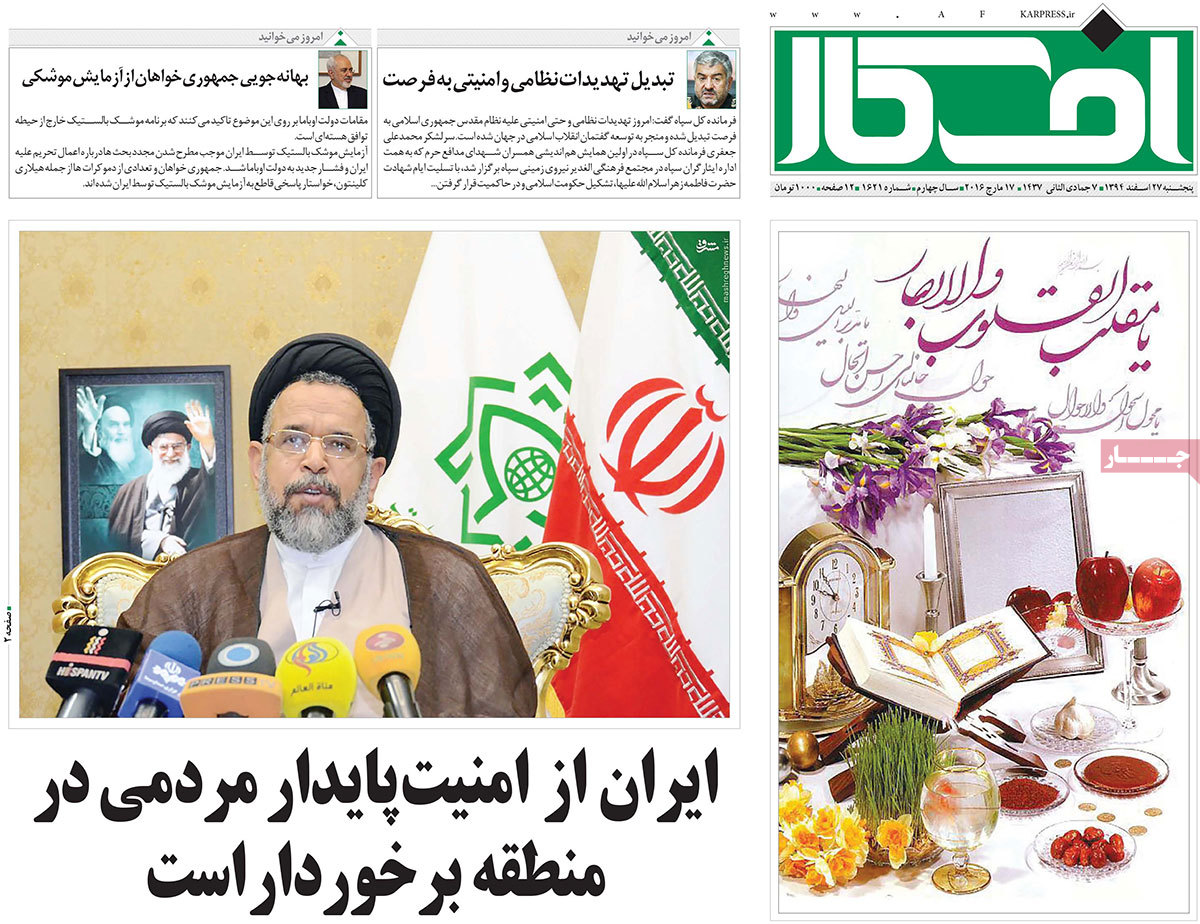
Abrar:

1. Nation seeks no parliament that is gov’t-based or anti-gov’t: Leader

2. Rouhani forbids casting wry look at JCPOA

3. UK resumes issuing visas for Iranians in Tehran

4. Kerry says US has ‘Plan B’ should syrian ceasefire deal fail

5. “I will relate Iranian culture to my friends:” Football Coach Carlos Queiroz

6. Recent dust storms spring from domestic sources

7. Death toll of Syrian crisis crosses 270,000


A look at Iranian newspaper front pages on Feb 25


Abrar Eqtesadi:

1. Boeing proposes Iran talks

2. Assets of corporate mogul put to bid

3. Baku resumes oil trade with Iran

4. Tehran-Ashgabat trade on the rise

5. EXIM Bank to provide $8bn credit line in Iran


A look at Iranian newspaper front pages on Feb 25


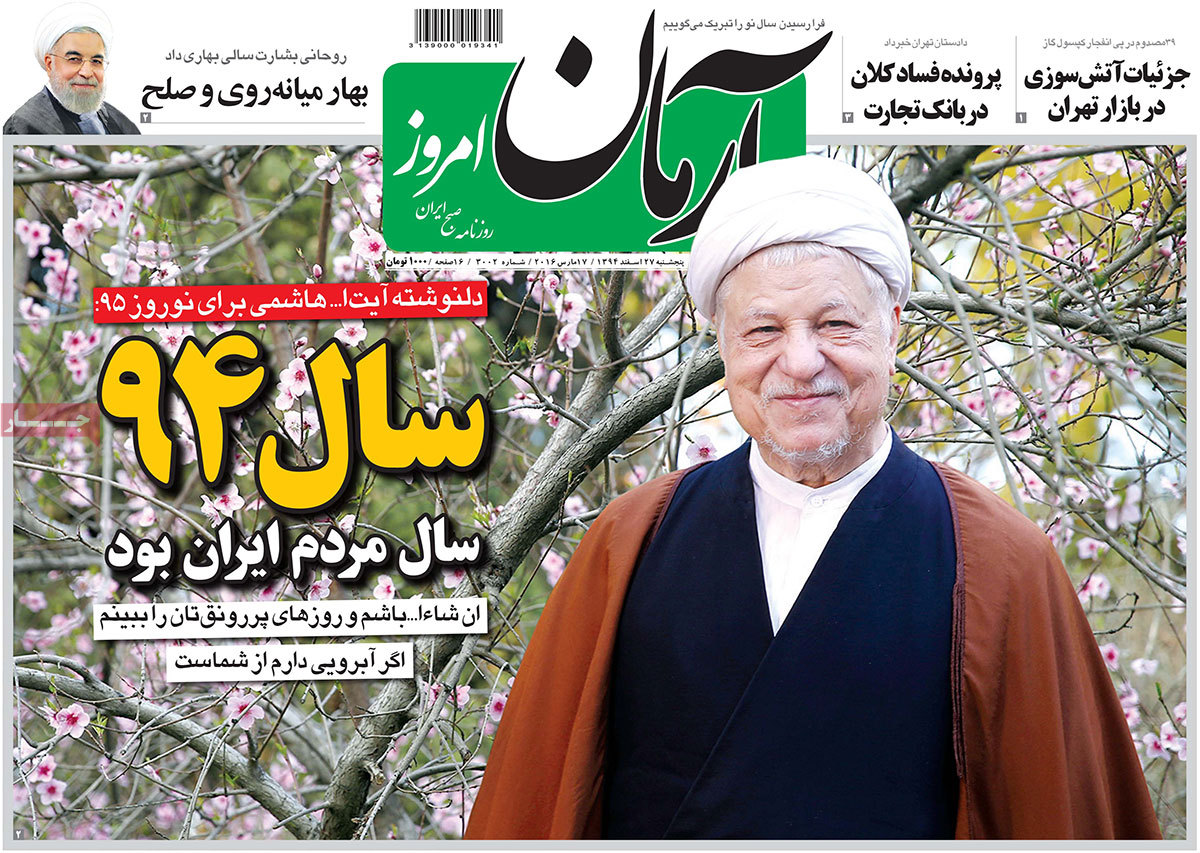
Arman-e Emrouz:

1. Calls for highest election turnout on Friday;

Let’s vote finely tomorrow

Last name of Iranian Minister of Foreign Affairs, Zarif, literally means fine. The title used the pub of referring to Zarif, or fine, for calling on people to cast their votes on February 26 elections for the parliament and Assembly of Experts.

2. Leader: Iranian nation wants a parliament that minds dignity and independence

3. President Rouhani: Interior minister guards people’s votes

4. London resumes issuing visas in Tehran


A look at Iranian newspaper front pages on Feb 25


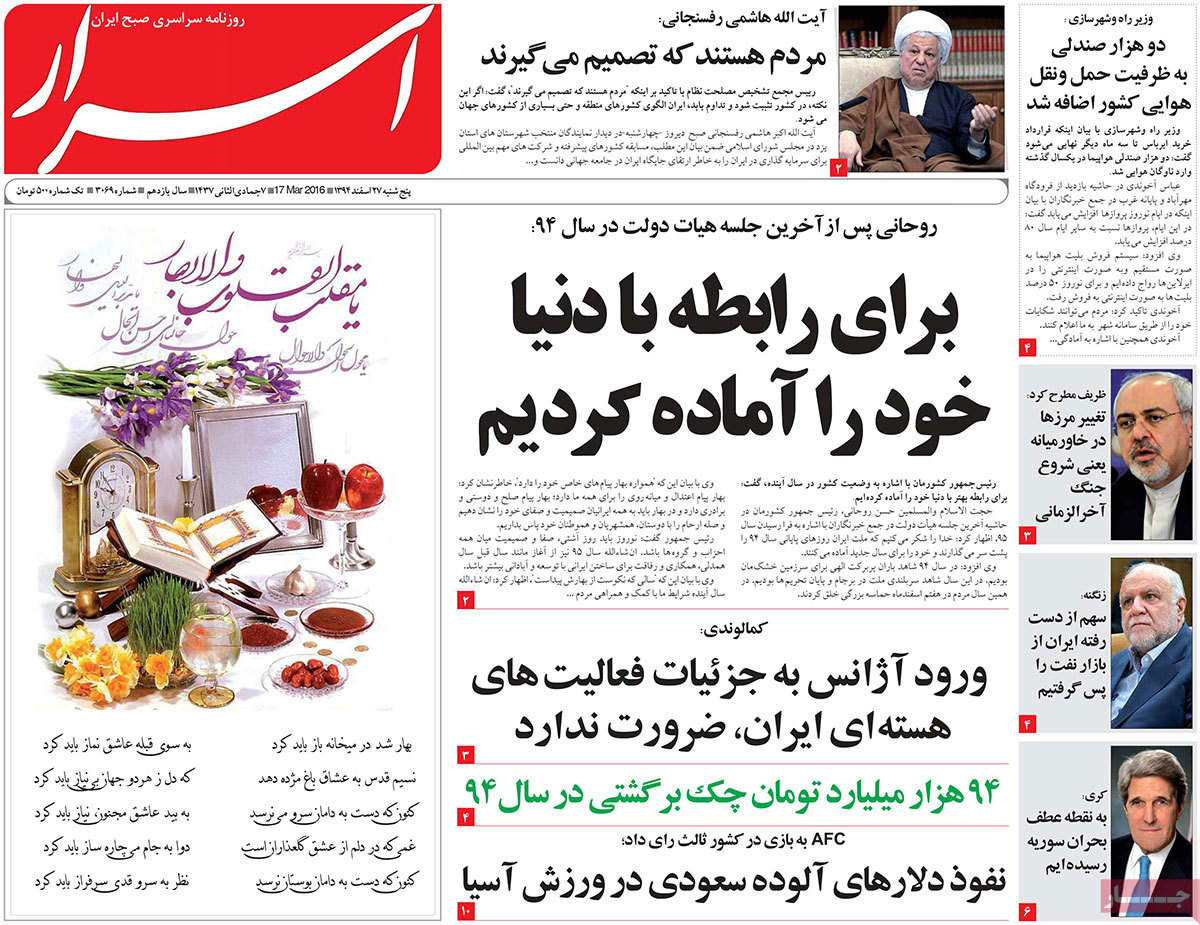
Asrar:

1. Shia clerics call on people to hold passionate elections on Friday

“Feb 26 and creation of new epic”

2. Mogherini warns of impending all-out war between Turkey-Russia

3. Judiciary official calls on admin to pursue UK interference in Iran thru “active diplomacy”


A look at Iranian newspaper front pages on Feb 25


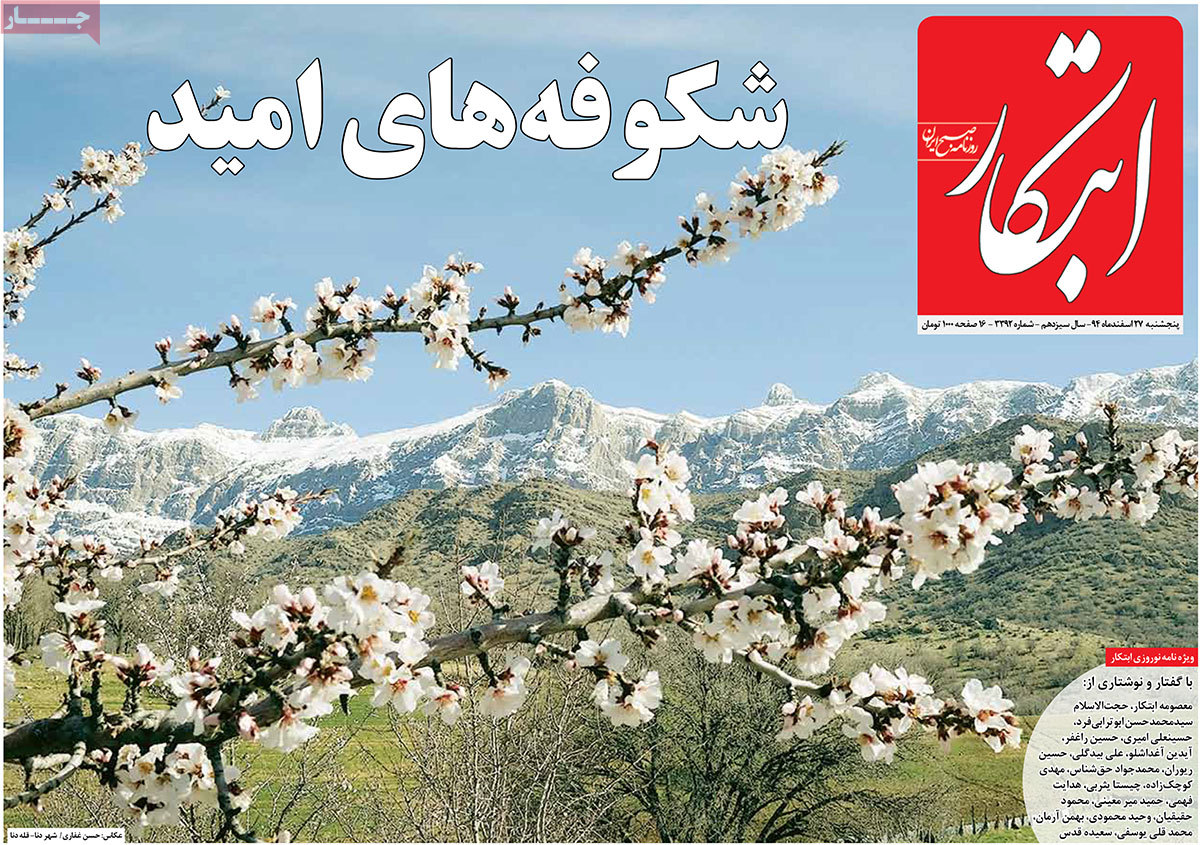
Ebtekar:

1. All together heading towards ballot boxes

A lengthy report about the reasons all votes must come to the ballot boxes on Friday.

2. Leader: Passion, vigor, supremacy, inferiority nature of election

3. Rafsanjani urges Iranians not to stay home on Friday

4. Rouhani to Putin: Cessation of hostilities’ should not help terrorists to reorganize

5. Potential 65% turnout in Parliament election


A look at Iranian newspaper front pages on Feb 25


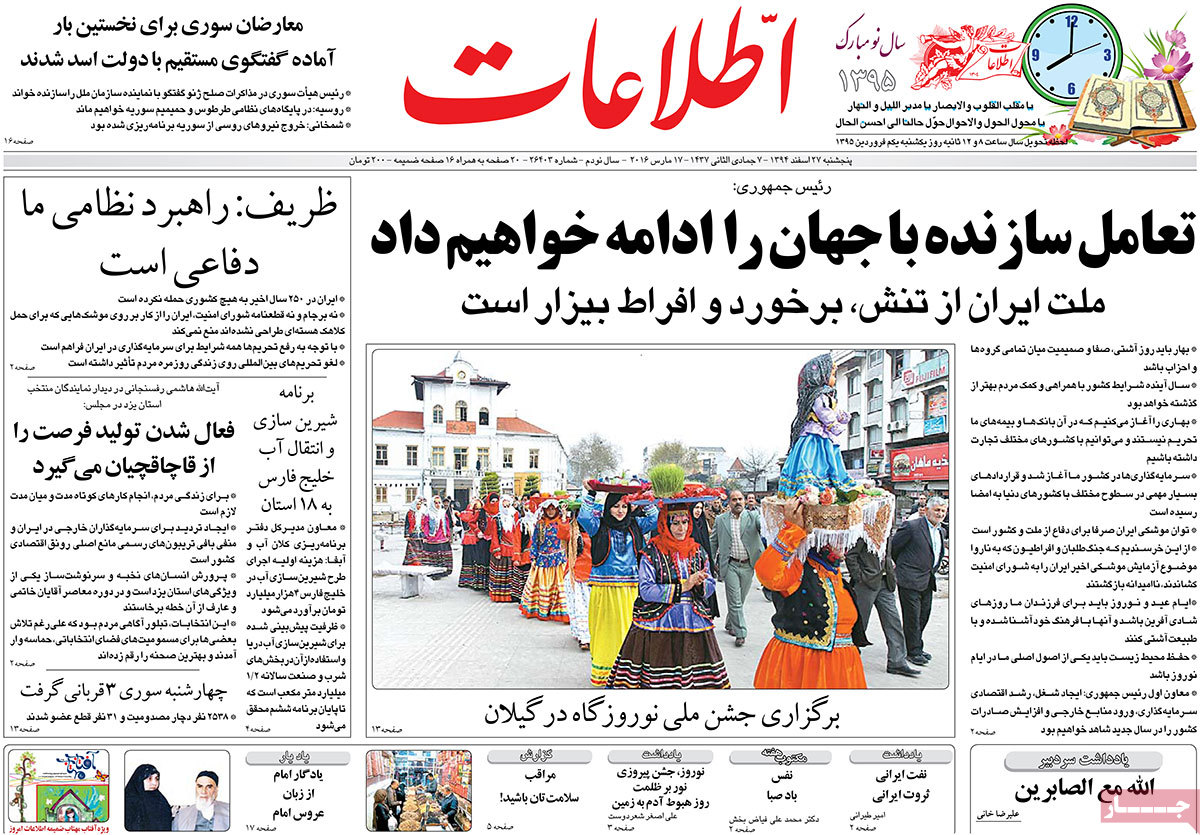
Ettela’at:

1. Moscow: Washington acceded to Syrian ceasefire plan after defeat

2. Leader: Nation seeks a parliament that knows how to cure their pain

3. Rouhani: Nation pick best candidates


A look at Iranian newspaper front pages on Feb 25


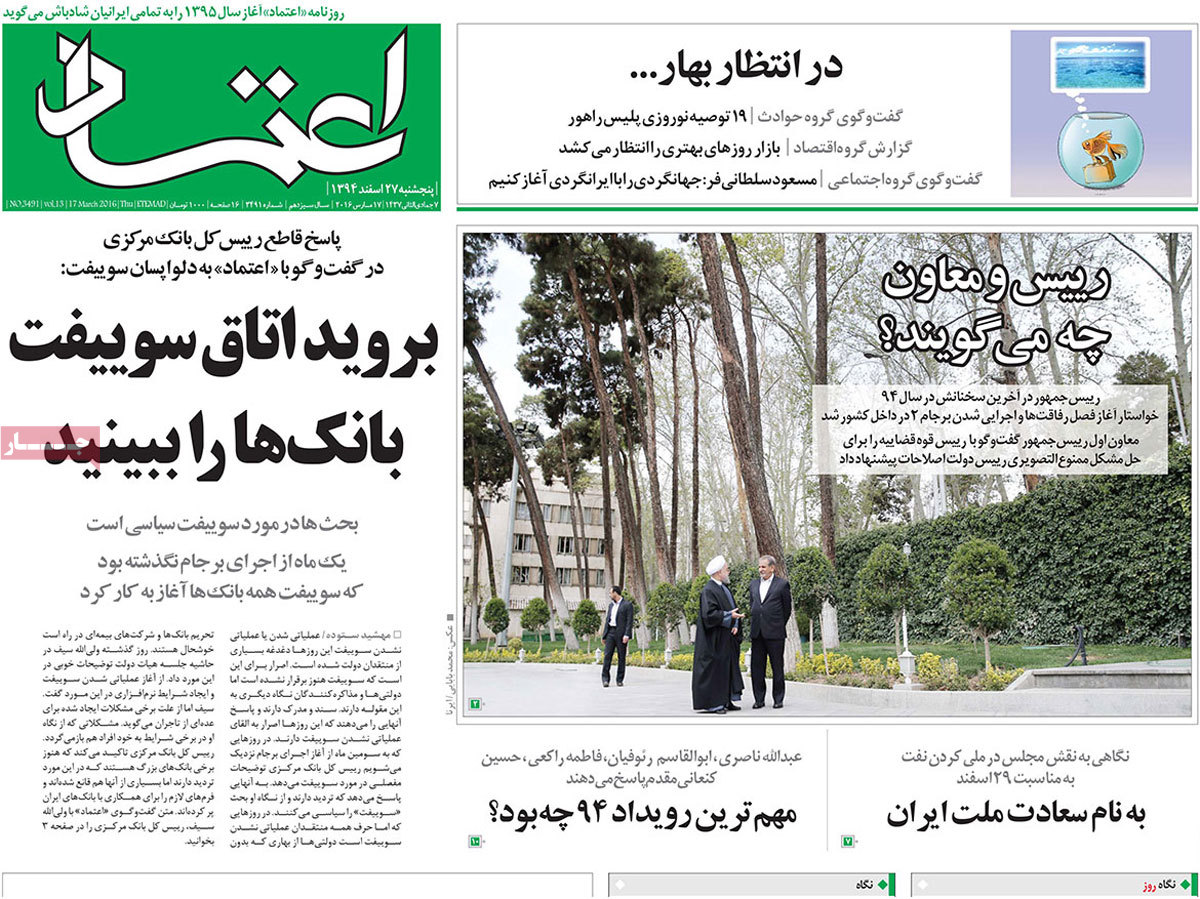
Etemad:

1. Iran: Brother of Abdolmalek Rigi captured in a nearby state

2. The storm of people’s vote

Iranian nation are preparing for a landmark election day to choose future members of the parliament and the Assembly of Experts.

3. Leader: We must try to make correct selection

4. Veep: People turn wheels of economy thru election


A look at Iranian newspaper front pages on Feb 25


Emtiaz:

1. Iran seeks to return stolen assets

2. Petroleum Minister: Iran not to freeze crude oil production growth

3. Rivers in danger of drying out

4. Iran still toddler in world-class art


A look at Iranian newspaper front pages on Feb 25


Hosban:

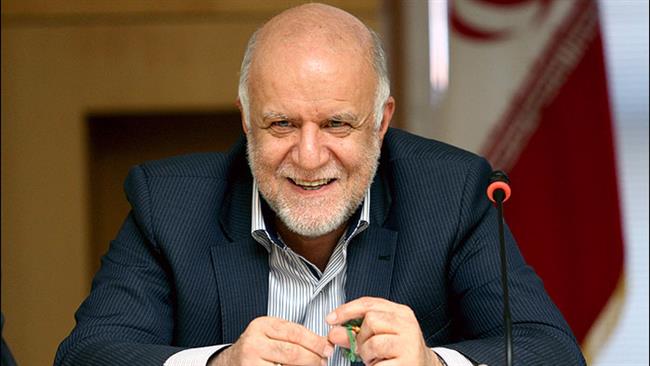
1. Petroleum Minister calls on nation for highest turnout

“Country’s development depends on nation for highest turnout in elections,” Iranian Minister of Petroleum Bijan Zanganeh said.

2. No bright future of field and track in olympic games


A look at Iranian newspaper front pages on Feb 25


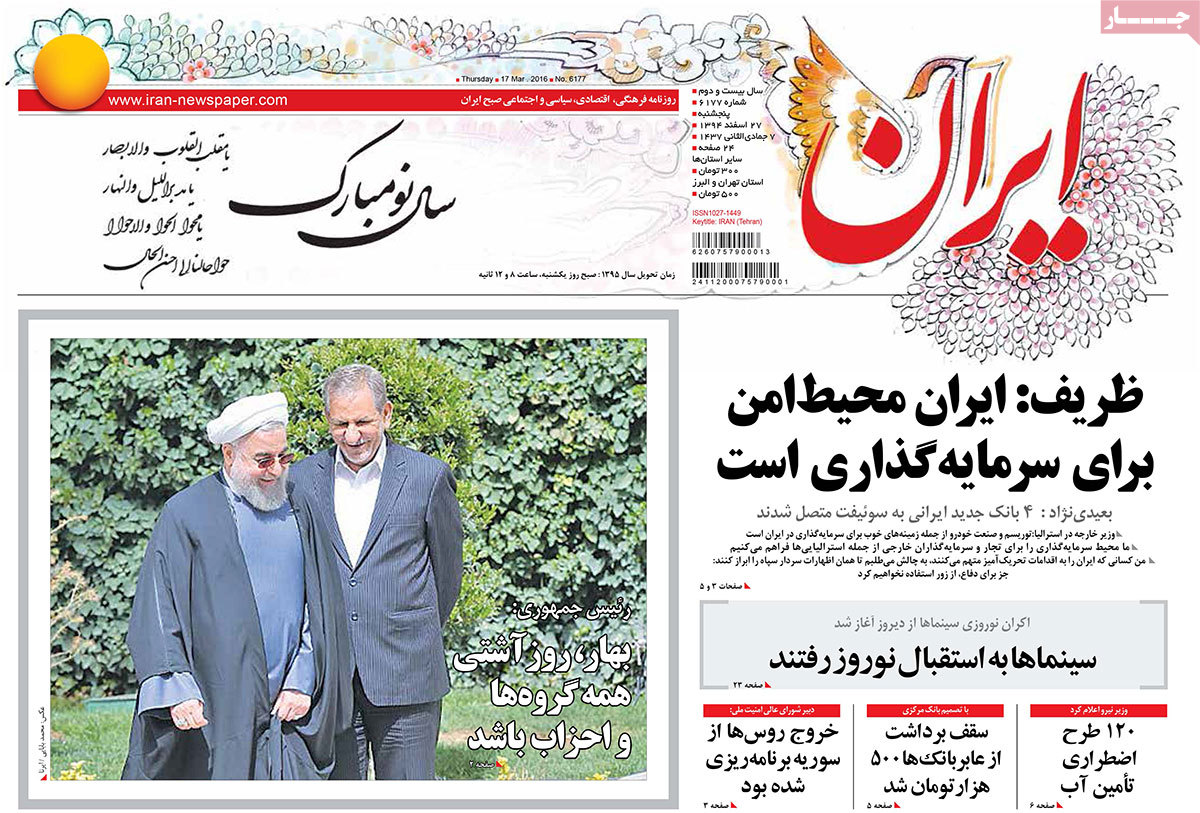
Iran:

1. Electing Iran’s future

Elections in a glance: 55 million eligible voters, 120,000 ballot boxes, 3.8 million first-voters

2. Rouhani calls on nation to draw hopeful future for Iran


A look at Iranian newspaper front pages on Feb 25


Jomhouri Eslami:

1. Leader urges all Iran lovers to attend elections; “Whatever the result, the country will benefit”

2. EU, US join South Pars customers club

Iran exported over 10 billion tons of gas condensate.

3. Syrian truce saves some face for US

4. Israeli mogul wins UAE security award


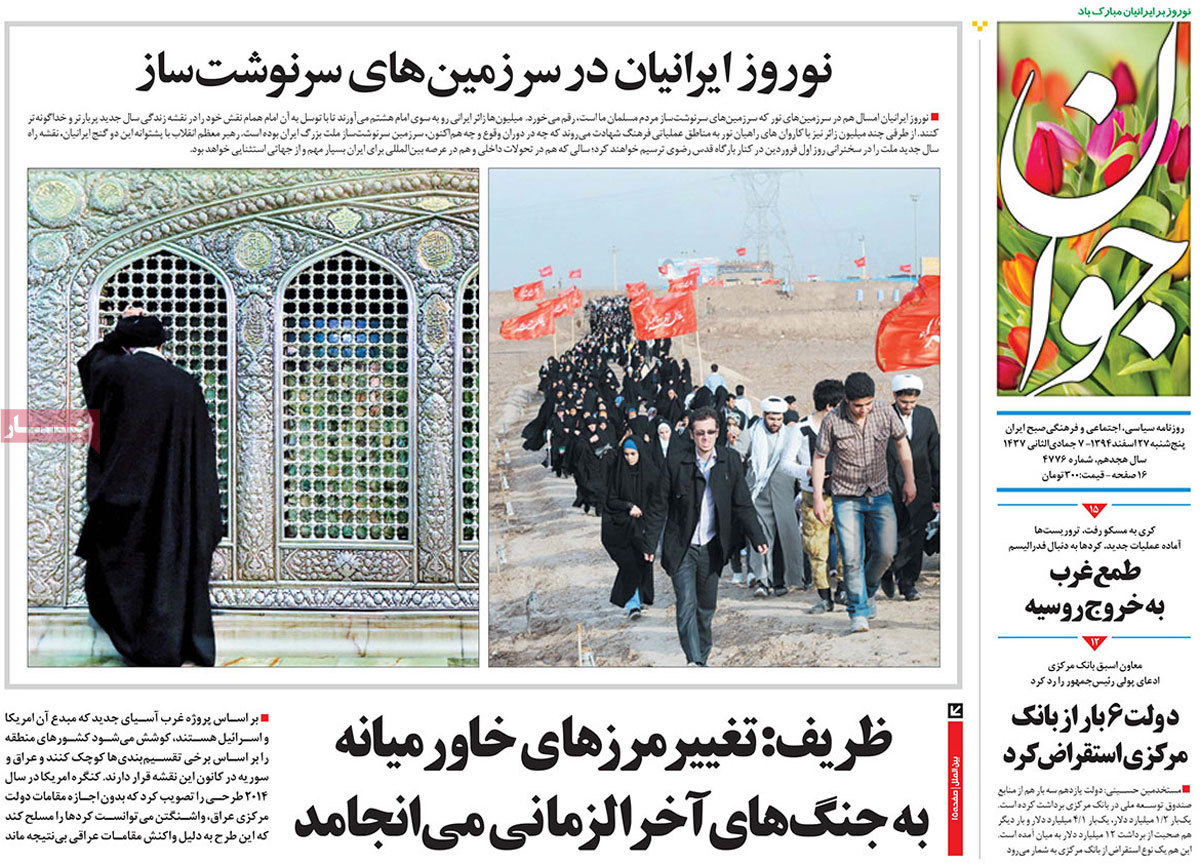
A look at Iranian newspaper front pages on Feb 25


Javan:

1. Nation seeks parliament that believes in endogenic economy: Leader

2. Kerry: Iran nuclear deal raised Tel Aviv security


A look at Iranian newspaper front pages on Feb 25


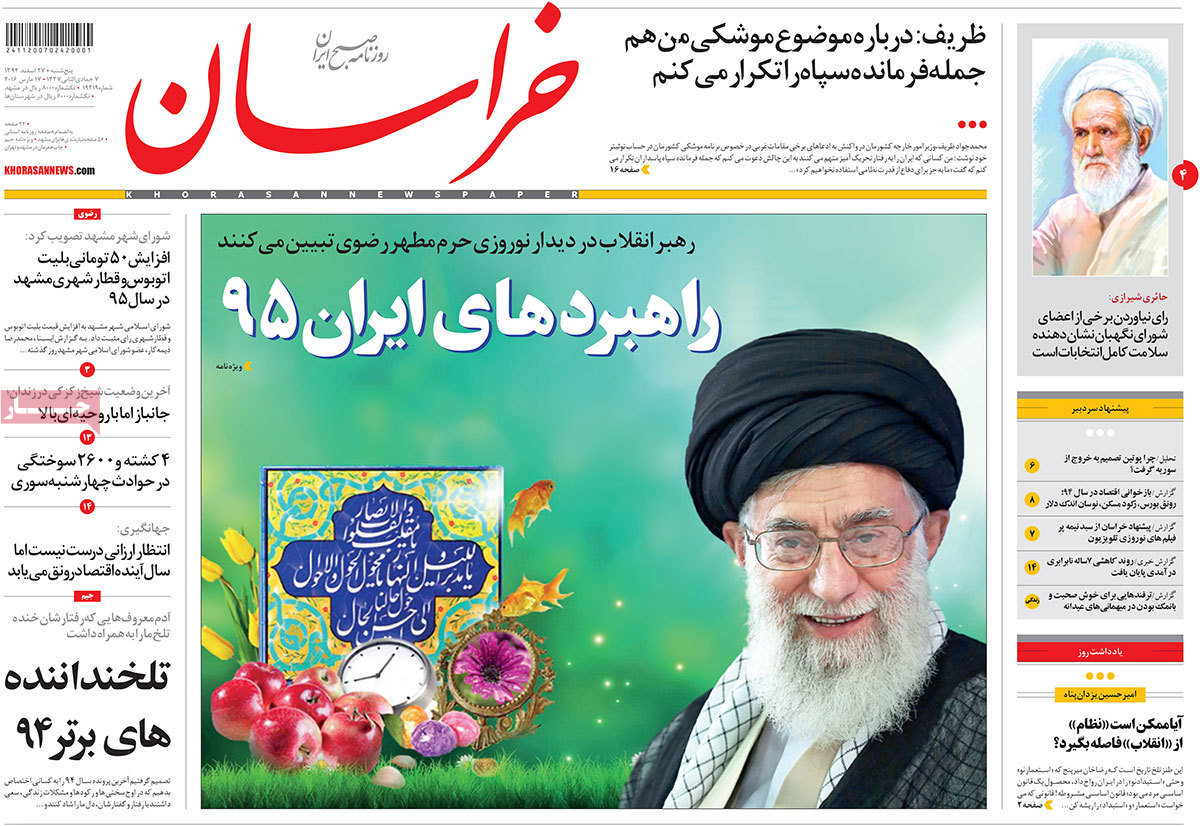
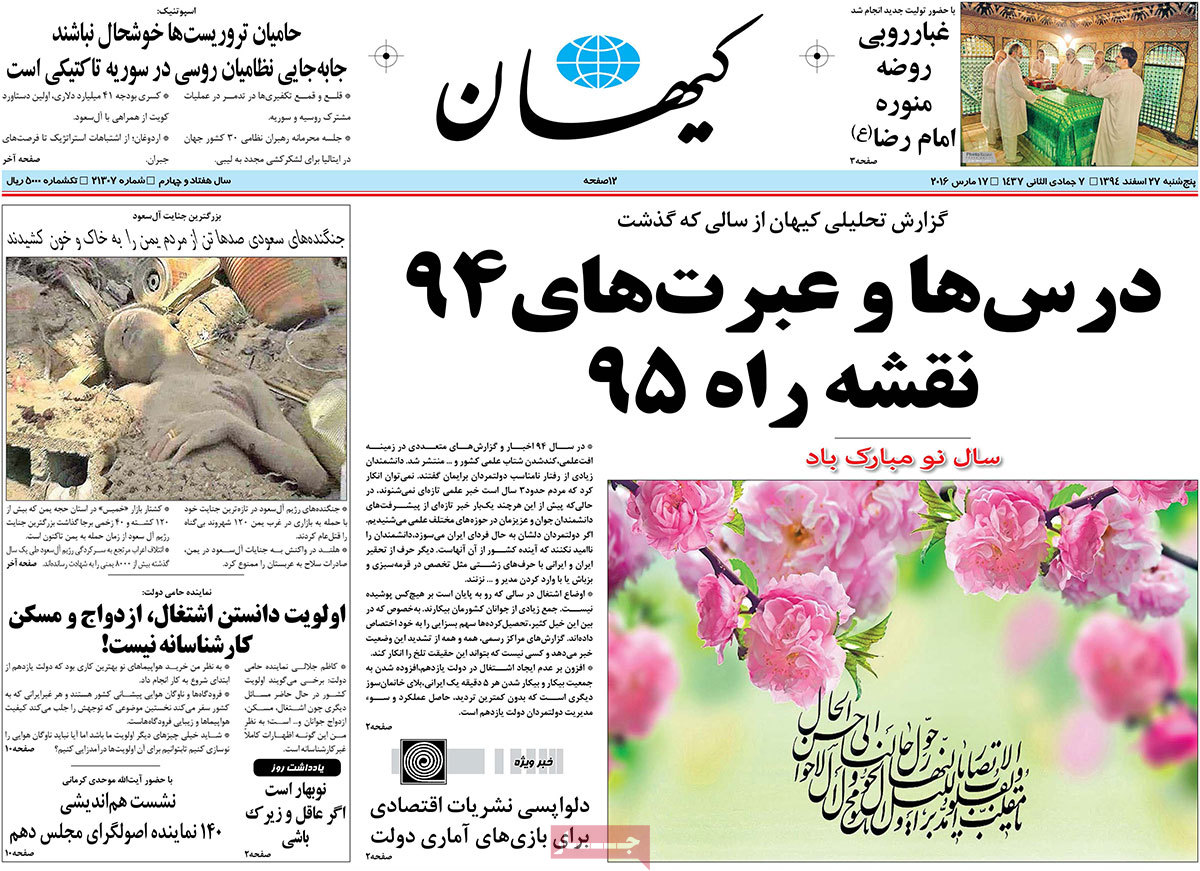
Kayhan:

1. Economists: Parliament must mind people’s livelihood

2. Leader: Enemy refers to submissive compromisers as moderates

3. Al-Saud mufti: Iran nation must not vote for Jannati, Mesbah and Yazdi

4. Amnesty: Al-Saud uses British arms to kill people


A look at Iranian newspaper front pages on Feb 25


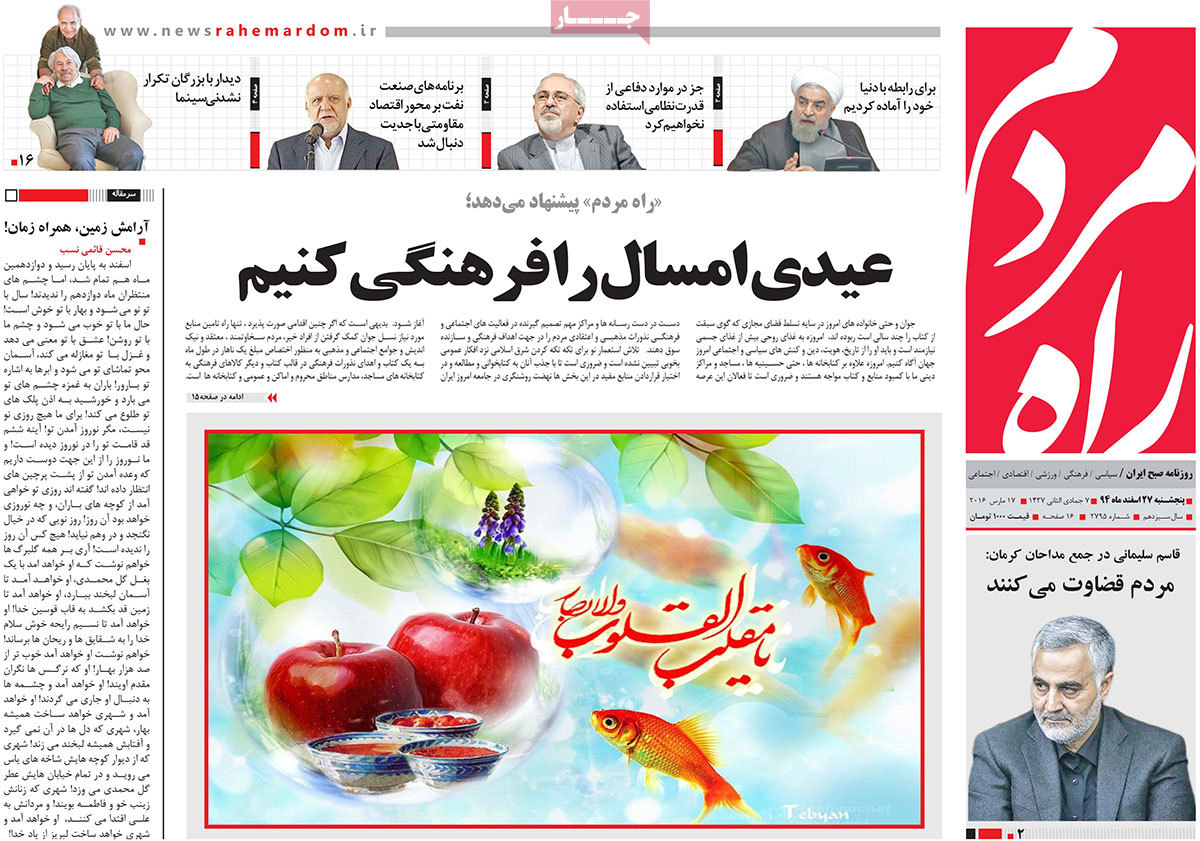
Rah-e Mellat:

1. Report: Parliament election poll


A look at Iranian newspaper front pages on Feb 25


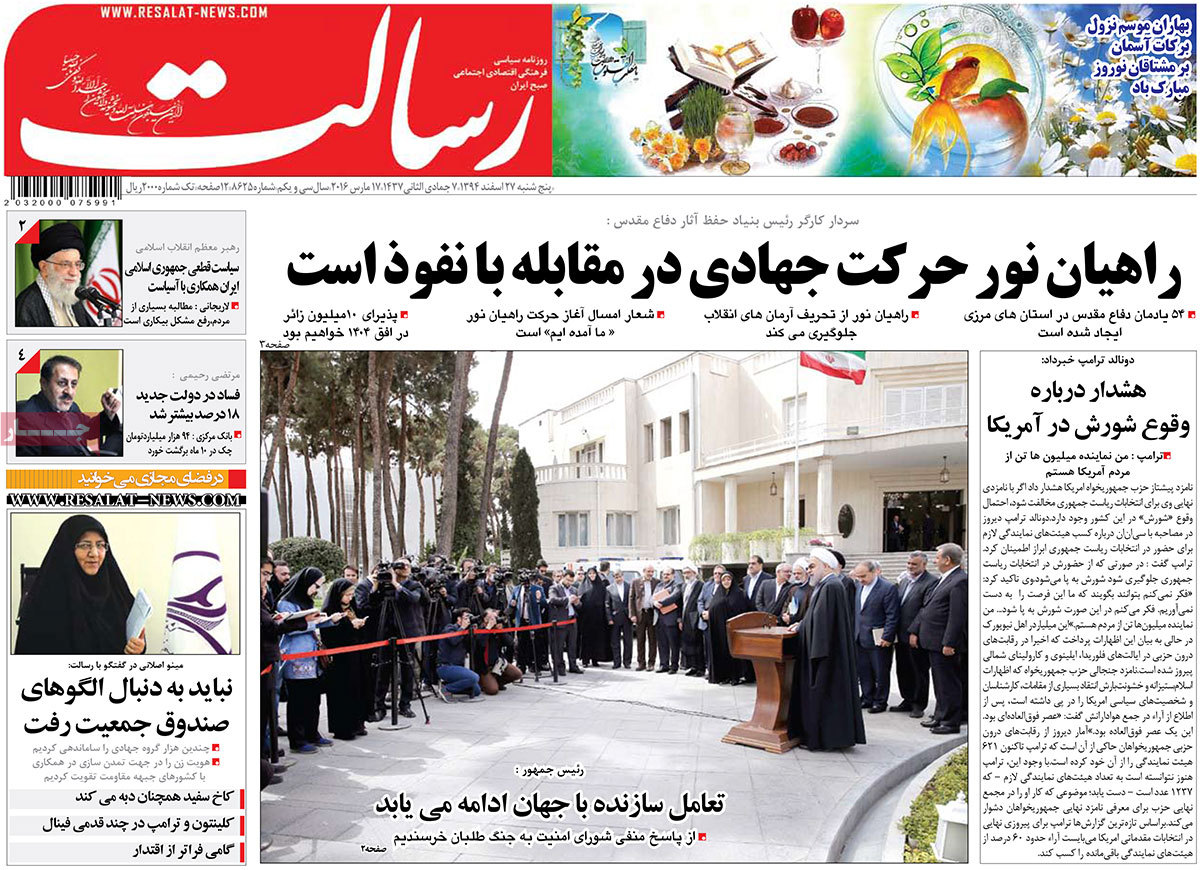
Resalat:

1. Elections guarantee sovereignty of Islamic establishment: President Rouhani

2. Lavrov: US, allies seek war in Syria


A look at Iranian newspaper front pages on Feb 25


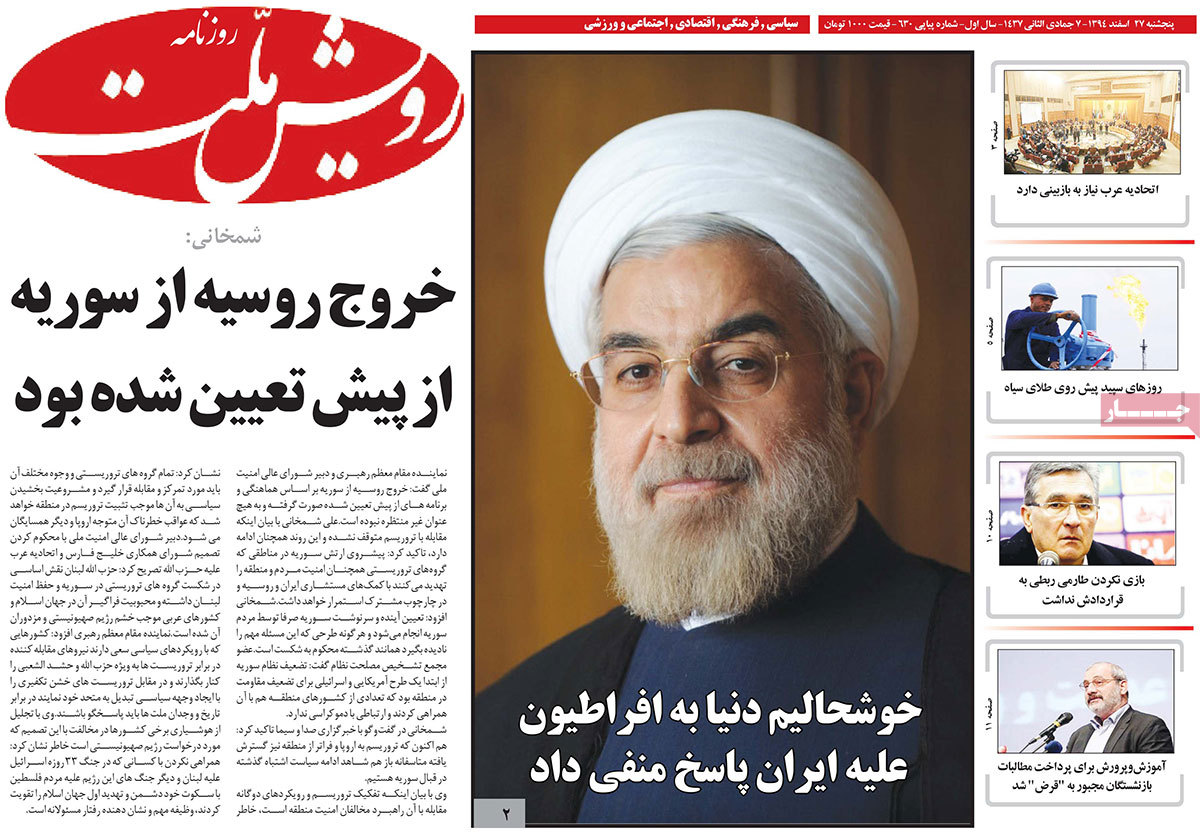
Rooyesh Mellat:

1. Petroleum Minister: Oil freeze plan a joke

2. 58 rare maladies identified in Iran


A look at Iranian newspaper front pages on Feb 25


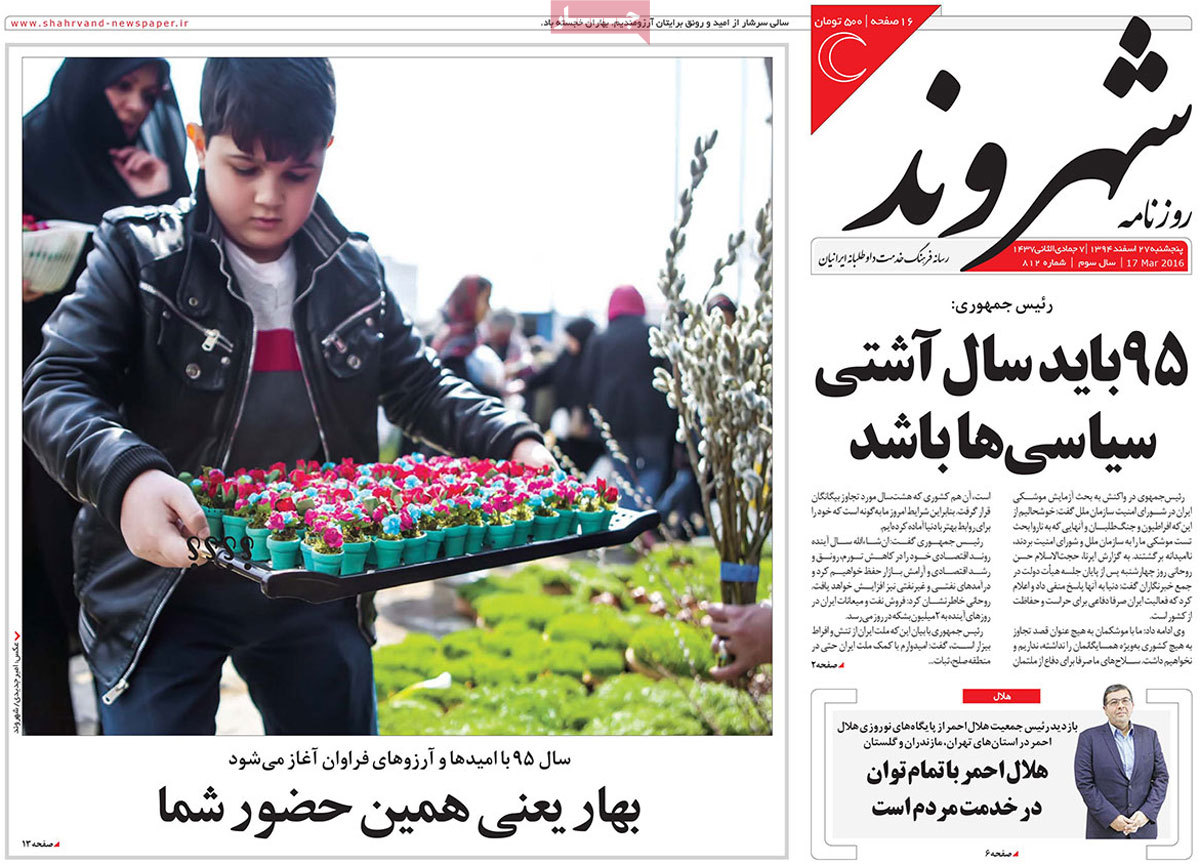
Shahrvand:

1. Rouhani to nation: Iran needs your votes

2. Election turnout may rise by Friday

3. Leader: Result of nation’s election turns back to them


A look at Iranian newspaper front pages on Feb 25


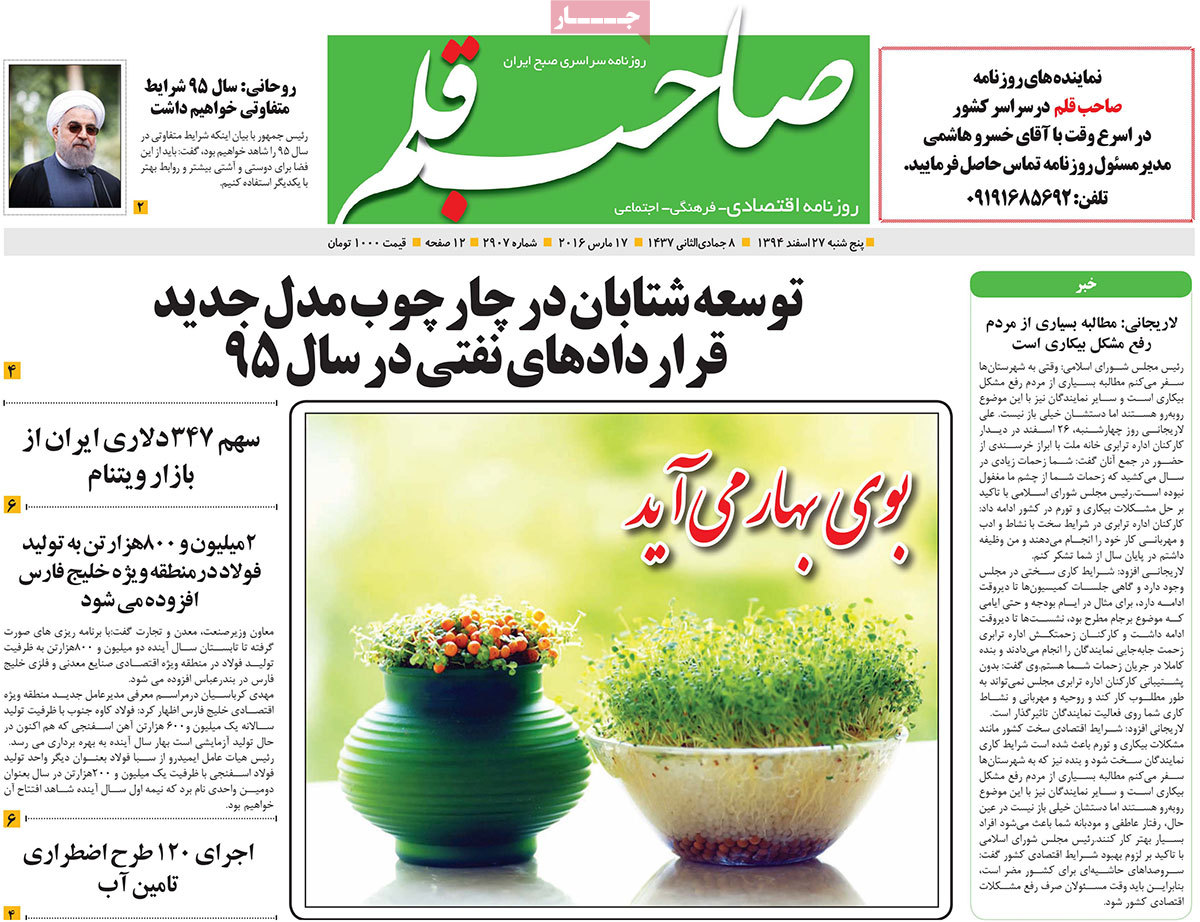
Saheb Ghalam:

1. Iran takes first step to launch smart power grid

2. Industry Minister issues special order to protect prices as New Year approaches


A look at Iranian newspaper front pages on Feb 25


Let’s Have National Day of Dialogue, Imam Sadr’s Daughter Proposes

Houra Sadr, the daughter of Iranian-Lebanese philosopher and religious leader Imam Musa al-Sadr, in an article, has asked Iranian officials to name February 19 as the National Day of Dialogue.

Here is the full text of her article in Khabar Online news website:


Hura Sadr40 years ago on February 19, 1975, fathers of the Saint Louis Capuchin Cathedral in Beirut invited Imam Musa al-Sadr to preach the Christians during Lent, which is the solemn religious observance in the liturgical calendar of many Christian denominations that begins on Ash Wednesday and covers a period of approximately six weeks before Easter Sunday.

It was the first time in the history of Islam and Christianity that a Muslim cleric was carrying out a Christian religious rite.

Let me explain the significance of the incident in Imam Sardr’s own words. During the disastrous civil war in Lebanon, he said in an interview:

“One of the most important objectives behind the plots that struck Lebanon was to destroy the form of coexistence and national unity in Lebanon. When coexistence is targeted by a plot, the symbols of coexistence will definitely be the first to be attacked.

“I do not suppose anyone in Lebanon to be a symbol of national unity as much as I am, because in addition to the cultural, social, and political contacts and all-out relations I have with all Lebanese sects, I reached a point that, three years ago at Saint Louis Capuchin Cathedral, I preached Christians during the Lent. No one in the world has reached such a position. That was just like a Christian clergyman preaching Muslims during the Friday prayers. So I became the symbol of national unity, and thus, the plot directly targeted me,” Imam Sadr said in the interview.

In his sermon at Saint Louis Capuchin Cathedral, Imam Sadr both preached and practiced his doctrine.

“We have gathered for the human being; the human being for whom religions came; the religious which were of the same origin, and each promised the emergence of the other, and acknowledged each other,” Imam Sadr said in his sermon.

Isn’t such a historic event an honor for Muslims? Isn’t it an honor for Christians? Isn’t such a huge incident the result of belief in unity and dialogue and dialogue-based practical behavior?

Given the ongoing crises in the region and the worrying future of Muslim world, I emphasize that dialogue should be venerated and institutionalized in Islamic societies.

Dialogue should begin in the years of childhood and continue until the end of academic educational in the country’s educational system. Dialogue is not an intellectualistic hobby only belonging to the elite, though elites have played a special role in its institutionalization.

Let us dignify dialogue and pay careful attention to its practice. Let us dedicate one day in our calendar to “Dialogue” so that we could examine, evaluate, and correct our one-year performance in this regard.

I propose that February 19, the day Imam Musa Sadr preached Christians in Capuchin Cathedral during the Lent, be named as the “National Day of Dialogue”. Institutionalizing dialogue needs symbols and icons. Choosing Imam and dedicating a day to dialogue is an effective method to institutionalize the concept.

Imam Musa Sadr was a prominent philosopher and religious leader who disappeared in August 1978.

On 25 August 1978, Sadr and two companions Sheikh Muhammad Yaacoub and journalist Abbas Badreddine departed for Libya to meet with government officials.

The visit was paid upon the invitation of the then Libyan ruler Muammar Qaddafi. The three were seen lastly on 31 August.

It is widely believed by his fans, relatives, and supporters that Qaddafi ordered Imam Sadr’s kidnapping.

The former Libyan regime had consistently denied responsibility, claiming that Sadr and his companions left Libya for Italy, but Rome never confirmed their entry into that country.

Islamic Architecture in Photos: World’s Pink Mosques

Islamic Architecture in Photos: World's Pink Mosques

The use of colours in mosques goes beyond the simple function of similar structures around the world. Take the colour pink as an example. Pink is a colour used in some mosques as a symbol of serenity, love and peace.

As reported by a cultural heritage journalist from ISNA, this type of place of worship all around the world is built using different patterns or colours. In terms of beauty, greatness and antiquity, the mosques have titles like Jame or Azam; as they are called in Iran.

Some of the characteristics of this beautiful style of architecture include mirrorwork, dome-like roofs, vaults and nested bedchambers. This beauty has turned many mosques all over the world into tourist attractions; whether for Muslims and followers of other religions.

Malaysia’s Pink Mosque 

One example of these mosques is Putra Mosque in Malaysia. This mosque sits next to the beautiful lake of Putrajaya. Its view causes it to be considered as one of the Islamic world’s most modern mosques.

Putrajaya Jame Mosque, also known as Putra mosque, was started in 1997 and it was first used two years later.


The Pink Mosque of the Philippines

Maguindanao Mosque in the Philippines is one of the world’s pink mosques. It seems that apart from the religious aspect, its colour has made it into a tourist attraction. The mosque was completed in 2014, and as a sign of unity between different religions, was built by Christian workers.


Islamic Architecture in Photos: World's Pink Mosques


Iran’s Pink Mosque

Another of the world’s pink mosques is Nasir al-Mulk, located in Shiraz, Iran. Because of its colourful windows and pink tiles used in its interior design, this mosque is known as the pink mosque in popular culture.

Nasir al-Mulk mosque is one of the oldest mosques in Shiraz. It was built over 12 years between 1877 and 1889.

It is interesting to know about the psychology of the colour pink. This colour promotes tolerance and patience in humans and encourages kindness and love.