Thursday, December 25, 2025
Home Blog Page 4515

Belgian Parliamentary Delegation Due in Tehran Wednesday

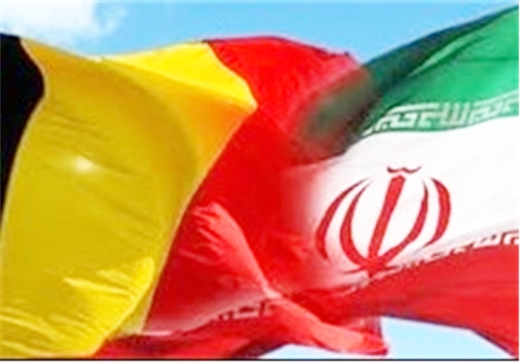
The delegation, headed by President of the Senate of Belgium Christine Defraigne, will arrive in Tehran on April 27.

Defraigne is planned to sit down with Iran’s Parliament Speaker Ali Larijani. The two will also hold a joint press conference after the meeting.

The president of the Senate of Belgium is also scheduled to hold talks with Iranian President Hassan Rouhani, Chairman of Expediency Council Ayatollah Akbar Hashemi Rafsanjani, a top adviser to Judiciary Chief Ayatollah Sadeq Amoli Larijani on international affairs, Vice-President for Women and Family Affairs Shahindokht Molaverdi, and a number of other officials during the 5-day visit.

The trip will come against a backdrop of international enthusiasm for enhanced ties with Iran after Tehran and the Group 5+1 (Russia, China, the US, Britain, France and Germany) on July 14, 2015 reached an agreement on Iran’s peaceful nuclear program and started implementing it on January 16.

Leader Underlines Closer Ties among Independent States

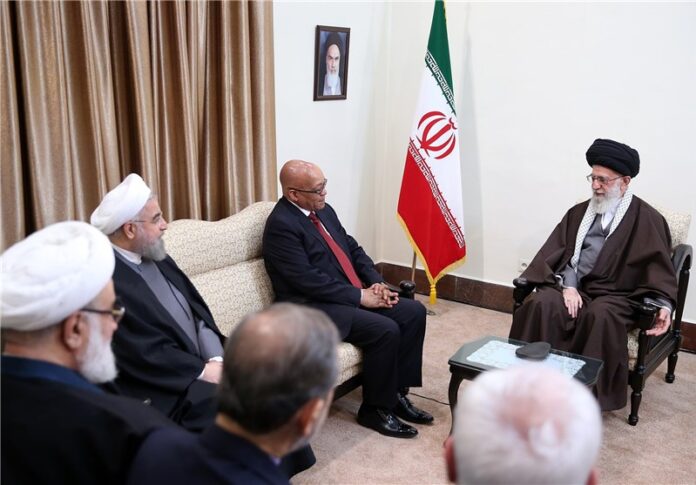
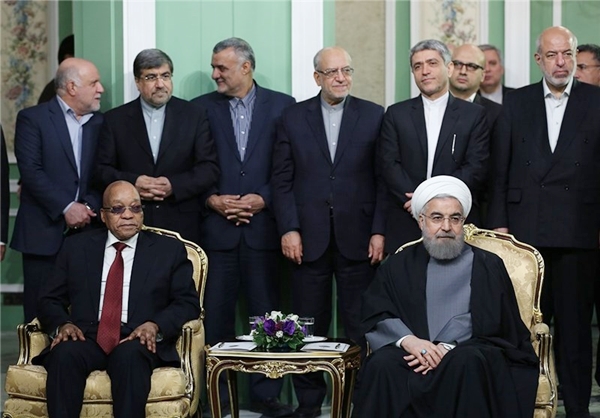
Imam Khamenei raised the issue at a meeting with visiting South African President Jacob Zuma in Tehran.

“The interests of independent states depends on closer cooperation in different sectors and the obstacles certain powers are raising against such cooperation should be countered,” the Leader said.

As regards Iran’s ties with the African state, Ayatollah Khamenei said Iran holds a “positive and constructive view” of South Africa.

The Leader further described the relations between Iran and South Africa are very warm, but at the same time noted that economic and trade ties between the two sides should match their existing capacities.

Also at the meeting, Zuma reiterated the necessity for cooperation between independent nations.

He reminded Pretoria’s stances towards Iran, and said the country had opposed the sanctions the Western governments imposed on Iran.

Zuma said there is now proper ground for cooperation between the two countries, adding that his country will restart economic and trade ties with Iran.

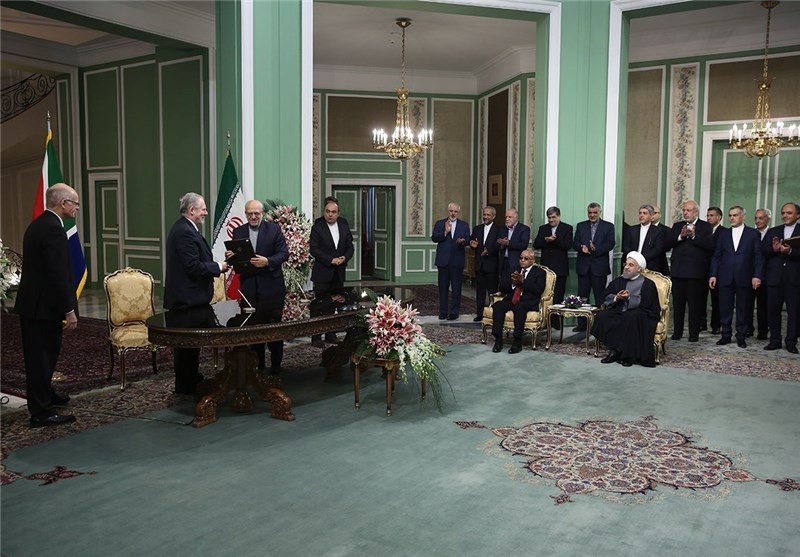
In a ceremony held in Tehran on Sunday, high-ranking officials from Iran and South Africa signed eight memorandums of understanding (MoUs) to broaden the relations between the two countries in a range of fields.

Iranian President Hassan Rouhani and his South African counterpart attended the ceremony.


“I Could Never Complain about Iranian Acting”

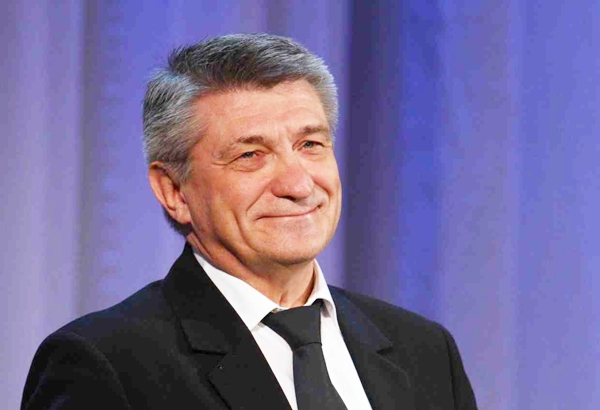
Alexander Sokurov, the famous Russian film director, attended the 34th Fajr International Film Festival. He talked about his knowledge of Iranian cinema and his reasons for being at the festival, “I know Iran more through its history. Of course, I’m familiar with Abbas Kiarostami and some of his works, but unfortunately I don’t have a good knowledge about Iranian documentary cinema. I’m definitely interested and try to get to know this cinema more.”


He continued, “Unfortunately, Iranian cinema is heavily based on social issues. I don’t know why Iranian filmmakers are so interested in social matters and less in artistic ones. If I am being picky, I could say that social cinema exists everywhere in the world, but not to this extent.”


He added, “The main difference between Iranian films and those of other countries is that Iranian films look much neater and cleaner on the screen. In a way, I can say they are more organic. The acting in them is also extremely precise and surprisingly natural. I personally could never complain about their acting.”


Sokurov also talked about the quality of Iranian cinema in comparison with the Middle East, “There’s much less development in Arab cinema than in Iran. I can say that they are not even close, and it’s wrong to compare them.”

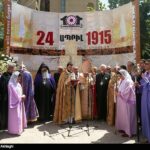
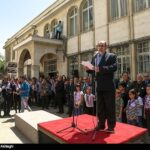
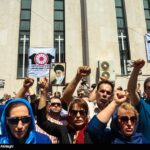
Rally Held in Tehran to Remember Armenian Killings of 1915

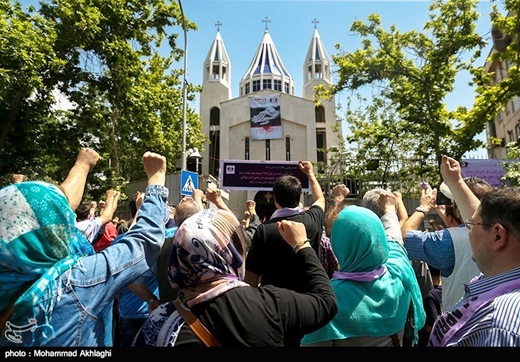
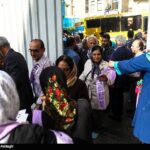
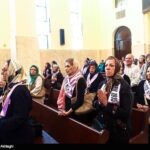
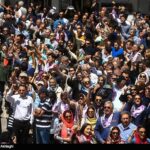
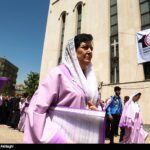
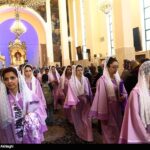
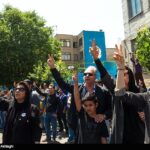
A large crowd of Armenian citizens, sporting purple signs, converged on Saint Sarkis Cathedral in central Tehran to mark the 101st anniversary of the 1915 massacre of Armenians in what they say was a genocide by the Ottoman Turks.

An estimated 1.5 million Armenians were killed and their property destroyed or confiscated during the period of 1915 to 1923 when the Ottoman Empire collapsed, and many survivors and their descendants scattered into a diaspora that has placed Armenian enclaves in more than 100 countries.


Turkey’s government has expressed condolences to Armenians but has denied that the killings constituted a genocide, arguing that many Ottoman Turks also were killed in that era of war and upheaval.

Ankara believes that up to 500,000 Armenian were killed, but mostly due to war and starvation.

In 2014, the then Turkish prime minister, Recep Tayyip Erdogan made unprecedented condolences to the grandchildren of Armenians killed at the time, but the legacy remains an obstacle to reviving frozen relations between Ankara and Yerevan.

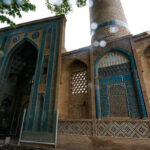
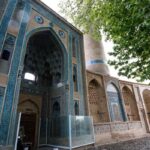
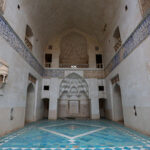
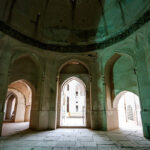
Natanz Jame’ Mosque

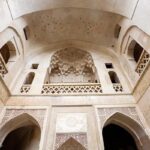
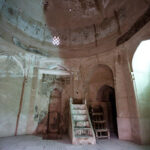
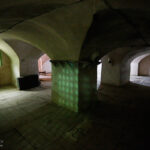
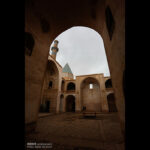
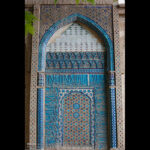
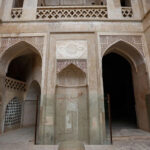
Natanz Jame’ Mosque is located near Sheikh Abdol Samad Isfahani Tomb in Isfahan province. Its dome house is a heritage of Al-e Bouyeh dynasty.


Iran, South Africa Ink 8 MoUs

Iranian President Hassan Rouhani and his South African counterpart, Jacob Zuma, who arrived in Tehran earlier in the day for an official visit, attended the ceremony.


139502051438034937570714


The documents signed in the gathering include MoUs on trade and industry, establishment of a joint task force on investment, agriculture, management of water resources, insurance services, exchange of financial information to counter money laundering, cooperation between the Research Institute of Iran’s Petroleum Industry and the Petroleum Oil And Gas Corporation of South Africa (PetroSA), as well as a document on culture and the arts.

Zuma is heading a 180-member politico-economic delegation in his trip to Tehran.

He had been expected to visit Iran in late February, but his trip was postponed.

Expansion of relations with African nations in all political, economic and cultural fields is top on the agenda of Iran’s foreign policy.

President Rouhani has repeatedly stressed his administration’s interest in boosting relations with African states.

Ahmadinejad’s Gov’t Is to Blame for US Seizure of Iranian Assets

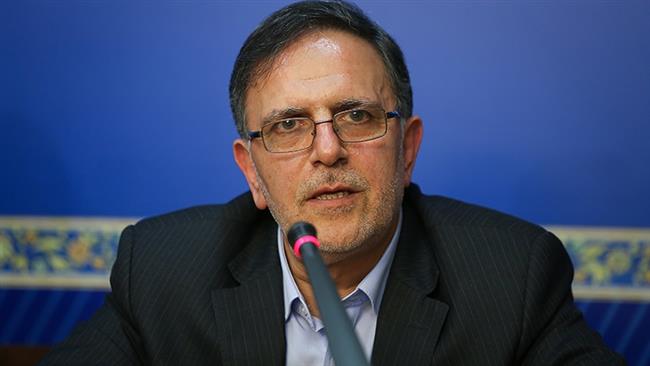
Valiollah Seif

“Unfortunately, in the previous government, there was negligence in buying bonds and making investments in the US dollar,” Seif said.

Seif noted that “u-turn” transactions with the Islamic Republic were exceptionally permitted in the US dollar sanctions against Iran, but Ahmadinejad’s administration was not careful and cautious enough in making the investments.

The former government’s officials should have considered the issue and exercised enough caution, but in spite of warnings by CBI experts against investments on dollar-based bonds, they (the then officials) made the purchases and set the stage for the Iranian nation’s loss, he added.

“The warnings by those experts came true, and unfortunately, the ban on dollar-based transactions with Iran was once again imposed in 2008, and American banks were banned from having such transactions with Iran,” Seif said.

If the bonds had not been purchased at that time, there would have been no money to be seized by the Americans, he added, as reported by the CBI’s website.

The measures taken by the forerm government led to other hostile moves by the US, including the 13599 Executive Order against the CBI, he noted.

He was referring to an executive order issued in 2012, based on which the US Treasury blocked “all property and interests in property of the Government of Iran, including the Central Bank of Iran, and of all Iranian financial institutions, regardless of whether such persons are located or incorporated inside or outside of Iran”.

Therefore, he concluded, all these unfair and illegal measures by the Americans took place under Ahmadinejad’s tenure, which was a time when the Iranian government considered sanctions to be barely effective, even futile.

If any of these moves had been prevented at that time, the recent US court ruling could not have happened, he noted.


Rouhani’s Gov’t Evading Responsibility by Pinning Blame on Predecessors: Analyst

Meanwhile, Kezem Anbarlouie, a political analyst, believes that the incumbent government of President Hassan Rouhani is trying to blame Ahmadinejad’s to whitewash its own deficiencies.
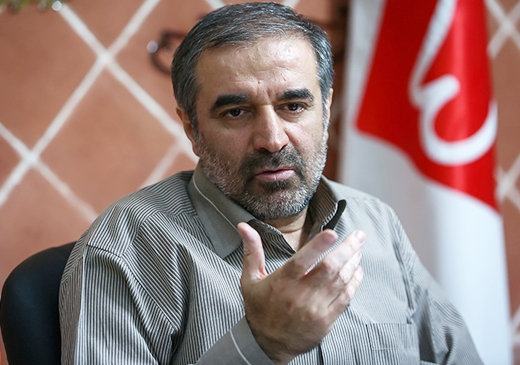
Mohammad Kazem AnbarloueiIn a comment published by Tasnim and translated by IFP, Anbarlouie referred to similar remarks by First Vice-President Eshaq Jahangiri on the responsibility of the former government for the asset seizure, describing his remarks as “shocking”.

“The First VP said the previous government was not prudent enough, and spent part of the CBI’s resources on purchasing bonds, even if it knew the Americans were not committed to international regulations,” Anbarlouie said.

He further argued that if Americans are not committed to international regulations, Rouhani’s government should also have refused to sign the recent nuclear deal (JCPOA) with them.

“The previous government was in conflict with the US, and everyone in the world knew that; however, the US government did not dare to seize Iran’s money at that time,” he went on to say.

“The 11th government has made an agreement with the Americans and shaken hands with them while they promised to release Iran’s frozen assets, but now, they have not only refused to release them, but they are also stealing and seizing the country’s money once again,” the analyst added.

“To those who say the former government is to blame for the US seizure of Iranian assets, one should say, ‘What were YOU doing? Do not blame the former government for your own imprudence’.”

Iran, German Sachsen state to Cooperate on Specialized Agriculture

Deputy Minister of Agriculture, Ali Akbar Mehrfard, and the German Minister of Agriculture and Environment Thomas Schmidt, accompanied by a delegation from the German state of Sachsen, held talks on ways to develop economic cooperation between the two countries.
Noting that Iran boasts numerous agricultural capacities and produces some 120 million tons of crops annually, Mehrfard called for transfer of technical know-how from the German state of Sachsen to Iran.
Iran stands high in the global production of crops such as pistachio, saffron and dates, he said, noting, “We are seeking to complement post-production chains, processing and packaging of products.”
Stressing the need for using modern equipment to store fruits and vegetables, he said that Iran produces four times the global average of citrus fruits, and that storing surplus consumer goods for export and processing is a significant issue.
Modern irrigation techniques are rapidly developing in the agricultural sector, he said, adding that Iran and Sachsen can have good cooperation in the field of modern irrigation.
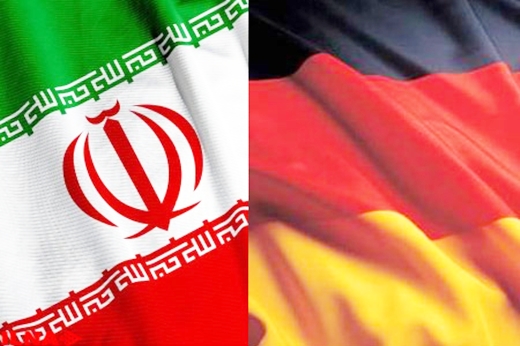
German Minister of Agriculture and Environment Thomas Schmidt, for his part, hoped Iran-Germany ties will further improve following the removal of sanctions, saying that German companies and the private sector can help Iran in this regard.
The State of Sachsen is ready for cooperation in the field of packaging and processing all types of fruits and medicinal herbs, he said. Schmidt invited Iran’s private sector to visit Sachsen to get further acquainted with technical and scientific capabilities.

Iran Ready to Help Expedite Silk Road Revival: Soltanifar

Soltanifar

Iran ready to help expedite Silk Road revival: Soltanifar

Addressing the 6th UNWTO Silk Road Task Force Meeting in Urmiye, Soltanifar noted that the Silk Road has been a route for political, cultural and tourism between Asia and Europe over the centuries, and has encouraged development for many countries.

Iran, as the descendant of ancient Persia and the centre of the Silk Road, has been a connecting link between East and West throughout history, he added.

The Iranian official further noted that over the years, the Silk Road has been a route for the exchange of goods between different countries and varied civilizations, but that unfortunately with the spread of terrorism and the existence of certain differences, certain controversies have emerged.

Soltanifar said that the promotion of friendship between different states and maintaining communication between countries requires increased intellectual and cultural efforts.

He called for the expansion of continental and international cooperation, and for ending disputes between countries in the coming decade.

The vice president said that the current meeting in Urmiye can be a tool to move away from conflicts and to promote humanitarian goals.

Soltanifar noted the Islamic Republic of Iran makes efforts to develop tourism, as well as economic, social and international potential among the Silk Road countries, in order to accelerate the process of reviving the Road and to encourage solidarity among the regional nations.

The three-day UNWTO Silk Road meeting is currently underway in Urmiye with representatives of UNESCO, the World Tourism Organization and delegates from more than 33 Silk Road countries participating.

Iran Marks 400th Anniversary of Shakespeare’s Death

At the beginning of the ceremony, which was hosted by Ardeshir Salehpour, Iranian theatre actor and director Mikaeil Shahrestani performed parts of Shakespeare’s Hamlet, one of the world’s most famous tragedies.

Qotbeddin Sadeqi, an Iranian theatre director and researcher, also delivered a speech, during which he described the playwright and poet as an exceptional personality who emerged in a time when Britain’s art and economy were thriving.

On the reason why Shakespeare is an inspirational figure for the world’s theatre, Sadeqi said, “If we look at his works, we will see four types of plays: comedies, historical plays, Roman plays, and tragedies.”

“The playwright taught us three lessons,” he noted. “The first was his special view of religion, which has its roots in the Baroque worldview. The second point, derived from his historical works, is that power is faithless and does not last forever,” with the third point being Shakespeare’s deep scepticism towards tradition and love, seen in his tragedies. Such scepticism originated from the fact that human perception of such concepts is nothing but an illusion, he added. “This tragic view is extrapolated to the extreme, leading to failure and death.”

“In his tragedies, everyone learns something: King Lear learns, Macbeth understands, and so on. How can these lessons be effective? I learned from Shakespeare that one can stand against the world’s conflicts through theatre,” the Iranian director said.

Elsewhere in the ceremony, Manouchehr Anvar, another Iranian director and playwright who is a graduate of Britain’s Royal Academy of Arts, recited parts of Hamlet in English.

A statement by Shakespeare’s Globe Theatre was also read out in the ceremony. In the statement, the group referred to its performances of Hamlet in 197 countries, including a recent performance in Tehran.

“Our performance in Tehran taught us that theatre can be a place to understand sincerity, sympathy, and a position beyond the limitations of languages,” the statement read.

“For centuries, Shakespeare’s plays have been inspiring different directors throughout the world, and Iran, with its old and brilliant history of theatre, and given the Iranian works performed in different parts of the world in recent years, is now considered part of the global theatre calendar,” the statement added.

It also noted that it is not surprising that Shakespeare’s works enjoy a great position in Iran and inspire various generations of Iranian artists.

At the end of the ceremony, a portrait of Shakespeare was unveiled and signed by Iranian artists.