Thursday, December 25, 2025
Home Blog Page 4516

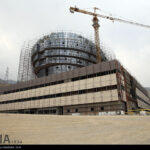
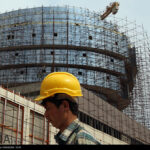
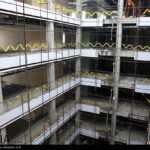
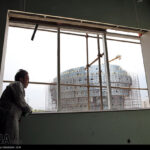
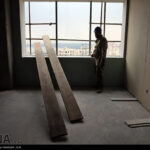
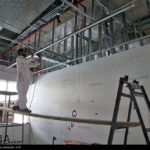
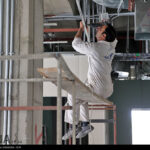
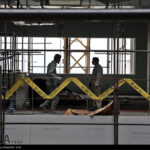
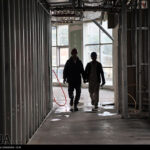
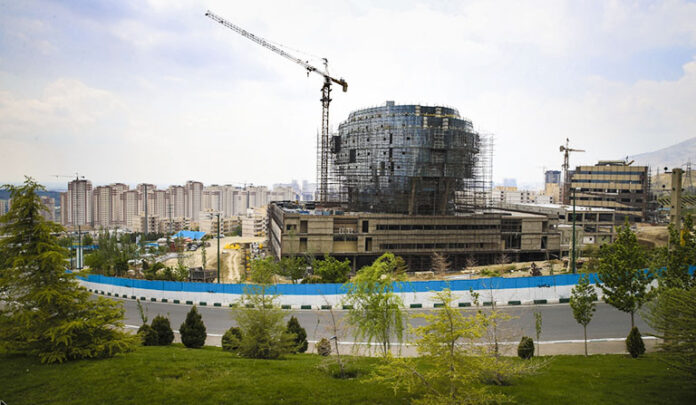
World’s Largest Brain Research Centre under Construction in Tehran

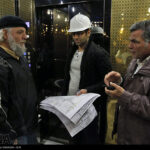
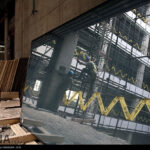
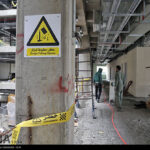
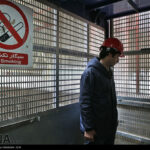
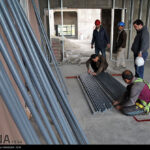
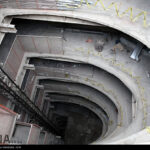
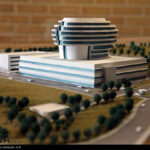
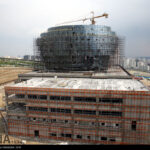
Based on a proposal by Professor Majid Samii, the world’s largest brain and neuro
​logy ​research centre is being constructed in the Iranian capital​, under the supervision of the distinguished neurosurgeon. The hospital ​will have an area of 80,000​ ​square metres​ ​and 11 storeys. The main building’s ​floorplan is 2.5 times larger than the world-renowned International Neuroscience Institute (INI), which was founded by Samii in Germany’s Hannover. The Tehran building ​will be exceptional,​​ both​ in the Middle East and ​globally, in terms of its size, structure, medical facilities and staff.


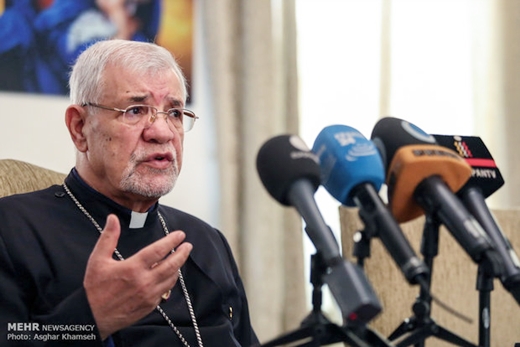
Iran Stood with Armenians in Grief over 1915 Genocide: Archbishop

“Iranians have always shared our grief over the large genocide, in which 1.5m Armenians were killed,” Sarkissian said, expressing Armenians’ happiness with Iran’s solidarity.

“It has been a century since the genocide, and during all these years, we Armenians have always tried to assert our rights, and are hopeful about the future,” he added.

The past century was full of wars and bloodshed, he said, at the same time noting that such problems had not prevented the Armenians from moving forward. “We continued our life and progress,” the Armenian archbishop said.

He further lashed out at Turkey over its failure to recognize and condemn the genocide after one hundred years, adding, “If world figures and organizations express their support in denouncing the genocide, it would cause peace-seeking countries to stand by us so that we would be able to protect our rights.”

“On the 101st anniversary of the genocide, we want to call on Turkish officials either to understand their own history or to recognize the realities of the genocide,” he added.

“After all these years, we still remember the victims of the painful disaster every day and believe that justice will one day be restored to its real position in human life,” Sarkissian continued.

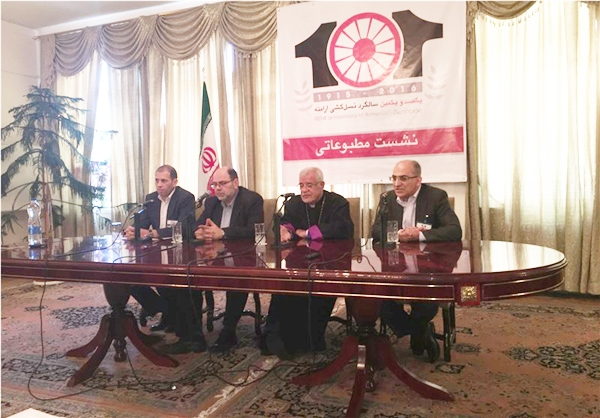
April 24 is the 101st anniversary of the Ottoman Empire’s massacre of Armenian nationals, which took place in 1915. On this day, a ceremony entitled “Genocide and Extremism: from Armenia to Syria” is held in Ararat Club in Tehran.


139502041817179657566454

IRGC Navy Commander: US Incapable of Waging War on Iran

Speaking in a ceremony held on Sunday in Yazd, Fadavi said the hostility of the US and other hegemonic powers towards Iran is constantly increasing, but that they know that the disadvantages of any move against Iran would outweigh any advantages.

Iran and Iraq signed a ceasefire in the 1980s and established peaceful borders between two countries. Despite this, US warships have remained active in the Persian Gulf, even though no bullet has been fired, General Fadavi stated.

“That was because the Americans believe in Iran’s power of deterrence, and do not have the capability to attack Iran militarily,” he added, as reported by Tasnim and translated by IFP.

“This deterrent power means that if they make any move against Iran, it would be more harmful than beneficial for them,” he added.

“Americans say the entire world should obey them because they are the most powerful, and this is happening in reality: many countries do not even dare to express rhetorical opposition to the US,” he continued.

“Currently, 50 American warships are in the Persian Gulf, and this number increases to 63 if we take into account the warships of its allies,” he said.

However, Fadavi emphasized, Iran does not consider them powerful at all.

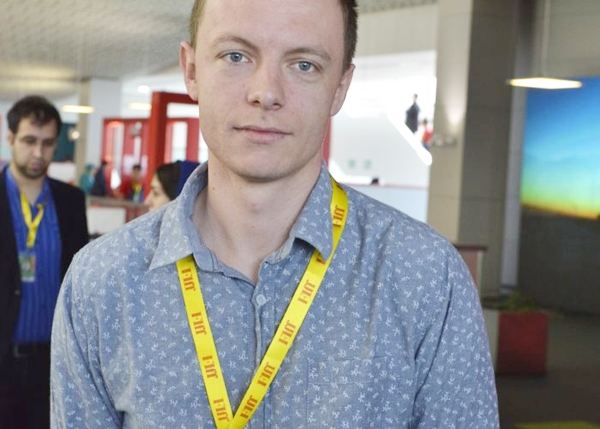
“FIFF Is Just Like Western Film Festivals” – Marcin Luczaj

How do you feel about being in Iran for the first time?

Good, very good. I have always wanted to be here. I select Iranian films for our festival and I have seen lots of Iranian films, but never have a chance to be here.

What do you like about Iranian cinema?

I think Iranian cinema is very close to Polish cinema; both cinemas are based on society, based on social dramas. And for us it is the exotic culture that is more fascinating. However, we can find lots of links between the two. I mean, on the surface Iranian cinema seems very exotic, but at the same time it is very familiar.

Are Polish audiences familiar with Iranian cinema?

They are quite familiar with Iranian cinema. Iranian films are distributed in Poland. For example, in our cinema, we show some of the Iranian films which were in Cannes or the Berlinale, so there is a chance of them being shown in cinemas. We always have one to five Iranian films every year. Last year, we had a film directed by Niki Karimi which the audience really liked.

How do you usually select Iranian films for your festival?

We receive over two thousand submissions and we screen one hundred films; we pick whatever movies we like. I mean we don’t select a movie because it is from Iran, and we don’t select a movie because we like the country or not! We like to show other movies which are made outside Europe, and Iran is part of that.

What do you think about the organization of the festival?

Well, it is very well-organized. I have been to a lot of festivals and I don’t see any difference between Fajr and the others. It is just taking place in another city, and when you are in the festival venues, it looks like other festival and film markets in Europe or Unites States, very similar.

What do you expect to see in the coming days in the festival?

We are in the selection process for the Warsaw Film Festival, so I am looking for new films from Iran. I know there are lots of Iranian films ready and waiting for an international premiere and we are interested to discover new names. Some of the names in the lineup are by familiar names, like Reza Dormishian.

Are you looking for something specific in the films?

We know the taste of our audience; we have been running the festival for over twenty years. Sometimes we don’t like a movie but know that our audience will like it and want to see it, so we select it. In our festival we are looking for more experimental films in terms of narrative to introduce to Polish people, because they are used to watching traditional films. Our festival is a platform to let them watch new films and discover films which are not shown in regular cinemas.


The 34th edition of Fajr International Film Festival is being held from April 20th to April 25th, 2016 in Charsou Cineplex, under the supervision of Iranian filmmaker Reza Mirkarimi, who is also the Managing Director of Khaneh Cinema.

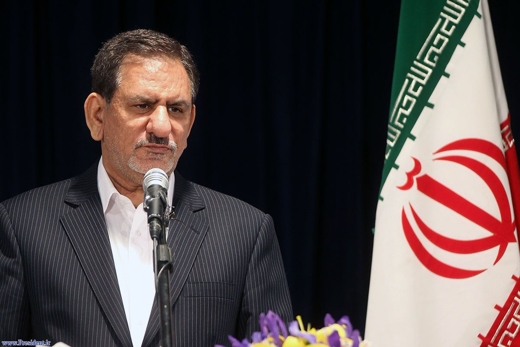
First VP Underlines Importance of Knowledge-Based Economy

Jahangiri

Jahangiri noted on Sunday that five approaches in the Resistance Economy are focused on knowledge-based economy, stressing that knowledge-based companies can benefit from all of these approaches, as they are all commensurate with each other.

He made the remarks at the opening ceremony of the 4th Exhibition of Iranian-Made Laboratory Equipment and Materials here in Tehran, as reported by IRNA and translated by IFP.

The main orientation of Iran’s economy is towards the accumulation of knowledge, Jahangiri pointed out, adding that the Iranian administration should develop precise approaches so as to realize this knowledge-based economy.

“A knowledge-based economy means that our industry, agriculture, and oil – as well as the way the country is administered – should be based on knowledge,” he added.

Jahangiri referred to universities as the main infrastructure for the realization of such an economy, and stated that universities have a key role to play in the production of knowledge inside the country.

“Our primary mission is to equip the universities correctly, and the government should help equip the country’s universities with the required laboratory equipment,” he went on to say.

The Iranian first vice-president further referred to the contracts recently signed by the Iranian oil ministry with the country’s top universities, and said that more than $300m is earmarked to be given to universities to make the oil industry less dependent on foreign sources of knowledge and expertise.

“We are all responsible for Iran’s development,” he said, stressing that sustainable development is only possible if it utilizes science and technology.

“Given Iran’s historical record in the production of science and technology in the world, we need to regain our former position. We should pay attention to the scientific elite and respect our universities,” he stated.

Kerry assures world business transactions with Iran are safe

Speaking to reporters before meeting with Iranian Foreign Minister Mohammad Javad Zarif in New York on Friday, Kerry urged internatioanl financial institutions to inquire whenever they have any doubts on their business with Iran.

The following is the full text of the remarks made by Secretary Kerry and Foreign Minister Zarif:

SECRETARY KERRY: Good afternoon, everybody. Let me just say a few words, if I can. I’m very pleased to be meeting with Foreign Minister Zarif today to continue our discussions about the Joint Comprehensive Plan of Action implementation. We had a very productive meeting earlier in the week. We exchanged a lot of thoughts. We talked about some challenges, and so I think we both decided that it was important to do some homework. And we’ve come back today to follow up on that conversation.

First, I want to say something about one of the issues that we have been discussing. As President Obama has said, as Secretary Jack Lew has said, and as I have said, and we have said it repeatedly, the United States is not standing in the way and will not stand in the way of business that is permitted with Iran since the JCPOA took effect.
And I want to emphasize we lifted our nuclear-related sanctions, as we committed to do, and there are now opportunities for foreign banks to do business with Iran.

Unfortunately, there seems to be some confusion among some foreign banks, and we want to try to clarify that as much as we can. Among the nuclear-related sanctions that were lifted were those that prevented Iran from engaging with non-U.S. banks, including getting access to Iran’s restricted funds that were previously held overseas.

Now, we have no objection – I want to make this clear. We have no objection and we do not stand in the way of foreign banks engaging with Iranian banks and companies, obviously as long as those banks and companies are not on our sanctions list for non-nuclear reasons. But the nuclear sanctions permitted non-U.S. banks to engage with business activity and companies in Iran, and it allows them to provide access to funds and financing, and it allows Iran, importantly, to have access to its own funds.

We also – I want to say that we understand that banks and businesses have complicated business decisions to make, and they have to make them. But that is why the State and the Treasury Department have been actively engaged with partner governments and the private sector in order to clarify those sanctions that have been lifted. And if banks or any company has any question about this, we’re happy to answer those questions. They shouldn’t just assume that activities that were not permitted before the JCPOA are not permitted at this point in time. And so they shouldn’t also assume that activities still prohibited by the primary embargo are also prohibited for foreign actors. That’s not the way that works.

So when in doubt – my message: when in doubt, ask.

Now, we recognize it is going to take some time for companies to feel confident in reengaging with Iran, and in all fairness, that is due to concerns other than sanctions. And Iran, as we have said in a candid conversation, also has a certain amount it needs to do to modernize its own banking system to begin to do things to – that it hadn’t done during the years that it was operating under sanctions, and that would facilitate this process.

But I want to make clear the United States is committed to doing our part as we believe it is in our interest to ensure that the JCPOA, the nuclear agreement that we reached, that it is in fact working for all participants. And just as we have upheld our commitments, we’re going to continue to work with Iran to verify that they uphold theirs also. It is mutuality that was created in this, and it’s important that we make sure there is mutuality in its implementation.

FOREIGN MINISTER ZARIF: Thank you, Secretary Kerry. I think what is important for everybody to understand is that the JCPOA was a balanced agreement, and Iran has implemented its part of the bargain and we hope that with this statement by Secretary Kerry and other steps that were taken by the United State, now we will see serious implementation of all JCPOA benefits that Iran should derive from this agreement so that we can ensure that agreement is a way for addressing international problems, that sanctions and pressure won’t resolve international problems, but negotiations,
talks, dialogue in fact are the way to address international problems.

We hope that the statement made today by Secretary Kerry will begin to open the difficult path that has been closed because of concerns that banks had about the U.S. approach towards implementation of the commitments under the JCPOA. We will continue to have differences with the United States. Our differences are very serious in a good number of areas. We will – but we have decided together with P5+1 to address this issue, and we want to show that P5+1 and Iran have been able to resolve a very serious, difficult issue through negotiations, and I believe we should take the necessary steps in that regard. And I hope that by – through serious action so that the Iranian people can see the benefits of implementation of JCPOA, we can move forward with the long-term implications for this very important agreement, which should create the foundations and not the ceilings for resolution of international issues. Thank you.

SECRETARY KERRY: The foreign minister just mentioned one thing I just want to make clear so we’re both on – addressing it. The foreign minister is correct; there are differences and some of them are obviously serious differences. Those have to be the subject of future discussion. But it’s important for people to understand that an agreement is an agreement, and we need to separate, even as we are working to resolve those other differences. And nothing that I said diminishes the United States commitment to helping to resolve those differences and certainly to continue to work for the peace and stability of the region. Thank you.

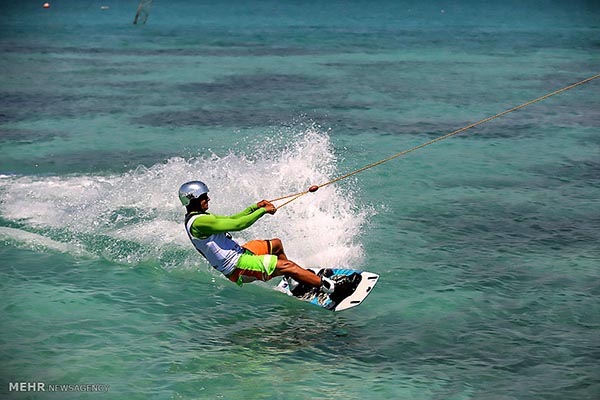
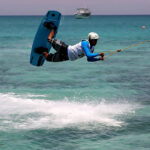
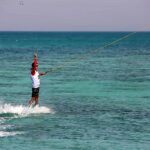
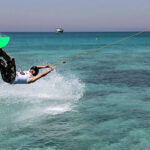
Water skiing competitions in Kish

The qualifying competitions of Iran’s national water skiing team was held in Kish Island of Persian Gulf on Friday.


President Rouhani Welcomes South African Counterpart in Tehran

President Zuma, heading a high-ranking delegation, arrived early today.

The national anthems of the two countries were played at the ceremony, and the two presidents reviewed a parade.

After that, the Iranian and South African presidents started bilateral talks.

During Zuma’s stay in Tehran, several economic documents will be signed by the two countries’ delegations.

The South African president is scheduled to leave Tehran for the historical Iranian city of Isfahan on Monday.

Tehran, Seoul to Ink Multi-Billion Dollar Deals: Report

Heading a delegation of some 200 businesspeople from such areas as construction, energy and finance, South Korean President Park Geun-hye is slated to visit Iran on May 1-3 to discuss ways to promote business ties between the two countries.

Her visit, the first of its kind by a South Korean president since the two sides established diplomatic relations in 1962, comes as Iran has been emerging as a high-potential market after international sanctions were lifted in January.

Leading Korean builders plan to sign memorandums of understanding and preliminary agreements on building railroads, a dam, petrochemical plants and hospitals, with the value of contracts estimated around 15-20 trillion won ($13-17 billion), Yonhap News Agency quoted industry officials as saying.

Daelim Industrial said it plans to ink a $4.9 billion deal on railroad projects and a preliminary agreement on a dam and water plant deal estimated at $2 billion. It has also been pushing for participating in a petrochemical project, hoping to sign a memorandum of understanding with the Iranian government during the South Korean president’s visit.

Hyundai Engineering Co. said it is set to clinch a $3.6 billion framework agreement with Kangan Petro Refining Co. to build a gas refining facility in the South Pars, the world’s largest gas field located in the Persian Gulf. The firm also plans to sign a preliminary deal to participate in a private power plant construction project estimated at $500 million.

Hyundai Engineering & Construction Co. and POSCO Daewoo Corp., formerly Daewoo International Corp., will sign a deal with Iran’s health ministry to build a hospital for Shiraz University of Medical Sciences, according to the company officials.

Under the contract, Hyundai E&C will build the facility and POSCO Daewoo will provide the medical equipment, they said.

The large-scale deals in the offing are expected to give momentum to Korean companies, which have grappled with shrinking demands in the Middle East amid low oil prices.

“It would take some time to sign formal agreements and confirm the contracts in Iran. But at least they would inject fresh momentum into the sluggish Middle Eastern construction market, dragged by a prolonged oil price slump,” said a senior official at a Seoul-based construction firm.

Iran’s President Urges Long-Term Plans for Environmental Protection

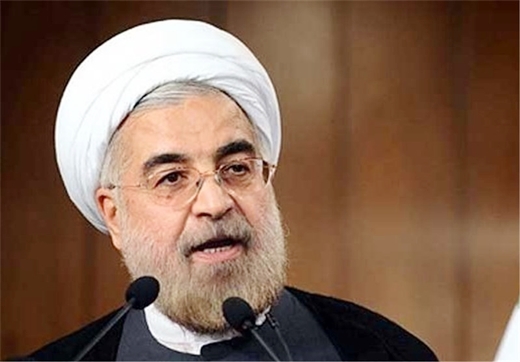
Despite a whole host of political and social concerns and security problems in the region, the first item on the agenda at the first cabinet session in 2013 was a scheme to save drying Lake Oroumiyeh in northwest of Iran, President Rouhani said in an address to the 2nd edition of an international seminar on environment, culture and religion, which kicked off in Tehran on Saturday.

He referred to plans for taking high-polluting vehicles off the roads, tackling dust particles, producing gasoline in compliance with the Euro-4 emission standards, developing the South Pars gas filed and feeding the country’s power plants with gas as some of the administration’s efforts to prevent damage to the environment.

President Rouhani further emphasized that the environmental concerns cannot be settled in short term, but a long-term plan is required to deal with those problems.

Back in March, Leader of the Islamic Revolution Ayatollah Seyed Ali Khamenei urged all Iranian people and officials to pay more attention to safeguarding the country’s green spaces.

The 2nd International Seminar on Environment, Religion and Culture is underway in Tehran for two days with the participation of representatives from 15 countries.

It has been organized by Iran in cooperation with the United Nations Environment Program (UNEP) and the UN Educational, Scientific and Cultural Organization (UNESCO).