Friday, December 26, 2025
Home Blog Page 4499

Deputy Minister: Being Optimistic about US Is a Strategic Mistake

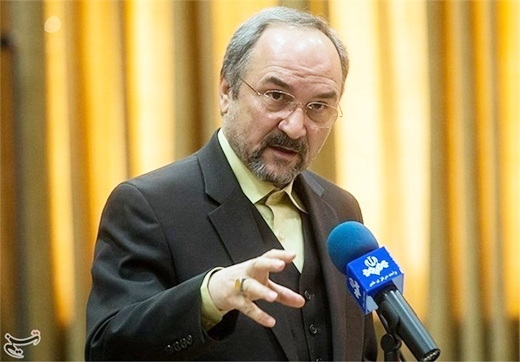
“This recent US move [the asset seizure] had its roots years ago. This is a very good indicator of the fact that fundamental hostility between the US and the Islamic Republic of Iran is going to last,” Khazaei told Tasnim, as translated by IFP.

“Although the move was made by the US judicial system, the US administration was also behind it, and we should be vigilant against such measures, as the Leader of the Islamic Revolution has warned,” he went on to say.

“Being optimistic that the Americans would completely renounce their hostility towards Iran is not a correct or strategic move. We should defend our national interests from any position,” Khazaei, who was Iran’s envoy to the UN, noted.

“US hostility towards Iran is a very complicated issue,” he said, stressing that Iran should take legal and diplomatic measures to follow up the seizure of its assets.

“Iran should follow up the issue in international legal bodies and put the US under pressure,” he went on to say.

“In this case, more important than the money is its political aspect, which is indicative of the continued hostility of Americans towards Iran,” he further noted, stressing that the enmity has not decreased at all.

A Look at Iranian Newspaper Front Pages on May 4

Iran Newspaper front pages

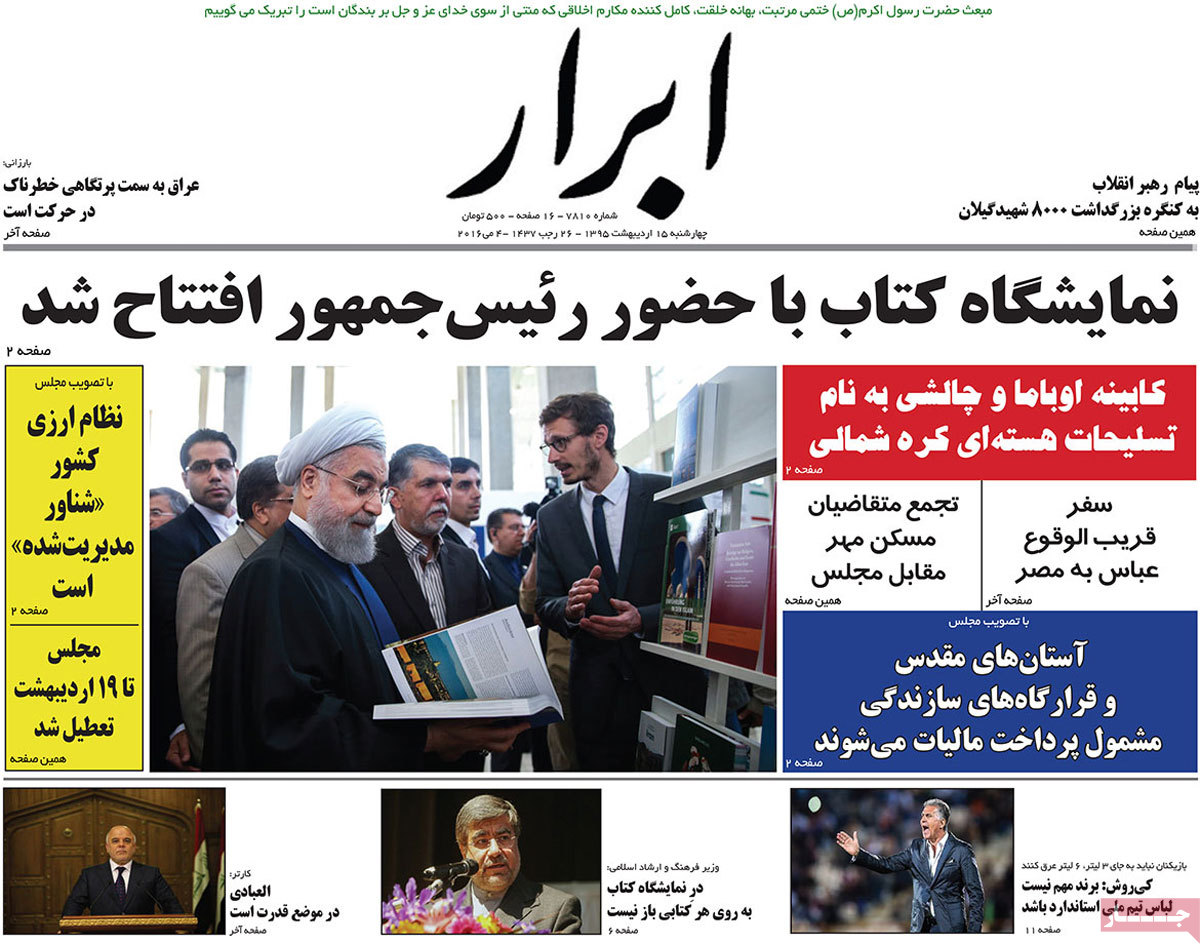
Iranian President Hassan Rouhani’s statements at the opening ceremony of the Tehran International Book Fair, about the necessity for showing tolerance towards criticism and giving freedom and security to authors, were widely covered by Iranian newspapers.

The media also focused on the warning by IRGC’s Brigadier General Hossein Salami to block the Strait of Hormuz in the Persian Gulf if the US threatens Iran.

There were also reports on a bill passed by the parliament to tax certain bodies like the custodians of holy shrines and IRGC construction units, which had previously been exempt from taxation.


Abrar:

1- Parliament Approves Plan for Construction Units and Custodians of Holy Shrines to Pay Taxes

2- Queiroz: Brand of National Team Kit Unimportant, They Should Be Standardized
 

A Look at Iranian Newspaper Front Pages on May 4


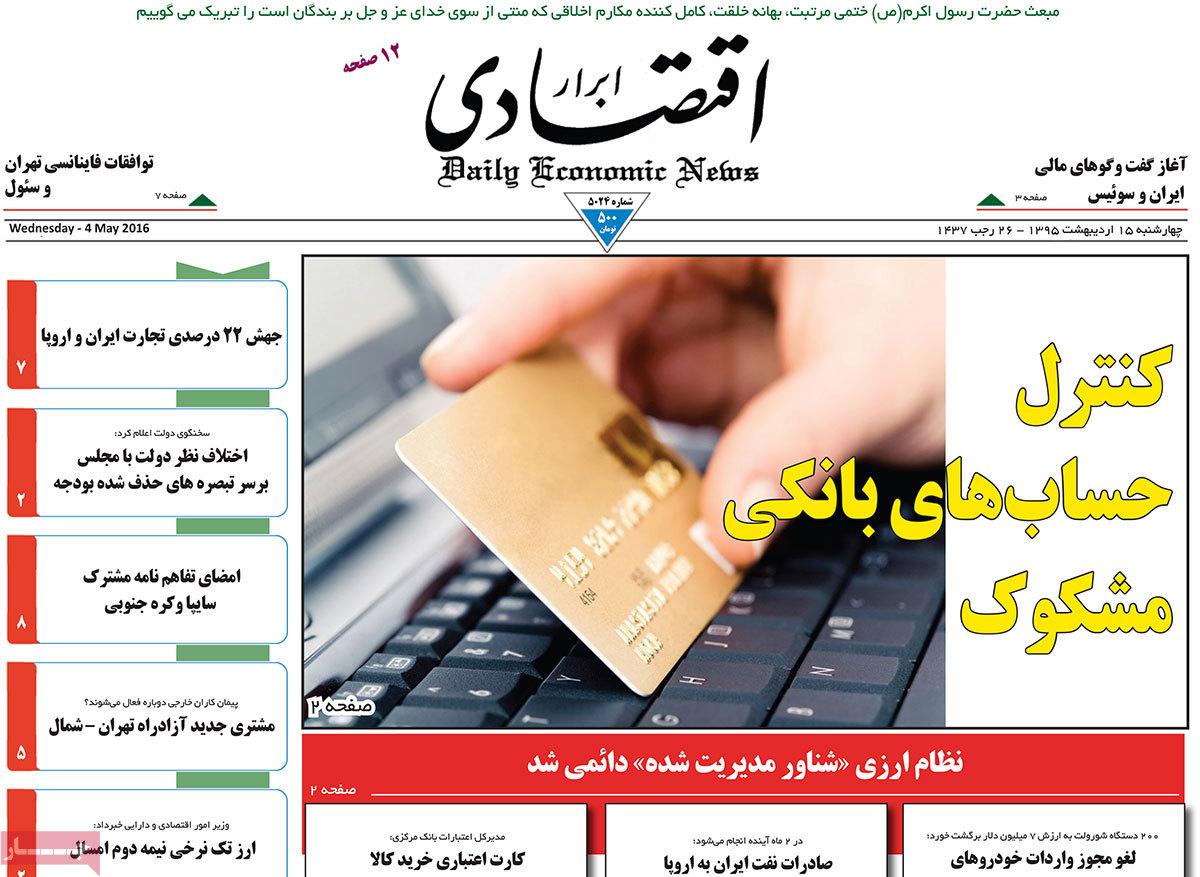
Abrar-e Eqtesadi:

1- Suspicious Bank Accounts to Be Controlled by Gov’t

2- Iran’s Oil to Be Exported to Europe in 2 Months

3- Giant Iranian Auto-Manufacturer Saipa Signs MoU with South Korea

4- Iran-European Trade Up by 22%
 

A Look at Iranian Newspaper Front Pages on May 4


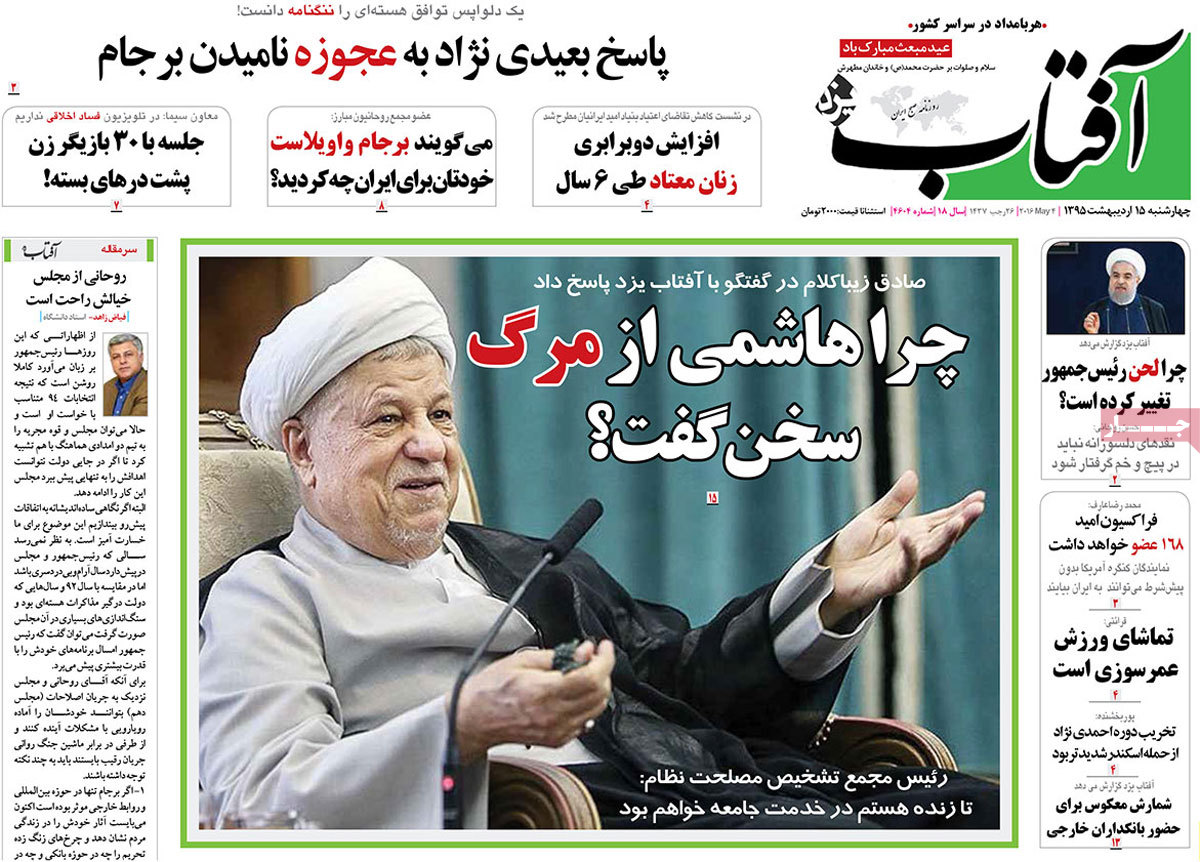
Aftab-e Yazd:

1- Number of Female Drug Addicts Doubled in 6 Years

2- Iran’s Destruction under Ahmadinejad Even Worse than Alexander’s Invasion
 

A Look at Iranian Newspaper Front Pages on May 4


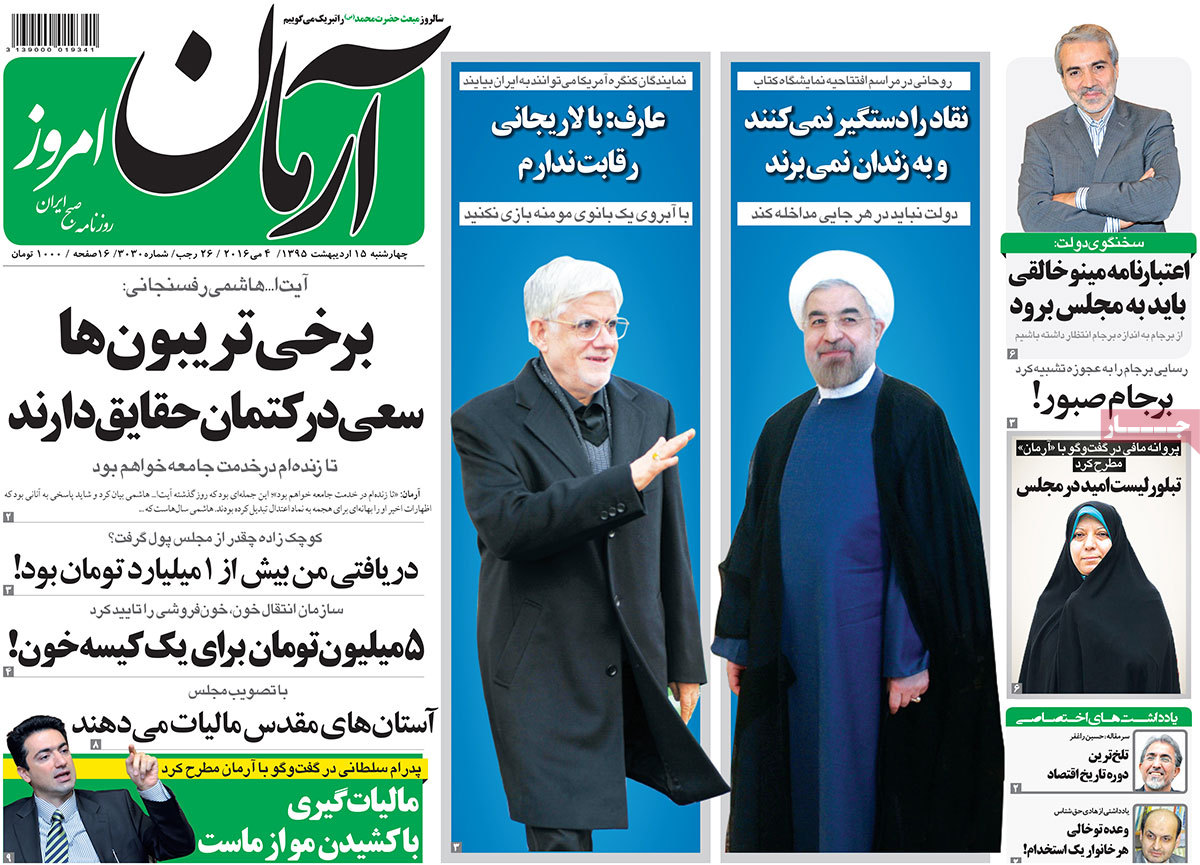
Arman-e Emrooz:

1- Critics Should Not Be Arrested and Jailed: Rouhani

2- Blood Sale in Iran Officially Confirmed: Almost $1,500 per Bag
 

A Look at Iranian Newspaper Front Pages on May 4


Etemad:

1- Tehran Has 1,200 Bookstores but 8,000 Cosmetics Shops: Mayor

2- Senior Reformist Aref: US Congressmen Can Visit Iran without Setting Preconditions
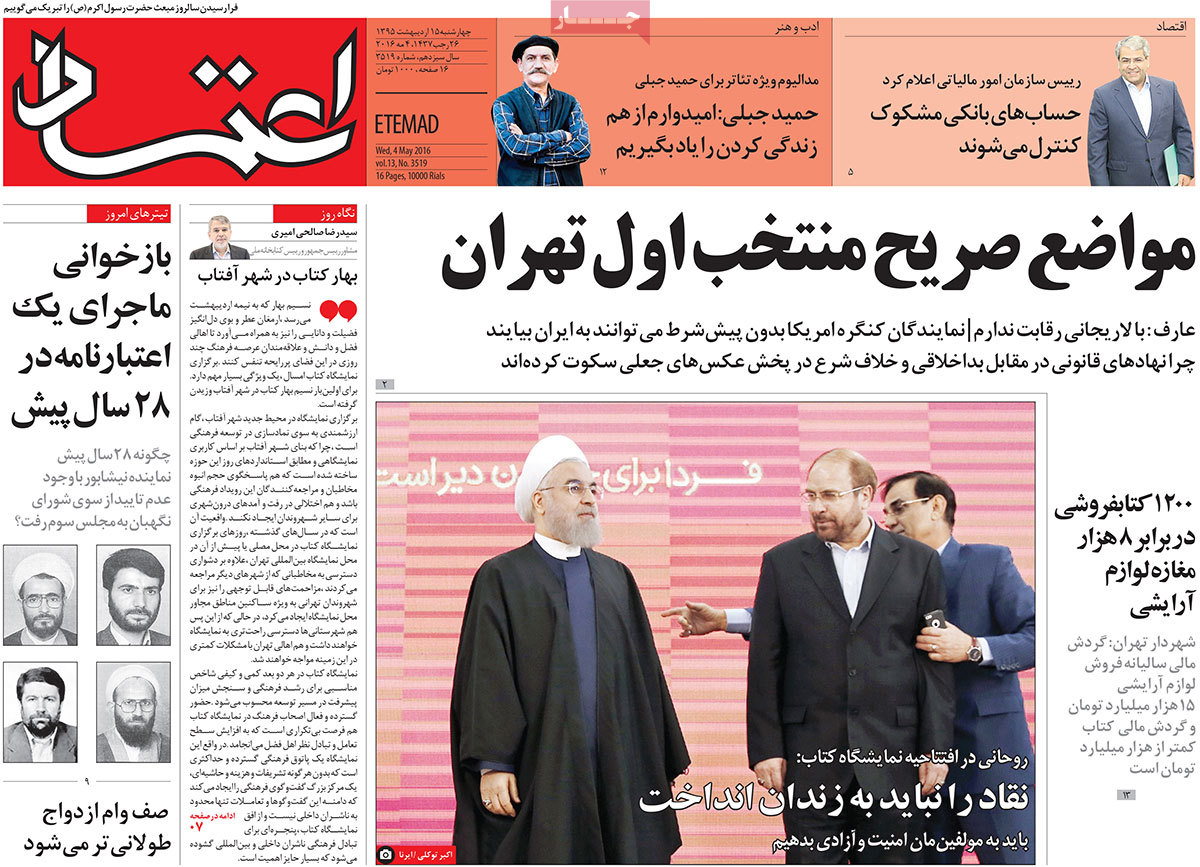
 

A Look at Iranian Newspaper Front Pages on May 4


Ettela’at:

1- If Not Useful, Leader Would Have Opposed Nuclear Talks: Negotiator

2- Parliament Speaker Larijani: We Should Prepare Grounds for People’s Recreation and Happiness
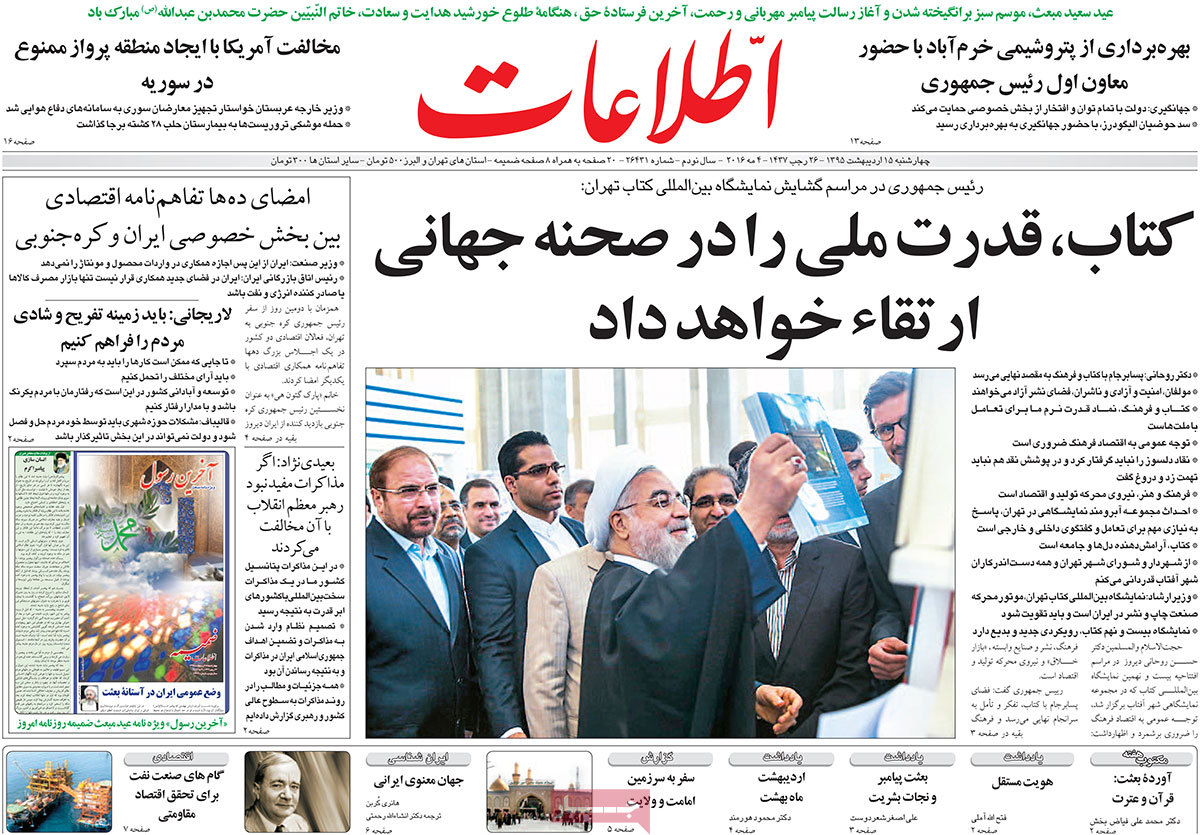
 

A Look at Iranian Newspaper Front Pages on May 4


Haft-e Sobh:

1- Barefoot Kingdom: Leicester City, the Unknown EPL Champions

2- Godfathers of Robbery in Tehran Arrested
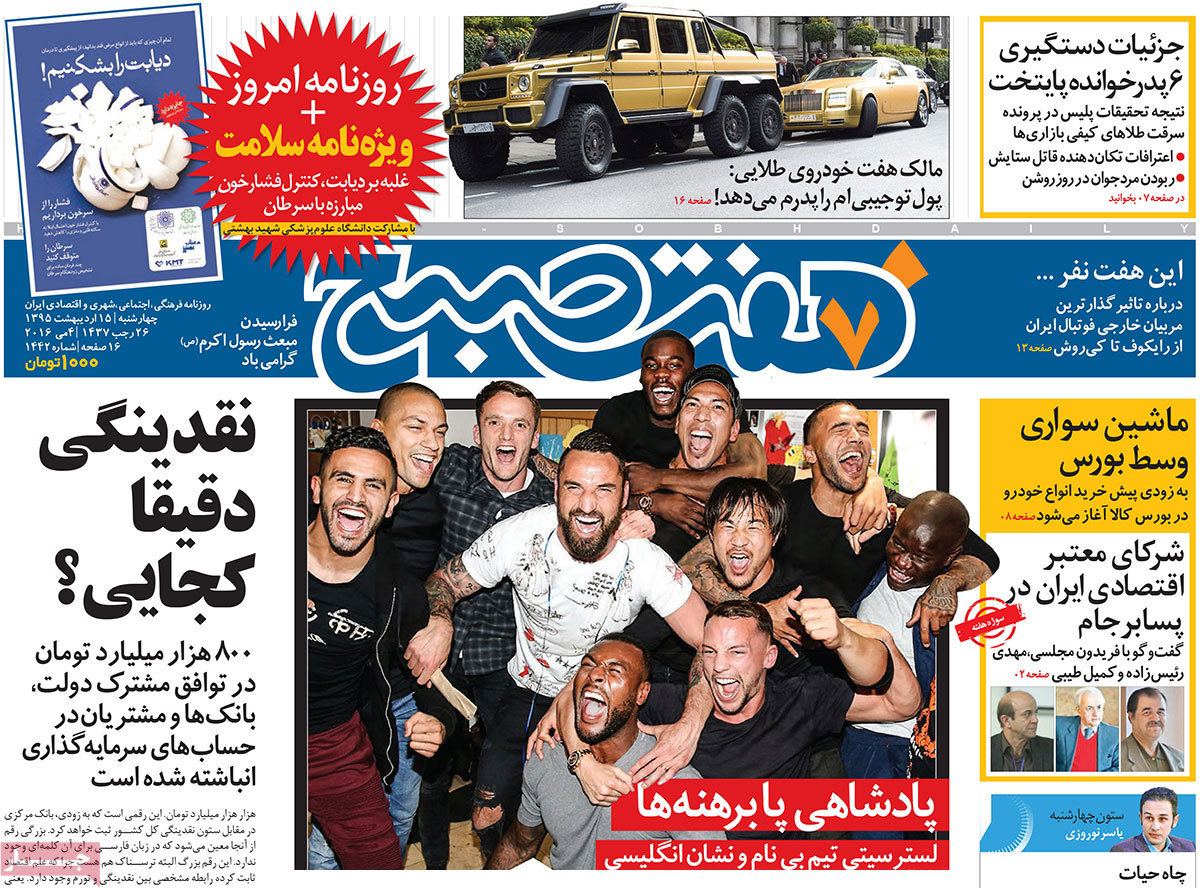
 

A Look at Iranian Newspaper Front Pages on May 4


Hemayat:

1- Licence for Import of American Cars Rescinded

2- We Brought Enemies to Their Knees: IRGC Quds Force Commander Gen. Soleimani
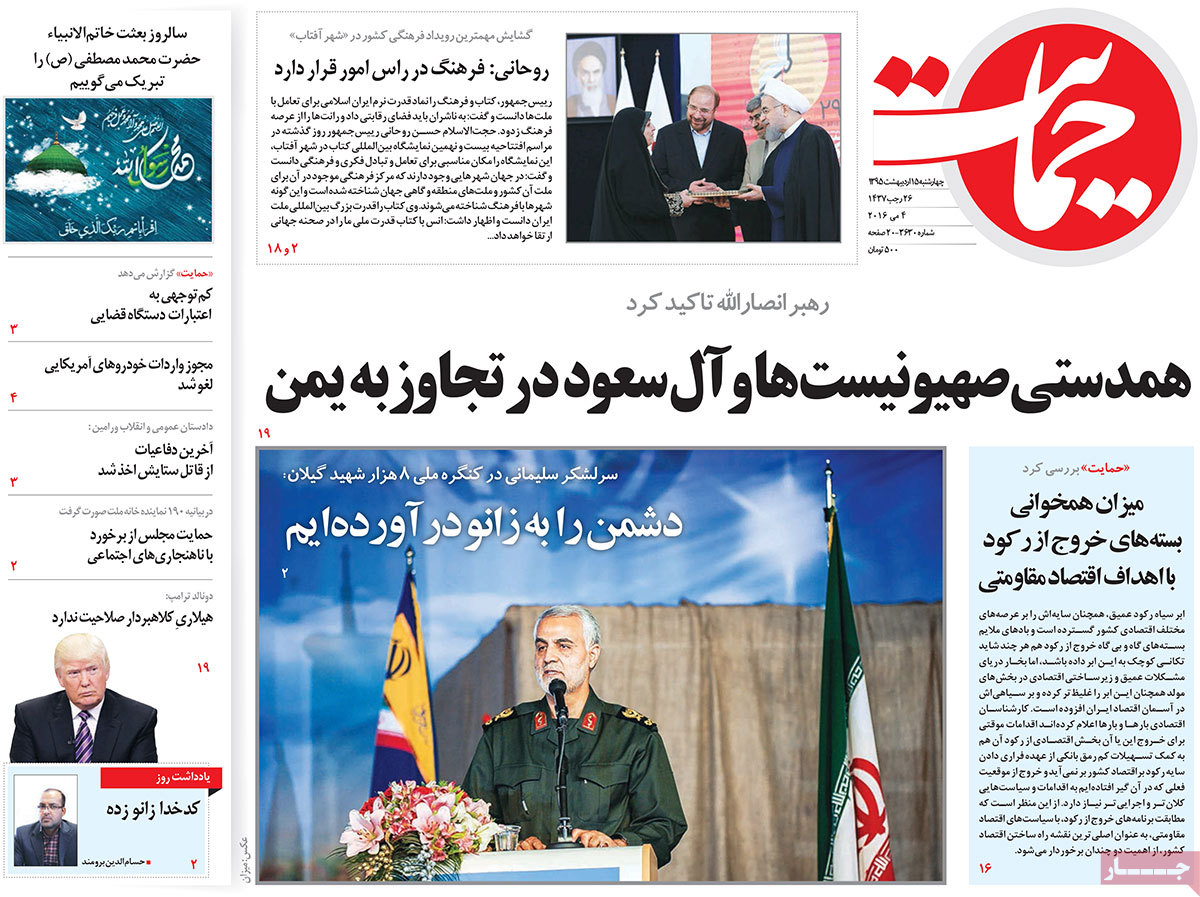
 

A Look at Iranian Newspaper Front Pages on May 4


Iran:

1- We Should Guarantee Security and Freedom of Authors: Rouhani

2- Rafsanjani Hails Improvement of Women’s Position [in Iran]
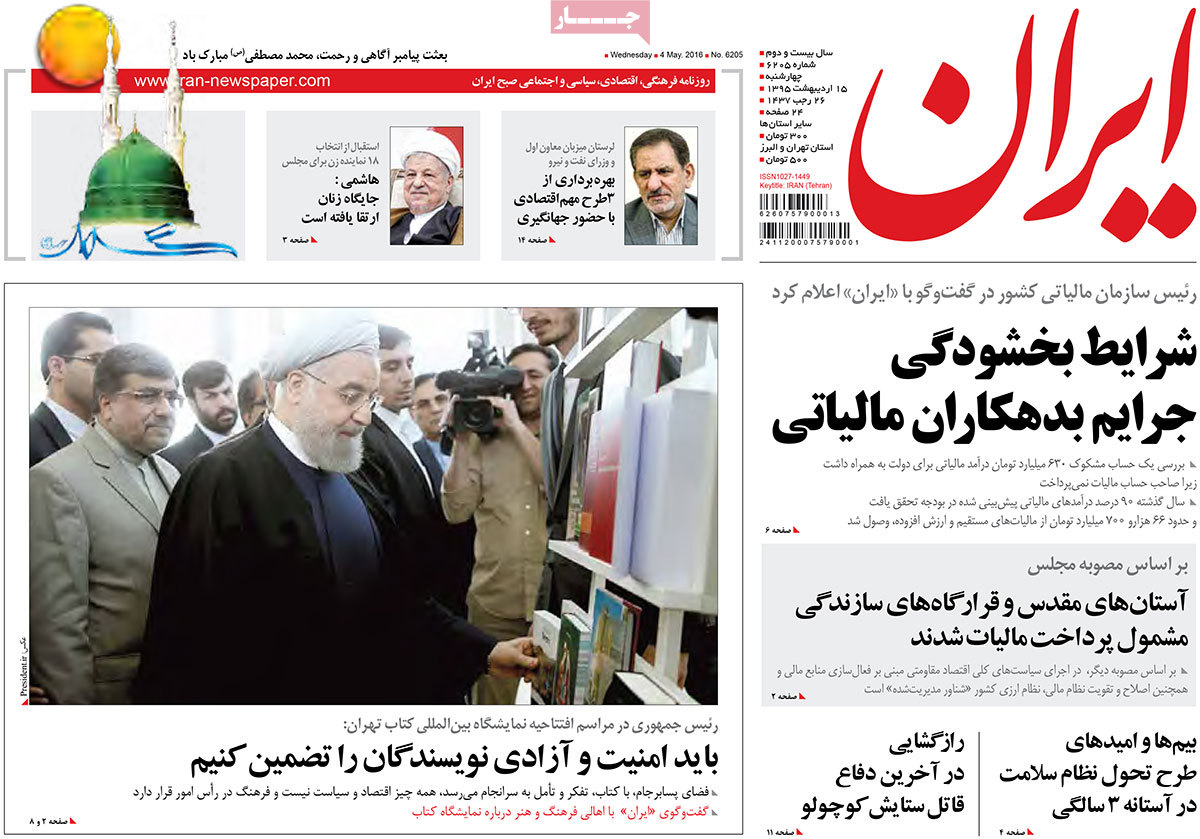
 

A Look at Iranian Newspaper Front Pages on May 4


Javan:

1- If US Threatens Iran, We Will Blockade Straits of Hormuz: IRGC Lieutenant Commander

2- Intelligence Ministry to Deal with Prosecution of Tax Evaders: Tax Organization

3- President Rouhani Insists JCPOA Brings Good Results
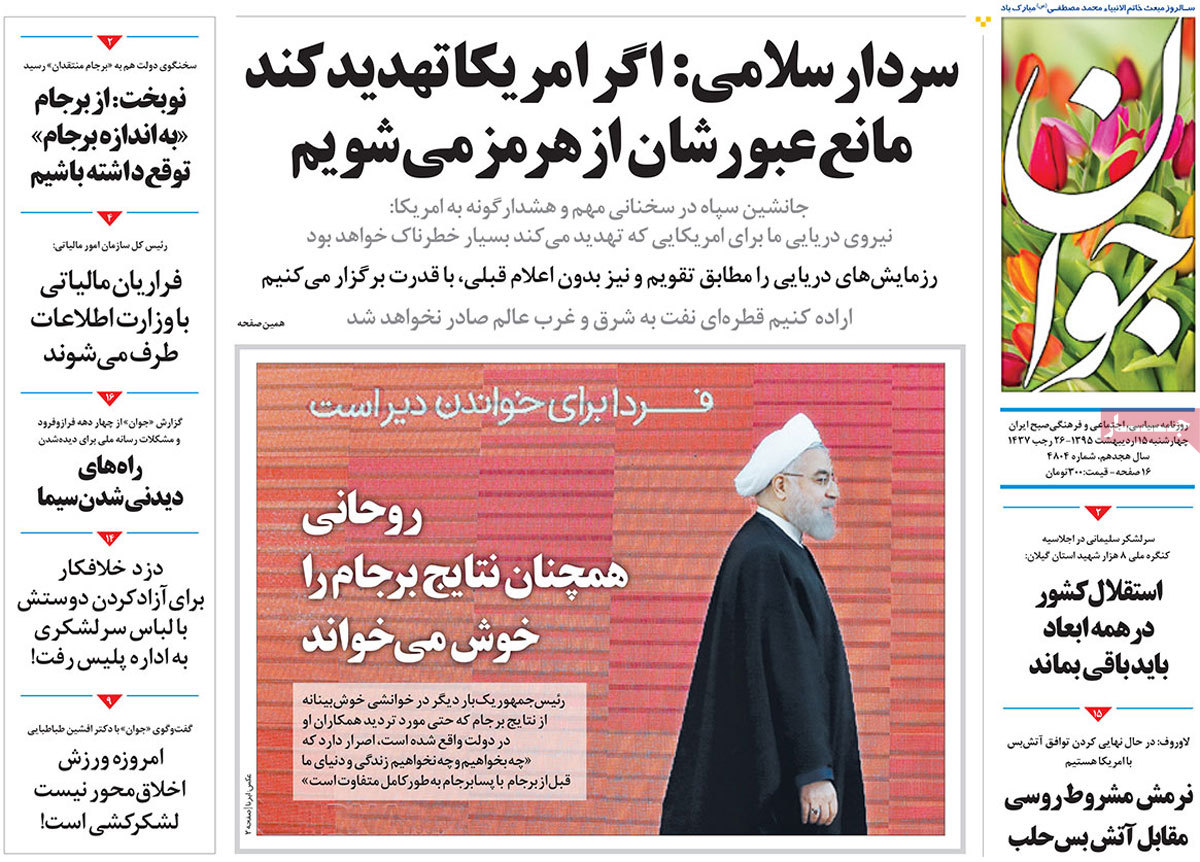
 

A Look at Iranian Newspaper Front Pages on May 4


Jomhouri Eslami:

1- World Now Trusts Islamic Republic of Iran and Its Commitments: President

2- Iran and South Korea Sign MoU on Medicine and Medical Equipment

3- Millions of Pilgrims Visit Iraqi Holy City of Kadhimiya despite ISIS Threat
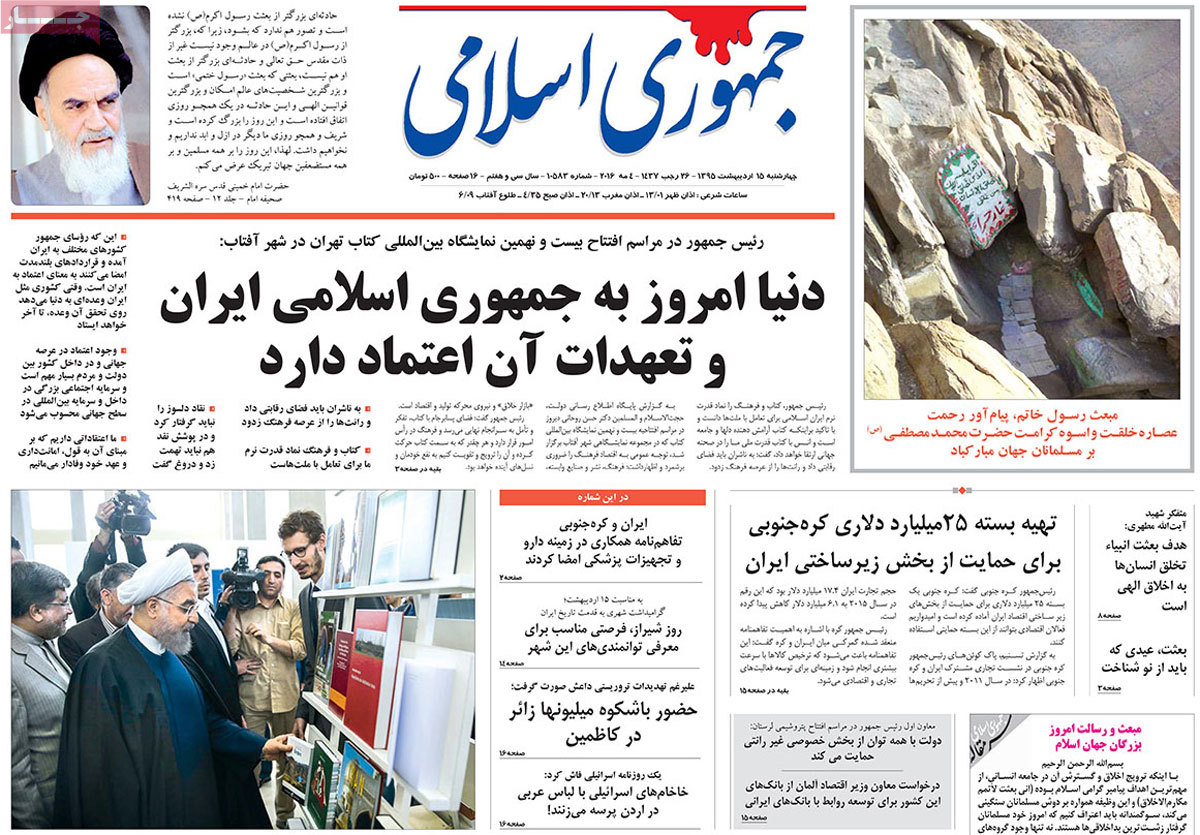
 

A Look at Iranian Newspaper Front Pages on May 4


Keyhan:

1- Rouhani Says Life in Iran is Totally Different Before and After Nuclear Deal: Do All Roads End in JCPOA?

2- 190 MPs Support Police’s Fight against Social and Ethical Norm-Breaking

3- How Many More Setayeshs Should Fall Victim until Gov’t Does Something?

[A piece urging the filtering of social media such as Telegram. The murderer of a 6-year-old Afghan girl, Setayesh, had reportedly watched pornographic clips on Telegram before raping and killing her]
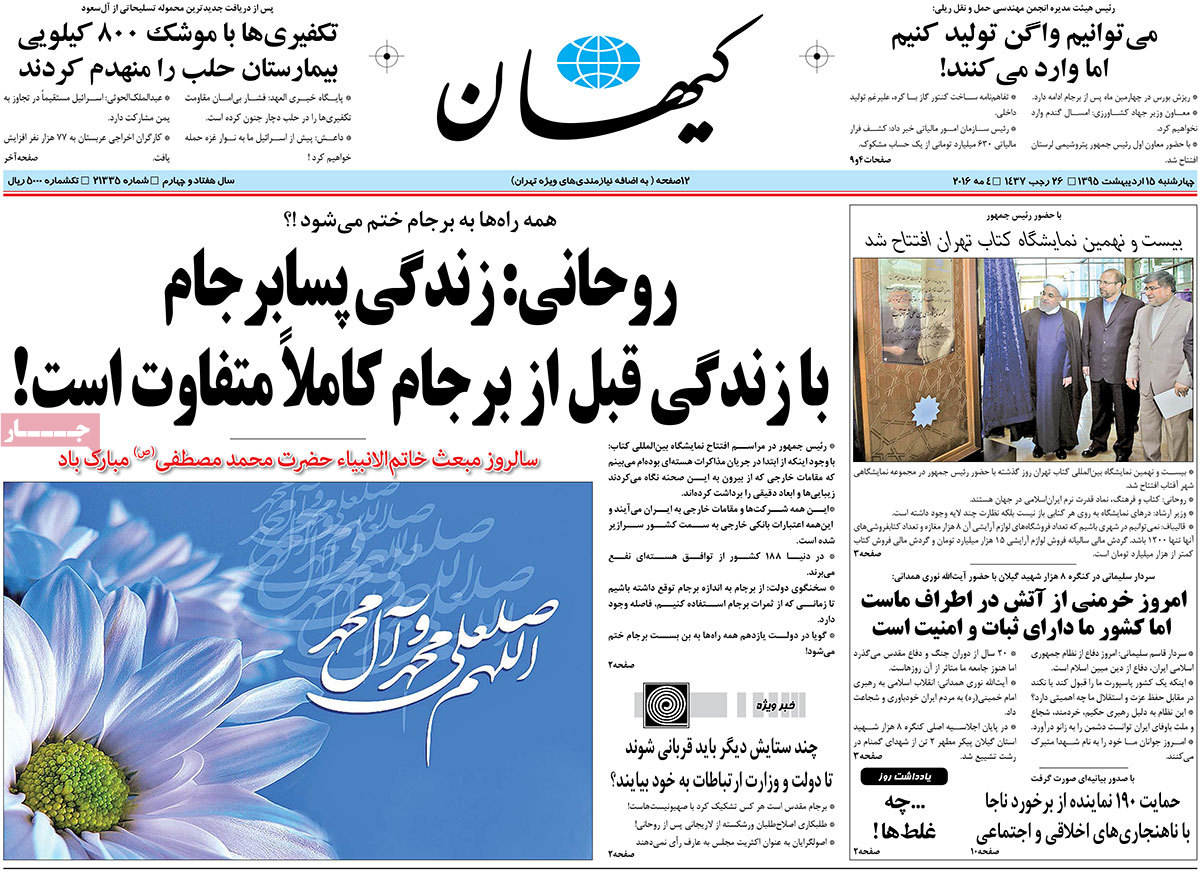
 

A Look at Iranian Newspaper Front Pages on May 4


Khorasan:

1- Secret behind Transmission of Dangerous Disease from British Girl

2- Freedom of Speech Suspended: 50 Members of Britain’s Labour Party Suspended over Anti-Israeli Comments
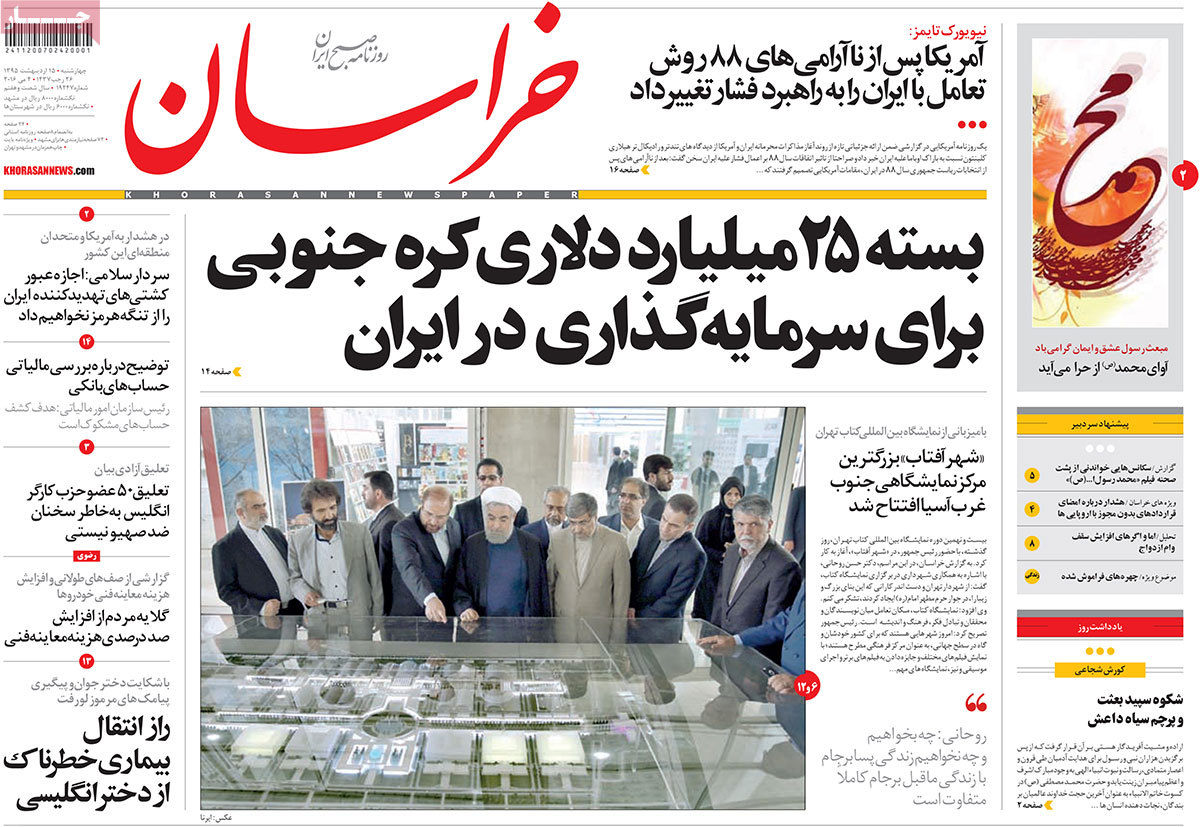
 

A Look at Iranian Newspaper Front Pages on May 4


Mardom Salari:

1- Financial and Banking Cooperation, New Opportunity for Iran and Malaysia: Zarif in meeting with Aman

2- Reformists to Form Majority of Next Parliament: Politician
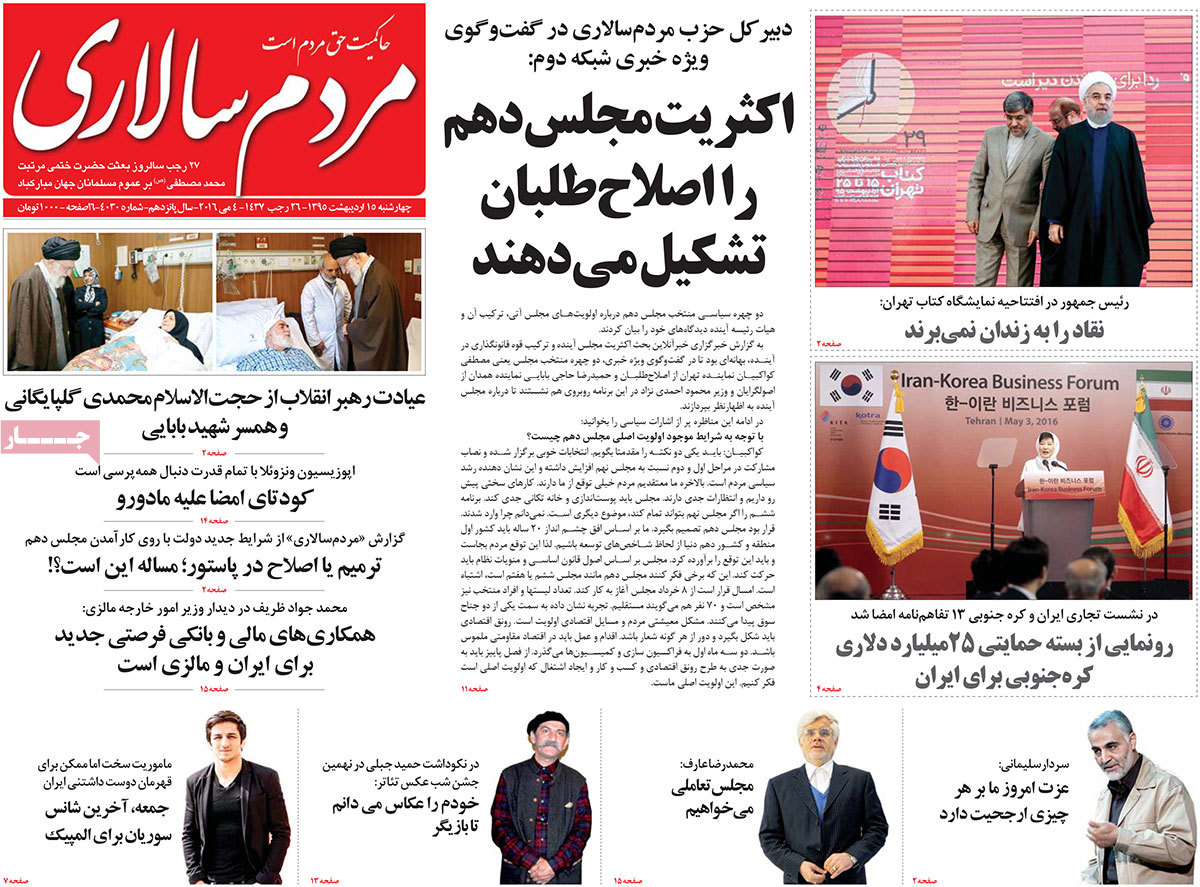
 

A Look at Iranian Newspaper Front Pages on May 4


Resalat:

1- Maintaining Dignity and Independence is Our Main Priority: General Soleimani

2- Optimism towards US is Strategic Mistake: Iran’s Former UN Envoy

3- Need for Global Fight against US Influence: Implications of Leader’s Meeting with Korean President
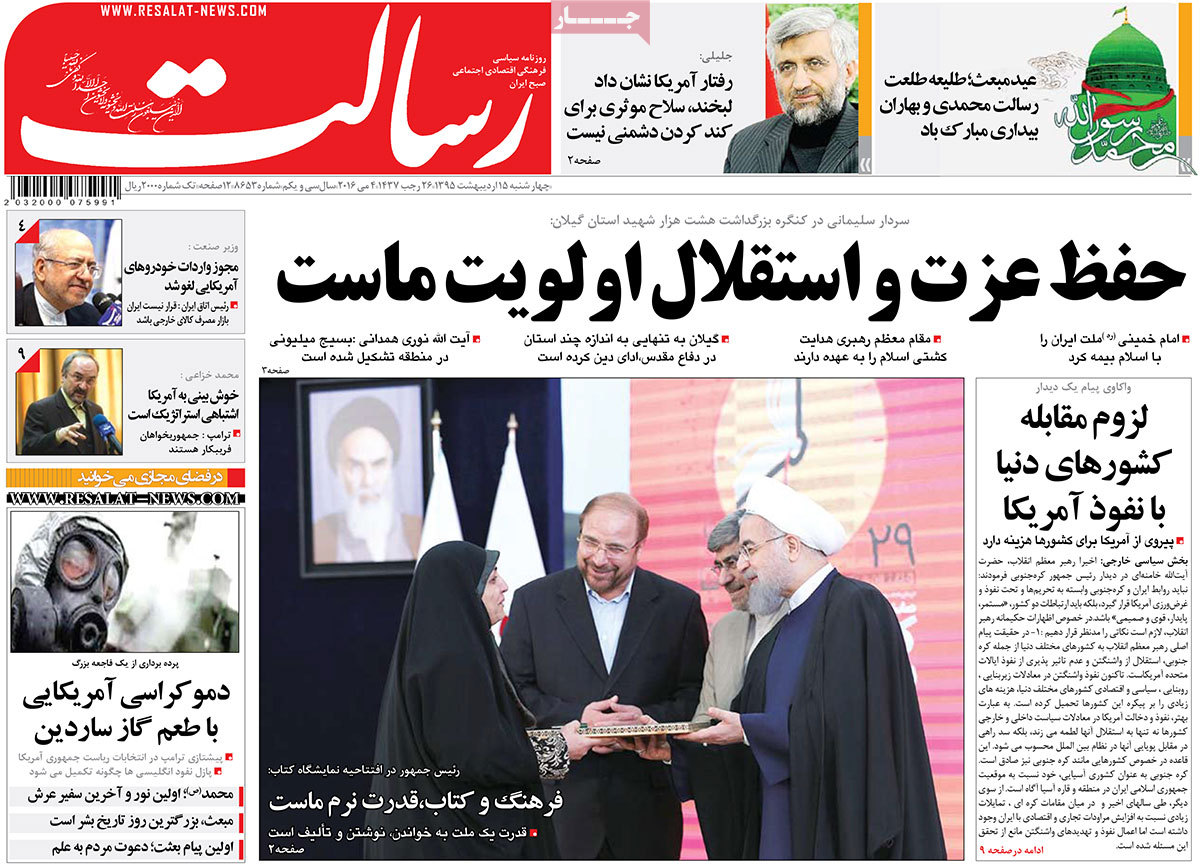
 

A Look at Iranian Newspaper Front Pages on May 4


Roozan:

1- Why is Rouhani, unlike Ahmadinejad, against Cabinet Reshuffle?

2- Iranian Teachers to Receive as much as University Lecturers
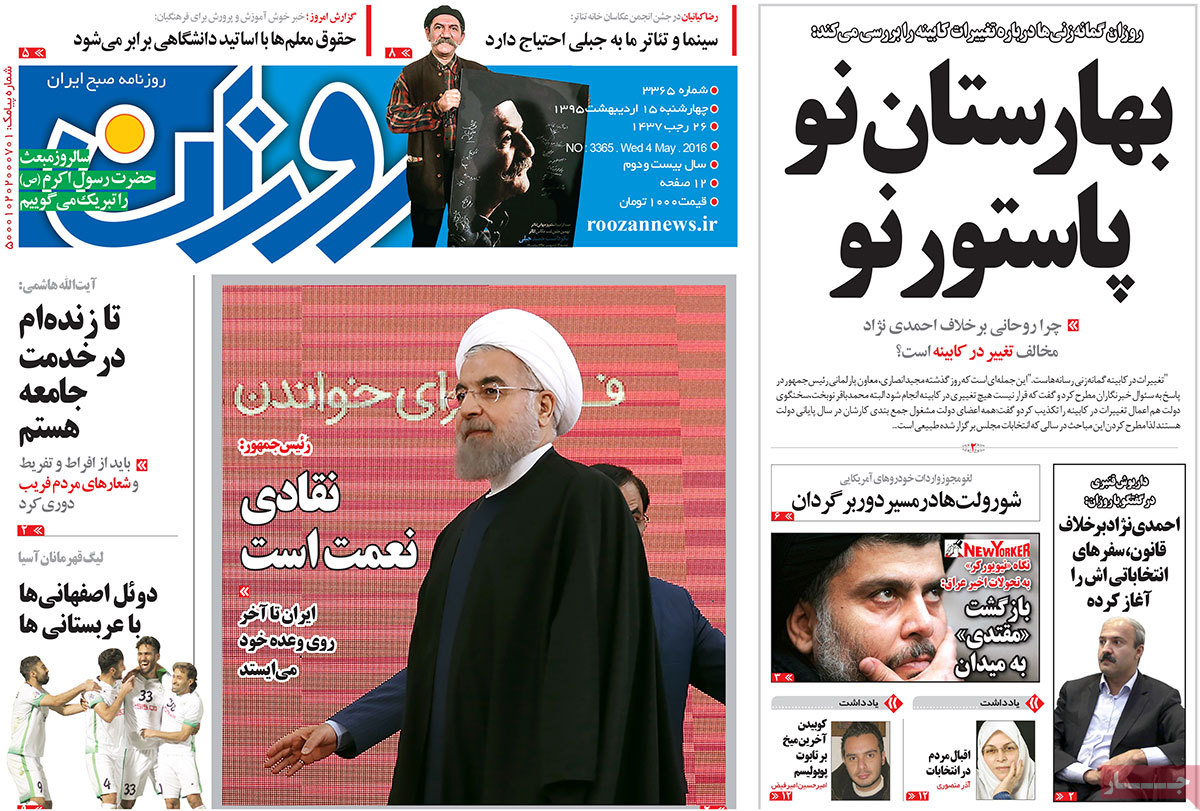
 

A Look at Iranian Newspaper Front Pages on May 4


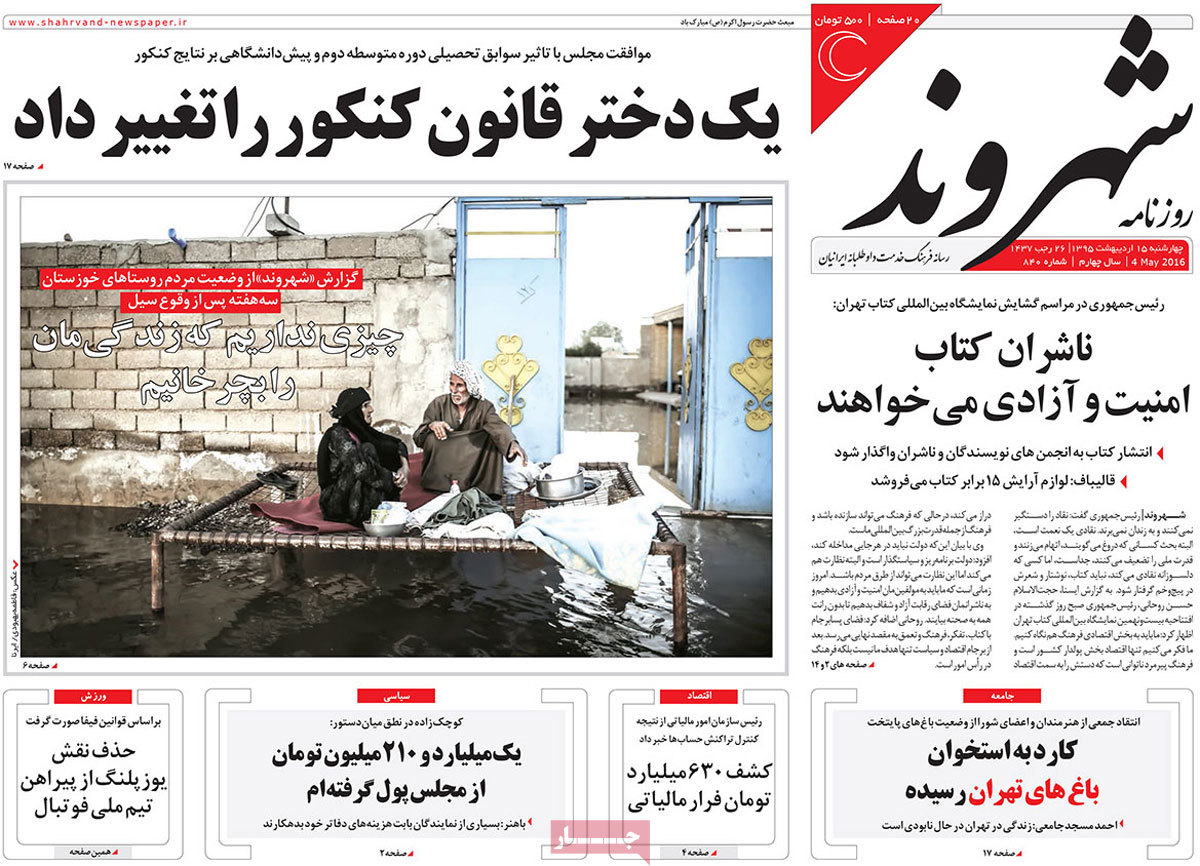
Shahrvand:

1- A Schoolgirl Changed the Rules of Iran’s Entrance Exam [Konkour – the university application exam]

2- Asiatic Cheetah Removed from National Team Shirts Based on FIFA Laws
 

A Look at Iranian Newspaper Front Pages on May 4


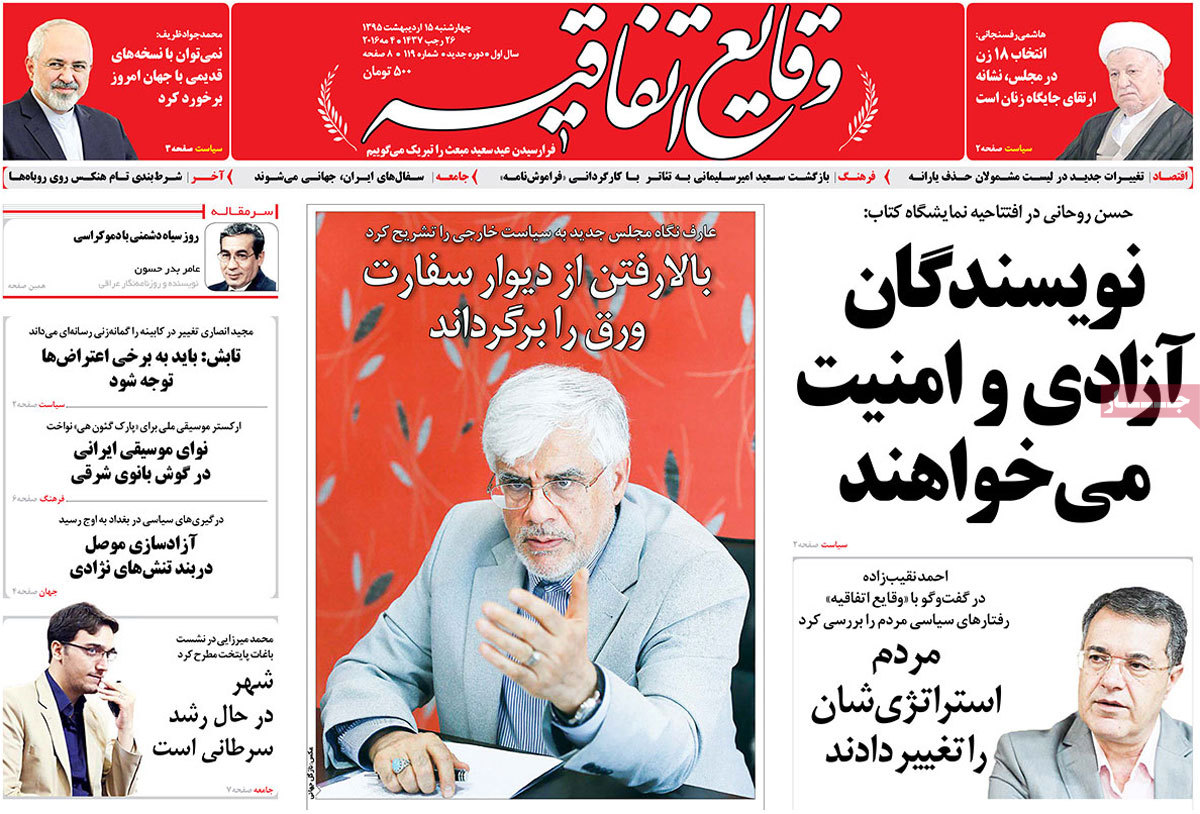
Vaghaye Ettefaghieh:

1- Attack on Saudi Embassy Was a Setback for Iran: Reformist Politician Aref

2- Sound of Iranian Music for Eastern Lady [Iran’s National Orchestra’s performance for South Korean President in Tehran’s Milad Tower]
 

A Look at Iranian Newspaper Front Pages on May 4


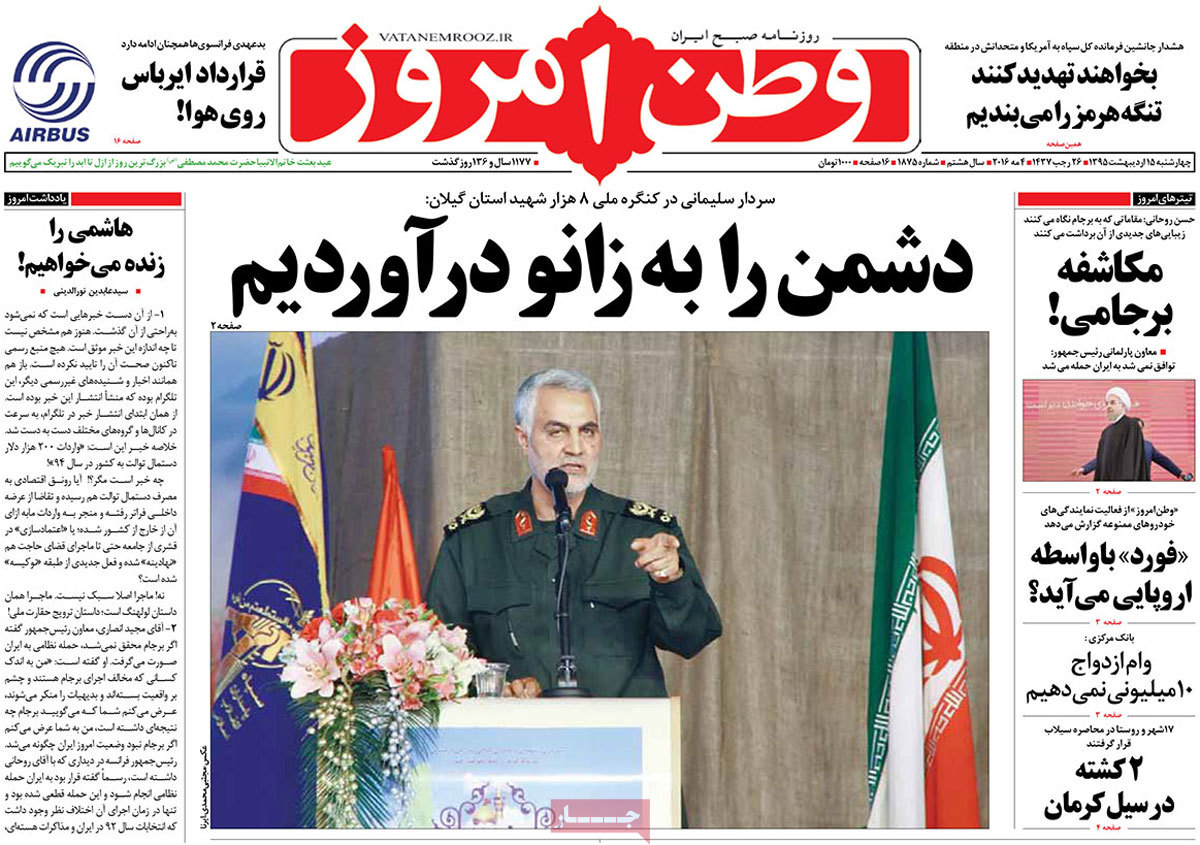
Vatan-e Emrooz:

1- Without JCPOA, Iran Could Have Been Attacked Militarily: VP

2- Will USA’s Ford Come to Iran through European Middleman?

3- Flooding in Iran’s Southern City of Kerman Kills 2
 

A Look at Iranian Newspaper Front Pages on May 4


Spokesman: Iran Supports National Compromise in Iraq

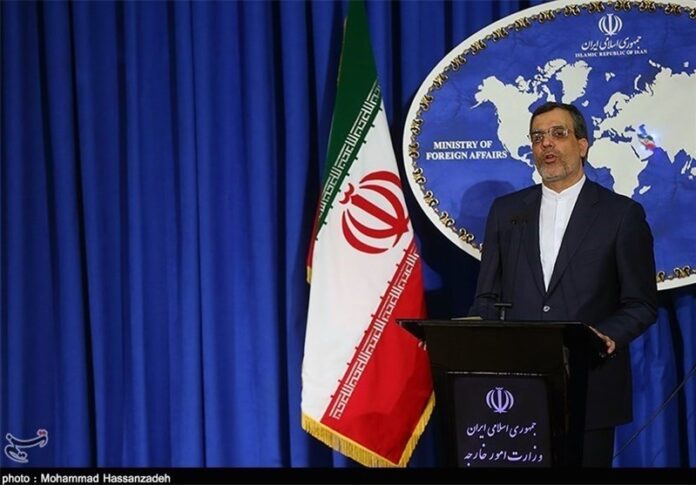
Speaking at a press conference in Iran’s northwestern city of Tabriz on May 3, Hossein Jaberi Ansari pointed to the chaotic protests in Baghdad, stressing that any development in Iraq should protect the “democratic achievements” that the Arab nation has gained over the past decade.

“The normal way is for serious dialogue and national compromise among the (Iraqi) local groups,” he underlined.

Expressing his hope for the settlement of conflicts in Iraq, Jaberi Ansari said Iran is prepared to help its Muslim neighbour by using its relations with Iraqi groups.

Asked about prominent Iraqi figure Muqtada al-Sadr’s recent trip to Iran, the spokesman made it clear that Iran maintains contacts with the Sadrist Movement, as with other active political groups in Iraq, and reciprocal visits by Iranian and Iraqi politicians are not unusual.

The comments came after hundreds of protesters stormed Baghdad’s heavily fortified Green Zone on Saturday and entered the Parliament building.

As the chaos erupted, one lawmaker was attacked, and protesters damaged several vehicles near parliament. The protesters were mostly supporters of the Muqtada al-Sadr.

Iran has always voiced its support for democracy and national dialogue in Iraq for settling political conflicts in a peaceful manner.

Iran Keen to Boost Cooperation with Iceland in New Tech, Clean Energy: Rouhani

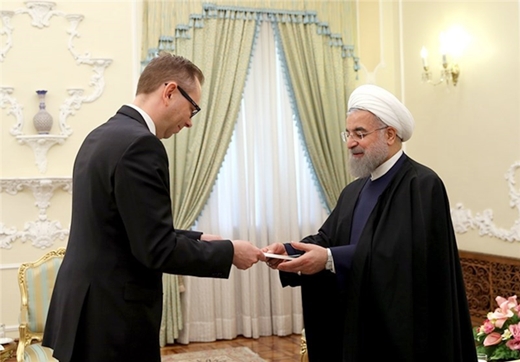
Speaking at a meeting with Iceland’s newly Accredited Ambassador Hermann Örn Ingólfsson, Rouhani said an exchange of delegations and cooperation between private sectors of the two countries would play an active role in the development of the two countries’ ties.

“Tehran welcomes expanding and deepening relations with Iceland in economic fields, modern technologies and renewable energies,” he reiterated.

Also at the meeting, Örn Ingólfsson, who submitted his credentials to President Rouhani, asked for expanded relations between Iran and the European Union.

He said that the two countries could cooperate in the fields of clean and renewable energies.

TAVANIR and KEPCO Sign $10bn MoU

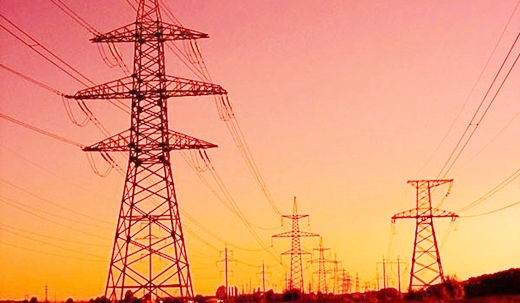
A Memorandum of Understanding (MoU) worth about $10bn was signed on Tuesday May 3 between Iran’s TAVANIR and South Korea’s KEPCO on the implementation of projects to reduce power loss, promote efficiency, construct new power plants as well as to improve the country’s power grid.

As stipulated in the joint agreement, a Chinese financing credit line will be exploited to launch nearly $10bn of new projects in Iran’s power and energy industries.

Another axis of the Tehran-Seoul MoU plans the construction of 705-kV transmission lines in the country. In addition, by using modern technologies from South Korea to set up a new generation of smart meters, electricity losses in the distribution network shall be minimized.

Speaking during the MoU signing ceremony between TAVANIR and KEPCO, Iran’s Deputy Energy Minister Houshang Falahatian pointed to the Korean president’s trip to Tehran, saying “A new chapter is being written in Iranian-Korean joint cooperation in the power and energy industries.”

The official emphasized the need for the transfer of technical knowledge and technology, as well as raising funds for expanding the country’s power industry during the post-sanctions era. “South Korea can be a trustworthy partner for Iranian industry in the post-JCPOA period, as negotiations have kicked off with Korean firms on making investments and on training electrical industry staff and professionals.”

Hajj to Be Cancelled Unless Saudis Carry Out Responsibilities: Iran

“Saudi Arabia claims that the subject of Hajj is different from political disputes, but there is a vast gap between its words and deeds,” said Hossein Jaberi-Ansari during a trip to Iran’s northwestern city of Tabriz on Tuesday.

“If Saudi Arabia carries out its responsibilities as the host government towards the health and safety of the pilgrims, Hajj will take place, otherwise, Iranians will not be able to take part in Hajj,” he added.

On Thursday, the head of Iran’s Hajj and Pilgrimage Organization said Saudi officials are continuing to stonewall in the talks with the Islamic Republic about the dispatch of Iranian pilgrims to the Arab country this year.

He added that an Iranian delegation had recently held talks with Saudi officials and submitted 20 proposals for ensuring the security and dignity of the Iranian pilgrims during the current year’s Hajj rituals.

Ohadi noted that Saudi officials are supposed to respond clearly to the Iranian delegation’s proposals and make preparations for an overdue agreement.

Riyadh’s inaction comes in the wake of a deadly stampede last year, which drew strong criticism from countries around the world including Iran.


“Iranian Women Do Not Give Up Easily”: Tech Girl Roxanne Varza

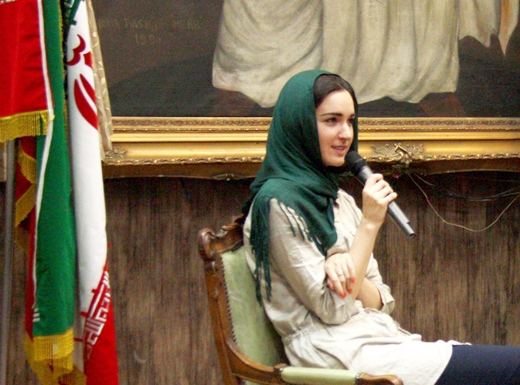
31-year-old Roxanne Varza placed 6th in Business Insider’s Top 30 Women under 30 in Tech back in 2013. She is trilingual, and holds degrees from UCLA, Sciences Po Paris and the London School of Economics. She is also the co-organizer of the Failcon Paris conference. More recently, she co-founded Tech.eu, a European technology media outlet. Here, she speaks to Tehran Times about her life, career, and Iranian women.

Varza was born to an Iranian family in the U.S. Prior to founding TechCrunch, she worked for the French government’s foreign direct investment agency, helping fast-growing startups develop their activities.

She has spoken, moderated, mentored and judged numerous startup events and programs throughout Europe and also helps European startups with content and communications. She is also an epilepsy advocate.


“Iranian women have a very good spirit. I love it. I have heard a lot about the difficulties and challenges that they have, but they still have a very strong spirit,” Varza said.

“It was a funny feeling when I came to know that I was among the top thirties. I think it is always very nice to be on this list but I think that there are so many women around the world that should be recognized”, she explained.

“Technology is both for men and women. When we started Girls in Tech, we were two people. I was a journalist at the time and I was writing about technology startups and all the startups that I met were founded by men and I was looking for some new stories. So we started this group to see who were the women working in technology, and we actually discovered that there were a lot, but they didn’t go to other technology events.”

“This was the main reason that we started Girls in Tech, and today we do a lot of different programs to help encourage more women to join technology,” she said, adding that the percentage of women in technology is very low, usually around 30% in Western Europe and the U.S., while noting that in Iran it’s a different story.

“For girls who want to work on startups, I usually say you should start your own project. It doesn’t have to be your own start-up, but a start-up project,” Varza said.

“I did the same thing when I started my blog or when I started Girls in Tech,” explained Varza, who co-founded the French and British chapters of Girls in Tech.

“Start-ups are not specific to women, but I have definitely been very excited about getting more women into technology and encouraging younger generations to come into technology.”

“For me, beginning to work in start-ups happened by accident. I worked for a French government agency, working with American startups to bring them to France. So I tried to open offices for Facebook, Twitter, and other companies in France and that was when I discovered actually I loved startups.”

“I love people who are creative, very optimistic and very intelligent. So I love entrepreneurs and that is how I got involved in startups. The second step I took was when I started a blog and my blog let me meet a lot of people, go to lots of events, and develop my network.”

“The talent of women in technology is actually very good. When people ask me what’s the difference between a man and woman, I always say I don’t know. I haven’t been a man! But I think when we are looking at the talent, it is exactly the same. Women are actually matching men in everything,” she stressed.

“I think it is a very good time to be a woman entrepreneur right now,” she said. “I think that even though women’s percentage in technology is very low, it’s an advantage. Having been somebody who is rare is definitely something that people remember and people notice, which actually helps businesses a lot. The second thing is that right now we are seeing a lot of big corporations, Microsoft, Google, IBM, all big companies that want to work more with women.”

“I think they are looking at being diverse. They don’t want to hire a ton of people with the same background, because that’s not where innovation comes from. So I think that they are realizing that they need women,” said  Varza, who was the lead for Microsoft’s startup activities in France, running both Bizspark and Microsoft Ventures programs for 3 years.

“There is no reason that a woman should be paid less than a man in any job,” she stressed. “There are different campaigns in France to make equal salaries for men and women.”

Varza travels to Iran at least once a year, this time to meet her old grandmother, Tooran Shahriyari, who was one of the first female Iranian lawyers, and is also a poet living in Tehran.

“I think Iran is also in a very exciting time, because its economy and market is very attractive for foreigners,” Varza noted, adding, “Foreigners want to learn about Iran and they want to be connected with Iran; and I think Iran is a very good place for investment right now.”

Abadan Oil Refinery’s Role in Iran History

When the Anglo-Persian Oil Company purchased a parcel of land from Sheikh Khazal to build the most important oil refinery in the world, it was not aware how this treatment facility would change Iran’s history.

Abadan oil refinery has been instrumental during four historical periods, detailed below.


Chapter I: Abadan Refinery Construction

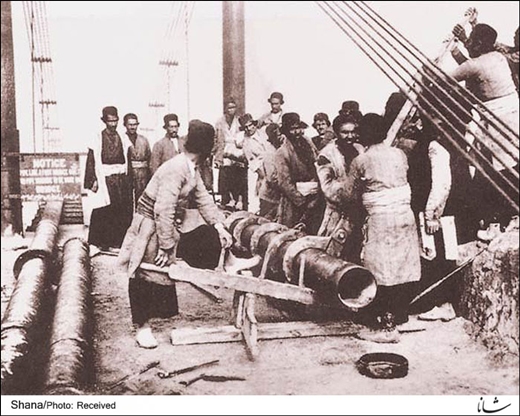
Here is Abadan. In 1909, one year after oil was discovered in Masjed Soleyman, the Anglo-Persian Oil Company purchased one square mile of land in the Bahmanshir area from Sheikh Khazal Bakhtiari, the local governor, and started building the most important oil refinery in the world. Due to its proximity to both the oil wells and fresh water, the location of the refinery was well-chosen. It could also serve as a favorable harbour for oil tankers and cargo vessels. Three years later, this refinery started work at a capacity of 2,500 b/d.


Chapter II: WWI, WWII

During World War I, Abadan was of great help to Britain’s war operations with its oil refining. The British government protected the treatment facility seriously throughout the war. The war was a pretext for further developing the refinery to produce more fuel for warships. During WWII, once the Allies had lost Burma’s oil and refineries, Abadan once again became the center of attention.

Abadan had become the biggest refinery in the world. Its reputation grew due to its delivery of 25,000 b/d of jet fuel during WWII. This supply of gasoline to the Allies’ fighter jets was a key factor in their victory.

After the oil industry was nationalized in 1951, and foreigners left, the maintenance of the refinery was assigned to Iranian staff and oil service workers. In 1954, an agreement was signed with the International Oil Consortium.

In August 1973, by virtue of Iran’s sovereignty on oil resources, the administration of Abadan oil refinery was assigned directly to the National Iranian Oil Company (NIOC). After that, Abadan refinery was developed to increase its capacity from 460,000 b/d to 600,000 b/d. After that development in September 1977, Abadan regained its status as the largest refinery in the world.

Before the Iran-Iraq war in 1980, Abadan produced 108 types of products. It had the most sophisticated installations for exporting products, used natural gas as its main source of fuel and was fitted with the largest electronic measurement machinery. It was therefore considered to be the most important refinery in the world.

As revolutionary fervour gained momentum in November 1978, oil service workers at the Abadan refinery went on strike. The refinery’s output was cut from 600,000 b/d to 150,000 b/d. Within weeks, oil production in Iran plunged into crisis, and the Shah’s regime came under heavy pressure.

Responding to an appeal by the late revolutionary founder Ayatollah Ruhollah Khomeini, the striking workers did not return to work. At the same time, military forces stopped distributing kerosene in the country, which ramped up pressure on people. With the Revolution, the general strike ended and the refinery resumed production.


Chapter III: Iraq-Iran War

On September 21, 1980, workers were going to the refinery as usual. All of a sudden, loud explosions were heard – the city of Abadan was under fire. On September 23, the refinery was attacked by the forces of the former Baathist regime of Iraq. Abadan refinery was the first oil facility to be targeted by Iraqi warplanes. That was when a new chapter in the efforts and sacrifices of the refinery workers started.

In the first stage, the refinery staff established emergency committees and managed to stop any oil substances spilling, despite the destruction of installations under heavy bombardment.

The formation of a fuel committee to handle fuel distribution was a major wartime initiative at Abadan refinery. In those days, huge amounts of gasoline produced at Abadan refinery were stocked in football stadiums. Another initiative was the production of gasoline with benzene. That was of great help to Iranian troops at the front.

Using technical and engineering facilities at the refinery to support the war was another case in point. The regular Army, the Islamic Revolution Guards Corps (IRGC) and other fighting forces used the refinery for their repairs.


Chapter IV: Newest Middle East Refinery

In October 1988, several months after Iran accepted the UN-brokered Resolution 598, staff from refineries across the country rushed to help Abadan. In the following years, a three-phase development plan was implemented for the refinery.

The development phases of the Abadan oil refinery will be completed in the coming years, and Iran will once more become the owner of one of the most important and most modern oil treatment facilities in the world.

Iranian Zoologist Discovers Unexpected Species of Rare Intertidal Spiders

In a recent study by Iranian Alireza Zamani, Russian Yuri M. Marusik and American James W. Berry, arachnologists, a new species of intertidal spider has been discovered on the shores of the Persian Gulf and the Gulf of Oman in Iran, and named as Paratheuma Enigmatica, due to its quite unexpected, enigmatic distribution.


Discovering the genus Paratheuma in Iran was particularly interesting. Previously, they were known to exist in Australia, USA, the West Indies, Mexico, Japan, Korea and a few islands in the Pacific Ocean. The closest reported locality of this genus is in Korea, more than 6,000 kilometers east of Iran.

As a result, this record fills a gap in the middle of the known distribution range of the genus. The distribution of P. enigmatica supports the previous observation that there is only one species per island, but one species may be found on several islands.

It seems that dispersal must have been of primary importance in the evolutional history of the Pacific Paratheuma. These spiders are of particular ecological interest as they inhabit broken coral rubble below the tideline, and feed upon intertidal crustaceans, but the ecology and full distribution range of this particular rare species remains unknown. The study’s findings were published in a recent issue of Zoology in the Middle East.


Unexpected Biodiversity for Iran

In order to gain a better knowledge of the spider fauna of Iran (currently comprising more than 600 species in 48 families), several surveys in various regions of the country have been recently carried out, especially by Alireza Zamani and colleagues.

Zamani told the Tehran Times that “While studying the spider fauna of the coastal and tidal zone of the Gulf of Oman and the Persian Gulf in Iran, several interesting species were found in the collected material, for example, Filistatidae.”

Zamani added that “Perhaps the most unusual finding was the occurrence of Paratheuma, a genus previously unknown around the shores of the Indian Ocean. This genus currently comprises 10 species of intertidal spiders, distributed in Australia, Hawaii, Florida, West Indies, Mexico, Japan, Korea and a few islands in the Pacific Ocean.”

Importance of Intertidal Spiders

The intertidal spider family Desidae, which is now moved to Dictynidae, is named thus because members live in a very unusual location – between the tides. The family has been reevaluated in recent years and now includes inland genera and species as well, such as Badumna and Phryganoporus.

Those intertidal spiders that are truly marine commonly live in barnacle shells, which they seal up with silk; this allows them to maintain an air bubble during high tide. They emerge at night to feed on various small arthropods that live in the intertidal zone.

Endangered Bird Lands in Lake Urmia

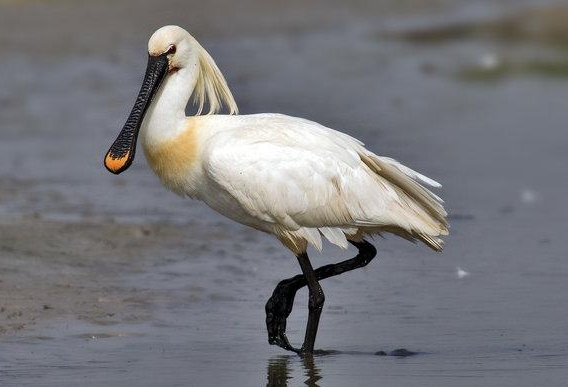
Behzad Shirpanjeh, head of the department, said these migrating birds had landed in the national park in recent days and are now living temporarily on the island.

“The spoonbill is an endangered species which makes very short stays in certain ponds and lagoons during its north-south migration, then after resting and eating, leaves to continue on its journey,” he noted, as reported by Mehr and translated by IFP.

Ordushahi Island is one of the 102 islands of Lake Urmia National Park.