Thursday, January 15, 2026
Home Blog Page 4390

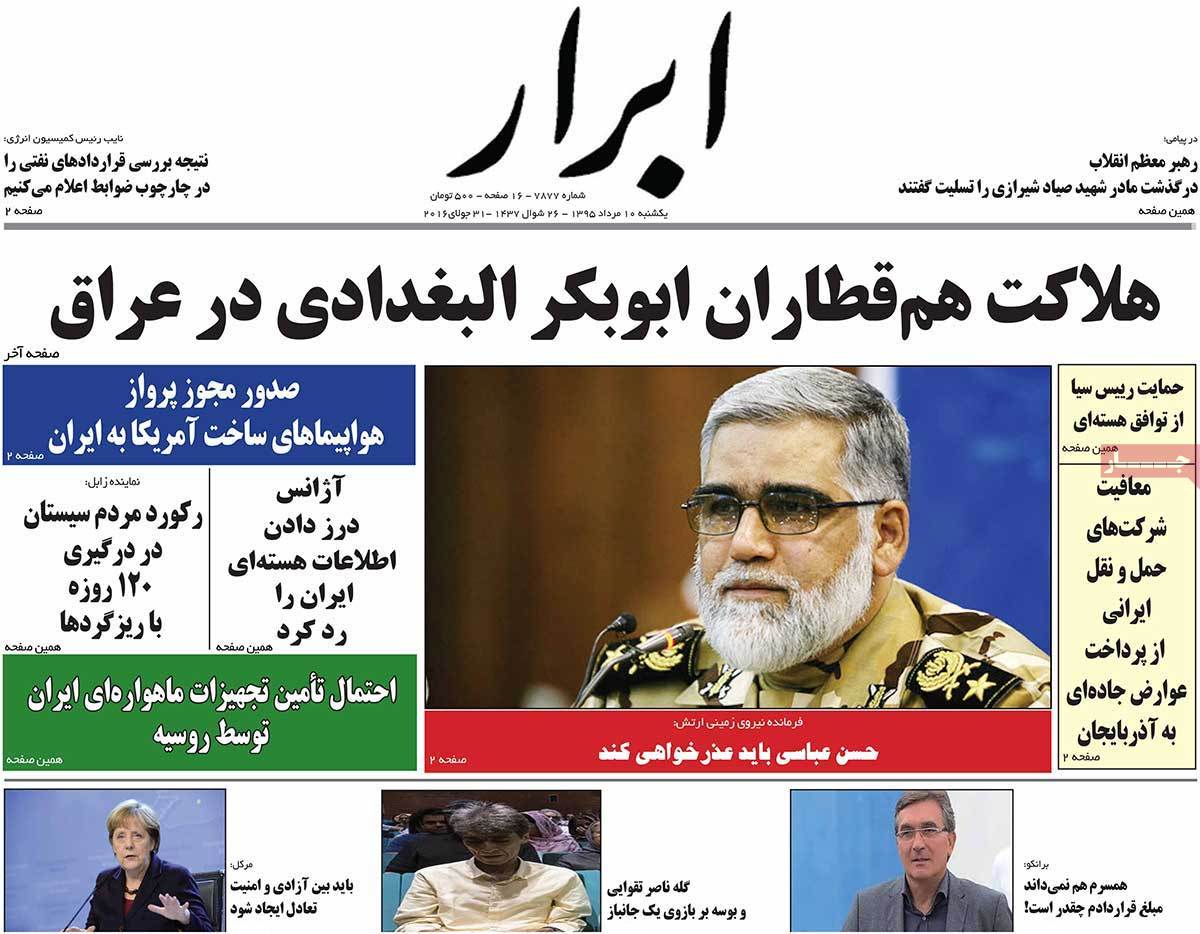
A Look at Iranian Newspaper Front Pages on July 31

Iran Newspaper front pages

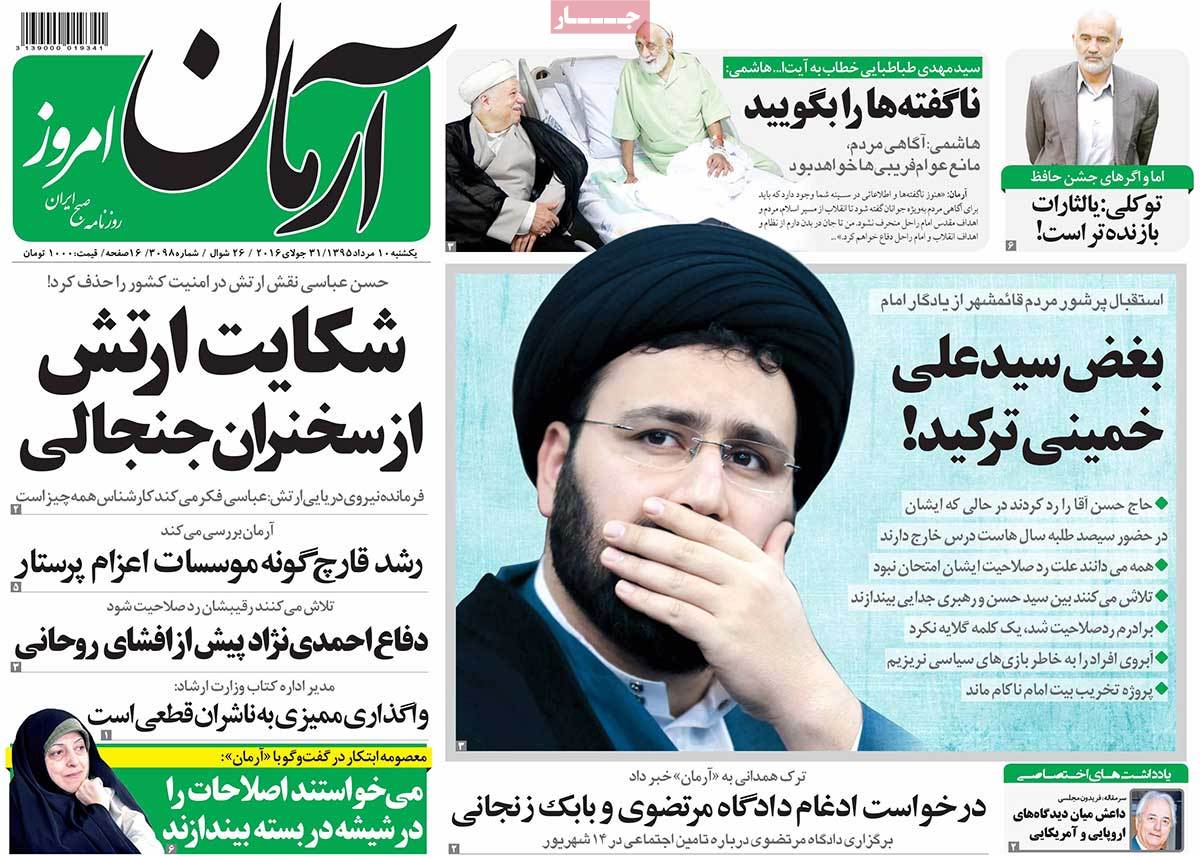
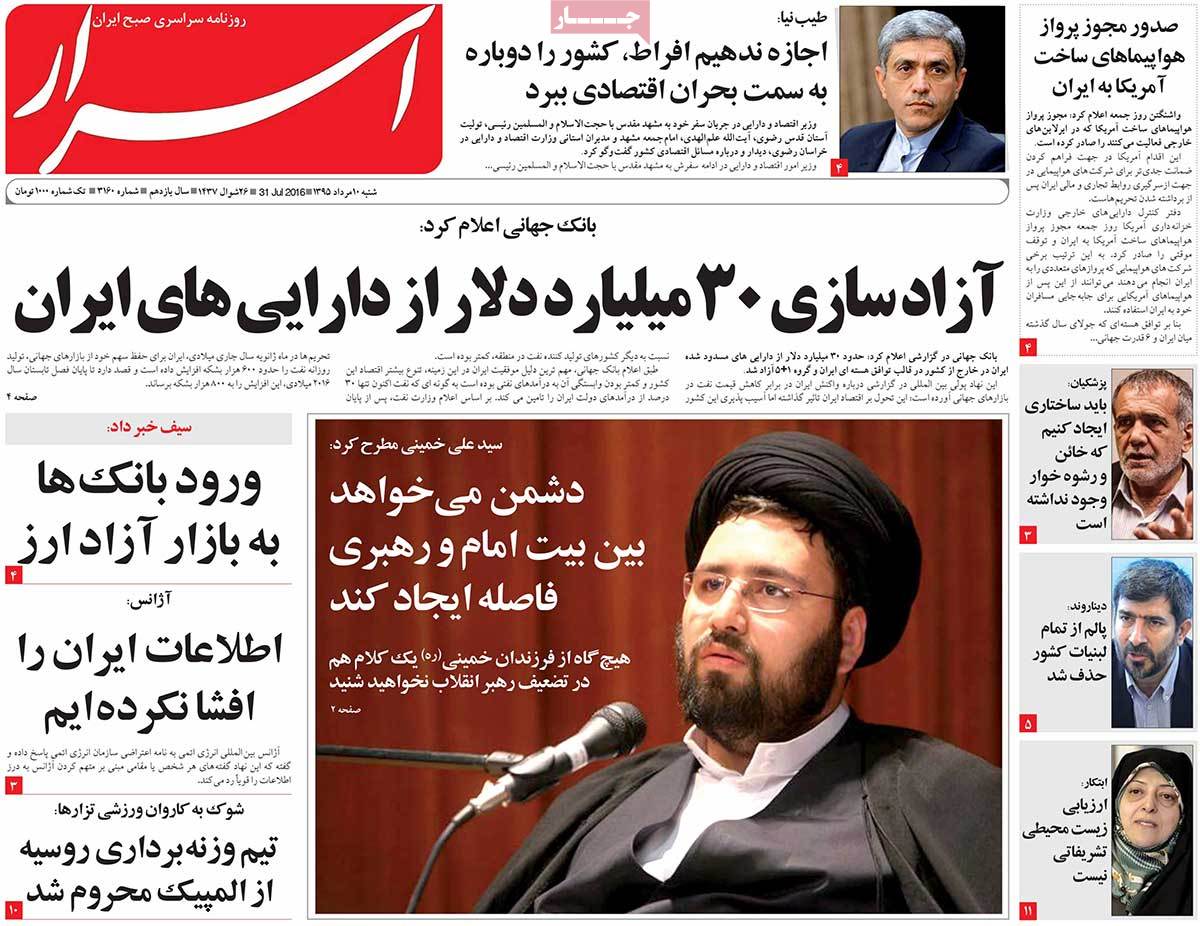
Newspapers on Sunday highlighted the remarks made by Imam Khomeini’s grandson, Seyyed Ali Khomeini, about the reasons for disqualification of Seyyed Hassan Khomeini from running for Assembly of Experts elections. He warned of plots to separate the late Imam’s family and the Leader of the Islamic Revolution Ayatollah Seyyed Ali Khamenei.

Another top story was the ongoing campaigns of ex-President Mahmoud Ahmadinejad for the next year’s presidential polls. His remarks against Hassan Rouhani’s incumbent government received great coverage in Iranian papers.

The above issues as well as many more are covered in the following headlines:


Abrar:

1- Al-Baghdadi’s Affiliates Killed in Iraq

2- US-Made Planes Allowed to Fly to Iran

3- People in [Iranian southeastern province] Sistan and Baluchestan Grappling with Dust Pollution for 120 Days

4- Russia May Supply Iran with Satellite Components

5- CIA Chief Supports Nuclear Deal

6- IAEA Denies Role in Leakage of Iran’s Nuclear Data
A Look at Iranian Newspaper Front Pages on July 31


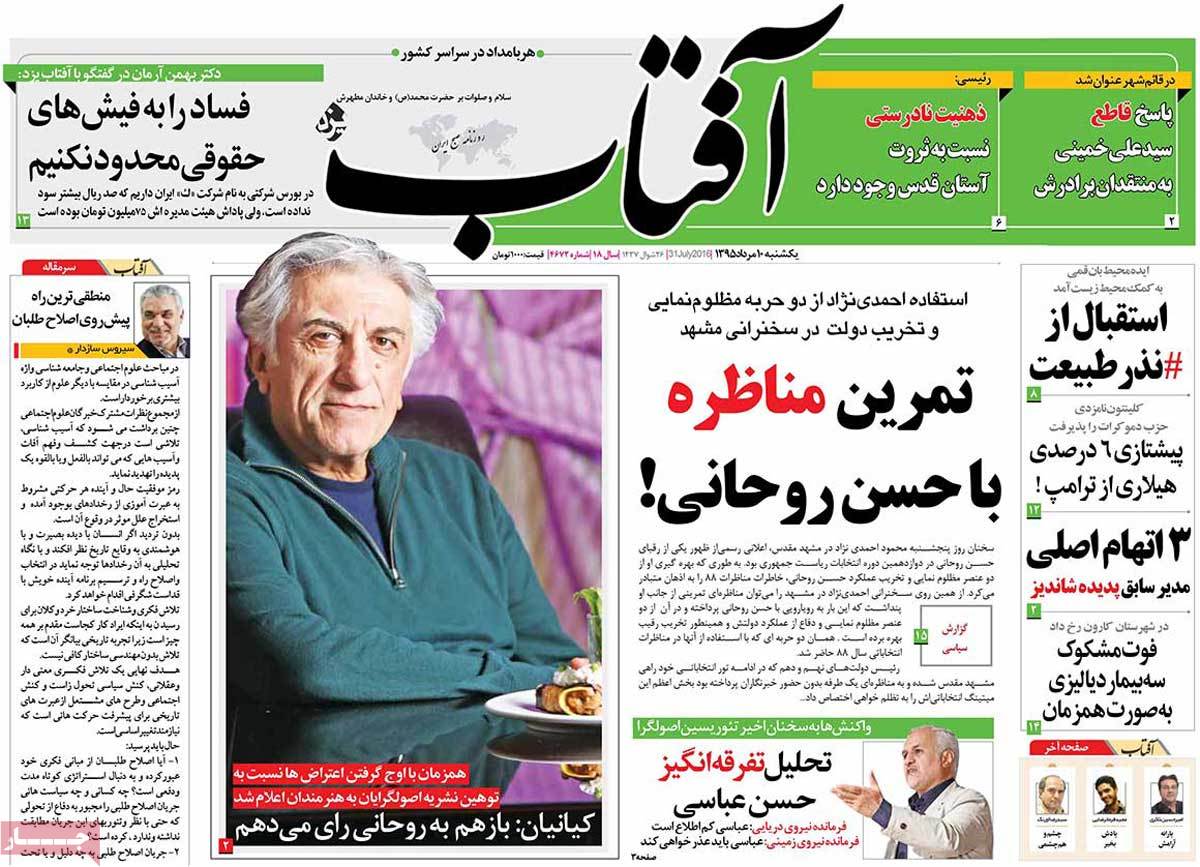
Aftab-e Yazd:

1- There Are Misconceptions about Wealth of Astan Quds Razavi [Custodianship of Imam Reza Holy Shrine in Mashhad]: Chief

2- Famous Actor Reza Kianian: I’ll Vote for Rouhani Once Again [His remarks came after a conservative weekly insulted Iranian artists for the way their wives had appeared in an awards ceremony]
A Look at Iranian Newspaper Front Pages on July 31


Arman-e Emrooz:

1- Publishers to Do the Censorship Themselves: Culture Ministry’s Book Official

2- Iran’s Army to File Lawsuit against Controversial Speech: Navy Commander Strongly Protests at an Address by Hassan Abbasi, a So-Called Strategist
A Look at Iranian Newspaper Front Pages on July 31


Asrar:

1- World Bank: $30bn of Iran’s Assets Released

2- Enemy Wants to Cause Rift between Imam Khomeini’s Family and the Leader: Imam’s Grandson; You’ll Never Hear a Single Word from Sons of Imam Khomeini That Weakens Ayatollah Khamenei

3- Iranians Banks to Enter Free Foreign Currency Exchange Market: CBI Governor
A Look at Iranian Newspaper Front Pages on July 31


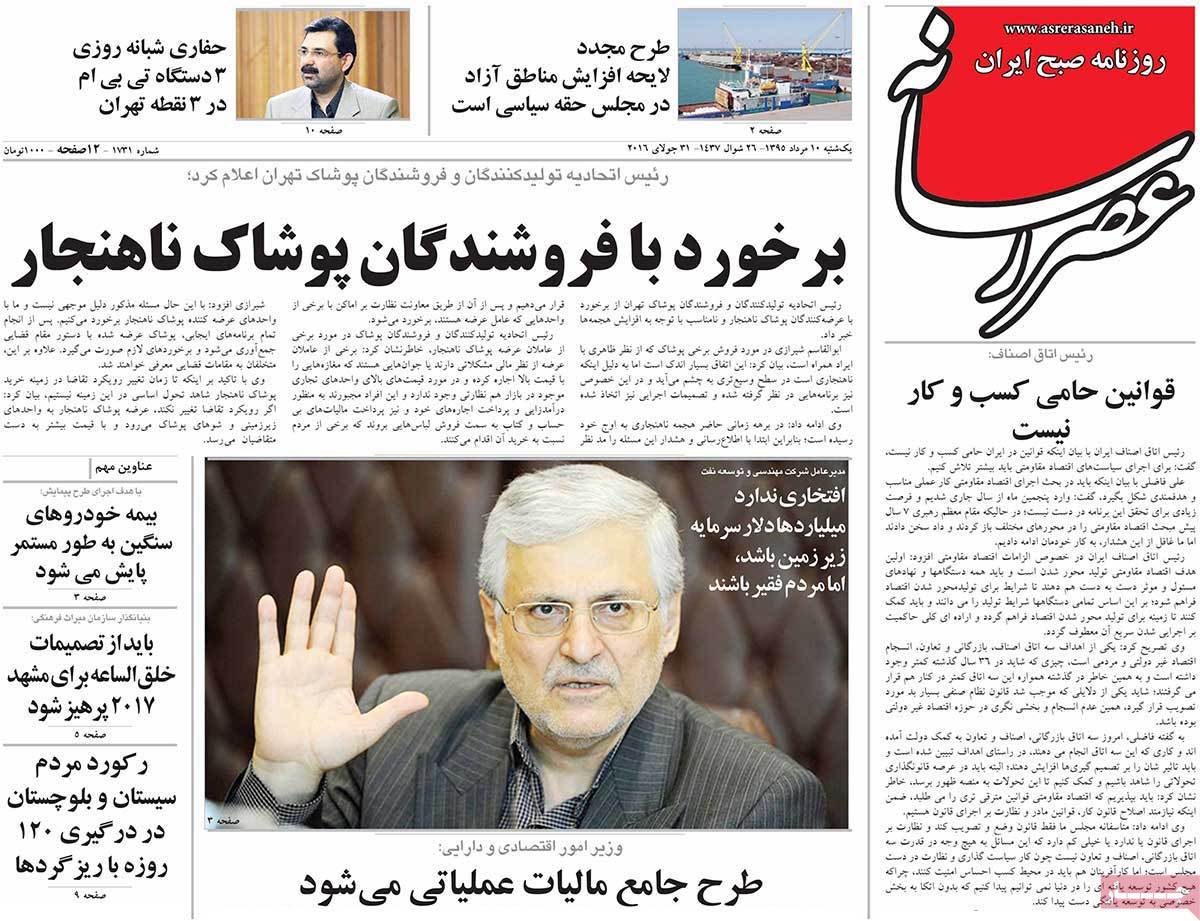
Asr-e Rasaneh:

1- Sellers of Norm-Breaking Clothes Will Be Reprimanded: Official

2- Laws and Regulations Don’t Support Businesses: Syndicate Official

3- It’s Not an Honour to Have Billions of Dollars of Underground Capital [the oil and gas reserves] When People Are Poor: Oil Official
A Look at Iranian Newspaper Front Pages on July 31


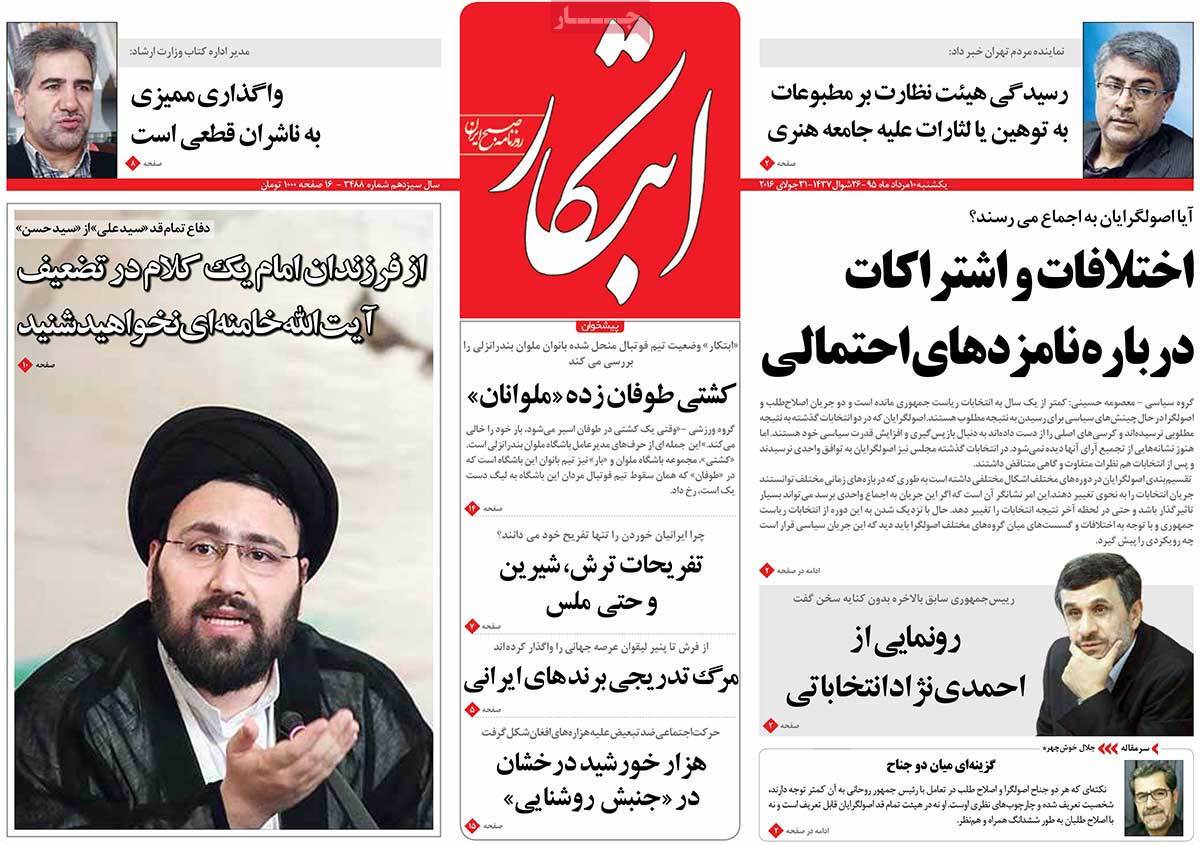
Ebtekar:

1- Ex-President Finally Stops Being Sarcastic: Unveiling of Ahmadinejad’s Campaign for 2017 Presidential Polls

2- Why Iranian People Consider Eating as Their Only Hobby? Sour, Sweet, and Even Sour-Sweet Leisure Activities

3- Gradual Death of Iranian Brands: From Carpet to Lighvan Cheese Are Giving Up Their Share in Global Markets
A Look at Iranian Newspaper Front Pages on July 31


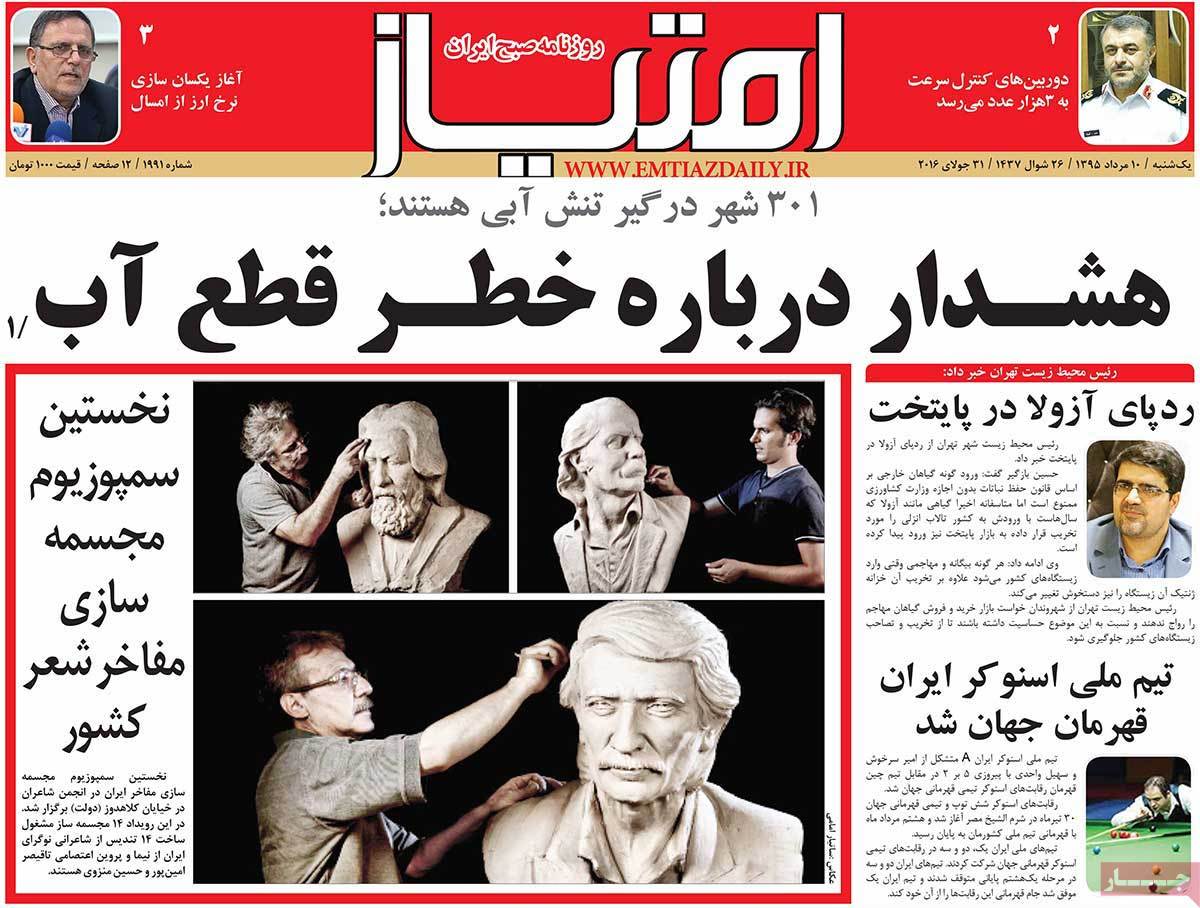
Emtiaz:

1- 301 Cities Grappling with Water Tension: Warnings about Water Cut

2- First Sculpture Symposium for Iranian Poetry Celebrities

3- Environment Department Official Warns: Azolla Has Arrived in Tehran

4- Iran’s Snooker Team Claims World Title
A Look at Iranian Newspaper Front Pages on July 31


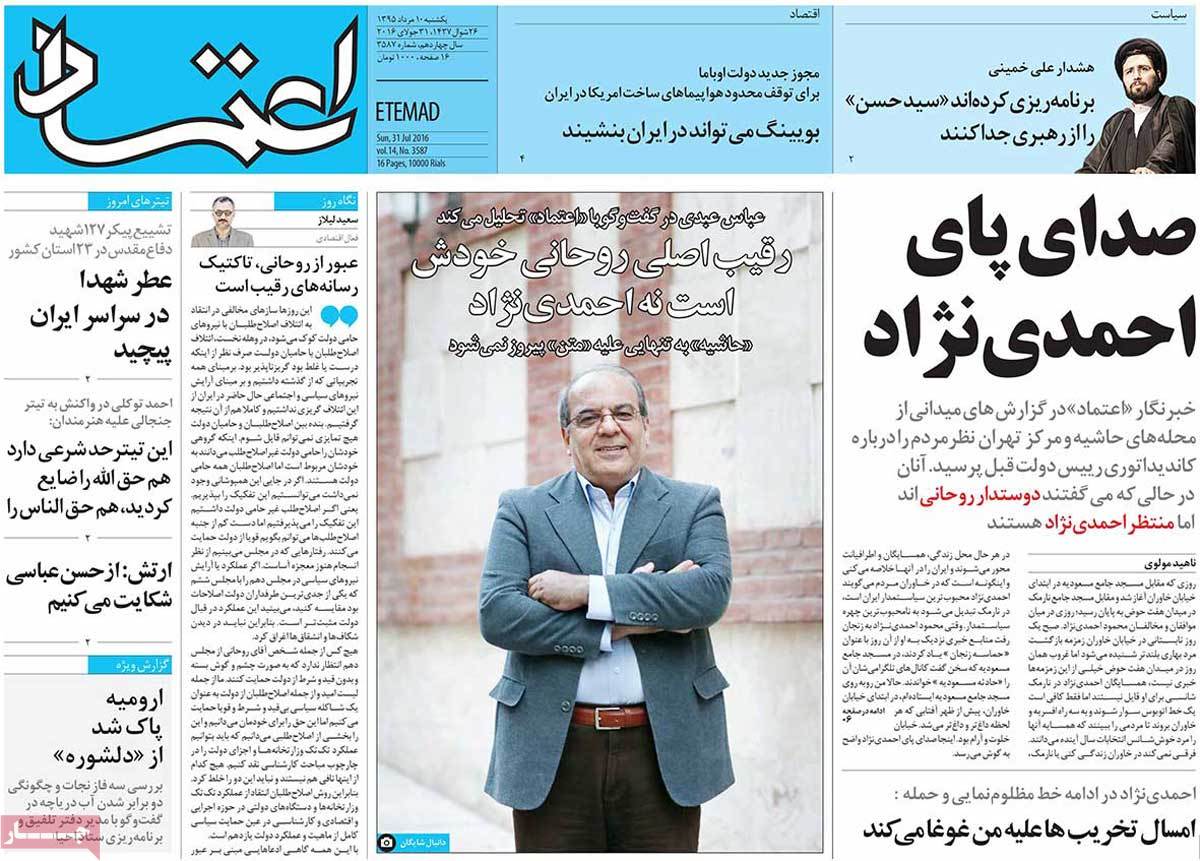
Etemad:

1- Rouhani’s Main Rival Is Himself, Not Ahmadinejad: Reformist Analyst

2- Sound of Ahmadinejad’s Steps: A Report on People’s Opinion about Mahmoud Ahmadinejad’s Candidacy; Some People Said They Love Rouhani, But They’re Waiting for Ahmadinejad!
A Look at Iranian Newspaper Front Pages on July 31


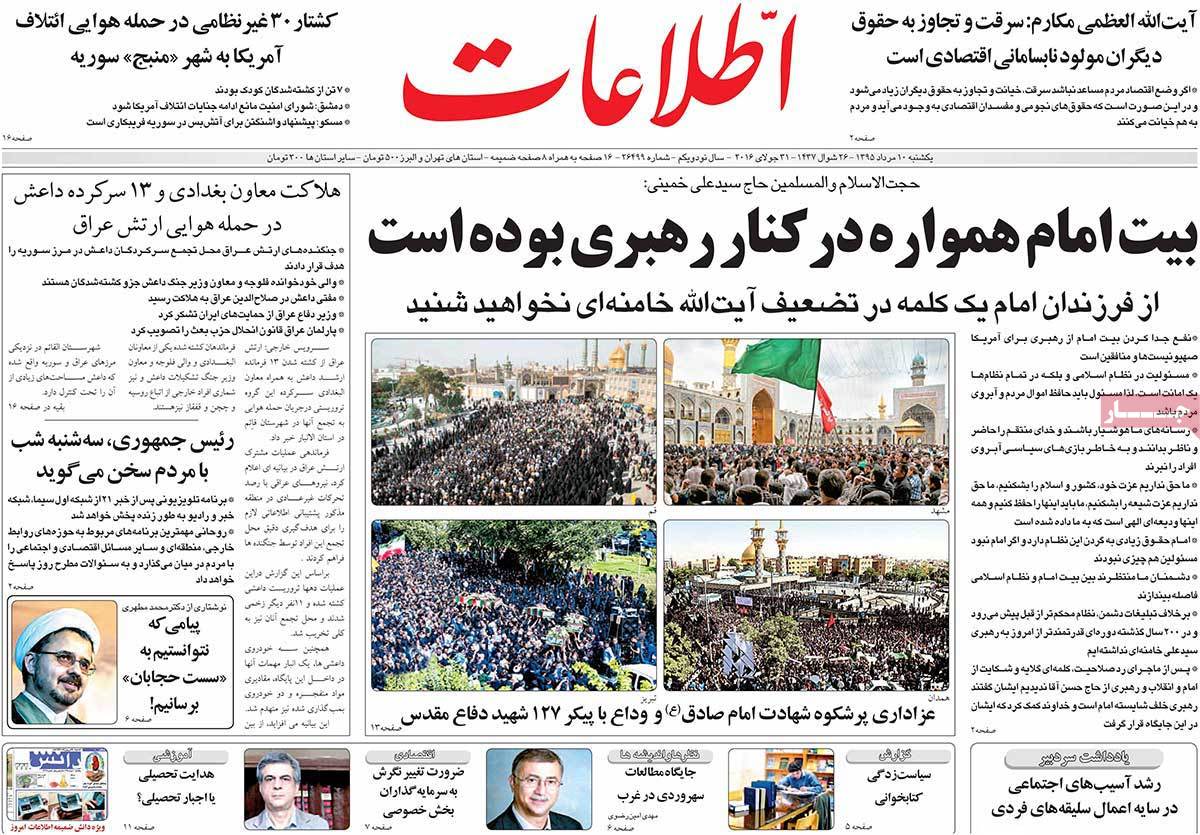
Ettela’at:

1- President Rouhani to Address Iranian Nation on Tuesday

2- The Necessity for Change of Attitude towards Private Sector Investors
A Look at Iranian Newspaper Front Pages on July 31


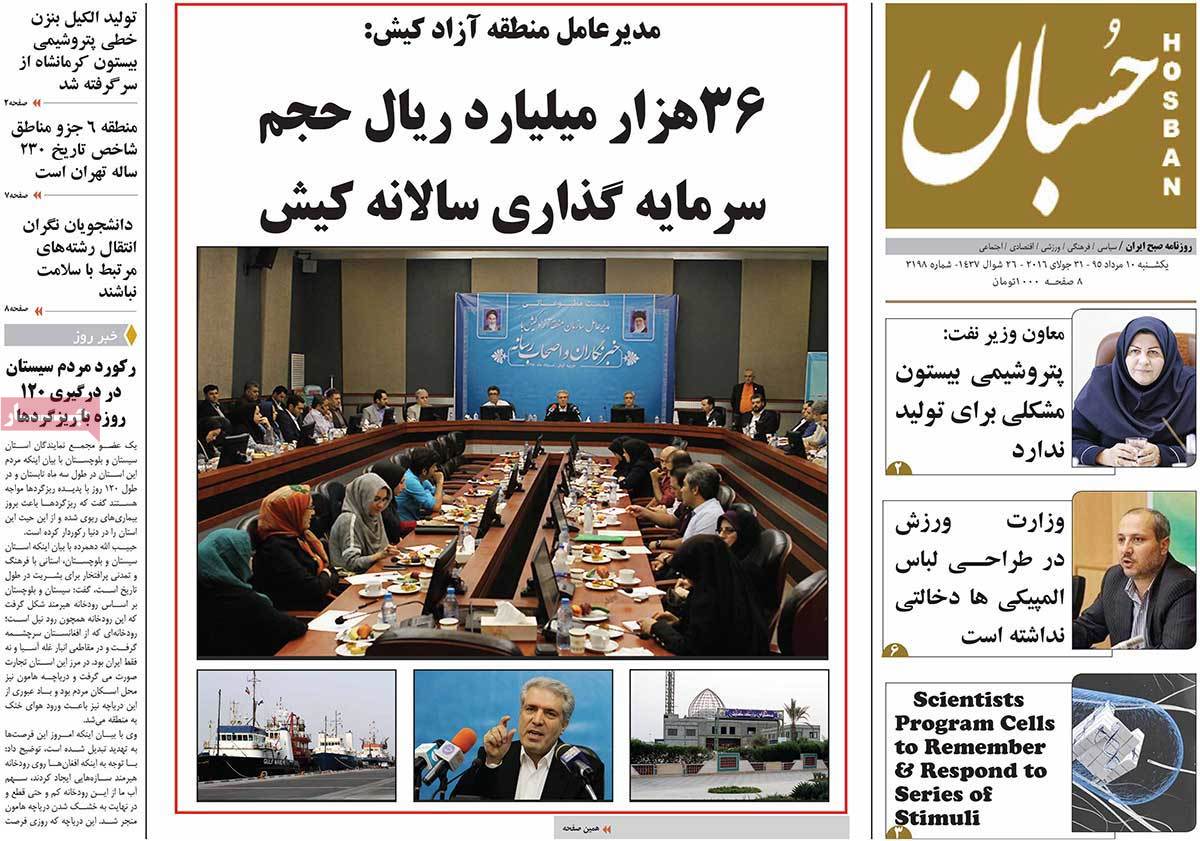
Hosban:

1- More Than $1bn Is Annually Invested in Kish Island

2- Sports Ministry Had No Role in Designing the Clothes of Iran’s Olympics Team

3- Bisotun Petchem Complex Has No Problem for Continuing Its Work: Deputy Oil Official
A Look at Iranian Newspaper Front Pages on July 31


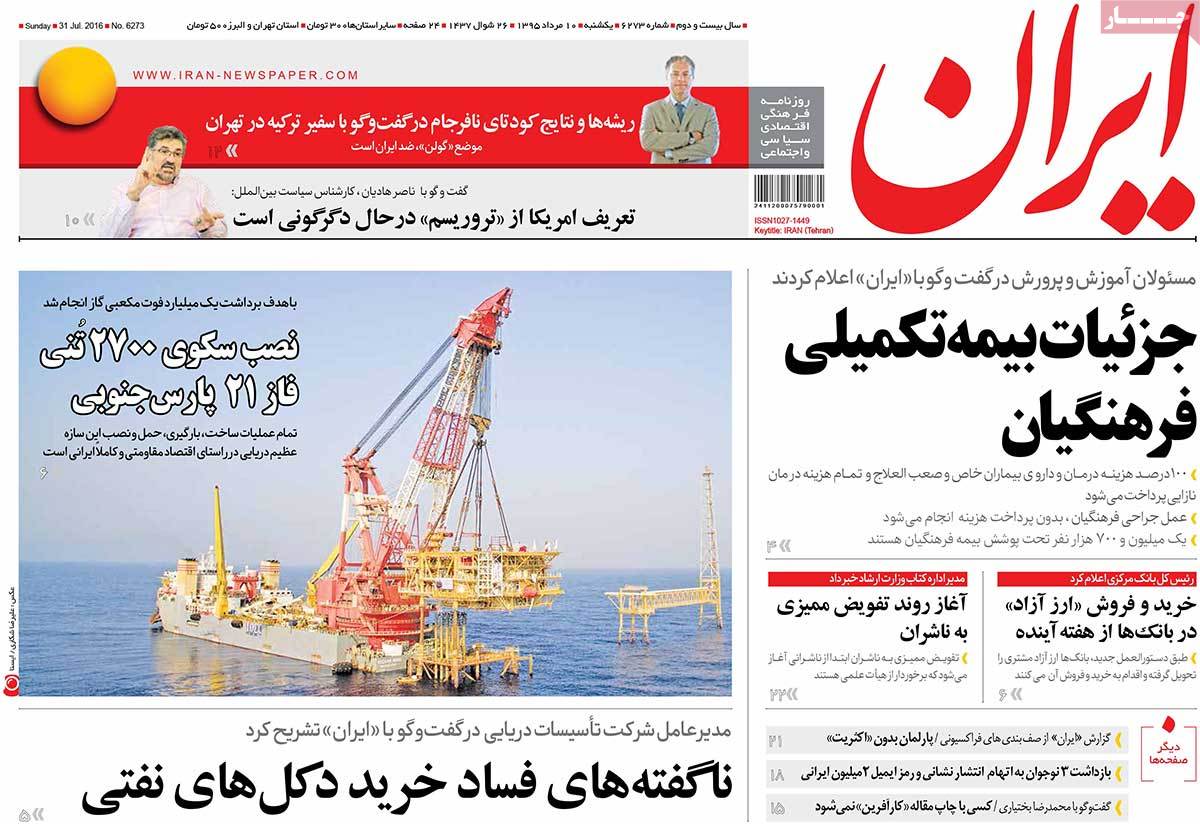
Iran:

1- 2,700-Ton Platform Installed in Phase 21 of South Pars Gas Field with Aim of Extracting 1bn Cubic Feet of Gas

2- USA’s Definition of Terrorism Is Changing: Analyst

3- Roots and Repercussions of Failed Coup in Interview with Turkey’s Ambassador to Iran: Gulen Has an Anti-Iran Stance
A Look at Iranian Newspaper Front Pages on July 31


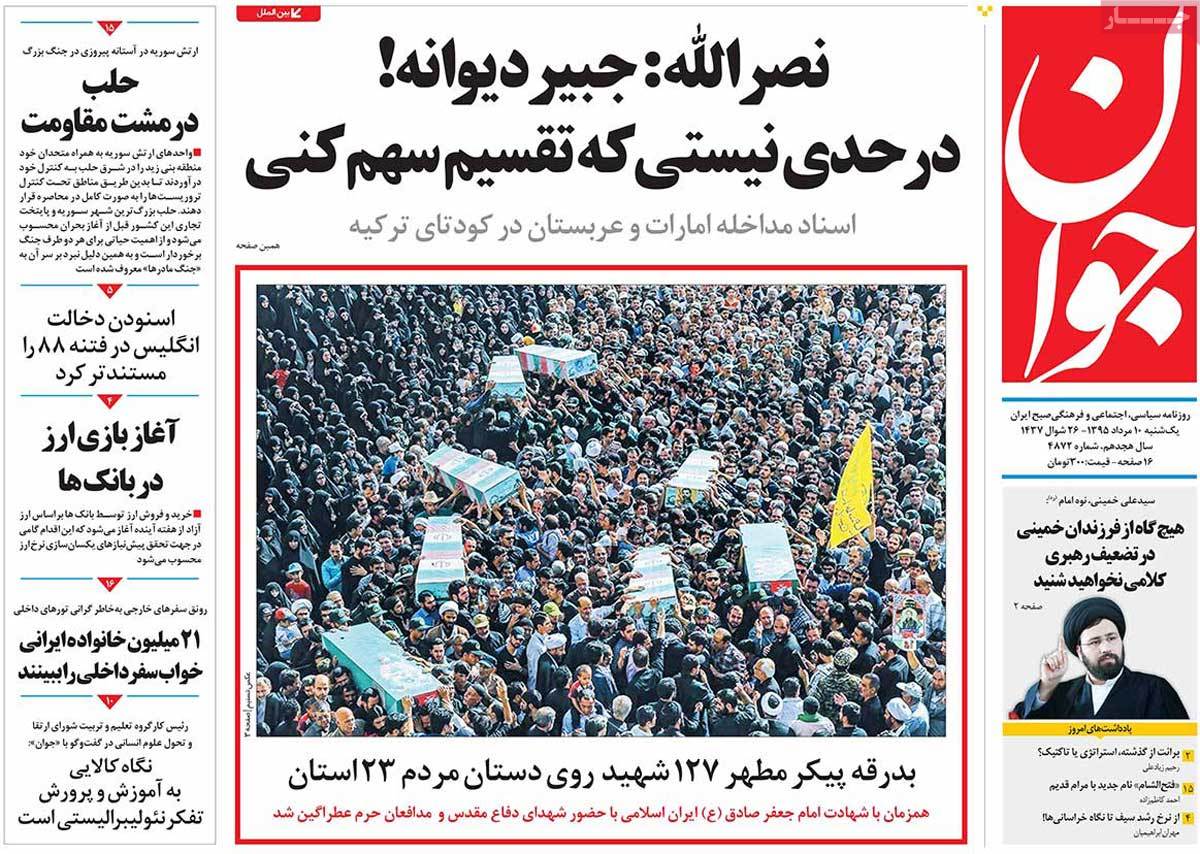
Javan:

1- Nasrallah: You Crazy Jubeir! It’s Way out of Your League to Divide the Shares!

2- Documents on UAE and Saudi Arabia’s Interference in Turkey Coup

3- Foreign Tours Thrive Because of Expensive Domestic Tours: 21m Iranian Families Should Dream about Domestic Trips
A Look at Iranian Newspaper Front Pages on July 31


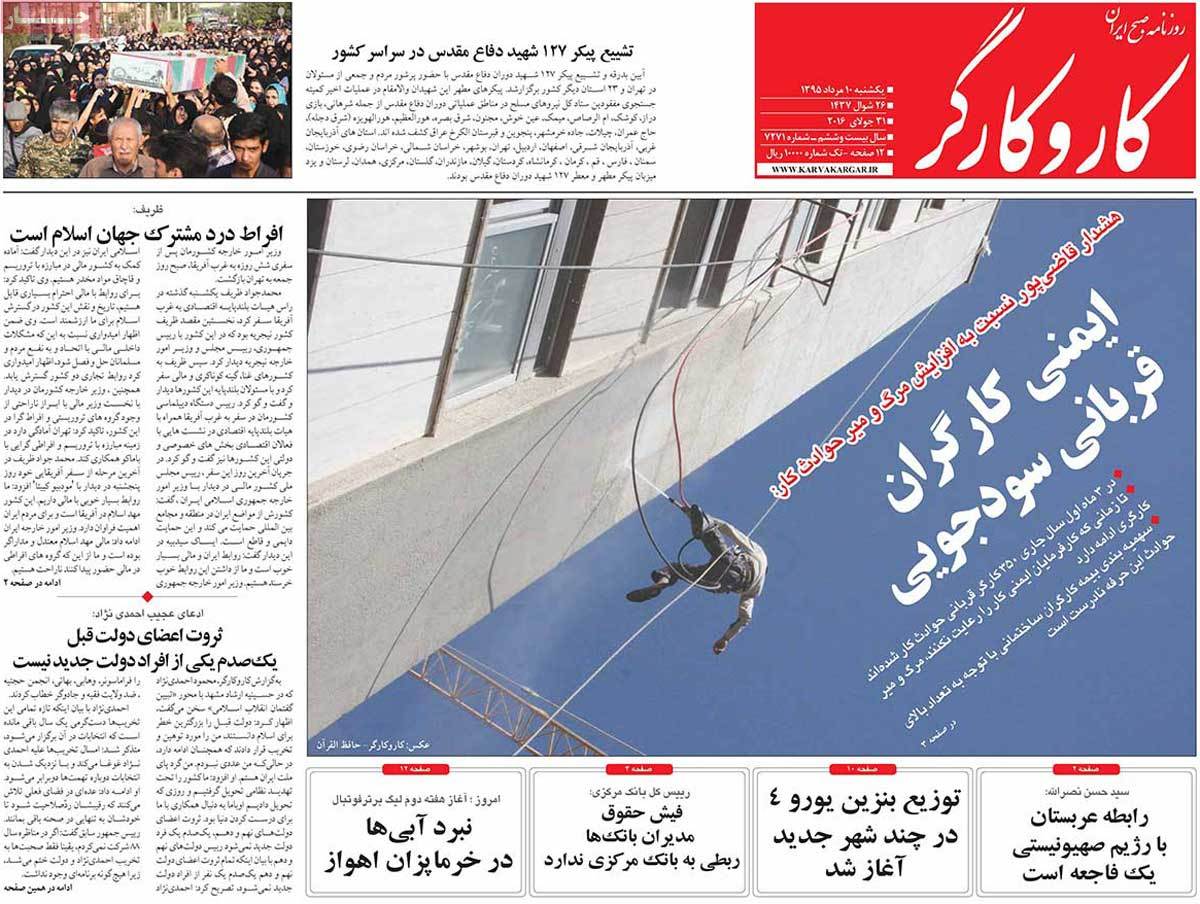
Kar-o Kargar

1- Extremism Is the Common Pain of Muslim World

2- MP Warns against Increasing Death Rate among Workers: Workers’ Safety Victim of Profit-Making

3- Ahmadinejad Claims the Wealth of His Cabinet Members Was Less than One-Hundredth of Only One of Rouhani’s Cabinet Members!

4- CBI Chief: Paycheques of Bank Managers Have Nothing to Do with Central Bank
A Look at Iranian Newspaper Front Pages on July 31


Kayhan:

1- Snowden Reveals Latest Documents on Britain’s Role in Management of Iran’s 2009 Sedition [protests after presidential elections]

2- Receivers of Huge Salaries to Be Disqualified

3- After Syrian Army’s Great Progress: US, Britain, France, and Israel Mobilised to Save Takfiris in Aleppo
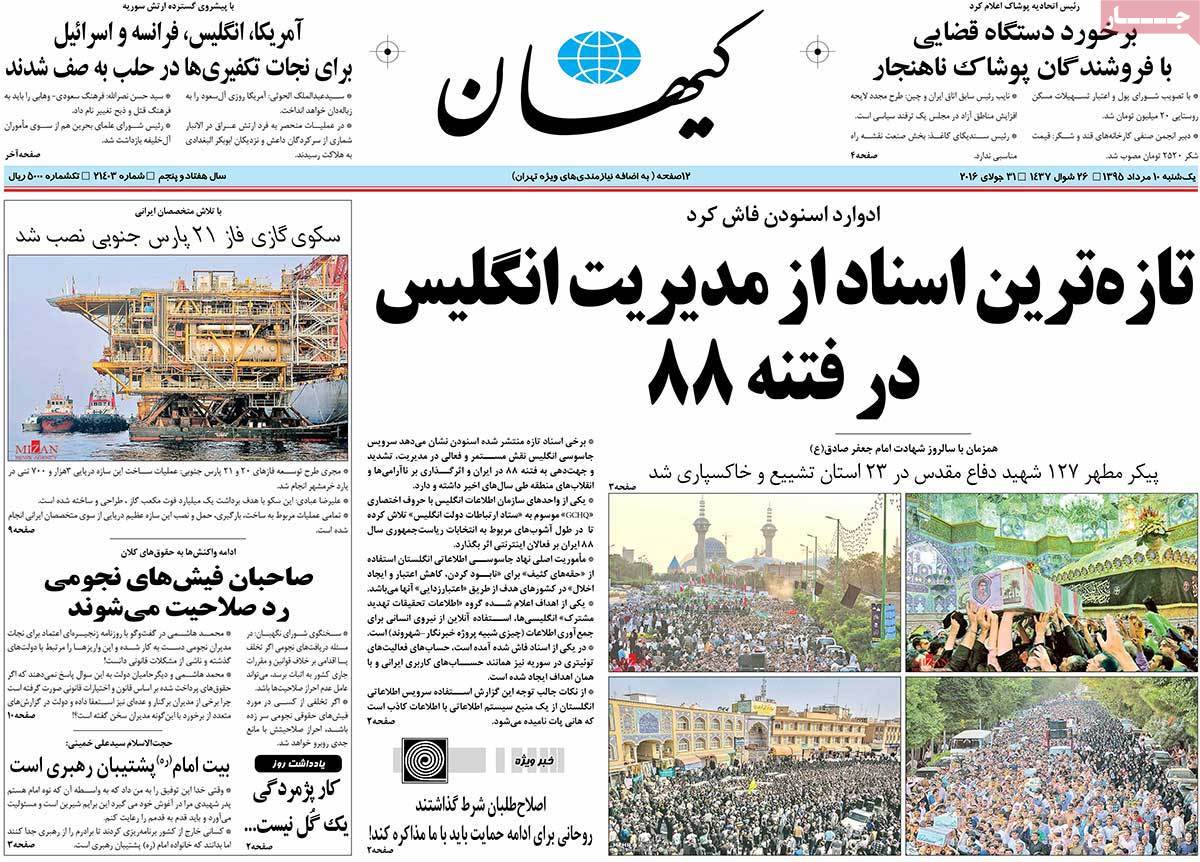
A Look at Iranian Newspaper Front Pages on July 31


Resalat:

1- Economy Minister: We Have Yet to See Results of JCPOA in Practice
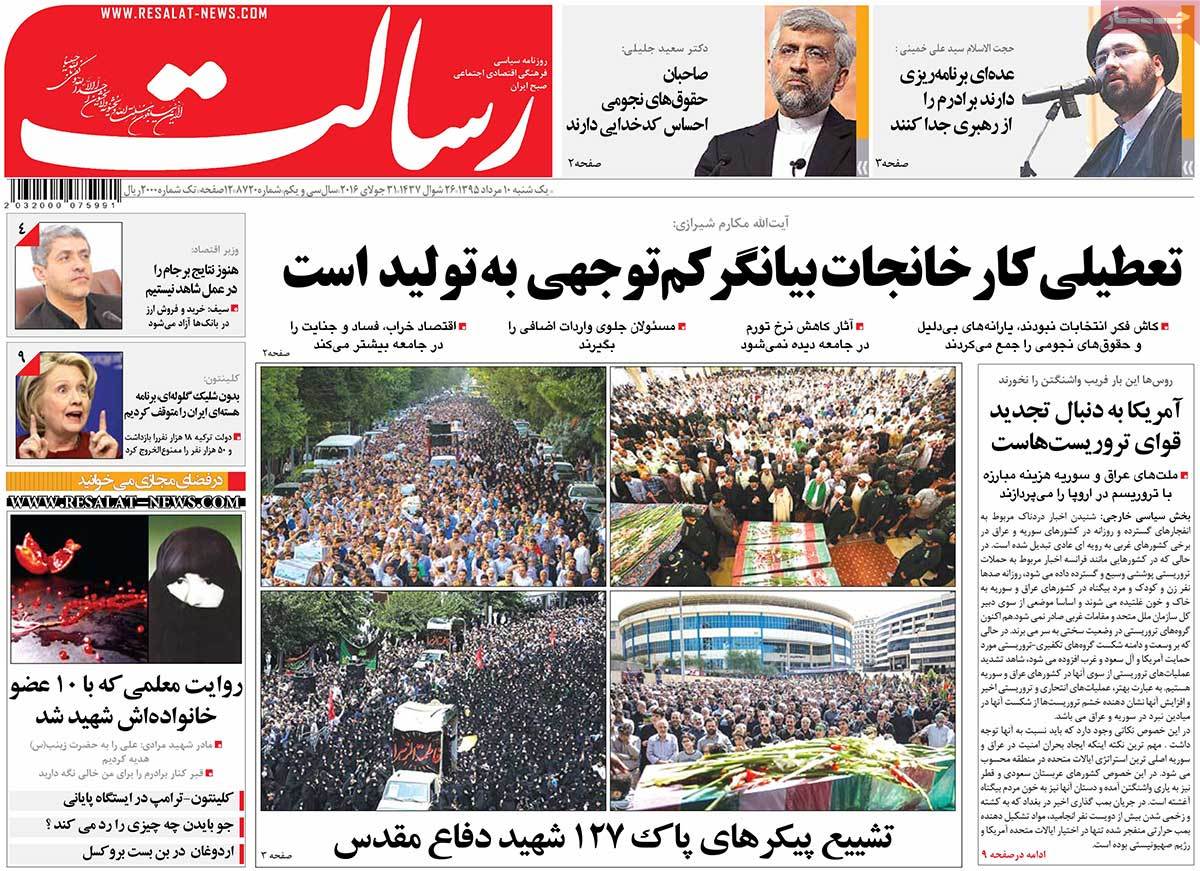
A Look at Iranian Newspaper Front Pages on July 31


Rooyesh-e Mellat:

1- Syrian Army on Verge of Liberating Aleppo

2- Iran’s Condition to Resume Sending Pilgrims to Minor Hajj Pilgrimage

3- Iran’s Karate to Become Technical Hub of Asia
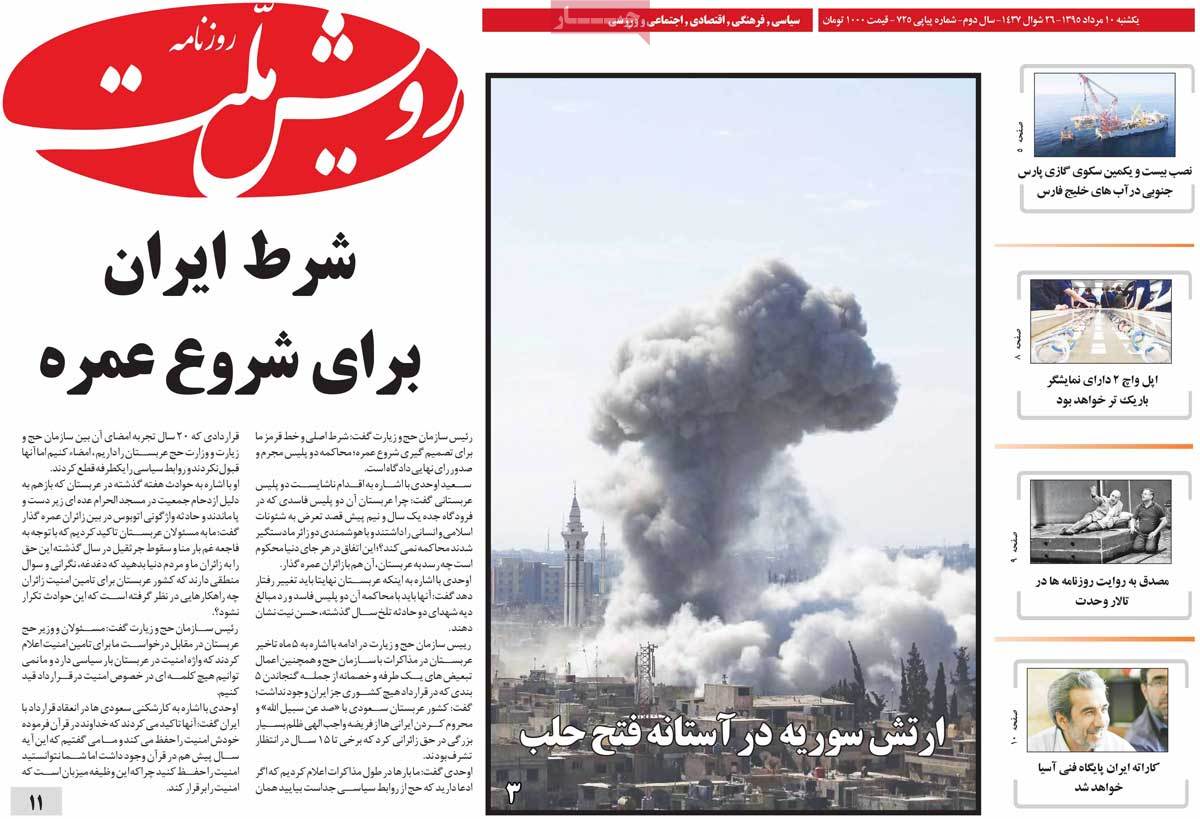
A Look at Iranian Newspaper Front Pages on July 31


Shahrvand:

1- Higher Education with Empty Chairs: Iran Has 5 Times More Universities than World’s Advanced Countries; Iran Has 2,640 Universities, While China Has 2,481 and India 1,620
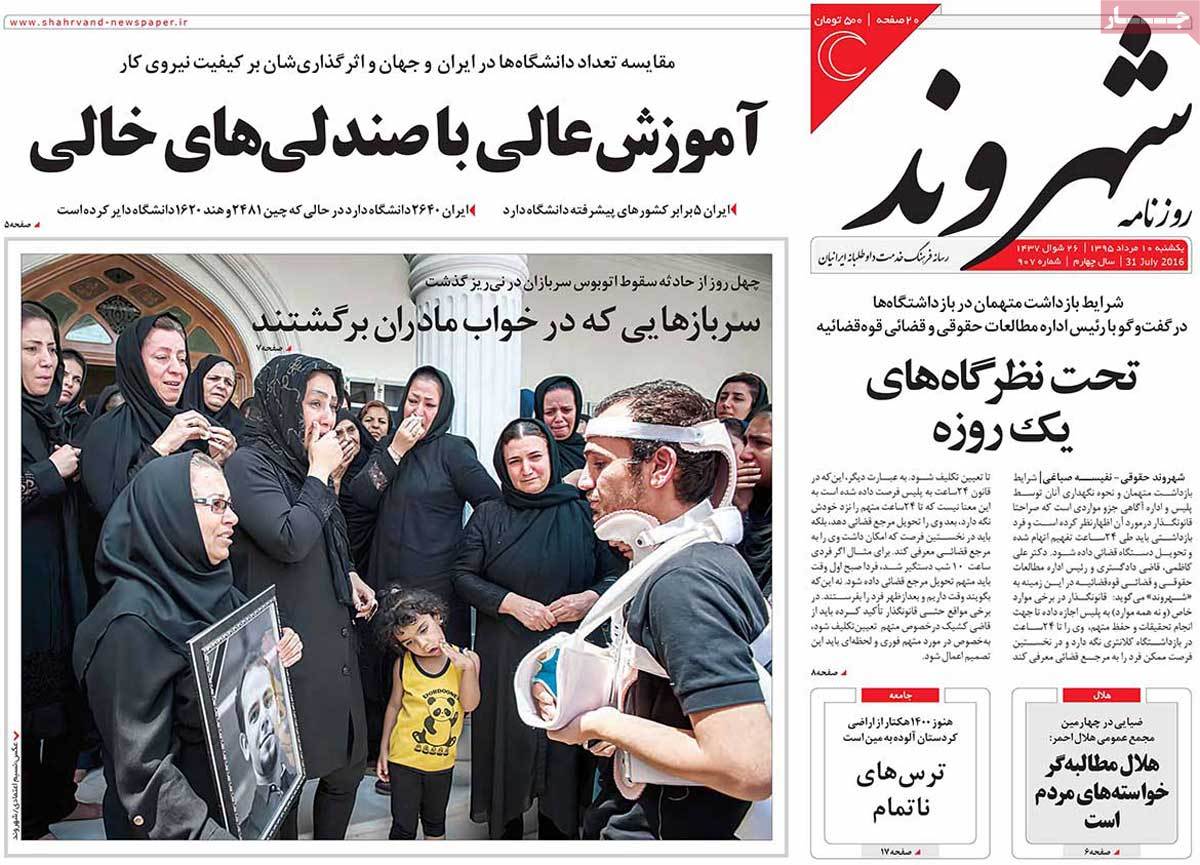
A Look at Iranian Newspaper Front Pages on July 31


Shargh:

1- Untold Stories about Operation Mersad [in Iran-Iraq War] and the MKO Leader

2- Everyone Knows Why Seyyed Hassan Khomeini Was Disqualified from Running for Experts Assembly Elections: Brother

3- Ahmadinejad’s Unprecedented Attack on Rouhani’s Gov’t: They Want to Disqualify Their Rivals
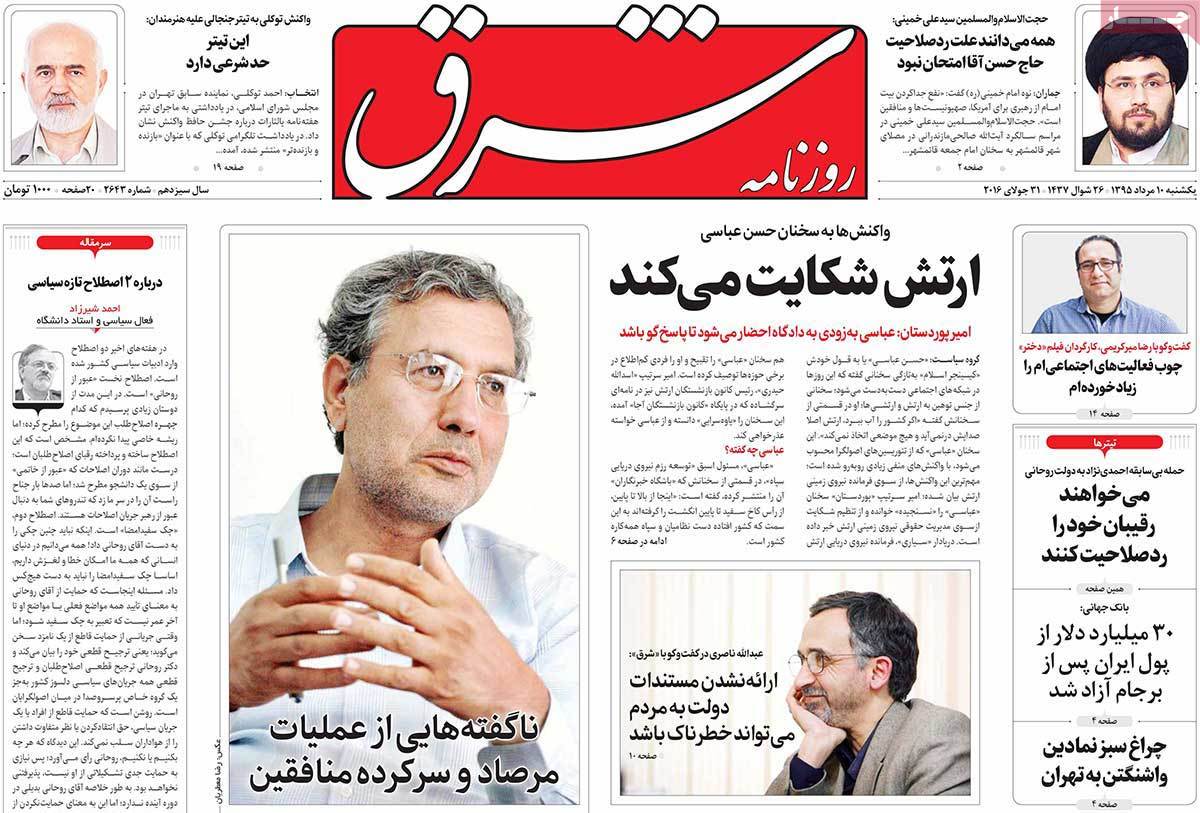
A Look at Iranian Newspaper Front Pages on July 31

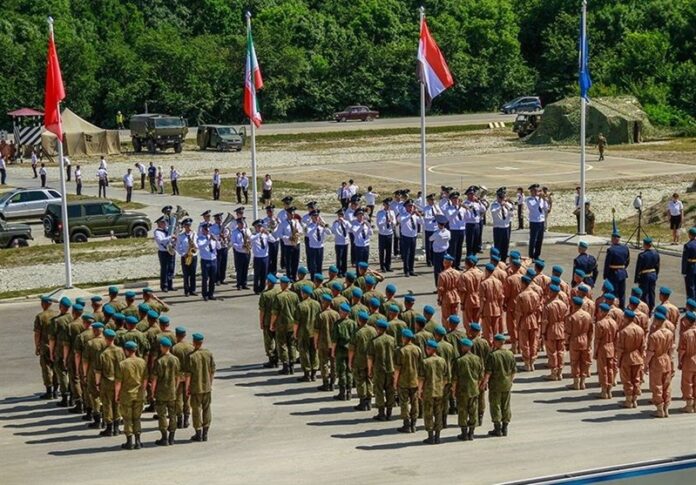
Iranian Commander: Int’l War Games to Boost Global Military Ties

Army

Major General Vali Madani, a member of panel of judges for the International War Games 2016, said, “Iran’s Armed Forces are in good relations with Russia. We are sure the competitions will strengthen them more,” the Tass news agency reported.

He added that the games will boost military ties between the nations taking part in the event.

“The competitions are held at very high level. We are grateful to Russia for holding these very significant competitions. We are looking forward to winning them,” Madani further said.

Seven military teams from Iran’s Armed Forces have been dispatched to Russia to participate in the annual event, scheduled to be held on August 1-14.

Military representatives from 17 countries, including Iran, Russia, China, Egypt, Venezuela, Belarus, and Kazakhstan will take part in the contest scheduled to be held in southwestern Russia.

The teams will compete in various categories, including Sniper Frontier, Tank Biathlon, Suvorov Attack, Elbrus Ring, Airborne Platoon, Seaborne Assault, and Depth.

Source Dismisses Haaretz Report on Injury of Basij Commander in Syria

General Naghdi in Syria

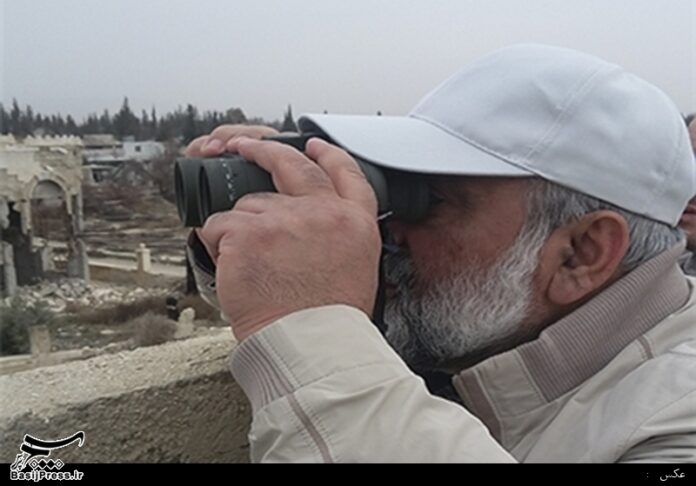
“The Basij commander is fully healthy and doing his daily jobs; the spread of such rumours is the result of the Zionists’ anger after photos [that appeared on the media] showed Brigadier General Naqdi’s powerful presence in Quneitra and the Golan Heights,” the source told Fars on Sunday, July 31.

Pictures of General Naqdi were released by Iranian media on Wednesday. In one of them, he is surveying the scene with binoculars, and in another one, he is inspecting the destruction at sites.

The visit was reportedly part of a situation assessment and inspection on the ground.

Also reports said that General Naqdi met with units of the Syrian army and the Lebanese Hezbollah resistance group that have been confronting the terrorists in Syria.

Iranian Woman Wins Top European Math Prize

2156117

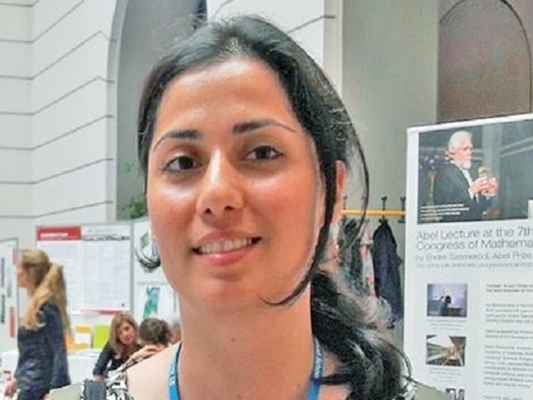
Working as a professor at KTH Royal Institute of Technology in Sweden, Zahedi is being recognized for her efforts to improve computer simulations of the behaviour of fluids that don’t mix together.

Zahedi, 35, is the only woman to win one of this year’s prizes, which were announced during the 7th European congress of Mathematics held in Berlin on July 18-22.

She is one of the nine female recipients of the honourable prize since its inauguration in 1992 and will receive a check for €5,000.

Zahedi, who have been living in Sweden since she was 10, pointed to her experiences in the country, saying, “I didn’t have any friends and I didn’t know any Swedish, but math was a language I understood.”

“In math class, I was able to communicate with my peers and make friends by solving problems with them,” she added, as reported by Mehr and edited by IFP.

Zahedi is an expert in numerical analysis, a study of how to make computer simulations more efficient and accurate. She creates simulations of fluids that do not mix well, such as water, oil and gas.

Sara Zahedi was one of the 1,300 participants, and among the stars of European congress of Mathematics in Berlin. She believes that anyone can understand mathematics.

“We must go much further towards younger age groups and to show them how math is used in their real world; I also believe that programming should be taught as a discipline in the school curriculum.”

3 States behind Leaking Data on Iran’s Nuclear Program: Official

Behrouz Kamalvandi

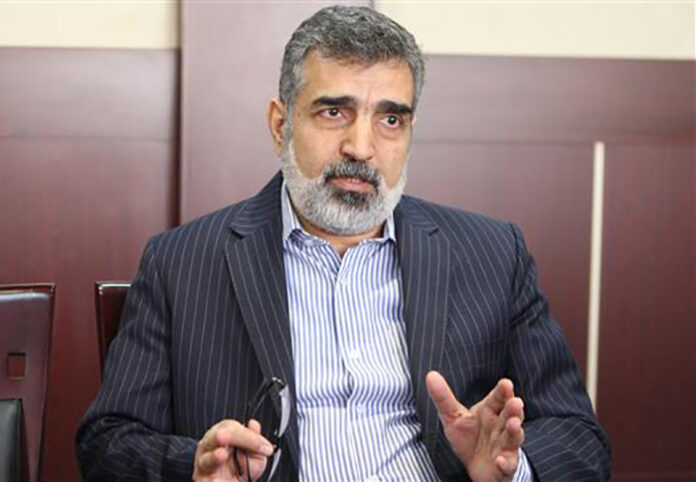
“Our assumption is that three countries have a role in leaking this data and we have also lodged a protest over the issue,” spokesman for the Atomic Energy Organization of Iran (AEOI) Behrouz Kamalvandi said on state television on Saturday.

Earlier this month, the Associated Press, citing a classified document, said Iran’s scaling back of its nuclear program under last year’s agreement with the P5+1 group of countries “will start to ease years before the 15-year accord expires.”

Iran held the International Atomic Energy Agency (IAEA) responsible for the leak, saying it had asked the agency to keep the data confidential. The IAEA, however, rejected the accusation.

Kamalvandi further said Tehran is “not afraid of” the disclosure of the entire documents, adding, however, that they were not supposed to be available to international media “so quickly.”

The official added that Iran’s Supreme National Security Council (SNSC) is in possession of the document on Tehran-IAEA cooperation, which is “highly confidential, while relevant authorities are also aware of the content.

Iranian “lawmakers will be provided with the document if the SNSC deems it necessary,” Kamalvandi stated, assuring that even the disclosure of the entire information “cannot harm our security and nuclear activities.”

Elsewhere in his remarks, Kamalvandi accused Washington of having a hand in the leak, saying such actions are “politically-motivated” amid heated election campaigns in the US.

The IAEA has protocols to protect confidential data, but the agency is “under the influence of political powers like the [United Nations] Security Council,” Kamalvandi said.

He added that Israel is under fire by members of the IAEA Board of Governers over its nuclear work, but the regime refuses to publicly declare the number of its nuclear warheads, which is estimated to stand between 200 and 400.

On January 16, Iran and the P5+1 group of countries – the United States, Britain, France, Russia, China and Germany started implementing the JCPOA which they reached on July 14, 2015.

Under the nuclear agreement, Iran agreed to limit its nuclear program and provide enhanced access to international atomic monitors in return for the termination of all nuclear-related sanctions against the Islamic Republic.

On the same of inking the JCPOA, Iran and the IAEA signed a road map for cooperation on Iran’s nuclear program.

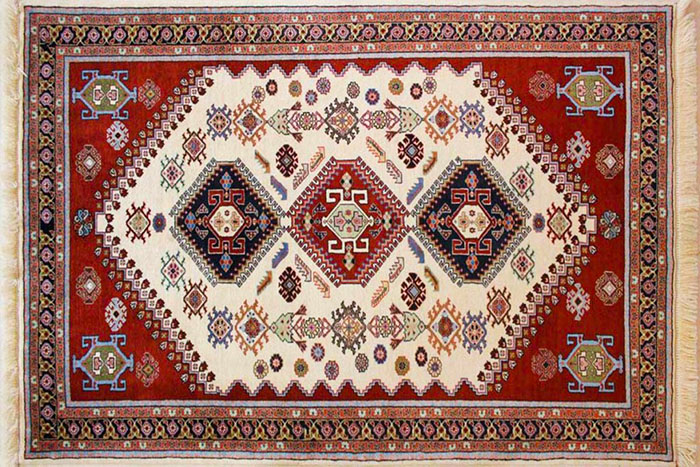
Hand-Woven Carpets of Iran’s Qom and Fars Province

hand-woven carpets
hand-woven carpets


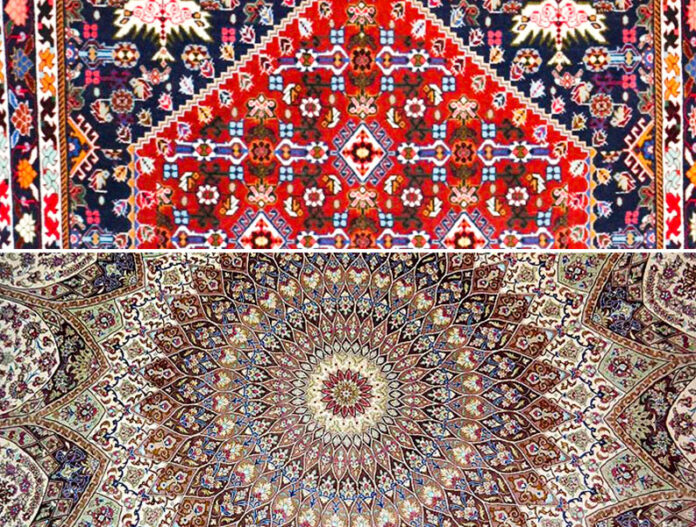
Handmade carpets have a special value among Iranians. In every single part of Iran, from Tabriz and Qom to Mashhad and Fars, and even among nomads, Iranian families weave carpets. You can identify a unique taste as well as the common Iranian roots in every piece of the precise handicraft.

According to a report by Mehr, every carpet mirrors a matchless pattern and a unique combination of hues blending into each other; which is different from one city to another. You will not discern the difference unless you happen to see the juxtaposition of two rugs from two cities.

Just like other handcrafts in Iran, one can smell the fragrant scent of women’s hands intertwined with the knots of the hanging rugs. Women have always been in the vanguard of handicrafts.

Weavers in Fars Province Create Improvised Art

Iran’s south-western province of Fars is one of the pioneering regions in carpet weaving.

When asked by Mehr News Agency on what distinguishes Fars’ carpets from those of other provinces, a carpet expert pointed to their style and pattern without hesitation.

“Fars’ weavers don’t follow a pre-designed pattern. They craft improvised knots and create novel art impromptu,” the expert went on to say.

Therefore, their hand-woven carpets are matchless; you cannot find two carpets that look exactly alike.

People of Fars Province use authentic wool and colours in their carpets. Women in this province use a spinning wheel to make their authentic cotton and wool and even make dye out of plants.

For that reason, no matter how long you use the carpet, it remains as beautiful and valuable as before.

hand-woven carpets


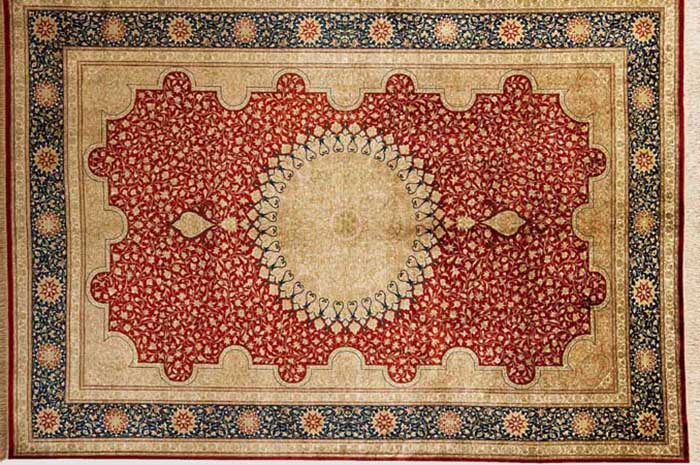
Qom’s Hand-Woven Carpets Parade a Mesmerizing Harmony of Colours

Iran’s holy city of Qom is also a pioneer in the field of carpet weaving; however, what distinguishes the carpets of this region from other cities is the diversity of colours. You rarely see such intricate yet enthralling combination of colours in the carpets of other cities.

Beguiling orange, purple, green and steel blue are the colours usually picked for the background. They are interlaced with intricate patterns and designs that grab the attention of every viewer.

hand-woven carpets


It is interesting to know that not a long time has passed since Qom’s carpets made way into the Iranian homes because they used to be exported for their high quality. However, the unfair sanctions imposed on Iran and the export of Persian carpets had ceased the export.

Since weavers of Qom use pure silk in their carpets, their inimitable handicraft is known for richness of their details, high knot density and great lustre. Consumers are advised to walk on the carpet with care.

Fire at Mahshahr Petchem Complex Was an Environmental Warning

“Given the national and worldwide importance of environmental issues, we need to make every effort to achieve sustainable development and promote environmental standards by making progress in our scientific and technology development,” Masoumeh Ebtekar said in an address in Mahshahr, which she was visiting to inaugurate a number of industrial projects.

According to a report by IRNA, as translated by IFP, she emphasized the efficient use of energy and water resources, and noted, “Authorities should spare no effort to decrease environmental contaminants, particularly greenhouse gases.”

Ebtekar pointed to the last year’s remarks made by the Leader of the Islamic Revolution about the general policies of environmental issues and said, “The Leader’s remarks highlight the importance of environmental issues and the necessity for observing its regulations.”

She went on to say that ignoring environmental issues could leave detrimental effects on economy, health and natural resources.

“Fortunately, the incumbent government has placed environment high on its agenda, which corroborates the claim that it is investing more time on environment than previous governments.”

Ebtekar appreciated the changes made in the approach of petroleum industry towards environmental issues and said, “To have a say in international arena, we need to strive to improve our standards.”

She expressed satisfaction with the omission of mercury from the productions of Bandar Imam Petrochemical Complex and added, “This change of approach not only benefits the residents of this region, but also turns a profit at the international level as it is connected to the Persian Gulf.”

“Exclusion of mercury decreases energy costs of the complex by 3% which is a big step forward under the Paris agreement,” Ebtekar underlined.

According to Paris agreement, Iran is obliged to decrease greenhouse gasses emissions by 8% on the condition that JCPOA is fully implemented.

Abgoosht, Delicious Traditional Persian Food

Abgoosht, Delicious Traditional Persian Food

Abgoosht has been widely popular among the Iranian nation since a long times ago, and is still made and served in many Iranian homes as well as traditional restaurants throughout the country.

Recipe for Dizi, Famous Traditional Persian Food

Here are CHN’s photos of Iranian people eating Abgoosht in a restaurant.


Child Sexual Abuse Prevention Programs in Iranian Kindergartens

Kindergarten

Little innocent children are sitting on red chairs with wide eyes and gaping mouths, listening attentively to the words coming out of their kindergartener’s mouth. They call her Khaleh Sima [aunt Sima]. She holds an MA in child psychology.

Sima has two teddy bears at hand; a big one and a small one. She turns to the small bear and asks, “Tell me my little bear girl! When uncle bear comes home and you go sit on his lap to get a yummy chocolate, where on your body isn’t he allowed to touch?”

After everyone heard the question clearly, the small bear points to the private parts on her body.

Then, Khaleh Sima asks a little girl named Gelareh about the ones who are allowed to shower with her. Gelareh, to show emphasis, raises her voice a little bit and replies immediately, “Just my dearest mom and grandma, and if they were not around, I shower with my daddy.”

The training takes 20 minutes every session.

Sima refers to the tragic incident that happened to her little cousin by an old family friend as the driving force behind the beginning of these classes.

“The man, called Meisam, was an old friend of my aunt and her husband. They used to spend almost all the weekends together. After a while, they noticed that their 6-year-old daughter was developing symptoms of extreme physical weakness,” Sima said.

Her cousin was hallucinating when sleeping and after several counselling sessions, she finally revealed the secret when she said, “I don’t really like the games uncle Meisam plays with me!”

They trusted Meisam so much that they would ask him to look after their daughter when they were busy or they would let him take her to the park. However, all these times he was wickedly molesting the poor Gelareh.

Sima said the appalling incident completely destroyed her aunt’s life; therefore, she made a firm decision to do something about it.

“I went to the Ministry of Education and Social Welfare Organization and filed a petition to hold these classes, but they rejected my request,” she went on to say.

“I paid visits to sporadic kindergartens in different areas of the city and shared the story with all of them. I have already signed several contracts with different kindergartens to hold sexual abuse prevention classes.”

Sima suggested that parents usually frown upon such training courses at kindergartens, but she firmly believes that serious attempts should be made to change this austere way of thinking.


Government to Hold Sexual Abuse Prevention Programs

After several cases of sad child abuses, especifically following the sexual harassment of an Afghan girl named Setayesh in Varamin County south of Tehran, who was brutally killed afterwards, the good news is that the authorities heard the wake-up call after all.

In an interview with Sharq daily newspaper, Siavash Shahrivar, the Director General of Tehran’s Social and Cultural Affairs, said, “Teaching children about child sexual abuse prevention in kindergartens and pre-schools is supposed to become a law in the near future.”

“The bitter incident of the rape and slaughter of a six-year-old girl in Varamin prompted the government to feel the need to educate children about sexual issues,” Shahrivar noted.

He introduced a plan that enlightens children about private parts of their bodies and said, “Children take these classes in kindergartens and pre-schools to acquire sufficient maturity and learn the difference between playing games and sexual abuse.”

“We reached out to university professors to come up with a practical solution for our problem, and finally found that a professor from Tehran’s Allameh Tabataba’i University had authored a comprehensive and prolific book on sexual abuse while observing our red lines,” Shahrivar noted.

A contract was inked with the professor to extract excerpts from his book and teach them in kindergartens and pre-schools, he noted.

In an interview with Shargh, Raziyeh Miraninejad, a child psychologist and faculty member in Shahid Beheshti University, elaborated on the training courses of sexual abuse prevention.

Miraninejad laid emphasis on the rules and regulations of teaching in such classes and said, “To familiarize children with the dos and don’ts of sexual issues, you should either be an expert or have an intimate relationship with them; therefore, teaching the parents might be even more important than teaching the children.”

Parents need to be careful about the language they use to talk to their children and always pick beautiful words in their speaking, especially when their children are around, she added.

According to Miraninejad, children’s sex education starts when they become three years old.

“When your child asks a question about sexual issues or is exposing his or her private parts carelessly, parents should seize the opportunity to teach them lessons,” she stressed.

Miraninejad went on to say that children should never feel shy about the private parts of their body because if they feel so, they would refrain from telling their parents if an abuser has crossed the red line.

“Children should learn that no one is allowed to touch them on their private parts simply as they never allow anyone to touch their tongue or poke their ears.”

When asked about the parents’ role in helping their children recover from the abuse, she described two reactions as soul murderer.

“Parents should be alert to avoid these two reactions; first, to ignore them and second, to attack them.”

The trauma of childhood sexual assault is almost incomprehensible.

“If parents realize that their child has been a victim of sexual assault for several times, psychological interventions can offer big help. The children educated in the field of sexual abuse prevention are less vulnerable than the uneducated ones,” Miraninejad said.

Iran’s FM Says West Africa Tour ‘Successful’

Zarif

“Ending successful W. Africa visit w/70 business execs. Encouraged by huge potential for economic cooperation & commitment to fight extremism,” Zarif said in a message posted on his Twitter account on Thursday upon his return from the trip.


Javad Zarif

The Iranian foreign minister started the four-nation tour of West Africa on Sunday, which took him to Nigeria, Ghana, Guinea and Mali to discuss possible ways of expanding relations.

He left Bamako, the capital of Mali, for Tehran on Thursday.

Back in February 2015, Zarif took another tour of Africa, and travelled to Kenya, Uganda, Burundi and Tanzania, heading a high-ranking political and economic delegation.

Expansion of relations with African countries in all political, economic and cultural fields has been a matter of prime importance in Iran’s foreign policy agenda.

Iranian President Hassan Rouhani, who took office in August 2013, has repeatedly stressed his government’s interest in boosting relations with the African nations.