Friday, December 26, 2025
Home Blog Page 4009

Iran Judiciary Slams Provocative Remarks on Opposition Figures’ House Arrest

Ayatollah Amoli Larijani

In a meeting with high-ranking judiciary officials on Monday, Ayatollah Amoli Larijani said the presidential candidates who promised their supporters to end the house arrest of opposition figures after being elected are not in a position to do such a thing.

The judiciary chief did not directly mention President Hassan Rouhani’s name, but he was the only candidate who made such a promise during his presidential campaign.

Ayatollah Amoli Larijani referred to such promises as populist moves aimed at standing against the legal decisions made by Iran’s legal bodies, and warned against making such comments.

He harshly criticized the “media and individuals who try to repeat such remarks in a coordinated way in an attempt to put the Judiciary under pressure,” and warned that they must stop it, otherwise the Judiciary will strongly stop them.

“The country’s highest-ranking security body [Supreme National Security Council] has made a decision regarding the issue. Ending the house arrest has its own procedures like any other SNSC resolution,” he noted, adding that those who are provoking people to stand against such legal decisions are following the spirit of 2009 sedition.

“Even if the SNSC annuls its resolution and the house arrest ends, that is the time when the Judiciary starts its work on the case. The decision about the accusations and the way to punish the convicts will be upon the judge of the case,” Mizan quoted the Judiciary chief as saying.

In reaction to Amoli Larijani’s remarks, Iranian Government Spokesman Mohammad Baqer Nobakht noted on Tuesday that the Judiciary Chief would better refrain from raising such issues publicly.

Speaking in a press conference, Nobakht said the power in the Islamic Republic of Iran is divided between the three branches [judiciary chief, president, and parliament speaker]. “The President should use all its authority.”

He advised the Judiciary chief to raise such issues in the regular sessions of the Supreme National Security Council, where Ayatollah Amoli Larijani is also a member.

“We should not talk about these issues in the media and avoid getting people engaged in such developments,” ILNA quoted him as saying.

Opposition figures Mahdi Karroubi, Mir-Hossein Mousavi and his wife Zahra Rahnavard have been under house arrest since 2011.

“Comments by Iranian Officials Triggered Tighter US Sanctions”

raisi-US Sanctions

Ebrabim Raisi, the conservative candidate who was defeated in Iran’s 12th presidential election, has harshly criticized the foreign policy adopted by Rouhani administration, saying some comments and messages from inside the country have contributed to the US ratcheting up its sanctions against Iran.

In an address to his supporters in the city of Mashhad, Raisi also slammed what he called the Iranian cabinet members’ illegal support for the incumbent president during the elections campaign.

“In the foreign policy domain, the administration should give up its policy of begging. It is wrong to send signals that would let the enemy know the country’s coffers are drying up. It is wrong to create the impression that people’s everything depends on the JCPOA [nuclear deal between Tehran and world powers]. Kneeling before an Arab official who killed thousands of Muslims in Mina is [an example of] a policy of begging,” said Raisi, who is the custodian of the Imam Reza holy shrine.

He further touched upon Washington’s efforts to slap fresh sanctions against Iran.

“They (US authorities) receive messages and signals which make them understand their sanctions have been effective, prompting them to ratchet up the sanctions.”

“Among the contributors to the tightening of the sanctions were the signals sent from inside the country. If the messages were related to [activities done to realize a] resilient economy and efforts made to ensure an independent economy, they wouldn’t have dared intensify the sanctions,” Raisi noted.

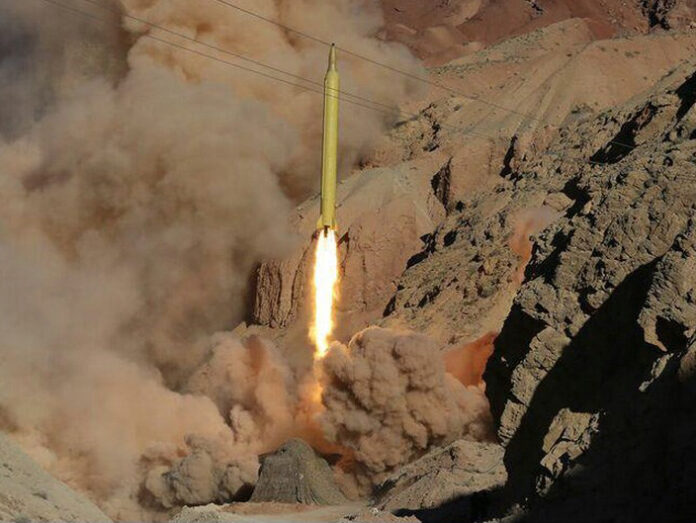
He also took a jab at Rouhani over his remarks about the missile tests conducted by the Iranian Armed Forces.

“I asked which president on earth would weaken his or her country’s defence and missile capabilities. The defence capability is not for waging war; rather, it is to avert war. All over the world, they boost this capability for the sake of deterrence to ward off aggression on their soil. You should be proud of martyrs’ families. Why are you undermining them? If it weren’t for them, we would have to be fighting ISIS in Tehran today,” said Raisi.

He then highlighted that religious democracy is among the features of an Islamic system and the country’s constitution, adding all pillars of the Islamic Republic of Iran are chosen by popular vote.

He further criticized the government over its handling of the 12th presidential election.

“Our people did their best as always, but the officials didn’t do enough. I, as a candidate, should apologize to the people who had come to vote, but had to wait for hours [in long queues] at polling stations simply because they wanted to vote for the hopeful who was a rival to the incumbent administration’s candidate. These people did not manage to cast their ballots finally,” he said.

He said the Guardian Council has received reports from around the country suggesting many people did not get the chance to vote because of long queues at polling stations.

He appreciate the 16 million people who voted for him in the election, and added those votes in fact belong to those who would like to see a government on a par with an Islamic government come to power, the ones whose demands are similar to those of the late Imam, the Leader, martyrs and war veterans.

“I consider the Guardian Council’s decision as the final word; I have put forward my demand and will follow up the issue through legal channels. I will not give up on pursuing my demands, neither will I back down in the face of baseless accusations,” he said.

Raisi warned about efforts by some elements to create tension in the society by polarizing it.

“They bang the drum for polarizing the society; it is a threadbare approach used by the UK to divide Shiites and Sunnis into two, each.”

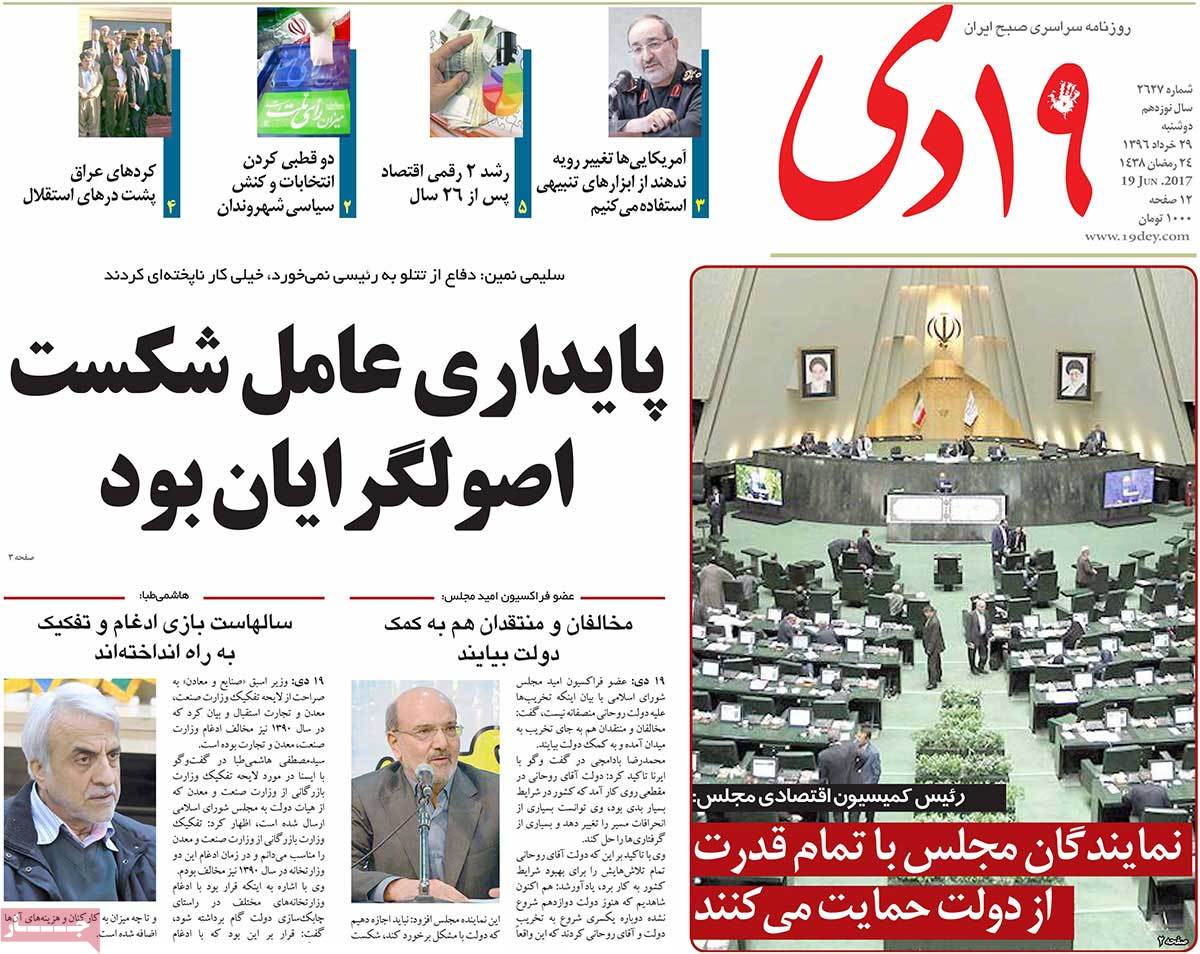
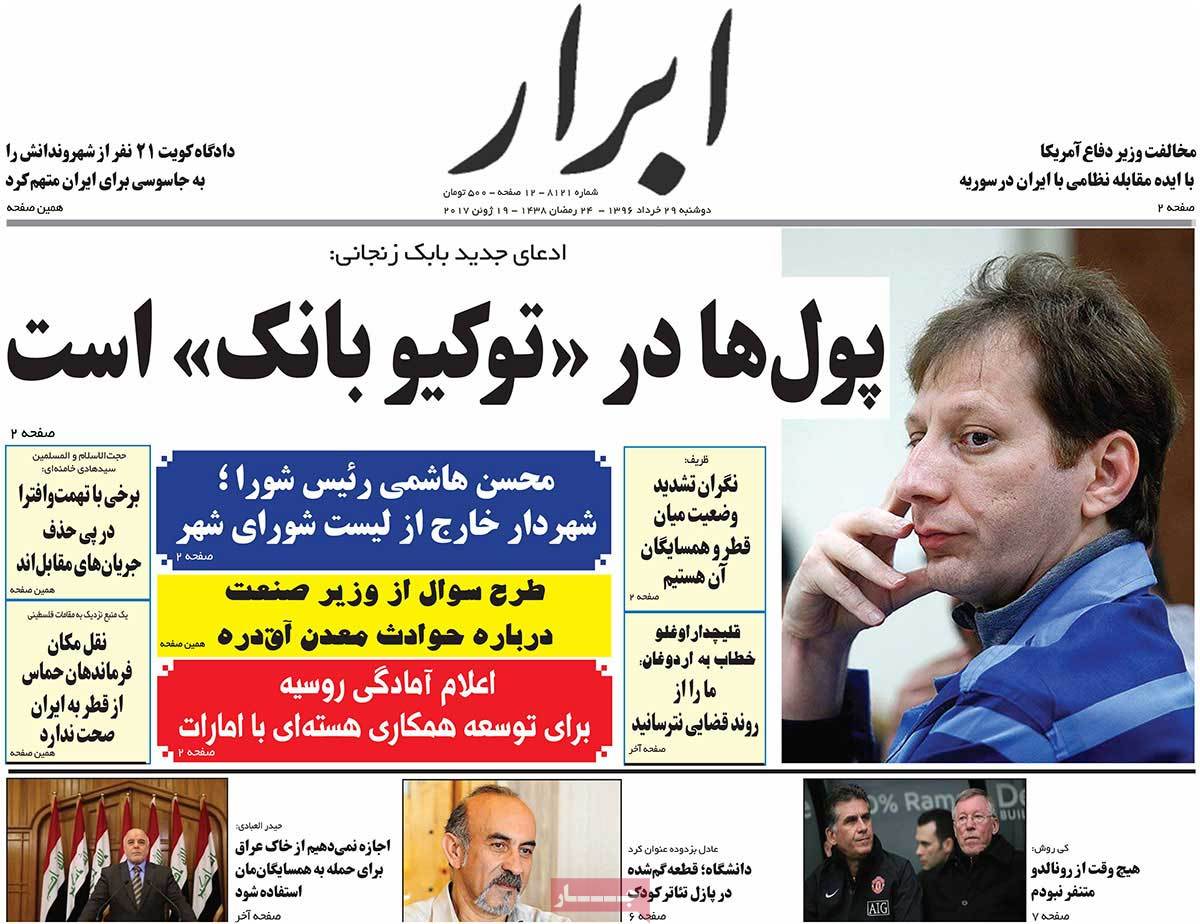
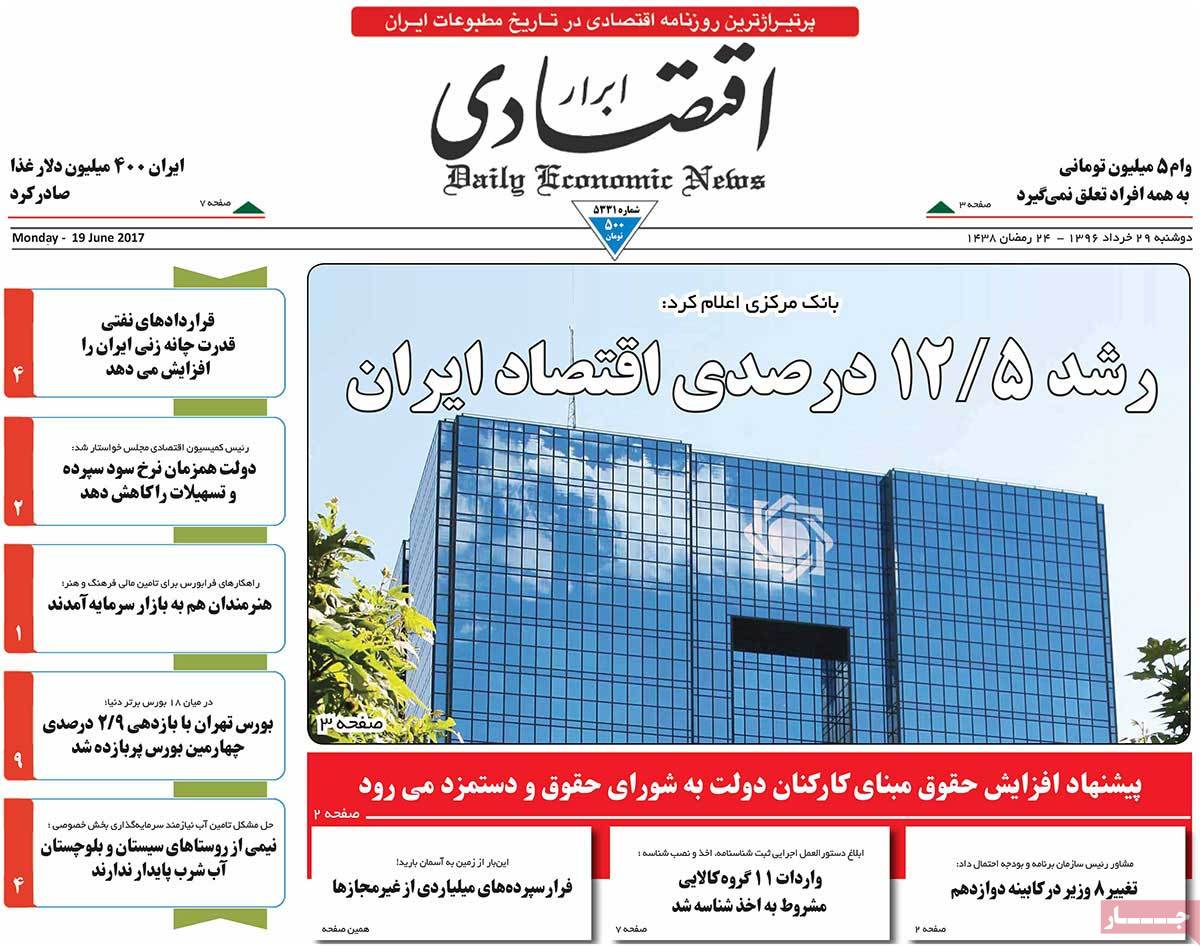
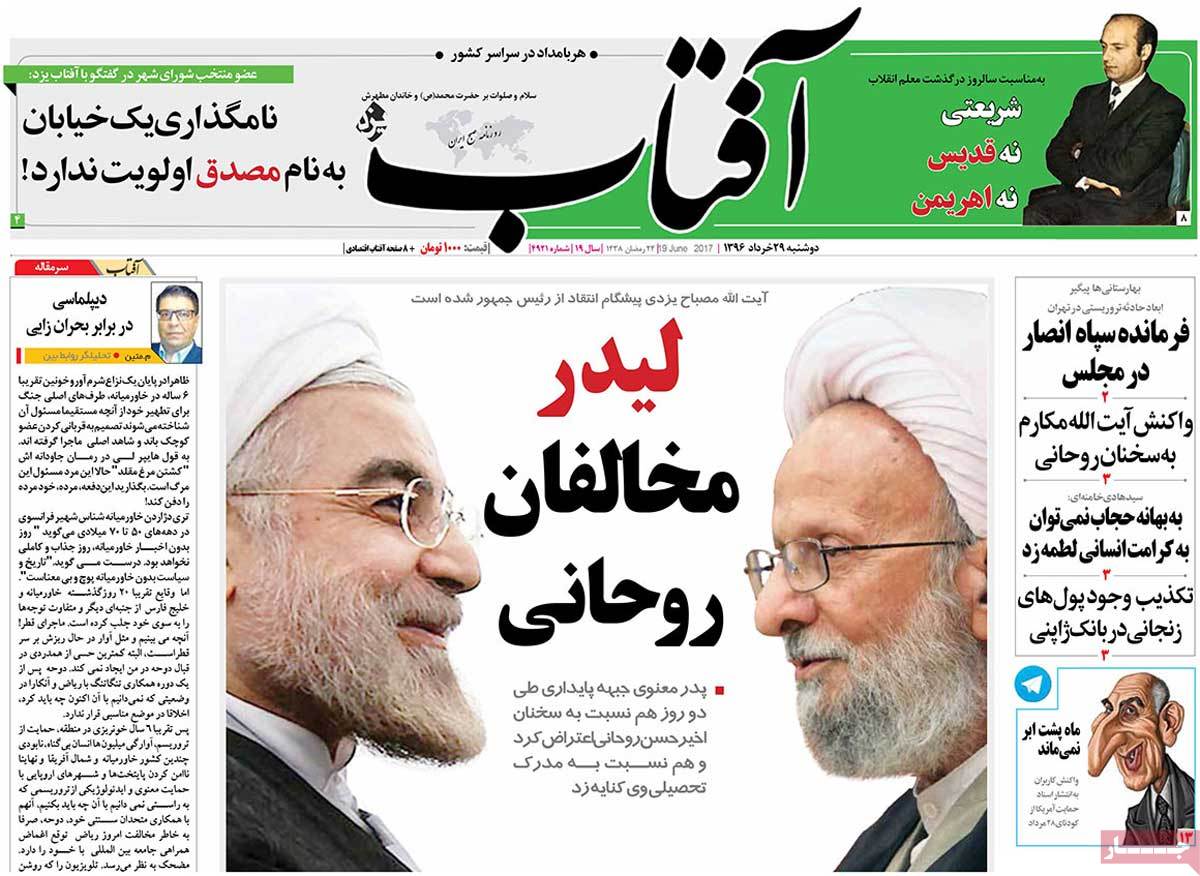
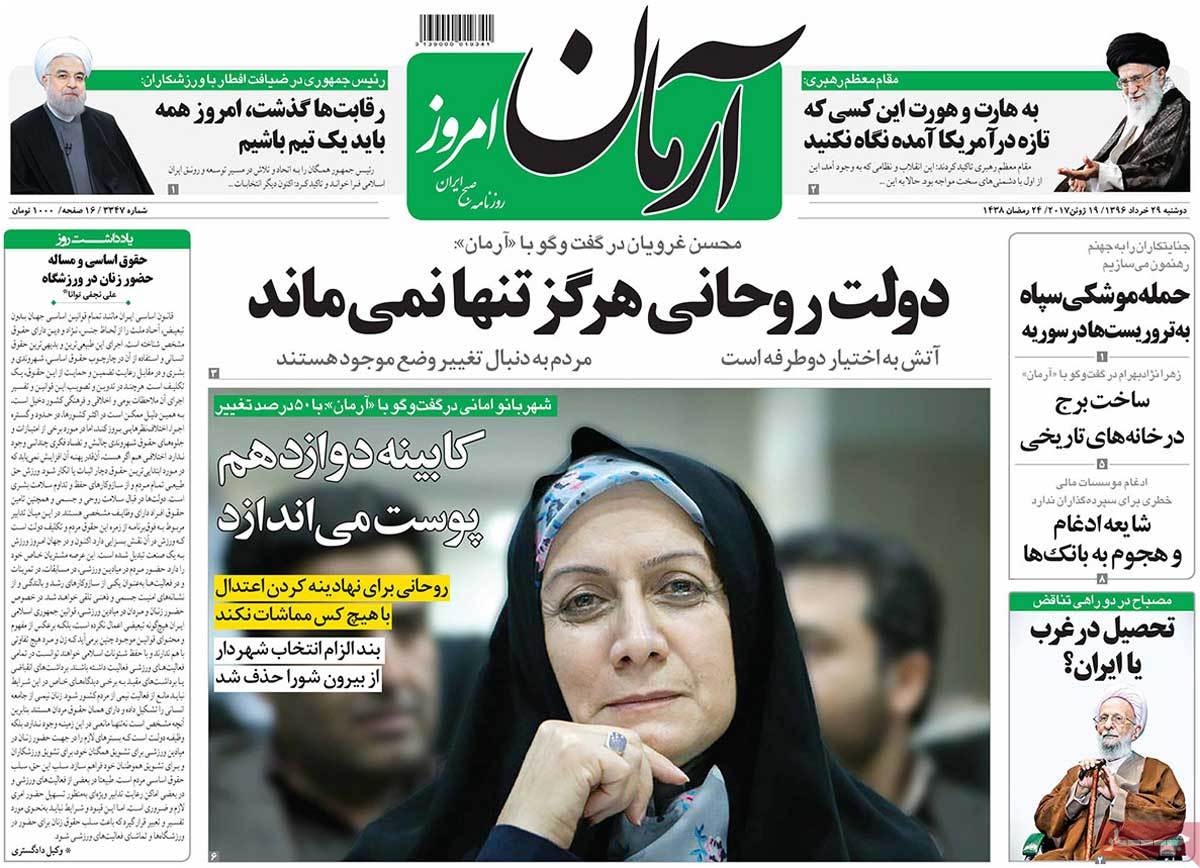
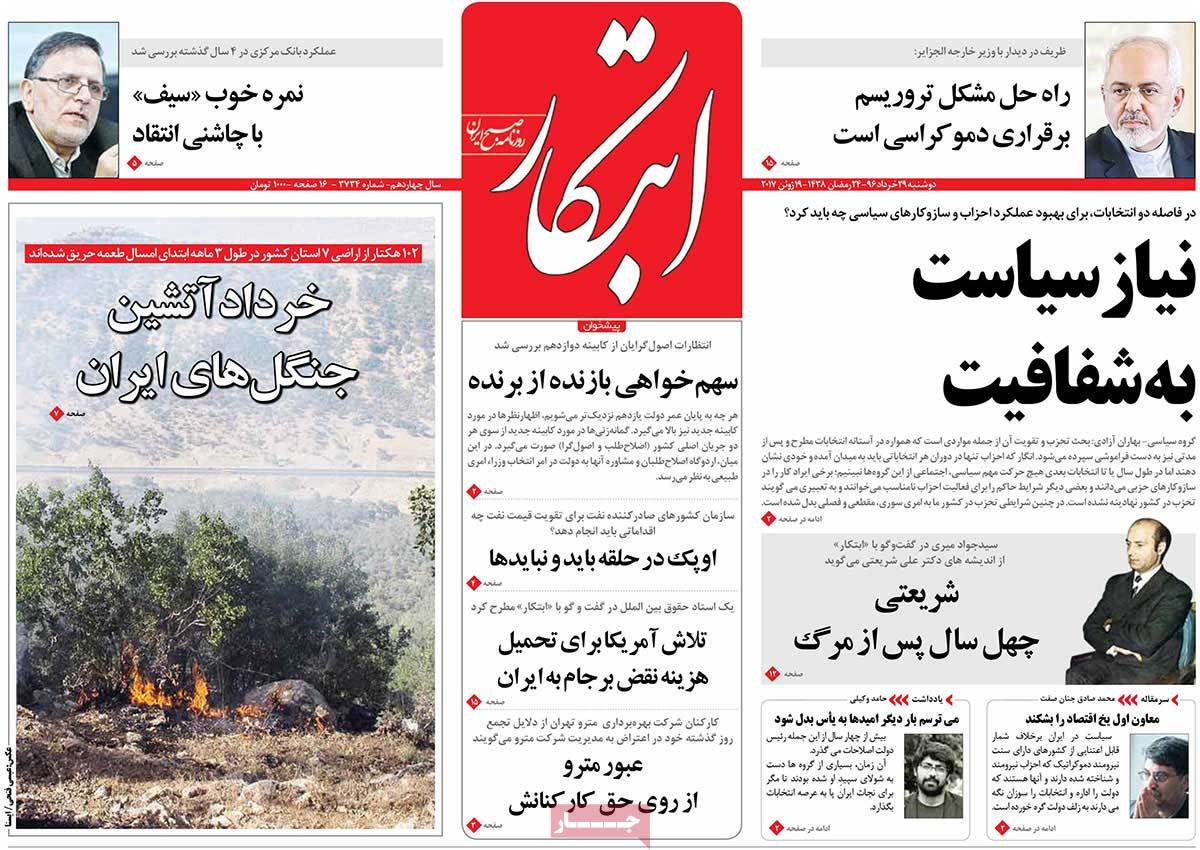
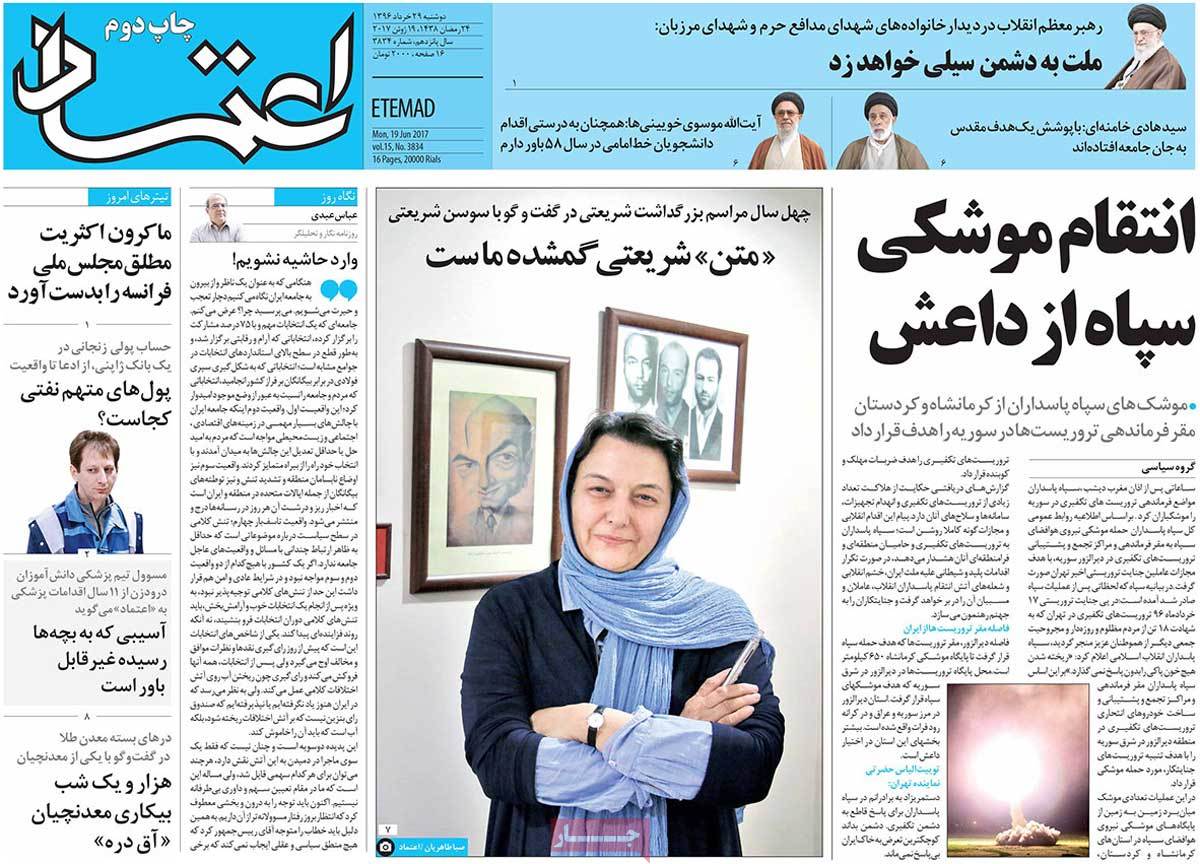
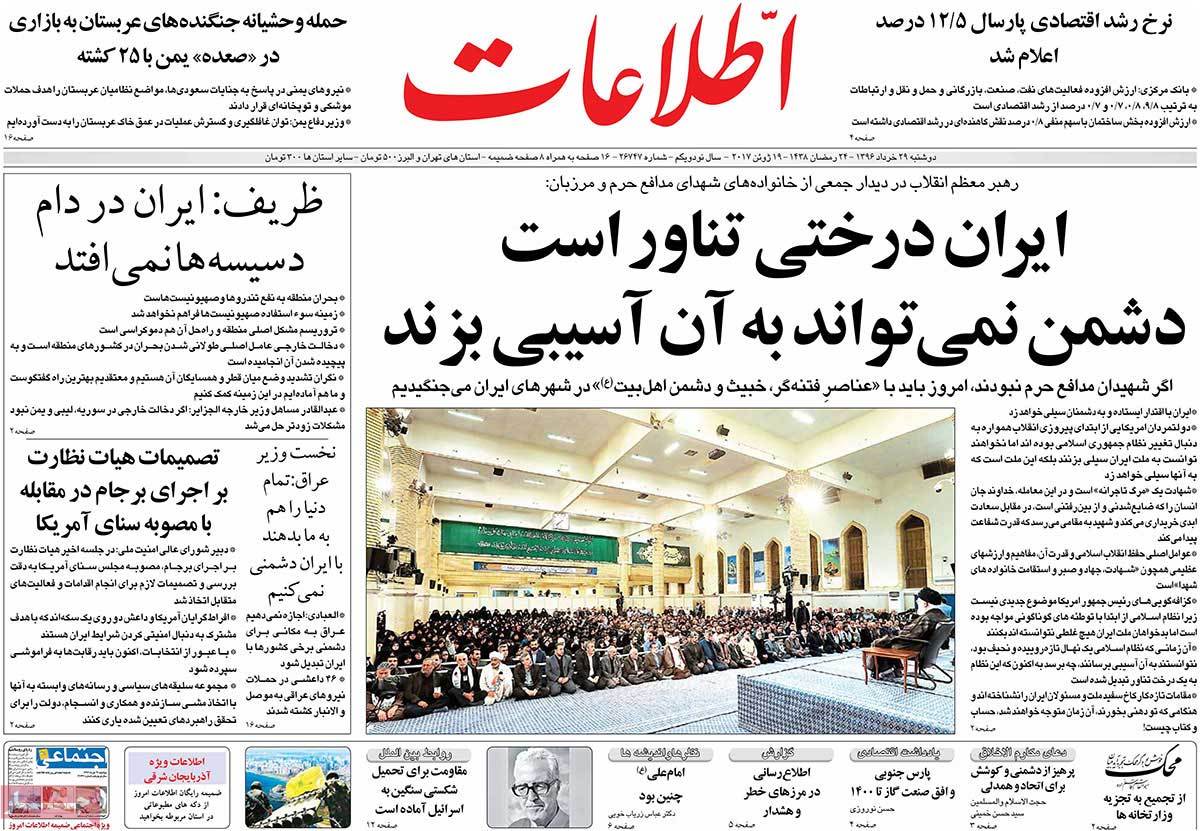
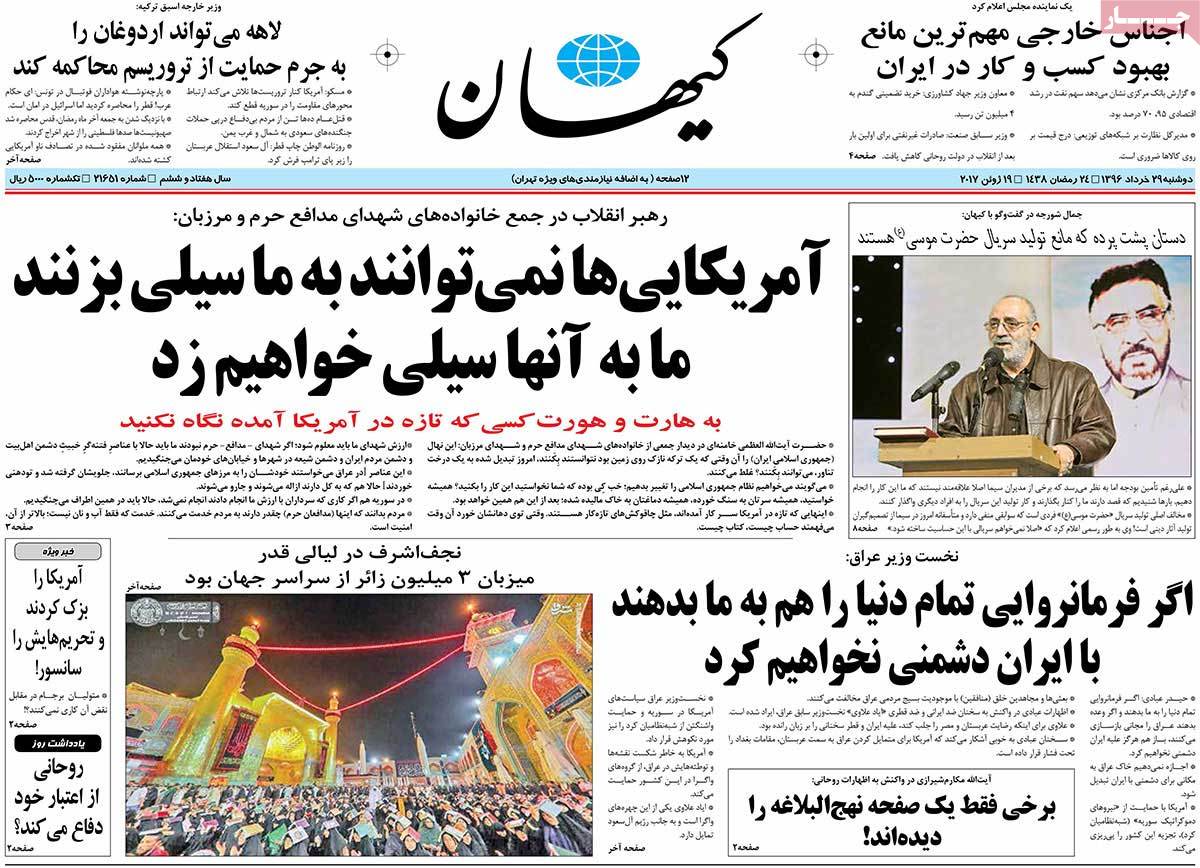
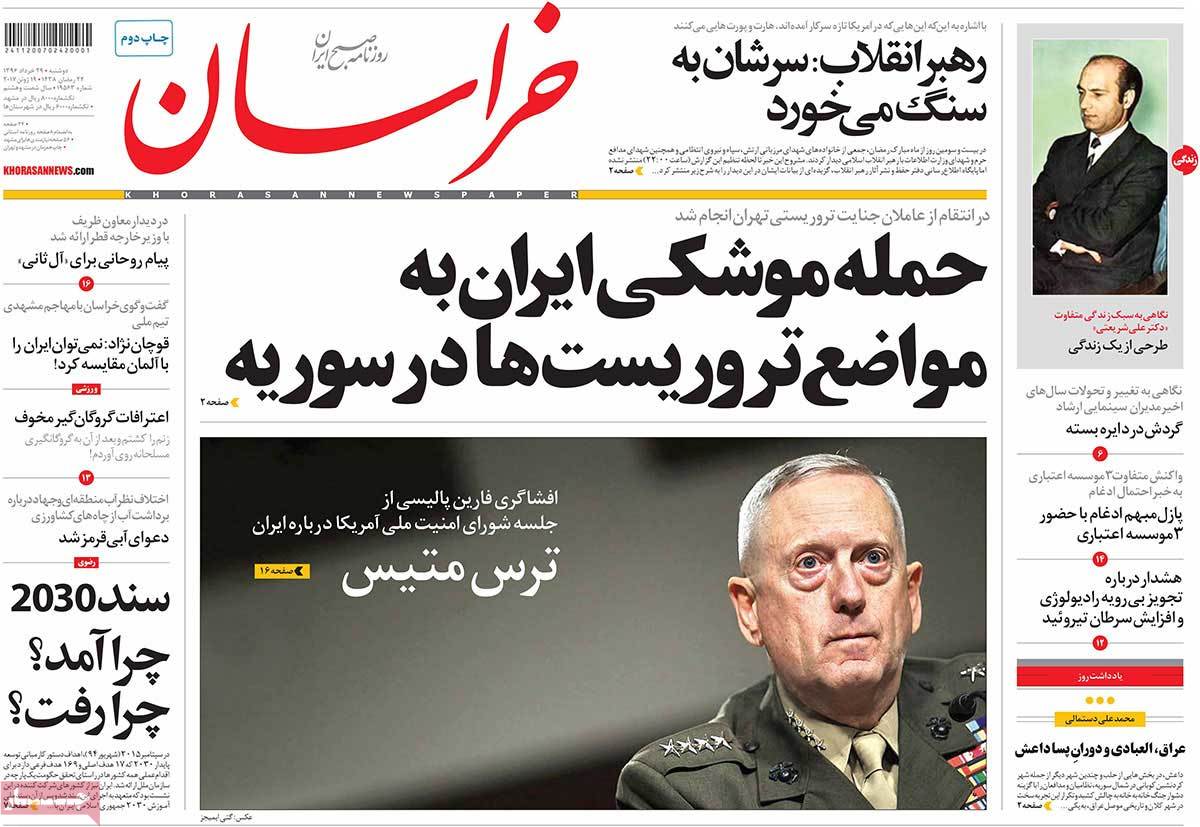
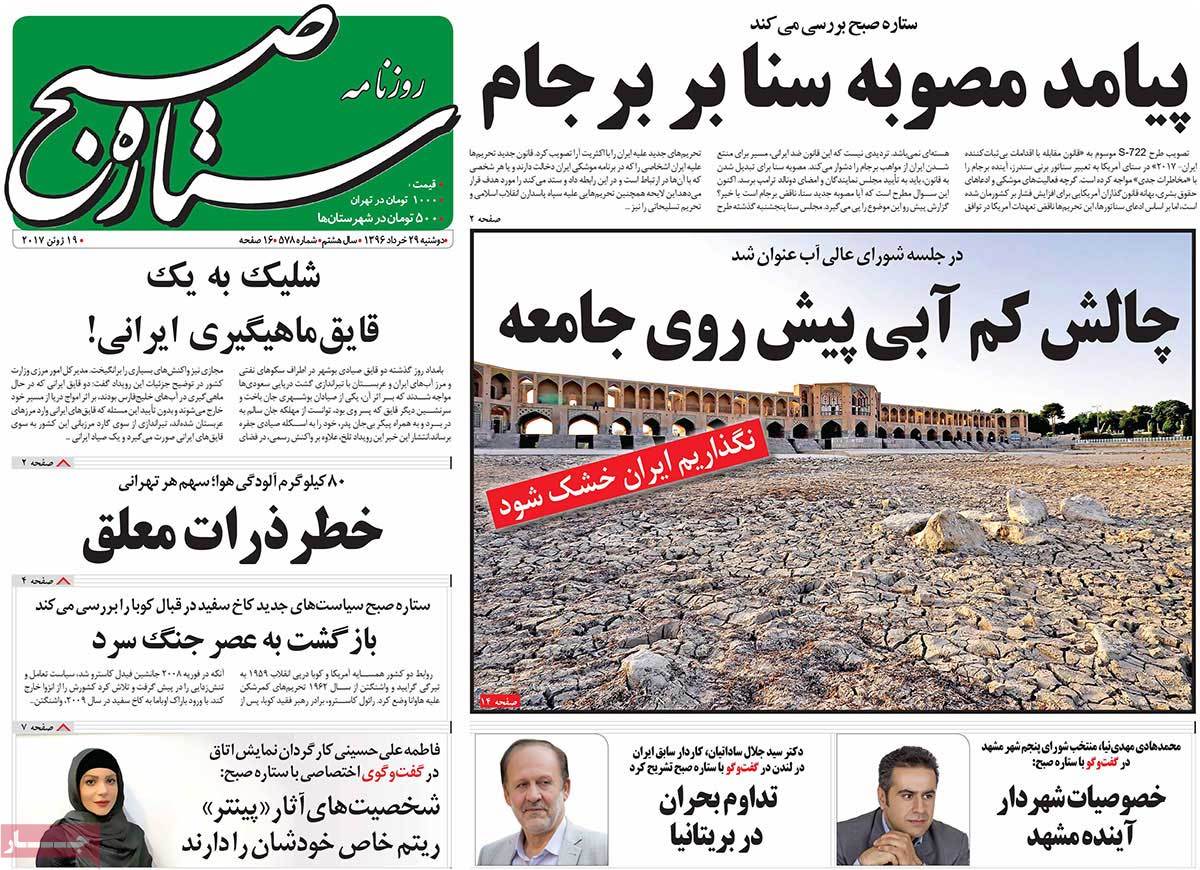
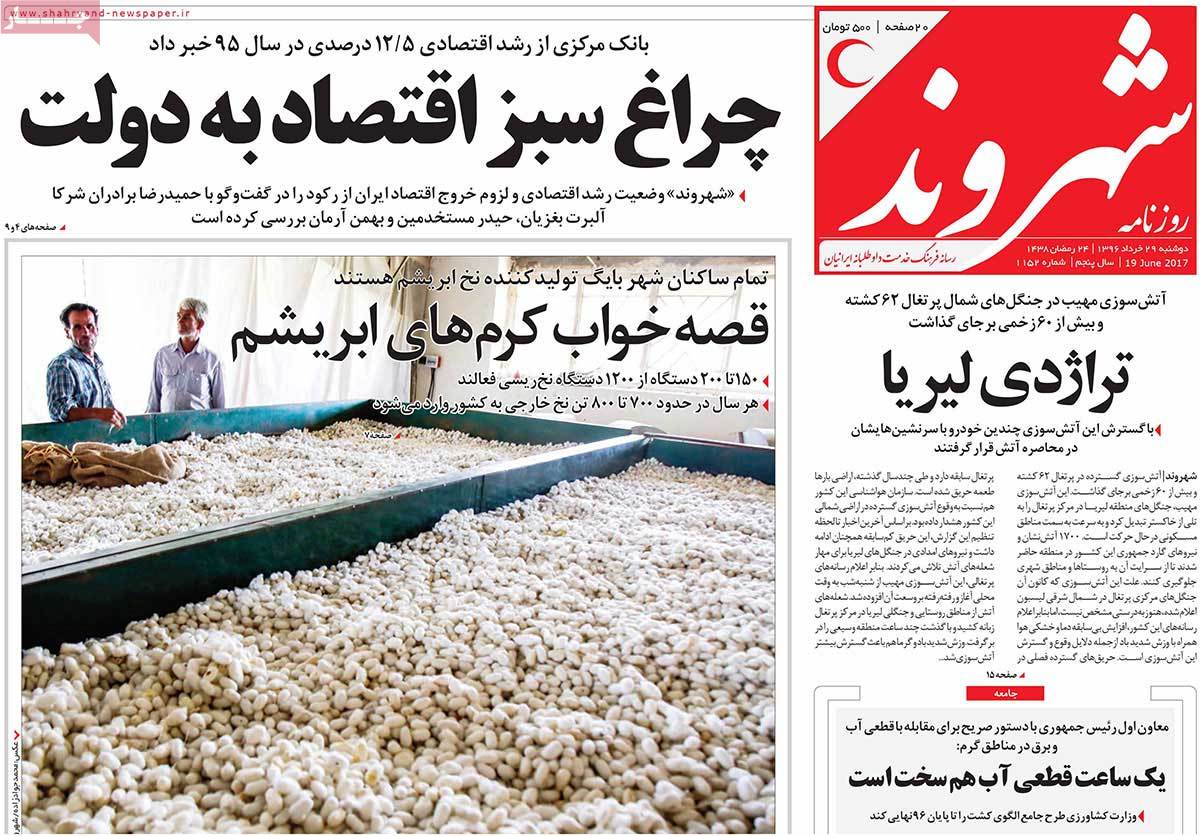
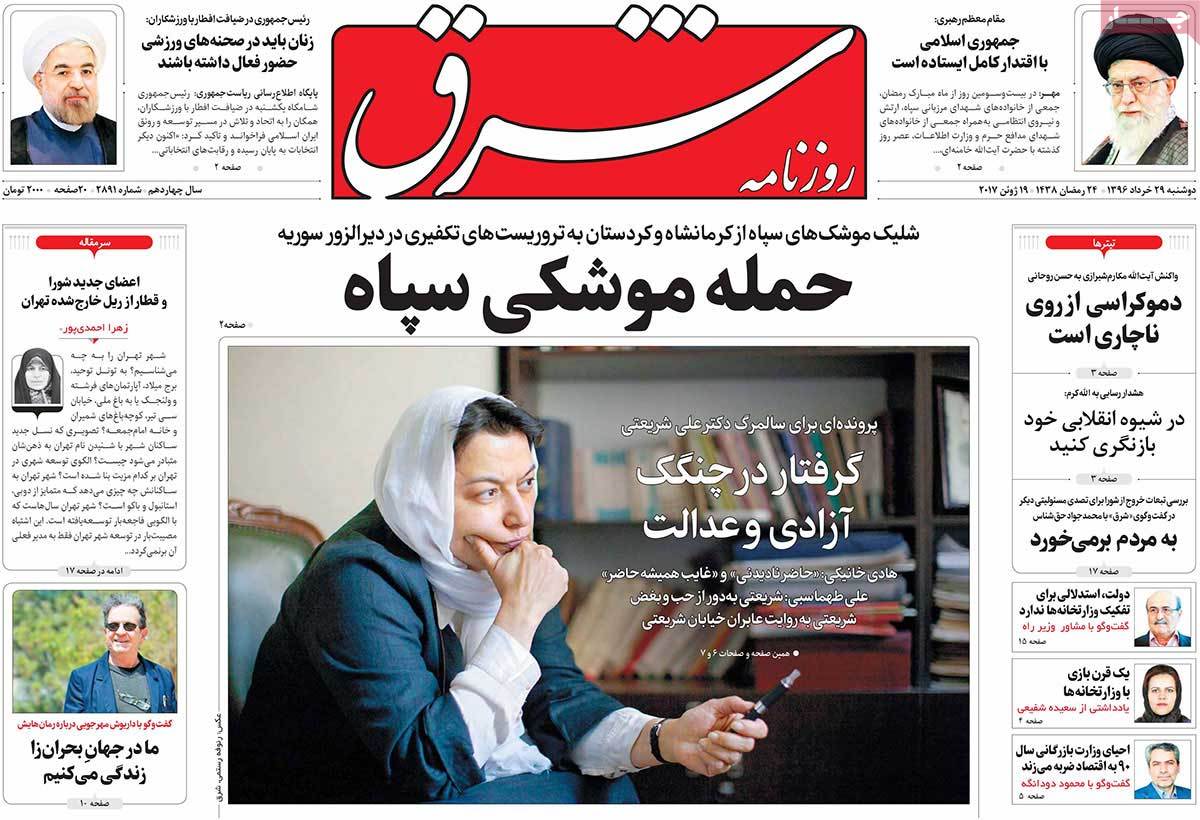
A Look at Iranian Newspaper Front Pages on May 30

Newspapers today covered the latest developments in Arab countries’ ties with Saudi Arabia, particularly Qatar’s refusal to follow Riyadh’s anti-Iran policies.

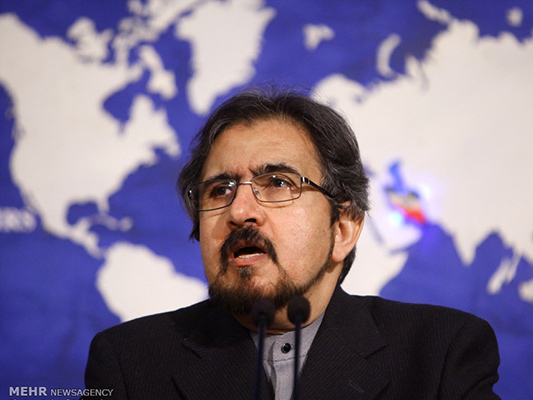
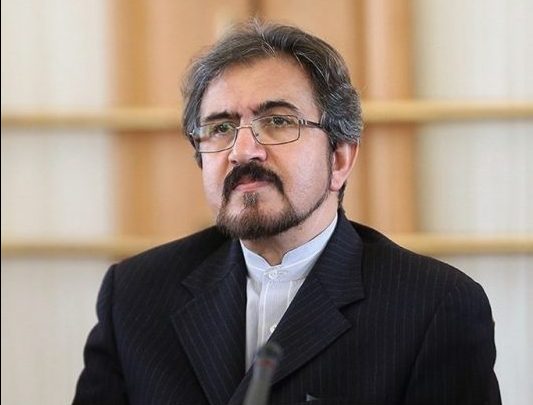
The remarks made by Iranian Foreign Ministry Spokesman Bahram Qassemi in reaction to international developments also received great coverage.

President Hassan Rouhani’s rival Ebrahim Raisi’s remarks against the government and its alleged electoral offences were also a top story today.

The above issues, as well as many more, are highlighted in the following headlines and top stories:


Abrar:

1- Mattis: War against N. Korea Will Be Disastrous

2- Iran Leader Donates 313 Million Tomans [$84,000] for Release of Prisoners

3- 3,000 Iranian Women Still Held Captive by ISIS

4- New York Times: Trump Interested in Doing Business with Iran

5- Oman FM: We Don’t Pay Attention to Iran-Saudi Row in Our Ties with Tehran

A Look at Iranian Newspaper Front Pages on May 30


Aftab-e Yazd:

1- Rouhani’s Gov’t against Reformist MPs

  • Why Rouhani’s Ministers Are Trying to Dissolve Reformists’ Coalition in Parliament

A Look at Iranian Newspaper Front Pages on May 30


Asr-e Rasaneh:

1- Korea Starts Production of Its Cars in Iran

2- Export of Iran’s Soil Prohibited by Parliament

3- First New Oil Contract to Be Signed by End of Rouhani’s First Term

A Look at Iranian Newspaper Front Pages on May 30


Ebtekar:

1- Factions in Iran Are Parties Indeed

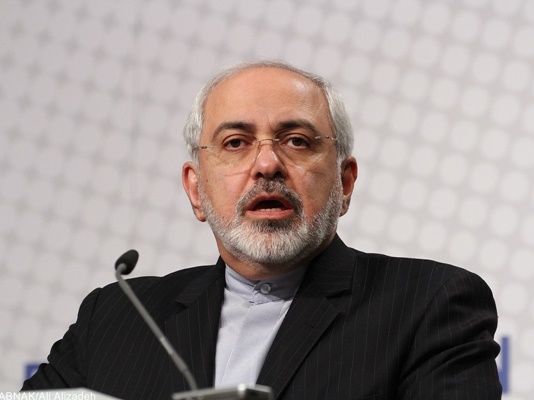
2- Ridiculous Claims against Zarif

  • Iranian FM Reacts to Hard-Line MP’s Allegation [that Zarif has promised to hand over General Soleimani to US]


A Look at Iranian Newspaper Front Pages on May 30


Ettela’at:

1- Merkel: US Not Trustworthy, We Should Stand on Our Own Feet

2- New York Times: US Not Capable of Resolving Mideast Crisis without Iran

3- 25th Int’l Quran Exhibition Opens in Tehran

4- Logistic Town of Tehran’s Imam Khomeini Airport to Be Built

A Look at Iranian Newspaper Front Pages on May 30


Haft-e Sobh:

1- A Report on Six Iranian Fishermen Lost in Kenyan Waters

A Look at Iranian Newspaper Front Pages on May 30


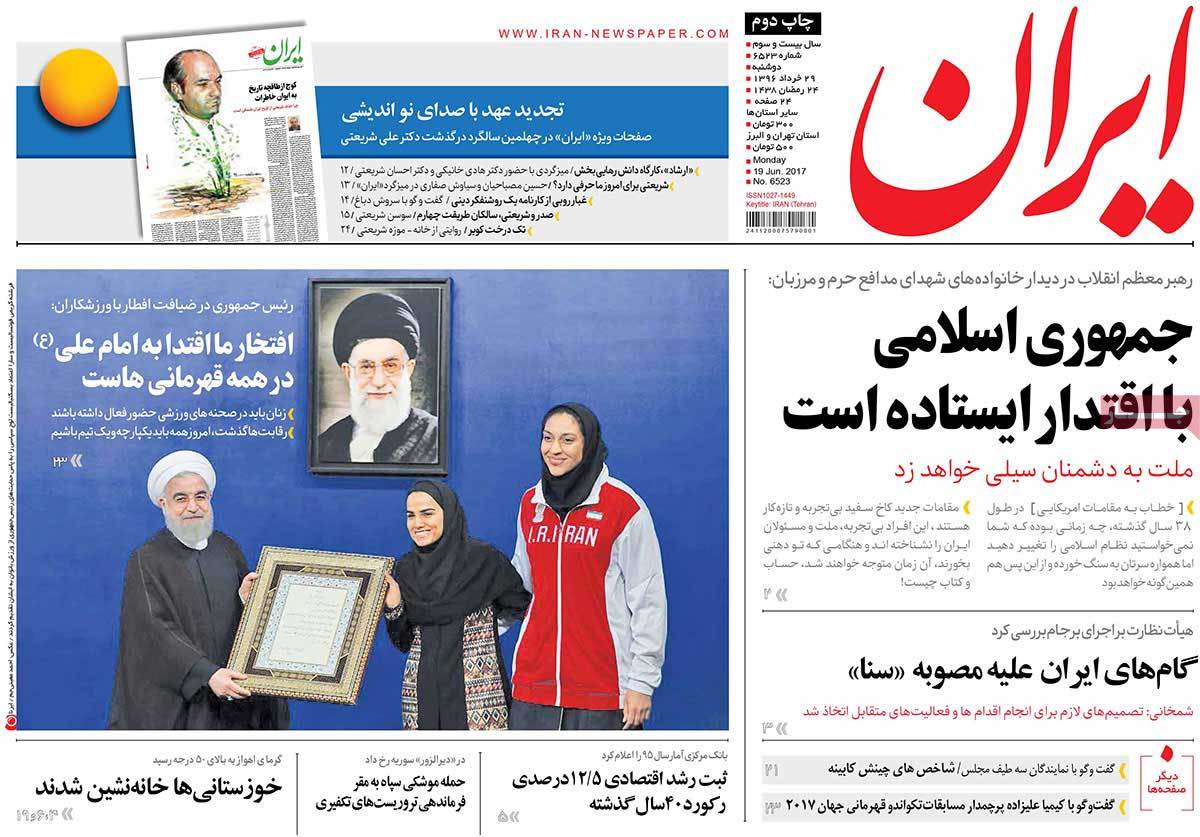
Iran:

1- First VP: Government Successfully Passed Test of Iran Elections

A Look at Iranian Newspaper Front Pages on May 30


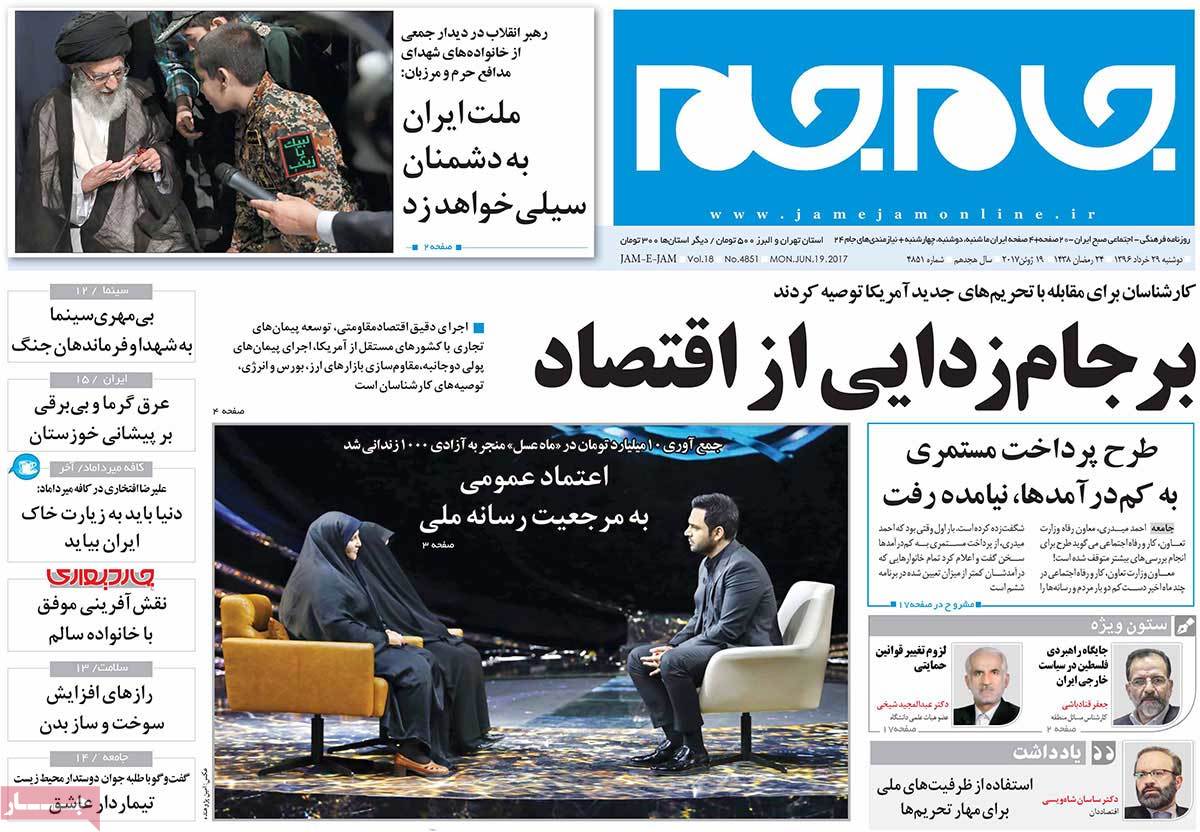
Jame Jam:

1- Al Saud’s Worn-Out Iranophobia Scenario Fails Once Again

  • Qatar, Oman, Iraq, Lebanon Refuse to Follow Riyadh’s Anti-Iran Policies

A Look at Iranian Newspaper Front Pages on May 30


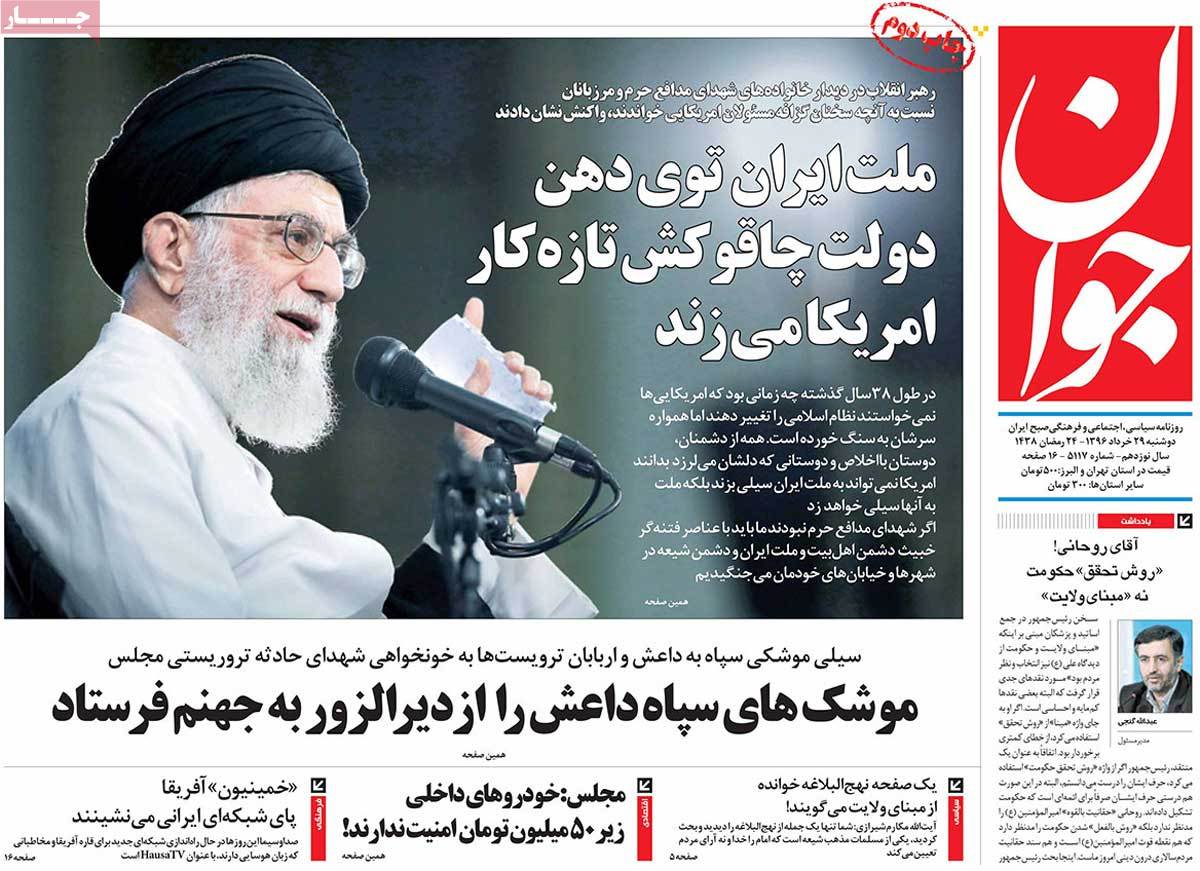
Javan:

1- Rouhani’s Gov’t to Quintuple Cash Subsidies for Poor People Using Existing Resources!

  • Rouhani Had Frequently Criticized Increase of Cash Subsidies in Debates

2- US on ‘Zero Line’ of Clash with Resistance Front

  • Iraq’s Popular Forces Advance to Syrian Border

3- Raisi: New Sanctions Was Response to Domestic Signals


A Look at Iranian Newspaper Front Pages on May 30


Kayhan:

1- It’s Not People’s Right to Know!

  • From New Sanctions to Delivery of Free Gas to Turkey

2- Iraqi Popular Forces Make Progress in Western Mosul, Arrives at Syrian Borders

3- Pakistan May Leave Saudi Coalition in Yemen

A Look at Iranian Newspaper Front Pages on May 30


Khorasan:

1- Europe, US on Path of Separation

  • Merkel: US No More a Reliable Partner for Europe

2- Raisi: Electoral Offences Unprecedented

  • I Urge Guardian Council, Judiciary to Protect People’s Votes

3- Qalibaf: We Never Should Stay in the Past as We’ll Lose Both Present, Future


A Look at Iranian Newspaper Front Pages on May 30


Resalat:

1- Ayatollah Noori Hamadani: Government’s Justifications about 2030 Document Unacceptable

2- Judiciary Chief: After End of House Arrest [of opposition figures], Judiciary Will Prosecute Them

3- Trump’s Stances Are False, Irrelevant: Iran

4- Riyadh: Centre of Terror, Violence in Mideast

  • Al Saud’s Gradual Movement towards Collapse


A Look at Iranian Newspaper Front Pages on May 30


Rooyesh-e Mellat:

1- North Korea Insults China: Trump, in Reaction to Pyongyang’s Missile Test

2- Al Khalifa Should Know Its Crackdown on Bahrainis Will One Day Backfire: Iran

A Look at Iranian Newspaper Front Pages on May 30


22 Int’l Bodies Call for UNSC’s Action to End Yemen Crisis

Iranian, Swedish Diplomats Discuss Ways to End Yemen War

In their letter to the UNSC, 22 international organizations stressed that the people of Yemen cannot wait any longer for the Security Council action, and an immediate ceasefire should be implemented to end the Yemenis’ suffering.

Here is the full text of their letter:


We the undersigned organisations call upon UN Security Council members to take action to bring about an immediate ceasefire in Yemen, end the humanitarian crisis and support the UN Special Envoy’s efforts towards an inclusive political solution to the conflict.

The Security Council can and must do more to protect civilians from the horrors of cholera, hunger and indiscriminate attacks by all parties to the conflict. The scale and speed of the multiple crises demand that the Security Council breaks its year-long inaction on Yemen. The humanitarian crisis in Yemen is now the largest in the world, with more than 18 million people in need of assistance and 7 million already at risk of famine. These figures come on top of over 50,000 casualties due to armed conflict.

The escalating cholera outbreak is a public health emergency that brings a new sense of urgency to an already acute situation. There are already over 40,000 suspected cholera cases across 19 of Yemen’s 22 governorates, over 400 deaths, and the World Health Organisation predicts that as many as 300,000 people across Yemen could be infected within six months.

Yemen’s crisis is man-made. It is a direct result of the armed conflict and cannot be solved with aid alone. It requires a political solution. It also requires that countries, including members of the Security Council, who are fuelling the conflict by supplying arms that are at risk of being used in the conflict cease doing so immediately.

There are concrete actions the Security Council can help to initiate that will immediately and positively impact the lives of Yemenis. These actions can build confidence and momentum towards a political break-through. As the penholder on Yemen in the Security Council, responsibility to lead the international response to the multiple crises in Yemen rests primarily with the United Kingdom. When the Security Council meets on 30 May to be briefed on Yemen, we call on the United Kingdom with the support of all Security Council members to make a clear and unequivocal commitment to take the following actions:

Recognise that Yemen’s man-made humanitarian crisis has dramatically worsened and is taking a massive toll on civilians, who are the primary victims.

Demand that parties to the conflict comply with their obligations under international humanitarian law, including that they ensure the safety of civilians, cease targeting civilian infrastructure, halt the use of illegal and indiscriminate weapons and refrain from impeding humanitarian access and supply through either bureaucratic delays or direct threats.

Demand that the parties to the conflict comply with their obligations under international human rights law, including that they release all people who are arbitrarily detained, allow civil society organisations to operate freely, and ensure accountability for those who are responsible for alleged breaches of international law.

Demand that all parties to the conflict ensure the full and effective functioning of the vital lifeline of Hudaydah Port, based on the recommendations of the UN Security Council Panel of Experts on Yemen. In the first instance, this means ensuring that this critical access route is protected from attack as well as the immediate installation of the four new cranes that are available to increase the speed at which essential imports are processed. Furthermore, the situation requires new inspection reporting requirements and strengthened support for the unhindered implementation of UNVIM’s mandate to ensure the consistent and swift supply of essential commodities, including an end to excessive delays imposed on vessels cleared by UNVIM.

Demand the re-opening of Sana’a airport for commercial flights so that additional humanitarian supplies can enter the country and people in need of medical treatment can leave.

Call on the parties to the conflict to cooperate with the Special Envoy to work expeditiously on a plan to resume the effective functioning of the Central Bank, thereby enabling the payment of public sector salaries as well as the disbursement of social-welfare cash transfers.

These actions collectively constitute the minimum acceptable response from the Security Council if we are to avert a humanitarian catastrophe and reinvigorate the UN-led political dialogue, which is critical to finding an end to the conflict.

The people of Yemen cannot wait any longer for Security Council action.


Signed 1. Action Against Hunger

  1. Arab Program for Human Rights Activists
  2. Avaaz
  3. Christian Aid
  4. Global Centre for the Responsibility to Protect
  5. Handicap International
  6. International Rescue Committee
  7. Islamic Relief
  8. Medecins du Monde
  9. Mercy Corps
  10. Mwatana Organisation for Human Rights (Yemen)
  11. Oxfam
  12. Physicians for Human Rights
  13. Saferworld
  14. Sana’a Center for Strategic Studies (Yemen)
  15. Save the Children
  16. Society for Threatened Peoples
  17. Tearfund
  18. The Arab Center for the Promotion of Human Rights
  19. The Yemen Peace Project
  20. War Child UK
  21. Wogood for Human Security (Yemen)

Walls in Iraq Are No More Dark

Walls in Iraq Are No More Dark

The Vaghaye Ettefaghieh daily newspaper has, in a Farsi article, shed light on the life of an Iraqi painter who speaks of the dark days of the ISIS rule and the bright days which ensued. Here is the full text of the piece:

Everyone in the Iraqi town of Hamam al-Alil knows Mostafa Taee.

“Aha, you’re looking for Mostafa, the painter! Go toward the market and follow the block of painted houses. There, you’ll see Mostafa drawing.”

Walls in Iraq Are No More DarkMostafa’s murals are a combination of palm trees, vivid colours, the hoisted Iraqi flag, different mosques and Iraq’s ancient symbols. They show the Iraqi history and culture which took shape between the Tigris and Euphrates rivers.

“When ISIS militants got to know I was a painter, they beat me with sticks and batons.”

With thick glasses on his face, Mostafa can now smile to his heart’s content. He is now free to paint wherever he wants. People in town like his paintings. His colours take the gloom and grief of the ISIS era off the town’s face. Folks warmly welcome him everywhere as they like the painter in their town.

Hamam al-Alil is located 20 kilometres south of Mosul on the west bank of the Tigris River. The town is known for its warm-water public baths, and is named after these very baths. Mostafa grew up in this town and began work as an engineer, but later quit his job and took up painting, his favourite subject.

“He can do everything,” says Hamid Yasin, Mostafa’s cousin.

“People come to him to have their ovens or heaters fixed. Mostafa not only fixes their stuff, but draws their pictures as well,” Hamid notes.

“Taee is famous for his paintings more than anything else.”

The 53-year-old painter says he is in love with painting.

“Painting has been my love for the past 20 years. I can’t imagine a day without it. I like to paint everywhere. I hate walls with no colours or designs. They are hollow and give you no feelings. It’s the designs and colours that make the town beautiful,” says Mosafa.

Walls in Iraq Are No More DarkIn mid-2014, Taee had to give up his artistic activities. That summer, ISIS militants had crossed the Syria desert and captured large parts of Nineveh, including Mosul. They had banned almost everything, from cigarettes to mobile phones. It was also forbidden to draw portraits. But Mostafa painted in secret. He is addicted to painting.

“Some people smoke. I paint. I’m addicted to painting. I’m a natural-born painter,” says Mostafa.

No one was interested to cooperate with ISIS. During the days when they were in power, executions and punishment by lashing in public were the order of the day. Taee’s painting was regarded as a crime. In those days, he had stopped painting typical scenes and begun to illustrate the horrific scenes he saw: decapitations, executions, wounded children and weeping widows. He drew them all in dull drab colours. He was tortured behind bars for weeks. He was lucky to have escaped execution due to his knowledge of engineering and ability to fix broken stuff.

With Hamam al-Alil now being liberated from ISIS, Mostafa, who has seen soldiers making sacrifices to free the town, has new things to paint now.

“They gave their lives on the path to freedom. I have seen many sacrifices by them. I remember how some of them were brutally killed. But I paint them in combat gear, with dignity and pride, to keep their memory alive. No one in the government has asked me to do this. I never charge anyone for what I’m doing. It’s a responsibility I feel is on me. I’m happy to see my love for painting is intertwined with a holy cause,” says Mostafa.

“One day, I was drawing on a wall. A man came to me and gave me a picture. He said it was the photo of his son Amin Sa’d, who was only 31 when he was martyred. He asked me to paint his son for him. I asked his address. As of the following day, the wall of his house was my canvas. His son had been a police officer. He’d been killed in a roadside bombing. I drew him in his blue uniform. His father is now my intimate friend. After that event, I received hundreds of photos and walls. I have promised to draw them one by one. I’ll keep painting on walls of the town as long as my hand is powerful enough to do so, so that everyone will come to realize that many youths gave their lives to secure this freedom,” he said.

Now, police in the town have allocated special facilities to him. No one bothers him, all walls in the town belong to him and all doors are open to him. People proudly hang his paintings on their walls while waiting for the murals on the walls of their houses to be finished. Taee has, so far, painted around a hundred murals depicting martyrs.

“The war is over, but struggle continues. We shouldn’t let those bitter days return. Walls shouldn’t turn into ISIS’ black flags. The streets shouldn’t get red with our people’s blood. Walls in the city should be full of colours. Our children should see the heroes of this land and get to know them, so that they won’t give in to humiliation in the future.”

Iran’s Esteghlal Fails to Advance to AFC Champions League Quarter-Final

Caio’s first half double put Al Ain in command, the Brazilian netting in the 27th and 33rd minutes, before the floodgates opened in the second half as Esteghlal sought a way back into the tie.

Omar Abdulrahman scored from the tightest of angles in the 49th minute, while Lee Myung-joo added the fourth seven minutes later before a long range attempt from Abdulrahman made it into the bottom corner on the hour mark.

Nassir Al Shamrani slammed home the sixth in the 76th minute.

Kevah Rezaei claimed a consolation for Esteghlal seven minutes from time when his free-kick sneaked in at Khalid Eisa’s near post.

Esteghlal had defeated Al Ain 1-0 in the first leg.

Iran-Azerbaijan Ties ‘Remarkably’ Improved in Rouhani’s Term

rouhani-aliyev

In a telephone conversation with Iranian President Hassan Rouhani on Monday, Azerbaijan’s President Ilham Aliyev said relations between Tehran and Baku had always been expanding, but the past four years had been a remarkable period for both countries.

He urged the two countries’ officials to implement all agreements previously signed, saying that a railway contract would also be inked between Tehran and Baku in the near future.

Aliyev further stressed the importance of enhancing bilateral cooperation on regional developments, particularly the regional stability and security as well as the joint fight against violence, extremism and terrorism, Press TV reported.

Rouhani, for his part, said the Islamic Republic and Azerbaijan enjoy very good potential for developing relations in various fields.

He went on to say that the firm determination of the Iranian and Azeri governments and deep commonalities between the two nations had laid the groundwork for strengthening mutual relations in all fields.

He emphasized that no obstacle could hinder the expansion of political, economic, trade and cultural cooperation between the two countries, saying that the speedy implementation of agreements could further increase the level of bilateral and regional relations.

The Iranian president also called for collective efforts to fight terrorism and extremism and foster unity among Muslim countries, stressing the importance of eliminating the ideological roots of extremism in Muslim states.

Earlier in the day, the Iranian president had sent a congratulatory message to Aliyev on the occasion of Azerbaijan Republic’s national day.

High Dose of Heparin Caused Kiarostami’s Death: Official

High Dose of Heparin Caused Kiarostami's Death: Official

Speaking at a press conference on Monday, Head of Medical Council of the Islamic Republic of Iran (IRIMC) Alireza Zali said a summary of the late director’s medical record –not obtained through official French sources- indicates that Kiarostami has died of severe meningeal hemorrhage (bleeding within brain membranes) after intake of Heparin, a medication used as a blood thinner, when he was receiving treatment at a hospital in France.

Criticizing French authorities for their lack of cooperation with Iran, Zali said France refused to give a single page of Kiarostami’s medical record to Iran, although Iranian diplomatic bodies did their best to pursue the case.

Iran could finally obtain a summary of the multi-award-winning director’s medical record, Zali added, noting that one of the most unusual and strange things in the case was that a developed country like France had allowed his body to return home without any autopsy report ascertaining the cause of the death.

Kiarostami died at the age of 76 on July 4, 2016, in Paris. He was laid to rest in Tehran.

The deceased had traveled to France to receive treatment for cancer after undergoing surgery in Tehran.

Kiarostami, whose 1997 film Taste of Cherry was awarded the Palme d’Or at the Cannes film festival, was known as a sophisticated master of cinematic poetry.

Many hail Kiarostami as Iran’s greatest filmmaker, whose searching, parable-like dramas of ordinary people and their problems reflected a poetic vision and a philosophical turn of mind.

Iran Calls for Increased Int’l Efforts to Help War-Torn Yemenis

Speaking in his weekly press conference on Monday, Qassemi referred to the deteriorating humanitarian situation in Yemen, and said Yemenis are suffering from very difficult conditions.

“The continuation of war and bombardment as well as the continued aerial and naval blockade in Yemen have led to a huge portion of people in the country facing famine and hunger,” he went on to say.

Qassemi also pointed to the outbreak of various diseases, particularly cholera, in the Arab country, and called on the international bodies and organizations to increase their efforts to provide Yemenis with humanitarian aid.

He also criticized a lack of sufficient action to resume the political talks in Yemen, and called for the international community’s serious measures to encourage all political groups to hold talks.

“The Islamic Republic of Iran maintains that the only solution to the existing situation in Yemen is a political strategy through negotiations among all political sides in the country and the formation of a broad-based government,” the Iranian spokesman added.

Iran Ready to Send Troops to Reinforce Syria Truce: Spokesman

bahram

Speaking in his weekly press conference, Qassemi said Iran, Russia and Turkey are seriously continuing efforts as part of the Astana talks to maintain a ceasefire in Syria.

The talks have been focusing on reinforcing the standing truce, which has resulted in the creation of four de-escalation zones in Syria.

Qassemi said once an agreement is reached, the guarantors are needed to dispatch troops to the zones to monitor the ceasefire, Press TV reported.

“The Astana debate is constantly underway and talks continue. There are negotiations among the three countries on reducing tensions and if the necessary conditions are met, the three countries are required to send troops in order to supervise the ceasefire,” he said.

“We are ready to grant this if the necessary understanding is reached,” Qassemi added.