
Thursday, April 9, 2026
Home Blog Page 4008

Iran Protests Tillerson’s Remarks in Letter to UN’s Guterres

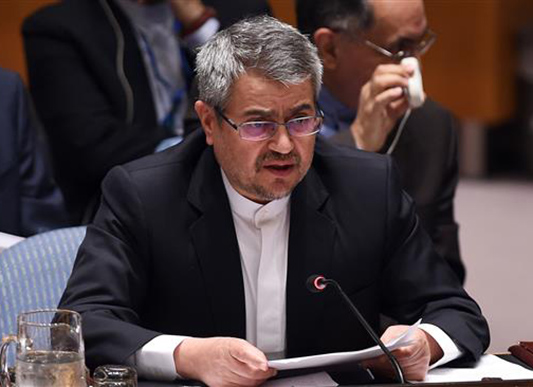
Gholam-Ali Khoshroo, the Iranian ambassador to the UN, said in a Sunday letter to Guterres that the recent anti-Iran remarks by US Secretary of State Rex Tillerson run “counter to every norm and principle of international law, as well as the letter and spirit of UN Charter”.

The full text of the letter is as follows:

In the name of God, the most Compassionate, the most Merciful

Excellency,

Upon instructions from my Government, I have the honour to bring the following to your attention:

  1. Mr. Rex Tillerson, the Secretary of State of the United States, during his address before the House Foreign Relations Committee on 14 June 2017 stated “the US policy towards Iran is … to work towards support of those elements inside of Iran that would lead to a peaceful transition of that government. Those elements are there, certainly as we know.”
  2. This statement is a brazen interventionist plan that runs counter to every norm and principle of international law, as well as the letter and spirit of UN Charter, and constitutes an unacceptable behavior in international relations.
  3. This statement is also a flagrant violation of the 1981 Algiers Accords and other treaty obligations to which the United States is a party. According to the Algiers Accords, “the United States pledges that it is and from now on will be the policy of the United States not to intervene, directly or indirectly, politically or militarily, in Iran’s internal affairs”.
  4. Interestingly, Mr. Tillerson’s statement coincides with the release of newly declassified documents that further clarify how the US agencies were behind the overthrow of Dr. Mohammad Mossadegh, the popular and democratically elected Prime Minister of Iran, on 19 August 1953. That CIA-backed coup abruptly interrupted the path of Iran towards independence, democracy and development and imposed and upheld a 25-year long dictatorship that left deep scars on the Iranian society and its collective conscience.
  5. It also came weeks after vibrant presidential and local elections in Iran in which more than 71 percent of the Iranian people participated. The people of Iran have repeatedly proven that they are the ones to decide their own destiny and thus US attempts to interfere in Iran domestic affairs will be doomed to failure. They have learned how to stand strong and independent, as demonstrated in the 1979 Islamic Revolution.

No Limit on Expansion of Iran-Tunisia Ties: FM

Zarif, who arrived in Tunisia on Monday on the last leg of his two-day North African tour, held a meeting with Tunisian President Beji Caid Essebsi.

The two sides discussed regional issues as well as ways for expansion of ties in different fields.

During the meeting, the Iranian foreign minister also thanked the Tunisian nation and government for their warm hospitality and conveyed Iranian President Hassan Rouhani’s greetings to him.

He went on saying that there is an appropriate ground for further cooperation between Iran and Tunisia and added Tehran is ready to exchange experiences in different fields with the Tunisian side.

For his part, the Tunisian president expressed sympathy with the families of Tehran terror attack victims. At least 18 people were killed and dozens more injured in the twin attacks on Iranian parliament and the mausoleum of late founder of the Islamic Republic, Imam Khomeini. ISIS claimed responsibility for the attacks.

Essebsi also congratulated President Hassan Rouhani’s reelection and voiced his country’s readiness to deepen mutual relations with Iran as a civilised nation with a long history.

Iran-Tunisia TiesMechanism for Continuous Political Talks

Iranian foreign minister also held talks with his Tunisian counterpart Khemaies Jhinaoui.

During the meeting, the Iranian top diplomat said the Islamic Republic sees no limit to expansion of mutual ties with Tunisia in any field.

He also called for establishing a mechanism for continuous political talks between the two sides.

The Tunisian top diplomat, for his part, extended a warm welcome to the Iranian delegation and said Tunisia attaches great importance to the visit.

“The two sides need to explore ways to expand relations in all fields during this important visit,” he said.

Jhinaoui also expressed his country’s readiness to develop further relations with Iran and added the two sides can establish a joint commission by the early months of 2018 tasked with deepening mutual ties.

Holding Tunisia’s Culture Week in Tehran, the visit of a Tunisian commercial delegation to Iran, regional developments as well as other bilateral issues were among other topics of discussion between the two foreign ministers.

Tunisia was the last destination of Zarif’s regional tour, which earlier took him to Algeria and Mauritania.


Iran Rejects Riyadh’s Claim about Arresting IRGC Forces

Majid Aqa-Babaei, the ministry’s director general for border affairs, told the Young Journalists Club on Monday, that, “Saudi Arabia’s claim about the arrest of Iranian military forces is not true.”

Earlier in the day, Saudi Arabia’s information ministry had said in a statement that Saudi forces had captured and were questioning “three IRGC members, who were intending to carry out an attack on a major offshore oilfield in the Persian Gulf,” according to an Associated Press (AP) report.

“The three were onboard [sic] a boat carrying a large number of explosives headed toward the Marjan oil field, located off the kingdom’s eastern shores between Saudi Arabia and Iran,” the report read.

Aqa-Babaei had on Saturday said that the Saudi Arabian coastguard had opened fire on Iranian fishing boats in the waters south of Iran, killing one fisherman.

Saudi Arabia, too, had reported the incident soon after it happened but had not made the claims about arrests and explosives. It offered a changed narrative, however, with the information ministry statement, which came some two days after the initial narrative.

In his Monday remarks, Aqa-Babaei referred to the new allegation about the arrests and said, “This issue has to do with the same two fishing boats” that had been shot at.

He said the Iranians in question were “simply fishermen” and had no types of weapons whatsoever.

In a separate interview with the Iranian Labour News Agency (ILNA) on Monday, Aqa-Babaei confirmed that three Iranians — all known fishermen from the southern Iranian city of Bushehr — had been taken into custody by the Saudi Arabian coastguard.

Saudi Arabia has severed its diplomatic ties with Iran. And Iran’s Foreign Ministry has been following up on the issue through indirect diplomatic channels.

Observers say Saudi rulers have interpreted US President Donald Trump’s recent visit to Riyadh as some kind of a green light to Riyadh to pursue its policies more aggressively.

The killing of the Iranian fisherman and the arrest of the other three come following that trip and also after Saudi Arabia led a group of its vassal states in cutting ties to Qatar. While the Saudi-led bloc of countries have accused Doha of sponsoring terrorism, most observers say the severance of ties and an accompanying economic war on Qatar have to do with the fact that Doha pursues its relations with Iran more independently of Riyadh.

A Saudi Arabian minister said last month that his country would work to move “the battle” to Iran. Another Saudi minister said on June 6 that Iran had to be “punished” for what he called interference in the region. Hours later, two terrorist attacks hit the Iranian capital, Tehran, killing 17 people and wounding 50 other people. Daesh claimed responsibility for the attacks.

Iran’s Speaker Urges Muslim World to Beware of Saudi Plots

Iranian parliament speaker on Monday referred to the good-faith policy of the Islamic Republic in its relations with regional countries, and said, “Our policy is based on establishing unity among the regional states. The recent developments in the region, however, have unveiled the ugly face of some regional countries.”

“We received reports that during Israel’s 33-day onslaught on Gaza, the Saudis provided Israel with information about the coastal enclave. We didn’t believe the reports at first, but reliable documents confirmed them later,” Larijani said in an address to ambassadors of Muslim countries who had gathered in Iran’s Parliament in Tehran ahead of the International Quds Day.

The Iranian Parliament speaker also noted that Saudi Arabia’s moves, including their support for terrorists, are in the interest of the Israeli regime.

“The Saudis even provide logistic support for some terrorist groups like al-Nusra Front,” he said, adding the Muslim World must remain vigilant against the plots of the Saudi rulers.

He further referred to a proposal by Palestinian ambassador to hold a meeting attended by the religious scholars of the Muslim world, and said the Islamic Republic of Iran welcomes such meetings to resolve differences.

“Although Al-Azhar University held fair and reasonable stances towards Tehran terror attacks, certain countries are just seeking to create tensions in the region,” he said.

Larijani went on saying that Iran has attempted to make the Saudis understand this fact that their policies endanger the Muslim world.

“The Saudis are always at loggerheads with the Islamic states and take extreme stance towards them. They are meddling in Syria. They have imposed a war on Yemen and turned the impoverished nation into their backyard. This comes as no independent country accepts being the backyard of other countries. The Saudis are warmongers. They have been creating crisis in Bahrain and now they have allowed diplomatic tensions to mount with Qatar,” he said.

Elsewhere in his remarks, Larijani voiced gratitude to the envoys for offering sympathy to the Iranians over the recent terror attacks in Tehran.

The Iranian speaker said the Muslim world has just recently turned into the target of terror attacks, while the Islamic Republic has been targeted by terrorists for years.

The Parliament chief further noted that the terrorists experienced some back-breaking defeats in Iraq and Syria recently and there would be more good news about their further defeats in the coming days.

He said certain terrorist attacks in the region are caused by the US outrage over the heavy defeats terrorist groups have been suffering over the past weeks.

“They have to understand the fact that they have chosen the wrong path,” he said, adding the Iranian nation is taking steps in the right direction.

He finally touched on the importance of the International Quds day and said the dependence of some Muslim countries on Israel amounts to a stigma.

“The Muslim nations should remain sensitive towards the fate of the Palestinians and their cause. That’s why the Quds Day is important for us. We hope the Muslim world can show its unity on Quds Day,” he concluded.

The last Friday of the Islamic month of Ramadan has been designated by the late founder of the Islamic Republic Imam Khomeini as the International Quds Day.

The day is annually marked in Iran and other parts of the world through anti-Israeli protest rallies, where people voice their support for the Palestinian cause and denounce the Israeli regime’s occupation of Palestine.

Saudi Arabia Rushing to Strengthen Ties with Iraq: Reports

According to a report by the Arabic website Iraq Today, informed sources say Riyadh has expressed its readiness to expand political and economic ties with Baghdad over the past few weeks.

The report also says that just ahead of the Monday’s visit of Iraqi Prime Minister Haider al-Abadi to Saudi Arabia, Riyadh has introduced four diplomats to Baghdad and asked the Iraqi government to pick up one of them as Saudi ambassador to Iraq.

The website noted that introducing a new ambassador to Iraq is part of Saudi Arabia’s larger plan to improve ties with Baghdad.

The sources also said Riyadh has taken a long step by introducing four diplomats to Iraqi government to choose one of them to replace Thamer al-Sabhan, the controversial former Saudi Arabian ambassador to Baghdad.

“The official visit of Iraqi prime minister to Saudi Arabia is just the beginning of a new phase in the two sides’ relations and now with upgrading ties to ambassador level, strengthening of mutual relations will gain momentum,” the sources added.

Thamer al-Sabhan was under fire for his extremist stances towards Iraqi Popular Mobilization Units as well as his statements about Iraq’s internal affairs. He had claimed that sectarianism and tribalism were the driving force behind the Iraqi government’s arming of volunteer forces known as the Popular Mobilization Units (PMU).

Iraqi Foreign Minister, Ibrahim al-Jaafari had officially lodged two complaints against Sabhan. With the growing tensions inside Iraq triggered by Sabhan, Saudi Arabia called him back. He is now serving as the Minister of State for the Persian-Gulf Affairs. Saudi Arabia has no ambassador in Iraq at present.

Abadi arrived in the Saudi capital on Monday. Reports say during the visit, Abadi will discuss the current diplomatic crisis between Saudi Arabia and Qatar. His office, however, rejected the reports saying he is not going to mediate between Saudi Arabia and Qatar.

The visit of Abadi to Saudi Arabia is being made amid an unprecedented diplomatic tension in the region since early 90s.

Nearly two weeks ago, Saudi Arabia and a number of other Arab countries including the United Arabic Emirate, Bahrain and Egypt cut their diplomatic ties with Qatar and recalled their ambassadors from Doha. They also repelled Qatar’s ambassadors.

Saudi Arabia also called on Turkey and Pakistan to follow its footsteps and cut their ties with Qatar. Ankara and Islamabad, however, rejected the call.

Abadi is set to visit Kuwait and Iran as well after Saudi Arabia.

In a statement published on Saturday, the Iraqi prime minister said pursuing national interest is the backbone of his government’s foreign policy.

“To this end, Iraqi government avoids creating tensions and divisions on the one hand and attracts more regional friends on the other,” the statement read.

It also added that Baghdad would not allow its territory to turn into a scene of proxy wars against any regional state, particularly Iran.

Elsewhere in the statement, Abadi also stressed that Iraq is the land of peace instead of war and should remain so in the future.

The Iraqi prime minister noted that his regional tour had been planned before the diplomatic crisis in the region and said the tour was aimed at establishing good-faith relations with regional states and creating a unified front against terrorism.

Iran’s Attack on ISIS Boosts Sense of Belonging to IRGC

Since the very early moments after Iran’s Islamic Revolution Guards Corps (IRGC) fired six missiles on the positions of terrorists in Syria’s Deir ez-Zor, Iranian users have been loading social networks with messages praising the IRGC’s prompt action.

What is important is that political and partisan demarcations have faded in these popular complimentary postings. The ISIS terror attacks on the Iranian parliament building and the late Imam Khomeini’s mausoleum incurred the wrath of different Iranian ethnic groups, making the Armed Forces and those who are responsible for the country’s security to put on their agenda the necessity of “punishment” as a national demand. Today, clear manifestations of national appreciation can be seen on social networks.

The following are comments about the recent attack on ISIS positions posted by Sahand Iranmehr, an Iranian commentator, on his Telegram channel.

  1. There is no doubt that the attack on areas under the ISIS control in Deir ez-Zor was a prompt action. The missile strike should be understood and explained within the framework of “legitimate defence,” a key and defensible concept which gives Iran the right to give a proper response to any attempt to disrupt the country’s security.
  2. Iran’s development of its missile capabilities is not a new event, but Sunday night was the time when the country experienced its first missile operation. The coincidence of the missile strike with the recent regional developments and Saudi Arabia’s muscle-flexing in Yemen and Qatar will send a meaningful message to Riyadh. With this strike, events will enter a new phase, and “military power” will assume a new meaning in the region, which, in turn, will subject countries’ security strategies to dramatic changes.
  3. Although the missile operation targeted the ISIS terror group, it had meaningful messages for other addressees as well. These addressees will undoubtedly receive Tehran’s message and send their own messages to Iran in other fronts.
  4. Any military operation also has a diplomatic dimension which safeguards its achievements and wards off its negative consequences. So, the operations should not only be limited to, and monitored in a military context.
  5. The IRGC’s operation was a strong reaction to an act of terror against Iranians. Many Iranian people from all walks of life take pride in such a move that has rekindled in them a sense of belonging to the IRGC forces and won support by all groups, even by some individuals allegedly affiliated with the opposition overseas.
  6. I don’t know whether it was simply due to technical reasons that the missiles were fired from Kurdish-majority areas in western Iran, or it was meant to send a message. Maybe the missiles were intended to be fired from the same area a handful of whose people were tempted and recruited by ISIS to carry out terrorist operations in Iran [those involved in Tehran attacks were mostly Kurdish people]. In that case, the location was exactly the right place for the missile operation.

“IRGC Missiles Hit Place Where Tehran Attacks Orchestrated”

Former Iranian Ambassador to Syria Hossein Sheikholeslam says the Sunday missile attacks by the IRGC against terrorists’ positions in Syria was a punitive measure in response to recent terrorist incidents in Tehran.

“ISIS terrorists had engineered a major operation in Tehran. They wanted to force their way onto the parliament floor and assassinate lawmakers,” said Sheikholeslam, who is also an advisor to Iran’s Foreign Minister Mohammad Javad Zarif.

He said investigations conducted by the Iranian Armed Forces suggest the Tehran terror attacks had been plotted by ISIS in Syria’s Deir ez-Zor province.

“We are announcing with pride that the same region where the Tehran terrorist operation had been orchestrated has been targeted from [IRGC bases in] Iran. We struck the very same region, exactly. This shows the superior missile and defence capability of the Islamic Republic of Iran,” he said.

Sheikholeslam added Iran’s missile attack will definitely make ISIS and other terrorists more vulnerable.

“God willing, the Syrian army and resistance front will continue fighting against terrorists with a vengeance,” he said.

He went on to say that the message sent by the missile attack to the enemies of the Islamic Revolution of Iran, the US and Al Saud regime is that Iran is capable of striking any target in any place.

He said Iran punished ISIS, and that supporters of the terror group must hear the sound of the slap in the face.

IRGC Kills Terrorist Ringleader in Clashes in SE Iran

Sistan-and-Baluchestan Province’s deputy governor for security affairs, Ali Asghar Mir-Shekari, said on Monday that Molavi Jalil Ghanbar Zehi, the ringleader of the so-called Ansar al-Furqan group, had been killed during the recent clashes with the IRGC’s Qods Headquarters in Qasr-e Qand Heights.

He added that the body of this “international terrorist” along with four of his deputies and elements is now in the hands of the IRGC Ground Forces.

The official noted that Iranian security officials had been conducting measures over the past 25 years to arrest this terrorist due to his numerous crimes committed in the southeastern Iranian border areas.

Commander of IRGC’s Ground Force Brigadier General Mohammad Pakpour told Fars news agency on Sunday that IRGC forces had managed to kill all members of the Takfiri terrorist outfit and completely dismantle it after the start of the operation in the town of Qasr-e Qand on Thursday.

He added that the identity of the terrorists had not been determined yet, adding, “The terrorists were members of the Ansar al-Furqan group and their identities are under investigation.”

The IRGC said in a Thursday statement that its Qods Headquarters had dispatched its units to Qasr-e Qand after obtaining information about the presence of a Takfiri terrorist group in the area and engaged the group in mountainous areas.

“During the anti-terror operation, the IRGC’s Qods Headquarters fighters destroyed a vehicle laden with 600 kilograms of explosives, and seized five bombs ready to be used in suicide attacks, 700 kilograms of explosives, tens of thousands of bullets and a number of weapons and ammunition,” the statement read.

Iran Summons Swiss Envoy to Protest Tillerson’s Claims

Iran’s Foreign Ministry Spokesman Bahram Qassemi said that following the “meddlesome and injudicious” statements by US Secretary of State Rex Tillerson about regime change in Iran, Tehran has summoned Switzerland’s charge d’affaires and gave him an official letter of protest.

Qassemi said that the letter has been handed over to the Swiss envoy by foreign ministry’s director general for the Americas, Mohammad Keshavarz-Zadeh.

“Our director general for the Americas has strongly condemned the remarks made by Tillerson in the US House of Representatives, calling them a clear interference in domestic affairs of the Islamic Republic,” Qassemi added.

“Tillerson’s statements are against the principles of international law and the international commitments of the US government, including the United Nations Charter, and agreements between Tehran and Washington. The US administration should be held accountable for these remarks,” Qassemi quoted Keshavarz-Zadeh as saying.

In this meeting, the Swiss representative said he will convey Tehran’s message to the US administration and inform Iran’s government of the results as soon as possible.

In an address to the US House Foreign Affairs Committee last Wednesday, Tillerson claimed that Iran continues activities and interventions that destabilise the Middle East.

He also accused Iran of providing support for the Assad government, funding militias and foreign fighters in Iraq and Yemen, and arming “terrorist” organizations like Hezbollah, which threaten Washington’s ally Israel.

Tillerson suggested that the policy of regime change is back on the US agenda, and Washington would help elements inside Iran bring about a ‘peaceful transition’ of the Iranian Establishment.

Tehran Ready to Boost Economic Cooperation with Nouakchott

During the meeting held in the Mauritanian capital of Nouakchott, Iranian FM Mohammad Javad Zarif and his counterpart Isselkou Ould Ahmed Izid Bih agreed to hold regular political negotiations.

Zarif said Tehran is ready to implement all the previous agreements with the African country and seriously follow up the new ones.

The two sides also discussed the ways to expand banking activities and encourage the private sector to bid for mining, energy, agriculture, and fishery.

Cooperation in science, technology, aerospace, medicines, biotechnology, and academic fields was high in the agenda as well.

The foreign ministers of Iran and Mauritania also exchanged ideas on regional issues and the ways to combat terrorism and extremism.

Zarif also appreciated the hospitality of the Mauritanian government and people, saying that the North African country has a long history of religious moderation.