Thursday, December 25, 2025
Home Blog Page 4010

Iran Condoles with Sri Lanka over Deaths in Floods, Landslides

In his message on Monday, Bahram Qassemi offered Iran’s sympathy for the loss of tens of Sri Lankan people in the natural disasters.

Landslides and floods in Sri Lanka have killed at least 151 people and the island nation faces the risk of more mudslides as torrential rains continue.

111 people are still reported missing and 95 injured after the worst rains in the Indian Ocean island since 2003, according to the state-run Disaster Management Center. Nearly 500,000 people have been affected by the disaster, the worst since the 2004 Indian Ocean tsunami.

Free Fruits Doled Out in Tehran to Change Kids’ Diet, Help Poor People

Free Fruits Doled Out in Tehran to Change Kids’ Diet, Help Poor People

Following the voluntary and spontaneous implementation of a number of charity and welfare public projects by Iranian people, such as the “Wall of Kindness”, which were received very well by the public, two other similar plans titled “Fruit Basket of Kindness” and “Free Fruit Plan” are being carried out in the Iranian capital of Tehran to help poor people have access to free fresh fruit and vegetables and encourage kids to have more fruit.

These days, kids prefer to have junk food as well as harmful snacks instead of eating fruits, and thus, some parents are worried about their children’s reluctance to eat sufficient fruit and voice complaints about this issue.

The managing director of the Iranian grocery markets organization, Abdolhossein Rahimi, came up with the plan to offer free fruits for children in Tehran’s grocery markets.

The “Free Fruit Plan”, which has gone into effect in some of Tehran’s markets since six months ago, involves doling out free fruit to the needy people, particularly kids and the elderly on a daily basis. The fruit, washed already, is placed by shopkeepers and fruit sellers in baskets – refilled a number of times during the day – in grocery markets across Tehran.

In addition to enabling penurious people to include fruit in their daily diet, the project helps promote fruit and vegetable consumption among children.

Interesting about the initiative is that, in addition to the shopkeepers and people responsible for managing the affairs of the markets, it has been received very well by the citizens and customers who pour some of their personal purchases into the baskets.

Iran’s Rouhani Hails Great Potentials for Enhanced Ties with Baku

In a message to Ilham Aliyev on Monday, President Rouhani congratulated the Azeri leader, government and nation on the Republic Day, which marks the founding of the Democratic Republic of Azerbaijan in 1918.

The Iranian president said the great potential for bilateral ties as well as the cultural, religious and historical values that the two nations have in common have created a “unique arena” for the enhancement of cooperation between the two neighbors in line with their mutual interests.

The Iranian president also wished success and prosperity for the Azerbaijani nation.

The Republic of Azerbaijan celebrated its national day on May 28.

Iran Will Soon Join Eurasian Economic Union

putin

Timur Suleimenov, Kazakhstan’s minister of economy, has been quoted by media as saying that the EEU would conclude discussions with Iran over the country’s membership to the Union by the end of 2017.

“We believe we can come up with something substantial by the end of the year . . . finished talks,” Suleimenov told the Financial Times.

“We would like to have a framework signed then,” he added.

Suleimenov became minister in December after previously working as the minister in charge of economy and financial policy at the EEU Commission in Moscow.

Reaching a deal on free trade would represent a notable victory for the nascent EEU — a single market of Russia, Kazakhstan, Belarus, Kyrgyzstan and Armenia set up in 2015 — and mark a significant strengthening of relations between Iran and the former Soviet republics, the report added.

The EEU’s prime ministers resolved in March to make talks with Tehran a priority, scenting an opportunity to expand beyond the bloc’s combined market of 183 million people.

Russia’s President Vladimir Putin said last August that Moscow wanted Iran to join the EEU – a move that was seen as crucial in bringing the two countries closer in their plans to form a strategic partnership.

Putin emphasized that a research had already started overt the possibility of creating a free-trade zone between Iran and the EEU.

“Iran is Russia’s longtime partner. We believe that bilateral relations will benefit from the reduction of tensions around Iran following the comprehensive agreement on the Iranian nuclear program,” Putin was quoted by the media as saying.

Tourists Paying $1,200 to Buy Each Pair of These Hand-Made Shoes

Tourists Paying $1,200 to Buy Each Pair of These Hand-Made Shoes

Mard-Ali Heidari, an old artist and shoemaker, makes a highly valuable kind of traditional leather footwear in the northwestern Iranian province of Zanjan.

Tourists Paying $1,200 to Buy Each Pair of These Hand-Made ShoesTourists visiting Zanjan pay between $600 and $1,200 to buy these eye-pleasing and valuable works of art, which are among the most popular handicrafts of the province.

Some 41 years have elapsed since Heidari sewed his first pair of Charouq and now, after all these years, he is still practicing the same profession and has, so far, as a maestro, taught the art to 314 individuals, most of whom are women.

Born in Salmanlu village in Zanjan province in 1956, Heidari lost his father when he was only seven years old and began sewing Charouq in a small shop in the bazaar of his village. There, he used to straighten up curved nails on the shoe soles and heels or wax the threads for shoemaking.

After years of learning the art from the great maestros of his time, he decided to become independent and start his own business.

After a few years of working independently, in 2000, Iran’s Handicraft Organization – which was later merged into the Cultural Heritage, Handicrafts and Tourism Organization of Iran – called upon him to take part in the first Iranian Handicrafts Exhibition held on the sidelines of the 14th General Assembly of the World Crafts Council in Paris, France.

Tourists Paying $1,200 to Buy Each Pair of These Hand-Made ShoesHaving trained a number of students in sewing Charouq at the ICHTO for a while, he returned to Zanjan province and got involved in the same activity, in the historical edifice of Rakhtshooy Khaneh (meaning washing-house in Farsi) which lies at the historical texture of Zanjan city and was built circa 20th century.

In a Farsi interview with ISNA, he, who still wears Charouq, said, “I have perfected the art of making Charouq. I mean I have sewn any form and type of Charouq [one can think of]. However, I cannot work with the same energy I did in the past and spend most of my time teaching the art.”

Tourists Paying $1,200 to Buy Each Pair of These Hand-Made ShoesCurrently, he, along with his students, is still engaged in practicing the art in Rakhtshooy Khaneh.

He has compiled a collection of the photos of his artworks. His works are spectacular. Some of them, worth between $570 and $1,140, are ornamented with filigree designs and some are trimmed with braid. These works very popular with foreign tourists.

Expounding on the properties of Charouq and advantages of wearing this kind of footwear, Heidari said, “Since Charouq is made of natural leather, it absorbs foot sweat. These days, shoes are mostly made of plastic which fails to absorb the sweat. Thus, all the perspiration is sent into the texture of socks.”


World’s Biggest Hand-Made Shoe

He has also sewn the world’s largest Charouq with a length and height of 160 centimetres and 70 centimetres in 18 months. To create the work of art he has used 10 square metres of leather, 500 grams of silk and four kilograms of glue.

Tourists Paying $1,200 to Buy Each Pair of These Hand-Made ShoesThe surface of the artwork is ornamented with pictures of a number of Iran’s historical places such as Dome of Soltaniyeh (Zanjan province), Pasargadae (Fars province), Allahverdi Khan Bridge – popularly known as Si-o-seh pol – (Isfahan Province) and Azadi Tower (Tehran Province). These pictures have been sewn on the artwork with braiding thread.

On the reason of sewing such a big Charouq, he said, “Women usually throw away their Charouqs after wearing it for a while. Since it is highly likely that no trace of the art would remain or be found in Zanjan province within the next 100 years, I felt the need to sew a decorative Charouq that endures for a long time.”

Heidari, who etches his name on all of his artworks, added, “Charouq is made both for men and women. The ones sewn for women have heels as well as more ornaments on them.”

4th Khayyam Int’l Photography Exhibition Opens in Tehran

The 4th Khayyam 2016 International Exhibition of Photography – an Iranian photo exposition – opened at the Iranian Artists Forum in Tehran on May 26, in a ceremony attended by the secretary general as well as the director of patronage service of the Fédération Internationale de l’Art Photographique (FIAP), Ricardo Bussi and Romain Nero, respectively.

In this ceremony, the winners of the exhibition’s competition section received their prizes. In addition, FIAP announced the opening of a branch in Iran and introduced Ali Samei, the secretary of Khayyam 2016 International Exhibition of Photography, as its representative in the country.

4th Khayyam Int’l Photography Exhibition Opens in TehranFounded in 1946, FIAP is an international organization of national associations of photography. More than 85 national associations are its members, comprising nearly one million individual photographers.

Addressing the opening ceremony, Samei said, “This year, we are holding the fourth edition of the international expo. It is such a pleasure to see that Mr. Bussi from Italy and Mr. Nero from Luxembourg are also present at the opening ceremony.”

ISNA quoted him as saying that the website of Khayyam 2016 International Exhibition of Photography has been designed in a way that it allows its international participants to view its contents in their own languages.

“We have, so far, held 50 exhibitions in 16 countries. The winners of FIAP’s gold medal in each edition of the [Iranian] expo, will have the chance to be among the show’s jury panel in the next edition. The call for participation in the fifth edition of the exposition will soon be published.”

Addressing the same function, Bussi expressed his pleasure at being present in the ceremony.

4th Khayyam Int’l Photography Exhibition Opens in Tehran

He said, “Up until 2014, FIAP’s main headquarters was in France. However, since holding expos in this country is quite costly, the headquarters has been transferred to Luxembourg since then. When I was appointed FIAP’s president, we decided to set up branches in other countries as well to have a more significant share in the promotion of the art of photography in the world. Today, I am very pleased to see that a FIAP branch has been opened in Iran.”

A total of 21,399 photos by artists from 55 countries were submitted to the secretariat of the 4th Khayyam exhibition. Jury members from Iran and France were responsible for selecting the photos meeting the criteria to take part in the exhibition’s competition section and, later, be showcased at the expo. The top works of the exposition will be put on display in Italy, France, Spain, China, Oman, Greece, Hong Kong, Argentina, Russia, Saudi Arabia, Turkey, Tajikistan, Uzbekistan and Macedonia as well as a number of Iranian and South African cities.

At the end of the opening ceremony, the book of the fourth edition of Khayyam expo was unveiled. The event will be open to visitors until June 2.

Here are IRNA’s photos of the exhibition:

Saudi Arabia Promoting Radicalism in Afghanistan: MP

ISIS

Saudi Arabia Promoting Radicalism in Afghanistan: MPMember of the Afghan Parliament Jafar Mahdavi has, in an interview with the Tasnim news agency, underlined that evidence shows the Afghan government and Riyadh back ISIS terrorists in Afghanistan.

He said the presence of ISIS in Afghanistan poses a serious threat to the country and is a scenario supported by elements behind the scenes.

“It’s not that a terrorist group has made plans on its own to be present in Afghanistan; rather, the hands of spying and intelligence organizations of state sponsors of terrorism such as Saudi Arabia are behind this,” said the Afghan MP.

Provincial council representatives and local officials of Afghanistan’s Eastern and Northern provinces, speaking on condition of anonymity, say they have evidence that Persian Gulf littoral states support the ISIS terrorist group in northern Afghanistan, added the MP.

He said Zahir Qadir, the representative of Nangarhar province in the Afghan Parliament, has time and again warned on the parliament floor about the danger of terrorist acts by ISIS spreading across Afghanistan, and unmasked the Afghan government’s financial and arms support for the terror group.

“Although I have not yet received conclusive evidence on that, I believe if you piece together the evidence on the ground, namely the close relationship between the Afghan government and the Al Saud regime, the frequent visits by princes from the Persian Gulf countries, and observations by local authorities from Eastern and Northern provinces, it will leave no doubt that ISIS is supported by the Al-Saud rulers and some elements within the Afghan government,” said Mahdavi.

Of course, the whole Afghan government cannot be accused of backing ISIS, said the MP.

However, he added, there are elements within the government that support the terrorist group as proven by reports from local authorities in provinces where ISIS militants are stationed.

Recently, he said, the governor of one of Afghanistan’s eastern provinces clearly spoke of the Afghan Security Council’s financial and arms support for ISIS.

He said there is enough evidence to dispel any doubts about Kabul’s support for terrorists.

He noted that a major proxy war is taking shape in Afghanistan.

“Afghanistan has turned into a battlefield where powers are fighting each other; some states are operating in the country to advance their own objectives while claiming to be safeguarding Afghanistan’s interests. These countries, in line with their interests, seek to create insecurity in Central Asia and Russia via Afghanistan. Of course, the scenario has already been started by the Persian Gulf coastal states and the US in such a way that one of them provides financial backing and the other, arms and training support,” said the parliamentarian.

“Unfortunately, an evil coalition is taking shape in Afghanistan which would not be in our interest and push Afghanistan’s security to the brink of a precipice,” he said.


Saudis, Emiratis Visiting Afghanistan to Watch Iran

He further touched upon frequent visits to Afghanistan’s western provinces by Qatari and Emirati princes in the name of game hunting.

“By being present in Afghanistan’s western provinces, Saudi Arabia, in addition to targeting Afghanistan, seeks to advance its interests with regards to Iran, and in fact wants to get close to Iran through the Afghan territory,” the MP noted.

“This issue is so important for Persian Gulf littoral states that they are making huge investments and allocating massive funds simply to travel to Afghan provinces bordering Iran,” he said.

Another scenario, he added, is to promote extremism and turn Afghanistan into a ground for breeding and exporting terrorism through the establishment of Saudi schools and universities in Afghanistan’s eastern provinces and capital city.

“All these efforts are made to turn Afghanistan into a hub of extremism,” said Mahdavi.

“They want to focus on sensitive points and trigger war in Afghanistan through foreign interference,” he said.

ISIS


Saudis Spending Money to Promote Wahhabism in Afghanistan

“Saudi Arabia is one of those that want to spend money to promote Wahhabism in Afghanistan and to extend the sphere of ISIS’ activities because Riyadh knows that exporting the Wahhabi ideology to Afghanistan works given the sensitive situation in the country,” he said.

He added some sympathizers of Afghanistan keep warning the government about this danger, but their words fall on deaf ears.

“Of course, part of the current Saudi-Afghan relations goes back to the agreements signed during [former Afghan President Hamid] Karzai’s tenure. But the reality is that both the previous and incumbent Afghan administrations have been seeking power, and ready to do anything and succumb to whatever political pressure simply to remain in power for a few more days. They want political survival no matter if such a big danger looms large over the nation,” he said.

The MP said he believes top Shiite figures and scholars in Afghanistan are to blame as well because they do not care enough about the issue.

“They have remained silent sitting idly by,” he said.

“All in all, given the current circumstances, no good future is in sight for Afghanistan, and if the current trend of constructing Wahhabi schools continues, Afghanistan will turn into a hub of training and exporting terrorism in the region,” the Afghan MP said.


Foreign Troops in Afghanistan Care about Their Own Interests

He then touched upon the role of foreign troops in fighting ISIS terrorists.

“Foreign troops care about their interests. The notorious Americans have obviously been supporting terrorism in Afghanistan in order to create insecurity in Russia and put pressure on Iran,” he said.

The MP added foreign countries in Afghanistan either view the campaign against ISIS based on their own interests, or they themselves are ardent supporters of the terrorist group.

“Qatar Seems to Be Leaning towards Iran”

Sheikh Tamim bin Hamad Al Thani

Amid growing divisions between Saudi allies and Qatar, the Qatari emir not only sent a congratulatory message to Iranian President Hassan Rouhani following his re-election, but held a phone conversation with Rouhani to once again felicitate him on having won the 12th Iranian presidential election.

During the phone conversation, the Qatari emir underlined the need to further enhance relations with Iran. He also touched upon the stances adopted by more moderate regional countries such as Kuwait, and stressed that dialogue takes priority in order to solve regional problems.

Therefore, given the recent developments in the diplomacy and media arenas in the region, it seems that rifts will grow between Iran, Syria, Iraq, and to some extent Qatar and Kuwait on the one hand, and Saudi Arabia, Bahrain, Egypt and the United Arab Emirates on the other.

Although tensions in relations between Arab countries and Qatar have their roots in the past, the new differences emanate from the Riyadh meeting held last week. In that event, Saudi Arabia brought together heads of around 40 Islamic countries with the help of Trump to somehow show that Saudi Arabia enjoys a superior position among regional countries.

The Qatari emir’s phone conversation with President Rouhani becomes all the more important as Arab media, following the publication of statements attributed to the Qatari emir in recent days, have launched a barrage of criticism and claimed Qatar has preferred Iran to its Arab brothers!

A couple of days ago, the Egyptian president also accused Qatar of supporting terrorism. Abdel Fattah el-Sisi wrote on his Twitter page that “Qatar backs the Muslim Brotherhood terrorist group and it’s time the country was punished.”

Rifts and differences between Arab states and Qatar are so wide that the Kuwaiti Foreign Minister Mohammed bin Abdulrahman Al Thani paid an unannounced visit to Doha last Friday in a bid to narrow the differences among the Persian Gulf littoral states.

In remarks last week, the Qatari emir acknowledged Iran’s position as a regional heavyweight as well as its status among Muslim states. He also underscored the need for a negotiated settlement of issues.

Middle East expert Jafar Qannadbashi was among the analysts who weighed in on the Qatari emir’s remarks. The expert said the emir is involved in a serious competition with Saudi Arabia, and maybe that is why he had made those comments. By competition, the expert means Qatar and Saudi Arabia have had age-old differences, especially when it comes to leadership as each of them considers itself as deserving to lead the Arab world.

In the meantime, the Iranian Iran daily newspaper quoted the Riyadh-based Okaz newspaper as claiming that the Qatari foreign minister and Major General Qassem Soleimani, the commander of the Quds Force affiliated with Iran’s Islamic Revolution Guards Corps, had met to counter a summit of Arab, Islamic and American heads of state held in Riyadh. According to the report, the Iraq-brokered meeting had been held in Baghdad last week.

According to the Tasnim news agency, Middle East expert Hassan Rostami says making such comments by Qatari officials is nothing new.

“Qatar Seems to Be Leaning towards Iran”“For example, in January 2011, a phone conversation between then Qatari Foreign Minister Hamad bin Jassim and Libya’s ex-dictator Muammar Gaddafi on a plan to disintegrate Saudi Arabia caused a lot of uproar at that time,” said the expert.

The two countries not only have border disputes, but also are divided on regional issues, namely Syria and the Muslim Brotherhood.

Rouzbeh Parsapour, another analyst, says Iran-Qatar relations have been at a high level in recent years as have been Iran-Oman ties.

“Although the issue of Syria harmed these relations, Qatari officials still have more wisdom and good will vis-à-vis Iran compared to other Persian Gulf states. Qatar will gradually distance itself from Saudi Arabia. This is quite predictable given the territorial and border disputes between the two countries as well as the Muslim Brotherhood’s influence on Qatari authorities.”

Parsapour predicted that Qatar will lean toward Iran in the coming months.

“What is clear is that the huge arms deals between the US and Saudi Arabia have scared sheikhdoms on the southern coast of the Persian Gulf. They, Qatar in particular, are afraid that Saudi Arabia might, over the next 10 years, embark on territorial expansionism and seize part of Qatar’s soil,” writes Tasnim.

Moreover, Qatar has apparently come to realize that it should be leaning toward Iran in order to extricate itself from Saudi domination and establish a balance of power in the Persian Gulf.

Now, with unprecedentedly growing tension between Qatar and other Persian Gulf countries, especially Saudi Arabia and the United Arab Emirates, the WikiLeaks scenario is being repeated for Arabs as Arab states continue to blow the whistle on one another.

The Sky News in the UAE called Qatar the major sponsor of the ISIS terrorist group. Also, Qatar’s Al-Jazeera news network spoke of secret UAE-run prisons in Yemen where inmates are being tortured.

Al Jazeera Removes Controversial Cartoon that Outraged Saudis

Al Jazeera Removes Controversial Cartoon that Outraged Saudis

A cartoon recently posted on the Doha-based Al Jazeera’s Twitter feed set off a storm of condemnation by Saudi Twitter users. They believed the two figures in the ‘insulting’ cartoon looked like the Saudi King Salman and Egyptian President Abdel Fattah el-Sisi.

The cartoon was eventually removed by the network in an attempt to ease the tension between the two neighbouring Arab states.

Relations between Qatar and the other (P)GCC states were already fraught after the Qatar News Agency last week reported that the Qatari Emir Sheikh Tamim bin Hamad Al Thani had criticised the aggressive rhetoric aimed at Iran by the Persian Gulf and US during Trump’s visit to Riyadh on May 20-2

Qatar’s government later declared that the news agency had been hacked, and the remarks attributed to the emir were false. However, Saudi Arabia, Bahrain, the UAE, and Egypt blocked all Qatari media in reaction to the emir’s remarks.

The Qatari emir, however, did not try to ease the tension, and called Iranian President Hassan Rouhani to congratulate him on his re-election. Sheikh Tamim also noted that there is no barrier to the expansion of Tehran-Doha relations.

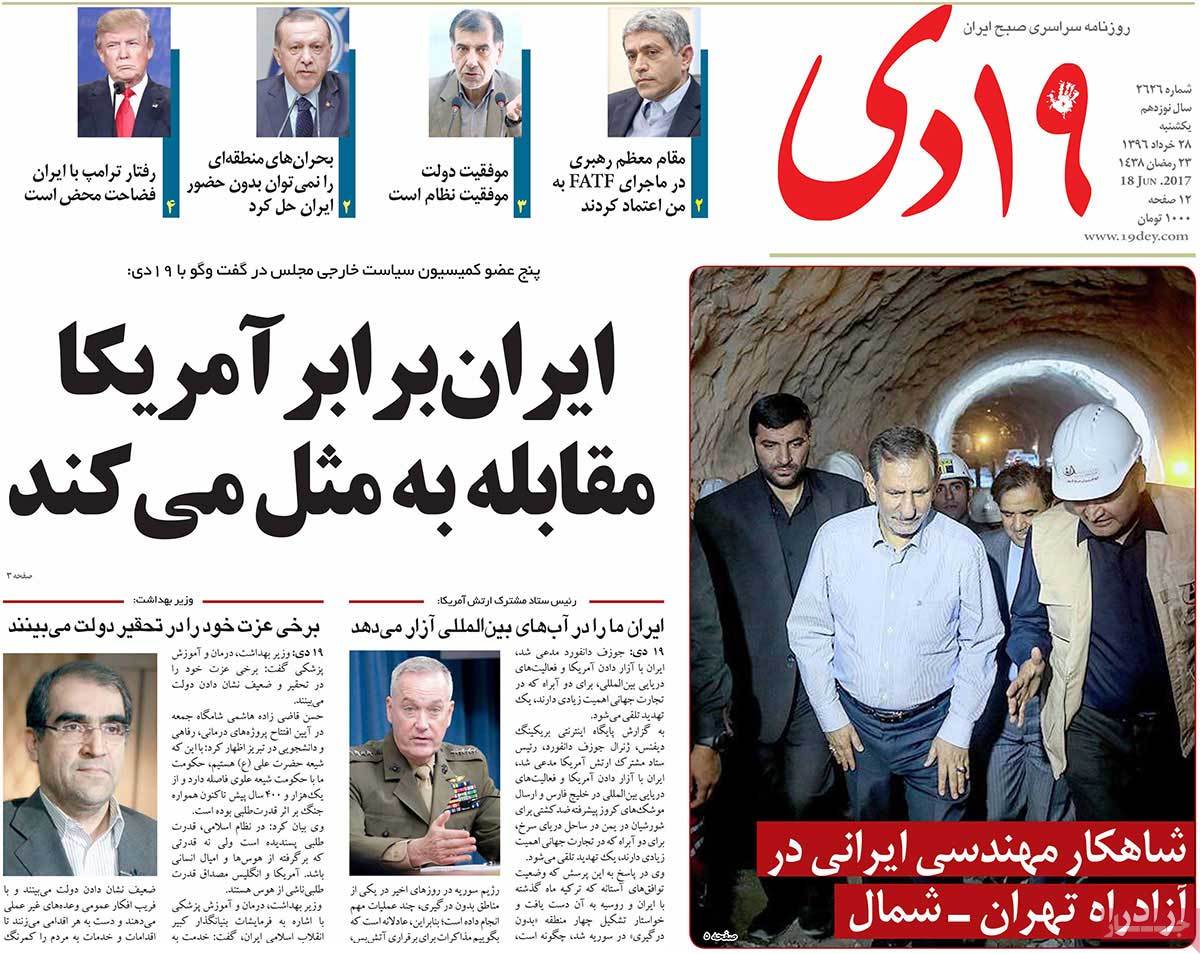
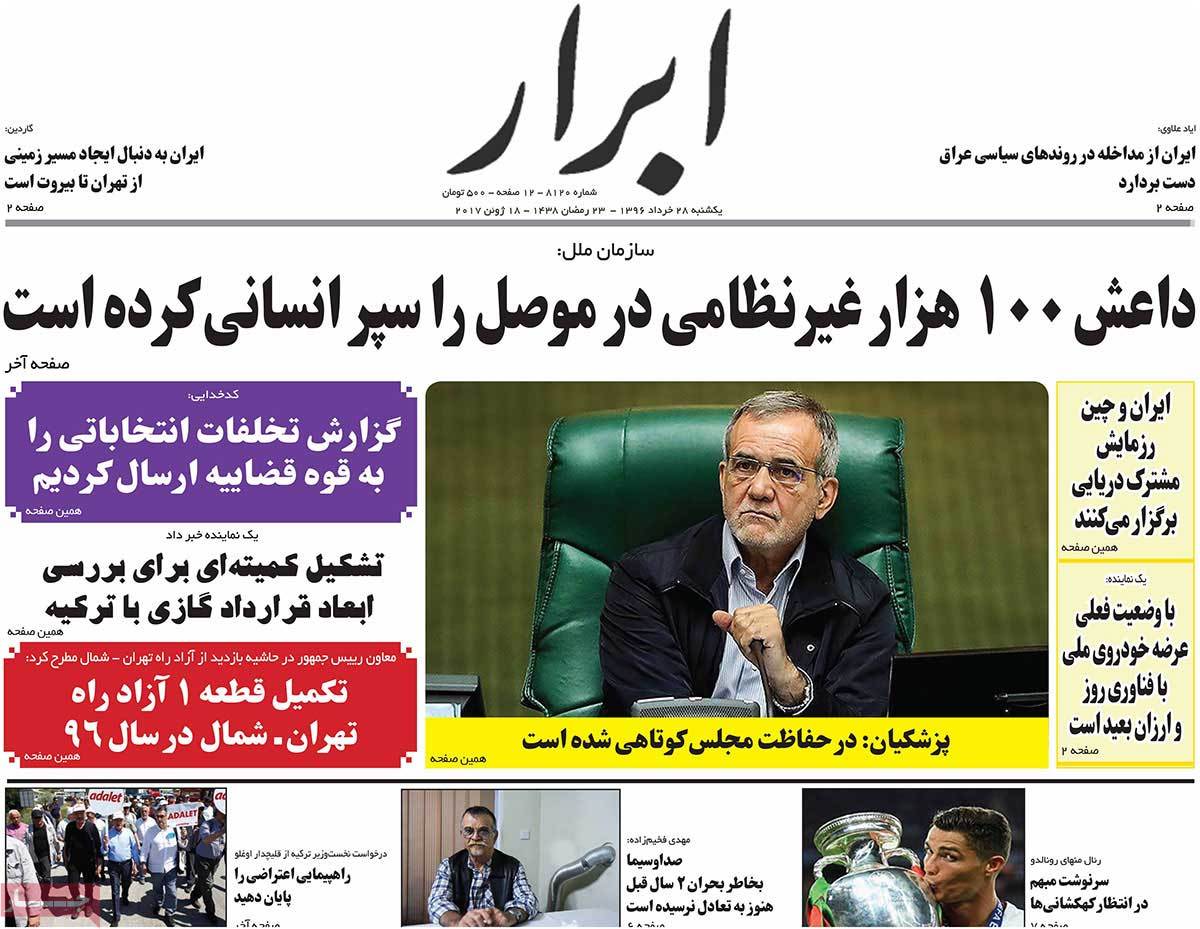
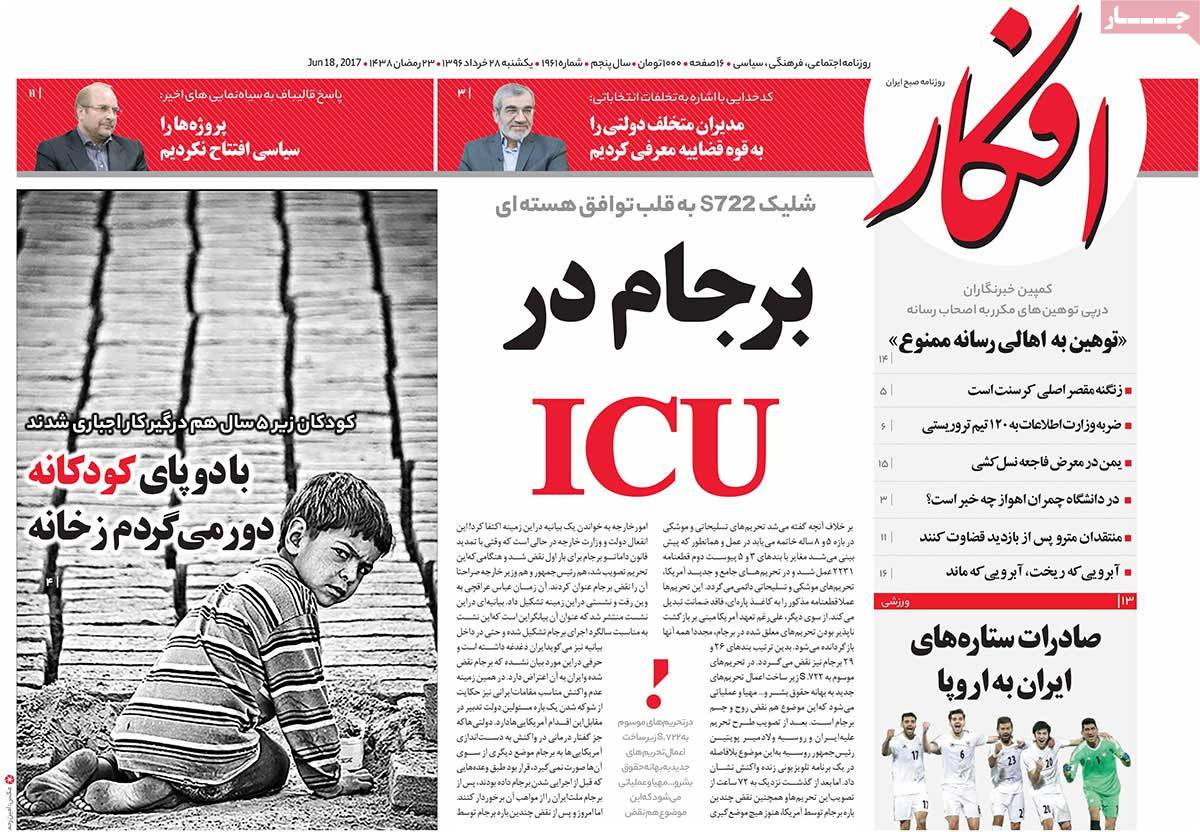
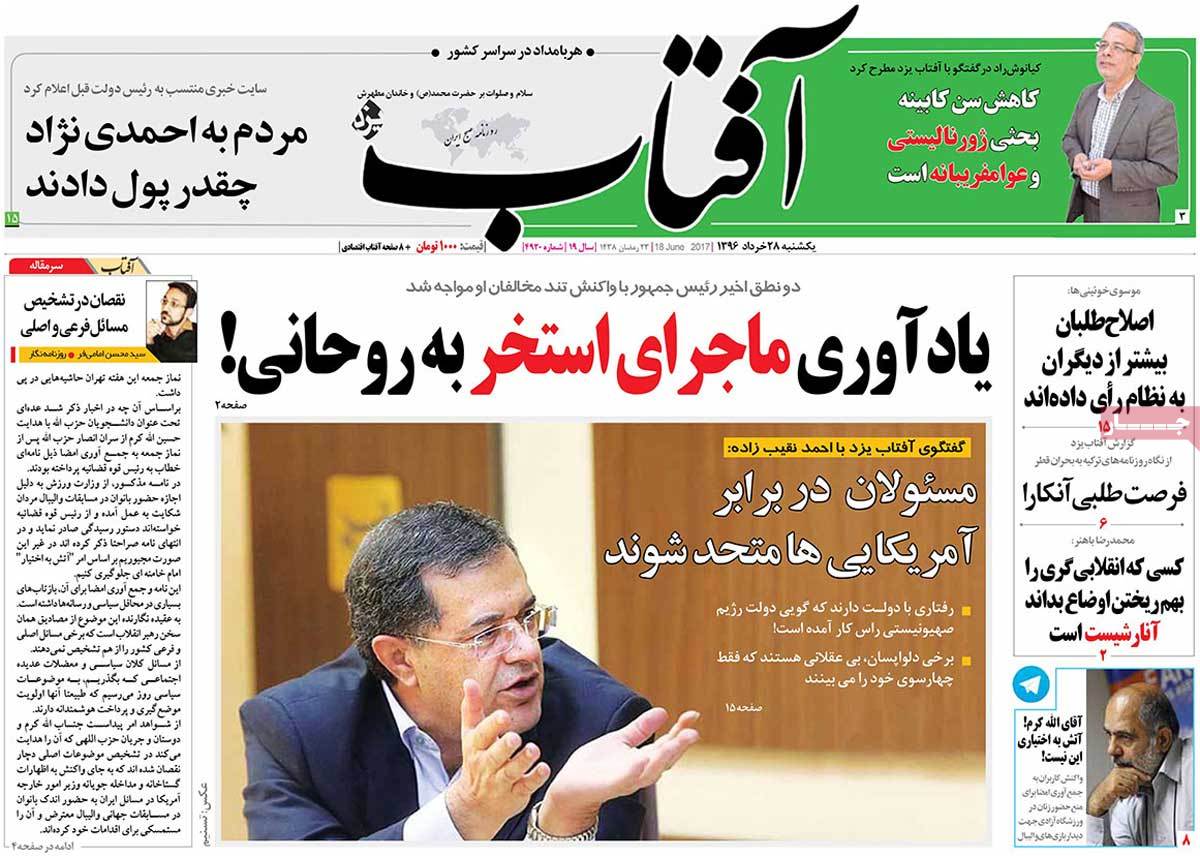
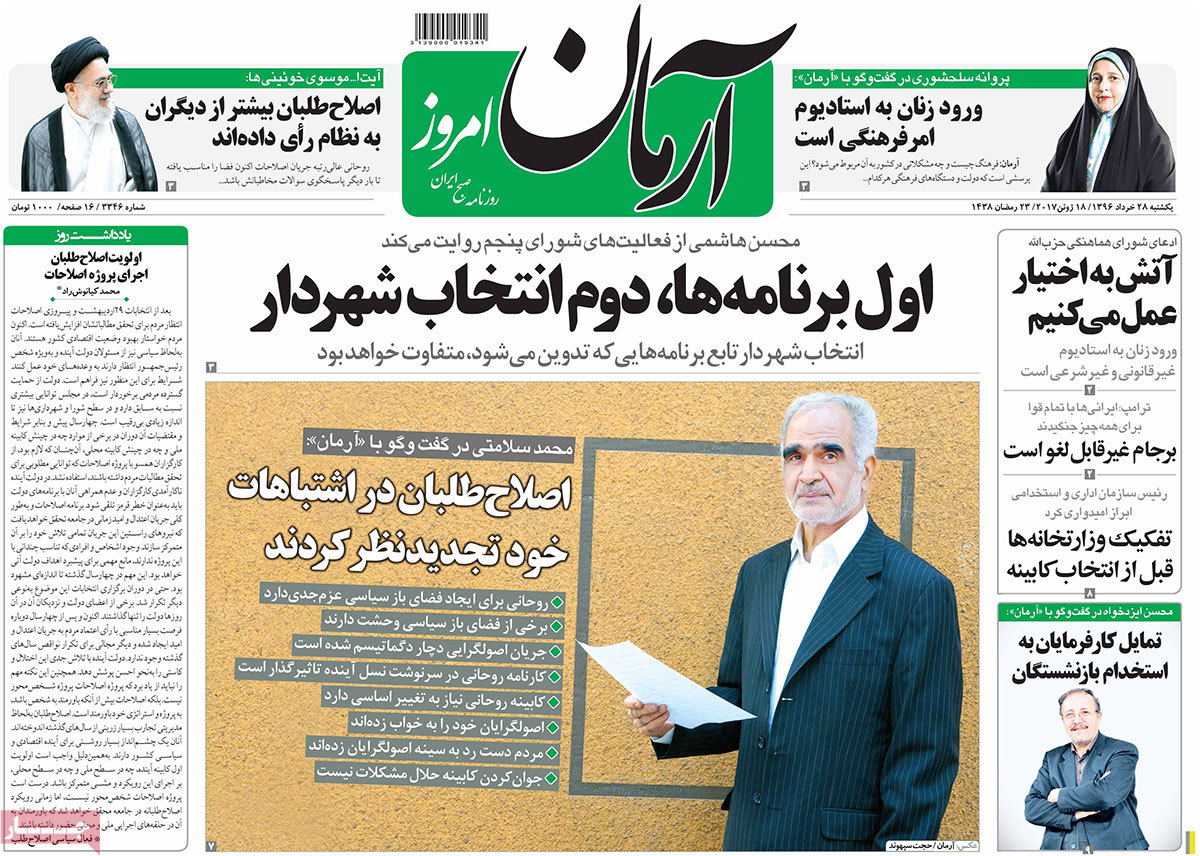
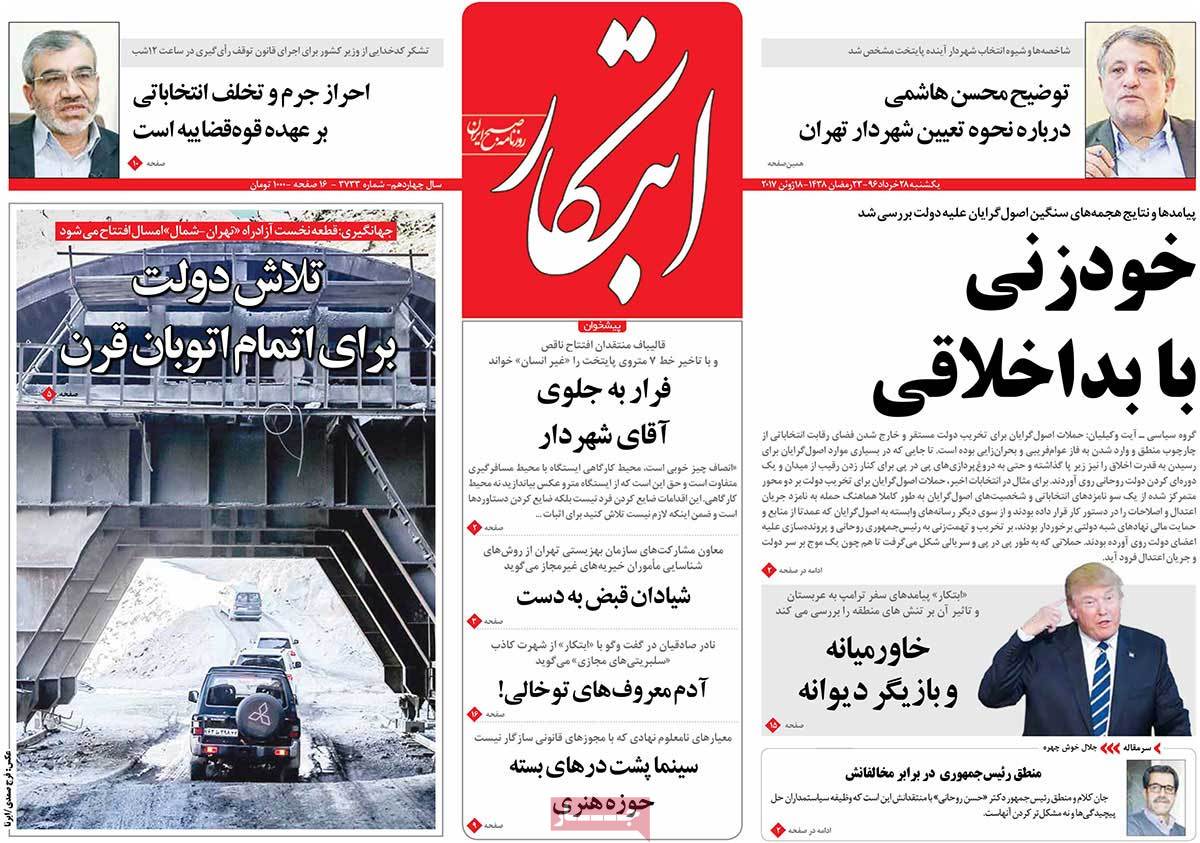
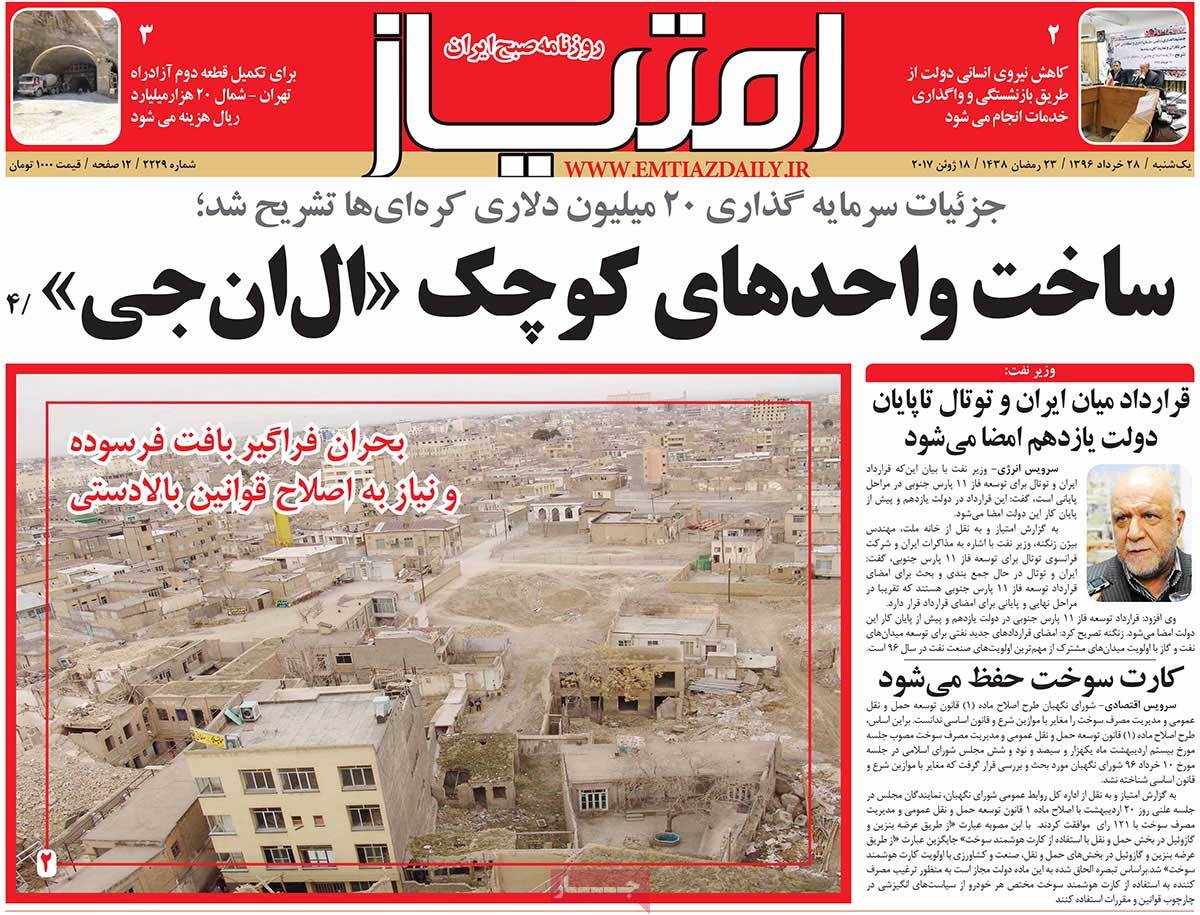
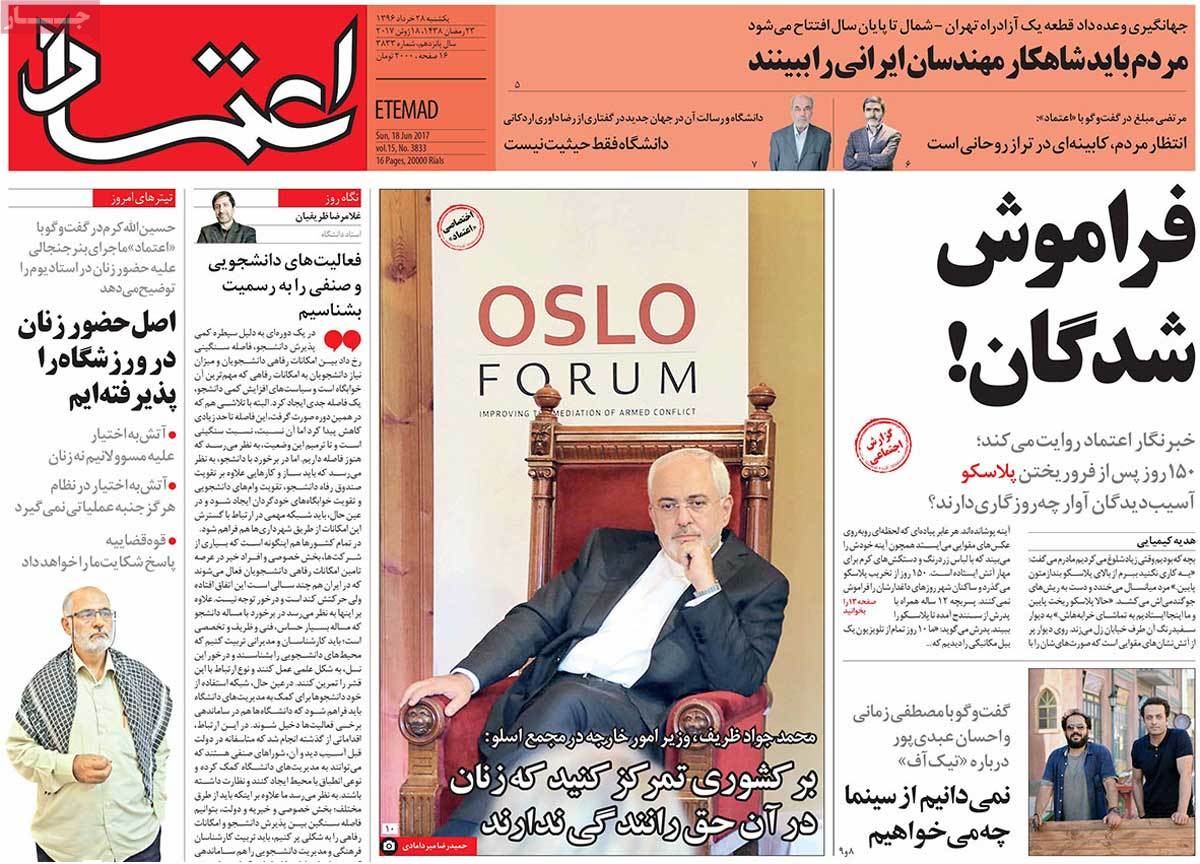
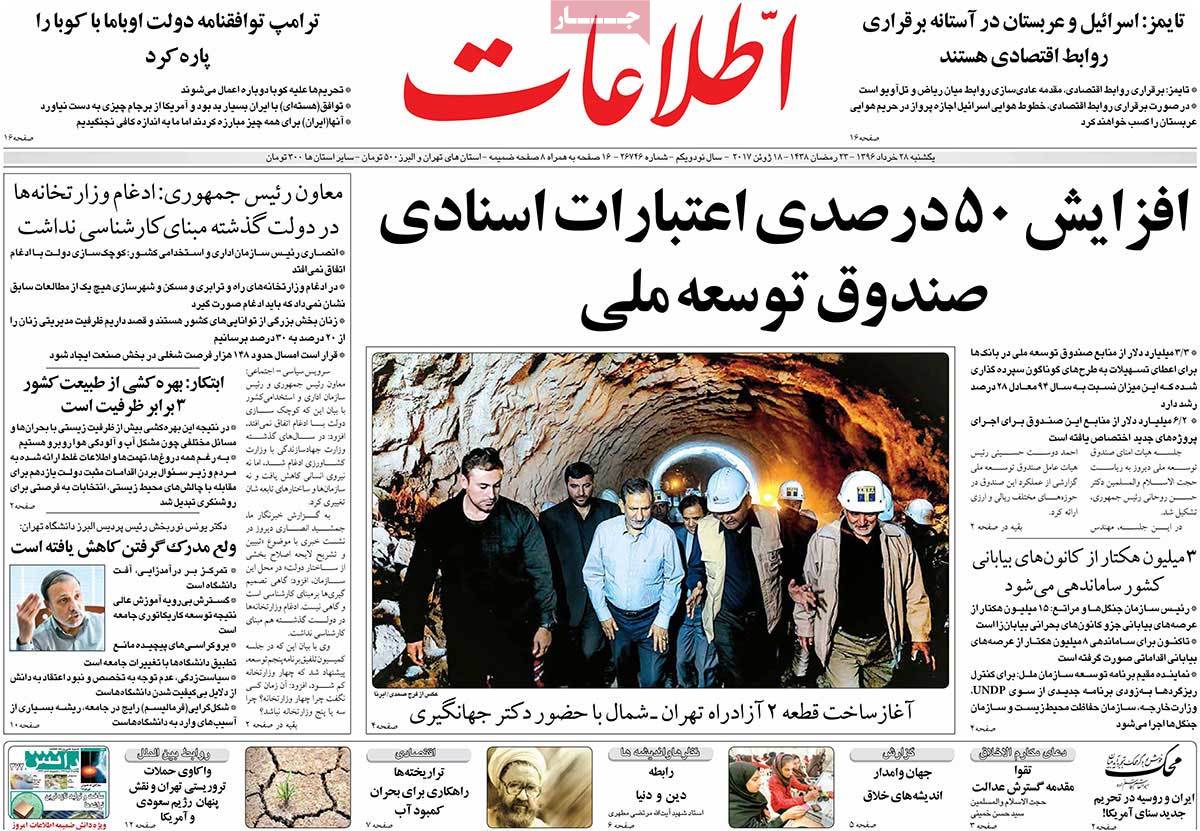
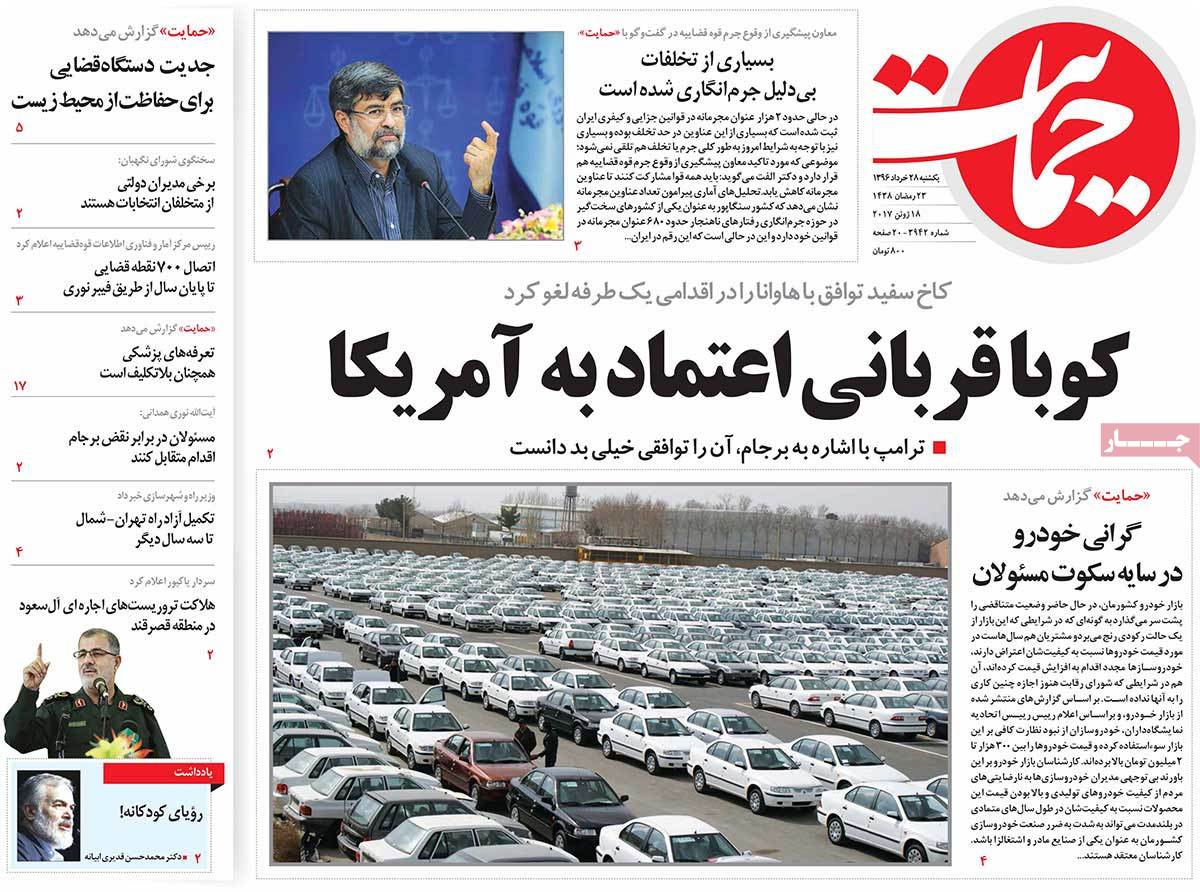
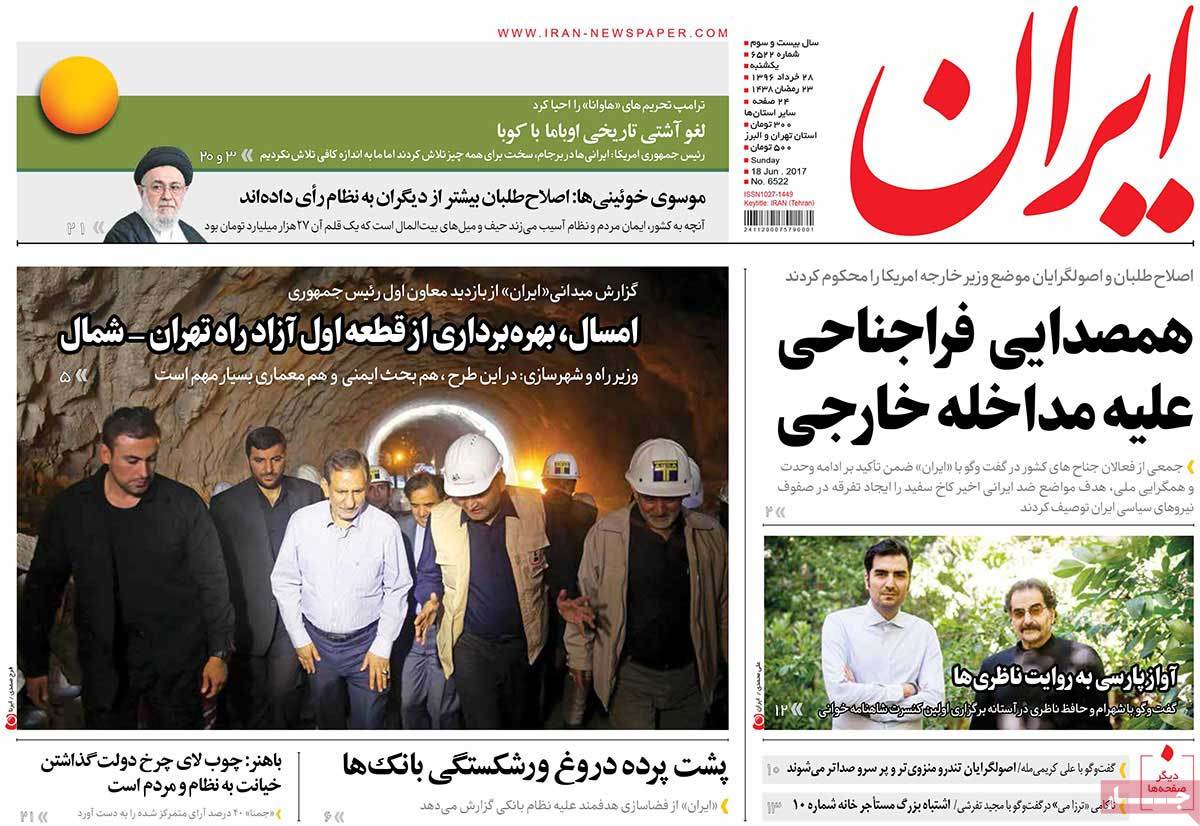
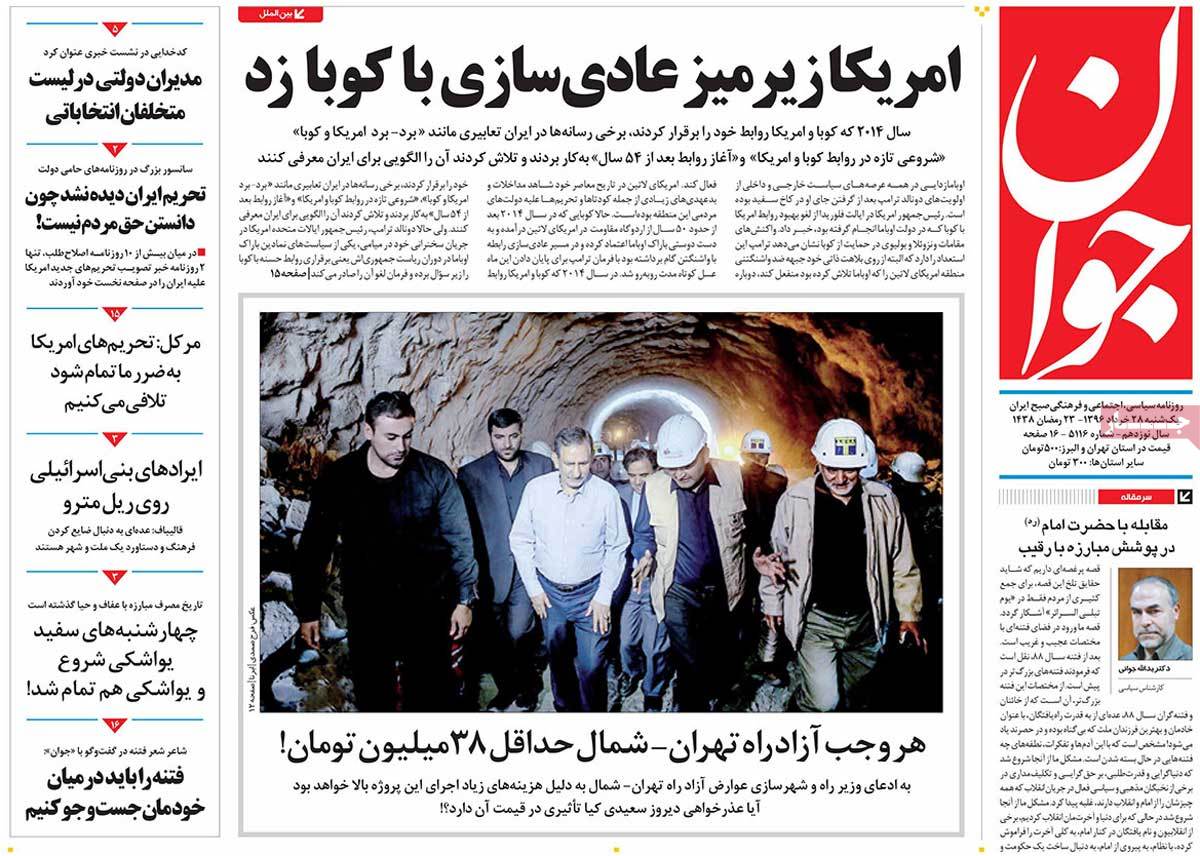
A Look at Iranian Newspaper Front Pages on May 29

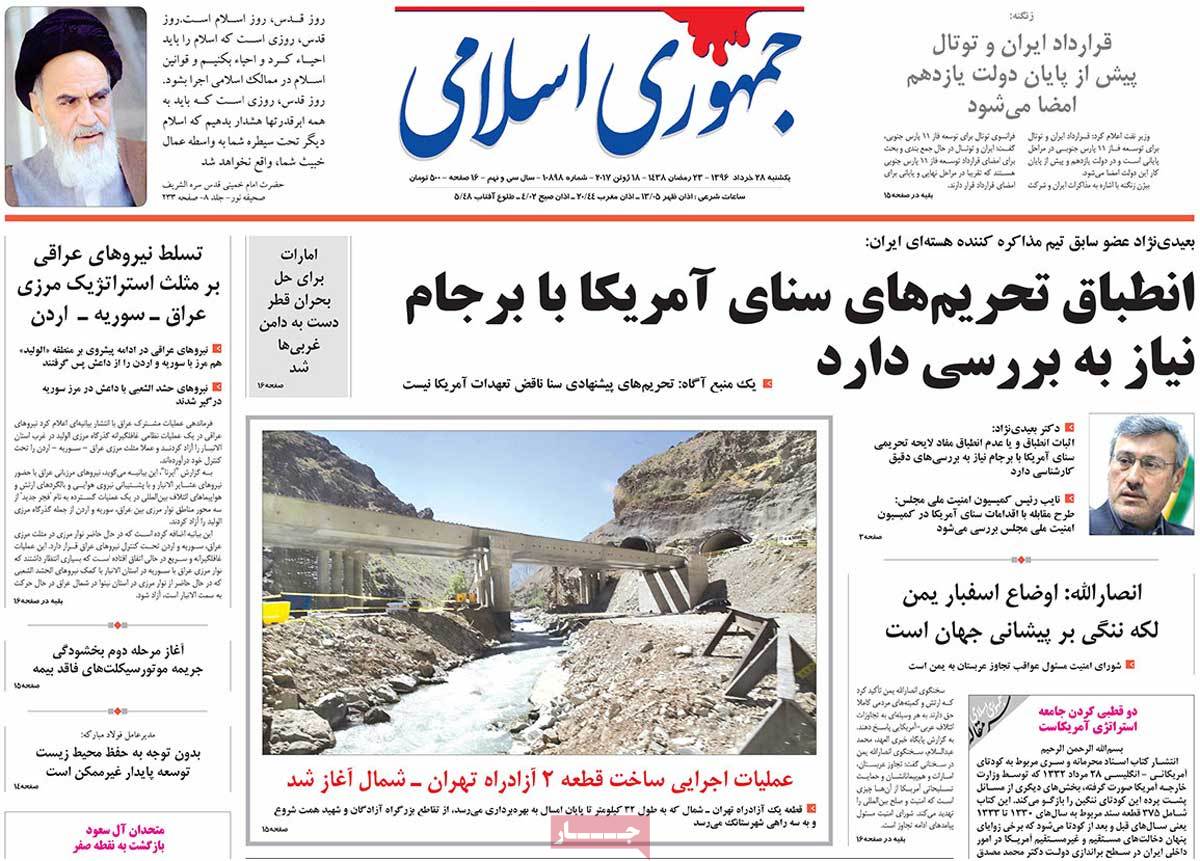
Newspapers today highlighted the ongoing clash between Qatar and Saudi Arabia, which seems to have been exacerbated by the recent phone conversation between Emir of Qatar and Iranian President.

Another top story was the epidemic of Crimean-Congo Fever, and the contradictory reports about the number of people diagnosed with it.

The issue of choosing female ministers in Rouhani’s new cabinet was also covered by two major reformist newspapers. Both papers say the president will probably introduce a couple of women to the Parliament as new ministers at his cabinet.

The above issues, as well as many more, are highlighted in the following headlines and top stories:


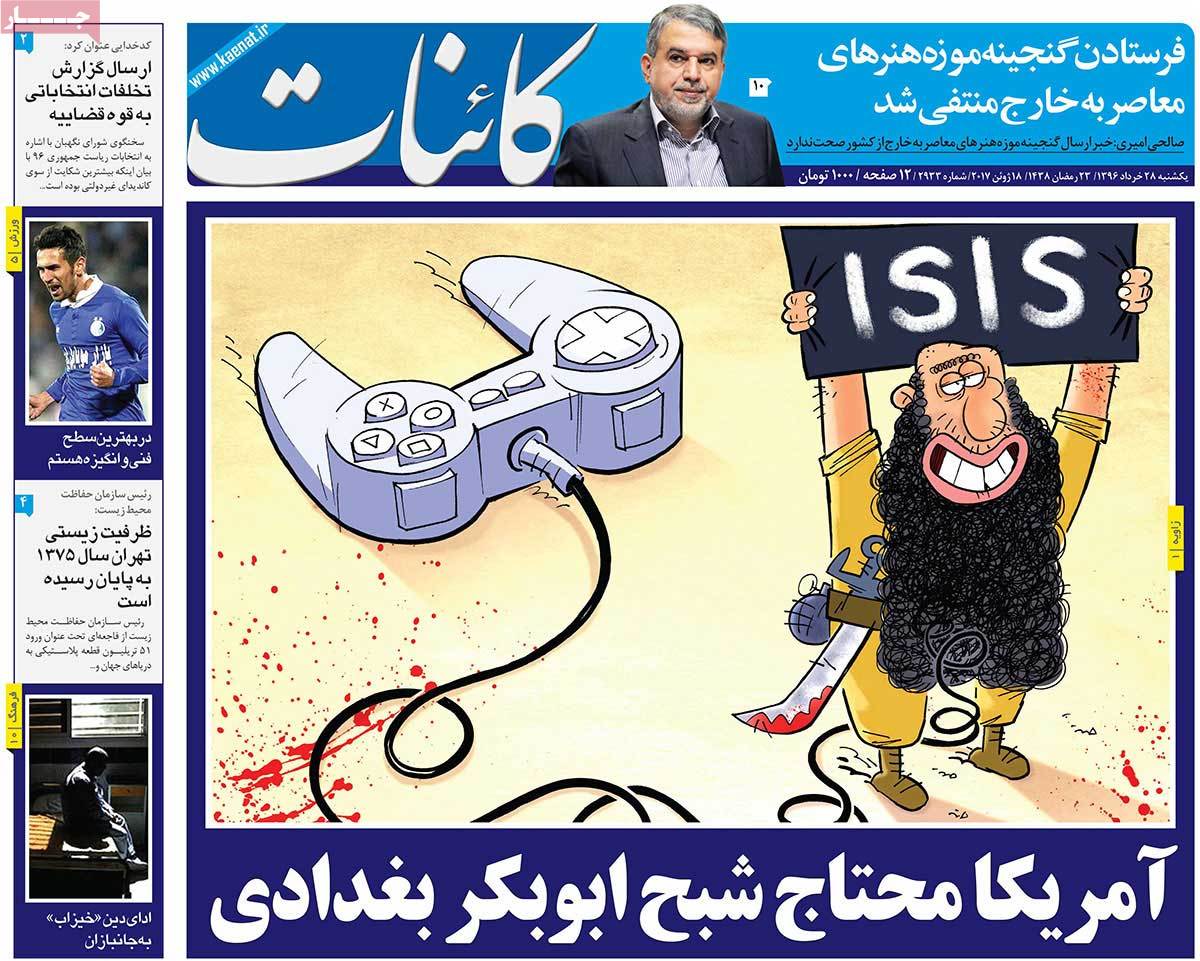
Abrar:

1- Leader: Iranian Nation’s Experiences Show Future Belongs to Young Believers

2- UAE Paper: Persian Gulf States Provoked by Qatar’s Congratulations to Rouhani

3- Iraqi Army to Liberate Mosul Soon

4- Obama Created Secret Channel for Talks with Iran: Pro-Trump Media

A Look at Iranian Newspaper Front Pages on May 29


Aftab-e Yazd:

1- Rouhani May Introduce 3 Female Ministers

2- 2030 Document Bill Has No Legal Flaw: Parliament Speaker

A Look at Iranian Newspaper Front Pages on May 29


Arman-e Emrooz:

1- Congo Fever Epidemic: From Rumours to Truth; Contradictory Reports of Victims

A Look at Iranian Newspaper Front Pages on May 29


Asrar:

1- Iran to Launch System for Discovering Banking Frauds

2- Rouhani to Qatari Emir: Sectarianism Disrupts Regional Security


A Look at Iranian Newspaper Front Pages on May 29


Donya-ye Eqtesad:

1- Signs of Economic Nationalism in Trump’s First Visit

A Look at Iranian Newspaper Front Pages on May 29


Ebtekar:

1- A Package against Poverty

  • Gov’t to Distribute Food Security Package among 3m Poor Families


A Look at Iranian Newspaper Front Pages on May 29


Etemad:

1- Analyst: US Intelligence Community at War with Trump


A Look at Iranian Newspaper Front Pages on May 29


Ettela’at:

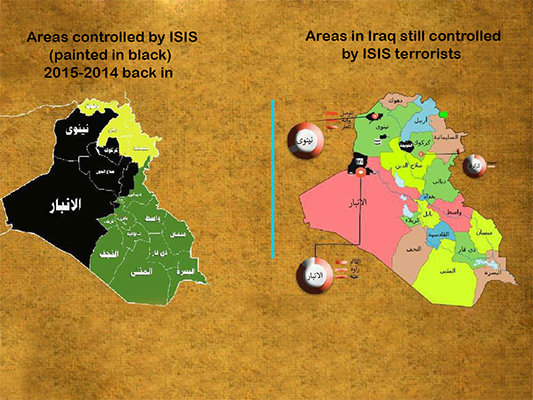
1- Iraqi Forces Close to ISIS Last Stronghold

2- Bahraini Protesters: We’ll Take Revenge of Our Martyrs

3- Guardian: Iran Celebrated Its Elections in Region Void of Democracy

4- Health of Tehran City Council Elections Approved

A Look at Iranian Newspaper Front Pages on May 29


Ghanoon:

1- Pro-Rouhani Old Man Who Sells Poems in Streets: I Want to See Rouhani before I Die

A Look at Iranian Newspaper Front Pages on May 29


Javan:

1- Basij Commander: IRGC is Thorn in Israel’s Side

  • Have Those Who [Verbally] Attack IRGC Thought about Consequences?

2- Qatari Virus in Riyadh Coalition

  • Tension with Saudi Arabia to Infect Lebanon, Pakistan, Other Saudi Allies

A Look at Iranian Newspaper Front Pages on May 29


Jomhouri Eslami:

1- Saudi Muftis Join Clash with Qatar

2- Saudis’ Bribe Worked: Trump Says Saudi King is Wise!

3- Oil Block Found in Deserts of Iran’s Semnan


A Look at Iranian Newspaper Front Pages on May 29


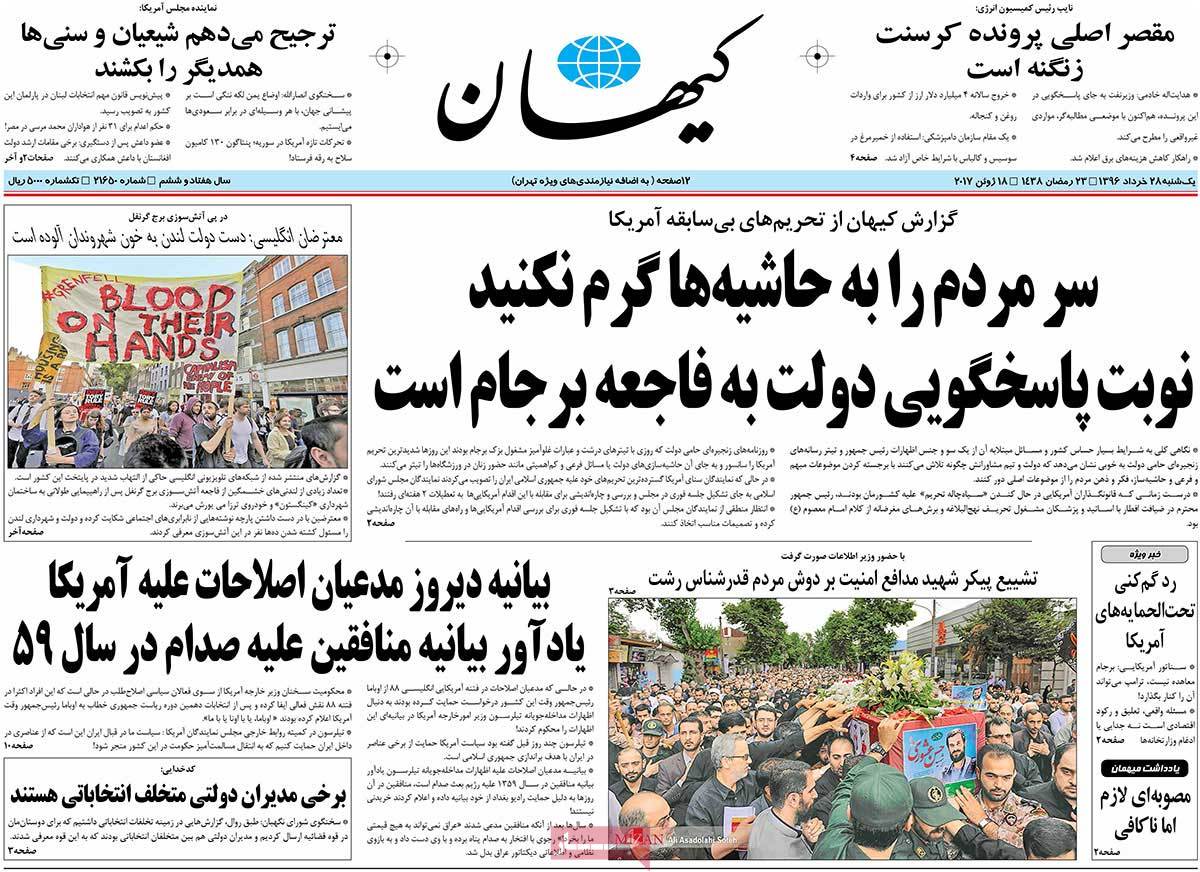
Kayhan:

1- After Milking Saudis: Trump Says Billions of Dollars Taken from Mideast Means More Jobs

2- Mr Larijani! Parliament Should Study Both Form, Content of 2030 Document

A Look at Iranian Newspaper Front Pages on May 29


Quds:

1- Reformists Want Parliament’s Presidency as Well

  • Reformist MPs Nominate Pezeshkian for Parliament Speaker


A Look at Iranian Newspaper Front Pages on May 29


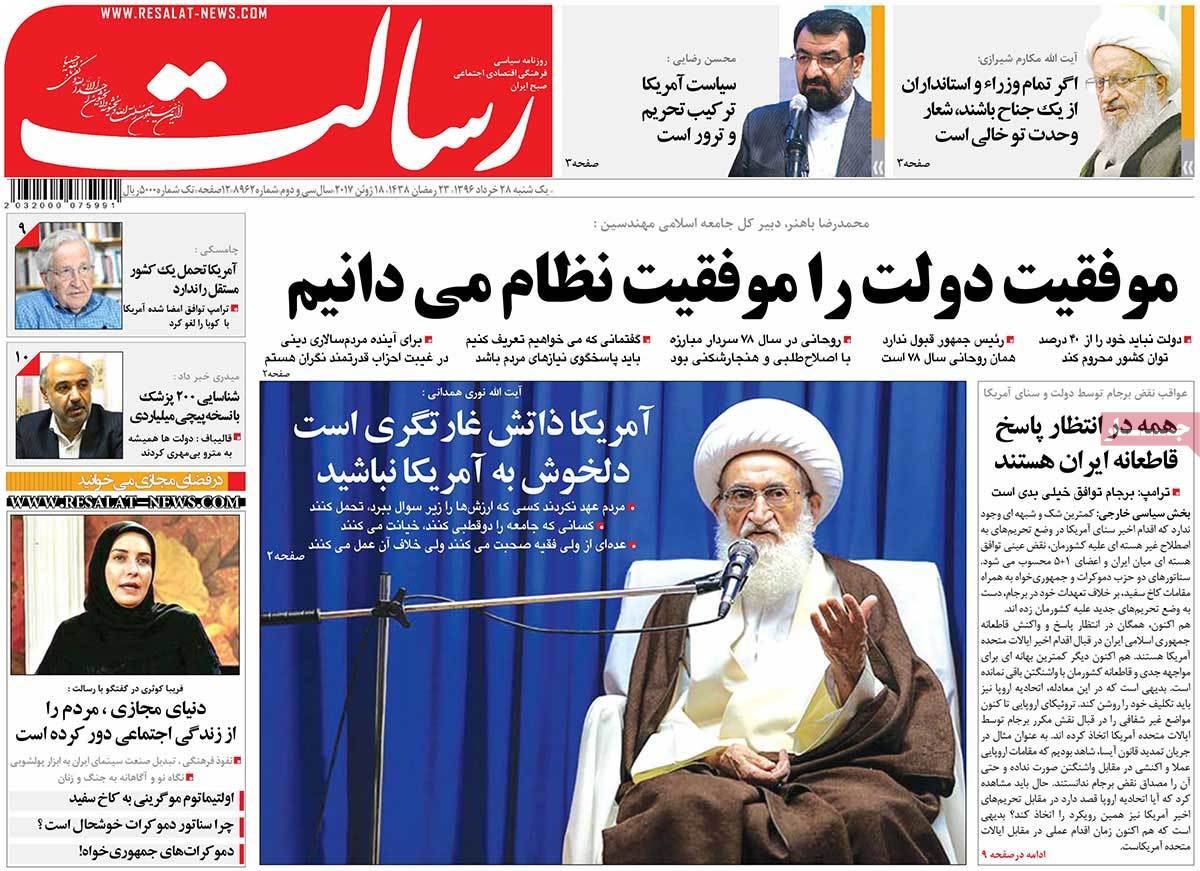
Resalat:

1- MPs: Increase of Sanctions, Big Challenge for JCPOA Implementation

2- Rouhani’s Gov’t Should Be Accountable for Sanctions: Politician


A Look at Iranian Newspaper Front Pages on May 29


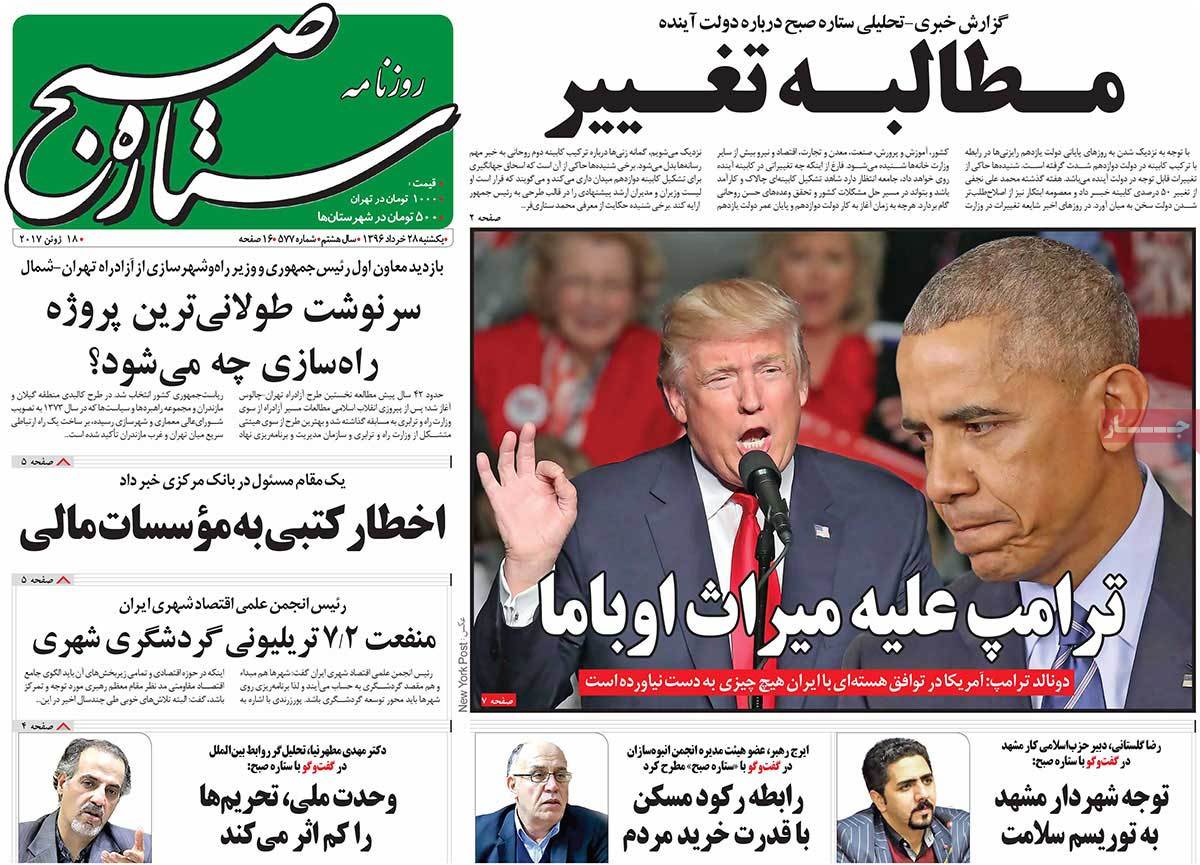
Setareh Sobh:

1- G7 in Deadlock


A Look at Iranian Newspaper Front Pages on May 29


Shahrvand:

1- Agriculture on Verge of Retirement: [Average] Age of Iranian Farmers Reach 53

2- Fever of Death: Pakistan, Afghanistan Sources of Crimean-Congo Fever in Iran


A Look at Iranian Newspaper Front Pages on May 29


Shargh:

1- Women in Line for Working as Minister

2- Iran, Europe, the US [Editorial by Foreign Ministry Spokesman]

3- Happiness in Cannes with Iranian ‘Lerd’: Rasoulof Wins Un Certain Regard Award

A Look at Iranian Newspaper Front Pages on May 29


Tejarat:

1- Total Will Once Again Invest in Iran: Deal to Be Signed before Summer

2- Interest Rate in Iran Five Times Higher than World Average: Expert


A Look at Iranian Newspaper Front Pages on May 29


Vaghaye Ettefaghieh:

1- Saudi Arabia to Be Left Alone: Repercussions of Qatar-Saudi Clash over Ties with Iran, US

2- Hamas Representative: Cutting Diplomatic Ties with Tehran Political Suicide

3- Wear Your Blue Hats for World Day of Int’l Peace Keepers

A Look at Iranian Newspaper Front Pages on May 29