Thursday, December 25, 2025
Home Blog Page 3511

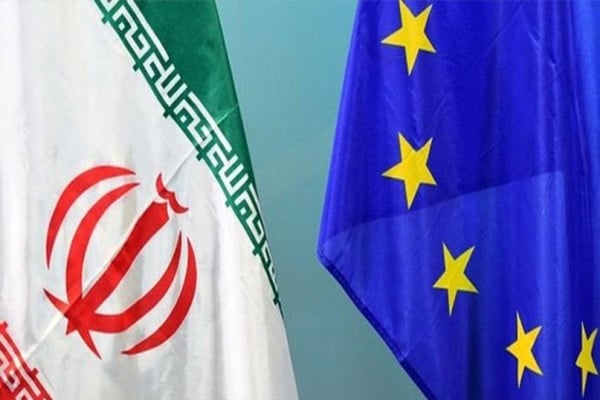
Europe’s Proposal on Iran Deal “A Step Forward, but Not Enough”

After US President Donald Trump withdrew from the Iran nuclear deal on May 8, 2018, and ordered American government bodies, including the Treasury Department, to reinstate sanctions on Iran, they planned to bring back sanctions in two phases: one in 90 days and another in 180 days. The first round of sanctions will be slapped on August 6, 2018. According to US authorities, the sanctions include a ban on Iran’s access to the greenback, gold trade and purchasing certain metals such as aluminium and steel.

Majid Takht-e Ravanchi, the deputy chief of staff of the president for political affairs has, in an interview with Tasnim News Agency, weighed in on the issue.

He said Iran and the European signatories to the JCPOA had predicted that the US might pull out of the deal, and hence Iran was in contact with the Europeans to settle the issue.

“We both had a common understanding that the US may withdraw from the JCPOA, but not the way it did; rather, [we thought it would pull out] using other methods,” he said.

The Europeans had told Iran that they would work on ways of maintaining the Iran nuclear deal if Washington withdrew from the agreement, he said.

After the US’ withdrawal, said the official, the other signatories to the deal, including the three European countries as well as Russia and China, were given the opportunity to work on the issue.

“President [Hassan Rouhani] also said Iran would give them the chance to do something to make up for the losses the Iran is suffering as a result of the United States’ withdrawal,” Takht-e Ravanchi said.

He underlined that Iran’s expert talks with the Europeans are ongoing, and the reason no news is announced in that regard is that the negotiations have produced no tangible results so far.

“First, the talks should bear fruit, then the results will be announced,” he noted.

The official underlined Iran is also holding consultations with Beijing and Moscow in parallel with the negotiations with Europe.

Elsewhere in his remarks, Takht-e Ravanchi described the package of proposals presented to Iran by the Europeans as “a step forward,” but added Iran believes the move is not enough and more needs to be done

“I believe a time will come when we will be able to discuss the details of the package, and I think everything will become clear at the end of the day,” he said.

He underscored that details should be discussed in order to handle issues.

“In order to move forward, we should get into details. When sanctions are imposed on our oil [sales], we should know how we can sell oil,” he said.

He said Iran and Europe are pressing ahead with the talks and “we see that the other parties are serious in their work.”

The official further touched upon the reinstatement of US sanctions on Iran in two phases, and said one round of sanctions applies to items such as currency, automobiles, gold and things like that, and the second round goes for banks, oil, and the like.

“We have told the Europeans that we should get things settled before the sanctions prove effective,” he said.

He underlined that the Europeans should adopt measures before sanctions are slapped or their actions will be of no use.

“What good are talks if sanctions are imposed and the measures they adopt to compensate [for the consequences of the sanctions] are not effective?” he said.

The official said he believes the Europeans will take some action before the first round of sanctions go into effect on August 8.
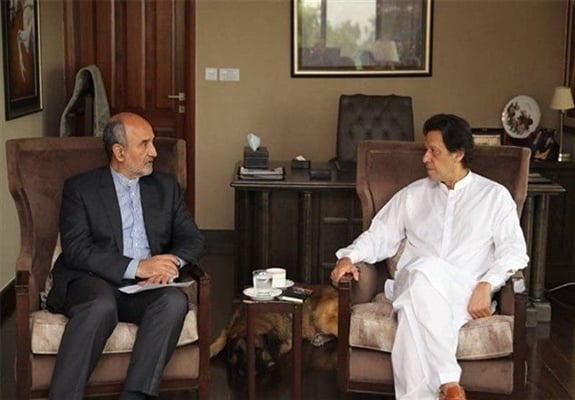
Pakistan’s Imran Khan Eager to Visit Iran

“I’m eager to visit Iran and see this country’s beautiful historic sites,” he said in a Saturday meeting with Iran’s ambassador to Pakistan Mehdi Honardoost who conveyed President Hassan Rouhani’s message to Imran Khan on his electoral success in the parliamentary elections.

Imran Khan, the leader of PTI party, thanked the Iranian ambassador for the congratulatory message and described Iran as a trustworthy friend of Pakistan, Tasnim News Agency reported.

“We seek to create friendly and brotherly relations will all neighbouring countries, particularly Iran,” he said.

Imran Khan said his government will spare no chance to boost Pakistan’s economy, hence it will work towards promoting trade with Iran.


Ready to Mediate between Tehran and Riyadh

The cricketer-turned-politician hailed Iran’s efforts to promote peace and stability in the region, saying Pakistan understands Iran’s concerns regarding regional developments.

Imran Khan said Pakistan is ready to play a constructive role to mend fences between Iran and Saudi Arabia.

Tehran and Riyadh have been at loggerheads in recent years over a long list of differences, particularly their conflicting view on conflicts in Yemen and Syria, among others.

Last week, Imran Khan’s PTI party won Pakistan’s election. Based on the official result, PTI won 115 seats out of 272 seats in the National Assembly.

Iran Strongly Condemns Assassination Attempt on Venezuelan President

In a statement on Sunday, Qassemi condemned the attempt and described it as a move to create instability and insecurity in Venezuela.

He also said that the attempt served the interests of the enemies of the Venezuelan government and nation.

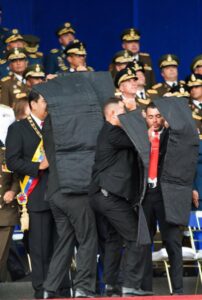
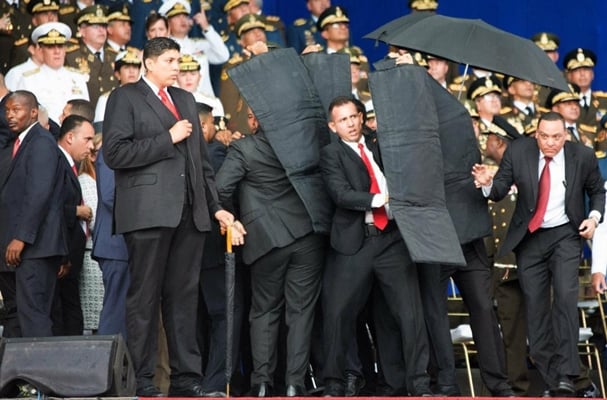
The Venezuelan president says he has survived an assassination attempt involving explosive drones. Maduro was speaking at a military event in Caracas when the alleged attack occurred.

Live footage of his speech shows the president suddenly looking upwards – startled – and dozens of soldiers running away.

Iran Strongly Condemns Assassination Attempt on Venezuelan PresidentMaduro accused neighbouring Colombia and elements within the US of instigating “a right-wing plot” to kill him, but Bogota has denied it as “baseless” accusation.
Seven soldiers were injured, and several people were later arrested, the Venezuelan authorities said.

Two drones loaded with explosives went off near the president’s stand, Communications Minister Jorge Rodriguez said.

Photos on social media showed bodyguards protecting Maduro with bulletproof shields after the alleged attack.

Meanwhile, a little-known group called Soldiers in T-shirts said on social media that it was behind the alleged attack.

It said it had planned to fly two explosives-laden drones at Maduro, but they were shot down by the military.

The claim was not backed up by any evidence, and the group did not respond to media requests for comment.

Top Judge Laments West’s Concerns over Rights Situation of Iranian Protestors

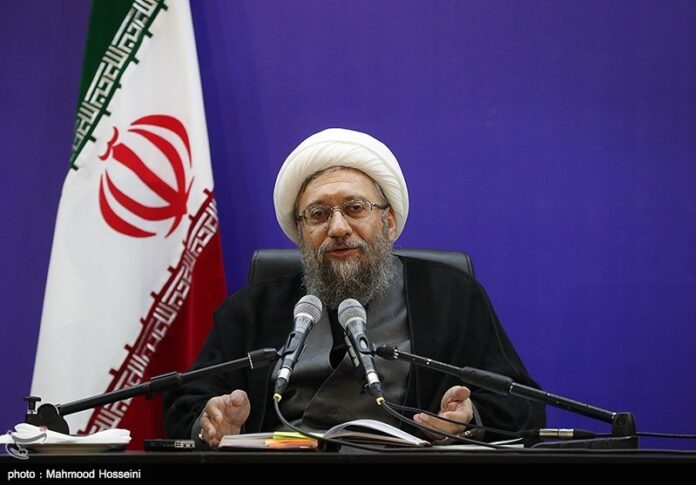
Sadeq Amoli Larijani

Speaking in a human rights conference in Tehran on Sunday, Ayatollah Amoli Larijani said the West is largely silent over the targeting of civilians in Bahrain and Yemen.

“In Bahrain, patients and children and women are being assaulted. War crimes are being committed in Yemen. Recently, a hospital was targeted and [many] people were killed,” he said, referring to an airstrike by the Saudi-led coalition which hit a hospital in the Yemeni city of Hudaydah on Thursday and killed 60 and injured over 100.

Bahrain has since 2011 been witnessing a pro-democracy uprising, which the government forces and Saudi troops have been trying to quell. Yemen has also been the scene of a Saudi military campaign, which Riyadh says aims to restore to power the fugitive president Abd-Rabbu Mansour Hadi.

“We see the self-proclaimed protectors of human rights keep mum [regarding the two countries]. But when it comes to Iran, they support street rioters and those who set fire to shops,” he said, ISNA reported.

Iran has saw sporadic protests in Tehran and other cities in recent months over economic hardships and other issues, which some officials have suggested are parts of hostile plots to foment chaos in the country.

The US has offered support for the protesters, with Secretary of State Mike Pompeo suggesting on June 21 that “Iranian people deserve respect for their human rights.”

Ayatollah Amoli Larijani was reiterating a long-standing Iranian position that western countries abuse the cause of human rights in order to advance their short-sighted political interests.

Since the Islamic Revolution of 1979 that overthrew the despotic regime of Mohammad Reza Pahlavi, Tehran has found itself in the western countries’ black list of human rights violators.

IRGC Confirms Reports of Holding Naval Drill in Persian Gulf

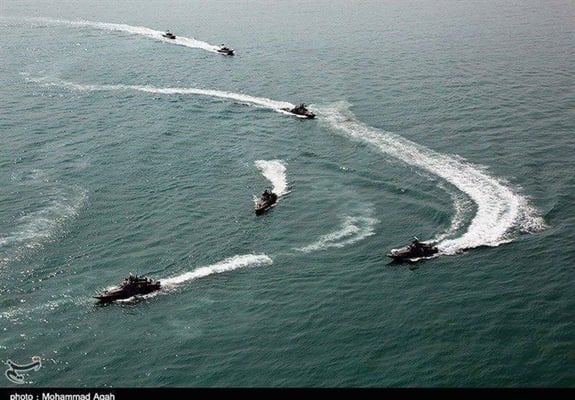
Brigadier General Ramezan Sharif said the drill was staged near the strategic Strait of Hormuz, which Iran has threatened to close in case its oil exports are hampered by the US and its allies.

“This drill was aimed at controlling and protecting security of the international waterway [Hormuz strait] and was part of annual IRGC drills planned beforehand,” Tasnim News Agency quoted him as saying.

The spokesman did not elaborate further about the details of the drill, which had not been publicized yet.

Unnamed US officials told Reuters on Thursday Washington believes Iran has started carrying out naval exercises in the Persian Gulf.

The report said Iran has apparently moved up the timing of annual drills amid heightened tensions with Washington.

One official said possibly more than 100 vessels were involved in the drills, including small boats.

Tensions between Tehran and Washington have seen a surge since US President Donald Trump took office January 2017. Trump pulled the US out of the 2015 nuclear deal in May, and is set to re-impose full sanctions in two stages in August and November.

The US is also working to pushing the world to cut trade with Iran and stop purchasing the country’s oil. Iran has vowed to hamper the region’s oil flow in case the US cut down to zero Iran’s oil export.

Top Violator of Child Rights Shedding Crocodile Tears for Iranians

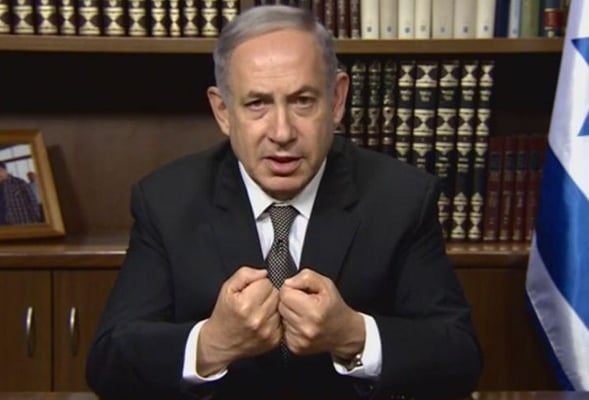
In a recent video posted on his Twitter account, Netanyahu said the children and teenagers of Iran have been going through “a regime that oppresses them and denies them a life of dignity, prosperity and respect.”

In the video, Netanyahu gives an example of an imaginary 15-year-old Iranian girl named Fatemah who is trying to live a normal life but is unable to do so due to the ongoing distress in the country.

Fatemeh, Netanyahu says, is faced with water and electricity shortage, cannot remove her head-covering outside her home, and her school is shut down due to air pollution, Jerusalem Post reported.

The video was the last in a series of such clips in which Netanyahu struggles to encourage the Iranian people to stand up to the Iranian government.

This is while the world still remembers a notable example of the Israeli violation of child rights, the case of Ahed Tamimi, a 17-year-old girl who was arrested and put on trial in an Israeli military court for slapping an Israeli soldier.

Late last month, Tamimi was set free after serving an eight-month prison sentence, which the UN human rights experts have described as a violation of the international Convention on the Rights of the Child.

The Amnesty International said Tamimi’s case is a reminder of Israel’s ongoing human rights violations against Palestinian children.

Fars News Agency in an article says Netanyahu’s call for helping Iranian children is sheer hypocrisy.

The report says Netanyahu sheds crocodile tears for Iranian children and teenagers while his government has a dark record in violating the Palestinian children’s rights.

During the 70-year history of the Israeli regime, Palestinian children have lived in the harshest conditions, the article wrote.

The prosecution of Palestinian children in Israeli military courts for acts like throwing stones is systematic, and violates the Convention on the Rights of the Child, the article said.

According to a report released by the Palestine Solidarity Campaign (PSC), “Israel is the only state in the world that systematically prosecutes children in military courts – between 500 and 700 each year. The Israel Prison Service revealed that an average of 204 Palestinian children have been held in custody every month since 2012.”

According to a report by the Israeli rights group B’tselem, the Israeli regime currently has near 300 Palestinian minors in its prisons.

“At the end of May 2018, 291 Palestinian minors were held in Israeli prisons as security detainees and prisoners, including 3 administrative detainees. Another 6 Palestinian minors were held in Israel Prison Service facilities for being in Israel illegally,” it says.

Of note, 60% of Palestinian children arrested by Israel were verbally, physically or psychologically tortured, according to the Palestinian Prisoners’ Club (PPC).

As recently as Wednesday, a group of senior UN officials voiced concerns over the violation of children’s rights in Gaza.

“Senior UN humanitarian officials in the Occupied Palestinian Territory have expressed their deep concern for the continued violation of children’s rights in and around the Gaza strip,” said Farhan Haq, deputy spokesman for UN Secretary-General at a news briefing.

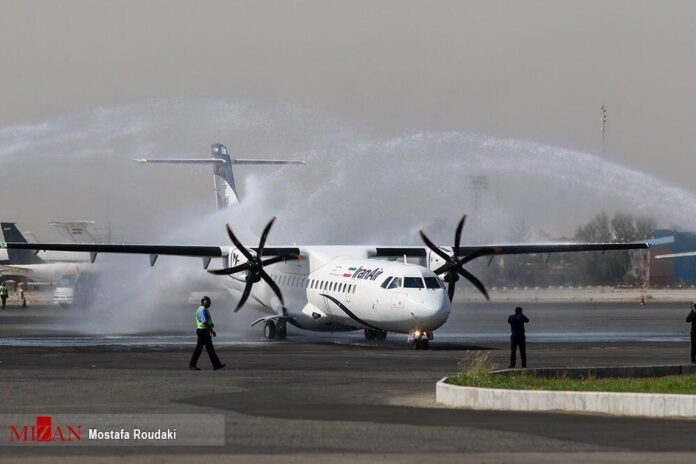
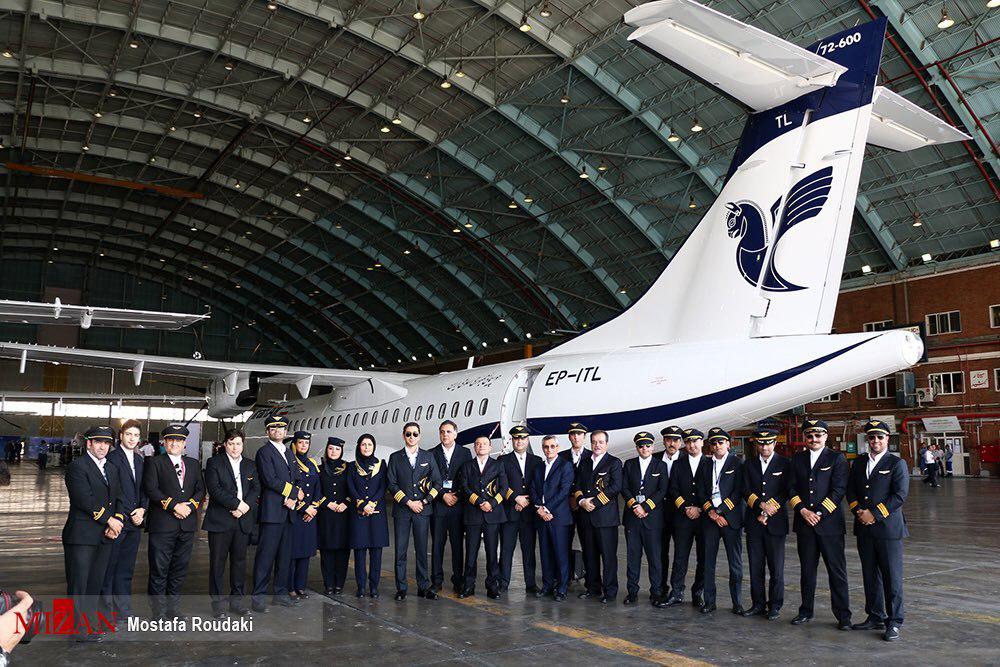
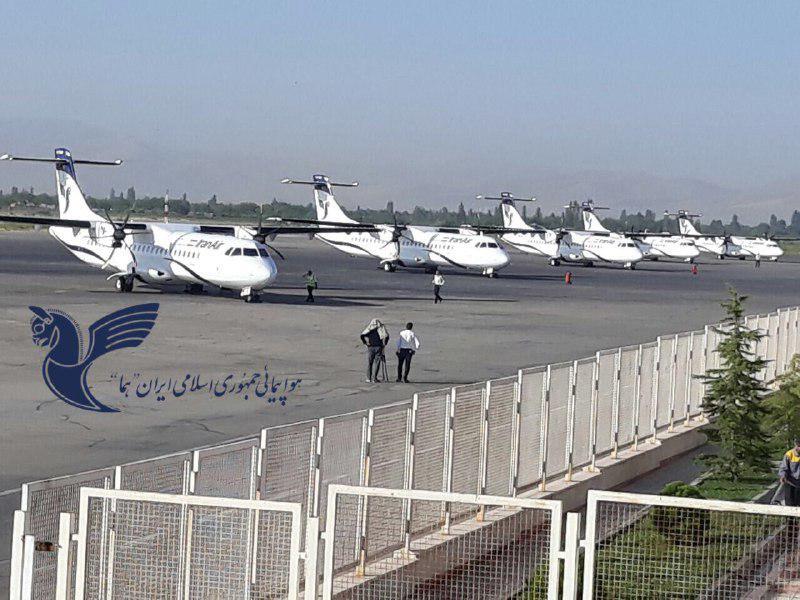
New ATR Planes Land in Tehran on Eve of US Sanctions

The planes are part of a deal for 20 new aircraft that national flag carrier Iran Air agreed to buy from the French plane-maker in April 2017, of which eight were delivered before.

The agreement came after restrictions on Iran’s aviation industry were removed under the 2015 nuclear deal, which placed confidence-building curbs on Iran’s nuclear program in exchange for the removal of international sanctions.

But the US’ withdrawal from the deal in May 2018 has hampered the deal, as the US is set to re-impose anti-Iran sanctions and escalate pressure on the country to force negotiations on a new deal.

The first series of sanctions on Iran’s automotive and metal sectors, gold trade, aviation industry and other fields will “snap back” on August 6.

Washington has revoked export licenses needed by all Western plane-makers due to their heavy use of US parts.

Further sanctions on oil and transactions with the central bank of Iran will come into effect November 4.

Asghar Fakhrieh Kashan, an advisor to Iran’s roads minister, said on Saturday Iran has paid for the five planes by cash on Friday, Tasnim News Agency reported.

 New ATR Planes Land in Tehran on Eve of US Sanctions

ATR to Lose

ATR, co-owned by Airbus and Italy’s Leonardo, has been lobbying the US Treasury to allow it to deliver aircraft it built for Iran by giving it temporary new licenses

The plane-maker has said it will suffer financial damage if it cannot deliver the aircraft it has already produced following earlier US approvals.

But the US government seems unwilling to issue any licenses that would allow companies like ATR to continue trade with Iranian airlines.

Farzaneh Sharafbafi, the CEO of Iran Air, says three more ATR planes are also expected to be delivered to Iran in case the French plane-maker manages to receive the required permissions.

Iran has also purchased over 100 Airbus planes, of which only three have so far been delivered to Iran.

Airbus said last month it would not attempt to deliver any more planes to Iran in the wind-down period.

In the wake of the deal, Iran also inked another agreement to buy 80 new planes from US aviation company Boeing. Boeing has not delivered any planes so far and does not seem to be allowed to do so in the future.

New ATR Planes Land in Tehran on Eve of US Sanctions

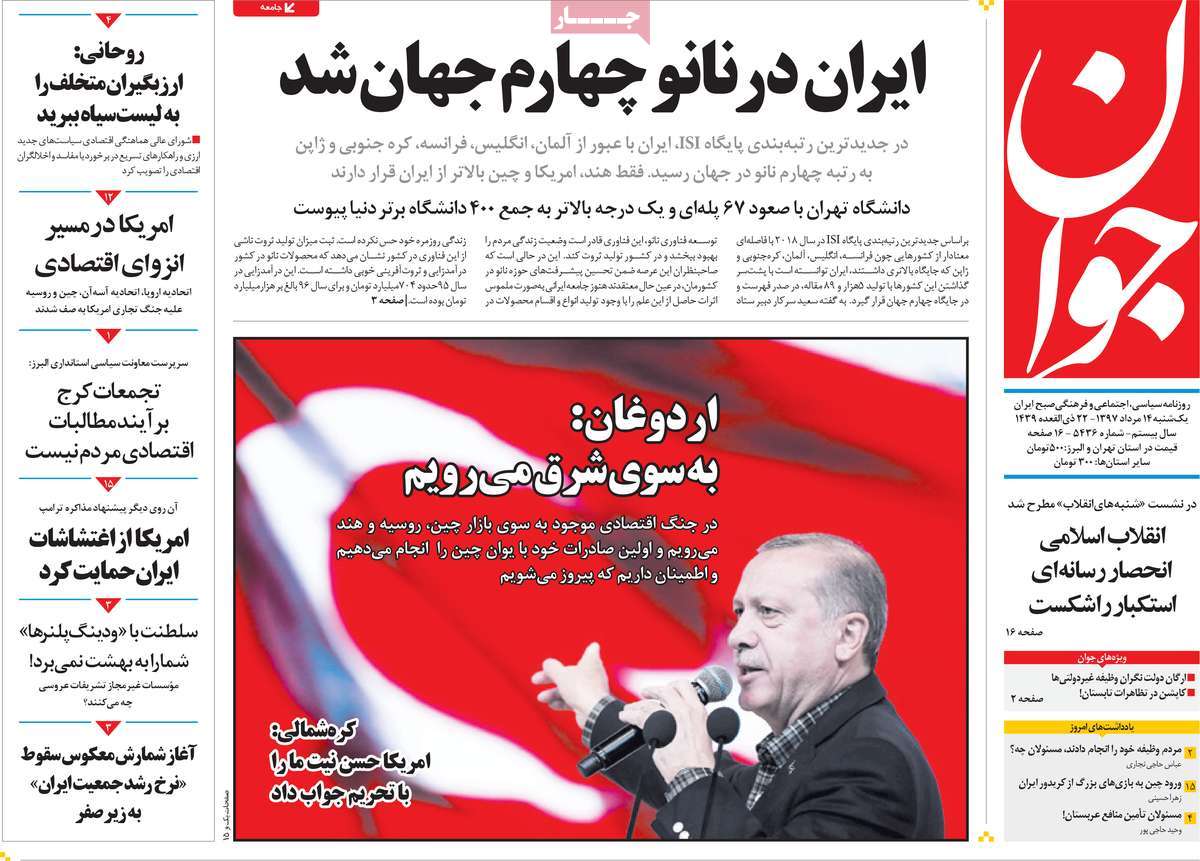
A Look at Iranian Newspaper Front Pages on August 5

A Look at Iranian Newspaper Front Pages on November 19

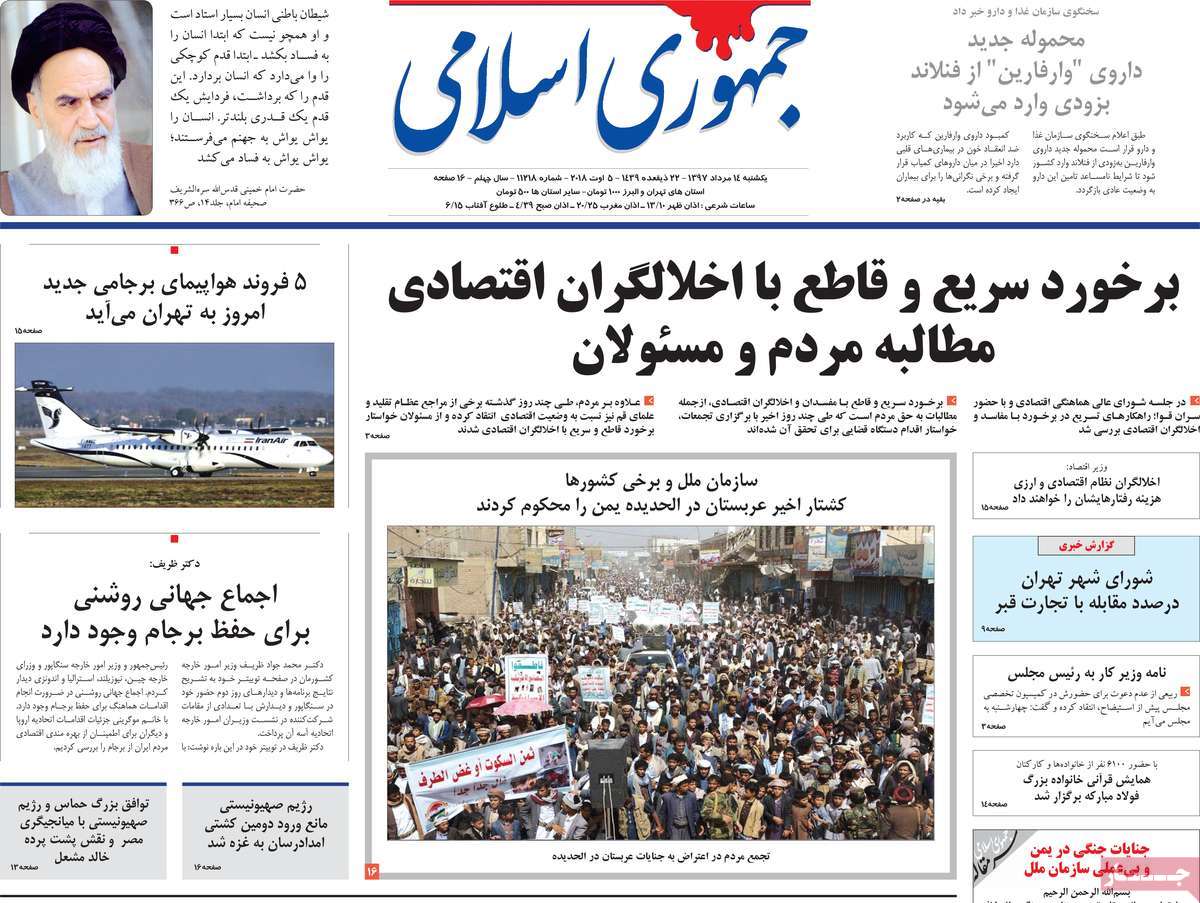
Iranian papers today widely covered the delivery of five ATR passenger planes to Iran one day before the US re-imposes the first series of its sanctions on the Islamic Republic.

Also a top story was the ongoing economic problems, including price hikes and high inflation, in Iran and the protest rallies held across the country, some of which have turned violent.

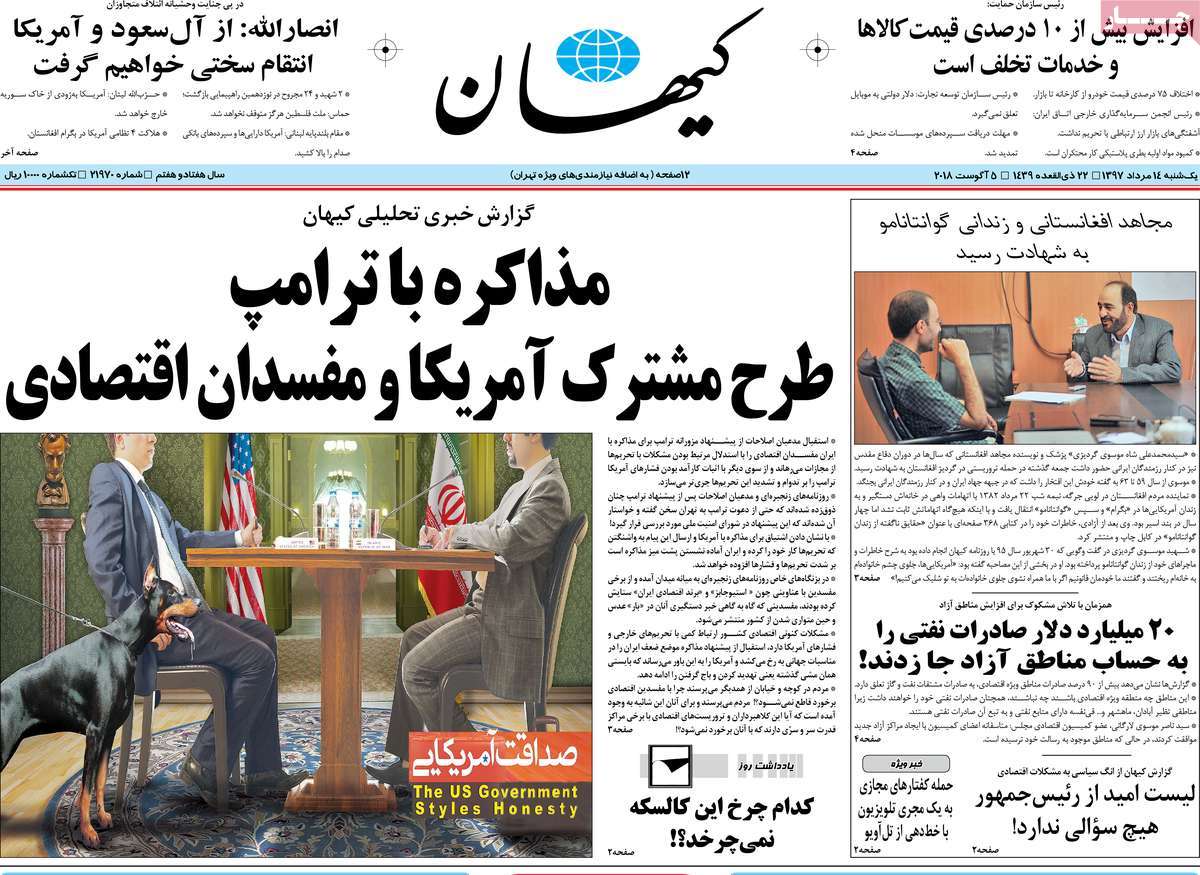
The issue of Iran-US negotiation and various viewpoints expressed about it also remained a top story today.

The above issues, as well as many more, are highlighted in the following headlines and top stories:


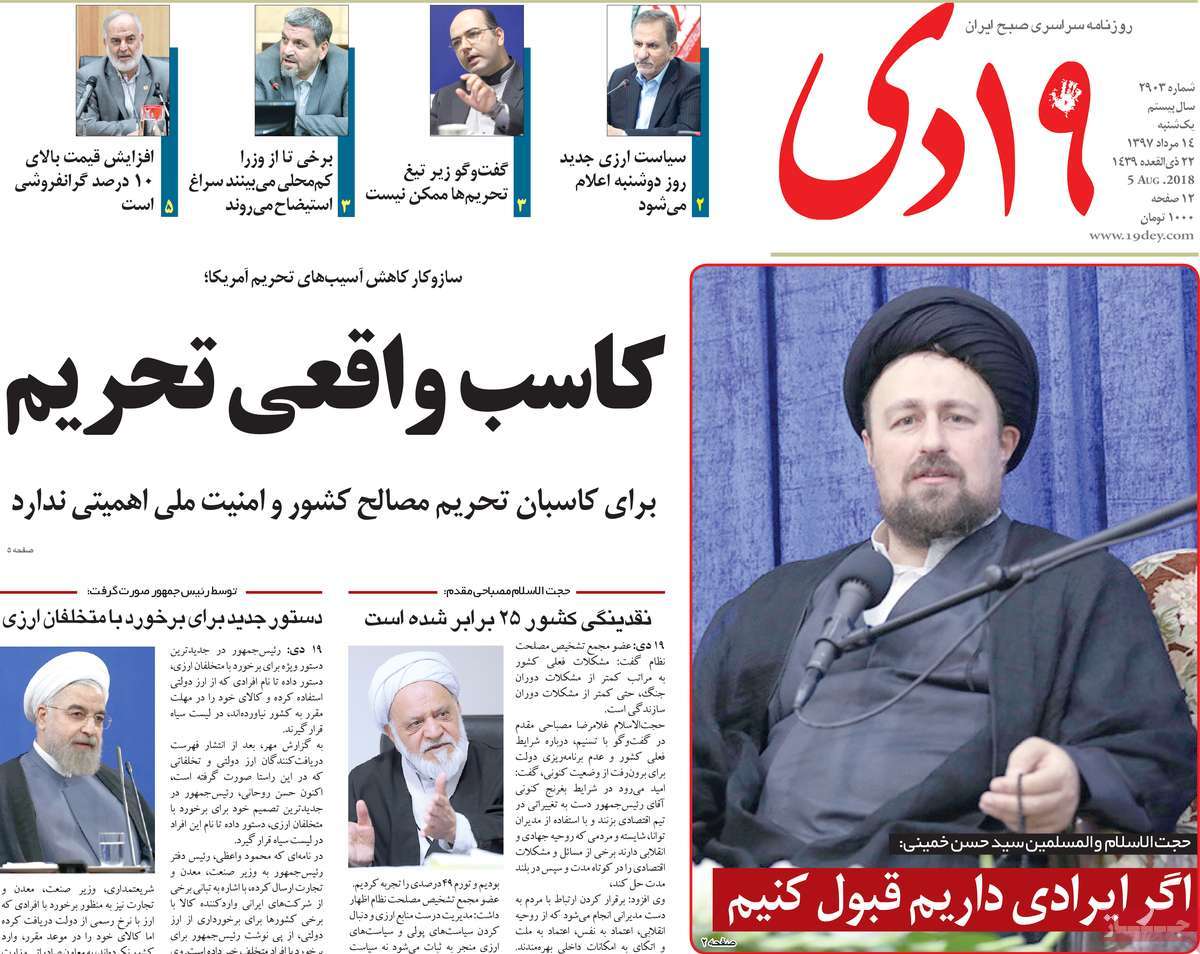
19 Dey:

1- Imam Khomeini’s Grandson: If We Have Any Deficiencies, We Must Accept It

2- Rouhani’s New Order for Countering Forex Offenders

A Look at Iranian Newspaper Front Pages on August 5


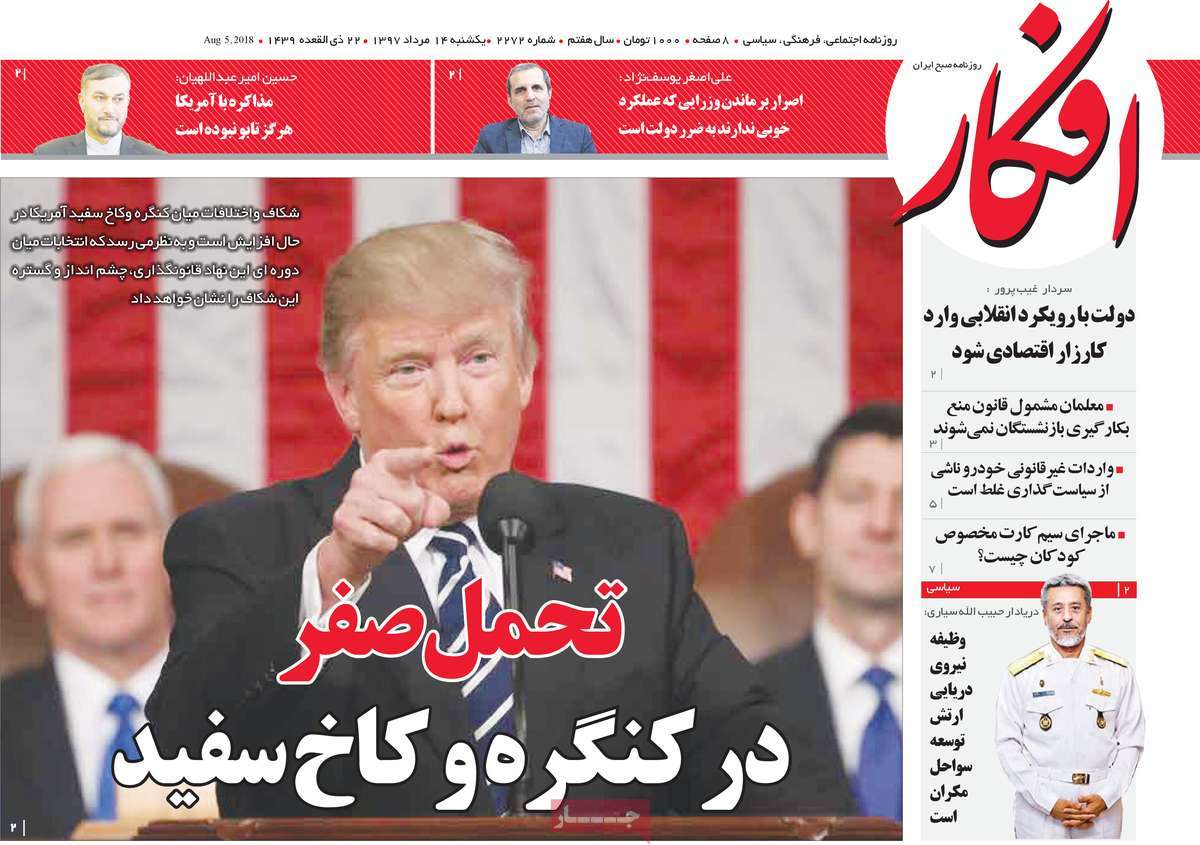
Afkar:

1- Zero Toleration in US Congress, White House

  • Disagreement between US Congress, Government Growing
  • US Congress Elections to Clearly Show This Rift

2- Government Must Get Engaged in Economic War with Revolutionary Approach: Basij Chief

A Look at Iranian Newspaper Front Pages on August 5


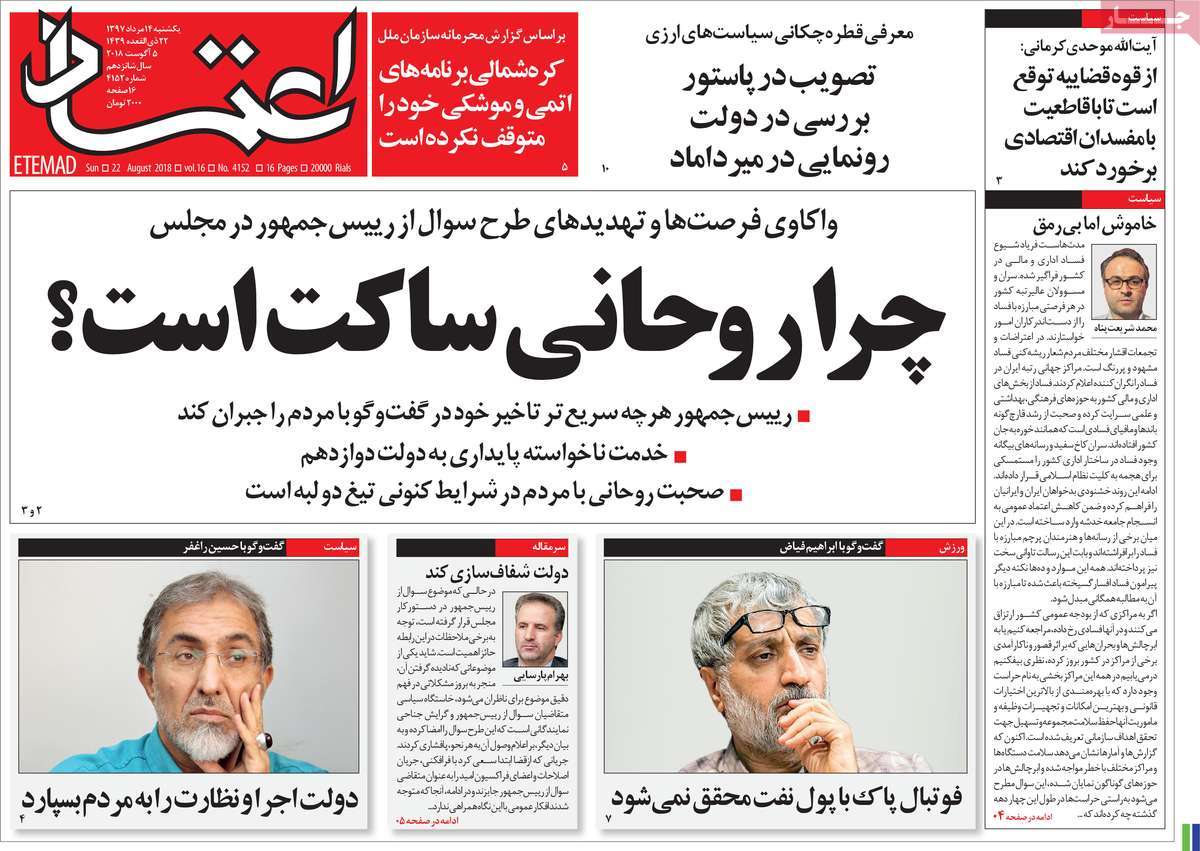
Etemad:

1- Why Is Rouhani Silent?

  • Rouhani Must Make Up for His Delay in Talking to People ASAP

A Look at Iranian Newspaper Front Pages on August 5


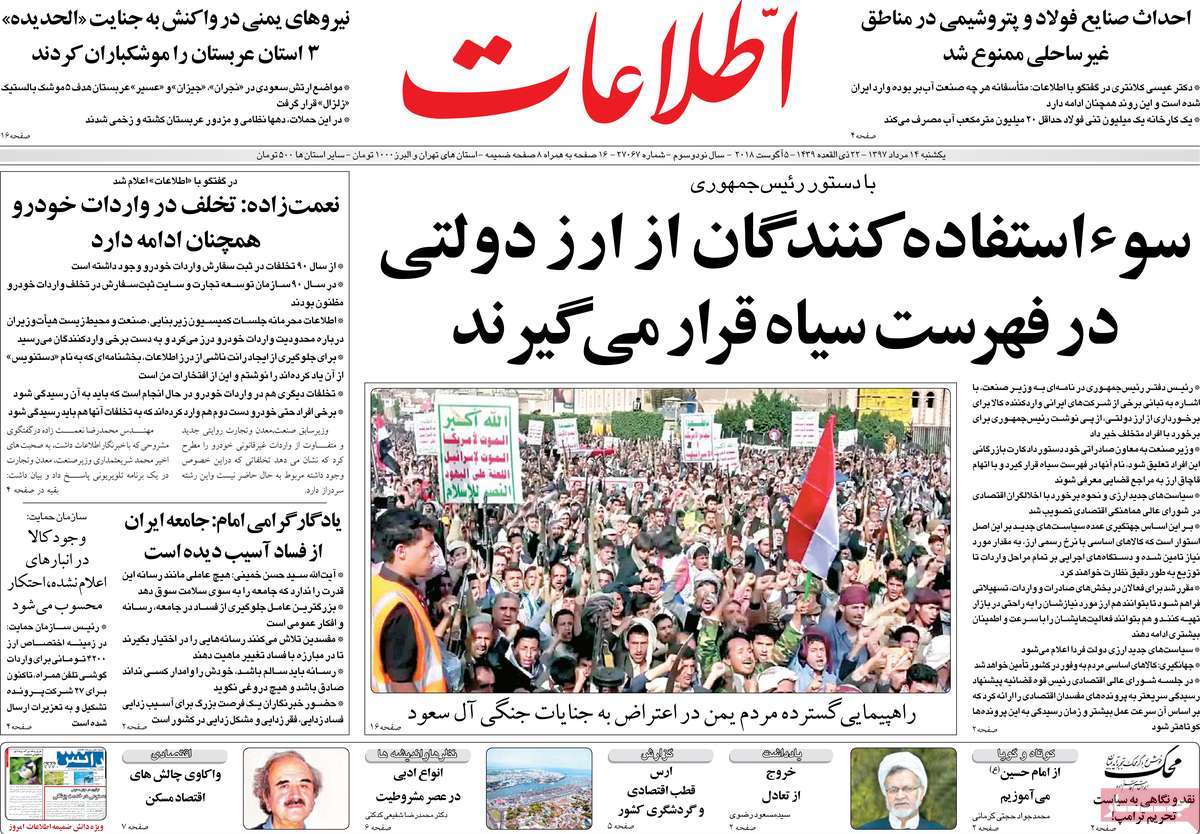
Ettela’at:

1- Those Who Abuse Official-Rate Foreign Currencies to Be Blacklisted

2- Yemeni Forces Fire Missiles at Three Saudi Provinces in Retaliation for Hudaydah Crime

3- Yemeni People Hold Massive Protest Rallies to Protest at Al Saud’s War Crimes

A Look at Iranian Newspaper Front Pages on August 5


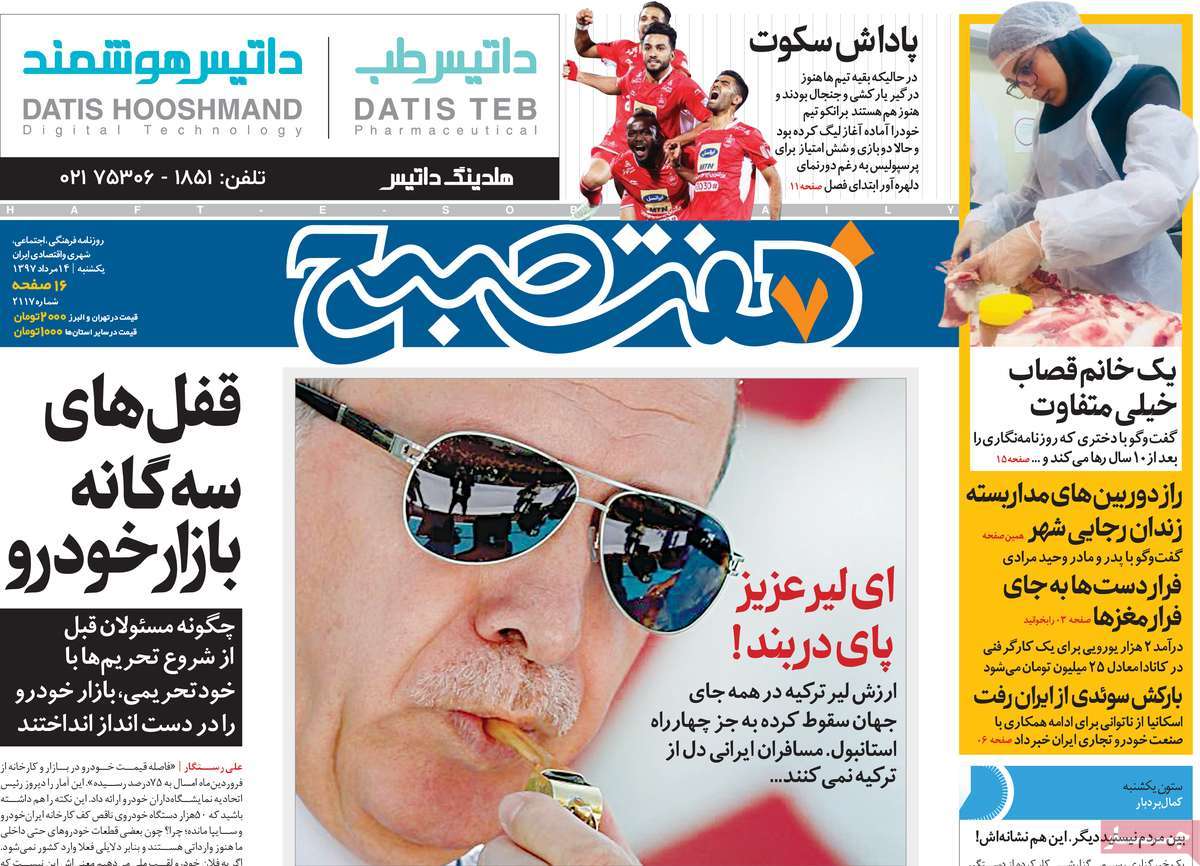
Haft-e Sobh:

1- Value of Turkish Lira Plunges in All Parts of the World, Except Iran!

  • Iranian Tourists Not Going to Stop Visiting Turkey

A Look at Iranian Newspaper Front Pages on August 5


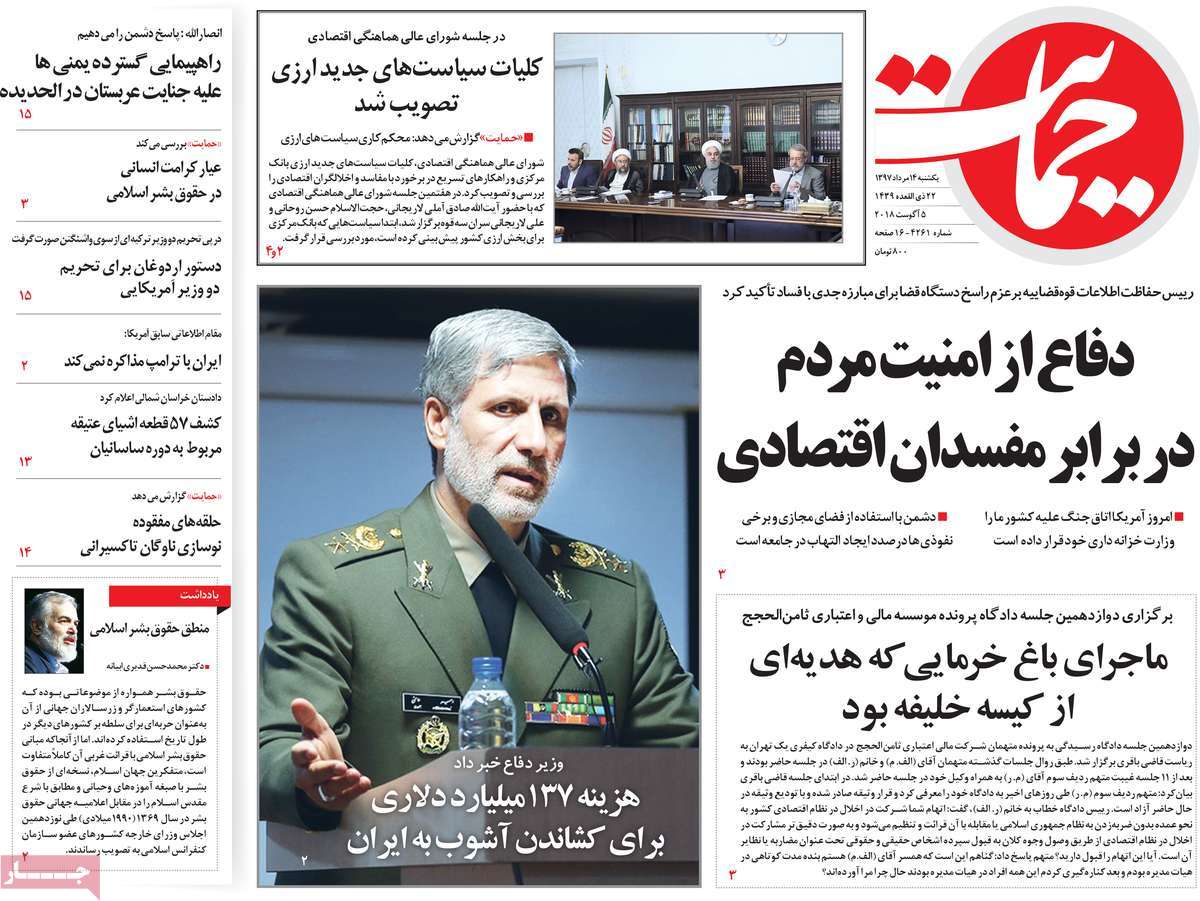
Hemayat:

1- Iranian DM Says Enemies Spend $137 Billion to Slide Chaos into Iran

A Look at Iranian Newspaper Front Pages on August 5


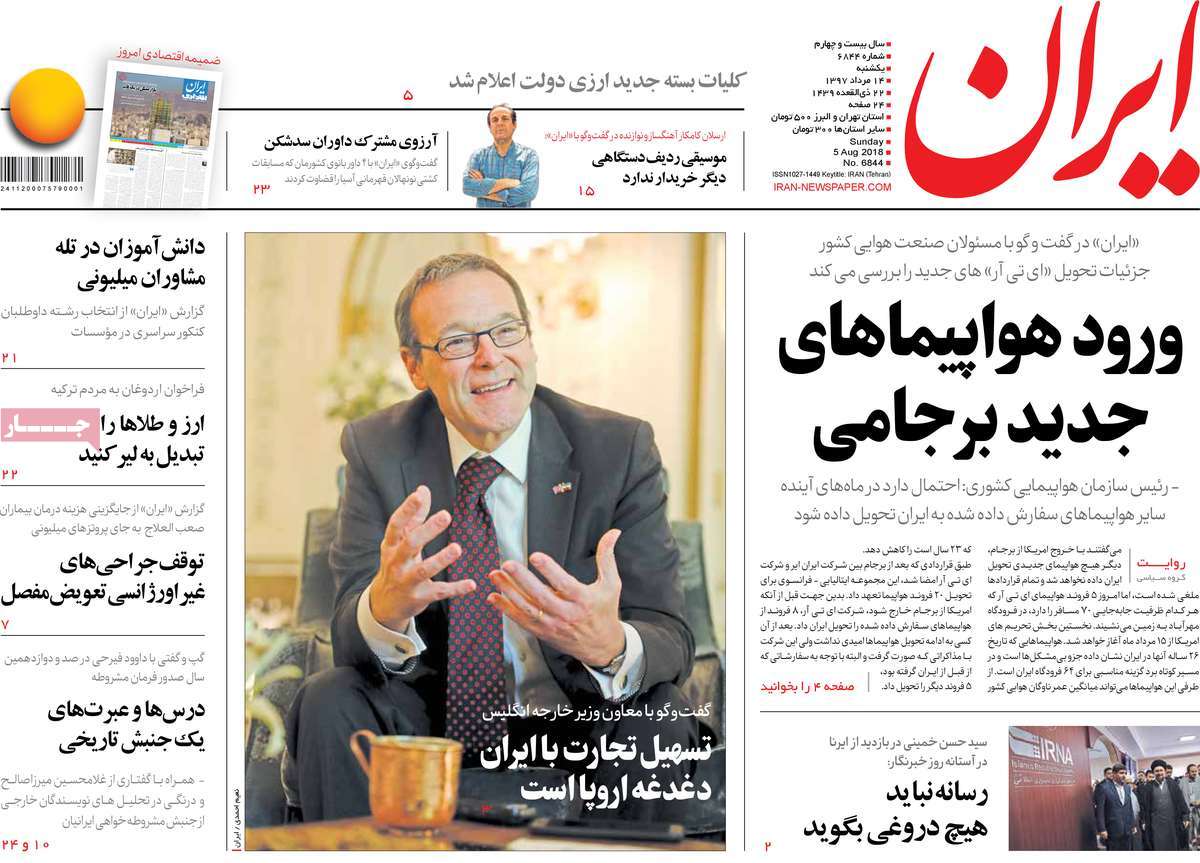
Iran:

1- New “JCPOA Planes” Arrive in Iran

2- Facilitating Trade with Iran Is Europe’s Concern: British Deputy Foreign Secretary

3- Media Should Not Tell Any Lie: Imam Khomeini’s Grandson

A Look at Iranian Newspaper Front Pages on August 5


Javan:

1- Iran Ranks Fourth Worldwide in Nanotechnology

  • In Latest ISI Ranking, Iran Outranks Germany, UK, France, Korea, Japan

2- Erdogan: We’re Moving towards East

3- US Supports Riots in Iran: Other Side of the Coin of Trump’s Offer

A Look at Iranian Newspaper Front Pages on August 5


Jomhouri Eslami:

1- People, Officials Want Judiciary to Take Rapid, Decisive Action against Those Disrupting Economy

2- Five New ATR Passenger Planes in Tehran

3- UN, Several Countries Condemn Recent Slaughters in Yemen’s Hudaydah

A Look at Iranian Newspaper Front Pages on August 5


Kayhan:

1- Negotiation with Trump, Joint Plan by US and Disruptors of Iranian Economy

A Look at Iranian Newspaper Front Pages on August 5


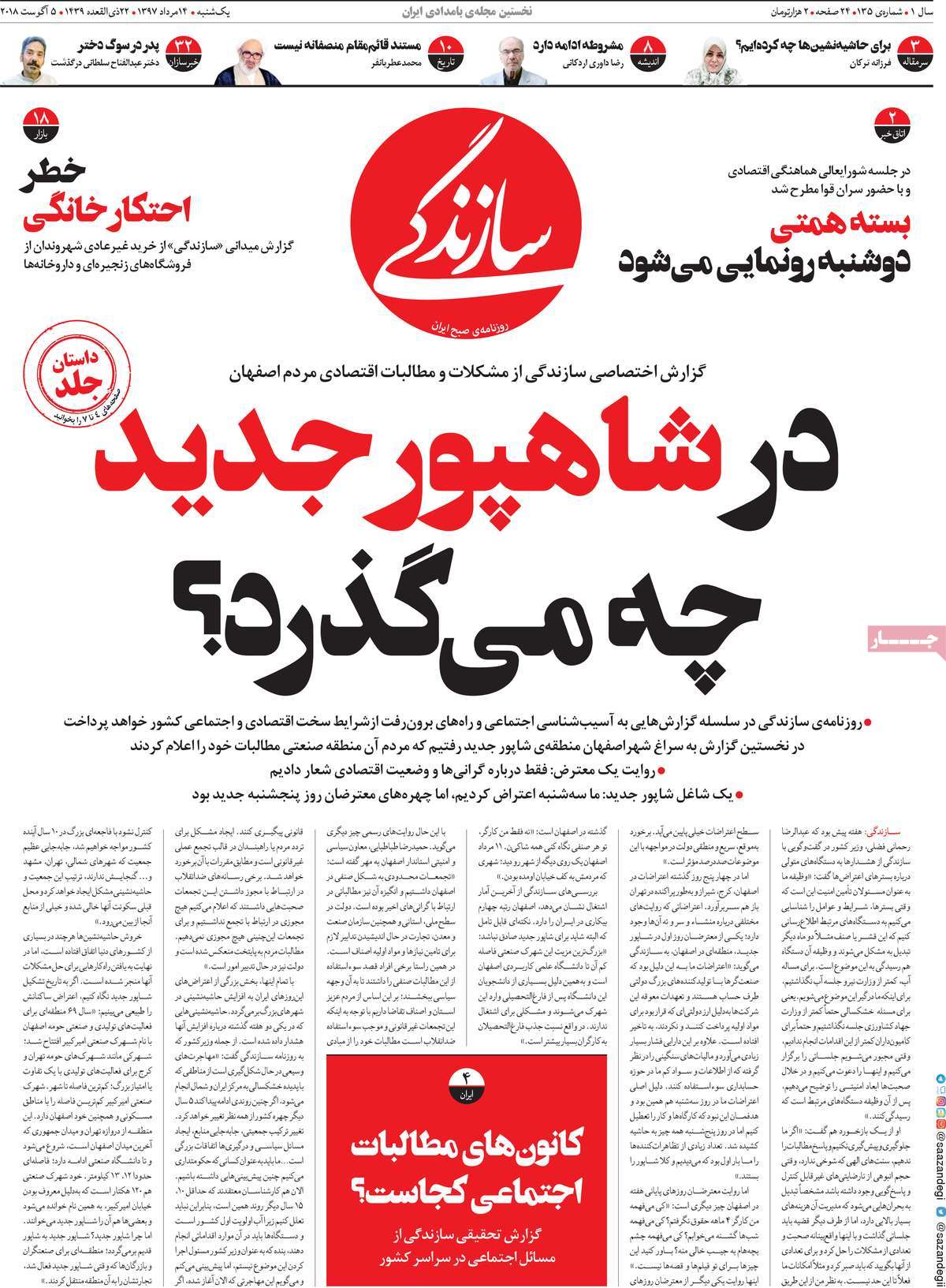
Sazandegi:

1- A Report on Economic Woes, Demands of People of Isfahan

  • We Just Chant Slogans about Price Hikes, Economic Conditions: Protester
  • We Staged Protest Rallies on Tuesday, but Those Protesting on Thursday Were New People

A Look at Iranian Newspaper Front Pages on August 5

Saudis Spending Hefty Money to Slide Iran into Chaos, DM Hints

Iran’s DM Vows Firm Response to Enemy’s Moves

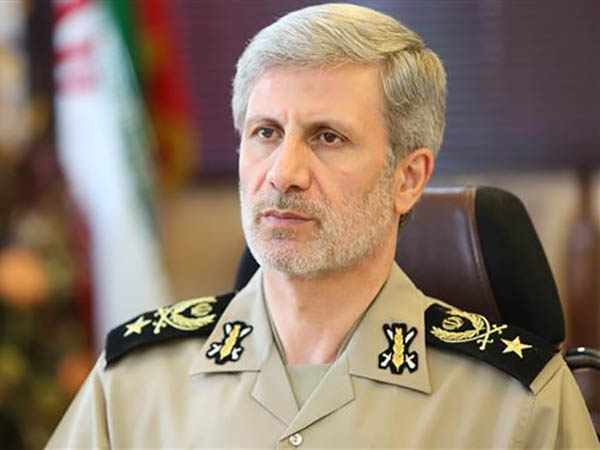
Addressing a Saturday ceremony in Tehran, General Hatami underlined that the current economic war waged against Iran as well as the brutal sanctions imposed on the country are part of the animosity of the US and its allies towards the Islamic Republic over the past four decades.

The Defence Minister indirectly suggested that Saudi Arabia has confessed it has spent $137 billion to slide Iran into chaos and support terrorist groups in Iraq and Syria, a report by Tasnim News Agency said.

Meanwhile, the US and its allies have invested over $500b to create tension in the region, he added.

He then described the creation of regional terrorism and sliding states like Iraq and Syria into chaos as other plots hatched by the enemies against Iran and said the adversaries are after institutionalizing insecurity and tension in the region.

The Defence Minister also said by creating terrorist groups in the region, the US and its allies have been seeking to tarnish the image of Islam as a religion of peace and added the enemy is seeking to pit regional states against each other to secure the Zionist regime.

Iran has been the scene of sporadic protests over the past few days as Iranians brace for a return of US sanctions.

Hundreds have rallied in cities across the country, including Tehran, Isfahan, Shiraz, and Karaj, according to videos posted on social media, to protest against high inflation caused in part by a plunging Iranian rial over fears of the re-imposition of crippling sanctions on August 7.

The US decided to re-impose sanctions on Iran upon its withdrawal from the Iran nuclear deal, accusing Tehran of posing a security threat, and has told other countries they must halt all imports of Iranian oil as of November 4 or face US financial measures.

Back in January, some cities of Iran witnessed rallies in protest at price hikes and economic woes. Police arrested a number of demonstrators who were trying to damage public property in the gatherings.

Iranian officials believe the protests are partly sponsored and orchestrated by foreign elements and spy services, including that of the US, Israel, and Saudi Arabia.

According to Article 27 of the Iranian Constitution, “public gatherings and marches are allowed so long as the participants do not carry arms and are not in violation of the fundamental principles of Islam.”

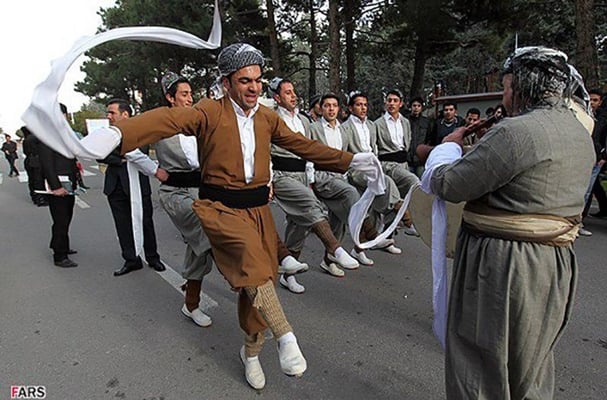
Kurdish Dance; Ancient Tradition with Military Applications!

Halparke is an ancient round dance where people hold hands and move their feet and shoulders rhythmically and in unison.

Mahmoud Qaderi, a sociologist, says Kurdish dance is a highly symbolic performance, showing solidarity and resistance.

Speaking to ISNA, Qaderi said his Kurdish dance has been performed not only in celebration of the new year and other happy occasions, but also during wartime, to demonstrate that Kurds are not afraid of the enemy and are united to defend their homeland.

In this dance, dancers take two steps back and then take four steps forward, while travelling in a circle, conveying a message that if the enemy attacks and pushes them back, they will fight back and won’t budge even an inch, he said.

Qaderi said the dancers hit their right foot roughly to the ground, which means no one can annihilate Kurds and they will remain forever.

In every dance one dancer comes to the head of the circle, who is called Serchopi, holding a colourful cloth in his right hand.

Qaderi said Serchopi plays the role of the military commander of the group, and the cloth he carries is the symbol of a weapon.

In the ancient times, Kurds used to perform dance in royal palaces in celebration of military victories. But it was forbidden to take arms to the palaces. So the Kurds used clothes for performing dance inside palaces.

Qaderi said he has found a Kurdish dance group, which he said aims to preserve their culture and traditions.

Kurdish dance is common in Kurdish-populated regions of Iran, particularly in Ilam, Kurdistan and Kermanshah provinces.