Monday, December 22, 2025
Home Blog Page 3256

A Look at Iranian Newspaper Front Pages on February 25

A Look at Iranian Newspaper Front Pages on November 19

The top story in all papers today was the remarks made by Iranian Foreign Minister Mohammad Javad Zarif about the need for Iranian officials to decrease pressure on the nation, and avoid taking advantage of people’s patience.

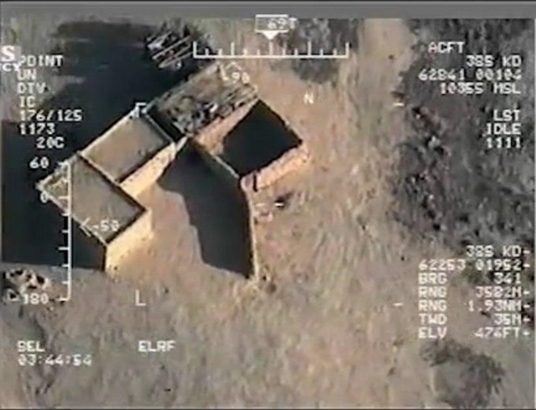
Also a top story was the details of Iran’s recent penetration into the US’ drone system in Iraq, which were outlined by IRGC Aerospace Commander Brigadier General Hajizadeh.

A lawsuit allegedly filed by 2,000 people in Ahvaz against Iranian Minister of Communications and Information Technology Mohammad Javad Azari Jahromi also received great coverage. These people have reportedly sued the minister for refusing to obey certain censorship requests.

The above issues, as well as many more, are highlighted in the following headlines and top stories:


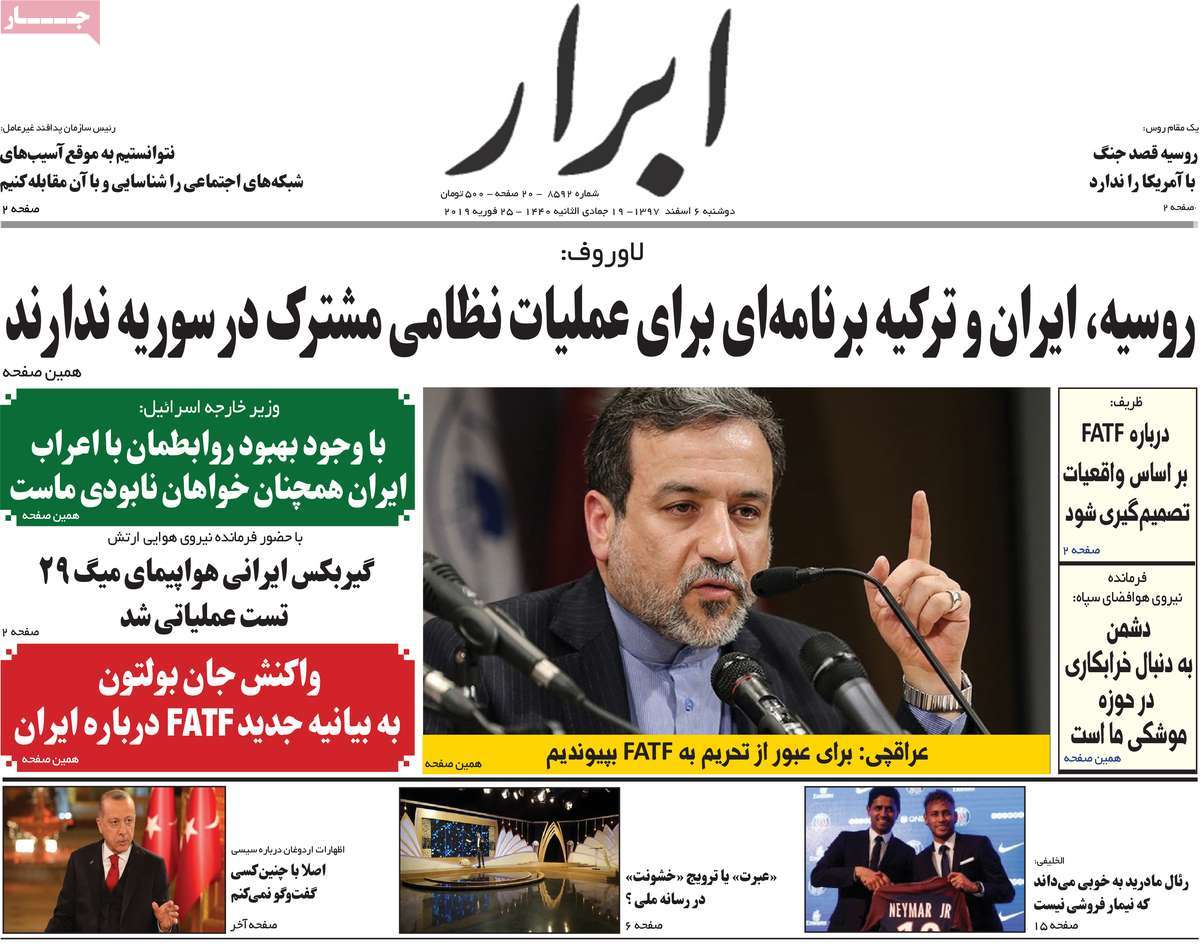
Abrar:

1- Lavrov: Russia, Iran, Turkey Have No Plan for Joint Operation in Syria

2- Israel FM: Iran Still Wants to Destroy Us despite Thaw in Tel Aviv’s Ties with Arabs
A Look at Iranian Newspaper Front Pages on February 25


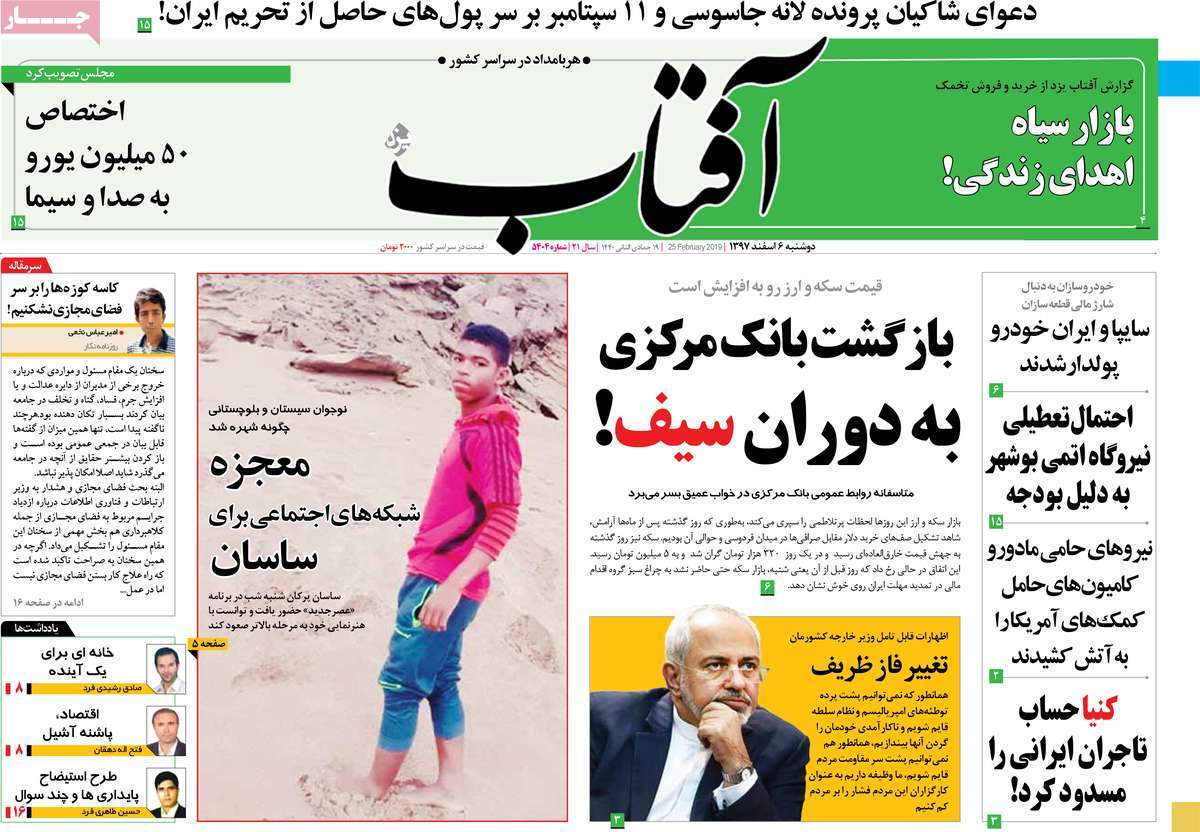
Aftab-e Yazd:

1- Plaintiffs of Two Anti-Iran Cases in US Fighting over Money Earned from Iran Sanctions!

2- Kenya Blocks Account of Iranian Businesspeople!

3- Zarif Changes His Tone, Makes Notable Remarks

* We Can’t Deny Our Incompetence, Pin Blame on Hegemonic Powers, Hide behind People’s Resistance
A Look at Iranian Newspaper Front Pages on February 25


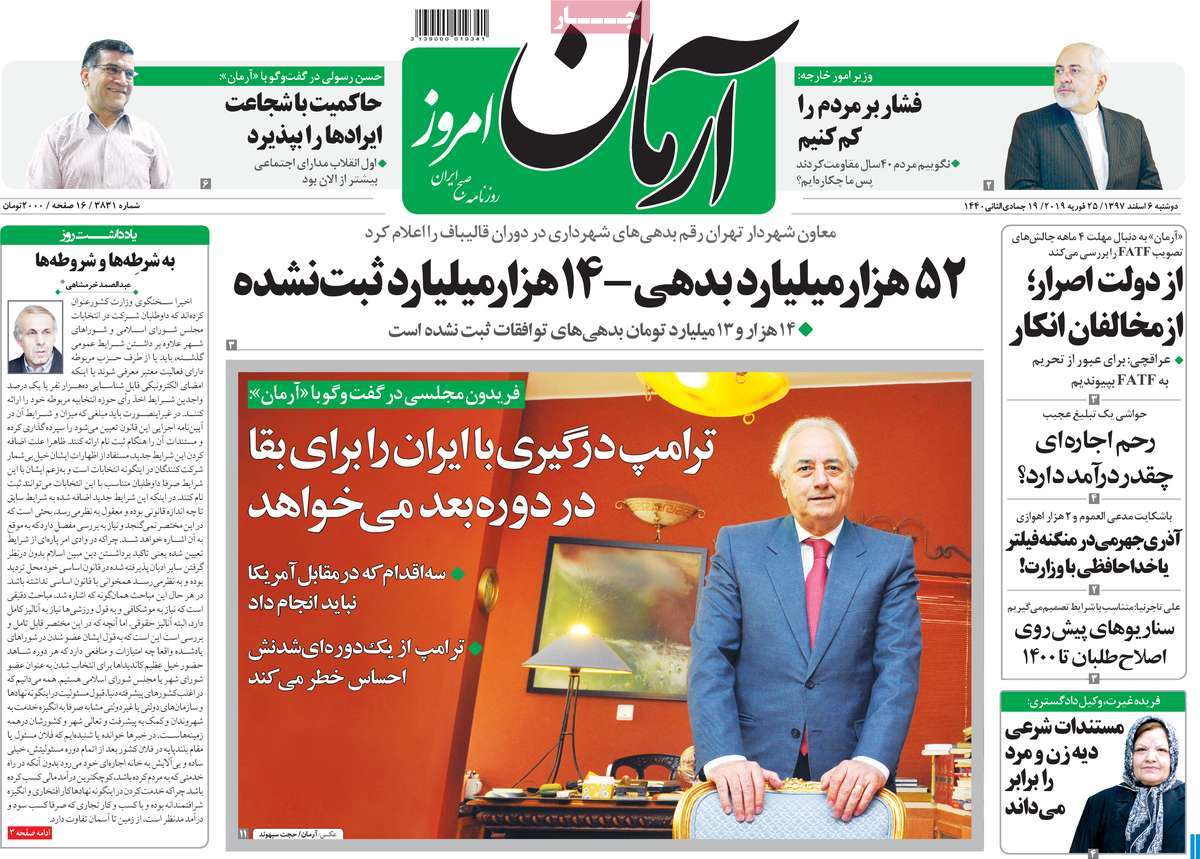
Arman-e Emrooz:

1- Zarif: We Must Decrease Pressure on People

2- Analyst: Trump Needs Clash with Iran for Re-Election

* Trump Afraid of Failing in 2020 Election

3- ICT Minister Should Either Leave Office or Censor What He’s Told to
A Look at Iranian Newspaper Front Pages on February 25


Ebtekar:

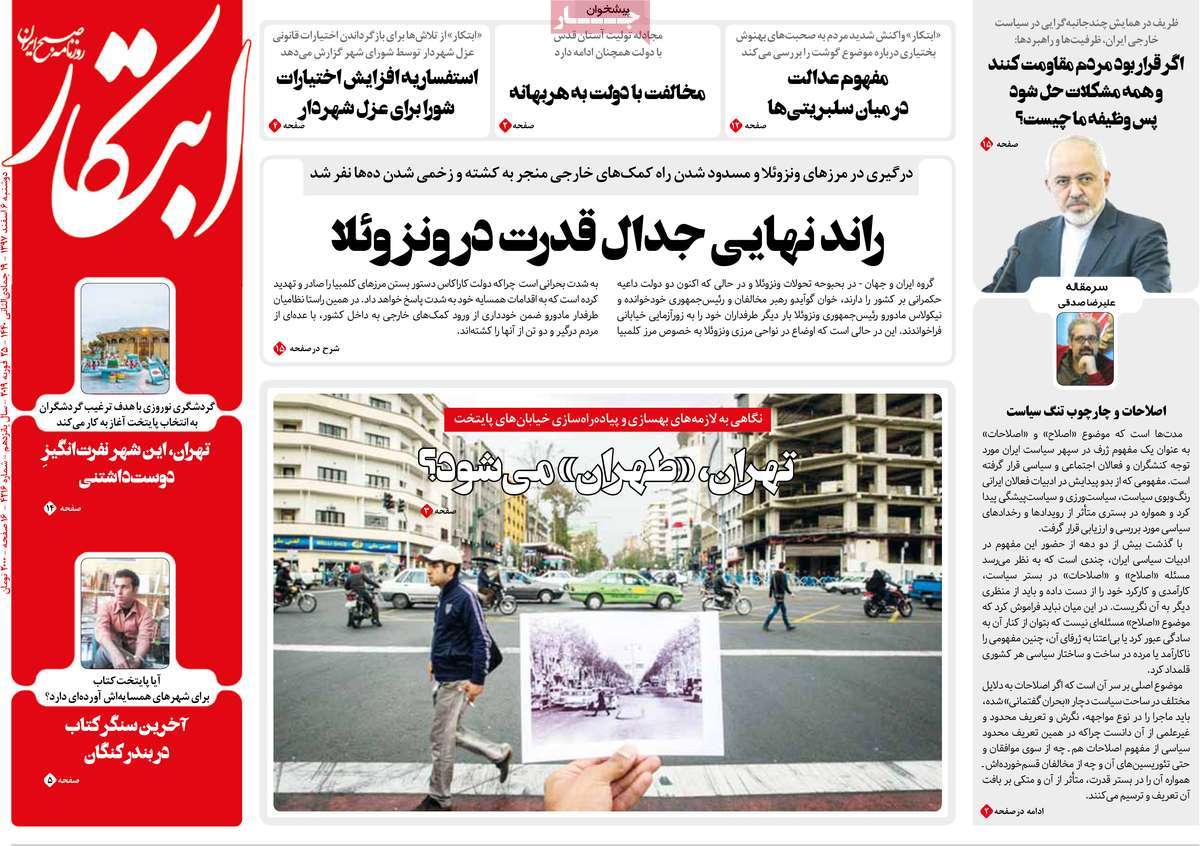
1- Final Round of Power Struggle in Venezuela
A Look at Iranian Newspaper Front Pages on February 25


Etemad:

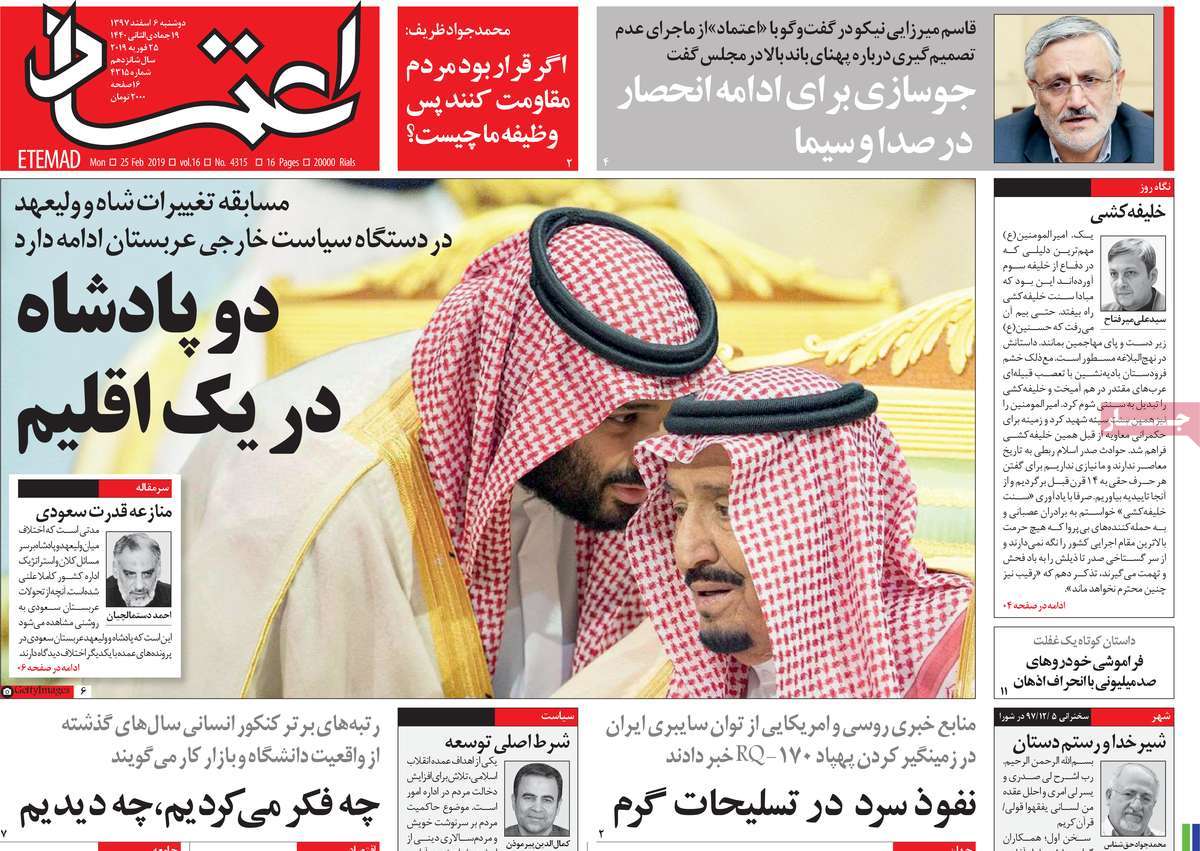
1- Two Kings in One Realm: Saudi King, Crown Prince Make Different Choices in Foreign Policy

2- Power Struggle in Saudi Arabia [Editorial]

3- Zarif: If People Were Supposed to Resist, What’s Our Duty?
A Look at Iranian Newspaper Front Pages on February 25


Ettela’at:

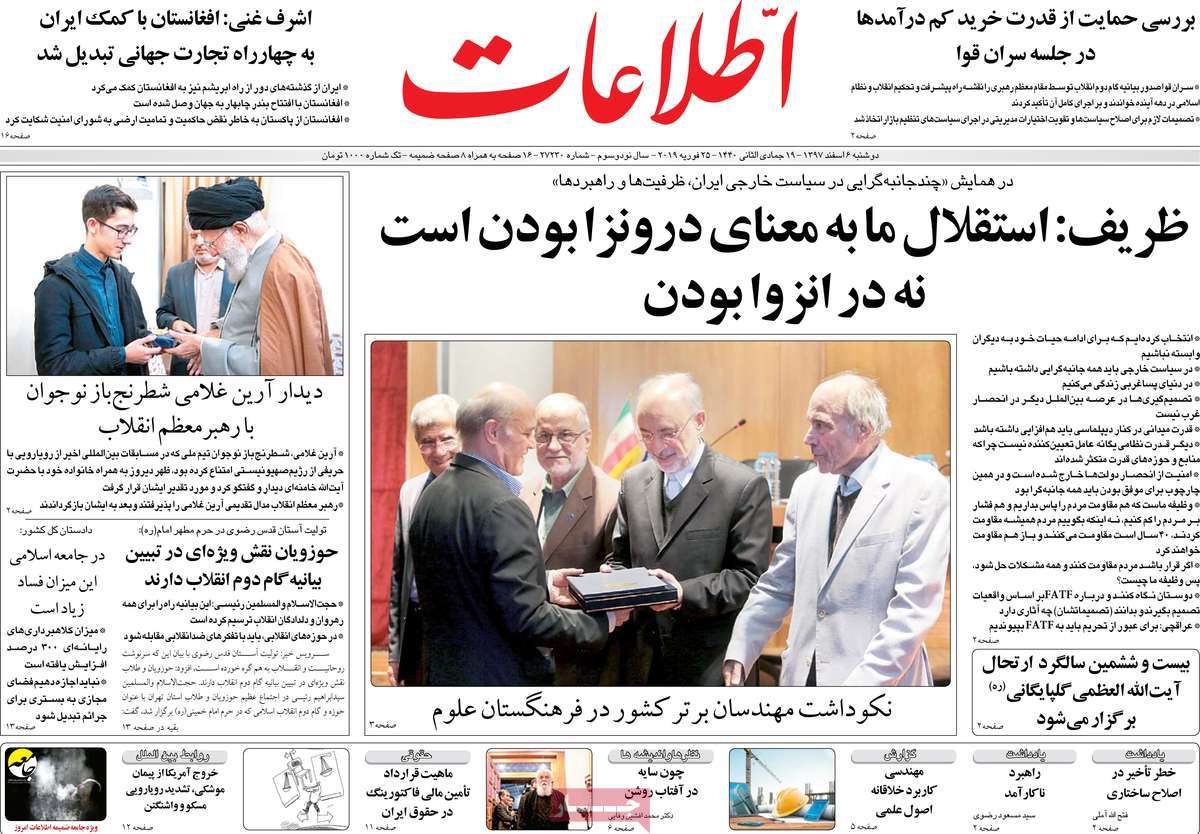
1- Zarif: Our Independence Means Being Endogenous, Not Isolated

2- Afghanistan Turned into Global Trade Hub with Iran’s Help

3- Prosecutor-General: In Islamic Society, This Level of Corruption Is Very Much
A Look at Iranian Newspaper Front Pages on February 25


Iran:

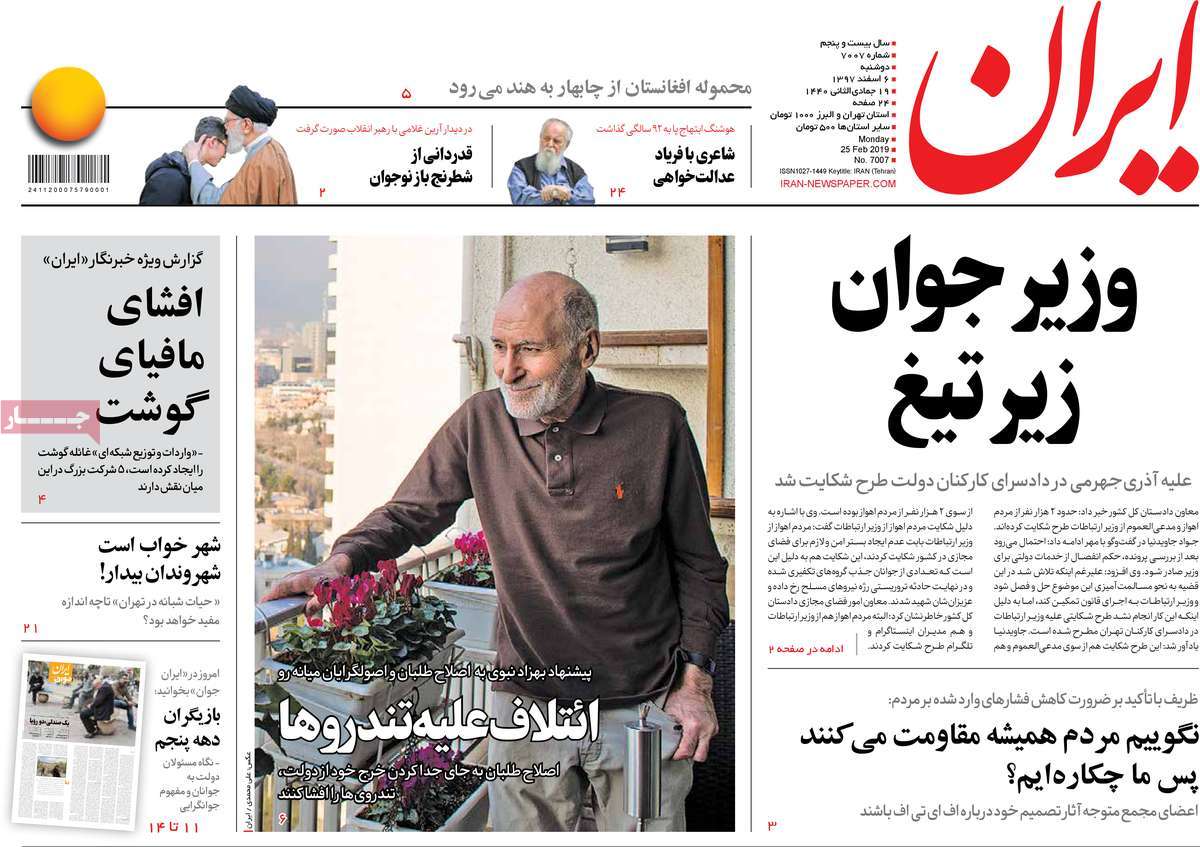
1- Young Minister under Fire

* Lawsuit Filed against ICT Minister for Refusing to Block Certain Media

2- Reformist Figure Says Both Left-Wingers, Conservatives Must United against Hardliners
A Look at Iranian Newspaper Front Pages on February 25


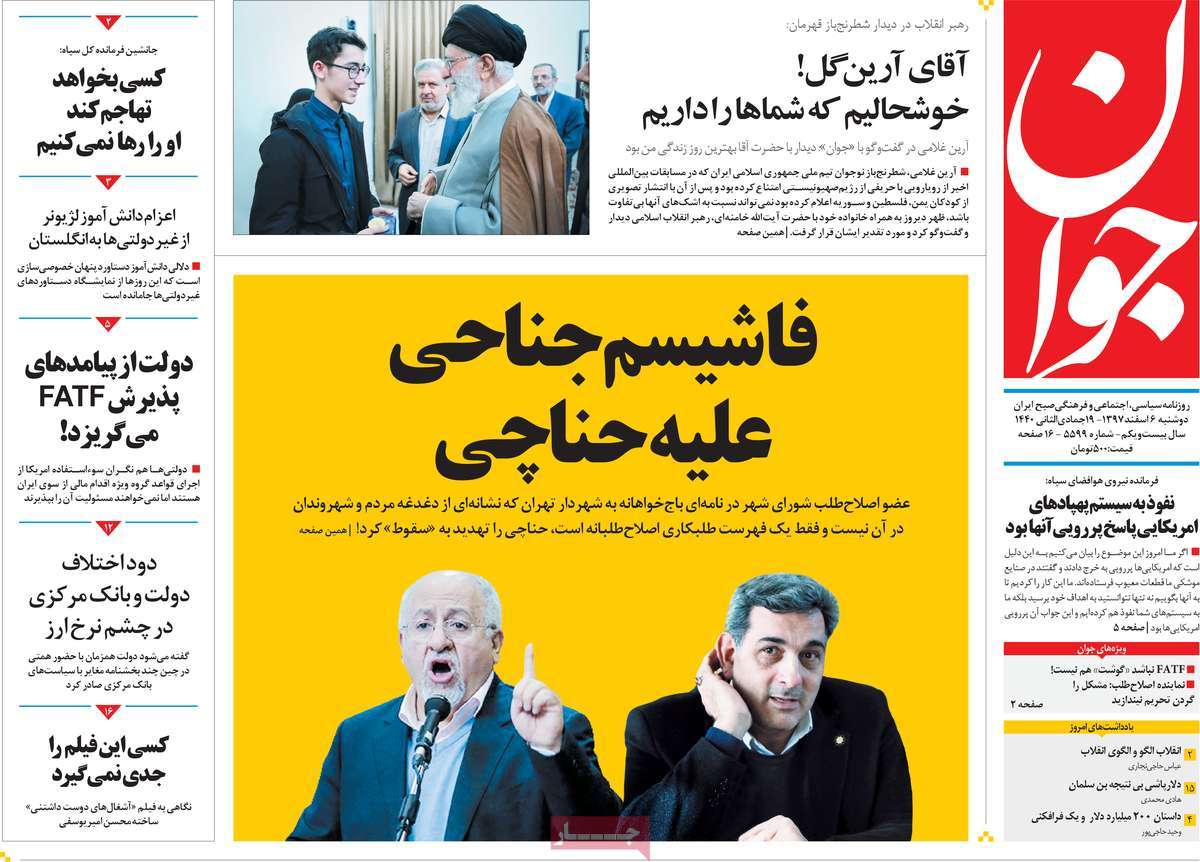
Javan:

1- IRGC Aerospace Commander: Iran Infiltrated into US Command System in Reaction to Their Insolence

2- IRGC General: We Won’t Leave Aggressors Unpunished

3- Government Evading Consequences of Adopting FATF!
A Look at Iranian Newspaper Front Pages on February 25


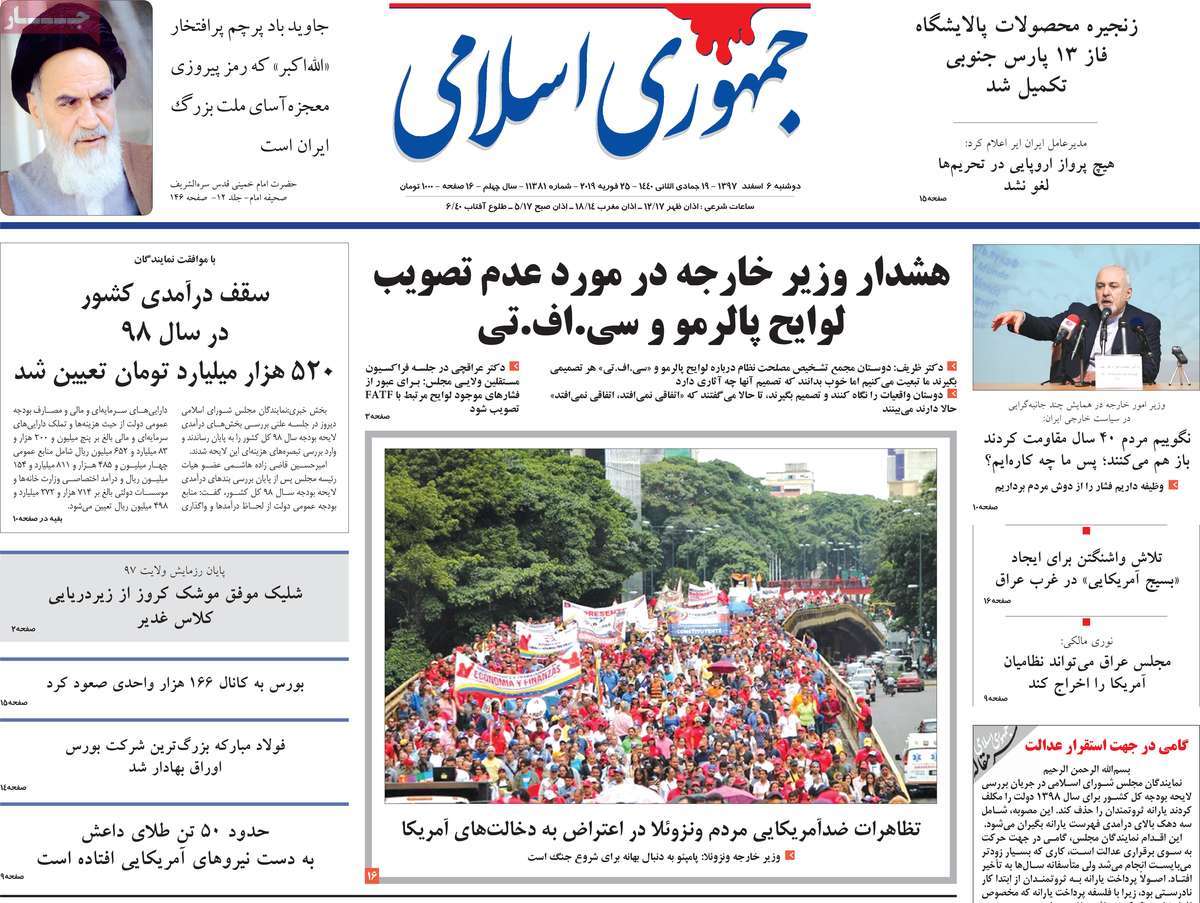
Jomhouri Eslami:

1- Iran FM Warns about Consequences of Not Adopting FATF

2- Venezuelan People Hold Anti-US Rallies in Protest at US Interference

3- US Forces Take Control of 50 Tonnes of Gold Belonging to ISIS

4- Zarif: We Shouldn’t Rely on People’s Resistance; We Should Do Our Own Duty
A Look at Iranian Newspaper Front Pages on February 25


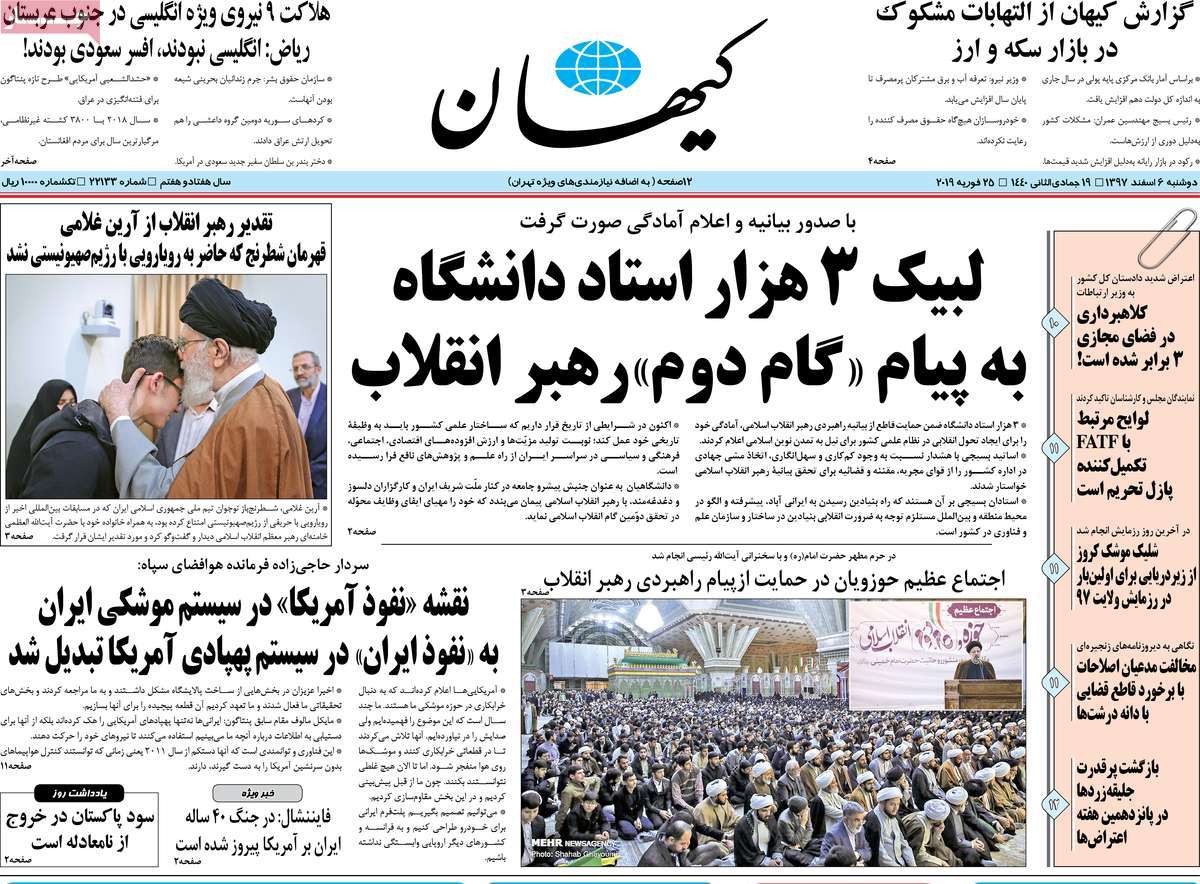
Kayhan:

1- IRGC: “US Infiltration” into Iran’s Missile Program Turned into “Iran’s Infiltration” into US’ Drone System

2- Suspicious Tension in Forex Market
A Look at Iranian Newspaper Front Pages on February 25


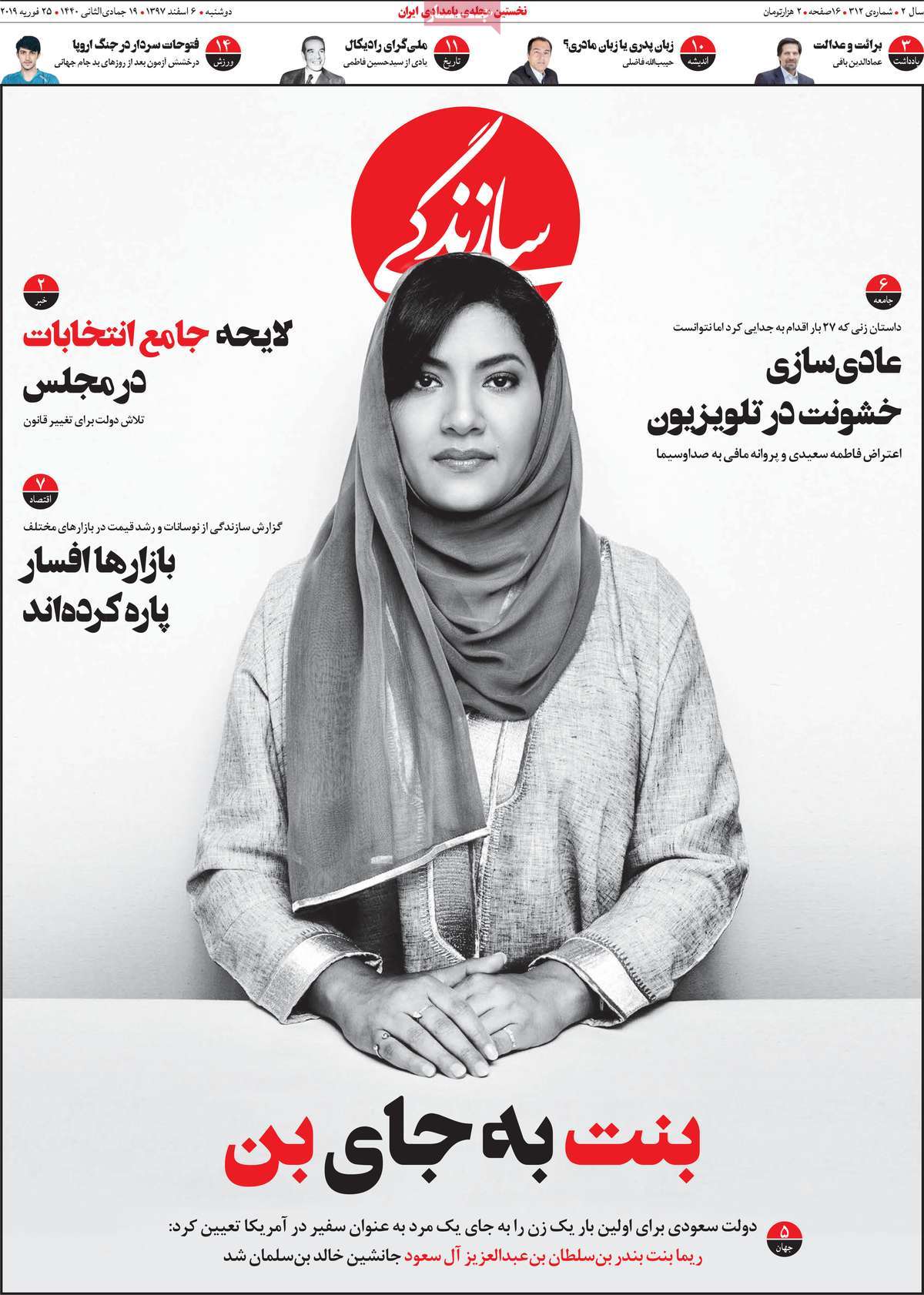
Sazandegi:

1- “Bint” to Replace “Bin”

* Saudi Gov’t for First Time Names Woman as Its Ambassador to US

* Reema bint Bandar Replaces Khalid bin Salman
A Look at Iranian Newspaper Front Pages on February 25


Shargh:

1- Araqchi: We Must Join FATF in Order to Evade US Bans

2- Invisible Hand in Forex Market
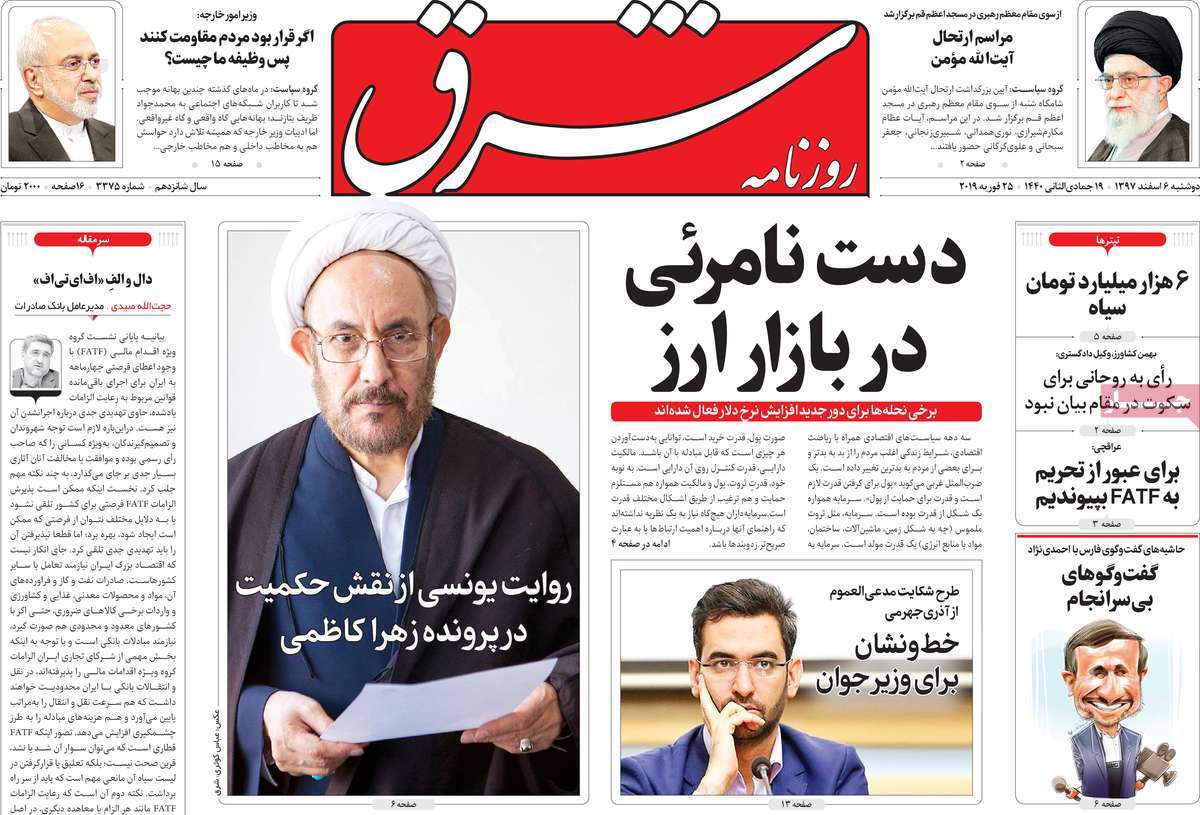
A Look at Iranian Newspaper Front Pages on February 25

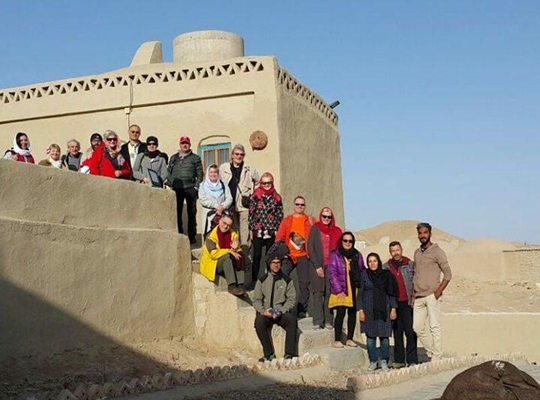
Austrian Tourists in Iran to Visit Sistan & Baluchestan Province

Assistant Director of Cultural Heritage, Handicrafts and Tourism Department of Sistan and Baluchestan Mojtaba Mirhosseini said these tourists will visit Hamun lake (in north of the province) and also Makran beaches in the south.

He noted that these foreign tourists are in Sistan and Baluchestan to get familiar with the historical and cultural capacities of the province, the customs and traditions of the people, the handicrafts and lifestyle of the villagers, local music and natural attractions, and, most importantly, the people of the province.

“Austrian tourists will stay for eight days at local traditional inns. Even in some areas where there is no accommodation facility, they may set up a camp.”

“The visit of foreign tourists represents the stability and security in the province and proves that the efforts made by the government and the people to make Sistan and Baluchestan the tourism destination of domestic and foreign tourists have borne fruit.”

The active participation of the people, the activities of the local communities and the private sector in the field of tourism have led to the introduction of the security and capabilities of the province to the people of other countries, stressed Mirhosseini.

The popularisation of tourism in this province has been the cause of the sustainability of this industry, he noted.

He also stressed that even the recent terrorist attacks could not prevent the development of tourism in this region of Iran, IRNA quoted him as saying.

Sistan and Baluchestan has hundreds of ancient, historical, cultural and recreational sites such as the burnt city, Khajeh Mountain, Taftan Peak, Tang port, numerous castles, beautiful beaches of Oman Sea, tropical fruit gardens, Martian mountains, etc.

It is known as the paradise of archaeologists and the new destination of domestic and foreign tourists.

Iran Frees French Citizen Detained for Illegal Entry

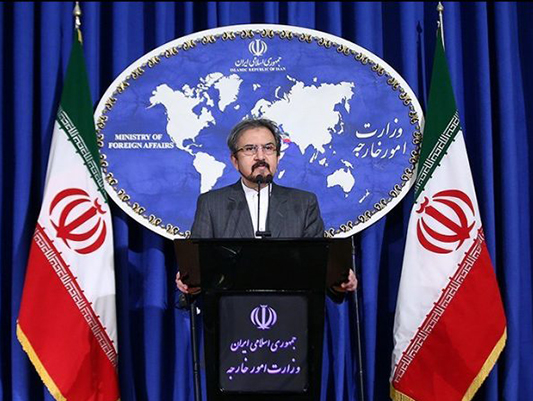
Bahram Qassemi

In response to IRNA’s question on Sunday, Qassemi said the French citizen has been freed in the past few days after legal proceedings were completed and other charges were dropped.

His comments came after French Foreign Minister Jean-Yves Le Drian told lawmakers Wednesday France was in touch with Iran to improve the conditions of the woman arrested in October on Iran’s Persian Gulf island of Kish for allegedly signing an illegal mining contract.

Qasemi did not give further details, but Le Drian said on Wednesday that the woman was held “on the grounds of having signed an illegal contract and carrying out a non-authorized trip”.

Nelly Erin-Cambervelle, a 59-year-old businesswoman from Martinique, had been on Kish – a free-trade zone allowing visa-free entry for visitors from most countries – as part of her import-export business.

Details over her arrest first appeared in Martinique media last week after Patricia Gros-Desirs Dicanot, a friend and colleague, was quoted as saying that Erin-Cambervelle had been arrested for illegally buying gold after originally going to Kish to begin negotiating a minerals contract.

“The consular services have been able to meet her several times and are very concerned about her situation,” Le Drian said on Wednesday. “We are in touch with the family and with the Iranian authorities to ensure that Mrs Erin’s situation improves, while respecting Iranian procedures.”

Iran, Venezuela Condemn US’ Meddlesome Measures

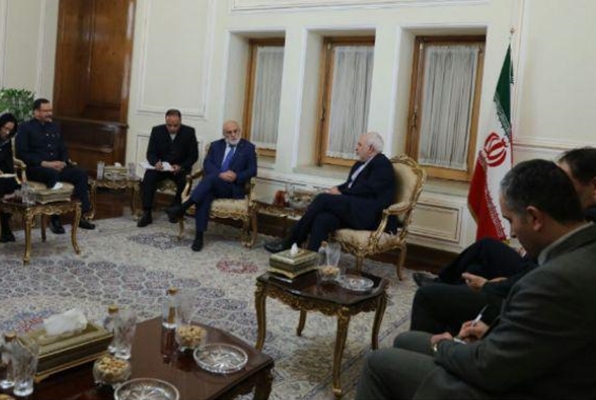
During the Sunday meeting, the Venezuelan official briefed Zarif on the latest political situation in his country and appreciated Iran’s efforts to help improve the situation in Venezuela.

For his part, Zarif rejected any foreign interference in Venezuela’s internal affairs and expressed support for the Venezuelan government and people.

He further threw his weight behind Venezuelan president’s proposal for political talks between the government and the opposition to resolve the differences.

The two sides also condemned the meddlesome measures of the US government in the internal affairs of Venezuela and other Latin American countries, saying that threatening to use force against Venezuela is a doomed measure in violation of the international law and the United Nations Charter.

Venezuela has been in political turmoil over the past weeks. The opposition has been holding widespread anti-government protests, blaming President Nicolas Maduro for an ailing economy, hyperinflation, power cuts, and shortages of basic items, and urging him to resign while branding his re-election in last year’s vote as a sham.

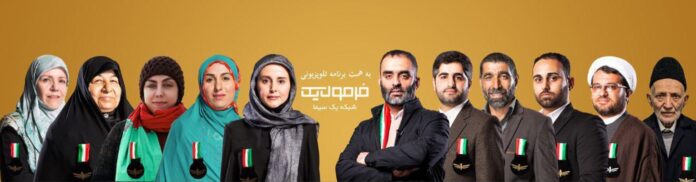
Iran Names 11 Candidates for ‘Person of the Year’ Award

The candidates have been chosen out of 40 figures in semi-final through the votes of a jury and public votes.

The jury was composed of more than 30 celebrities from various social, cultural, artistic, political, scientific and academic areas who selected the final candidates within the past few days.

The mission to choose and announce the list of the finalists was carried out by Iran’s Vice-President for Science and Technology Sorena Sattari; Iranian filmmakers Narges Abyar and Mohammad Hossein Mahdavian; lawmakers Ali Motahari, Tayyebeh Siavoshi, Behrouz Ne’mati and Elyas Hazrati; environmentalist Mohammad Darvish; international football referee Alireza Faghani; senior journalist Arash Khoshkhu; writer Morteza Barzegar, and many others.

Public votes collected through the social media also played a key role in this stage.

After all votes were counted, the final 11 candidates with the highest number of votes were announced as follows: (The names are sorted based on an alphabetical order)

Esmat Ahmadian: Mother of an Iranian martyr who creates jobs for women in the southern city of Ahvaz

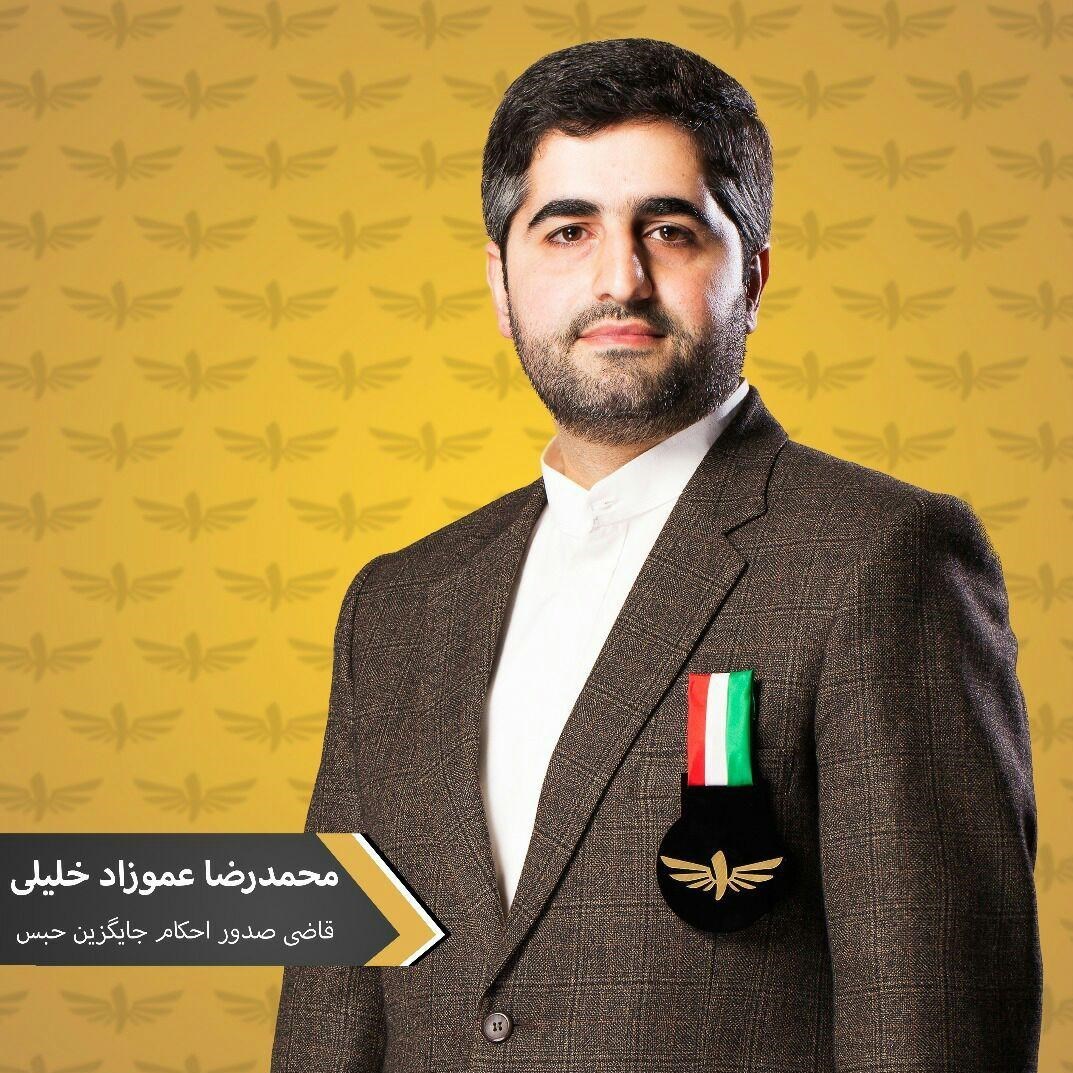
Mohammad Reza Amouzadeh: A judge from Golestan province who issues cultural verdicts instead of prison sentences.

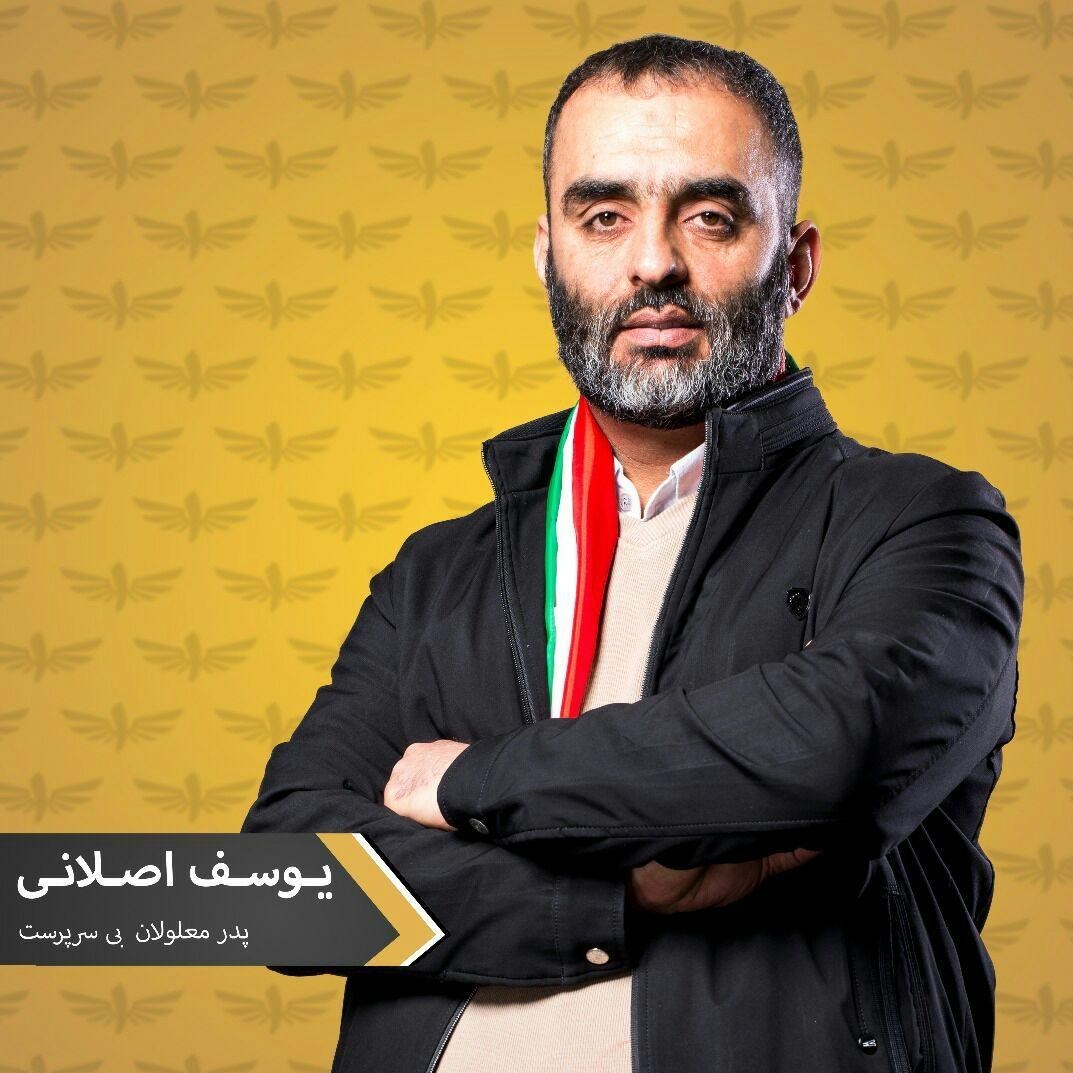
Yousef Aslani:  An activist in rehabilitation area and an entrepreneur for the disabled

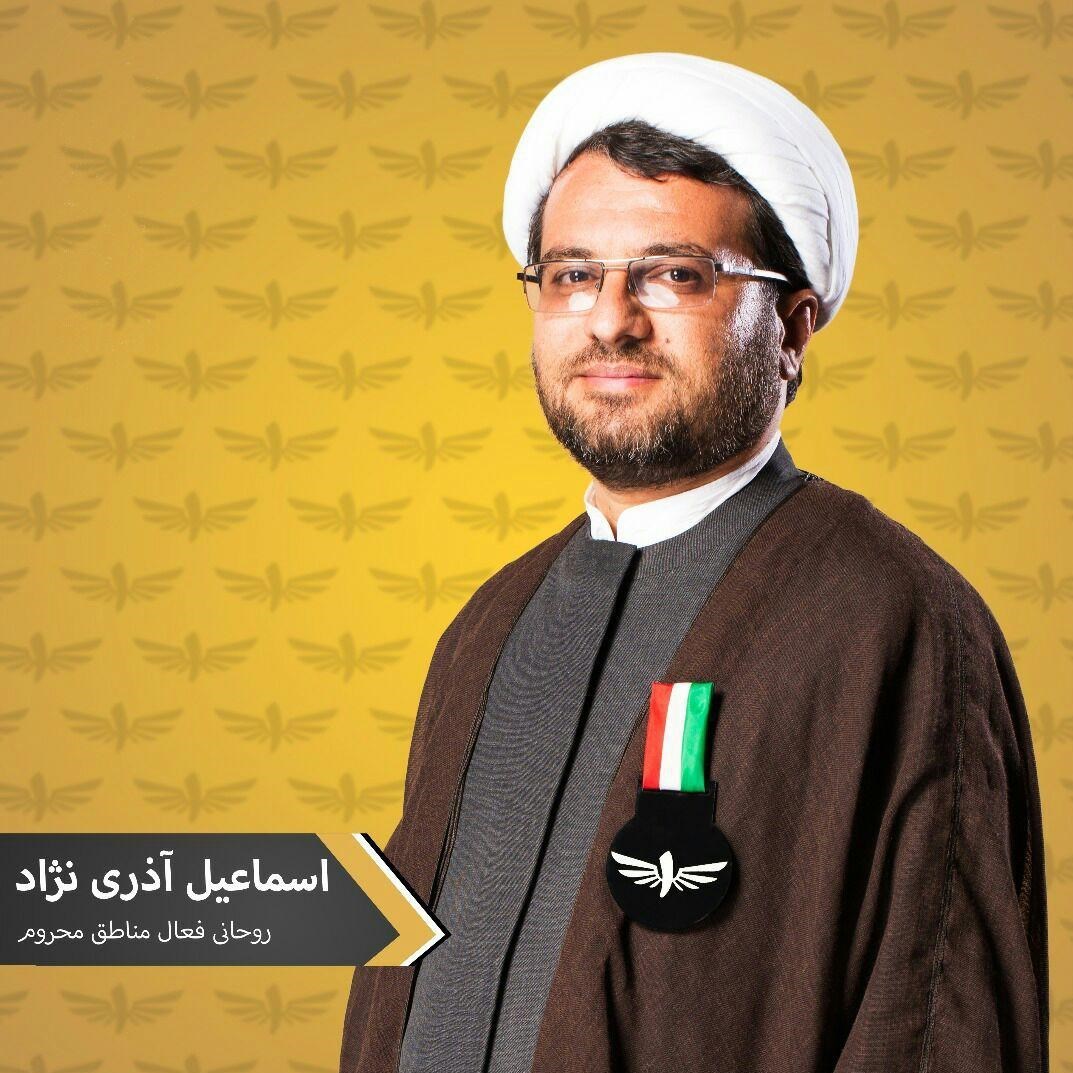
Esmaeil Azarinejad: A clergyman who travels to deprived areas of the southwestern province of Kohgiluyeh and Boyer-Ahmad to tell stories to children.

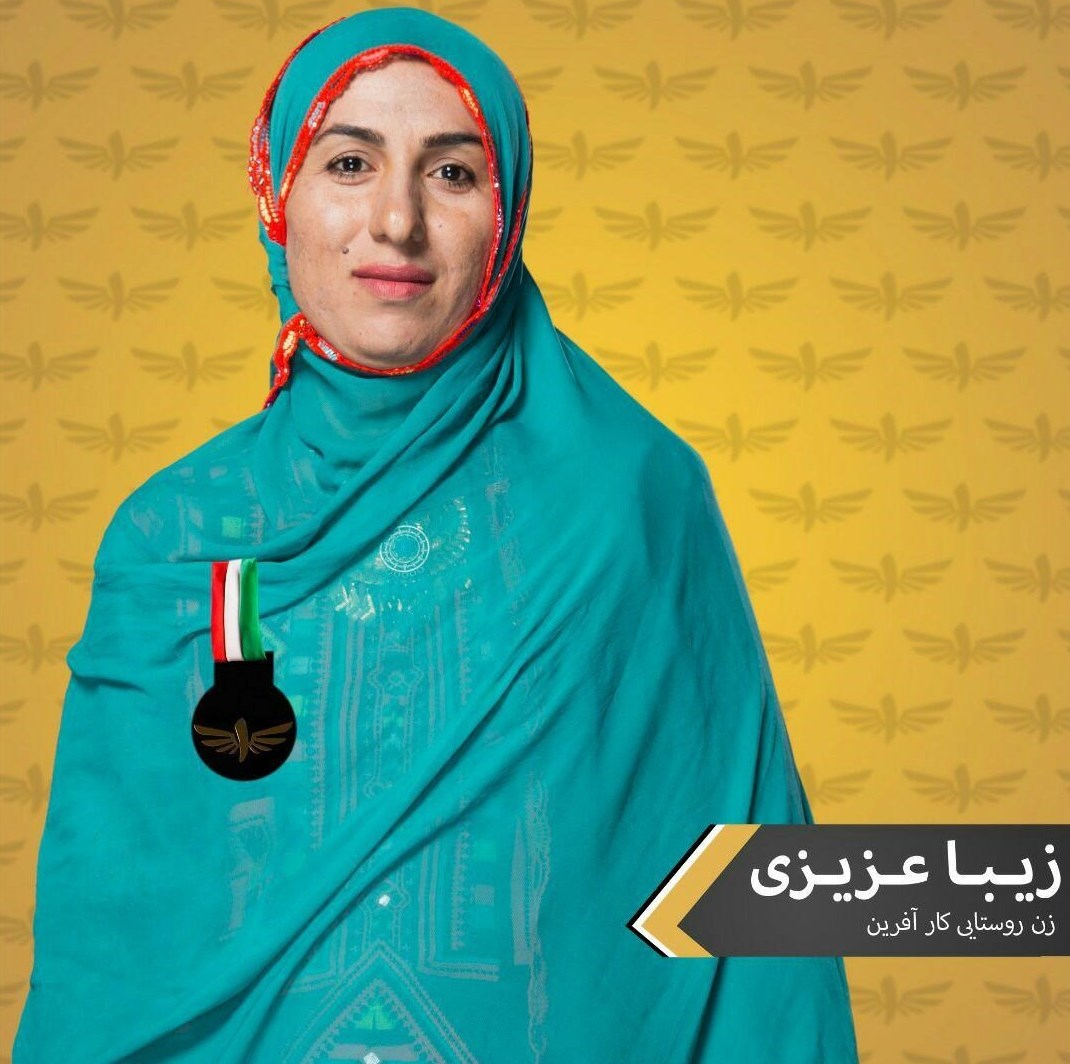
Ziba Azizi: A rural woman from Sistan and Baluchestan province who won the fourth prize of Women’s World Summit Foundations (WWSF) for creativity in rural life

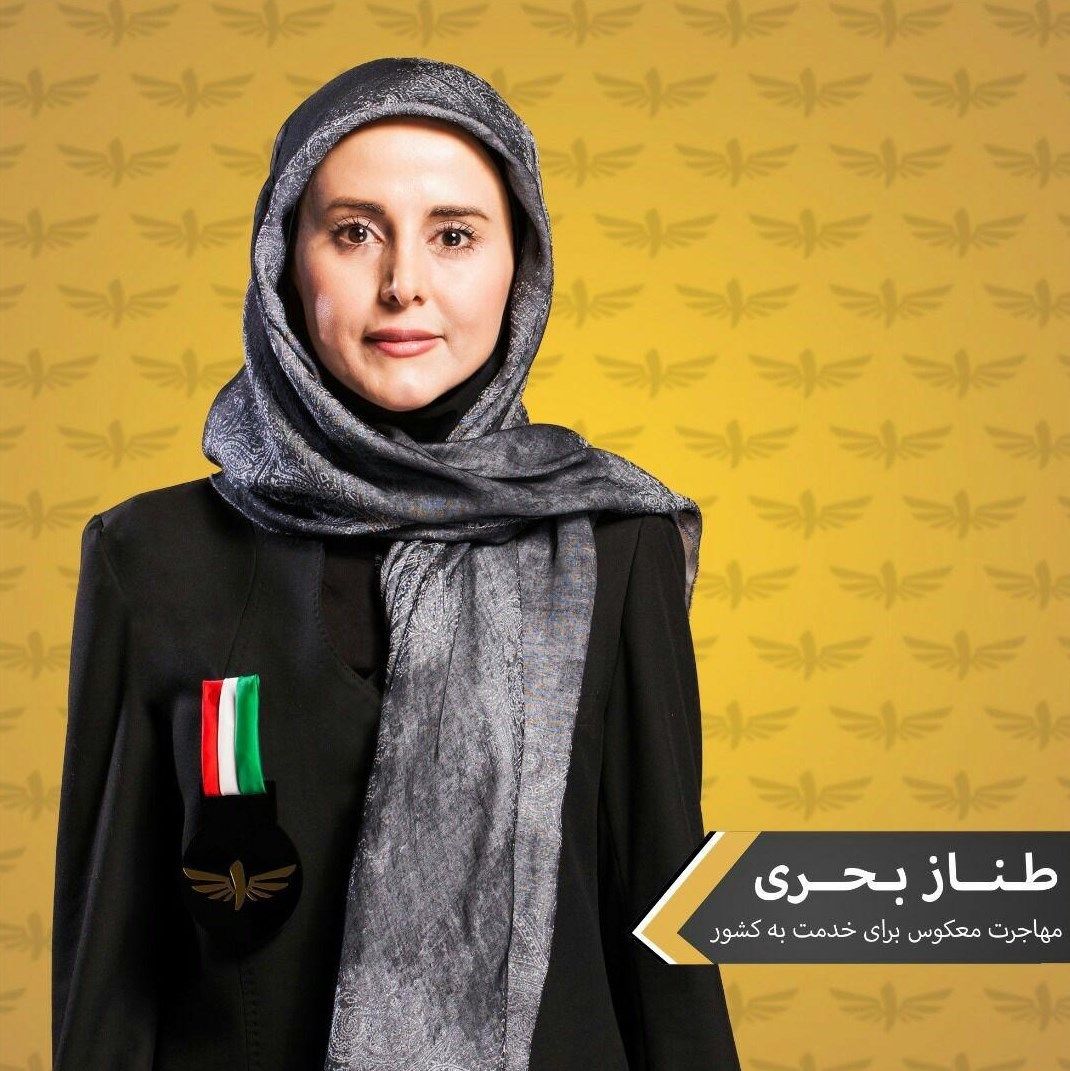
Tannaz Bahri: A physician who has made a reverse migration from the Netherlands to offer services to Iranians

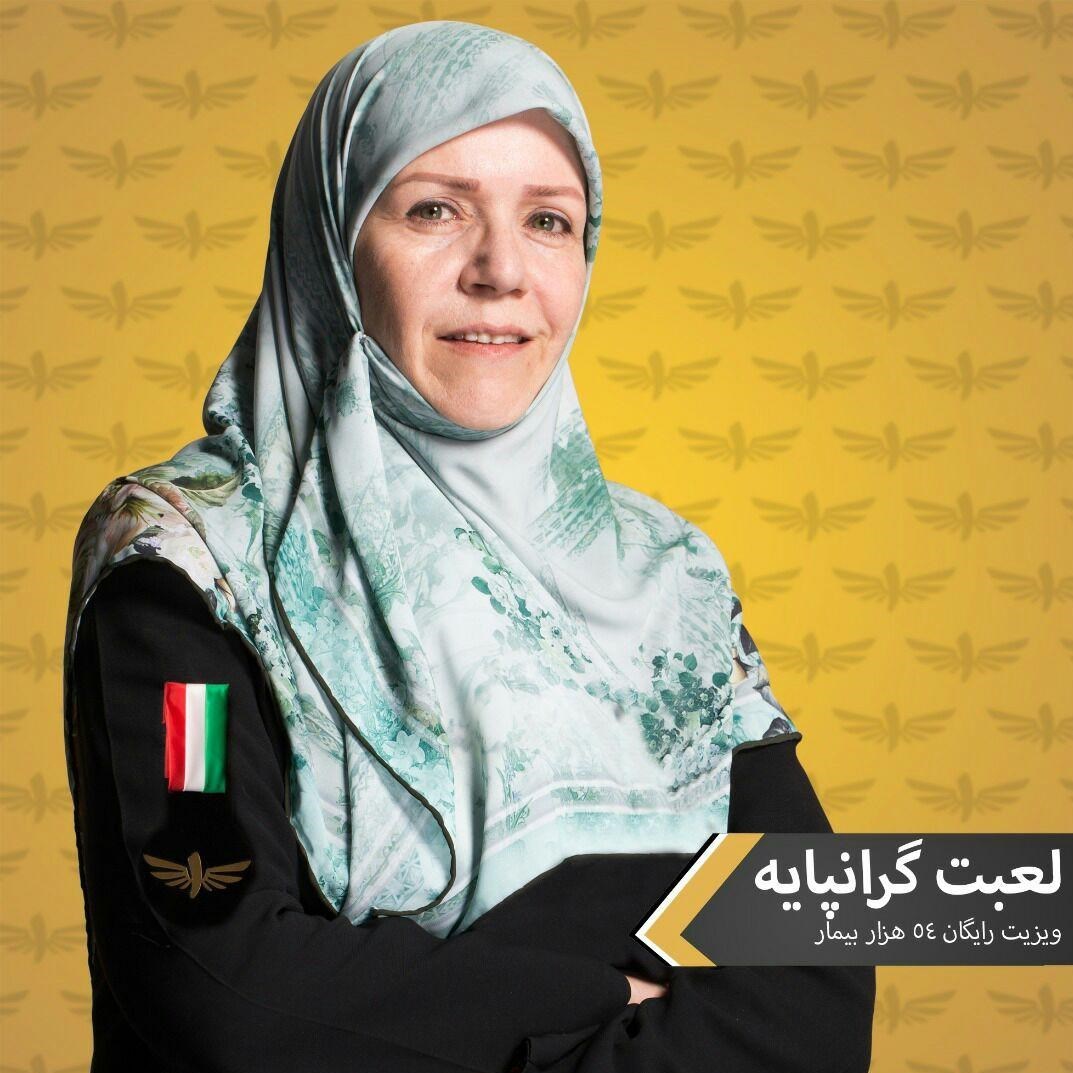
Lo’bat Geranpayeh: Also known as the surgeon of the poor, she has so far visited 54,000 people and carried out surgeries on 1,500 others free of charge.

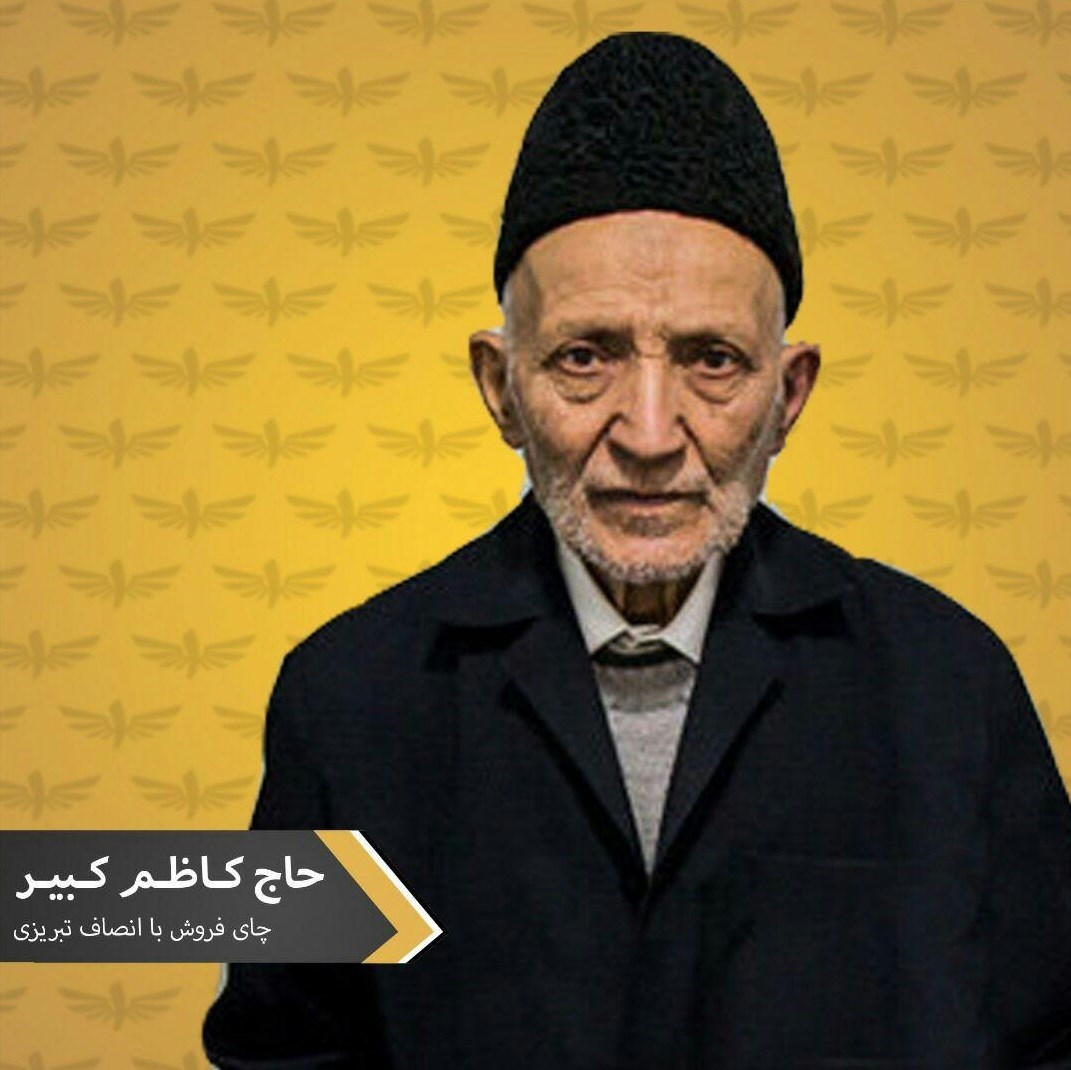
Haj Kazem Kabir Saber: A fair tea-seller from the city of Tabriz who takes into account the weight of the pocket in which the tea is sold.

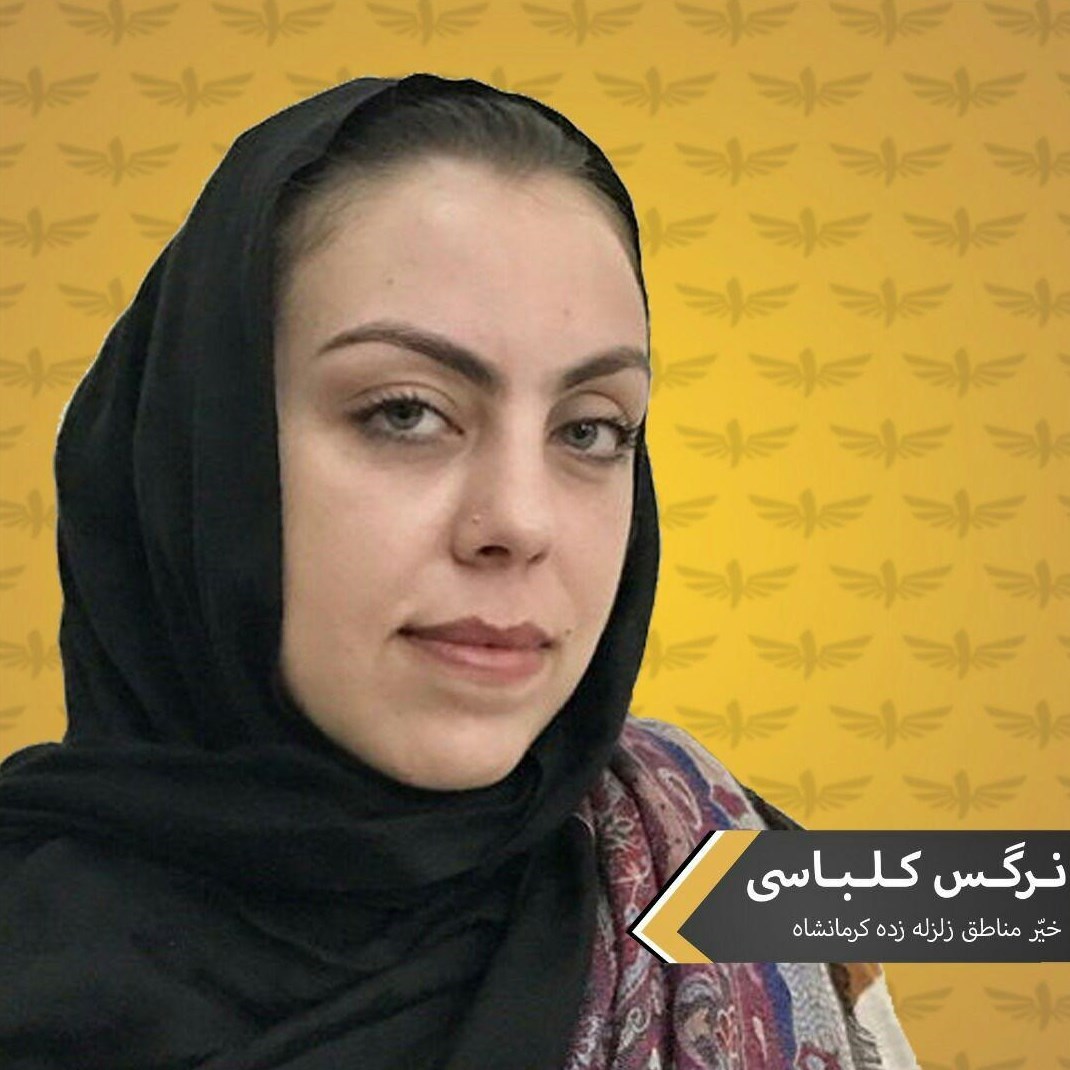
Narges Kalbasi: A young woman who has dedicated her life to the lives of the earth-quake people in the northwestern city of Kermanshah.

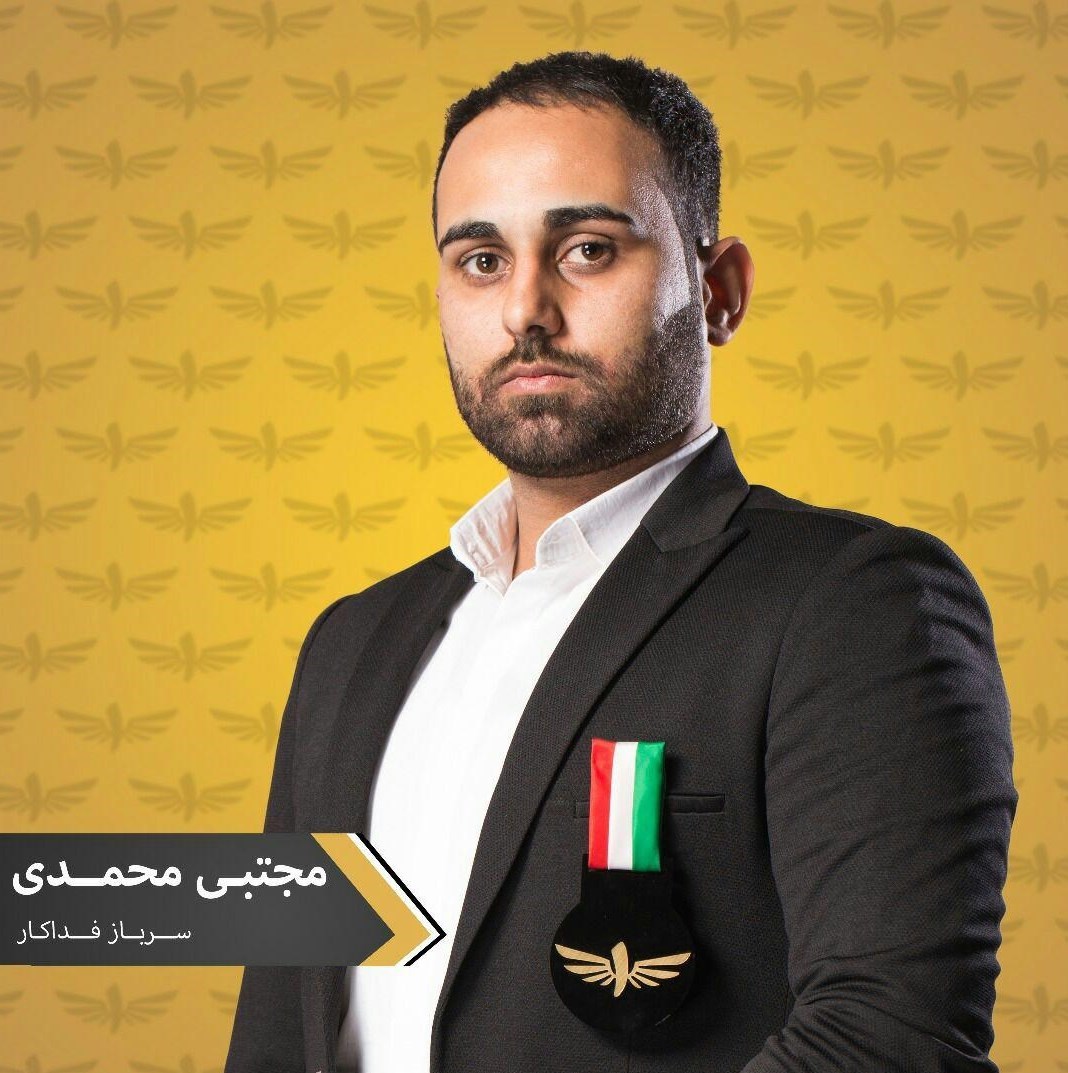
Mojtaba Mohammadi: A soldier from Khuzestan who did a great job in saving civilians during the terrorist attack on a military parade in the city of Ahvaz.

Noureddin Tavassoli: A shepherd from the central Ilam province who plants trees while watching his sheep.

‘Iranian Theatre Most Influential in Middle East’

‘Iranian Theatre Most Influential in Middle East’
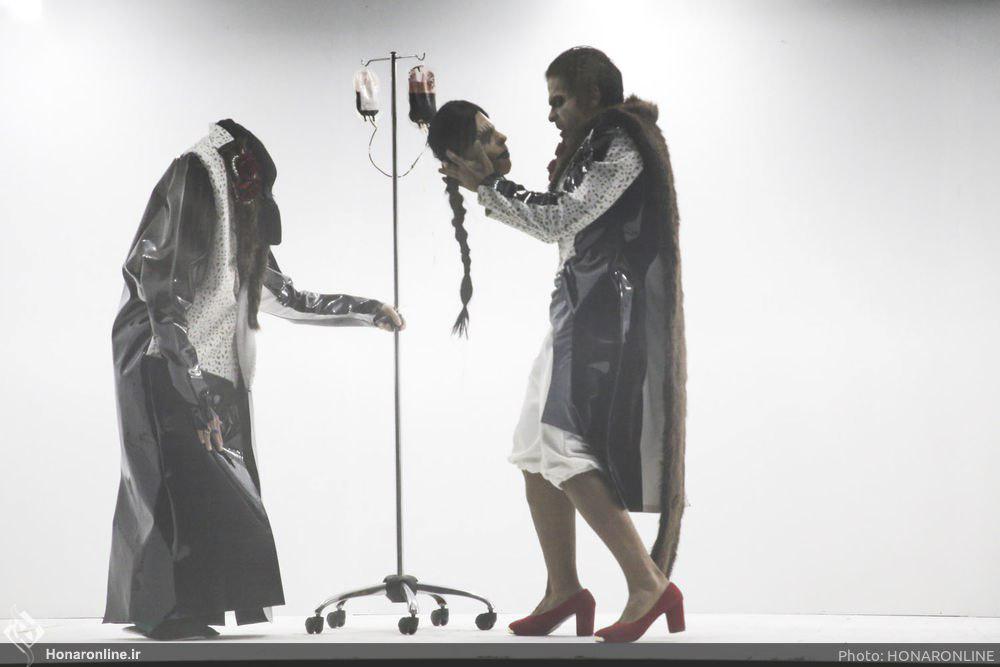
Photo of the Iranian play "I'm a woman, do you hear me?"

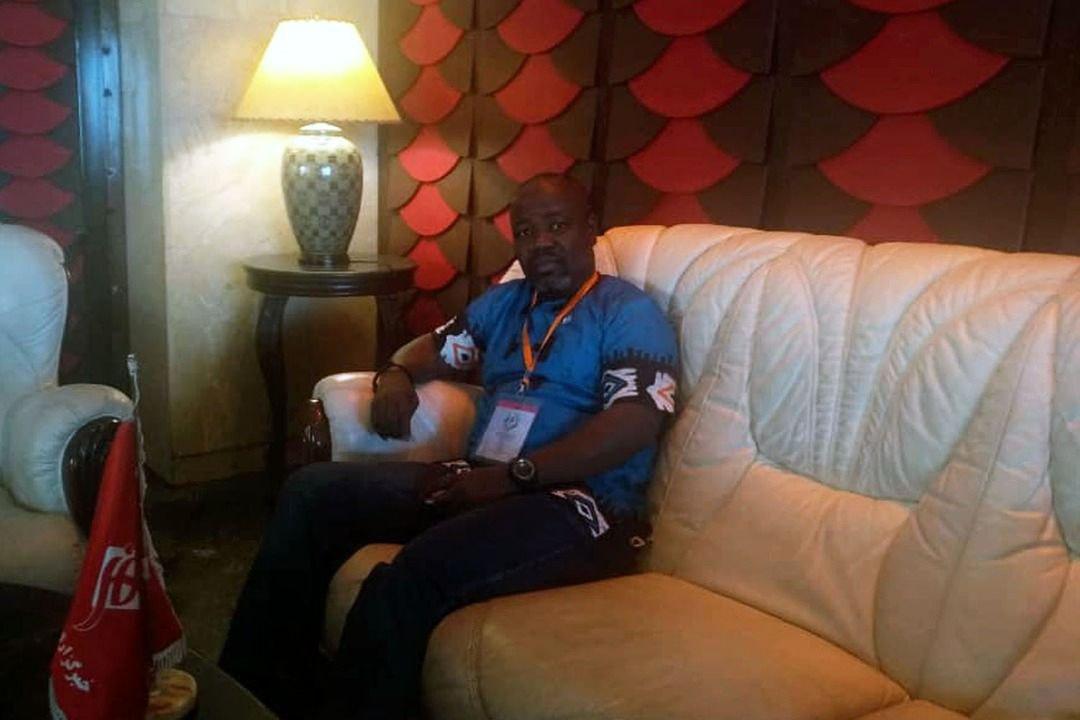
Om’Oba Jerry Adesewo, the founder, producer and artistic director of the Royal Theatre of Arojah, made the remarks after attending the 37th Fajr Theatre Festival.

He says he has realized the Iranians generally love theatre and have a good relation with it.

‘Iranian Theatre Most Influential in Middle East’
Om’Oba Jerry Adesewo

He has founded the Arojah Royal Theatre in Nigeria and works as a playwright, theatre producer, etc. Adesewo says he is trying to promote living standards in Nigeria.

He is a guest of the SHOWCASE section, or “The First National Showcase for Iranian Dramatic Arts” at the 37th Fajr International Theatre Festival.

Honar Online has conducted an interview with him about his experience of being in Iran and watching the Iranian works. Following you can find excerpts of this interview:

Q: Is this your first time in Iran?

A: Yes. I really wanted to see Iran and now I’ve been in this country since a few days ago.

Q: Have you ever seen an Iranian drama?

A: Yes, once in October, I saw a classic drama from Iran. They had come to our country at the invitation of the Nigerian embassy.

‘Iranian Theatre Most Influential in Middle East’
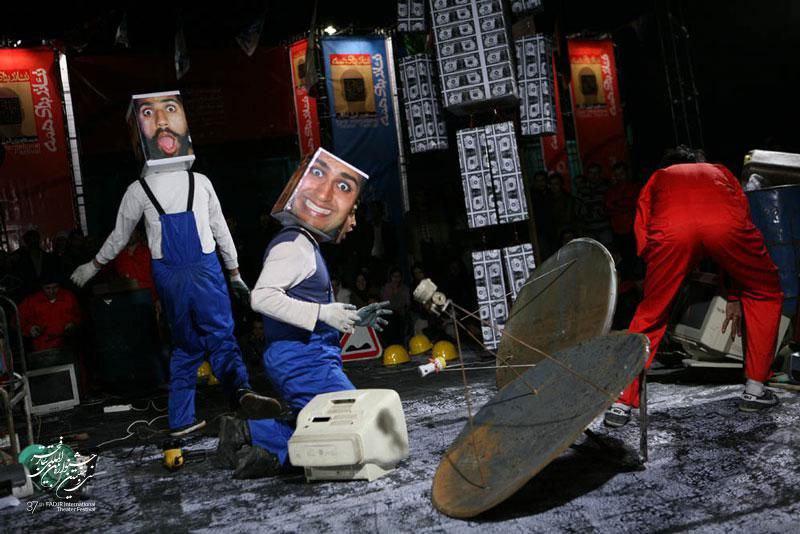
Photo of the Iranian play “When the Rooster Sings in Wrong Way” by Ali Shams

Q: What do you think of the works you have seen at the Fajr Theatre Festival so far, and how do you rate them?

A: The shows were very impressive. In general, if I want to comment, it seems to me that all in all everything was great. This is my first impression regarding Iranian theatre. I published a post on Instagram and wrote, “I think the Iranian theatre is one of the most influential ones in the Middle East.” As Iran is an Islamic country, I thought like some other countries in the region, the works would be censored very much, but I saw the actors could work in the spaces they want. On the other hand, I thought the crowds were due to the theatre festival, but I noticed that Iranians generally like theatre and have a good relation with it.

Q: Does a drama in the Showcase section attract your attention?

A: Many works attracted me. A drama directed by Kamelia Ghazali called “I’m a woman, do you hear me?” as well as the work of Ali Shams were among the shows I really liked. “Don Quixote” was also very persuasive. I have a lot of candidates in my mind and there are many theatres I like to choose.

Q: What do you think of Fajr International Theatre Festival which is the biggest theatre event in Iran?

A: It’s very good, but there’s always room for improvement. My problem is that I cannot understand the language. Honestly, things were really impressive, and if we do not consider the problem of language, the rest was satisfying. Theatre as a means of communication helps the world know the people of Iran and their culture. This is even more influential than reading an article.

The 37th Fajr International Theatre Festival ran from February 11 through 22. This edition was held in 11 sections including stage theatre, street theatre and other types of performances, theatre of nations, provincial performances, forty years of the Islamic Revolution, playwriting competitions, photo and poster exhibitions, workshops and specialized meetings.

‘Iranian Theatre Most Influential in Middle East’

West’s Arms Sales Turn Mideast into ‘Powder Keg’: Zarif

“Over the past year alone, they [Western countries] sold 100 billion dollars’ worth of weapons to the [countries] of the Persian Gulf Cooperation Council. Did the weapons bring anyone security, though?” Foreign Minister Zarif said in a foreign policy speech at the University of Tehran on Sunday.

The Persian Gulf Cooperation Council groups Bahrain, Kuwait, Oman, Qatar, Saudi Arabia, and the United Arab Emirates.

Earlier, an annual international security report showed that arms sales to the Middle East had doubled during the period between 2013 and 2017 compared to the previous five years. The Munich Security Report 2019 also said the outsize concentration of weapons in the Middle East increased the risk of confrontation in the region.

‘Islamic Revolution ended interference in Iran’

Zarif said Iran’s 1979 Islamic Revolution ended historical foreign interference in the country’s internal affairs.

“One of the Iranian people’s major concerns prior to the victory of the Islamic Revolution — which can be referred to as a historical concern — was foreign interference in the country’s internal affairs,” Foreign Minister Zarif said.

He said such interference was exercised largely during the rule of the Qajar dynasty and the Pahlavi regime in Iran.

Iran’s Islamic Revolution, he said, ended that trend.

“We have lived, for 40 years, without American support. For 40 years, we have been living in spite of American pressure. This [independence] does not mean confrontation with and separation from the world. Rather, it means that we have chosen not to be dependent on others for continuing our livelihood,” the Iranian foreign minister said.

By taking such a course, Zarif said, “certainly no one would be able to say [things like], ‘If it weren’t for us, the Iranians would be speaking, say, Chinese or Russian.’”

The Iranian foreign minister was making a reference to remarks by US Senator Lindsey Graham about Saudi Arabia last December, when he told Fox News that Saudi Arabia would be defeated by Iran militarily “in about a week” if it did not have the support of the US.

“Let me put it this way — I want to be very blunt with you: If it weren’t for the United States, they’d be speaking Farsi in about a week in Saudi Arabia,” Graham said back then, acknowledging the depth of Saudi dependence on the US.

‘Post-Western world’

The Iranian foreign minister further said that the West was no longer the focal point of decision making in the world.

“We [now] live in the post-Western world,” he said, adding that countries had to adopt multilateral approaches under the current circumstances.

Military power, diplomacy should work in tandem

Zarif also emphasized the importance of simultaneously exercising hard and soft power.

“Field power and diplomacy should act synergistically,” he said.

Iran Produces All-Electric Four-Wheel Motorcycle

The four-wheel motorcycle Youz (Cheetah) has been under development since 2015 and now has reached the pilot production phase, relying on the technical knowledge of Iranian specialists.

100 Youz motorcycles are being produced at this stage, Mehr News Agency reports.

At the moment, the motorcycle is being tested, and by the end of the current Iranian year [March 20], the evaluation process will come to an end and its final price would be announced.

The company’s CEO says the small size and small dimensions of its engine, reduced pollution in metropolitan areas, ease of driving, reduced risk of driving and the stability of the electric motor are among the benefits of the all-electric motorcycle.

In case of mass production, it will be very helpful to consumers, he added.

3 Airbus Planes Join Iran’s Flag Carrier

Three Airbus 319 planes with numbers EY-557, EY-558 and EY-559 will join the airline’s fleet in a matter of hours.

The airplanes were purchased from Hungary around one year ago, and landed at an airport in the city of Mashhad in northwestern Iran.

The aircraft were manufactured in 2002 and now belong to Iran Air.

The US sanctions have prevented Iran from receiving the planes it had purchased as per deals with Airbus and ATR following the signing of the Iran nuclear deal.

The bans, which also keep spare parts from being delivered to Iran, have affected air safety in the country and jeopardized the lives of civilians travelling by air.

IRGC Says Hacked US Drone in Reaction to Missile Sabotage Claim

IRGC Aerospace Commander Brigadier General Amirali Hajizadeh said in a ceremony Sunday that Iran recently hacked American drones in Iraq in response to Washington’s “insolence”.

“The Americans were cheeky enough to say they had sent faulty parts into our missile industries. We did this (infiltration into their systems in Iraq) to tell them that they were unable to achieve their goals, that we have infiltrated into their systems as a response to their rude behaviour,” said General Hajizadeh.

“When the Americans came to Iraq, they said the war would take 30 years. The efforts by Iran’s Islamic Revolution Guards Corps (IRGC), especially by its Quds Force, caused the duration of the war to decrease to 3 years,” the top general added.

He also touched upon Iran hacking American drones in Iraq.

Hajizadeh announced recently that the IRGC had acquired footage showing the US military bombs one of its own drones for fear that it might be seized by the IRGC.

“Seven or eight aerial vehicles [belonging to the US-led coalition] with regular flights in Syria and Iraq were under our [intelligence] control; we could monitor their data, and managed to acquire their first-hand information,” Hajizadeh said a few days ago.

According to the top general, one of these unmanned aerial vehicles was once forced to have an emergency landing due to a problem it faced during the flight.

As shown in a drone footage released by the IRGC, the unmanned aerial vehicle was landed with difficulty in a desert area 10 km from the US base.

However, the Americans did not dare to approach their own drone, and thus bombed and destroyed it with a jet fighter, so that it would not be seized by resistance forces.

Elsewhere in his remarks on Sunday, the top general said the enemy has been trying to sabotage Iran’s missile industries by manipulating missile parts to make the projectiles explode mid-air.

Also, General Hajizadeh underlined that Saudi Arabia and the United Arab Emirates are affecting Iran’s economy.

“The traces of the Saudis and Emiratis are evident in Iran’s economy. Saudi Arabia pays money and recruits people in Pakistan to carry out hundreds of operations against us,” he said.

He noted Iran should remain on the watch for the enemy’s cyberattacks as well.