Friday, December 26, 2025
Home Blog Page 2766

US Presence Source of Instability in Syria: Iran’s President

US Presence Source of Instability in Syria: Iran’s President

Addressing a video teleconference of the Astana Peace Process on Wednesday, President Rouhani said the illegitimate presence of the US regime’s occupying forces on Syrian soil has become a source of instability in Syria and the whole region.

By increasing the number of its illegal military bases in Syria’s oil-rich region on the eastern bank of the Euphrates River, the US is plundering the natural resources of Syria, the Iranian president said at the summit, held via videoconference.

“I emphasize that it is necessary for the terrorist American forces to leave the region, particularly Syria, immediately, and that the Syrian government’s sovereignty would prevail all over those territories,” President Rouhani added.

The Iranian president also described the Astana Peace format as the “only successful process” contributing to the peaceful settlement of crisis in Syria, saying Iran, Russia and Turkey –the three friends and guarantors of the Astana Process- should protect and promote the achievements of the format.

President Rouhani then underlined that Tehran, Moscow and Ankara share views on “common basic and unchanging principles” regarding Syria, which are protecting Syria’s solidarity and territorial integrity, respecting Syria’s national sovereignty and independence, and determination of the fate of Syria in the hands of Syrian people alone and through Syrian-Syrian talks without foreign interference.

The president then lashed out at the US government for imposing new unilateral and inhumane sanctions against Syria under the so-called Caesar Act, saying Washington is making such vain attempts to fulfill its illegitimate political objectives while the outbreak of the coronavirus pandemic has caused widespread health and economic problems in Syria as the Syrian people are in need of humanitarian assistance, including medical equipment and pharmaceuticals to combat the epidemic.

“Such measure taken by the US regime amounts to economic terrorism that violates the international law, the human rights, the international humanitarian law, and the sovereignty of nations,” President Rouhani added.

“The Islamic Republic of Iran condemns any sanction against nations in the world, particularly against Syria, and emphasizes that it will continue to support the people and legitimate government of Syria more vigorously,” President Rouhani underlined.

“Such illegitimate and inhumane measures from the US regime will not cause any disruption to the resolve of Syria’s friends and allies,” he added.

The president further reminded the US that economic pressures against Syria and punishing Syrians will not help it achieve what it has failed to obtain by military pressures and resorting to terrorist groups.

The president then called on the international community to address the problem of internally displaced persons in Syria and help the Syrian refugees return home. “This is a humanitarian issue and will also help restore peace, stability and trust-building among the Syrian people. Any move to make humanitarian aid conditional on the achievement of political purposes will disrupt this process.”

“Today, after more than nine years since the onset of crisis in Syria, the Islamic Republic of Iran still believes that the only solution to the Syrian crisis is a political one and that it has no military solution. As the guarantor states of the Astana Process, we always support Syrian-Syrian dialogue within the framework of the agreements made under the Astana Process, and reaffirm our determination to fight against the terrorism of Daesh (ISIS), al-Qaeda, and all of their offshoots across the entire region, as in Syria,” President Rouhani stated.

Iran proudly talks about the war on terrorism, the president said, paying tribute to top Iranian commander Lt. General Qassem Soleimani who was assassinated in a US airstrike in Iraq.

The US claims to be fighting against terrorism, but it has assassinated the “hero of war on terrorism” and his companions, President Rouhani noted, saying it reveals the US regime’s false claims about the battle with terrorism.

President Rouhani underscored that the war on terrorism must continue until it is totally eradicated in Syria and the region, but emphasized the need to protect civilian lives in this battle. “We must not allow the terrorists to use people as human shields.”

He then noted that the fight against terrorism in Syrian must be coupled with respect for the Arab country’s national sovereignty and independence.

“A united and independent Syria without the illegitimate presence of foreign forces will not only result in the restoration of calm to that country after long years of sufferings of its people, but also would contribute to the stability and security of its neighbors,” President Rouhani noted.

The Iranian president finally condemned an escalation of the Israeli aggression against Syrian soil, adding, “The Zionist regime’s measures, in addition to the occupation of the Golan region, are in violation of Syria’s sovereignty and are destabilizing factors that threaten regional peace and security, and such occupying regime (Israel) will be accountable for their consequences.”

Iran Successfully Tests COVID-19 Vaccine on Animals

Iran Successfully Tests COVID-19 Vaccine on Animals

“Iran has made great strides in producing the COVID-19 vaccine and the human trial phase of the vaccine will soon begin,” the Iranian Minister of Health and Medical Education said in remarks on Tuesday at the opening of the 2020 edition of Pharmex Middle East, a pharmaceutical exhibition held in Iran.

The minister said he has been closely monitoring the activities and research programs of the Iranian scientists to produce the coronavirus vaccine over the past four months, saying the results are “very promising”.

The vaccine has been tested on animals successfully, Namaki noted, adding that the clinical human trials will start very soon.

The minister also highlighted the country’s considerable progress in the pharmaceutical industry, saying Iran is now one of the most powerful countries in the region in producing pharmaceutical precursor chemicals and medicines.

“Thanks to the efforts by the scientists and knowledge-based companies, Iran is today one of the major exporters of pharmaceutical raw materials, both in the field of chemical medicine and high-tech medicine,” Namaki stated.

The minister finally noted that amid the coronavirus pandemic, Iran could change from an importer of medical and protective equipment to a major exporter of those items within only 60 days.

In March, Iranian President Hassan Rouhani had called for all-out efforts to develop a vaccine and medication for the novel coronavirus.

Vice President for Science and Technology Sorena Sattari said in April that three domestic teams were working separately on research into a coronavirus vaccine.

Iran Ready to Enhance All-Out Ties with Austria: Envoy

Iran Ready to Enhance All-Out Ties with Austria: Envoy

Iran’s new Ambassador to Vienna Abbas Baqerpour Ardakani submitted his letter of credence to President of Austria Alexander Van der Bellen in a meeting at Austria’s presidential palace on Tuesday, June 30, 2020.

In the meeting, held with a special ceremony attended by Austria’s presidential ceremonial guard, the Iranian ambassador conveyed a message of friendship from the Islamic Republic of Iran’s president and expressed the country’s readiness to enhance relations with Austria in all political, economic, cultural, and social fields on the basis of the historical and age-old relations between the two countries.

For his part, the Austrian president conveyed his warm greetings to Iranian President Hassan Rouhani, pointed to President Rouhani’s landmark visit to Austria in July 2018 and a telephone conversation between the two presidents in May 2020, welcomed the expansion of relations between the two countries, and expressed Austria’s readiness to help promote the ties.

Baqerpour Ardakani has already served in top jobs at the Foreign Ministry. He used to serve as Director-General for Legal and International Affairs at the Iranian Ministry of Foreign Affairs, the Iranian Foreign Minister’s assistant, and the Islamic Republic of Iran’s ambassador and deputy representative at the United Nations Office at Geneva.
He is currently serving as the Islamic Republic of Iran’s accredited ambassador to Slovakia too.

Iran, Russia, Turkey Reaffirm Commitment to Syria Sovereignty

Iran, Russia, Turkey Reaffirm Commitment to Syria Sovereignty

The statement was released on Wednesday at the conclusion of a video teleconference of the leaders of Astana Process guarantor states.

What follows is the full text of the joint statement released by President Hasan Rouhani of Iran, President Vladimir Putin of Russia, and President Recep Tayyip Erdogan of Turkey:


Joint Statement by the President of the Islamic Republic of Iran, the President of the Russian Federation, and the President of the Republic of Turkey

Video Tele-Conference (VTC), 1 July 2020

President of the Islamic Republic of Iran, H.E. Hassan Rouhani, President of the Russian Federation, H.E. Vladimir Putin, and President of the Republic of Turkey, H.E. Recep Tayyip Erdoğan, held a tripartite virtual summit on 1 July 2020.

The Presidents:

  1. Discussed the current situation on the ground in Syria, reviewed the developments following their last meeting in Ankara on 16 September 2019 and reiterated their determination to enhance the trilateral coordination in light of their agreements.
  2. Emphasized their strong commitment to the sovereignty, independence, unity and territorial integrity of the Syrian Arab Republic as well as to the purposes and principles of the UN Charter. Highlighted that these principles should be universally respected and that no actions, no matter by whom they were undertaken should undermine them.
  3. Rejected in this regard all attempts to create new realities on the ground under the pretext of combating terrorism, including illegitimate self-rule initiatives, and expressed their determination to stand against separatist agendas aimed at undermining the sovereignty and territorial integrity of Syria as well as threatening the national security of neighboring countries.
  4. Discussed the situation in the north-east of Syria, emphasized that security and stability in this region can only be achieved on the basis of preservation of the sovereignty and territorial integrity of the country and agreed to coordinate their efforts to this end. Expressed their opposition to the illegal seizure and transfer of oil revenues that should belong to the Syrian Arab Republic.
  5. Reaffirmed the determination to continue cooperation in order to ultimately eliminate DAESH/ISIL, Al- Nusra Front and all other individuals, groups, undertakings and entities associated with Al-Qaeda or DAESH/ISIL, and other terrorist groups, as designated by the UN Security Council, while ensuring the protection of the civilians and civilian infrastructure in accordance with the international humanitarian law.
  6. Reviewed in detail the situation in the Idlib de-escalation area and underscored the necessity to maintain calm on the ground by fully implementing all agreements on Idlib.
  7. Expressed grave concern at the humanitarian situation in Syria and the impact of the COVID-19 pandemic, recognizing that the pandemic presents a profound challenge to Syria`s health system, socio-economic and humanitarian situations. Rejected all unilateral sanctions which are in contravention of international law, international humanitarian law and the UN Charter, particularly in the face of the COVID-19 pandemic. Emphasized, in this regard, the critical need to ensure rapid, safe and unhindered humanitarian access throughout Syria in order to alleviate the suffering of the Syrian people, and, called upon the international community, particularly the UN and its humanitarian agencies, to increase their assistance to all Syrians without discrimination, politicization and preconditions.
  8. Reaffirmed their conviction that there could be no military solution to the Syrian conflict and that it could only be resolved through the Syrian-led and Syrian-owned, UN-facilitated political process in line with the UN Security Council Resolution 2254. Emphasized in this regard the important role of the Constitutional Committee in Geneva, created as a result of the decisive contribution of the Astana guarantors and the implementation of the decisions of the Syrian National Dialogue Congress in Sochi. Welcomed the agreement to hold the third meeting of the Constitutional Committee in August 2020 and reaffirmed the readiness to support its work through continuous interaction with its members and the UN Secretary-General’s Special Envoy for Syria Geir O. Pedersen, as facilitator, in order to ensure its sustainable and effective work.
  9. Reaffirmed their determination to continue operations on mutual release of detainees/abductees within the framework of the respective Working Group of the Astana format. Underscored that the Working Group was a unique mechanism that had proved to be effective and necessary for building confidence between the Syrian parties, and agreed to take measures to continue its work.
  10. Highlighted the need to facilitate safe and voluntary return of refugees and internally displaced persons (IDPs) to their original places of residence in Syria, ensuring their right to return and right to be supported. In this regard, they called upon the international community to provide appropriate contributions for their resettlement and normal life as well as to undertake greater responsibility in burden-sharing and to enhance their assistance to Syria, inter alia by developing early recovery projects, including basic infrastructure assets – water and power supply facilities, schools and hospitals as well as the humanitarian mine action.
  11. Reaffirmed the necessity to respect universally recognized international legal decisions, including those provisions of the relevant UN resolutions rejecting the occupation of Syrian Golan, first and foremost UN Security Council Resolution 497 and thus condemned the decision of the US Administration on the occupied Syrian Golan, which constitutes a grave violation of international law and threatens regional peace and security. They consider Israeli military attacks in Syria as destabilizing and violating the sovereignty and territorial integrity of this country and intensifying the tension in the region.
  12. In addition to the Syrian issue, they confirmed their intention to strengthen trilateral coordination in different fields in order to promote joint economic cooperation.
  13. Agreed to assign their representatives with the task of holding the next International Meeting on Syria in the Astana format as soon as possible.
  14. Agreed to hold the next Tripartite Summit in the Islamic Republic of Iran upon the invitation of President of the Islamic Republic of Iran, H.E. Hassan Rouhani, as soon as possible.


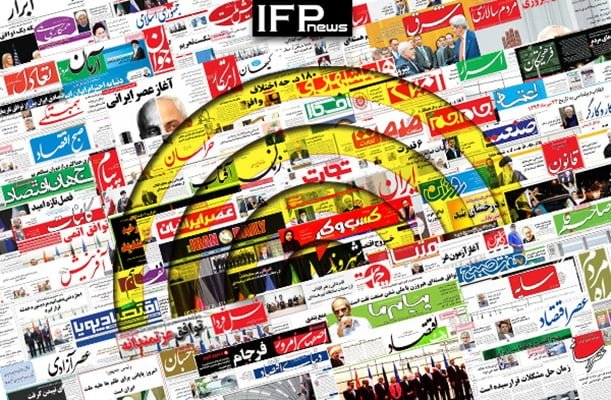
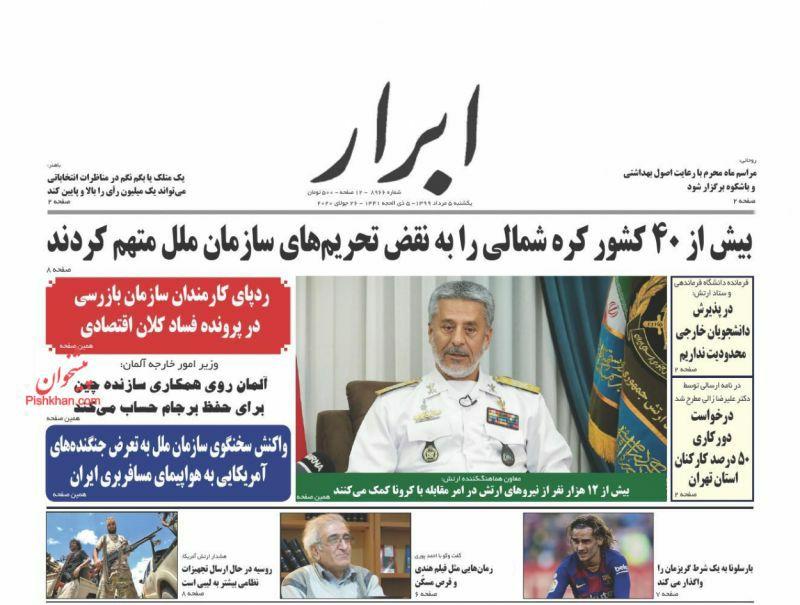
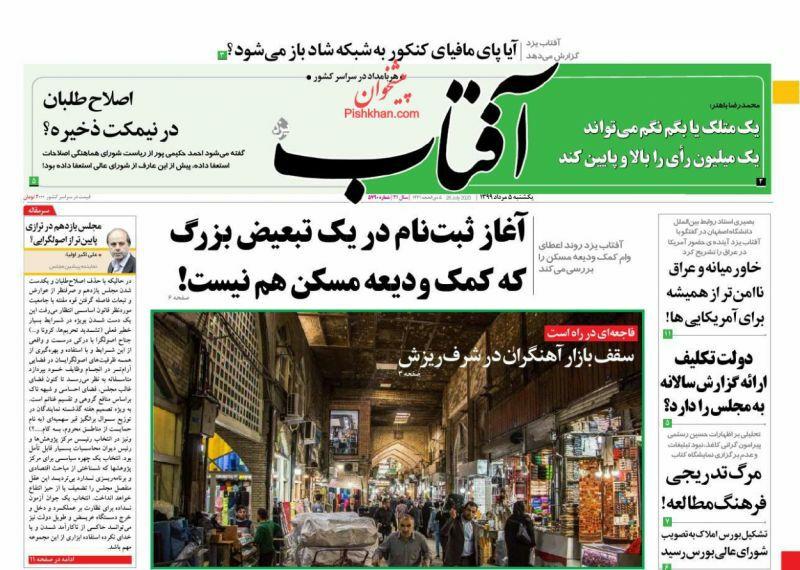
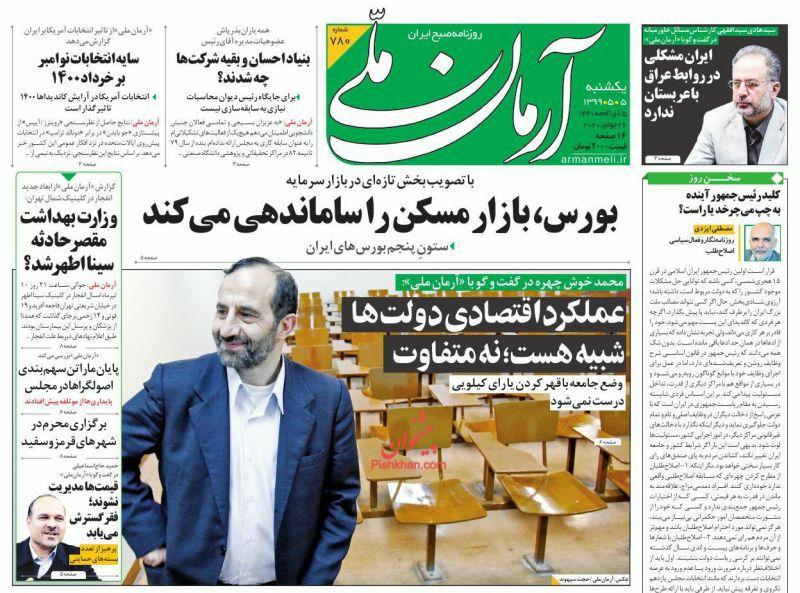
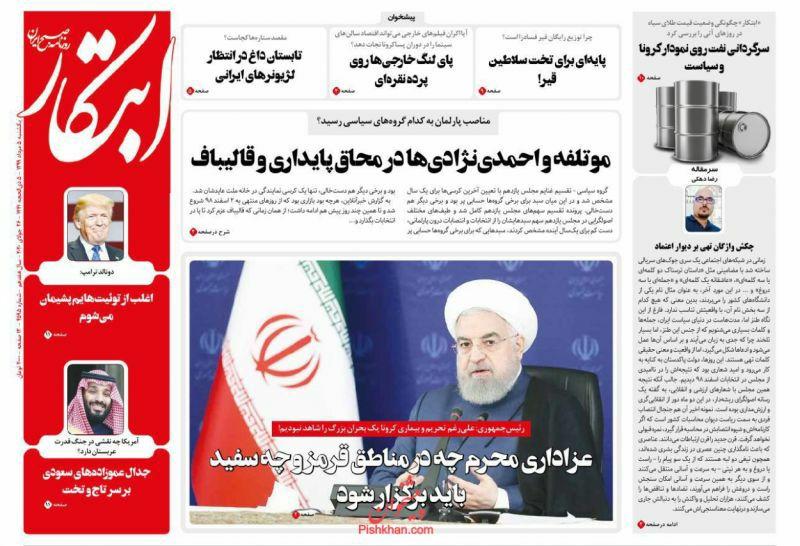
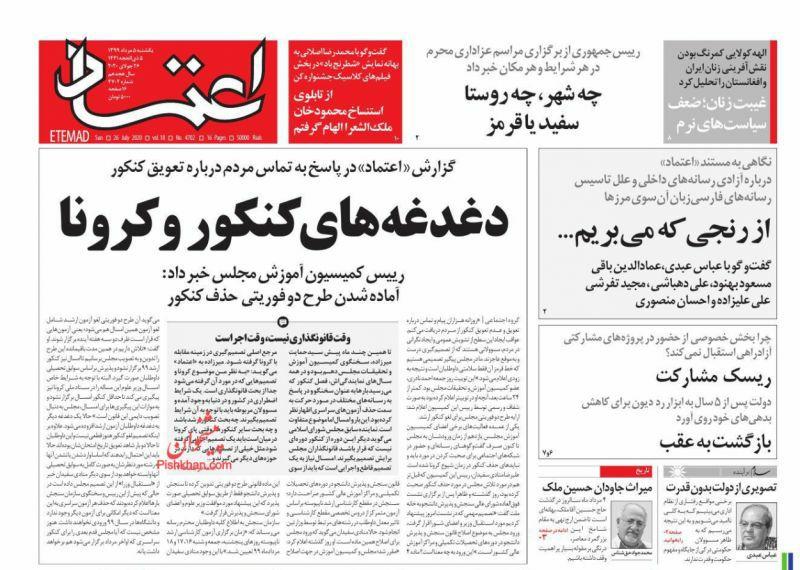
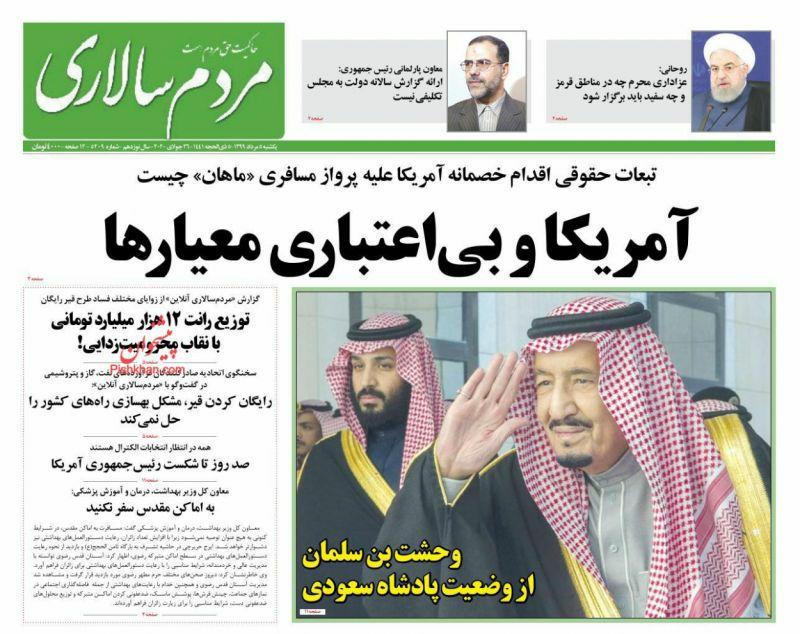
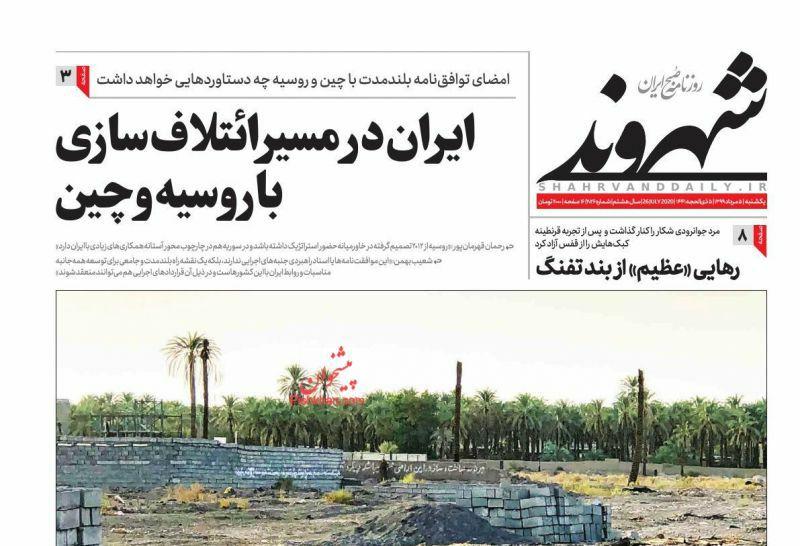
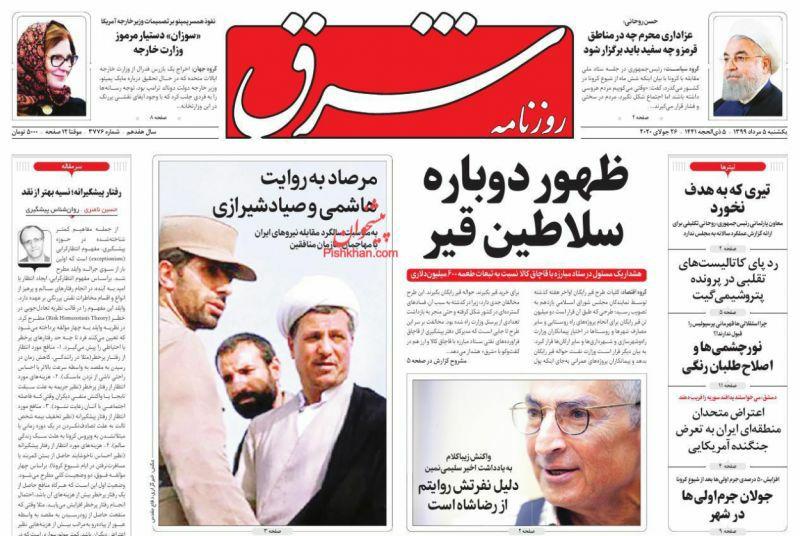
A Look at Iranian Newspaper Front Pages on July 1

A Look at Iranian Newspaper Front Pages on November 18

Iranian Newspapers

Aftab-e Yazd Newspaper:

1- Ruhollah Zam Sentenced to Death
2- New Swine Flu with Pandemic Potential Discovered in China
3- Iran to Launch Dwelling Stock Market for First Time in WorldA Look at Iranian Newspaper Front Pages on July 1


Arman-e Melli Newspaper:

1- Trump Playing Innocent
2- Blast and Fire in Northern Tehran
3- US Must Remove Iran Sanctions: What Happened at UNSC? A Look at Iranian Newspaper Front Pages on July 1


Ebtekar Newspaper:

1- Iran Breaks Records of Coronavirus
2- UNSC Unanimous in Favour of Iran, Against US
* Zarif Uses Mosaddegh’s Remarks in UNSC Speech
3- Rouhani Says Subsidies Allocated for Production of Cheap Face MasksA Look at Iranian Newspaper Front Pages on July 1


Etemad Newspaper:

1- Zarif Reiterates Mosaddegh’s Warning to UNSC
2- Iran Won’t Accept Even Temporary Extension of Arms Embargo: Ex-Diplomat
3- Negligence in Wearing Face MaskA Look at Iranian Newspaper Front Pages on July 1


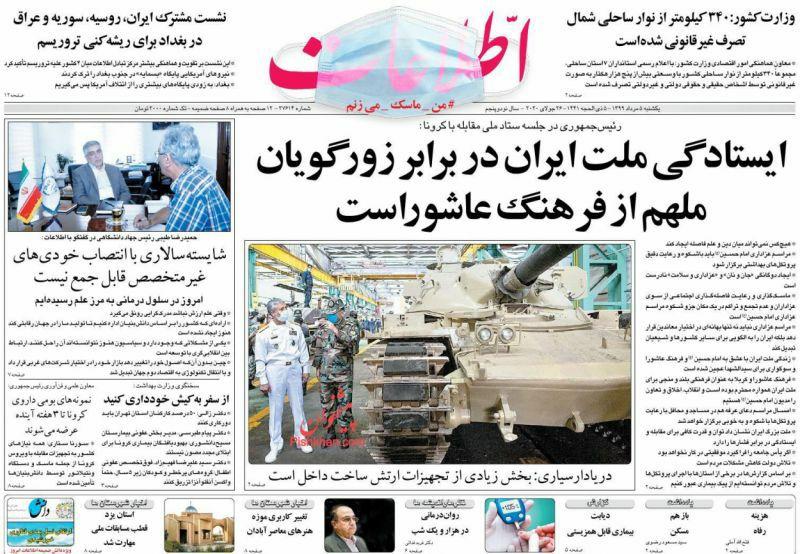
Ettela’at Newspaper:

1- Zarif: Any New UNSC Restriction against Commitments towards Iran NationA Look at Iranian Newspaper Front Pages on July 1


Iran Newspaper:

1- Zarif Warns UNSC: Iran Won’t Give in to Foreign Pressure
2- Details of Explosion in TajrishA Look at Iranian Newspaper Front Pages on July 1


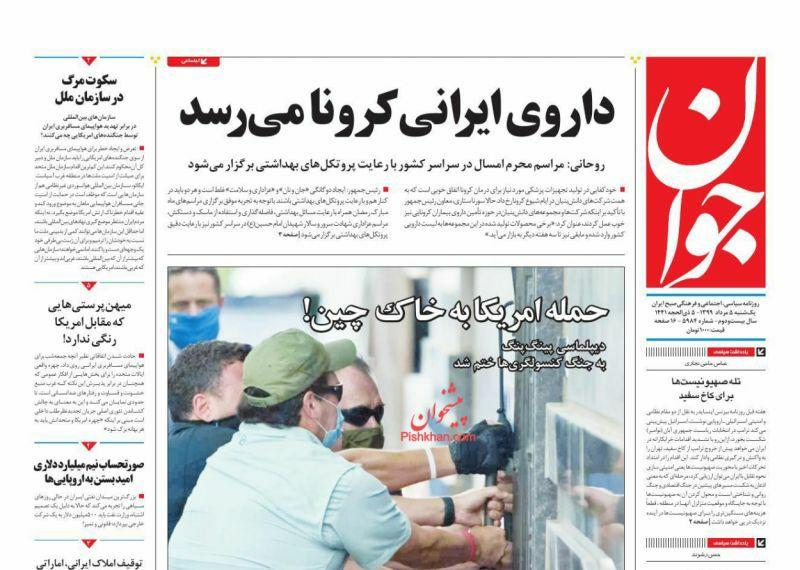
Javan Newspaper:

1- Zarif Warns UNSC about Making Any Mistake
2- Trump’s Withdrawal from Nov. Elections Becoming SeriousA Look at Iranian Newspaper Front Pages on July 1


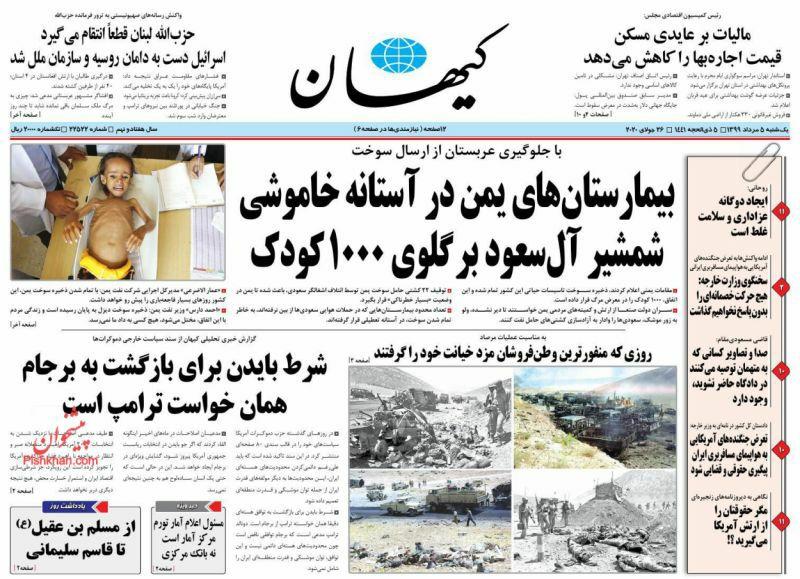
Kayhan Newspaper:

1- Gov’t Must Work Harder; House Price Hike Has Nothing to Do with Corona, Sanctions
2- US Unrest in 40th Day: Autonomous Area Established in New York
3- Interpol and FATF Fail in Test of Prosecuting Murderers of Gen. Soleimani
4- Iranian Vaccine for Coronavirus Successfully Passes Animal Tests
5- German FM: UNSC on Verge of Being ParalyzedA Look at Iranian Newspaper Front Pages on July 1


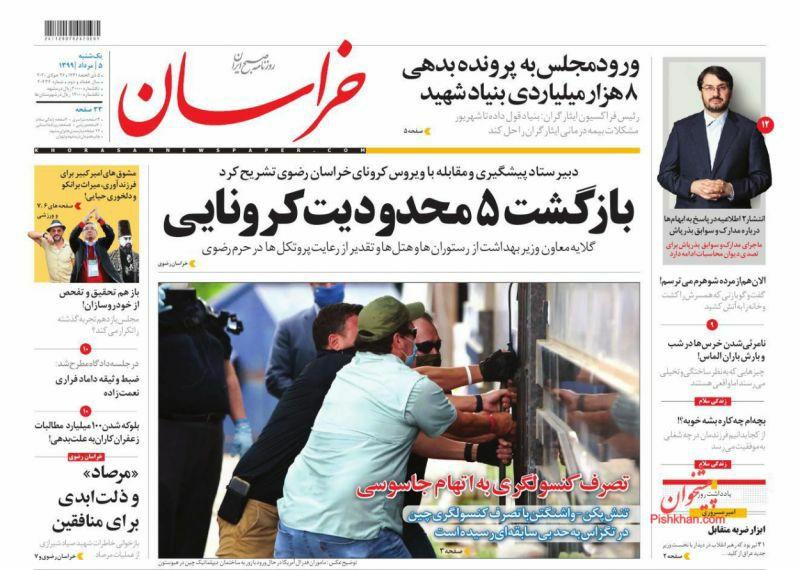
Khorasan Newspaper:

1- US Quarantined in UNSCA Look at Iranian Newspaper Front Pages on July 1


Mardom Salari Newspaper:

1- Testing Europe with UNSC Resolution 2231
2- Health Minister: Iran on Verge of Producing Corona VaccineA Look at Iranian Newspaper Front Pages on July 1


Setareh Sobh Newspaper:

1- Iran Uses Mosaddegh’s Way of Claiming Its Rights at UNSC after 69 YearsA Look at Iranian Newspaper Front Pages on July 1


Shargh Newspaper:

1- Judiciary Spokesman: We’re Seeking to Clear Ambiguities of Judge Mansouri’s Murder
2- Coronavirus Changing Trump’s Game
3- Rouhani: There’s Basic Need for Creating Psychological Security in SocietyA Look at Iranian Newspaper Front Pages on July 1

Iran Raps French Meddling in Iran’s Judicial Cases

Iran Vows to Take Action If UN Arms Embargo Not Lifted

In a statement on Wednesday, the Foreign Ministry spokesman denounced the French officials’ recent stances on two Iranian convicts.

“Hearing the cases and issuing rulings on the crimes committed by Iranian nationals in a fair judicial procedure and within the framework of civil regulations and rights in the Islamic Republic of Iran are within the purview of Iran’s judicial courts,” Mousavi underlined.

“Ms. Adelkhah and Ruhollah Zam have received punishment proportional to the crimes committed and are serving their sentences,” the spokesperson noted.

He also underlined that the Foreign Ministry of France lacks any competence and authority to meddle in Iranian judicial cases, stressing, “The Islamic Republic of Iran would not approve any interference in its internal affairs.”

His comments came after France made meddlesome comments over Iran’s internal affairs following a death sentence issued against Ruhollah Zam, the administrator of a counterrevolutionary website and Telegram channel.

France’s Foreign Ministry has described the death sentence as “a serious blow to freedom of expression and press freedom in Iran.”

The ministry has also described the death penalty as “unjust, inhumane and ineffective” and said France opposes its use “everywhere and in all circumstances.”

President Offers Condolences to Families of Tehran Clinic Blast Victims

President Offers Condolences to Families of Tehran Clinic Blast Victims

In his message on Wednesday, the President called on the relevant agencies to investigate the cause of this accident as soon as possible, and take special care of the injured and their bereaved families to relieve their pain.

What follows is the full text of his message:

In the Name of Allah, the Most Beneficent, the Most Merciful

We are all from Allah and to Him we shall return (Holy Quran)

The tragic accident of the explosion and fire in Sina At’har Medical Centre in Tehran, which resulted in the death and injury of a number of patients and medical staff of the centre, caused deep sorrow and grief.

Fire in Tehran Clinic Kills 19, Wounds 11

It is necessary for the relevant agencies to investigate the cause of this accident as soon as possible, and take special care of the injured and their bereaved families to relieve their pain. We hope that by taking the necessary measures and monitoring, we will never see the repetition of such tragic events in the country.

I express my condolences to the families of the victims, and I ask the Almighty to have mercy and forgiveness for those who have lost their lives, patience and reward for all bereaved families, and a speedy recovery for the injured.

Hassan Rouhani         

President of the Islamic Republic of Iran

Over 230,000 Infected by Novel Coronavirus: Ministry

Almost Entire Iran Declared as COVID-19 ‘Red Zones’

In a press briefing on Wednesday, Sima-Sadat Lari said 141 people have died of the virus in the past 24 hours, bringing the overall fatalities to 10,958.

She further noted that 191,487 patients have so far recovered from the disease, and been discharged from hospital.

According to Lari, 3,081 patients are also in severe conditions of the disease.
The spokesperson said 1,693,242 COVID-19 tests have been taken across the country.

According to the spokeswoman, Kermanshah, Hormozgan, Bushehr, Khuzestan, Khorasan Razavi, Kurdistan, East and West Azarbaijan provinces are considered as red zones.

She also noted that the number of patients hospitalized in Tehran province shows a considerable growth.

Coronavirus online test
If you are worried that you may have contracted the Coronavirus, take this test right now.

Iran Cultural Heritage in Photos: Dome of Soltaniyeh

Dome of Soltaniyeh

Iran-Soltaniyeh DomeSoltaniyeh means “the Imperial” in Farsi. It is the name of a city located 240 kilometers to the northwest of Tehran, in the northwestern province of Zanjan. Soltaniyeh used to be the capital of Mongol Ilkhanid rulers in the 14th century AD. The old city found its way onto the UNESCO list of the World Heritage Sites in 2005; and is home to Gonbad-e Soltaniyeh [the Dome of Soltaniyeh], the world’s highest brick dome.

The 50-meter-high structure has been adorned with 10,000 square meters of plasterwork and painting. A wide array of ornamental works, among them tile-work and painting on plastic and mosaic, catch the eyes of the beholders. Dome of Soltaniyeh shares the title of the world’s highest dome with Santa Maria Gloriosa dei Frari Church in Venice, Italy and Hagia Sophia Cathedral in Istanbul, Turkey.

The unrivalled dome’s brick structure is decorated with turquoise-coloured tiles. It is one of the biggest domes in the world. The dome of the Florence Church was modelled after the Soltaniyeh Dome during the Middle Ages.

On Iranian Cultural Heritage 

As a vast country with a history that stretches millennia, Iran has made significant contributions to human civilization. Over the centuries many awe-inspiring monuments have been set up in Iran. In 1979 Iran joined the UNESCO World Heritage Convention. As of 2009, ten Iranian monuments had been officially registered as World Heritage Sites. Several others have been nominated for registration.

Introduction to Astrology: Skimming the Surface

Introduction to Astrology

Lots of articles have been written from all sides of the fence. In astrology many of the traditional rules have been lost, and many more have been added during 20th century. Some textbooks in astrology are opinions based on experience and the use of astrology others are based on serious research and old texts, however, at this point in time none from either category are accepted by all astrologers.

The one and only concept astrologers, as a group, agree upon is that Jupiter is the biggest planet.

I am writing this in hopes of providing a basic primer on astrological concepts and on how to study astrology, and where to start.

Defining Astrology

Astrology is a symbolic language, and much in the same manner we learn a foreign language we can learn astrology. Translators and interpreters take words and sentences and write or say them in another language.

Astrologers do the same with symbols. Astrologers themselves argue about what astrology is, some call it an intuitive art and some call it a science, the truth lies somewhere in between. However, the symbols become words when the astrological chart is interpreted, hence I choose to refer to it as a symbolic language.

Webster’s Dictionary gives the meaning of the word astrology being astron = star, and logia = to speak. Both astrology and astronomy are based on observation, up until the 16th century there was no distinction.

The word astronomy has the same prefix and the latter part of the word is nomos, which means to arrange. The definition for astronomy is the science of heavenly bodies – fixed stars, planets, satellites and comets – their nature, distribution, magnitudes, motions, distances, periods of revolution, eclipses, etc. Astrology is defined as the divination of the supposed influences of the stars and planets on human affairs and terrestrial events by their position and aspects.

Apart from definitions based on dictionaries, astrology is basically a language like any other. It is a language of symbols, which dates back to 8000 BCE when the Assyrians, Babylonians, Egyptians and Mayans had astrologers who observed the heavens in view of fate, events and destiny.

The chart that astrologers cast is called a horoscope. Horos means time, and scopos means an observer. Astrologers recorded their observations on time, events and cycles, and passed the information on. So literally an astrologer speaks about the stars based on the observation of time. Astrology is not a belief system, it is not a religion nor is it witchcraft or clairvoyance.

The first actual textbook on astrology was written less than two millenniums ago by a mathematician called Ptolemaios. He practiced in Egypt during 150 AD to 180 AD. The first ephemeris was printed by the Greeks. An ephemeris is an almanac, similar to the Nautical Almanac sailors use to plot their position at sea. One of the most recognized astronomical calendars is the Stonehenge which is estimated to date back to 1600 BC – 1400 BC.

Ancient astronomer priests recorded their observations on lunar cycles, the solstices and fixed stars by carving markings onto the stone. Scientists today find the calendar accurate today. Computers accurately generate Modern ephemerides. An ephemeris is the main tool for an astrologer, as it gives the astronomical positions of the celestial bodies at noon or midnight every day.

Ancient astrology knew the Sun, the Moon, Mercury, Venus, Mars, Jupiter and Saturn. In those times it was mostly used for predicting events for the benefit of the ruling classes, the ordinary person lived a relatively short life of toil.

The three Wise Men to visit Baby Jesus bearing gifts were astrologers; the founding fathers of the United States were well versed in astrology, namely Benjamin Franklin and Thomas Jefferson. Sir Francis Bacon and Carl Jung both spent time in astrological study. President Reagan used astrology, according to rumors he had 12 astrologers on his payroll.

But what is it that astrologers do?

Firstly a horoscope has to be calculated using an ephemeris and tables of houses. The information the astrologer needs is the date, time and location of birth. Most astrologers use either a computer or a computer service to perform the time consuming calculations.
The horoscope is a circle divided into 12 segments called houses, the planets Sun through Saturn as well as the more recently discovered outer planets Uranus, Neptune, and Pluto each have their position at a particular degree on the circle.

The 360° circle is divided into 30° segments according to the 12 constellations (sidereal or star-based) or zodiac signs used in astrology; Aries, Taurus, Gemini, Cancer, Leo, Virgo, Libra, Scorpio, Sagittarius, Capricorn, Aquarius and Pisces. Constellations are a sidereal (star based) perspective and the zodiacal signs are based on tropical astrology.

The third major element comprises of aspects, which measure geometrical distance between two planets.

The wheel is 360°, and aspects are divisions of it. Each aspect has its own unique quality. There are two basic kind of aspects; the harmonious, producing ease for the use of the energies, and friction aspects, which produce growth, action and change in an individual.

Most of us are aware of the horoscope columns in newspapers and magazines based on the position of the Sun on the day of their birth. This kind of astrology divides people into twelve categories.

At best this can only be 30% accurate according to most astrologers. Planets represent outlets for energy, and each one of us has the Sun, the Moon, Mercury, Venus, Mars, Jupiter, Saturn, Uranus, Neptune and Pluto uniquely located in our own birth chart. The 12 houses describing areas of life are equally unique.

The zodiacal signs, named after constellations, define a kind of energy; the birth charts of twins vary enough to make a difference, small but yet significant. There are several other components that are delineated to give a full view of the person.

The picture of the heavens at the time of birth weaves a very intricate picture of a person; it is like a fingerprint – unique to the individual. Sun sign astrology is like peeping through a tiny keyhole, you cannot see the full vivid picture the chart paints.

Once the planetary positions, house divisions and aspects are drawn onto a chart wheel the astrological analysis can begin. An astrologer is a lot like a translator, if she or he only knows the meaning of the planets it is like knowing the words but not being able to make coherent sentences.

It takes more than basic knowledge of a foreign language to be able to write the same text in another language, it takes a feel for the language. As a professional translator I know that the work requires more than just the knowledge of words and grammar. The very same principle applies to astrology.

Life is much more complex today than a hundred years ago, we cope with countless issues that people in medieval times didn’t have. Divorce, competitive careers, increased educational demands, substance abuse, alcoholism, household chores combined with a full-time career, stress, mid-life crises… Not so long ago people didn’t live long enough to have a mid-life crisis. We don’t accept things as par for the course any more, we know about childhood traumas, dysfunctional families, codependency, increased suicide rates…

But what if there was a tool that could help explain to you why you feel this way, why you have such low self-esteem, or simply why do you feel as if you just treading water instead of getting on with life.

What if someone could point out that there really is light at the end of the tunnel. Or perhaps you are uncertain of your capabilities and talents as a creative person, which is when learning more about yourself might help you acknowledge and realize those dreams.

A horoscope is like a road map or a blueprint we created for ourselves to guide us through this life. It gives us the paths and roads we can follow. We may choose to use it or discard it, nonetheless it does describe everything about us – our inherent strengths and weaknesses, our skills and talents, our insecurities, our views of our parents, children, as well as people in general.

Astrology is a symbolical language, which reveals our personality, appearance, emotions, feelings, and events in our lives. But as with any blueprint the plans may be altered and changed according to our free will. The philosophical debate about what free will really is I leave to the philosophers.

As astrology is based on symbols, which reflect on mythology as well as thousands of years of knowledge, the meaning of the many energies and the way they relate to our lives can be “translated” in several different ways.

There is no such thing as a complete delineation of a natal horoscope, as it is conceivable that it would result in an Opus – because all that we are and all that we do is contained within our own blueprint.

For instance, if three people read the same book or view an object of art, they will all describe and respond to it differently. The same is true of three astrologers reading a chart, the basics will be the same, but the nuances in the delineation can change the analysis dramatically.

I view astrology as tool for self-discovery. Its ultimate gift is to enable us to learn to know and love ourselves. Once we are in tune with the planetary forces in ourselves, we are in harmony with the world. Being fully aware of our own potential allows us to accomplish ‘our mission in life’. Much along the lines of NBC’s campaign “The more you know…”

Modern astrology is geared toward personal growth, learning about our potential, learning to know ourselves, finding out more about our emotional and psychological make-up. I used to think astrology was hogwash, and certainly the columns I read in hopes of finding something nice written about me, one of the 333,333,333 Scorpio Suns inhabiting our planet, made me classify it as fairy tales.

Now that I have found my complete chart, and learned to translate the symbols into words reasonably well,

I use astrology because I have determined for myself how well it works. Just like each individual is complex and unique so is the science-art of astrology. For the complete study of this subject a lifetime seems inadequate, but the rewards are immeasurable.