Thursday, April 9, 2026
Home Blog Page 2746

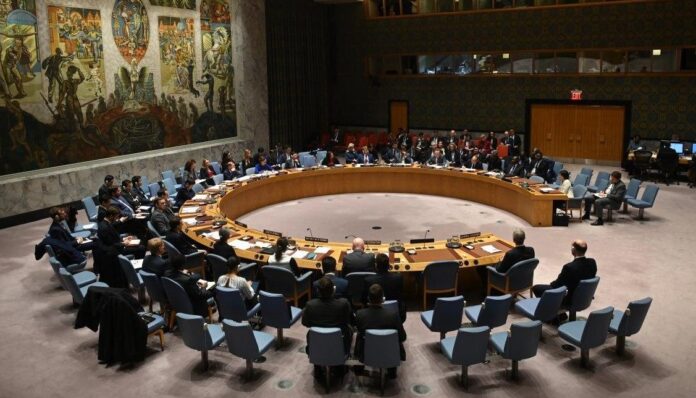
US Has No Right to Activate Snapback Mechanism, Zarif Writes to UNSC

‘US Bid to Restore UN Sanctions on Iran Has Dire Legal Consequences’

In the letter, released on Thursday, Zarif called on the UN Security Council and international community to dismiss the US action.

The letter was handed over to the Indonesian president of the council by Iran’s Ambassador and Permanent Representative to the United Nations Majid Takht Ravanchi.

The full text of the letter reads as follows:

The term “snapback” is never employed in either the Joint Comprehensive Plan of Action (JCPOA) or UN Security Council Resolution 2231. Rather, the US has intentionally used the term to connote rapidity and automaticity. The wording in UNSCR 2231 is actually “reapplication of the provisions of terminated resolutions”, which requires an elaborate time-consuming process—intended to preserve the JCPOA, and not to destroy it.

It is clear that the US has no right to the “reapplication of the provisions of terminated resolutions” against Iran for the following reasons:

I. US Terminated Explicitly its Participation in the JCPOA

On 8 May 2018, President Trump signed an executive order to “cease US participation” in the JCPOA. The US administration thus took extensive measures to terminate US participation, and to re-impose all US sanctions–a violation of the JCPOA and UNSCR 2231.

Secretary Pompeo speaking at the Heritage Foundation on May 21 2018: “President Trump terminated the United States participation in the Joint Comprehensive Plan of Action.”

On 11 May 2018, the US Government informed all JCPOA Participants that it would no longer participate in JCPOA–related meetings or activities.

The term “participant” is not a simple honorific title, rather it requires taking part in an activity or event in compliance with an agreed upon and specifically defined description of duties, rights and obligations. The US is therefore not a “Participant” by any stretch of imagination.

II. US Officially Abrogated Any Right to the Dispute Resolution Mechanism

US officials have repeatedly admitted in public that they relinquished the right to utilize the provisions of UNSCR 2231 when the US left the JCPOA.

Then National Security Advisor John Bolton speaking on 8 May 2018: “… provisions of Resolution 2231, which we’re not using because we’re out of the deal.”
John Bolton writing in the Wall Street Journal on 16 August 2020: “The agreement’s backers argue that Washington, having withdrawn from the deal, has no standing to invoke its provisions. They’re right.”

Brian H. Hook told reporters in New York on 20 December 2019: “… we’re no longer in the deal, and so the parties that are still in the deal will have to make their decisions with respect to using or not using the dispute resolution mechanism.”

The Trump administration hoped that its withdrawal from the JCPOA and unlawful imposition of “maximum pressure” would either cause regime change, Iran’s submission, or Iran’s withdrawal from the JCPOA. After the failure of its policy—predicated on poor advice–the Trump administration is now attempting to change course and–in an extreme case of bad faith–conveniently resort to the procedure that they over two years ago permanently closed to themselves.

The US being described as a “JCPOA participant” in a paragraph of Resolution 2231 is purely descriptive and exhortatory; it lists as a factual matter who the participants were at the time of the adoption of the resolution in 2015 and has no other definition.

he EU, UK, France, Germany, China and Russia have all declared the notification by the U.S. as “null and void.”

III. Material Breach of UNSCR 2231 and Lack of Good Faith

The Trump administration has never acted in good faith–an inseparable part of international relations.

Operative Paragraph 2 of UNSCR 2231 calls upon all to refrain “from actions that undermine implementation of commitments under the JCPOA;”
The US violated the JCPOA and UNSCR 2231 by withdrawing from the JCPOA, unilaterally re-imposing sanctions, and even punishing those complying with the resolution.

On 26 June 2019, addressing the UN Security Council on implementation of UNSCR 2231 the UN Secretary-General stated: “… the lifting of sanctions allowing for the normalization of trade and economic relations constitute an essential part of the Plan”. President Trump has imposed countless sanctions against Iran on over 145 times. He has even decided not to extend waivers for nuclear-related projects which, in the words of the UN Secretary-General, “may also impede the ability of the Islamic Republic of Iran to implement certain provisions of the Plan and of the resolution.”

The International Court of Justice clearly underlined in its 1971 advisory opinion on Namibia: “One of the fundamental principles governing international relationship thus established is that a party which disowns or does not fulfill its own obligations cannot be recognized as retaining the rights which it claims to derive from the relationship.

The United States cannot benefit from the fruits of its unlawful act

IV. Iran’s Efforts in Good Faith to Fully Implement the JCPOA

President Trump’s decision to cease U.S. participation in the JCPOA was not preceded by even a single case of Iran violating its commitments.

Even after the US withdrawal from the JCPOA, Iran continued–for a full year–full implementation of the JCPOA, as verified by 15 consecutive IAEA reports.

Having repeatedly exhausted the Dispute Resolution Mechanism to absolutely no avail, Iran exercised its rights under Paragraphs 26 and 36 of the JCPOA to apply remedial measures and cease performing part of its commitments.
Iran’s remedial measures have had no impact on the IAEA’s monitoring, thereby rendering any claim of proliferation risks irrelevant.

V. Conclusion: Notification by the US Is Inadmissible

The Dispute Resolution Mechanism is only open to the actual JCPOA Participants—and not to a defected “original” participant that willfully and explicitly decided to “cease participation”, actively sought to destroy the instrument, and subsequently–and self-admittedly–relinquished all its prerogatives and privileges.

The UN Security Council should prevent the US–an unapologetic and serial violator of UNSCR 2231–from unilaterally and unlawfully abusing the Dispute Resolution Mechanism, with the stated objective of destroying that very resolution–and along with it, the authority of the Security Council and indeed the UN.

The Iranian people expect the UN Security Council to bring the United States to account for the irreparable harm inflicted on the entire Iranian nation merely for reasons of personal aggrandizement or domestic political expediency.

Is Iran Going to Ban Instagram?

Is Iran Going to Ban Instagram

Famous applications like Twitter, Telegram, Facebook, and YouTube are already restricted across the country, yet social media are still very popular among the 84-million state population.

In 2018, Iran was ranked the world’s 7th Instagram user, having 25% of citizens using it on a regular basis.

After the ban of Twitter, YouTube and Facebook in 2009 and the block of Telegram in 2018, the suspension of Instagram doesn’t seem infeasible at all.

What’s more, some Iranian organizations consider Instagram far more than just a photo-sharing social network.

Mohammad Qomi, Head of Iran’s Islamic Propaganda Organization, views the app as a guilty party in 30% of cybercrimes, “non-standard propaganda”, and online gambling happening within the country.
Conservative lawmaker Mousa Ghazanfarabadi said of Instagram that it has turned into a killing ground of religious convictions of a younger generation. It also affects the institute of family, according to his words.
Is There a Single Chance for a Total Ban to Happen?

According to experts, building a Chinese-like walled garden is not possible in Iran. The irony is that Iranian President Hassan Rouhani has 2.2M followers and actively uses the platform for communication with his electorate. He and some other Iranian politicians use Twitter despite the network being officially banned more than a decade ago.

Presumably, Iranian authorities may approve the ban of Instagram, so citizens will have to use VPN services to access the network. Still, it will be a reckless and inefficient decision for several reasons.

First, Instagram is the last one standing in this drama. Most of Iranian population use it now as their major messenger, which is a good idea after Instagram introduced direct messaging functionality in 2013. Thus, the ban of Instagram will likely cause people to go on a destructive rampage, as blocking all the decent messengers in the country is simply too much.

Second, even if people tolerate the changes, they still will use Instagram they got used to through VPN. So, in fact, such a move from the government won’t bring them any closer to their ideals, but only disrupt already shattered society’s trust in the government.

All in all, the full ban of Instagram is highly unlikely. This bold yet ineffective measure will remain merely in the forms of dreams, threats, and opinions.

Iran’s Daily Coronavirus Deaths Continue to Decline

Iran COVID-19

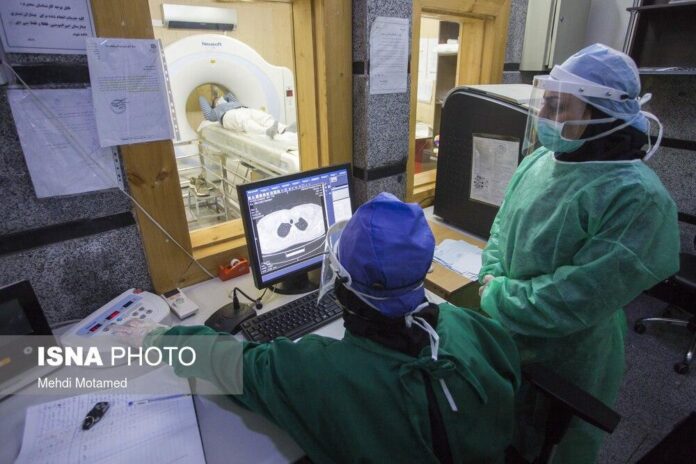
In a press briefing on Thursday, Sima-Sadat Lari confirmed 2,279 new cases of COVID-19 infection, raising the total number of infections to 352,558.

The spokeswoman said 304,236 patients have so far recovered from COVID-19 or been discharged from hospital, but 3,869 are still in critical conditions of the disease.

Lari added that so far 2,963,741 COVID-19 tests have been taken across the country.

She said the high-risk “red” zones include Tehran, Qom, Mazandaran, East Azarbaijan, Isfahan, Ardabil, Yazd, Markazi, Khorasan Razavi, North Khorasan, Alborz, Semnan, Gilan, Golestan, and Kerman provinces.

The “orange” zones also include Lorestan, Hormozgan, Ilam, Fars, Hamadan, Bushehr, West Azarbaijan, Qazvin, Chaharmahal and Bakhtiari, Kohgiluyeh and Boyer-Ahmad, and Zanjan provinces, she added.

Iran Summons Emirati Envoy to Condemn UAE Killing of Its Fishermen

Iran Officially Announces Termination of UN Arms Embargo

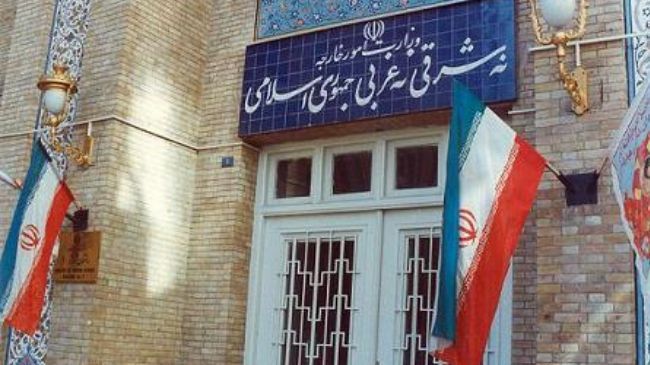
“Right after the incident in which two fishermen were also killed, relevant Iranian officials put on their agenda an immediate investigation into the tragic event,” the Foreign Ministry said in a Thursday statement.

“After the situation on the ground was carefully examined, the UAE diplomat was summoned to the ministry in the early hours of the following days by the director of the International Legal Affairs Department of the ministry,” it added.

At the ministry, the Iranian official has condemned the UAE vessels’ harassment of the Iranian fishing boats, saying the responsibility for this illegal and out-of-norm move rests with the UAE government.

He has stressed that those arrested as well as the fishing boats seized must be released, and bodies of those killed must be handed over to Iran. The Iranian official has also demanded compensation for the damage inflicted and called on the UAE to take the necessary measures to prevent such events from happening again in the future.

The UAE charge daffaires, for his part, has expressed regret over the incident, and underlined that he will inform Abu Dhabi of the developments accordingly.

In less than 24 hours, another meeting was also held between the UAE diplomat and the Iranian official to follow up on the outcome of the previous talks, according to the Iranian Foreign Ministry.

“Following these developments in Tehran and thanks to efforts by the Iranian embassy in the UAE, the Abu Dhabi government sent an official note yesterday expressing deep sorrow over the incident and expressed its readiness to make up for all the damage inflicted,” the statement added.

“Also, through the coordination of both countries’ border guards, the seized fishing boat and its crew were released. The legal procedure for delivering the bodies of those killed is underway.”

Moreover, the statement said, on the same day (August 17, 2020) a UAE vessel was intercepted and its crew arrested by Iranian border guard boats for illegally entering Iranian waters. Legal procedure is underway to look into the situation of the vessel.

“The Foreign Ministry deems it necessary to once again announce to all countries in the Persian Gulf that the Islamic Republic of Iran brooks no encroachment upon its interests and no harassment of its nationals in the Persian Gulf, and will adopt all necessary measures to support its vessels and nationals,” it added.

Iran’s Defence Power Poses No Threat to Neighbours: Rouhani

Rouhani Congratulates Beijing on China’s National Day

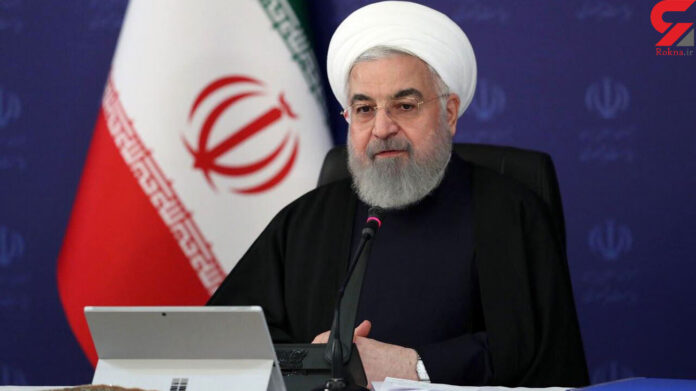
President Hassan Rouhani noted on Thursday that Iran has never pursued a strategy of aggression.

“In the defence sector, whatever the Islamic Republic of Iran produces, and whatever research work it does, and whatever effort it makes and whatever preparations it makes, are all based on a deterrence and defence strategy,” said the president in a ceremony where several new achievements in the country’s defence sector were unveiled.

“We don’t intend to occupy any place. We don’t want to harm any nation. Our neighbours should rest assured that our defence power is in their interest,” he said.

“We will use our defence power to serve our friends’ interests. We won’t use it against them. Never ever in history, especially after the 1979 Islamic Revolution, has Iran initiated a war. We have always only defended ourselves,” he said.

Iran Unveils ‘Soleimani’ Ballistic Missile with Range of 1,400km

The president also expressed gratitude to local defence experts for increasing the range of domestically developed marine cruise missiles from 300 to more than 1000 kilometres.
He said weapons produced in the country should have enough precision, destruction power and maneuverability.

He also said Iran’s skies should be as safe as it can be. “We should have a radar which, given the technologies used in stealth aircraft, does not miss any target.”

The president appreciated efforts by domestic experts which, as he said, have led Iran to reach self-sufficiency in numerous weapons and defence systems.

Iran’s Beauties in Photos: Nature of Nishapur

Nature of Nishapur 9

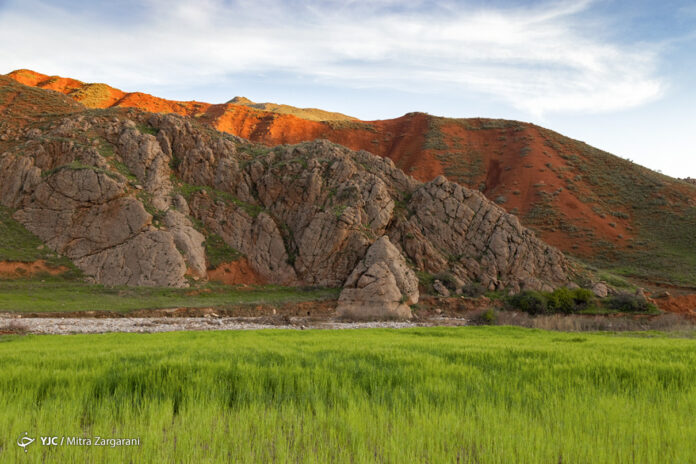
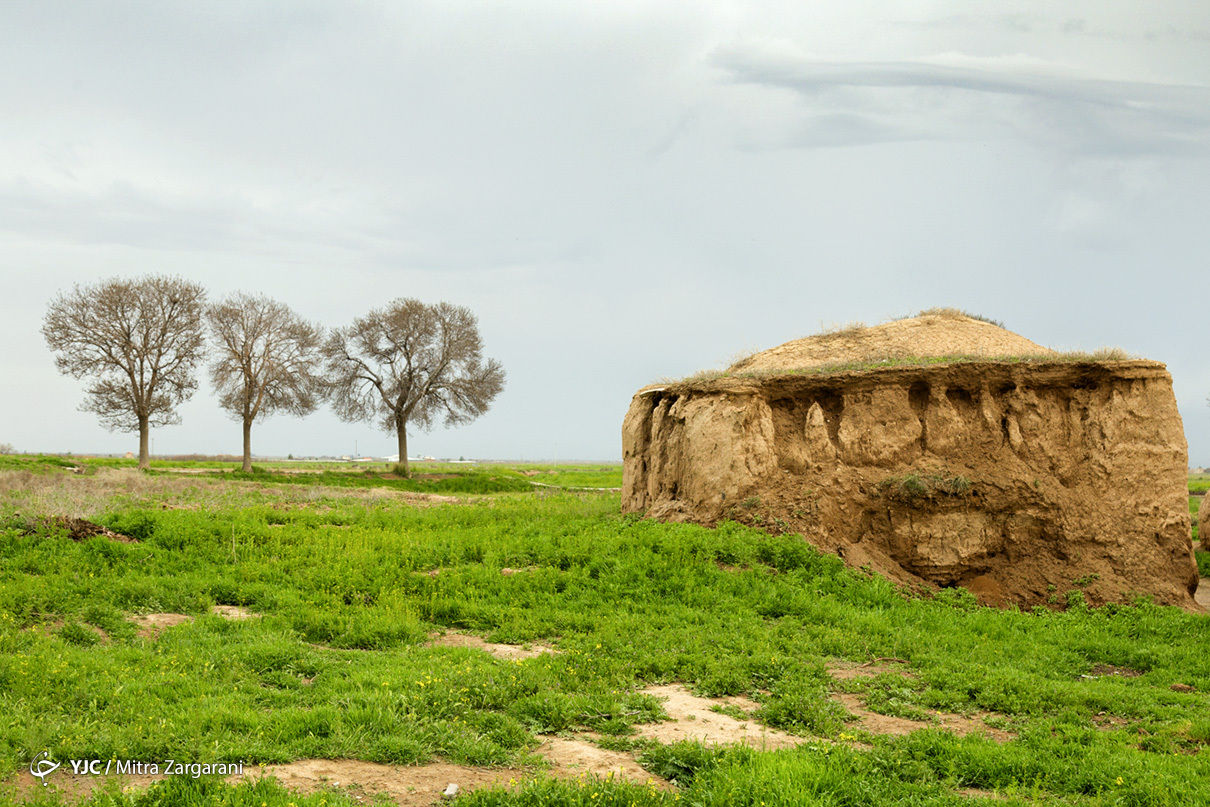
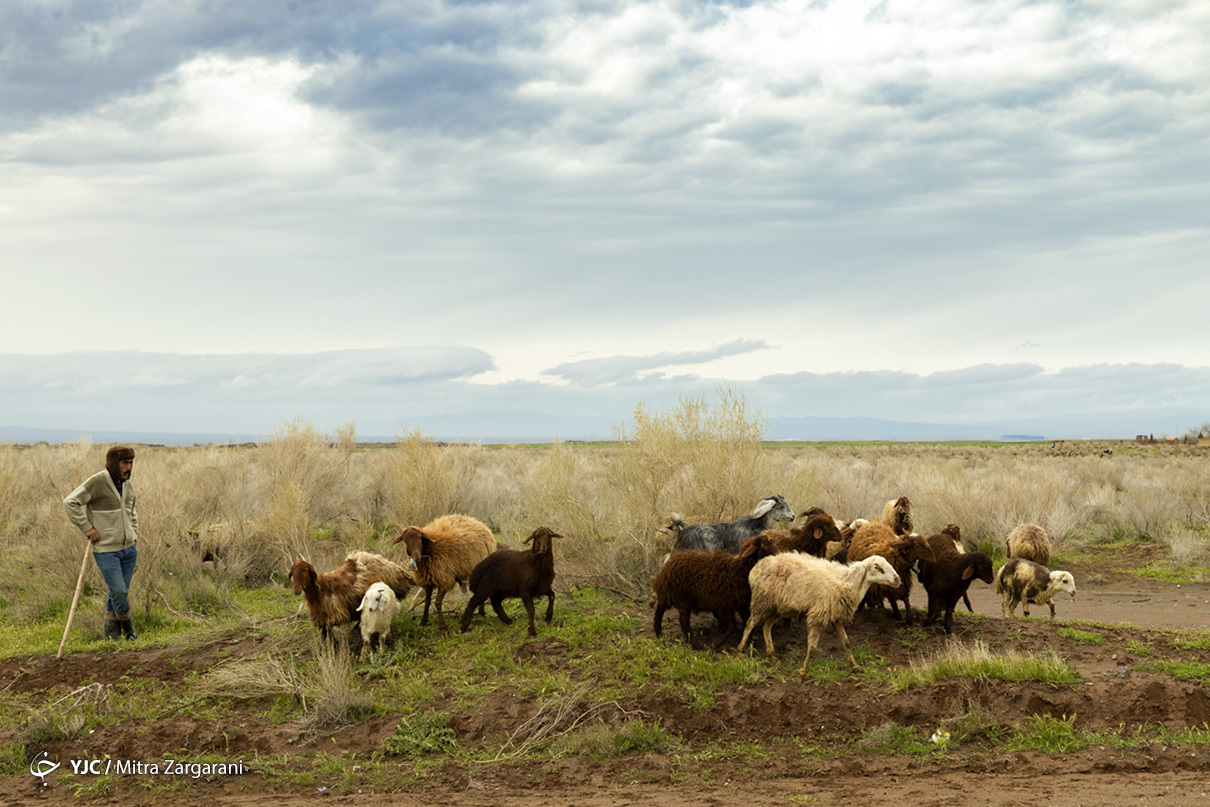
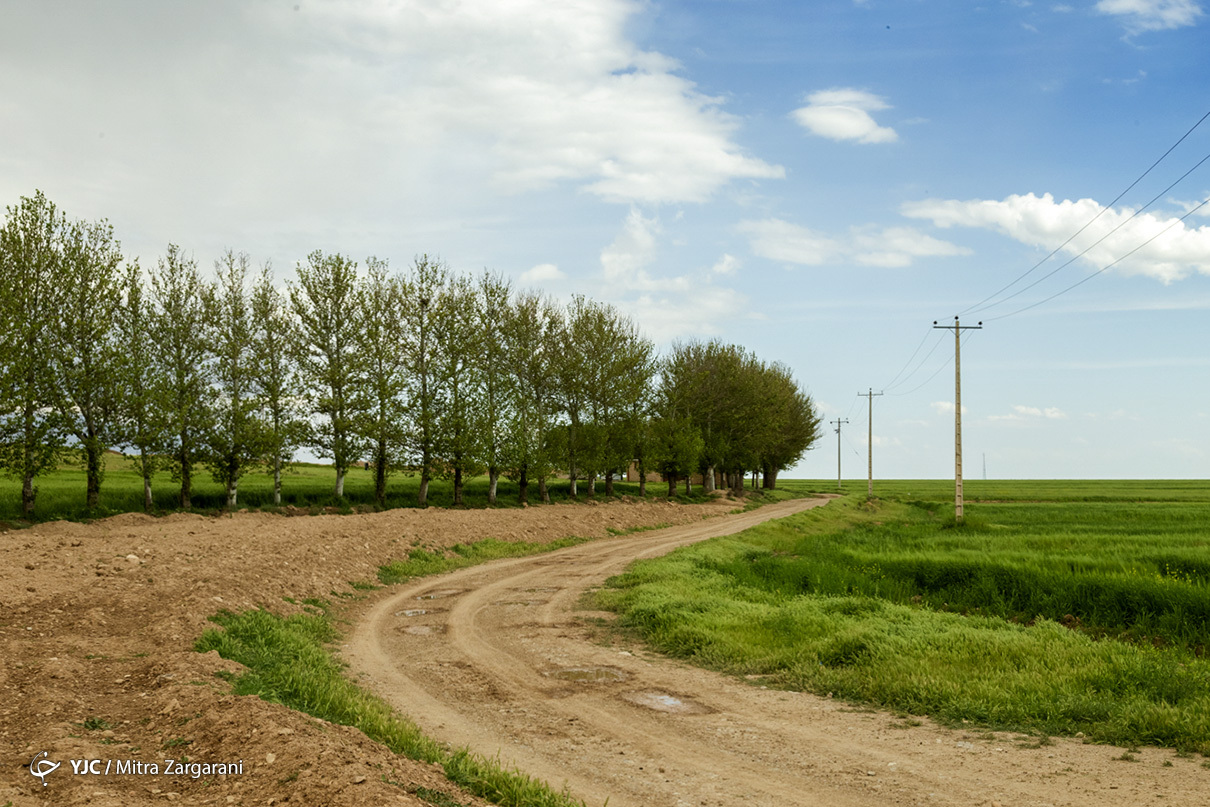
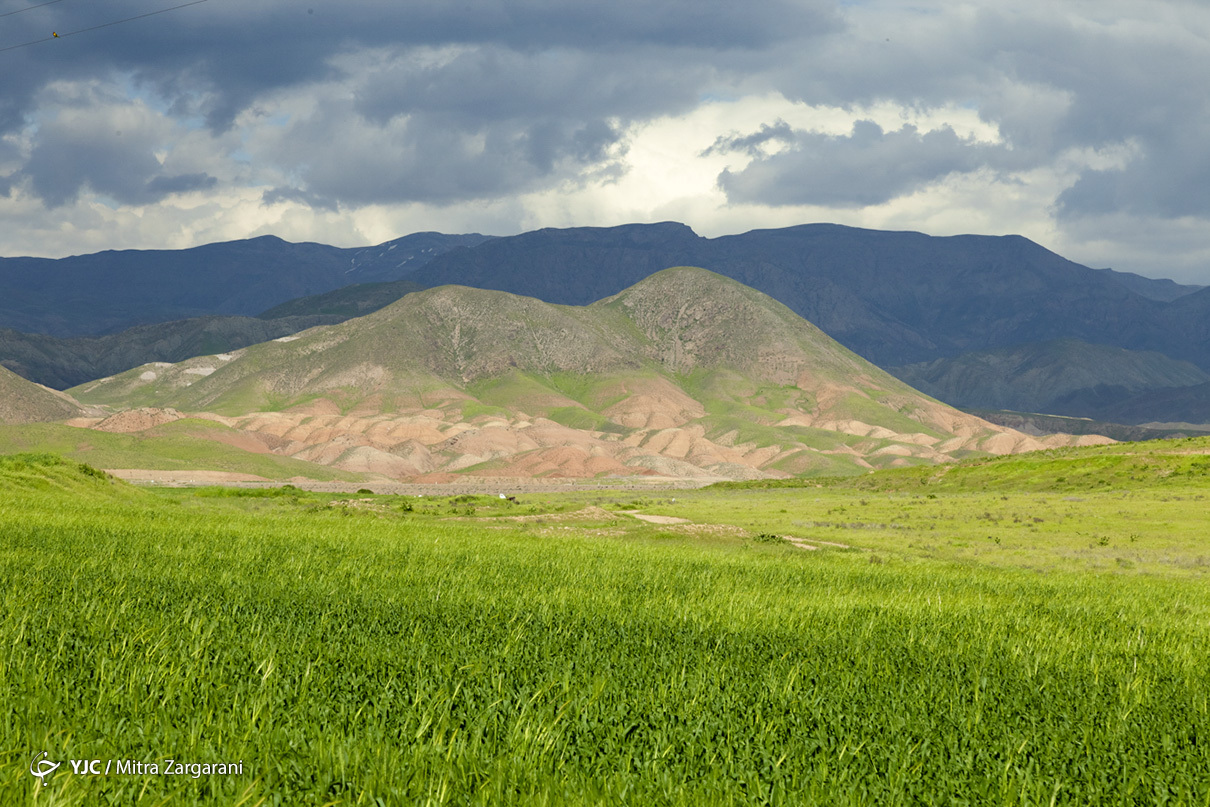
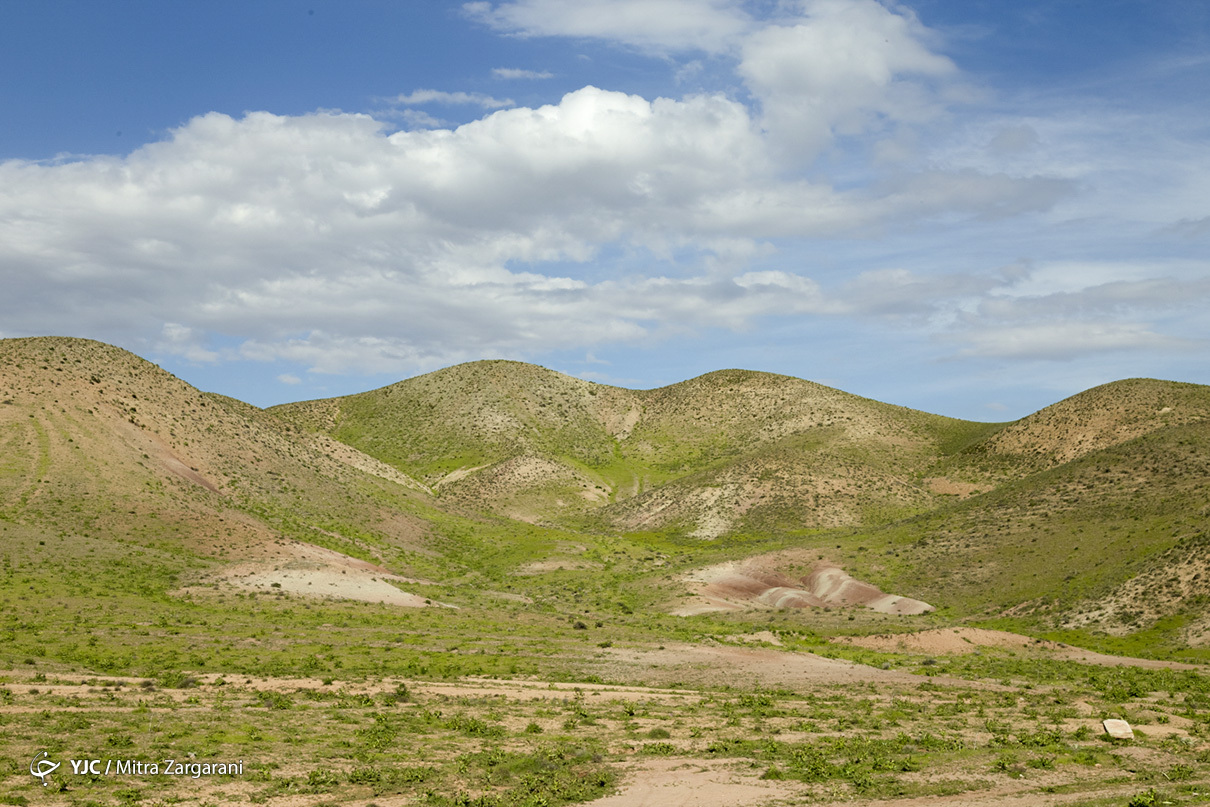
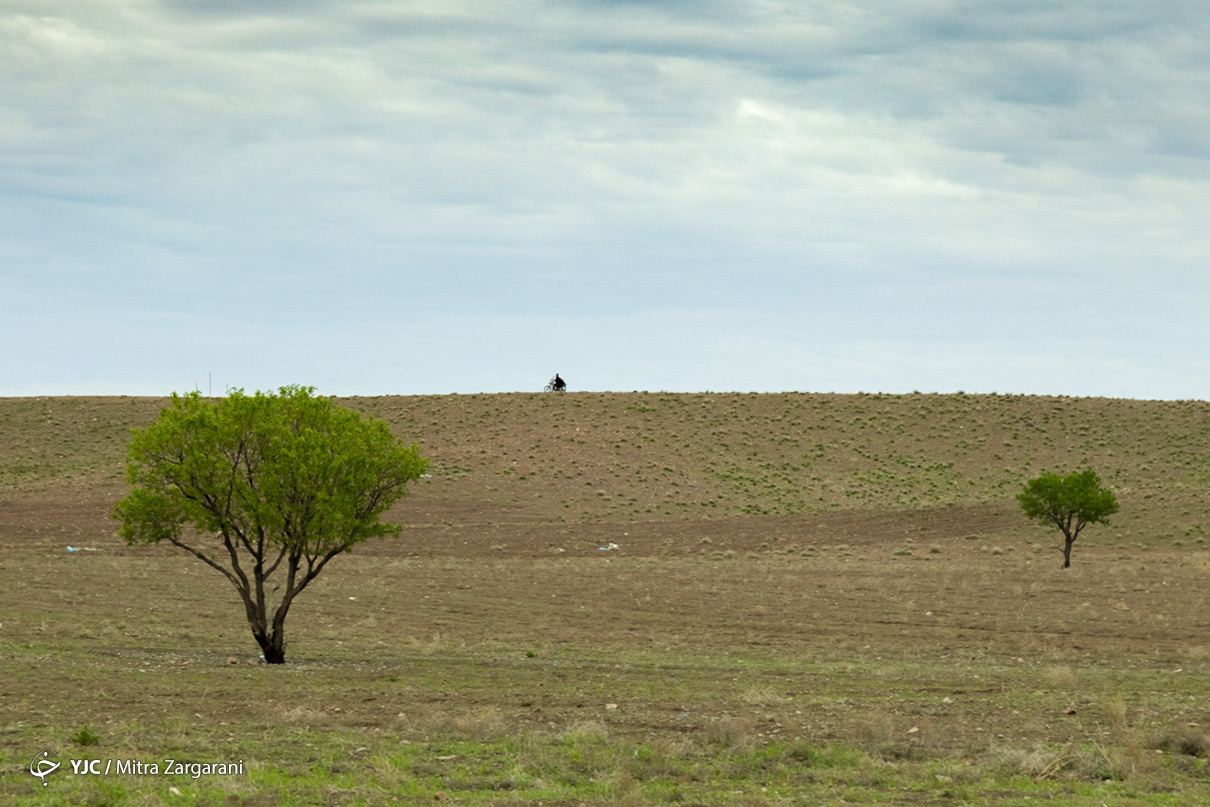
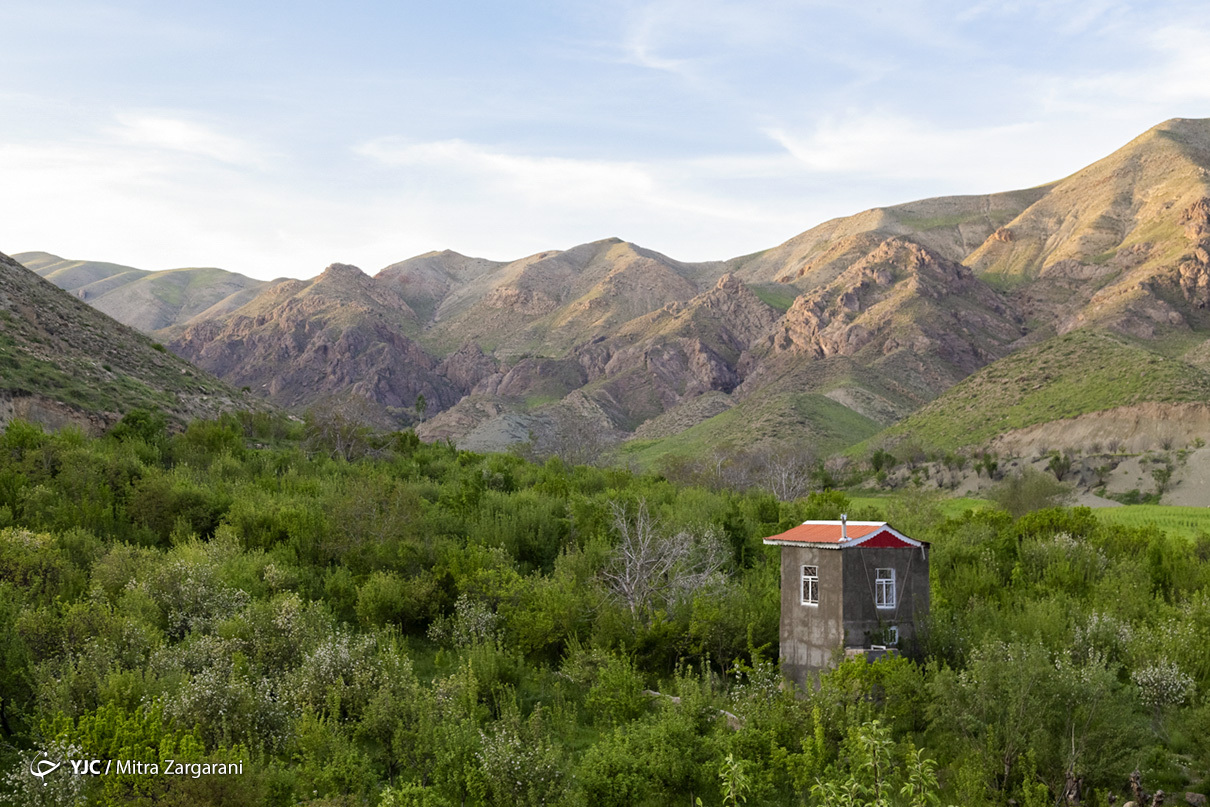
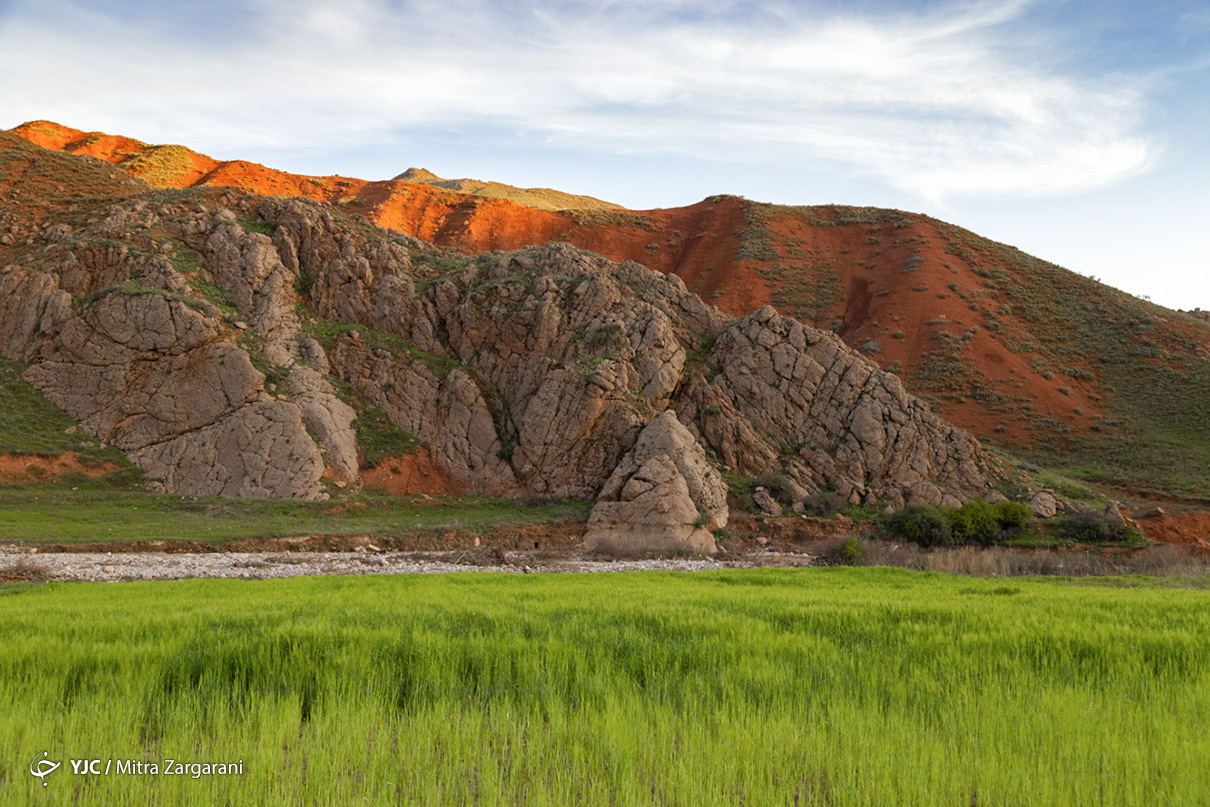
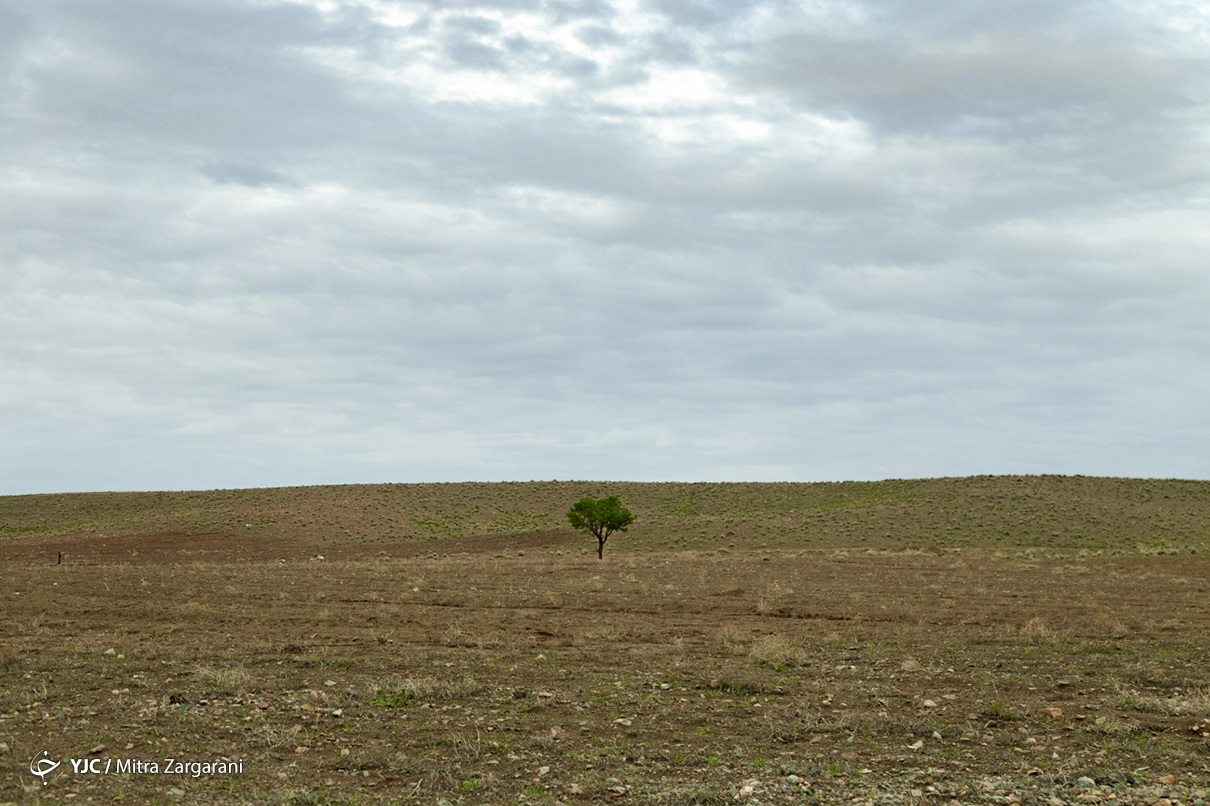
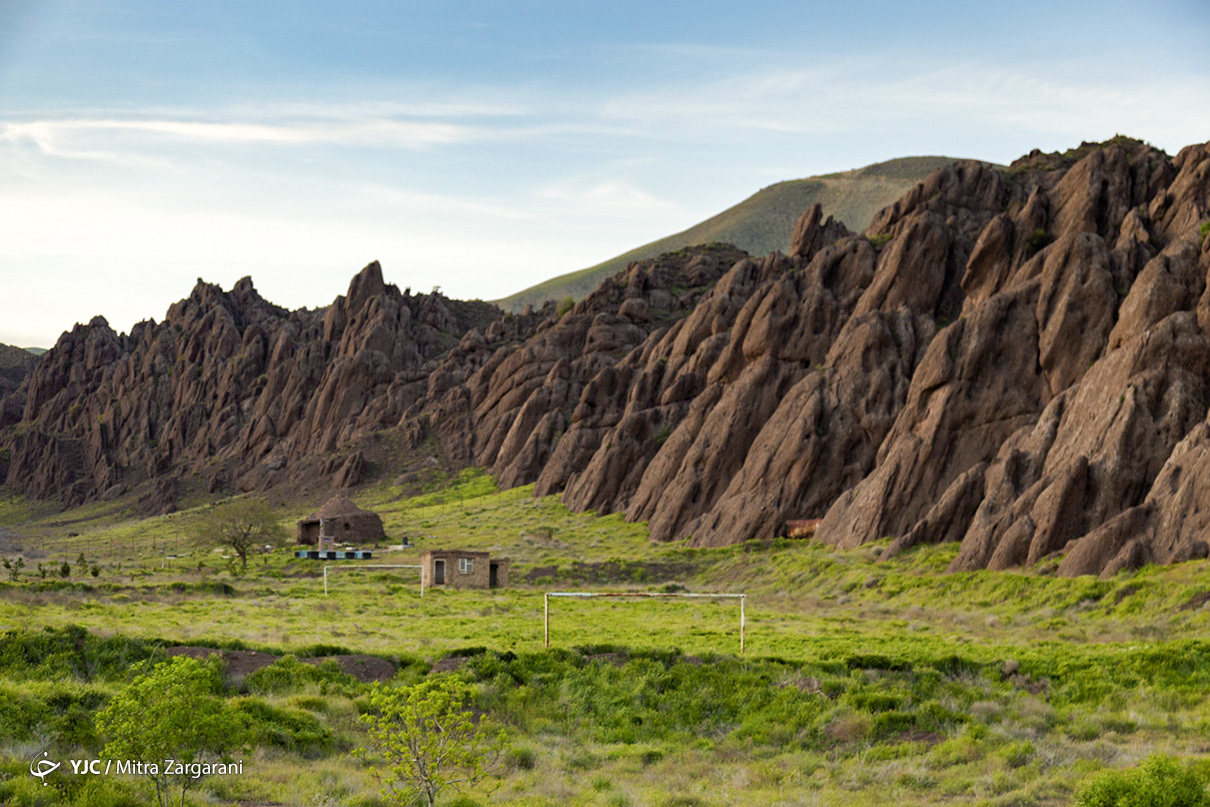
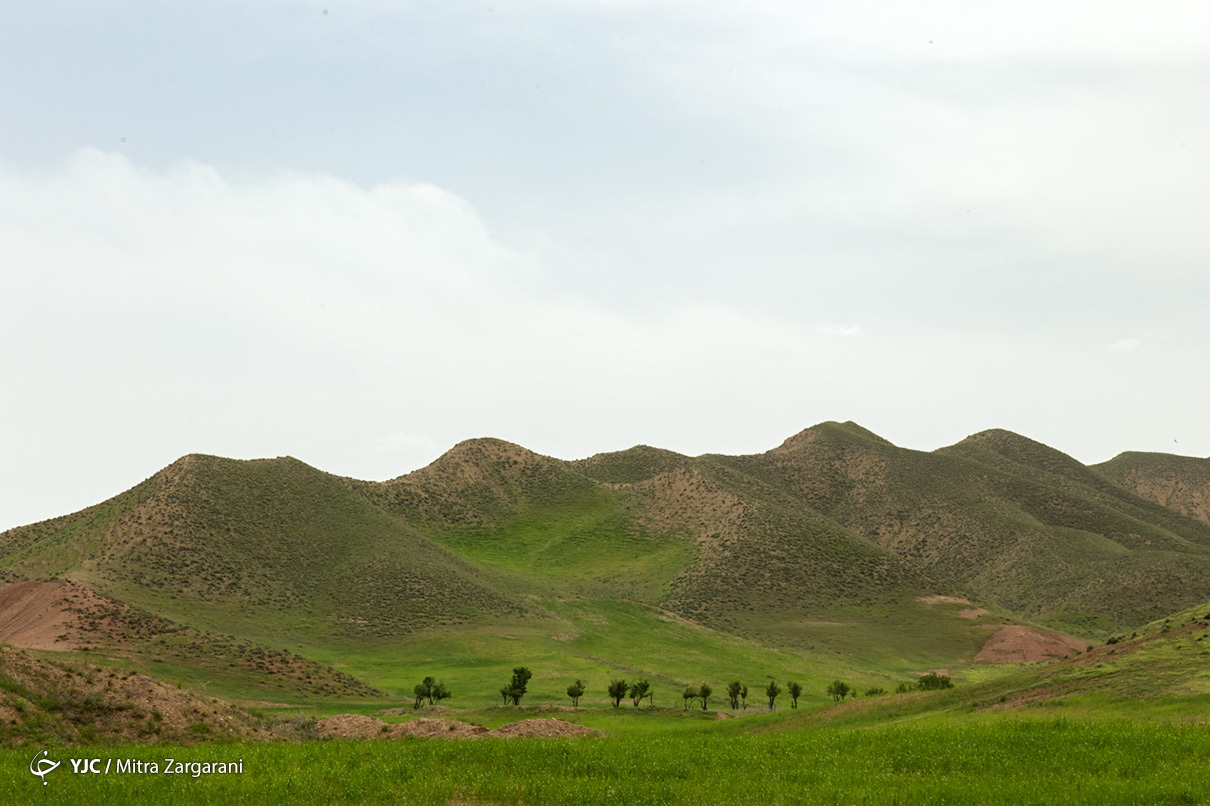
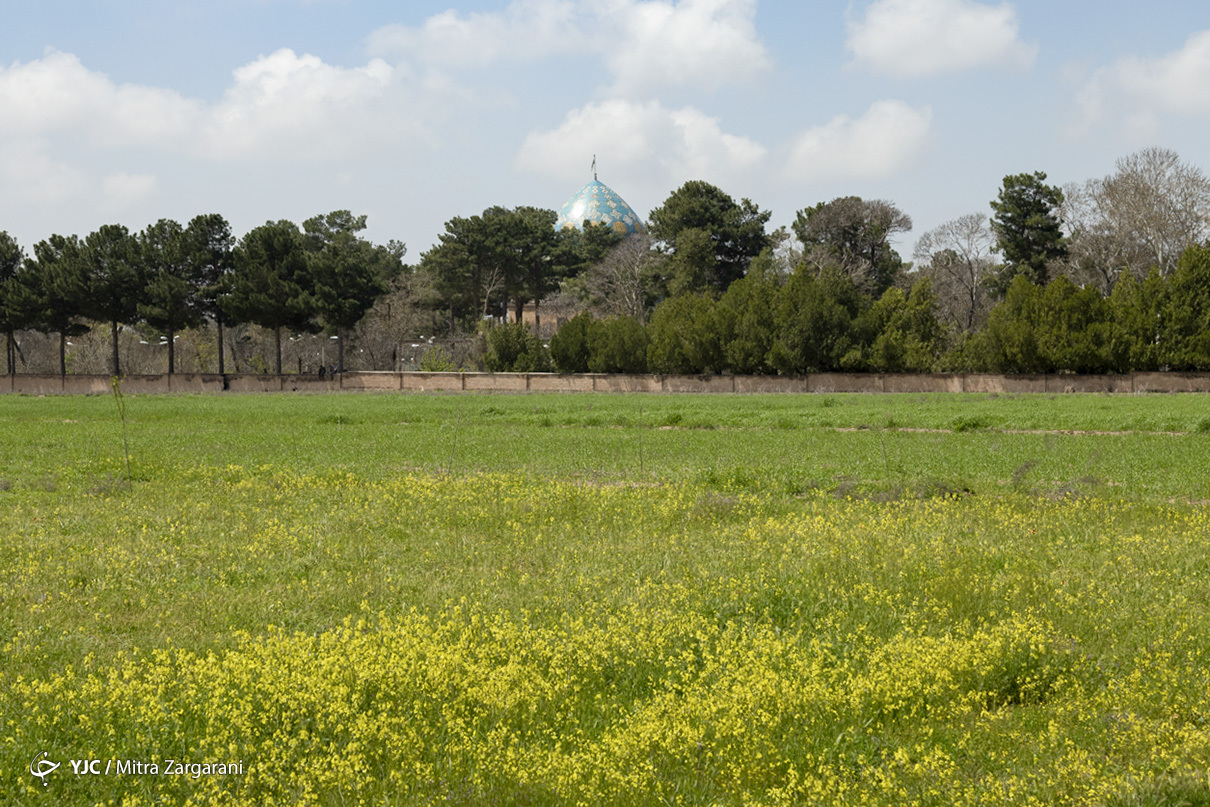
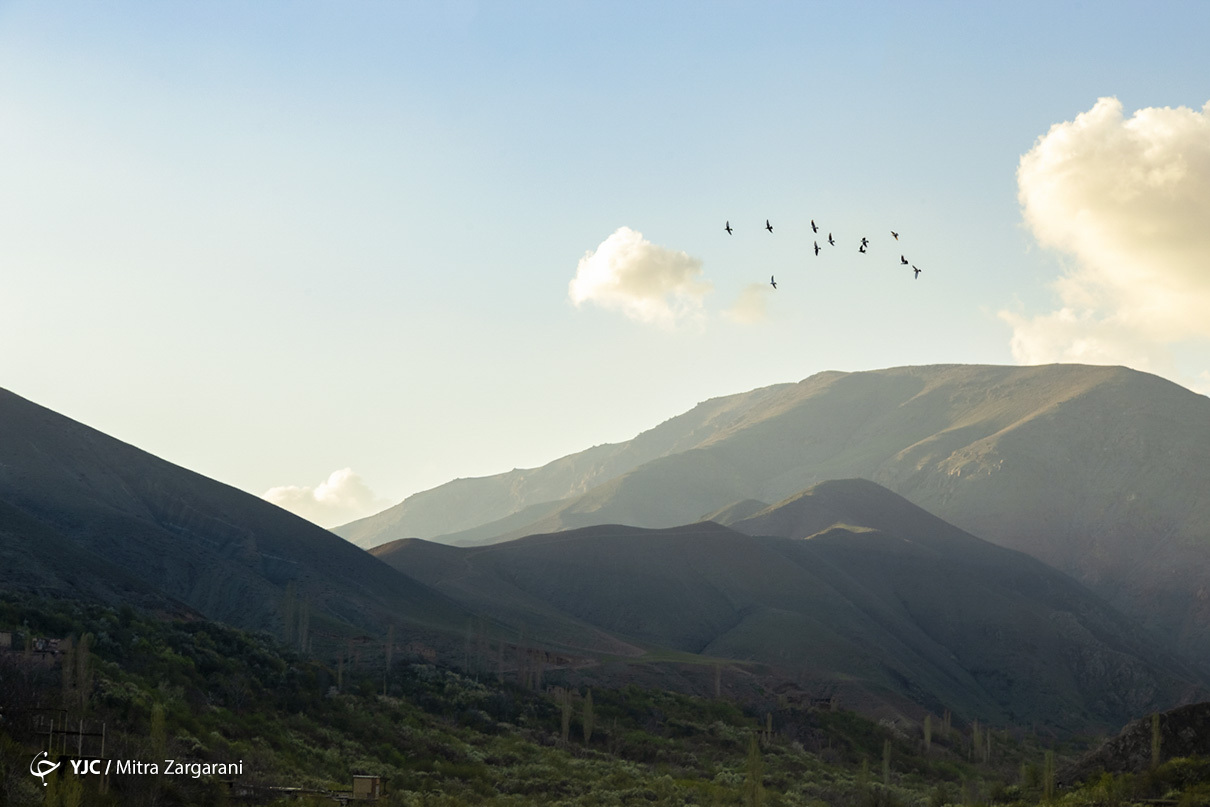
Nishapur is known for its history and civilization; but also a stunning nature. A large part of the city is situated in a large, highly fertile plain. The county includes four districts, seven cities and 13 villages.

There is a large difference of about 2,300 metres between the altitude of Neishabour plain and the region’s mountains; which causes special climatic conditions in the city.

What follows are YJC’s photos of Nishapur’s nature:

Iran May Buy Russian Vaccine for COVID-19 If Approved by WHO

Iran, Russia to Work Together to Produce COVID-19 Vaccine

Speaking to reporters on the sidelines of a cabinet session on Wednesday, Vaezi said Iran will definitely purchase the coronavirus vaccine that is certified by the WHO.

On the possibility of buying the Russian vaccine, he said the Iranian Health Ministry is still evaluating the numerous vaccines produced in the world for coronavirus treatment.

While 28 vaccines have passed animal tests so far, Iran would be purchasing the vaccine that is approved by the WHO, although the country itself is developing the COVID-19 vaccine, Vaezi added.

“We need to assess the Russian vaccine to see if we’d purchase that vaccine or the other ones,” the president’s chief of staff noted.

Last week, Iran’s health minister said a number of vaccines for the novel coronavirus being developed inside the country have successfully passed the human tests and are ready for clinical trial.

On August 11, Russian President Vladimir Putin said his country has become the first country to approve a vaccine offering “sustainable immunity” against the coronavirus.

Russian Ambassador to Tehran Levan Jagarian has also expressed his country’s readiness to supply Iran with the new vaccine.

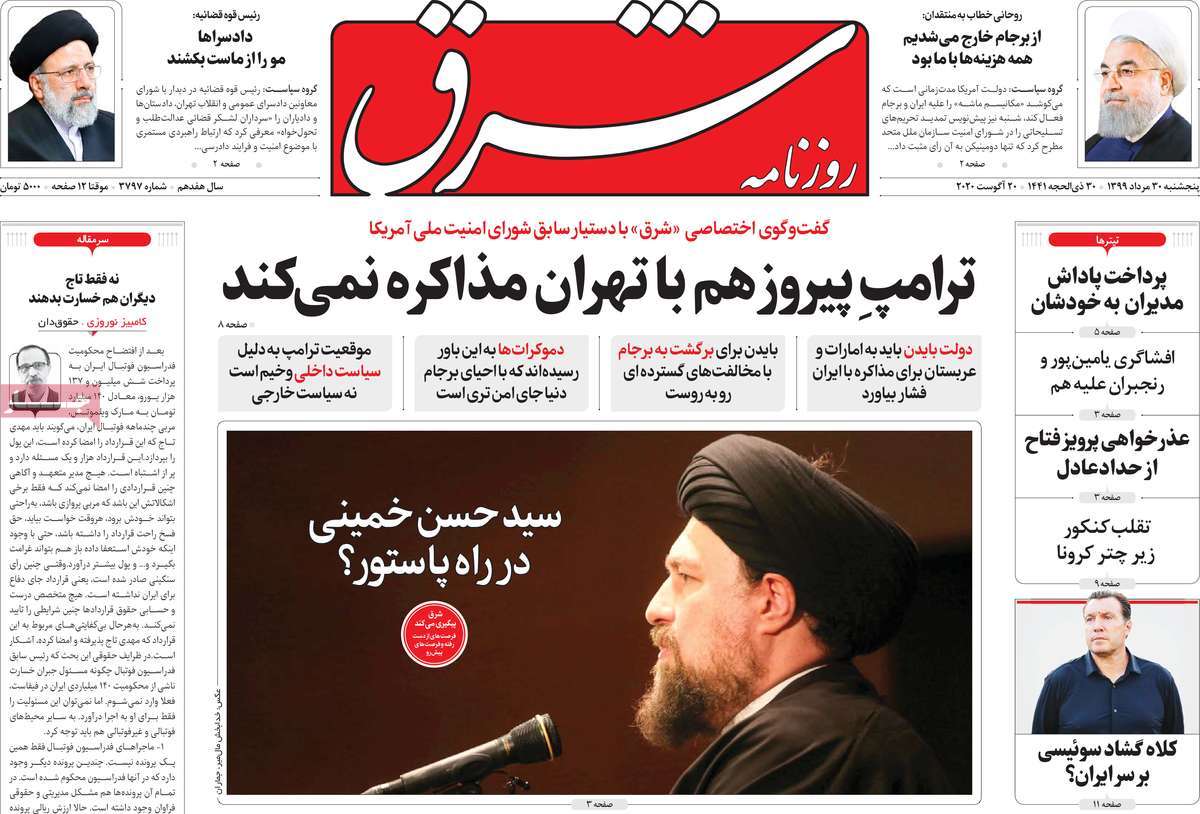
A Look at Iranian Newspaper Front Pages on August 20

A Look at Iranian Newspaper Front Pages on November 18

Iranian Newspapers

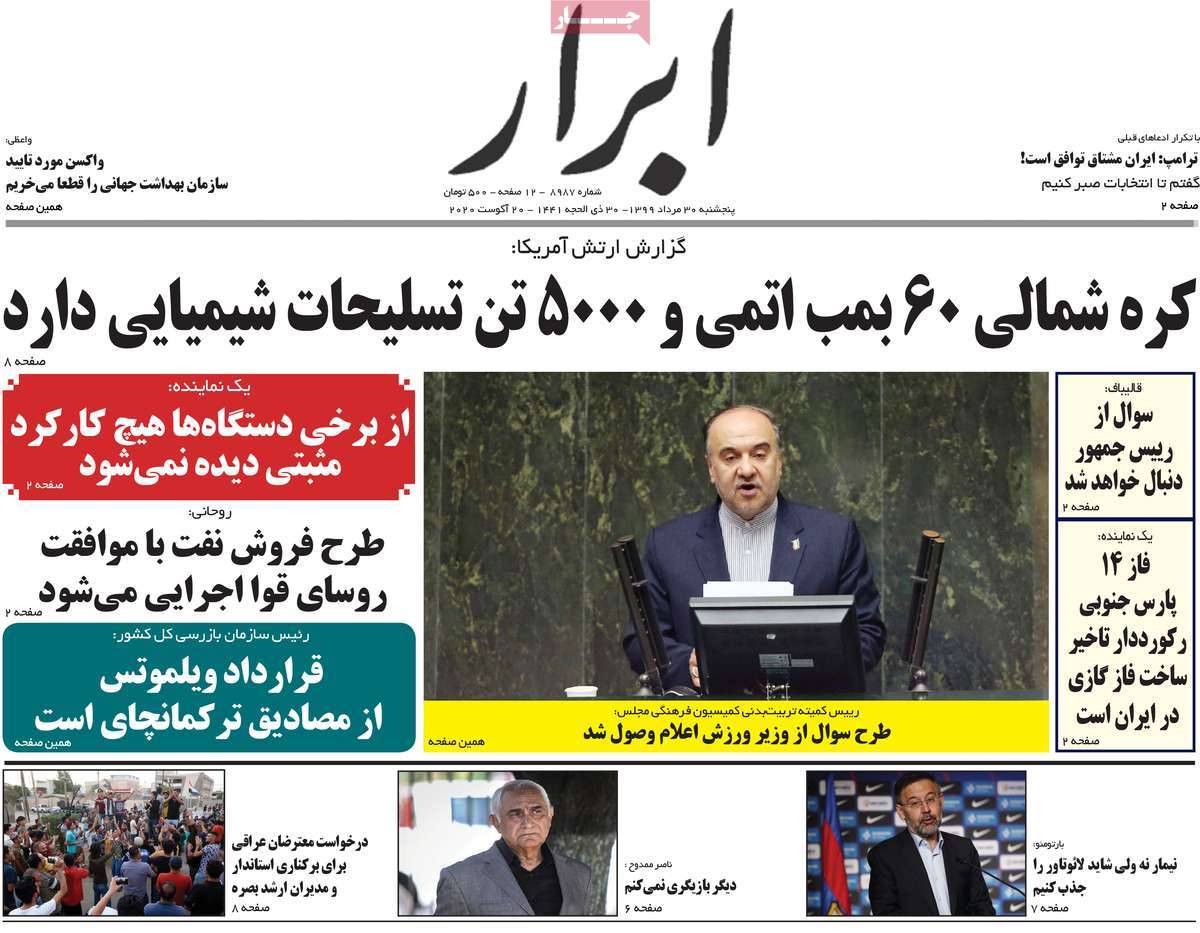
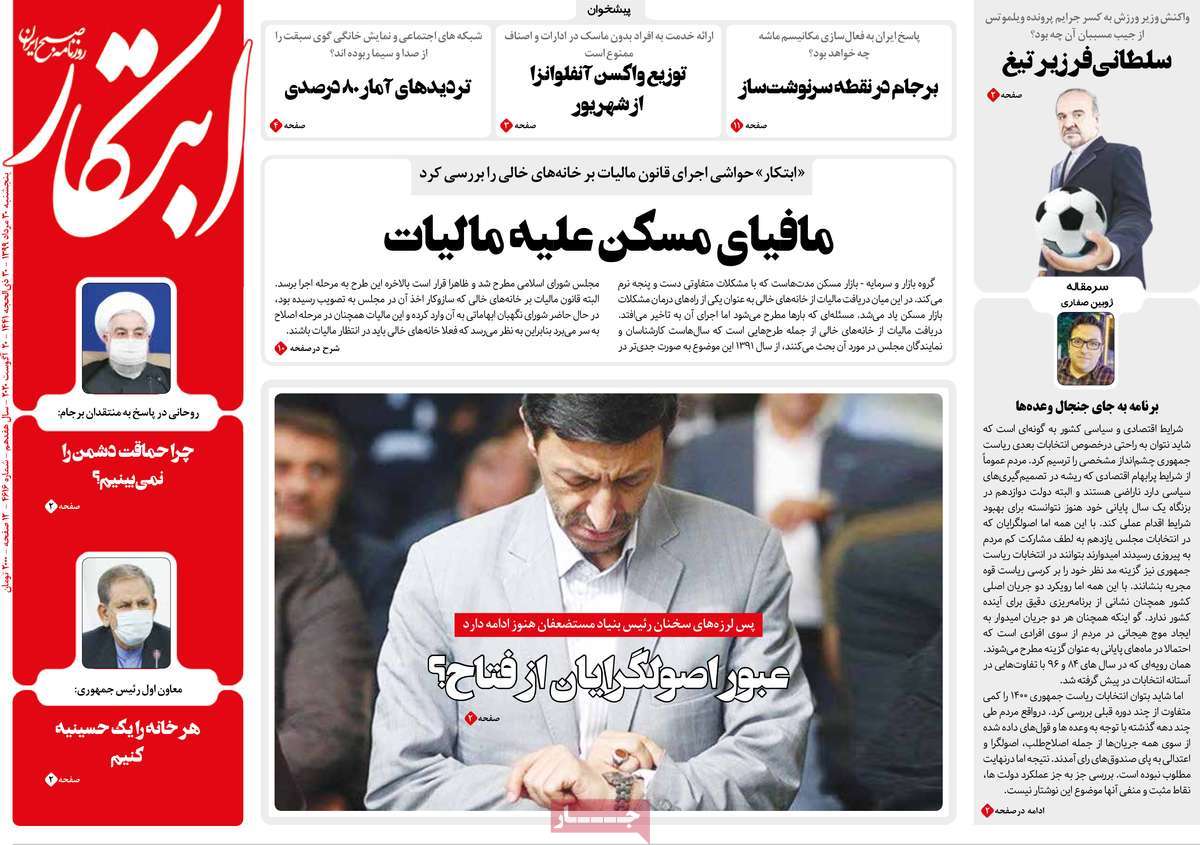
Abrar Newspaper:

1- US Army Report Claims N Korea Has 60 Atomic Bombs, 5,000 Tonnes of Chemical Weapons

2- Vaezi: Iran Will Definitely Buy WHO-Approved Vaccine for COVID-19

3- Trump: Iran Eager for Deal!

4- Rouhani: Oil Sale Plan to Be Implemented If Approved by Judiciary Chief, Parliament Speaker

A Look at Iranian Newspaper Front Pages on August 20


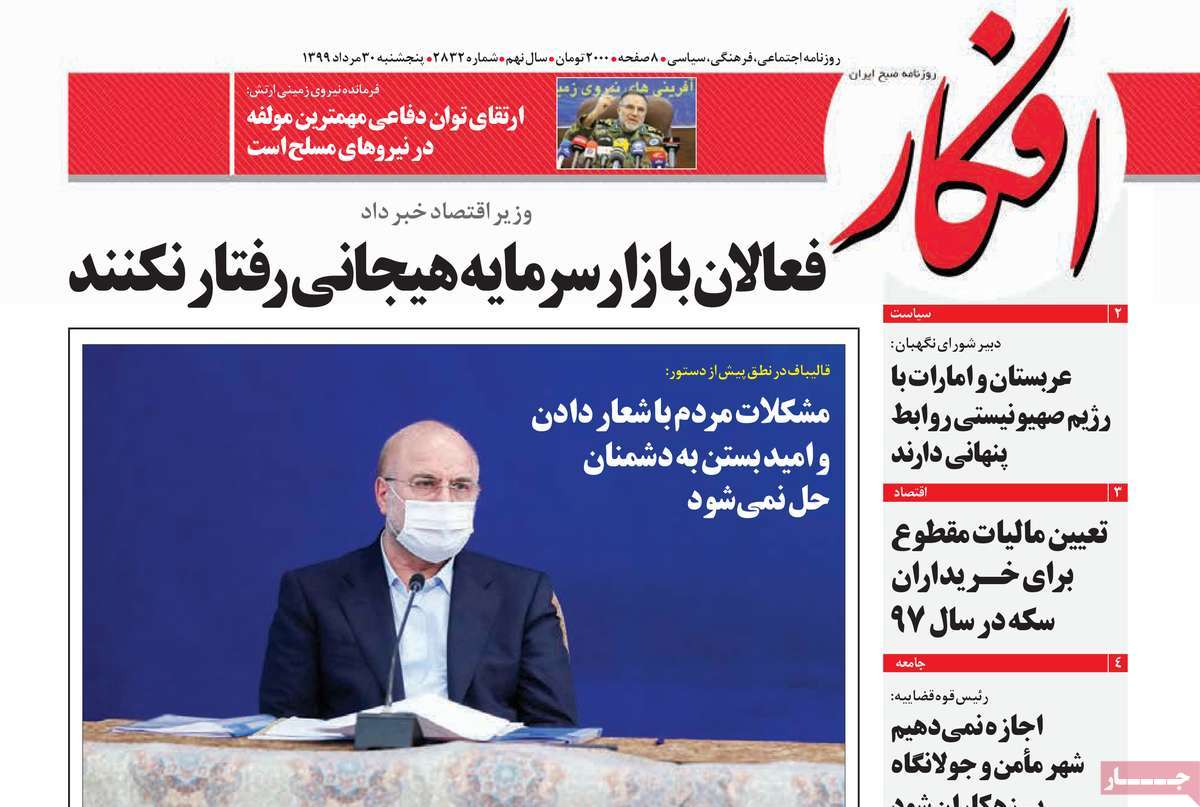
Afkar Newspaper:

1- Saudi, UAE Have Covert Ties with Israel: Guardian Council

A Look at Iranian Newspaper Front Pages on August 20


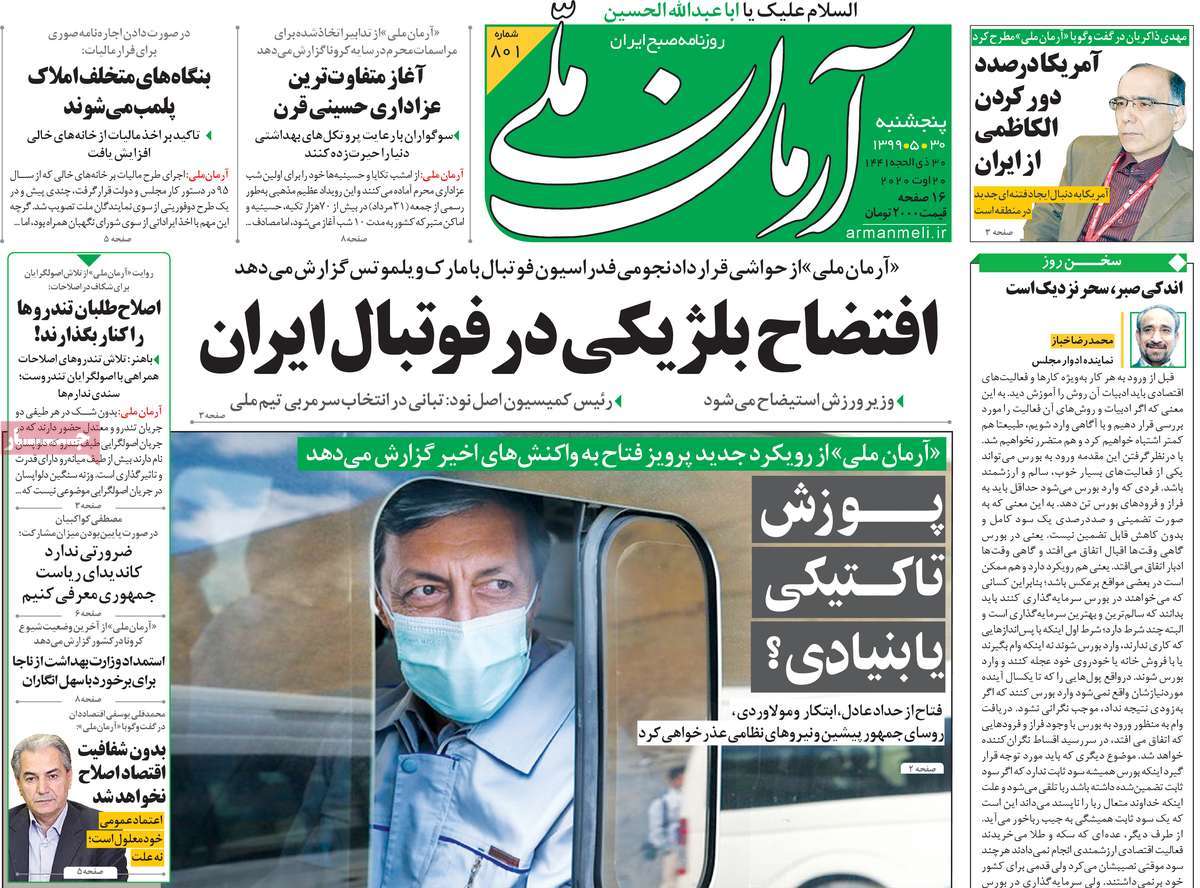
Arman-e Melli Newspaper:

1- US Seeks to Keep Al-Kadhimi Away from Iran

2- Belgian Scandal in Iran: Controversies over Wilmots Deal with Football Federation

A Look at Iranian Newspaper Front Pages on August 20


Ebtekar Newspaper:

1- JCPOA at Turning Point: How Will Iran Respond to Activation of Trigger Mechanism?

2- Rouhani to JCPOA Critics: Why Don’t We See Any Stupidity from Enemies?A Look at Iranian Newspaper Front Pages on August 20


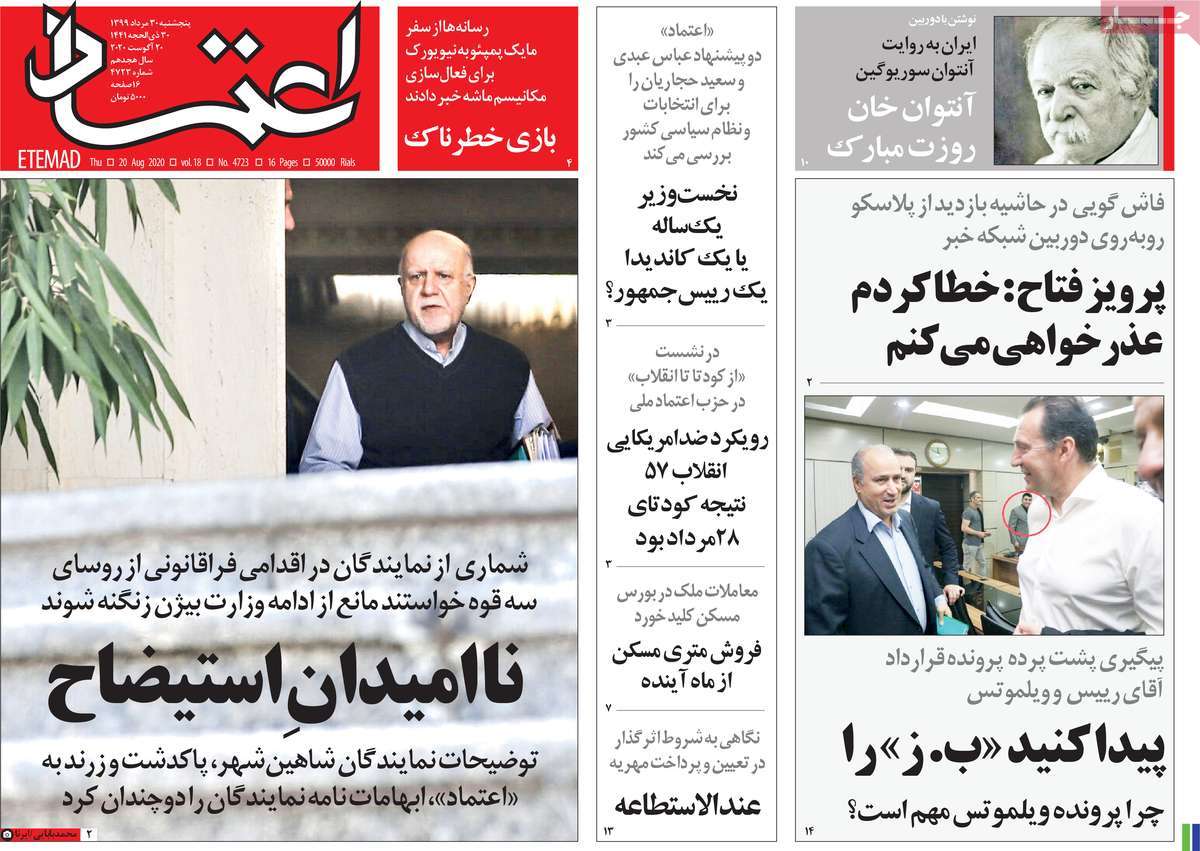
Etemad Newspaper:

1- Reports Say Pompeo Visits New York to Activate Snapback Mechanism

A Look at Iranian Newspaper Front Pages on August 20


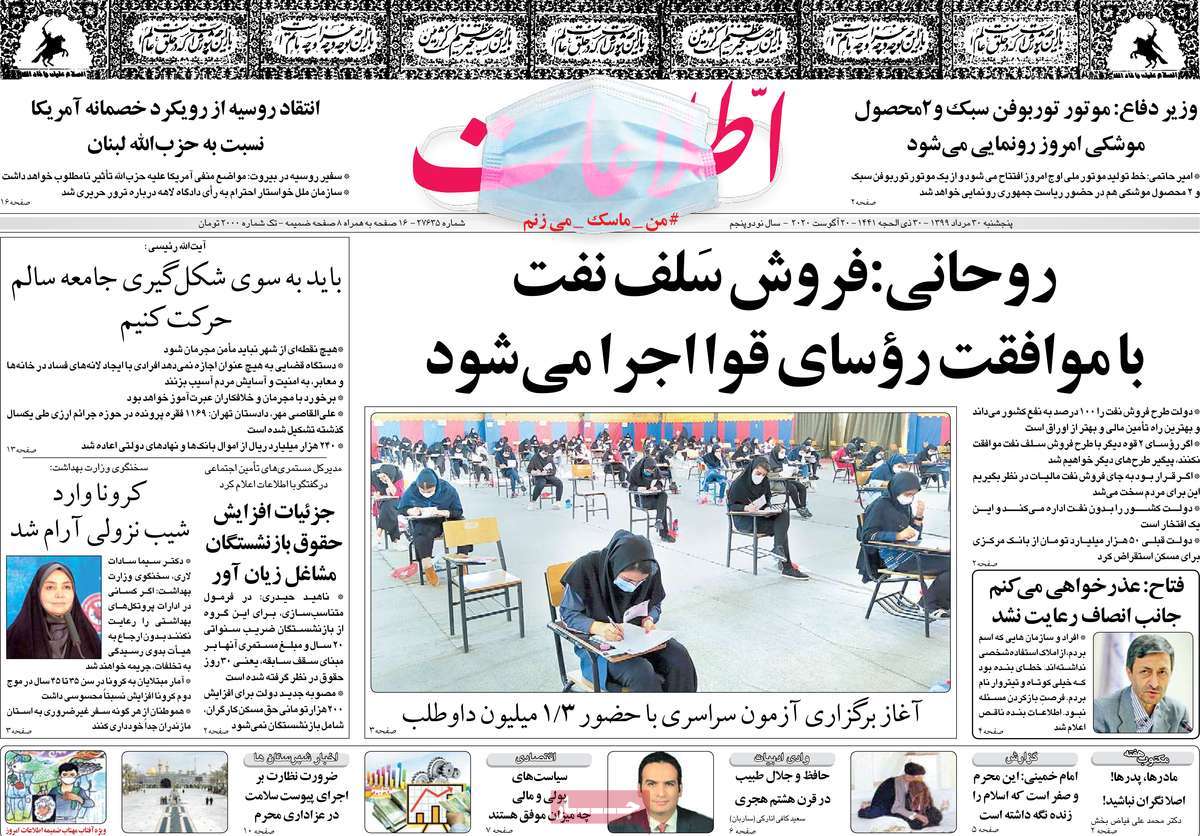
Ettela’at Newspaper:

1- Rouhani: If Heads of All Trio Branches of Power Agree, We’ll Sell Oil Bonds to People

2- Russia Slams US Hostile Approach to Lebanon’s Hezbollah

A Look at Iranian Newspaper Front Pages on August 20


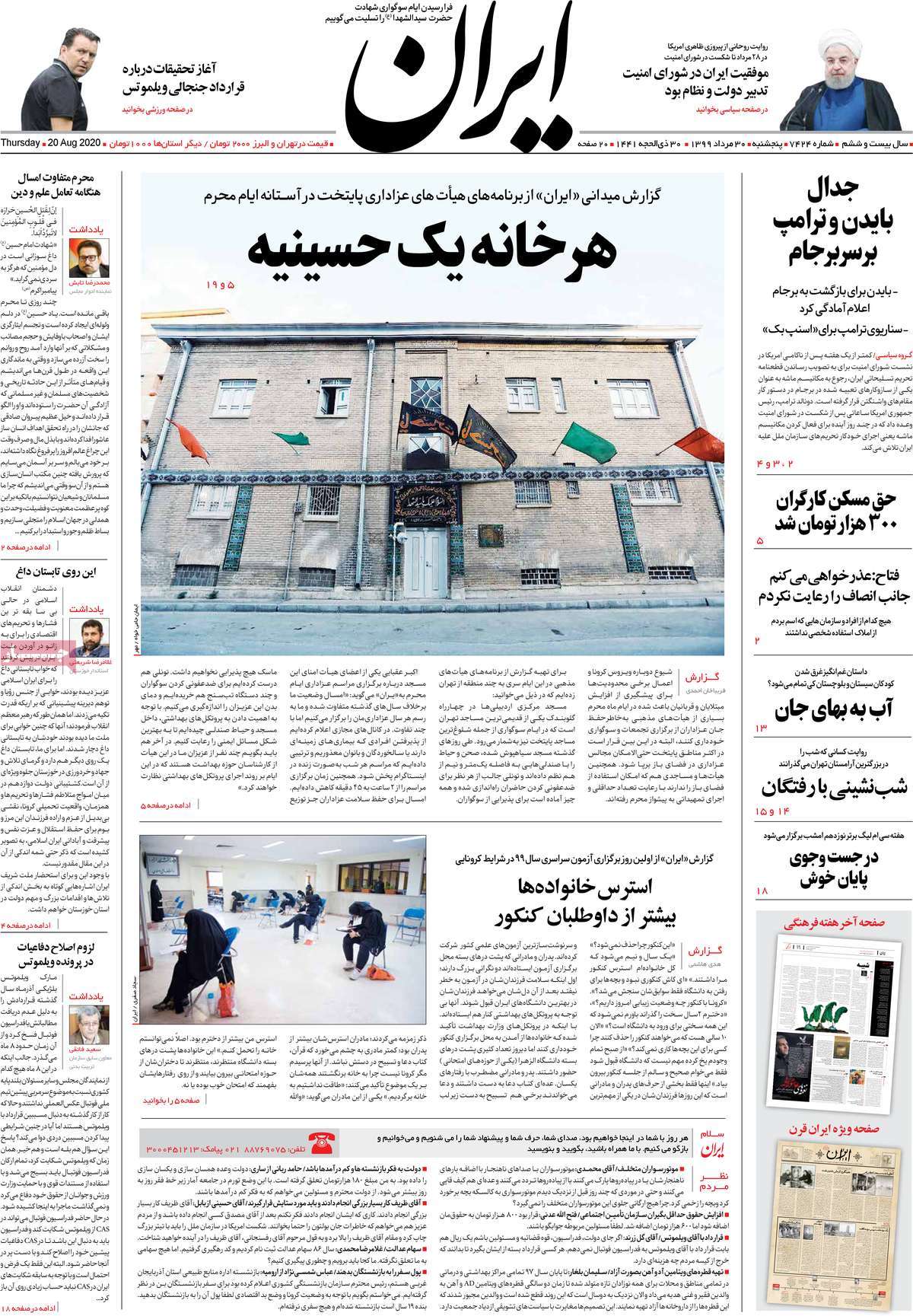
Iran Newspaper:

1- Iran’s Success at UNSC Was Result of Government’s Prudence

2- Biden-Trump Clash over JCPOA

A Look at Iranian Newspaper Front Pages on August 20


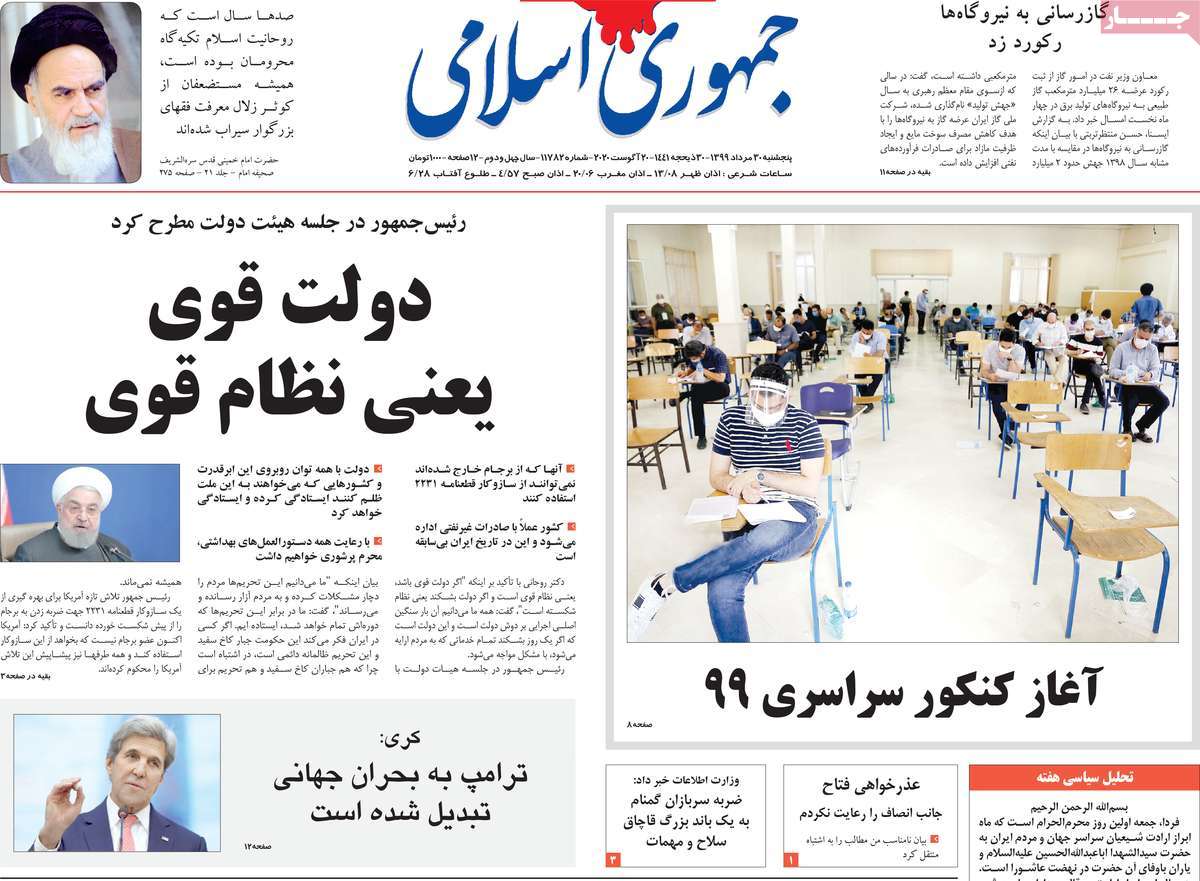
Jomhouri Eslami Newspaper:

1- Strong Government Means Strong Establishment: Rouhani

2- Kerry: Trump Has Turned into Global Crisis

A Look at Iranian Newspaper Front Pages on August 20


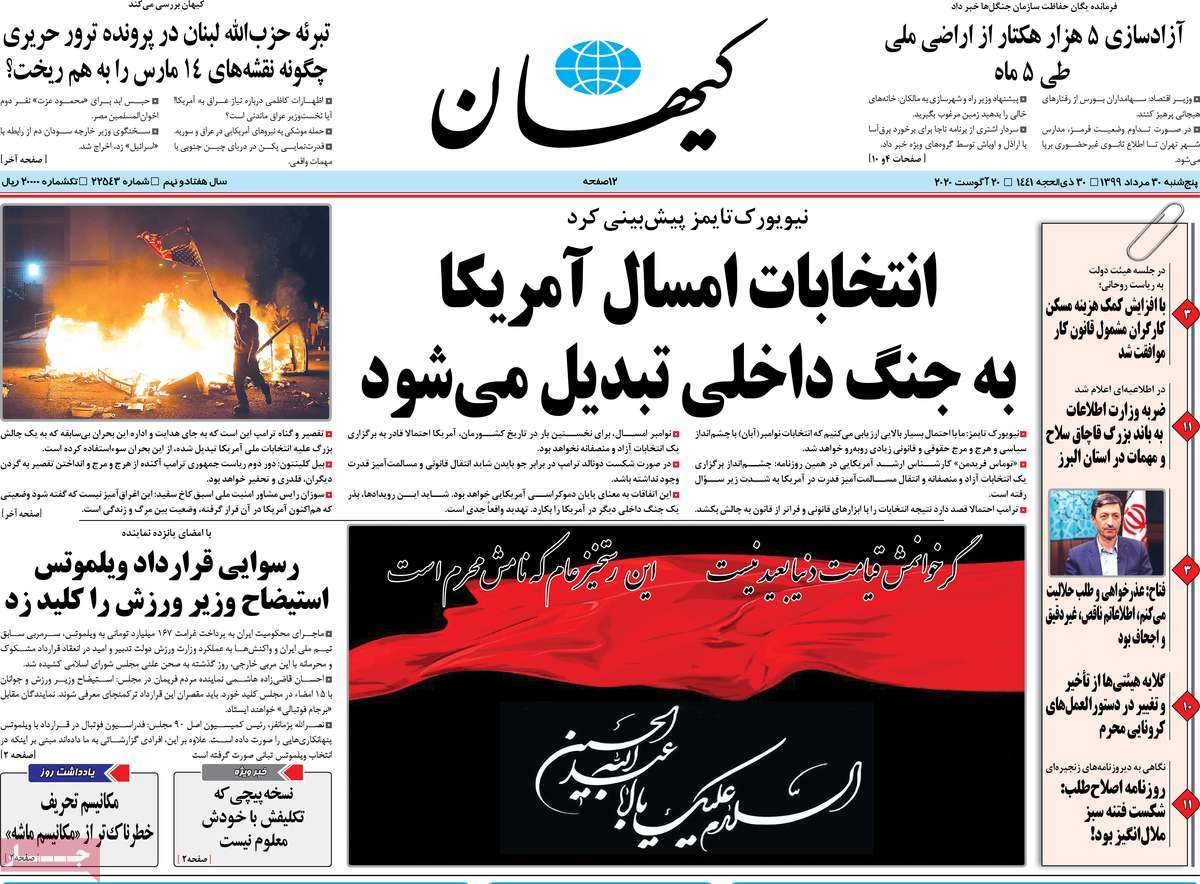
Kayhan Newspaper:

1- Nov. Elections Will Turn into Civil War: NY Times

2- Lebanese Hezbollah Exonerated over Rafic Hariri Case: How March 14 Plots Were Foiled

A Look at Iranian Newspaper Front Pages on August 20


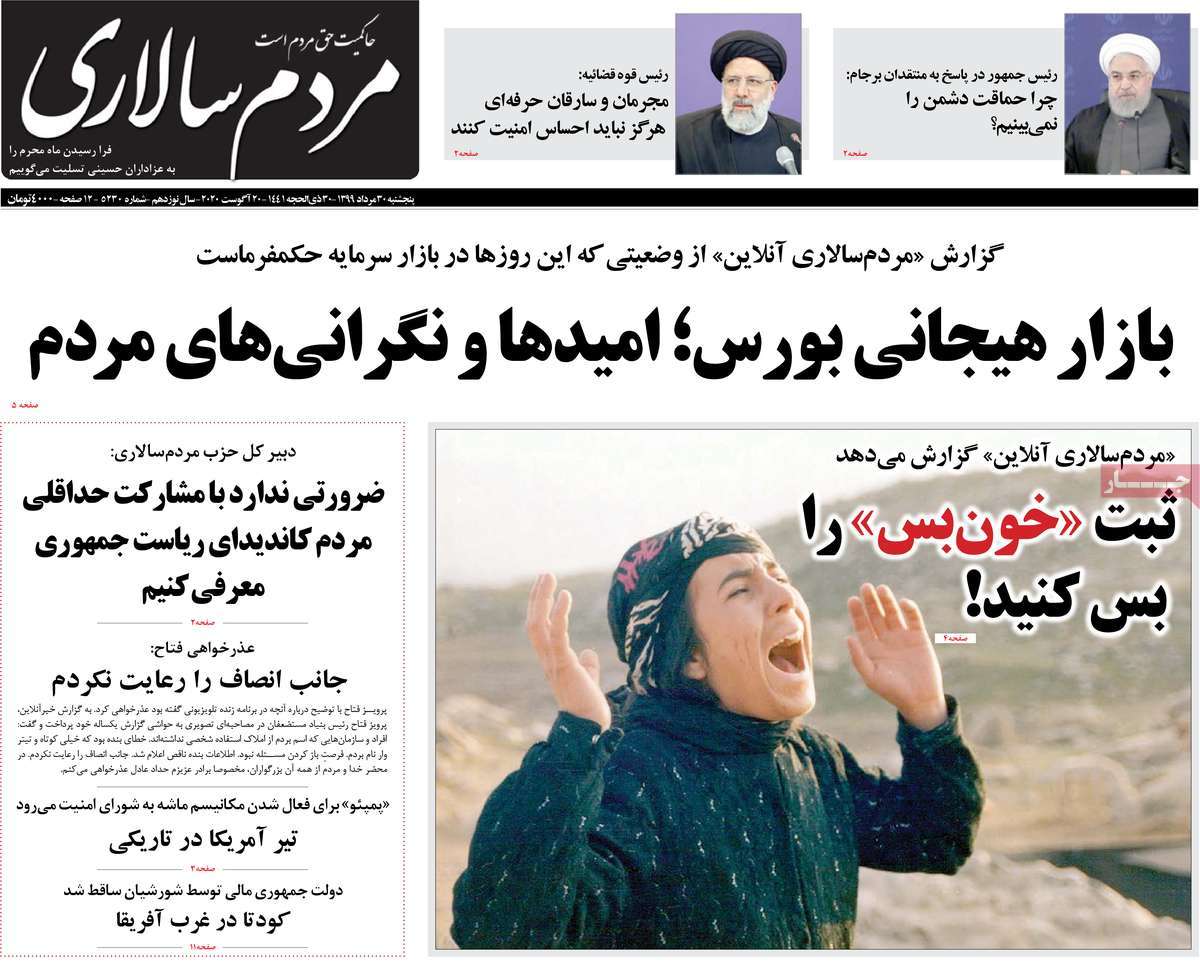
Mardom Salari Newspaper:

1- Pompeo to Go to UNSC for Activating Snapback Mechanism

A Look at Iranian Newspaper Front Pages on August 20


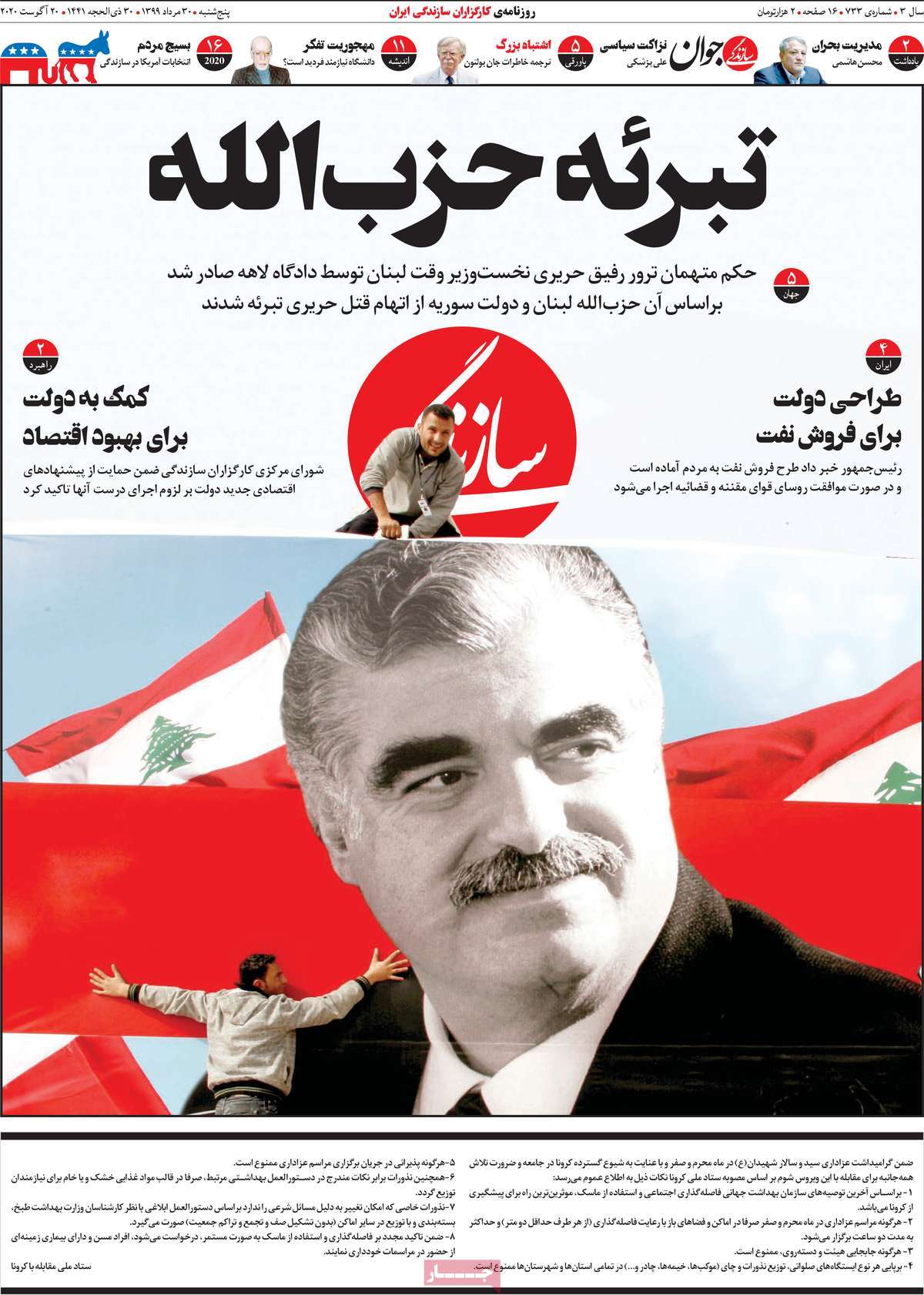
Sazandegi Newspaper:

1- Hezbollah, Syrian Gov’t Cleared from Charges over Rafic Hariri Case

A Look at Iranian Newspaper Front Pages on August 20


Shargh Newspaper:

1- Critics Must Know We’d Have to Bear All Costs Had We Left JCPOA

2- Trump Won’t Negotiate with Iran Even If Re-elected: Former US National Security AdvisorA Look at Iranian Newspaper Front Pages on August 20

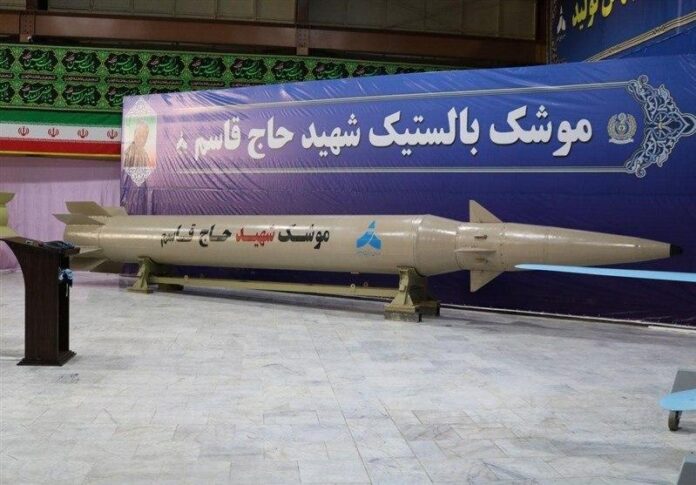
Iran Unveils ‘Soleimani’ Ballistic Missile with Range of 1,400km

Iran Unveils ‘Soleimani’ Ballistic Missile with Range of 1,400km

In a televised speech on Thursday, Defence Minister Brigadier General Amir Hatami said the country has also unveiled a new homegrown cruise missile.

“The surface-to-surface missile, called martyr Qassem Soleimani, has a range of 1,400 km and the cruise missile, called martyr Abu Mahdi, has a range of over 1,000 km,” Hatami said.

Pictures of the new missiles, which were unveiled on the National Day of Defence Industry, were shown on state TV.

“The country’s achievements in the defense industry over the past four decades are not comparable to any other period,” said Hatami, describing the accomplishments as a “basis for military self-reliance and a must for [maintaining] the country’s independence.”

Commenting on the new achievement’s features, Iran’s Deputy Defense Minister Brigadier General Qassem Taqizadeh said the speed of the Martyr Qassem Soleimani missiles makes their interception impossible.

He added that the cruise missiles are capable of flying at a low altitude and getting around the enemy’s missile systems.

The new ballistic missile is an upgraded version of the pinpoint-accuracy missile Fateh-110, according to Tasnim.

General Soleimani, the commander of IRGC Quds Force, and Iraqi military commander Abu Mahdi al-Muhandis were assassinated in January in a US drone strike on their convoy in Baghdad airport.

Earlier, the Iranian president had noted that “missiles and particularly cruise missiles are very important for us … the fact that we have increased the range from 300 to 1,000 in less than two years is a great achievement.”

The new missiles were unveiled as the United States is pushing in vain to extend a UN-imposed arms embargo against Iran, which is due to expire in October under Tehran’s 2015 nuclear deal with world powers.

Iran’s Zarif Congratulates Omani Counterpart on Taking Office

Iran's Zarif Congratulates Omani Counterpart on Taking Office

In an Arabic post on his Twitter account on Wednesday, Foreign Minister Zarif congratulated his “brother and close friend” Badr bin Hamad Albusaidi on his appointment as the new Minister of Foreign Affairs of the brotherly Sultanate of Oman and succeeding Yusuf bin Alawi bin Abdullah.

“I wish brother Badr all the success in his career, and I hope that he would receive the necessary assistance and help from his brothers in Iran in carrying out this mission. I also wish brother Yusuf (bin Alawi) health and wellness,” Zarif added.

Oman’s Sultan Haitham on Tuesday appointed Badr Albusaidi as the Foreign Minister, replacing the long-serving Yusuf bin Alawi bin Abdullah in a government reshuffle.

Sultan Haitham, since his accession in January, has vowed to maintain Oman’s policy of neutrality and non-interference.

Albusaidi, 60, has been named Foreign Minister, a title held by late Sultan Qaboos himself but with Alawi responsible for foreign affairs for the past two decades.

Albusaidi has been in the diplomatic service since the 1980s and held a number of posts, including Foreign Ministry Secretary-General.