Monday, December 22, 2025
Home Blog Page 2637

Iran Urges Saudi Arabia, Israel to Come Clean on Nuclear Activities

Iran Urges Saudi Arabia, Israel to Come Clean on Nuclear Activities

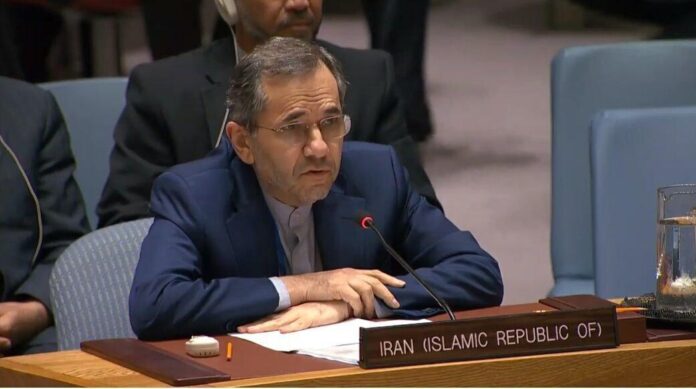
Majid Takht-Ravanchi underlined that the International Atomic Energy Agency (IAEA) should maintain its independence, neutrality and professionalism.

“If Saudi Arabia is seeking a peaceful atomic program, it should act transparently and allow IAEA inspectors to verify its nuclear work,” said Takht-Ravanchi at a meeting of the UN General Assembly on the annual report of the IAEA.

He then highlighted that the Israeli regime has not yet joined the Nuclear Non-Proliferation Treaty (NPT) and has not allowed verification of its nuclear activities. He urged the IAEA to adopt an independent and professional approach to settle this issue.

The Iranian ambassador also rejected any restrictions on peaceful nuclear activities, and highlighted the important role of nuclear energy in promoting countries’ economic and social development.

Takht-Ravanchi said the importance of nuclear energy is stipulated in the NPT and the Statute of the IAEA. He said one of the duties of the IAEA is to promote the peaceful use of nuclear energy and boost international cooperation among member states in that regard.

“By making a lot of efforts and investment in this field, the Islamic Republic of Iran has secured significant achievements and, at the moment, uses nuclear energy in the domains of power generation, medicine, agriculture and industry,” said Iran’s UN envoy.

“From the Islamic Republic of Iran’s standpoint, the IAEA’s verification duty, as stipulated in the agency’s statute, should be fulfilled in such a way that it does not eclipse member states’ inalienable right to promote peaceful use of nuclear energy,” he said.

He underscored even proliferation concerns should not restrict member states’ entitlement to peaceful use of nuclear energy.

“Accordingly, any attempts to restrict the peaceful use of nuclear energy should be rejected,” he said.

He further said that last year, 22 percent of the IAEA’s total inspections were conducted in Iran.

“Even at the height of the coronavirus outbreak, the agency’s activities in Iran did not stop,” said the ambassador.

Elsewhere in his remarks, Takht-Ravanchi touched upon the United States’ illegal withdrawal from the 2015 Iran nuclear deal known as the Joint Comprehensive Plan of Action (JCPOA).

“The US pullout from the JCPOA and the re-imposition of illegal sanctions against Iran and the United States’ failure to comply with UN Security Council Resolution 2231 have kept the Islamic Republic of Iran from enjoying the rights stipulated in the resolution,” Takht-Ravanchi noted.

“The JCPOA, as an important multilateral accomplishment which enjoys unflinching international support, is under intense pressure due to the United States’ unilateral actions,” he said.
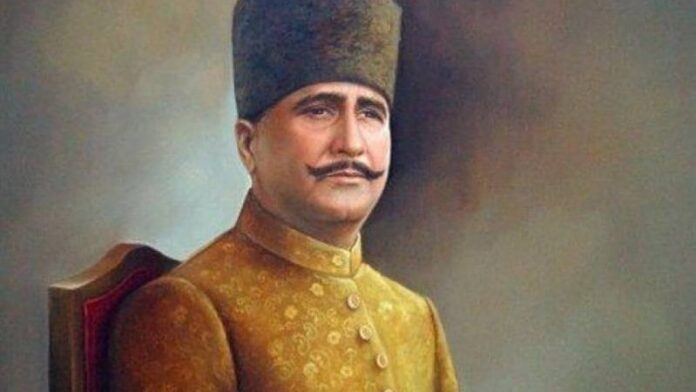
Iran’s Foreign Minister Pays Tribute to Allama Iqbal

Iran’s Foreign Minister Pays Tribute to Allama Iqbal

The Wednesday ceremony was also attended by Pakistani Foreign Minister Shah Mahmood Qureshi.

Before departing Tehran for Islamabad, the Iranian foreign minister had congratulated the people of Pakistan on Iqbal Lahori Day.

In a tweet on Monday, Zarif said Allama Iqbal is the pride of the Islamic world and an international poet and thinker.

“His concern for unity among Muslims is currently one of the problems facing the Islamic world. Happy Iqbal Day to all Pakistanis.”

Muhammad Iqbal was a Muslim poet, philosopher, and politician from Punjab, British India, whose poetry in Urdu and Persian is considered to be among the greatest of the modern era, and whose vision of an independent state for the Muslims of British India was to inspire the creation of Pakistan.

Iran’s Foreign Minister Pays Tribute to Allama Iqbal

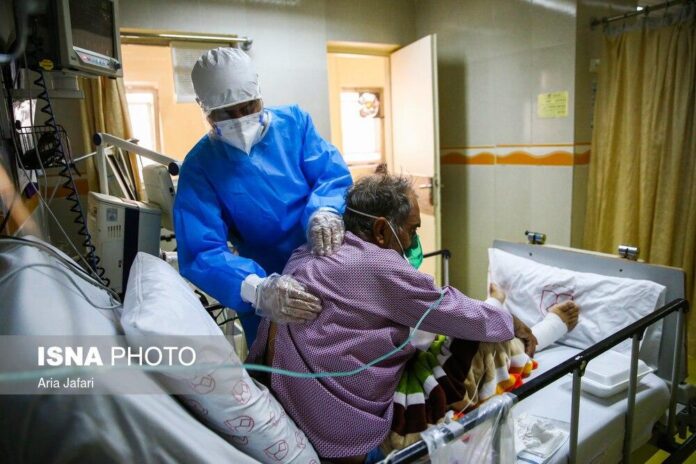
Coronavirus Figures Continue to Rise in Iran

Coronavirus Figures Continue to Rise in Iran

In a press briefing on Wednesday, Sima-Sadat Lari said the new cases raise the total number of cases to 715,068, and the new fatalities increase the overall death toll to 39,664.

So far, she added, 536,105 patients have recovered from the disease or been discharged from the hospital.

Lari said 5,601 patients are also in critical conditions caused by more severe infection.

The spokeswoman noted that 5,344,821 COVID-19 tests have been taken across the country so far.

She said the high-risk “red” zones include Tehran, Qom, Mazandaran, East Azarbaijan, Isfahan, Yazd, Ardabil, Khorasan Razavi, Khuzestan, Hamadan, West Azarbaijan, Bushehr, Chaharmahal and Bakhtiari, Kohgiluyeh and Boyer-Ahmad, Alborz, Lorestan, Markazi, Ilam, South Khorasan, Kermanshah, North Khorasan, Semnan, Gilan, Zanjan, Qazvin, Kurdistan, and Kerman provinces.

The “orange” and “yellow” zones also include Golestan, Hormozgan, Fars, and Sistan and Baluchestan provinces, she added.

US Admin Dreaming of Iran’s Collapse Toppled Humiliatingly: President

US Admin Dreaming of Iran’s Collapse Toppled Humiliatingly: President

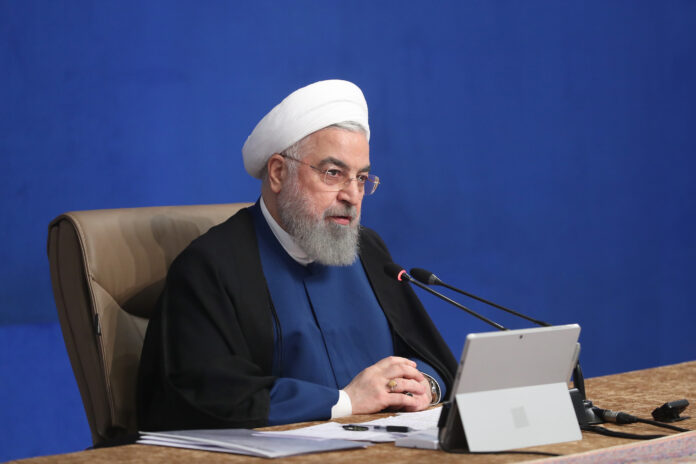
Addressing a weekly cabinet session on Wednesday, President Rouhani said the US administration that dreamed about the Iranian establishment’s collapse has been toppled in a humiliating manner.

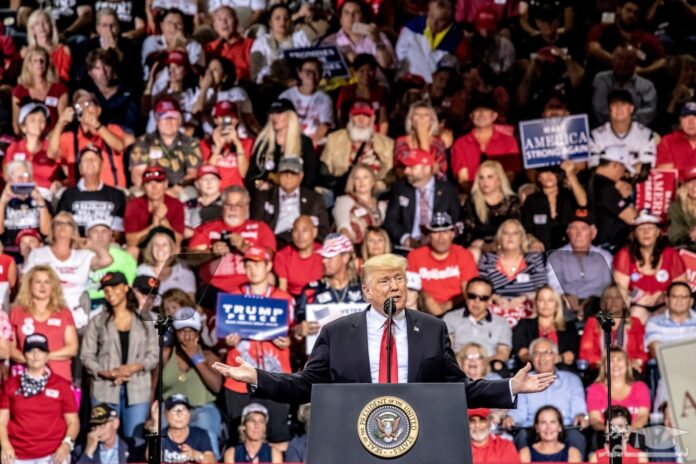
“Last week, the world saw a considerable development. The (US’) arrogant policies that came with the humiliation of a number of nations, even a number of nations in our region -as he (Trump) had explicitly called them milking cows- and the policies that had disgusted the whole world nations and even the people of the US itself, were decisively opposed by people in election,” President Rouhani said about the defeat of Donald Trump in the last week’s US presidential election.

“This was highly significant, meaning that the regime that dreamed about the collapse of Iran and the collapse of the Iranian establishment has been itself overthrown very humiliatingly. Today, you can see that apart from (the support for the US provided by) a number of tiny countries that have been always among the cohorts of that (US) regime, they (American officials) are now facing and experiencing new conditions across the country,” the Iranian president added.

“Also inside our country, the expectations of the society and people are undergoing a change and evolution, meaning that the inflation expectations and the stagnation expectations have turned into expectations of boom with the hope about the future conditions,” the president stated.

“However, it doesn’t mean that such hope is based on how our relations with the US government are… The basis of our relations are founded on (ties) with the neighboring countries and our friends,” President Rouhani underlined.

“The US government, as the regime of the outgoing American administration, has been unfortunately playing a role as a disturbance to our relations with the other countries. They (friends of Iran) sense that such disturbance is being removed, and the situation has been further prepared for activities on the basis of their interests,” the Iranian president said.

“Over the past years, we’ve established very good relations, particularly with a number of our neighbors, like Iraq, Turkey, Afghanistan, (the Republic of) Azerbaijan, and the other countries that are our friends in this region, (including) with Russia, China, and the others. We have the feeling that the atmosphere has become more prepared for closer ties and better interaction with all of our friends,” he concluded.

Iran’s Foreign Minister, Pakistani PM Meet in Islamabad

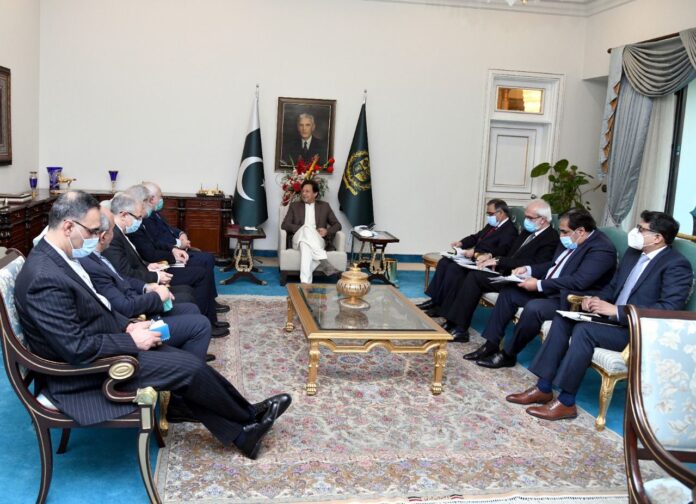
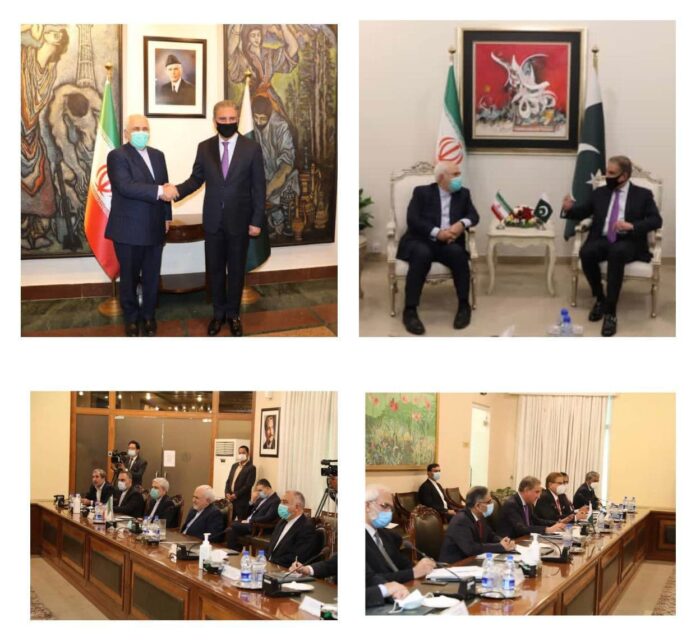
Foreign Minister Zarif, who has already met senior Pakistani political and military authorities in an official visit to Islamabad, had a meeting with Prime Minister Khan on Wednesday evening.

Highlighting the amicable political relations between Iran and Pakistan, Foreign Minister Zarif said in the meeting, “The neighbouring countries are prioritized in the Islamic Republic’s foreign relations for cooperation.”

Pointing to the ample opportunities for the promotion of bilateral trade and economic interaction, the Iranian minister touched on a number of plans for the expansion of economic cooperation, such as convening the Economic Cooperation Joint Commission, reopening the border crossings and border markets, and enhancement of bilateral trade and barter system.

Foreign Minister Zarif also expressed gratitude to Pakistan for supporting Iran’s accession to the Shanghai Cooperation Organisation.

For his part, Prime Minister Imran Khan expressed satisfaction with the negotiations that the visiting Iranian foreign minister has held with the Pakistani officials, and reaffirmed his country’s willingness to broaden the political and economic relations with Iran.

The Pakistani premier also expressed hope for the expansion of bilateral ties between Islamabad and Tehran.

The Pakistani leader and the Iranian foreign minister further discussed the regional and international issues, specifically the developments in Afghanistan and the Islamic world.

In the meeting, Foreign Minister Zarif praised the Pakistani prime minister’s stances against the Zionist regime and the process of normalization of ties with Israelis.

Foreign Minister Zarif earlier held separate meetings with his Pakistani counterpart Shah Mahmood Qureshi and with Chief of the Army Staff of Pakistan General Qamar Javed Bajwa during his stay in Islamabad.

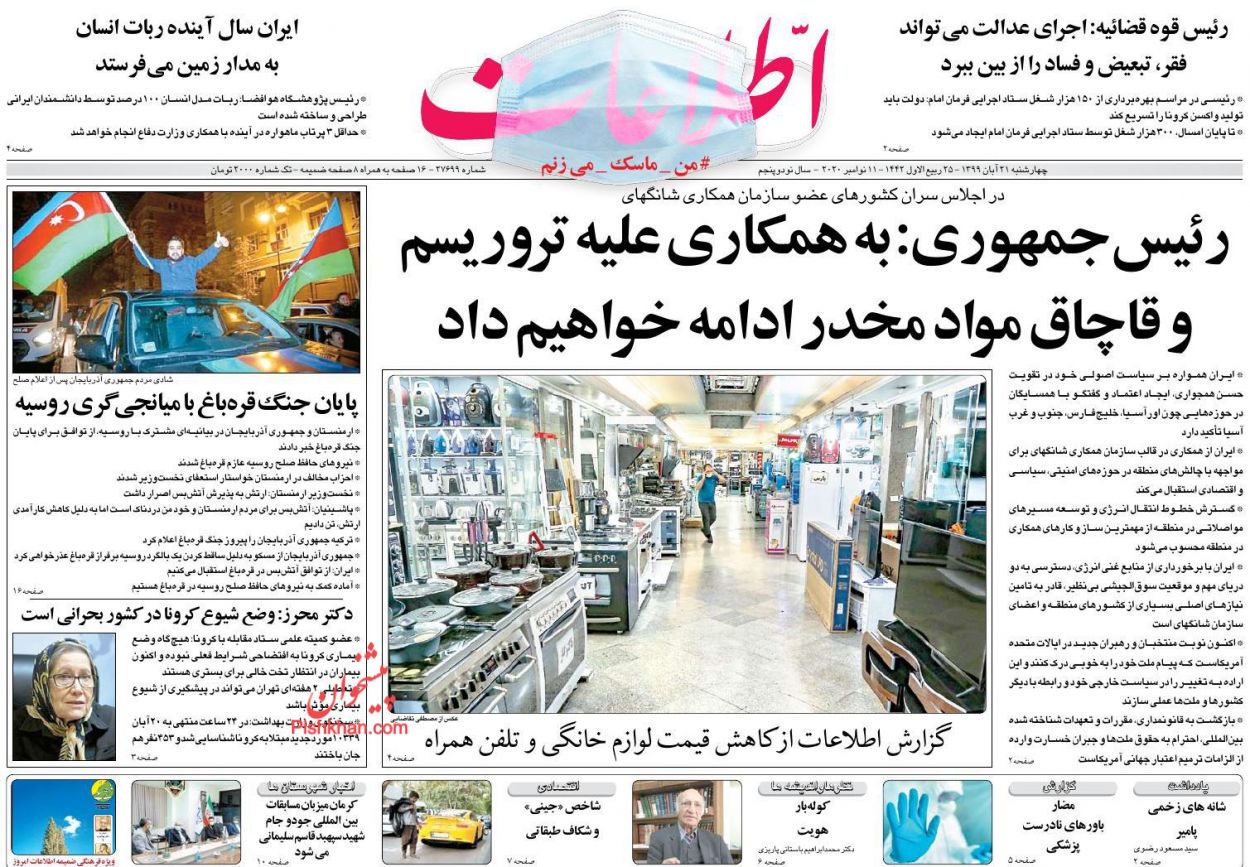
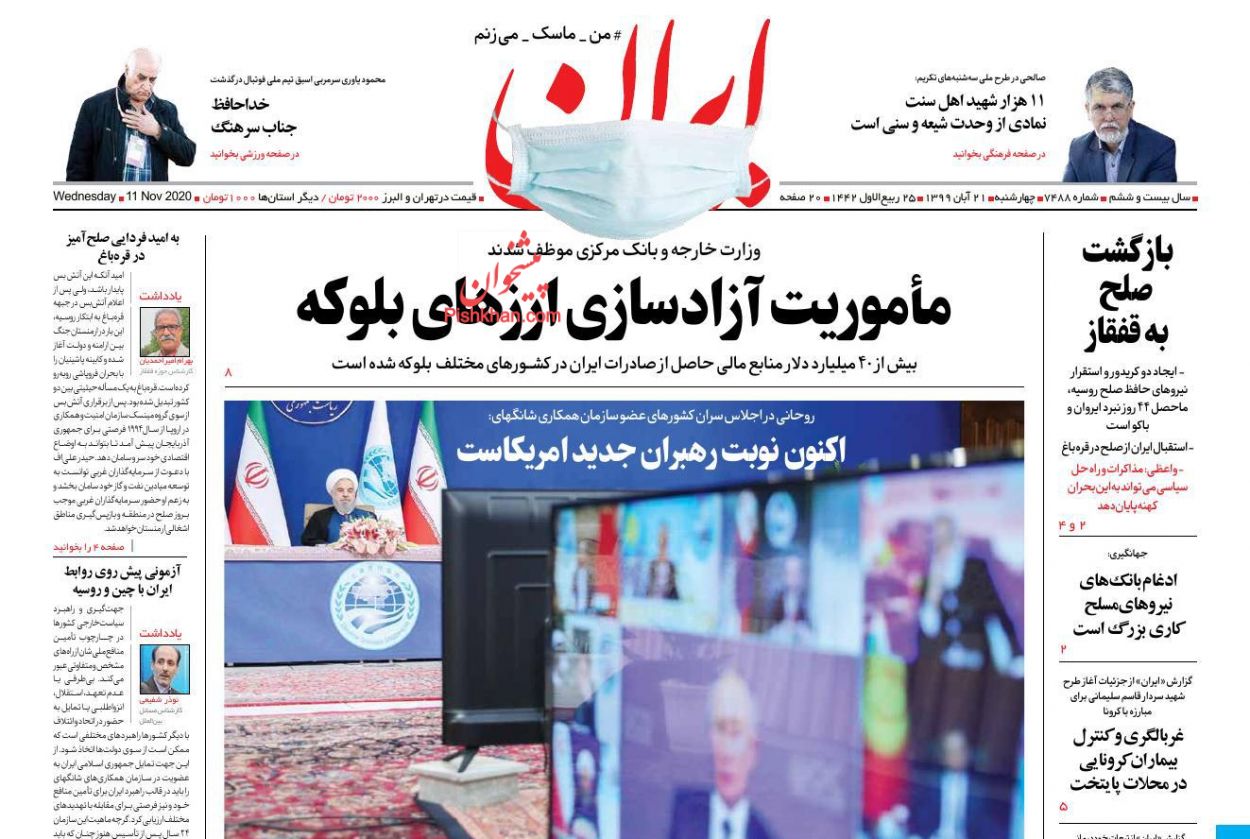
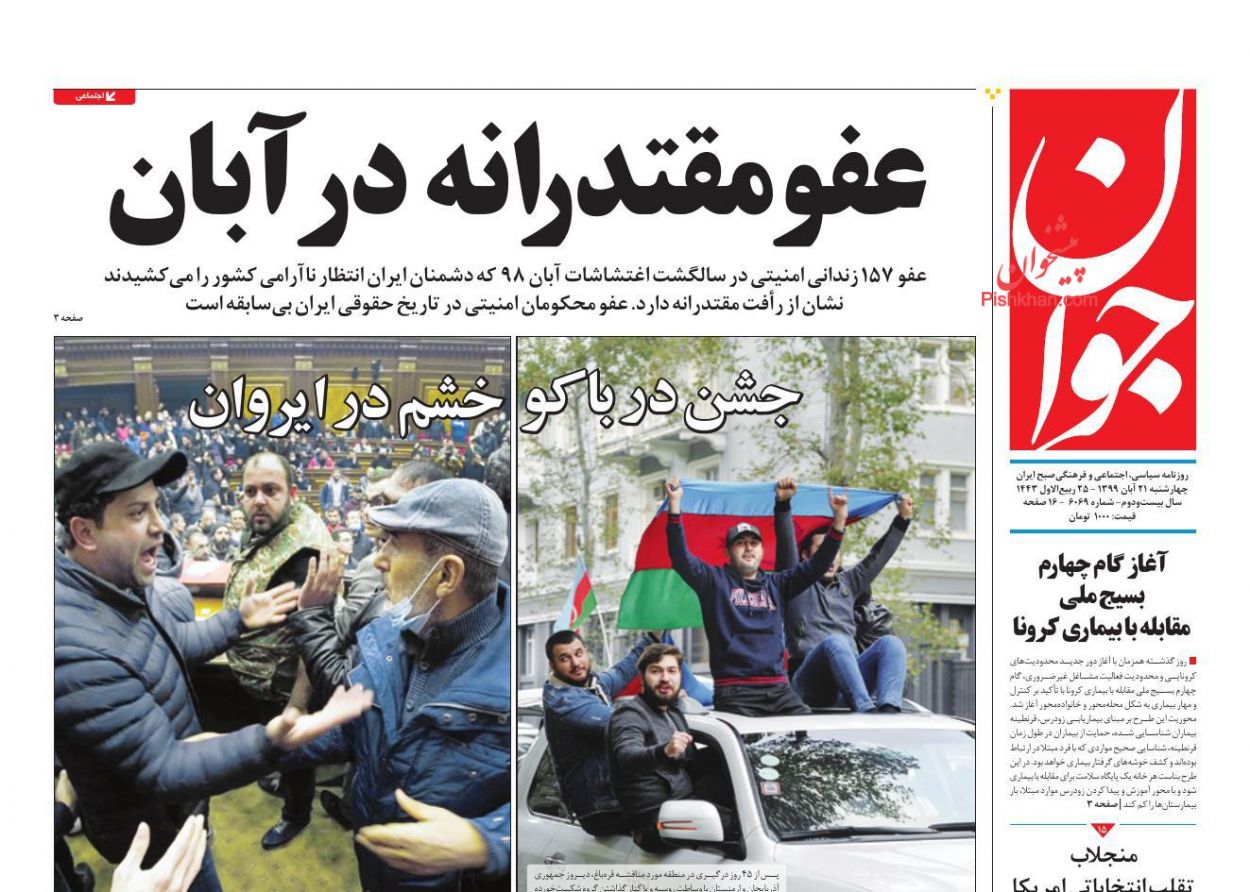
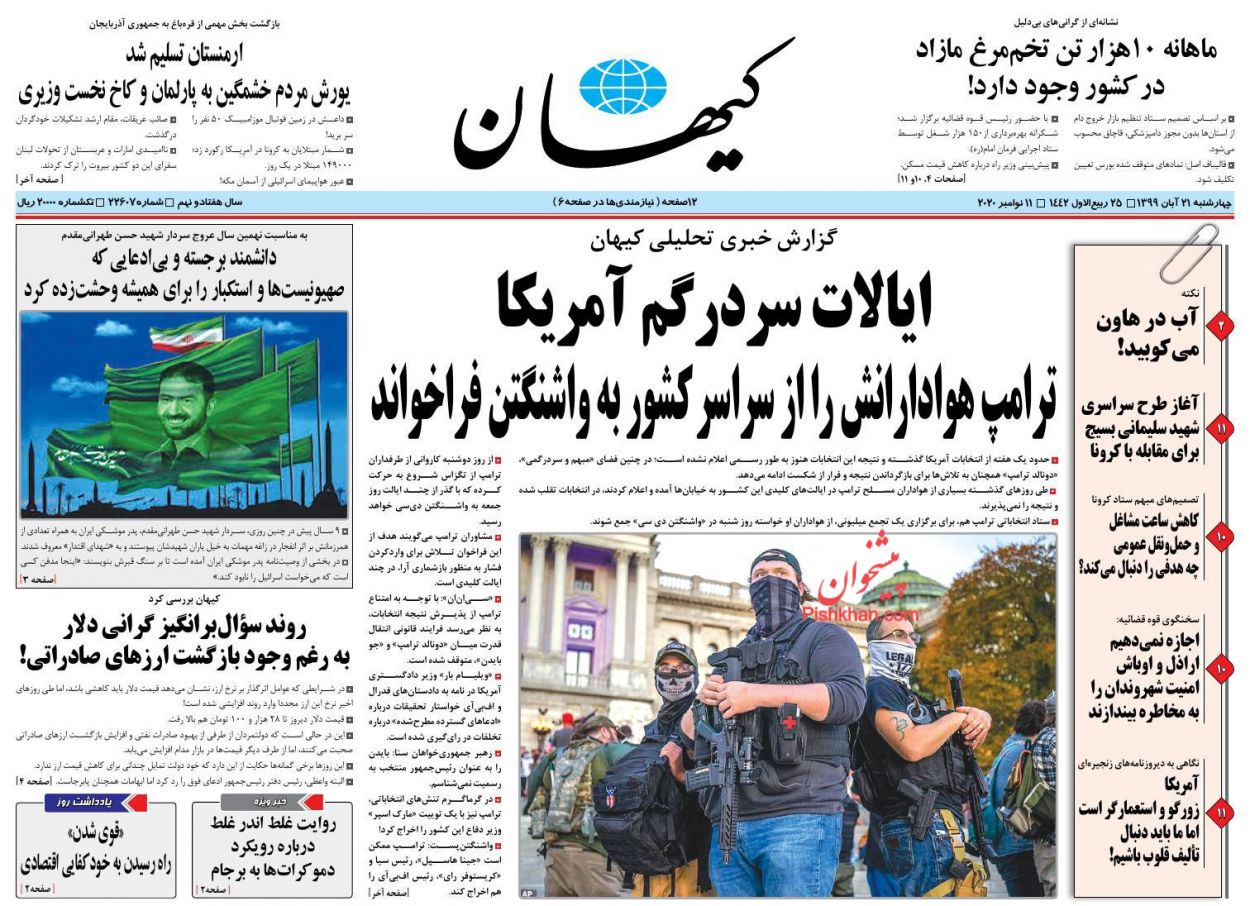
A Look at Iranian Newspaper Front Pages on November 11

A Look at Iranian Newspaper Front Pages on November 18

Iranian Newspapers

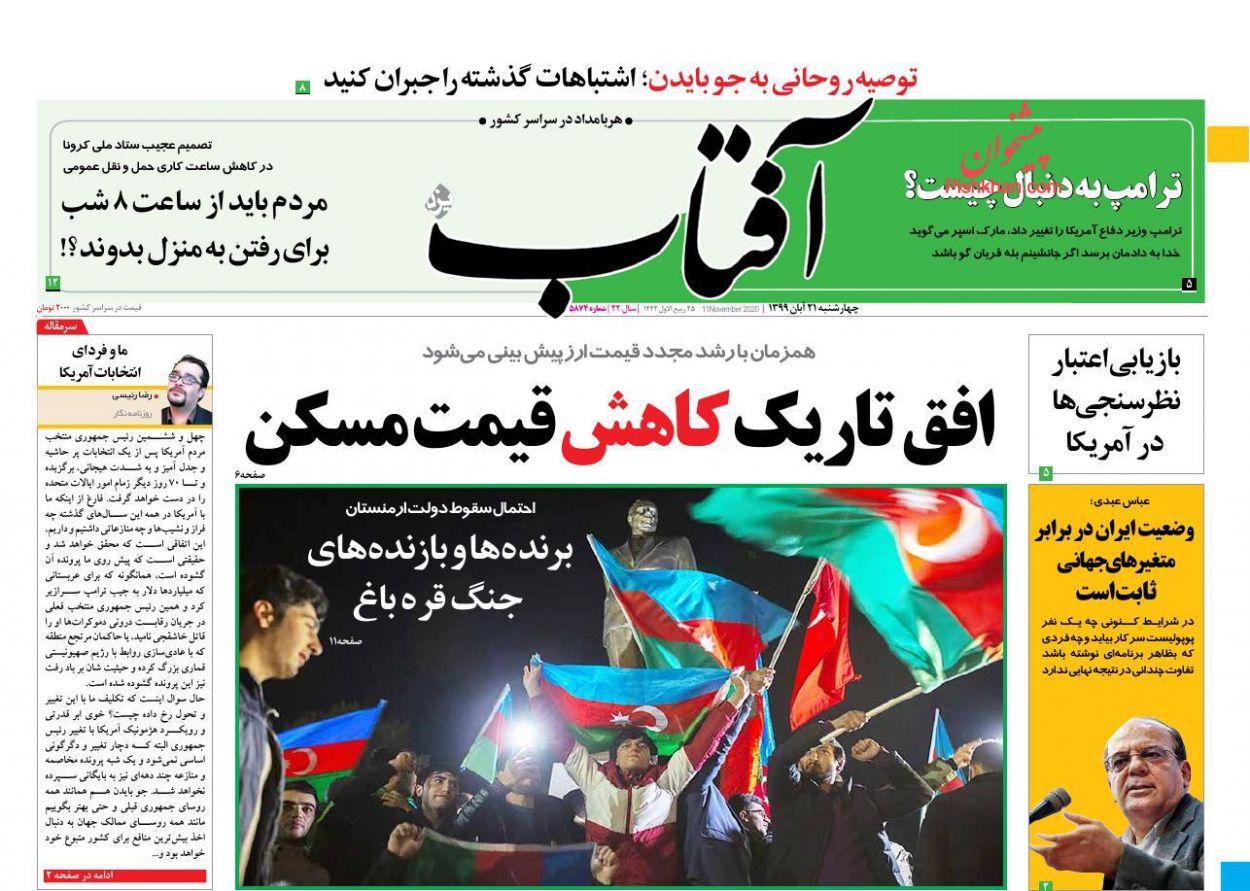
Aftab-e Yazd Newspaper:

1- Armenian Government May Fall

A Look at Iranian Newspaper Front Pages on November 11


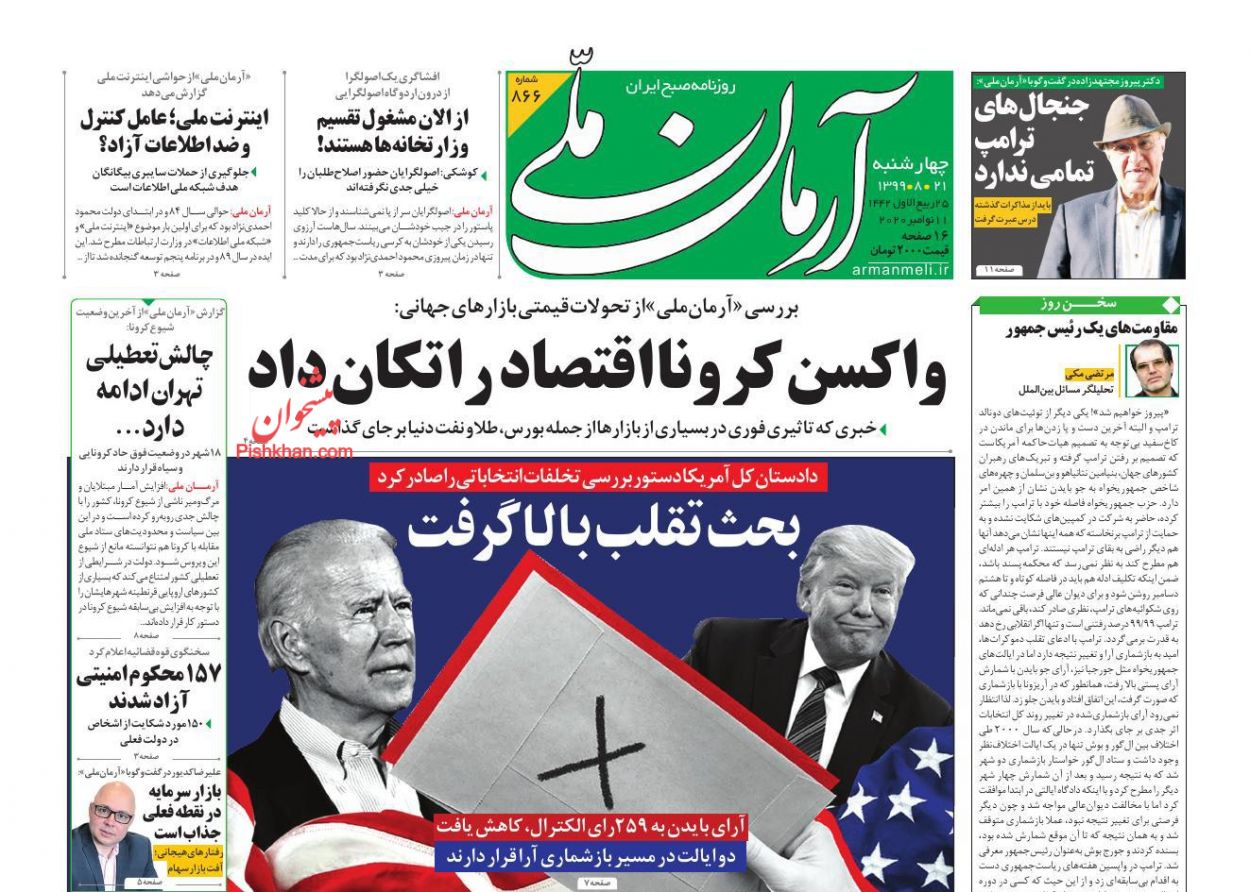
Arman-e Melli Newspaper:

1- Coronavirus Vaccine Shakes Economy

2- Fraud Debates Heated as US Prosecutor Orders Investigation

3- Trump’s Controversies Not Going to End

A Look at Iranian Newspaper Front Pages on November 11


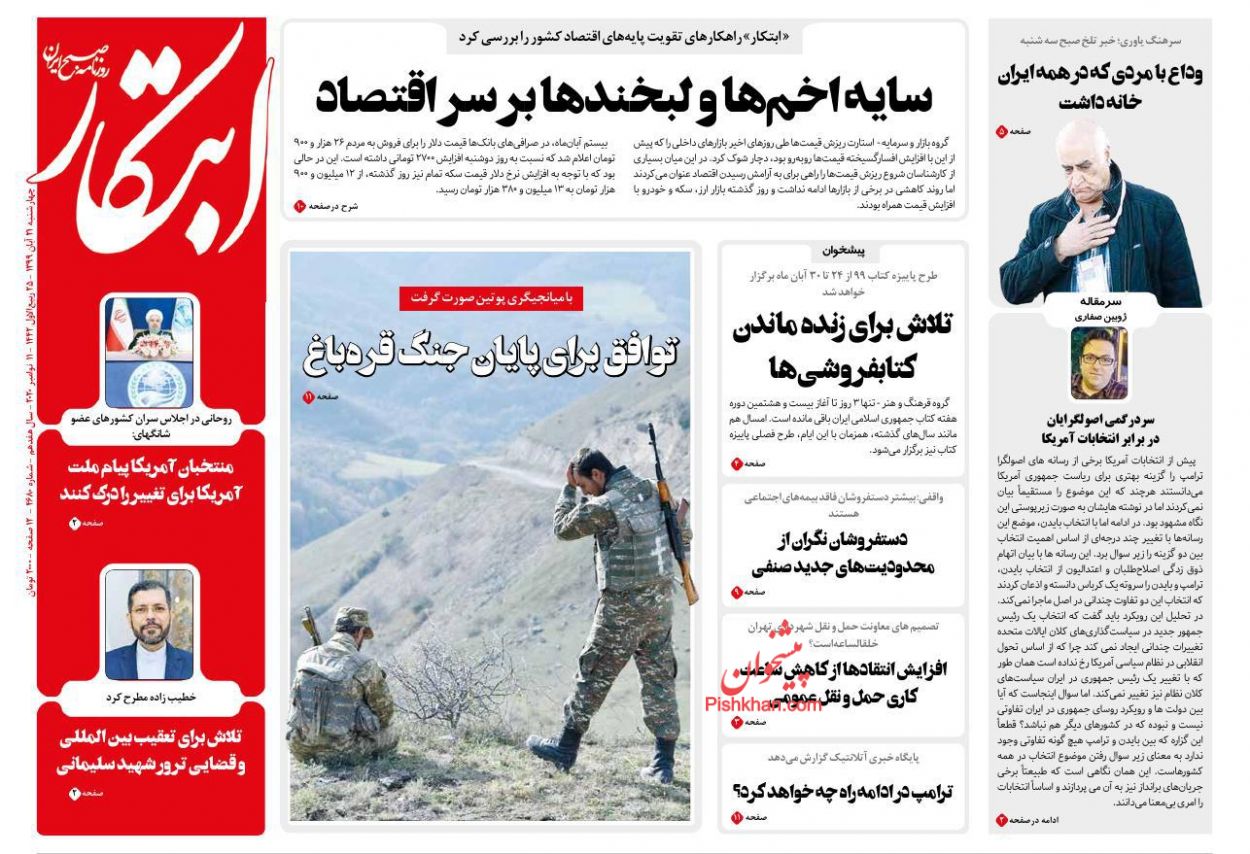
Ebtekar Newspaper:

1- With Putin’s Mediation, Karabakh War Gets Over

2- Iran to Use All Capacities to Prosecute Those Involved in Gen. Soleimani Killing: Foreign Ministry

3- Rouhani at SCO Summit: US President-elect Must Get American People’s Message of Change

A Look at Iranian Newspaper Front Pages on November 11


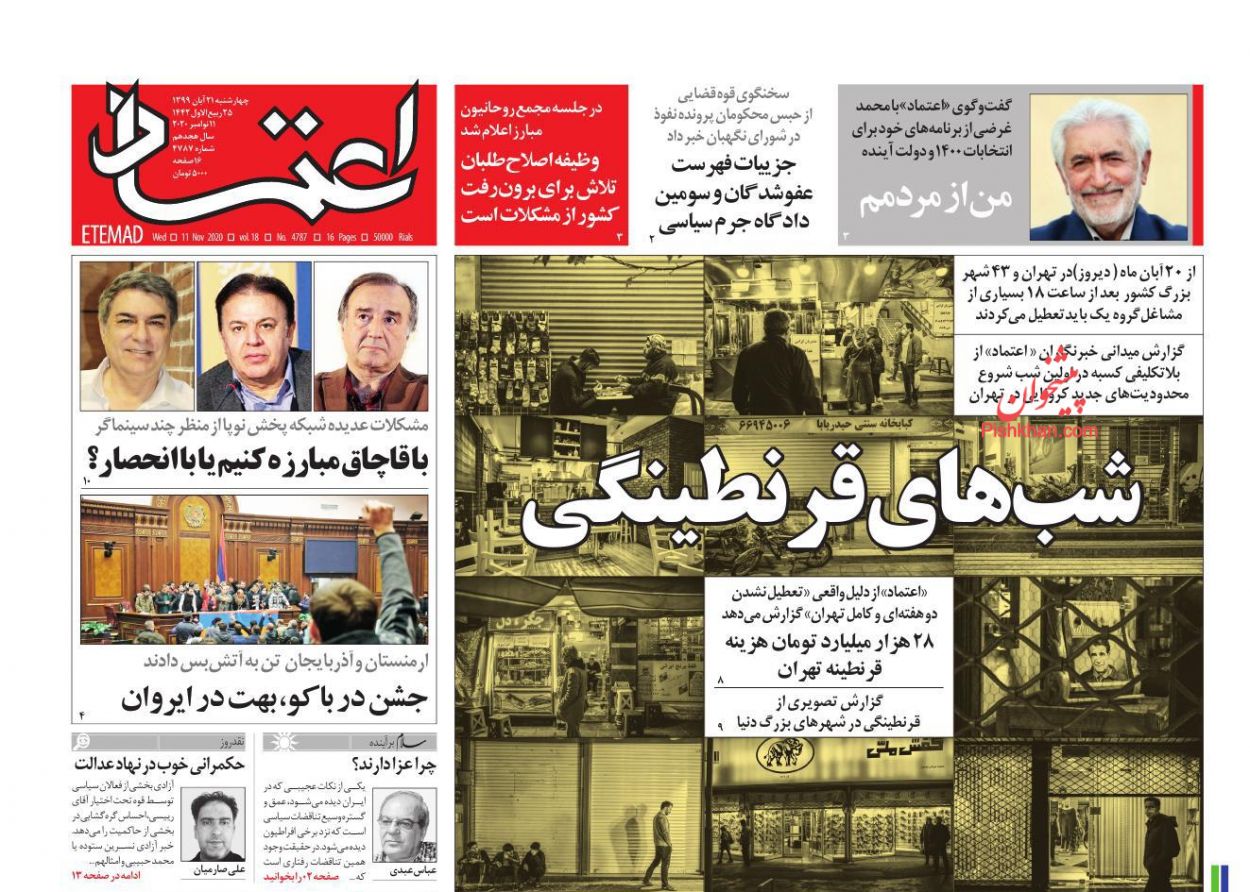
Etemad Newspaper:

1- Nights of Quarantine: Cost of Quarantine in Tehran Is IRR 280,000 Billion

2- Celebration in Baku, Shock in Yerevan

A Look at Iranian Newspaper Front Pages on November 11


Ettela’at Newspaper:

1- Rouhani: We’ll Continue Int’l Cooperation against Terror, Smuggling of Narcotics

2- End of Karabakh War with Russian Mediation

A Look at Iranian Newspaper Front Pages on November 11


Iran Newspaper:

1- 11,000 Sunni Martyrs Show Unity of Shiites and Sunnis

2- A Test for Iran’s Ties with China and Russia

3- Now It’s Time for New US Leaders

4- Return of Peace of Caucasus

A Look at Iranian Newspaper Front Pages on November 11


Javan Newspaper:

1- Powerful Clemency in November: 157 Security Prisoners Released on Anniv. of Nov. Riots

2- Celebration in Baku, Anger in Yerevan

A Look at Iranian Newspaper Front Pages on November 11


Kayhan Newspaper:

1- Chaotic States of America: Trump Urges Supporters to Come to Washington

2- Armenia Surrenders: Outraged People Attack Parliament, PM’s Office

A Look at Iranian Newspaper Front Pages on November 11


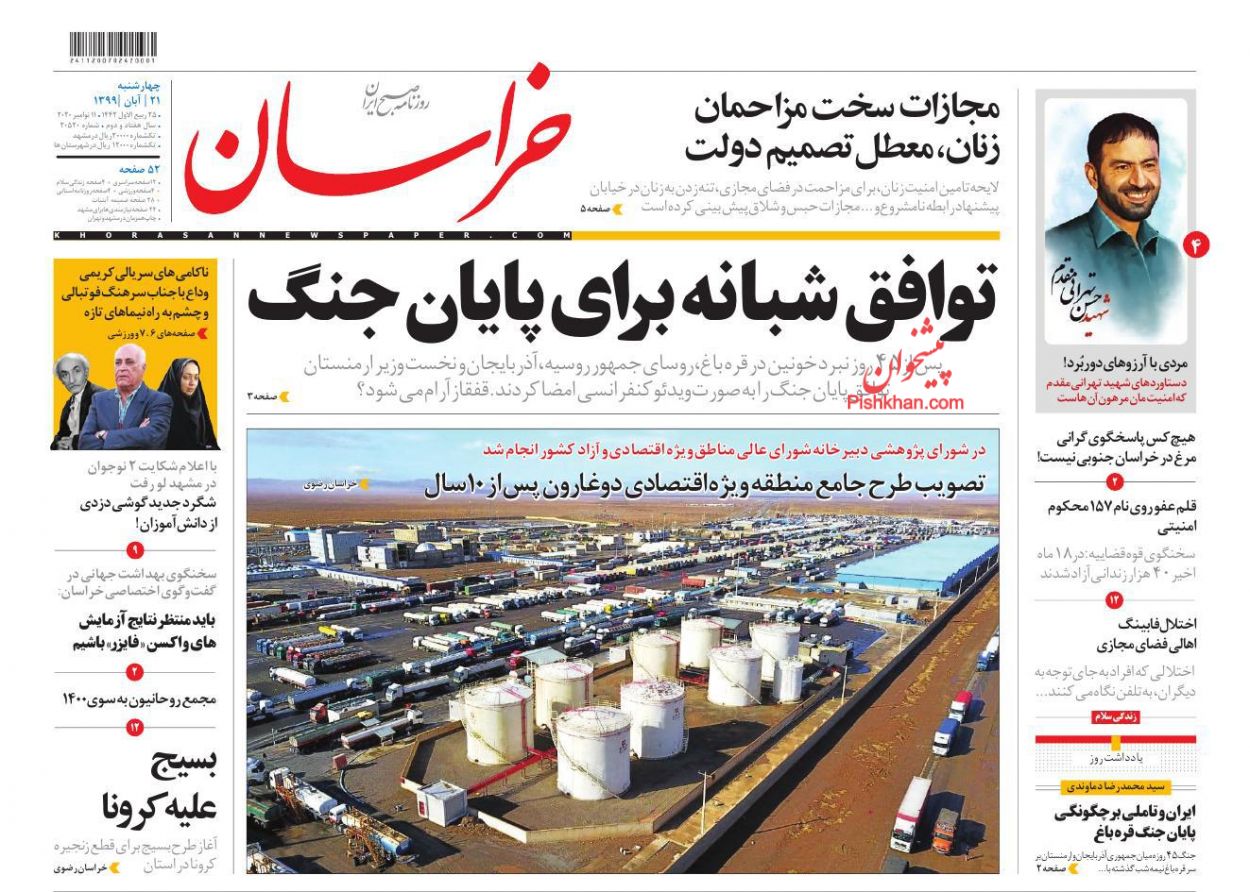
Khorasan Newspaper:

1- End of War with Overnight Deal

A Look at Iranian Newspaper Front Pages on November 11


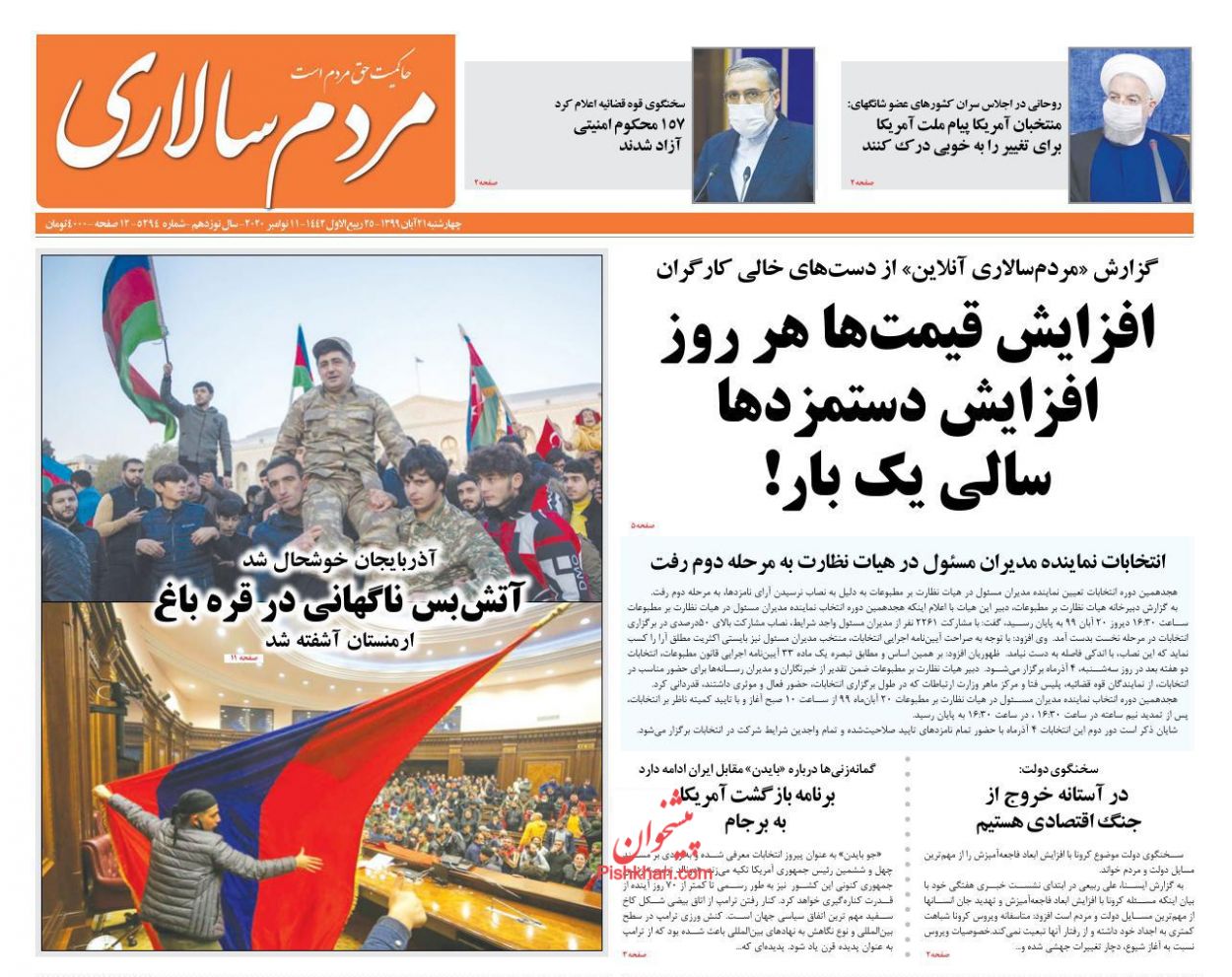
Mardom Salari Newspaper:

1- Sudden Ceasefire in Karabakh

2- US Plan for Return to JCPOA

A Look at Iranian Newspaper Front Pages on November 11


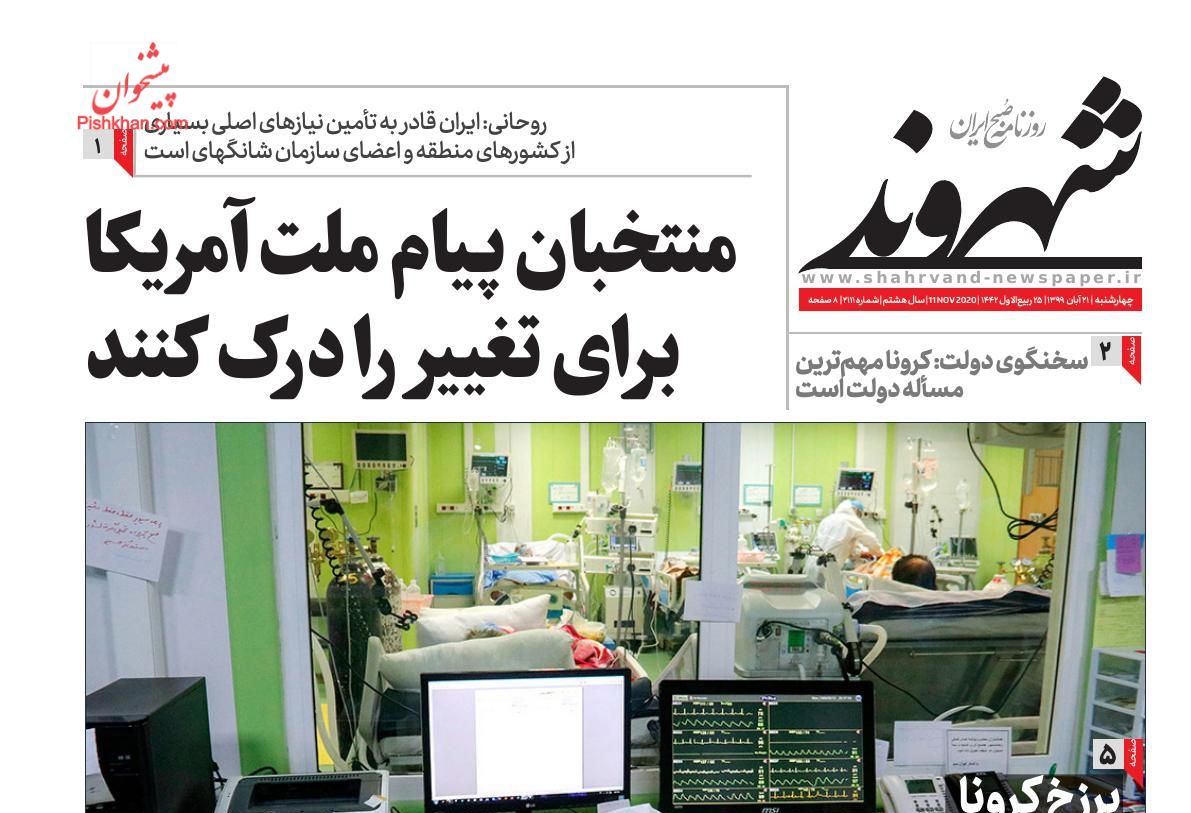
Shahrvand Newspaper:

1- Nurses Can No More Tolerate Coronavirus Limbo

A Look at Iranian Newspaper Front Pages on November 11


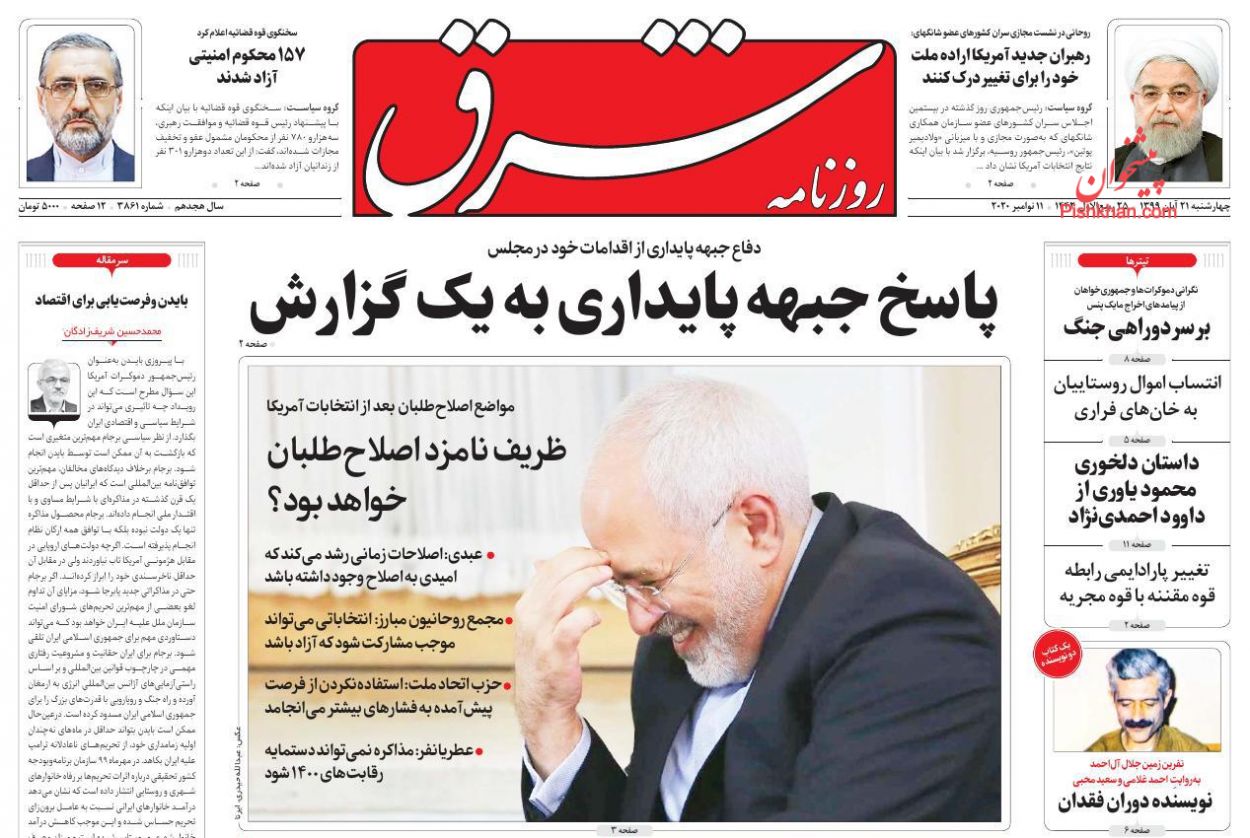
Shargh Newspaper:

1- Will Reformists Choose Zarif as Their Presidential Candidate?

2- Rouhani: New US Leaders Must Recognize Their Nation’s Resolve for Change

A Look at Iranian Newspaper Front Pages on November 11

Iranian, Pakistani Foreign Ministers Meet in Islamabad

Iranian, Pakistani Foreign Ministers Meet in Islamabad

Foreign Minister Zarif, who has travelled to Islamabad for an official visit, held a meeting with Minister of Foreign Affairs of Pakistan Shah Mahmood Qureshi on Wednesday.

In the gathering, the ministers discussed the ways to expand the political, economic, and international cooperation between the two neighbouring countries.

Highlighting the deep historical and cultural commonalities between the two nations, Foreign Minister Zarif expressed Iran’s readiness to enhance relations with Pakistan in all fields.

Pointing to Iran’s decision to promote the border crossings with Pakistan, the Iranian foreign minister welcomed the Pakistani government’s decision to open up new border markets for the enhancement of bilateral trade and voiced Tehran’s readiness for an agreement on new methods for trade exchanges.

Foreign Minister Zarif also stressed the need to step up security at the common border, calling for constant consultations between the two countries in this regard.

Shah Mahmood Qureshi, for his part, hailed Iran as a friend and major neighbour of Pakistan.

He also unveiled the Pakistani government’s plans for practical measures to broaden trade and economic cooperation with Iran, saying, “The government of Pakistan has decided to contribute to the border trade exchanges between the two countries.”

Highlighting the importance of establishment of peace and security along the common border, Qureshi emphasized that Pakistan will not allow hostile measures against Iran.

Among the other topics the two ministers discussed in the meeting were the regional developments, the Islamic world’s issues, the battle against Islamophobia, regional cooperation, particularly strengthening the Economic Cooperation Organization (ECO), joint action against terrorism and illegal migration, facilitation of pilgrimages, and holding a session of the Economic Cooperation Joint Commission in the near future.

Azerbaijan-Armenia Peace Deal Based on Iran’s Proposal: Araqchi

Azerbaijan-Armenia Peace Deal Based on Iran’s Proposal: Araqchi

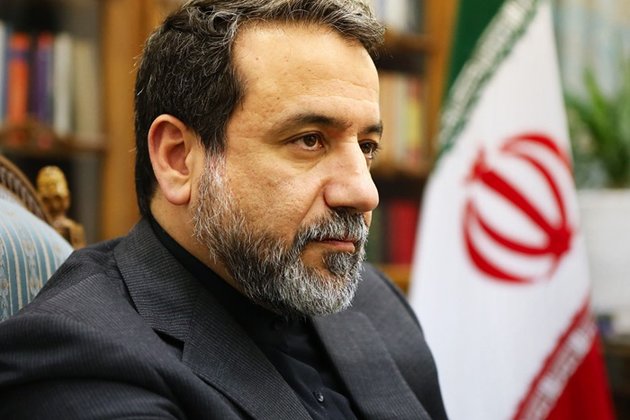
Abbas Araqchi, the Iranian deputy foreign minister for political affairs, said Tehran’s proposals contributed heavily to the establishment of the ceasefire.

“Fortunately, the principles and framework that we introduced for a ceasefire and the start of the talks were welcomed, and the Russia-brokered agreement that was finally reached between Azerbaijan and Armenia two days ago, was, in fact, within the framework of the principles and framework and proposals that Iran had put forward,” he said.

He reiterated that Iran had misgivings over the military conflict going on near its borders.

“The Nagorno-Karabakh crisis unfolding outside Iran’s northern borders had been a cause for serious concern for us,” he said.
“The conflict was a cause for concern, and it caused concerns along our borders. Even in certain cases, the conflict caused damage on our borders. There were some ensuing concerns as well, making it all the more necessary for the conflict to come to an end as soon as possible,” he noted.

The official noted that Iran has had good relations with both Baku and Yerevan.
“We have had age-old, cordial relations with both the Azerbaijan Republic and Armenia. Of course, our relationship has been closer with the Azerbaijan Republic because of our Azeri-speaking fellow countrymen. We have also had good ties with Armenia due to our Armenian compatriots,” he said.
Araqchi highlighted that Iran took it upon itself to help resolve the crisis.
“A war going on in our backyard between two of our neighbouring countries with which we have good relations was definitely an unfortunate event. Of course, that war has its roots in a historical conflict going on between Azerbaijanis and Armenians since old times. It was necessary that Iran play a role in easing or ending the conflict,” he explained.

“We put forward a proposal after holding consultations with all sides. Then I was tasked with introducing and seeking to build a consensus on the proposal during my trip to the region. We also sought to let these countries know about the concerns that the Islamic Republic of Iran had, so that they would know what areas Iran was concerned about,” Aaqchi said.

US Election Results Show Half of Americans Back Trumpism Ideology: Iran

US Election Results Show Half of Americans Back Trumpism Ideology: Iran

Araqchi said the outcome shows fifty percent of Americans favour Trump’s wicked policies.

“Whether Trump remain in office or not, half of the US population support the Trumpism ideology, in which he regards himself as superior to the whole world and refuses any cooperation and withdraws from all international agreements and regards himself as the number-one person and is ready to sacrifice anything. I believe this shows American leaders are pushing the US society as well as themselves toward political decline. These are the things that the world is paying attention to,” he said.
“Almost 50 percent of the US population, i.e., around 70 million people, have voted for Mr. Trump despite all his characteristics. That means half of the US population supports his negative and wicked personality traits, his bullying policies and his breach of regulations. I think this should be reflected upon, and it can be a threat,” said Araqchi.

The top official underlined the support of so many people for Trump shows the American society has been polarized.

“This election also umasked another important reality, and that is the American society has been polarized. The US society has reached a point where there are two poles with almost the same weight, and these two poles are involved in a rivalry, and they cannot tolerate one another,” he said.
“One can see a country which claims to have the biggest democracy in the world and the most ancient democratic traditions has come to a point where all the things that the US accused other countries of, are happening in that country itself,” he said.
“They are now accusing each other of electoral fraud. They say the whole election process was rigged due to alleged irregularities. The candidates are bringing their fans onto the streets in a gang-like move. They are now facing the same things which they accused others of, and for which they ridiculed others,” said Araqchi.
“These developments laid bare and shattered the false grandeur of American democracy and revealed their structural weaknesses,” he added.

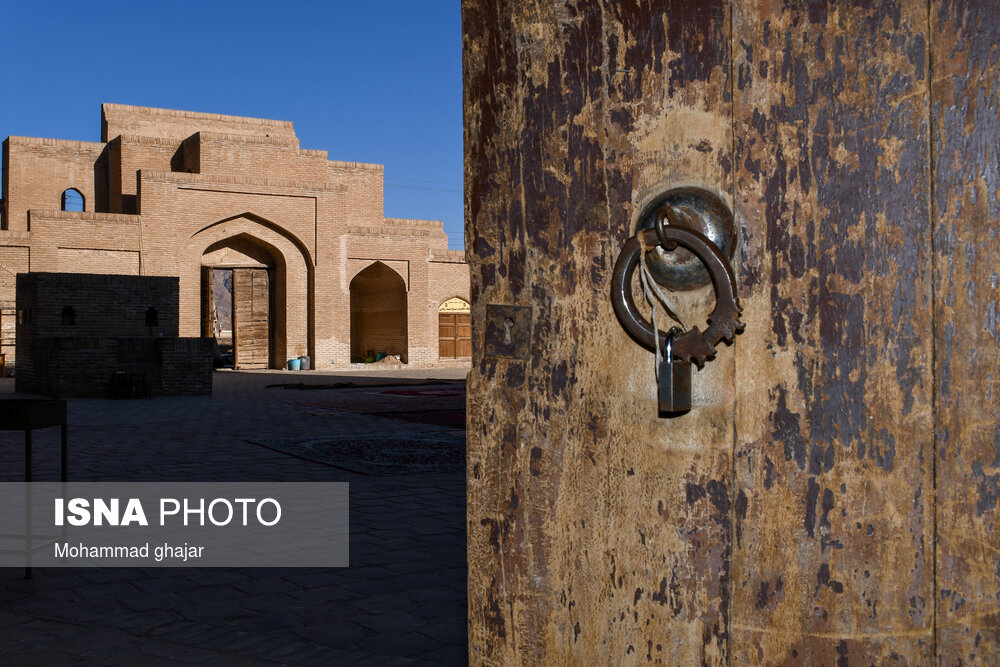
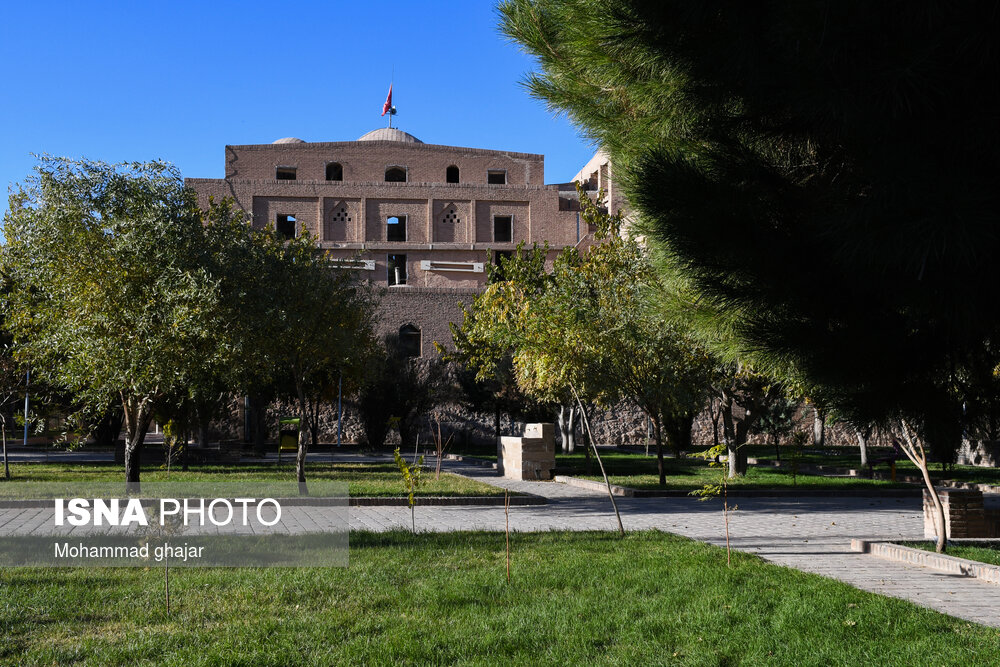
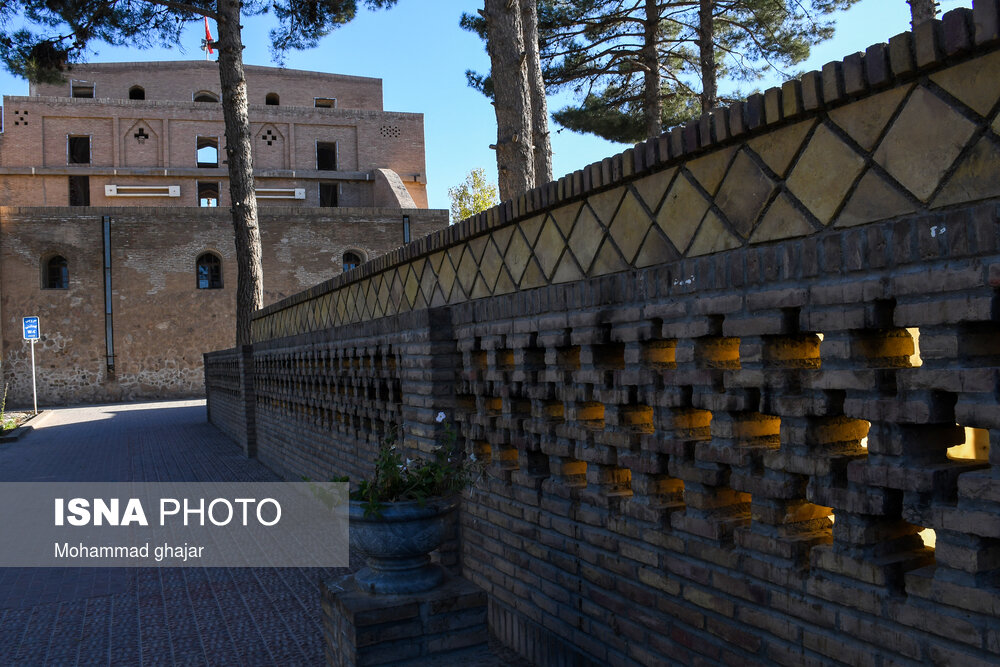
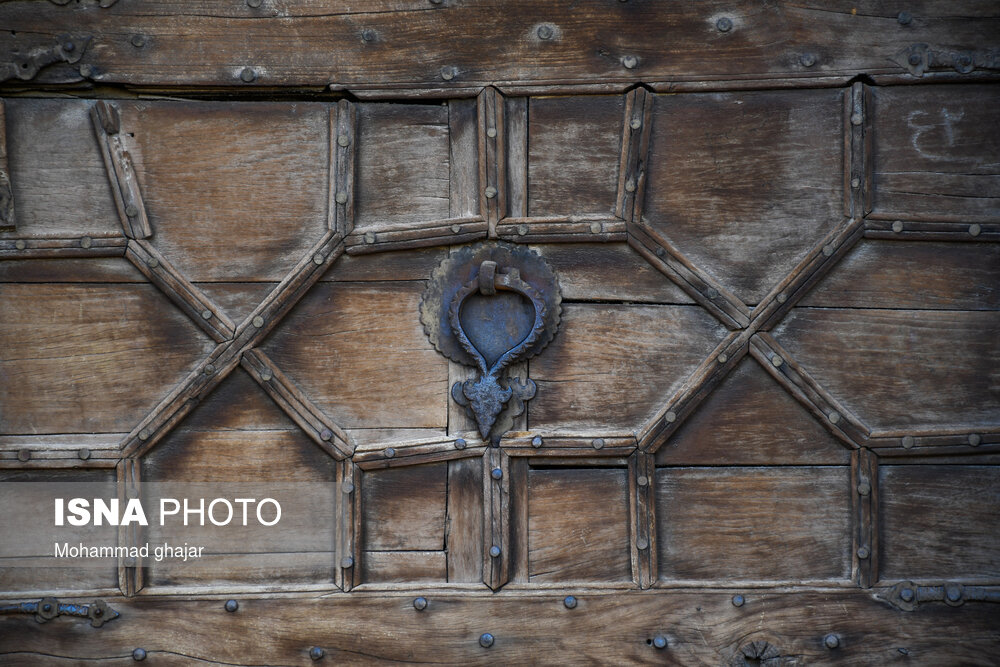
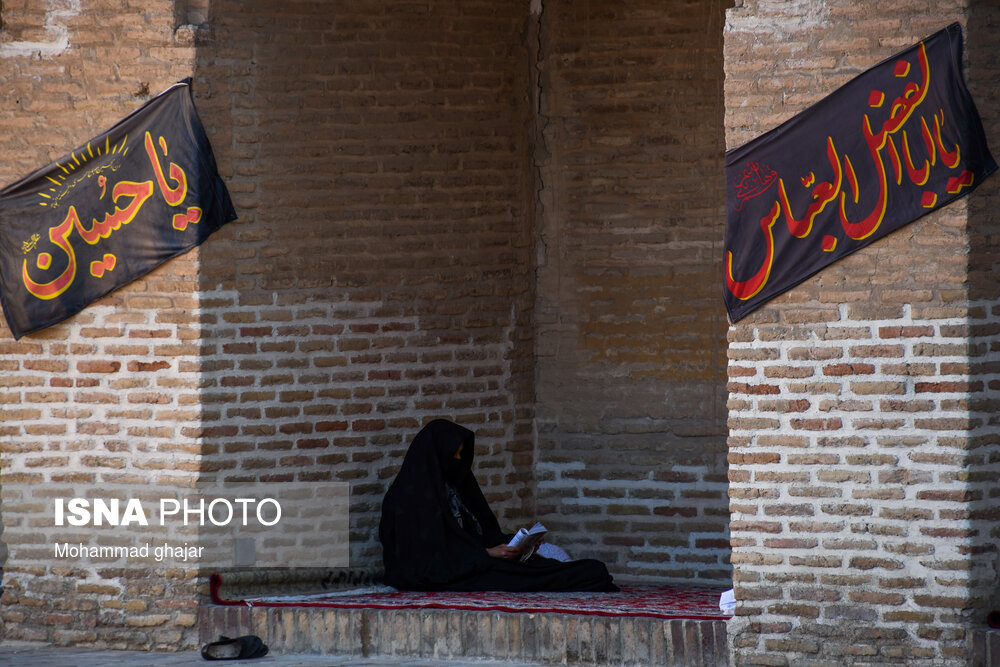
Iran’s Architecture in Photos: Qaen Grand Mosque

Qaen Grand Mosque

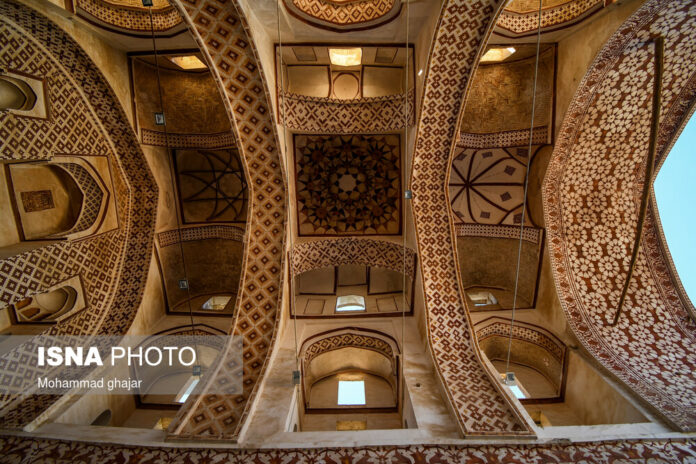
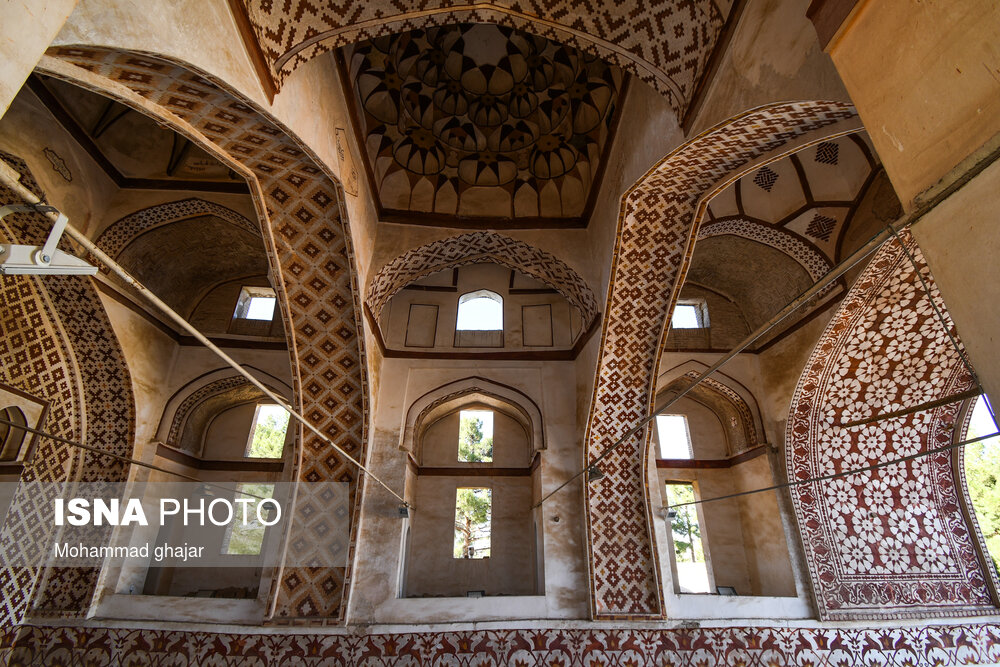
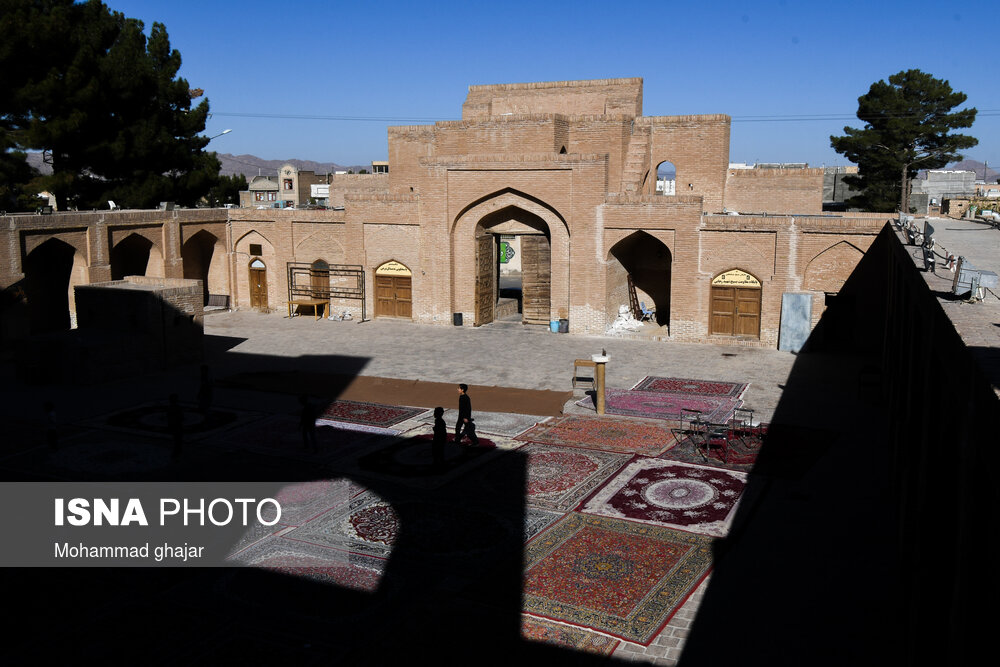
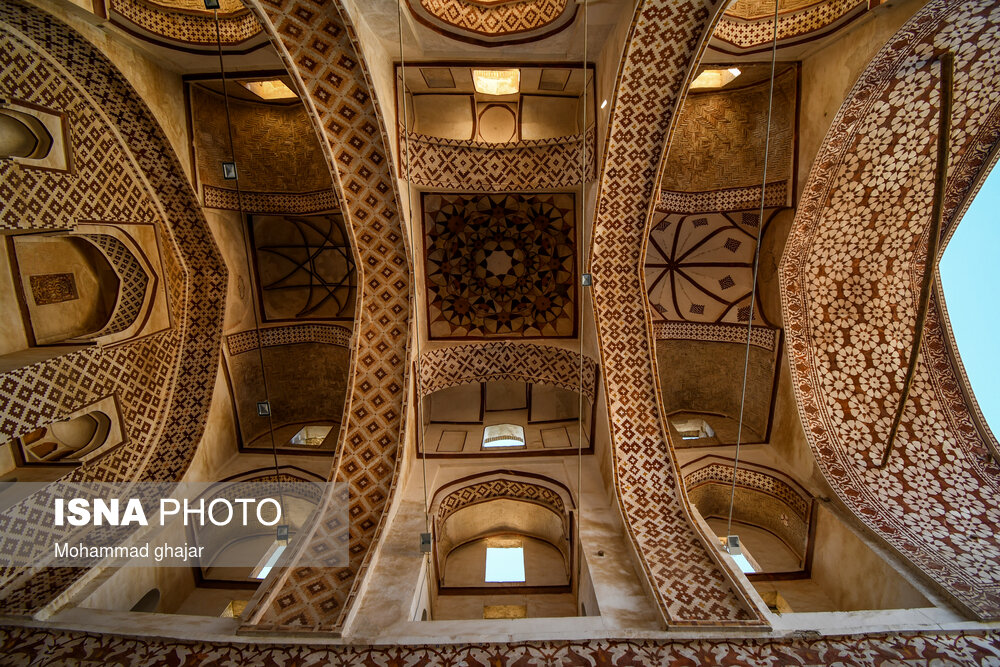
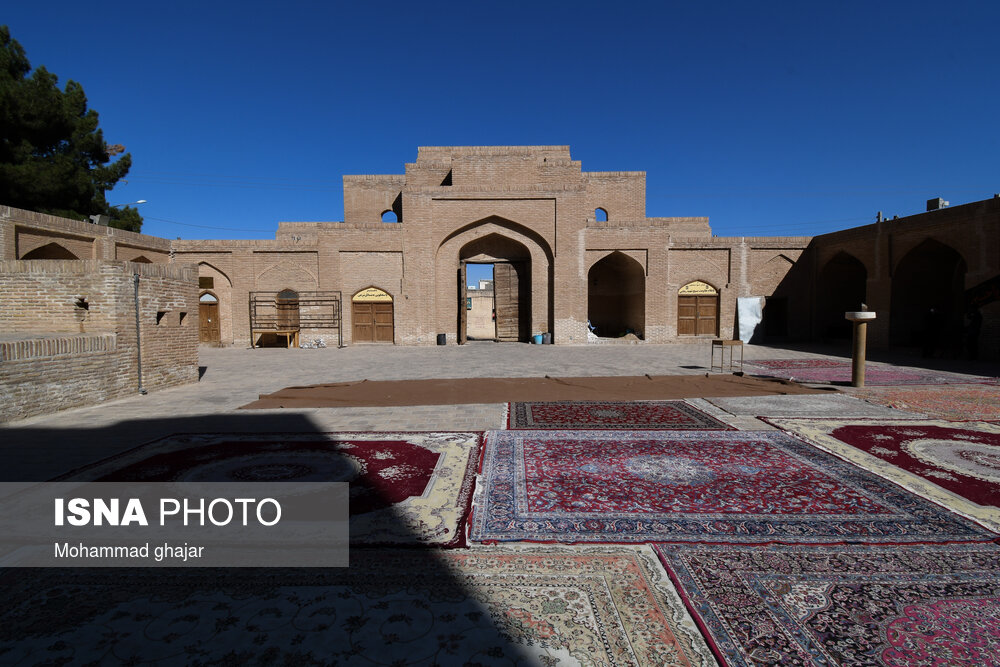
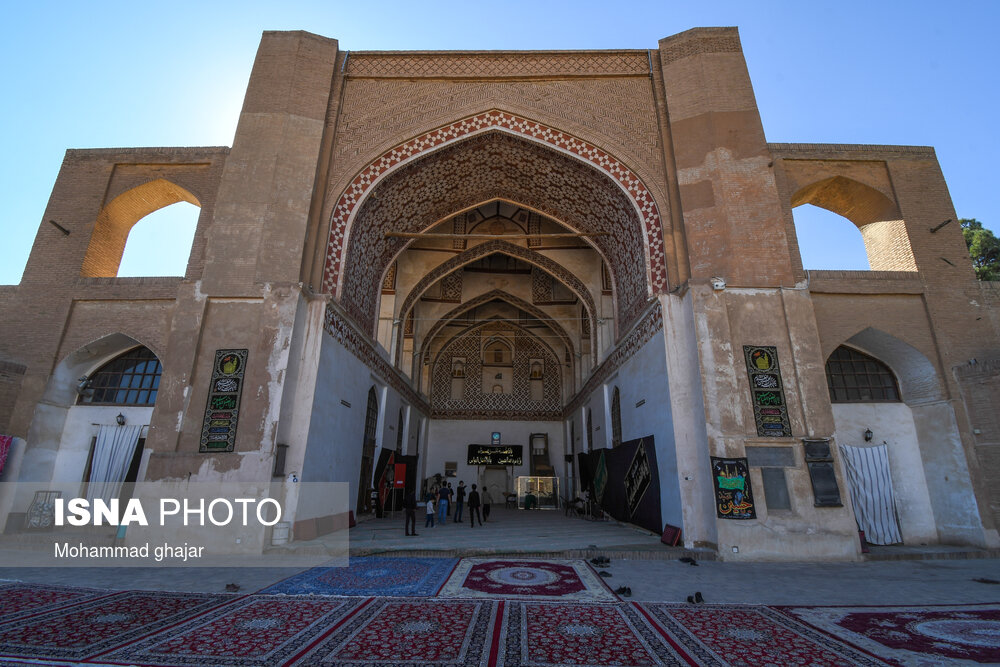
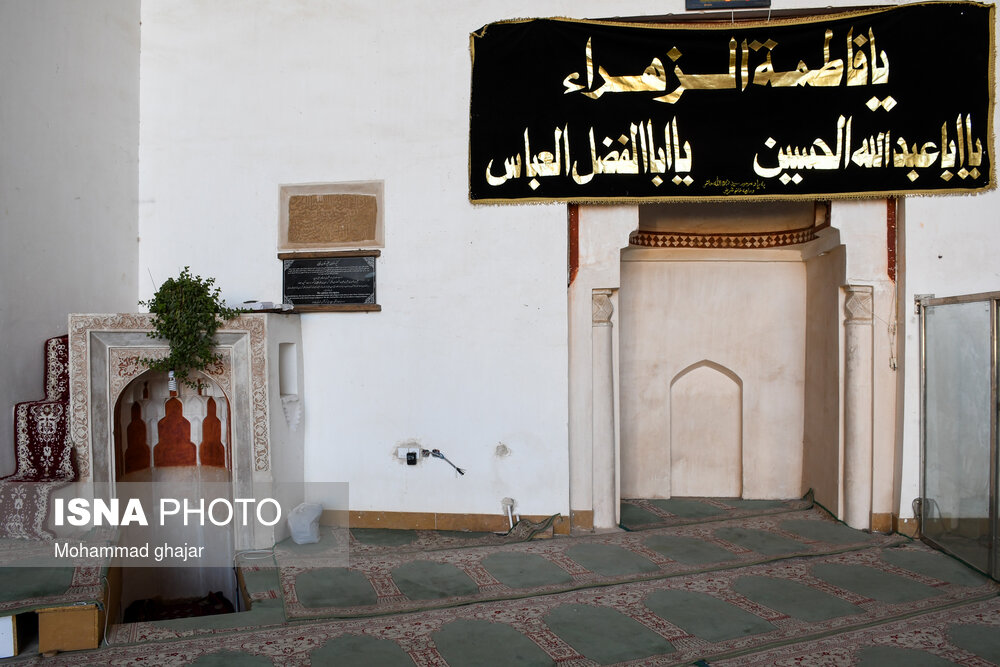
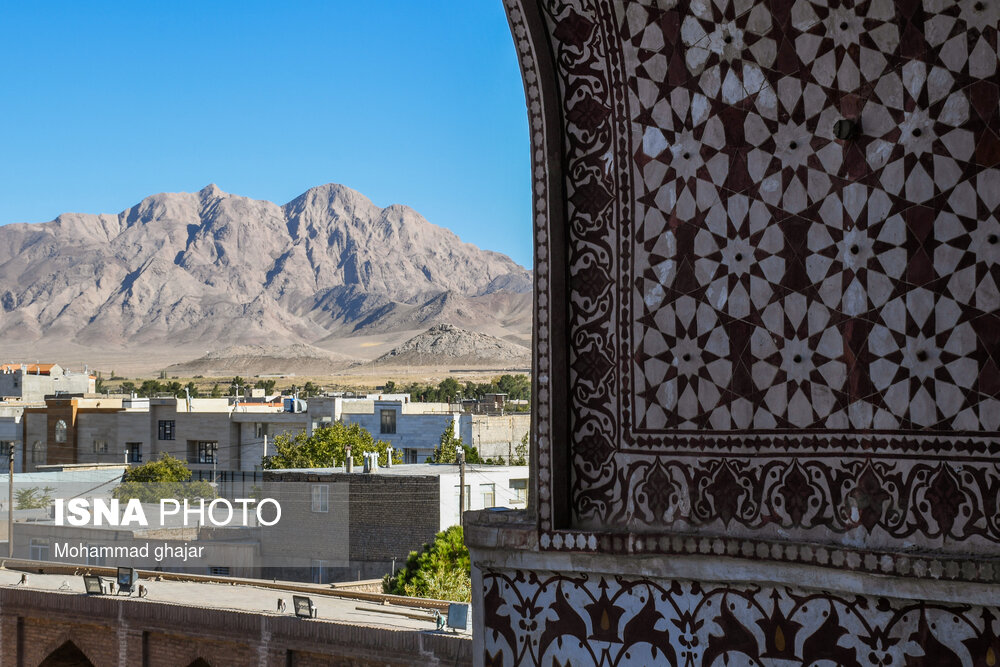
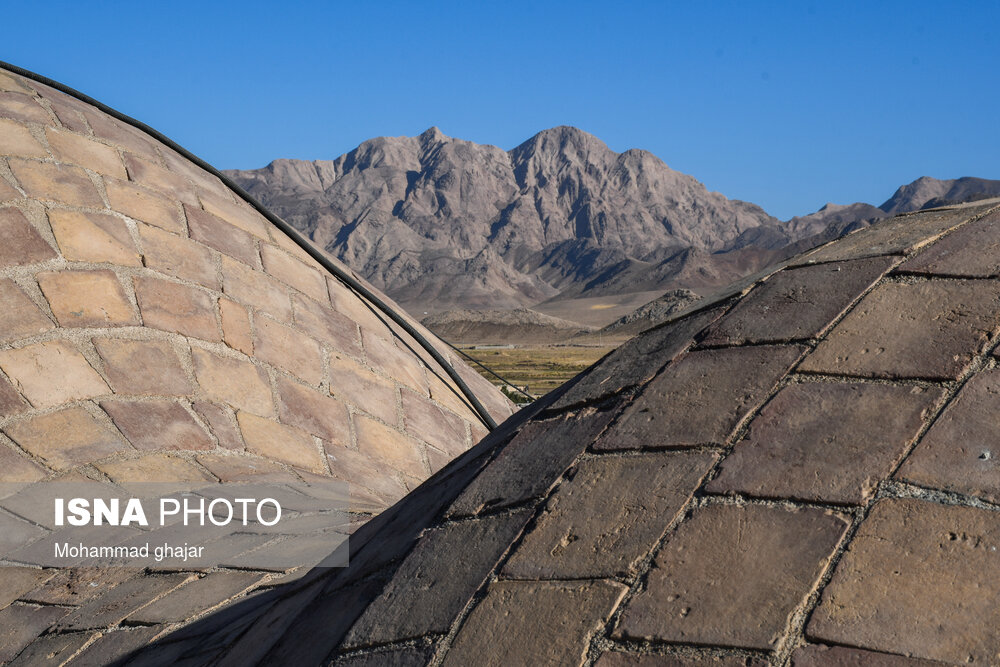
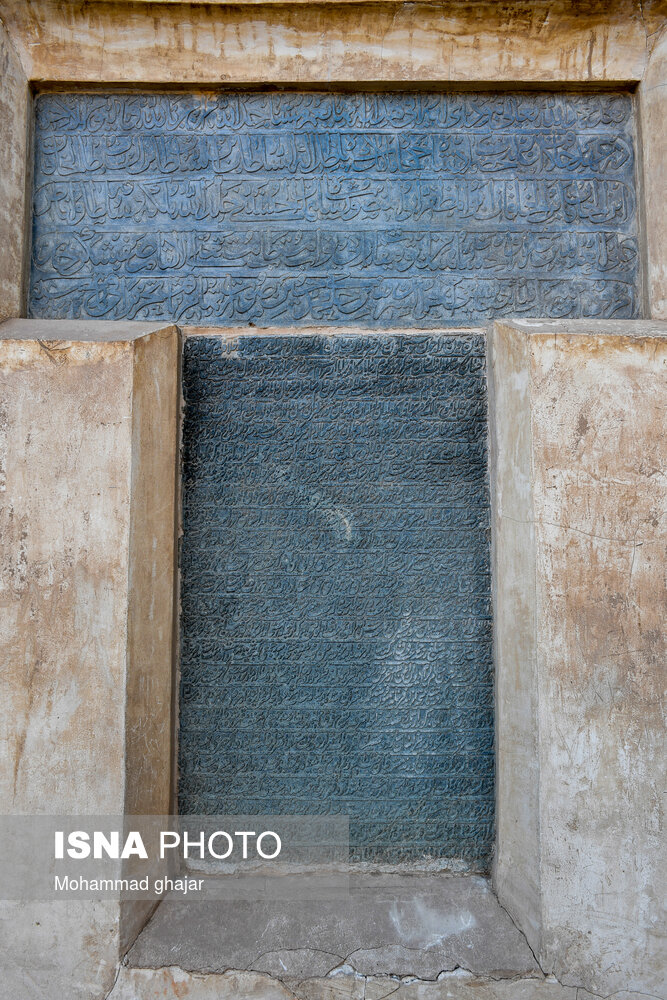
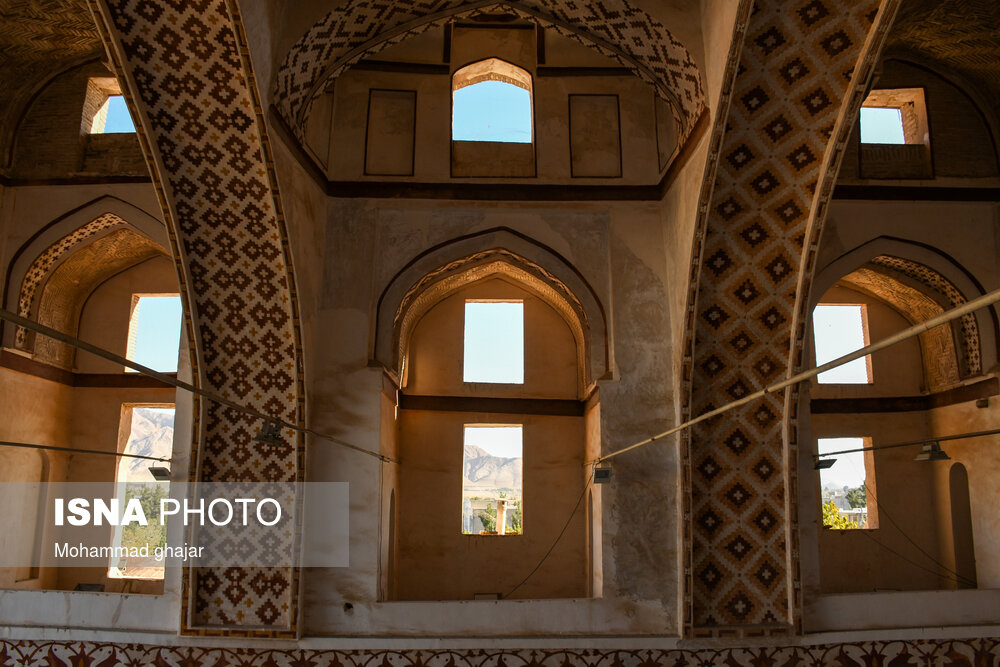
The Grand Mosque of Qaen in South Khorasan Province, which dates back to the late Ilkhanate and early Timurid era, has still maintained its position as the tallest building of the town.

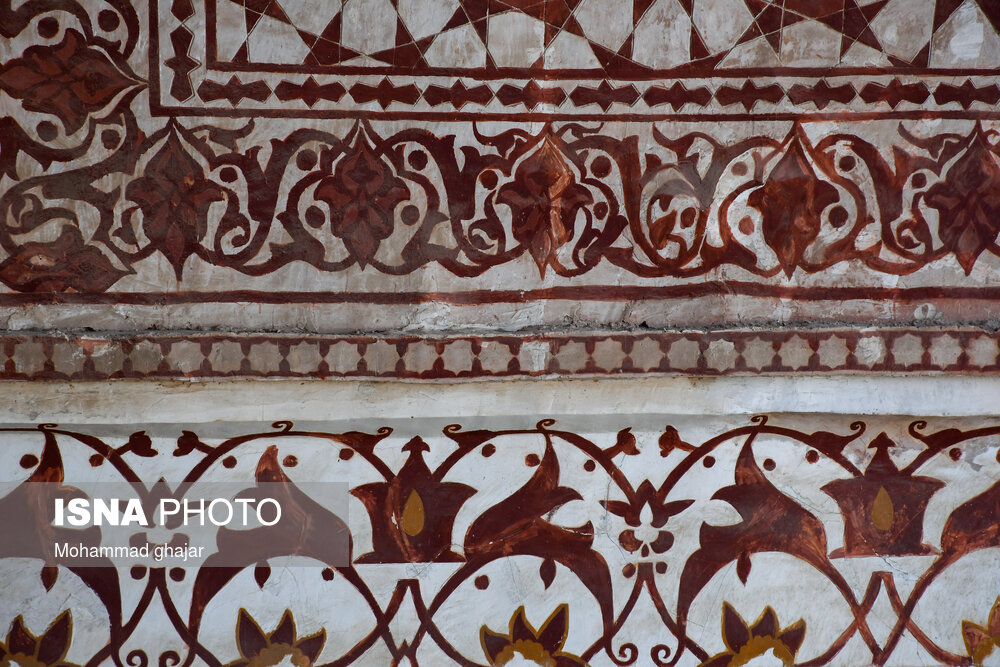
The first nationally registered monument in the province, this ancient mosque has a sundial and magnificent murals grace its portico.

It has been built during the eighth century AH by the order of Amir Jamshid Qareni, the ruler of the region. It has an area of 2470m2 of which 1050 m2 is the foundation of porches, Shabestans and rooms.

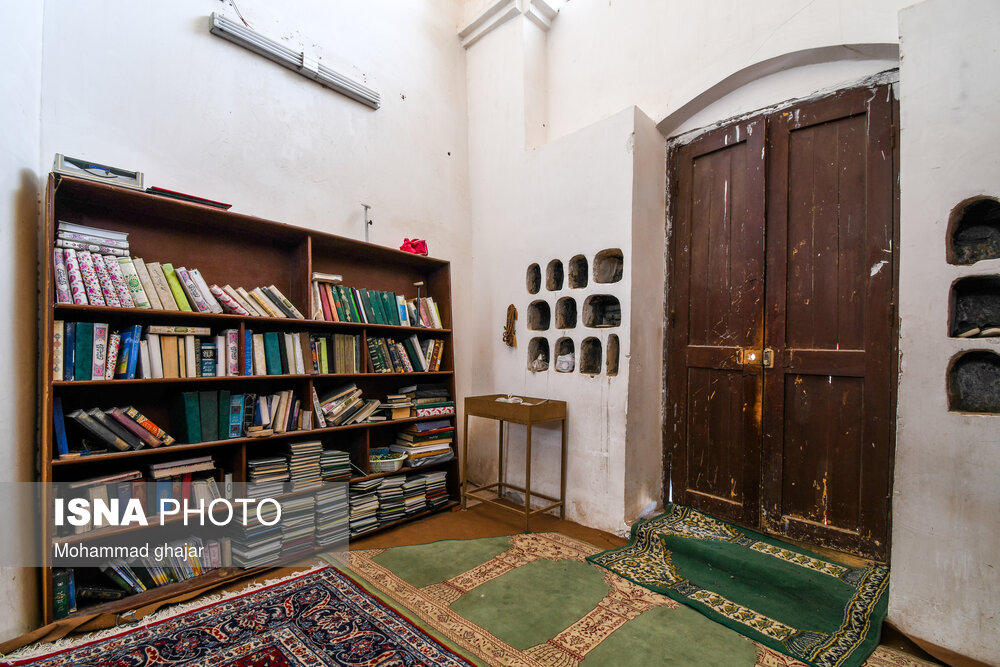
This genuine Iranian-Islamic architectural masterpiece two altars: one faces Mecca; the other faces Jerusalem, the former Qibla of Muslims.

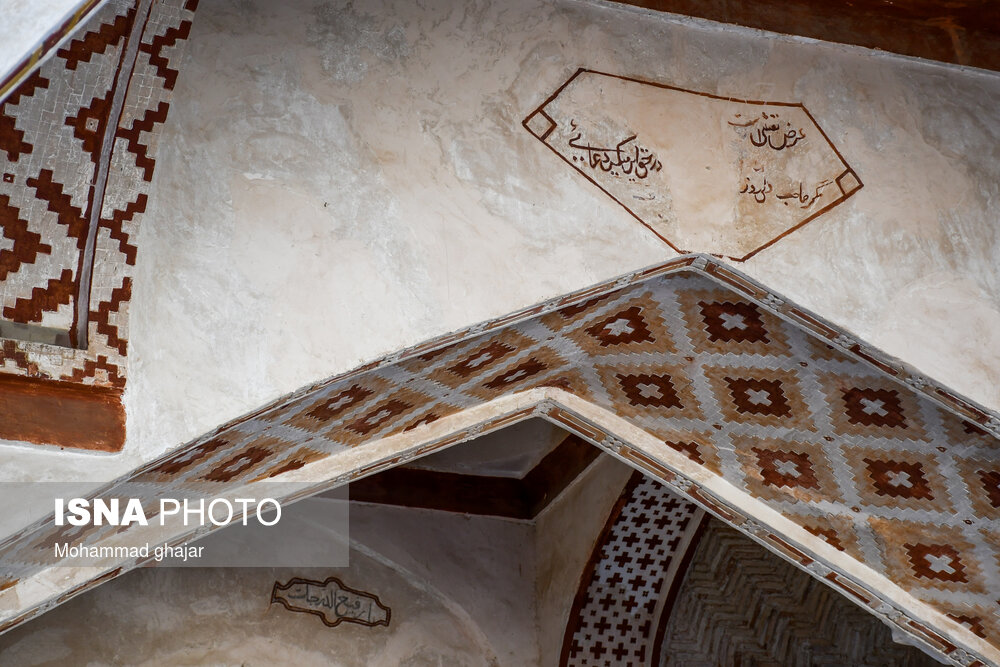
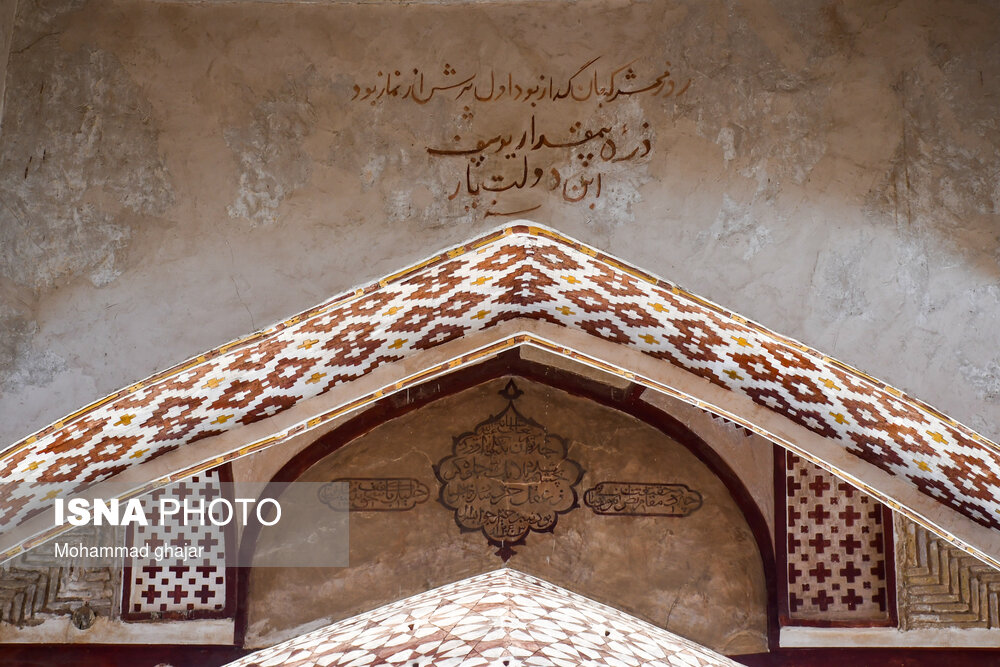
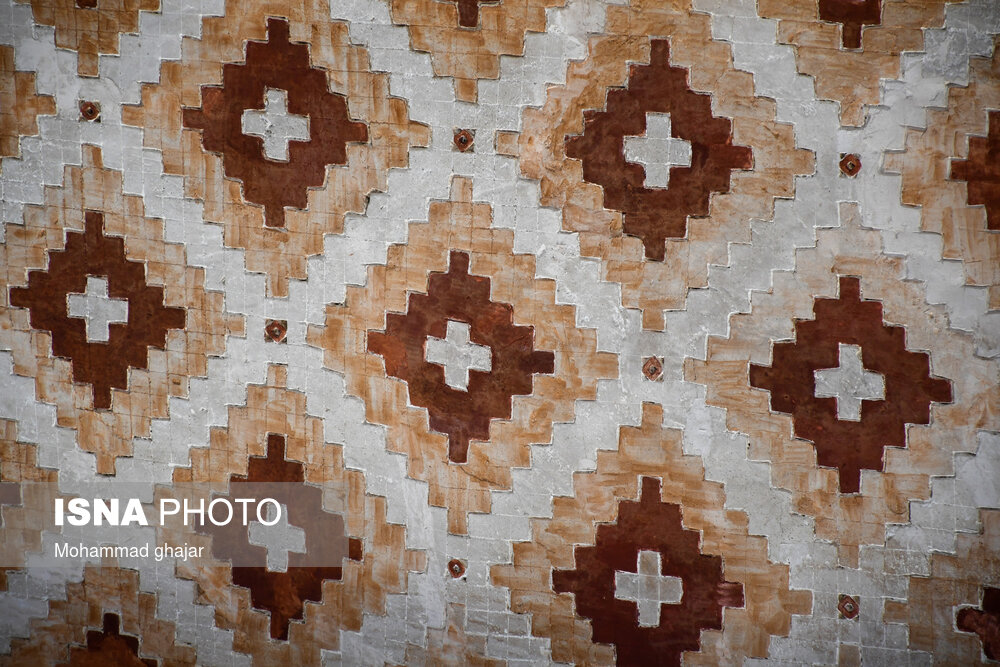
The porch of the Grand Mosque has four arches and three domes, beautifully painted and decorated with delicate marquetry. The Isfahan style paintings have been done in Safavid period.

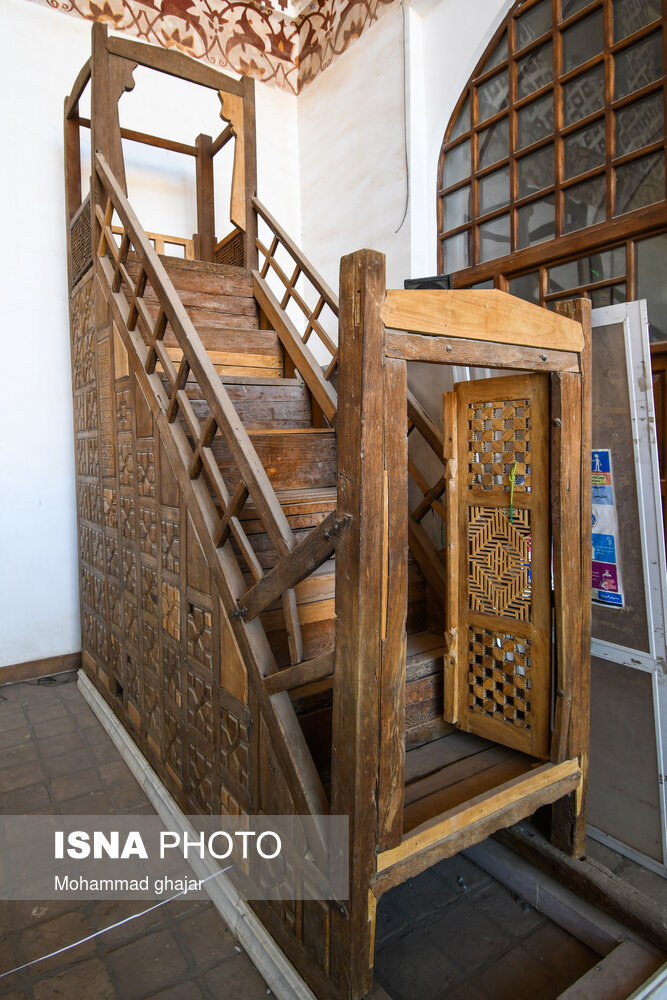
The large, valuable wooden pulpit of the mosque is made of sycamore wood by Master Mohammad Vaezi Kakhki; with an inscription carved on it.

What follows are the images of Grand Mosque of Qaen published online by the ISNA: