Wednesday, December 24, 2025
Home Blog Page 1963

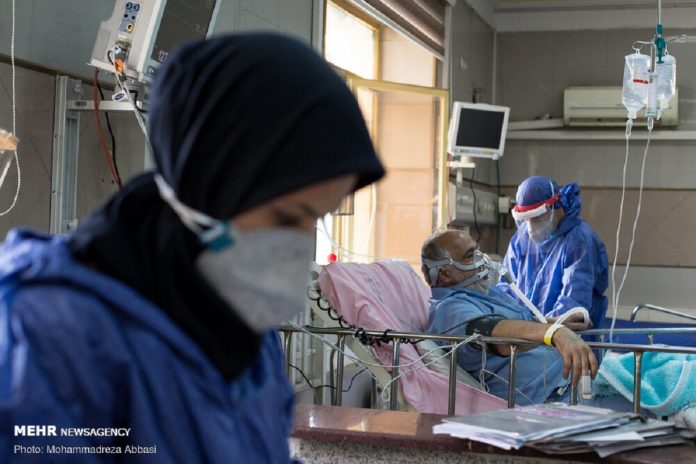
Iran Covid: 14 deaths, 719 new infections

COVID in Iran

The Friday tally released by the ministry put the number of deaths at 14 and that of the infections at 719. The total deaths now stand at 141,072.

A good number of cities in Iran have shown zero number of fatalities from Covid.

Meanwhile, the Friday caseload was also way lower than most of the days during the past couple of weeks.

The downward trend of Covid has been attributed by Iranian authorities to a nationwide vaccination campaign that began over a year ago and saw nearly 149 million doses of vaccine administered to people in Iran, including both Iranian nationals and foreigners.

Over 27 million people have received three shots while the Health Ministry has started giving a third to healthcare staff.

According to the latest, the number of red cities Covidwide is now zero. Red denotes the highest risk from the disease.

Dozens killed in Kabul mosque blast

Afghanistan Blast Mosque Kabul

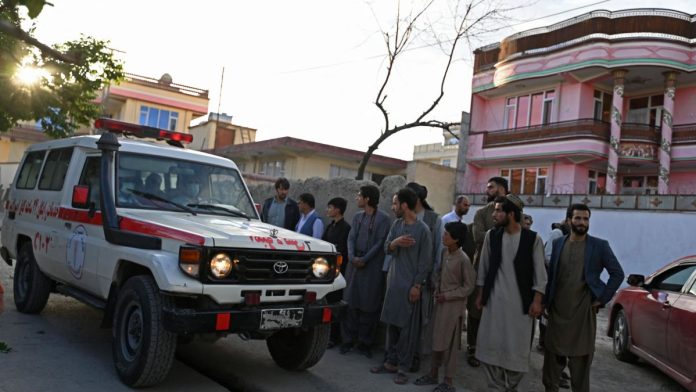
The blast hit the Khalifa Sahib Mosque in the west of the capital in the early afternoon, said Besmullah Habib, deputy spokesman for the interior ministry, who said the official confirmed death toll was 10.

The attack came as worshippers at the Sunni mosque gathered after Friday prayers for a congregation known as Zikr.

Sayed Fazil Agha, the head of the mosque, stated someone they believed was a suicide bomber joined them in the ceremony and detonated explosives.

“Black smoke rose and spread everywhere, dead bodies were everywhere,” he told Reuters, adding that his nephews were among the dead.

“I myself survived, but lost my beloved ones,” he continued.

Resident Mohammad Sabir said he had seen people being loaded into ambulances.

“The blast was very loud, I thought my eardrums were cracked,” he added.

Emergency Hospital in downtown Kabul announced it was treating 21 patients wounded in the blast and two patients were dead on arrival. A nurse at another hospital, who declined to be identified, said it had received several wounded in critical condition. A health source added hospitals had so far received at least 30 bodies in total.

Scores of Afghan civilians have been killed in recent weeks in blasts, some of which have been claimed by Islamic State.

The latest attack came on the last Friday in the month of Ramadan in which most Muslims fast, and before the religious holiday of Eid next week.

The Taliban rulers say they have secured the country since taking power in August and largely eliminated Islamic State’s local offshoot, but international officials and analysts say the risk of a resurgence in militancy remains.

Many of the attacks have targeted the Shi’ite minority, however Sunni mosques have also been attacked.

Bombs exploded aboard two passenger vans carrying Shi’ite Muslims in the northern city of Mazar-e-Sharif on Thursday, killing at least nine people. Last Friday, a blast tore through a Sunni mosque during Friday prayers in the city of Kunduz, killing 33.

Leader: New equation in anti-Israel struggle as Palestinians turn to resistance

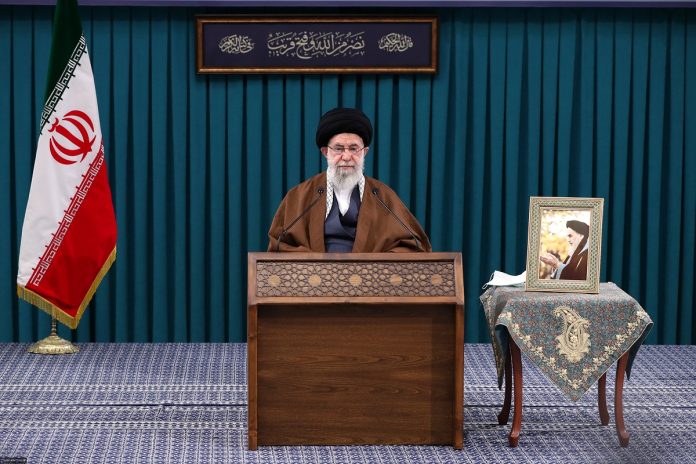
Iran’s leader Ayatollah Seyyed Ali Khamenei

Ayatollah Khamenei marked the International Quds Day on Friday with a live televised speech in Arabic addressing the Palestinian people.

The Leader said today, the “invincible will” in Palestine and the entire West Asia region has replaced the Israeli regime’s once-called “invincible army.” Such circumstances, he said, have forced the “criminal” Israeli military to go on the defensive.

Ayatollah Khamenei said Israel’s staunch supporter, the United States, has also been suffering defeat after defeat in the region and elsewhere, including in the Afghanistan war, in the “maximum pressure” campaign against Iran, in controlling the global economy, and even in running its own state affairs.

He added that opinion polls suggest that most Palestinians are today encouraging their leaders to launch military operations against Israel, describing it as a “significant phenomenon.”

“This signifies the full readiness of Palestinians for confronting the occupying regime and gives a free hand to resistance organizations to take action whenever deemed necessary,” the Leader said.

Ayatollah Khamenei said the latest Palestinian activities in Jenin, which claimed the lives of over a dozen Israelis, have “driven the Zionists crazy.” This is while, he added, the Israelis massacred 200 Palestinians at the Jenin refugee camp 20 years ago, following the killing of a few Israelis.

The movements of Palestinians in both northern and southern parts of the 1948 territories in parallel with large protests in Jordan and East al-Quds and drills in Gaza show “the entie Palestine has turned into the scene of resistance.”

“What has been happening in Palestine in recent years has nullified all compromise plans with the Zionist enemy, since any plan on Palestine adopted in the absence or in contradiction with the opinion of its owners, who are the Palestinians, cannot be implemented,” he added.

Ayatollah Khamenei renewed Iran’s support for the Palestinian cause against Israeli occupation and condemned the “treacherous trend of normalization” with the Zionist entity.

“The Islamic Republic of Iran is a supporter and proponent of the resistance front and Palestine. We have always said this, remained committed to this and insisted on it,” he added.

The Leader described resistance as the only option to resolve the issues of the Muslim world and Palestine, above all.

IRGC commander warns Israel against any “foolish act”

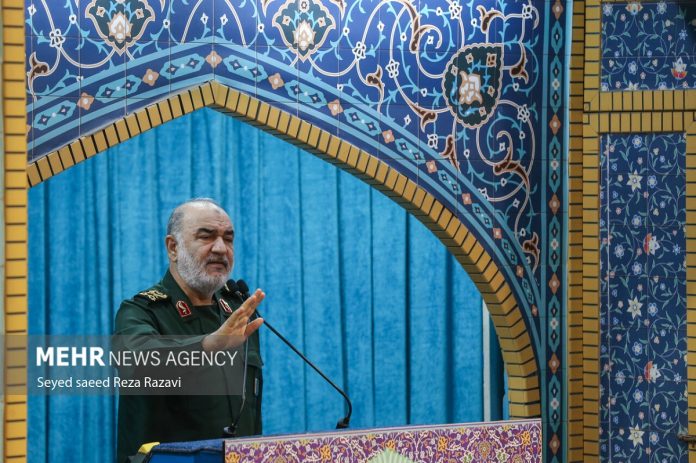
Major General Hossein Salami

Speaking on the occasion of the International Quds Day in Tehran on Friday, Salami added that Palestine is now armed and its men are ready to fight the Zionists.

Addressing the leaders of the Zionist regime, Salami said, “You are now witnessing the firing of thousands of Palestinian rockets and the failure of your Iron Dome missile shield and you are feeling like you have been encircled in the heart of the Islamic world”.

Salami also advised the Zionists to note the fact that the US has weakened and it now looks like the “house of a spider” and it’s no longer a reliable ally.

He also cited the US’s humiliating retreat from Afghanistan as a sign that Washington’s clout is on the wane.

The commander of the IRGC then warned the Israeli regime against a “foolish act” against the Islamic Republic of Iran.

Salami said the Israelis know that Iran makes good on its promise and that any aggression against the nation will have painful consequences for Tel Aviv.

Salami urged the Palestinians to press ahead with their struggle against the Zionists, saying, “Your enemy is on the decline and you are becoming more and more powerful”.

He noted that Iran will continue supporting Palestine in its fight against Israel.

Raisi: Int. Quds Day rallies symbol of solidarity among Muslim nations

Iranian President Ebrahim Raisi

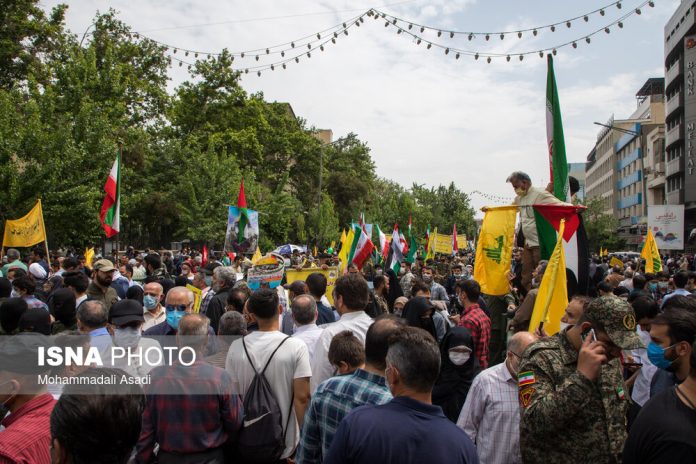
Speaking to reporters while taking part in the demonstration in Tehran on Friday, Raisi praised the active participation of the youths in the mass rallies.

“The important message of this participation is that it is the Palestinian youths, teenagers, and the resistance front that have taken the initiative in the field of action and are deciding the fate of Palestine’s long-running resistance,” he said.

“The great movement that we are witnessing today in the form of demonstrations is the symbol of solidarity in the Islamic Ummah and will lead to the destruction of the Zionist regime,” he said.

“As promised by God and the dear Prophet of Islam, we consider the liberation of al-Quds to be definitive” the president added.

Iran demonstrators: Normalization with Israel ‘unforgiveable betrayal’

Quds Day in Iran

In a final communiqué issued at the end of the International Quds Day rallies on Friday, the demonstrators described the liberation of al-Quds and the “oppressed, defenseless Palestinian nation from Zionist occupiers” as well as efforts to “bring about the annihilation of the cancerous Israeli tumor” as the “lofty ideal of the Islamic world.”

“We censure any attempt at diverting the attention of Islamic Ummah from the sinister plot” of normalization or compromise with Israel, they said.

The demonstrators said the repeated defeats suffered by the US, Israel, and Whahhabi reactionaries destroyed the myth of the Israeli military’s “invincibility” and were a sign of the decline of the hegemonic system in the Middle East.

They voiced “firm support” for Iran’s Armed Forces in backing the anti-Israel resistance front, especially the brave Palestinian fighters.

The demonstrators also condemned international bodies and the human rights advocacy organizations for their “deafening silence” in the face of Israel’s apartheid, racism, crimes against humanity, and genocide against the Palestinians as well as the regime’s “evil crimes” against the Iranian nation.

They also delivered a separate warning to the enemies of Iran.

The demonstrators called the US administration the “number-one enemy” of Iran and condemned Washington’s hostile withdrawal from the 2015 nuclear deal.

They described a removal of all sanctions and securing guarantees that the US will remain committed to the agreement, in case of its revival, as the sole way to safeguard the Iranian nation’s rights and interests.

They also praised Iran’s deterrent missile power and spiritual influence in the region as the country’s “strategic asset,” warning the enemies that any act of mischief or illusions for weakening the country’s conventional missile activities constitute a “red line” for the Iranian nation.

Why Iran set up centrifuge parts workshop at underground site?

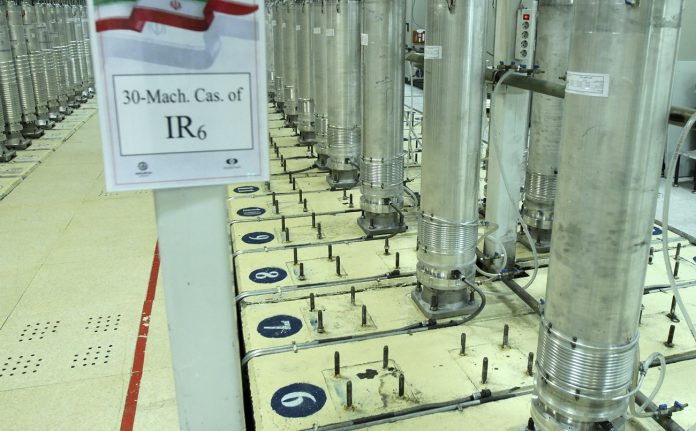
Centrifuge-parts workshop Iran Natanz

In a piece published on Thursday, the Nour News website, which is affiliated with Iran’s Supreme National Security Council (SNSC), provided explanations on an announcement earlier in the day by Secretary-General of the International Atomic Energy Agency (IAEA) Rafael Grossi about Iran’s decision to set up the new workshop at “one of the halls” of the underground Fuel Enrichment Plant at the Natanz site.

The report clarified that the acts of sabotage, for which the Israeli regime has implicitly taken responsibility, caused damage to the country’s nuclear facilities over the past years, as a result of the IAEA’s “lack of sensitivity and disregard for its duties of protecting” Tehran’s civilian nuclear activities.

The report recalled that the Atomic Energy Organization of Iran (AEOI) moved the machines for producing spare parts for uranium enrichment centrifuges to the Natanz site in the aftermath of a sabotage attack on the Karaj facility attributed to Israel in June.

The AEOI made the move with the aim of boosting the security rate at workshops for manufacturing centrifuge parts “using passive defense,” it added.

“Adopting such an approach, of which the IAEA was informed, was a natural response to the acts of mischief carried out with the objective of dealing blows to Iran’s peaceful nuclear activities,” it added.

In mid-April, Nour News reported the launch of the new workshop using the machines moved there from the TESA Karaj complex, in a step that the website described as a “decisive stride on the path toward increasing the degree of protection and security at nuclear sites and relevant industries.”

Israeli troops storm al-Aqsa Mosque, dozens injured

Palestinians Al-Aqsa Mosque
JERUSALEM - APRIL 29: Some of Palestinians who responded Israeli forces raid Masjid al-Aqsa, are wounded in the Old City of East Jerusalem on April 29, 2022. The Israeli police, who removed Palestinians in the courtyard of al-Aqsa Mosque, closed the doors of the Masjid al-Aqsa to Muslims coming from outside for the last Friday prayer of Ramadan. (Photo by Mostafa Alkharouf/Anadolu Agency via Getty Images)

The unrest came on the final Friday in the Muslim holy month of Ramadan. Most of those injured suffered “upper-body injuries” the Red Crescent said, adding that 22 people had been taken to hospital.

Israeli police claimed forces entered the compound after “rioters” hurled stones and fireworks, including down towards the Western Wall, the sacred Jewish site below Al-Aqsa.

Witnesses stated police fired tear gas and rubber bullets.

Police said three people had been arrested, two for throwing stones and one for “inciting the mob”.

“For the past hour, the site has been quiet and [Muslim] worshippers are safely entering [the compound],” police added.

But tensions remain high at the site in the heart of Jerusalem’s old, walled city, part of Israeli-occupied East Jerusalem.

Over the past two weeks, nearly 300 Palestinians have been injured in Israeli incursions at the Al-Aqsa compound, Islam’s third-holiest site.

Muslim leaders have been angered by a recent uptick in the number of Israeli settlers entering the Al-Aqsa Mosque compound.

The longstanding convention has been that only Muslims are allowed to pray at the compound, but, according to the Jerusalem Islamic Waqf, nearly 3,700 Israeli settlers have entered the Al-Aqsa Mosque compound over the past week to mark the Jewish festival of Passover.

Most Orthodox Jews do not pray inside the compound, believing it to not be religiously acceptable, and Jerusalem’s Chief Rabbinate also forbids prayer there.

However, a growing number of Israeli religious nationalists have encouraged Jewish prayer on the site, with elements calling for the construction of a Jewish temple there.

The growing presence of the movement has led to many Palestinians fearing that Israel is seeking to divide the compound and create a space where Jews may worship.

In an apparent attempt to ease tensions, Israel’s foreign minister Yair Lapid has stressed that the government was committed to the status quo at the compound, and said that no plan to divide it exists.

However, Palestinians living in the occupied West Bank still face tough restrictions on visiting the Al-Aqsa compound, a national symbol for Palestinians, with travel being almost totally restricted for most of the year, and only allowed for certain age groups during Ramadan. In effect, this means that many Palestinians who live only miles away from East Jerusalem have never been able to visit.

Israel says that the measures are necessary for security reasons. The fresh unrest comes on the last Friday of Ramadan, with the end of the Muslim holy month coming early next week.

Violence in Israeli-occupied East Jerusalem has raised fears of another armed conflict similar to an 11-day Israeli assault on Gaza last year which was triggered by similar unrest at the mosque.

Recent weeks have seen isolated rocket fire from Gaza towards Israel and Israeli reprisals, but no casualties reported on either side. The Al-Aqsa tensions have come against a backdrop of violence since March 22 in Israel and the occupied West Bank and Gaza.

At least 26 Palestinians and three Palestinian citizens of Israel have died during the period, most of them in raids by Israeli security forces in the occupied West Bank.

Twelve Israelis and two Ukrainians were also killed in four separate attacks inside Israel. Two of the deadly attacks were carried out in the Tel Aviv area by Palestinians.

Envoy: Iran, Saudi Arabia agree to create roadmap for talks

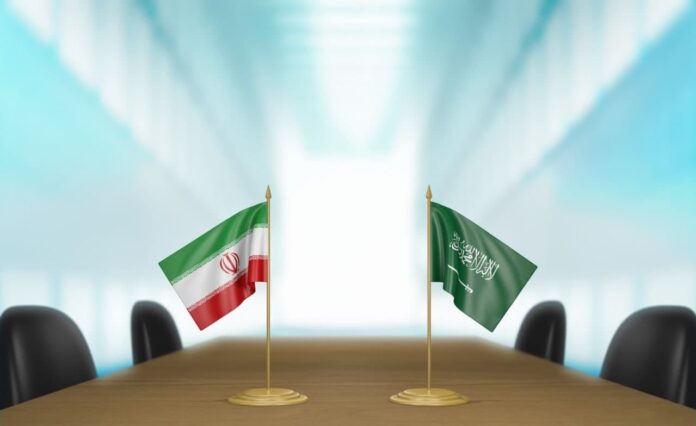
Iran Saudi Flags

Iraj Masjedi also spoke of the fifth round of negotiations between Tehran and Riyadh brokered by the Iraqi government.

He said during the talks that happened in Baghdad, the two sides made some proposals including the roadmap which they agreed upon.

Asked if Iran and Saudi Arabia will reopen their embassies, Masjedi said the trend of the future negotiations will decide if this will happen.

He added what mattered in the latest round of talks was that the two sides would agree on a roadmap for the future, which paid off, and this is a positive sign.

The Iranian ambassador to Baghdad said one issue Tehran and Riyadh agreed upon was confidence building.

Masjedi added that the other issues were Hajj, the reopening of embassies and also regional and international matters.

Erdogan: Turkey, Saudi Arabia striving to increase all-out relations

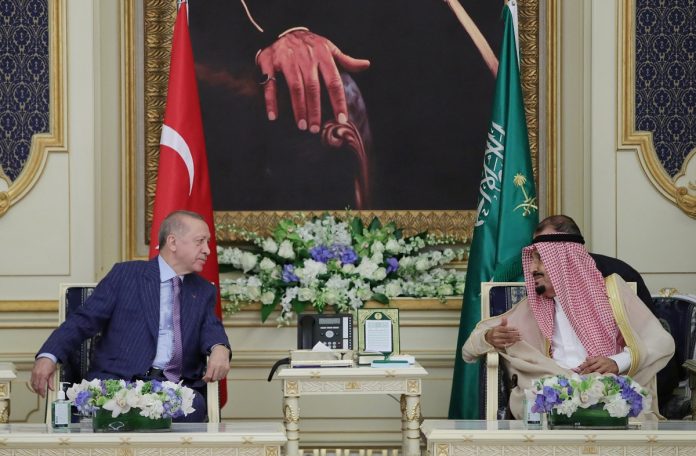
Erdogan King Salman

“We paid a visit to Saudi Arabia upon the invitation of Hadimu’l Haremeyn,” or “the Servant of Mecca and Medina,” stated Erdogan, referring to Saudi King Salman bin Abdulaziz Al Saud.

“As two brotherly countries with historical, cultural and human ties, we are striving to increase all kinds of political, military and economic relations between us and to start a new era,” said Erdogan on Twitter.

Increased cooperation with Saudi Arabia in health, energy, food security, agricultural technologies, the defense industry and finance is in the common interest, Erdogan continued, adding the two countries have serious cooperation potential in renewable and clean energy technologies.

Erdogan also stated that Turkey attaches great importance to the security and stability of the Persian Gulf region.

“We express on every occasion that we attach as much importance to the stability and security of our brothers in the Gulf region as our own,” he said.

“We underline that we are against all forms of terrorism and that we attach importance to cooperation with the countries in our region against terrorism,” he added.

“I believe we will take our relations to a level beyond what they were previously,” said Erdogan, adding his visit during the Muslim holy month of Ramadan “will open the doors of a new era with our friend and brother Saudi Arabia.”

King Salman received President Erdogan Thursday evening with an official ceremony in the city of Jeddah. The two leaders held a closed-door meeting at Al-Salam Royal Palace.

Erdogan also met with Saudi Crown Prince Mohammed bin Salman.

Earlier, the Turkish president arrived in Saudi Arabia for a two-day working visit.