Tuesday, December 23, 2025
Home Blog Page 1960

How people in Iran’s Hormozgan observe Ramadan

Ramadan Iran

They have developed their own traditions over the past centuries to best perform the religious duty of fasting.

Rituals of Ramadan in Hormozgan’s Minab

In Hormozgan, like in any other part of the world, many traditions and rituals have undergone transformation or even faded away with the passage of time, but those of Ramadan continue to give a special face to the province’s east.

For years, the people of Hormozgan have been gloriously observing the holy fasting month in their own style, with some of the traditions being either rooted in the same land or passed down from one generation to another.

Recitation of hymns by the local mullah (clergyman)

In this tradition, an individual goes up to the roof of a house, mosque or a hussainiyah one hour before the mourning call to prayer and wakes people up by reciting hymns with a loud voice for them to have the meal before the dawn of the fasting day. This ritual, as a spiritual and intangible legacy of Hormozogan, used to be observed in suburban neighborhoods and villages until a few years ago, but it has lost its vigor due to a more common use of alarm clocks.

“The crowing of the cock” was yet another common way that was relied on to wake people up early in the morning for the meal before the start of the fasting day.

Breaking the fast with light meals

In the course of the holy month of Ramadan, residents of Hormozgan have the habit of breaking their fast with some warm water, salt, dates, tea, hot milk, Halva (a kind of sweet paste), Sooraq and Mahyaveh types of sauce with eggs, saffron cookies, Komaj bread, and Gerdeh sweet bread upon the evening call to prayer. This tradition was known as “mouth opening” in old times.

Still, some women can be seen, especially in the course of Ramadan, cooking local bread, such as Tomshi, with Sooraq, Mahyaveh, oil, and sometimes, eggs and cheese in parks, on the beachside, or in the crowded streets, while others sell Aash (pottage), hot Haleem, peas and broad beans.

Sharing the Iftar table with relatives

According to their long-running habits and beliefs, the people of Hormozgan share a portion of the food they have for Iftar with neighbors and relatives so that the food will bring more delight and blessings.

Honoring the memory of those lost

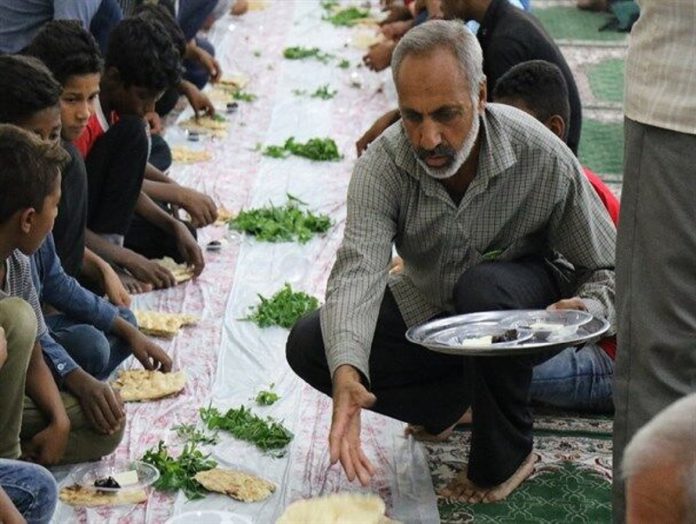
The people of Hormozgan, especially those in Minab, hold a procession of nine nights in memory of those who have passed away by reciting Qur’an and distributing food for Iftar. They usually invite between 50 to 100 relatives to the ceremony known as “the Eid of the Dead,” which is, in itself, a kind of family visit.

“The 100-paragraph prayer”

Joshan-e Kabir prayer, which in Hormozgan is known as “the 100-paragraph prayer,” is recited during the nights of Qadr (Destiny) in the month of Ramadan. According to ongoing ritual, the locals of Hormozgan carry thread or knitting yarn with themselves [to mosques where the prayer is recited] and they give one knot to the yarn with every paragraph of the prayer, and they believe that keeping that yarn on themselves or at home alleviates problems.

“Sar-Roozeh”in Hormozgan (Minaab)

People in Hormozgan call Zakat al-Fitr “sar-roozeh.” In the evening of the last day of the holy month of Ramadan and before the evening call to prayers, they assign “sar-roozeh” to each member of the family and put it aside until they give it to the needy or the custodian of the local mosque on Eid al-Fitr.

Eid al-Fitr in Minaab

On Eid al-Fitr, especially in Hormozgan, Minaab, family members get together and, distilling grievances, set up a big serving tablecloth to host worshipers. Then, they head to the graveyard to visit the dead and recite the Quran and prayers and congratulate them on the eid.

The holy month of Ramadan has many long-held rituals and traditions in Hormozgan and the Persian Gulf region, which has a high tribal, religious, and cultural diversity because of the presence of the many Iranian ethnicities who live there. That diversity is the reason why you would smell different tribal and local foods and appetizers as you pass neighborhoods when Ramadan begins.
Iran MP: No country has so far released frozen Tehran assets

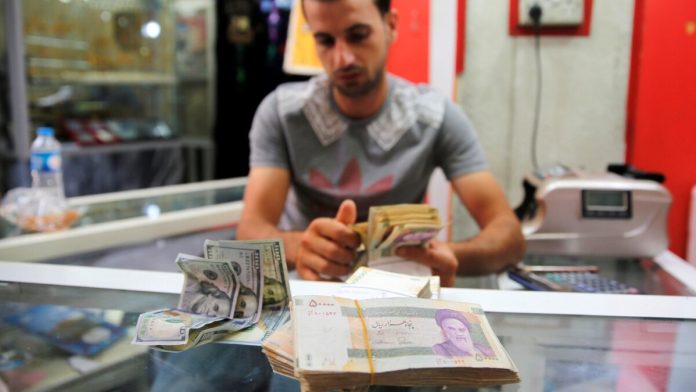
Rial Dollar

Commenting about reports that a large portion of frozen Iranian assets in other countries will be released soon, Shariair Heidari added, “Some of these countries expressed readiness but, so far, they have failed to make any payments. In the latest meeting we had with relevant officials, they announced that some of these assets are planned to be released.”

“Some countries, where our forex funds are blocked there, are delaying things until an agreement on the Joint Comprehensive Plan of Action is reached, so they release our funds. After the agreement there would be no reason to block [our assets]. And if there is no agreement, they may come up with excuses again. However, as they have realized that an agreement is close, they are showing some flexibility. I hope our forex resources, which belong to our country, are released as soon as possible.” he told Entekhab news website.

Heidari added that some countries are saying that the blocked Iranian funds will be released before the agreement on the 2015 nuclear deal and others think differently.

“What is clear is that these funds have been blocked unjustly and only due to the sanctions,” he said.

Heidari also said the largest portion of Iranian funds are blocked in Iraq and South Korea.

The lawmaker said Koreans have repeatedly pledged to release the Iranian assets but they have failed to fulfill their pledges.

“We expect these countries to release our assets sooner than other countries,” he said.

Report: Mashhad stabber harbors Takfiri thoughts

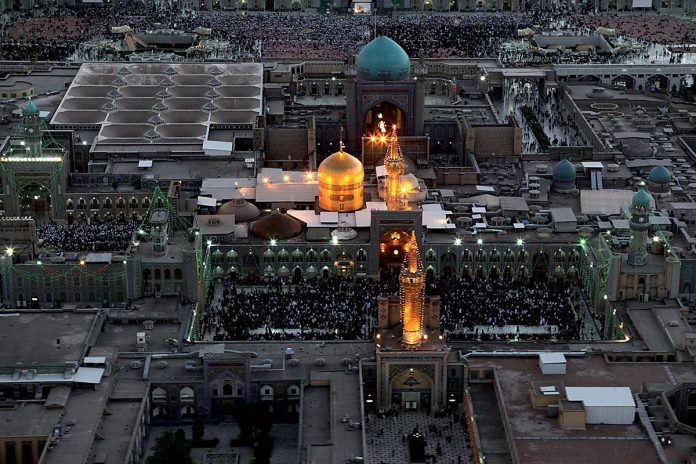
Iran Mashhad Shrine of Imam Reza (PBUH)

According to Tasnim News Agency, Abdul Latif Moradi is of Uzbek descent and has lived in Mashhad’s Mehrabad district along with his brother for some time.

The report says Abdul Latif Moradi, unlike other Sunni Muslims, follows the Takfiri ideology, considers Shia Muslims as rejectionist and believes Shais’ blood must be spilled.

Tasnim says the man has some nicknames including Abdul Latif al-Salafi, Hassan Moradi and Abul Agheb al-Muvahid and that he sought to propagate Wahabi views and confront Shia Muslims.

Security forces in Mashhad have arrested 6 other people accused of aiding and abetting the attacker including two of his brothers.

The Mashhad deadly stabbing killed one of the three clerics and injured the other two.

The incident has angered Iranians, with many criticizing authorities for allowing what they see as foreign extremists to stay in Iran after illegally entering the country.

A Hero’s producer says no final verdict on Farhadi’s plagiarism yet

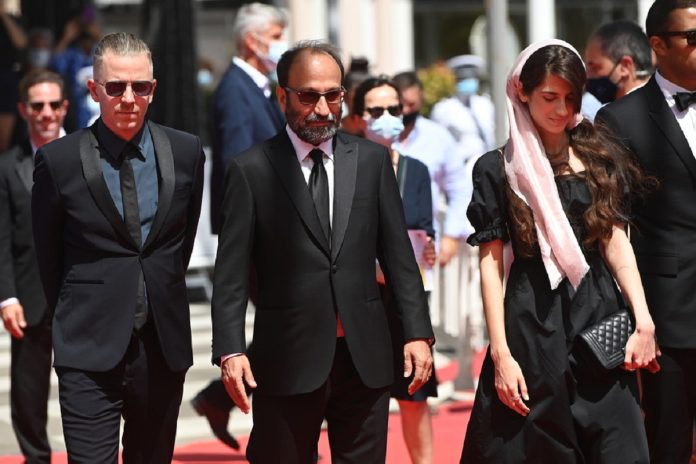
Alexander Mallet-Guy and Asghar Farhadi

Alexander Mallet-Guy said in the statement that no final binding verdict has been so far issued on the case and initial investigations has only warranted a court hearing on the allegations against Farhadi.

Mallet-Guy, a long-time associate of Farhadi and the president of the Paris-based film production and distribution company Memento Pictures, also said the Iranian court, which is in charge of the case, has so far rejected all claims of the plaintiff Azadeh Massihzadeh concerning the revenues of “A Hero”.

“A Hero is the eighth film of Farhadi for which I have done the distribution and my fourth film with him as producer. Together, we won two Oscars for the best foreign film as well as numerous awards in Cannes Film Festival, including its Grande Prix for A Hero. I have full trust in Asghar Farhadi, whom I consider one of the most talented and innovative directors in the world. I know that one of his former students, who directed a documentary under his direction, as well as a former prisoner, whose story has a source of inspiration for Farhadi’s A Hero, have filed a lawsuit against him concerning the movie,” he said.

Millet-Guy added that “we strongly believe” the court will reject Massihzadeh’s claim.

He noted that the story of the prisoner, produced by Massihzadeh, is also only a beginning point for Farhadi’s A Hero, which he described as a complicated creation of the Oscar-winning director.

On Tuesday, Massihzadeh said the court had accepted her evidence to prove plagiarism by Farhadi. Different English-language periodicals have also given wide coverage to the story.

One of them, the prestigious Hollywood Reporter said an initial court in Iran has found evidence that Farhadi did use some elements of a documentary by his former student in violation of her copyright. But, the magazine said a second court should decide on the matter and Farhadi can appeal any verdict that comes out.

Covid kills 44 more people in Iran

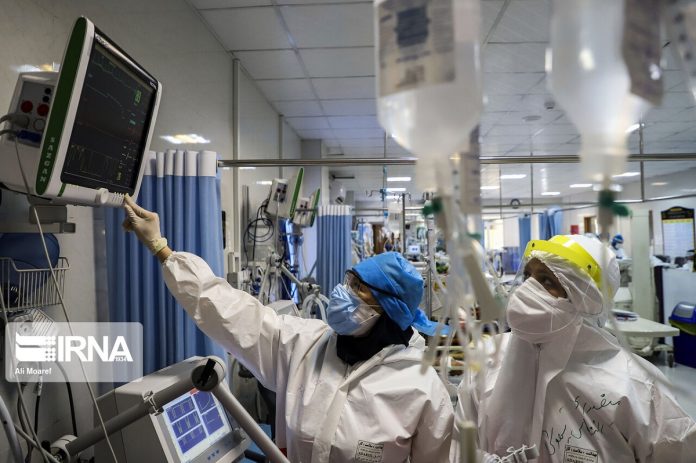
COVID in Iran

The total death toll from the disease in Iran is now 140,451.

The Health Ministry figures also put the daily caseload of Covid at 4,428 including 494 hospitalizations.

There has been a downward trend in the Coronavirus deaths and infections in Iran in recent weeks.

Many Covid-related restrictions have been removed. Schools and universities have reopened. But the Iranian officials have urged people to observe health protocols to prevent a resurgence of the virus.

Over 30 cities across Iran are still marked red, which denotes the highest risk from the virus.

The downward trend in the Covid deaths and cases has been attributed to a nationwide vaccination campaign in Iran that has seen more than 147 million doses of vaccine administered to people.

Iran nuclear chief: Tehran to unveil new atomic achievements soon

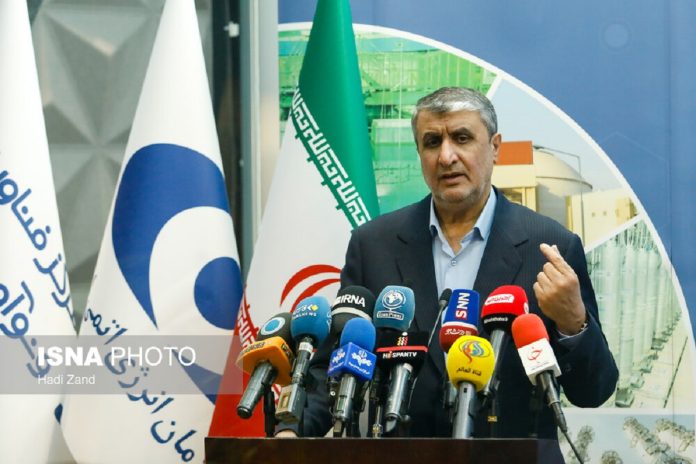
Head of the Atomic Energy Organization of Iran Mohammad Eslami

Mohamamd Eslami said 3 achievements are in the fields of radiopharmaceutical, diagnosis and treatment, 2 in the field of plasma therapy and the remaining 4 in the industrial field, namely laser.

Eslami said the nuclear fuel cycle is now totally indigenous and that Iran is also moving toward building its first fully homegrown nuclear power plant.

He added that the construction of a 360 megawatt power plant in Darkhovein, in southern Iran, will be pursued in the current Persian year, for which all knowledge-based industries and companies will be employed.

According to the director of the AEOI, Iran’s goal is to generate 10k megawatts of electricity, which he described as “nuclear renaissance”.

Eslami said Iran has already made 25 achievements in the peaceful nuclear energy field and will continue the trend. He also spoke about the Vienna talks aimed at reviving the 2015 nuclear deal, JCPOA.

Eslami said the country is willing to build confidence with the other parties to the Vienna talks but it will not give in to bullying. He maintained now that the US wants to return to the JCPOA, there must be verification so that the next steps can be guaranteed.

Eslami also referred to the International Atomic Energy Agency’s oversight activities in Iran. He said the IAEA’s concerns about a site have been dispelled and efforts are ongoing to remove the agency’s worries about three other sites within the next two months.

Eslami also dismissed claims that traces of uranium were detected at a site as unfounded, saying such uranium never existed in the first place.

The AEOI’s director said the Zionist regime is faking proof to level baseless allegations against Iran. He also said the regime has been doing acts of sabotage and terrorism against Iran with impunity.

Expert: Iranian province bordering Afghanistan faces risk of measles outbreak

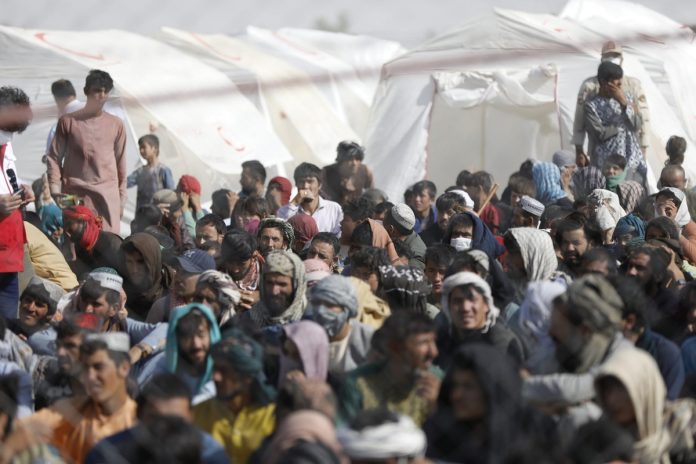
Afghan Refugees in Iran

Dr. Zahra Nahbandian, head of the Department of Contagious Diseases at Mashhad’s University of Medical Sciences, said there had been a noticeable rise in cases of measles in Afghanistan, putting Iran’s Khorsan Razavi at risk.

“Regardless of their nationalities, all those with children under the age of five, who have delayed the vaccination of their kids due to the coronavirus spread, should make sure to go for measles inoculation,” she added.

Measles is generally a childhood infection caused by a virus. Also called rubeola, measles can be serious and even fatal for small children, but the disease can almost always be prevented with a vaccine. It causes high fever, a red rash, cough and red eyes. It can have serious complications such as encephalitis, which itself can cause hearing loss.

Iranian daily warns against influx of Afghan refugees after Mashhad stabbing

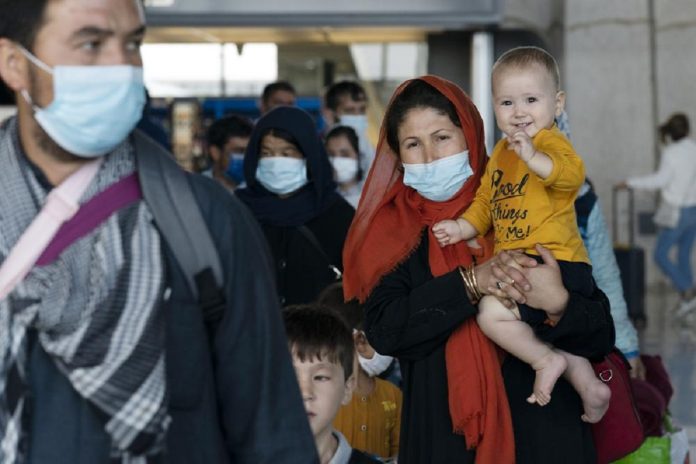
Afghan refugees in Iran

Citing “field data,” the Iranian Jomhouri-e Islami (Islamic Republic) Daily reported on Wednesday that around 10,000 Afghans cross the border into Iran on a daily basis.

“The demographic composition is changing in many provinces. Important developments are unfolding, an example being the crime that was perpetrated at the courtyard of Imam Reza’s shrine,” it said.

The daily warned the country’s officials to contain “the dangerous situation,” especially as there are what it called elements linked to the Taliban among the refugees flowing into Iran.

The report came a day after a knife attack that left a cleric dead and two others injured at the holy shrine of Imam Reza in the northeastern city of Mashhad, Khorasan Razavi Province, near the Afghan border.

The assailant, along with four other people, were quickly arrested on the spot. Some media reports have claimed that the attacker is an Afghan national.

President Raisi: Takfiri terrorists behind Mashhad stabbing

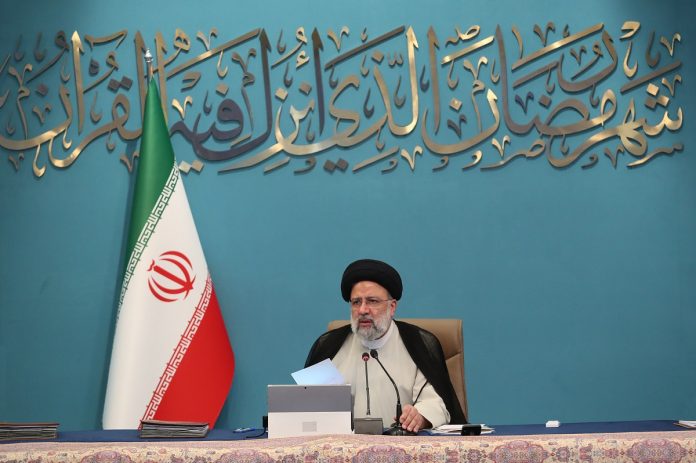
Iranian President Ebrahim Raisi

President Raisi issued a message on Wednesday saying this atrocity will only increase unity among people who love Islam and the Islamic Republic of Iran.

The Iranian president described the stabbing to death of the cleric in Mashhad as heart-rending and offered condolences to his family.

The stabbing spree happened on Tuesday. The attacker was captured by pilgrims inside the Imam Reza shrine, the eighth Shia Imam, and handed over to authorities.

Officials say the stabber is a foreign national. They also say four other people have been arrested in connection with the stabbing.

President Raisi has ordered the Intelligence Ministry to identify all the culprits behind the killing of the cleric. Raisi told the Intelligence Ministry to get the job done fast in cooperation with other related organizations.

Iran’s non-oil trade hits record high in years: Official

Non Oil Exports

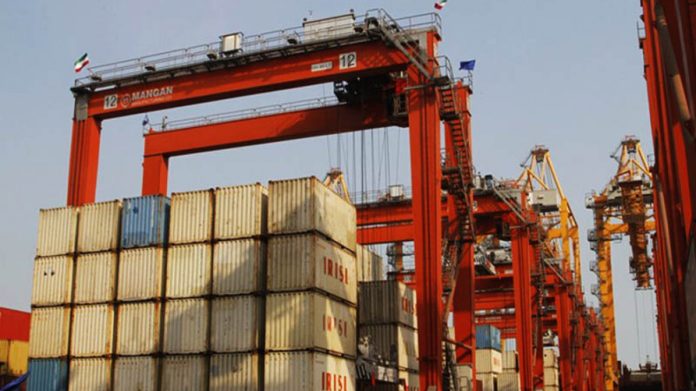
Rouhollah Latifi, spokesman for the Islamic Republic of Iran Customs Administration, said that overall monthly trade excluding oil reached 11,538,000,000 dollars on March 20, the highest “in the past couple of years, especially during the period of the intensification of sanctions and maximum pressure” on Iran.

That figure accounted for 14,539,000 tons of goods traded between Iran and other countries, registering a 40-percent increase compared to the same period the year before.

Exported goods summed at approximately 5.1 billion dollars and imports at 6.4.

According to figures provided by IRNA, Iran exported 48 billion dollars’ worth of products to the world and imported 52 billion dollars in the last Iranian calendar year.