Six hundred Ukrainians ‘tortured’ in Kherson: official
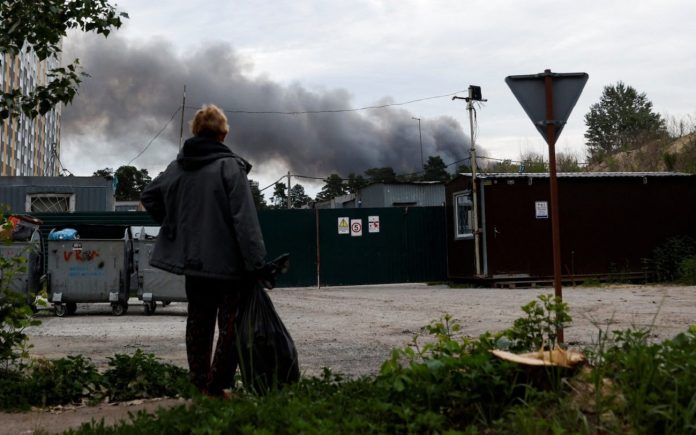
Some 600 Ukrainians are being held captive and tortured in the Russia-occupied southern region of Kherson, a Ukrainian presidential aide has said.
“They are held in basements, in specifically-designed torture chambers,” Tamila Tasheva stated in televised remarks.
She added the captives who were detained for their pro-Ukrainian sympathies, suffer in “inhumane conditions” in the basements of police stations, government offices and schools throughout Kherson, a Belgium-sized region that was taken over in early March.
Ukraine needs to demine ports for grain exports to resume: Kremlin
Russia has announced Ukraine needs to remove sea mines near its Black Sea port of Odesa to allow grain exports to resume.
Asked about a possible deal to allow grain shipments from Odesa, Kremlin spokesman Dmitry Peskov said in a conference call with reporters that Ukraine’s removal of the mines would allow commercial vessels to arrive at Odesa to take a load of grain.
“Ukraine must demine the approaches into the ports, which will allow the vessels – after undergoing a check by our military to make sure they don’t carry weapons – to enter ports and load up on grain, and then, with our help, if necessary, continue on towards international waters,” he added.
Road from Russia to Crimea open for drivers: FM
Russia’s defense minister stated on Tuesday that one can drive from Russia to Crimea via Moscow-occupied parts of eastern and southern Ukraine.
“Car movement from Russia’s territory via [Ukraine’s] mainland opened,” Sergei Shoigu was quoted by the Interfax news agency as saying.
After the 2014 annexation, Ukraine started an economic blockade of the annexed peninsula, and Moscow built the exorbitantly expensive Crimean Bridge from its southwestern region of Krasnodar.
A “land bridge” from southwestern Russia via the separatist-controlled Donbas and newly-seized areas was one of Moscow’s top goals in the war.
Germany to boost military mission in Lithuania: Scholz
German Chancellor Olaf Scholz says his country is ready to ramp up its military mission in Lithuania amid Russia’s invasion of Ukraine.
“We are ready to strengthen our engagement and to develop it towards a robust combat brigade,” Scholz told reporters after meeting with Lithuanian President Gitanas Nauseda and the prime ministers of Estonia and Latvia in Vilnius.
“We will defend every centimetre of NATO’s territory,” he added.
Zelensky says Ukraine military capabilities inferior to Russia’s
Ukrainian President Volodymyr Zelensky said on Tuesday that his country’s military capabilities are inferior to those of Russia’s, making advances in the battlefield against its powerful neighbor all but impossible.
“We are inferior in terms of equipment and therefore we are not capable of advancing. We are going to suffer more losses and people are my priority,” Zelensky told Financial Times editor Roula Khalaf at the FT’s Global Boardroom conference.
He added pushing Russian forces back into positions held before the start of the military operation would mean a “serious temporary victory” for Ukraine.
Mariupol’s population shrank four times: Ukrainian official
A Ukrainian official has claimed that the population of the southern city of Mariupol occupied by Russia has shrunk from 460,000 to about 120,000.
While some 200,000 residents managed to get to Ukraine-controlled areas, up to 70,000 of those who left the city still linger in occupied areas, Mariupol mayor’s adviser Petro Andriyushchenko said on Telegram.
Some 47,000 were forced to leave for Russia or Moscow-friendly Belarus, and the remaining residents live without running water, electricity or natural gas, he added.
UK foreign secretary says more sanctions on Russia are “in the pipeline”
British Foreign Secretary Liz Truss stated the United Kingdom will not back down in its support for Ukraine and that more sanctions on Russia are “in the pipeline,” according to a readout of Monday’s cabinet meeting.
“She said the UK would not back down in its support, with further sanctions in the pipeline and continued work with global allies on how to help Ukraine rebuild in the future,” the cabinet readout said.
Prime Minister Boris Johnson also reiterated that the UK will remain at the forefront of supporting Ukraine.
“He said it was vital that President [Volodymyr] Zelensky was not pressured into accepting a bad peace, noting that bad peace deals do not last,” according to the cabinet readout.
“He said the world must avoid any outcome where Putin’s unwarranted aggression appears to have paid off,” it added.
Ukraine must not be pressured into a bad peace deal: Johnson
Ukrainian President Volodymyr Zelensky must not be pressured by world powers into accepting a bad peace deal with Russian President Vladimir Putin, British Prime Minister Boris Johnson has told his top team of ministers.
At the cabinet meeting, British foreign minister Liz Truss also said London was readying further sanctions against Russia for its invasion of Ukraine, Johnson’s spokesman told reporters.
Johnson told his ministers Britain would “remain at the forefront” of support for Ukraine, the spokesman added.
“He said it was vital that President Zelensky was not pressured into accepting a bad peace, noting that bad peace deals do not last. He said the world must avoid any outcome where Putin’s unwarranted aggression appears to have paid off,” the spokesman stated.
Scholz: Sanctions prevent Moscow from retaining military capabilities
Moscow will not be able to retain its military capabilities due to tough Western sanctions imposed as a result of Russia’s invasion of Ukraine, German Chancellor Olaf Scholz has said.
“We have far reaching sanctions now that will set back the Russian economy by decades, that means it will not be able to participate in global economic and technological progress,” Scholz told reporters during a visit in Vilnius.
“We know from reports that this means that Russia will not even be able to retain its military capacities at the same level,” he stated, adding Moscow had in the past abused imports of civilian goods for military purposes.
The larger part of the Donetsk and Lugansk People’s Republics has been liberated along the left bank of the Seversky Donets River in Russia’s special military operation in Ukraine, Russian Defense Minister Sergey Shoigu announced on Tuesday.
“A considerable part of the Donetsk and Lugansk People’s Republics along the left bank of the Seversky Donets has been liberated, including the towns of Krasny Liman and Svyatogorsk, and also 15 other populated localities,” the defense chief said at a conference call.
The Russian defense minister mentioned Studenok, Yarovaya, Kirovsk, Yampol and Drobyshevo among the largest liberated populated areas.
Also, the residential areas of Severodonetsk have been fully liberated and the offensive towards Popasnaya is underway, Shoigu added.
“The residential quarters of the city of Severodonetsk have been fully liberated. The troops continue placing its industrial zone and nearby localities under their control. They are developing an offensive in the Popasnaya direction,” the defense chief said.
“As a whole, 97% of the territory of the Lugansk People’s Republic has been liberated to date,” Shoigu added.
Russian President Vladimir Putin and his Turkish counterpart Recep Tayyip Erdogan did not discuss the NATO exercises that are scheduled to take place in Turkey but the Russian military always keeps a close eye on such activities, Kremlin Spokesman Dmitry Peskov told reporters on Tuesday.
“No, this issue was not discussed. The Russian military certainly keeps a close eye on all exercises,” he said, when asked if the issue had been brought up in Putin’s phone call with Erdogan and whether the Kremlin was concerned in that regard.
Peskov pointed out that Turkey was a NATO member. “We are well aware of it,” the Russian presidential spokesman added.
Fierce battle for key Ukraine city changing ‘every hour’
Street fighting raged for control of Ukraine’s flashpoint city of Severodonetsk, with the situation changing “every hour”, an official has said, as Kyiv warned its troops were outnumbered by Russian forces.
“The situation is changing every hour, but at the same time there’s enough forces and resources to repel attacks,” stated the mayor of Severodonetsk, Oleksandr Striuk.
“We have hope, we have faith in our armed forces, no one’s going to abandon” Severodonetsk, he added.
Just days ago, Moscow seemed close to taking the strategic industrial hub in the east but Ukrainian forces have managed to hold out.
“Our heroes are holding their positions in Severodonetsk. Fierce street fights continue in the city,” Ukrainian President Volodymyr Zelensky noted in a video address late Monday.
Russians may siege key town of Sloviansk: Ukraine official
A presidential aide has said that the Russian army may siege the strategic Ukrainian town of Sloviansk in the southeastern Donetsk region, while Ukrainian forces would either face a “defeat” or may have to retreat.
“The siege of Sloviansk is coming up. And our forces to the north of the Seversky Donets river will either be defeated or will retreat to the southern bank,” Oleksiy Arestovich stated in televised remarks.
Arestovich, usually known for his optimistic and humorous comments on the war, added that Russians have a strategic advantage because of constant delays with Western arms supplies to the Ukrainian military.
Ukraine slams planned IAEA mission to Russian-occupied nuclear plant
Ukraine’s state nuclear company Energoatom has criticised an IAEA plan to send a delegation to a Russian-occupied nuclear plant in southern Ukraine, saying it “did not invite” such a visit.
“We consider this message from the head of the IAEA as another attempt to get to the (power plant) by any means in order to legitimise the presence of occupiers there and essentially condone all their actions,” Energoatom wrote on the Telegram messaging app.
On Monday, IAEA head Raphael Grossi stated the organisation was working on sending an international mission of experts to the Russian-held nuclear power plant at Zaporizhzhia in Ukraine, Europe’s largest.
Bodies of Ukrainian fighters from Mariupol handed over to Kyiv
The bodies of some Ukrainian fighters killed defending the city of Mariupol from Russian forces at a vast steel works have been handed over to Kyiv, the families of Ukraine’s Azov unit of the national guard said.
Ukrainian forces defending Mariupol were holed up in the Azovstal steel works for weeks as Russian forces tried to capture the city.
The Ukrainian soldiers eventually surrendered last month and were taken into custody by Russian forces.
Ukrainians learn to collect evidence for possible war crime trials
Take a 360 degree panoramic shot. Hold your cell phone camera steady. Close up on details. Comment on what you are filming.
These are not instructions on the basics of filming. This is how a Ukrainian broadcaster has been instructing average Ukrainians to collect evidence on possible Russian war crimes.
“People don’t keep the original videos. They edit them, add certain marks, there’s a risk that a court won’t accept such a video. You must keep the original,” lawyer Anna Vishnyakova told the TSN broadcaster.
Authorities have for weeks urged Ukrainians not to post videos or photos of explosions, casualties and damage caused by Russian shelling so that Russians can not use them to perfect their targeting or claim success.
In a video shared on social media, Vishnyakova also urged Ukrainians not to make visual evidence public – and, instead, keep it for future war crime trials.
Russia may hold ‘referendum’ in occupied Kherson
A Moscow-appointed official in occupied Kherson has said that a referendum was likely to be held to declare the southern region’s secession from Ukraine.
“Most likely, there will be a referendum that will be held in the Kherson region on [its] self-determination,” Kirill Stremousov, a former fish inspector and pro-Russian blogger who became Kherson’s deputy governor, told the RIA Novosti news agency.
In 2014, the Kremlin held a “referendum” in Crimea that paved the way for the annexation, despite being unrecognised by the international community. Pro-Russian separatists held similar votes to declare their “independence” from Ukraine.
Stremousov added elections would be the “next step,” but declined to specify the specific dates.
Russian troops advancing from Crimea seized Kherson by early March, ensuring energy, food and water supplies to the annexed peninsula.
Battle for Severodonetsk continues: Governor
Russian forces are maintaining their attack on Severodonetsk as the battle for the key eastern city continues, the governor of Luhansk has said.
Serhiy Haidai stated Russian forces shelled the town of Zolote on Monday morning and destroyed 13 houses in one go.
“In the afternoon, the Russians hit the town of Hirske – 11 damaged houses,” he added.
Haidai also noted that two people were injured in the shelling of a school, and a market in Lysychansk caught fire. He mentioned that three more people were injured in Lysychansk but did not specify if these injuries were related to the fire or a separate incident.
Ukraine claims some 263 children killed amid war
Ukraine says 263 children have been killed as a result of Russia’s invasion and subsequent conflict, while more than 467 have been injured.
Work is still underway to establish the number of casualties in “places of active hostilities, temporarily occupied and liberated territories,” the office of the prosecutor general said.
The highest number of children who suffered were in the Donetsk region (190), followed by Kyiv (116), Kharkiv (112), Chernihiv (68), Luhansk (53), Kherson (52), Mykolaiv (47) and Zaporizhzhia (29), the office added.
Russia’s progress on Popasna axis stalled over last week: UK
Russia’s progress made through May on the southern Popasna axis has stalled over the last week, Britain’s defence ministry has announced.
Reports of heavy shelling near the city of Izyum suggests Russia is preparing to make a renewed effort on the northern axis, the ministry also said in its latest intelligence briefing.
The ministry added Russian forces likely occupied the eastern districts of Severodonetsk and Moscow’s broader plan was to cut the off the main city area from both the north and the south.
“Russia will almost certainly need to achieve a breakthrough on at least one of these axes to translate tactical gains to operational level success and progress towards its political objective of controlling all of Donetsk Oblast,” the ministry noted.
The United States will continue providing Ukraine with military support, White House spokesperson Karine Jean-Pierre said at the briefing.
“Russia continues to make incremental gains and limited progress in certain areas of Ukraine. That’s why we are continuing to provide deliveries of weapons and equipment as quickly as possible. So that has not changed. We’re going to continue to do that,” Jean-Pierre stated.
“We are going to do everything that we can to put them [Ukraine] in a position of strength so that they can defend themselves and if there is an opportunity for them to negotiate, they will be able to do that at a in a position of strength,” the spokesperson added.
Washington ‘harassing’ Russian journalists: envoy
Russia’s ambassador to the United States has accused Washington of harassing Russian journalists in the US, state news agency RIA has reported.
“Russian journalists sent to the United States are being harassed. They face direct bans on broadcasting on American soil. They have limited access to official events. The process of obtaining work visas is complicated. Bank accounts are blocked. Special services approach employees of our media, persuading them to cooperate” Anatoly Antonov wrote on Telegram, according to RIA.
“Numerous attempts by the embassy to convey to ordinary US citizens our position on topical issues of international politics, with rare exceptions, are immediately rejected by local publications as ‘malicious propaganda’. There is no possibility to publish materials even on a commercial basis,” Antonov added.
Russia likely retains control over most of Severodonetsk: ISW
Russian forces likely retain control over most of Severodonetsk as of Monday, although the exact situation in the city remains unclear, the Institute for the Study of War (ISW) has said, adding that the city was likely frequently changing hands.
Luhansk Governor Serhiy Haidai stated on Sunday that Ukrainian forces had managed to retake large parts of Severodonetsk and controlled half the city. Ukrainian journalist Yuri Butusov, however, denied this claim saying Kyiv’s forces only controlled the city’s Azot industrial sector, the ISW noted.
“Haidai amended his claims on June 6 and reported that the situation in Severodonetsk has deteriorated significantly, adding that Ukrainian forces were indeed fighting within the Azot industrial site on June 6,” the institute said.
“The reason for Haidai and Butusov’s conflicting reports is unclear, and heavy urban fighting is ongoing in the city,” the ISW added.
Ukraine’s first lady says 60% of country needs psychological help
About 60 percent of Ukrainians need psychological help as a result of the war, Ukraine’s first lady has said, adding that Kyiv was working on establishing a national support system.
Olena Zelenska said that the figure was mentioned in a working group of the National Program for Mental Health and Psychosocial Support, which she said had gone from negotiations with first ladies of various countries and the World Health Organisation (WHO) to the creation of a specific action plan at the state level.
She added the action plan included having representatives of WHO helping Ukraine establish a model for a system of care, and delivering training to family doctors, psychologists, social workers and teachers in rapid methods of psychological support.
Japan imposes more Russian sanctions
Japan will freeze the assets of two more Russian banks and one more Belarusian bank as part of additional sanctions for Russia’s Ukraine invasion, Japan’s foreign ministry has announced.
Biden declassified Russia intel due to allied “skepticism”: US spy chief
US President Joe Biden gave the order to declassify intelligence in the run-up to Russia’s invasion of Ukraine on Feb. 24 because US officials’ claims about the impending attack were being met with “skepticism” by American partners and allies, according to the nation’s top spymaster.
“When we explained to our policymakers and our policymakers went to their interlocutors, they found that there was a fair amount of skepticism about it,” Director of National Intelligence Avril Haines said at a cybersecurity conference on Monday.
“As a consequence, the President came back to us and said, ‘you need to go out and share as much as you possibly can and ensure that folks see what it is that you’re seeing, so that we can engage again and perhaps have more productive conversations about how to plan for essentially the potential of a Russian invasion’,” she added.
Dating back to the early days of the Russian buildup on the Ukrainian border, the Biden administration has been selectively declassifying and releasing intelligence surrounding Russia’s war in Ukraine, both to media organizations and to other friendly nations. The approach has been aimed at combating Russian propaganda globally and to ensure the US partners and allies are sharing a unified picture.
Haines stated the US “did a lot of sharing in this space with partners and allies,” ultimately developing “mechanisms for sharing” that can be used in the future.
Washington accuses Moscow of conducting ‘full assault on media’
The US has accused Russia of trying to “intimidate” American correspondents in Moscow who were summoned by the Russian foreign ministry and threatened with reprisals because of US sanctions.
“The Russian Ministry of Foreign affairs summoned your colleagues to quote, ‘explain to them the consequences of their government’s hostile line in the media sphere,’” State Department Spokesperson Ned Price told reporters in the US capital.
“Let’s be clear, the Kremlin is engaged in a full assault on media freedom, access to information and the truth,” he added, slamming what he called “a clear and apparent effort to intimidate independent journalists”.
Russia’s offensive an ‘unambiguous act of aggression’: US
The United States and its allies will keep providing “significant” support to Ukraine out of respect for the legacy of D-Day soldiers, whose victory over the Nazis helped lead to a new world order and a “better peace”, the top US army general has said.
In an interview with The Associated Press news agency overlooking Omaha Beach in Normandy, Mark Milley, US chairman of the Joint Chiefs of Staff, stated Russia’s war in Ukraine undermines the rules established by Allied countries after the end of World War II.
He spoke on the 78th anniversary of the D-Day invasion of Allied troops onto the beaches of France, which led to the overthrow of Nazi Germany’s occupation.
One fundamental rule of the “global rules-based order” is that “countries cannot attack other countries with their military forces in acts of aggression unless it’s an act of pure self-defence”, Milley told the news agency.
“But that’s not what’s happened here in Ukraine. What’s happened here is an open, unambiguous act of aggression,” he added.
EU foreign policy chief condemns Russian missile strike on Ukrainian grain terminal
The European Union’s High Representative, Josep Borrell, condemned a Russian missile strike this weekend that destroyed a large grain storage terminal in the southern port city of Mykolaiv.
“Another Russian missile strike contributing to the global food crisis. Russian forces have destroyed the second biggest grain terminal in Ukraine, in Mykolaiv,” Borrell said in a tweet Monday.
Images on social media Sunday showed the terminal engulfed in flames. Mykolaiv is close to some of Ukraine’s most fertile grain-producing regions.
Borrell added the strike was at odds with recent pledges by Russian President Vladimir Putin to offer safe passage through the Black Sea from Ukrainian ports for merchant shipping.
“The disinformation spread by Putin deflecting blame becomes ever more cynical,” he tweeted.
Zelensky: Over 2,500 prisoners from Mariupol’s Azovstal plant may be held in Donetsk and Luhansk regions
Ukrainian President Volodymyr Zelensky says there may be more than 2,500 prisoners from the Azovstal steel plant in Mariupol now detained in the Donetsk and Luhansk regions in eastern Ukraine.
In a wide-ranging media availability in Kyiv, Zelensky stated that regarding the treatment of these prisoners — including the intention to hold a so-called public tribunal — the Russian plans were changing constantly. Officials in the Donetsk People’s Republic have spoken of putting some of the Azovstal defenders on trial where they are alleged to have carried out human rights abuses in Ukraine.
Asked whether he thought the prisoners were being tortured, Zelensky noted he was convinced that it was not in the interests of the Russian side because they are “public prisoners” whose condition is monitored by the world community.
Zelensky added the first phase of the operation — getting the soldiers out of Azovstal alive — had been achieved.
“Today there is the second part — to bring them home alive,” he said.
“We know what can be agreed on with the Russians, we know this price. We know they can’t be trusted,” he added.
Turning to the situation in eastern Ukraine, Zelensky said the situation was difficult. The president visited forward positions on Sunday in Luhansk, Donetsk and Zaporizhzhia.
“We are holding positions in the Severodonetsk direction. There are more of them [the Russians], they are more powerful, but we have every chance to fight in this direction,” Zelensky added.
Asked whether it would be more appropriate to withdraw Ukrainian forces from Severodonetsk to better positions, the Zelensky noted that returning to these positions could be more expensive in terms of losses.
“As for Zaporizhzhia, the situation there is the most threatening because part of the region is occupied and the enemy constantly wants to occupy Zaporizhzhia,” Zelensky continued.
While front lines in Zaporizhzhia have moved little in the last two months, settlements beyond the front lines are shelled almost daily.
Earlier Monday, Zelensky presented awards to media workers and the families of journalists who had been killed since the beginning of the Russian invasion.
Ukraine’s president thanked journalists for the work they did.
“You bring the truth and important information — very powerful, important meanings that can be a great advantage for our country in this fight, in which we will definitely win,” he stated.
More than 30 Ukrainian and foreign media workers have been killed since Russia’s invasion began.
Russia sanctions more US officials and media executives
Moscow has imposed sanctions on 61 United States officials, including Treasury Secretary Janet Yellen and Energy Secretary Jennifer Granholm, as well as a number of leading defence and media executives, the Russian foreign ministry said on Monday.
The ministry added the personal sanctions were in retaliation for the “constantly expanding US sanctions against Russian political and public figures, as well as representatives of domestic business”.
Also included are Edward Bastian, chief executive of Delta Air Lines, White House Communications Director Kate Bedingfield, and Jeffrey Sprecher, chair of the New York Stock Exchange.
Zelensky: 75 million tonnes of grain could be stuck in Ukraine by autumn
Ukrainian President Volodymyr Zelensky warned that there could be as much as 75 million tonnes of grain stuck in Ukraine by this autumn because of Russian blockades, and that Kyiv wanted anti-ship weapons to secure the safe passage of its exports.
Zelenskyy said that Ukraine has been discussing with the United Kingdom and Turkey the idea of naval help from a third country guaranteeing the passage of Ukrainian grain exports through the Russia-dominated Black Sea.
However, the strongest guarantee of the safe passage of the grain exports would be Ukrainian weaponry, he added, according to Reuters.