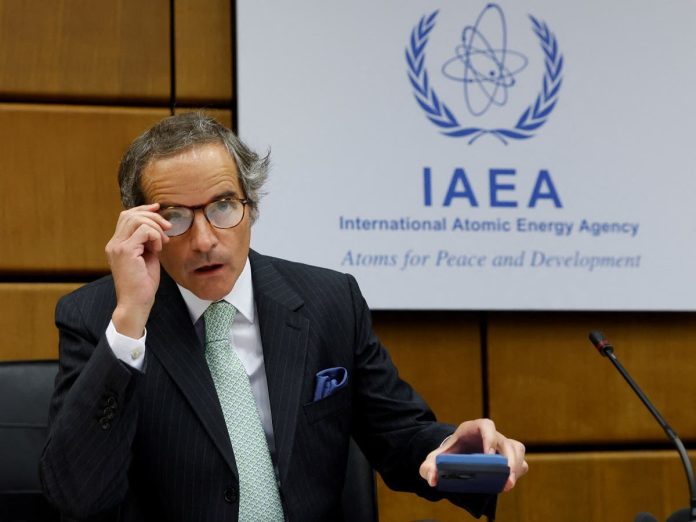
The spokesman for the Atomic Energy Agency of Iran, Behrouz Kamalvandi, has written a column for Iran’s news agency, IRNA, on the IAEA’s latest report. Here is what he had to say.
To sum up, the director general of the IAEA, in his report, talks about four sites including one on which the agency has no other questions, at least at the present stage, that is, this site is not considered an outstanding safeguards issue. But on the other three sites, the agency has announced that the explanations offered by Iran are technically flawed and invalid. The director general has also declared in his report that:
Iran has not provided information that is technically credible in relation to the Agency’s findings at three undeclared locations in Iran and has not informed the agency of the current location, or locations, of the nuclear material and/or of the equipment contaminated with nuclear material, that was possibly moved.
As long as Iran does not provide technically credible explanations for the existence of uranium particles of anthropogenic origin in this three sites, and the current location, or locations, of the nuclear material or equipment contaminated with them are not informed to the agency, the IAEA cannot confirm the accuracy and completeness of Iran’s statements under the Comprehensive Safeguards Agreement. Therefore, safeguard issues related to these three locations remain on the agenda of the agency as outstanding issues.
For the IAEA to be in a position to make sure that Iran’s nuclear program is exclusively civilian, the agency is ready for interaction with Iran, as before, to resolve these issues without any delay.
Points to consider regarding the report by the IAEA’s director general
Unfortunately, the recent report by the agency, does not pay attention to the constructive interaction and wide-ranging cooperation Iran has had with the agency voluntarily, by giving its inspectors access to the aforementioned sites, providing initial and complementary information and holding joint technical and legal meetings to review and settle the outstanding issues.
Although Iran has no obligation to respond to the questions raised by the agency based on forged and invalid documents, Iran has adopted a voluntary approach and has submitted all the required information and supporting documents to the agency and has made the necessary access and responses available to the agency.
Such a level of cooperation by Iran proves its goodwill toward transparency. If Iran was not going to cooperate with the agency, it would have refrained from providing the IAEA with the access and the support information. Unfortunately, reference of the agency to fake documents and deeming them real has led to an invalid and unfair assessment.
In general, the IAEA’s director general’s references on the three locations mentioned in his report have a few points in common:
Firstly, in some cases, he has accused Iran of failing to report and preventing access to some sites, and in other cases, to keeping matters silent. This is while, according to the agreed protocols and standards designated by the IAEA, Iran has no obligation to provide access to non-nuclear sites. Despite this, Iran decided to voluntarily allow the agency to visit these locations and also collect samples, as a goodwill gesture.
Secondly, the agency lays emphasis on incredible satellite images that do not correspond to the current status of the mentioned sites. It is not clear why the director general does not cast doubt on the images that can be fabricated professionally in the virtual world, and fails to use his doubt for the issues for which it has mobilized financial and logistical funds.
Thirdly, despite the fact that the director general’s reports tend to begin with doubtful verbs and, for instance, such wordings as “possible storage”, “has not been clarified”, “possibly”, “likely results”, “one could say”, etc., in his analytical – and not objective — conclusions, the esteemed director general adopts a more compelling tone and talks about “failure to address doubts”!
Fourthly, the director general calls Iran unsuccessful in providing “technically credible” answers to the IAEA’s questions regarding finding of nuclear material particles in undeclared sites. The director general, rather than contending viewing the lack of correspondence between satellite images and the existing geographical status of the sites as a reason to doubt the reports by the Zionist elements, raises doubts about the argument by Iran on likely anthropologic sabotage at the location. He ignores the most obvious reasons for such a plot and asks Iran to provide more convincing reasons for contradicting his viewpoint. The director general of the IAEA, by recourse to principles and methods of reasoning, can imagine how a large country like Iran, with its geographical diversity, is exposed to acts of anthropologic sabotage to create contaminations in its far flung areas. If the director general decides to ignore other exhibits with the same sort of reasoning, this game, which is designed by the corrupt Zionist regime, will continue one way or another every now and then and the country should continuously be answering fake reports fabricated by its enemies.
Fifthly, back in March, and after the visit by Rafael Grossi to Tehran, Iran and the IAEA agreed that alleged issues should be resolved based on a defined roadmap and within a specific time frame. Before that, the IAEA had also undertaken to protect the confidential information on safeguards of member countries. The moves by the director general to release such issues to the media and his subsequent speculation and creation of anti-Iran atmosphere on the eve of the meeting of the Board of Governors contradict his undertakings.
And Finally, in legal terms, hostile and fake reports are not credible for verification purposes, and such enmity and aggression are undeniable, seeing the assassination of Iranian scientists in Iran. Under such circumstances, the Islamic Iran, to prove its goodwill and in line with a push for peace and agreement, agreed to the presence of the IAEA’s director general. Iran provided him with the needed facilities to enable the IAEA’s verification and took part in three technical briefing meetings with relevant officials of the agency over the past two months and provided the required technical explanations and documents. Unfortunately, along with the efforts by the Zionist regime to openly disrupt the different stages of formation and implementation of the Joint Comprehensive Plan of Action and also the recent relevant negotiations, the IAEA’s director general surprisingly made the text of his recent report identical to the one delivered at the European Parliament, before the end of the stages predicted in the joint statement (of the third round of technical negotiations with Iran). In other words, the conclusion of the director general was made long ago.
It is worth mentioning that Iran and the IAEA agreed twice on August 26, 2020 and March 05, 2022 under joint statements in Tehran to speed up their cooperation and talks.
Questions raised by the IAEA should be legitimate and within the framework of its statute, the Comprehensive Safeguards Agreement and the Additional Protocol (before the halt in its implementation by Iran) and answering IAEA questions and any access to the agency should also be subordinate to such legal considerations.
In fact, the IAEA’s requests for access were not based on the article 69 of the safeguards agreement and article 4D of the additional protocol, as Iran had not submitted any report to the agency under the mentioned articles for the IAEA to ask for clarification by the country.
As mentioned in the reports by the IAEA director general, Iran’s nuclear activities are subject to the strictest verification regime compared to any country in the world. This sort of behavior with a member country of the agency is a clear example of contradiction and injustice in today’s world.
It should be mentioned that, after the Joint Comprehensive Plan of Action was sealed, 22 percent of all inspections carried out by the IAEA have been in Iran and, according to the agency’s safeguard report of 2021, Iran has been subject to the strictest verification regime for the past 20 years.
18 quarterly reports by the director general of the agency point to the constructive and wide-ranging cooperation of the Islamic Republic of Iran with the agency and Iran’s cooperation on giving access to IAEA inspectors is in itself a proof of the commitment of the country and the high level of transparency in its peaceful nuclear activities.
Despite this, the agency has always leveled baseless accusations against the fully peaceful nuclear program of Iran, based on allegations by the Zionist regime.
The request by the regime and the US that the IAEA reopen the now-closed “possible military aspects” case regarding Iran based on the unfounded claims and fake information by the Zionist regime reveals a serious weakness and vulnerability of the agency regarding independent verifications and exposes the risk of political pressure on the international body to advance illegitimate purposes. The agency should not turn into a means for advancing the policies of certain governments and neglecting this issue will undermine the impartiality and professionalism of the agency and its independence.
If the IAEA takes action based on information provided by third parties or open sources, then one may say the information gathering and presentation practice by the agency on countries can set the stage for abuses by third parties for political point-scoring against target countries, especially as, no mechanisms are predicted to prevent abuse of false information and its presentation to the agency. Such circumstances can divert inspections from their normal course and based verification efforts by the agency on information obtained from other sources (open sources or third parties). In this regard, the representative of the Russian Federation declared in a statement in the International Symposium on the Safeguards that:
“The agency should not become a means for political pressure against some other countries, or a means for prizing their political loyalty … based on this approach, member countries should only trust choice of information by the secretariat … moreover, intelligence agencies of certain countries may be tempted to abuse the agency as a means to confirm information they have obtained through their operational channels … we reiterate that the right to use all existing information on the safeguards should not be considered a carte blanche by member countries to the secretariat to investigate the information.
Existing fact:
The Islamic Republic of Iran has developed its major peaceful nuclear programs for the purpose of addressing its national needs based on the regulations and standards of the IAEA, including the NPT and the Safeguards Agreement.
It goes without saying that the US and its allies, especially the Zionist regime cannot tolerate the development of the peaceful nuclear program of Iran and have always created fake obstacles in this regard. However, the Islamic Republic of Iran, with reliance on God, the support of the nation and the 24/7 efforts of officials and others involved in its nuclear industry, has overcome all those obstacles and we can now say that the nuclear industry of Iran has come to enjoy a special place in the world.
One should not forget that baseless accusations by the enemies are leveled with the aim of exerting pressure on our country to push it to abandon the development of its nuclear industry, which is a source of its power.
Conclusion:
Seeing the fatwa by the Islamic Revolution Leader that bans the production, proliferation, storage and use of all weapons of mass destruction and the unprecedented and widespread clarification coupled with a strict verification mechanism, the Islamic Republic of Iran has nothing to hide and, due to strategic reasons, basically does not need nuclear weapons.
Despite the positive record of interaction of the Islamic Republic of Iran and the IAEA and with emphasis on the 18 reports by the agency confirming the peaceful nature of the nuclear activities of Iran, regretfully, some parties are again pushing the Iranian case out of the technical-legal phase toward a political-security phase.
There is no doubt that requests beyond the obligations mentioned in the Safeguards Agreement and the Additional Protocol harm the mutual cooperation between Iran and the IAEA. The Islamic Republic of Iran believes that exerting pressure outside the framework of the obligations and duties of the countries and beyond the authority of the agency, as outlined in its statute and the Safeguards Agreement and the Additional Protocol, undermines the country’s agreements with the agency. After all, the Islamic Republic of Iran will never cave in to such pressure and also asks other countries to work to strengthen the agency and its independence to help move toward the non-proliferation of nuclear weapons in an impartial manner.
International organizations especially the IAEA, while maintaining their professionalism, independence and while respecting international norms and regulations, should take care not to exit the path defined by member countries, under the influence of such factors as political pressure, methods of funding of its budget, etc.
Finally, it should be reiterated that:
The agency should not use as reference the information obtained through acts of espionage, or allegation it received form unreliable sources. In fact, any question or request by the agency based on alleged and fake documents is in contradiction with the agency’s statute and the verification regime. Therefore, these create no obligation for the Islamic Republic of Iran to answer such requests. Such unjustified references should not and cannot justify, and cannot be a legal basis or pretext for, pressuring or leveling accusations against countries. What is more is that the agency should not ignore the destructive role of the Zionist regime in undermining the relations between Iran and the agency.