Russian cruise missiles from Black Sea killed at least 22 people in attack on Vinnytsia: Ukraine
At least 22 people have died in an attack on the central Ukrainian town of Vinnystia, according to Chief of Ukraine’s National Police Ihor Klymenko.
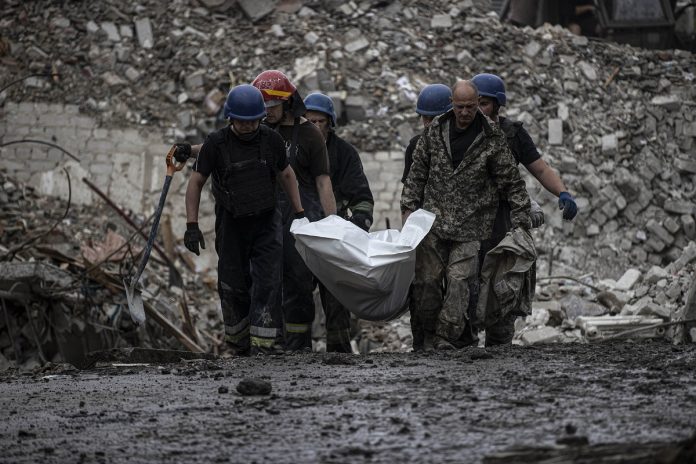
The number of dead includes three children, and dozens of people are still unaccounted for, according to Ukraine’s State Emergency Service.
A further 52 people, including four children, have been hospitalized — 34 of whom are in a serious condition, SES added.
Klymenko said only six of the bodies had so far been identified, and DNA tests may be required to identify others.
Thirty-nine people were still listed as missing, he continued.
More than 50 buildings and more than 40 cars were damaged by the strikes, Klymenko noted.
The attack was carried out with Russian Kalibr cruise missiles that were launched from submarines stationed in the Black Sea, according to Kyrylo Tymoshenko, the deputy head of the Office of the President of Ukraine.
“The enemy continues to keep ready 32 cruise missiles of the ‘Kalibr’ type on three surface and two submarine ships, and two big landing ships are also present” in the Black Sea, the Operational Command South of the Ukrainian Armed Forces had announced on Monday.
Dmytro Kuleba, Ukraine’s Foreign Minister, described the missile attack as “terrorism.”
“Already 20 civilians have been confirmed dead following a Russian missile strike on Vinnytsia. Three children, including a toddler, in the photo. This is terrorism,” Kuleba tweeted.
“Deliberate murder of civilians to spread fear. Russia is a terrorist state and must be legally recognized as such,” he added.
Putin signs law introducing special economic measures to support military
Russian President Vladimir Putin signed a law on Thursday allowing the government to introduce special economic measures to support the Russian armed forces during “counter-terrorism and other operations” outside the country.
As the special measures get adopted, companies will not be able to refuse government contracts and employees will have to work at night and on holidays.
The government also received the right to temporarily reactivate mobilization capacities and facilities and the right to unbook the material assets of the state reserve.
Although the Russian government continues to reject framing the conflict in Ukraine as a war, the new measures effectively mean the country is re-shaping its industry in support of the ongoing invasion.
On Thursday, Putin also signed additional laws that include tougher measures for individuals or entities considered foreign agents by Russia, and expanding criminal liability for defection to high treason.
Forty-five nations pledge to coordinate evidence of war crimes in Ukraine
More than 40 US and European judicial authorities have agreed to coordinate investigations into suspected war crimes in Ukraine, shortly after what Kyiv stated was a Russian missile strike that killed civilians far from front lines.
At a conference in The Hague – headquarters of the International Criminal Court (ICC) – the countries signed a political declaration to work together on the investigations.
They also pledged 20 million euros ($20 million) to assist the ICC, as well as the prosecutor general’s office in Ukraine and United Nations support efforts.
Ukraine’s FM calls for creation of a special tribunal to investigate Russia’s “crime of aggression”
Ukrainian Foreign Minister Dmytro Kuleba called on Thursday for the creation of a special tribunal “on the crime of aggression against Ukraine” that will bring to account Russia’s “top military and political leadership.”
“Together with other countries, organizations and institutions, we shall use all available tools to get justice for the thousands of innocent victims of this crime, and we shall not rest until the guilty are brought to justice,” Kuleba said in his address to an international conference in The Hague on crimes committed in Ukraine.
While the international criminal justice system is sufficiently equipped to investigate war crimes, crimes against humanity and the crime of genocide, the available institutions face legal difficulties investigating the crime of aggression against Ukraine, he continued, adding that “it is necessary to create a Special Tribunal capable of holding the Russian leadership accountable for this kind of crime.”
“In the absence of appropriate tools to allow justice to be done, we shall return to the beginnings of international criminal justice in order to create these,” Kuleba stated.
Kuleba noted the initiative to create a Special Tribunal has been already supported by the Parliamentary Assembly of the Council of Europe, the European Parliament, the NATO Parliamentary Assembly, the OSCE Parliamentary Assembly and the Sejmas of the Lithuanian Republic.
The initiative to create a Special Tribunal is not intended “to replace or weaken the important efforts of the International Criminal Court and other international courts and tribunals,” but rather “supplement” them, he told the conference Thursday.
The ad-hoc Tribune’s mandate would be investigate and prosecute crimes of aggression against Ukraine since Feb. 24, covering all individuals — including state heads and officials, Kuleba detailed.
“Justice is also required for the international community as a whole in order to punish this greatest violation of international law since the Second World War. We must put an end to impunity and leave future generations with a world where the rule of law is always supreme,” he added.
Dutch Foreign Minister Wopke Hoekstra, who is chairing the conference, echoed Kuleba’s comments, saying a Special Tribunal would fill a legal “vacuum” to prosecute perpetrators of war crimes committed in Ukraine.
Security organisation sounds ‘alarm’ on Ukraine ‘filtration centres’
A report by the world’s largest security body has expressed “grave concern” about alleged mistreatment of tens of thousands of Ukrainians at so-called filtration centres set up by Russia in Ukraine.
“There are reports indicating that people are subject to harsh interrogations and humiliating body searches in such centres,” said the 115-page report, calling the setting up of such centres an “alarming” development.
It added those found to have collaborated with Kyiv “often simply disappear” with some being allegedly transferred to Russian controlled territories, where they are detained or even murdered.
The report is based on a mission of three experts under the Organization for Security and Cooperation in Europe (OSCE) covering the Ukraine war from April 1 to June 25.
Separatist leader says two killed in Ukrainian strike on bus station
Two people were killed when Ukrainian forces shelled a bus station in the separatist-held city of Donetsk in eastern Ukraine, a separatist leader has claimed.
In a post on Telegram, Denis Pushilin, head of the self-proclaimed, Russian-backed Donetsk People’s Republic (DPR), said that two civilians had been killed and three wounded when the bus station was struck by a howitzer.
Ukrainian interior ministry adviser Anton Herashchenko accused Russian forces on social media of striking the centre of Donetsk but pinning the blame on Ukraine.
Officials: Russian missiles kill at least 20 in Ukraine
Russian missiles that struck a city in central Ukraine killed at least 20 people and wounded about 90 others, Ukrainian authorities have said.
Ukraine’s national police stated three missiles hit an office building and damaged nearby residential buildings in Vinnytsia, which is located 268km (167 miles) southwest of the capital, Kyiv.
A Russian submarine in the Black Sea fired Kalibr cruise missiles at the city, the deputy head of Ukraine’s presidential office, Kyrylo Tymoshenko, wrote on the Telegram messaging app. Three children were among the dead, he added.
The Russian military has not confirmed the attack.
The missiles ignited a fire that expanded to engulf 50 cars in an adjacent parking lot, officials announced.
Ukrainian police said people were reported missing.
The governor of the Vinnytsia region, Serhiy Borzov, noted Ukrainian air defence systems shot down four more missiles over the area.
Russian strikes on Vinnytsia ‘an open act of terrorism’: Zelensky
Ukraine President Volodymyr Zelenskyy has lashed out at Russia for carrying out missile strikes that killed at least 17 people on Vinnytsia in central Ukraine earlier.
“Every day, Russia kills civilians, kills Ukrainian children, carries out missile attack on civilian facilities where there is no military target. What is this if not an open act of terrorism?” the president stated in a statement on social media.
The Russian defence ministry did not immediately comment on the reports from Vinnytsia.
Russian strike in central Ukraine kills 17, including two children: Officials
Three Russian missiles have been fired at buildings in Vinnytsia, central Ukraine, according to Ukrainian officials.
At least 17 people, including two children, were killed in the air strikes, said the Prosecutor General’s Office of Ukraine.
“Several dozen” more were injured, and search operations are ongoing, it added.
Ukraine’s State Emergency Service announced that “90 rescuers, as well as dog trainers and psychologists, are working at the scene of the terrible tragedy” in a post on Facebook.
Kyrylo Tymoshenko, deputy head of the Presidency of Ukraine, called the attack “another crime of the occupiers in our peaceful city” on Telegram.
The head of police in Vinnytsia, Igor Klymenko, said the “missiles were aimed at a building with office premises.” Nearby residential buildings were also damaged, he added.
Vinnytsia has not been the site of any previous Russian attacks since the invasion.
Ukrainian Foreign Minister Dmytro Kuleba condemned the air strikes on Twitter.
“While Accountability Conference in The Hague is underway, Russia commits another war crime. At least one child killed, among other victims of a missile strike on Vinnytsia,” wrote Kuleba.
“We will put Russian war criminals on trial for every drop of Ukrainian blood and tears,” he added.
Moscow proxies in southern Ukraine aim for September vote on joining Russia
Russian-installed officials in a region of Ukraine partly under Moscow’s control are aiming to stage a referendum on joining Russia in September, the RIA Novosti news agency reported, citing a local official.
The head of the civil-military administration in occupied Zaporizhzhia in southern Ukraine stated an accession vote would be staged in early autumn.
“The estimated date is in the first half of September,” RIA Novosti quoted Vladimir Rogov as saying.
“We will finally announce when it will be once we understand the level of readiness and involvement of the people,” Rogov added.
Russian-backed forces have seized the majority of the Zaporizhzhia region along Ukraine’s southern coast, but Ukraine’s military still controls the northern chunk of the region, including the city of Zaporizhzhia, the largest urban centre and home to more than half of the region’s pre-war population.
Russia says Nord Stream 1 future will depend on gas demand and sanctions
Russian foreign ministry spokeswoman Maria Zakharova said that the future of the Nord Stream 1 gas pipeline to Germany would depend on gas demand in Europe and Western sanctions against Russia.
The pipeline from Russia to Germany is undergoing annual maintenance until July 21 but European governments are worried that Moscow could extend that in order to restrict European gas supply, disrupting plans to build up storage for winter.
Kremlin-controlled energy giant Gazprom announced on Wednesday it could not guarantee the safe operation of a critical part of Nord Stream 1 because of doubt over the return of a turbine from Canada, which had imposed sanctions against the company
Canada said at the weekend it had issued a permit to allow the return of the turbine for Nord Stream 1’s Portovaya compressor station in Russia.
“As far as the gas pipeline’s work in future is concerned, a lot will depend on our partners in terms of gas demand and illegitimate sanctions, as happened with the turbines in Canada,” Zakharova stated.
She added the maintenance on the pipeline had been agreed in advance with consumers.
EU forced to tap gas reserves amid Russian supply shortfall
European energy companies have started using gas from underground storage facilities to make up for supplies lost due to maintenance work on Russia’s Nord Stream 1 pipeline.
According to data from Gas Infrastructure Europe (GIE), 85.5 million cubic meters of natural gas were withdrawn from German UGS facilities on July 12.
They exceeded the injection level for the first time since the beginning of April, data showed.
The largest withdrawals were made by German energy major Uniper, Austrian OMV and Norwegian Equinor.
Earlier, Uniper said it did not rule out having to take gas from UGS facilities and reduce supplies as early as this week, while OMV announced a decrease in gas deliveries to Austria by about 70% amid the shutdown.
The situation has been exacerbated by production problems in Norway, Europe’s second largest natural gas supplier after Russia.
Equinor’s Sleipner gas field in the North Sea was forced to temporarily halt production this week due to multiple leaks.
Romania and Belgium also started tapping into reserves on July 12, as the shutdown of the Sleipner field also affected supplies to the Zeebrugge gas receiving terminal in Belgium.
As of July 12, the total reserves in Europe’s gas storage facilities amounted to 62.57% of capacity, which is about 1.5% lower than the average for this date over the past five years.
Currently, Europe has about 67 billion cubic meters of gas.
Daily injection rates are roughly two times lower than before the shutdown of supplies via Nord Stream. The pipeline, which is one of the major routes for Russian gas supplies to Europe, is undergoing scheduled maintenance from 11- 21 July. But even before the shutdown it was operating at just 40% capacity because critical pipeline components were not returned to Russia due to Western sanctions.
Currently, the only remaining route for Russian gas supplies to the countries of Western and Central Europe is the transit line through Ukraine. However, those were cut by nearly half in May when Kiev shut down the Sokhranovka entry point, with only the Sudzha transit route still in operation.
Gas supplies via Turkish Stream and Blue Stream have not been affected, but they are intended for Turkey and the countries of Southern and South-Eastern Europe.
EU prepares for gas cutoff: Report
The European Union is planning out a set of emergency measures to mitigate the impact of a potential Russian gas cutoff, Bloomberg reported on Wednesday. Among the measures being considered are stockpiling, directing supply to key industries, and placing restrictions on public use.
The steps are laid out in a draft document seen by Bloomberg, which calls for “early joint action at EU level” to address the bloc’s fears that Russia may abruptly cut off the gas supply to the continent.
“Acting now could reduce the impact of a sudden supply disruption by one third,” the European Commission stated in the document, which Bloomberg noted is still subject to change before it is adopted as policy next week.
According to the document, gas flows from Russia are now less than 30% of the 2016-2021 average. Should Russia pull the plug, the EU would like to have gas reserves at 80% in order to “reduce the impact of a sudden supply disruption by a third.”
The EU plans to recommend that countries prioritize supply chains and key industries in the event of a cutoff, while incentivizing reduced usage through “market-based measures,” such as auctions or tender systems – which would drive up prices.
Domestic consumers will be hit with information campaigns urging them to reduce their home heating – as has already happened in several countries – and would have mandatory limits placed on their gas usage “during an alert level of crisis,” in Bloomberg’s words.
Russian strike in central Ukraine kills 12, including a child: Officials
Three Russian missiles have been fired at buildings in Vinnytsia, central Ukraine, according to Ukrainian officials.
At least 12 people, including a child, have been killed, Ukraine’s State Emergency Service said on Facebook.
“90 rescuers, as well as dog trainers and psychologists, are working at the scene of the terrible tragedy,” it added.
Kyrylo Tymoshenko, deputy head of the Presidency of Ukraine, called the attack “another crime of the occupiers in our peaceful city” on Telegram.
The head of police in Vinnytsia, Igor Klymenko, stated the “missiles were aimed at a building with office premises.” Nearby residential buildings were also damaged, he added.
Vinnytsia has not been the site of any previous Russian attacks since the invasion.
Russia blames West for giving Ukrainian forces weapons training
Russia’s foreign ministry has condemned the US and the UK for helping train Ukraine’s armed forces, calling it part of “hybrid warfare” being waged by NATO countries against Russia.
In a media briefing, spokeswoman Maria Zakharova said Washington had provided Ukraine with instructors who were helping Kyiv’s forces use advanced US-made high mobility artillery rocket systems (HIMARS) against Russian positions.
She added the rockets, which have a longer range and are more precise than other artillery weapons, were being used “widely” by Ukrainian forces.
Zakharova also criticised Britain’s decision to bring Ukrainian service personnel to the UK for weapons training.
US official: Russia’s war in Ukraine ‘greatest challenge’ to global economy
US Treasury Secretary Janet Yellen says Russia’s war in Ukraine posed the “greatest challenge” to the global economy.
“Our greatest challenge today comes from Russia,” she told a news conference on the resort island of Bali in advance of G20 ministerial talks in Indonesia.
“The international community must be clear-eyed about the economic and humanitarian consequences of his [President Vladimir Putin’s] war,” she added.
Nations discuss Ukraine war crime probes
Government officials from dozens of nations are meeting in the Netherlands to discuss with the International Criminal Court’s chief prosecutor how best to coordinate efforts to bring perpetrators of war crimes in Ukraine to justice.
Since Russian President Vladimir Putin ordered the invasion of Ukraine on February 24, his forces have been accused of abuses ranging from killings in the Kyiv suburb of Bucha to deadly attacks on civilian facilities, including the March 16 bombing of a theatre in Mariupol.
Some 40 nations from the EU and around the world will be represented at Thursday’s conference that is hosted by Dutch Minister of Foreign Affairs Wopke Hoekstra, ICC Prosecutor Karim Khan and EU Justice Commissioner Didier Reynders.
Ukrainian President Volodymyr Zelensky is expected to address the government representatives in recorded video messages before they meet behind closed doors to discuss coordinating investigations and evidence gathering as the ICC and different countries pursue war crime cases.
Russian forces risk losing momentum in Donetsk: UK
Despite Russian forces continuing to shell in the Donetsk region, they have made no significant ground advances over the past 72 hours and risk losing the momentum built up after they captured Lysychansk, the United Kingdom’s defence ministry has said.
“The ageing vehicles, weapons, and Soviet-era tactics used by Russian forces do not lend themselves to quickly regaining or building momentum unless used in overwhelming mass – which Russia is currently unable to bring to bear,” the ministry added in its latest intelligence briefing.
Missile hits Kramatorsk, causes power outage: Mayor
A missile struck the city of Kramatorsk, in the Donetsk region, on Thursday morning, the mayor has said.
“It’s been a disturbing morning. Air missile strikes across the industrial zone of Kramatorsk. There’s a power outage in parts of the city. The danger is not over, take shelter!,” Oleksandr Goncharenko stated.
All Ukrainian nationals who receive Russian citizenship are doing it voluntarily, Washington’s allegations that Russia takes away their Ukrainian passports are nothing but low-grade disinformation, the Russian embassy to the United States announced.
“Ukrainian receive Russian citizenship voluntarily. Allegations about forcible confiscation of Ukrainian passports are low-grade Western disinformation,” it said in a press statement.
“Another attempt at demonizing Russia’s armed forces obviously stems from discontent over the successes of the special military operation,” it noted.
“It is also obvious that such allegations are geared to heighten the degree of Russophobia to attract attention to the developments in Ukraine and mobilize additional resources to support the Kiev regime,” it added.
“Russia’s armed forces, public organizations and general public offer all-round assistance to people living on liberated territories. Humanitarian cargoes are dispatched regularly to the people in the Donbass republics, as well in the Kharkov, Zaporozhye, and Kherson regions. Humanitarian corridors are functioning and people can use them to move freely in any direction,” the embassy said.
US Secretary of State Antony Blinken stated earlier on Wednesday that Washington believes that Russia is forcibly keeping up to 1.6 million Ukrainians on its territory. He claimed that their Ukrainian passports were confiscated and Russian passports were issued instead.
According to the latest data, more than 2.5 million refugees have arrived in Russia from Ukraine and Donbass, with around half of them being citizens of the Donetsk and Lugansk People’s Republics (DPR and LPR).
Washington calls on Moscow to halt unlawful ‘filtration’ of Ukrainians into Russia
Secretary of State Antony Blinken called on Russia to cease its “filtration” system that has forcibly deported thousands of Ukrainians in Russian-occupied territory, which he called a war crime.
“The unlawful transfer and deportation of protected persons is a grave breach of the Fourth Geneva Convention on the protection of civilians and is a war crime,” Blinken wrote in a statement, citing as many as 1.6 million unlawful deportations, detainments and interrogations.
Ukrainian President Volodymyr Zelensky put the number at 2 million.
“So many of our people have already been taken to Russia. Several hundred thousand children,” the president stated.
The exact numbers are unknown, Zelensky noted, because “all these deported people are deprived of means of communication, their documents are taken away from them, they are intimidated and taken to remote areas of Russia to make it as difficult as possible for them to return to their homeland.”
Blinken called on Russia to release the Ukrainians and facilitate their safe return — and to allow outside observers to monitor the “‘filtration’ facilities” and areas to which Ukrainians were forcibly relocated.
Russian President Vladimir Putin took a step in the opposite direction on Monday, signing a new passport decree expanding a fast track to Russian citizenship for Ukrainians.
Putin also recently introduced the Russian ruble as currency in occupied areas as part of his efforts to delegitimize the Ukrainian state and assert Russia’s influence.
As part of the “filtration” process, Blinken wrote, many Ukrainians are coerced into signing legal agreements not to return to Ukraine.
“Reports also indicate Russian authorities are deliberately separating Ukrainian children from their parents and abducting others from orphanages before putting them up for adoption inside Russia,” he continued, adding that as many as 260,000 children have been among those pushed through “filtration.”
Blinken also cited “mounting” evidence that Russia is “detaining or disappearing thousands of Ukrainian civilians who do not pass ‘filtration.’”
Ukrainians with ties — or potential ties — to their country’s army, media and government are among those flagged.
“President Putin and his government will not be able to engage in these systematic abuses with impunity,” Blinken wrote, affirming US support for the collection of evidence against Russia by Ukraine and international authorities.
Zelensky welcomes progress towards agreement on grain exports
Ukrainian President Volodymyr Zelensky has welcomed signs of progress in talks mediated by the United Nations and Turkey to guarantee safe passage of merchant shipping in and out of Ukrainian ports.
In his daily address, Zelensky said, “We are indeed making significant efforts to restore food supply to the world market. And I am grateful to the United Nations and Turkey for their respective efforts.”
“The success of this story is needed not only by our state but also, without exaggeration, by the whole world. If it is possible to remove the Russian threat to shipping in the Black Sea, it will remove the severity of the global food crisis,” he stated.
He added that the Ukrainian delegation has informed him “there has been some progress.”
“We will agree on the details with the UN Secretary General in the coming days,” Zelensky continued.
Ukraine has “nothing to discuss” with Russia on peace talks: FM
“There is nothing to discuss” on the subject of peace talks with Russia, Ukrainian Foreign Minister Dmytro Kuleba said Wednesday in an online briefing with reporters.
“Currently, there are no talks between Russia and Ukraine, because of the position of Russia and its continued aggression against our country. So there is really nothing to discuss,” he told CNN.
Ukraine’s objective in this war is “to liberate our territories and restore our territorial integrity and full sovereignty in the east and in the south of Ukraine. This is the end point of our negotiating position,” he added.
Kuleba also played down suggestions there might be “fatigue” abroad with the conflict.
He stated the website created by the Ukrainian government had reached 600 million people around the world, including 91 million in June.
“Despite the narratives about war fatigue, our communications only improve and become stronger,” he said.
Chasiv Yar death toll climbs to 48
The death toll from Saturday’s Russian missile attack on the town of Chasiv Yar has climbed to 48, President Volodymyr Zelensky has said, adding that the clearance of debris continues.
As of this time, the list of the dead includes 48 people, including one child,” he said in his evening address on Wednesday. “Unfortunately, the number of those rescued has not changed – nine people.”
“It was one of the most brutal Russian strikes during the entire war – so many victims … My condolences to the relatives and friends of the victims,” he added.
Russia accuses Ukraine of fresh strike on Nova Kakhovka
Russian media has reported that Ukrainian forces again launched a missile attack on the town Nova Kakhovka, in a strategically important Russian-occupied southern area of Kherson that Kyiv is hoping to retake.
RIA news agency quoted the Russian-backed administration of the Kherson region on Wednesday evening saying that Russian air defences shot down five missiles fired at Nova Kakhovka, while the debris of two of the missiles fell near a factory.
Ukraine seems to have confirmed the attack with Serhiy Khlan, an advisor to the Ukrainian head of Kherson saying: “According to preliminary information, there’s been another hit on a Russian munitions plant, at Sokol.”
Ukraine claims a separate strike earlier in the week on Nova Kakhovka destroyed a Russian ammunition depot and killed 52 Russians. But a Moscow-appointed Kherson official accuses Ukraine of killing seven people in the strike, including civilians, and injuring around 90.
Explosions rock Mykolaiv: Mayor
“Powerful explosions” have again rocked the port city of Mykolaiv, the mayor has said.
“The air alert continues. I ask everyone to stay in shelters,” Alexander Senkevich wrote on Telegram.
The blasts were also reported by residents on social media, with some counting up to eight explosions.
Russian forces have targeted Mykolaiv for days. Shelling in the region on Wednesday killed at least five civilians and damaged a hospital as well as several residential buildings, the deputy head of the president’s office, Kyrylo Tymoshenko, noted.
IMF chief warns natural gas disruptions could trigger recession in Europe
The global economic outlook remains extremely uncertain, the head of the International Monetary Fund (IMF) has said, warning that further disruption in the natural gas supply to Europe could plunge many economies into recession.
In a blog published ahead of this week’s meeting of finance officials from the Group of 20 leading economies, IMF Managing Director Kristalina Georgieva stated Russia’s war in Ukraine had darkened the economic outlook significantly, and the IMF was poised to downgrade its outlook for 2022 and 2023.
“Countries must do everything in their power to bring down high inflation … because persistently high inflation could sink the recovery and further damage living standards, particularly for the vulnerable,” she continued, adding that rising concerns over food and energy supplies also elevated the risks of social instability.
To avoid further hunger, malnutrition and migration, wealthier countries should provide urgent support for those in need through new bilateral and multilateral funding, as well as reversing recent restrictions on food exports, Georgieva stated.
‘United we support Ukraine’: Germany’s president
Germany’s president, in a show of unity and support, visited the Grafenwoehr US Army base on Wednesday, saying Washington and Berlin were united in their effort to support Ukraine.
“We do it politically, we do it financially, we do it through humanitarian means and we also do it militarily. This support is necessary in a situation where Ukraine is desperately fighting for democracy and freedom in its country,” Frank-Walter Steinmeier told reporters at the base.
The social democrat politician also thanked the troops for their decisive contribution to the freedom and security of Germany and confirmed Germany’s commitment to NATO solidarity in an address to the 3rd US Infantry Division on Wednesday.
“We will strengthen our defence capability and we will also strengthen our contribution to NATO,” he added.
Macron calls on troops to maintain ‘moral strength’ amid conflict in Europe
France’s president has encouraged troops to maintain their “moral strength” in the face of conflict at Europe’s doorstep.
“War is returning, fully and cruelly, on European soil, and it reminds us of the tragedies of history,” Emmanuel Macron said during a traditional address to military personnel ahead of Bastille Day.
“We now rediscover that the moral strength of our nation should absolutely be cultivated, encouraged and developed,” he added.
Macron stated the government aims to fulfil its commitment as part of a military budget law that projected to allot 50 billion euros ($50.17 bn) for the military by 2025, amid the Ukraine war.
The president also said more investment will be needed for defence, adding that industries should “change our paradigm” on how defence projects are handled.
Macron will preside over France’s traditional Bastille Day parade on Paris’ Champs Elysees avenue on Thursday.
Lithuania will allow sanctioned Russian goods trade to Kaliningrad
European Union member Lithuania will allow sanctioned Russian goods to transit its territory on their way to Russia’s Kaliningrad exclave, its foreign ministry has announced, reversing its policy after new European Commission guidelines.
The new guidelines followed weeks of tension among Moscow, Lithuania and the European Union that tested Europe’s resolve to enforce sanctions on Russia.
Kaliningrad, which is bordered by EU states and relies on railways and roads through Lithuania for most goods, has had some freight transport from mainland Russia cut off since June 17 under sanctions imposed by Brussels.
‘An important and substantive step’: UN
UN Secretary-General Antonio Guterres said that an “important and substantive step” was made towards a comprehensive deal to resume Black Sea exports of Ukraine grain.
“Next week, hopefully, we’ll be able to have a final agreement. But, as I said, we still need a lot of goodwill and commitments by all parties,” he told reporters in New York.
He added that although Ukraine and Russia had engaged, “for peace we still have a long way to go.”
Turkey says warring parties agree to form coordination centre for grain exports
Talks between Russia, Ukraine, Turkey and UN officials on resuming Black Sea exports of Ukraine grain resulted in an agreement to form a coordination centre in order to ensure the safety of routes, the Turkish defence minister has said.
In a statement, Turkey’s Defence Minister Hulusi Akar stated an agreement would be signed next week when all parties meet again, adding the parties had agreed on joint controls for checking grains at harbours.
Russia ‘hysterical’ about raids from US-made HIMARS: Official
Attacks using US-supplied HIMARS systems have caused “hysteria” among Russian forces, an aide to Ukrainian President Volodymyr Zelenskyy has said.
Kyiv used high-precision HIMARS, or “high-mobility artillery rocket systems,” to effectively destroy several large ammunition stores in occupied or separatist-controlled areas.
“There is hysteria in Russia. It is a weapon that cannot be resisted. All measures that can be taken: dispersal, separation – worsen the combat capabilities of the Russian army, because their principle of deploying troops is concentration,” adviser to the president Oleksiy Arestovych noted in televised remarks.
Over 9 million border crossings registered from Ukraine: UN
The UN Refugee Agency announced that more than nine million people have crossed the border from Ukraine since Russia invaded the country.
Russian and Russian-backed separatist forces enter Siversk
Russian troops, along forces from the Russian-backed Luhansk People’s Republic (LPR), have entered the city limits of Siversk city in the east of Ukraine, a LPR’s official told the Russian TASS news agency.
“It seems that in a couple of days Siversk will be free”, Vitaly Kiselev, an assistant to the self-styled interior minister of the LPR, was reported as saying.
The US and its allies understand that sanctions on Russia come at a cost but are prepared to take further action, Deputy Assistant Secretary of State for the Bureau of Economic and Business Affairs, Erik Woodhouse, said on Wednesday.
“In terms of the cost in the United States, I think the United States, but also our partners and allies around the world, have demonstrated an understanding and a commitment to take action that imposes costs on Russia, even though we understand that there will be costs for our own economies,” he stated at a news conference to a question from TASS.
Woodhouse conceded “the United States has borne some of those costs” but noted European countries face a “more intense situation.”
“But I think partners and allies, especially those in Europe, have shown that we all understand those costs, and we decided that the circumstances warrant taking action and accepting those costs,” he added.
Deputy Assistant Secretary of State for European and Eurasian Affairs, Molly Montgomery, added, “We have demonstrated incredible unity with our allies and partners, not just in Europe, but also in the Indo-Pacific.”
That unity has been seen “even as these measures do become more painful,” she said.
US wants China, India to pay Russia less for crude
The US State Department believes that China and India, the two current major buyers of Russian oil, should be part of the proposed oil price cap mechanism, Assistant Secretary of State for the Bureau of European and Eurasian Affairs Molly Montgomery said on Wednesday.
“China and India are importers of Russian oil, and I can say that we are working very actively with partners and allies to help develop a proposal [to limit the price of Russian oil],” Montgomery stated during a press briefing.
“We see this [price cap] as an opportunity for countries to do something in the international interest, to pay less for energy imports and stabilize the global oil market, so countries should be interested,” she added.
According to US Deputy Assistant Secretary for Economic and Business Affairs Erik Woodhouse, the participation of both China and India in the deal could persuade other countries to join in.
“Obviously, China and India are important purchasers of Russian oil. I can say that we’ve been [talking] most intensively with partners and allies to help design a proposal… Perhaps this can work, as well as outreach to countries that we would like to see participate or otherwise support the price cap,” Woodhouse continued.
In an interview with the Wall Street Journal published earlier on Wednesday, Treasury Secretary Janet Yellen said the US plans to set a price cap for Russian oil which would be profitable enough for the country to continue production. She did not specify the exact numbers, but explained that the mechanism will demand that any tanker carrying Russian oil would only receive financing and insurance from US, UK, and EU institutions if the sales price of the oil is below the cap.
Also on Wednesday, US National Security Advisor Jake Sullivan noted that the introduction of the price cap mechanism will take some time due to the number of details that have to be sorted out. He added, however, that Washington has already been discussing the measure with a number of key oil consuming countries, including China and India.
The Chinese Ministry of Commerce on Thursday confirmed that the issue of the Russian oil price cap was discussed between Yellen and China’s vice premier, Liu He, earlier this month. According to a statement from the ministry, the issue of the price cap is a complex one, and should be solved based on the desire of the parties involved to reduce tensions in Ukraine.