EU executive proposes new gold import ban on Russia
The European Union’s executive, the European Commission, has formally proposed new sanctions on Russia, including a new import ban on Russian gold.
EU governments must still sign off on the measures, expected as early as next week.
Ukraine hurrying to agree grain deal next week: Official source
Ukraine is hurrying to clinch a deal with Russia, Turkey and the United Nations next week to export grain via its Black Sea ports, a senior Ukrainian official source has said.
Asked if it was realistic for the deal to be signed next week, the source stated: “We really hope so. We’re hurrying as fast as we can.”
The source asked not to be identified.
Russia sanctions 384 Japanese lawmakers
Russia has imposed sanctions against 384 members of Japan’s parliament, the foreign ministry has said in a statement.
Moscow noted the measures were taken against those who had “taken an unfriendly, anti-Russian position”.
Tokyo has hit Russia with harsh sanctions, joining the G7 in freezing the central bank’s assets, since Moscow sent tens of thousands of troops into Ukraine on February 24.
Russia not interested in nationalising foreign enterprises: Trade and industry minister
Moscow is not interested in nationalising foreign-owned enterprises operating in Russia, Trade and Industry Minister Denis Manturov has said, offering limited reassurance to Western businesses.
“We are not interested in the nationalisation of enterprises or their removal, God forbid,” Manturov told parliament’s lower house, the State Duma.
But he thanked deputies for giving initial approval in May to a bill allowing the state to seize control of an enterprise in the event of a “sudden departure” by a foreign partner in order to save jobs and pay wages and taxes.
“This is also a message for our foreign partners to think about how and what decisions they will take for themselves. We want a comfortable, mutually beneficial working relationship,” Manturov added.
EU to target Russian gold in next sanctions package: Commissioner
The European Union will target Russian gold exports in its next sanction package and seek to “close exit routes” for those bypassing its earlier packages, an EU commissioner has said.
The EU will look into “ways we could slap a sanction regime on gold, which is an important commodity for exports from Russia”, Maros Sefcovic, deputy head of the European Commission, stated in Prague.
Polish official criticises EU plan to curb gas use amid energy crisis
A top Polish official in charge of energy security has said the European Commission’s plans to encourage member states to cut gas consumption would breach national sovereignty,
“These are actions that go beyond the EU treaties,” Piotr Naimski, Poland’s top official in charge of energy security, told TV Republika in an interview.
The EU plan, due to be published next week, is expected to incentivise industries to use less gas in preparation for possible further cuts to Russian supplies.
Russia says document on resumption of Ukraine grain exports nearly ready
The Russian defence ministry has said its proposals to bring about a resumption of Ukrainian grain exports were “largely supported” during talks this week in Istanbul and that an agreement was close.
The ministry added that work on what it calls the “Black Sea Initiative” will be finalised soon.
Turkey had said a four-way deal with Russia, Ukraine and the United Nations would be signed next week.
Saudi Arabia doubles Russian fuel oil imports for power generation
Saudi Arabia, the world’s largest oil exporter, has more than doubled the amount of Russian fuel oil it imported in the second quarter to feed power stations, amid international sanctions over Moscow’s invasion of Ukraine.
Russia has been selling fuel at discounted prices after a backlash over its “special military operation” left it with fewer buyers.
The increased sales of fuel oil, which Riyadh uses to meet summer cooling demand and free up its own crude for export, pose a challenge to US President Joe Biden as his administration seeks to isolate Russia and cut its energy export revenues.
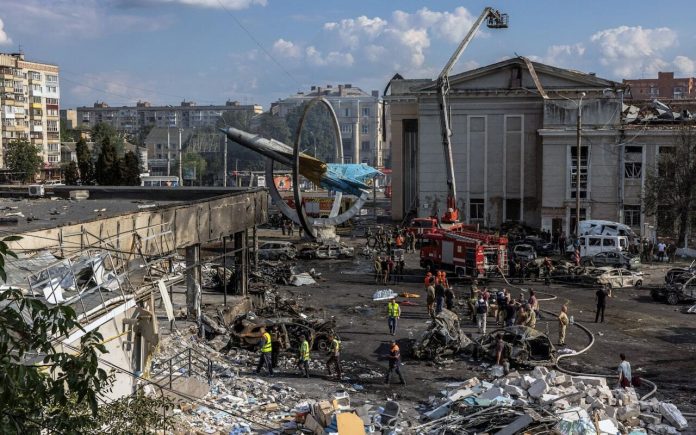
Russia says building struck in Ukraine’s Vinnytsia was military target
Russia’s defence ministry has claimed Thursday’s cruise missile strike on Vinnytsia was directed at a building where top officials from Ukraine’s armed forces were meeting foreign arms suppliers.
“On July 14, Kalibr [cruise] missiles were launched at the House of Officers in Vinnytsia,” Russia’s defence ministry said in its daily update.
“The facility was hosting a conference of the Ukrainian Armed Forces command with representatives of foreign arms suppliers … The attack resulted in the elimination of the participants,” it added.
Ukraine has denied any military target was hit, saying the attack killed at least 23 people and struck a cultural centre used by retired veterans.
Briton captured by separatists in Donetsk dies in detention: Official
Paul Urey, a British man captured by pro-Russian forces in Ukraine, has died in detention, Moscow-backed separatists have said.
“He died on July 10,” Darya Morozova, a representative of the self-proclaimed Donetsk People’s Republic, stated, adding that he had diabetes.
Non-governmental organisations describe Urey as a humanitarian who worked as an aid volunteer in Ukraine, while Moscow-backed separatists insist he was a “professional” soldier.
Urey was an aid worker, an international legion backing Kyiv has told the Interfax-Ukraine news agency.
“We are saddened by the news of Mr Urey’s death… He did not fight in Ukraine. He was an employee of a humanitarian organisation,” the press service of the International Legion for the Defence of Ukraine said after the separatists described Urey as a professional soldier.
Europe ‘shot itself in the lungs’ with Russia sanctions: Hungry
The European Union has “shot itself in the lungs” with ill-considered economic sanctions on Russia, which, unless rolled back, risk destroying the European economy, Hungary’s prime minister has said.
“Initially, I thought we had only shot ourselves in the foot, but now it is clear that the European economy has shot itself in the lungs, and it is gasping for air,” Victor Orban, a long-time sanctions critic, told public radio in an interview.
Orban added Ukraine needed help, but European leaders should reconsider their strategy, as sanctions have caused widespread damage to the European economy without weakening Russia or bringing the months-long war closer to any resolution.
“The moment of truth must come in Brussels, when leaders admit they have made a miscalculation, that the sanctions policy was based on wrong assumptions and it must be changed,” he continued.
18 remain missing after Vinnytsia attack
Nearly 20 people remain missing in Vinnytsia after a missile hit the central Ukrainian city on Thursday, the state emergency service reports.
“23 people died (including three children); 71 people (including three children) were hospitalised; 117 people applied for medical help; 18 people remain missing,” the department said on Telegram.
Bakhmut Russia’s next objective after Siversk: UK
Russian forces continue to slowly advance westward from the town of Lysychansk in the Luhansk region towards Siversk in Donetsk, the United Kingdom’s defence ministry has said.
Troops have used “shelling and probing assaults” to aid the advance and open a pathway onward to the cities of Sloviansk and Kramatorsk, the ministry announced in its latest intelligence briefing.
UK defence also noted that Russian and pro-Russian separatist claims that their forces have entered the outskirts of Siversk have not been corroborated, but Bakhmut will likely be the next objective once Siversk is secured.
“Russia continues to face accusations that it is forcibly deporting Ukrainians; in many cases Ukrainians have reportedly been mistreated in filtration camps set up by Russia,” the ministry added.
Sharp increase in burials in Russian-held areas of Ukraine: NGO
Satellite photos and on-the-ground images indicate a sharp increase in burials in Russian-held areas of Ukraine, a UK-based watchdog has found.
The non-government Centre for Information Resilience analysed images of burials in six areas, two of which previously held by Russian forces and the rest still under Moscow’s control in southern Ukraine.
“Open source information can give unprecedented reach behind the frontlines of the war in Ukraine and into areas occupied by Russian forces,” Benjamin Strick, director of investigations at CIR, said.
The organisation’s newly released report said 1,141 new graves were seen in satellite images between March 28 and May 12 and over 1,700 more between May 12 and June 29.
Russian Foreign Ministry Spokeswoman Maria Zakharova on Friday stated the US embassy in Kiev has to admit that the weapons that Washington supplies to the Kiev regime extends the conflict and kills people.
The diplomat highlighted, in a Telegram post, a security alert from the US diplomatic mission in Ukraine that’s asking American citizens to leave the country immediately and avoid mass gatherings and public events, as “they can become military targets for the Russians.”
“The US Embassy in Ukraine forgot to mention that Washington provides US weapons to the Kiev regime, the use of which provokes a prolongation of the conflict and deaths of people,” Zakharova added.
The US embassy in Kiev on Thursday urged Americans to leave Ukraine immediately.
“The US Embassy urges US citizens not to enter Ukraine and those in Ukraine to depart immediately using privately available ground transportation options if it is safe to do so. Avoid large gatherings and organized events,” the alert said.
The notice came out under a headline that mentioned a “missile threat.”
The government of Canada imposed another round of sanctions against Russia’s oil and gas sector and chemical industry, according to the Canadian foreign ministry’s website.
“On July 14, 2022, Canada further amended the Special Economic Measures (Russia) Regulations to prohibit the provision of 2 manufacturing services to the Russian oil, gas, chemical and manufacturing industries,” the document says, adding that Canada targeted the manufacturing sector by adding 8 new industries to the list.
According to the document, Canadian citizens and companies are prohibited from providing a number of services to the Russian side, including services incidental to manufacturing of fabricated metal products; motor vehicles, trailers and semi-trailers; computer, electronic and optical products; electrical equipment and other sectors.
Russia shells Dnipropetrovsk: Governor
Ukraine’s Dnipropetrovsk region suffered a “tense night of alarms and shelling,” the regional governor has said.
Valentyn Reznichenko reported that Russian forces attacked three districts in the region with “various weapons,” adding that information about casualties was being clarified.
A fire broke out in the Nikopol district on the Dnipro river and “debris from ‘Grad’ [rockets] and phosphorous ammunition were found at the site of the shelling,” he added.
The Kryvorizka district was shelled with “barrel artillery”, Reznichenko stated, while a a rocket hit a school in the Synelniky district causing “serious destruction”.
Missiles hit Kharkiv: Emergency service
Missiles hit the city of Kharkiv overnight, damaging two educational facilities, according to the state emergency service.
One of the missiles hit a school courtyard and damaged part of the building.
Shelling also occurred across the broader Kharkiv region, the department added.
Two fires had to be put out in the town of Chuhuiv, one of which was in a residential area. The emergency service said there were no casualties.
US blasts Russian officials for continued support of Putin
United States Treasury Secretary Janet Yellen has condemned Russia’s “brutal and unjust war” in Ukraine and said Russian finance officials taking part in the G20 meeting in Bali, Indonesia, shared responsibility for the “horrific consequences” of the war.
Yellen, speaking at the opening session of the gathering of Group of 20 finance ministers and central bankers, welcomed Ukraine’s Finance Minister Serhiy Marchenko and blamed the negative spillovers of the war “solely” on Russia, a Treasury official said.
Russian Deputy Finance Minister Timur Maksimov was in Bali for the meetings, while Finance Minister Anton Siluanov was participating virtually when Yellen spoke, a source familiar with the matter said.
“You share responsibility for the innocent lives lost and the ongoing human and economic toll that the war is causing around the world,” she added, addressing the Russian officials.
G20 finance chair warns on risks to poor countries if no consensus
Failure by G20 finance chiefs meeting in Bali to reach consensus could be catastrophic for low-income countries amid soaring food and energy prices exacerbated by the war in Ukraine, Indonesia’s finance minister has said.
In her opening remarks to the meeting, Sri Mulyani Indrawati said the world had high hopes that the group would be able to find a solution to the triple threat of war, rising commodity prices and their spillover effects on the ability of low-income countries to repay debt.
“We are acutely aware that the cost of our failure to work together is more than we can afford. The humanitarian consequences for the world, and especially for many low-income countries would be catastrophic,” she said.
France must brace for Russian gas supply cuts: Macron
France must quickly learn to do without Russian gas, as Moscow is using cuts in supplies to Europe as a weapon in its war with Ukraine, President Emmanuel Macron has said, urging everyone to rein in their energy consumption.
In a televised interview to mark France’s national day on Thursday, Macron stated he would soon submit an “energy restraint plan” which would ask all citizens to commit to a general “hunt for waste”, such as turning off the light when leaving the office.
“We must today prepare for a scenario in which we have to manage completely without Russian gas … Russia uses energy, as it uses food, as a weapon of war,” he added.
Ukraine expected to keep paying debt: IMF
The International Monetary Fund (IMF) expects Ukraine to continue to service its foreign debt, an IMF spokesperson has said, as speculation grows that Kyiv could default on its debt as the battle against Russia’s invasion rages on.
At the moment, Ukraine is servicing its debt in an orderly way, IMF spokesperson Gerry Rice told a scheduled news briefing, adding, “We would expect that to continue.”
He stated the Fund sees international community grant financing as a priority for the immediate and short term, as “that would allow the Ukrainian government to remain operational without incurring further debt”.
Ukraine’s state-owned gas company, Naftogaz, asked its international creditors earlier this week to allow for a two-year deferral on debt payments, raising bets that the country’s sovereign debt could follow. Creditors were urged on Thursday to reject the company’s request.
Zelensky calls on international community to recognize Russia as a “terrorist state” after Vinnytsia attack
Ukrainian President Volodymyr Zelensky called on the international community to officially recognize Russia as a terrorist state in his nightly address on Thursday in the wake of the Vinnytsia attack.
“Russia has shown its attitude to international law, to Europe, and to the entire civilized world,” Zelensky said.
He added, “After that, no one can have any doubt that a Special Tribunal on Russian aggression against Ukraine is needed as soon as possible.”
Zelensky’s remarks come after missiles struck the city of Vinnytsia on Thursday. He confirmed that among 23 people killed were three children under the age of 10.
The president called for the confiscation of “all Russian assets and funds in all countries of the world” in order to compensate “for the victims of Russian terror.”
“It is absolutely necessary to implement as soon as possible such restrictions against Russian energy exports, which will not allow terrorists to cover their costs at the expense of the international community,” he continued.
According to Zelensky, a final number of casualties is still being clarified as “the debris clearance is ongoing” and “dozens of people are listed as missing.”
“One of the missiles destroyed the Neuromed medical center. There were people inside,” he said.
The Ukrainian president added that among the dead was a four-year-old girl named Liza and added that her mother is” in critical condition at the moment.”
“Russia ended the girl’s life just at the time when a conference on Russian war crimes was taking place in the Netherlands, in The Hague,” Zelensky noted.
New report finds evidence Russia used torture chambers and civilians as human shields in Ukraine
A new report from the Organization for Security and Cooperation in Europe documents the discovery of torture chambers at a summer camp in Bucha, Ukraine.
This report — OSCE’s second one — covered the period between April 1 to June 25. The OSCE experts traveled to Ukraine to collect evidence, including visiting the towns of Bucha and Irpin, which the report said were “two emblematic examples of the breaches of International Humanitarian Law under the Geneva Conventions and their Additional Protocols, which constitute war crimes.”
The experts noted that photographic and video evidence showed Russian forces carried out “targeted, organized killings of civilians in Bucha” who were found shot dead with their hands tied behind their backs.
The report documented a “series of torture chambers separated by concrete walls” discovered at a summer camp in Bucha, including a room that the report said appeared to be used for executions with bullet holes in the walls.
In another room where experts said there was evidence of torture and waterboarding, five dead men were found. “They were covered with burns, bruises, and lacerations,” the report said.
In a village in the Bucha district, the bodies of 18 men, women and children were discovered in a basement.
The report added that “some had their ears cut off, while others had their teeth pulled out.”
The OSCE mission wrote that reports of women and girls being raped and sexually abused by Russian forces “have become abundant,” especially in territories newly occupied by Russian forces.
The report noted several particularly atrocious cases, including a report from the Ukrainian Commissioner for Human Rights Lyudmyla Denisova, who said that 25 girls aged 14 to 24 years old were kept in a basement in Bucha and gang-raped. Nine became pregnant, the report said.
The report also documented instances of Ukrainian civilians being used as “human shields,” being forced to fight alongside Russians against their own country in the ongoing war and being displaced to Russia without their consent.
The report noted: “Russian soldiers used over 300 Ukrainian civilians as human shields and held them captive for 25 days in March in the basement of Yahidne School, where a major Russian military camp was located.”
Ukraine seeks ‘special tribunal’ on Russia’s invasion
Ukraine’s leader Volodymyr Zelensky has called for a “special tribunal” to investigate Russia’s invasion of his country.
“Existing judicial institutions cannot bring all the guilty parties to justice. Therefore, a special tribunal is needed to address the crime of Russian aggression against Ukraine,” Zelensky said via video link to a conference at The Hague focused on war crimes in Ukraine.
He added the tribunal should “ensure the fair and lawful punishment of those who started this series of disasters”.
EU condemns Russia attacks on Vinnytsia
The European Union has strongly condemned Russia’s bombardment of Vinnytsia, calling the attack an “atrocity”.
“This atrocity in Vinnytsia is the latest in a long series of brutal attacks targeting civilians and civilian infrastructure,” EU foreign policy chief Josep Borrell and Commissioner for Crisis Management Janez Lenarcic said in a statement.
“There can be no impunity for violations and crimes committed by the Russian forces and their political superiors,” they added.
Experts document crimes against humanity committed by Russian forces in Ukraine
A new report from the Organization for Security and Cooperation in Europe found that patterns of violent acts by Russian forces in Ukraine meet the qualification of crimes against humanity, detailing horrific actions by Russian forces.
The new report released Thursday is the latest documentation of potential war crimes committed by Russian forces. The OSCE experts who put together the report traveled to Kyiv and met with Ukrainian authorities there as well as Bucha and Irpin, where they found “grave breaches” of international humanitarian law and the Geneva Convention.
The report “found credible evidence” that suggested “some patters of violent acts which had been repeatedly documented during the conflict,” including “killing, rape abductions or massive deportations of civilians, qualified as a widespread or systematic attack against a civilian population.”
The OSCE mission that compiled the report wrote that 1.3 million Ukrainian citizens have been deported against their will to Russia and said there was evidence that tens of thousands of civilians had been detained at so-called “filtration centers” before being transported to Russian-controlled areas of eastern Ukraine.
“Approximately 2,000 children from various orphanages and children’s institutions” have been “purportedly transferred to Russia, even though they have living relatives and were in the institutions only for medical care,” the report stated.
US Ambassador to the OSCE Michael Carpenter stated in a statement that the report “gives us an opportunity to pull back and document the unconscionable atrocity crimes, human rights violations, and abuses members of Russia’s forces have committed.”
This week’s report is the second that OSCE has released documenting atrocities committed against the Ukrainian population. In April, the group released its first report with similar findings of “credible evidence” suggesting violations of “even the most fundamental human rights.”
Together, both reports “comprise the most comprehensive accounting of evidence to date of Russia’s human rights abuses, international humanitarian law violations,” US State Department Spokesman Ned Price said in a statement after the second report’s release Thursday.
“The United States and our partners will seek to hold accountable those responsible for all human rights abuses and violations of international humanitarian law, including war crimes, they commit in Ukraine,” Price added in the statement.
The report noted that it had identified “numerous violations” of international humanitarian law that constituted war crimes, “if the responsible individuals can be found.”
“These violations included mistreatment of prisoners of war, deliberate killing of civilians, deliberate attacks against civilians and against civilian objects, including schools, hospitals or cultural property, or the failure to respect the principles of distinction, proportionality, and precautions,” the report read.
Conscription, meaning forced military service, “was imposed on all local men between the age of 18 and 65 in areas under Russian control in the Donbas as well as of the oblasts of Kharkiv, Kherson, and Sumy,” the report added.