Sunday, December 28, 2025
Home Blog Page 5014

Iran owes its independence to Sheikh Safi al-Din Ardabili

Hossein Nasr
Hossein Nasr

A conference on “Islamic Spirituality and the Needs of Humanity Today” was held in Imperial College London on November 17 to commemorate Sheikh Safi al-Din [Ishaq] Ardabili, an Iranian mystic and poet (1252–1334).

Seyyed Hossein Nasr, a professor at the George Washington University who has penned Islam in the Modern World, was a speaker at the get-together which marked the 700th anniversary of Ardabili’s demise.

Ettela’at newspaper filed a report on November 22 on Nasr’s speech at the conference, which convened at the invitation of the London Academy of Iranian Studies (LAIS) and in cooperation with the Muslim Students Association.

Islamic Spirituality and the Needs of Humanity TodayHere comes a partial translation of the speech in which Nasr referred to the Sheikh’s big help to Iranian society and said that Iranians should remain grateful to him for his substantial contribution to Iran’s independence:

Sheikh Safi al-Din immeasurably helped Iran gain independence. He was a mystic who had a central role in building the culture and civilization of the world of Islam. His lofty teachings continue to be used in efforts to build and develop the Islamic civilization and culture.

The Sheikh, who has been a great scholar in Iran and the world of Shiism, was the pioneer of the idea of proximity between Islamic denominations.

What the Sheikh taught was based on the Holy Koran and the traditions of the Household of the Prophet Muhammad (PBUH). Islamic spirituality is the backbone of Islamic art, knowledge and ethics. Islamic mysticism and spirituality is also the pure essence of the Iranian literature.

Attention to the environment makes no sense in the absence of an Islamic spiritual thinking. According to the Islamic thinking, nature, which has been created by God, is animate; thus it is sacred and should be respected. […]

Extremism in the world of Islam which has manifested itself in the horrible acts of terror committed at the hands of the Islamic State of Iraq and the Levant (ISIL) [militants] in Syria and Iraq has been produced jointly by money and ignorance.

[…]

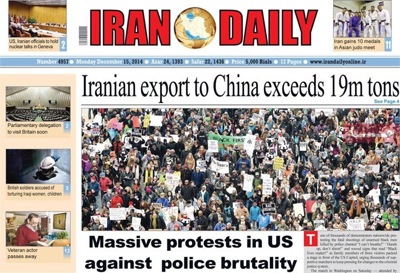
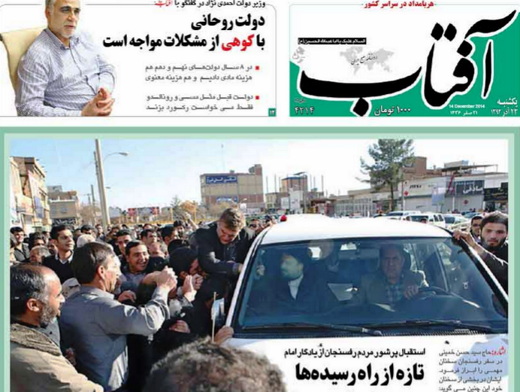
A look at Iranian newspaper front pages on Nov. 22

Iranian Newspapers Headlines

The dominant news story on the front pages of Iranian dailies on Saturday was the ongoing nuclear talks between Iran and P5+1. Another top story of the day was the funeral procession of Gholamhossein Mazloumi, a veteran footballer and coach, who passed away on November 19 after losing a hard-fought two-year battle to cancer.


Aftab-e Yazd: “Ahmad Jannati, the secretary of the Guardian Council, has thanked parliament for not granting a vote of confidence to government-proposed ministers for the vacant top job at the Ministry of Science, Research and Technology.”

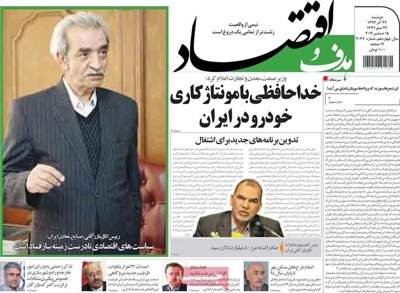
Aftab-e Yazd: “We should not trample national interests because of internal pressure,” said Oil Minister Bijan Namdar Zanganeh.
A look at Iranian newspaper front pages on Nov. 22


Asrar: “We will provide security for those who want to be active on economic, cultural and scientific fronts,” said Intelligence Minister Seyyed Mahmoud Alavi.

A look at Iranian newspaper front pages on Nov. 22


Emtiaz: “Ezzatolah Entezami, a veteran Iranian actor, and Director of the National Library of Iran Seyyed Reza Salehi Amiri paid a bedside visit to Najaf Daryabandari, a very famous writer and translator of works from English into Persian.

Emtiaz: “Gholamhossein Mazloumi nicknamed ‘the Golden Head’, a famous soccer player, coach and administrator who passed away on November 19, was laid to rest.”

A look at Iranian newspaper front pages on Nov. 22


Ettela’at: “Oil exports will see a two-fold rise after the lifting of sanctions,” said Oil Minister Bijan Namdar Zanganeh.
Ettela’at: “The invitation to visit bookshops – called the day of bookstore- hopping – was welcomed by the public and scholars.”

A look at Iranian newspaper front pages on Nov. 22

Hambastegi: “Addict mortality rate has seen a 6-percent increase,” said Interior Minister Abdolreza Rahmani Fazli.

Hambastegi: “Zarif’s trip back to Tehran has been scrapped; the talks will carry on.”

A look at Iranian newspaper front pages on Nov. 22


Hamshahri: “Iran’s beach soccer defeated Japan and came first in 2014 Asian Beach Games in Phuket, Thailand.”

A look at Iranian newspaper front pages on Nov. 22


Iran: “Drug smugglers rake in almost $3.3 billion in revenues each year,” said the interior minister.

A look at Iranian newspaper front pages on Nov. 22


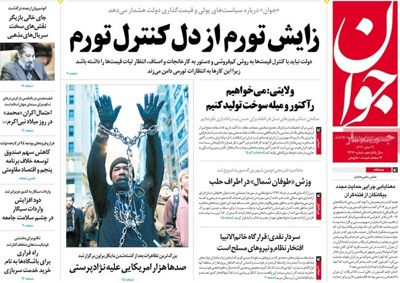
Javan: “We seek a deal which guarantees the independence and dignity of the country,” said President Rouhani.

A look at Iranian newspaper front pages on Nov. 22


Jomhouri Islami: “The government is utterly determined to complete the construction of the freeway linking Tehran to the north,” said First Vice President Eshagh Jahangiri.

A look at Iranian newspaper front pages on Nov. 22


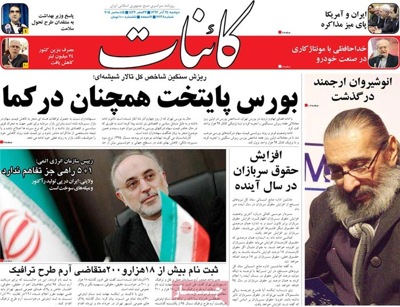
Kaenat: “Poor air quality of Tehran persists; the Air Quality Control Organization has urged people with medical conditions to stay indoors.”

A look at Iranian newspaper front pages on Nov. 22


Khorasan: “Child birth has seen a 4.3 percent rise between March 21 and October 22, 2014.”

A look at Iranian newspaper front pages on Nov. 22


Sepid: “Those who are behind recording the dying moments of pop singer Morteza Pashaei in the hospital and posting the video online will be punished,” said Health Minister Hassan Hashemi, stressing that no one has the right to film patients in operating rooms and that the privacy of patients should be respected.

A look at Iranian newspaper front pages on Nov. 22


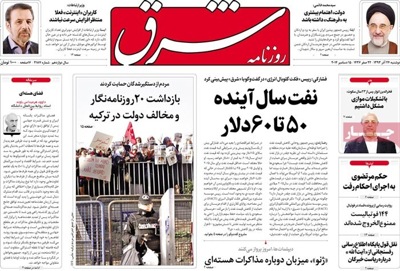
Sharq: “We do not have a nuclear facility in Marivan; we will grant the International Atomic Energy Agency (IAEA) access; the country which gave such baseless information to the agency has not given the exact location of it yet, because such a nuclear site does not exist at all,” said Iran’s envoy to IAEA Reza Najafi.

Sharq: “The National Development Fund of Iran has $70 billion.”

A look at Iranian newspaper front pages on Nov. 22


Tafahom: “We have nothing to hide; drinking water in Tehran is clean enough for drinking purposes,” said the health minister.

A look at Iranian newspaper front pages on Nov. 22


A different day in Tehran on a bookstore crawl

Ahmad Masjed Jamei - Mahmoud Dowlatabadi

A host of people, including the big names of art and culture, went to bookshops and publishing houses on Thursday [November 20] to both buy books and have a chat with book lovers.

Khabaronline filed a report on November 21 on an initiative by Ahmad Masjed Jamei, culture minister under President Khatami and a former Chairman of Tehran City Council who was replaced by Mehdi Chamran back in September, in support of book makers, publishers and distributors. The following is the translation of part of the report:

The plan dubbed “Bookstore Hopping”, which came after a call by Masjed Jamei on people from different walks of life to appear in bookshops, is meant to support those involved in the book industry and encourage book reading in society.

Masjed Jamei started his day on Revolution Street, which is the capital’s bookstores center, and was joined by some big names forming a group of bookstore hoppers.

Masjed Jamei had a stopover at Cheshmeh Publication whose license was revoked in June 2012. [In November 2013, Culture Minister Ali Jannati said that Cheshmeh Publication will resume work.]

At Farhang Moaser Publishing House Masjed Jamei was welcomed by a group of people among them Mahmoud Dowlatabadi, a famous writer who was awarded France’s Chevalier of the Ordre des Arts et des Lettres last week. There the veteran writer told Masjed Jamei: “In my lifetime I have never waited five hours for anybody, but I did it today out of respect for you.” He also praised the initiative.

Bookstore Hopping is the second initiative by the former chairman of Tehran City Council. Earlier Masjed Jamei put forward a Tehrangardi (Tehran Tour) plan [during which he stopped by different places in the capital to visit the known locations and discover unknown attractions.]

In a ceremony to open a publishing house Masjed Jamei thanked Minister of Culture and Islamic Guidance Ali Jannati for answering his call to go to bookstores in the city of Qom.


Obstacles the US has thrown in the way of nuclear talks

John Kerry in Vienna

With only a couple of days to go before the November 24 deadline, speculations as to whether or not the negotiating teams can conclude a deal are growing. As different countries and groups call on parties to the talks to try to resolve a 12-year-old dispute over Tehran’s nuclear program, the US policies seem likely to disrupt the ongoing talks.

Tasnim News Agency on November 16 filed an analysis of the negotiations between Iran and major powers at a time when heated debates and guesswork surrounding the talks have done little to help the prospects brighten. It also takes a look at different scenarios that are likely to be put on the table, with a sharp focus on what stands in the way of a final deal. The following is a partial translation of the analysis:

Reports released on the future of the talks explain the scope of Iran’s uranium enrichment and the way sanctions are to be removed as the main sticking points in reaching an agreement. […]

Iran’s compliance with its obligations as a member of the International Atomic Energy Agency and the all-out support the Islamic establishment has lent to the negotiating team reaffirms Iran’s steely resolve to arrive at a deal with the six world powers. But, major hurdles in the US could dim the prospect of such a deal.

Sanctions: A weapon the US does not want to lay down

Ever since Washington imposed economic embargoes against Iran, it has gone to great lengths to win over the international community for respecting its sanctions. Over the past decade it has exploited every avenue to fill the void created by the sanctions and now that a final deal seems to be on the horizon, it is struggling to get maximum concessions in exchange for lifting the sanctions.

Paranoia of a nuclear breakout

The US officials describe “nuclear breakout” [the time it would take to produce enough highly enriched uranium for a nuclear weapon] as one of their main concerns when they make comments on Iran’s nuclear program. […] The IAEA has repeatedly claimed in its reports that non-cooperation on the part of Iran will keep the case unsolved. Nuclear physicist Yousaf Butt, who is also a senior scientific advisor to the British American Security Information Council (BASIC) in London, has said in published remarks [Why is the IAEA getting Iran Wrong, The National Interests, Nov. 14, 2014] that the UN nuclear agency has got involved in the “Possible Military Dimensions” (PMD) file, asking, “Why is the IAEA pressing Iran on dubious evidence garnered from adversarial intelligence agencies?” whereas “there is not much nuclear-weapons expertise at the IAEA.” […]

Israeli lobby and perpetual Iran-US hostility

Interference by the pro-Israeli lobby in the US foreign policy is no secret. […] It is clear where Benjamin Netanyahu and other Israeli officials stand on Iran’s nuclear talks. That says a lot about what pro-Israeli lobbying group expects of Washington in the nuclear talks: irretrievable breakdown, moving toward heightened sanctions and ultimately a war. […]

To protect the American national interests, the US foreign policy needs to cut off the hands of the pro-Israeli lobby from lawmaking and policymaking, especially when it comes to dealing with Iran’s nuclear dossier and other regional and international questions – something which does not look likely to happen any time soon.

US bipartisan wrangling in nuclear field

The Republicans seem to be inclined to show opposition to almost anything the US president – a Democrat – does, irrespective of what the American national interests call for. […]

The across-the-aisle bickering over Iran’s nuclear program is not all. The US media too have waged full-scale war against a deal. Few are days in which a highly-circulated US paper does not publish an op-ed or opinion piece to negate any compromise or acceptance of Iran’s nuclear rights. This trend has been given momentum with the November-24 deadline looming.

Obama’s dismal foreign policy record speaks for itself: the bleak outlook of Palestinian-Israeli peace; the Ukrainian crisis and mounting tensions with Russia; US friction with China and its challenges in East Asia; trouble in Iraq and Afghanistan which are still reeling under the aftermath of unpopular US wars; and the like.

As for a nuclear deal if the obstructionist moves by hawks in Washington prove successful, Obama will be remembered as a president who could never use diplomacy to deescalate the [politically-charged] situation.

US needs to change course

The US administration needs to remove the obstacles in the way of the nuclear deal. […]

The American policies, at home and abroad, have been overshadowed by legislative lobbyism. The lobbyists who serve the interests of their advocates – Zionists and oil-rich Persian Gulf states – influence US decisions on security, economic and social fronts as well as the stances of the Obama administration on nuclear talks with Iran.

Washington needs to get the core of the issue: partisan rivalry in Congress has nothing to do with Iran. A successful foreign policy calls for a country’s corridors of power to speak with one voice. If President Obama fails to arrive at a consensus, sooner or later the Republican-held Congress will sabotage the nuclear talks and a possible conclusion of a deal.

Time is tight. As the US secretary of state is sitting around the negotiating table with Iranian diplomats, Obama is expected to do something for what is playing out inside the US. If not, he is to blame for the possible breakdown of the talks.

Envoy Calls for Resumption of Direct Bishkek-Mashhad Flights

Iran-Kyrgyzstan flight

Kyrgyzstan’s Ambassador to Tehran Asanbeyk Osman Aliyev called for the establishment of direct flights between Bishkek and Mashhad in a bid to further expand mutual cooperation between his country and Iran.

“The existing communication channels are not enough for establishment of relations and under the status quo establishment of direct flights will be practical,” Osman Aliyev said, addressing a meeting of a group of businessmen in the northeastern city of Mashhad on Thursday.

The Kyrgyz envoy reiterated that today the level of bilateral economic relations between the two countries is highly important.

Experts believe that resumption of Bishkek-Mashhad flights after years of interruption will be a major stride in further developing the close relations and cooperation between Iran and Kyrgyzstan in all fields.

Iran and Kyrgyzstan have expanded their bilateral ties and mutual cooperation in different fields since independence of the Central Asian state in the’90s.

Iranian President Hassan Rouhani in a meeting with Osman Aliyev in June underlined the need for the further expansion of bilateral relations.

“There is no obstacle to the development of mutual cooperation between Iran and Kyrgyzstan,” President Rouhani said during the meeting.

The Iranian president pointed to his recent negotiations with his Kyrgyz counterpart Almazbek Atambaev over the construction of a joint railway network among the regional countries, and said, “Construction of railroads, roads and aerial routes will bring the countries closer to each other.”

President Rouhani called for the fulfillment of undertakings and materialization of the agreements signed between Iran and Kyrgyzstan, and hoped that the two countries’ relations would further expand during the tenure of the new ambassador.

The Kyrgyz ambassador, for his part, pointed to the status quo of Iran-Kyrgyzstan relations, and said, “Iran is a country with global importance now and due to the country’s very high potential in different areas, Bishkek supports broadening of cooperation with Tehran.”

Osman Aliyev also laid emphasis on the start of direct flights between the two countries, and said, “We want to increase the volume of trade transactions with Iran.”

Vienna talks based on Iran’s plans, initiatives

Marzieh Afkham

Iran’s Foreign Ministry says no new proposals have been offered by P5+1 during nuclear talks in Vienna and Iran was the sole party putting new initiatives on the table.

“During the past three days, intense and numerous bilateral and multilateral talks have been held based on multiple plans and initiatives offered by Iran’s negotiating team…[during previous talks] in Omani capital, Muscat,” Iran’s Foreign Ministry Spokeswoman Marzieh Afkham said on Friday.

She added that negotiations between the two sides will continue at various expert and political levels.

“No new plans have been offered by the member states of P5+1,” Afkham emphasized.

On Friday, Iran’s Foreign Minister Mohammad Javad Zarif said despite extensive negotiations between Iran and P5+1 in the Austrian capital, Vienna, the group did not offer any significant proposals to Iran.

“There were many discussions during Vienna negotiations, but there were no new ideas and no significant proposal that I could take to Tehran,” Zarif told reporters in Vienna.

Zarif met with US Secretary of State John Kerry and EU coordinator, Catherine Ashton, on Friday. The meeting was part of the negotiations between Iran and P5+1 – the US, Britain, France, Russia, China and Germany – to work out a final deal aimed at ending the longstanding standoff over the Islamic Republic’s nuclear energy program.

Sources close to the Iranian negotiating team say the main stumbling block in the way of resolving the dispute over Iran’s nuclear energy program remains to be the removal of all the bans imposed on the country, and not the number of Iran’s centrifuges or the level of uranium enrichment.

Tehran wants the sanctions entirely lifted while Washington, under pressure from the pro-Israeli lobby, insists that at least the UN-imposed sanctions should remain in place.

Over 270 Tons of Narcotics Seized by Police in Iran in 7 Months

Narcotics Seized by Police in Iran

“The Iranian police have seized 272 tons of narcotics during March 21-October 22 period,” Deputy Head of Iran’s Anti-Narcotics Council Babak Dinizadeh told reporters on Thursday.

He reiterated that 179,000 drug traffickers were arrested and 3,654 drug gangs were also busted in the seven-month period.

Dinizadeh noted that the number of those arrested in thisperiodfor drug-related crimes showed a considerable rise compared with the corresponding period last year.

Earlier this year, Iranian Police Commander Esmail Ahmadi Moghaddam announced that the drug squads of Iran’s law enforcement forces had seized a sum of 500 tons of illicit drugs in the last Iranian year (ended March 20, 2014).

He noted that the amount of illicit drugs seized last year had shown a 14 percent increase as compared with the figures of the year before.

Iran’s geographical position has made the country a favorite transit corridor for drug traffickers who intend to smuggle their cargoes from Afghanistan to drug dealers in Europe.

Sistan and Balouchestan Province, where Iran, Pakistan and Afghanistan come together, has porous borders andbandits and drug traffickers there operate despite frequent entanglements and intense efforts of the Iranian law enforcement police.

Iran has recently established a central database and strengthened police-judiciary cooperation in a new effort to combat organized crime.

Nearly 4,000 Iranian security personnel have been killed fighting drug smugglers since Iran’s 1979 Islamic Revolution.

The Iranian anti-narcotic police have always staged periodic, but short-term, operations against drug traffickers and dealers, but latest reports – which among others indicate an improved and systematic dissemination of information – reveal that the world’s most forefront and dedicated anti-narcotic force (as UN drug-campaign assessments put it) have embarked on a long-term countrywide plan to intensify the crackdown on the drug trade since the beginning of the current Iranian year (started on March 21).

According to official estimates, Iran’s battle against drugscoststhe country around $1 billion annually. Strategies pursued by Tehran include digging canals, building barriers and installing barbed wire to seal the country’s borders, especially in the East.

Iran has long complained that the global community, especially the Western nations, does not play their role in the campaign against drugs, saying that Iran is makingefforts to block the transit of narcotics from Afghanistan to Europe and the US. Meantime, the Iranian police officials maintain that drug production in Afghanistan has undergone a 40-fold increase since the US-led invasion of the country in 2001.

While Afghanistan produced only 185 tons of opium per year under the Taliban, according to the UN statistics, since the US-led invasion, drug production has surged to 3,400 tons annually. In 2007, the opium trade reached an estimated all-time production high of 8,200 tons.

Ali Akbar Salehi: Iran does not allow ‘special’ inspection of nuclear sites

Salehi

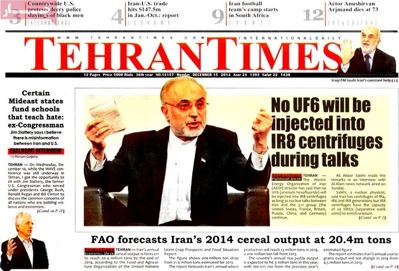
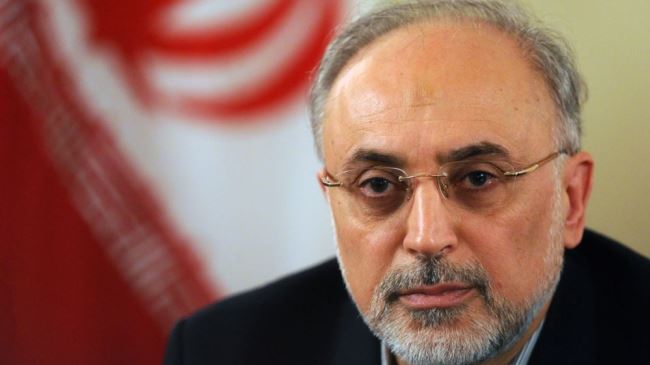
Head of the Atomic Energy Organization of Iran (AEOI) Ali Akbar Salehi has said that Iran does not allow ‘special’ inspections by the International Atomic Energy Agency (IAEA) of its nuclear facilities, Tasnim News Agency reported on November 20.

“We will not accept any special inspection or process (exclusive to Iran’s nuclear program),” Salehi said on a TV news bulletin on Wednesday.

He said that Iran has inked the nuclear Non-Proliferation Treaty (NPT) and has been implementing its Additional Protocol for two and a half years.

Salehi further said that over 7,000 man-hours of inspections of Iran’s nuclear facilities have been carried out by IAEA experts and cameras installed at Iranian nuclear sites monitor them round the clock.

He stated that the AEOI has grown on technical, industrial and scientific fronts and its various products have begun to hit the market, adding that the country is seeking to employ nuclear energy for agricultural, industrial and medicinal purposes.

Salehi went on to say that the AEOI is building centrifuges for the health sector which will be unveiled on April 9 [The National Nuclear Technology Day], adding that one of those centrifuges is to be handed over to the Health Ministry soon.

He further said that the AEOI has produced radio drugs for medical purposes, adding that the radio isotopes developed by Iran can help treat 800,000 patients on an annual basis.

He also rejected reports that Iran has agreed to ship its nuclear fuel to other countries, including Russia, saying that Tehran and Moscow have inked protocols and agreements to have further nuclear cooperation.

The atomic chief further said that as many as 1,000 experts are working in the Bushehr Nuclear Power Plant [in southern Iran] and added the Bushehr plant is at a satisfactory level in terms of human resources.

The students who are majoring in related fields in universities should not be concerned about their future jobs, Salehi said, citing a new partnership agreement between Iran and Russia [to build eight nuclear power units in Iran].

The nuclear technology is the point where all other sciences such as mechanics, chemistry, metallurgy, physics and mathematics are employed [for a singular purpose], he said.

I hope the West does not dissuade Iran from cooperation

Ali Larijani
Ali Larijani

Speaker of the Islamic Consultative Assembly Ali Larijani said that Iran does not buy claims by the Americans that the US Congress is throwing obstacles in the way of the [Obama] administration when it comes to negotiations on Iran’s nuclear program.

Fars News Agency (FNA) quoted Ali Larijani on November 20 as speaking in a national conference on strategies to materialize the Resistance Economy. The following is the partial translation of comments by Iran’s top MP in the gathering in the northeastern city of Mashhad:

The US Congress raises some questions, but it does not mean that we buy what they [the Americans] are trying to sell. They should not do anything which may discourage Iran from the path it has taken. Iran does not make its decisions based on what the US Congress says.

No one [in Iran] would accept the miscalculated remarks the US Congress makes and claims by the Americans that congress is creating obstacles in the way of the US government as far as its role in the nuclear negotiations with Iran is concerned.

This is an [internal] problem of the Americans and they are the ones who are supposed to solve this problem. You [the Americans] should not do something that may make Iran regret what it has already opted for: cooperation and interaction with the West.

I remember efforts by the Iranian MPs who proposed a motion to limit inspections by the International Atomic Energy Agency (IAEA) of Iran’s nuclear facilities. The MPs are defenders of the Iranian nation’s rights in parliament. But back then I asked them to show patience arguing we were cooperating with them. […]

Now that Iran has decided to have interaction with the West, they [the Americans] cannot go ahead in this path as they wish, regardless of Iran’s [national] interests.

We really hope to see the West acts wisely in the nuclear talks. We hope misconceptions do not make Washington step into the wrong path. […]

A look at Iranian newspaper front pages on Nov. 20

Iranian Newspapers Headlines

Introduction of Mohammad Farhadi, a one-time health minister, by President Hassan Rouhani as his pick for science minister dominated the front pages of Iranian dailies on Thursday. A last round of talks in Vienna between Iran and major powers to clinch a nuclear deal ahead of the November 24 deadline also generated headlines. And news about the passing of Gholamhossein Mazloumi, a great soccer player in the late 1970s and early 80s, appeared on the front pages of most newspapers, too.

Afarinesh: Judiciary Chief Ayatollah Sadegh Amoli Larijani has voiced opposition to calls to give more powers to the justice minister.

Afarinesh: “Reports that nuclear talks have already been extended are not true,” said Foreign Ministry Spokeswoman Marzieh Afkham.


Afarinesh newspaper


Arman-e Emrooz: Mohammad Farhadi, a health minister in the reformist government [of President Khatami] has been named by President Rouhani to take over the Ministry of Science, Research and Technology, pending parliamentary confirmation.


Armane Emrouz newspaper


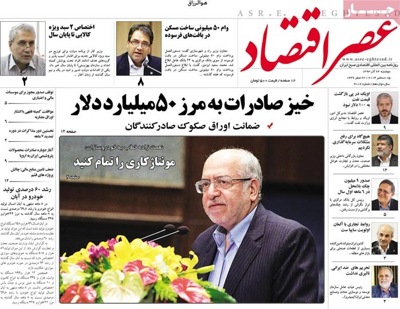
Asr-e Eghtesad: The health minister has rejected reports that a “cancer tsunami” is sweeping the nation.

Asr-e Eghtesad: The Tales by [Iran’s] Rakhshan Bani-Etemad has been named as the best film at [the 20th] Kolkata International Film Festival.


Asre Eghtesad


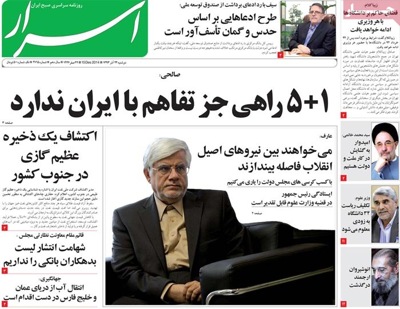
Asrar: [Following a hike in air pollution levels in the capital] Masoumeh Ebtekar, the director of the Environment Protection Organization, and Mohammad Bagher Ghalibaf, Tehran’s mayor, have been summoned to parliament for a review of measures to push down pollution levels.

Asrar: “In the absence of excessive demands, a deal [with P5+1] is within reach,” said President Hassan Rouhani.


asrar newspaper


Ebtekar: International media reports suggest that nuclear talks in Vienna have made 95 percent progress.


Ebtekar newspaper


Emtiaz: Seyyed Hassan Khomeini, the grandson of the architect of the Islamic Republic, has taken a swipe at firebrands [in a speech at a National Conference on Moderation].


Emtiaz newspaper


Etemad: Iranian soccer player Gholamhossein Mazloumi, who was widely known for his superb headers, has passed away at the age of 64.


Etemad newspaper


Hadaf va Eghtesad: “Production at Iran Khodro has posted a 95 percent growth over last year,” said the managing director of the Iranian giant carmaker.


Hadafe Eghtesad newspaper


Hamshahri: Road accidents in North Khorasan Province on Wednesday alone claimed 10 lives, sending 77 people to hospitals.


Hamshahri newspaper


Hemayat: “Nuclear talks should lead to the removal of sanctions and no new sanctions should be imposed [on Iran]” said the Iranian Judiciary chief.

Hemayat: The human rights resolution critical of Iran is hostile and politically-motivated, Iranian officials say.


hemayat newspaper


Iran Daily: All-out efforts to clinch a [nuclear] deal before the deadline.


iran daily


Isfahan Ziba: “Recent incidents in Isfahan [acid attacks] seem to have been designed to hurt tourism,” said Police Chief Brigadier General Esmail Ahmadi Moghaddam.


Isfahan ziba newspaper


Kaenat: Iran is making efforts to restore stability to global oil markets.


Kaenat newspaper


Kasbokar: “We are ready for any outcome,” said Government Spokesman Mohammad Bagher Nobakht of nuclear talks underway in Vienna.


Kasbo Kar newspaper


Kayhan: The health minister said, “Equipment that jams satellite signals does not cause cancer.”


Kayhan newspaper


Khorasan: National economy, regional developments and nuclear talks took center stage at a meeting of the heads of the three branches of government.


Khorasan newspaper


Mardomsalari: “Dialogue amounts to a practice in moderation,” said Seyyed Hassan Khomeini, the grandson of the late Imam Khomeini at a National Conference on Moderation in Tehran.


Mardom Salari newspaper


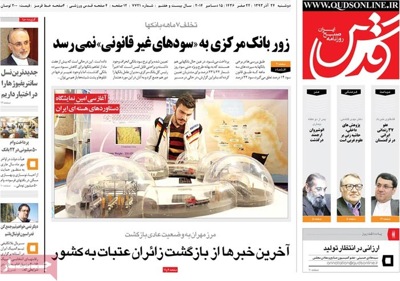
Qods: Health Minister Seyyed Hassan Hashemi has suggested that a law be drafted to deal with those who release unlawfully recorded videos of hospital procedures such as surgery.


Quds newspaper


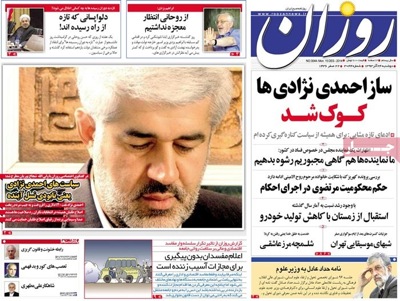
Roozan: Iranian movie Melbourne [directed by Nima Javidi] has won the Golden Pyramid of the 36th Cairo International Film Festival.


Rouzan newspaper


Taadol: “Investment has posted growth for the first time in two years,” said the deputy-governor of the Central Bank of Iran.


Taadol newspaper