Monday, December 29, 2025
Home Blog Page 4976

New cave discovered in east of Iran

New cave in Iran

Head of the Red Crescent Society in Khaf Mohammad Amani said on Saturday that some 23 members of the society rescue operation division discovered a new 80-meter long cave in Bar-Abad in Sangan district.

It took about five hours for the rescue team to walk in and explore the new cave, he said.

Since the new cave is located in Bar-Abad Aldang, its name was registered as ‘Al-Dang’, he said.

The team is to continue its exploration journey with more modern equipment and facilities in the future, he said.

The city of Khaf is located some 267 kilometer south of Mashhad.

Over 200 caves have been explored and identified in Khorasan Razavi Province which is regarded as an ideal place to absorb adventure tourists.

US keeps sanctions conditional

Iran Talks-John Kerry

In an interview with Mosalas [Triangle] Weekly in late December, Hadi Ajili, a professor of international relations at Tehran’s Allameh Tabataba’i University, examined the nature of US sanctions against Iran and said they could be viewed as being either tactical or strategic. The following is the translation of the Q and A:

Q. There are different views about US sanctions against Iran. Some view them as a tool to exert pressure on the Islamic Republic which won’t be lifted even if a nuclear deal is struck. What is your take on the nature of these sanctions?

Hadi AjiliA. There are two main views about the sanctions Washington has imposed on Iran. One group believes the sanctions are tactical. That means the US has imposed them to force Iran to behave the way Washington wants it to. In other words, the sanctions are a means to bring pressure to bear. So if the world powers struck a deal with Iran, there would be no grounds for the sanctions to remain in place.

People in this group believe that once the underlying reasons for sanctions are gone, sanctions will lose their legitimacy. They also doubt the sustainability of the sanctions regime. With globalization of trade in full swing, maintaining sanctions for a long time is practically impossible, because there are many ways to bypass them.

They also argue that although sanctions are imposed by the US, Washington is not the country that actually implements them. After all, the US does not do much business with Iran. In other words, the US is imposing sanctions on Iran through proxy. It either begs other nations to honor the sanctions regime or coerces them into sticking to it.

Topping the list of US demands is that countries decrease the volume of oil they purchase from Iran. So other countries which do not necessarily support the US goals are the actual implementers of the sanctions regime. US threats to punish those who violate the sanctions and Washington’s pledges of favor have been two of the most important reasons why other countries have so far been sticking to the sanctions.

Q. Are you suggesting that most of these countries want things to return to the pre-sanctions era because they seek to reestablish trade ties with Iran?

A. That is right. These countries are after normalizing ties with Iran. Their purchase of Iranian oil in the past has been a result of their need which still remains in place. In other words, continued sanctions also harm the interests of the countries which implement them.

Several European countries are waiting for the sanctions to be lifted and for US penalties affecting those who act in violation of the sanctions regime to be eased so that their firms could return to Iran and flood its market with their products.

That Iran has been a customer of European products so far makes Europe more interested than Iran in reestablishing ties. Such an interest on the part of Europe is meant to cushion the recession that still grips the continent.

There is a similar situation when it comes to oil. Countries in Southeast and South Asia like India need Iranian oil and their demand is bound to increase in the future. So they cannot remain committed to sanctions in the long run.

The reason why some describe the sanctions as tactical is that they believe countries which are implementing the sanctions want things to return to normal. In believing that they also resort to comments by the US president or his secretary of state that Washington might lose some allies if it wanted to walk further down the sanctions path.

That means the US is concerned its European and Asian allies might not want to maintain or step up the current level of sanctions. That is why Washington has agreed to sit at the negotiating table to settle the issues of Iran’s nuclear program and sanctions through dialogue.

So if the US Congress decides to slap more sanctions on Iran, countries other than the US will have to implement them. One should not forget that the US has already paid a heavy price to keep allies on board as far as implementing the sanctions is concerned.

Q. If we assume sanctions are tactical, as this group argues, how and when will they be lifted?

A. Conclusiveness of the nuclear talks would leave no reasons for sanctions to remain in place. That would be a reward for Iran. So far the US has controlled its behavior through punishment and sanctions, but when a deal is clinched the US will have to control Iran through easing the sanctions.

In either case, the US seeks to control Iran’s behavior. One way goes through imposing sanctions and the other through lifting or easing them. The pace of terminating or easing the sanctions would depend on the calculations of those in power in Iran.

Q. You said there are two views about sanctions. Tell us about the second one.

A. The second group regards American sanctions against Iran as strategic. It believes that sanctions have nothing to do with Iran’s nuclear program and were first imposed on the country in 1980. It also believes that sanctions date back to before the emergence of the nuclear case and continue to date. But over the past few years sanctions have become more crippling.

The reason why we didn’t feel the bite of the sanctions until 2012 was that they were being bypassed and the oil and central bank sanctions were not as tough as they are today. In 2012, sanctions targeting Iran were stepped up and began to bite.

This group argues that the Islamic Republic has been the target of sanctions even before the row erupted over the nuclear issue. Does American hostility toward Iran merely revolve around the nuclear case? The answer is in the negative. We know that US enmity dates back to the early years of the revolution and has simply intensified over the nuclear issue.

In fact the Americans use different approaches in trying to control Iran’s behavior. Of course one should not forget the fact that only moderate US administrations seek to control Iran’s behavior. What is ideal to others is regime change. If the stage is set, they would definitely walk down that path.

So the ultimate goal is to replace the Islamic Republic, and the nuclear case is only one of the pieces of the puzzle.

A look at the sanctions laws passed by the US Congress vindicates the second group. Those laws slap sanctions on Iran because of what they describe as norm-breaking behavior on the international stage, including in the nuclear case, support for terrorist entities, human rights record and lack of democracy.

When the European Union imposed sanctions against Iran similar issues were raised. That the West’s disagreement with Iran is not simply over the nuclear issue is obvious. UN Security Council resolutions make mention of Iran’s missile capability and other non-nuclear issues too.

Q. Does that mean even if a comprehensive deal is struck sanctions would remain in place?

A. That’s right. According to the second group, the West has repeatedly said there are other issues that need to be addressed and the sanctions are not simply centered on the nuclear case to be removed upon conclusion of a nuclear deal.

In other words, the Americans have learnt how to put pressure on Iran. Of course Washington may ease the sanctions or at least stop imposing new ones in hopes of stopping the progress of Iran’s nuclear program.

But assumptions that conclusion of a nuclear deal will bring US-imposed sanctions and hostilities between the two countries to an end are wrong. As I said American enmity toward Iran does not solely center on the nuclear issue.

Q. In case of a deal what tools will the US use to sustain such animosity?  

A. I don’t think the US will use the military option. That they sat at the negotiating table with Iran means they are unwilling to go to war with Iran. If the US can deal with a country militarily, they do not enter negotiations with that country. Sanctions provide a platform to sustain US hostility against Iran.

To that end, they would use ambiguous terms in the wording of the deal and prolong its implementations as much as they can. They would finally say their implementation of the provisions of the agreement hinges on certain conditions.

They want to make sure things would return to their previous state if and when Iran did something that they did not like. That means easing sanctions is a new project to control Iran’s behavior.

Besides, Obama will remain at the helm only for two more years and it is unclear whether his successor will continue to stick to his policy. Most important, the White House and Congress follow separate agendas and it is unclear whether Congress will lift the sanctions at the urging of the president if a deal is struck.

Q. If that is the way the US looks at Iran, what should Tehran do, both domestically and at the negotiating table, to prevent the realization of American goals?

A. Through sanctions the US seeks to cripple Iran’s economy and create domestic problems for the country. As long as the Iranian government remains solely focused on efforts to have the sanctions lifted and bring petrodollars into the country, it won’t have time to deal with other issues.

The US seeks to create conditions in which the farthest the Iranian government would be able to go is to handle the economy. That would eventually isolate the country, allowing the other side to identify Iran as a disagreeable player that has swum against the tide and thus subjected to punishment.

At this juncture Iran should make efforts to render sanctions ineffective by making sure that at the talks the questions of Iran’s nuclear conduct and the termination of sanctions do not land on two sides of a final equation. That would give the other side the opportunity to condition its lifting of sanctions on Iran’s conduct.

The Iranian side should act on the basis of the nuclear Non-Proliferation Treaty and force the other party to do the same thing. Iran should not allow its nuclear transparency to be a factor in the scale of easing sanctions.

Iran should act carefully because the other party will continue to stick to its present policy as long as they think the performance of Iran’s economy is tied to the question of sanctions. In fact, they think they are holding the controls of the Iranian economy and there is no reason to let go of the controls.

But if they feel that imposition and continuation of sanctions won’t have much impact on Iran’s economy, sanctions will lose their efficacy and cannot be used as a bargaining chip at the talks. That requires jihad-like efforts on the economic front.

First things first; moral training before education

Iranian Students

The voice of teachers of my school days is still echoing in my ears, those who used to say enthusiastically that the fixed order of “education and moral training” is not right and should be replaced with “moral training and education”, because moral training takes precedence over education. Such mindset seemed to be correct. A lack of harmony between the two generations clearly proves this.

These are the opening sentences of an article the Amordad Weekly – a Zoroastrian magazine – ran in its 317th issue on January 3. What comes below is the partial translation of the piece written by Firouzeh Foroodi:

Back then some teachers believed that training had to come before education. If not, the knowledge – when fallen into the hands of those who don’t deserve it – will be like an unsheathed sword in the hands of a blind drunk man. …

At that time I thought these are excuses by a handful of old, fatigued teachers who failed to establish a bond with their students. It is common knowledge that education and moral training are two complementary and interdependent terms. In other words, education without training leads nowhere. …

Now I’ve come to learn that those teachers were concerned about our present conditions today when moral training has been crushed under the domination of education.

Nowadays training is a term which follows education only to keep an old collocation [of education and training] alive. Today top-performing schools are known with the number of their university admissions or sharp-witted students instead of the number of hopeful and vibrant students who draw on love and faith to work together – not compete against each other– for a better future.

Today the conditions our children live in fall short of moral standards and we have yet to think about what must be done. Our children have received education, not training, for more than 70 years under the auspices of the Ministry of Education, especially at present when everything in life has been overshadowed by technology.

If a child finds enough time to put aside computer and its accessories, they learn that they don’t know how to play. The Iranian children know nothing about the meaning of happiness and grief. They have not learned how to respect adults and do not like teamwork.

In school they just learn to study their lessons. An Iranian teen is good at math and science, and solves math problems, but they fail to endure hardships, inhibit anger, make apologies, and speak their mind in public. […]

Education in the absence of moral training turns students into robots who seek pleasure in the virtual world. They learn friendship, kindness and teamwork in an unreal world. ….

The new education system might have spared the students concerns [about their studies], but it instills carelessness and oversimplificationinto the mind of the present generation.

We have a dream; the dream of schools in which students are both respected and given the opportunity to learn the skills they need to lead a successful life; the dream of training centers where students not only are not demeaned but they are motivated to learn from their mistakes in a safe environment. […]

We dream of training centers where [traditional] methods (learning materials by heart and answering multiple choices) are replaced by ways to think, make innovations, have dialogue, and learn how to be a good human and how to love and be loved.

Tokyo’s banking channels at Tehran’s disposal

Abbas Araghchi

Nuclear talks with P5+1 are in the news these days. Despite the media hype, Iran’s negotiating team seeks to settle the nuclear case. Given the progress made so far, they seem to have been somewhat successful on that front already.

At the same time, Iranian diplomats are not indifferent to what is going on in the world or in Iran’s relations with other nations. One such development has unfolded of late in relations between Tehran and Tokyo: Japan has raised its oil purchase from Iran to over 163,000 barrels a day.

Seyyed Abbas Araghchi, a deputy foreign minister and top negotiator who once served as Iran’s ambassador to Japan, has responded to a series of questions posed by Tejarat Farda (Tomorrow’s Trade), a weekly magazine, on January 3, 2015 about Tehran-Tokyo ties. What appears below is a partial translation of what the Iranian diplomat had to say in this regard as reported by Alef news website:


– Tokyo is a US ally and therefore it will move along in line with a series of policies set by the West, the US in particular. However, within that framework, Japan will carry on its friendly relations with Iran based on mutual respect.

– Although the West has exerted a lot of pressure and put a spoke in their wheel, Iran and Japan have succeeded in maintaining their ties. With nuclear talks between Iran and P5+1 in progress, the two countries are trying to open a new chapter in their ties. It could be said that the two nations are anticipating the removal of sanctions to allow relations to return to their past status.

– That Japan needs energy is undeniable. As a reliable and trustworthy energy supplier in the Middle East, Iran can meet such demand. In the sensitive conditions in the region, Japan and other nations in East Asia cannot ignore Iran.

– Over the past years, Japanese politicians have struck a balance between their ties with Iran and their relations with the West. Although they have not openly defined sanctions, they have carried on their economic cooperation as much as they can afford and kept the present channels open.

– All Japanese firms are willing to cooperate with Iran. In spite of the sanctions slapped over the last few years, they have not shut down their offices in Iran.

– The former Japanese foreign minister was the first top diplomat close to the West to visit Tehran prior to the Geneva interim deal. Even after the deal was clinched, the Japanese cooperated with us in implementing it.

– When Iran was in considerable need of banking cooperation, Japanese banks played a great role. The financial channels envisaged in the Geneva interim agreement were all opened up with the help the Japanese.

– The Japanese government is logical in commitment to oil sanctions and won’t go beyond them.

– As for a 98-percent rise in oil purchase from Iran by Japan, the average annual figure not the monthly stats should be taken into account, yet relations should be analyzed beyond a temporary purchase.

– I am not of the opinion that the Islamic Republic of Iran should present its oil cheaper than the market price or as they say, sell it off.

– Iran will be a major player in the regional energy market in the future and other nations should adapt themselves to our policies.

– Oil market is run by certain rule. In other words, it’s influenced by economic issues as well as political matters. Selling cheap oil over a short period of time is only one political factor.

– The Japanese might stop purchasing Iran’s oil under short-term contracts as a result of pressure from some regional countries, yet a majority of Japan’s refineries are compatible with Iran’s oil and the Japanese cannot swiftly make changes to their systems to make them compatible with oil from other countries like Saudi Arabia.

– Following the Geneva interim agreement, the US government made a lot of attempts to regain control over things after a [positive] atmosphere in favor of Iran emerged.

– A great deal of enthusiasm emerged among all nations for establishing relations with Iran. That threw the Americans into panic, prompting them to remind the world that the sanctions are still in place and only a small number of restrictions have been suspended based on what is agreed on under the Geneva interim deal. From my perspective [such strategy] has proved to be extremely futile.

– Japanese contributed to the banking channels that opened under the Geneva interim accord. They provided us with banking services more than other nations. We consider their contribution valuable.

Stability will be restored to Iraq soon

Ali Akbar Velayati-12

A senior adviser to Leader of the Islamic Revolution Ayatollah Seyyed Ali Khamenei says that terrorism in Iraq is on the decline and the country will soon regain stability.

Ali Akbar Velayati said on Sunday that Iraq has managed to contain terrorism as it followed “guidelines issued by the clergy” and used “Iran’s advice” in its military campaign against the terrorists.

Velayati made the remarks after a meeting with Chairman of the Islamic Supreme Council of Iraq (ISCI) Ammar Hakim in Tehran.

Velayati dismissed recent calls by some Iraqi politicians for federalization of Iraq based on religions.

He said that all political groups in Iraq are seeking unity and solidarity and they will oppose any issue which “could weaken the integrity” of their country.

In recent weeks, Iraqi forces have clinched decisive victories against the Takfiri terrorists operating in the Arab country.

The ISIL terrorist group, with members from several Western countries, controls swathes of land in Iraq and Syria.

The group has been carrying out horrific acts of violence such as public decapitations and crucifixions against all communities, including Shiites, Sunnis, Kurds, and Christians.

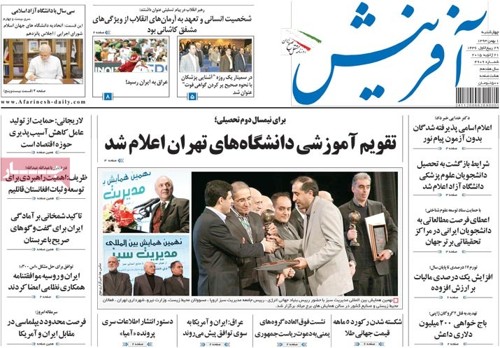
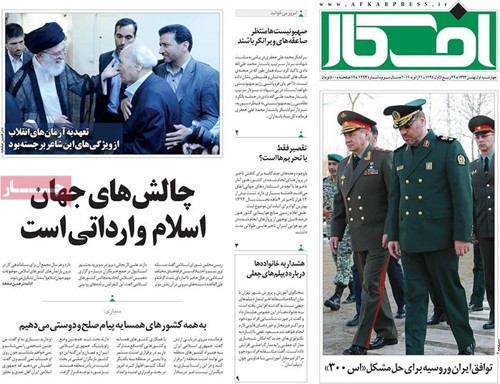
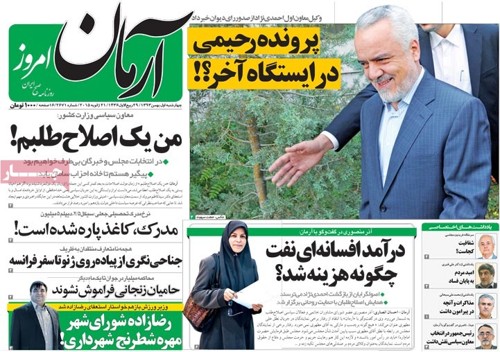
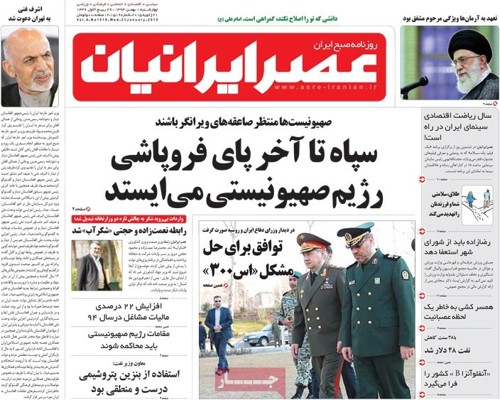
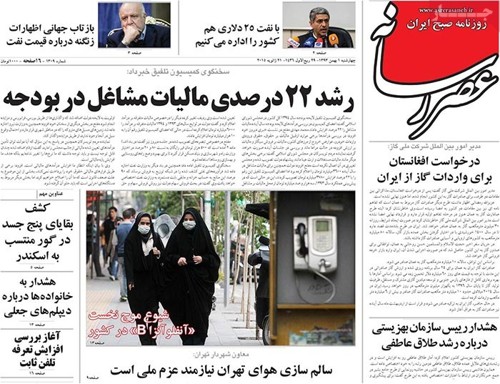
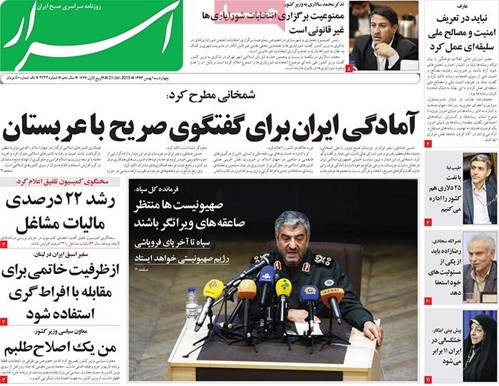
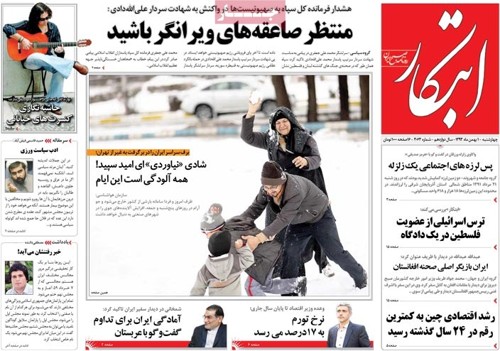
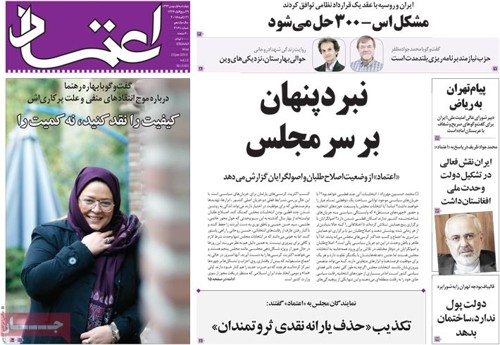
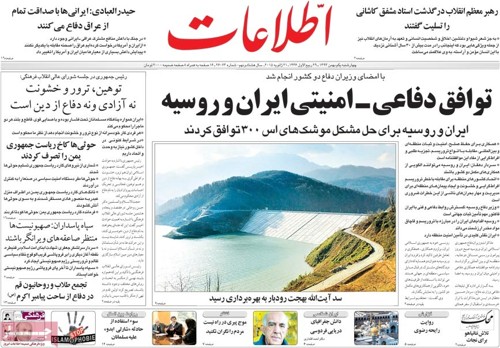
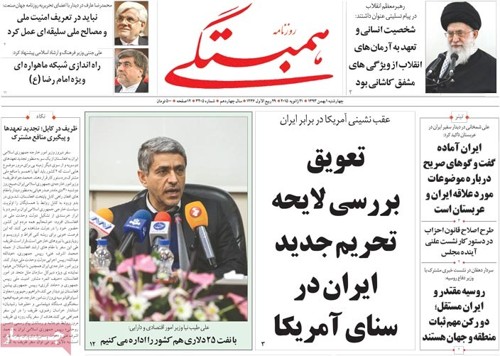
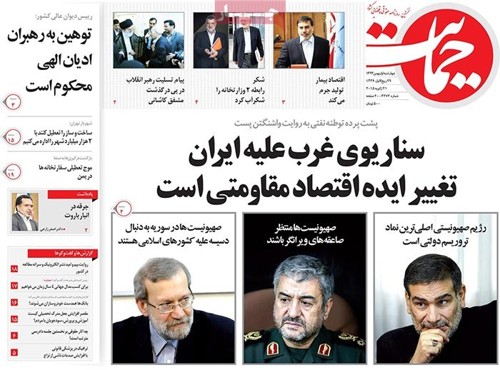
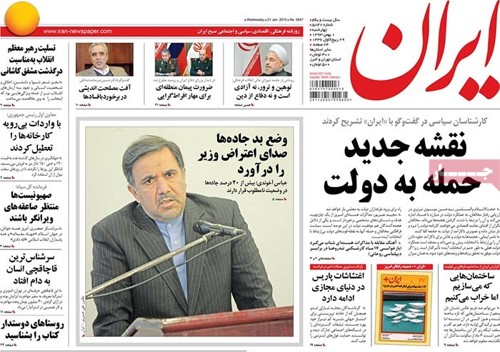
A look at Iranian newspaper front pages on Jan. 5

Iranian Newspapers Headlines

Most Iranian dailies on Monday led on a first conference on economy held in Tehran a day earlier. In the conference the president said the Iranian Constitution envisions referendums on important topics. Comments by the governor of the Central Bank that financial institutions that operate without proper documentation will be closed down also dominated the front pages of the Iranian dailies.


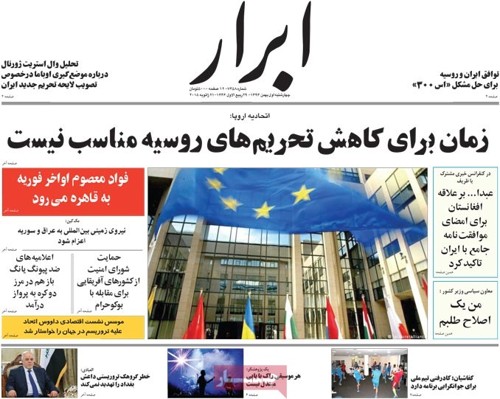
Abrar: The government spokesman has said a decline in oil prices won’t bring Iran to its knees.


Abrar newspaper 1- 5


Afarinesh: “Iran won’t change its stance simply because of 1 million barrels of oil,” said Oil Minister Bijan Namdar Zanganeh.


Afarinesh newspaper 1- 5


Afkar: The Iranian foreign minister has offered condolences to Indonesians who lost loved ones in an AirAsia plane crash in later December.


Afkar newspaper 1- 5


Aftab-e Yazd: Members of parliament’s Article 90 Committee have quit their seats on the committee en masse.


Aftabe yazd newspaper 1- 5


Arman-e Emrooz: “Our cause is not linked to centrifuges. The constitutional provision that allows holding referendums [on important questions] can be invoked. We should rid our economy of rent-seeking,” President Hassan Rouhani told a conference on Iran’s economy.

Arman-e Emrooz: “The Iran offices of 17 satellite channels based abroad have been shut down,” said a deputy intelligence minister.


Armane emruz newspaper 1- 5


Asr-e Rasaneh: “When a third phase of the Targeted Subsidies law will be implemented has yet to be determined,” said the president’s chief of staff.


Asre resaneh newspaper 1- 5


Asrar: “There are murmurs that an Iran-US joint chamber of commerce is being formed,” said Mohammad Reza Behzadian, a former head of Tehran Chamber of Commerce.


Asrar newspaper 1- 5


Emtiaz: The National Youth Organization will be reinstated next year [starts March 21, 2015].

Emtiaz: Foreign tourists view Iran as safe.

Emtiaz: A House of Artists commemorative stamp has been unveiled.


Emtiaz newspaper 1- 5


Ettela’at: Parliament has given the green-light to foreign investment in oil, gas, water and electricity sectors.


Ettelaat newspaper 1- 5


Hambastegi: “If the present level of budget supply continues, completion of Tehran subway will take 250 years,” said a Tehran deputy mayor.

Hambastegi: “Foreign policy basically hinges on national interests rather than principles and causes,” said President Hassan Rouhani.


Hambastegi newspaper 1- 5


Hemayat: The judiciary chief has named two judges to look into administrative offenses at the Presidential Office.

Hemayat: In the first conference on Iranian economy no one stepped forward to take the blame for the economic woes of the country.


Hemayat newspaper 1- 5


Jamejam: “We’ll have single-digit inflation in three years,” said President Rouhani.


Jame jam newspaper 1- 5


Javan: All the president’s economists got together for a conference that produced no practical results.

Javan: “Iran won’t quit nuclear technology,” said Ali Akbar Velayati, an advisor to the Supreme Leader.


Javan newspaper 1- 5


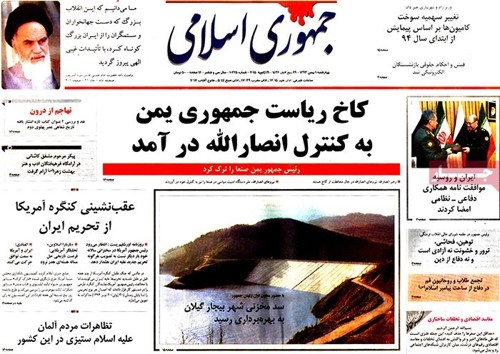
Jomhouri Islami: Parliament has required the executive branch to lend support to manufacturers.

Jomhouri Islami: “If global decisions are made based on prudence, the world won’t see a rise in terrorist attacks,” said the chairman of the Expediency Council in a meeting with Russian ambassador to Tehran.


Jomhorhe eslami newspaper 1- 5


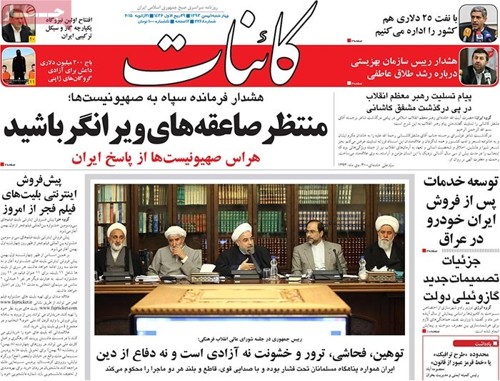
Kaenat: “A final decision will be made by yearend in the case of financial institutions that are operating without license,” said the governor of the Central Bank of Iran.


Kaenaat newspaper 1- 5


Kar va Kargar: “The leader won’t allow statesmen to budge over the nuclear issue,” said Ali Akbar Velayati, an advisor to Ayatollah Khamenei and a onetime foreign minister.


Karo kargar newspaper 1- 5


Kayhan has taken a swipe at President Rouhani’s government and the conference on Iran’s economy by leading on “Fulfillment of economic promises, maybe some other time.”


Kayhan newspaper 1- 5


Mardom-e Emrooz: Palestinian group Hamas says developments in Syria have dealt a blow to its relations with Iran.


Mardome emruz newspaper 1- 5


Qods: Eight senior bank managers have been sacked following extensive violations of banking regulations.


GHODS newspaper 1- 5


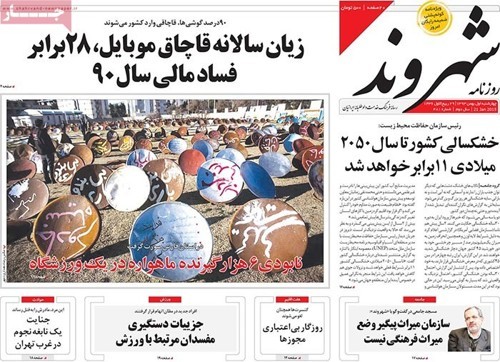
Shahrvand: Following the demolition of the top floor of Alaeddin Cell Phone Center, shop owners have stepped forward seeking compensations.


Shahrvand newspaper 1- 5


Sharq: The government spokesman has signaled Iran’s readiness to hold talks with Saudi Arabia.


Shargh newspaper 1- 5


Siasat-e Rooz: Winds helped rid Tehran’s air of smog that had blanketed the capital for almost two weeks.


Siasate ruz newspaper 1- 5


SMT: Imports of low-quality medical equipment has been banned.


Samt newspaper 1- 5]


Falling crude prices unable to push Iran to soften tone

oil price

Iranian Oil Minister Bijan Namdar Zanganeh stressed that the free fall in oil prices will not affect the country’s steadfast positions and stances.

“We pursue a series of measures to confront the oil price falls, but the important point is that we have shown that we will not withdraw from our positions by decreasing oil prices and will not change our positions; we will continue our resistance regardless of oil prices,” Namdar Zanganeh told reporters in Tehran on Sunday.

Asked if Iran would call for an OPEC emergency meeting, he said an OPEC session will not help the situation and the member states first should reach a consensus.

“Iran will not call for an OPEC emergency meeting unless it sees consensus among the members,” Namdar Zanganeh said.

Also asked about the membership of new countries in the oil cartel, he said, “The new members have a low (production) capacity and their membership will not help OPEC.”

“And Russia will not enter the OPEC either,” Zanganeh added.

In relevant remarks last month, Iranian Government Spokesman Mohammad Baqer Nobakht underscored that the country was ready to defuse the possible impacts of the drop in crude prices over the Iranian economy, ensuring that the government could manage the country even with lower oil revenues.

“They think that they can pressure Iran by continuing such conditions, but just the same way that we are now acting exactly on the basis of the budget planning despite the decreased (oil) prices in the current year, we will move on the same course in future as well,” he added.

Iran decries fatal shooting of 3 Sunni clerics in Iraq

fatal shooting

Iran’s Foreign Ministry has sharply condemned a fatal shooting attack that claimed the lives of three senior Sunni clerics in the southern Iraqi province of Basra.

Foreign Ministry spokeswoman Marzieh Afkham said on Sunday that the “targeted” killings of the Iraqi Sunni figures were aimed at “sowing religious discord in the Islamic Ummah.”

The Iraqi Interior Ministry said in a statement on January 2 that unknown attackers ambushed a vehicle carrying four clerics in the district of Bab al-Zubeir in Basra. Three of the clerics lost their lives in the assault.

No group has claimed responsibility for the deadly terror attack so far.

Afkham further said such a crime was committed as Sunni Muslims were preparing to commemorate the birthday of Islam’s holy Prophet Mohammad (Peace Be upon Him), which fell on January 4 this year, according to the Sunni Muslim interpretation.

The Iranian official also called on the Iraqi nation as well as political and religious elite in the Arab country to remain vigilant in the face of plots by enemies and ill-wishers.

Iraqi Prime Minister Haider al-Abadi has ordered security commanders in Basra to “urgently work to reveal the circumstances of the attack” and arrest the perpetrators.

According to the figures released by the Iraqi government, violence killed over 15,500 civilians and security forces in 2014, the deadliest year since 2007, when the monthly death toll sometimes exceeded 3,000.

A toy designed to teach children a lesson in archeology

Children archaeology

The website of the Research Center of Iran’s Cultural Heritage, Handicrafts and Tourism Organization (www.richt.ir) has reported that the center plans to introduce a new toy to the market to familiarize children and teenagers with archeology and the country’s heritage. What comes next is a partial translation of the report:

“The first model of the toy has been sent to a national competition of toy-designing which is held at the Sharif University of Technology,” said Leila Kafashzadeh, the head of the Department for Child Research and Education at the center.

Kafashzadeh, who is also the designer and inventor of the toy, expressed hope that the invention will catch the eye of the jury and investors so that it could be mass-produced later.

“The magic hill is a mass of dry clay that comes in the form of an archeological site. Inside the hills, there are some toy archeological items to be dug out by children. Going through different stages of the game, children will learn about the difficulties archeologists face in recovering ancient items that later go on display in museums,” she added.

Kafashzadeh went on to say, “The magic hill comes in seven packages. When a child buys the first package and gets his hands on the buried treasure, they get motivated to buy the other six. Having bought them all, the child can set up a museum of sorts at home and get familiar with the concept of running a museum.”

“The toy, which is intended for those in the 6-15 age group, can rekindle child patience and anticipation through sharpening their concentration and stimulating interest in pursuing and finally achieving the aim of the game. Also, through reading the brochures, children will learn a lot about Iran’s rich culture and the heritage that the past generations have left for them,” she stated.

President Rouhani for referendum on significant topics

Rouhani

President Hassan Rouhani highlighted an article of the Iranian Constitution which proposes a public referendum on initiatives on certain issues.

Addressing the opening of an economic conference in Tehran on Sunday, the president noted that one significant article of the Iranian Constitution has been neglected so far.

He said that in his capacity of the country’s chief executive, he is keen to put into practice that part of the Constitution which proposes that as for major economic, social, political and cultural issues, instead of having the suggested changes to the law approved in parliament, they could be put to a referendum.

While parliament retains its supreme position as the legislative body, he added, people should be asked to directly vote on the issues which are of high importance for the country and have a remarkable impact on their lives.

Once in 36 years since the victory of the Islamic Revolution in Iran, this chapter of the Constitution has to be invoked, the president noted.

He called for further concentration on the issue of economy and stressed the need for uprooting the economic corruption which he said is massive and rampant.

The president opened the first conference on ‘Strategies for Achieving Sustainable Growth and Employment’.

Several Iranian ministers as well as some 1500 economic experts, university scholars and economic activists are attending the two-day gathering which is to discuss macroeconomic issues.