Monday, December 29, 2025
Home Blog Page 4975

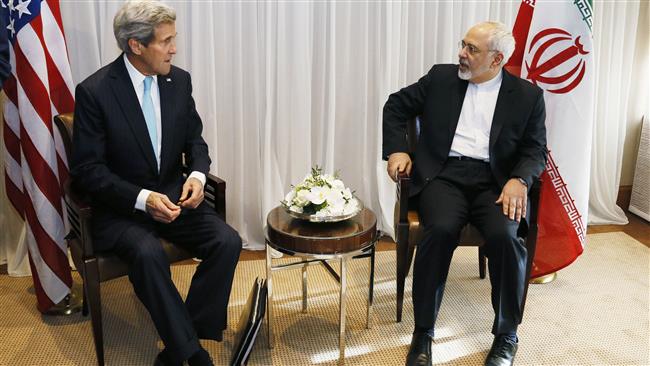
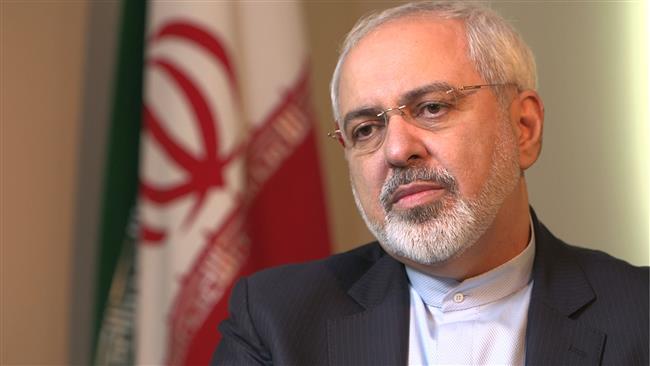
Iran will never give up nuclear rights: Zarif

Mohamad Javad Zarif

“In these negotiations, we will defend the interests of all people and take the country’s high goals into consideration,” Zarif said at an open session of Iran’s Parliament (Majlis) on Tuesday in response to questions by 40 lawmakers.

He pointed to Iran’s “effective and serious” presence and role in regional and international developments and added that the ill-wishers of Iran and the Islamic Revolution organized and implemented a relatively long-term plot to portray the Islamic Republic’s peaceful nuclear activities as a threat with two major objectives.

The first one, the Iranian minister said, was to “portray an insecure and dangerous image of Iran, [as a country] which endangers global peace and security; and the second one was to weaken the country’s economic, defense and industrial capability and exert pressure on our good people” through various cruel sanctions, including by the UN Security Council as well as unilateral bans.

The nuclear negotiations, however, illustrated an “interactive, stable and powerful” image of Iran and prevented the expansion of sanctions, he pointed out.

Zarif said that, following the Geneva deal reached between Iran and the P5+1 countries in November 2013, Iran’s foreign policy managed to counter the hostile propaganda against the Islamic Republic and boost the country’s security and power.

“I assure you that the [Iranian] government and negotiating team have never followed and will never follow any political and factional objective in the nuclear talks,” the top Iranian nuclear negotiator added.

Iran and the five permanent members of the UN Security Council – Russia, China, France, Britain and the US – plus Germany wrapped up their latest round of talks on the Islamic Republic’s nuclear program in the Swiss city of Geneva on December 17, 2014.

The three-day Geneva discussions were held almost three weeks after Tehran and the six countries failed to reach a final agreement by a November 24 deadline despite making some progress. Back then, the two sides agreed to extend their discussions for seven more months until July 1, 2015. They also agreed that the interim deal they had signed in Geneva in November 2013 should remain in place during the negotiations.

Renovation of Biglar Beigi Building in Photos

Iran-Biglar Beigi Garden

Biglar Beigi Garden is located in Ekhtiarabad Village, 25 km from the southern Iranian city of Kerman. The adobe building inside the garden, which is also known as Fathabad Garden, was built some 140 years ago when the Qajar Dynasty was in power. It was registered as a national site in 2002. The following are some images IRNA posted of the building which is undergoing renovation:


Rafsanjani warns of civil war in Iraq

Rafsanjani-Hakim

Chairman of the Expediency Council Ayatollah Akbar Hashemi Rafsanjani said on Monday that Shia and Sunni dignitaries should be watchful of civil war in Iraq.

He made the remarks in a meeting with head of the Supreme Iraqi Islamic Council, Ammar al-Hakim.

Ayatollah Rafsanjani said support for the IS terrorist group by certain regional states is the result of their lack of political wisdom and foresightedness.

‘The Shia and Sunni dignitaries should be vigilant not to allow enemies of Islam not to drag Muslims into civil war,’ warned Ayatollah Rafsanjani.

Saying that generosity and courage are two noble features of Iraqi people, as observed in Arbaeen procession this year, Ayatollah Rafsanjani said when insecurity was prevailing in every corner of Iraq, people set out, on foot, for Karbala from around the country and people in cities along the way host the majority of the guests, and drew the attention of global observers.

Ayatollah Rafsanjani said treating people with compassion was on agenda of the words and deeds of the infallible household of Holy Prophet (PBUH), and said a true Shia Muslim should learn from the infallible household of the prophet about how to stick to ethics and respect people equally.

He said religious festivals should not be an excuse for desecration of sanctity by followers of other religions.

The Ayatollah underlined the need for unity and solidarity in the world of Islam, especially in Iraq, and said divisions strengthen such groups as IS, Boko Haram, Jibha al-Nasra, Wahabis and Salafis.

He said that even if terrorists succeed in capturing certain regions by force, they will fail to do so when people’s consent and sovereignty is to be taken into consideration because they can do nothing other than massacre of people and plunder of assets and bullying them.

As for the goals behind strengthening terrorist groups in Muslim lands, Ayatollah Rafsanjani said establishment of military bases by enemies is the sign of their program for staying long in the Muslim lands.

He lauded the important and outstanding role of the authorities and people of the Iraqi Kurdistan Region in preserving and ensuring security in the country.

Emphasizing the need for cooperation between Iran and Iraq and ample ground for expansion of cooperation, Ayatollah Rafsanjani said Tehran and Baghdad with rich natural resources, geographical condition and Ahl-ul-Bayt (AS) school of thought have the potential to cooperate with the whole world.

Hakim in turn recalled the opinion of Ayatollah Shahid Seyed Mohammad-Bagher Hakim and the late Ayatollah Seyed Abdelaziz Hakim about Ayatollah Rafsanjani and said at different historical junctures, Ayatollah Rafsanjani played a key and influential role in Iraq, striving for interests and benefits of the public.

He then provided Ayatollah Rafsanjani with a report on the presence of some on 20 million people in Arbaeen ceremonies this year and said he had joined the public in the ceremony from Basra to Karbala and observed public love and feeling for Imam Hossein (AS) and his mourners.

Underlining political and security conditions in Iraq and unity between Shia and Sunni Muslims there he said solidarity between Muslims has prompted the enraged enemies to resort to savage acts of terror and the emergence of terrorist groups such as IS is a result of their latest attempts to that end.

He commented on conditions of Shia in the world of Islam, especially Iraq, and said Shia Muslims want Iraq for all people from all religious and ethnic groups and the past 11 years have shown that despite civil differences, Iraq believes in democracy in general.

Underscoring the need for cooperation between Kurds and Shia Muslims to ensure security in Iraq, he added our principal goal is to guarantee the territorial integrity of Iraq.

Iran favors security cooperation with Afghanistan: Official

Shamkhani-Iran-Afghanistan

Secretary of Iran’s Supreme National Security Council Ali Shamkhani made the remarks in a Monday meeting with Afghan National Security Adviser Hanif Atmar in Tehran, where the Iranian official underscored the achievement of lasting solutions for the establishment of security along the joint border of the two countries.

Shamkhani pointed to the historical and cultural commonalities between Iran and Afghanistan as the main deterrent factor in the face of the divisive policies of the enemies of both countries.

Elsewhere in his remarks, Shamkhani said that the withdrawal of NATO troops from Afghanistan would serve as a suitable opportunity for the country’s army and security forces to prove their capabilities in defending national interests and countering terrorism.

The Iranian official said that the spread of insecurity and terror has been a long-time policy of certain powers to undermine the national capacities and regional standing of Muslim countries to justify their military, economic and political interference.

“The era of using terrorism as a tool for meddling in the region and advancing colonialist objectives is over,” Shamkhani said.

The Afghan official, for his part, praised Iran’s active role in the development and progress of Afghanistan and Iran’s hosting of Afghan refugees during years of war and insecurity in the country.

He said that concerted efforts for political cohesion and an all-out campaign against extremism and terrorism along with the expansion of cooperation, especially with the neighbors, are the priorities of the new Afghan government.

Onepetro picks Iranian paper on gas as highly-cited

gas

A paper submitted by an Iranian scientist at Amir Kabir Poly Technique University, Ehsan Khamehchi, was selected as a highly-cited paper by Onepetro database, a unique library of technical documents and journal articles linked to Society of Petroleum Engineers (SPE) and is serving the oil and gas exploration and production industry.

The article on ‘underground natural gas storage in Sarajeh Gas Field to provide gas for Tehran’ was published in 2006 in Onepetro database.

The article has been downloaded 700 times until December 9 and has been selected as a highly-cited one.

There are 160,000 papers and articles on Onepetro.

Dr. Khamehchi is a faculty member at Amir Kabir Poly Technique University.

Gas storage has been widely discussed in European countries since 40 years ago, and has been one of the key issues in Iran of late.

In late December, Iranian Deputy Health Minister for Research and Technology Reza Malekzadeh said the country accounts for 30 percent of scientific achievements in the Middle East.

“Iran’s achievements in science account for 30 percent of those in the Middle East and 1.5 percent in the world,” Malekzadeh said.

According to the Essential Science Indicators (ESI) data in 2014, there are 60,000 top researchers across the world working in different fields, of whom 88 are Iranian, 18 of them working on medicine.

According to Malekzadeh, out of 25,000,000 million papers in the world, 245,000 belong to Iran, 32 percent of them on medicine.

Iran stood 13th in the world and 1st in the region in terms of publishing papers in 2013.

According to the statistics, Iran produced over 39,000 articles in 2013, which gained the country the world’s 17th rank in science production and consolidated its top position in the region, above Turkey.

The promotion is mainly due to the achievements, in areas of medical research and medical technology, of Iran’s Pasteur Institute.

Iran’s scientific progress was the result of the country’s recent policies and programs to develop knowledge and facilitate researchers’ access to the world’s top academic resources.

Assessing and promoting research centers and universities of medical sciences as well as launching some 50 new research centers were among the activities that have paved the way for the country’s science improvement, according to the report of the Iranian Health Ministry’s Center.

In 2000, the Islamic Republic ranked 53rd in the world in terms of highly cited medical articles, but moved up to the 23rd rank in 2011.

According to the Institute for Scientific Information (ISI), Iranian researchers and scientists published a total of 60,979 scientific articles in major international journals from 1999 to 2008.

Iran’s 2009 growth rate in science and technology was highest globally, being 11 times faster than the world’s average rate.

Iran disbands terrorist cell

parchameiran_by_asr_entezar

The Islamic Revolution Guard Corps (IRGC) ground forces successfully identified and arrested members of a terrorist cell in the city of Sarbaz, southeastern Iran, the Public Relations Office of Quds Base of the force said in a report.

Joint operations by IRGC forces and police to identify and arrest the terrorist cell have produced the intended results, the report said.

The terrorist cell had already killed some teachers and Basij (volunteer) force in southeastern Iran.

According to the report, further information will be made public later.

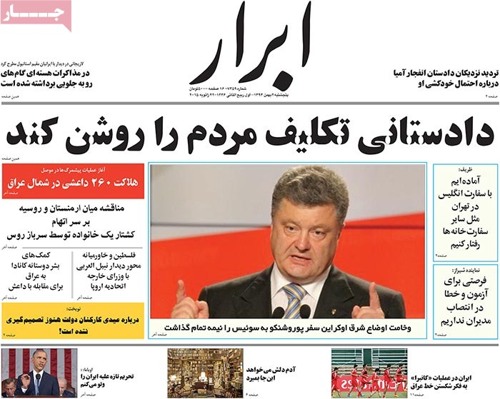
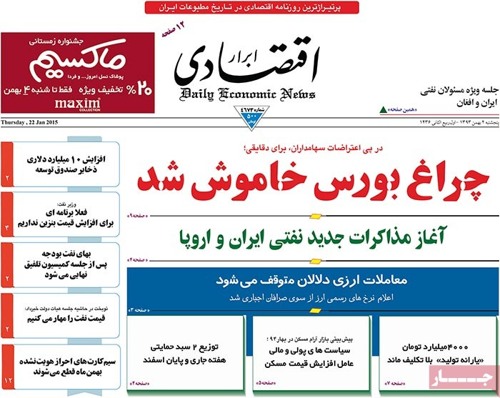
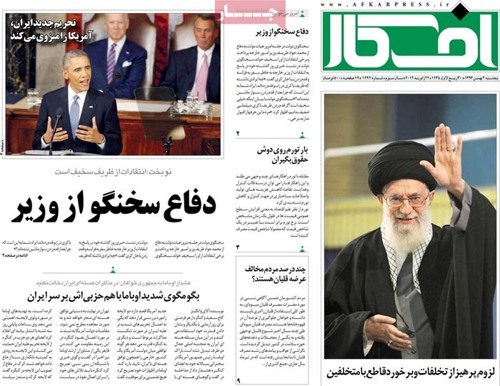
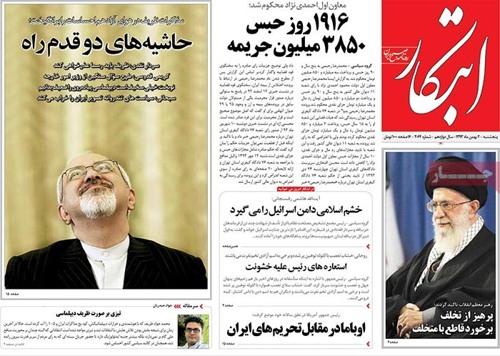
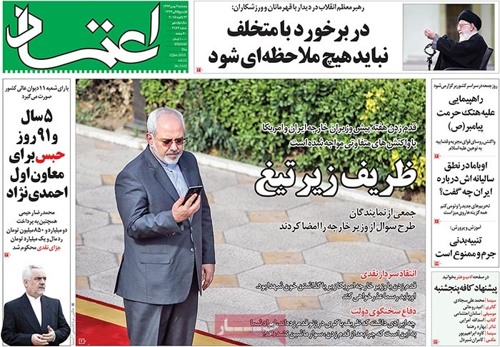
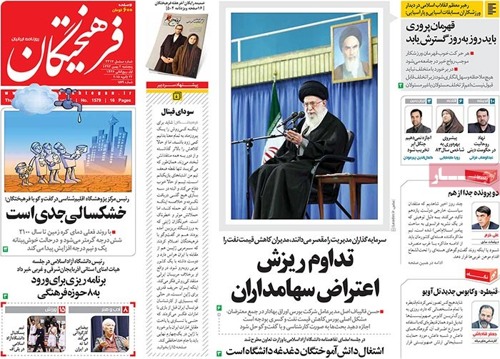
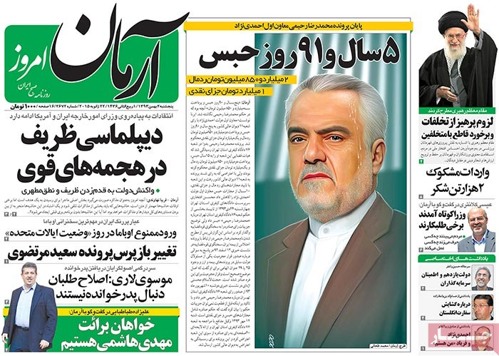
A look at Iranian newspaper front pages on Jan. 6

Iranian Newspapers Headlines

The comments of Judiciary Deputy Chief Gholamhossein Mohseni Ejei on a wide range of issues, including cases involving Babak Zanjani, who stands accused of corruption, and former vice-president Mohammad Reza Rahimi and the possible prosecution of two presidential candidates who disputed the results of the 2009 vote and thus sparked riots were on the cover of many Iranian dailies on Tuesday. Apprehension of the members of a terrorist cell in the southeast by the Islamic Revolution Guard Corps appeared on the front pages of several newspapers too.


Aftab-e Yazd: “Babak Zanjani [who faced charges of massive corruption] has been found guilty,” said the judiciary spokesman.

Aftab-e Yazd: “Police support promoters of virtue as long as they do not get physical in promoting virtue and preventing vice,” said Police Chief Brigadier General Esmail Ahmadi Moghaddam.


Aftabe yazd newspaper 1- 6


Arman-e Emrooz: The Islamic Revolution Guard Corps has arrested three people who sought to join IS.

Arman-e Emrooz: NATO aircraft cannot fly in Iranian airspace.

Arman-e Emrooz: With a new round of nuclear talks approaching, hardliners are trying to stir up tension.


Armane emruz newspaper 1- 6


Asr-e Eghtesad: “Public satisfaction with healthcare services has increased 70 percent,” said Health Minister Hassan Hashemi.


Asre eghtesad newspaper 1- 6


Asrar: “An 8 percent minority does not want to accept the policies of the government,” said political analyst Sadegh Zibakalam.

Asrar: Foreign Minister Mohammad Javad Zarif will appear in parliament to answer questions by MPs today.


Asrar newspaper 1- 6


Ebtekar: “Oil prices account for only one third of the government budget,” said the government spokesman.


Ebtekar newspaper 1- 6


Emtiaz: Road accidents in Iran claim one life every 20 minutes. Iran is first in the Middle East when it comes to the number of road deaths.

Emtiaz: A big fire swept through a furniture market in southwest Tehran.


Emtiaz newspaper 1- 6


Esfahan Emrooz: Students in Isfahan have developed a motorcycle that runs on electricity.


Esfehane emruz newspaper 1- 6


Etemad: “Some of the issues Ali Motahari [a principlist MP] has mentioned in his letter [to the judiciary] are false and actionable,” said the spokesman of the judiciary.


Etemad newspaper 1- 6


Hambastegi: “Tehran is first when it comes to growth in the number of delinquency cases,” said the interior minister.


Hambastegi newspaper 1- 6


Hamshahri: A court has sentenced to death a young man for assaulting women in Jahrom, in the southern province of Fars.


Hamshahri newspaper 1- 6


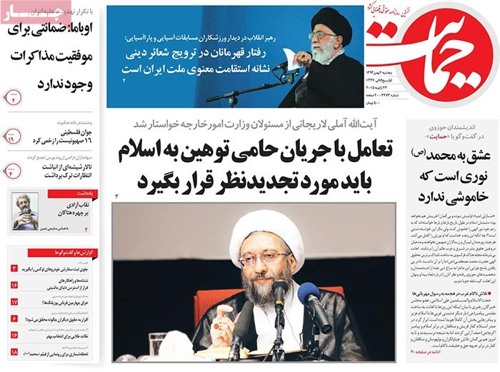
Hemayat: The drop in oil prices cannot deal a blow to Iran’s economy.


Hemayat newspaper 1- 6


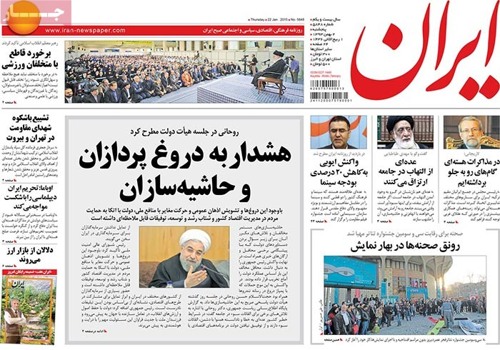
Iran Daily: IRGC arrests terrorists in Sistan-Baluchestan.

Iran Daily: [Iran’s] Non-oil exports top $35 billion.


Iran daily newspaper 1- 6


Jahan-e Sanat: The judiciary spokesman has said that Mousavi and Karroubi [who are under house arrest for sparking post-election unrest by disputing the results of the presidential vote in 2009] can be tried as soon as possible.


Jahane sanaat newspaper1- 6


Javan: In a conference on Iran’s economy, a minister, an advisor to the president and a number of economists admitted that the government does not dare make major economic decisions.


Javan newspaper1- 6


Kar va Kargar: “Bank liquidity should be tapped to counter unemployment,” said Chairman of the Expediency Council Akbar Hashemi Rafsanjani.


Karo kargar newspaper 1- 6


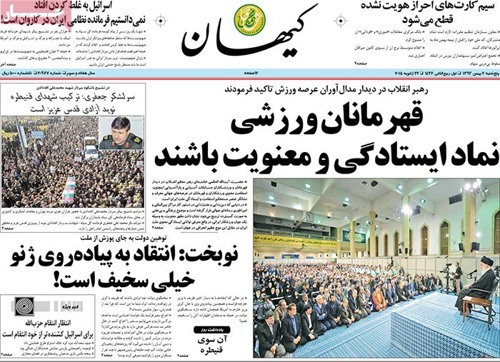
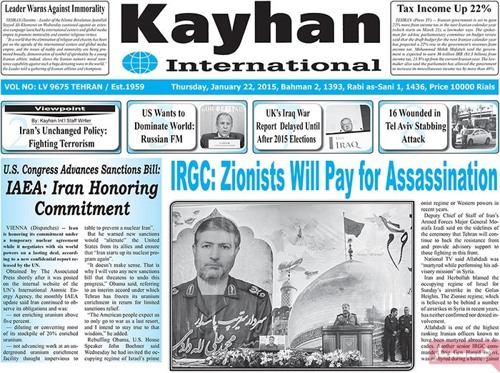
Kayhan: The Supreme Leader has issued a message of condolences following the demise of Ayatollah Ansari Shirazi [a senior seminary scholar].


Kayhan newspaper 1- 6


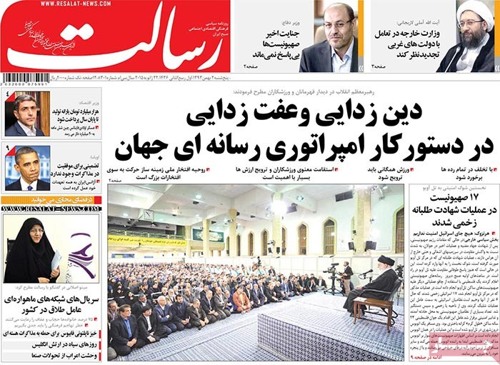
Resalat: “Some 80 percent of the country’s economy is still in the hands of the government,” said business magnate Asadollah Asgar-Oladi.


Resalat newspaper 1- 6


Shahrara: “Iranian negotiators won’t make compromise to the enemy,” said Ayatollah Vaez Tabasi.


Shahre ara newspaper 1- 6


Tehran Times: Tehran lauds religious scholars’ wise role in Iraq.


Tehran times newspaper 1- 6


Nobakht: Iran to face no budget deficit even if oil prices drop further

Nobakht

Government Spokesman Mohammad Bagher Nobakht Monday said Iran is to face no budget deficit even if oil prices drop to half of its current value.

Nobakht who is also the vice-president and head of the Management and Planning Organization said the government is taking necessary measures to cope with a possible further decrease of oil prices and its probable impact on next year’s budget.

The MPO chief made the remarks on the sidelines of the first National Economic Conference in Tehran on Monday.

He said even if oil prices drop to half, the government is not worried about any budget deficit. He further urged the media and press to differentiate between the two phrases of “lack of sufficient financial resources” and “budget deficit.”

The senior official further stressed that the government is going to spend sources more economically if its anticipated oil revenues for the next year budget bill are not materialized.

That means, he added, the country will face no budget deficit under any circumstances.

However, he said, the government is going to suffer a shortage of revenues of up to 350,000 billion rials given the present declining trend of oil prices.

Reactions by reformists and principlists to Rouhani’s call for referendum

President Rouhani

The recent call by President Rouhani for putting major national issues to referendum has met with mixed reactions from politicians, analysts and major players on Iran’s political landscape. His remarks have drawn a broad welcome from reformists and a mildly critical response from principlists.

“Once and for all, as for immensely important questions over which there might be disagreement, matters which are of great significance to all and have an impact on everyone’s life, why don’t we hold a referendum?” President Rouhani proposed in his speech Sunday.

It has been the first time that an Iranian president has floated the idea of conducting a referendum on major issues. The following is the translation of some reactions to President Rouhani’s comments Fararu news website posted online on January 5:


Hossein Shariatmadari (Kayhan Managing Editor)

shariat-madariThe remarks by the esteemed president about resorting to referendum have come as plebiscite is envisaged in two parts of the Constitution in two different forms. The first one is a mandatory referendum which is stipulated in Article 59. It lies within the jurisdiction of the legislative body and only parliament can call for a referendum.

The article reads in extremely important economic, political, social, and cultural matters, the function of the legislature may be exercised through direct recourse to popular vote through a referendum.

Also, the very article stresses that any request for such direct recourse to public opinion must be approved by two-thirds of the members of the Islamic Consultative Assembly. Therefore, unlike what the esteemed president said, parliament cannot be bypassed for such a referendum.

The other popular vote stipulated in Article 177 of the Constitution mainly revolves around revisions to the Constitution. The referendum in question requires an edict by the Supreme Leader and cannot be called for by parliament.

If President Rouhani was referring to cultural and social matters, the solution for such issues passes through parliament. If he was referring to the second type of referendum (amending the Constitution which is the subject of Article 177) that seems unlikely, it does not require parliament’s go-ahead.

Of course, if the president’s appeal was for such a referendum, preparations should be made and an order by the Supreme Leader is required.


Hamid Reza Jalaeipour (journalist)

Hamid Reza JalaipourFor decades, the number of referendums has been an indicator of development in the world. This has been envisioned in Iran’s Constitution too, but it has remained untapped.

The country is currently facing fundamental questions because of which national and public consensus has been seriously hurt. In other words, the fact that the take of society on some issues is far from clear has paved the way for different groups to stake out their viewpoints in the name of people, and – on some occasions – dictate their views, downplaying other groups as minority.

No doubt, what is important here is to shed more light on the country’s problems in 2009 [when Iran was hit by unrest after two candidates disputed the results of presidential election]. Five years on, those problems have yet to be resolved, and continue to be the main bone of contention at home.

So, if the country is to put anything to referendum, it should make decisions – through popular vote – on the 2009 postelection incidents in the first place.


Javad Haghshenas (reformist political activist)

Javad HaghShenasThe Constitutional article on referendum is one of the most progressive articles of the charter. Although no one can guess what Hassan Rouhani had in mind when he said a referendum was needed to remove the country’s problems, I think popular vote is a means to reach a certain goal.

If the president had said for which problems he was calling for a referendum, we could have elaborated better. When it comes to parliament, the general approach of the legislative body does not seem to allow the materialization of a referendum.

The president believes that popular vote is a vote other than what is unfolding on parliament floor. More light should be shed on this question. Up for discussion is not the gravity of Iran’s domestic issues; rather the question is: What kind of problem the head of the eleventh government has come across that the oversight body does not allow him to solve. The president had better talk with people more frankly and avoid keeping what he wants to say under wraps.


Sadegh Zibakalam (political analyst)

Sadegh Ziba KalamThe problems Mr. Rouhani is talking about are not holding a referendum, nor will they be removed by holding a referendum. The main problem lies in the country’s macro-politics. Let me elaborate more. All democracies in the world are based on the circulation of elite or popular elected governments. This means a political faction takes part in a general vote as a party and forms the government if it secures a majority of votes and takes office for four full years.

That party, president and his cabinet will be reelected if people feel satisfied with their performance. Otherwise people will vote for another party or group.

In Iran, the circulation of elite is nominal. But in practice, such circulation is simply a small, yet incomplete movement. Eighteen months ago, people in Iran took part in an election, said “no” to the policies of the eight years [under President Ahmadinejad] and picked Mr. Rouhani as a replacement for [the one who adopted] those policies.

This is where the shoe starts to pinch. The majority of people said “no” to the previous policies calling for change and implementation of new policies, but the elected government cannot practically put into force the policies and plans it has on its agenda. Why? Because new policies cannot be implemented for different reasons despite the fact that people voted – in an election – for a change to past policies and voiced willingness for new policies.


Mohammad Safari (editor-in-chief of Siasat-e Rooz daily)

Mohammad SafariAs far as holding a referendum in the country is concerned, only [the Islamic Consultative] Assembly can make a decision. The Supreme Leader should give the go-ahead for a referendum. Other branches of government have no role to play. The president was referring to nuclear talks, an important issue which matters to all Iranians.

The government seems to be in need of such a measure [holding referendum] to be able to reach its intended objectives. The stage for the referendum was set yesterday [Sunday January 4] when Mr. Rouhani called for holding it. Certainly, the proponents and opponents of this presidential request will put forward their standpoints and analyses in the days to come.

He did not lose his life, life lost him

Hassan Hazer Moshar

He lost one of his eyes to World War II. For years, he was a shopkeeper. At the age of 70, he had an accident and slipped into a coma. When he came to, he changed course and like a young man took up painting. Over time, he turned into a sculptor. He would make sculptures on the sidewalk and put them up for sale right there.

It looked as if his eye, blinded during the war, found a way to the world of peace and could now delve deeply into life through the prism of art. How this 90-year-old man defined life and human beings was the subject of a report posted on honaronline.ir on January 4. The following is a partial translation of the item:


Hassan Hazer Moshar22_A few months ago, when he held an exhibition of his sculptures in a Tehran gallery, I went there for a visit. There he told me that the passion for life was not limited to a specific age and that he hadn’t been and wouldn’t be scared of death ever. In his 90s, he did everything on his own. I saw him on his feet for hours to create sculptures. Unfortunately, I have just heard that the artist has passed away.

If one day I were asked about the most astonishing characters I have ever come across in my life, undoubtedly, Hassan Hazer Moshar would be among the first who come to mind. The two sculptures I bought at his last exhibition keep reminding me of him, a character whose lifestyle and uniqueness cannot be summed up in a few sentences.

However, for a start, suffice it to say that he took up self-taught art at the age of 70 which by itself is an interesting story. In his early 90s he would stand on his feet for 13 hours to paint, make sculptures or deal with a group of university students. I am sure it will strike you as interesting to hear that after living in the capital city for five decades, he still maintained his Gilaki accent which was reminiscent of friendliness in human nature.

“My feet won’t feel exhaustion as long as my mind is not consumed with fatigue. What matters is that the brain should not be overwhelmed with weariness,” he would say.

“I began to take art seriously after I had an accident in the vicinity of my carpentry workshop near Azadi Square in Tehran where I hit my head on a stone and fell into a coma. When I came around, I could no longer work, so my daughter rented out the shop to my apprentices and did not let me work.

“However, I could not stand doing nothing. I somewhat knew how to paint and gradually learned more from my daughter who is a painter. Since then I have spent almost every waking moment on this art. At first when I started making sculptures, I did not have a workshop so I worked on the sidewalk and then sold my works there, too.

“One day I was sitting under an overpass in Tehran making a fairly big sculpture when a man came to me and asked if I had created it by myself. When I told him that I was the sculptor, he bought it from me and placed an order for more sculptures. Afterward, he put them on display in an exhibition in Tehran. The man was Kambiz Derambakhsh [a cartoonist and graphic designer]. He still has my sculptures and won’t sell them. When it comes to creating artworks, I have always felt free and comfortable. If an artwork did not turn out the way I liked, I threw it away,” said Hassan Hazer Moshar.

“I don’t approve of old men sitting idly by on park benches all the time. Even if you have nothing to do, doing something seemingly pointless is much better than sitting idle. It’s never late to start doing what you want. Even at the age of 90, life can be seen as a package full of dreams. When unwrapped and used up, one should be able to introduce himself as a [good] human.

“People should not be driven by greed and worldly affairs. If they are consumed by such things, they will be lost. If people think long and hard, they will notice that everything will end up in death. Therefore, they will understand that they should leave behind something by which to be remembered. To me, art is a vehicle for immortality. Nonetheless, art can help keep alive well-known figures like Saadi and Hafez – two famous Persian poets – or a person of humble background like me,” he added.

The disabled veteran who had lost one of his eyes in World War II said, “Beauty is only skin-deep. I never thought of myself as someone who doesn’t have an eye. I even married after I lost sight in one eye.

“Now that I am alone, I do my daily routines all by myself. I get up early in the morning, go for a walk, prepare a light meal, and then start working. My house has two rooms. I use one of them as workshop and the other as living room. Time passes, life goes on and one should apply logic. One day you weep and the other you smile. That’s the secret to life. That’s why it is not worth feeling concerned.”

That day he talked about several other things. Now that he is gone, I feel devastated by his loss. I am sorrowful not for him because I knew he was not afraid of death, I am sorry because in his absence, there is something missing in life. In fact, life has lost him.