Monday, December 29, 2025
Home Blog Page 4977

Oil price manipulation, too risky a gamble

OPEC

Plummeting oil prices are still grabbing headlines around the world. Hamshahri Diplomatic, a periodical which focuses on Iran’s foreign policy and international developments, ran in its 85th issue an opinion piece on the ramifications of a risky oil gamble involving the US and Saudi Arabia.

The following is a partial translation of the piece by Ali Biniaz, Ph.D., who is the director of the Office for International Economy and Energy Studies at the Institute for Political and International Studies (IPIS), a well-known Tehran-based think-tank affiliated to Iran’s Ministry of Foreign Affairs:

World oil prices have hit [six-year] lows in recent months, raising questions as to what has caused the slump in crude prices and who the eventual winners and losers of this game will be. To answer these questions, an array of economic and political factors should be taken into account.

The continuing economic recession in the West and in the emerging economies such as China and Brazil – on the demand side – and growing shale oil and gas production in the US, and more importantly Saudi Arabia’s overproduction (more than its OPEC quota) – on the supply side – are to blame for the plummeting prices.

Some analysts, including Thomas L. Friedman, [a New York Times Op-Ed columnist], have gone even further talking about an oil alliance between the US and Saudi Arabia only to bring pressure to bear on Iranian and Russia economies.

Others, however, say Riyadh’s oversupply of oil is expected to sound a stern warning to Washington. Through a glut of cheap oil on the market, low oil prices might also drive unconventional oil industries out of business.

To prevent this, the US may decide to renew its previous political allegiance to Saudi Arabia and bolster it in the face of Iran’s growing regional power. For its part, Riyadh can punish Russia and force it to adopt a constructive approach to the Syrian crisis.

The Kingdom might also expect Iran – which is hit by painful sanctions – to learn a lesson from the Saudi behavior and not to cross the unwritten red lines in Iraq, Syria and the Middle East, those which are associated with Saudi interests.

[…]

Apart from Iran and Russia’s economic vulnerability, what does a steep drop in oil prices mean to the US and Saudi Arabia? […]

Currently Saudi Arabia’s foreign exchange reserve stands at $741 billion. Riyadh, whose trade surplus stood at $15 billion last year, has settled the debts arising from its hefty arms purchases. So it will not feel the financial pinch in the next two or three years even if oil prices remain low.

Although Riyadh, as some analysts say, intentionally plays the oil price card to deal a blow to nascent US oil and gas industries and make them bankrupt, these small and big industries, which have left behind the embryonic stage and gone through technological trials and errors, seem unlikely to take a beating.

The price tag for producing one barrel of unconventional oil has reportedly slipped below $50 in the US. That means the unconventional oil industries have managed to rise above the challenge after sustaining losses, undergoing mergers and shaping an efficient industry thanks to the drastic drops in oil prices.

Despite short-term, yet alluring geopolitical benefits of lower prices for the US and Saudi Arabia, the two countries, that face a common challenge – IS terrorists who will gradually haunt the two governments – will be the real losers in middle and long run if the oil prices continue to take a dive as a result of manipulations.

It is surprising that US strategists who are enraged at Iran and Russia and have got caught in a Zionist trap to bring Tehran to its knees over its peaceful nuclear program have made a grave strategic mistake by resorting to the Saudi-initiated manipulation of prices. If the current trend persists, it will result in the gradual disintegration of the integrated oil market.

This would mean new initiatives can be taken by those countries involved in the oil market – at macro- and micro- economic levels – and this will finally lead to the emergence of new alliances and economic-cultural regions which can tip the international balance against developed economies.

[…]

The Integrated World Oil Market has been the strategic achievement of developed nations since the discovery of oil. The achievement now seems a few steps away from total disintegration. In the past the Seven Sisters (oil companies) defined oil as a fungible commodity [one that can be easily and inexpensively moved around, is widely distributed and can be refined into a variety of products], cut the crude oil ties with its origin and exploited it in a developed market to serve their own interests. Consequently, they funneled its fruits – on which human welfare hinged – into their own economies for years and manipulated nominal dollar rates to prevent a reasonable rise in oil prices.

Now this commodity is reestablishing ties with its origin during a complicated transition of international relations; at a time of an IT revolution which has brought new players into the scene; at a time when a wide chasm has surfaced between the Cold War-era military powers and the economically developed bloc; at a time when ideological confusions of the military bloc – Cold War relics – may be a sign of the emergence of a new ideological bloc assisted by other [nations]; at a time when nobody knows what will become of a mix of Internet-motivated social movements and a yawning income gap among people in developed nations; at a time when religious movements – both violent groups like IS, and a peaceful, humane model such as Iran’s Islamic Revolution inspired by Shiite Islam – are likely to target the two allied nations, Saudi Arabia and the US, as part of soft warfare.

It’s unclear how social movements will combine in the economically developed bloc or in the world of Islam. Nonetheless, China is yet another factor in this calculus; its ostensibly humble, but complex game, its past which remained detached from religion, its uncertain future – since it is seeking to hold sway or pose a threat on both sides in an organized manner – are yet to be analyzed.

As things stand, the systemic manipulation of prices can promise change in the profits key oil market players reap, and signify the collapse – partial albeit – of the integrated oil market. Isn’t it strategic, yet overpriced, dauntlessness? […]

Can we assume that the de facto, or organized, oil alliance between Saudi Arabia and the US can turn into an enduring political alliance and stronger strategic partnership in the coming years? The answer is not only in the negative, but it also raises the possibility that fundamental changes in the Saudi rule are in the cards, and the outbreak of a conflict or a war between the US and Saudi Arabia isn’t a remote possibility.

The Saudi Arabia is a failed state in terms of economic and social stability. What is known today as IS in the world was – over the past two centuries – the supporting pillar of social stability to maintain the current political establishment in the Kingdom.

The threat of IS, known for what they did in Syria and Iraq and as a political enemy of the ruling Saudi government, is now the talk of the town everywhere.

Economically, the gravity of the regime’s bankruptcy is not weaker than its social and ideological failure. A static, non-innovative, oil-dependent economy, which is the historic product of the extremist social system of Wahhabism, is not potent enough to grapple with the world’s military, political and economic hegemony; nor does this establishment have any value for the global hegemony to try to keep it in power in the years and decades to come.

Russian, Saudi FMs hope for rapid settlement of Iran’s nuclear issue

Zarif-Lavrov

Russian Foreign Minister Sergei Lavrov and his Saudi counterpart Saud al-Faisal in response to a letter that their Iranian counterpart Mohammad Javad Zarif had sent to all the top diplomats of the world states, expressed hope that Tehran and the world powers would be able to reach a final nuclear deal at the earliest, sources said.

An informed source told Fars News Agency (FNA) that the Russian and Saudi top diplomats wrote official responses to Zarif’s last month letter to the world foreign ministers, which described the latest conditions in the talks between Tehran and P5+1 (the US, Russia, China, Britain and France plus Germany) and Iran’s positions.

“A number of foreign ministers, including the Saudi and Russian top diplomats, have sent official responses to that letter, while some other foreign ministries, including those in East Europe and Latin America, issued general statements in response,” the source told FNA on Saturday.

“In their responses, the other sides appreciated Iran for its measures and expressed hope that Iran and P5+1 would soon reach an agreement, and underlined that the agreement will be of paramount importance to the world and the region,” the source added.

The source stated that the responses showed that members of the international community admit the Islamic Republic’s righteous positions in the nuclear negotiations and believe that a win-win deal is possible.

Zarif in separate letters to his counterparts in the world states in December reiterated that any nuclear deal with the world powers should include annulment of all sanctions against Tehran.

[…]

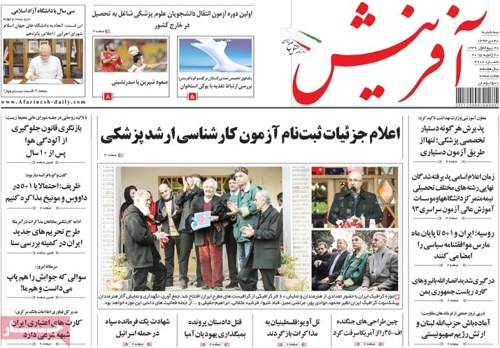
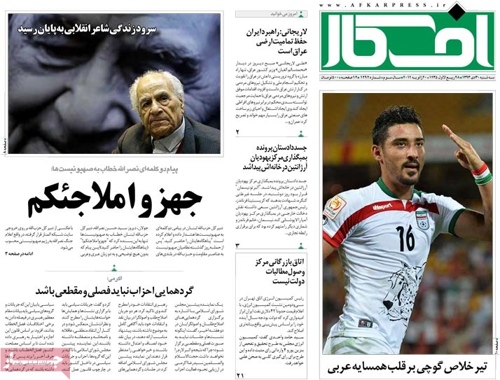
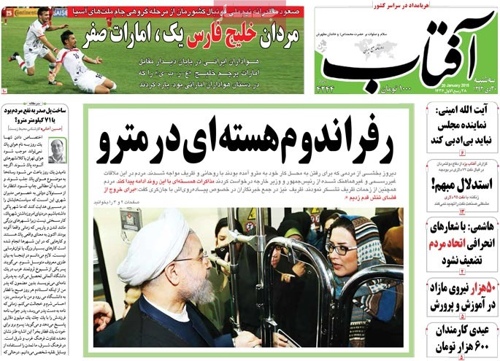
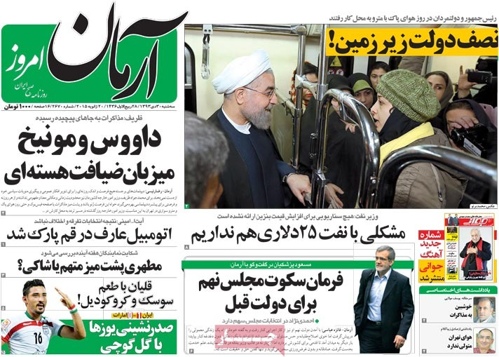
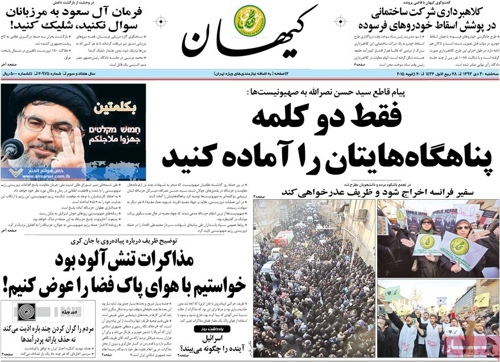
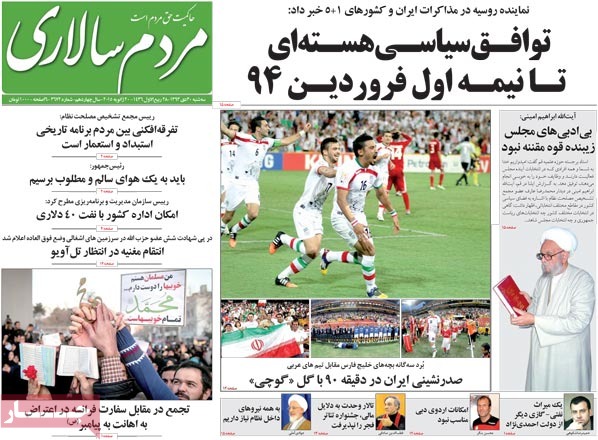
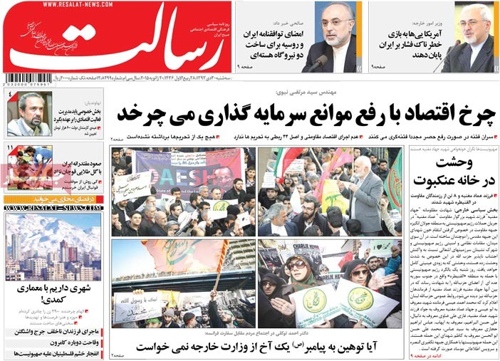
A look at Iranian newspaper front pages on Jan. 4

Iranian Newspapers Headlines

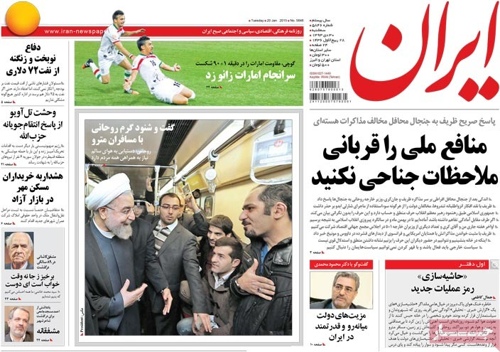
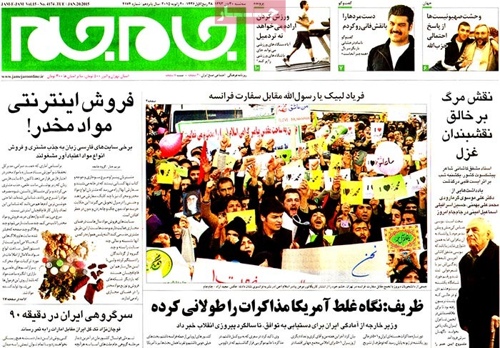
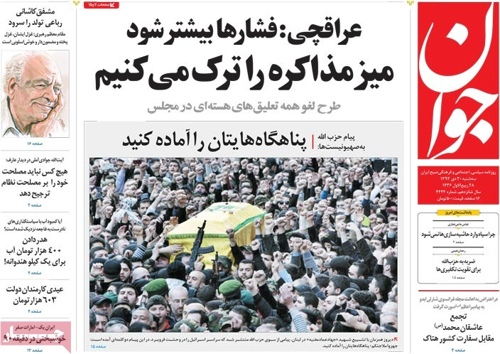
The rejection by the Iranian Foreign Ministry of an Associated Press report that Iran and the United States have already clinched a nuclear deal dominated the front pages of several newspapers on Sunday. News that the Guardian Council has found a parliamentary act on promotion of virtue unconstitutional also appeared on many front pages.


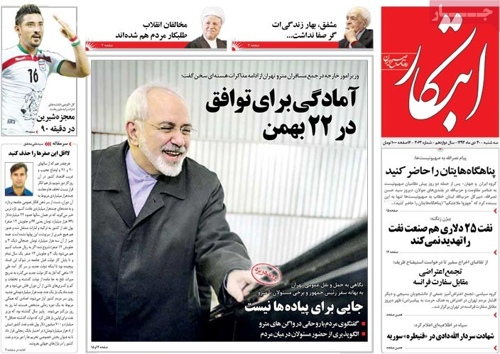
Abrar-e Eghtesadi: The Pakistani oil minister has said Islamabad badly needs Iran’s natural gas.


A look at Iranian newspaper front pages on Jan. 4


Afarinesh: “Iran will soon celebrate its victory in nuclear talks,” said the director of the Atomic Energy Organization of Iran.

Afarinesh: The Iranian Foreign Ministry has rejected an AP report that Tehran and Washington have already clinched a nuclear deal.


A look at Iranian newspaper front pages on Jan. 4


Aftab-e Yazd: “A plot by IS to highjack an Iranian plane has been foiled,” said a commander of the Islamic Revolution Guard Corps.

Aftab-e Yazd: The Guardian Council has found parliament’s Support for Promoters of Virtue Act unconstitutional.

Aftab-e Yazd: “The previous government dealt a blow of historic proportions to the nation,” said Isa Kalantari, a former minister of agriculture.


A look at Iranian newspaper front pages on Jan. 4


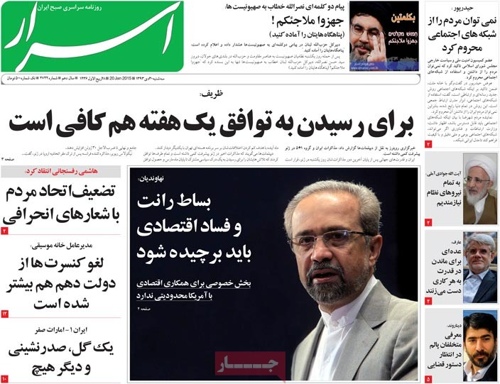
Asrar: “The Central Bank won’t allow a repeat of fluctuations in the value of foreign currencies,” said the governor of the Central Bank of Iran.

Asrar: “We will prove in the upcoming parliamentary elections that reformists speak with one voice,” said Mohammad Reza Aref, a former vice president under Mohammad Khatami.

Asrar: Farimah Farjami [a once-famous Iranian actress] has decided to return to the big screen after being on the sidelines for 11 years.


A look at Iranian newspaper front pages on Jan. 4


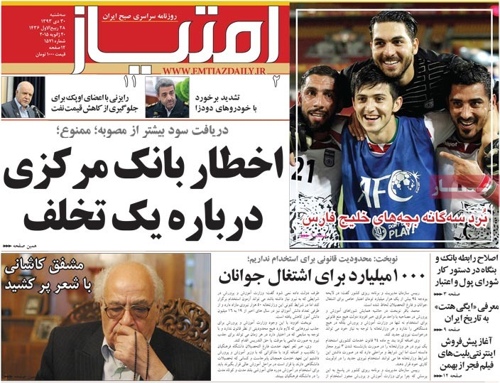
Emtiaz: Each year as many as 600,000 people are sent to prisons across the country.


A look at Iranian newspaper front pages on Jan. 4


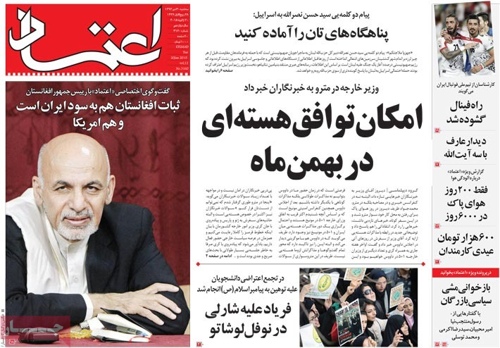
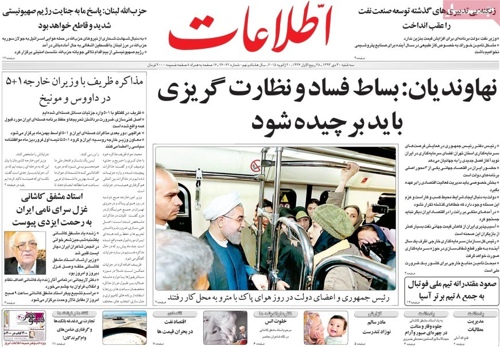
Etemad: There are speculations that Saeed Jalili might want to run for parliament in Qom constituency.


A look at Iranian newspaper front pages on Jan. 4


Ettela’at: According to a decision by the Expediency Council, candidates need an absolute majority in the first round and a simple majority in the second to win seats in the Islamic Consultative Assembly.

Ettela’at: A plot to assassinate a nuclear scientist has been foiled.


A look at Iranian newspaper front pages on Jan. 4


Hambastegi: “National occasions should not be used to attack a certain political group,” said Mohammad Reza Aref, a member of the Expediency Council.


A look at Iranian newspaper front pages on Jan. 4


Hamshahri: Tehran’s air is pollution-free for the first time in two weeks.


A look at Iranian newspaper front pages on Jan. 4


Hemayat: A member of Tehran City Council said the damage the capital suffered during the sedition of 2009 [unrest in the wake of the presidential election] amounted to $100 billion.

Hemayat: The spokesman of the Guardian Council has said those who played a role in the sedition of 2009 cannot run for elected office.


A look at Iranian newspaper front pages on Jan. 4


Jahan-e Sanat: Migratory birds are being massacred by poachers in Mazandaran Province.


A look at Iranian newspaper front pages on Jan. 4


Jomhouri Islami: Iran is among the top six builders of power plants in the world.

Jomhouri Islami: Tehran is to play host to an Islamic gathering to investigate the root causes of extremism.


A look at Iranian newspaper front pages on Jan. 4


Kaenat: The Central Bank is to punish banks that do not comply with banking regulations. A number of managers have been sacked.


A look at Iranian newspaper front pages on Jan. 4


Kayhan: Scientific production dropped in Iran dramatically in 2014.

Kayhan: Senior Iraqi Shiite cleric Ayatollah Sistani has called for the immediate punishment of those behind the assassination of Sunni scholars in the country.


A look at Iranian newspaper front pages on Jan. 4


Mardom-e Emrooz: “The reservoirs of dams across Iran are only 41 percent full,” said the energy minister.

Mardom-e Emrooz: “In the 2009 [presidential] elections some members of the Guardian Council went beyond being simply an objective judge,” said Mohsen Esmaili, a jurist with a seat on the oversight council.


A look at Iranian newspaper front pages on Jan. 4


Resalat: “The Interior Ministry won’t issue permits for establishment of a party if the Intelligence Ministry does not approve of the credentials of its members,” said the interior minister.


A look at Iranian newspaper front pages on Jan. 4


Araghchi stresses US failure in spoiling world’s post-Geneva opportunities for mending ties with Iran

Araghchi

Iranian Deputy Foreign Minister and senior negotiator Seyyed Abbas Araghchi underlined that the US has failed to prevent the world states from taking the opportunities which arose after the endorsement of the Geneva interim deal for expanding ties and cooperation with Iran.

“[After the Geneva agreement] all countries were deeply interested to have relations with Iran and this was so scary for the Americans that they declared to the entire world that the sanctions are still in place and only a part of the restrictions against Iran have been suspended based on what was agreed in Geneva, but I believe that this [the US policy] has proved unsuccessful to a large degree,” Araghchi said on Saturday.

“Anyway, with this (Geneva) agreement, the world came to realize that Iran’s nuclear negotiations and the process to reach an agreement were coming to an end and the atmosphere and (propaganda) attacks launched by the Westerners in this case were falling apart,” he added.

In relevant remarks in December, Iranian President Hassan Rouhani announced that a large number of foreign companies are waiting for a comprehensive deal between Tehran and P5+1 (the five permanent UN Security Council members plus Germany) to rush for investment in the Iranian market.

“Hundreds of foreign companies have prepared themselves to enter Iran in the coming months,” President Rouhani said, addressing a large crowd of people in Golestan Province, in northern Iran.

The Iranian president reiterated that Iran would reach a final deal with the West over its nuclear program as the country was moving on the path of constructive interaction with the world.

“You should not have any doubt that P 5+1, the Western world, the Eastern world and the region are all in need of constructive interaction with Iran,” President Rouhani added.

Also on Friday, a senior energy official announced that a large number of European and Asian companies had voiced their willingness to invest in Iran’s gas projects.

“Many companies from France, Britain, Germany, South Korea, Japan, China and Russia have announced that they are enthusiastic to invest in Iran’s gas projects,” Head of Investment Committee of the National Iranian Gas Company (NIGC) Asghar Soheilipour said.

He noted that NIGC needed $30 billion to complete its projects, and said, “We are ready to cooperate with domestic and foreign investors in this regard.”

Mr. Obama, please elaborate!

Obama interview npr

The comments President Obama made in an interview with NPR in late December continue to draw reaction from the Iranian media. Earlier IFP translated the viewpoints of Mehdi Motaharnia, a university professor, on the American President’s remarks. On January 3, Resalat* daily published an analysis of the same comments, from a different angle though.

What is interesting is that at the end of the opinion piece, its author Hanif Ghafari says “Iranian Foreign Ministry officials had better ask Obama to elaborate on his understanding of Iran’s legitimate defense concerns. And that could be an example of constructive dialogue, even if it is brief and indirect!” What comes below is the translation of the piece:

The US President has recently made significant comments about the Islamic Republic of Iran and its regional power. In an interview National Public Radio aired at the end of 2014, President Obama said, “Iran suffered from a terrible war with Iraq. They have legitimate defense concerns, but those have to be separated out from the adventurism, the support of organizations like Hezbollah, the threats they’ve directed towards Israel.” There are six questions worth noting about the US president’s comments:

1. No doubt, his admission that Iran has legitimate defense concerns is the most important part of his comments in the interview. As the highest-ranking political official in the United States, Obama has described Iran’s concerns as legitimate and held up the eight-year war between Iran and Iraq as reason for such legitimacy. But the conclusion he draws is that Iran’s support for resistance group is unacceptable.

In other words, there is no proportionality between the opening and ending of his comments. Certainly, such incompatibility has nothing to do with a confused state of mind, nor does it stem from his inability to strike a simple balance – rather it is the result of Washington’s fear of Tel Aviv and the Zionist lobby.

On the other hand, such incompatibility is influenced by the White House’s macro-policy of shading the realities of the Middle East in line with American interests. The footprints of this macro-policy and the fear Tel Aviv has instilled are still seen in Washington’s foreign policy. But the fact that the highest-ranking American official admits that Iran has legitimate defense concerns is worth pondering.

As the highest-ranking political official in the United States, Obama has described Iran’s concerns as legitimate and held up the eight-year war between Iran and Iraq as reason for such legitimacy. But the conclusion he draws is that Iran’s support for resistance group is unacceptable.

2. According to public international law, when a country admits something, their admission bears consequences. The president of the United States has openly admitted to Iran’s “legitimate defense concerns”. He has even taken one step further by mentioning the war Iraq imposed on Iran. By the way, how can one assess the ramifications of such admission and follow the case legally?

What is interesting is that Obama has been as conservative as he could have been in his recent comments and has linked the legitimate concerns in question to the past, that is to say, the Sacred Defense era [the Iran-Iraq war in the ‘80s]. He has failed to make any mention of American, and most recently British, bases in the Persian Gulf.

Also missing from his comments are establishment of American bases in countries to the north of Iran, Incerlic Air Base in Turkey, presence of US forces in Afghanistan, the threats posed by the Taliban and Alqaeda in Pakistan, as well as IS and other Takfiri groups, which are a product of the West, in Iraq and elsewhere.

3. The constant threats posed by the West, […] and thousands of other factors require us to build on our religious instructions and realities on the ground to shore up our defenses in the face of threats.

Based on religious instructions, the Islamic Republic of Iran will never conduct the first strike, nor will it ever take action in favor of war in the region or around the world. In fact, any Iranian military action will be defensive in nature. In nuclear talks we have reiterated again and again that under a religious edict issued by the Supreme Leader, the Islamic Republic views development and delivery of atomic weapons forbidden.

Based on religious instructions, the Islamic Republic of Iran will never conduct the first strike, nor will it ever take action in favor of war in the region or around the world. In fact, any Iranian military action will be defensive in nature.

4. Former Zionist Premier Ehud Olmert has admitted that there are scores of nuclear weapons in the Israeli arsenal. That means the occupying regime of Israel is at the center of Iran’s legitimate defense concerns. Under such circumstances, Iran’s support for Islamic resistance groups in Lebanon and Palestine and our efforts to shore up resistance are both religiously and realistically justifiable.

If international theorists took a realistic and unbiased look at the Middle East and the record of the Zionist regime, they would understand that Iran’s defense concerns are legitimate and our concentration on defensive weapons and long-range missiles are part of efforts to promote our deterrence in the face of a serious threat.

5. The fact of the matter is that White House officials are not in a legal position to label Iran’s defense measures as legitimate or otherwise. Neither do they have the authority to set limits for Iran. Legally speaking, the US is not even entitled to recognize such legitimacy.

The decisions our country makes about its defense capabilities are on the one hand based on religious instructions and, on the other, on regional equations. Besides, Obama should not forget the fact that his respective country is not only not in a position to pass judgment on the legitimacy of Iran’s defense measures, but the US itself is an integral part of Iran’s legitimate defense concerns.

America’s constant support for the Zionist regime, its military presence in neighboring countries and Washington’s creation of regional crises like the emergence of IS and other Takfiri groups cannot be denied by Obama.

As for the Iraq war which has been mentioned by Obama, the US, as the main Western supporter of Saddam’s Iraq, should be held accountable for the blood of tens of thousands of Iranian combatants spilled during the war. He should not forget the fact that his country does not call the game of crisis, it is part of the game.

The fact of the matter is that White House officials are not in a legal position to label Iran’s defense measures as legitimate or otherwise. Neither do they have the authority to set limits for Iran.

6. So it seems that Obama needs to elaborate on what he has said. If he understands the legitimate defense concerns of the Islamic Republic, why the question of Iran’s missile capability has been brought up in nuclear talks? In two crucial rounds of talks, that is to say Vienna 6 and Vienna 8, American negotiators used the same issue to prevent the conclusion of a final deal.

In Vienna 4, they used the same issue to block the drafting of a deal. Besides why is it that Obama, who appreciates Iran’s legitimate defense concerns in light of regional threats, rushes to the defense of the despised, infanticidal Zionist regime whenever the question of Iran’s support for Hamas and Hezbollah which is designed to help prevent the continuation of genocide and barbarism pops up.

Iranian Foreign Ministry officials had better ask Obama to elaborate on his understanding of Iran’s “legitimate defense concerns” and that could be an example of constructive dialogue, even if it is brief and indirect!


* Resalat is a principlist daily which first appeared on newsstands more than three decades ago. It was backed by bazaar merchants who supported the movement led by the late founder of the Islamic Republic. The daily now represents the viewpoints of conservatives who play a prominent role in the country’s political equations.

Qom is cultural hub of Islamic world

Qom-Books

The holy city of Qom is a major hub for the publication of religiously-themed books, Iran’s Book News Agency (IBNA) on January 1 quoted a deputy minister of culture and Islamic guidance as saying.

What comes below is a partial translation of Abbas Salehi’s remarks at the opening of a fourth specialized exhibition of religious books in Qom on Wednesday. It is followed by a critical analysis offered by an expert of religious books:

“Qom accounts for around 12 percent of the books released in Iran. As many as 5,601 books have been published in Qom this year, of which 3,180 were on their first print. […]

“About 183,000 religiously-themed book titles have been released in Iran after the Islamic Revolution (1979-2013), with 20,000 being on their second reprint. The remaining has yet to go to reprint.

“The existing stats on religious books should be revised. We need to counter the appropriation of books which is a common occurrence in the area of religious books. [The publication of pre-existing books in one’s own name] is a cultural ploy which causes multiple ills. We need to legally and religiously counter this practice which has tarnished the image of the book industry.

[…]

“Cultural diplomacy can be better exercised in the presence of foreign publishers and this is one of the objectives the government is pursuing.”


Mohammad Taghi Sobhani, a religious expert:

“Since books are traded as a commodity we can look at the publishing industry through an economic prism.

“Books are a medium through which an author signals his/her message to the readers. A medium which holds no appeal is meaningless.

“Books are also a cultural phenomenon and part of a nation’s cultural identity. They can build civilizations and reflect a nation’s human, social and religious identity.

“Some books are religious at the outside but they are anti-religious in the inside. Others are apparently non-religious, but they inspire a sense of consciousness and self-awareness in the audience. A religious book, in fact, raises the readers’ religious consciousness and makes them contemplate.”

Massive manhunt by police leads to the capture of one robber; accomplice is dead

General Hossein Ashtari

Almost a week after a deadly armed robbery in central Iran which sounded more like a Hollywood story, police captured one of the robbers.

In a press conference in Isfahan on Friday, Deputy Police Chief Brigadier General Hossein Ashtari elaborated on the manhunt which resulted in the arrest of one of the robbers. The following is a partial translation of what Mehr News Agency reported on January 3 on the comments of Ashtari about the deadly rampage:

Last Saturday, police officers ordered a vehicle whose occupants were acting suspiciously to pull over. When the driver of the car ignored the order police gave chase during which three police officers were injured.

Afterward, an operation was launched in the provinces of Isfahan and Markazi to stop and search all suspicious vehicles. During one such stop, when a police officer asked the driver of a car to hand in license and registration, the robbers opened fire and shot him dead before fleeing the scene.

In the ensuing chase, another police officer was martyred. Since the shootout in public places could have put people’s lives in danger, police were overly cautious. In the gun-battle a father and his son as well as an assailant were killed.

The corpse of the dead robber produced some clues which helped police find the hideout of the other two robbers in Fuladshahr, a city in Isfahan Province.

When officers stormed the hiding place of the two suspects, one robber was apprehended alive and the other was killed after he put up resistance. Three grenades, four Kalashnikovs and a thousand rounds of ammunition were also seized from their hideout.

During the interrogation, the robber in custody confessed to committing ten murders in the last nine years. He also confessed to having broken into gold shops, along with the two dead robbers, in different cities and making off with some 50 kg of gold.

Those who aided and abetted the robbers have also been apprehended and are being interrogated.

The three robbers behind the deadly robbery were between 37 and 40 years of age.

An interview with Shahram Nazeri about Mawlana and Iranian society

Shahram Nazeri-1

MowlanaShahram Nazeri is widely known to be the greatest vocalist who has set Rumi’s poetry to [Persian] music. Each year, fans of well-known poet Mawlana Jalaleddin Rumi invite Nazeri to Konya, Turkey to sing at a ceremony which marks the birth anniversary of Rumi.

Throughout his singing career, Nazeri has always taken account of the conditions of society in his artwork. His historical look at music as a key part of Iranian culture has been indicative of his efforts to trace the roots of art in different historical periods.

That is why some view Nazeri as a pioneer of modern classical music in Iran. Nazeri has been among first vocalists to stage benefit concerts for people suffering from leprosy and a group of young girls who suffered severe burns after their classroom caught fire in Shinabad, West Azerbaijan Province.

He thinks of artists as a segment of society that speaks on behalf of the public and says he believes he and his fellow artists should make the most of the trust people have placed in them.

The 6th of Rabi’ al-Awwal – the third month in the Islamic calendar – marks the birth anniversary of Rumi. To commemorate the occasion which fell on December 29 this year, Shahrvand, a daily, interviewed Shahram Nazeri, among other things about, the thought-provoking aspects of social art. What comes next is a partial translation of the interview which appeared in the daily on December 30:

Today marks the birth anniversary of Rumi. As the first and perhaps the only Iranian vocalist who has set Rumi’s poetry to music, why do you think the world attaches so much significance to this Persian poet?

To learn about Rumi, one needs to explore his worldview which is so broad and comprehensive that his masterpiece Masnavi has become as a major reference in modern psychology in the US. I lay emphasis on the word “modern” to indicate the importance of the matter. It’s no mean feat!

Rumi is like an ocean only a drop of which can be explored. You know what that means? Centuries ago, a man from the Orient talked about issues that are today a reference for modern psychology. I have not sought to promote mysticism or mystical music by singing Rumi’s poems, rather I have wanted to present the approach of the mystical literature which covers the struggles and movements pioneered by Iranian ethnic groups for thousands of years.

What attracted you to Rumi and his thoughts?

Since I was a teenager, I have been infatuated with Rumi and profoundly impressed by him. I am so mesmerized by him that at the mention of his name, I get excited. I remember that I spent the whole night outside my uncle’s residence in Kermanshah talking until dawn about him with two likeminded poets who were friends of mine.

However, today, things have changed. The fast pace at which so-called artworks are cranked out does not leave any room for such infatuation and enthusiasm, nor does it give you an opportunity to devote attention to psychological and sociological aspects of great figures like Rumi.

Such enthusiasm has disappeared, and lots of things are fake. We live in an era that with a click of a mouse works which are in effect detrimental to arts are created in the name of art and fed to the public. A look back at architectural works in Iran and the rest of the world would be enough to help us realize what is going on. The masterpieces of the past have ceased to exist today.

The reason why we have ended up in this mess is that the atmosphere for creation is non-existent. Take a look back at the list of distinguished Iranian and world authors of the past. Today, they are sorely missed. They all emerged at a certain period and disappeared together. How many giants could possibly emerge in the world of art in a century? Today the stage has been set for the presence of dwarves whose number is actually very big. There used to be a hundred big authors in the world, but now we have three million dwarves who run the show.

Let me bring up the measures that you have taken to help patients suffering from leprosy and victims of the tragedy that happened in Shinabad. Do you believe that an artist is a representative of his society?

I believe that arts and artists represent their society. So I and people like me should make the most of the trust that people have placed in us. As for the concerts you pointed out, I must say that in fact society and those in authority do not pay much attention to those suffering from leprosy.

In such conditions, the presence of an artist on the scene could spur others into action. An opportunity to eradicate this disease has presented itself and we should make the most of it.

As far as I know about 60 years ago, French philanthropist and writer, Raoul Follereau, named the last Sunday of January as World Leprosy Day. Back then, there were 15 million people suffering from this disease.

Thanks to the intense battle fought against the disease over the years, the number of people suffering from leprosy across the world has plunged to two million. It’s a great pity that the number of those affected by this disease has increased in Iran.

In such conditions, as an artist of this land, I just want to speak on behalf of those suffering from this disease and say that they live among us. What else could be done rests with healthcare authorities. I just want to remind them as well as the public of what is going on. That’s all.

Iranian translator Roshan Vaziri has died at 81

Roshan Vaziri

Roshan Vaziri, an Iranian translator of Polish literary works, has died at 81. She lost her battle against a brain tumor several days ago.

Her daughter who lives in the US broke the news Monday night in emails to her friends and relatives, saying her mom had passed away at a US hospital without mentioning the exact time of Vaziri’s death.

Some media sources have reported that Leshek Wozniak, her husband of Polish origin, will make a trip to Tehran in coming days to hold a commemorative ceremony for his deceased wife.

Roshan Vaziri studied medicine in the University of Warsaw many years ago. She married a Polish man there and developed a liking for Poland and its people. Vaziri translated several Polish books into Farsi, including The Heavenly Lady, a collection of short stories by Polish writers.

On August 2, 2014, Iran Front Page (IFP) released the translation of an interview Andisheh Pouya (Dynamic Thought) magazine had conducted with the late Vaziri, in which the culture and lifestyle of the Poles and their long-rooted ties with the Iranians had been brought up.

IFP staff offer their heartfelt condolences to her family and all literature lovers, hoping the loss of Vaziri – who built bridges between the two cultures – will not interfere with interaction between the two nations.

She will be sorely missed.

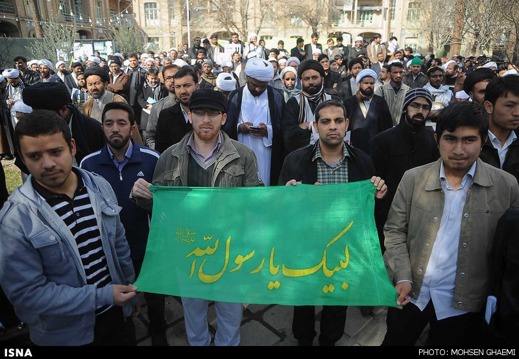
Celebrating Prophet Muhammad’s birthday is superstition and heresy

Top Saudi Mufti

In a surprise fatwa (religious edict), Saudi Arabia’s top Islamic scholar has urged Muslims to stop staging ceremonies to mark the birthday of the Prophet Mohammed (Peace Be upon Him), saying such celebrations amount to heresy.

Sheikh Abdul Aziz bin Abdullah Al Shaikh, the Persian Gulf kingdom’s Grand Mufti and head of the seven-man Islamic Scholars Authority, said Muslims had acquired the habit of organizing ceremonies on the eve of the birthday of the Prophet Mohammed (Peace Be Upon Him) over the past three centuries and that it had spread to most Arab and Islamic nations.

This habit is a heresy and superstition, which must stop,” the Mufti said in a sermon during Friday’s open air prayers in the Saudi capital Riyadh, according to the official Saudi press agency (SPA).