Sunday, December 21, 2025
Home Blog Page 4745

Iran held talks with P5+1 for removal of sanctions: Ayatollah Khamenei

Leader

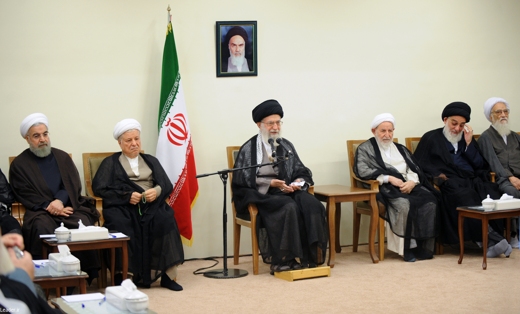
“If the framework of the sanctions is to remain in place [then] what did we negotiate for? This is completely against the reason why the Islamic Republic of Iran partook in negotiations, since the goal of the talks was the removal of the sanctions,” Ayatollah Khamenei said in a meeting with members of Iran’s Assembly of Experts on Thursday.

On July 14, Iran and the P5+1 countries – the United States, Britain, France, China, Russia and Germany – finalized the text of a nuclear agreement dubbed the Joint Comprehensive Plan of Action (JCPOA) in the Austrian capital Vienna.

Under the JCPOA, limits will be put on Iran’s nuclear activities in exchange for, among other things, the removal of all economic and financial bans against the Islamic Republic.

The Leader said the potential removal of the sanctions was the main reason Tehran gave some concessions at the talks, “Otherwise, there would be no need for us to take part in the negotiations. We could continue our work and could increase the number of our centrifuges to 50,000 to 60,000 from the current 19,000 in a short while and continue 20-percent [uranium] enrichment, and speed up research and development.”

“Should the sanctions remain in place, then there would be no deal either. So this issue must be resolved,” Ayatollah Khamenei said and also rejected the idea that the bans be “suspended” instead of being “lifted.”

The Leader further insisted that Iran’s Majlis (parliament) be involved in the examination of the JCPOA.

“I have no recommendation for the Majlis regarding the manner of the review or whether they should ratify or reject it. It is the representatives of the nation who should decide,” said Ayatollah Khamenei.

The Leader also referred to the comments made by American officials, which were irrelevant to the issue of nuclear agreement.

“They (American officials) say the JCPOA has offered some opportunities to the United States both inside Iran and outside the country and in the region,” Ayatollah Khamenei said.

“One of the US policies in the region is to annihilate and fully destroy the forces of resistance and fully dominate Syria and Iraq and they expect that the Islamic Republic enter this framework. Such a thing would never transpire,” the Leader said, ruling out any negotiation with the US unless on the nuclear issue.

“One should not be duped by the enemy as a result of its smile or probable short-term assistance in a certain issue. We should always find out what the enemy’s plotting and scheme are,” the Leader said.

Director of The Godfather praises Muhammad, the Messenger of God

Muhammad Movie
Francis Ford Coppola

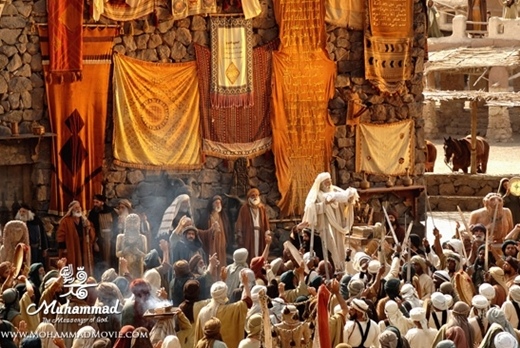
The private screening of Muhammad, the Messenger of God, a film by Iranian director Majid Majidi, at the American Film Institute has drawn a warm welcome from a group of 135 big names in the cinema industry in Los Angeles.

Fars News Agency on September 2 released this report quoting the website of the Iranian movie on the life of the Prophet Muhammad (Peace Be Upon Him) and said that Vittorio Storaro, an Italian who was in charge of Muhammad‘s cinematography, screened the Iranian movie for his American counterparts who widely welcomed it. The following is the translation of the report:

Muhammad, the Messenger of God premiered at the opening ceremony of the Montreal World Film Festival (MWFF) in late August and then it was screened in the movie theaters across Iran and other countries – where it was given an enthusiastic welcome. The latest screening of the movie was in the US where the American movie-goers stood in long lines to watch the Iranian movie.

A group of 135 well-known figures in the film industry were present for the private screening of Muhammad, the Messenger of God at the American Film Institute in Los Angeles.

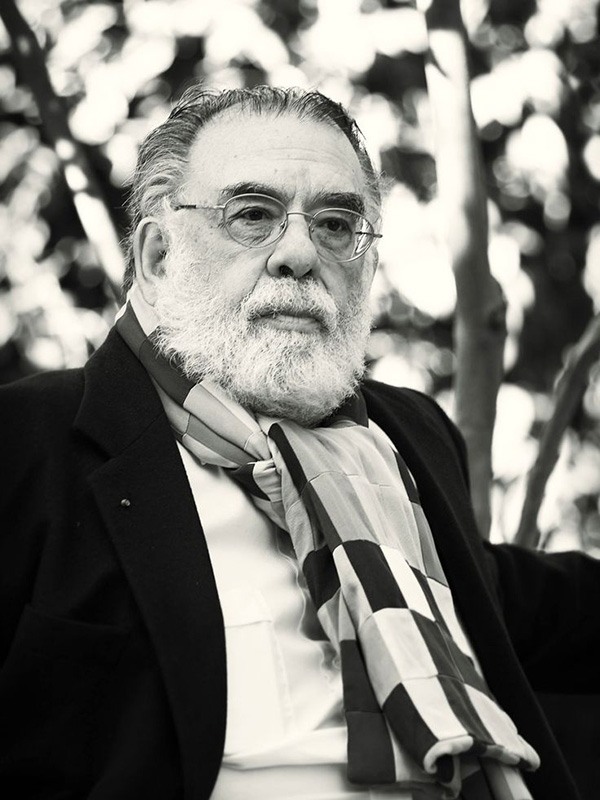
According to Storaro, a big number of people could not watch the film. Francis Ford Coppola – an American filmmaker who has directed The Godfather – was among the audience of the private screening and highly praised the movie.

Those who watched Muhammad expressed their interest in the film, with many saying that Muhammad has a big capacity to establish interfaith peace [in the world].

On Tuesday the Montreal World Film Festival dedicated two extra screening times for Muhammad, the Messenger of God. Nonetheless, many fans failed to watch the movie and asked those in charge to allocate extra show time.

[Muhammad, the Messenger of God is the first part of Iran’s big-budget trilogy on the life of the Prophet Muhammad (PBUH). A number of internationally-acclaimed professionals, including Academy Award winning visual effects supervisor and filmmaker Scott E. Anderson, three-time Oscar-winning Italian director of photography Vittorio Storaro and renowned Croat production designer Milijen Kreka Kljakovic collaborated in making the film.]

Iran’s shared oil, gas fields need $50 billion

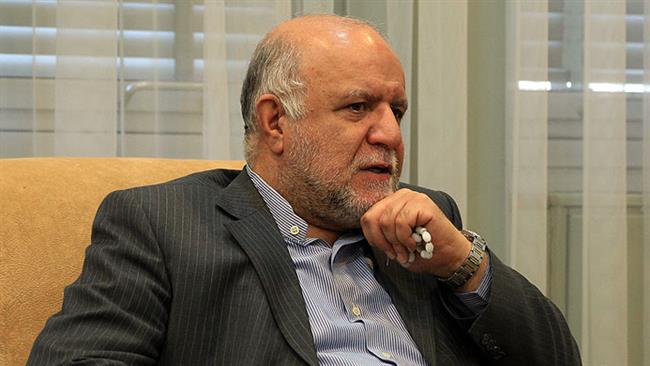
Zangeneh

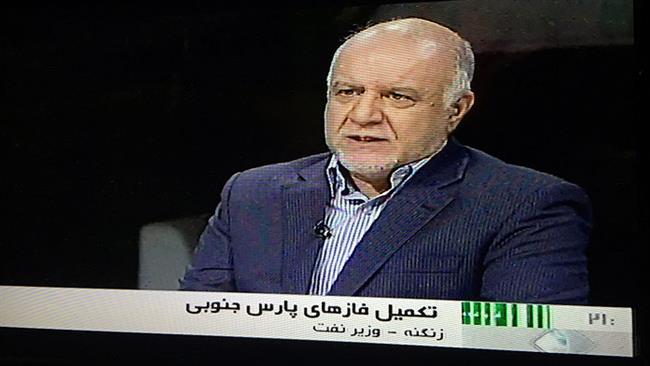
For production from shared fields, Iran lags behind its neighbors, which is a matter of concern for Zangeneh and other state officials, he told a live televised program, adding beefing up output from those reservoirs is a top priority.

At present, Iran produces 110,000 bpd from those fields in the southwest which is expected to rise to 260,000 bpd next year, Zangeneh said.

More than $20 billion is needed to boost recovery to 700,000 bpd, which would mark Iran’s fastest production growth at those fields, he added.

South Azadegan, Iran’s largest oilfield shared with Iraq, is the highest priority reservoir. Iraq started producing 210,000 barrels per day from the field in April 2014 and is targeting a production plateau of 1.8 million bpd.

Iran’s production from the field stands at 50,000 bpd, according to officials. Zangeneh said 17 rigs are currently spudding South Azadegan but this count has to be raised further.

In the gas sector, Iran needs $30 billion of investment in its giant South Pars field which the country shares with Qatar, Zangeneh said.

By the next two years, 25 phases of the field are expected to become operational, raising Iran’s production capacity to one billion cubic meters per day, he added.

Zangeneh said each phase adds 25 million cubic meters of gas to the national grid per day. Ten phases are already operational, with two more expected to come on stream and a third possibly to join the network this year.

The minister said projects will accelerate after the removal of sanctions which were mainly aimed at “bringing Iran’s petroleum industry to its knees”.

“The personnel of the petroleum industry, with their exemplary resistance, neutralized  those objectives,” he said.

Zangeneh said for Iran and other OPEC members, the oil price in the range of $70-80 is “acceptable”. He said members have to cut production in order boost prices from under $50 per barrel now.

“We are currently negotiating with OPEC members. But fortunately or unfortunately, each OPEC decision has to be approved by consensus and the implementation of the decisions is voluntary.”

Major defense drills underway in Iranian capital

Basij Drills

Several commanders of the Islamic Revolution Guards Corps (IRGC) as well as government officials are observing the exercises.

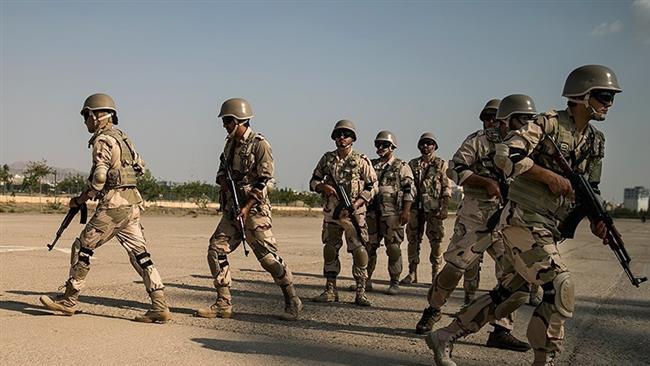
The drills, code-named Tharallah, started at around 8:30 a.m. local time (0400 GMT) on Thursday at Velayat Park – formerly a large military garrison – in Tehran, and as many as 50,000 members of the Basiji volunteer force from 250 battalions have participated in them.

Thousands of Basiji members marched at the site, followed by ten gyroplanes, twenty paramotors and a motorized flying kite performing aerobatic demonstrations.

A Mil Mi-17 helicopter also conducted a number of airborne operations, namely parachuting, airdropping, rappelling as well as surveillance.

The Tharallah exercises, which are meant to enhance Iran’s deterrence power and improve its defense and security preparedness, will wrap up later on Thursday.

Iran has over the recent years conducted numerous military drills to enhance the defense capabilities of its armed forces and test modern military tactics and equipment.

The Islamic Republic has repeatedly underscored that its military might poses no threat to other countries, reiterating that its defense doctrine is based on deterrence.

On Tuesday, Iran unveiled two domestically-manufactured and state-of-the-art radar systems capable of detecting stealth targets at high altitudes.

The radar systems, dubbed Nazir and Bina, were unveiled on in a ceremony attended by Commander of Iran’s Khatam al-Anbiya Air Defense Base Brigadier General Farzad Esmaili.

Nazir is a long-range radar system that can detect and track hostile aerial targets within a radius of 800 kilometers at an estimated altitude of 100,000 feet, while Bina uses three-dimensional (3-D) technology to detect radar-evading targets. It can also be used to deter electronic warfare.

The two radar systems have been deployed in mountainous and plain areas in the southeastern parts of Iran.


A look at Iranian newspaper front pages on September 3

Iranian Newspapers Headlines

News related to the recently-concluded 18th meeting of the Assembly of Experts and comments by the parliament speaker in an interview with CNN dominated the front pages of Iranian newspapers on Thursday. The support of a 34th US senator for the Iranian nuclear deal also appeared on the cover of dailies.


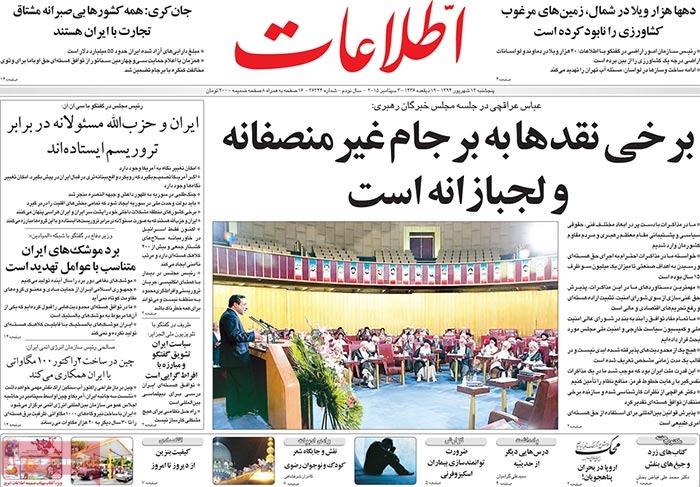
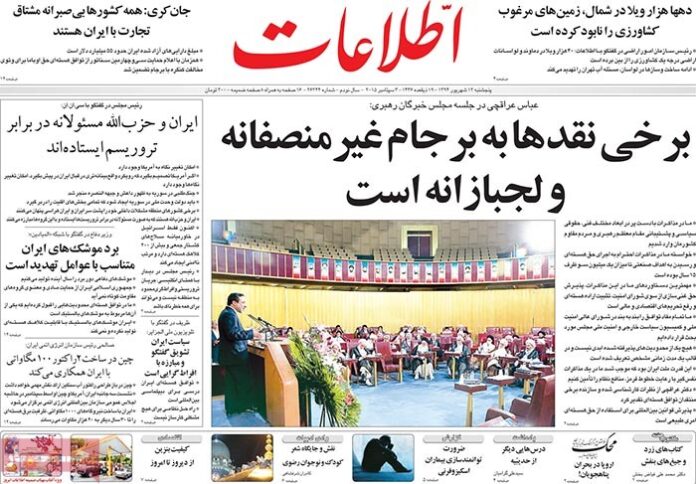
Ettela’at: “Some critical remarks about the Joint Comprehensive Plan of Action (JCPOA) are unfair and out of obstinacy,” Deputy Foreign Minister Abbas Araghchi said.

Speaking at a meeting of the Assembly of Experts, the diplomat who is also a member of Iran’s nuclear negotiating team said that every clause of JCPOA has been carefully reviewed at the Supreme National Security Council and in parliament’s National Security and Foreign Policy Committee.


Abrar: A motion to increase the number of representatives at the Assembly of Experts has been rejected.

Abrar: “The cars of women who fail to observe the Islamic dress code behind the wheel will be impounded,” said Tehran traffic police chief.

Abrar: Don’t go too far Mr. minister! Not buying locally-manufactured cars is no treason.

[It comes after the minister of trade and industries slammed those who boycott local vehicles as “traitorous and anti-revolutionary”.]

Abrar: “Cooperation with foreign carmakers will help end monopoly,” said a member of parliament’s Mines and Industries Committee.
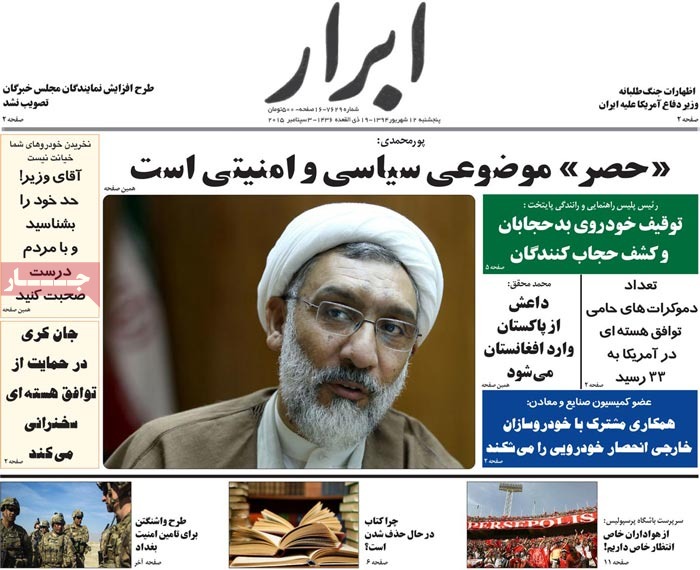
 

A look at Iranian newspaper front pages on September 3


Abrar-e Eghtesadi: Iran and Russia have opened talks to jointly manufacture airplanes.
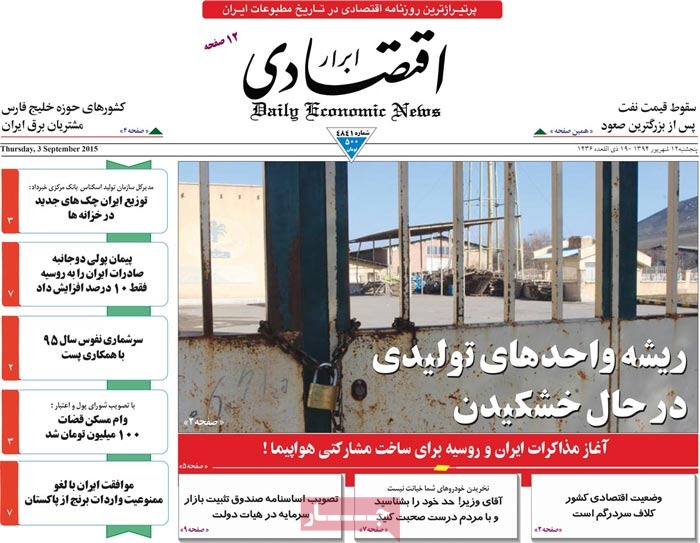
 

A look at Iranian newspaper front pages on September 3


Aftab-e Yazd: Renowned vocalist Mohammad Reza Shajarian, who had been hospitalized for a breathing condition, has been discharged from hospital.

Aftab-e Yazd: “The solution to the problem of house arrest [of two presidential candidates who doubted the results of the 2009 vote and thus sparked widespread unrest] lies in maintaining calm,” said the justice minister.
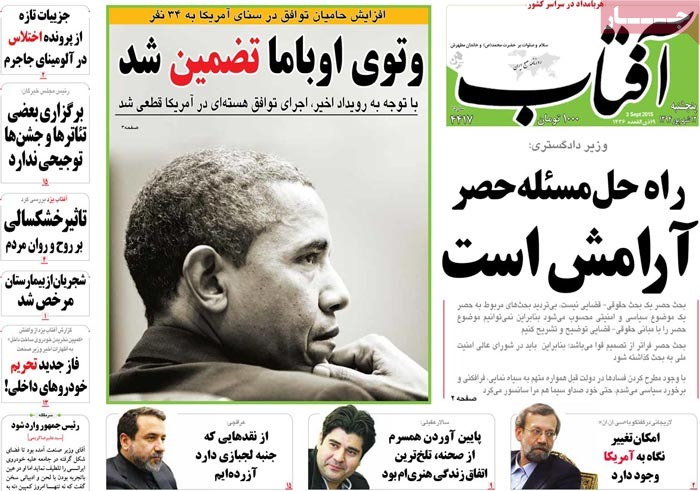
 

A look at Iranian newspaper front pages on September 3


Arman-e Emrooz: In an interview, the director of Imam Khomeini Relief Committee has talked about construction of a clinic and a park in Gaza [in the Palestinian territories].

Arman-e Emrooz: Iran’s first Sunni Muslim ambassador has been named.

Arman-e Emrooz: Implementation of the Joint Comprehensive Plan of Action is now a certainty after a 34th US senator threw his weight behind the Iran nuclear deal.
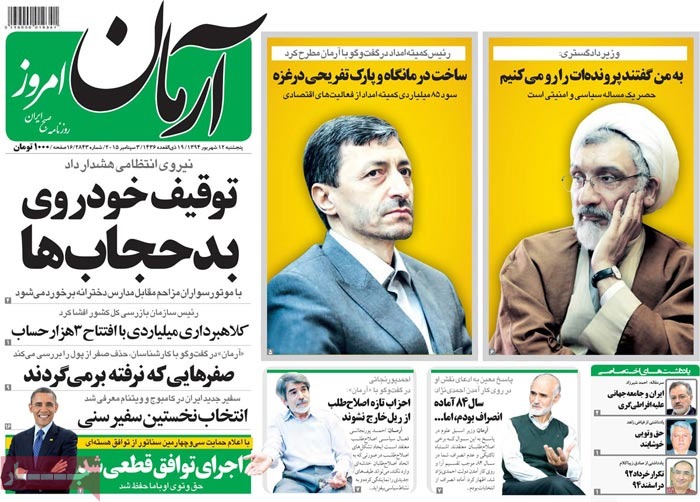
 

A look at Iranian newspaper front pages on September 3


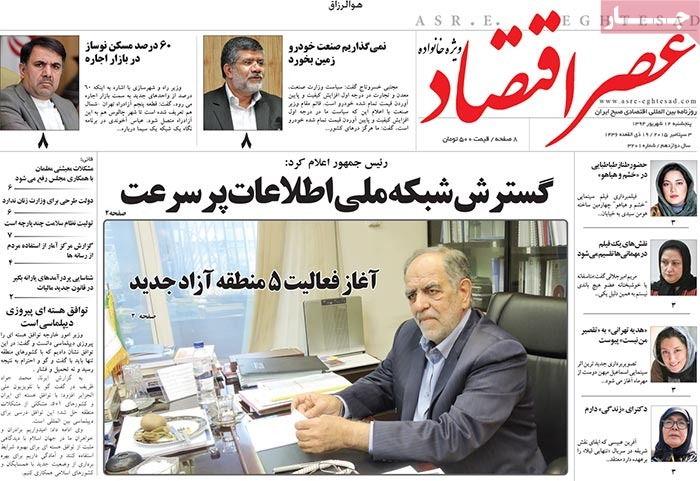
Asr-e Eghtesad: Five new free trade zones will be set up in Iran.
 

A look at Iranian newspaper front pages on September 3


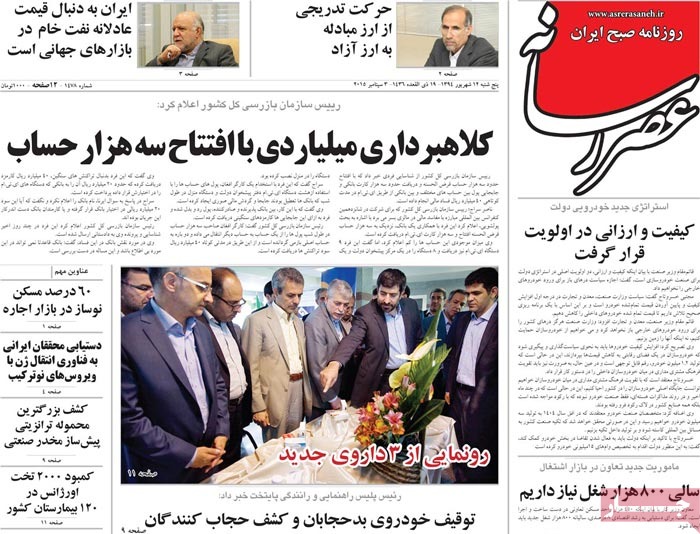
Asr-e Rasaneh: Seizure of the largest haul of drug precursors.
 

A look at Iranian newspaper front pages on September 3


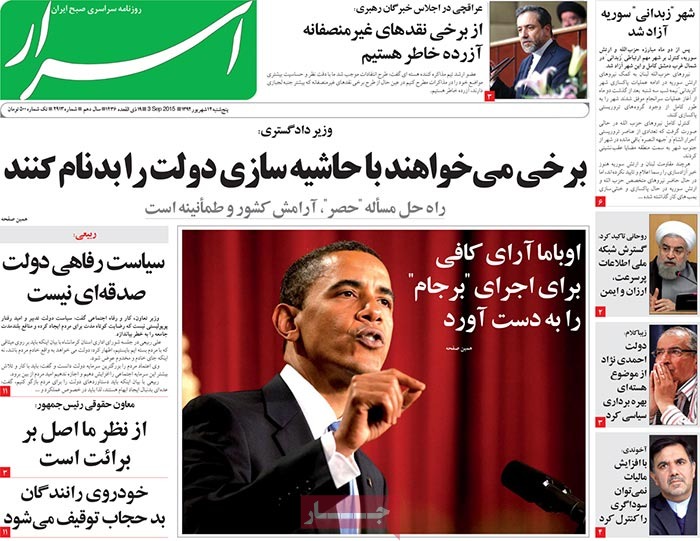
Asrar: The Syrian town of Al-Zabadanihas been freed.
 

A look at Iranian newspaper front pages on September 3


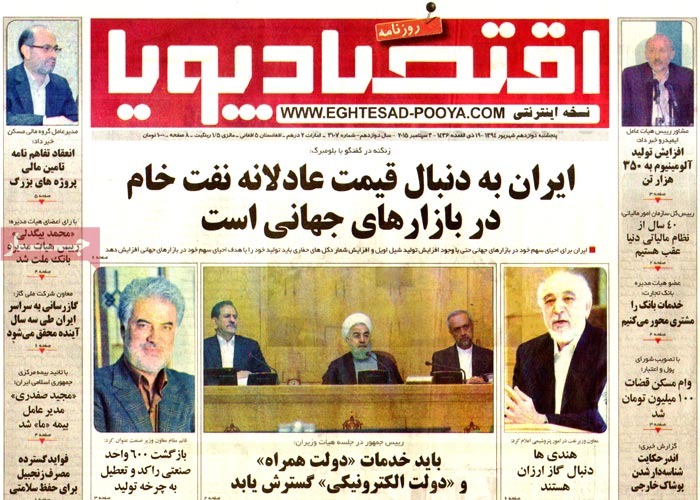
Eghtesad-e Pooya: “Some 600 industrial units which were either in hibernation or out of business have returned to the production cycle,” said the deputy industry minister.
 

A look at Iranian newspaper front pages on September 3


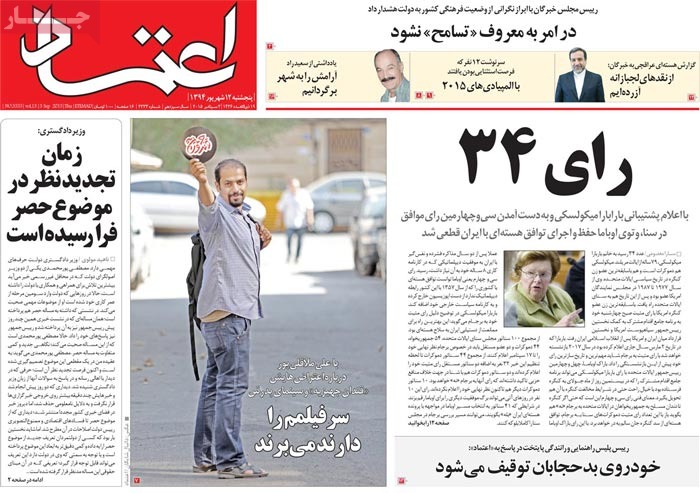
Etemad: The chairman of the Assembly of Experts has expressed concern about the country’s cultural condition, warning government not to relent when it comes to promotion of virtue.

Etemad: The 34th vote

With Maryland Senator Barbara Ann Mikulski throwing her weight behind the Iran nuclear deal, Obama can veto the likely rejection of the deal on Capitol Hill. That also guarantees the implementation of the Joint Comprehensive Plan of Action.
 

A look at Iranian newspaper front pages on September 3


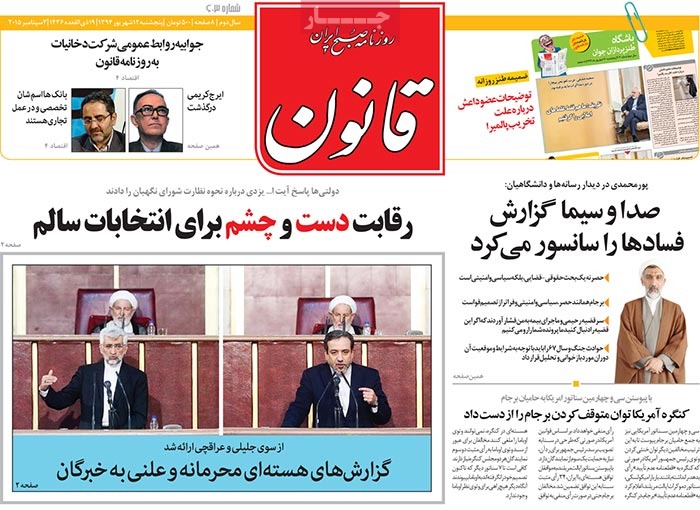
Ghanoon: Iranian director and film critic Iraj Karimi has passed away.
 

A look at Iranian newspaper front pages on September 3


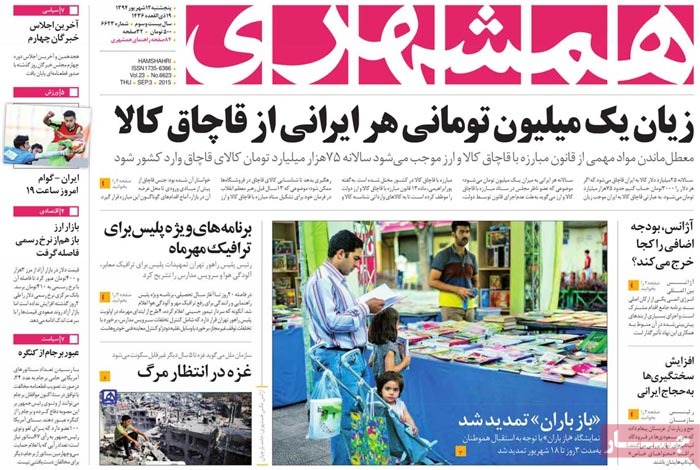
Hamshahri: Each Iranian suffers some $300 in losses as a result of smuggling in goods.

Hamshahri: Saudi authorities are implementing tough rules when it comes to Iranian Hajj pilgrims.
 

A look at Iranian newspaper front pages on September 3


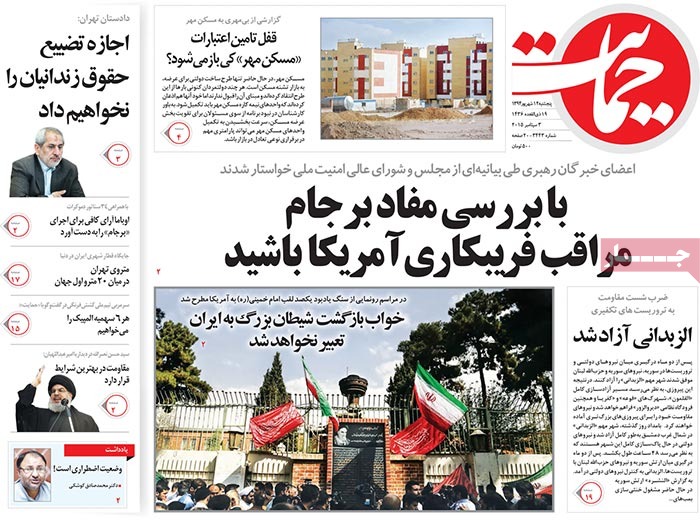
Hemayat: The dream of the Great Satan returning to Iran won’t come true.

The announcement was made as a stone plaque – bearing the 100 terms the late Imam used to refer to the US – was unveiled outside the former US embassy in Tehran.
 

A look at Iranian newspaper front pages on September 3


Iran: Parliaments rush to the aid of diplomacy

The parliament speaker, who is in New York, has held extensive talks with his European counterparts on the sidelines of an inter-parliamentary meeting.

Iran: The Congressional hurdle [standing in the way of the Iran nuclear deal] came crashing down.

Iran: A member of Iran’s nuclear negotiating team has said that obstinacy by some is bothering the negotiating team.
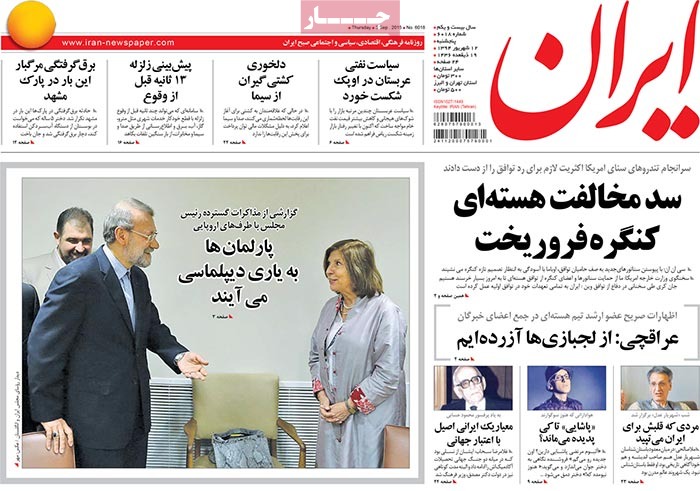
 

A look at Iranian newspaper front pages on September 3


Jamejam: A statement issued by the Assembly of Experts has urged the Supreme National Security Council to make sure provisions of the Constitution and the red lines of the establishment are respected in the Joint Comprehensive Plan of Action.

Jamejam: A taxi driver in Damghan has returned a handbag containing a lot of gold to its owner.
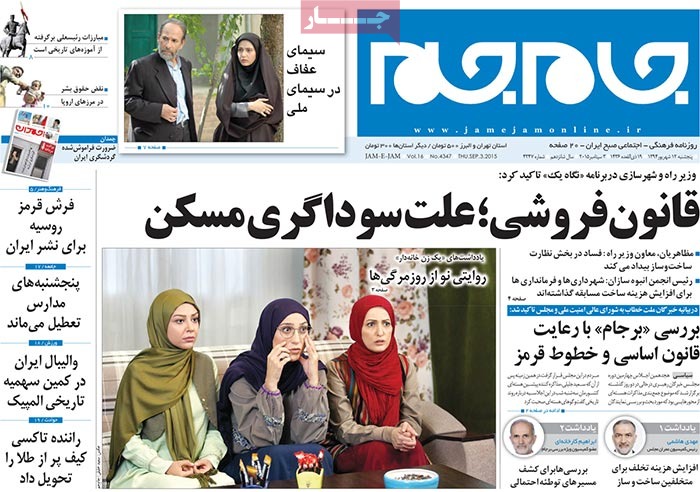
 

A look at Iranian newspaper front pages on September 3


Javan: The administration-Congress game is over.

Javan: A stone plaque bearing the 100 terms the late Imam used to characterize the US has been unveiled outside the former US embassy in Tehran.
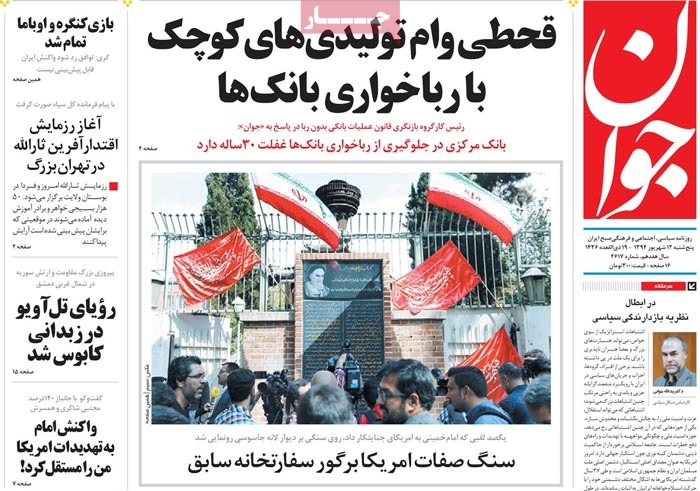
 

A look at Iranian newspaper front pages on September 3


Jomhouri Islami: “We reached all of our goals in nuclear talks,” Abbas Araghchi, a member of Iran’s nuclear negotiating team, said in speech at the Assembly of Experts.
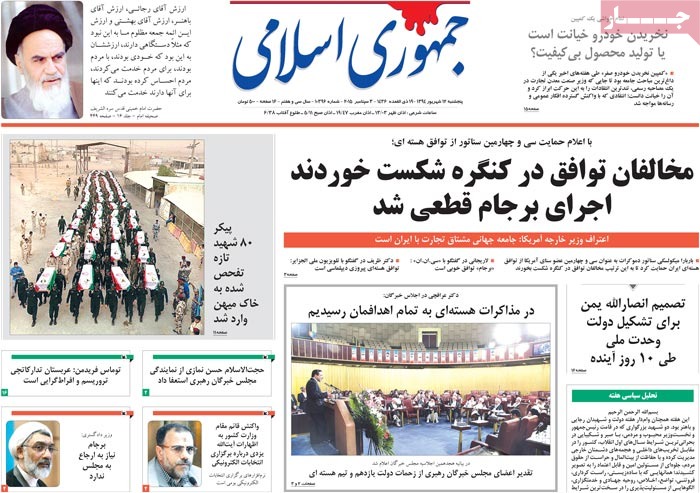
 

A look at Iranian newspaper front pages on September 3


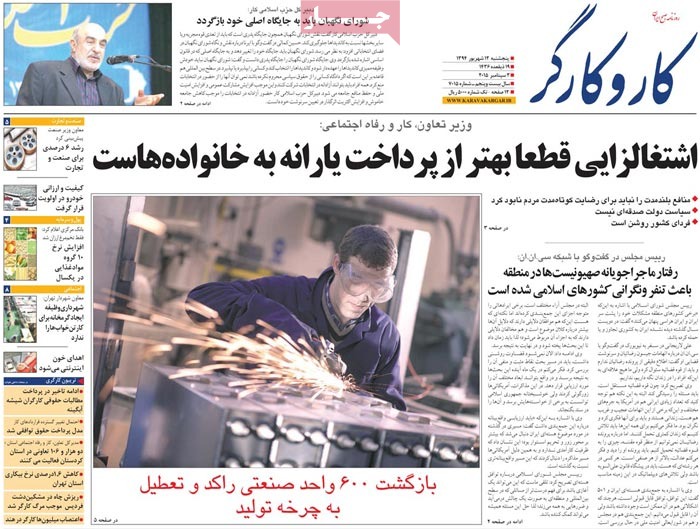
Kar va Kargar: “The regional adventurism of the Zionists has caused resentment and concern in Islamic countries,” the parliament speaker said.
 

A look at Iranian newspaper front pages on September 3


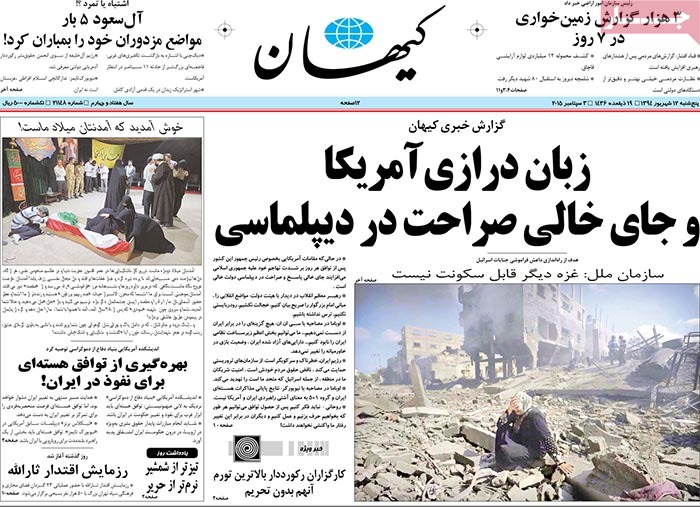
Kayhan: Saudi fighters have bombed the positions of [Saudi-led coalition] mercenaries five times.

Was it simply a mistake or disobedience?!
 

A look at Iranian newspaper front pages on September 3


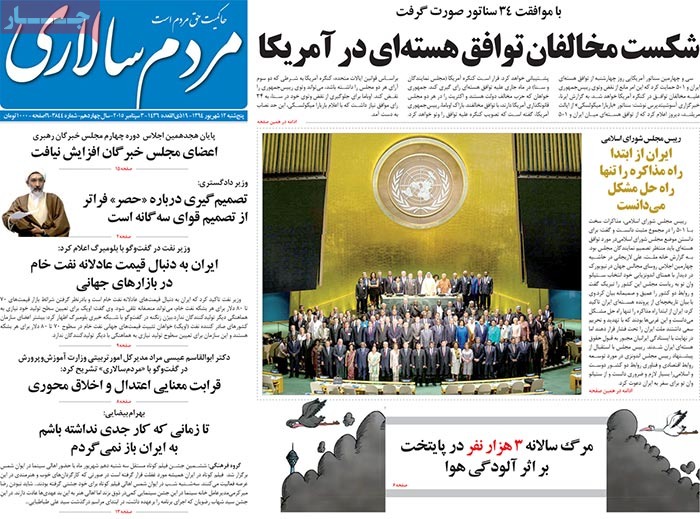
Mardomsalari: “Iran seeks fair crude prices on global markets,” said Oil Minister Bijan Namdar Zanganeh.

Mardomsalari: Some 3,000 Iranians die of air pollution-related complications each year.
 

A look at Iranian newspaper front pages on September 3


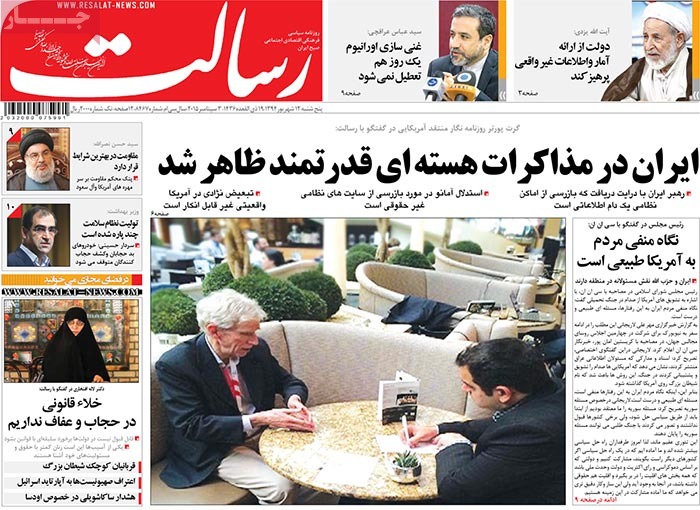
Resalat: The chairman of the Assembly of Experts has urged the government not to release any unreal figures.

Resalat: The secretary of the Lebanese Hezbollah has said that the resistance movement is in best shape.

Resalat: US [investigative] journalist Gareth Porterhas said in an interview with Resalat that Iran was powerful in nuclear talks.
 

A look at Iranian newspaper front pages on September 3


Roozan: “Releasing American prisoners, a two-way street,” Hamidreza Asefi, a former Iranian diplomat and world affairs expert, said.
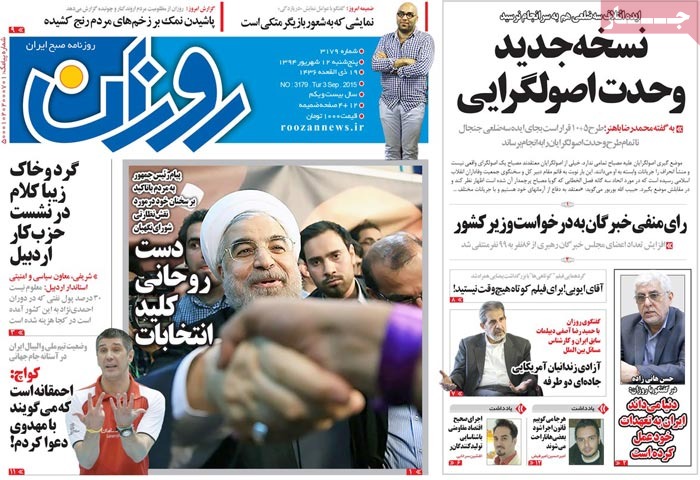
 

A look at Iranian newspaper front pages on September 3


Setareh Sobh: Two Iranian scientists have developed a hybrid heart valve.
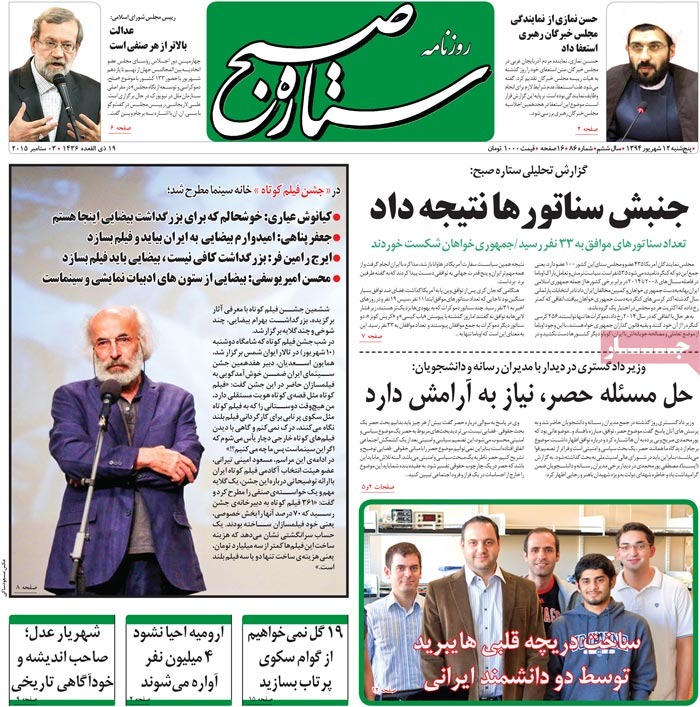
 

A look at Iranian newspaper front pages on September 3


Sharq: “We are not anti-Semites, but we find fault with Israel,” said Parliament Speaker Ali Larijani.
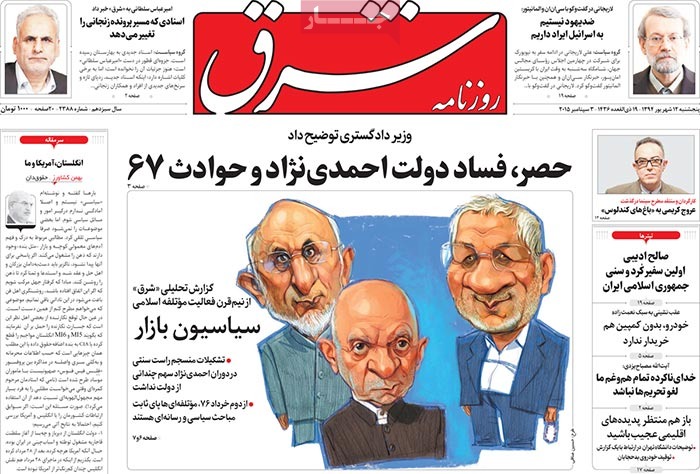
 

A look at Iranian newspaper front pages on September 3


Taadol: “Regional countries should stick to their right to self-determination,” said Foreign Minister Mohammad Javad Zarif.
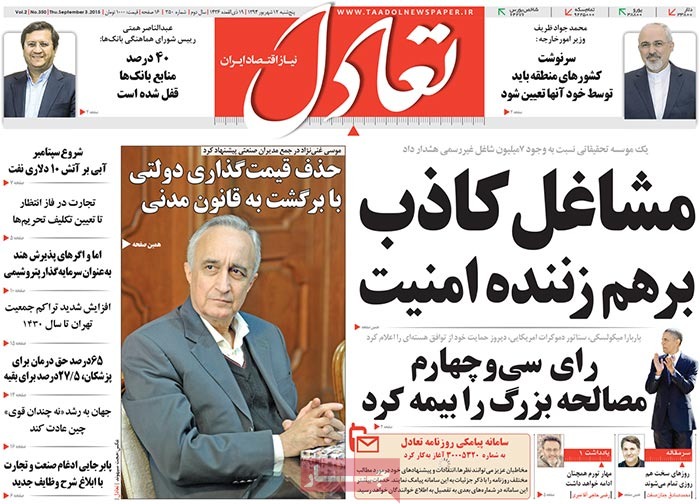

 

A look at Iranian newspaper front pages on September 3


Supreme Leader’s letter welcomed at Moscow Book Fair

Iran Moscow book fair

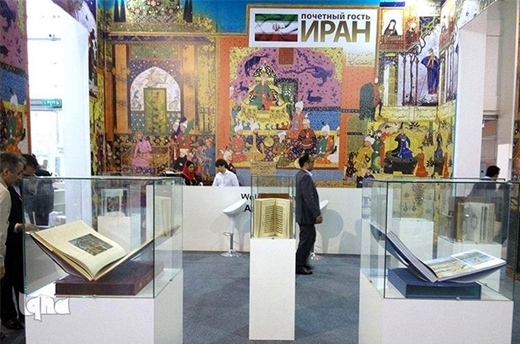
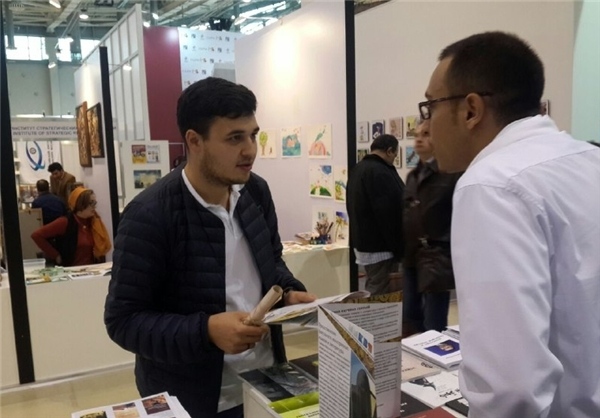
The Sacred Defense Publishers’ Association has distributed the Russian translation of the Supreme Leader’s letter to the Western youth among visitors at the 28th Moscow International Book Fair (MIBF).

Fars News Agency on September 2 published a report on the Russian translation of the Supreme Leader’s letter and its distribution among young visitors at the Moscow Book Fair (September 2-6). The following is the translation of part of that report:

The 28th Moscow International Book Fair (MIBF) opened in the Russian capital on Wednesday (September 2). From Iran, the Sacred Defense Publishers’ Association handed out copies of the Russian translation of the Supreme Leader Ayatollah Ali Khamenei’s letter to the youth in North America and Europe to the young people visiting the book fair.

In a letter on January 21, Supreme Leader of the Islamic Revolution Ayatollah Seyyed Ali Khamenei introduced a true image of Islam to the youth in Europe and North America and elaborated on the reasons behind Western efforts to spread Islamophobia.

[In the historic letter, Ayatollah Khamenei asked the Western youth to try to gain direct and firsthand knowledge of the religion in reaction to the flood of prejudgments and disinformation campaigns against Islam.

The letter, which has been met with a warm welcome by Muslims in the world and the Western media, has been translated into multiple languages.

[Iran’s Islamic Culture and Relations Organization (ICRO) has translated the Supreme Leader’s message to the Western youth into 21 languages in order to foil attempts to distort the content of the letter or marginalize it.

The ICRO has translated the letter into languages such as Russian, Croatian, Serbian, Bulgarian, Swahili, Turkish, Indonesian, Chinese, Japanese, Spanish, Italian, Thai and Albanian.]


Russia-Book fair

Highlights of Ettela’at newspaper on September 3

82aa4b0a (1)

Ettela’at: “Some critical remarks about the Joint Comprehensive Plan of Action (JCPOA) are unfair and out of obstinacy,” Deputy Foreign Minister Abbas Araghchi said.

Speaking at a meeting of the Assembly of Experts, the diplomat who is also a member of Iran’s nuclear negotiating team said that every clause of JCPOA has been carefully reviewed at the Supreme National Security Council and in parliament’s National Security and Foreign Policy Committee.

Ettela’at: Construction of tens of thousands of villas in the north has taken a toll on agricultural land.

The director of the Land Affairs Organization said continued development in Lavasan poses a threat to Tehran’s water supply.

Ettela’at: The US secretary of state has said that all countries are anxiously waiting for business with Iran.

Iran’s unfrozen assets run into $55 billion.

Ettela’at: “Iran and Hezbollah have responsibly stood up against terrorism,” the Iranian parliament speaker said in an interview with CNN.

Ali Larijani further said that a change of attitude toward the US is possible.

Ettela’at: “The range of Iranian missiles is proportionate to threats,” said the defense minister in an interview with Al Mayadeen.

Brigadier General Hossein Dehghan said that his ministry will develop long-range defensive missiles next year.

Ettela’at: “China helps Iran build two 100 MW nuclear reactors,” said the director of the Atomic Energy Organization.

Ali Akbar Salehi further said China will play an important role in redesigning Arak’s heavy water reactor.

Ettela’at: “Iran’s policy centers on encouragement of dialogue and the fight against extremism,” said Foreign Minister Zarif in an interview with Algerian national TV.

The top diplomat further said the Iranian nuclear deal is a lesson for international diplomacy.

Iran nuclear deal cannot fix all economic problems

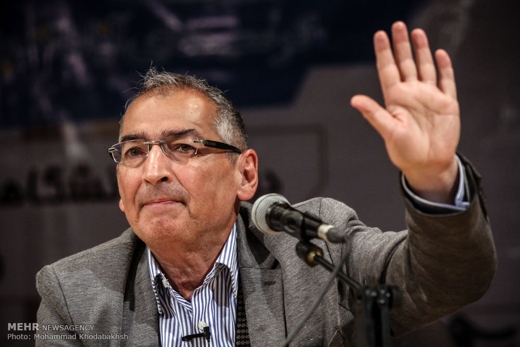
Sadegh Zibakalam

A Tehran University professor has rejected remarks that Iran’s economic problems will be gone after the removal of sanctions, saying that those problems do not solely stem from the nuclear issue.

Sadegh Zibakalam, a political analyst who is a fervent supporter of the Rouhani administration and its foreign policy, made the remark in a meeting on Tuesday on the dos and don’ts of the policies adopted by the Islamic Republic of Iran after the nuclear deal and added that the reason why Iran’s economy is not doing well lies somewhere else. The following is the translation of his remarks as reported by Mehr News Agency on September 1:


Nuclear deal and economic woes

Who has said that all Iran’s problems will become history in the post-sanctions era? It is unclear who has claimed that the economic situation of the low-income families would improve, inflation would be reduced and housing prices would change.

As many as six million people are jobless in the country. The assumption that all these people will land a job after the termination of sanctions and the nuclear deal is far from correct. Some of the post-deal must-haves are in fact the aspirations and wishes people cherish in society.


Nuclear deal and the opponents

We need to be careful not to walk into the trap the opponents of the nuclear deal have set. They used to have critical analyses of our position, saying that we are simpletons to expect to see Iran turn into a paradise after the [conclusion of the] nuclear deal.


Economic woes and their roots

It is not wise to assume that sanctions are to blame for all the problems the country has been grappling with and that their termination would solve all problems. It is not wise to think that all economic ills come from the nuclear issue. I should say that we have a more serious problem in the country.

Iran has an inefficient state-run economy. As long as the country’s economy is controlled by the government, nothing will change whether sanctions are in place or not. If we want to treat people honestly, we should not confirm the assumption that all problems will be removed after sanctions are removed.


Lessons to learn from others

Foreign policy in any country has been intertwined with its domestic policy. The political management can affect a wide range of issues, among them politics and economy.

Turkey, for instance, saw its economy grow over the past 36 years and earn $150b in exports last year without selling a cubic meter of gas or a barrel of oil.

We need to review why Iran can – at best – collect $40b in non-oil exports. Turkey’s success in the export sector has cost the country its membership in the European Union, because as an EU member, Turkey’s exports can dominate the European markets.

Compared with this country’s economic breakthroughs, we in Iran have simply resorted to sloganeering over the past years.


Unaccountability, Iran’s acute problem 

The country’s economy is not working properly and we need to set asides all talks [and no action]. Unaccountability is a big issue in the country. For eight years, no one asked those who were in power to answer [for their performance].

How much has the country paid for [the nuclear program and] sanctions? Parliament has never asked how much the country spends on developing uranium per kilogram or how much money the country should pay for the electricity which is generated at Bushehr [Nuclear Power Plant].


Nuclear deal and jubilation of US Democrats

How will the Joint Comprehensive Plan of Action affect the 2016 presidential elections in the United States? The Iran nuclear deal is viewed as an achievement of Obama and the Democrats [in general]. Unfortunately, the Democrats have fared poorly in Iraq, Syria, Yemen and even Afghanistan; talks with Iran are the only issue [among regional disputes] the US can claim it has reached a breakthrough over.

The Vienna agreement is a promising deal and I am optimistic about it. For the Americans, Obama in particular, the Iran nuclear deal is a trump card. They will try to keep their end of the bargain so that they can win the presidential elections next year.

We are at odds with the US over Israel, support for ISIL and human rights. We need to make optimal use of the opportunities that will open up in the post-sanctions era.

‘Iran seeks friendly ties with all regional countries’

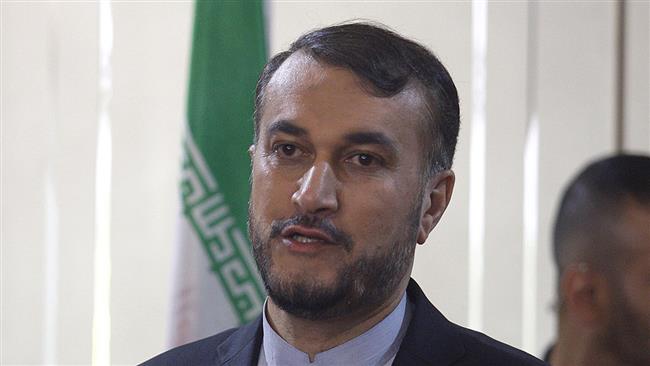
Amir Abdollahian

A senior Iranian diplomat says Tehran seeks to improve its relations with all countries in the Middle East region, including Saudi Arabia.

“The Islamic Republic of Iran seeks to establish friendly ties along with mutual respect with regional countries, including Saudi Arabia,” said Iran’s Deputy Foreign Minister for Arab and African Affairs Hossein Amir-Abdollahian during a meeting with Lebanese Prime Minister Tammam Salam in Beirut on Wednesday.

“We are ready to hold talks with our Saudi friends and we believe that this country enjoys an important role and status in the region,” he stated.

Amir-Abdollahian also voiced Iran’s readiness to cooperate with regional countries to ensure Lebanon’s security, adding that undermining the security of the Arab country just benefits the Israeli regime.

“Iran has always been concerned about Lebanon’s security and stability, and the frequent meetings of Iranian officials with their Lebanese counterparts indicate this concern,” the senior diplomat stressed.

He further touched upon the “important” visits of Iranian Foreign Minister Mohammad Javad Zarif to regional countries immediately following the recent breakthrough in nuclear talks between Tehran and P5+1, saying they testify that “Iran’s foreign policy is to improve regional relations within the framework of maintaining stability and security.”

Tehran and P5+1 – the US, Russia, China, France, Britain, and Germany – finalized the Joint Comprehensive Plan of Action (JCPOA) over the Iranian nuclear program on July 14. Under JCPOA, limits will be put on Iran’s nuclear activities in exchange for, among other things, the removal of all economic and financial bans against the Islamic Republic.

Later in the day, Amir-Abdollahian left the Arab country for neighboring Syria and was welcomed by Syrian Deputy Foreign Minister Faisal Mekdad.

According to Syria’s official news agency SANA, the Iranian official also met with Prime Minister Wael al-Halqi to discuss ways to boost bilateral relations in such fields as industry, agriculture, health, oil and electricity.

During the meeting, Amir-Abdollahian reiterated Iran’s pledge to support the Syrian government and people in their battle against foreign-backed Takfiri terrorists.

Halqi, for his part, hailed Iran’s stance towards the crisis in the Arab country, saying Tehran has responsibly tried to reduce the impacts of war and unjust economic sanctions on the lives of Syrian people.

The Iranian diplomat further held talks with Syrian Foreign Minister Walid Muallem, SANA reported.

Syria has been facing a foreign-backed militancy since 2011. Takfiri terrorists, who currently control areas across Syria as well as northern and western Iraq, have been carrying out horrific acts of violence, including public decapitations, against Iraqi and Syrian communities such as Shias, Sunnis, Kurds and Christians.

Iran determined to reclaim its share in global oil market: Zanganeh

Zangeneh

“Immediately after lifting sanctions, it’s our right to return to the level of production we historically had,” Bijan Zangeneh said, adding, “We have no other choice.”

The Iranian minister made the remarks in an interview with Bloomberg, which was published on Wednesday, at the Iranian Oil Ministry in Tehran.

Iran lost part of its share in the global oil market after sanctions were imposed on the country by the United States and the European Union at the beginning of 2012, with Western countries claiming that there was diversion in Iran’s nuclear program toward military purposes. Iran rejected Western countries’ claims categorically, insisting that its civilian nuclear program was only meant for peaceful purposes.

Iran reached an agreement with the P5+1 group of countries – the US, the UK, France, Germany, China, and Russia – in Vienna on July 14, known as the Joint Comprehensive Plan of Action (JCPOA). According to JCPOA, sanctions against Iran’s economic sectors, including oil and gas industry, will be lifted in return for certain restrictions on Tehran’s nuclear program.

Elsewhere in his interview, Zangeneh said Iran plans to produce 3.8-3.9 million barrels per day (bpd) of oil by March 2016.

He noted that the country will raise its output by 500,000 bpd soon after sanctions are lifted and by 1 million bpd within the following five months.

He added that Iran’s oil output currently stands at 2.8 million bpd, which is the highest level the country has achieved in three years, and is exporting more than 1 million bpd.

Referring to the drastic oil price fall in global markets, the Iranian oil minister emphasized that the oil price slump will not slow Iran’s return to the market.

Oil has dropped by about half in the past year from more than USD 100 a barrel in September 2014 after the 12-member Organization of the Petroleum Exporting Countries (OPEC) decided during meetings in December 2014 and June 2015 not to reduce output despite a global crude glut.

In another part of his interview, Zangeneh said most OPEC members would like to see crude prices at $70-$80 a barrel and the organization does not need to coordinate with other oil suppliers to determine output levels.

An oil price at $70-$80 a barrel would be “fair,” he said, adding that OPEC is open to coordinating its action with non-members, although it won’t wait for others to determine or approve its action.