Tuesday, December 30, 2025
Home Blog Page 4727

Iran’s Zarif highlights ECO continued support for int’l efforts to ensure peace

Dr

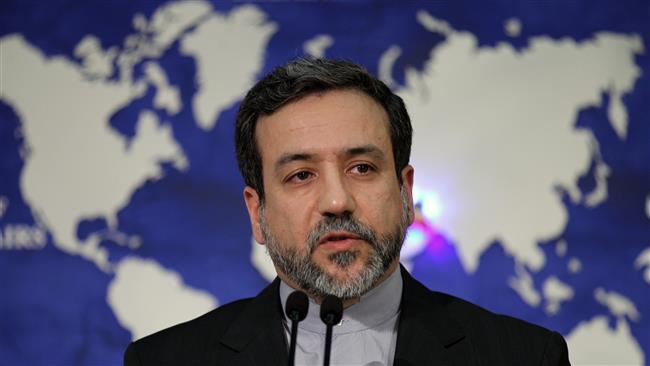
Iran’s Foreign Minister Mohammad Javad Zarif asked the Economic Cooperation Organization members to renew their commitment to supporting the national, regional and global efforts to achieve lasting peace, stability and prosperity in the ECO region.

The full text of the statement is as follows:


Statement by:

H.E. Dr. Javad Zarif

Foreign Minister of the Islamic Republic of Iran

at the

Extraordinary Session of the Council of Ministers

of the Economic Cooperation Organization

New York, 2nd October 2015


In the name of God, the most Compassionate, the most Merciful

Mr. Secretary General,

Distinguished Fellow Ministers,

Excellencies,

Ladies and Gentlemen,

Allow me at the outset to express my deep gratitude to all colleagues for participating in this Meeting despite their heavy schedules in New York. I wish to congratulate and welcome H.E. Mr. Halil Ibrahim Akcha, the new Secretary General of the Economic Cooperation Organization and wish him every success.

Distinguished Colleagues,

Almost two years have passed since we last met in Tehran in November 2013, during the 21st Meeting of the ECO Council of Ministers. In this period, a number of developments have taken place within the Organization including the holding of RPC Meetings and Sectoral Ministerial Meetings, implementation of certain joint projects, formulation of the new vision for ECO during 2016-2025, and appointment of our new Secretary General and Deputy Secretaries General.


Since our last Ministerial Meeting, tangible progress has been made in the transport sector. The ECO new railway corridor connecting Iran, Turkmenistan and Kazakhstan was officially inaugurated by the Presidents of the three member-states on 3rd December 2014 in Inche-Boroon, and is expected to be a convenient and cost-effective route for cargo transportation with a view to boosting and facilitating the regional and international trade and transit cooperation.

Moreover, strengthening regional cooperation in the field of energy through, inter alia, making efforts for the establishment of the ECO Regional Electricity Market, has been an important achievement within the Organization. In this context, the first trilateral meeting between Iran, Turkey and ECO secretariat was held in September 2014 in Ankara. We are of the view that there is a strong need for the establishment of the ECO Regional Electricity Market and invite Member States to take necessary steps to facilitate this process. We also believe that the idea of establishing a Trust Fund for financing high priority ECO regional energy projects, which was raised during the Third ECO Ministerial Meeting on Energy/Petroleum in March 2013 in Tehran, needs special attention.

Dear Friends,

More than two decades of collective attempts have resulted in varying degrees of maturity and success in different layers and areas of regional cooperation within ECO region. The Organization has been successful in forging a range of cooperation frameworks. However, we are still away from full realization of objectives of our Organization.

In the third decade of its expansion, cooperation within ECO can bring about meaningful benefits to all Member States. This requires the continued and enhanced support lent to ECO by all its Members.

Along the line of strengthening the ECO integrity through wider inclusiveness and enhanced ownership, there is a need to explore, and remain open to needed regulatory, institutional, budgetary and other changes within the Organization. The envisaged reform is a common responsibility of the Membership and the Secretariat alike, which entails mandates to be given by the Council of Ministers.

Allow me to conclude by recalling a number of relevant issues to the Organization which require greater attention by Member States:

–          First, the Economic Cooperation Organization provides a unique opportunity for the Member States and the whole Region. However, ECO in the third decade of its expanded cooperation needs a series of reform measures. We need to explore the possibility and scope of the required reforms and make necessary decisions accordingly. Any reform process shall be built on the experience gained from the last two decades with a view to enabling ECO to respond to the needs and requirements of Member States and the Region as a whole.

–          Secondly, based on the deliberations of Member States during the 25th RPC Meeting in Tehran, the Secretariat initiated formulation of a new ECO Vision for the period 2016-2025. We are currently in the process of considering the first draft and later finalizing recommendations for the ECO Vision 2016-2025. In view of the rapid socio-economic, political and scientific developments taking place at the regional and global levels, we need to define our Vision in a manner to enhance regional cooperation and economic development. To this end, we should develop and implement strategies in the next decade in such areas as energy, transport and transit, trade, management of region’s resources, human development, environment, and natural disaster risk management. In this context, the “2030 Agenda for Sustainable Development” can be utilized as a roadmap. We shall opt for real measures to implement this ambitious agenda. We believe that the agreed principles of “country ownership” and “common but differentiated responsibilities”, with an emphasis on the development orientation of the three pillars, should remain the cornerstones of our common endeavors.

–          Thirdly, there is a strong interdependence between peace and development; peace and stability are essential for realizing the genuine goals of sustainable development and welfare of our countries and peoples. We should recommit ourselves to continue supporting the national, regional and global efforts to achieve lasting peace, stability and prosperity in our region.

–          Finally, we need to be mindful of the global efforts aimed at addressing the challenges facing the international community. In doing so, we should give priority to the immediate needs and concerns of our region and its people. To that end, benefiting from relevant international and regional organizations need to be taken into consideration and cooperation with those which have already established relations with ECO should be strengthened.

Dear Colleagues,

We have a full agenda that we need to cover this morning as scheduled and agreed. Our task has been facilitated by a special meeting of the Council of Permanent Representatives, acting as the Senior Officials Meeting, which was convened in Tehran on 20th September 2015, and reviewed comprehensively the agenda in front of us. I count on every delegation’s support and cooperation to enable us to conclude our work in a smooth and successful manner.

Thank you for your attention.

Tehran police trying to break up illegal gathering outside parliament

Worriers

Tehran Police Chief Brigadier General Hossein Sajedinia on Saturday went, in plain clothes, to the site of a sit-in outside parliament and asked protesters – opposed to the Joint Comprehensive Plan of Action Iran has inked with world powers – to bring their illegal gathering to an end and leave.

The Islamic Republic News Agency (IRNA) on October 3 published a report on Tehran police’s efforts in dealing with the illegal gathering of the so-called Worriers. The following is the translation of the report:

The general met with the organizers of the illegal gathering outside the Iranian parliament and urged them to peacefully end their assembly soon to avoid any possible confrontation.

The police chief told the protesters that the Supreme Leader wanted to see the gathering ended. He talked with a staffer at the Supreme Leader’s Office on the phone and asked him to convey the Leader’s view to the organizers of the gathering.

After talking with a senior member of the Leader’s Office, Ammar Ammarloo, the protester who initiated the sit-in against JCPOA, said that opposition to this gathering is the view of the Leader’s office, not the view of the Leader himself, thus announcing the protest will carry on.

Eyewitnesses quoted General Sajednia as threatening that police would seriously deal with the illegal gathering which has disrupted traffic and caused obstruction in the area if the protesters did not break up.

Reports have also indicated that Masoud Mirkazemi, an MP who represents Tehran, Shahr-e Rey, Shemiranat and Eslamshahr in the Islamic Consultative Assembly, joined the protesters and voiced his objection to the implementation of JCPOA and defended the gathering.

It came after Tehran governor general and governor’s office announced that the gathering outside the building of the Islamic Consultative Assembly in protest at the JCPOA implementation lacks any permit and thus is illegal.

There was an increased police presence around parliament on Saturday morning with law enforcement units cordoning off nearby streets. The illegal sit-in in opposition to the implementation of JCPOA was staged last week after a few people gathered outside parliament. The protest sit-in is still continuing.

In another development, provocative flyers were distributed in the University of Tehran – the venue of the capital’s Friday prayers – on Friday among worshippers.


Worriers


Supreme Leader pardons prisoners on auspicious occasions

81783534-70204767

Supreme Leader of the Islamic Revolution Ayatollah Seyyed Ali Khamenei has pardoned or commuted prison terms of 630 of convicts sentenced by the public, revolutionary and military courts.

The amnesty was made at the request of the Judiciary Chief Ayatollah Sadegh Amoli Larijani and was accepted by the Supreme Leader on the occasion of the auspicious occasions of al-Adha and Ghadir-e Khom.

Ghadir-e Khom is the valley in the neighborhood of holy Mecca where Prophet Mohammad (PBUH) introduced Imam Ali (AS) as his successor during his last Hajj pilgrimage.

The Clause 11 of the Constitution’s Article 110 has given the Supreme Leader authority to pardon prisoners.

The Amnesty does not apply to all convicts, especially those who have been sentenced for their role in armed struggle against the Islamic Republic, armed robbery or organized crime, drug-trafficking, rape, arms smuggling, abduction, bribery and embezzlement.

Q&A: Iran’s top science official strives for a Silicon Valley spirit

Sattari

The journal Science has conducted an interview with Iranian Vice President for Science and Technology Dr. Sorena Sattari on the sidelines of the 70th session of the United Nations General Assembly. The Islamic Republic News Agency published a translated version of the interview on October 3. The following is the original interview that sciencemag.org posted online:

During his two years in office, Iranian President Hassan Rouhani has filled his cabinet with Ph.D.-trained technocrats. One of the youngest is Sorena Sattari, the vice president for science and technology. A mechanical engineer by training, Sattari, 43, has been a forceful proponent of yoking science more tightly to the economy and says he would like to imbue Iran with an “entrepreneurial spirit.” His Innovation and Prosperity Fund has handed out $600 million in low-interest loans to 1650 technology startups and to other firms seeking to branch out in new directions.

He has not turned his back on basic research, however. He cites as “a point of pride” for his country the $30 million Iranian National Observatory, a world-class, 3.4-meter optical telescope that is expected to see first light in four or five years. Backers credit him with helping get the long-delayed project back on track earlier this year (Science, September 4, p. 1042). Sattari spoke with Science last week on the sidelines of the United Nations General Assembly. This interview has been edited for brevity and clarity.

Q: Your father, Mansour Sattari, was commander of the Iranian Air Force during the Iran-Iraq war. That was a difficult time to come of age.

A: I spent a lot of time on Air Force bases during the war. Before the revolution [in 1979], Iran had one of the most advanced air forces in the world. But when U.S. military advisers left the country during the revolution, we realized we didn’t understand the technology. I think that’s why Saddam Hussein attacked us. He thought we would survive only three months. Iranian pilots were flying aircraft that weren’t reliable because they weren’t maintained well. But we learned how to stand on our own feet. Two days before [the] war ended, we had our last air combat with Iraq. For the first time, we shot down a MiG-29. We used an F-14 aircraft with an Iranian missile. We learned how to build new weapons. That was the start of the Iranian missile program. It was a result of international sanctions.

Q: The war and sanctions hardened the Iranian psyche.

A: The war was difficult, but what was harder was what went on under the skin of society. Many women lost their husbands, and parents lost their sons. Sometimes I get scared when the phone rings at night, because I think it must be very bad news. That fear comes from those times.

Q: Your father died in a military plane crash in 1995. Did you think to follow his path into the military?

A: My father didn’t want me to go into the military and didn’t ask me to. He was martyred when I was 22.

Q: You had just finished your master’s degree in mechanical engineering at Sharif University of Technology.

A: After I lost my father, I had to take care of my family. I left school and started working in the oil and gas ministry. After I collected enough money for my family, I went back to Sharif and completed my Ph.D.

Q: In December 2013, Iran put a monkey named Fargam [“auspicious”] into orbit and safely brought him back to Earth. What’s next for the space program?

A: We will have to change how we manage the space program, both the technology side and the business side. We’re hoping that with [the] help of foreign companies, we can commercialize the program.

Q: Iran and Russia are talking about jointly developing remote-sensing satellites for environmental monitoring. Does this represent a deepening of scientific ties?

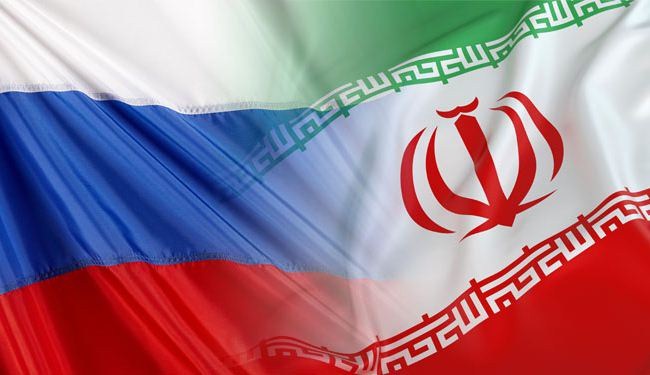
A: We are now becoming very serious in our relationship with Russia. We have formed for the first time a joint commission on science and technology cooperation, which is much higher level than our economic joint commission. It’s headed by the deputy prime minister of Russia and myself. For the first time, science and technology is driving the relationship between our countries.

Q: You said recently that “the most important responsibility” of your vice presidency is changing Iran’s oil-based economy into a knowledge-based economy.

A: Before sanctions, our government got 85% of its revenues from oil. This year, we got less than 25% from oil. But we have not succumbed to this pressure. Resistance is ingrained in our nature; it is in Iranian genes. Our mindset has changed because of the sanctions. Now, we believe in investing in science and technology. Innovation is essential to creating a knowledge economy.

Q: You’ve talked about privatizing Iran’s research institutes. Do you have a concrete plan?

A: I have a mental model. There must be a difference between grants for pure research and support for projects that have potential to become a business. Government funds should be used to expand the boundaries of science. We have wasted a lot of money on institutes that are not contributing to the economy. We thought that we could use oil money to simply buy whatever technology we need. We thought that if we have a building and equipment, we could achieve results. But you have to acquire expertise. In many of our institutes, frankly, we need a new way of thinking.

Q: In a speech at the University of Tehran in October 2013, President Rouhani pledged to increase academic freedom at Iranian universities. Are conditions improving?

A: It’s unprecedented for an Iranian president to walk in and out of a university and talk to students without some sort of protests. We never experienced this before. It shows how supportive the majority of university students are of his policies. The university atmosphere has become much better compared with the past. Iran is becoming more open. If the United States wants to create a serious scientific relationship, this is the time.

Q: This summer you were appointed to the Supreme Council of Cyberspace. One of its tasks is to accelerate the launch of a national intranet. What is the purpose of this network?

A: Many countries are building similar networks. It will increase the speed and security of information transfer. And this does not have political intentions behind it.

Q: The council also is supposed to pay special attention to “cleaning and securing” the nation’s cyberspace, and promoting Islamic and Iranian norms. Iran now blocks Facebook, Twitter, and other social media websites. Will achieving the council’s goal mean more aggressive Internet censorship?

A: The Internet has a good face and a bad face. In the Middle East we have lots of challenges. For example, we have [the Islamic State group] recruiting on the Internet. It’s very scary to see what’s happening in the region. We want to make sure our data hubs remain in Iran. We don’t want messages to go out of the country and then come back in. We want more security.

Q: According to the Supreme Council of the Cultural Revolution’s master plan for science, “the revival of the great Islamic civilization” is “contingent upon all-out progress in science.” What does that mean?

A: It means that we want to be the superpower of science and technology in the region. And we also want to be No. 1 in the Islamic world as well.

Q: Who is No. 1 now?

A: Overall, Iran is No. 1. [Smiles.] Now, we are aiming for the whole world.

FM Zarif meetings in New York

Zarif

Iranian Foreign Minister Mohammad Javad Zarif and Arab League Secretary General Nabil Al-Arabi in a meeting on the sidelines of the UN General Assembly in New York on Friday discussed the recent developments in the Middle East region.

They also emphasized the need for cooperation to settle regional crises, particularly those in Syria and Yemen.

Also on Friday, Zarif met with US Secretary of State John Kerry on the sidelines of the UN General Assembly meeting.

The two sides discussed ways to implement the Joint Comprehensive Plan of Action (JCPOA).

It was their second meeting after the nuclear deal struck in Vienna on July 14, 2015, which led to the conclusion of JCPOA.

Zarif and Kerry’s first meeting was held on September 26.

Iran welcomes home bodies of Mina victims (Photos)

1

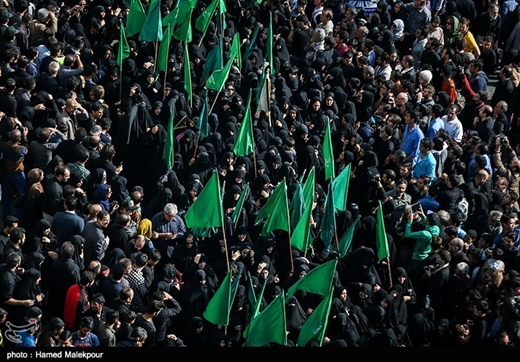
A ceremony was held in Tehran on Saturday to welcome the return to Iran of the bodies of 104 Iranian pilgrims killed in the Mina incident some ten days ago. Heads of the three branches of government, the Supreme Leader’s chief of staff as well as state and military officials were present in the ceremony which was held at the capital’s Mehrabad Airport. The Islamic Republic News Agency (IRNA) has released the following images of the homecoming of the bodies of Iranians died in the Mina crush:


Camps of Worriers outside Iranian parliament (Photos)

Worriers2

A group of Worriers [supporters of former President Ahmadinejad’s policies and critics of President Rouhani’s foreign policies, especially his nuclear approach] are still in their tents outside parliament in protest at the conclusion of the Iran nuclear deal. 

This comes as Tehran’s governor has said that the gathering outside the Islamic Consultative Assembly is illegal and Tehran police have asked the protestors to break up. The Worriers staged a sit-in on Monday (September 28) and launched a website to cover their protests.  

The protesters have also installed banners some of which read: JCPOA is the Trojan Horse of the USWhy an agreement, if sanctions are not to be lifted?; and The result of two years of [nuclear] negotiations: Sanctions will not be removed!

The following are the images Entekhab.ir released on Saturday (October 3) of the illegal sit-in by the Worriers:

Highlights of Ettela’at newspaper on October 3

Ettelaat

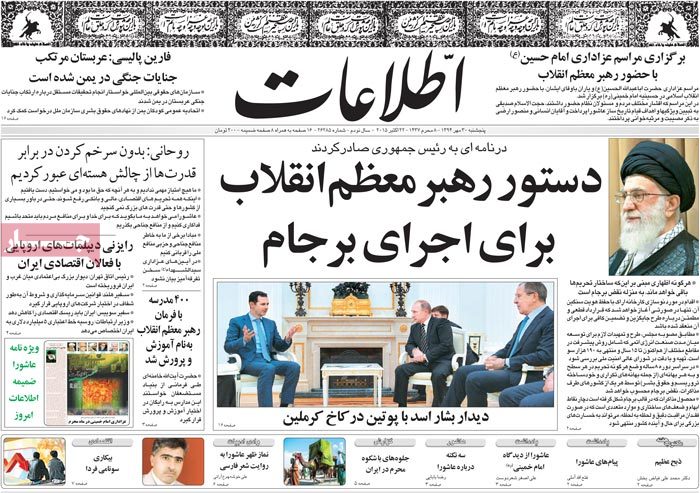
 “You need to bolster the country’s power so that the enemy cannot even think of attacking Iran,” said the Supreme Leader in a meeting with Army commanders.

Ayatollah Khamenei further said that the enemy is seeking the surrender of the Islamic establishment, adding that hostilities will not become history even if Iran backs down.

 Tehran’s Friday payer leader has said that the management of Hajj should be changed.

The Friday prayer leader also said that those responsible for the Mina tragedy should be immediately identified and brought to justice.

 The Taliban in Afghanistan have brought down a US Army cargo plane. Eleven people were killed in the crash.

The Taliban have claimed responsibility for the downing of the US C-130 transport plane.

 A commemorative ceremony will be held for the victims of the Mina tragedy in Tehran and Qom on orders of the Supreme Leader.

The number of Iranian pilgrims killed in the Mina tragedy has risen to 465.

 Foreign Minister Mohammad Javad Zarif has said that time has come for a new approach toward nuclear disarmament.

The UN secretary general has praised Iran’s initiative to designate an International Day for the Total Elimination of Nuclear Weapons.

 “The country is indebted to the competence and self-sacrifice of the war disabled,” said Dr. Mohammad-Ali Javadi, a renowned ophthalmologist.

 The tragic death of the Persepolis captain


Critical remarks about Rouhani’s trip and Zarif are out of spite

un

An Iranian expert in international affairs has taken an analytical look at the addresses made by the US, Russian and Iranian presidents at the General Assembly, how they fared in their appearances at the UN and where they stood on efforts to settle the Syrian crisis.

Khabaronline.ir on September 30 published an interview with Ali Bigdeli, also a university professor. The following is the translation of what Bigdeli said:

US President’s Speech

The speech by the US president can be studied from two perspectives. The first angle has to do with eloquence and how to connect the subjects and topics. The US president had a good performance on that front.

The second part [which focuses on the subjects] came with conflicting remarks. What Mr. Obama said in his address, especially about Russia, Iran and Cuba, does not conform to US policies. For instance, Mr. Obama said that the US was not seeking to isolate Russia, but this is what is exactly happening on the ground.

As for Iran and Cuba, his rhetoric was less fiery, but his words on Russia were more pointed. On top of that, Obama’s comments such as “[…] is what allowed us to become the most powerful nation in the world”, and “[…] I lead the strongest military that the world has ever known […]”, etc.” were not in keeping with the core of his speech.

Syria in UN speeches

A sort of harmony was evident in the speeches of Messrs. Obama, Putin and Rouhani as far as the future of Syria was concerned. They agreed that the question of ISIL should be settled with the Syrian government in power and then they can move on to the question of the Syrian government.

We’ve witnessed that the US administration has recently adopted a more flexible approach toward the Syrian situation. Washington earlier lent support to any solution to the Syrian crisis which would lead to the departure of Assad from office, but now the United States has agreed to put the fight against ISIL ahead of the presence or absence of Assad [in the future of Syria].

Russian President’s Speech

President Putin’s UN speech was heroic. In his address, Putin organized a show of force suggesting that the US cannot settle the problems and crises by sidelining Russia. On Syria, Mr. Putin said that Russia should be part of any plan to defuse the crisis there. In fact, Putin has put the US in a tight corner. The US has come to realize that it cannot keep up the fight against ISIL without Putin’s help.

The developments in Crimea and Eastern Ukraine can be explained in the same manner. All in all, I think Putin performed well in his UN General Assembly address thanks to Russia’s new position in regional equations.

Iranian President’s Speech

Iran’s president did a perfect job at the UN General Assembly. It was obvious that Mr. Rouhani sought to speak cautiously about different topics and avoid aggressiveness and going to extremes. This approach is in the best interest of Iran. Any radical views by Iran would benefit Israel.

In his speech, Mr. Rouhani focused on three questions. Firstly, he announced that the Joint Comprehensive Plan of Action (JCPOA) is a closed question and now Iran has opened its doors to the whole world.

Second, the president discussed the unjust sanctions imposed on the country. Third, he said that the decisions made on the Middle East’s crises and problems are not feasible and cannot be implemented without Iran having a role.

A controversial handshake

Since the Iranian and American delegations had repeatedly announced that they had no plans for a meeting between the Iranian and US presidents, this encounter [between Foreign Minister Zarif and President Obama] was not a preplanned contact.

Mr. Zarif is well versed in the principles of diplomacy and consular etiquette. When Mr. Zarif ran into Obama in the UN corridor, he could not have made a U-turn. The diplomatic protocols required the two to shake hands.

The critical comments some have made at home are baseless. These criticisms have been leveled [at the foreign minister] out of spite and are mere excuses. Issues between Iran and the US are so much complicated that an accidental handshake can do little to solve them. We need to evaluate the handshake as a measure taken out of respect and courtesy.

Deft diplomacy in dealing with Mina tragedy

Rouhani_UN

Critics of the Rouhani administration have said that the president’s failure to cut short his New York trip immediately after the Mina tragedy amounts to disrespect for the Iranian people, citing the fact that following incidents much smaller in scale than the Mina stampede the heads of state from other countries have immediately cancelled their trips and returned home to show sympathy with their people.

Even worse, Mr. Zarif did not call off his trip to come back home, the opponents of the eleventh government say. The managing editor of one newspaper has said in an interview that US President Barack Obama cancelled his annual summer holiday after news got out that a number of students have been killed in a shooting spree.

What you read above is part of an opinion piece by Musa Alizadeh Tabatabaei, a senior expert in international relations Fararu.com published on September 29 on the government’s shrewd diplomacy in dealing with the Mina incident. The following is the translation of the rest of the piece:

There are some considerations as far as the remarks of the critics go. There are different analyses and scenarios about the tragedy in Mina. One suggests that in the buildup to the first trip [since the conclusion of the nuclear deal] by the Iranian president to the United Nations – a big diplomatic meeting point of world leaders where heads of state were trying to have a meeting with Iran’s president – the Al Saud and Zionist regimes, enraged by a nuclear agreement between Iran and six world powers, got extremely concerned, seeking to overshadow President Rouhani’s trip and its achievements.

This scenario does not seem to have a leg to stand on, but it is quite clear that cancellation of the president’s trip would simply serve the interests of the opponents of the Islamic Republic of Iran, especially the banned MKO grouping and the Zionists who do not want the voice of the Iranian nation be heard all over the world.

One of the critics has cited cancellation of Obama’s holiday at home following the shooting incident in a US state; this sounds to be a move to divert the attention of the public opinion.

First, it is surprising that a local critic of President Rouhani views the US president as a role model for the president of the Islamic Republic of Iran.

Second, the examples the critics have presented draw an irrelevant analogy, because the incidents the critics have mentioned have all happened inside the country. When an incident happens somewhere inside the country, it’s natural for the president to cancel his trip and routine schedule to manage the crisis and regulate [coordination] work among different ministries and provinces/states.

Third, the US president cancelled his annual leave, and not his overseas trip.

Fourth, cancellation of an overseas trip when it focuses on bilateral relations is more frequent than a trip to an international organization where multilateral relations are discussed, especially to the United Nations whose General Assembly is held once in a year.

Fifth, if the esteemed president had cancelled his New York trip and returned home, the critics would have stirred yet another controversy blaming him for failure to tap into the opportunity that had arisen at the UN General Assembly which serves as an international bully pulpit to reveal the depth of the Mina tragedy.

The Mina tragedy is different from a shooting incident in the US, because the former occurred outside Iran and its management inside the country was impossible. Despite the fact that the Mina incident took place outside Iran, the president tasked his Cabinet and first vice-president with pursuing the case. No more measures – than what have been adopted so far – would have been taken in dealing with the Hajj incident even if the president had returned home [halfway through his UN trip].

Given [not-so-friendly] ties between Iran and Saudi Arabia and the obstacles the latter throws in the way of Iran’s diplomatic measures to attend to those Iranian pilgrims injured in Mina, even if the president had not had any plan for a UN trip to take part in the General Assembly, he would have been expected to seize such an opportunity, travel to New York to place more diplomatic pressure on Saudi Arabia.

His government did just that. The president and his foreign minister built on their interviews, meetings and speeches [the president’s at the UN General Assembly] to highlight the Saudi government’s mismanagement of Hajj rituals and remind world nations of the incompetence of the Saudis as far as the handling of Hajj [the biggest Muslim congregation] is concerned.

Chief among what the government did was the president’s address at the UN General Assembly which opened with his criticism of Saudi Arabia over the Mina incident. Would Iran have achieved such a breakthrough if the president had cut short his trip?

The president drew on smart planning to foil the plots of the enemies of Iran and Iranians: Preventing the Iranian president from addressing the General Assembly; second, he cut his New York trip and returned home immediately after his UN speech to attend a ceremony to welcome the return home of the bodies of the pilgrims killed in Mina incident and express sympathy with the [bereaved] families of the victims.

It is surprising that the critics lay the blame for the Mina tragedy at the president’s door instead of lashing out at the Al Saud for their incompetence in the management of Hajj. What the critics have done will play into the hands of Saudi rulers.