Wednesday, April 29, 2026
Home Blog Page 4728

Iran can use the knowledge of foreign managers to get into global markets

Nematzadeh

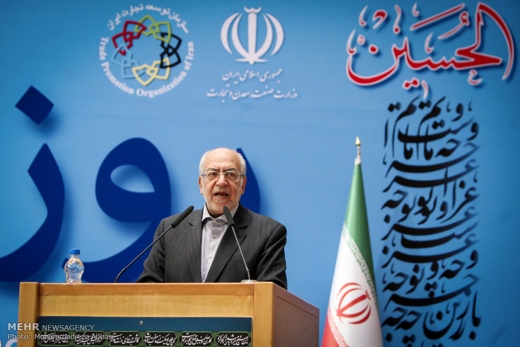
The minister of industries, mines and trade has said that Iran needs to reach out to foreign managers to promote exports and capture international markets.

Mohammad Reza Nematzadeh made the comment in a ceremony to mark National Exports Day on Tuesday and added that like the foreign coaches the sports sector asks to come over to steer different sporting teams, the country should hire foreign managers for the economy sector if it seeks to develop its exports and have a share of the global markets.

Alef.ir on October 20 published a report on Nematzadeh’s remarks in the ceremony. The following is the translation of what else the minister told exporters:

Export is not an option; rather, it is a must for the country if it wants to create jobs and boost its economy. In the twelve months to March 2015, Iran posted a 20 percent increase in non-oil exports, but the export figures dropped in the following six months due to the prolongation of the implementation of the Joint Comprehensive Plan of Action (JCPOA), as well as other factors such as insecurity in target markets and neighboring countries, and a slump in global crude prices. We hope things change and the country can raise its non-oil exports in the six months to March 2016 thanks to [better access to] target markets.

Iran stands 51st among 229 countries which export goods and it ranks 60th among 152 service exporting countries. Oil has a share in Iran’s exports; excluding oil, Iran’s conditions [export-wise] would be worse.

Target: $190b exports in 2025

Iran accounts for %0.34 of [the world’s] exports of commodities and %0.18 of services exports. Iran’s exports of goods and services are projected to climb to $190 billion by 2025 [under the 20-year Outlook Plan], up from the current $63 billion.

Iran’s goods and non-oil export per capita is $800. The figure should rise to $2,000 according to the Outlook Plan. If Iran fails to reach that target, it will lose its status as an exporter.

Resistance-based economy and exports

Iran needs to fully tap into the principles of the resistance-based economy in all sectors. Such an economy has taken into account what is needed in all sectors to develop exports.

Amendments to the Act on Adjusting Part of Government’s Financial Rules were ratified last year [March 2015]. [The government has approved] a number of tax incentives for investment and joint ventures with foreigners, among them a 50 percent tax cut to foreign investors. We hope 20 percent – at least – of the products of such joint ventures will be exported overseas.

To develop exports, the government has also put on its agenda efforts to facilitate the import of raw materials and set preferential price for exports. To that end, the National Development Fund is expected to deposit money into agent banks, which will in turn grant loans to exporters. This is underway now.

Export loans deposited into agent banks

Part of the money [to be granted as loans to exporters] has been deposited into the Bank of Industry and Mine and the ECO Trade and Development Bank.

For years, Iran has easily exported handicrafts, dried fruits, fruits and fresh greens, but it needs to get more involved in the science-based sector for which it should exploit the potential of efficient managers.

Diplomatic ties are not enough to develop exports. The country’s capabilities are not enough to boost exports. To do so, Iran needs more investment.

Certain governmental agencies stop exports to supply the [domestic] market. This is not acceptable. Exports should not stop even if an item is in short supply on the market for a short period, and this is stressed by the country’s Fifth Development Plan as well.

In foreign investments, exports should be taken into account. As a proposal, we can say that 30 percent of what is produced from the initial investment should be exported.

Foreign economy managers

The country also needs to support large-scale companies and industries if it seeks to break into export markets. Macro- and small-sized institutions cannot make it to the international markets and compete there. Investments should be funneled into big, reputable institutions.

We have to bolster marketing management and expertise. I have suggested some companies bring in foreign managers. Some have done so and welcomed the results. Nothing goes wrong if we tap into the expertise and knowledge of well-experienced foreign managers.

Like the sports sector which invites foreign coaches, we, in the economy sector too, need to bring on board foreign economy managers.

$200m deposited into Export Guarantee Fund

Carpet exporters cannot send their items to overseas markets on their own. That’s why officials should step in and give priority to carpet exports. Some $200 million has been deposited into the Export Guarantee Fund of Iran (EGFI) and it can pave the way for efforts to facilitate exports in the country.
Flow of Iran’s oil in post-JCPOA era ends oil honeymoon of Arab nations

oil

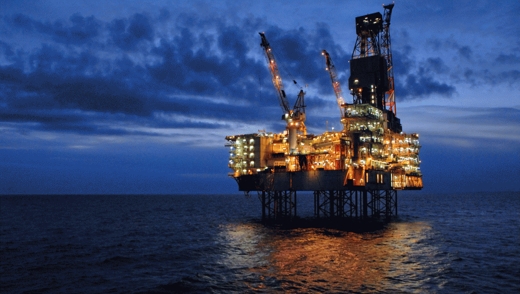
With the countdown to the removal of anti-Iran sanctions on, authorities are getting ready to raise Iran’s oil exports to Turkey. It comes as terrorist explosions along the Kirkuk–Ceyhan Oil Pipeline are interfering with Baghdad’s crude sales to Ankara.

In a report on October 18, Mehr News Agency focused on Iran’s oil trade with other countries, especially Turkey, after the implementation of the Joint Comprehensive Plan of Action. What follows is the translation of part of that report:

Before international sanctions were put in place, Turkey was a major importer of Iran’s crude oil (200,000 barrels a day).

With international sanctions against Iran ratcheting up and challenges such as transfer of foreign currency emerging, Iran’s oil exports to Turkey were cut in half. So Iraq seized the opportunity and raised its crude exports to Turkey.

One of the most serious challenges Baghdad has recently faced in its oil exports to Turkey have been occasional acts of terror along its oil pipeline to Turkey.

On top of that, divisions between the Iraqi Kurdistan Region and the Iraqi central government have thrown an obstacle in the way of exports and have crippled the Iraqi oil market.

When sanctions are lifted, Iran can tap into the great potential of its naval fleet to deliver uninterrupted oil to Turkish refineries.

This potential coupled with the removal of sanctions can spell an end to the oil honeymoon of Arab nations on this traditional market.

Zand Historical House, a museum of anthropology (PHOTOS)

Zand Historical House0

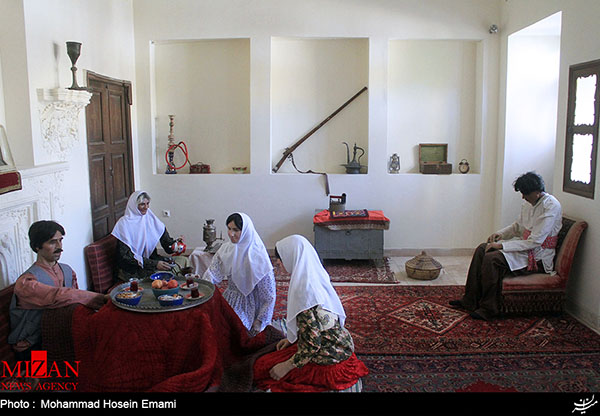
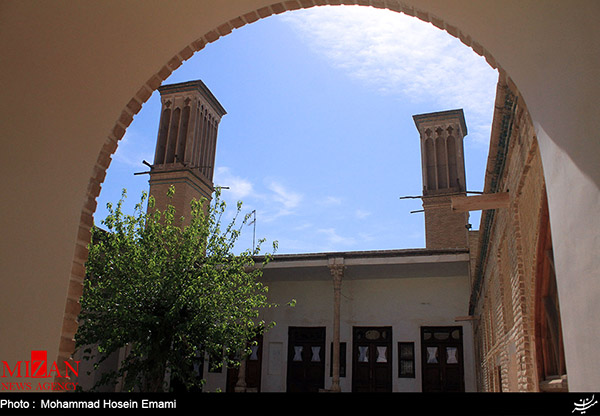
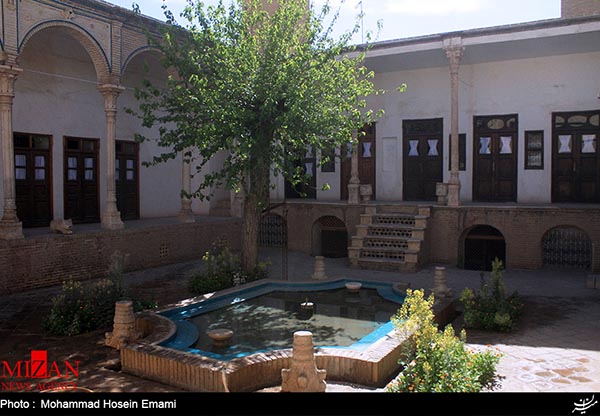
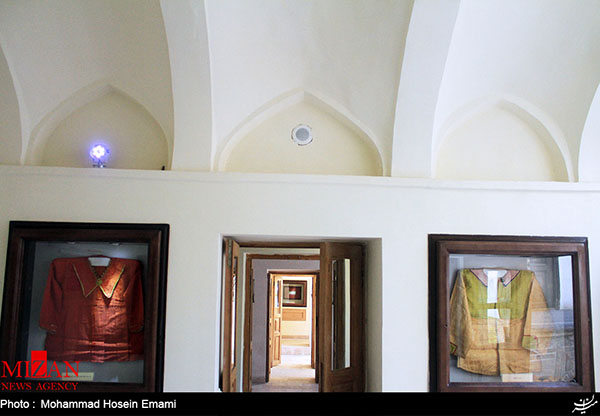
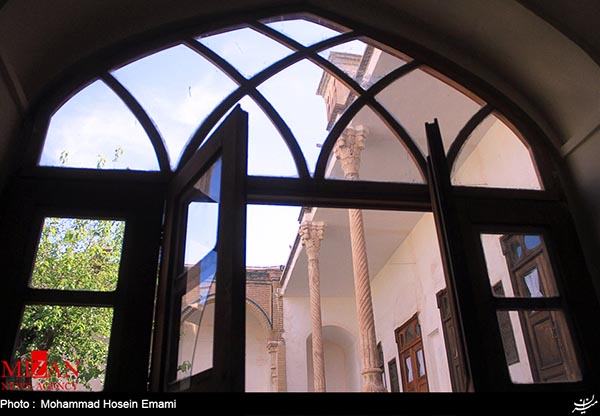
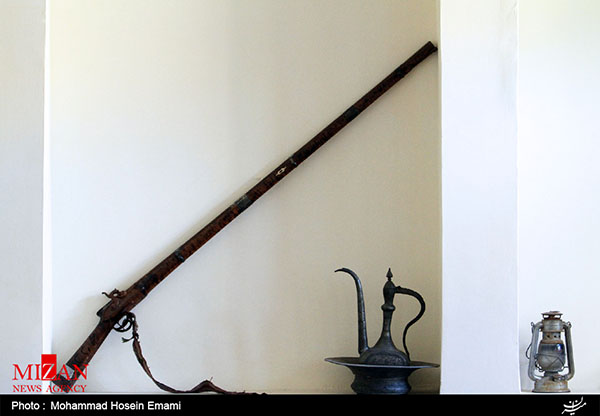
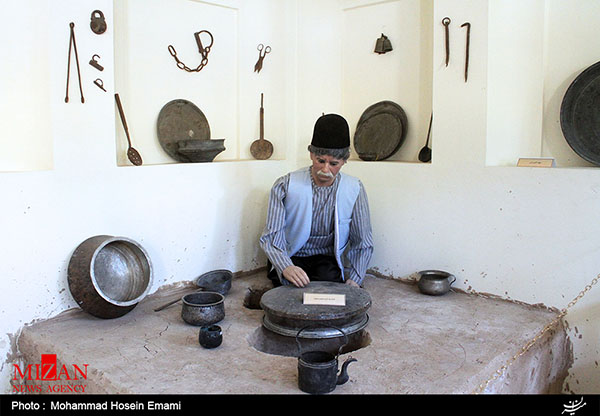
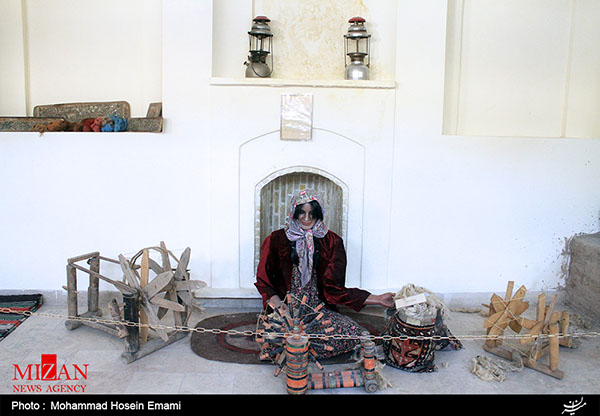
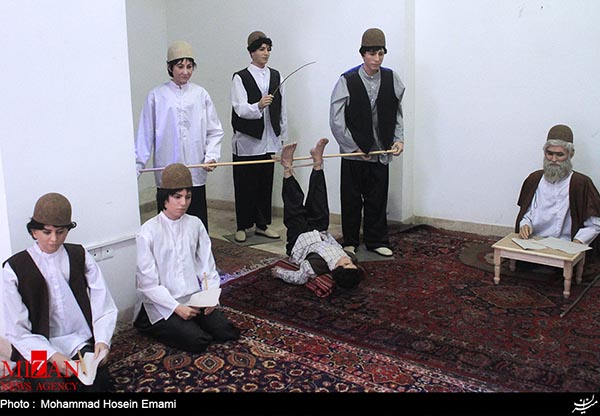
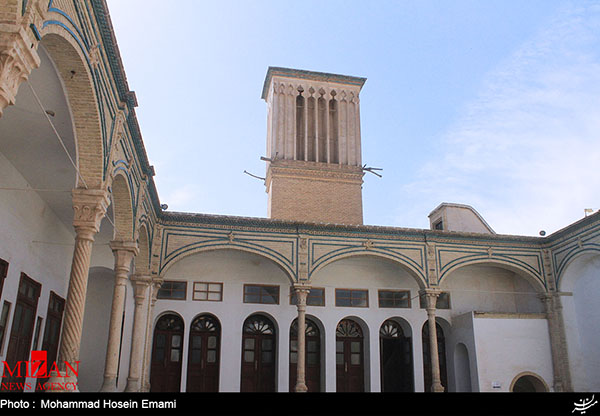
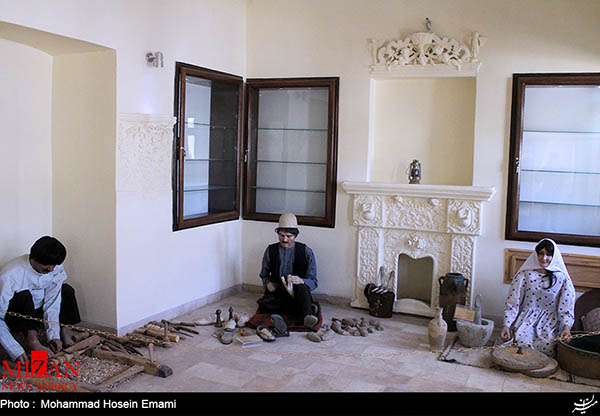
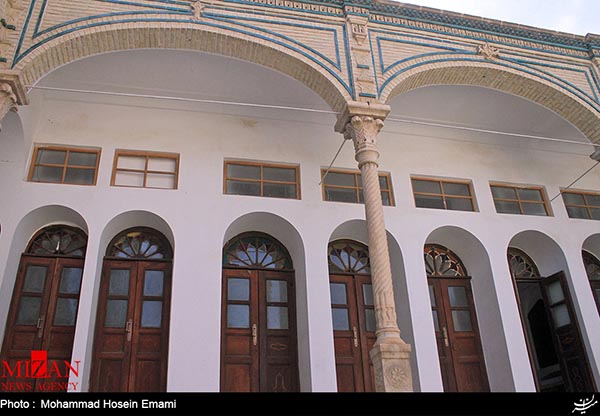
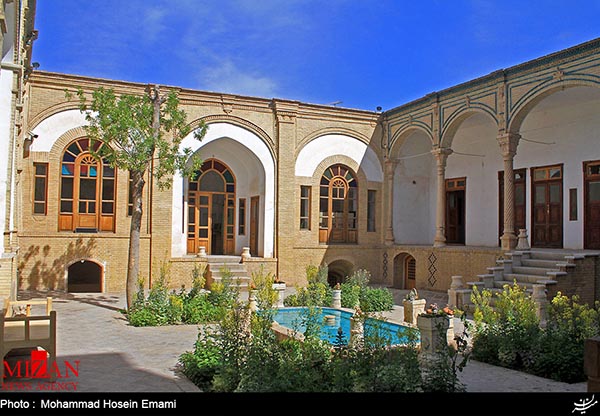
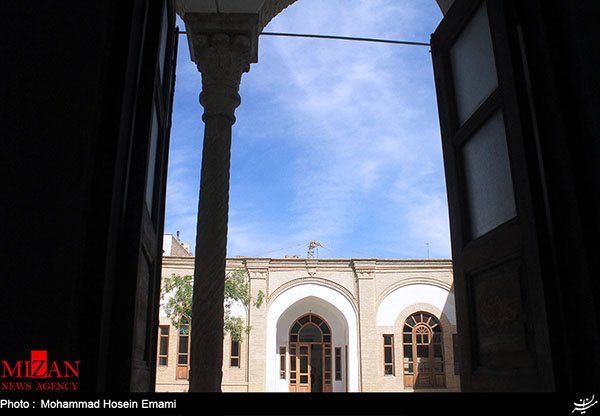
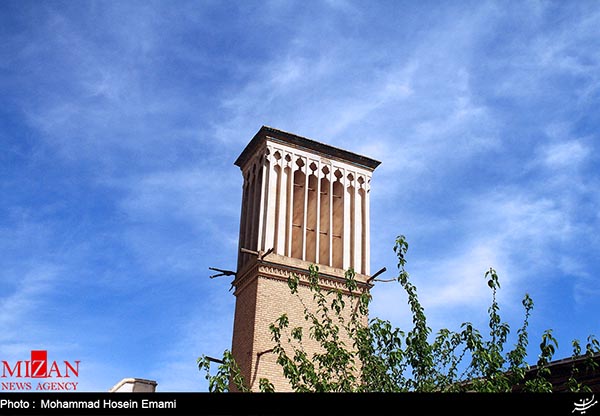
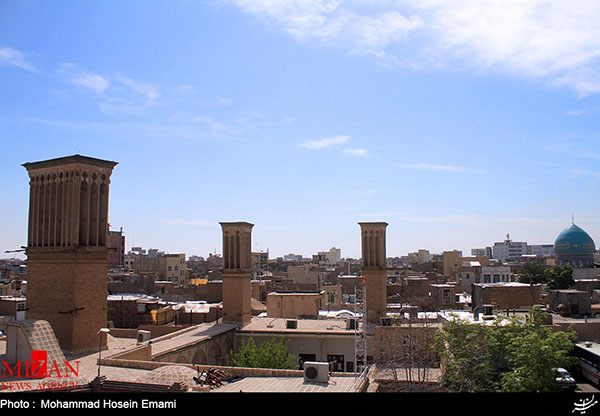
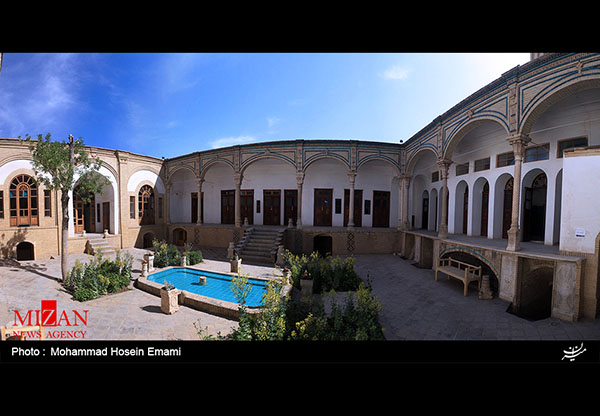
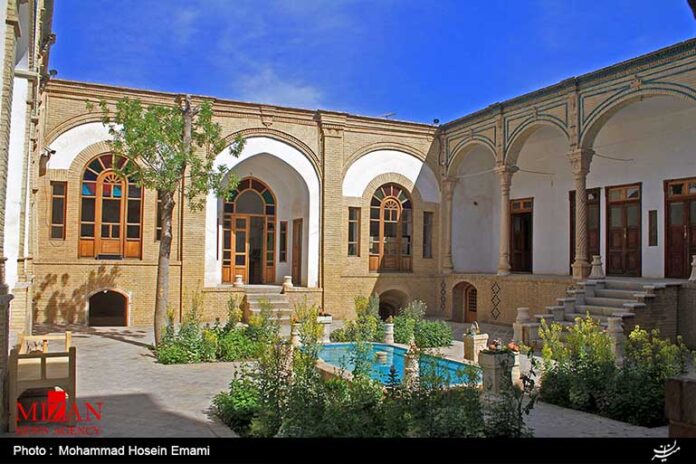
Zand Historical House at the heart of the city of Qom dates back to the late Qajar era. The 130-year-old building which is now a museum of anthropology displays is a manifestation of original Iranian architecture.

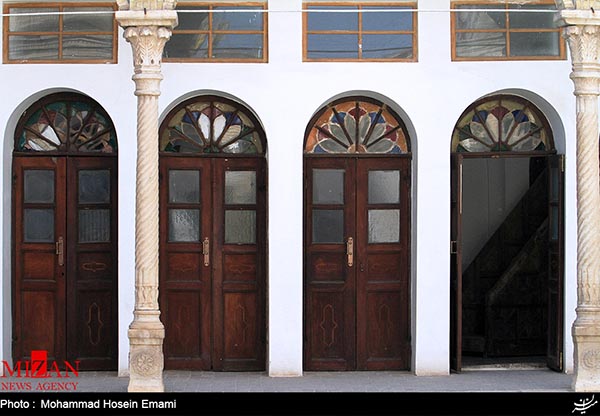
The historical house has two yards, 14 rooms, 36 wooden doors and windows and 14 stone pillars.

Stones, woods, bricks, adobe and stucco have been used in the construction of the building. Although the house has been restored a few times, its original structure has remained intact.

The following are images of the house mizanonline.ir has posted online:

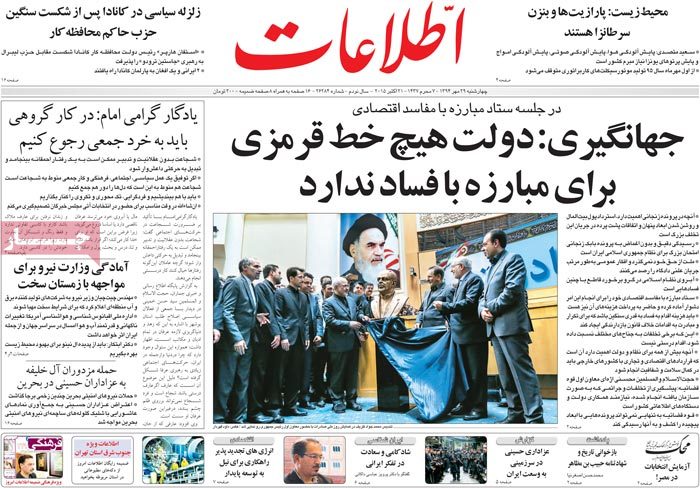
Highlights of Ettela’at newspaper on October 21

ettelaat-21-oct

“There are no government red lines in the fight against corruption,” the first vice-president told a meeting of the anti-corruption commission.

Eshagh Jahangiri further said what is important in the case involving Babak Zanjani [a young billionaire on trial for corruption] is the return of the money which has been siphoned off.

 The Environment Protection Organization has said that satellite signal jammers and benzene are carcinogenic.

A deputy director of the organization has said that production of motorcycles with carburetors will stop as of September 2016.

 The defeat of the ruling Conservative party in Canada, a political seismic shift.

In the same elections, two candidates of Iranian origin and one of Afghan descent won parliamentary seats.

 The grandson of the architect of the Islamic Republic has said that collective wisdom should be tapped in teamwork.

Seyyed Hassan Khomeini further said he’ll make a decision “in due time” on whether to run for the Assembly of Experts.

 The Energy Ministry is ready for a harsh winter.

The energy minister has urged water and electricity companies to brace for a bitterly cold winter.

 Bahraini forces have attacked Shiite mourners.

The attack by the security forces left a few worshippers injured.

A look at Iranian newspaper front pages on Oct. 21

Iranian Newspapers Headlines

The comments of the first vice-president and the trade minister in a ceremony to mark National Exports Day dominated the front pages of Iranian newspapers on Wednesday. Also on the cover of reformist dailies was the response of the grandson of the late Imam Khomeini to a question as to whether he plans to run for the Assembly of Experts.


Ettela’at: “There are no government red lines in the fight against corruption,” the first vice-president told a meeting of the anti-corruption commission.

Eshagh Jahangiri further said what is important in the case involving Babak Zanjani [a young billionaire on trial for corruption] is the return of the money which has been siphoned off.


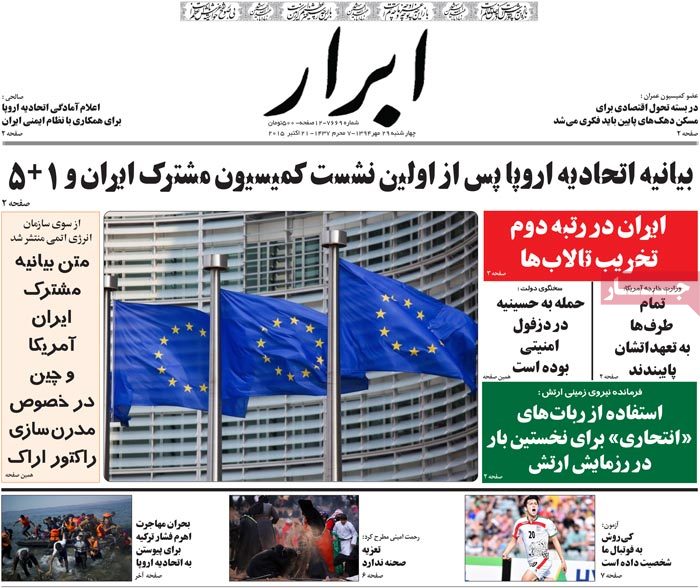
Abrar: The European Union has expressed willingness to contribute to Iran’s safety system, said the director of the Atomic Energy Organization of Iran.

Abrar: The refugee crisis is a Turkish lever to put pressure on the EU to admit Turkey.


A look at Iranian newspaper front pages on Oct. 21


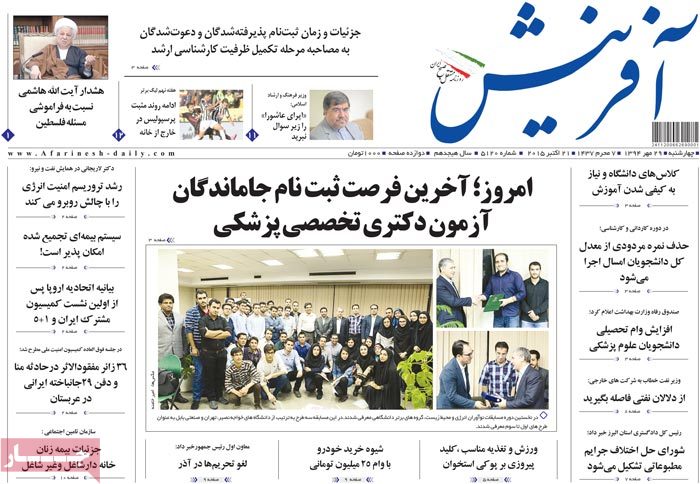
Afarinesh: An ad hoc session of the National Security Committee has reported that 36 Iranian pilgrims are still missing and 29 have been laid to rest in Saudi Arabia following the deadly stampede in Mina on September 24.


A look at Iranian newspaper front pages on Oct. 21


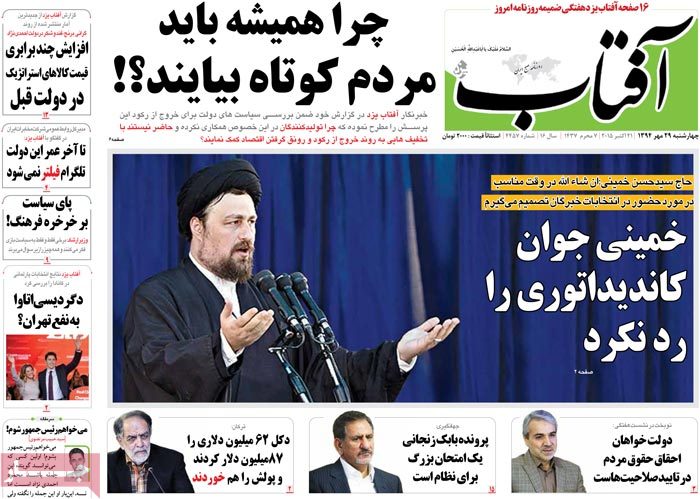
Aftab-e Yazd: The young Khomeini did not rule out running for the Assembly of Experts.

Aftab-e Yazd: Why should the public always back down?

In reviewing the policies of the government to lift the economy out of recession, the daily wonders why manufacturers are not willing to be cooperative and prop up the economy by offering discounts.


A look at Iranian newspaper front pages on Oct. 21


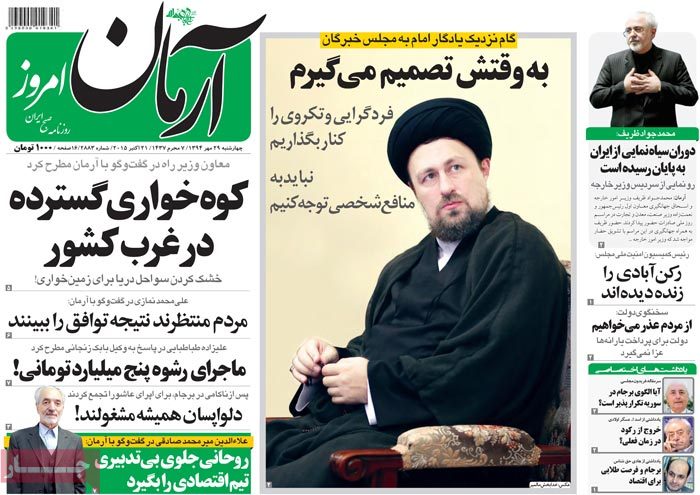
Arman-e Emrooz: The deputy minister of roads has revealed that there has been massive reclamation in mountainous areas in the west.

Arman-e Emrooz: The chairman of parliament’s National Security and Foreign Policy Committee has said Roknabadi [Iran’s former ambassador to Lebanon who has been missing since the deadly stampede in Saudi Arabia in September] was spotted alive after the incident.


A look at Iranian newspaper front pages on Oct. 21


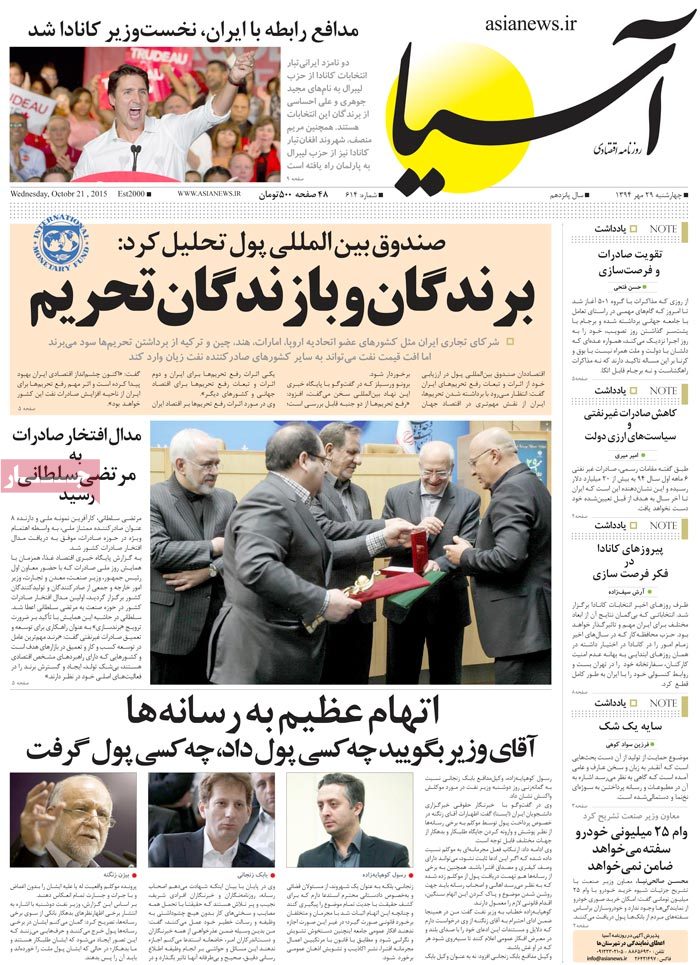
Asia: A politician who favors [better] relations with Iran has been elected prime minister in Canada.


A look at Iranian newspaper front pages on Oct. 21


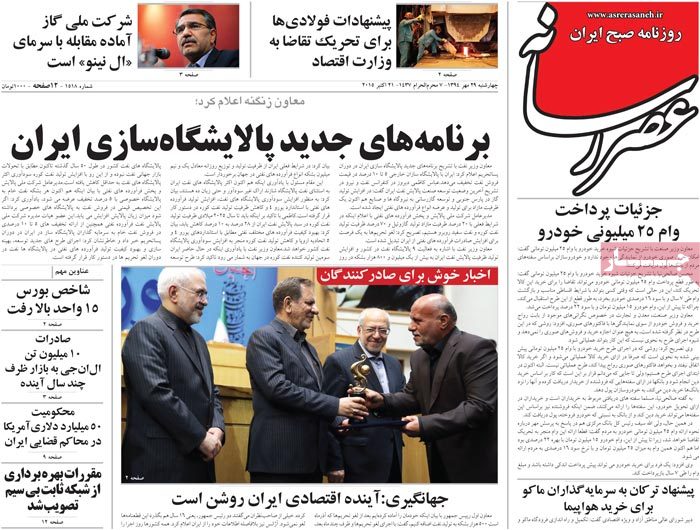
Asr-e Rasaneh: Within years, exports of LNG to global markets will hit 10 million tons.


A look at Iranian newspaper front pages on Oct. 21


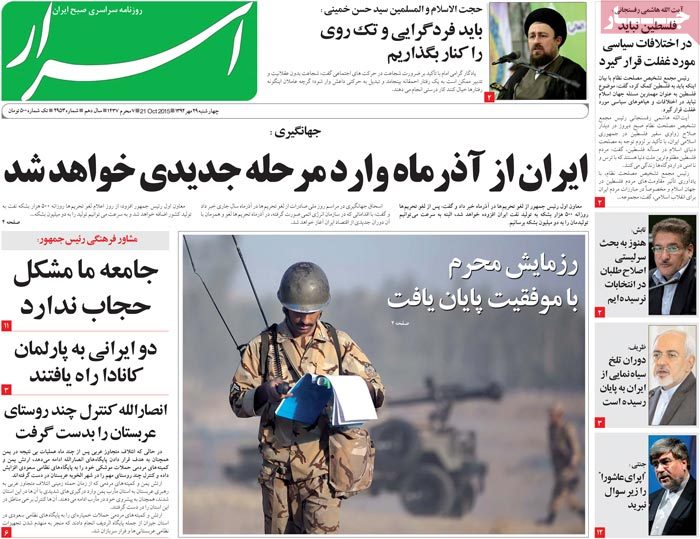
Asrar: “We need to dispose of individualism and go-it-alone approaches,” said the grandson of the late Imam Khomeini.

Asrar: “The dark days of painting a dark image of Iran have come to an end,” said Foreign Minister Mohammad Javad Zarif.


A look at Iranian newspaper front pages on Oct. 21


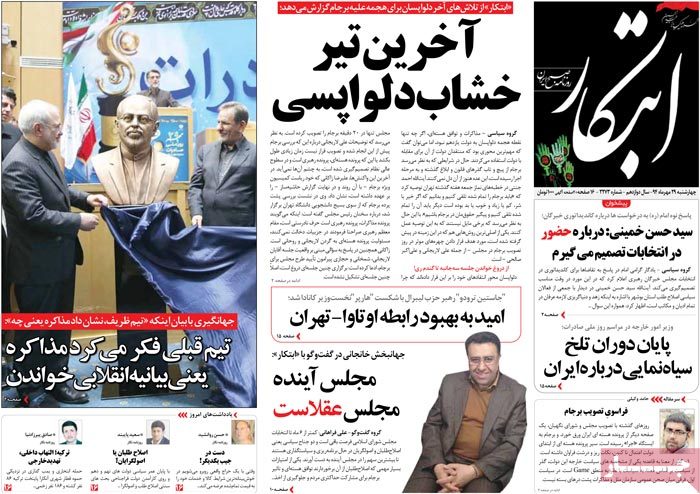
Ebtekar: The election of a liberal prime minister in Canada has raised hopes of an improvement in Tehran-Ottawa relations.


A look at Iranian newspaper front pages on Oct. 21


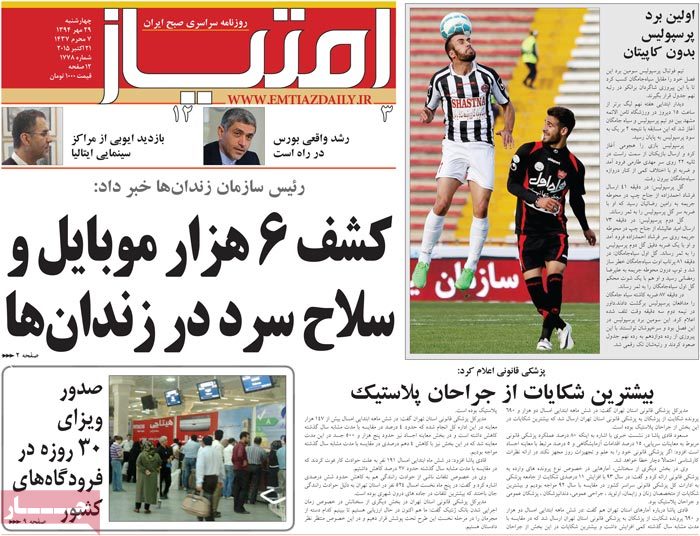
Emtiaz: The director of the State Prisons Organization has said nearly 6,000 cell phones and 20,000 bladed weapons have been seized from inmates in detention facilities across the country.
 

A look at Iranian newspaper front pages on Oct. 21


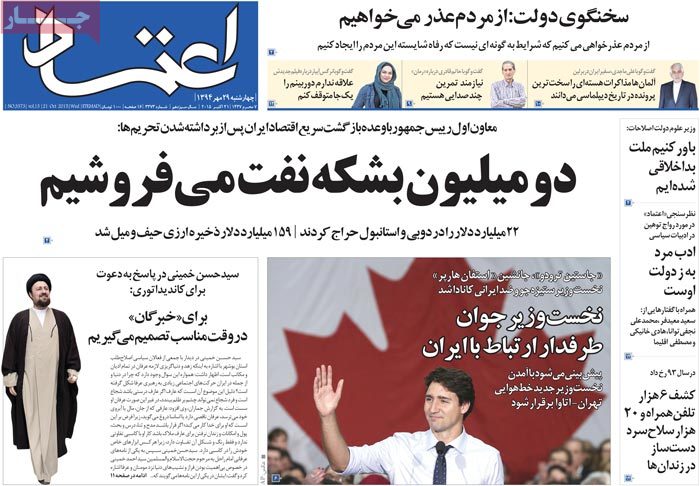
Etemad: The first vice-president has vowed Iran’s economy will rally fast after the sanctions have been lifted.

He said [during the presidency of Ahmadinejad] $159 billion of the Foreign Reserve Fund was wasted.


A look at Iranian newspaper front pages on Oct. 21


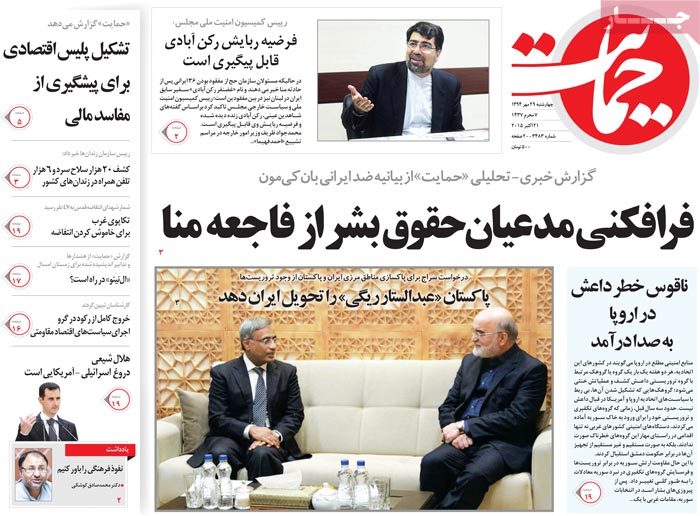
Hemayat: An economic police division is to be set up to prevent corruption.


A look at Iranian newspaper front pages on Oct. 21


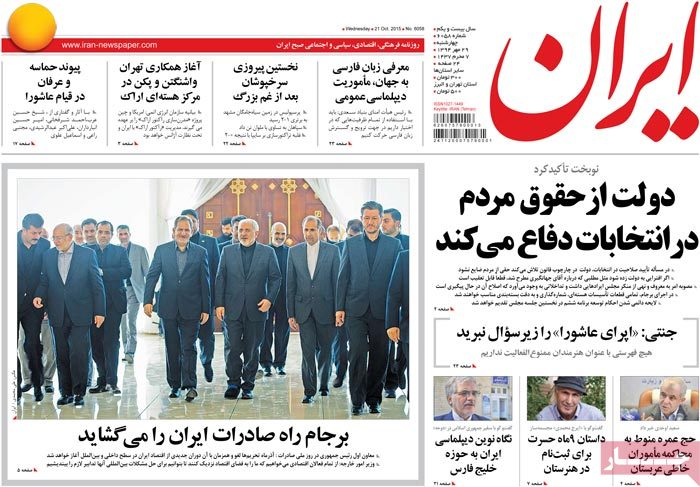
Iran: Government Spokesman Mohammad Bagher Nobakht has said that the Rouhani administration will stand up for the rights of the public in the upcoming elections.


A look at Iranian newspaper front pages on Oct. 21


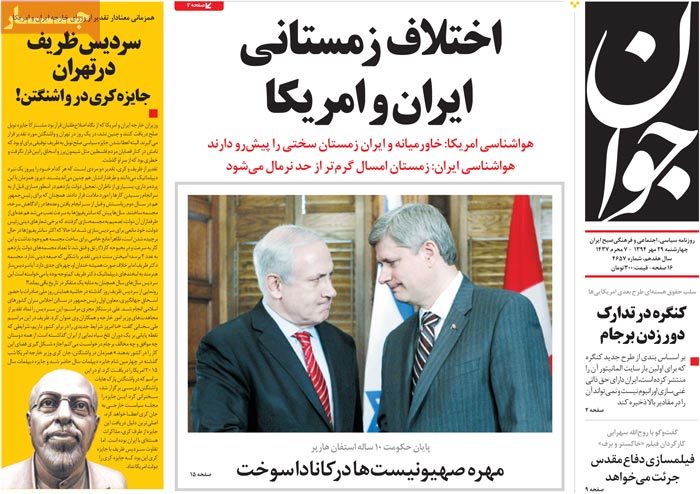
Javan: The Zionist pawn in Canada was ousted.

The decade-long reign of Stephen Harper came to an end.

Javan: The winter-based disagreement between Iran and the US.

The US National Weather Service says the Middle East and Iran are in for a harsh winter.

Iran’s Meteorological Organization says that this winter will be warmer than normal.


A look at Iranian newspaper front pages on Oct. 21


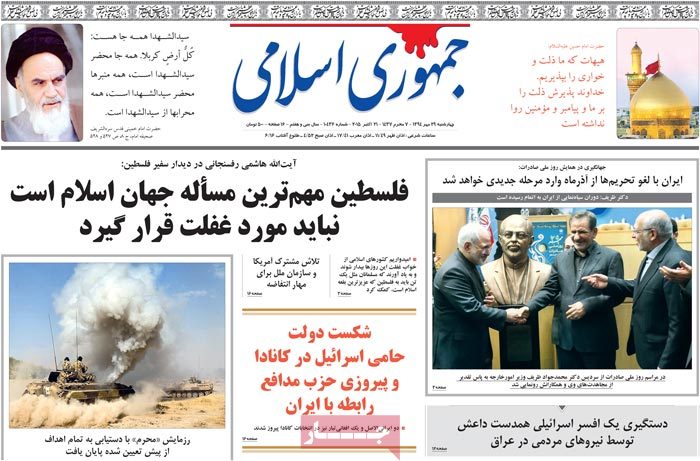
Jomhouri Islami: “With the termination of sanctions in two months, a new chapter will open for Iran on the international stage,” said first vice-president Eshagh Jahangiri.

Jomhouri Islami: “Palestine is the most important issue of the world of Islam; it should not skip through the cracks,” Chairman of the Expediency Council Ayatollah Akbar Hashemi Rafsanjani said in a meeting with the Palestinian ambassador to Tehran.


A look at Iranian newspaper front pages on Oct. 21


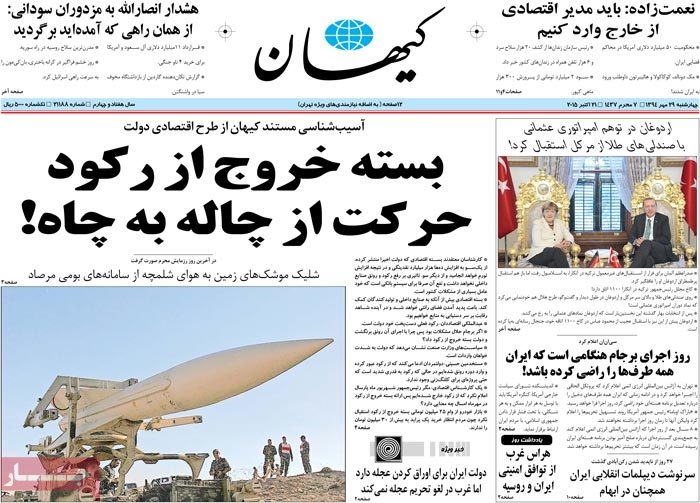
Kayhan: The package to lift the country out of recession is like jumping out of the frying pan into the fire.

The daily takes a closer look at the government’s economic plan.


A look at Iranian newspaper front pages on Oct. 21


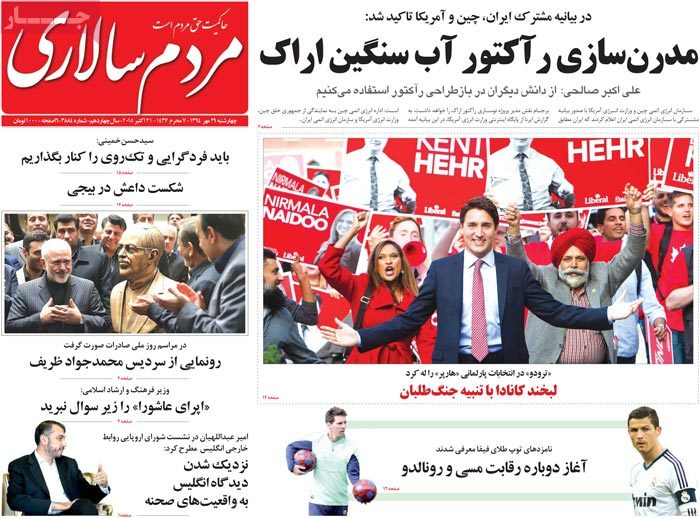
Mardomsalari: The Iranian deputy foreign minister has said that British views are getting closer to realities on the ground in Syria.


A look at Iranian newspaper front pages on Oct. 21


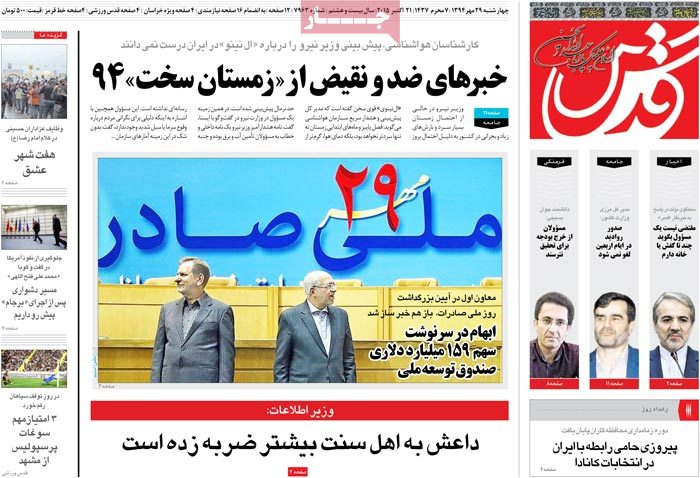
Qods: “The harm IS has done to Sunnism is greater [than to Shiism],” said the intelligence minister.


A look at Iranian newspaper front pages on Oct. 21


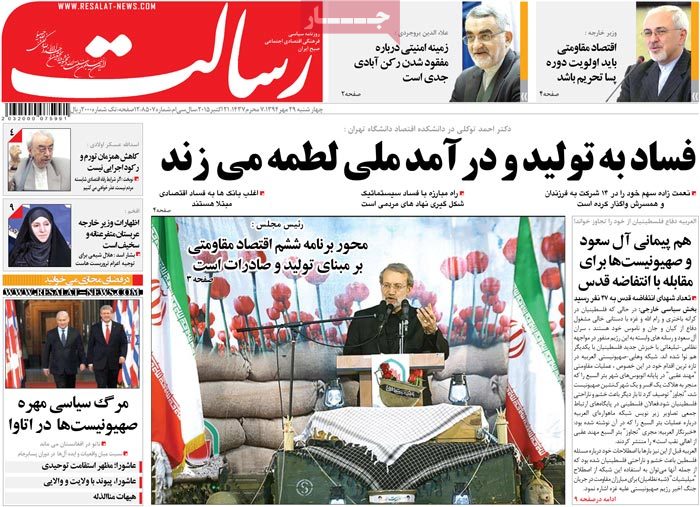
Resalat: The foreign minister has said that propping up a resistance-based economy should be the country’s top priority in the post-sanctions era.


A look at Iranian newspaper front pages on Oct. 21


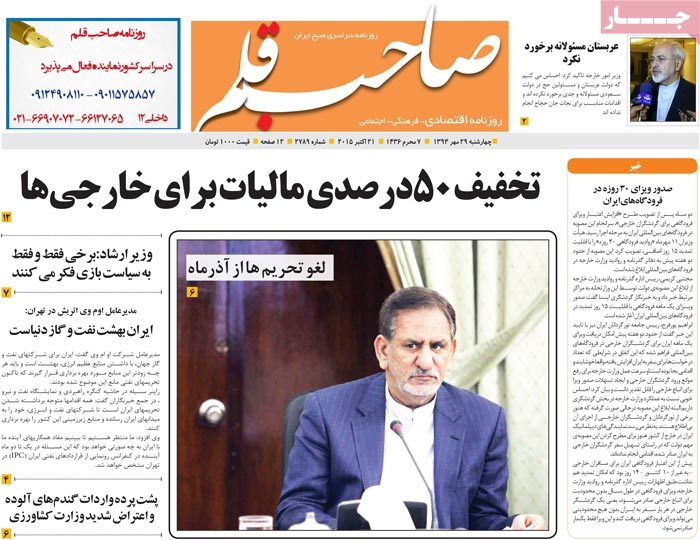
Saheb Ghalam: A 50 percent tax cut for foreigners


A look at Iranian newspaper front pages on Oct. 21


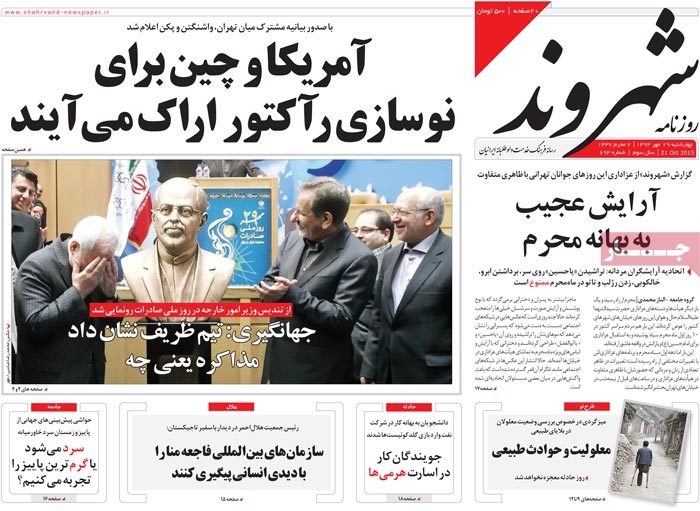
Shahrvand: The US and China will help redesign the reactor of Arak nuclear facility.
 

A look at Iranian newspaper front pages on Oct. 21


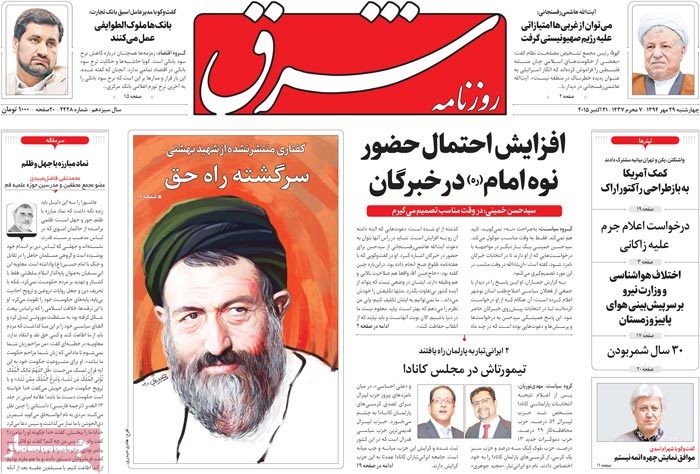
Sharq: The Meteorological Organization and the Energy Ministry are at odds with each other over winter weather forecasts.


A look at Iranian newspaper front pages on Oct. 21


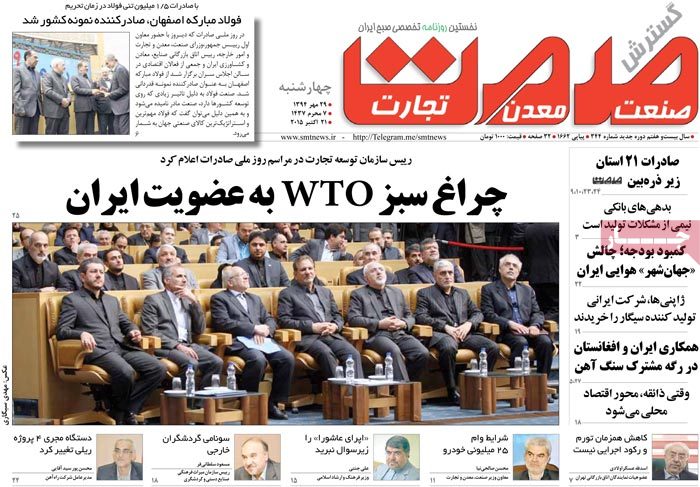
SMT: The director of the Trade Promotion Organization has said that the World Trade Organization has given the green-light to Iran’s membership of the world body.


A look at Iranian newspaper front pages on Oct. 21


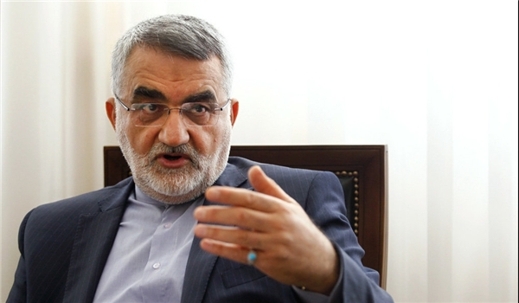
Roknabadi seen alive in S. Arabia, claims on his death not acceptable: Senior MP

Broujerdi

Chairman of parliament’s National Security and Foreign Policy Committee Alaeddin Boroujerdi rejected claims that Tehran’s former ambassador to Beirut, Ghazanfar Roknabadi, who went missing during the recent crush in Saudi Arabia is dead, and said there is a growing body of evidence which indicates he may have been abducted in Saudi Arabia.

“Based on documented evidence, eyewitnesses have seen Roknabadi alive and being taken to a hospital, but after that there has been no reliable news about his situation and whereabouts,” Boroujerdi said on Tuesday.

He said that the Saudi government should account for the fate of all Iranian nationals missing since the Mina incident, and added given the important position of Roknabadi, his fate should come to light very soon.

Boroujerdi dismissed as “unacceptable” claims that Roknabadi has died in the Mina incident, and said, “Roknabadi’s abduction theory remains a very strong possibility as long as the Saudi government doesn’t return his body to Iran.”

[…]

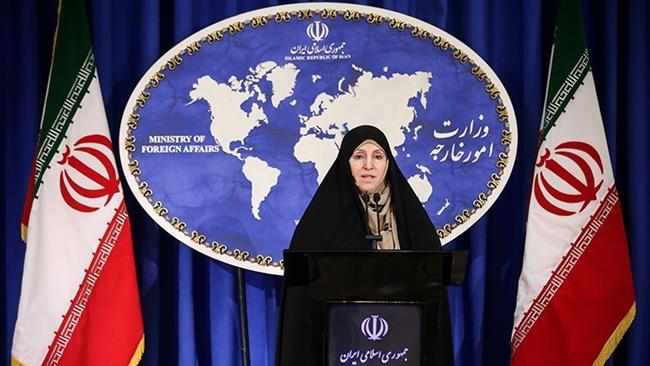
Canadian election outcome indicates demand to avoid extremism

Marzieh Afkham

The Foreign Ministry spokeswoman said Tuesday that the outcome of general election in Canada was the reaction of Canadian people to the radical policies of the Conservative government.

Marzieh Afkham said that the results reflected the desire of the Canadian people to refrain from radical policies and that Iran respects the choice of the Canadian people.

Canadians went to the polls on Monday for ‘Big Change’. The Liberal Party led by Justin Trudeau defeated the Conservative Party’s Stephen Harper, who pursued a tough line on Iran.

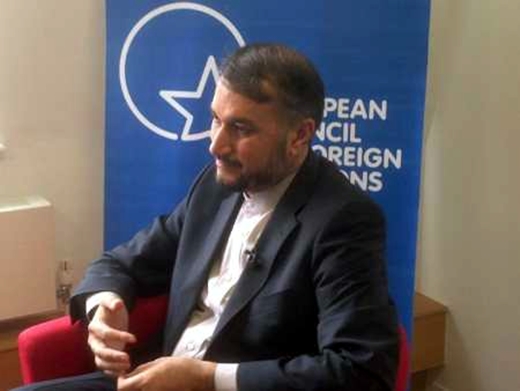
Deputy FM confirms Iran increased military advisors in Syria

Amirabdollahian

The deputy foreign minister for Arab and African affairs said Tuesday that the increased presence of Iran’s military advisors in Syria is aimed at the restoration of stability there and the anti-terrorism campaign comes at the request of Damascus.

“We have no combatant force in Syria, but our military advisors assist that country’s central government in its campaign against terrorism,” said Hossein Amir Abdollahian in an interview with BBC 4.

In answer to a question on the extent of Iran’s military participation in Syria, Abdollahian referred to the broad ongoing anti-terrorism campaign in Syria, including the effective presence of the Russian Air Force, and added that the increased presence of Iranian military advisors which is aimed at contributing to the campaign comes at Syria’s request.

“Those advisors have the necessary experience and military expertise for effective anti-terrorism campaign,” he said.

When asked whether Iran considers itself a strategic ally of Russia, or whether it has just joined the coalition with Russia in Syria, he said, “We have strategic relations with Moscow and Iran’s ties with Russia in the post-Islamic Revolution era have never been provisional, or for a certain period of time,” he said.

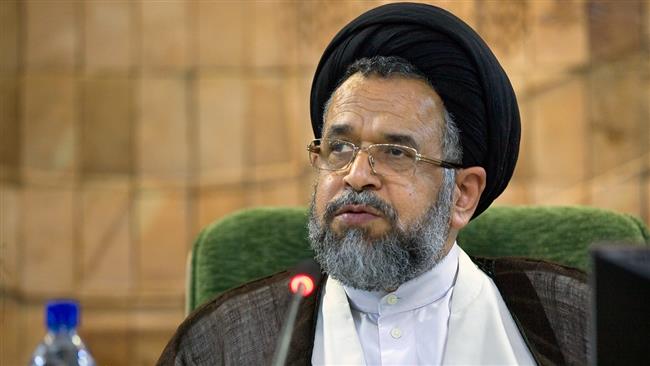
Enemy intelligence services plotting to divide Muslims: Iran

Iran's Intelligence Minister Seyyed Mahmoud Alavi

Intelligence Minister Mahmoud Alavi has said the intelligence services of enemy states seek to cause discord among Muslim nations and harm them.

“Since the enemy cannot harm Islam through armies and military hardware, it tries to cause discord among Muslim countries and bring them to their knees through its intelligence services,” Alavi said on Tuesday.

He added that the enemy spy agencies are securing the survival of the Israeli regime by sowing discord among Muslim countries.

Alavi said the enemy switched from deploying military to psychological warfare for protecting the Israeli regime after Tel Aviv’s defeats in its military adventures.

He said that such plots have failed to harm Iran thanks to the valuable guidelines of Leader of the Islamic Revolution Ayatollah Seyyed Ali Khamenei, stressing the importance of maintaining unity and security in Iran.

“Irrespective of ethnicity and religion, the Islamic [Republic of] Iran has not hesitated to help Muslims every time an adversity has befallen them. [That is] because the sacred establishment of the Islamic Republic of Iran knows no ethnic and religious bounds.”

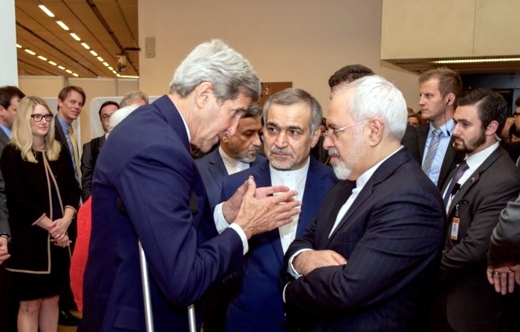
Efforts of two top diplomats praised on the same day

Zarif-Kerry

US Secretary of State John Kerry will receive the Diplomat of the Year award from Foreign Policy magazine Tuesday night for his role in concluding the Iran nuclear agreement.

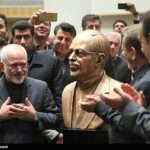
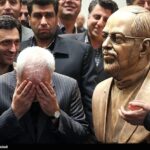
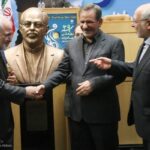
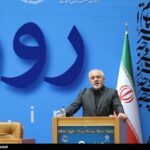
Also on Tuesday, a bust of Foreign Minister Mohammad Javad Zarif was unveiled – in a ceremony in Tehran to mark National Exports Day – in praise of his efforts on the diplomatic front.

At the ceremony which was attended by the first vice president and the minister of industries, mines and trade, Dr. Zarif was also awarded an accolade.

[The timing of the award: National Exports Day shows the economic aspects of the deal in Iran outweigh its political significance.]