Wednesday, December 24, 2025
Home Blog Page 4705

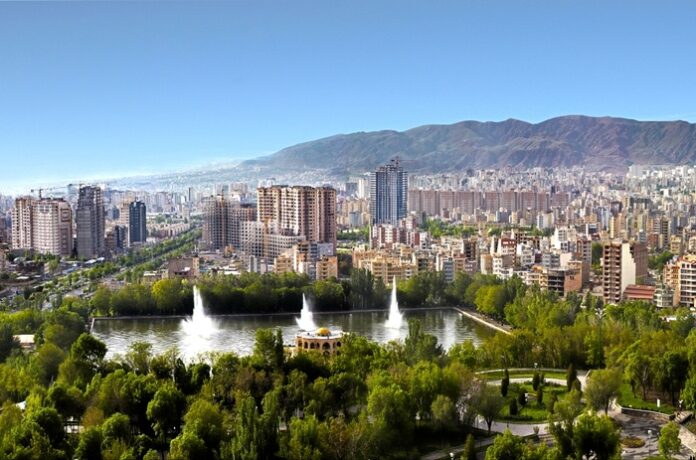
Tabriz, best Iranian city to live in

Tabriz

For a third consecutive year, the northwestern city of Tabriz has been introduced as the best Iranian city to live in.

According to studies by the United Nations about different cities across the world published in an online magazine, Tabriz is the most beautiful and developed Iranian city followed by Tehran, Isfahan, Mashhad, Shiraz, Qom and Orumiyeh.

Fars News Agency filed a report on October 12 on the designation of Tabriz as the best Iranian city. The translation of part of the report is as follows:

Among other things, the number of modern and beautiful buildings, developed airlines, attractive pristine nature, delicious food, beautiful mosques and historical sites contributed to Tabriz’s securing the title.

It came after the World Health Organization named Tabriz as the healthiest and most hygienic city in Iran two years ago.

Tabriz has also been identified as an Iranian city at the forefront of private investment and the most successful in fulfilling the provisions of Article 44 of the Constitution [which deals with privatization of state companies].

The provincial capital of East Azerbaijan was also named as the World’s Carpet Capital in 2015 by UNESCO and the World Crafts Council. Only 11 cities have been designated as a World Crafts City. As the representative of Muslim cities on that list Tabriz is in the lead.

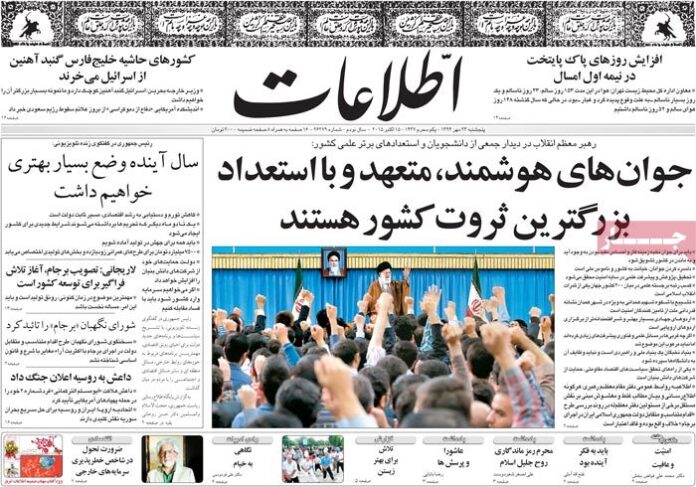
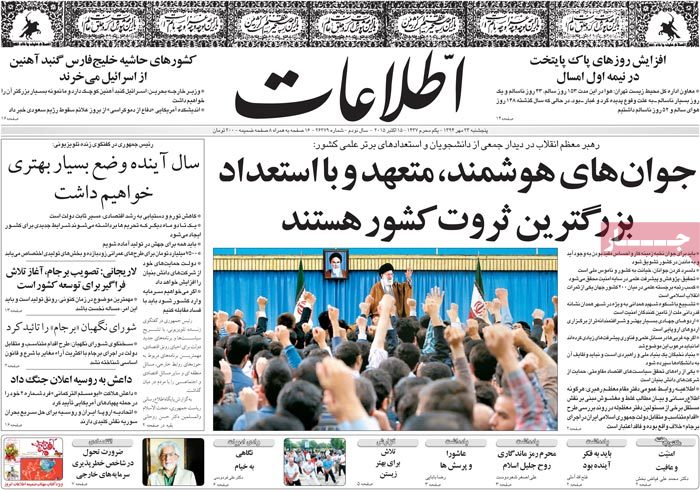
Highlights of Ettela’at newspaper on October 15

Ettelaat-15-oct

“The intelligent, committed and talented youth are the biggest asset of the country,” said the Supreme Leader at a meeting with a host of students and scientific talents of the country.

Ayatollah Khamenei further said the stage should be set for youth employment and for the youth to feel useful in the country.

 The number of days the capital had clean air increased in the first half of the year.

 Countries on the Persian Gulf are to buy Iron Dome from Israel.

 In a televised live interview [Tuesday night] President Rouhani said the country will have much better conditions next year.

He further said measures to cut inflation and secure economic growth are an integral part of the policies of his government.

 “Approval of the Joint Comprehensive Plan of Action marks the beginning of comprehensive efforts to develop the country,” Parliament Speaker Ali Larijani said.

The top MP further said that measures to promote production should be given priority.

 The Guardian Council has approved the Joint Comprehensive Plan of Action.

A spokesman for the council said a majority of the councilors did not find any constitutional or Sharia-related problems with the Government’s Reciprocal and Proportional Action Bill on the implementation of the Joint Comprehensive Plan of Action.

 IS has declared war on Russia.

The terrorist group confirmed its number two man has been killed in airstrikes by American drones.

A look at Iranian newspaper front pages on Oct. 15

Iranian Newspapers Headlines

The comments by the Supreme Leader at a meeting with a host of students and scientific talents from across the country and the approval by the Guardian Council of the Joint Comprehensive Plan of Action dominated the front pages of Iranian newspapers on Thursday.


Ettela’at: “The intelligent, committed and talented youth are the biggest asset of the country,” said the Supreme Leader at a meeting with a host of students and scientific talents of the country.

Ayatollah Khamenei further said the stage should be set for youth employment and for the youth to feel useful in the country.


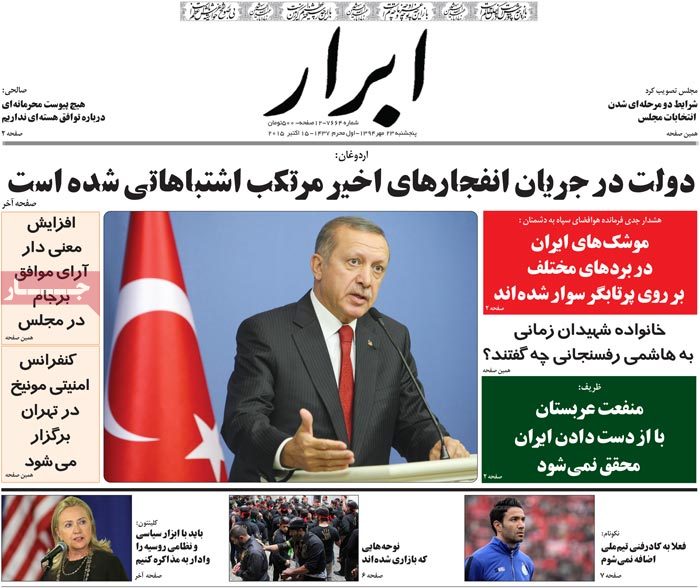
Abrar: Parliament has voted for a bill that sets conditions for legislative votes to be held in two rounds.

Abrar: Foreign Minister Zarif has said that cutting ties with Iran won’t serve the interests of the Saudis.

Abrar: Munich Security Conference will be held in Tehran.
 

A look at Iranian newspaper front pages on Oct. 15


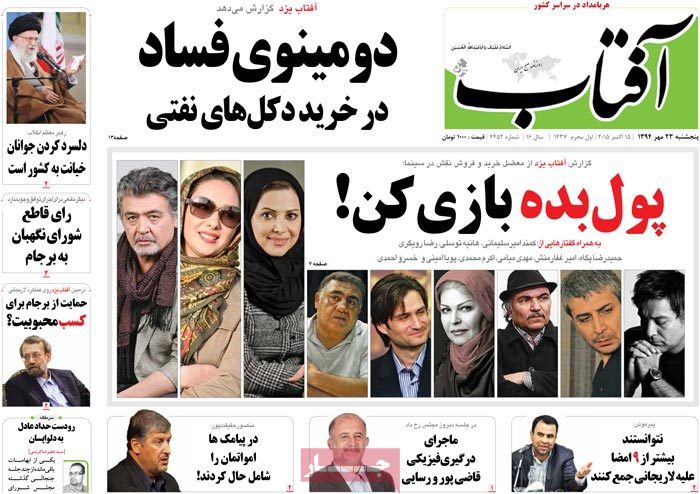
Aftab-e Yazd: Did Ali Larijani, the speaker of the Islamic Consultative Assembly, throw his weight behind the Joint Comprehensive Plan of Action to win popularity? The daily answers the question in a report.

Meanwhile, Kamaleddin Pirmoazen, an MP, said opponents of the speaker could only gather nine signatures against him.
 

A look at Iranian newspaper front pages on Oct. 15


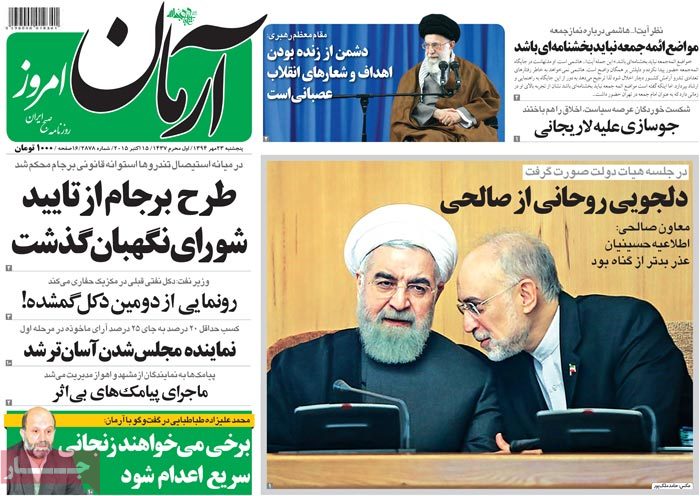
Arman-e Emrooz: Becoming an MP has been made easier.

Candidates need to secure 20 percent of the votes instead of the previous 25 percent to find their way to the Islamic Consultative Assembly in the first round of legislative elections.
 

A look at Iranian newspaper front pages on Oct. 15


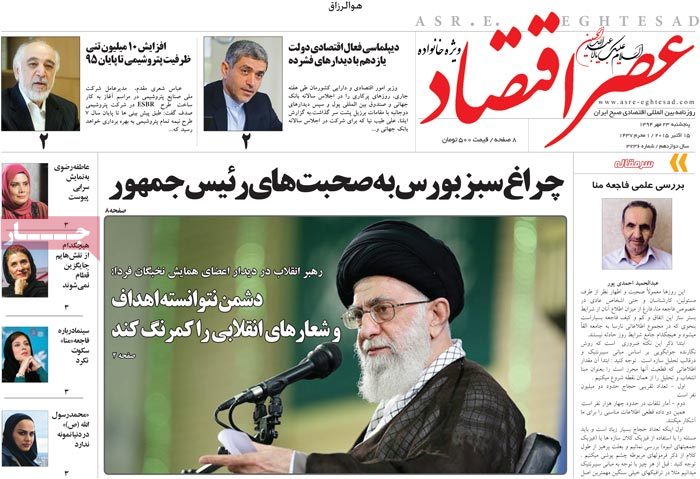
Asr-e Eghtesad: The country’s petrochemical capacity will have increased by 10 million tons by March 2017.
 

A look at Iranian newspaper front pages on Oct. 15


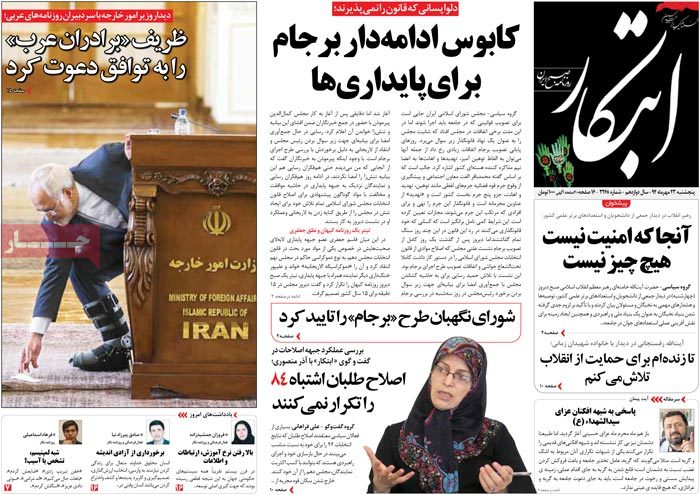
Ebtekar: Zarif has urged “the Arab brethren” to come to agreement.
 

A look at Iranian newspaper front pages on Oct. 15


Eghtesad-e Pooya: “Knowledge-based companies are the pillars of resistance-based economy,” said the Supreme Leader.


A look at Iranian newspaper front pages on Oct. 15


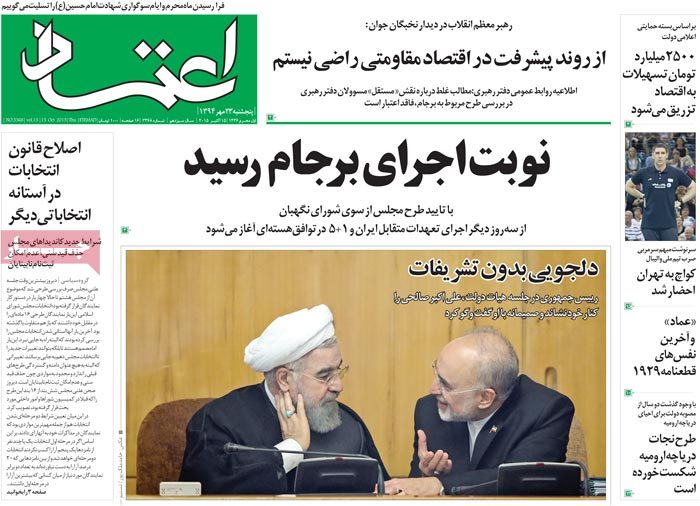
Etemad: The Supreme Leader has said that he is not satisfied with the trend in the growth of the resistance-based economy.

Etemad: Time to implement the Joint Comprehensive Plan of Action

With the approval of the legislative act by the Guardian Council, implementation of the deal between Iran and P5+1 will begin in three days.
 

A look at Iranian newspaper front pages on Oct. 15


Hemayat: Abu Bakr al-Baghdadi, the kingpin of the IS terrorist grouping, has been reportedly taken to Turkey to receive treatment.
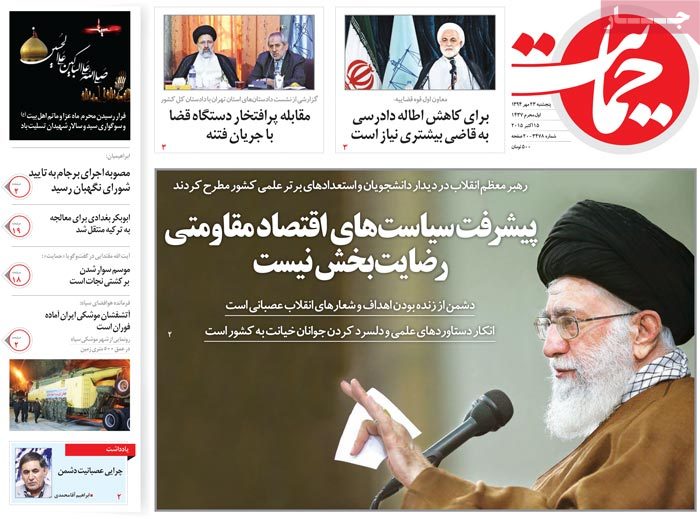
 

A look at Iranian newspaper front pages on Oct. 15


Iran: Oil Minister Bijan Namdar Zanganeh has unveiled fresh aspects of the oil derrick [embezzlement] case.
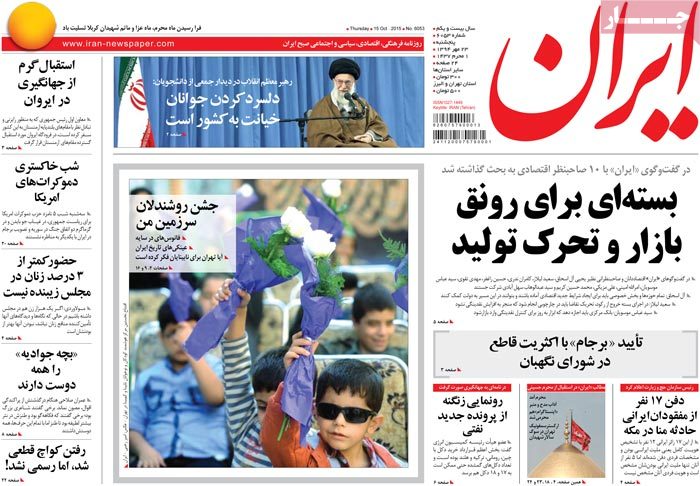
 

A look at Iranian newspaper front pages on Oct. 15


Jahan-e Sanat: The Stock Exchange trusted in Rouhani, and its three-month recession came to an end.

Jahan-e Sanat: The EU foreign policy chief has underlined regional contribution, including a key role for Iran and Russia, to efforts to settle the Syrian crisis.
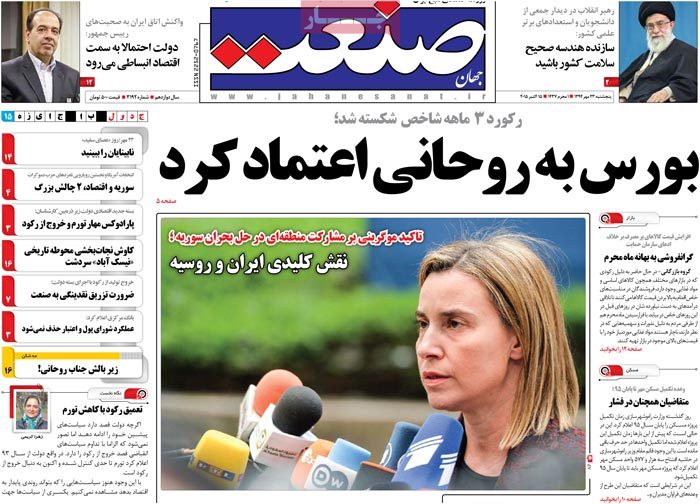
 

A look at Iranian newspaper front pages on Oct. 15


Javan: The Public Relations Department of the Supreme Leader’s Office has said [reports] that officials with the office have had an independent role in the review of the Joint Comprehensive Plan of Action are not true.

Javan: Images of the missile town of the Islamic Revolution Guard Corps nestled 500 meters underground in mountains have been released.

The commander of the Aerospace Division of the force has said in case the enemies make a mistake, our missiles will roar from deep underground.
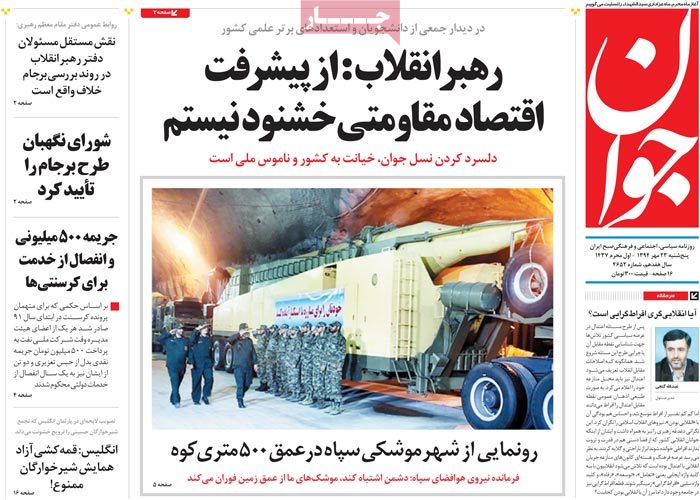
 

A look at Iranian newspaper front pages on Oct. 15


Kayhan: There was nothing going on behind the scenes, those who claimed otherwise should answer.

Claims that officials with the office have played an independent role in the review of the Joint Comprehensive Plan of Action are wrong, the Supreme Leader’s Office has said in a statement.
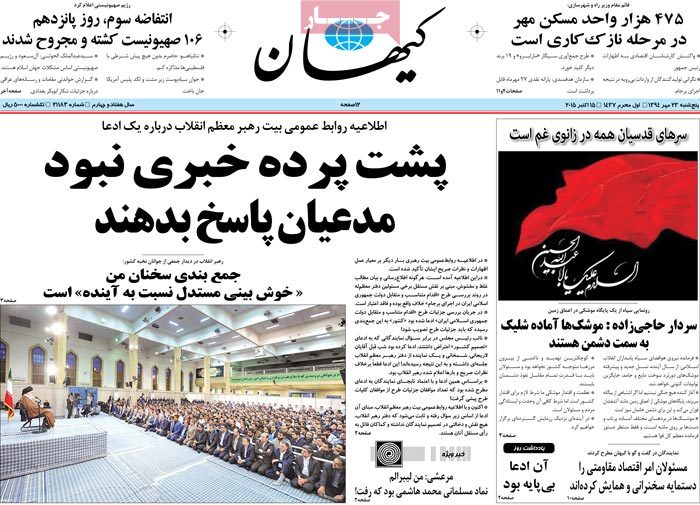
 

A look at Iranian newspaper front pages on Oct. 15


Mardomsalari: The vice president for women and family affairs has said that the percentage of women’s share of parliamentary seats, which currently stands at three percent, does not befit the establishment [and should increase].
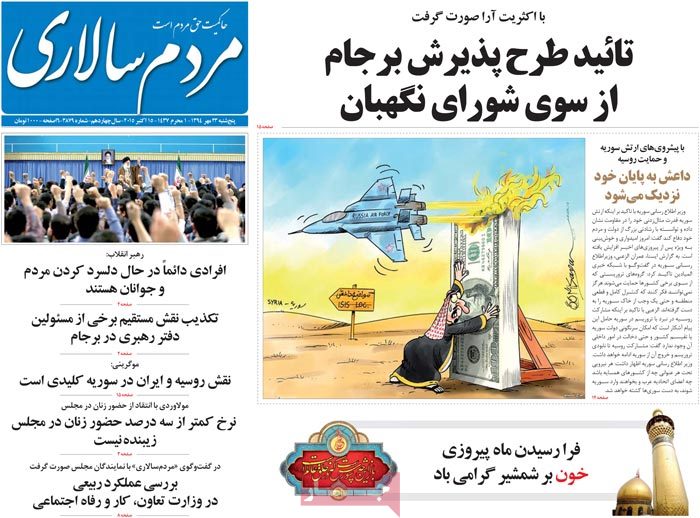
 

A look at Iranian newspaper front pages on Oct. 15


Qods: Backed by Russian air support, the Syrian Army is preparing to attack Aleppo.
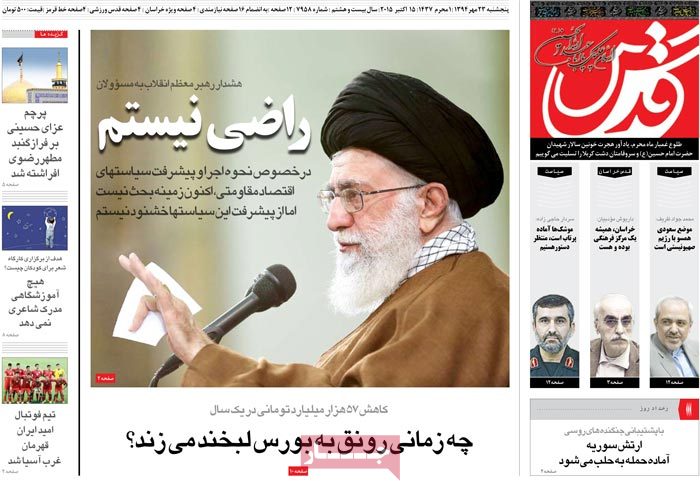
 

A look at Iranian newspaper front pages on Oct. 15


Resalat: “Iran has had no secret deal with the US over regional matters,” said Foreign Minister Zarif.

Resalat: The president has said that Iran’s monetary assets frozen overseas [as a result of sanctions] have already been spent.
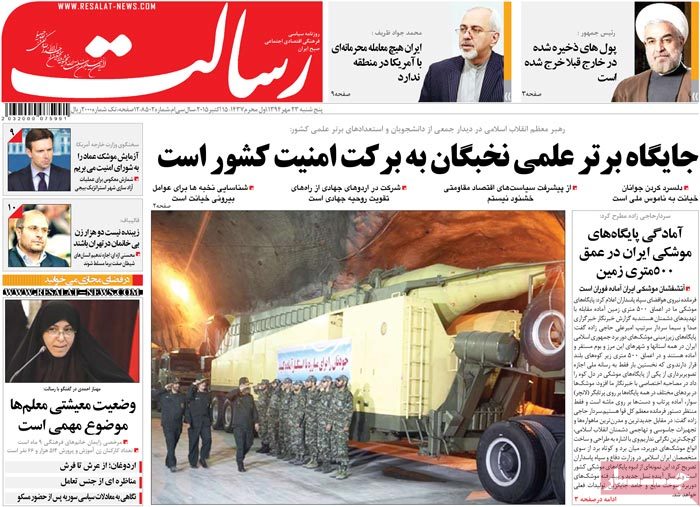
 

A look at Iranian newspaper front pages on Oct. 15


Sharq: “Staying in the country and making efforts to remove weak points amounts to honor,” said the Supreme Leader in remarks aimed at the youth.
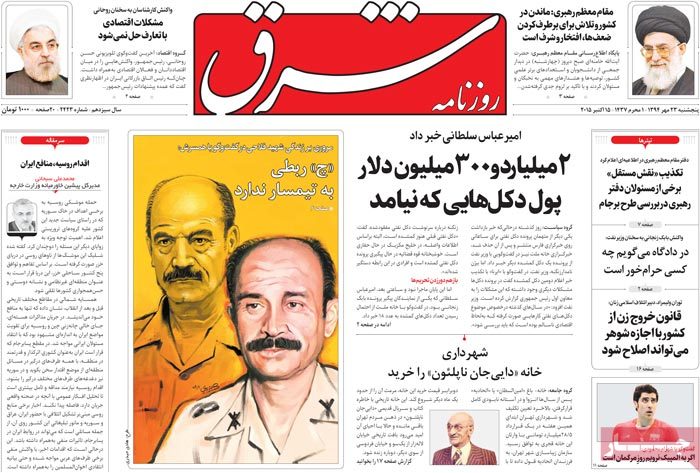
 

A look at Iranian newspaper front pages on Oct. 15


SMT: The countdown is on for the termination of sanctions.
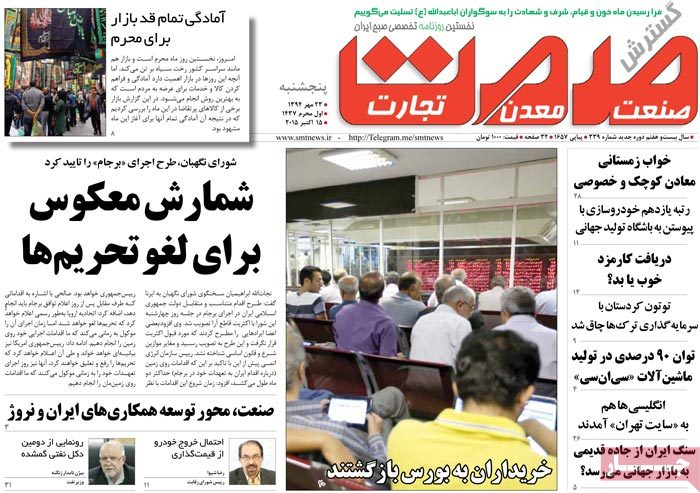
 

A look at Iranian newspaper front pages on Oct. 15


Former rough sleepers, special guests of a wedding in Tehran (PHOTOS)

wedding0

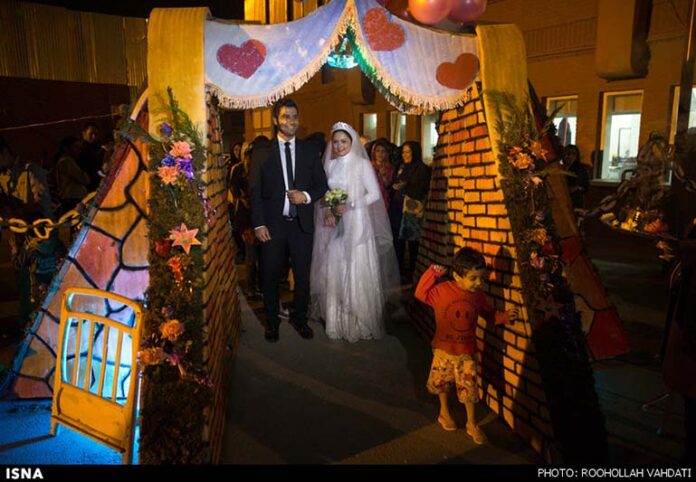
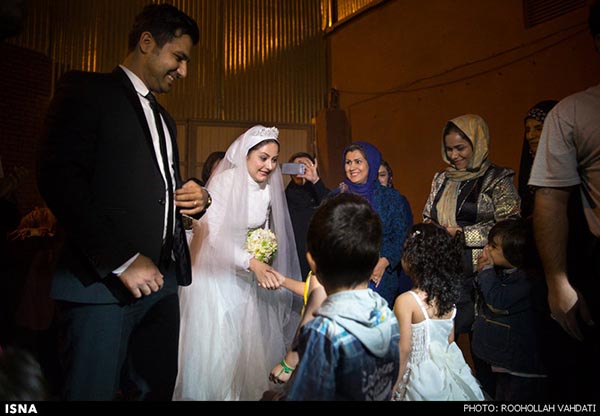
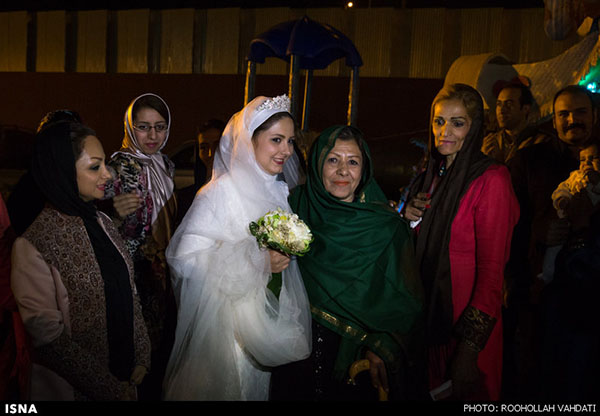
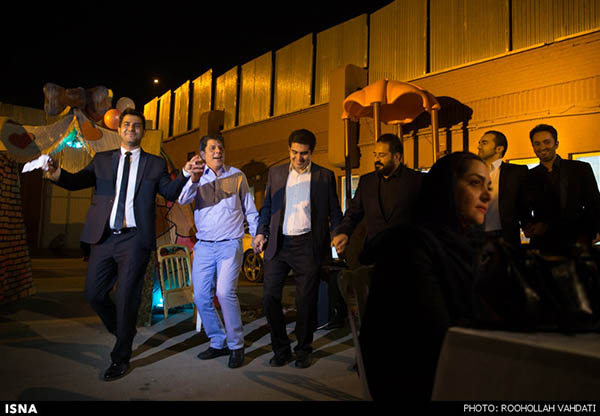
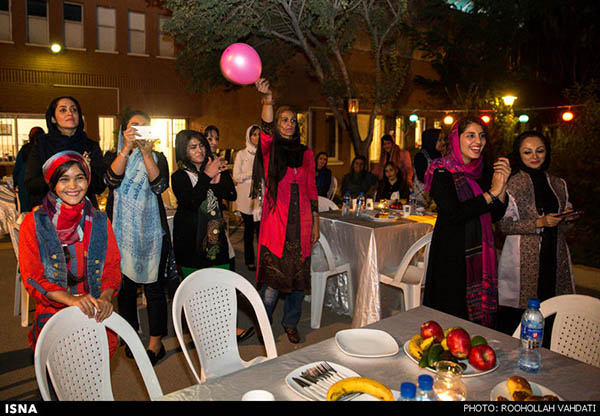
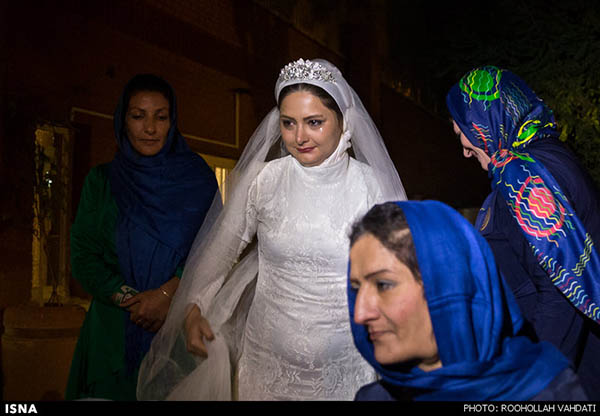
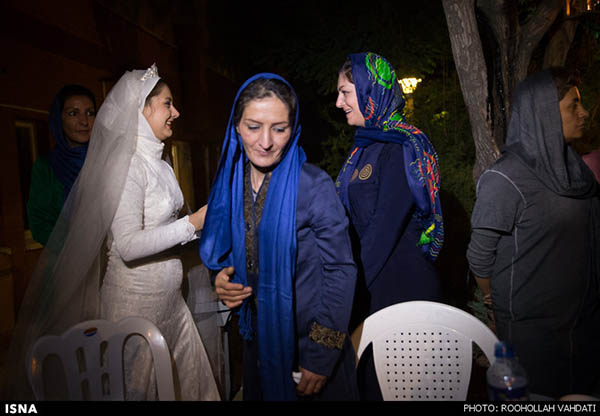
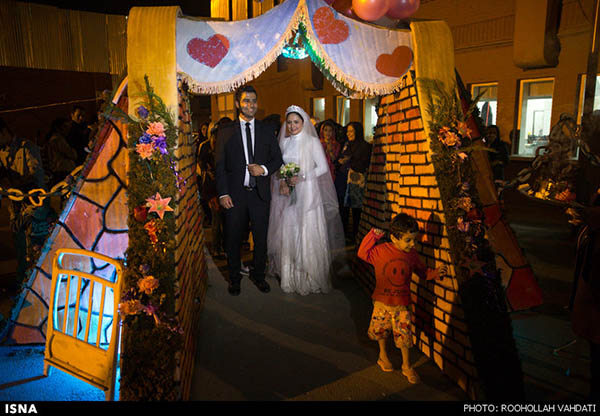
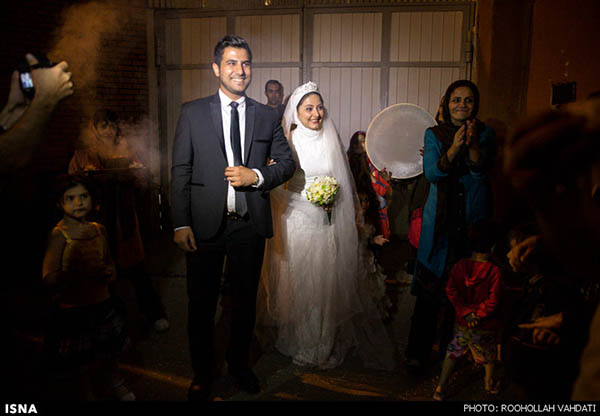
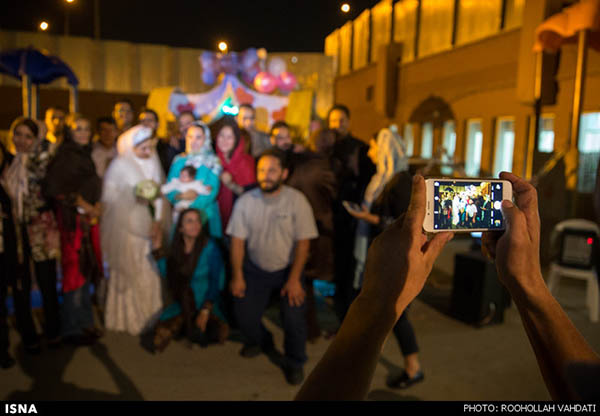
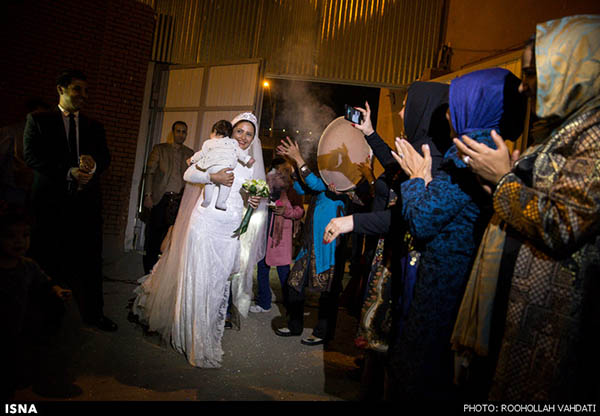
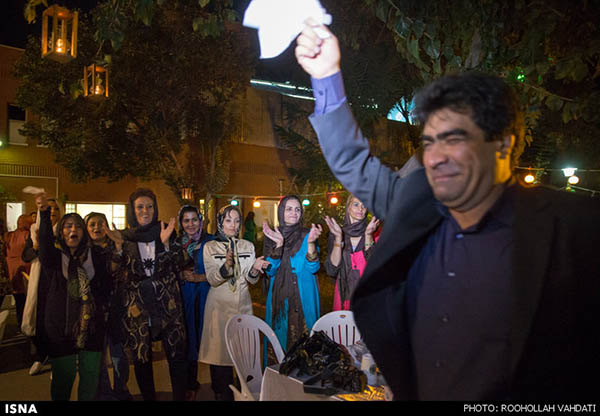
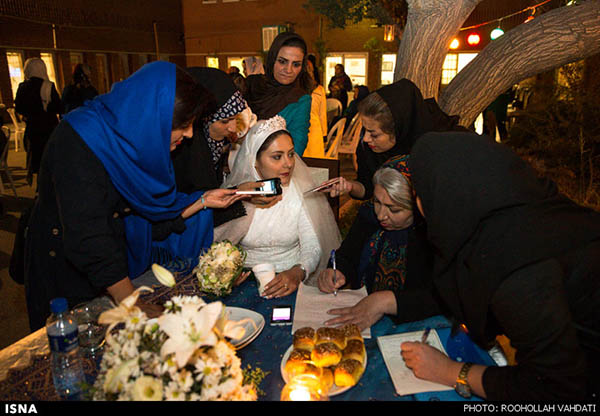
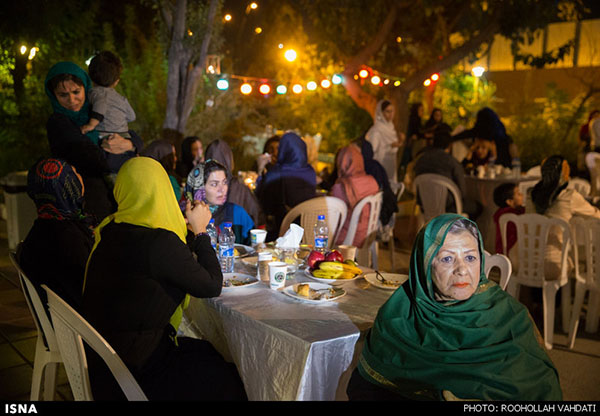
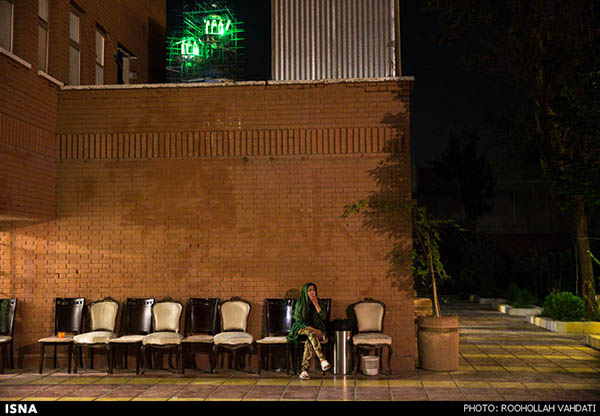
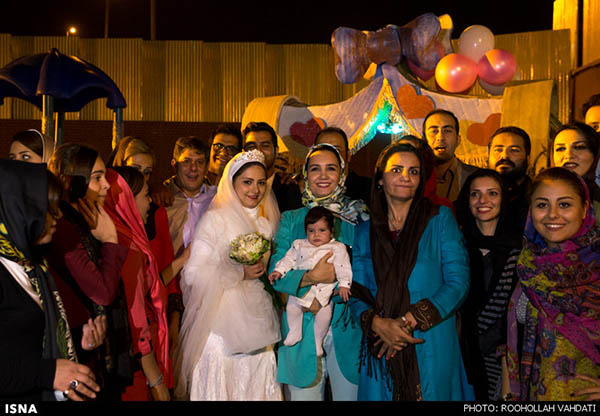
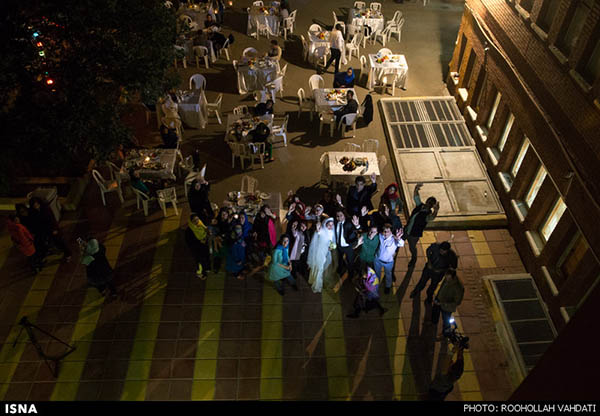
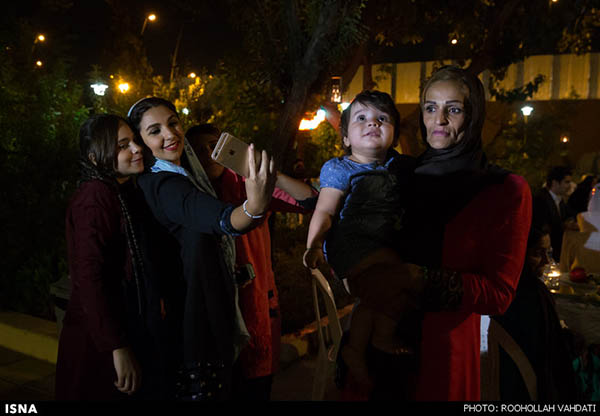
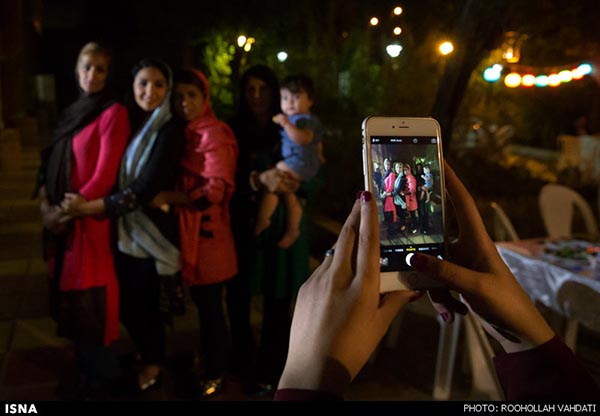
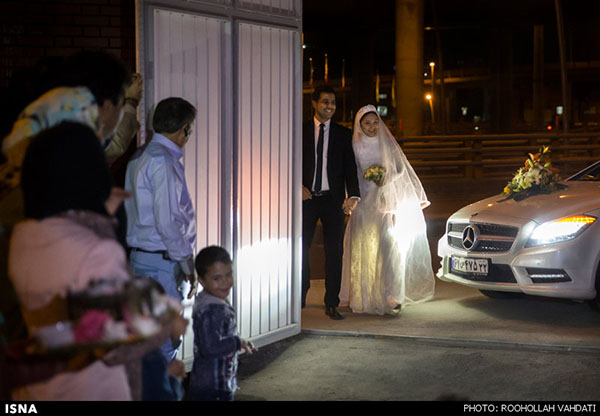
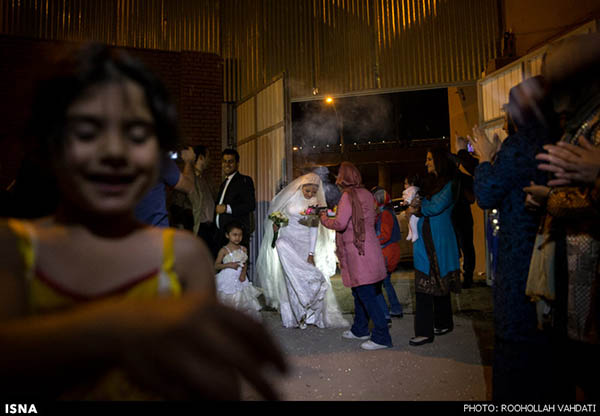
In Tehran, a young couple has celebrated its wedding with rehabilitated women attending as guests.

What comes next is a report alef.ir filed on October 13 about the initiative the young couple took to cheer up those who had long forgotten what it was like to be happy:

Every single person is entitled to be happy, and being part of joyful occasions is a psychological need. That was the reason behind the decision of a young couple in Tehran to celebrate the beginning of their married life alongside a number of rehabilitated women who used to sleep rough.

Atiyeh, the 28-year-old bride, and her husband, Mehdi, agreed to invite to their wedding those who had not attended a party for years.

She says, “When a girl is denied the safe and reliable shelter of a family, she thinks that all her wishes are gone and always carries with herself profound, old regrets. That’s why my husband and I decided to give a gift to no-longer homeless women who had kicked their drug habit with the help of a charity. Our guests at the wedding party were the ones who were sober for months or even years.”

Humans should be committed to lofty human objectives and should empathize with those who have been subjected to social harms, she said.

Atiyeh added, “My parents and husband live among ordinary people and can relate to them. So they did not oppose the idea of celebrating the wedding with rehabilitated women and children. People like them may have never experienced having a family. That’s why we decided to share the happiest night of our lives instead of with our own families with those who were denied a home and family. That was meant to alleviate their suffering.”

The following are images of the wedding the news website has released:


Armenian composer: I am glad I belong to the ranks of the insane

Loris Tjeknavorian

Loris Tjeknavorian (Cheknavarian), an Iranian Armenian composer and conductor, says art – and not the artist – is what people should take seriously.

The Iranian Students’ News Agency (ISNA) on October 12 published a report on Tjeknavorian and his remarks at his birthday party about his family background, works and favorites. The following is the translation of what he said:

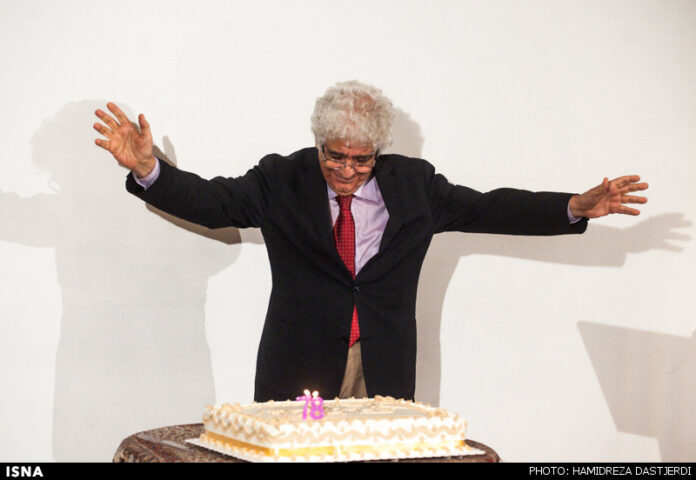
“I grow younger each year. I’m [like] grapes which are not in their right mind and have yet to turn into wine. In insanity, you make progress. You cannot live in this world if you are not insane. I’m glad I belong to the ranks of the insane,” said Tjeknavorian at his 78th birthday party.

“I do not take myself seriously. What I do should remain in the world. My works should be serious. Your prayers are very much important to me. If I swim in an ocean, I will drown, but now I am swimming in an ocean of affection and I am with you. No one drowns in an ocean of love,” he added.

The Iranian conductor further said, “I have been often told that I am an Armenian. Some people separate us from the Iranians, but the fact is that we are all Iranians. Iran is not home to one single culture alone; rather, it is the place where [people from] different cultures have come together. Shah Abbas [the 5th Safavid king of Iran] and Fath Ali Shah [the second Qajar Shah] are to blame for ceding Armenia to the Russians. Back then millions of Armenians were massacred.

“During the Armenian massacre, my parents fled and I’m lucky that they fled to Iran. They returned to their homeland. Nowhere else better than Iran could I have been born,” he said.

The creator of The King Cyrus Symphonic Suite went on to say, “I was in love with music since childhood. Being mad, I used to do strange things. At 16, I formed an orchestra in the vocational school. I did what I did to the dislike of many people.”

He added, “I do not know much about the Iranian music, but I have based my work on Muharram’s musical rhythms. In fact, the music played as part of rituals at Zoorkhaneh [where heroic sports are practiced], in Muharram [the first month of the lunar year during which Shiites mourn the loss of Imam Hussein] and at the Armenian Church has always impressed me. I have composed my works building on these three sources.”

Tjeknavorian concluded, “Take my works, not me, seriously, because my works will survive me and will live on forever.”

Tjeknavorian then blew out his candles and cut his birthday cake.

Loris Tjeknavorian, the Iranian composer and conductor, was born in Borujerd on 13 October 1937 to immigrant Armenian parents. He is a prolific musician who has created and written more than 75 pieces among them: five symphonies; six operas; chamber music; concerti for piano, violin, guitar, cello and pipa (Chinese lute); ballet music; piano and vocal works; a requiem; an oratorio; as well as scores for over 45 documentary and feature films.
Tjeknavorian was the Principal Conductor and Artistic Director of the Armenian Philharmonic Orchestra (APO) in Yerevan, Armenia (1989-2000). For three successive years, from 1991 to 1993, he was with the APO which was the resident orchestra in Vienna performing benefit and charity programs.


Iran objects to burial of Iranian victims in Saudi Arabia: Official

Ohadi

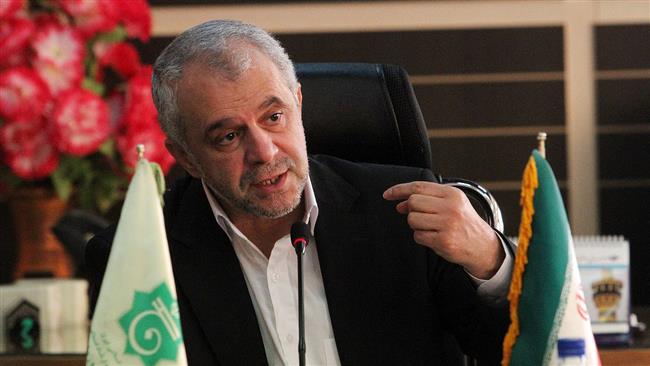
Head of Iran’s Hajj and Pilgrimage Organization Saeed Ohadi has said that the organization under his watch has officially conveyed its objections to Riyadh over the burial in Saudi Arabia of 29 Iranian victims of a recent crush in Mina, near Mecca.

In a phone interview with Press TV’s Website on Thursday, Ohadi, who is in Saudi Arabia to follow up on the case of the Iranian victims, said the Iranian Hajj and Pilgrimage Organization has objected to the burial of the Iranian victims in Saudi Arabia in a written form.

He said the Saudi authorities had said that the burials were inevitably made due to hygienic concerns.

Ohadi said the burials were made even as legal proceedings had been completed for the return of some of the bodies buried.

Iranian officials had on several times emphasized that no authorization had been given to Saudi Arabia to bury the Iranian victims of the Mina tragedy.

The Hajj crush took place on September 24 after two large masses of pilgrims reached one another from opposite directions in Mina during the symbolic ceremony of the stoning of Satan in Jamarat.

‘Saudi Arabia will have to comply’

In his Thursday interview, Ohadi emphasized that the victims’ fingerprints and samples of their nails had been taken for identification before burial, and stressed that their places of burial are also completely specified.

He added, however, that the Saudi government will have to remain committed to its pledges to fully cooperate with the Islamic Republic including by complying with the potential demands of the families of the buried victims to have them returned to Iran.

Saudi Arabia has provided a death toll of nearly 770 from the incident. This is while only summing up the official tallies provided by some of the countries that lost victims in the incident provides a much larger figure. The Saudi government defiantly refuses to upgrade its figure, nonetheless.

Iran’s Hajj and Pilgrimage Organization says at least 4,700 people lost their lives in the tragedy.

The bodies of 399 Iranian victims have been repatriated so far.

A total of 36 Iranian victims still remain unaccounted for. Ohadi said efforts will continue to determine their fates.

US influence in Middle East must be blocked: Iranian defense minster

Iran-China-Defense

The Iranian defense minister says “powerful regional coalitions” must be formed to block the US influence and its “resulting crises” in the region.

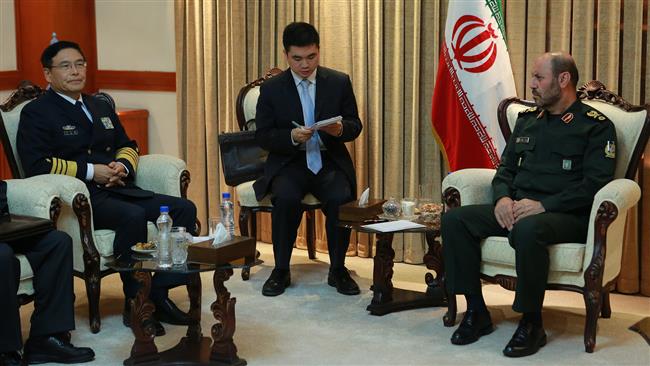
Brigadier General Hossein Dehghan made the remarks during a meeting with Admiral Sun Jianguo, the deputy chief of People’s Liberation Army General Staff Department, in Tehran on Wednesday.

“The US interfered in Iraq and Afghanistan, it occupied these two countries, then it promised the people welfare and security,” but all it did was aggravating the situation in the two countries, Dehghan said.

He praised the “iron resolve” of the Yemeni people who have been resisting Saudi attacks since late March, and lauded Russia’s efforts in battling terrorist groups in Syria.

Sun, who is in Tehran along with a high-ranking Chinese military delegation, also met with Iran’s Navy Commander Rear Admiral Habibollah Sayyari.

During the meeting, Sayyari stressed the need for further cooperation with China in maritime security.

Considering the constant presence of Iranian and Chinese vessels in the Indian Ocean, both countries’ navies should increase cooperation to provide security for the shipping lines active in the region, Sayyari noted.

According to reports, the military commanders also talked about intelligence exchange during the meeting, and expressed hope that a joint maritime committee would form to step up the collaboration.

Sun also met with the head of Iranian armed forces’ joint affairs Major General Mohammad Baqeri. The two further stressed the necessity of closer military relations between Tehran and Beijing.

During the meeting, Baqeri noted that battling terrorism, Takfiri groups, and extremism are the main focus of cooperation between the Iranian and Chinese military.

Leader neither approved nor disapproved of JCPOA

Kamal Kharazi

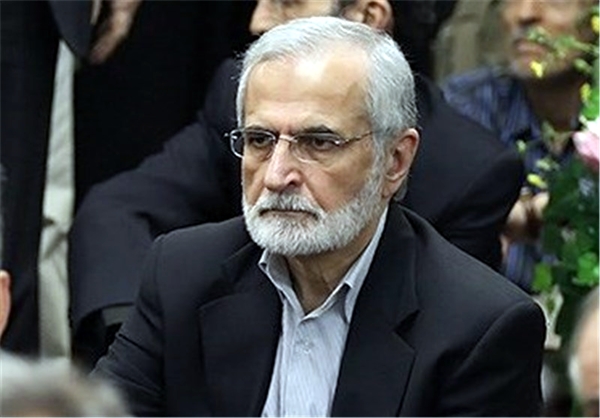
The head of the Strategic Council on Foreign Relations says that the Supreme Leader has not taken a stance for or against the Joint Comprehensive Plan of Action (JCPOA).

Kamal Kharrazi, also a former foreign minister, made the comment in response to a reporter’s question on remarks by an MP on the Supreme Leader’s view of JCPOA. As parliament was debating the details of the JCPOA implementation bill on Tuesday an Iranian MP said that the Leader opposes JCPOA. The following is the translation of what else Kharrazi said as reported by Etemaad daily on October 14:

Kharrazi said that the Supreme Leader spoke his mind transparently and explicitly, adding, “The leader stressed that what he says on the record is exactly what he tells officials in private meetings and there is no difference [between his remarks].”

The former top diplomat went on to say that the Supreme Leader has not taken any stance on approving of or disapproving of JCPOA, adding that the Leader left it to the Supreme National Security Council and the Islamic Consultative Assembly to decide.

He further said these are manifestations of democracy in Iran [that the bodies in charge decide on an issue] like what the chamber did in its debates on Tuesday and approved the JCPOA implementation bill.

What counts now is the future of JCPOA and its implementation, Kharrazi said, adding that in the post-JCPOA era the country needs to make appropriate efforts to prevent the possible misuse of the Iran nuclear deal.

As for the vote of the Guardian Council and whether its approval or disapproval will be the final stance of the Islamic Republic of Iran on JCPOA, Kharrazi said officials and people would naturally accept what the Islamic Consultative Assembly and the Supreme National Security Council decide.

Guardian Council approves JCPOA

Guardian Counci

The Guardian Council on Wednesday approved the bill on implementation of the Joint Comprehensive Plan of Action (JCPOA) the Iranian parliament approved on Tuesday.

The Guardian Council in its Wednesday session endorsed the bill on the Islamic Republic of Iran Government’s reciprocal and proportional measures in dealing with the other parties to the deal in the process of implementing JCPOA.

The Iranian parliament approved JCPOA in an open session on Tuesday with 161-59 votes, with 13 MPs abstaining.

IRNA parliamentary reporter said that 250 out of Iran’s 290 lawmakers were present, with 17 deputies not voting.

The legislation requires the government to implement JCPOA voluntarily under the supervision of the Supreme National Security Council.

Trust in or distrust of the US; which one is more sensible?

Majlis

The Joint Comprehensive Plan of Action does not guarantee the termination of sanctions, nor does it offer any assurances that the country’s achievements will be safeguarded. Swearing to God does nothing to deny these facts.

The following is the translation of an opinion piece by Mohammad Kazem Anbarloui Resalat daily published on October 14:

After 40 days of review which involved veteran experts – both for and against the Joint Comprehensive Plan of Action (JCPOA) – well versed in politics and economy as well as cultural and technical issues, parliament’s JCPOA Review Committee presented a report to the Islamic Consultative Assembly.

Immediately after the release of the report, a motion with double urgency status was put forth. The motion titled the Government’s Reciprocal and Proportional Action Bill on the implementation of the Joint Comprehensive Plan of Action was in no way a representation of the committee’s report.

What stands out about the motion was that it negated four important acts of parliament ratified over the past decade; all four having to do with the country’s independence on security and technical fronts. These acts were a guarantor of the nuclear achievements of the country for which five nuclear scientists have fallen.

What we have on our hands now is a text which offers no guarantee on the removal of sanctions; and no guarantee on safeguarding the country’s achievements and scientific independence framed in comments by the leader.

Unfortunately, the logic supporters of the deal, especially the representative of the government put forth was wobbly. Mr. Salehi [the director of the Atomic Energy Organization who appeared in parliament to support the deal on the day the chamber debated the motion] swore to God three times that there would be no slowdown or halt in the nuclear program. His statements do not conform to the wording of JCPOA and its annexes.

Supporters of JCPOA need to present evidence rather than swear to God. The shortcomings of JCPOA and the concessions we have made under the deal leave no doubt that JCPOA is no great achievement. But Mr. Salehi praised it as the jewel in the crown, a document government is unwilling to label as a deal, an agreement, an accord or a treaty.

The logic of government and proponents of JCPOA is based on trust in the US, whereas there is no legal or logical ground in JCPOA or in the history of relations between Iran and the US to justify such trust.

What happened in the course of the JCPOA review in parliament was marginal. What we are dealing with now is a text pitting a Muslim nation against the enemy, or I should say the number one enemies, of Islam and Iran!

Opponents and proponents of JCPOA should wait and see which one of the following has been sensible: trust in the US or advice to stay away from deal breakers, enemies and devils.